Layered Double Hydroxide Nanocomposite Coatings for Improved Flame Retardancy of Polyethylene-Based Copolymers

 , , and
Abstract
1. Introduction
2. Materials and Methods
2.1. Materials
2.2. Processing and Sample Preparation
2.3. Characterization Techniques
3. Results
3.1. Preliminary Characterization of EVA- and EBA-Based Nanocomposite Films
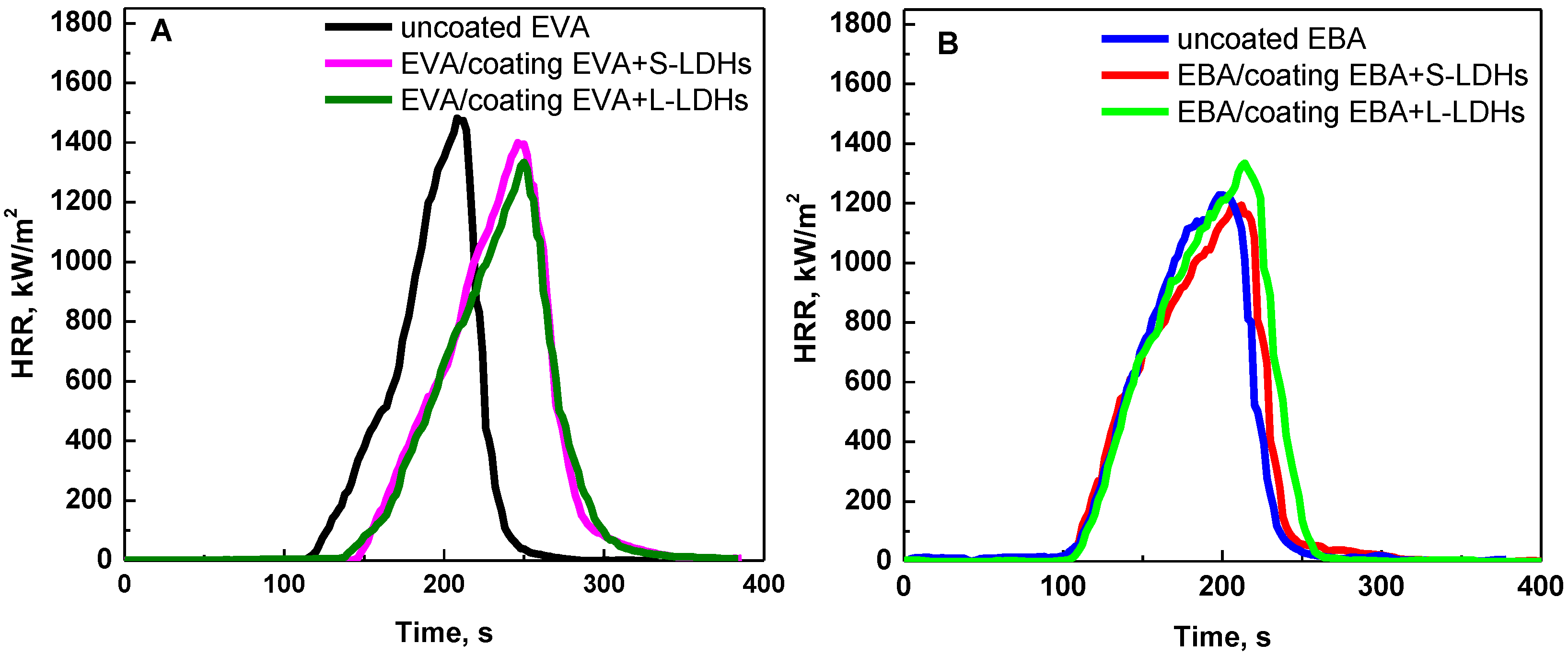
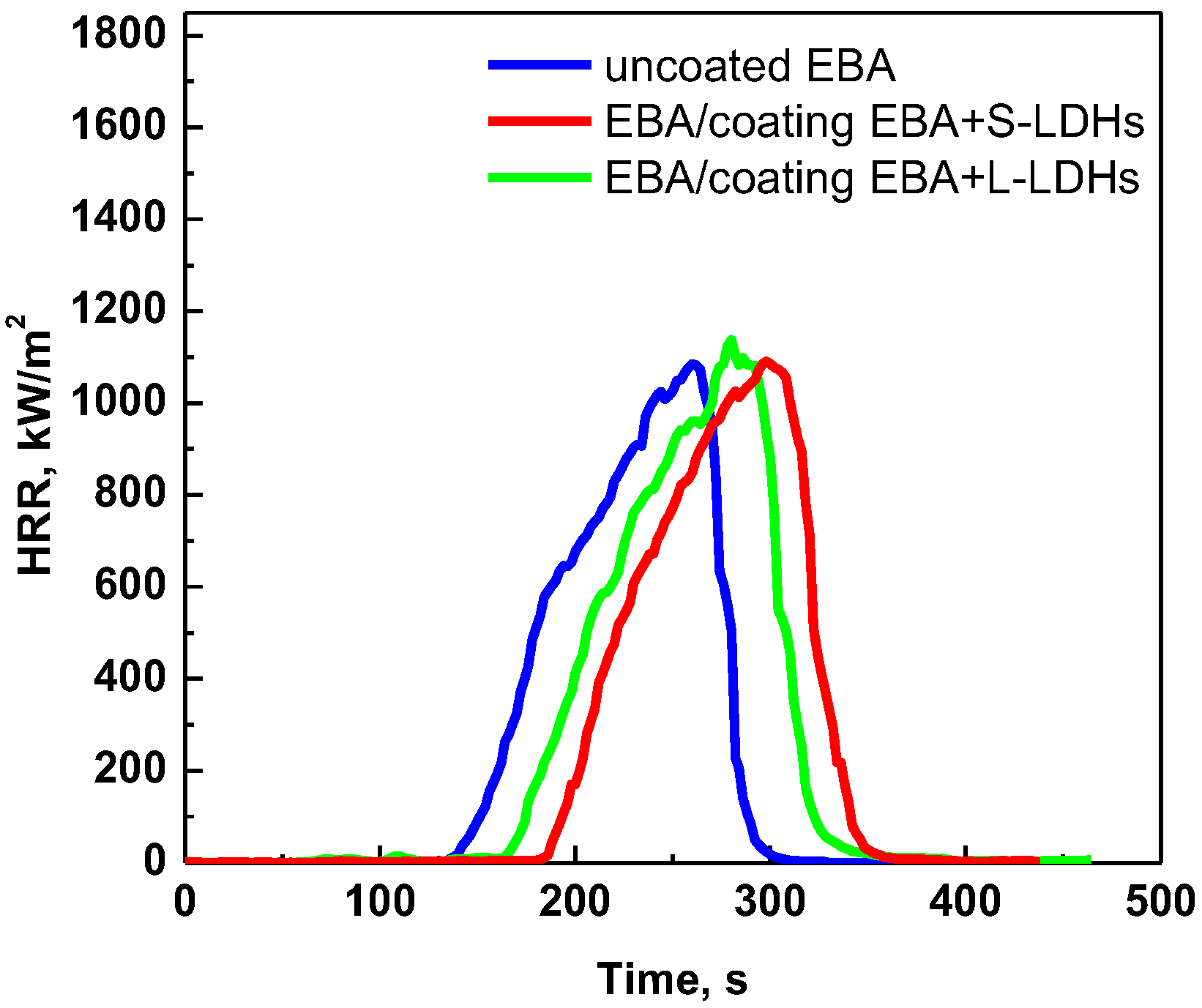
3.2. Combustion Behavior of Coated Samples
4. Conclusions
Supplementary Materials
Author Contributions
Funding
Institutional Review Board Statement
Data Availability Statement
Acknowledgments
Conflicts of Interest
References
- Laoutid, F.; Bonnaud, L.; Alexandre, M.; Lopez-Cuesta, J.M.; Dubois, P. New prospects in flame retardant polymer materials: From fundamentals to nanocomposites. Mater. Sci. Eng. R Rep. 2009, 63, 100–125. [Google Scholar]
- Wu Klingler, W.; Rougier, V.; Huang, Z.; Parida, D.; Lehner, S.; Casutt, A.; Gaan, S. Recyclable flame retardant phosphonated epoxy based thermosets enabled via a reactive approach. Chem. Eng. J. 2023, 466, 143051. [Google Scholar] [CrossRef]
- Hornsby, P.R. Fire retardant fillers for polymers. Int. Mater. Rev. 2001, 46, 199–210. [Google Scholar] [CrossRef]
- Silva, N.G.S.; Zanini, N.C.; De Souza, A.G.; Barbosa, R.F.S.; Rosa, D.S.; Mulinari, D.R. Halogen-Based Flame Retardants in Polyurethanes; American Chemical Society: Washington, DC, USA, 2021; Volume 1399, pp. 141–171. [Google Scholar]
- Kaspersma, J.; Doumen, C.; Munro, S.; Prins, A.M. Fire retardant mechanism of aliphatic bromine compounds in polystyrene and polypropylene. Polym. Degrad. Stab. 2002, 77, 325–331. [Google Scholar] [CrossRef]
- Chen, L.; Wang, Y.Z. Aryl polyphosphonates: Useful halogen-free flame retardants for polymers. Materials 2010, 3, 4746–4760. [Google Scholar] [CrossRef]
- Camino, G.; Costa, L.; Luda, M.P. Mechanistic aspects of intumescent fire-retardant systems. Makromol. Chem. Macromol. Symp. 1993, 74, 71–83. [Google Scholar] [CrossRef]
- Camino, G.; Costa, L.; Martinasso, G. Intumescent fire-retardant systems. Polym. Degrad. Stab. 1989, 23, 359–376. [Google Scholar] [CrossRef]
- Porter, D.; Metcalfe, E.; Thomas, M.J.K. Nanocomposite fire retardants—A review. Fire Mater. 2000, 24, 45–52. [Google Scholar] [CrossRef]
- Lorenzi, E.; Arrigo, R.; Frache, A. Development of a Polypropylene-Based Material with Flame-Retardant Properties for 3D Printing. Polymers 2024, 16, 858. [Google Scholar]
- Peng, Y.; Niu, M.; Qin, R.; Xue, B.; Shao, M. Study on flame retardancy and smoke suppression of PET by the synergy between Fe2O3 and new phosphorus-containing silicone flame retardant. High Perform. Polym. 2020, 32, 936–948. [Google Scholar] [CrossRef]
- Liu, Y.; Gao, Y.; Wang, Q.; Lin, W. The synergistic effect of layered double hydroxides with other flame retardant additives for polymer nanocomposites: A critical review. Dalton Trans. 2018, 47, 14827–14840. [Google Scholar] [CrossRef]
- Shea, J.J. Handbook of Building Materials for Fire Protection [Book Review]. IEEE Electr. Insul. Mag. 2004, 20, 66. [Google Scholar] [CrossRef]
- Feng, C.; Liang, M.; Chen, W.; Huang, J.; Liu, H. Flame retardancy and thermal degradation of intumescent flame retardant EVA composite with efficient charring agent. J. Anal. Appl. Pyrolysis 2015, 113, 266–273. [Google Scholar] [CrossRef]
- Bourbigot, S.; Le Bras, M.; Leeuwendal, R.; Shen, K.K.; Schubert, D. Recent advances in the use of zinc borates in flame retardancy of EVA. Polym. Degrad. Stab. 1999, 64, 419–425. [Google Scholar] [CrossRef]
- Camino, G.; Sgobbi, R.; Zaopo, A.; Colombier, S.; Scelza, C. Investigation of flame retardancy in EVA. Fire Mater. 2000, 24, 85–90. [Google Scholar] [CrossRef]
- Ye, L.; Qu, B. Flammability characteristics and flame retardant mechanism of phosphate-intercalated hydrotalcite in halogen-free flame retardant EVA blends. Polym. Degrad. Stab. 2008, 93, 918–924. [Google Scholar] [CrossRef]
- Xu, B.; Ma, W.; Wu, X.; Qian, L.; Jiang, S. Flame retardancy and thermal behavior of intumescent flame-retardant EVA composites with an efficient triazine-based charring agent. Mater. Res. Express 2018, 5, 045309. [Google Scholar] [CrossRef]
- Camino, G.; Maffezzoli, A.; Braglia, M.; De Lazzaro, M.; Zammarano, M. Effect of hydroxides and hydroxycarbonate structure on fire retardant effectiveness and mechanical properties in ethylene-vinyl acetate copolymer. Polym. Degrad. Stab. 2001, 74, 457–464. [Google Scholar] [CrossRef]
- Zhang, H.; Wang, H.; Wang, H. Flame retardant mechanism and surface modification of magnesium hydroxide flame retardant. IOP Conf. Ser. Earth Environ. Sci. 2018, 170, 032028. [Google Scholar] [CrossRef]
- Ramazani, S.A.A.; Rahimi, A.; Frounchi, M.; Radman, S. Investigation of flame retardancy and physical-mechanical properties of zinc borate and aluminum hydroxide propylene composites. Mater. Des. 2008, 29, 1051–1056. [Google Scholar]
- Huang, N.; Wang, J. A TGA-FTIR study on the effect of CaCO3 on the thermal degradation of EBA copolymer. J. Anal. Appl. Pyrolysis 2009, 84, 124–130. [Google Scholar]
- Tademr, M.; Yildirim, H. Thermal degradation studies of different polar polyethylene copolymers. J. Appl. Polym. Sci. 2002, 84, 1465–1473. [Google Scholar] [CrossRef]
- Moyano, M.A.; París, R.; Martín-Martínez, J.M. Viscoelastic and adhesion properties of hot-melts made with blends of ethylene-co-n-butyl acrylate (EBA) and ethylene-co-vinyl acetate (EVA) copolymers. Int. J. Adhes. Adhes. 2019, 88, 34–42. [Google Scholar] [CrossRef]
- Ellis, T.S.; D’Angelo, J.S. Thermal and mechanical properties of a polypropylene nanocomposite. J. Appl. Polym. Sci. 2003, 90, 1639–1647. [Google Scholar] [CrossRef]
- Colonna, S.; Cuttica, F.; Frache, A. Aging of EVA/organically modified clay: Effect on dispersion, distribution and combustion behavior. Polym. Degrad. Stab. 2014, 107, 184–187. [Google Scholar] [CrossRef]
- Malucelli, G.; Carosio, F.; Alongi, J.; Fina, A.; Frache, A.; Camino, G. Materials engineering for surface-confined flame retardancy. Mater. Sci. Eng. R Rep. 2014, 84, 1–20. [Google Scholar] [CrossRef]
- Matta, S.; Bartoli, M.; Arrigo, R.; Frache, A.; Malucelli, G. Flame retardant potential of Tetra Pak®-derived biochar for ethylene-vinyl-acetate copolymers. Compos. Part C Open Access 2022, 8, 100252. [Google Scholar]
- Arrigo, R.; Frache, A. FDM Printability of PLA Based-Materials: The Key Role of the Rheological Behavior. Polymers 2022, 14, 1754. [Google Scholar] [CrossRef]
- Schartel, B.; Hull, T.R. Development of fire-retarded materials—Interpretation of cone calorimeter data. Fire Mater. 2007, 31, 327–354. [Google Scholar]
- Hirschler, M.M. Use of heat release rate to predict whether individual furnishings would cause Self propagating fires. Fire Saf. J. 1999, 32, 273–296. [Google Scholar] [CrossRef]
- Riva, A.; Zanetti, M.; Braglia, M.; Camino, G.; Falqui, L. Thermal degradation and rheological behaviour of EVA/montmorillonite nanocomposites. Polym. Degrad. Stab. 2002, 77, 299–304. [Google Scholar] [CrossRef]
- Sultan, B.; Sörvik, E. Thermal degradation of EVA and EBA—A comparison. I. Volatile decomposition products. J. Appl. Polym. Sci. 1991, 43, 1737–1745. [Google Scholar] [CrossRef]
- Wang, X.; Rathore, R.; Songtipya, P.; Jimenez-Gasco, M.; Manias, E.; Wilkie, C.A. EVA-layered double hydroxide (nano)composites: Mechanism of fire retardancy. Polym. Degrad. Stab. 2011, 96, 301–313. [Google Scholar] [CrossRef]
- Karimpour-Motlagh, N.; Khonakdar, H.A.; Jafari, S.M.A.; Mahjub, A.; Panahi-Sarmad, M.; Kasbi, S.F.; Shojaei, S.; Goodarzi, V.; Arjmand, M. Influence of polypropylene and nanoclay on thermal and thermo-oxidative degradation of poly(lactic acid): TG-FTIR, TG-DSC studies and kinetic analysis. Thermochim. Acta 2020, 691, 178709. [Google Scholar] [CrossRef]
- Golebiewski, J.; Galeski, A. Thermal stability of nanoclay polypropylene composites by simultaneous DSC and TGA. Compos. Sci. Technol. 2007, 67, 3442–3447. [Google Scholar] [CrossRef]
- Stark, W.; Jaunich, M. Investigation of Ethylene/Vinyl Acetate Copolymer (EVA) by thermal analysis DSC and DMA. Polym. Test. 2011, 30, 236–242. [Google Scholar] [CrossRef]
- Arrigo, R.; Ronchetti, S.; Montanaro, L.; Malucelli, G. Effects of the nanofiller size and aspect ratio on the thermal and rheological behavior of PEG nanocomposites containing boehmites or hydrotalcites. J. Therm. Anal. Calorim. 2018, 134, 1667–1680. [Google Scholar] [CrossRef]
- Chandran, N.; Sarathchandran, C.; Thomas, S. Rheology of polymer-clay nanocomposites. In Rheology of Polymer Blends and Nanocomposites: Theory, Modelling and Applications; Elsevier: Amsterdam, The Netherlands, 2019; pp. 97–122. [Google Scholar]
- Hornsby, P.R.; Rothon, R.N.; Takeda, K.; Pelegris, C.; Kashiwagi, T.; Lomakin, S.; Georlette, P. Use of Nanocomposite Materials: Flammability of Nanocomposites: Effects of the Shape of Nanoparticles. In Fire Retardancy of Polymers; The Royal Society of Chemistry: Cambridge, UK, 2007; pp. 79–99. [Google Scholar]
- Camino, G.; Tartaglione, G.; Frache, A.; Manferti, C.; Costa, G. Thermal and combustion behaviour of layered silicate-epoxy nanocomposites. Polym. Degrad. Stab. 2005, 90, 354–362. [Google Scholar] [CrossRef]
- Fina, A.; Camino, G. Ignition mechanisms in polymers and polymer nanocomposites. Polym. Adv. Technol. 2011, 22, 1147–1155. [Google Scholar] [CrossRef]
- Fina, A.; Cuttica, F.; Camino, G. Ignition of polypropylene/montmorillonite nanocomposites. Polym. Degrad. Stab. 2012, 97, 2619–2626. [Google Scholar] [CrossRef]



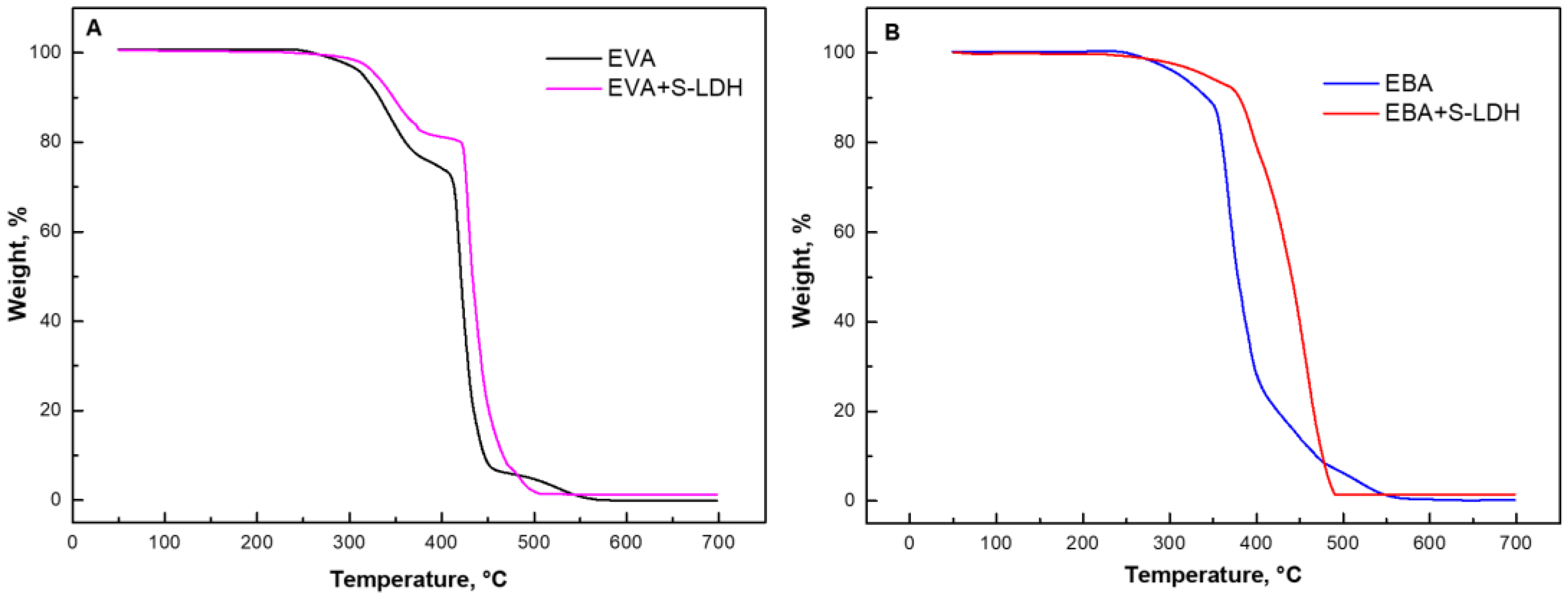
| Tonset [°C] | Tmax [°C] | Residue @ 600 °C [%] | |
|---|---|---|---|
| EVA | 291.2 | 419.7 | 0 |
| EVA + S-LDHs | 310.3 | 428.9 | 1.44 |
| EBA | 281.5 | 367.0 | 0 |
| EBA + S-LDHs | 294.8 | 422.7 | 1.53 |
| Tm1 [°C] | Tm2 [°C] | [%] | |
|---|---|---|---|
| EVA | 48 | 81 | 32 |
| EVA + S-LDHs | 48 | 85 | 31 |
| EVA + L-LDHs | 49 | 83 | 31 |
| EBA | 50 | 94 | 36 |
| EBA + S-LDHs | 51 | 94 | 34 |
| EBA + L-LDHs | 51 | 96 | 35 |
| TTI [s] | TTP [s] | FPI [m2s/kW] | FIGRA [kW/m2s] | |
|---|---|---|---|---|
| EVA | 101 ± 1 | 210 ± 2 | 0.0675 ± 0.0027 | 7.1 ± 0.3 |
| EVA/coating EVA + S-LDHs | 133 ± 3 | 252 ± 6 | 0.0910 ± 0.0015 | 5.8 ± 0.1 |
| EVA/coating EVA + L-LDHs | 135 ± 13 | 255 ± 5 | 0.0968 ± 0.0119 | 5.5 ± 0.2 |
| EBA | 91 ± 5 | 194 ± 12 | 0.0749 ± 0.0053 | 6.3 ± 0.5 |
| EBA/coating EBA + S-LDHs | 102 ± 2 | 208 ± 4 | 0.0836 ± 0.0036 | 5.9 ± 0.2 |
| EBA/coating EBA + L-LDHs | 107 ± 3 | 214 ± 2 | 0.0848 ± 0.0068 | 5.9 ± 0.3 |
| TTI [s] | TTP [s] | FPI [m2s /kW] | FIGRA [kW/m2s] | |
|---|---|---|---|---|
| EBA | 124 ± 4 | 242 ± 9 | 0.1137 ± 0.0008 | 4.5 ± 0.4 |
| EBA/coating EBA + S-LDHs | 173 ± 9 | 307 ± 3 | 0.1470 ± 0.0200 | 3.9 ± 0.4 |
| EBA/coating EBA + L-LDHs | 161 ± 5 | 268 ± 9 | 0.1416 ± 0.0031 | 4.2 ± 0.1 |
Disclaimer/Publisher’s Note: The statements, opinions and data contained in all publications are solely those of the individual author(s) and contributor(s) and not of MDPI and/or the editor(s). MDPI and/or the editor(s) disclaim responsibility for any injury to people or property resulting from any ideas, methods, instructions or products referred to in the content. |
© 2025 by the authors. Licensee MDPI, Basel, Switzerland. This article is an open access article distributed under the terms and conditions of the Creative Commons Attribution (CC BY) license (https://creativecommons.org/licenses/by/4.0/).
Share and Cite
Trapani, G.; Arrigo, R.; Sisani, M.; Bastianini, M.; Frache, A. Layered Double Hydroxide Nanocomposite Coatings for Improved Flame Retardancy of Polyethylene-Based Copolymers. Polymers 2025, 17, 3189. https://doi.org/10.3390/polym17233189
Trapani G, Arrigo R, Sisani M, Bastianini M, Frache A. Layered Double Hydroxide Nanocomposite Coatings for Improved Flame Retardancy of Polyethylene-Based Copolymers. Polymers. 2025; 17(23):3189. https://doi.org/10.3390/polym17233189
Chicago/Turabian StyleTrapani, Giuseppe, Rossella Arrigo, Michele Sisani, Maria Bastianini, and Alberto Frache. 2025. "Layered Double Hydroxide Nanocomposite Coatings for Improved Flame Retardancy of Polyethylene-Based Copolymers" Polymers 17, no. 23: 3189. https://doi.org/10.3390/polym17233189
APA StyleTrapani, G., Arrigo, R., Sisani, M., Bastianini, M., & Frache, A. (2025). Layered Double Hydroxide Nanocomposite Coatings for Improved Flame Retardancy of Polyethylene-Based Copolymers. Polymers, 17(23), 3189. https://doi.org/10.3390/polym17233189