


Abstract
Bipolar plates (BPs) are one of the most important components of polymer electrolyte membrane fuel cells (PEMFCs) because of their important role in gas and water management, electrical performance, and mechanical stability. Therefore, promising materials for use as BPs should meet several technical targets established by the United States Department of Energy (DOE). Thus far, in the literature, many materials have been reported for possible applications in BPs. Of these, polymer composites reinforced with carbon allotropes are one of the most prominent. Therefore, in this review article, we present the progress and critical analysis on the use of carbon material-reinforced polymer composites as BPs materials in PEMFCs. Based on this review, it is observed that numerous polymer composites reinforced with carbon allotropes have been produced in the literature, and most of the composites synthesized and characterized for their possible application in BPs meet the DOE requirements. However, these composites can still be improved before their use for BPs in PEMFCs.
1. Introduction
The modern society heavily relies on fossil fuel energy. However, this energy source is finite, and the byproducts of fossil fuels are associated with environmental problems such as climate change [1,2]. Therefore, we must move toward renewable energy sources to reduce the impact of anthropogenic activities associated with conventional energy conversion and production. In this direction, hydrogen can be crucial as a clean energy carrier with higher energy density compared with conventional fuels [3,4]. Although hydrogen is the most abundant element in the universe [5], it is not the primary energy source available on the earth. Therefore, various technologies have been developed for its production [6,7], storage [8,9], and use [10,11] in an efficient and safe manner.
For hydrogen utilization, polymer electrolyte membrane fuel cells (PEMFCs) are gaining considerable importance because they allow for a highly efficient conversion of the chemical energy contained in hydrogen into electrical energy [11,12,13]. However, we must enhance the performance and reduce the cost of several of their components to achieve massive use of PEMFCs [11,12,13]. In particular, bipolar plates (BPs) are one of the components that have attracted attention because of their importance in the gas and water management, electrical performance, and mechanical stability of PEMFCs [14,15,16]. Therefore, promising materials for use as BPs should meet several technical targets established by the United States Department of Energy (DOE) [17].
Thus far, many materials have been investigated and used for the design of BPs. Graphite is the most widely used material for BPs because of its satisfactory corrosion resistance, high thermal and electrical conductivities, and stable chemical properties, among other properties [15,16]. However, it suffers several drawbacks such as limited mechanical properties (brittleness), high weight and volume, high manufacturing cost, and poor machinability [15,16,17,18,19]. Therefore, to address these drawbacks, carbon material-reinforced polymer composites have been widely studied as BPs because they offer several advantages such as a light weight, easy machinability, and satisfactory corrosion resistance [15,18,19,20,21,22]. Thus far, polymer matrices have been reinforced via various types of carbon allotropes such as graphite, graphene, multiwalled carbon nanotubes (MWCNTs), and carbon fibers [15,16,18,19,20,21,22]. Several of the proposed composites meet the DOE requirements. In the light of the importance that composites have gained, several review articles have analyzed the use of carbon material-reinforced composites as BPs in PEMFCs [15,16,18,19,20,21,22,23,24]. In 2017, the generalities of various types of carbon–polymer composites were revised [19]. Recently, various models for predicting the electrical conductivity of conductive polymer composites were analyzed [20]. In another review, various materials studied as promising candidates for BPs were reviewed, including polymer-based composites [21]. More recently, a comprehensive review of the current investigation on various materials used for developing polymer composites for BPs was conducted [22]. However, a detailed review focused on the properties of carbon-reinforced polymer composites as BPs materials still does not exist. Therefore, in this review, we present the progress on the use of carbon material-reinforced composites as BPs materials in PEMFCs.
2. Carbon-Reinforced Polymer Composites
2.1. Carbon-Reinforced Phenolic Resin Composites
Phenolic resin-based composites have a large market vis à vis their thermostructural applications because of their decent heat and flame resistance, satisfactory hardness, chemical resistance, and low cost [25,26]. Nevertheless, phenolics are nonconductive, can be brittle, and have low resistance to tensile strength [27,28]. Therefore, their properties should be substantially improved for application in BPs. In the first instance, phenolic resin-based composites were reinforced with a carbon allotrope [29,30,31,32,33,34,35,36,37,38,39,40,41,42,43,44], and the most studied composites of this type are based on phenolic resin and graphite [29,30,31,32,33,34,35,36,37,38,39,40,41,42]. Various compositions of resin and graphite have been studied (see Table 1). The electrical properties of the composites improved as the concentration of graphite-based materials increased in them [29,30,31,32,33,34,38,39,40,41,42], which is directly associated with the satisfactory electrical properties of graphite [45,46]. In contrast, the flexural strength decreased as the concentration of graphite materials increased in the composites [30,31,32,33,37,39,42]. This decrease in flexural strength might be associated with the unremarkable mechanical properties of graphite [45,47]. Nevertheless, some studies did not report a direct relationship between the flexural strength and concentration of graphite-based materials in the composites [29,41].

Table 1.
Electrical and mechanical properties of phenolic resin reinforced with an allotrope of carbon.
Phenolic resin-based composites have also been reinforced with other carbon allotropes, such as carbon fibers [29,34,43], carbon black [42,43,44], and MWCNTs [43]. However, the results obtained for these composites are still controversial (see Table 1). Some studies reported an increase in through-plane [29,44] and in-plane conductivities [34,42] upon increasing the concentration of these carbon allotropes. Nevertheless, other studies reported a reverse trend [43]. Regarding flexural strength, in most studies, optimum results were obtained at a specific composition [29,43,44]. However, other studies reported deterioration in this property when the carbon allotropes concentration increased in the composites [42,43]. Interestingly, there are some studies on the corrosion properties of phenolic resin composites reinforced with a carbon allotrope [32,37]. For instance, the corrosion resistance properties of phenolic resin (20 wt.%) and graphite (80 wt.%) composite were explored [32]. This composite presented good anodic (0.69 μA/cm2) and cathodic (1.05 μA/cm2) current densities because the values are similar to those required by the DOE (1 μA/cm2) [17,21]. In another study, the corrosion properties of phenolic resin-expanded graphite composites were measured by varying the composition of the phenolic resin and expanded graphite [37]. The phenolic resin-expanded graphite composites exhibited better corrosion resistance properties than expanded graphite BPs. Also, the corrosion resistance properties improved upon increasing the concentration of phenolic resin in the composites due to the good corrosion resistance of phenolic resin [37].
The design of phenolic resin composites reinforced with two [29,32,35,36,38,45,48] or three [29,38,49] carbon allotropes was proposed to enhance the mechanical and electrical properties of phenolic resin-based composites reinforced with one carbon allotrope. Unfortunately, several of the studies only analyzed three compositions, which makes it difficult to observe a trend between the composite compositions and their properties (see Table 2). Fortunately, a detailed study was conducted on the properties of phenolic resin-based composites reinforced with three carbon allotropes with different compositions of phenolic resin and exfoliated graphite [49]. Interestingly, the electrical and mechanical properties improved with the increase in exfoliated graphite concentration (see Table 2) [49]. Also, various studies have shown that phenolic resin-based composites reinforced with two or three carbon allotropes have better electrical and mechanical properties than phenolic resin-based composites with a carbon allotrope. For instance, the electrical and mechanical properties of phenolic resin–graphite–MWCNTs composites were higher than those of phenolic resin–graphite composites [32,35,36]. In another study, the electrical and mechanical properties of phenolic resin–graphite–expanded graphite composites were higher than those of phenolic resin–expanded graphite BPs [38]. However, more detailed studies on phenolic resin-based composites reinforced with two and three carbon allotropes are required.
Table 2.
Electrical and mechanical properties of phenolic resin reinforced with two and three carbon allotropes.
Various phenolic resin composites reinforced with two or three carbon allotropes presented better electrical and mechanical properties than phenolic resin composites reinforced with a single carbon allotrope. These differences can be attributed to the distribution, composition, characteristics, and properties of the reinforcing materials [15,24]. For instance, the electrical properties of polymer composites depend on the conductive channels, the contact distance between the reinforcing materials, and the electrical conductivity of the reinforcing materials [49]. When the polymer composites are reinforced with various carbon allotropes (Figure 1b), the synergistic effect of the carbon allotropes produces a strong conducting network in the phenolic resin in comparison with a single carbon allotrope (Figure 1a).
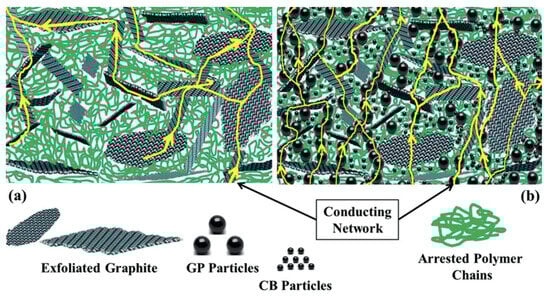
Figure 1.
Schematic of electrical conduction mechanism in polymer composite containing (a) single and (b) multiple carbon fillers. Reproduced with permission from Reference [49].
2.2. Carbon-Reinforced Polypropylene Composites
Polypropylene has rapidly gained immense popularity in BPs because it is very cheap and flexible for molding and offers satisfactory mechanical properties with relatively decent resistance to impacts compared with other polymers [50,51,52]. However, it has a high electric resistance, oxidative degradation, and poor low-temperature impact strength [50,51,52]. Therefore, to be applied in BPs, it must be reinforced with carbon allotropes [53,54,55]. First, polypropylene was reinforced with a single carbon allotrope. Thus far, various studies have been conducted on polypropylene reinforced with a carbon allotrope [56,57,58,59,60,61,62,63,64,65,66], highlighting the use of graphite and MWCNTs. For example, polypropylene and graphite were produced in various ratios (32:68, 28:72, 24:76, 20:80, and 16:84 wt.%) [57]. Upon increasing the concentration of graphite in the composites, the through-plane conductivity tended to increase, whereas the flexural strength decreased [57]. In another study, various compositions of polypropylene–graphite (30:70, 25:75, 22.5:77.5, and 20:80 wt.%) were studied [62]. The in-plane conductivity tended to increase with increasing graphite concentration [62]. Additionally, various compositions of polypropylene–carbon black (98.5:1.5, 97:3, 95:5, 93:7, and 92:8 wt.%) were synthesized [59]. As in the case of polypropylene–graphite composites, upon increasing the concentration of carbon black in the composites, the through-plane conductivity increased, whereas the flexural strength tended to decrease [59]. For polypropylene–MWCNTs composites, the in-plane conductivity and flexural strength tended to increase in general upon increasing the concentration of MWCNTs [62,65,66]. On the corrosion properties of polypropylene composites reinforced with a carbon allotrope, [65], Ramírez-Herrera and collaborators studied the corrosion properties of polypropylene–MWCNTs composites by varying the composition of the polypropylene and MWCNTs [65]. The corrosion properties obtained for the polypropylene–MWCNTs composites were lower than those established by the DOE [65].
Polypropylene was reinforced with two or three carbon allotropes to further improve its electrical and mechanical properties [57,58,59,60,61,63,65,67,68,69,70,71]. In the first instance, polyprolylene was reinforced with two carbon allotropes [57,58,59,60,61,63,65,67,68,71], highlighting the use of graphite–carbon black and graphite–MWCNTs. Different studies were conducted on polyprolylene-based composites reinforced with graphite–carbon black [57,58,59,60,71]. For instance, polypropylene–graphite–carbon black composites were produced at various ratios (see Table 3) [57]. Upon increasing the concentration of graphite in the composites, the through-plane conductivity tended to increase, whereas the flexural strength decreased. In another study, polypropylene (20 wt.%) composites were reinforced with graphite–carbon black at various compositions (75:5, 70:10, 65:15, 60:20, 55:25, and 50:30 wt.%) [58]. The electrical properties (through-plane conductivity) of the composites tended to improve upon increasing the concentration of carbon black [58]. In general, a similar trend was observed in other studies [59,60], in which the through-plane conductivity tended to increase with an increase in the composition of carbon black in the composites. However, the mechanical properties did not exhibit any trend upon varying the composition of the composites [59]. Interestingly, the conductivity of polypropylene–graphite–carbon black was higher than that measured for polypropylene–graphite, which shows that the incorporation of carbon black is a satisfactory strategy to enhance the properties of these composites [58,59,60]. Some studies showed promising results for polyprolylene-based composites reinforced with graphite–MWCNTs [57,63,67]. For example, polypropylene–graphite composites at various ratios were reinforced using MWCNTs at 2 wt.% (see Table 3) [57]. Upon increasing the concentration of graphite in the composites, the through-plane conductivity tended to increase, whereas the flexural strength tended to decrease [57]. In another study, the electrical and mechanical properties of polypropylene–graphite–MWCNTs composites at various proportions (19:80:1, 18:80:2, and 16:80:4 wt.%) were analyzed [63]. The electrical (in-plane conductivity) and mechanical (flexural strength) properties improved upon increasing the concentration of MWCNTs in the composites [63]. On the corrosion properties for these composites, the corrosion properties of polypropylene–carbon fiber–MWCNTs composites were investigated [65]. The corrosion properties obtained for these composites were lower than those established by the DOE [65].
Table 3.
Electrical and mechanical properties of polypropylene reinforced with two and three allotropes of carbon.
Polypropylene composites with three carbon allotropes were proposed to further reduce the graphite content in the composites (see Table 3). Thus far, several such studies have been conducted [67,69,70]. For instance, polypropylene–graphite–carbon fiber–carbon black composites were fabricated and studied. The in-plane conductivity increased upon increasing the concentration of carbon allotropes in the composites [69]. Additionally, the polypropylene–carbon black (20:25) composites were studied by varying the composition of the graphite and MWCNTs (54:1, 53:2, 52:3, 51:4, 50:5, 49:6, 48:7, 47:8, 46:9, and 45:10 wt.%) in the composites [70]. The electrical and mechanical properties tended to improve when the concentration of MWCNTs tended to increase in the composites. However, when the concentration of MWCNTs exceeded 6 wt.%, the electrical properties tended to deteriorate, whereas the flexural strength exhibited an oscillatory behavior for MWCNTs concentrations greater than 5 wt.% [70]. In another study, polypropylene–graphite–carbon black–MWCNTs composites at different compositions of graphite and carbon black were studied [67]. In general, upon increasing the carbon black concentration, the through-plane conductivity of the composites increased, whereas the flexural strength decreased [67].
2.3. Carbon-Reinforced Polyphenylene Sulfide Composites
Polyphenylene sulfide (PPS) has excellent chemical resistance, low degradation at high temperatures, and high rigidity. It also shows remarkable fatigue endurance and creep resistance, which have attracted extensive attention to it regarding its use for BPs [72,73,74]. However, PPS has a low elongation to break and low conductivity [75,76]. Therefore, to be used for BPs, it must be reinforced with carbon allotropes. In the first instance, PPS was reinforced with a carbon allotrope (see Table 4) [77,78,79,80]. For instance, PPS–graphite composites were studied at different concentrations [77]. Upon increasing the concentration of graphite in the composites, the in-plane conductivity increased, whereas the flexural strength decreased. A similar trend was observed in the electrical properties of PPS–mesocarbon composites [80]. In another study, PPS–graphene composites were produced at different ratios [79]. Upon increasing the concentration of graphene in the composites, the in-plane conductivity increased, whereas the flexural strength exhibited an oscillatory behavior [79].
Table 4.
Electrical and mechanical properties of polyphenylene sulfide reinforced with an allotrope of carbon.
In a bid to further improve the electrical and mechanical properties of PPS-based composites, this polymer has been reinforced with two carbon allotropes with promising results [78,79,80]. For example, PPS was reinforced at different ratios of graphite–carbon black. The through-plane conductivity tended to increase upon increasing the concentration of carbon black in the composites, which shows the importance of carbon black in the composites [78]. In addition, the PPS polymer was reinforced with different compositions of carbon black–graphene [79]. The flexural strength increased as the composition of graphene increased in the composites. The in-plane conductivities obtained for these composites are considerably different from the targets established by the DOE. On the corrosion properties for these composites, the corrosion properties of PPS–graphite–carbon black composites were investigated by varying the composition of the graphite and carbon black [78]. The corrosion properties obtained for the PPS–graphite–carbon black composites were similar to those required by the DOE [78]. Various PPS-based composites reinforced with one or two carbon allotropes meet the electrical and mechanical properties required by the DOE. However, the studies developed to date are still scarce.
2.4. Carbon-Reinforced Polybenzoxazine Composites
The polybenzoxazine polymer has good thermal properties. However, this material exhibits high brittleness, which makes it difficult to use them to prepare films or complex structures [81,82,83]. Carbon allotrope-reinforced polybenzoxazine composites were proposed to improve the mechanical properties and processibility of these composites [84,85,86]. Thus far, some studies have been conducted on the use of polybenzoxazine composites reinforced with different types of carbon allotropes as materials for BPs (see Table 5) [87,88,89,90]. For instance, polybenzoxazine–graphite composites at different compositions of graphite were studied. With the increasing concentration of graphite in the composites, the in-plane conductivity increased, whereas the flexural strength decreased [87,88]. A similar trend was observed for polybenzoxazine–graphene composites [90]. Interestingly, the mechanical and electrical properties obtained for most of these composites were higher than those required by the DOE [87,88,89,90].
Table 5.
Electrical and mechanical properties of polybenzoxazine reinforced with an allotrope of carbon.
To reduce the graphite content in polybenzoxazine–graphene composites, as for other polymers, the strategy of incorporating other carbon allotropes in the composites has been established. Some studies were conducted on polybenzoxazine–graphene composites reinforced with two or three carbon allotropes. For instance, polybenzoxazine–graphite composites were reinforced with different concentrations of graphene [89]. The in-plane conductivity increased upon increasing the concentration of graphene in the composites. However, a higher flexural strength was observed in the polybenzoxazine 17%–graphite 80.5%–graphene 2.5% composite [89]. In another study, polybenzoxazine–graphite–graphene composites were reinforced with different concentrations of MWCNTs [91]. The in-plane conductivity increased as the concentration of MWCNTs increased in the composites. In addition, the electrical properties obtained for polybenzoxazine–graphite–graphene–MWCNTs were higher than those for polybenzoxazine–graphite–graphene ones [91]. These studies demonstrate the importance of incorporating more carbon allotropes into polybenzoxazine–graphite composites [89,91]. Various in polybenzoxazine-based composites reinforced with one or two carbon allotropes meet the electrical and mechanical properties required by the DOE. However, the investigations developed to date are still scarce.
2.5. Carbon-Reinforced Epoxy Resin Composites
Epoxy resin is also considered a polymer matrix for BPs because of its remarkably high adhesion strength, satisfactory heat resistance, good chemical and mechanical stabilities, easy mass production, and cost effectiveness [92]. However, epoxy resin BPs must exhibit better mechanical, electrical, and corrosion resistance properties to be applied as BPs [93]. Therefore, epoxy is generally reinforced with carbon allotropes to enhance these properties [24]. Recently, various studies have been conducted on epoxy resin reinforced with carbon allotropes [56,92,94,95,96,97,98], highlighting the use of graphite. Various ratios of epoxy resin–graphite were employed, ranging from ~20% to 80% graphite. Interestingly, the effect of the composition of epoxy resin–graphite composites on their electrical and mechanical properties was explored in detail. For instance, epoxy resin–graphite composites with different ratios (60:40, 50:50, and 40:60 wt.%) were investigated [94]. The in-plane conductivity, and flexural strength tended to increase upon increasing the concentration of graphite in the composites. A similar trend was observed in another study, in which different ratios of epoxy resin and graphite (40:60, 30:70, and 20:80 wt.%) were explored [96]. Interestingly, various synthesized materials comply with the DOE requirements [92,94,97].
Composites of epoxy resin reinforced with two carbon allotropes were investigated in a bid to reduce the graphite content in graphite-reinforced epoxy resin composites [94,95,96,98,99,100,101], as presented in Table 6. The most studied are epoxy resin composites reinforced with graphite–carbon black [94,95,99,100,101]. For instance, epoxy resins (20%) reinforced with various compositions of graphite–carbon black (60:20, 55:25, and 50:30 wt.%) were produced. The optimum results were observed for the epoxy resin (20%) reinforced with graphite–carbon black (55:25 wt.%) [101], highlighting that the in-plane conductivity was higher than that required by the DOE. In addition, epoxy resins (20 wt.%) reinforced with various concentrations of graphite–MWCNTs (79:1, 77.5:2.5, 75:5, 72.5:7.5, and 70:10 wt.%) were explored [96]. The optimum results were obtained for the epoxy resin (20 wt.%) reinforced with graphite–MWCNTs (75:5 wt.%). Interestingly, the electrical properties obtained for the epoxy resin reinforced with graphite–MWCNTs were superior to those of the epoxy resin reinforced with only graphite [96]. A similar trend was observed in another study, in which the electrical and mechanical properties of epoxy resin reinforced with carbon fiber–MWCNTs were superior to those of epoxy resin reinforced with only carbon fiber [98].
Table 6.
Electrical and mechanical properties of epoxy resin reinforced with two allotropes of carbon.
3. Carbon-Reinforced Two-Polymer Composites
Thus far, numerous single-polymer composites reinforced with one to three carbon allotropes have been explored, which have delivered promising results. Interestingly, two-polymer composites reinforced with carbon allotropes have also been explored [56,58,71,97,102,103]. In the first instance, two-polymer composites were reinforced with a carbon allotrope [56,58,97,102]. For example, epoxy resin–polyethylene composites were reinforced with various proportions of graphite [56,97]. The electrical properties improved upon increasing the concentration of graphite in the composites [56,97]. The optimum mechanical properties were achieved for a specific composition of epoxy resin, polyethylene, and graphite (see Table 7).
Table 7.
Electrical and mechanical properties of two polymers reinforced with an allotrope of carbon.
The synthesis and characterization of two-polymer composites reinforced with two or three carbon allotropes was proposed to improve the mechanical and electrical properties of composites formed by a carbon allotrope (see Table 8) [71,103]. In the first instance, two-polymer composites reinforced with two carbon allotropes (e.g., epoxy resin–polypropylene–graphite–carbon black composites) were proposed with satisfactory properties [103]. For example, these composites were studied at various concentrations of polymers and carbon allotropes [103]. The electrical properties improved as the concentration of the carbon allotropes increased in the composites [103]. The optimum mechanical properties were obtained for composites formed with epoxy resin (30%), polypropylene (10%), graphite (57%), and carbon black 3% [103]. In addition, two-polymer composites reinforced with three carbon allotropes were studied [71]. However, studies on these materials are scarce.
Table 8.
Electrical and mechanical properties of two polymers reinforced with two and three allotropes of carbon.
4. Discussion
4.1. Synthesis Methods
So far, several carbon allotrope-reinforced polymer composites have been produced (see Table 1, Table 2, Table 3, Table 4, Table 5, Table 6, Table 7 and Table 8), where several of these synthesized composites have the same or similar compositions. However, their mechanical and electrical properties differ substantially. These differences can be attributed to the synthesis conditions employed to produce these composites. Almost all analyzed polymer composites were produced using the compression molding technique (Figure 2). This method uses some parameters that have an influence on the characteristics and properties of the synthesized composites such as molding time, molding temperature, and molding pressure [104]. Therefore, it is important to consider these parameters for the production of polymer composites reinforced with carbon allotropes.
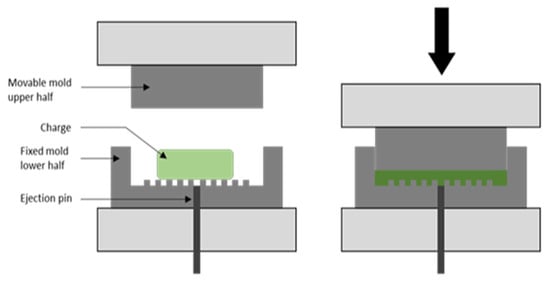
Figure 2.
Compression molding technique to fabricate BPs. Reproduced with permission from Reference [104].
Molding time: It has been reported that this parameter substantially changes the characteristics and properties of polymer composites reinforced with carbon allotropes [30,87]. For instance, the electrical and mechanical properties of phenolic resin (15 wt.%) composites reinforced with graphite (85 wt.%) were investigated by varying the molding time (15, 30, 45, 60, 75, and 90 min) [30], and the best results were found with 60 min of molding time (142 S/cm and 61.6 MPa). In another study, polybenzoxazine (15 wt.%) composites reinforced with graphite (85 wt.%) were produced by varying the molding time (20, 30, 40, 60, 90, and 120 min) [87]. The maximum conductivity (228 S/cm) was measured at 60 min of molding time. While the maximum flexural strength (48 MPa) was obtained at 90 min [87].
Molding temperature: It has been documented that molding temperature substantially changes the electrical and mechanical properties of polymer composites reinforced with carbon allotropes [30,87,96]. For instance, the conductivity of a phenolic resin (15 wt.%) composite reinforced with graphite (85 wt.%) changed from 108 S/cm to 142 S/cm when the molding temperature increased from 220 to 240 °C, whereas the flexural strength increased from 53 MPa to 62 MPa when the temperature presented the same increase [30]. In another study, the conductivity of polybenzoxazine (15 wt.%) composite reinforced with graphite (85 wt.%) increased from 234 to 247 S/cm when the temperature changed from 160 °C to 200 °C. Also, the flexural strength increased from 34 to 44 MPa when the temperature increased from 160 °C to 200 °C [87].
Molding pressure: Some studies have demonstrated that the electrical and mechanical properties are directly related to the molding pressure [31,39,42,96,100]. For example, the conductivity and flexural strength of phenolic resin composites increased when the molding pressure increased [31,39,42]. The same trends were observed for epoxy resin composites [96,100].
4.2. Production Costs
Polymer composites reinforced with carbon allotropes are excellent candidates for use in BPs because their properties are superior to those required by the DOE. However, some of the carbon allotropes (e.g., MWCNTs and graphene) utilized to reinforce polymer matrices present challenges related to production costs. It is well documented in the literature that the production methods used to produce these carbon allotropes are still expensive because these structures were discovered recently [105,106,107]. For the year 2025, the DOE established cost targets of 2 USD/kW for BPs in PEMFCs [17,108]. Considering the current costs of graphene and MWCNTs, their real applications in BPs could be limited since BPs based on graphene-reinforced polymer materials are more expensive than graphite and metal BPs, and their costs could be much higher than those established by the DOE. Therefore, to ensure the use of composite materials reinforced with graphene and MWCNTs, it is necessary to have a method that allows for the production of these carbon structures in large quantities and with good quality, which could help to use these materials in BPs and, thus, comply with DOE’s cost targets.
4.3. Stability of BPs
The thermal stability of polymer composites reinforced with carbon allotropes is important for their use in BPs. However, it is well known that polymer-based composites can exhibit degradation problems at high temperatures. Therefore, it is essential to know the thermal stability of polymer composites reinforced with carbon allotropes at the PEMFCs operating temperatures (80–120 °C). Fortunately, there have been studies on the thermal stability of polymer composites reinforced with carbon allotropes at PEMFCs operating temperatures, and the results are promising [42,44,49,88]. For instance, the phenolic resin (45 wt.%) and graphite (55 wt.%) composite presented a 2.2 wt.% loss at 400 °C [42]. Also, the storage modulus was practically constant in a range from 30 to 100 °C [42]. In another study, the thermal stability of phenolic resin (varying the concentration) composites reinforced with exfoliated graphite (varying the concentration), carbon black (5 wt.%), and graphite (3 wt.%) was studied at 200 °C. The best results (0.03 wt.% loss) were obtained with the phenolic resin (57 wt.%)–exfoliated graphite (35 wt.%)–carbon black (5 wt.%)–graphite (3 wt.%) composite [49]. It has also observed that the storage modulus of the synthesized composites were similar when the temperature varied from 30 to 75 °C. Interestingly, it has also been shown that the incorporation of carbon allotropes improves the thermal stability of polymer composites [109,110,111,112,113,114,115]. According to the studies conducted on the thermal stability of polymer composites reinforced with carbon allotropes, these may not present serious degradation problems and may practically maintain the mechanical properties (storage modulus) at the operating temperatures of PEMFCs.
5. Conclusions and Future Directions
Carbon material–reinforced–polymer composites have been widely studied as BPs because they offer several advantages, such as a light weight, easy machinability, and a satisfactory corrosion resistance. From this detailed review, the following conclusions and future directions can be suggested:
- (a)
- For single-polymer composites reinforced with carbon allotropes, phenolic resin, polypropylene, PPS, polybenzoxazine, and epoxy resin are the polymers more commonly used for BPs. However, more studies are required for PPS, polybenzoxazine, and epoxy resin-based composites since the studies developed to date show promising results.
- (b)
- The single-polymer composites have been reinforced using various types of carbon allotropes, mainly graphite, carbon fibers, carbon black, carbon nanotubes, and graphene. However, it is necessary to extend the study on single-polymer composites reinforced with carbon nanotubes and graphene since these are popular in the literature for their extraordinary electrical and mechanical properties.
- (c)
- Two-polymer composites with one, two, or three carbon allotropes have been partially explored with outstanding results. Therefore, more detailed studies on these composites should be conducted.
- (d)
- Almost all composites were produced using the compression molding technique. Nevertheless, the use of additive manufacturing could be a good strategy to produce BPs using the composites analyzed in this review.
- (e)
- Future studies should report on the properties required by the DOE and, thus, facilitate the analysis of the results.
Author Contributions
Conceptualization, A.G.-S., V.A.F.-L., H.M.A.-L., L.H.-S., H.C.-M. and D.I.M.; investigation, A.G.-S., V.A.F.-L. and H.M.A.-L.; data curation, L.H.-S., H.C.-M. and D.I.M.; writing—original draft preparation, A.G.-S., L.H.-S., H.C.-M. and D.I.M.; writing—review and editing, V.A.F.-L., H.M.A.-L., H.C.-M. and D.I.M.; funding acquisition, H.C.-M. and D.I.M. All authors have read and agreed to the published version of the manuscript.
Funding
This research was funded by Tecnológico Nacional de México, grant number 18563.23-P, and the APC was funded by Tecnologico de Monterrey.
Institutional Review Board Statement
Not applicable.
Data Availability Statement
Not applicable.
Conflicts of Interest
The authors declare no conflicts of interest.
References
- Höök, M.; Tang, X. Depletion of Fossil Fuels and Anthropogenic Climate Change—A Review. Energy Policy 2013, 52, 797–809. [Google Scholar] [CrossRef]
- Liew, W.H.; Hassim, M.H.; Ng, D.K.S. Review of Evolution, Technology and Sustainability Assessments of Biofuel Production. J. Clean. Prod. 2014, 71, 11–29. [Google Scholar] [CrossRef]
- Abdin, Z.; Zafaranloo, A.; Rafiee, A.; Mérida, W.; Lipiński, W.; Khalilpour, K.R. Hydrogen as an Energy Vector. Renew. Sustain. Energy Rev. 2020, 120, 109620. [Google Scholar] [CrossRef]
- Nazir, H.; Louis, C.; Jose, S.; Prakash, J.; Muthuswamy, N.; Buan, M.E.M.; Flox, C.; Chavan, S.; Shi, X.; Kauranen, P.; et al. Is the H2 Economy Realizable in the Foreseeable Future? Part I: H2 Production Methods. Int. J. Hydrogen Energy 2020, 45, 13777–13788. [Google Scholar] [CrossRef]
- Jain, I.P. Hydrogen the Fuel for 21st Century. Int. J. Hydrogen Energy 2009, 34, 7368–7378. [Google Scholar] [CrossRef]
- Nikolaidis, P.; Poullikkas, A. A Comparative Overview of Hydrogen Production Processes. Renew. Sustain. Energy Rev. 2017, 67, 597–611. [Google Scholar] [CrossRef]
- da Silva Veras, T.; Mozer, T.S.; da Costa Rubim Messeder dos Santos, D.; da Silva César, A. Hydrogen: Trends, Production and Characterization of the Main Process Worldwide. Int. J. Hydrogen Energy 2017, 42, 2018–2033. [Google Scholar] [CrossRef]
- Durbin, D.J.; Malardier-Jugroot, C. Review of Hydrogen Storage Techniques for on Board Vehicle Applications. Int. J. Hydrogen Energy 2013, 38, 14595–14617. [Google Scholar] [CrossRef]
- Cruz-Martínez, H.; García-Hilerio, B.; Montejo-Alvaro, F.; Gazga-Villalobos, A.; Rojas-Chávez, H.; Sánchez-Rodríguez, E.P. Density functional theory-based approaches to improving hydrogen storage in graphene-based materials. Molecules 2024, 29, 436. [Google Scholar] [CrossRef] [PubMed]
- Tellez-Cruz, M.M.; Escorihuela, J.; Solorza-Feria, O.; Compañ, V. Proton Exchange Membrane Fuel Cells (PEMFCs): Advances and Challenges. Polymers 2021, 13, 3064. [Google Scholar] [CrossRef]
- Cruz-Martínez, H.; Guerra-Cabrera, W.; Flores-Rojas, E.; Ruiz-Villalobos, D.; Rojas-Chávez, H.; Peña-Castañeda, Y.A.; Medina, D.I. Pt-Free Metal Nanocatalysts for the Oxygen Reduction Reaction Combining Experiment and Theory: An Overview. Molecules 2021, 26, 6689. [Google Scholar] [CrossRef]
- Das, V.; Padmanaban, S.; Venkitusamy, K.; Selvamuthukumaran, R.; Blaabjerg, F.; Siano, P. Recent Advances and Challenges of Fuel Cell Based Power System Architectures and Control—A Review. Renew. Sustain. Energy Rev. 2017, 73, 10–18. [Google Scholar] [CrossRef]
- Cruz-Martínez, H.; Rojas-Chávez, H.; Matadamas-Ortiz, P.T.; Ortiz-Herrera, J.C.; López-Chávez, E.; Solorza-Feria, O.; Medina, D.I. Current Progress of Pt-Based ORR Electrocatalysts for PEMFCs: An Integrated View Combining Theory and Experiment. Mater. Today Phys. 2021, 19, 100406. [Google Scholar] [CrossRef]
- Hermann, A.; Chaudhuri, T.; Spagnol, P. Bipolar Plates for PEM Fuel Cells: A Review. Int. J. Hydrogen Energy 2005, 30, 1297–1302. [Google Scholar] [CrossRef]
- Antunes, R.A.; De Oliveira, M.C.L.; Ett, G.; Ett, V. Carbon Materials in Composite Bipolar Plates for Polymer Electrolyte Membrane Fuel Cells: A Review of the Main Challenges to Improve Electrical Performance. J. Power Sources 2011, 196, 2945–2961. [Google Scholar] [CrossRef]
- De Oliveira, M.C.L.; Ett, G.; Antunes, R.A. Materials Selection for Bipolar Plates for Polymer Electrolyte Membrane Fuel Cells Using the Ashby Approach. J. Power Sources 2012, 206, 3–13. [Google Scholar] [CrossRef]
- DOE Technical Targets for Polymer Electrolyte Membrane Fuel Cell Components. Department of Energy. Available online: https://www.energy.gov/eere/fuelcells/doe-technical-targets-polymer-electrolyte-membrane-fuel-cell-components (accessed on 31 December 2023).
- Boyaci San, F.G.; Tekin, G. A Review of Thermoplastic Composites for Bipolar Plate Applications. Int. J. Energy Res. 2013, 37, 283–309. [Google Scholar] [CrossRef]
- Alo, O.A.; Otunniyi, I.O.; Pienaar, H.; Iyuke, S.E. Materials for Bipolar Plates in Polymer Electrolyte Membrane Fuel Cell: Performance Criteria and Current Benchmarks. Procedia Manuf. 2017, 7, 395–401. [Google Scholar] [CrossRef]
- Mohd Radzuan, N.A.; Sulong, A.B.; Sahari, J. A Review of Electrical Conductivity Models for Conductive Polymer Composite. Int. J. Hydrogen Energy 2017, 42, 9262–9273. [Google Scholar] [CrossRef]
- Song, Y.; Zhang, C.; Ling, C.Y.; Han, M.; Yong, R.Y.; Sun, D.; Chen, J. Review on Current Research of Materials, Fabrication and Application for Bipolar Plate in Proton Exchange Membrane Fuel Cell. Int. J. Hydrogen Energy 2020, 45, 29832–29847. [Google Scholar] [CrossRef]
- Mathew, C.; Naina Mohamed, S.; Devanathan, L.S. A Comprehensive Review of Current Research on Various Materials Used for Developing Composite Bipolar Plates in Polymer Electrolyte Membrane Fuel Cells. Polym. Compos. 2022, 43, 4100–4114. [Google Scholar] [CrossRef]
- Cunningham, B.D.; Huang, J.; Baird, D.G. Review of Materials and Processing Methods Used in the Production of Bipolar Plates for Fuel Cells. Int. Mater. Rev. 2007, 52, 1–13. [Google Scholar] [CrossRef]
- Saadat, N.; Dhakal, H.N.; Tjong, J.; Jaffer, S.; Yang, W.; Sain, M. Recent Advances and Future Perspectives of Carbon Materials for Fuel Cell. Renew. Sustain. Energy Rev. 2021, 138, 110535. [Google Scholar] [CrossRef]
- Asim, M.; Saba, N.; Jawaid, M.; Nasir, M.; Pervaiz, M.; Alothman, O.Y. A Review on Phenolic Resin and Its Composites. Curr. Anal. Chem. 2017, 13, 185–197. [Google Scholar] [CrossRef]
- Pilato, L. Phenolic Resins: A Century of Progress; Springer: Berlin/Heidelberg, Germany, 2010; pp. 1–545. [Google Scholar]
- Okuno, K.; Woodhams, R.T. Mechanical Properties and Characterization of Phenolic Resin Syntactic Foams. J. Cell. Plast. 1974, 10, 237–244. [Google Scholar] [CrossRef]
- Zhou, J.; Yao, Z.; Chen, Y.; Wei, D.; Wu, Y.; Xu, T. Mechanical and Thermal Properties of Graphene Oxide/Phenolic Resin Composite. Polym. Compos. 2013, 34, 1245–1249. [Google Scholar] [CrossRef]
- Taherian, R.; Hadianfard, M.J.; Golikand, A.N. Manufacture of a Polymer-Based Carbon Nanocomposite as Bipolar Plate of Proton Exchange Membrane Fuel Cells. Mater. Des. 2013, 49, 242–251. [Google Scholar] [CrossRef]
- Yin, Q.; Li, A.J.; Wang, W.Q.; Xia, L.G.; Wang, Y.M. Study on the Electrical and Mechanical Properties of Phenol Formaldehyde Resin/Graphite Composite for Bipolar Plate. J. Power Sources 2007, 165, 717–721. [Google Scholar] [CrossRef]
- Chen, H.; Liu, H.-B.; Yang, L.; Li, J.-X.; Yang, L. Study on the Preparation and Properties of Novolac Epoxy/Graphite Composite Bipolar Plate for PEMFC. Int. J. Hydrogen Energy 2010, 35, 3105–3109. [Google Scholar]
- Yao, K.; Adams, D.; Hao, A.; Zheng, J.P.; Liang, Z.; Nguyen, N. Highly Conductive and Strong Graphite-Phenolic Resin Composite for Bipolar Plate Applications. Energy Fuels 2017, 31, 14320–14331. [Google Scholar] [CrossRef]
- Pitchiya, A.P.; Le, N.T.; Putnam, Z.A.; Harrington, M.; Krishnan, S. Microporous Graphite Composites of Tailorable Porosity, Surface Wettability, and Water Permeability for Fuel Cell Bipolar Plates. Ind. Eng. Chem. Res. 2021, 60, 10203–10216. [Google Scholar] [CrossRef]
- Taherian, R.; Hadianfard, M.J.; Golikand, A.N. A New Equation for Predicting Electrical Conductivity of Carbon-Filled Polymer Composites Used for Bipolar Plates of Fuel Cells. J. Appl. Polym. Sci. 2013, 128, 1497–1509. [Google Scholar] [CrossRef]
- Chaiwan, P.; Pumchusak, J. Wet vs. Dry Dispersion Methods for Multiwall Carbon Nanotubes in the High Graphite Content Phenolic Resin Composites for Use as Bipolar Plate Application. Electrochim. Acta 2015, 158, 1–6. [Google Scholar] [CrossRef]
- Dhakate, S.R.; Sharma, S.; Chauhan, N.; Seth, R.K.; Mathur, R.B. CNTs Nanostructuring Effect on the Properties of Graphite Composite Bipolar Plate. Int. J. Hydrogen Energy 2010, 35, 4195–4200. [Google Scholar] [CrossRef]
- Li, W.; Jing, S.; Wang, S.; Wang, C.; Xie, X. Experimental Investigation of Expanded Graphite/Phenolic Resin Composite Bipolar Plate. Int. J. Hydrogen Energy 2016, 41, 16240–16246. [Google Scholar] [CrossRef]
- Masand, A.; Borah, M.; Pathak, A.K.; Dhakate, S.R. Effect of Filler Content on the Properties of Expanded-Graphite-Based Composite Bipolar Plates for Application in Polymer Electrolyte Membrane Fuel Cells. Mater. Res. Express. 2017, 4, 095604. [Google Scholar] [CrossRef]
- Kang, K.; Park, S.; Ju, H. Effects of Type of Graphite Conductive Filler on the Performance of a Composite Bipolar Plate for Fuel Cells. Solid State Ion. 2014, 262, 332–336. [Google Scholar] [CrossRef]
- Sykam, N.; Gautam, R.K.; Kar, K.K. Electrical, Mechanical, and Thermal Properties of Exfoliated Graphite/Phenolic Resin Composite Bipolar Plate for Polymer Electrolyte Membrane Fuel Cell. Polym. Eng. Sci. 2015, 55, 917–923. [Google Scholar] [CrossRef]
- Gautam, R.K.; Kar, K.K. Preparation, Characterization, and Properties of Resole Type Phenolic Resin/Exfoliated Graphite Composite Bipolar Plates for PEM Fuel Cell. Adv. Sci. Eng. Med. 2015, 7, 429–434. [Google Scholar] [CrossRef]
- Gautam, R.K.; Kar, K.K. Synthesis and Properties of Highly Conducting Natural Flake Graphite/Phenolic Resin Composite Bipolar Plates for PEM Fuel Cells. Adv. Compos. Lett. 2016, 25, 87–97. [Google Scholar] [CrossRef]
- Zheng, J.; Peng, Y.; Fan, R.; Chen, J.; Zhan, Z.; Yao, D.; Ming, P. Study on Carbon Matrix Composite Bipolar Plates with Balance of Conductivity and Flexural Strength. Chin. Chem. Lett. 2023, 34, 107616. [Google Scholar] [CrossRef]
- Gautam, R.K.; Kar, K.K. The Effects of Nano-Sized Carbon Black Content and Particle Sizes on the Properties of Carbon/Phenolic Composite Bipolar Plates. J. Multidiscip. Eng. Sci. Technol. 2015, 2, 191–200. [Google Scholar]
- Sengupta, R.; Bhattacharya, M.; Bandyopadhyay, S.; Bhowmick, A.K. A Review on the Mechanical and Electrical Properties of Graphite and Modified Graphite Reinforced Polymer Composites. Prog. Polym. Sci. 2011, 36, 638–670. [Google Scholar] [CrossRef]
- Rezaei, A.; Kamali, B.; Kamali, A.R. Correlation between Morphological, Structural and Electrical Properties of Graphite and Exfoliated Graphene Nanostructures. Measurement 2020, 150, 107087. [Google Scholar] [CrossRef]
- Solfiti, E.; Berto, F. Mechanical Properties of Flexible Graphite: Review. Procedia Struct. Integr. 2020, 25, 420–429. [Google Scholar] [CrossRef]
- Lv, B.; Shao, Z.; He, L.; Gou, Y.; Sun, S. A Novel Graphite/Phenolic Resin Bipolar Plate Modified by Doping Carbon Fibers for the Application of Proton Exchange Membrane Fuel Cells. Prog. Nat. Sci. Mater. Int. 2020, 30, 876–881. [Google Scholar] [CrossRef]
- Gautam, R.K.; Kar, K.K. Synergistic Effects of Carbon Fillers of Phenolic Resin Based Composite Bipolar Plates on the Performance of PEM Fuel Cell. Fuel Cells 2016, 16, 179–192. [Google Scholar] [CrossRef]
- Shubhra, Q.T.H.; Alam, A.K.M.M.; Quaiyyum, M.A. Mechanical properties of polypropylene composites: A review. J. Thermoplast. Compos. Mater. 2013, 26, 362–391. [Google Scholar] [CrossRef]
- Liu, W.; Cheng, L.; Li, S. Review of Electrical Properties for Polypropylene Based Nanocomposite. Compos. Commun. 2018, 10, 221–225. [Google Scholar] [CrossRef]
- Király, A.; Ronkay, F. Polypropylene as a Promising Plastic: A Review. Am. J. Polym. Sci. 2016, 6, 1–11. [Google Scholar]
- Gaxiola, D.L.; Jubinski, M.M.; Keith, J.M.; King, J.A.; Miskioglu, I. Effects of Carbon Fillers on Tensile and Flexural Properties in Polypropylene-Based Resins. J. Appl. Polym. Sci. 2010, 118, 1620–1633. [Google Scholar] [CrossRef]
- Moskalyuk, O.A.; Aleshin, A.N.; Tsobkallo, E.S.; Krestinin, A.V.; Yudin, V.E. Electrical Conductivity of Polypropylene Fibers with Dispersed Carbon Fillers. Phys. Solid State 2012, 54, 2122–2127. [Google Scholar] [CrossRef]
- Jiang, X.; Bin, Y.; Kikyotani, N.; Matsuo, M. Thermal, Electrical and Mechanical Properties of Ultra-High Molecular Weight Polypropylene and Carbon Filler Composites. Polym. J. 2006, 38, 419–431. [Google Scholar] [CrossRef][Green Version]
- Alo, O.A.; Otunniyi, I.O.; Pienaar, H.C.Z. Development of Graphite-Filled Polymer Blends for Application in Bipolar Plates. Polym. Compos. 2020, 41, 3364–3375. [Google Scholar] [CrossRef]
- Tariq, M.; Utkarsh; Syed, N.A.; Behravesh, A.H.; Pop-Iliev, R.; Rizvi, G. Synergistic Enrichment of Electrically Conductive Polypropylene-Graphite Composites for Fuel Cell Bipolar Plates. Int. J. Energy Res. 2022, 46, 10955–10964. [Google Scholar] [CrossRef]
- Dweiri, R.; Sahari, J. Electrical Properties of Carbon-Based Polypropylene Composites for Bipolar Plates in Polymer Electrolyte Membrane Fuel Cell (PEMFC). J. Power Sources 2007, 171, 424–432. [Google Scholar] [CrossRef]
- Király, A.; Ronkay, F. Effect of Graphite and Carbon Black Fillers on the Processability, Electrical Conductivity and Mechanical Properties of Polypropylene-Based Bipolar Plates. Polym. Polym. Compos. 2013, 21, 93–100. [Google Scholar] [CrossRef]
- Ahmad, M.S.; Selamat, M.Z.; Daud, M.A.M.; Yunus, I.K.M.; Azman, M.S. Effect of Different Filler Materials in the Development of Bipolar Plate Composite for Polymer Electrolyte Membrane Fuel Cell (PEMFC). Appl. Mech. Mater. 2013, 315, 226–230. [Google Scholar] [CrossRef]
- Selamat, M.Z.; Jamil, A.; Hasan, R.; Dharmalingam, S. Effect of Carbon fiber Loading in Gaphite-Polypropylene Composite Properties as Bipolar Plate for Polymer Electrolyte. J. Anal. Sci. 2021, 25, 766–775. [Google Scholar]
- Liao, S.H.; Yen, C.Y.; Weng, C.C.; Lin, Y.F.; Ma, C.C.M.; Yang, C.H.; Tsai, M.C.; Yen, M.Y.; Hsiao, M.C.; Lee, S.J.; et al. Preparation and Properties of Carbon Nanotube/Polypropylene Nanocomposite Bipolar Plates for Polymer Electrolyte Membrane Fuel Cells. J. Power Sources 2008, 185, 1225–1232. [Google Scholar] [CrossRef]
- Hsiao, M.C.; Liao, S.H.; Lin, Y.F.; Weng, C.C.; Tsai, H.M.; Ma, C.C.M.; Lee, S.H.; Yen, M.Y.; Liu, P.I. Polypropylene-Grafted Multi-Walled Carbon Nanotube Reinforced Polypropylene Composite Bipolar Plates in Polymer Electrolyte Membrane Fuel Cells. Energy Environ. Sci. 2011, 4, 543–550. [Google Scholar] [CrossRef]
- Radzuan, N.A.M.; Sulong, A.B.; Somalu, M.R.; Majlan, E.H.; Husaini, T.; Rosli, M.I. Effects of Die Configuration on the Electrical Conductivity of Polypropylene Reinforced Milled Carbon Fibers: An Application on a Bipolar Plate. Polymers 2018, 10, 558. [Google Scholar] [CrossRef]
- Ramírez-Herrera, C.A.; Tellez-Cruz, M.M.; Pérez-González, J.; Solorza-Feria, O.; Flores-Vela, A.; Cabañas-Moreno, J.G. Enhanced Mechanical Properties and Corrosion Behavior of Polypropylene/Multi-Walled Carbon Nanotubes/Carbon Nanofibers Nanocomposites for Application in Bipolar Plates of Proton Exchange Membrane Fuel Cells. Int. J. Hydrogen Energy 2021, 46, 26110–26125. [Google Scholar] [CrossRef]
- Liao, S.H.; Weng, C.C.; Yen, C.Y.; Hsiao, M.C.; Ma, C.C.M.; Tsai, M.C.; Su, A.; Yen, M.Y.; Lin, Y.F.; Liu, P.L. Preparation and Properties of Functionalized Multiwalled Carbon Nanotubes/Polypropylene Nanocomposite Bipolar Plates for Polymer Electrolyte Membrane Fuel Cells. J. Power Sources 2010, 195, 263–270. [Google Scholar] [CrossRef]
- Bühler, R.; Thommen, M.; Le Canut, J.M.; Weber, J.F.; Rytka, C.; Tsotra, P. Highly Conductive Polypropylene-Based Composites for Bipolar Plates for Polymer Electrolyte Membrane Fuel Cells. Fuel Cells 2021, 21, 155–163. [Google Scholar] [CrossRef]
- Mohd Radzuan, N.A.; Sulong, A.B.; Somalu, M.R.; Abdullah, A.T.; Husaini, T.; Rosli, R.E.; Majlan, E.H.; Rosli, M.I. Fibre Orientation Effect on Polypropylene/Milled Carbon Fiber Composites in the Presence of Carbon Nanotubes or Graphene as a Secondary Filler: Application on PEM Fuel Cell Bipolar Plate. Int. J. Hydrogen Energy 2019, 44, 30618–30626. [Google Scholar] [CrossRef]
- Yeetsorn, R.; Fowler, M.; Tzoganakis, C.; Wang, Y.; Taylor, M. Polypropylene Composites for Polymer Electrolyte Membrane Fuel Cell Bipolar Plates. Macromol. Symp. 2008, 264, 34–43. [Google Scholar] [CrossRef]
- Bairan, A.; Selamat, M.Z.; Sahadan, S.N.; Malingam, S.D.; Mohamad, N. Effect of Carbon Nanotubes Loading in Multifiller Polymer Composite as Bipolar Plate for PEM Fuel Cell. Procedia Chem. 2016, 19, 91–97. [Google Scholar] [CrossRef]
- Adloo, A.; Sadeghi, M.; Masoomi, M.; Pazhooh, H.N. High Performance Polymeric Bipolar Plate Based on Polypropylene/Graphite/Graphene/Nano-Carbon Black Composites for PEM Fuel Cells. Renew. Energy 2016, 99, 867–874. [Google Scholar] [CrossRef]
- Xia, L.G.; Li, A.J.; Wang, W.Q.; Yin, Q.; Lin, H.; Zhao, Y.B. Effects of Resin Content and Preparing Conditions on the Properties of Polyphenylene Sulfide Resin/Graphite Composite for Bipolar Plate. J. Power Sources 2008, 178, 363–367. [Google Scholar] [CrossRef]
- Dushina, A.; Satola, B.; Dyck, A.; Wagner, P. Comparative Investigation of Polyphenylene Sulfide Polymer-Graphite Bipolar Plates for Fuel Cell Application. ECS Trans. 2019, 92, 361–373. [Google Scholar] [CrossRef]
- Park, H.J.; Woo, J.S.; Park, S.Y. Poly(Phenylene Sulfide)-Graphite Composites for Bipolar Plates with Preferred Morphological Orientation. Korean J. Chem. Eng. 2019, 36, 2133–2142. [Google Scholar] [CrossRef]
- Hill, H.W.; Brady, D.G. Properties, Environmental Stability, and Molding Characteristics of Polyphenylene Sulfide. Polym. Eng. Sci. 1976, 16, 831–835. [Google Scholar] [CrossRef]
- Rahate, A.S.; Nemade, K.R.; Waghuley, S.A. Polyphenylene Sulfide (PPS): State of the Art and Applications. Rev. Chem. Eng. 2013, 29, 471–489. [Google Scholar] [CrossRef]
- Zhang, H.Y.; Yang, X.D.; Liu, X.J.; Wang, T. Preparation of CF Reinforced PPS/Graphite Conductive Composite for Bipolar Plate. Adv. Mat. Res. 2014, 875–877, 1245–1249. [Google Scholar] [CrossRef]
- Lopes De Oliveira, M.C.; Sayeg, I.J.; Ett, G.; Antunes, R.A. Corrosion Behavior of Polyphenylene Sulfide–Carbon Black–Graphite Composites for Bipolar Plates of Polymer Electrolyte Membrane Fuel Cells. Int. J. Hydrogen Energy 2014, 39, 16405–16418. [Google Scholar] [CrossRef]
- Jiang, X.; Drzal, L.T. Exploring the Potential of Exfoliated Graphene Nanoplatelets as the Conductive Filler in Polymeric Nanocomposites for Bipolar Plates. J. Power Sources 2012, 218, 297–306. [Google Scholar] [CrossRef]
- Yang, T.; Shi, P. Study on the Mesocarbon Microbeads/Polyphenylene Sulfide Composite Bipolar Plates Applied for Proton Exchange Membrane Fuel Cells. J. Power Sources 2008, 175, 390–396. [Google Scholar] [CrossRef]
- Shen, S.B.; Ishida, H. Development and Characterization of High-Performance Polybenzoxazine Composites. Polym. Compos. 1996, 17, 710–719. [Google Scholar] [CrossRef]
- Yagci, Y.; Kiskan, B.; Ghosh, N.N. Recent Advancement on Polybenzoxazine—A Newly Developed High Performance Thermoset. J. Polym. Sci. A Polym. Chem. 2009, 47, 5565–5576. [Google Scholar] [CrossRef]
- Ishida, H. Overview and Historical Background of Polybenzoxazine Research. In Handbook of Benzoxazine Resins; Elsevier: Amsterdam, The Netherlands, 2011; pp. 3–81. [Google Scholar]
- Kiskan, B.; Ghosh, N.N.; Yagci, Y. Polybenzoxazine-Based Composites as High-Performance Materials. Polym. Int. 2011, 60, 167–177. [Google Scholar] [CrossRef]
- Mohamed, M.G.; Lin, R.C.; Kuo, S.W. Polybenzoxazine/Carbon Nanotube Composites. In Advanced and Emerging Polybenzoxazine Science and Technology; Elsevier: Amsterdam, The Netherlands, 2017; pp. 725–738. [Google Scholar]
- Chen, Q.; Xu, R.; Yu, D. Multiwalled Carbon Nanotube/Polybenzoxazine Nanocomposites: Preparation, Characterization and Properties. Polymer 2006, 47, 7711–7719. [Google Scholar] [CrossRef]
- Kim, S.G.; Kim, J.H.; Yim, J.H. A Study on the Physicochemical Properties of a Graphite/Polybenzoxazine Composite for Bipolar Plate of Polymer Electrolyte Membrane Fuel Cells. Macromol. Res. 2013, 21, 1226–1232. [Google Scholar] [CrossRef]
- Dueramae, I.; Pengdam, A.; Rimdusit, S. Highly Filled Graphite Polybenzoxazine Composites for an Application as Bipolar Plates in Fuel Cells. J. Appl. Polym. Sci. 2013, 130, 3909–3918. [Google Scholar] [CrossRef]
- Phuangngamphan, M.; Okhawilai, M.; Hiziroglu, S.; Rimdusit, S. Development of Highly Conductive Graphite-/Graphene-Filled Polybenzoxazine Composites for Bipolar Plates in Fuel Cells. J. Appl. Polym. Sci. 2019, 136, 47183. [Google Scholar] [CrossRef]
- Plengudomkit, R.; Okhawilai, M.; Rimdusit, S. Highly Filled Graphene-Benzoxazine Composites as Bipolar Plates in Fuel Cell Applications. Polym. Compos. 2016, 37, 1715–1727. [Google Scholar] [CrossRef]
- Witpathomwong, S.; Okhawilai, M.; Jubsilp, C.; Karagiannidis, P.; Rimdusit, S. Highly Filled Graphite/Graphene/Carbon Nanotube in Polybenzoxazine Composites for Bipolar Plate in PEMFC. Int. J. Hydrogen Energy 2020, 45, 30898–30910. [Google Scholar] [CrossRef]
- Soleimani Alavijeh, M.; Kefayati, H.; Nozad Golikand, A.; Shariati, S. Synthesis and Characterization of Epoxy/Graphite/Nano-Copper Nanocomposite for the Fabrication of Bipolar Plate for PEMFCs. J. Nanostruct. Chem. 2019, 9, 11–18. [Google Scholar] [CrossRef]
- Planes, E.; Flandin, L.; Alberola, N. Polymer Composites Bipolar Plates for PEMFCs. Energy Procedia 2012, 20, 311–323. [Google Scholar] [CrossRef]
- Du, L.; Jana, S.C. Highly Conductive Epoxy/Graphite Composites for Bipolar Plates in Proton Exchange Membrane Fuel Cells. J. Power Sources 2007, 172, 734–741. [Google Scholar] [CrossRef]
- Rigail-Cedeño, A.F.; Espinoza-Andaluz, M.; Vera, J.; Orellana-Valarezo, M.; Villacis-Balbuca, M. Influence of Different Carbon Materials on Electrical Properties of Epoxy-Based Composite for Bipolar Plate Applications. Mater. Today Proc. 2020, 33, 2003–2007. [Google Scholar] [CrossRef]
- Suherman, H.; Sulong, A.B.; Sahari, J. Effect of the Compression Molding Parameters on the In-Plane and through-Plane Conductivity of Carbon Nanotubes/Graphite/Epoxy Nanocomposites as Bipolar Plate Material for a Polymer Electrolyte Membrane Fuel Cell. Ceram. Int. 2013, 39, 1277–1284. [Google Scholar] [CrossRef]
- Alo, O.A.; Otunniyi, I.O.; Pienaar, H.c.Z. Exploring the Potential of Polyethylene/Epoxy/Graphite Composite as Bipolar Plate Material for Proton Exchange Membrane Fuel Cell. AIP Conf. Proc. 2020, 2289, 020007. [Google Scholar]
- Darıcık, F.; Topcu, A.; Aydın, K.; Çelik, S. Carbon Nanotube (CNT) Modified Carbon Fiber/Epoxy Composite Plates for the PEM Fuel Cell Bipolar Plate Application. Int. J. Hydrogen Energy 2023, 48, 1090–1106. [Google Scholar] [CrossRef]
- Santana-Villamar, J.; Reyna, R.; Rigail-Cedeño, A.F.; Espinoza-Andaluz, M. Processing Methods of Epoxy/Graphite-Based Compounds for PEFC Bipolar Plates Using Different Secondary Fillers. J. Electrochem. Soc. 2021, 168, 064508. [Google Scholar] [CrossRef]
- Sadeli, Y.; Johny, W.S.; Prihandoko, B.; Harjanto, S. The Effects of Carbon Black Loading on the Characteristics of Carbon Composite Bipolar Plate by Utilizing Graphite Waste Products. Appl. Mech. Rev. 2013, 268–270, 104–110. [Google Scholar] [CrossRef]
- Suherman, H.; Sahari, J.; Sulong, A.B.; Astuti, S.; Septe, E. Properties of Epoxy/Carbon Black/Graphite Composites for Bipolar Plate in Polymer Electrolyte Membrane Fuel Cell. Adv. Mater. Res. 2014, 911, 8–12. [Google Scholar] [CrossRef]
- Chen, H.; Xia, X.H.; Yang, L.; He, Y.D.; Liu, H.B. Preparation and Characterization of Graphite/Resin Composite Bipolar Plates for Polymer Electrolyte Membrane Fuel Cells. Sci. Eng. Compos. Mater. 2016, 23, 21–28. [Google Scholar] [CrossRef]
- Alo, O.A.; Otunniyi, I.O.; Pienaar, H.C.V.Z.; Sadiku, E.R. Electrical and Mechanical Properties of Polypropylene/Epoxy Blend-Graphite/Carbon Black Composite for Proton Exchange Membrane Fuel Cell Bipolar Plate. Mater. Today Proc. 2021, 38, 658–662. [Google Scholar]
- Tang, A.; Crisci, L.; Bonville, L.; Jankovic, J. An overview of bipolar plates in proton exchange membrane fuel cells. J. Renew. Sustain. Energy 2021, 13, 022701. [Google Scholar] [CrossRef]
- Nasir, S.; Hussein, M.Z.; Zainal, Z.; Yusof, N.A. Carbon-based nanomaterials/allotropes: A glimpse of their synthesis, properties and some applications. Materials 2018, 11, 295. [Google Scholar] [CrossRef]
- Jayakumar, K.; Pandiyan, S.; Rajalakshmi, N.; Dhathathreyan, K.S. Cost-benefit analysis of commercial bipolar plates for PEMFC’s. J. Power Sources 2006, 161, 454–459. [Google Scholar] [CrossRef]
- Tiwari, S.K.; Kumar, V.; Huczko, A.; Oraon, R.; Adhikari, A.D.; Nayak, G.C. Magical allotropes of carbon: Prospects and applications. Crit. Rev. Solid State Mater. Sci. 2016, 41, 257–317. [Google Scholar] [CrossRef]
- Huya-Kouadio, J.M.; James, B.D.; Houchins, C. Meeting cost and manufacturing expectations for automotive fuel cell bipolar plates. ECS Trans 2018, 83, 93–109. [Google Scholar] [CrossRef]
- Razavi-Nouri, M. Effect of carbon nanotubes on dynamic mechanical properties, TGA, and crystalline structure of polypropylene. J. Appl. Polym. Sci. 2012, 124, 2541–2549. [Google Scholar] [CrossRef]
- Chrissafis, K.; Paraskevopoulos, K.M.; Stavrev, S.Y.; Docoslis, A.; Vassiliou, A.; Bikiaris, D.N. Characterization and thermal degradation mechanism of isotactic polypropylene/carbon black nanocomposites. Thermochim. Acta 2007, 465, 6–17. [Google Scholar] [CrossRef]
- Durmaz, B.U.; Aytac, A. Characterization of carbon fiber-reinforced poly (phenylene sulfide) composites prepared with various compatibilizers. J. Compos. Mater. 2020, 54, 89–100. [Google Scholar] [CrossRef]
- Khan, S.M.; Gull, N.; Munawar, M.A.; Zia, S.; Anjum, F.; Iqbal, M.S.; Jamil, T. Polyphenylene sulphide/carbon fiber composites: Study on their thermal, mechanical and microscopic properties. Iran. Polym. J. 2016, 25, 475–485. [Google Scholar] [CrossRef]
- Zúñiga, C.; Bonnaud, L.; Lligadas, G.; Ronda, J.C.; Galià, M.; Cádiz, V.; Dubois, P. Convenient and solventless preparation of pure carbon nanotube/polybenzoxazine nanocomposites with low percolation threshold and improved thermal and fire properties. J. Mater. Chem. A 2014, 2, 6814–6822. [Google Scholar] [CrossRef]
- Zhou, Y.; Hosur, M.; Jeelani, S.; Mallick, P.K. Fabrication and characterization of carbon fiber reinforced clay/epoxy composite. J. Mater. Sci. 2012, 47, 5002–5012. [Google Scholar] [CrossRef]
- Pervin, F.; Zhou, Y.; Rangari, V.K.; Jeelani, S. Testing and evaluation on the thermal and mechanical properties of carbon nano fiber reinforced SC-15 epoxy. Mater. Sci. Eng. A 2005, 405, 246–253. [Google Scholar] [CrossRef]
Disclaimer/Publisher’s Note: The statements, opinions and data contained in all publications are solely those of the individual author(s) and contributor(s) and not of MDPI and/or the editor(s). MDPI and/or the editor(s) disclaim responsibility for any injury to people or property resulting from any ideas, methods, instructions or products referred to in the content. |
© 2024 by the authors. Licensee MDPI, Basel, Switzerland. This article is an open access article distributed under the terms and conditions of the Creative Commons Attribution (CC BY) license (https://creativecommons.org/licenses/by/4.0/).