Abstract
The main modifications of thermal and colorimetric parameters after thermal aging of DGEBA/TETA system (plain epoxy) and fique-fiber woven fabric-reinforced epoxy composites are described. As a preliminary study, thermal analysis was carried out on epoxy matrix composites reinforced with 15, 30, 40 and 50% fique-fiber woven fabric. After this previous analysis, the 40% composite was chosen to be thermally aged, at 170 °C. Three exposure times were considered, namely, 0, 72, 120 and 240 h. Samples were studied by thermogravimetric analysis (TGA), differential thermal analysis (DTA), differential scanning calorimetry (DSC), thermomechanical analysis (TMA) and colorimetry analysis. Significant color changes were observed after thermal aging combined with oxidation. It was also found that the thermal behavior of the plain epoxy showed greater resistance after thermal exposure. By contrast, the composites were more sensitive to temperature variations as a result of thermal stresses induced between fique fibers and the epoxy matrix.
1. Introduction
Nowadays, there is a worldwide trend in search of resources that will benefit society, not only in the creation of new products, but also in the opportunity to create work and generate income through the development of new technologies with sustainability. Brazil does not disregard this principle; therefore, the current interest in composites with natural fibers, whether of vegetable, mineral or animal origin, is mainly due to its growing concern with the preservation of the environment and socialization [1]. Vegetable fibers, usually defined as natural fibers, are actually widely used as reinforcements in polymeric composites due to their low cost and biodegradability, which is consistent with the current appeal for environmental preservation and the use of renewable materials. Due to their inherent hydroxyl-rich nature, plant fibers are particularly useful in thermosetting systems. The main applications of these composites are in civil construction, furniture industries, packaging and the automotive sector. For its application, a fiber-reinforced composite (FRC) must have certain properties capable of withstanding physical, mechanical and chemical degradation processes caused by agents such as mechanical action, heat, oxygen atmosphere, and light, among others [2,3,4,5,6,7,8].
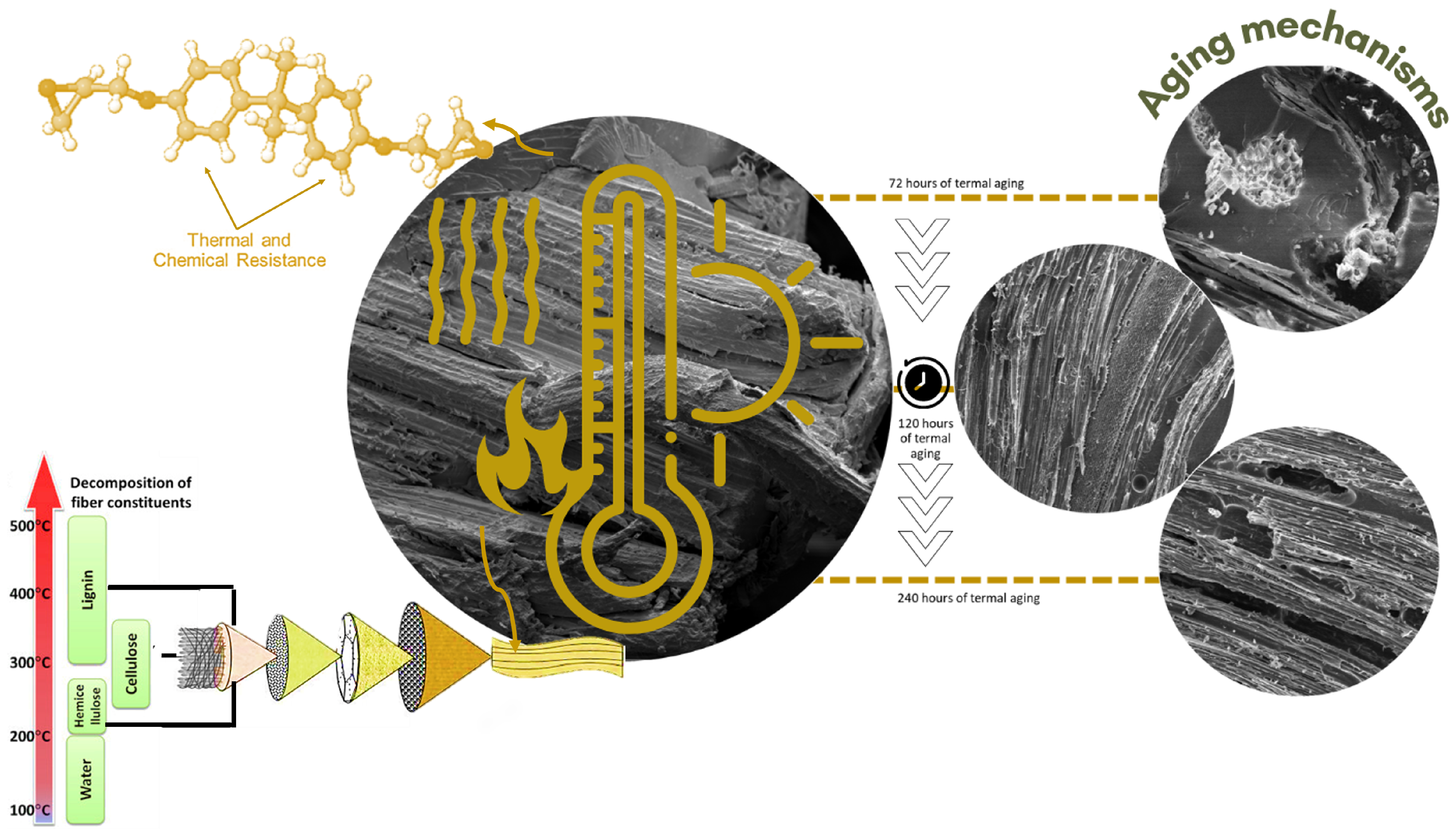
With this in mind, thermoxidative and mechanochemical transformations in a natural fiber and its polymer matrix composites are inevitable after use and, consequently, reduce the material’s performance [9]. These transformations involve partial destruction of the composite structures, making it necessary to find ways to minimize these processes. Based on the aforementioned considerations, the main modifications caused by thermal aging on fique fabric-reinforced epoxy matrix composites were investigated. Figure 1 presents schematically the structure of a fique-fiber woven fabric-reinforced epoxy composite, proposed in the present work, before aging and after three thermal agings at different times of exposure, making clear the changes in structure and rupture mechanisms. In view of this, the polymer ability to resist thermomechanical degradation, defined as its thermal stability, was studied [10]. This property is evaluated by the temperature at which polymer degradation begins to be perceptible, by the formed products and by the reaction kinetics [11]. During the degradation process, color changes are observed followed by the formation of solid and gaseous products [6]. Generally, these reactions can be divided into two main groups: (i) reactions occurring without main chain breakage; and (ii) reactions with main chain rupture, which is normal thermal degradation.
Figure 1.
Schematic showing the degradation temperature ranges for different constituents of natural fibers, and the chemical structure of bisphenol A diglycidyl ether epoxy resin (DGEBA) and fique-fiber woven fabric-reinforced composite after aging (adapted from Refs. [10,12]).
Indeed, some general degradation processes may involve a combination of two or more individual mechanisms [13,14,15,16,17,18,19,20,21,22,23,24,25,26,27]. Some references that considered high temperature aging and its effects are shown below in Table 1.
Table 1.
Summary of some references that considered high temperature aging and its effects.
In the absence of light and at room temperature (RT), most polymers are stable for long periods of time [2]. However, as reported by Qin et al. [28], under sunlight the oxidation rate of polymers is accelerated and this effect can be exacerbated by the presence of atmospheric pollutants, as well as nitrogen and sulfur oxides, which are frequent components of the industrial atmosphere. In this case, the degradation occurs due to the phenomenon of photolysis, which is a chemical decomposition caused by light and photo-oxidation [2,20,27]. Natural fibers can undergo degradation due to biological agents, acid and alkaline media, moisture absorption, radiation and temperature. According to Balla et al. [12], the lignocellulosic components of natural fibers respond in different ways to the aforementioned media. Thus, considering the above, it is important to carry out aging studies under separate conditions, making it possible to understand the phenomena that are produced by each mechanism involved in the aging.
Thermal analysis is often used to describe the analytical technique that investigates the behavior of a sample as a function of temperature variation [29]. This makes it possible to qualitatively and quantitatively characterize a large number of thermal occurrences over a wide temperature range. As stated by Fan et al. [6] and Azwa and Yousif [8], the exposure to elevated temperature induced thermal stresses between fibers and matrices due to differential thermal expansion between polymer matrices and fibers. This differential thermal expansion of the fiber and matrix may lead to the formation of microcracks at the fiber/matrix interface. In a previously reported work [10], the aging mechanisms were therefore dominated by the effects of the unreacted resin components present in the laminate. Hemicellulose loss and oxidation were pointed out as the main mechanisms for the microstructure changes that occur during thermal aging of fique-fiber woven fabric-reinforced epoxy composites. All samples of fique-fiber woven fabric, plain epoxy and fique-fiber woven fabric composites revealed physical aspect changes at the macrostructural level, exhibiting a formation of a brownish layer at the sample surface [10].
Additionally, ballistic vests, manufactured based on high-performance polymers, have an expiration date fixed from the date of manufacture, and must be permanently disposed of or destroyed after this period, causing financial loss to the country [30,31]. The materials presented in this article have already been studied with a proposal for partial replacement of the common ballistic panel [32,33,34,35]. These components of the ballistic panels determine the level of vest protection and are planned according to the ballistic threat they must withstand [31]. Thus, in the present work, the aging of these proposed ballistic panels was considered.
The present work details the results from an extensive work program that was undertaken to develop thermal accelerated aging tests for ballistic composites that could be used to partially replace some of the expensive and unsustainable synthetic fibers.
2. Materials and Methods
2.1. Materials and Composite Processing
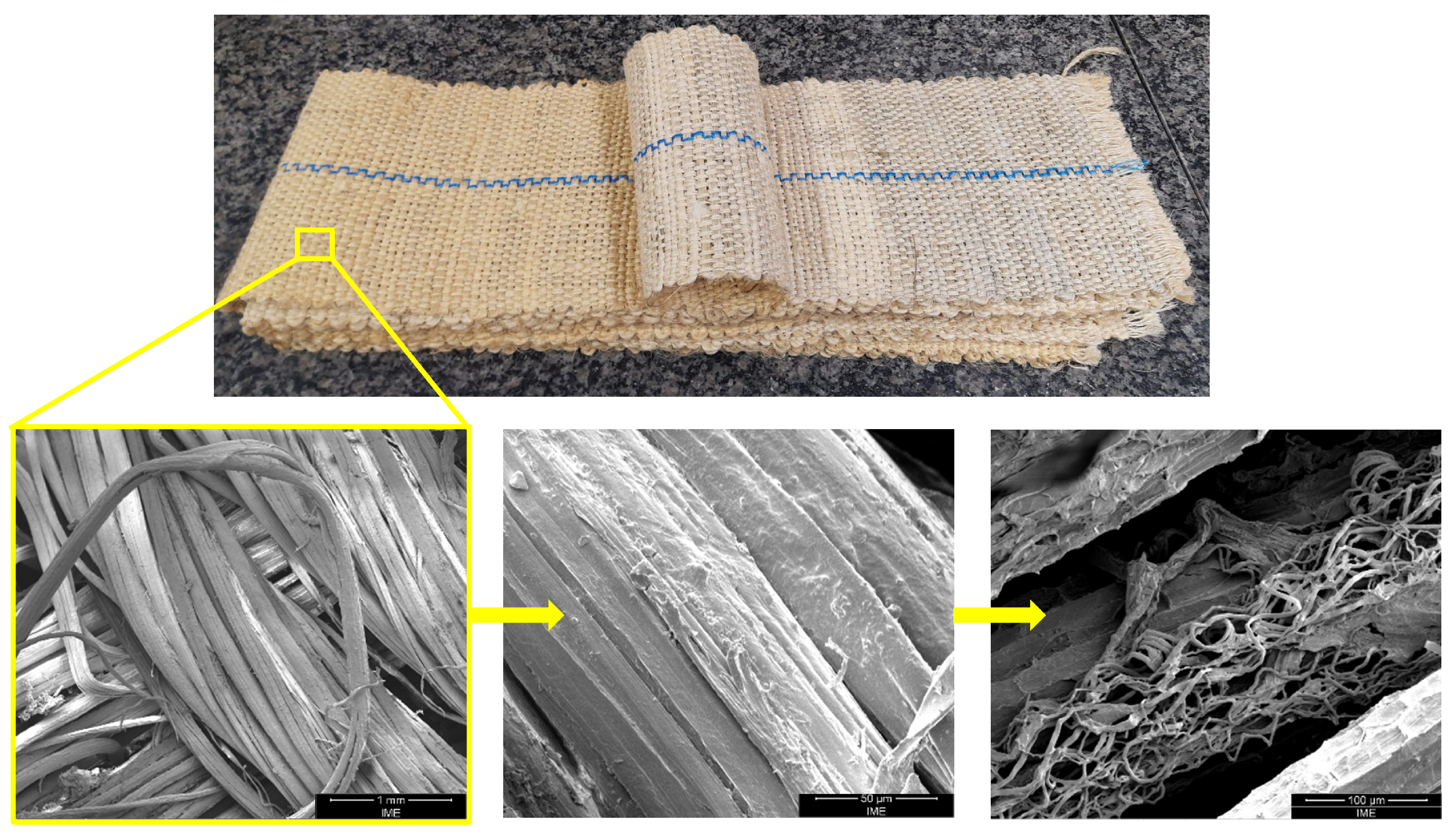
Fique-fiber woven fabric, illustrated in Figure 2, was supplied by co-author Henry Colorado and considered as composite’s reinforcement. These fique-fiber woven fabrics were cut into dimensions of 15 × 12 cm and placed in an oven at 70 °C for 24 h to remove moisture absorbed by the fiber.
Figure 2.
Architecture of fique-fiber woven fabric.
Epoxy polymer composed of diglycidyl ether of bisphenol A (DGEBA) and the hardener triethylenetetramine (TETA) was used as matrix. Both DGEBA and TETA were supplied by Epoxyfiber, Rio deJaneiro, Brazil. The mixture of these two components was made with a stoichiometric ratio phr 13, recommended by manufacturer. Composite plates with 15, 30, 40 and 50 vol% of fique fabric, Table 2, were produced in a steel mold with an internal volume of 180 cm³ (150 × 120 × 10 mm³) by hand lay-up process. For epoxy, a density of 1.1 g/cm³ was adopted [36] and for the fique-fiber woven fabric 0.67 g/cm³ [32].
Table 2.
Different percentages of reinforcement of fique-fiber woven fabric in epoxy composites evaluated.
To facilitate the plate demolding, a layer of silicone grease was applied to metallic mold followed by alternating layers of epoxy and fique-fiber woven fabric. After complete accommodation of components, the metallic mold was closed applying a load of 5 tons (3 MPa) for 24 h. The percentage of reinforcement used in the thermal aging study was based on previous works [33,34,35], where the integrity maintained in the composite of 40% in volume of fique-fiber woven fabric reinforcement was observed, guaranteeing superior ballistic protection in comparison with the use of Kevlar®, taking into account the energy absorption capacity. Likewise, the multilayered ballistic system (MBS) with the composite reinforced with 40% fabric, although not the one that presented the lowest trauma depth, exhibited better ballistic performance taking into account the cohesion of material and reliability level.
2.2. Accelerated Thermal Aging
The fique-fiber woven fabric-reinforced epoxy composite and plain epoxy were subjected to accelerated aging test performed in air chambers (Nova Instruments, Brazil) at 170 °C for progressively increasing time lengths (0, 3, 5 and 10 days). The aging temperature of 170 °C was selected as the limit temperature before degradation in both the epoxy [9,37] and the fique-fiber woven fabric. The continuous use of temperatures in an unstressed state generally vary from 70 °C up to 200 °C, according to Biron [29]. Table 3 lists the nomenclatures used for the samples in this work.
- 0 h (no aging)—reference sample;
- Aging temperature: 170 °C;
- Aging time: 72, 120 and 240 h.

Table 3.
Environmental conditions of aging and aged materials [10].
Table 3.
Environmental conditions of aging and aged materials [10].
| Material | Aging Times (Hours) | |||
|---|---|---|---|---|
| 0 | 72 | 120 | 240 | |
| Plain epoxy | PE-T0 | PE-T72 | PE-T120 | PE-T240 |
| Composite | FC-T0 | FC-T72 | FC-T120 | FC-T240 |
2.3. Thermogravimetric Analysis (TGA)
TGA, using curves of TG and derivative DTG, was performed to obtain the thermal properties of composites and epoxy for different evaluation groups. The test conditions were performed under a nitrogen atmosphere at a flow of 50 mL/min, varying from 30 °C to 700 °C, at a heating rate of 10 °C/min. TA Instruments equipment (New Castle, DE, USA) was used for this analysis.
2.4. Thermomechanical Analysis
Thermomechanical analysis was carried out with Shimadzu equipment (Barueri, SP, Brazil), model TMA-60, in order to obtain the thermal expansion coefficients of the composites and epoxy for the different evaluation groups. The samples were prepared in accordance with the ASTM E831 standard [38], being placed on a quartz support, under a nitrogen atmosphere, with a temperature range of 25 °C to 200 °C and a fixed compression load of 10 gf.
2.5. Differential Scanning Calorimetry Analysis
The use of differential scanning calorimetry technique aimed to obtain knowledge of the glass transition and to evaluate the cure of epoxy resin temperature, as well as the enthalpies involved in the degradation process of the material caused by aging. The analysis was carried out in a Shimadzu DTG-60H model (Barueri, SP, Brazil). Samples were prepared in accordance with ASTM D3418 standard [39], with masses of ≈5 mg, and were subjected to a single heating cycle from 25 °C to 400 °C, at a rate of 10 °C/min, under a nitrogen flow of 50 mL/min.
2.6. Colorimetry Analysis: CIE Lab
Colorimetric analysis was performed to evaluate surface color changes using a chromometer, according to the CIE L* a* b* color system. The colorimetry analysis aimed at evaluation using the coordinates of this method. The L* represents the luminosity value, where the darkest black is L* = 0 and the brightest white is L* = 100. The green–red and blue–yellow components are represented by the chromaticity coordinates a* and b*, respectively. The red and yellow components are shown in the positive direction, while the green and blue components are shown in the negative direction. Total color changes (ΔE) were calculated as described in ISO 7724 [40], according to Equation (1), where ΔL, Δa and Δb are the differences between the initial (non-weathered sample) and final (weathered sample) values of L*, a* and b*.
The whiteness index, Equation (2), is a numerical indicator used to indicate the degree of whiteness. In the CIE Lab color space, two of the axes are perceptually orthogonal to the luminosity. Hue can be calculated along with chroma, Equation (3), transforming coordinates a and b from rectangular to polar form. Hue is the angular component of the polar representation, while chroma is the radial component. The colorimetric pattern tests of the plates were carried out in a portable colorimeter model WR-10QC, ARTBULL, CN (Barueri, SP, Brazil).
3. Results and Discussion
3.1. Thermogravimetric Analysis
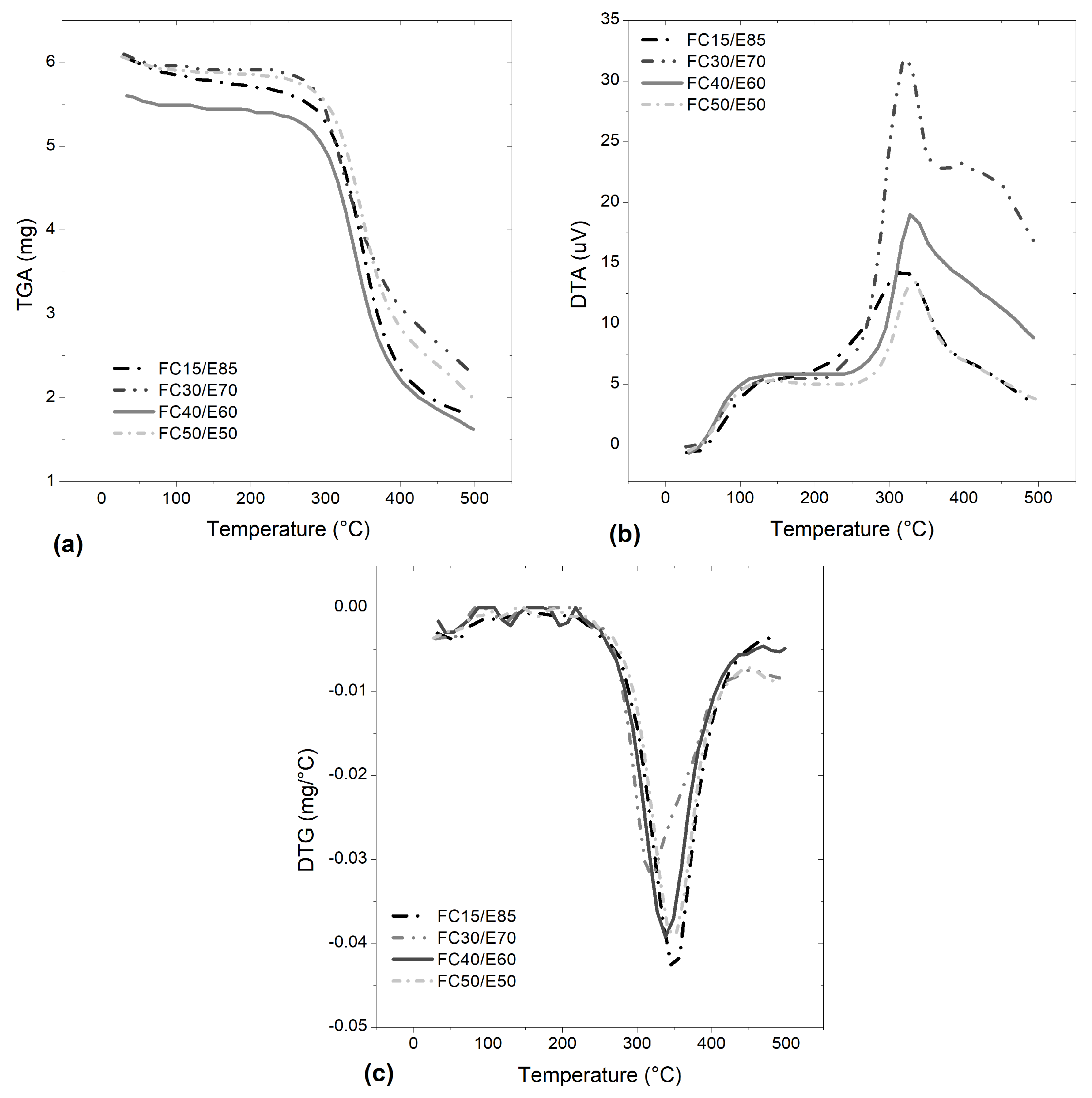
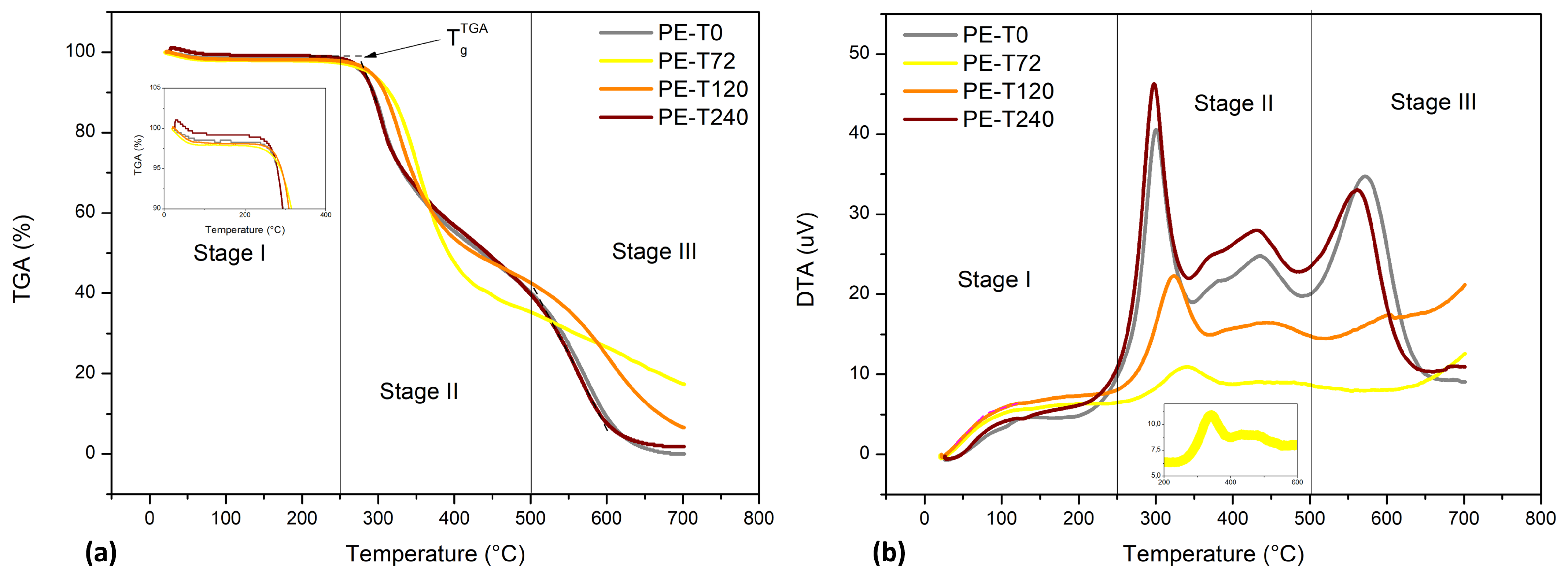
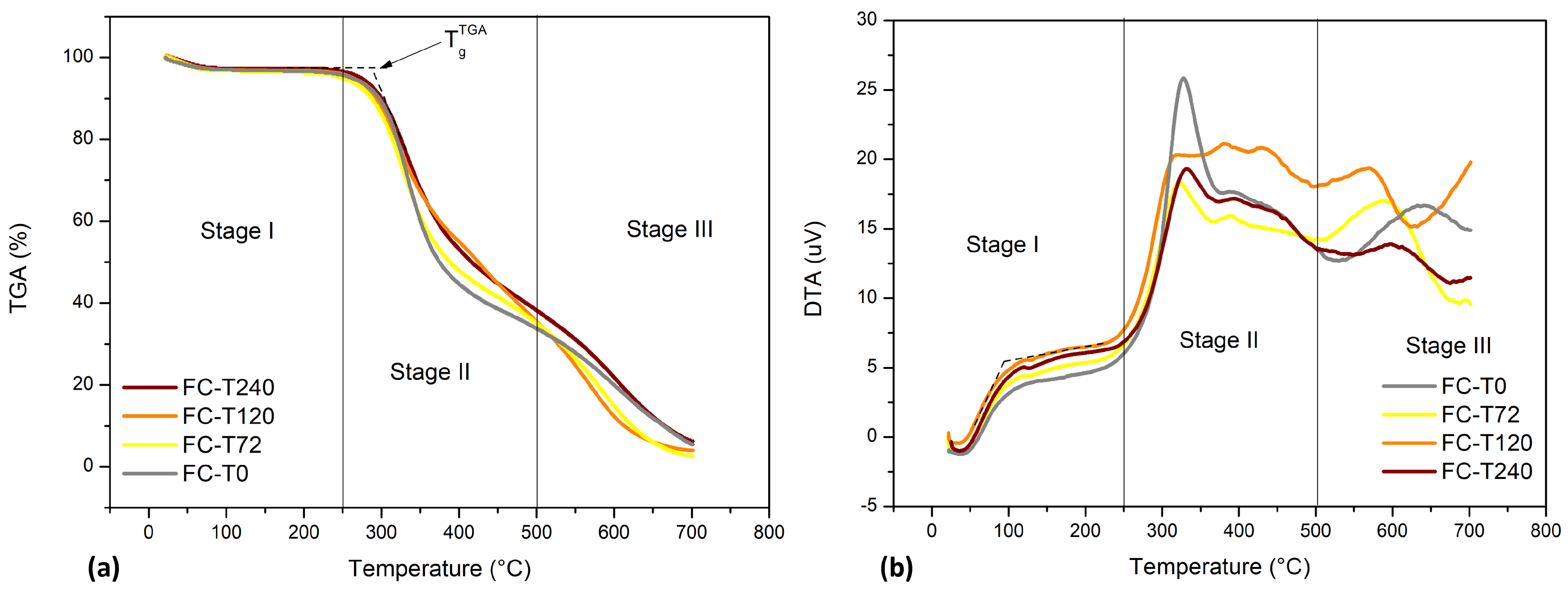
Thermogravimetric analysis (TGA) coupled with differential thermal analysis (DTA) and derived thermogravimetric (DTG) analysis was carried out to determine the materials’ thermal stability, and to find evidence of any exothermic or endothermic process in fique-fiber woven fabric-reinforced epoxy composites with different percentages (Figure 3) and aged materials (Figure 4 and Figure 5). As a preliminary study, analyses were carried out on epoxy matrix composites reinforced with 15%, 30%, 40% and 50% fique-fiber woven fabric reinforcement. Figure 3a and Table 4 present a small weight loss (<4%) occurring at a temperature around 100 °C. The greatest weight loss, about 59%, occurred between 260 °C and 400 °C for the FC40/E60 composite. It was also noticed that the weight loss rate during degradation at up to 100 °C of FC30/E70 and FC50/E50 was lower than FC15/E85, once their thermal stabilities were increased and the degradation process shifted to a higher temperature, which can be evidenced by the transposition of the DTA peak to higher temperatures.
Figure 3.
(a) Thermogravimetric analysis (TGA) coupled with (b) differential thermal analysis (DTA) and (c) derivative thermogravimetry (DTG) carried out on non-aged epoxy matrix composites with 15%, 30%, 40% and 50% fabric reinforcement.
Figure 4.
(a) Thermogravimetric analysis (TGA) coupled with (b) differential thermal analysis (DTA) carried out on aged and non-aged DGEBA/TETA system.
Figure 5.
(a) Thermogravimetric analysis (TGA) coupled with (b) differential thermal analysis (DTA) carried out on thermally aged and non-aged fique-fiber woven fabric-reinforced epoxy composites.
Table 4.
TgTGA, weight loss and DTA parameters for different percentages of reinforcement of fique-fiber woven fabric in epoxy composites.
The DTA curve in Figure 3b only shows a symmetrical and uniform peak related to a maximum rate of weight loss at 322 °C, 313 °C, 333 °C and 332 °C for FC15/E85, FC30/E70, FC40/E60 and FC50/E50, respectively. In general, thermal decomposition causes endothermic peaks and oxidative decomposition causes exothermic peaks, as can be seen for the composites. As shown in Figure 3c, in the region of the TGA curve drop, where weight loss is most apparent, the DTG curve shows an expressive peak at between 311 °C and 346 °C. Fique-fiber woven fabric-reinforced epoxy composites have been shown to have weight loss in up to two stages. It should be noted that the residues at 500 °C were 30, 39, 29 and 33%, respectively.
With the purpose of understanding whether or not the thermal stability of the studied composites has been obtained, it is necessary to observe the thermal behavior of the polymeric resin and the fiber in its singularities. With this in mind, Bard et al. [41] report the onset temperature of the large weight loss for the DGEBA/TETA system at around 250 °C [42]. Pistor et al. [43] mention that the first stage, at between 150 and 320 °C, is related to the presence of low molecular weight fractions that do not participate in the curing process. And the second stage of weight loss (<320 °C) is related to the presence of allylic ethers formed by the amine or ester bonds from the dehydration of the secondary alcohol present in the structure of the epoxy. For the fique-fiber contained as reinforcement, Sánchez et al. [44] reports that at a temperature of 280 °C there is a marked reduction in weight and this event may be related to the decomposition of the fiber structure. This occurs due to the rupture of the macromolecular chains and decomposition process of hemicellulose and cellulose. Unlike hemicellulose, cellulose is a linear polymer without branches and a higher order, which gives it a higher thermal stability. It is emphasized that the maximum working temperature for the studied composites considered was 200 °C, once the moment represented by the beginning of the sudden weight drop in the TGA curve is fixed as the thermal stability temperature [45].
Taking into account Figure 4a, for the aged and non-aged DGEBA/TETA system, it can be noticed that weight loss for plain epoxy is almost negligible, around 2%, up to approximately 200 °C. TGA onset temperatures are almost the same for all samples, in the range of 278–301 °C. One can observe that PE-T240 showed the lowest weight loss during the onset of sudden weight loss and PE-T72 showed the highest onset temperature, as can be seen in Table 5. In comparison to PE-T0, it was observed that the TgTGA of PE-T72 and PE-T120 was higher. During the TGA curve drop, four peaks can be seen in DTA curves for PE-T0, PE-T120 and PE-T240, and three peaks for PE-T72 (Figure 4b). The first, considered as a shoulder, is related to the evaporation of moisture and low molecular weight oligomers, between 79 and 126 °C. The second peak is related to the main decomposition that occurs in the DGEBA/TETA system, i.e., associated with rupture and degradation of polymeric chains, between 297 and 340 °C. The third (431–435 °C) and fourth (561–571 °C) peaks are secondary breakdowns. The fourth peak, in particular, may be indicative of the complexity of composition formed in PE-T0, either because it is a post-cure, or due to prior degradation of the components for PE-T120 and PE-T240. Because the degradation phenomena occur in a heterogeneous manner and form simultaneously, the chain scission gives rise to several products, such as combustible gases, allylic alcohol, acetone and various hydrocarbons [43].
Table 5.
TgTGA, weight loss and DTA parameters for different percentages of reinforcement of aged and non-aged DGEBA/TETA system and fique-fiber woven fabric epoxy composites.
Regarding fique-fiber woven fabric-reinforced epoxy composite, slight weight loss can be seen, around 3%, up to approximately 200 °C. Figure 5a shows that TGA onset temperatures are slightly decreased as exposure to high temperatures increases, between 278 and 296 °C. The greatest weight loss of the composite is in FC-T72, with a residue of only 2%, followed by FC-120, with a residue of approximately 4%, up to 700 °C. During the TGA curve drop, three peaks can be seen in DTA curves under all conditions, as one can see in Figure 5b. The first peak, between 93 and 113 °C, occurs lightly and is associated with the removal of moisture when the sample was heated and evaporation of moisture and low molecular mass oligomers, as also seen in the DGEBA/TETA system. The second peak, between 316 and 332 °C, is associated with the decomposition of hemicelluloses [46]. The third and largest peak occurs between 565 and 633 °C, and is related to the degradation of resin and its solvents [47], as well as the cellulose and lignin degradation. These statements are based on the non-stability of the curves at temperatures above 400 °C and the amplitude of the peak presented in the aforementioned range. Lignin was the most difficult to decompose; its decomposition occurred slowly at temperatures higher than 400 °C [12,46]. The enthalpy variation decrease compared to the DGEBA/TETA system samples can be observed clearly (Figure 4b).
It is important to note that aged composites had fewer intense initial peaks, which proves the effects of the fique-fiber woven fabric reinforcement. This is because the thermal properties of the lignocellulosic fibers, as fique fiber, are mainly influenced by their composition, i.e., cellulose, hemicelluloses and lignin content [12]. In this case study it was clear that hemicelluloses are associated with moisture content [46]. It is noteworthy here that the literature reports the following contents of lignin, hemicellulose and cellulose for fique fiber, respectively: 6.81–16.6% [48], 22.1–27.1% [48,49], and 18.27–70% [48,49].
3.2. Thermomechanical Analysis
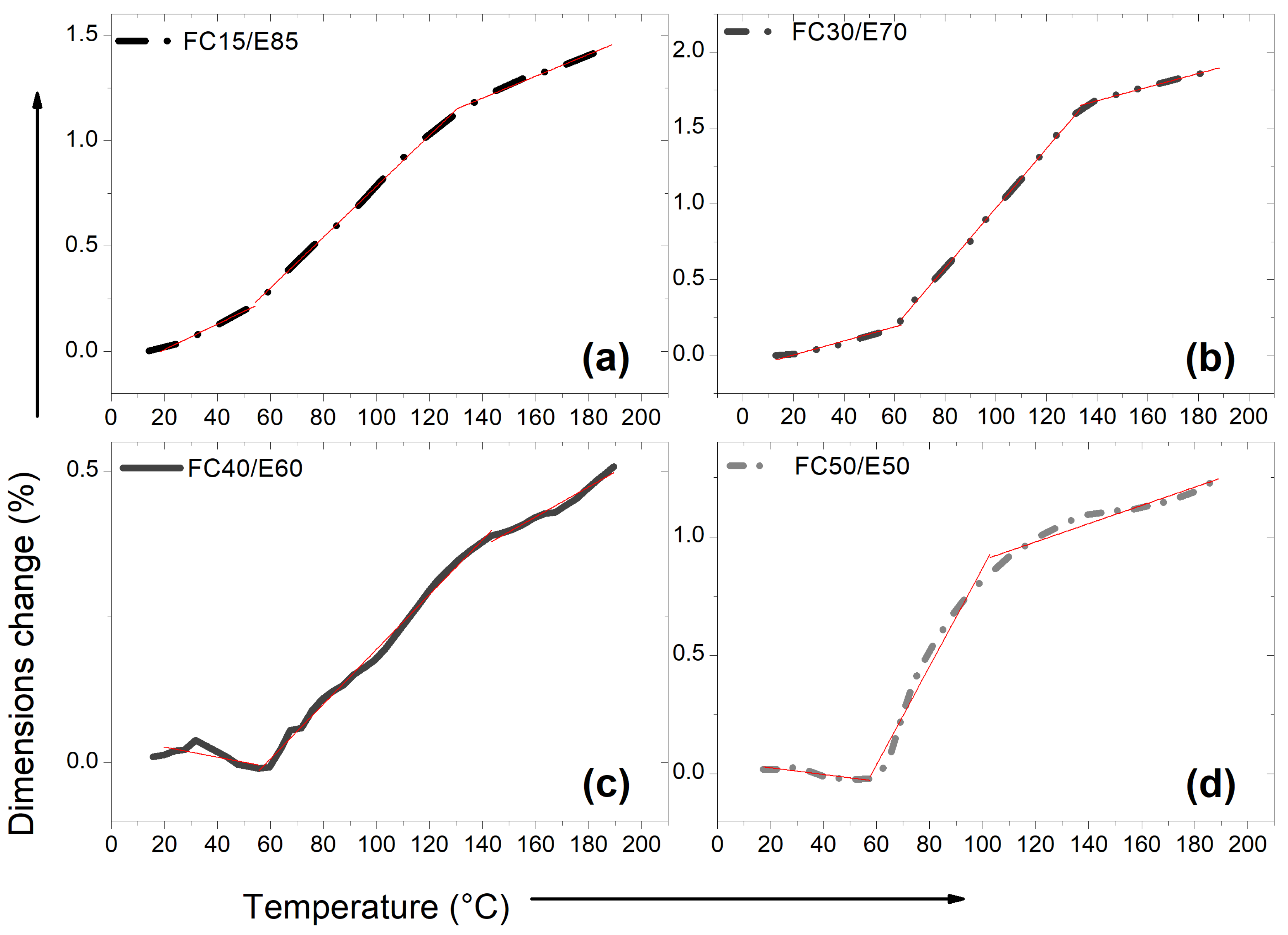
Figure 6 presents the TMA curves obtained for fique-fiber woven fabric-reinforced epoxy matrix composites. The glass transition temperatures were obtained by TMA (TgTMA) in the order of approximately 54 °C for FC15/E85, 62 °C for FC30/E70, 60 °C for FC40/E60 and 57 °C for FC50/E50. As the temperature increased, the material expanded slightly. All the thermal expansion curves were dispersed; however, the total variations were small, especially for FC40/E60, i.e., very close to the detection limit of the equipment; therefore, the reading accuracy decreased. The coefficient of linear thermal expansion (CLTE) obtained through three different temperature ranges is shown in Table 6.
Figure 6.
Dimensional change versus temperature change for (a) FC15/E85, (b) FC30/E70, (c) FC40/E60 and (d) FC50/E50.
Table 6.
The thermal expansion coefficients for fique-fiber woven fabric-reinforced epoxy composites.
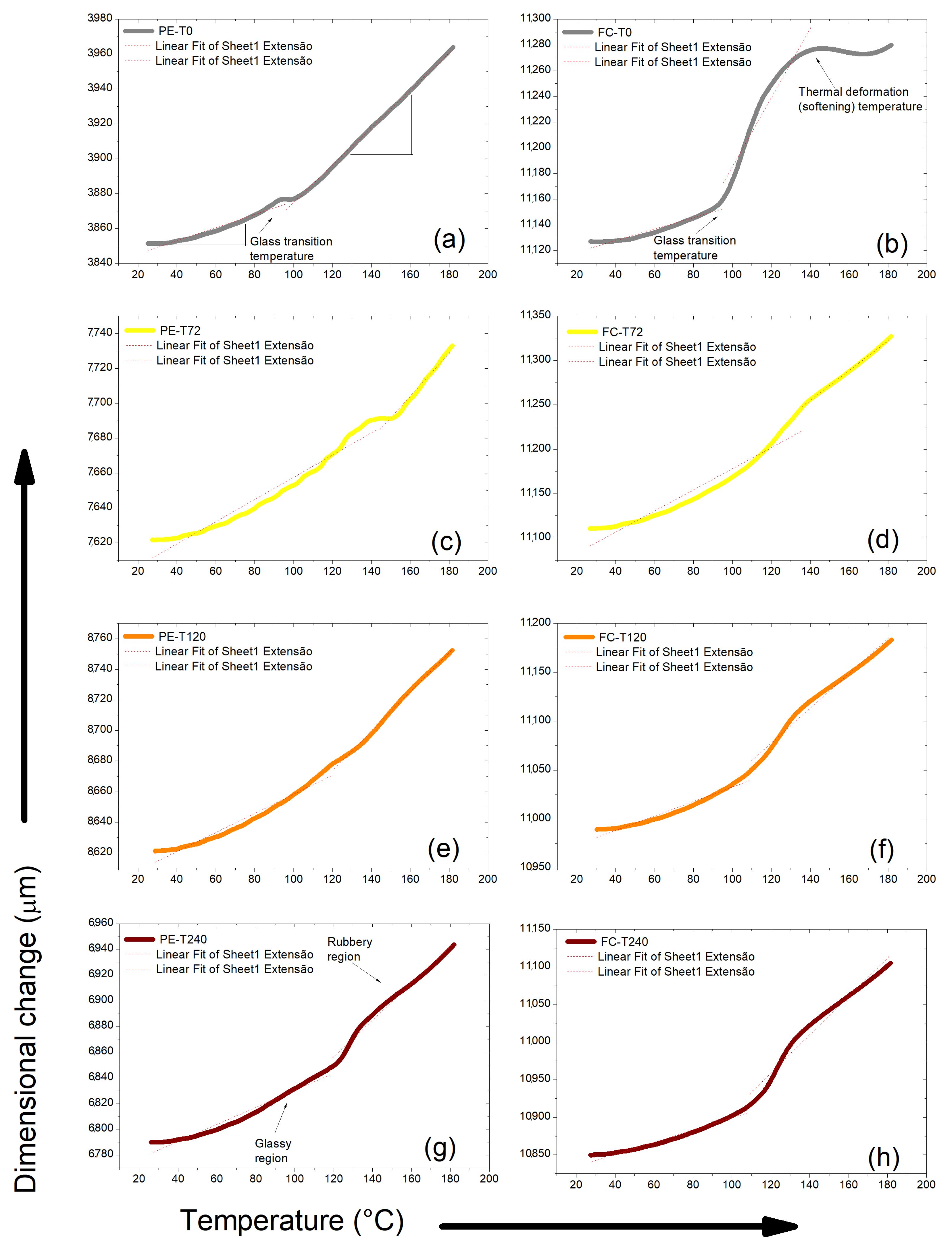
Figure 7 shows TMA curves for aged and non-aged DGEBA/TETA system and fique-fiber woven fabric-reinforced epoxy composites. The CLTE of the DGEBA/TETA system and fique-fiber woven fabric-reinforced epoxy composites were calculated by measuring their deformation within a specific or useful temperature range. Table 7 presents the data contained in Figure 7, in which all materials showed thermal expansion.
Figure 7.
Thermomechanical analysis (TMA) carried out on thermally aged and non-aged DGEBA/TETA system and fique-fiber woven fabric-reinforced epoxy composites: PE−T0 (a), FC−T0 (b), PE−T72 (c), FC−T72 (d), PE−T120 (e), FC−T120 (f), PE−T240 (g) and FC−T240 (h).
Table 7.
TgTMA and CLTE of thermally aged and non-aged DGEBA/TETA system and fique-fiber woven fabric-reinforced epoxy composites.
Increases in CLTEs were noted before and after TgTMA, both for PE-T0 and FC-T0, as well as after three periods of thermal aging. The TgTMA also increased after exposure to high temperatures. These increases may be related to the material stiffening. A peak observed at around 96–144 °C in the DGEBA/TETA system indicates the TgTMA of the epoxy matrix. As listed in Table 7, the CLTE above TgTMA of PE-T0 was 182 × 10 °C and this value decreased to 148 × 10 °C for PE-T120. This value was even smaller than that in the case of PE-240 (i.e., 187 × 10 °C).
In addition, composites are more sensitive to temperature variations as a result of thermal stresses induced between the fibers and polymeric matrix. This occurs due to the different CLTEs between the matrix and reinforcement material. At high temperatures, differential thermal expansion of the fiber and polymer matrix can lead to the formation of microcracks at the fiber/matrix interface, making it also susceptible to aggressive reactions, and leading to degradation of both fiber and matrix. This affects the integrity of composites, as it is through the interface that thermal and mechanical loads are transferred from the matrix to the fibers [50]. According to Chee et al. [51] each composite shows contraction and expansion in its dimension when subjected to temperature changes and is strongly influenced by the orientation and direction of the fibers.
3.3. Differential Scanning Calorimetry Analysis
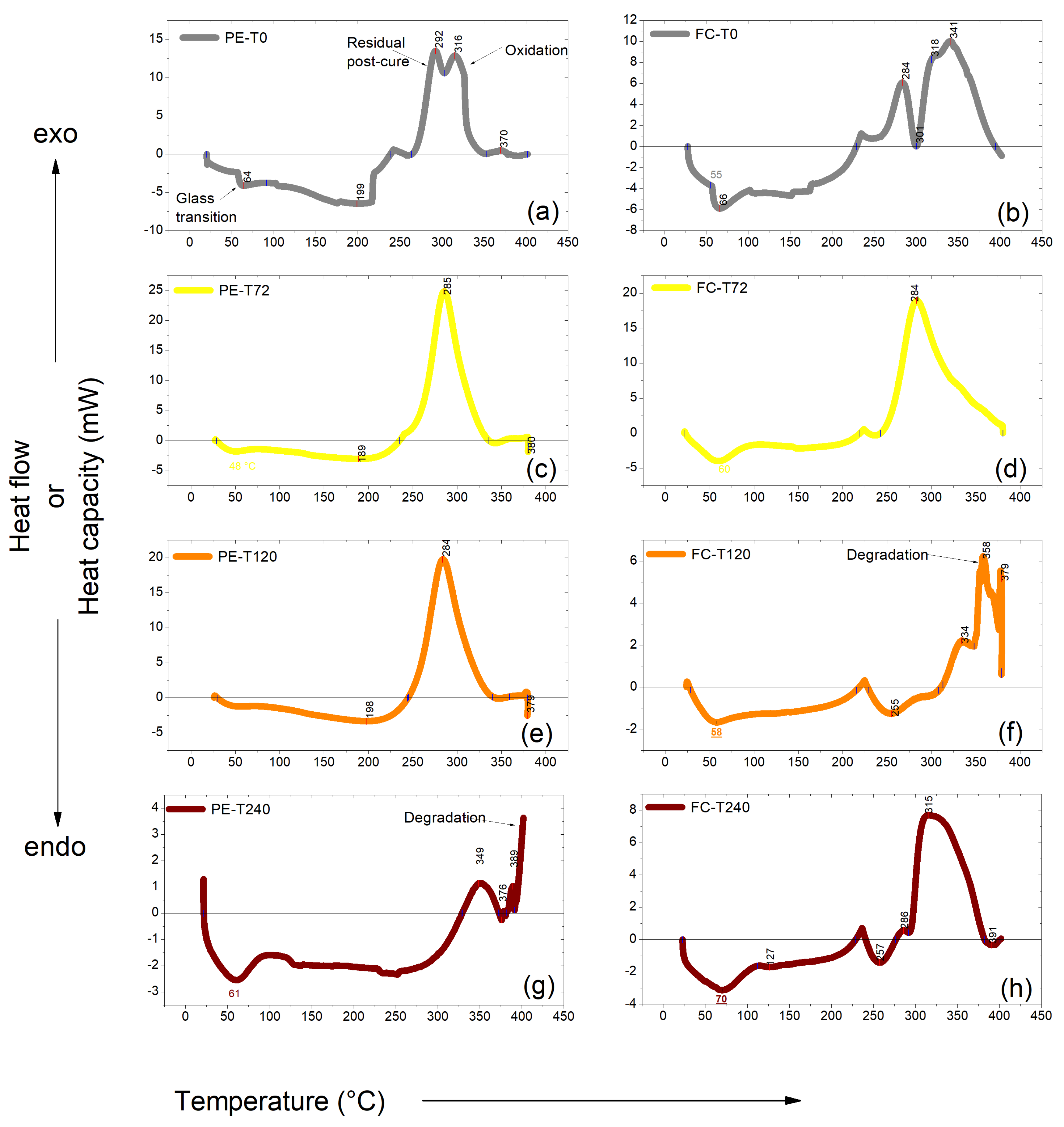
DSC curves of fique-fiber woven fabric-reinforced epoxy composites were presented in previously work [52]. It was suggested that the variation in the amount of natural fibers used for reinforcement did not affect the thermal stability of the composite, once any variation in enthalpy was observed. The DSC curves for aged and non-aged DGEBA/TETA system and fique-fiber woven fabric-reinforced epoxy composites are shown in Figure 8. In general, first-order transitions are observed as well defined peaks, while second-order transitions are variations in the heat flow curve [53]. The glass transition temperature determined by DSC (TgDSC) is observed as a slight change in the slope of the curve, and is shown in Figure 8 and described in Table 8.
Figure 8.
DSC curves of thermally aged and non-aged DGEBA/TETA system and fique-fiber woven fabric-reinforced epoxy composites: PE−T0 (a), FC−T0 (b), PE−T72 (c), FC−T72 (d), PE−T120 (e), FC−T120 (f), PE−T240 (g) and FC−T240 (h).
Table 8.
TgDSC and chemical reactions of thermally aged and non-aged DGEBA/TETA system and fique-fiber woven fabric-reinforced epoxy composites.
It can be seen that the TgDSC related to the DGEBA/TETA system was reduced after the first exposure to thermal aging, with an increase in TgDSC also being observed as exposure increased. The TgDSC of the composite had a reduction after the first exposure to thermal aging and the same trend was observed for the DGEBA/TETA system. Jesuarockiam et al. [54] observed the initial endothermic peak at around 60–70 °C and attributed it to epoxy TgDSC. PE-T240 showed a higher TgDSC value compared with the others. This was due to the presence of high NH groups that had accelerated the curing rate and extended more links to form higher dense polymer networks, and that resulted in high T [55].
The endothermic peak, which was more prominent for PE-T240, is related to moisture loss. It is possible to note that PE-T0 has several stress reliefs as temperature increases; these effects are reduced with exposure to high temperatures. As the temperature increases, the material gains enough energy and the microstructure is reorganized, displaying an exothermic peak at approximately 280 °C. It is important to point out that the double peaks, Figure 8a, at 292 °C and 316 °C, are related to residual/additional curing of the epoxy [10] and amine reactions [29]. At a higher temperature, the system has gained so much energy that the separation between the molecules is large enough to break the intermolecular interactions required for keeping the molecules together. The system lowers its viscosity and softening at around 370 °C [45]. An exothermic peak ranging from 284 to 349 °C was also observed and this peak is attributed to the effect of the curing of the DGEBA/TETA system, specifically related to decomposition of the aromatic epoxy and aliphatic amine hardener [54,56]. In the PE-T240 variant, displacement of the mentioned peak to a temperature of 349 °C is quite evident. And even in PE-T240 it is possible to notice a high reduction in energy flow compared to other conditions. The addition of further energy at higher temperatures, applied in PE-T240 before the analysis, produces the oxidative decomposition and degradation processes observed at 380 °C. The appearance of an exothermic peak at 389 °C, attributed to epoxy oxidation, and the final ascending of the DSC curve indicate sample degradation.
Figure 8 and Table 8 also present DSC curves obtained for the fique-fiber woven fabric-reinforced epoxy composite thermally aged for 72 h, 120 h and 240 h, and the control group. The endothermic peak, between 58 and 70 °C, can be attributed to moisture loss in the composite samples. It should be noted that this endothermic event was more prominent for samples exposed for the longest time to high temperatures, indicating a possible epoxy matrix weakening, facilitating entry of moisture, or even water, into the material structure. The first exothermic peak, at around 284 °C, was reduced with exposure to high temperatures. An exothermic peak was noted, approximately at 350 °C, indicating the beginning of hemicellulose degradation. It was expected that cellulose degradation would start to occur from 400 °C, also characterized by an endothermic event, but this was not observed. The second exothermic high, with a double peak, or even peak broadening, was observed in all composite samples, which may be related to fique-fiber degradation and DGEBA/TETA system oxidation. It stands out that the energy flow was greatly increased in the FC-T72 variant.
3.4. Colorimetry Analysis
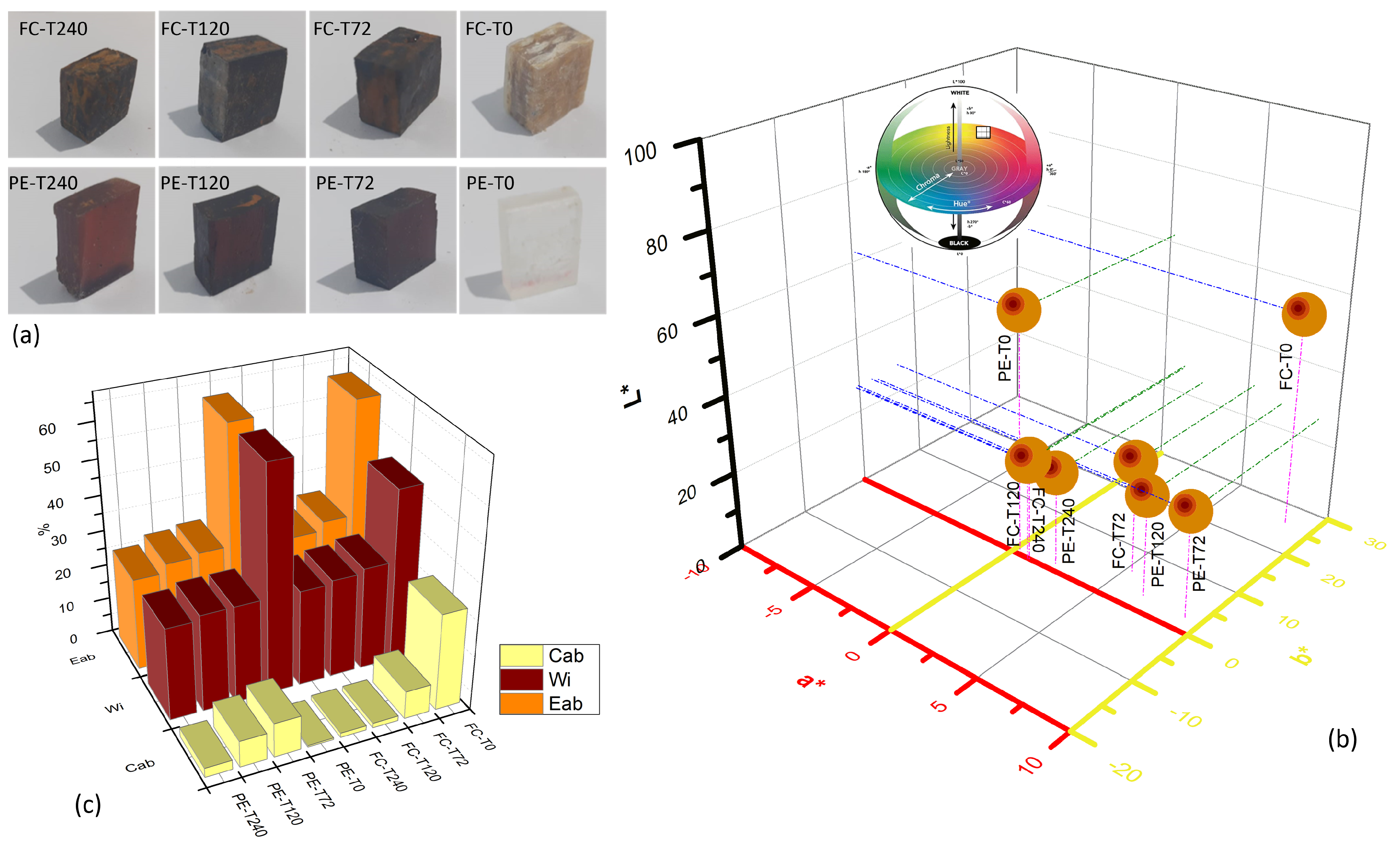
Figure 9a shows that the DGEBA/TETA system and fique-fiber woven fabric-reinforced epoxy composite became darker with increasing aging and treatment time. Taking the controls groups, PE-T0 and FC-T0, as a reference, the following colorimetric alterations can be seen. Figure 9b shows a reduction of approximately 44% in luminosity (L*) for PE-T72, 43% for PE-T120 and 41% for PE-T240. Regarding composites, the luminosity parameters have a greater reduction of 51% for FC-T72, 49% for FC-T120 and 47% for FC-T240. The parameter that varied the most was a*, especially for the DGEBA/TETA system, showing an increase of around 22 times for PE-T72, 17 times for PE-T120 and 6 times for PE-T240, indicating the samples reddening. The changes in parameter a* for the composite were equivalent to 61% for FC-T72, 14% for FC-T120 and 12% for FC-T240. The b* parameter, which indicates the samples yellowing in a positive direction, also showed an increase of 11 times for PE-T72, 10 times for PE-120 and 2 times for PE-T240.
Figure 9.
CIE L* a* b* colorimetric parameter values measured for the investigated aged and non-aged DGEBA/TETA system and fique-fiber woven fabric-reinforced epoxy composites: (a) specimen color changes, (b) changes in color coordinates of CIELAB, (c) main parameters during thermal aging.
The color changed exhibited the formation of a brownish layer at the sample surface [10]. As one can observe in Figure 9c, the E parameter increased after thermal aging for both DGEBA/TETA system and fique-fiber woven fabric-reinforced epoxy composites. This increase ranged between 41 and 46% compared to PE-T0, and between 43 and 48% compared to FC-T0. The whiteness index also showed an increase, in the range of 41–43% for the DGEBA/TETA system and 55–59% for the fique-fiber woven fabric-reinforced epoxy composites, both after thermal aging. The behavior of the chroma parameter (C) for the DGEBA/TETA system is highlighted, showing high variation. Increases were observed of 21 times for PE-T72, 16 times for PE-T120 and 5 times for PE-T240. In the study carried out by Masek and Latos-Brozio [57] with polyhydroxyalcaonate, chroma and brightness parameters were the most affected by aging. Significant color changes were observed by the authors after thermal aging combined with oxidation and they attributed this fact to the reaction of OH groups during oxidation.
4. Summary and Conclusions
In the present work, the thermal and colorimetric behavior of the non-aged and aged DGEBA/TETA system and epoxy composites reinforced with fiber fabric were, for the first time, investigated. The main conclusions are:
- TGA carried out on non-aged epoxy matrix composites reinforced with 15%, 30%, 40% and 50% fique-fiber woven fabric reinforcement showed a small weight loss (<4%) that occurred at a temperature around 100 °C. The greatest weight loss, around 59%, occurred between 260 °C and 400 °C for the FC40/E60 composite. The DTG curve showed a significant peak between 311 °C and 346 °C. Aged composites presented less intense initial peaks for the DGEBA/TETA system (plain epoxy), which proves the reinforcement effects of fique-fiber woven fabric. This is because the thermal properties of lignocellulosic fibers are mainly influenced by their composition, i.e., cellulose, hemicelluloses and lignin content.
- TMA performed for the non-aged composite of epoxy matrix reinforced with fique-fiber woven fabric showed a TgTMA between 54 and 62 °C. As the temperature increased, the material expanded slightly. All thermal expansion curves were dispersed but the total variations were small, mainly for FC40/E60. Additionally, aged composites are more sensitive to temperature variations as a result of thermal stresses induced between the fibers and the polymeric matrix. At high temperatures, the differential thermal expansion of the fiber and the matrix could lead to the formation of microcracks at the fiber/matrix interface, making it also susceptible to aggressive reactions, and to the degradation of both fiber and matrix.
- DSC analysis curves of thermally aged and non-aged DGEBA/TETA system and fique-fiber woven fabric-reinforced epoxy composites suggest that the variation in the amount of natural fibers used for reinforcement did not affect the thermal stability of the composite once any variation in enthalpy was observed. In PE-T240 it is possible to notice a high reduction in energy flow compared to other conditions. The addition of further energy at higher temperatures, applied in PE-T240 before the analysis, produces oxidative decomposition and degradation processes observed at 380 °C.
- Colorimetry analysis showed a reduction of approximately 40% in luminosity (L*). Regarding composites, the luminosity parameters have a greater reduction of 50%. Additionally, highlighting the chroma parameter for the DGEBA/TETA system, it showed high variation, 21 times for PE-T72, 16 times for PE-T120 and 5 times for PE-T240.
In summary, significant changes in the color of the DGEBA/TETA system and the fique-fiber woven fabric-reinforced epoxy composites were observed after thermal aging combined with a suggested oxidation. It was also observed that the thermal behavior of the DGEBA/TETA system showed greater resistance after thermal exposure. The composites, on the other hand, were more sensitive to temperature variations as a result of thermal stresses induced between the fique fibers and the epoxy matrix.
Author Contributions
Conceptualization, M.S.O. and S.N.M.; methodology, M.S.O. and S.N.M.; validation, M.S.O.; formal analysis, M.S.O., A.B.-H.d.S.F. and S.N.M.; investigation, M.S.O.; resources, S.N.M.; data curation, M.S.O.; writing—original draft preparation, M.S.O., A.C.P., J.d.S.C.d.C., N.M.M., H.A.C. and S.N.M.; writing—review and editing, M.S.O., A.B.-H.d.S.F. and S.N.M.; visualization, M.S.O. and A.B.-H.d.S.F.; supervision, A.B.-H.d.S.F. and S.N.M.; project administration, M.S.O., A.B.-H.d.S.F. and S.N.M. All authors have read and agreed to the published version of the manuscript.
Funding
This study was financed in part by the Coordenação de Aperfeiçoamento de Pessoal de Nível Superior—Brasil (CAPES)—process 151276/2022-6 and Fundação de Amparo à Pesquisa do Estado do Rio de Janeiro—Brasil (FAPERJ)—process E-26/202.045/2020.
Institutional Review Board Statement
Not applicable.
Data Availability Statement
The data presented in this study are available on request from the corresponding author.
Acknowledgments
The authors would like to thank the Brazilian agencies CNPq (Conselho Nacional de Desenvolvimento Científico e Tecnológico) and FAPERJ (Fundação de Amparo à Pesquisa do Estado do Rio de Janeiro) for their support, as well as the public institutions Institute of Macromolecules Professor Eloisa Mano at UFRJ (IMA), in the person of Livia Rodrigues de Menezes; Research Institute of the Brazilian Navy (IPqM), in the persons of Ana Paula da Silva, Maurício Ferrapontoff Lemos and Foluke Assis Salgado; and Military Institute of Engineering (IME), in the person of Fernanda Santos da Luz.
Conflicts of Interest
The authors declare no conflict of interest.
References
- Monteiro, S.; Drelich, J.; Colorado, H.; Nascimento, L.; Luz, F.; Silva, L.; Santos, J.; Garcia Filho, F.; Assis, F.; Lima, E., Jr.; et al. Natural Fibers Reinforced Polymer Composites Applied in Ballistic Multilayered Armor for Personal Protection—An Overview: An EPD Symposium in Honor of Sergio Monteiro. In Green Materials Engineering; Springer: Cham, Switzerland, 2019; pp. 33–47. [Google Scholar] [CrossRef]
- Hota, G.; Barker, W.; Manalo, A. Degradation mechanism of glass fiber/vinylester-based composite materials under accelerated and natural aging. Constr. Build. Mater. 2020, 256, 119462. [Google Scholar] [CrossRef]
- Koolen, G.; Soete, J.; van Vuure, A.W. Interface modification and the influence on damage development of flax fibre—Epoxy composites when subjected to hygroscopic cycling. Mater. Today Proc. 2020, 31, S273–S279. [Google Scholar] [CrossRef]
- Wei, J.; Meyer, C. Degradation rate of natural fiber in cement composites exposed to various accelerated aging environment conditions. Corros. Sci. 2014, 88, 118–132. [Google Scholar] [CrossRef]
- Birger, S.; Moshonov, A.; Kenig, S. The effects of thermal and hygrothermal ageing on the failure mechanisms of graphite-fabric epoxy composites subjected to flexural loading. Composites 1989, 20, 341–348. [Google Scholar] [CrossRef]
- Fan, W.; Li, J.; Zheng, Y.; Liu, T.; Tian, X.; Sun, R. Influence of thermo-oxidative aging on the thermal conductivity of carbon fiber fabric reinforced epoxy composites. Polym. Degrad. Stab. 2016, 123, 162–169. [Google Scholar] [CrossRef]
- Souza, C.; Marlet, J.; Moura, A.; Rezende, M. Estudo do comportamento térmico de laminados carbono/epóxi submetidos a múltiplos ciclos térmicos. Polímeros 2016, 26, 8–15. [Google Scholar] [CrossRef]
- Azwa, Z.; Yousif, B. Characteristics of kenaf fibre/epoxy composites subjected to thermal degradation. Polym. Degrad. Stab. 2013, 98, 2752–2759. [Google Scholar] [CrossRef]
- Pei, Y.; Wang, K.; Zhan, M.; Xu, W.; Ding, X. Thermal-oxidative aging of DGEBA/EPN/LMPA epoxy system: Chemical structure and thermal–mechanical properties. Polym. Degrad. Stab. 2011, 96, 1179–1186. [Google Scholar] [CrossRef]
- Oliveira, M.S.; da Luz, F.S.; da Costa Garcia Filho, F.; Pereira, A.C.; de Oliveira Aguiar, V.; Lopera, H.A.C.; Monteiro, S.N. Dynamic Mechanical Analysis of Thermally Aged Fique Fabric-Reinforced Epoxy Composites. Polymers 2021, 13, 4037. [Google Scholar] [CrossRef]
- Morsch, S.; Liu, Y.; Lyon, S.; Gibbon, S.; Gabriele, B.; Malanin, M.; Eichhorn, K.J. Examining the early stages of thermal oxidative degradation in epoxy-amine resins. Polym. Degrad. Stab. 2020, 176, 109147. [Google Scholar] [CrossRef]
- Balla, V.K.; Kate, K.H.; Satyavolu, J.; Singh, P.; Tadimeti, J.G.D. Additive manufacturing of natural fiber reinforced polymer composites: Processing and prospects. Compos. Part B Eng. 2019, 174, 106956. [Google Scholar] [CrossRef]
- Mei, J.; Tan, P.; Liu, J.; He, Z.; Huang, W. Moisture absorption characteristics and mechanical degradation of composite lattice truss core sandwich panel in a hygrothermal environment. Compos. Part A Appl. Sci. Manuf. 2019, 127, 105647. [Google Scholar] [CrossRef]
- Chateauminois, A.; Vincent, L.; Chabert, B.; Soulier, J. Study of the interfacial degradation of a glass-epoxy composite during hygrothermal ageing using water diffusion measurements and dynamic mechanical thermal analysis. Polymer 1994, 35, 4766–4774. [Google Scholar] [CrossRef]
- Dhakal, H.; Zhang, Z.; Richardson, M. Effect of water absorption on the mechanical properties of hemp fibre reinforced unsaturated polyester composites. Compos. Sci. Technol. 2007, 67, 1674–1683. [Google Scholar] [CrossRef]
- C, S.G.; Srinivas, G.R. Sisal/Coconut Coir Natural Fibers – Epoxy Composites: Water Absorption and Mechanical Properties. Int. J. Eng. Innov. Technol. (IJEIT) 2012, 2, 166–170. [Google Scholar]
- Krauklis, A.; Echtermeyer, A. Mechanism of Yellowing: Carbonyl Formation during Hygrothermal Aging in a Common Amine Epoxy. Polymers 2018, 10, 1017. [Google Scholar] [CrossRef] [PubMed]
- Behera, A.; Thawre, M.; Ballal, A. Hygrothermal aging effect on physical and mechanical properties of carbon fiber/epoxy cross-ply composite laminate. Mater. Today Proc. 2020, 28, 940–943. [Google Scholar] [CrossRef]
- Behera, A.; Vishwakarma, A.; Thawre, M.; Ballal, A. Effect of hygrothermal aging on static behavior of quasi-isotropic CFRP composite laminate. Compos. Commun. 2020, 17, 51–55. [Google Scholar] [CrossRef]
- Wang, X.; Petrů, M. Degradation of bending properties of flax fiber reinforced polymer after natural aging and accelerated aging. Constr. Build. Mater. 2020, 240, 117909. [Google Scholar] [CrossRef]
- Van den Oever, M.; Snijder, M. Jute fiber reinforced polypropylene produced by continuous extrusion compounding, part 1: Processing and ageing properties. J. Appl. Polym. Sci. 2008, 110, 1009–1018. [Google Scholar] [CrossRef]
- Abu-Sharkh, B.; Hamid, H. Degradation study of date palm fibre/polypropylene composites in natural and artificial weathering: Mechanical and thermal analysis. Polym. Degrad. Stab. 2004, 85, 967–973. [Google Scholar] [CrossRef]
- Scida, D.; Alix, S.; Buet, S.; Saidane, E.H.; Courmont, F.; Behlouli, K.; Rezak, A. Hygrothermal/UV Aging Effect on Visual Aspect and Mechanical Properties of Non-Woven Natural-Fiber Composites. J. Renew. Mater. 2019, 7, 865–875. [Google Scholar] [CrossRef]
- Belec, L.; Nguyen, T.; Nguyen, D.; Chailan, J. Comparative effects of humid tropical weathering and artificial ageing on a model composite properties from nano- to macro-scale. Compos. Part A Appl. Sci. Manuf. 2015, 68, 235–241. [Google Scholar] [CrossRef]
- Chen, D.; Li, J.; Ren, J. Influence of fiber surface-treatment on interfacial property of poly(l-lactic acid)/ramie fabric biocomposites under UV-irradiation hydrothermal aging. Mater. Chem. Phys. 2011, 126, 524–531. [Google Scholar] [CrossRef]
- Furtado, S.C.; Araújo, A.L.; Silva, A. Inverse characterization of vegetable fibre-reinforced composites exposed to environmental degradation. Compos. Struct. 2018, 189, 529–544. [Google Scholar] [CrossRef]
- Bazli, M.; Jafari, A.; Ashrafi, H.; Zhao, X.L.; Bai, Y.; Singh Raman, R. Effects of UV radiation, moisture and elevated temperature on mechanical properties of GFRP pultruded profiles. Constr. Build. Mater. 2020, 231, 117137. [Google Scholar] [CrossRef]
- Qin, J.; Jiang, J.; Tao, Y.; Zhao, S.; Zeng, W.; Shi, Y.; Lu, T.; Guo, L.; Wang, S.; Zhang, X.; et al. Sunlight tracking and concentrating accelerated weathering test applied in weatherability evaluation and service life prediction of polymeric materials: A review. Polym. Test. 2021, 93, 106940. [Google Scholar] [CrossRef]
- Biron, M. Chapter 4—Detailed accounts of thermoset resins for moulding and composite matrices. In Thermosets and Composites; Biron, M., Ed.; Elsevier Science: Oxford, UK, 2004; pp. 183–327. [Google Scholar] [CrossRef]
- de Vasconcelos Cardoso, A.L.; Mattos, J.M.M.; Rodrigues Júnior, J.C.J.; Pereira, I.M. Envelhecimento das fibras de aramida utilizada em coletes balísticos nível -III. Revista Militar de Ciência e Tecnologia 2011, 4, 22–27. [Google Scholar]
- Konarzewski, V.; Spiekemann, F.; Santana, R. Natural ageing of polyaramide fiber from ballistic armor. Polímeros 2019, 29, e2019002. [Google Scholar] [CrossRef]
- Monteiro, S.N.; Assis, F.S.d.; Ferreira, C.L.; Simonassi, N.T.; Weber, R.P.; Oliveira, M.S.; Colorado, H.A.; Pereira, A.C. Fique Fabric: A Promising Reinforcement for Polymer Composites. Polymers 2018, 10, 246. [Google Scholar] [CrossRef]
- Oliveira, M.S.; Pereira, A.C.; Da Costa Garcia Filho, F.; da Luz, F.S.; de Oliveira Braga, F.; Nascimento, L.F.C.; Lima, É.P., Jr.; da Cruz Demosthenes, L.C.; Monteiro, S.N. Fique Fiber-Reinforced Epoxy Composite for Ballistic Armor Against 7.62 mm Ammunition: An EPD Symposium in Honor of Sergio Monteiro. In Green Materials Engineering; Springer: Cham, Switzerland, 2019; pp. 193–199. [Google Scholar]
- Oliveira, M.S.; da Costa Garcia Filho, F.; Pereira, A.C.; Nunes, L.F.; da Luz, F.S.; de Oliveira Braga, F.; Colorado, H.A.; Monteiro, S.N. Ballistic performance and statistical evaluation of multilayered armor with epoxy-fique fabric composites using the Weibull analysis. J. Mater. Res. Technol. 2019, 8, 589–5908. [Google Scholar] [CrossRef]
- Oliveira, M.S.; Luz, F.S.d.; Lopera, H.A.C.; Nascimento, L.F.C.; Garcia Filho, F.d.C.; Monteiro, S.N. Energy Absorption and Limit Velocity of Epoxy Composites Incorporated with Fique Fabric as Ballistic Armor—A Brief Report. Polymers 2021, 13, 2727. [Google Scholar] [CrossRef] [PubMed]
- Callister Junior, W.D.; Rethwish, D.G. Ciência e Engenharia dos Materiais: Uma Introdução, 9th ed.; Wiley: Hoboken, NJ, USA, 2014; p. 990. [Google Scholar]
- Inamdar, A.; Yang, Y.H.; Prisacaru, A.; Gromala, P.; Han, B. High temperature aging of epoxy-based molding compound and its effect on mechanical behavior of molded electronic package. Polym. Degrad. Stab. 2021, 188, 109572. [Google Scholar] [CrossRef]
- E831-19; Standard Test Method for Linear Thermal Expansion of Solid Materials by Thermomechanical Analysis. American Society for Testing and Materials (ASTM): West Conshohocken, PA, USA, 2019.
- D3415; Standard Test Method for Transition Temperatures and Enthalpies of Fusion and Crystallization of Polymers by Differential Scanning Calorimetry. American Society for Testing and Materials (ASTM): West Conshohocken, PA, USA, 2015.
- ISO. Paints and Varnishes—Colorimetry—Part 3: Calculation of Colour Differences; International Organization for Standardization: Geneva, Switzerland, 2021. [Google Scholar]
- Bard, S.; Demleitner, M.; Weber, R.; Zeiler, R.; Altstädt, V. Effect of Curing Agent on the Compressive Behavior at Elevated Test Temperature of Carbon Fiber-Reinforced Epoxy Composites. Polymers 2019, 11, 943. [Google Scholar] [CrossRef] [PubMed]
- Thomason, J.L.; Nagel, U.; Yang, L.; Bryce, D. A study of the thermal degradation of glass fibre sizings at composite processing temperatures. Compos. Part A Appl. Sci. Manuf. 2019, 121, 56–63. [Google Scholar] [CrossRef]
- Pistor, V.; Soares, B.G.; Mauler, R.S. Influence of the Polyhedral Oligomeric Silsesquioxane n-Phenylaminopropyl—POSS in the Thermal Stability and the Glass Transition Temperature of Epoxy Resin. Polímeros Ciência E Tecnol. 2013, 23, 331–338. [Google Scholar] [CrossRef]
- Sánchez, G.F.G.; Lopez, R.E.G.; Osorio, A.M.R.; Arroyo, E.H. Fique as thermal insulation morphologic and thermal characterization of fique fibers. Cogent Eng. 2019, 6, 1579427. [Google Scholar] [CrossRef]
- Saba, N.; Jawaid, M. A review on thermomechanical properties of polymers and fibers reinforced polymer composites. J. Ind. Eng. Chem. 2018, 67, 1–11. [Google Scholar] [CrossRef]
- Poletto, M. Thermal degradation and morphological aspects of four wood species used in lumber industry. Rev. Árvore 2016, 40, 941–948. [Google Scholar] [CrossRef]
- Oliveira Silva, S.; Maria da Luz, S. Estudo da influência do tratamento e teor de fibras de coco e sisal nas propriedades térmicas de pré-impregnados de fibra natural/ epóxi. Rev. Interdiscip. De Pesqui. Em Eng. 2020, 6, 38–48. [Google Scholar]
- Guzman, C.; Bacterióloga, L.; Hernández, H.; Castro, L. Influence of Particle Size and Temperature on Methane Production From Fique’s Bagasse Influencia del tamaño de partícula y la temperatura sobre la producción de metano a partir del bagazo de fique. Iteckne 2012, 9, 72–77. [Google Scholar]
- Delvasto, S.; Toro Perea, E.; Perdomo, F.; Mejia, R. An appropriate vacuum technology for manufacture of corrugated fique fiber reinforced cementitious sheets. Constr. Build. Mater. 2010, 24, 187–192. [Google Scholar] [CrossRef]
- Ray, B.C.; Rathore, D. Durability and integrity studies of environmentally conditioned interfaces in fibrous polymeric composites: Critical concepts and comments. Adv. Colloid Interface Sci. 2014, 209, 68–83. [Google Scholar] [CrossRef] [PubMed]
- Chee, S.S.; Jawaid, M.; Sultan, M.; Alothman, O.Y.; Abdullah, L.C. Accelerated weathering and soil burial effects on colour, biodegradability and thermal properties of bamboo/kenaf/epoxy hybrid composites. Polym. Test. 2019, 79, 106054. [Google Scholar] [CrossRef]
- Oliveira, M.; Pereira, A.; Monteiro, S.; Da Costa Garcia Filho, F.; Demosthenes, L. Thermal Behavior of Epoxy Composites Reinforced with Fique Fabric by DSC. In Green Materials Engineering; Ikhmayies, S., Li, J., Vieira, C., Margem, J., de Oliveira Braga, F., Eds.; The Minerals, Metals and Materials Series; Springer: Cham, Switzerland, 2019; pp. 101–106. [Google Scholar] [CrossRef]
- Leyva-Porras, C.; Cruz-Alcantar, P.; Espinosa-Solís, V.; Martínez-Guerra, E.; Piñón-Balderrama, C.I.; Compean Martínez, I.; Saavedra-Leos, M.Z. Application of Differential Scanning Calorimetry (DSC) and Modulated Differential Scanning Calorimetry (MDSC) in Food and Drug Industries. Polymers 2020, 12, 5. [Google Scholar] [CrossRef] [PubMed]
- Jesuarockiam, N.; Jawaid, M.; Zainudin, E.S.; Thariq Hameed Sultan, M.; Yahaya, R. Enhanced Thermal and Dynamic Mechanical Properties of Synthetic/Natural Hybrid Composites with Graphene Nanoplateletes. Polymers 2019, 11, 1085. [Google Scholar] [CrossRef]
- Lakshmi, M.S.; Reddy, B. Development of Inter-Crosslinking Polymer Materials From DGEBA/PDMS- Epoxy Resin Systems: Processing And Application Study. Malays. Polym. J. 2023, 5, 84–98. [Google Scholar]
- Ignatenko, V.; Ilyin, S.; Kostyuk, A.; Bondarenko, G.; Antonov, S. Acceleration of epoxy resin curing by using a combination of aliphatic and aromatic amines. Polym. Bull. 2020, 77, 1519–1540. [Google Scholar] [CrossRef]
- Masek, A.; Latos-Brozio, M. The Effect of Substances of Plant Origin on the Thermal and Thermo-Oxidative Ageing of Aliphatic Polyesters (PLA, PHA). Polymers 2018, 10, 1252. [Google Scholar] [CrossRef]
Disclaimer/Publisher’s Note: The statements, opinions and data contained in all publications are solely those of the individual author(s) and contributor(s) and not of MDPI and/or the editor(s). MDPI and/or the editor(s) disclaim responsibility for any injury to people or property resulting from any ideas, methods, instructions or products referred to in the content. |
© 2023 by the authors. Licensee MDPI, Basel, Switzerland. This article is an open access article distributed under the terms and conditions of the Creative Commons Attribution (CC BY) license (https://creativecommons.org/licenses/by/4.0/).