


Abstract
The relaxation time and frequency spectra are vital for constitutive models and for insight into the viscoelastic properties of polymers, since, from the spectra, other material functions used to describe rheological properties of various polymers can be uniquely determined. In recent decades the non-integer order differential equations have attracted interest in the description of time-dependent processes concerning relaxation phenomena. The fractional Maxwell model (FMM) is probably the most known rheological model of non-integer order. However, the FMM spectrum has not yet been studied and used to describe rheological materials. Therefore, the goal of the present paper was to study the applicability of the relaxation spectrum of FMM to the description of the relaxation spectra of polymers. Based on the known integral representation of the Mittag-Leffler two-parameter function, analytical formulas describing relaxation time and frequency spectra of FMM model were derived. Monotonicity of the spectra was analyzed and asymptotic properties were established. Relaxation frequency spectrum grows for large frequencies with a positive power law, while the relaxation time spectrum decays for large times with a negative power of time. Necessary and sufficient conditions for the existence of the local extrema of the relaxation spectra were derived in the form of two trigonometric inequalities. A simple procedure for checking the existence or absence of the spectra extrema was developed. Direct analytical formulas for the local extrema, minima, and maxima are given in terms of model fractional and viscoelastic parameters. The fractional model parameters, non-integer orders of the stress and strain derivatives of FMM uniquely determine the existence of the spectrum extrema. However, the viscoelastic parameters of the FMM, elastic modulus, and relaxation time affect the maxima and minima of the relaxation spectra and the values of their local peaks. The influence of model parameters on their local extrema was examined. Next, the applicability of the continuous–discrete spectrum of FMM to describe Baumgaertel, Schausberger and Winter (BSW) and unimodal Gauss-like relaxation spectra, commonly used to describe rheological properties of various polymers, was examined. Numerical experiments have shown that by respective choice of the FMM parameters, in particular by respective choice of the orders of fractional derivatives of the stress and strain, a good fit for the relaxation modulus experiment data was obtained for polymers characterized both by BSW and Gauss-like relaxation spectra. As a result, a good approximation of the real spectra was reached. Thus, the viscoelastic relaxation spectrum of FMM, due to the availability of the two extra degrees of freedom (non-integer orders of the stress and strain derivatives), provides deep insights into the complex behavior of polymers and can be applied for a wide class of polymers with unimodal relaxation spectra.
1. Introduction
For several decades, apart from the classical integer-order differential models, fractional order rheological models have been widely adopted to describe the combined elastic and viscous properties of various polymers. In fractional calculus the operations of integration and differentiation are of non-integer (fractional) order [1]. Theoretical studies have been devoted to the study of fractional-order rheological models, e.g., [2,3,4,5,6] and their application to the description of polymers, for example, poly-isobutylene [4], polyurea and PET [6], shape memory polymers [7], amorphous polymers [8], and flax fiber reinforced polymer [9].
The viscoelastic behavior of polymers varies depending on the type of polymer [10,11], therefore different fractional models have been and are still being developed. Exponential relaxation is often modeled by classic or fractional Maxwell models [2,3]. When the Debye decays show deviations from Maxwell models, solutions can be approximated by the exponential stretched Kohlrausch–Williams–Watts (KWW) model [12,13]. To approximate non-exponential relaxation, inverse power-laws were also used [14,15,16,17]. Simultaneously, the relaxation processes described by fractional Maxwell model can be fitted by asymptotic power-law for small and large times [3,18], while the KWW model fits fractional Maxwell model for short times [3]. Fractional viscoelasticity, a new formalism introduced for mathematical modeling of rheological materials [14], appears to be a solid tool to describe the relaxation processes in polymers exhibiting both exponential and non-exponential type. Fractional order models have gained research interest due to their improved flexibility and better adjustment of their time-dependent properties, compared to those offered by their classic, integer order, counterparts.
Fractional Maxwell and Kelvin–Voight models are probably the most known fractional rheological models, similarly as for integer order differential viscoelastic models [2,4,5]. However, a deep insight into the complex behavior of polymers was also provided by the viscoelastic relaxation spectrum [11,19,20]. The relaxation spectrum is vital for constitutive models and for the insight into the properties of a viscoelastic material, since from the relaxation spectrum other material functions used to describe rheological properties of the material can be uniquely determined. Therefore, the spectrum is commonly used to describe, analyze, compare, and improve the mechanical properties of polymers [20,21,22,23,24].
However, there are no papers concerning the relaxation spectra of the fractional order viscoelastic models, even the fractional Maxwell model (FMM). Although Mainardi [4,25] and Mainardi and Spada [5] gave a spectral representation of the product of the Mittag-Leffler one-parameter function and power of time that provides the solution to the fractional Maxwell model with identical orders of the stress and strain derivatives, it can be directly related to the niche the definition of the relaxation spectrum as the inverse Laplace transform of the linear relaxation modulus. The possibility of using the FMM relaxation spectrum for modelling the relaxation spectra of polymers has not been studied so far. Thus, the determination and investigation of the relaxation spectrum of FMM is still an open issue.
Therefore, determination of the relaxation spectra of FMM, their analysis, and studying the applicability of these spectra to description of the relaxation spectra of polymers were the goals of the present paper.
First, starting from the known integral representation of the Mittag-Leffler two-parameter function, the relaxation time and frequency spectra of the fractional Maxwell model were derived in the form of direct analytical formulas. Next, the monotonicity of the spectra was analyzed, and asymptotic properties were established. Necessary and sufficient conditions for the existence of the local extrema of the relaxation spectra were derived in the form of two trigonometric inequalities. Also, some necessary conditions for the local extrema existence were given in the form of simpler inequalities. A fast procedure for checking the existence or not of the spectra extrema was presented based on the necessary and sufficient extreme conditions. Direct analytical formulas for the local extrema, minima and maxima were given in terms of model fractional and viscoelastic parameters. The fractional model parameters, namely non-integer orders of the stress and strain derivatives of FMM, uniquely determine the existence of the spectrum extrema. However, the local maxima and minima also depend on the relaxation time of FMM, and the values of the local extrema are affected by the elastic modulus of FMM.
Next, the applicability of the continuous spectrum of FMM to describe Baumgaertel, Schausberger, and Winter (BSW) [26,27] and Gauss-like relaxation spectra was examined. The BSW spectrum is often used to describe rheological properties of various polymers; for example, polydisperse polymer melts [28,29], polymethylmethacrylate (PMMA) and polybutadiene (PBD) [30], and polymer pelts [31]. Gauss-like distributions were used to describe rheological properties of, e.g., poly(methyl methacrylate) [32], polyethylene [33], native starch gels [34], polyacrylamide gels [35], and carboxymethylcellulose [36].
Numerical studies were conducted, and a good approximation of the real spectra was reached. Thus, the viscoelastic relaxation spectrum of FMM can be applied for a wide class of polymers with unimodal relaxation spectra. The applicability of the relaxation spectra of fractional order viscoelastic models to the description of multimodal spectra will be the subject of future research, with particular attention to bimodal spectra.
In Appendix A, the proofs and derivations of some mathematical formulas are given to increase the clarity of the article.
2. Materials and Methods
2.1. Maxwell Model
Classic viscoelastic Maxwell model is the arrangement of ideal spring in a series with a dashpot (see Figure 1a) described by the first order differential equation [11,37]:
where and denote the stress and strain, respectively, is the elastic modulus of the spring, and means the viscosity of the dashpot. Assuming unit-step strain the uniaxial stress response of Maxwell model (1), i.e., the time-dependent relaxation modulus , has exponential type given by [11,37]
with the relaxation time .
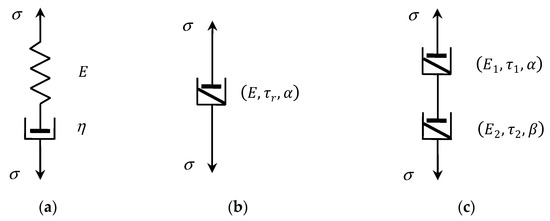
Figure 1.
(a) Classic Maxwell model; (b) fractional Scott-Blair model of a non-integer positive order ; (c) fractional Maxwell model; elastic modulus , , , viscosity , relaxation times , , .
2.2. Elementary Fractional Scott-Blair Model
Elementary fractional Scott-Blair model [2,4,38] is described by the fractional differential equation:
where is non-integer positive order of fractional derivative of the strain . Here, means the fractional derivative operator in the sense of Caputo’s fractional derivative of a function of non-integer order with respect to variable and with a starting point at , which is defined by [1,4]:
where and is Euler’s gamma function [1] (Equation (A.1.1)).
Assuming unit-step strain , the uniaxial stress response of fractional element (2) is given by [2,4,38]:
i.e., is represented by power of time law.
The fractional Scott-Blair model is an intermediate model between ideal spring and the Newton’s model of ideal fluids represented by means of an ideal dashpot of viscosity . The elementary fractional element (2) is uniquely described by three parameters , as shown in Figure 1b. The first material described in 1944 by Scott-Blair and Veinoglou [39] using the fractional inverse power model (3) was bitumen. Following that, the inverse power-laws with various exponents were used for modelling many relaxation processes which have been reviewed by Bonfanti et al. [14]. Winter and Chambon [40] derived a power-type relaxation modulus with an exponent of −1/2 for cross-linking polymers at their gel point, which were used to analyze polydimethylsiloxane gel data. Likhtman and McLeish [15], studying the stress relaxation dynamics of linear entangled polymers (polystyrene and polybutadiene), dismissed the BSW dynamics and applied multiplicative exponential-power-laws models. Similar models were applied by Kapnistos et al. [16] for modelling the stress relaxation for entangled ring polymers which have a characteristic entanglement plateau.
2.3. Fractional Maxwell Model
Connecting in a series, by analogy to classic Maxwell model, two elementary fractional Scott-Blair elements and , see Figure 1c, we obtained fractional Maxwell model (FMM) described by the fractional differential equation [2,4,38]:
where the parameters and are uniquely defined by the model components parameters according to [18]:
For details of model (4) construction see, for example, [2,18]. The relaxation modulus of FMM (4) is known for an arbitrary and given by the formula [2,4,5]:
where is the generalized two-parameter Mittag-Leffler function defined by series representation, convergent in the whole z-complex plane [1,2]:
The fractional Maxwell model (4) is uniquely defined by four parameters , while the classic Maxwell model (1) is defined by only two parameters , or equivalently .
2.4. Spectrum of Relaxation
In rheology, it is commonly assumed that the relaxation modulus has the following integral representation [11,19]:
or, equivalently, by [11]
where and characterize the distributions of relaxation times and relaxation frequencies , respectively. Equations (7) and (8) yield the formal definitions of the relaxation spectra [11,19], which are related by . Although other definitions of the relaxation spectrum are used in the literature, for example, in [4,21,24,25], the definitions introduced by (7) and (8) dominate.
3. Results and Discussion
In this section, the relaxation spectra of the fractional Maxwell model (4) are derived based on the known integral representation of two-parameter Mittag-Leffler function. Next, the monotonicity of the spectra was analyzed, with a special emphasis on the existence of the spectra local extrema. The analysis of the relaxation spectra monotonicity can be reduced to the painstaking analysis of the properties and roots of some cubic function (third order polynomial), whence it has been moved to appendices, where the proofs of most results are given. The necessary and sufficient conditions for the existence of the spectra extrema are derived in the form of two algebraic trigonometric inequalities. Asymptotic properties of the spectra are also examined. A simple scheme for the examining of spectra peaks existence and their determination is outlined. Due to the different forms of spectrum description, two complementary cases, when and , were studied separately. Direct analytical formulas for the local extrema, minima, and maxima are derived. The influence of FMM parameters on the spectra extrema was investigated by combining analytical and numerical approaches. Finally, the applicability of the relaxation spectra of FMM for describing the unimodal spectra was examined; both Gauss-like and Baumgaertel, Schausberger, and Winter spectra were studied.
3.1. Relaxation Spectra of the Fractional Maxwell Model
In [1], the following representation of two-parameter Mittag-Leffler function (6) was obtained for complex variable such that , and [1] (Theorem 4.18, Equation (4.7.17)):
where the kernel function [1] (Equation (4.7.15)):
Based on (9) and (10), the following result is derived in the Appendix A.1.
Proposition 1.
Let . Then the relaxation time spectrum of the fractional Maxwell model (4) is given by:
or equivalently by
while the spectrum of relaxation frequencies is as follows
The last formula can also be obtained by anti-transforming of the Laplace transform of (5) by using the complex Bromwich formula as outlined, for example, by Mainardi [4,25] for one parameter Mittag-Leffler function.
Since undertaken assumptions and are nonnegative and the expressions from the denominators of (11) and (13) can be expressed in a common compact form
where ,
the spectra and are nonnegative definite, regardless of the sign of . A few exemplary relaxation spectra (13) and (11) are shown in Figure 2 for different parameters and ; the logarithmic scale is applied for the frequencies and times axis. It is seen that the type of their monotonicity depends on parameters α and , thus on the orders of the stress and strain derivatives in FMM (4). Below, a detailed analysis of the spectra monotonicity is performed, starting with the boundary conditions at and and their asymptotic properties.
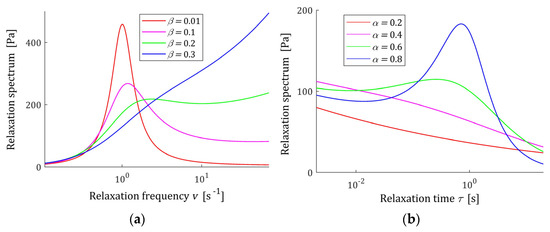
Figure 2.
The spectra of the fractional Maxwell model (4) for elastic modulus , relaxation time : (a) relaxation frequency spectrum (13) for and (b) relaxation time spectrum (11) for and the other parameters , shown in the plots.
Previously, an analytical formula for the relaxation spectrum was obtained for fractional Maxwell model with identical orders of the stress and strain derivatives by Mainardi [4,25] using the complex Bromwich formula to invert the Laplace transform of (5) and bending the Bromwich path into the Hankel path. However, this formula, the properties of which were examined in [41], was derived for another definition of the relaxation spectrum.
3.2. Relaxation Spectra of Elementary Fractional Scott-Blair Model
From (3) and (8), by the Laplace transform pair [1] (p. 311)
the relaxation frequency spectrum of (2) is obtained
whence the relaxation time spectrum is as follows
Fixing and sending to , by Equation (13), we obtain
as , whereas, by the reflection equation [1] (Equation (A.1.13))
the formula follows
Simultaneously, as Equation (2) results in
the relaxation spectrum of which, in view of (14), is described by the right-hand side expression of (16). The power nature of the relaxation modulus (3) and the relaxation spectra (15) and (14) characterize the viscoelasticity of many materials; examples are given in [14]. Combined power models may be necessary for complex polymers. Saphiannikova et al. [17] proposed a versatile multi-scale theoretical approach for modelling viscoelasticity of the homogenous rubbers, taking into account relaxation processes at different relaxation time intervals. A four-interval power model with fractional exponents was designated in [17] for a solution-polymerized styrene butadiene rubber.
3.3. Monotonicity of the Relaxation Spectra
The boundary conditions are characterized by the next proposition derived in Appendix A.2.
Proposition 2.
Let . Then the relaxation frequency spectrum (13) of the fractional Maxwell model (4) is such that
while for the relaxation time spectrum (11) we have
Both spectra are unbounded. Relaxation frequency spectrum tends, with increasing frequency , to infinity; however, in view of (A4), the exponent of the power of frequency is equal to , i.e., is smaller than one. A few characteristics (13) are shown in Figure 3 for two different relaxation frequency range, fixed and five values of . However, in view of (18), from a mathematical point of view, spectrum tends to infinity with growing , and for physically sensible values of the relaxation frequency, the characteristic takes a finite value of the order of .
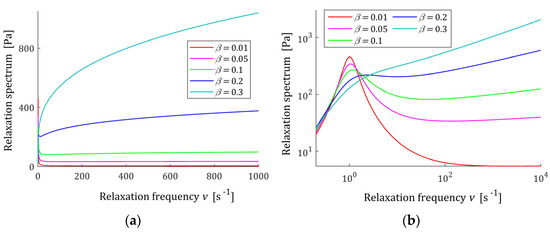
Figure 3.
Relaxation frequency spectrum (13) of the fractional Maxwell model (4) for , , elastic modulus , relaxation time and frequency range , where (a) and (b) .
Relaxation time spectrum is unbounded in the near neighborhood of zero and, in view of (11), with increasing relaxation time decays to zero with a negative power law .
The monotonicity properties of both spectra are given below. Models (11) and (13) are described in terms of the following coefficients defined by the model parameters:
Under the assumption , the two first parameters are such that and , while the sign of depends on specific values of and . The following coefficients are also defined
to simplify further notations. Using standard trigonometric identities, coefficients and are expressed as explicit functions of and according to:
Thus, under taken assumption the coefficient , but the sign of coefficient depends on the relationship between the parameters and .
The following property, fundamental for the analysis of the spectra monotonicity, results from the comparison of (12) and (13). For a mathematical justification, see Appendix A.3.
Property 1.
Let . The relaxation frequency spectrum (13) has a local maximum for relaxation frequency and a local minimum for frequency , if and only if the relaxation time spectrum (11) has a local maximum for the time and a local minimum for . Spectrum is a monotonically increasing function if and only if spectrum monotonically decreases.
Thus, the monotonicity of spectrum uniquely determines the monotonicity of spectrum , and vice versa. The first simple, useful, necessary but not sufficient condition for the existence of local extrema of and is proved in the Appendix A.4.
Proposition 3.
Let . If the relaxation time (11) and frequency (13) spectra of the fractional Maxwell model (4) have local extrema for some times and frequencies , then the coefficient , i.e., the following inequality holds
Thus, if inequality (28) is not satisfied, then by simple contradiction, relaxation spectra (13) and (11) are, respectively, monotonically increasing and decreasing functions. Inequality (28) implies the next, weaker, necessary condition of the existence of the spectra local extrema, namely, the requirement that .
It is demonstrated in Appendix A.5 that the further analysis, concerning the existence of the spectra extrema is convenient to carry out separately in two different cases when is equal to one, or not. The analysis begins with the second case.
3.4. Analysis of the Relaxation Spectra Monotonicity for
Bearing in mind Proposition 3, assume for further analysis that . The existence of the spectra local extrema is uniquely resolved by the following necessary and sufficient condition proved in Appendix A.6.
Proposition 4.
Let be such that . The relaxation time (11) and frequency (13) spectra of the fractional Maxwell model (4) have local minima and maxima for positive arguments if and only if
where the coefficients , , and are defined by (21), (22), (24), and (25), respectively. In the opposite case, when the inequality
holds, then the relaxation frequency spectrum (13) is monotonically increasing function, while the relaxation time spectrum (11) is monotonically decreasing.
Since for the denominators in all fractions of the right-hand side of inequality (29) are positive, this inequality can be rewritten in a more useful way for numerical verification in an equivalent form
where
From the above proposition, in particular from inequality (29), the next necessary condition for existence of the spectra local extrema follows; for derivation see Appendix A.7.
Proposition 5.
Let be such that . If the relaxation frequency (13) and time (11) spectra of the fractional Maxwell model (4) have local extrema for some frequencies and times , then the following inequality holds
where the coefficients , , and are defined by (21), (24), and (25), which can be expressed in equivalent form
From Propositions 3, 4, and 5, the following simple scheme was followed to check if there were local extrema of the relaxation spectra for given parameters and .
- Check if the inequality , or equivalent (28), holds. If yes, go to step 2. Otherwise, go to step 4.
- Check if the inequality (33), or equivalent (34), holds. If yes, go to step 3. Otherwise, go to step 4.
- Check if the inequalities and (29), or equivalent (31), hold. If yes, a local extrema of both spectra and exists. Otherwise, go to step 4.
- Spectrum is a monotonically increasing function for all , while spectrum is a monotonically decreasing function for all .
Checking in steps 1 and 2, if , equivalently (28), and next (33), hold, avoids verification of the necessary and sufficient condition (29) in the case when they are not satisfied.
Both the necessary and sufficient conditions are formulated in terms of the and parameters; they do not depend on the rheological model parameters E and . The sets of the derivative order parameters and for which the necessary conditions (28) and (33) hold are depicted in Figure 4, together with the set of all parameters and , for which the local extrema of the spectra exist. As can be seen, the necessary and sufficient condition (33) of Proposition 5 is a good approximation of the necessary and sufficient conditions of the extrema existence specified by Proposition 4.
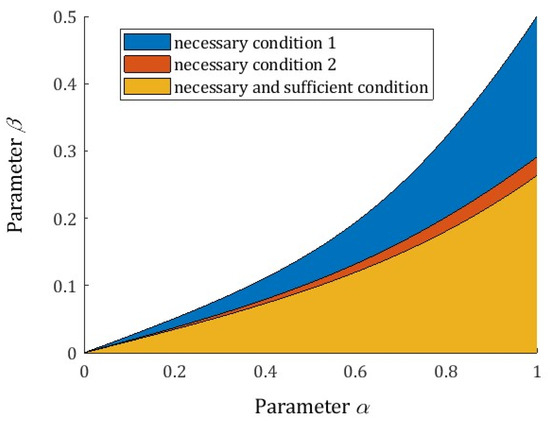
Figure 4.
The sets of the derivative orders parameters and fulfilling the necessary and sufficient conditions for the existence of the local extrema of the relaxation spectra (13) and (11) of the fractional Maxwell model (4): necessary condition 1— (equivalently (28)), necessary condition 2—(33) and necessary and sufficient conditions and (29).
Below, the spectra extrema are determined and examined, separately, for and .
3.5. Extrema of the Relaxation Spectra for
The following property results directly from Property 1 and the proofs of Propositions 3 and 4.
Proposition 6.
Let the parameters and be such that inequalities , and (29) are satisfied. Then:
- (i)
- The relaxation frequency spectrum (13) of the fractional Maxwell model (4) has the local maximumand the local minimum given bywhen the inequality holdsand equal toin the case opposite to inequality (37), wherewithand the angle defined bywhere the coefficients , , , and are defined by (21), (22), (24), and (25), respectively, . denotes signum function.
- (ii)
- The relaxation time spectrum (11) has the local maximumand the local minimum given bywhen the inequality (37) holds, while in the opposite case equal to
The relaxation time affects the -independent extrema , , , and . Dependence of the extrema on and is illustrated by the following figures. Figure 5a,b shows the local minimum (45), (46), and maximum (44) for 0< β < α < 1; for and such that spectrum monotonically decreases, the plot is equal to zero. The colors are specified by color bar added to the right. Figure 5c,d illustrate for the range of variation of (35) and (36), (38) as functions of and varying from the values close to zero to that on the order of 106 and 1029, respectively. Dependence of (35) and (36), (38) on parameter for a few is depicted, separately, in Figure 6. However, from a practical point of view, mainly is important, and this varies within the frequencies for which the real spectra peaks occur. The selection of parameters and , and even only for a given , allows us to shape the spectrum whose maximum peak varies in a very wide range of frequencies.
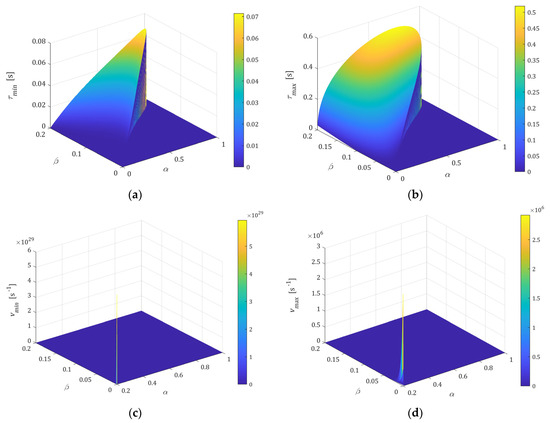
Figure 5.
The local extrema of the relaxation spectra: (a) minimum (45), (46), and (b) maximum (44) of relaxation time spectrum (11) for parameters ; (c) minimum (36), (38), and (d) maximum (35) of the relaxation frequency spectrum (13) for parameters . Fixed relaxation time . For and , such that spectrum monotonically increases, the plot is equal to zero.
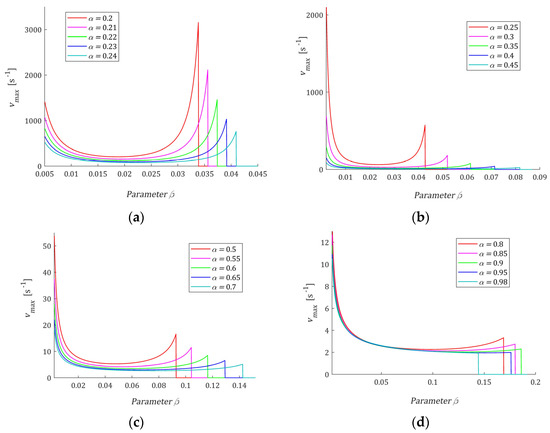
Figure 6.
The local maximum (35) of the relaxation frequency spectrum (13) as a function of parameter for for: (a) α = 0.2, 0.21, 0.22, 0.23, 0.24; (b) α = 0.25, 0.3, 0.35, 0.4, 0.45; (c) α = 0.5, 0.55, 0.6, 0.65, 0.7; (d) α = 0.8, 0.85, 0.9, 0.95, 0.98; for α and β, such that spectrum H(v) monotonically increases, the plot is equal to zero. Relaxation time .
The course of the spectrum (11) is illustrated by Figure 7. In Figure 7a, the spectrum is depicted for a few values of for fixed parameter , while in Figure 7b parameter is fixed and the spectrum’s dependence on changing is illustrated. In Figure 8 the relaxation frequency spectra (13) are given for other values of fixed parameters and . The non-integer orders and uniquely determine the existence or absence of local extrema of the relaxation spectra of the FMM model and, together with the relaxation time , the values of local minima and maxima. The smaller the is the higher their local maxima, and the more concise their peaks are. Conversely, the greater the , the higher the maxima and the more pointed peaks.
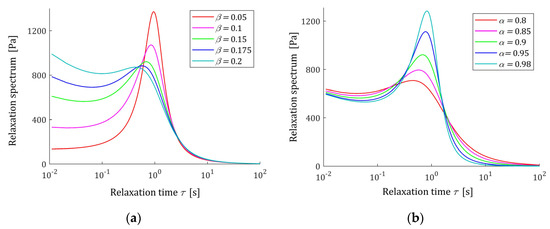
Figure 7.
Relaxation time spectrum (11) of the fractional Maxwell model (4) for: (a) and ; (b) and . Elastic modulus , and relaxation time .
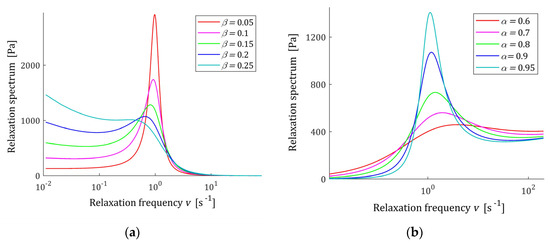
Figure 8.
Relaxation frequency spectrum (13) of the fractional Maxwell model (4) for: (a) and ; (b) β = 0.11 and . Elastic modulus , and relaxation time .
3.6. Analysis of the Relaxation Spectra Monotonicity for
For , the relaxation spectrum (11) is given by
or according to (12) by the formula
while, by (13), spectrum is described by
For , by (26), the necessary condition for the existence of the extrema specified in Proposition 3, i.e., , is equivalent to
i.e., is fulfilled whenever .
The monotonicity of the spectra is resolved by the next result proved in Appendix A.8. The necessary and sufficient conditions for the existence of local extrema and formulas describing them are given.
Proposition 7.
Let and α = 1. The spectra of relaxation frequencies (49) and times (47) of the fractional Maxwell model (4) have local minima and maxima for positive arguments, if and only if parameter is such that the following inequality holds
Then:
- (i)
- The relaxation frequency spectrum (49) has the local maximumand the local minimum given by
- (ii)
- The relaxation time spectrum (47) has the local maximumand the local minimum given byIf is such that inequality (50) does not hold, then (47) and (49) are monotonically decreasing and increasing functions, respectively.
A complete set of for which the necessary and sufficient condition (50) holds is as follows: .
3.7. Extrema of the Relaxation Spectra for
The frequencies , and the times , are uniquely determined by and . The extrema as functions of the parameter are shown in Figure 9 for satisfying the necessary and sufficient condition (50); the relaxation time is assumed. In Figure 9b, for , the logarithmic scale is applied. The peak frequency increases with increasing frequency, therefore decreases. Decreasing with increasing , means that spectrum (49) increases monotonically to infinity for lower relaxation frequencies. In turn, being smaller with increasing times means that spectrum (47) decreases faster for relaxation times smaller than .
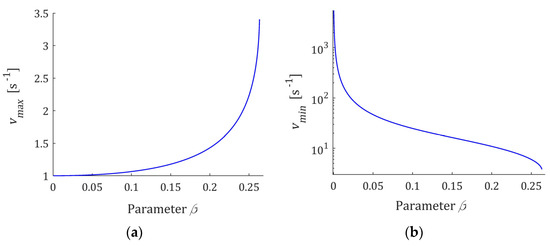
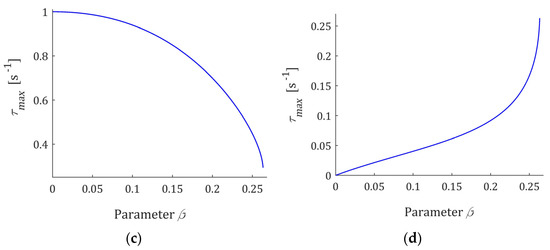
Figure 9.
The local extrema: (a) (51); (b) (52); (c) (53); (d) (54) of the relaxation frequency (49) and time (47) spectra as the functions of parameter fulfilling the necessary and sufficient condition (50). Relaxation time .
Since, in view of (51) and (53), , by (49) and (48), the equality holds. Similarly, . By (51) and (49), the local maximum of the spectra is as follows
while, in view of (52), local minimum is given by
Thus, for the quotient
monotonically decreases, from infinity to one. The maxima (55) and minima (56) are uniquely determined by and elastic modulus . Since they are proportional to , only the dependence on parameter is illustrated in Figure 10 for fixed ; a logarithmic scale was used for the vertical axis.
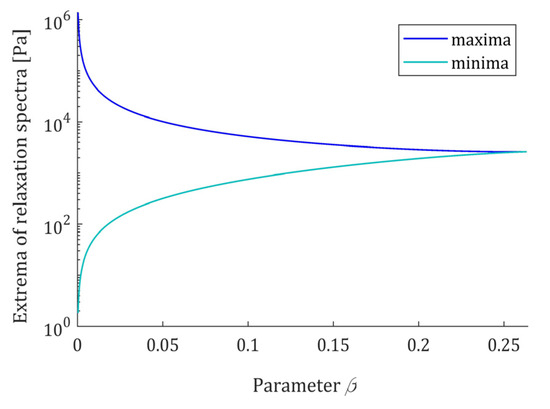
Figure 10.
The local maxima (55) and minima (56) of the relaxation spectra (49) and (47), as the functions of parameter fulfilling the necessary and sufficient condition (50). Elastic modulus .
In conclusion, the relaxation time and parameter uniquely determine the extrema relaxation times and frequencies. In turn, the extreme values of the spectra depend on the elastic modulus E and . The course of the spectrum (49) is illustrated by Figure 11, where the spectrum (49) is depicted for a few values of ; in Figure 11b the logarithmic scale is used for the relaxation frequency axis to expose both the maxima and minima of the characteristics. In Figure 12, the relaxation time spectra are given for the same parameters ; the logarithmic scale is used for the relaxation times axis.
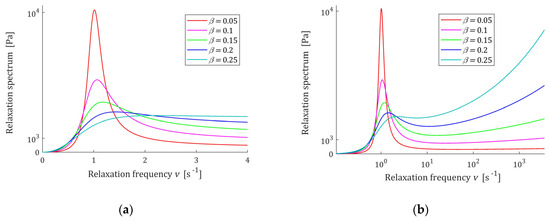
Figure 11.
Relaxation frequency spectrum (49) of the of the fractional Maxwell model (4) for , , elastic modulus , , and frequency range , where: (a) and (b) .
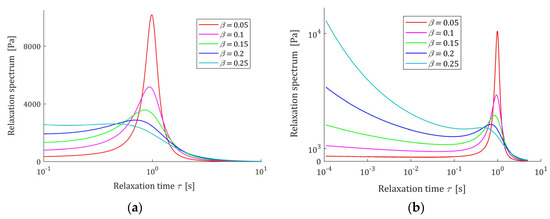
Figure 12.
Relaxation time spectrum (47) of the fractional Maxwell model (4) for , , , , and range of times: (a) and (b) .
From Figure 11 and Figure 12 it is seen that the lower is, the higher its local maximum is, and the more concise this peak is. Thus, the order parameter influences both the ‘height’ of the spectrum peak and its ‘width’. The relaxation frequencies and times of the peaks also depends on the relaxation time —the bigger their ‘height’, the bigger the elastic modulus is. Therefore, by the respective choice of the three model parameters , a wide class of the unimodal relaxation spectra can be described.
3.8. Identification
The spectrum, not being directly accessible by measurement, is recovered from relaxation stress [42,43,44] or oscillatory shear data [19,29,45,46] by using an appropriate identification method. Identification consists of selecting, within the chosen class of models given by (4) with the relaxation modulus described by (5), such a model, which ensures the best approximation to the measurement data. To clarify the description, model (5) is denoted as
where the subscript ‘’ means the model and
is a -element vector of unknown coefficients of the model. The relaxation time spectrum (11) for parameters (58) will be hereinafter referred to as , by analogy spectrum of the relaxation frequency (13) as , to emphasize the dependence on the determined parameters of the model.
Suppose a certain identification experiment (stress relaxation test [11,35,37]) resulted in a set of measurements of the relaxation modulus at the sampling instants , , where is the measurement noise. Following [44,47], as a measure of the model accuracy, the mean quadratic index is taken
Thus, the optimal identification of FMM model defined by (4) or (57) consists of determining the model parameters minimizing the index , i.e., in solving the non-linear least-squares problem
When the optimal parameter is determined, the spectra of FMM are described by and according to the formulas (11) and (13), respectively.
There are known methods of identifying FMM either by direct minimization of the index , or by approximate identification methods, according to which the original identification task (60) is replaced by a simpler task that gives an approximate solution. An example of such a method is the scheme proposed by Stankiewicz [18]. However, the task itself (60) is not the subject of this paper, so it will not be discussed in detail here. Since it was desirable to accurately determine the model of the relaxation modulus (57), the function MLFFIT2 provided by Podlubny [48] for fitting data using the two parameters Mittag-Leffler function multiplied by a power function was used to determine it. This procedure has been introduced and described in detail in [49]. All four parameters of the model will be selected optimally.
Both unimodal and multimodal, especially bimodal, relaxation spectra are used to describe viscoelastic properties of polymers. Bearing in mind the unimodal character of the spectra (11) and (13), the applicability of these spectra for describing commonly used models of polymer spectra was examined. Both Gauss-like distributions and BSW spectra dominating in the rheology of polymers [36,50] were considered. All models were simulated in Matlab R2022a, using the special function erfc for the Gauss-like distributions. Functions MLFFIT2 [48] and MLF [51], provided by Podlubny, were used.
3.9. Applicability of the FMM Spectra to Modelling Gaussian Spectra
In this section, relaxation spectra of the fractional Maxwell model are applied to modelling the relaxation spectra described by the unimodal Gauss-like distributions. Although studies confirming the use of the BSW spectrum for various polymers prevail, thereby research concerning them does not require justification, there are also studies indicating the use of the Gaussian spectrum for some polymeric materials, including biopolymers. In [52], the linear viscoelastic behavior of commercial polypropylenes is studied under the assumption that the relaxation spectrum takes the shape of a log-normal distribution, which is in agreement with the linear viscoelasticity theory by providing limiting values, contrary to BSW model. Museau et al. [32] applied a Gaussian distribution of the relaxation times, modified to introduce asymmetry of the relaxation process and to describe viscoelasticity in poly(methyl methacrylate). Recently, the spectra of a Gaussian character for bimodal polyethylene were determined by Kwakye-Nimo et al. [33] (Figures 4b and 8b), for glass by Wang et al. [53] (Figure 2), and for soft polyacrylamide gels by Pérez-Calixto et al. [35] (Figure A4). The spectra of various biopolymers studied by many researchers are also Gaussian in nature, for example, some (wheat, potato, corn, and banana) native starch gels [34] (Figures 6b, 7 and 9a), xanthan gum water solution [36] (Figures 6 and 10), carboxymethylcellulose (CMC) [36] (Figures 6 and 11), wood [54] (Figure 7), and [55] (Figures 2 and 3), fresh egg white-hydrocolloids [36] (Figures 6 and 14). Gauss-type spectra have been tested when developing new viscoelastic models and identification methods, for example, in [56] (Figure 2), [57] (Figures 9, 11, and 17) and [58] (Figures 2, 3, 6, 7–11, and 14). Two examples with different relaxation times are shown.
3.9.1. Example 1
Consider the viscoelastic material of relaxation spectrum described by the unimodal Gauss-like distribution:
where the parameters are as follows [44]: , and . The related relaxation modulus is [34]:
In the experiment, sampling instants were generated with the constant period in the time interval with seconds chosen in view of the course of the modulus (62). Additive measurement noises were selected independently by random choice with uniform distribution on the interval . The optimal parameters of the model (57) are determined
the mean square relative identification index defined by
is . The course of the optimal FMM and the real characteristic G(t) (62) are summarized in Figure 13a, where the measurements of the real modulus (62) are marked. The relaxation time spectrum (11) is plotted in Figure 13b, together with the spectrum (61) of the real material.
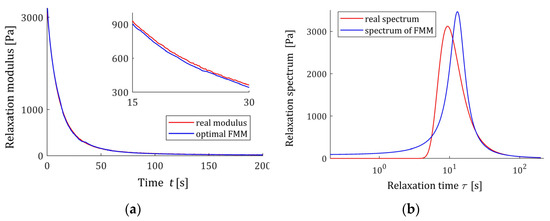
Figure 13.
For the “real” material from Example 1 and the fractional Maxwell model (57) with optimal parameters (63) are presented: (a) the measurements of the real relaxation modulus (62) (red points) and model (57); (b) real relaxation time spectrum (61) (solid red line) and the spectrum model (11).
3.9.2. Example 2
Now, the parameters of the Gauss-like distribution (61) are as follows: , , and . In the experiment, sampling instants were generated with the constant period in the time interval seconds chosen in view of the course of the modulus (62). Additive measurement noises were selected independently by random choice with uniform distribution on the interval [−0.05, 0.05] Pa. The optimal parameters of the model (57) are determined
the optimal mean square identification index (59) is . The optimal FMM and the real modulus (62) are plotted in Figure 14a. The relaxation time spectrum (11) is plotted in Figure 14b, together with the real material spectrum (61).
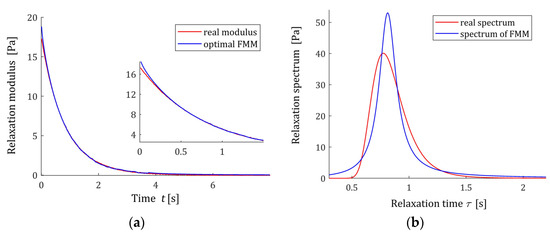
Figure 14.
For the “real” material from Example 2 and the fractional Maxwell model (57) with optimal parameters (65) are presented: (a) the measurements of the real relaxation modulus (62) (red points) and model (57); (b) real relaxation time spectrum (61) (solid red line) and the spectrum model (11).
3.10. Applicability of the FMM Spectra to Modelling BSW Spectra
Consider the spectrum of relaxation times introduced by Baumgaertel, Schausberger, and Winter [26,27],
which is known to be effective in describing polydisperse polymer melts [28,29], with the parameters [29]: , , , , and . The corresponding ‘real’ relaxation modulus is given by (7). In the experiment, time instants were sampled with the constant period in the time interval . The results of the numerical experiment for several values of and are given in Table 1 and illustrated by Figure 12 and Figure 13. In Figure 15, the real material spectrum (66) along with the model (11) and real modulus fitted by the optimal FMM , are plotted for the first three experiments. Since the fit of the model to the measurement data is very good and the waveforms of the characteristics for the relaxation modulus practically coincide with the measurement points and do not differ between each other, only the spectra are presented for three subsequent numerical experiments in Figure 16. These spectra also almost merge, however the maximum peak increases slightly with a growing number of measurement points and decreases with increasing experiment time .

Table 1.
The parameters of the optimal models for the BSW spectrum (66) (62) in successive numerical experiments: number of numerical experiment , number of measurements , the time horizon of the experiment , mean quadratic identification index (59), and mean relative quadratic identification index (64), and the optimal FMM parameters , , , and .
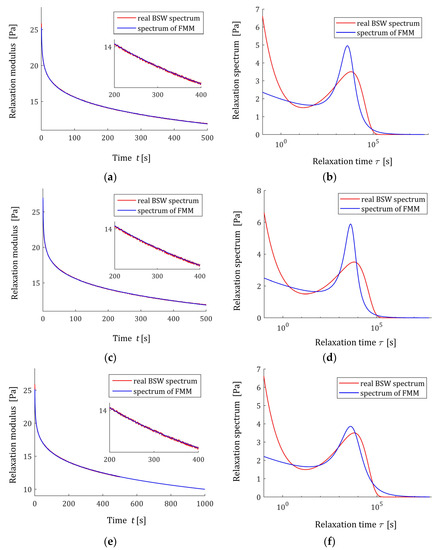
Figure 15.
Relaxation modulus (red points) of the “real” material described by BSW spectrum (66) (solid red line) and the fractional Maxwell model (57) and relaxation time spectra (11), the model optimal parameters are given in Table 1 for: (a,b) experiment 1; (c,d) experiment 2; (e,f) experiment 3.
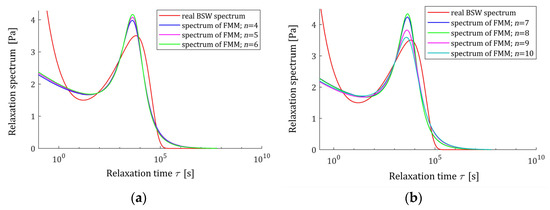
Figure 16.
Relaxation spectra of the “real” material described by BSW spectrum (66) (solid red line) and relaxation time spectra (11) of the fractional Maxwell model for numerical experiments: (a) ; (b) . The optimal parameters are given in Table 1.
4. Conclusions
Analytical formulas describing relaxation time and frequency spectra of FMM were given. The analytical studies proved that:
- Necessary and sufficient conditions for the existence of the local extrema, minima, and maxima of the relaxation spectra are given by two algebraic inequalities.
- Only two fractional model parameters, the non-integer orders of the stress and strain derivatives, uniquely determine the existence of the spectrum extrema.
- The local minima and maxima of the relaxation spectra are described by direct analytical formulas.
- The local extrema depend on fractional model parameters and on the relaxation time of FMM.
- The spectrum values for the local extrema are affected by the elastic modulus of FMM, i.e., by all four model parameters.
Analytical analysis combined with numerical studies of model monotonicity and the spectra applicability to modelling BSW and Gauss-like spectra demonstrated that the viscoelastic relaxation spectrum of FMM can be applied for a wide class of polymers with unimodal relaxation spectra. This is due to the availability of the two extra degrees of freedom, non-integer orders of the stress and strain derivatives, which provides deep insight into the complex behavior of polymers.
The applicability of the relaxation spectra of fractional order viscoelastic models to the description of multimodal spectra will be the subject of future research, with particular attention to bimodal spectra that characterize many polymers. A respective modification of the fractional Maxwell model is then necessary. Since the identification of FMM is, in general, difficult, mainly due to the form of the relaxation modulus model form given by the product of Mittag-Leffler and power functions, approximate identification methods are still needed. Future research will be focused on this issue. Multi-scale combined power-law Scott-Blair model or FMM is a dilemma that may accompany the modelling of polymers governed by power-laws. It sets another research direction in the field of fractional viscoelasticity of polymers.
Funding
This research received no external funding.
Institutional Review Board Statement
Not applicable.
Informed Consent Statement
Not applicable.
Data Availability Statement
Not applicable.
Conflicts of Interest
The author declares no conflict of interest.
Appendix A
Appendix A.1. Derivation of Proposition 1
Consider spectral representation (9), (10) of the Mittag-Leffler function. Let us put and . By the assumptions , the parameter and, simultaneously, parameter . For real the argument , thus the formula (9) holds and take the form
with
In view of (A2), the integral on the right-hand side of (A1) takes the form
whence, by applying the substitution , after algebraic manipulations we obtain
Combining (5), (A1) and (A3) yield
whence, by virtue of (8) model, (13) results. By the relation , we immediately obtain Equation (12), which can be rewritten as formula (11); proposition is derived. □
Appendix A.2. Derivation of Proposition 2
Since all exponents in powers of the expression in (13) are positive, the first boundary condition (17) is obvious. The spectrum (13) can be equivalently expressed as
where the denominator of the right-hand side tends to 1, as , while the nominator tends to infinity regardless of the sign of the expression , as , whence the second boundary condition (18) follows. By the relation , (19) and (20) directly follow from (18) and (17), respectively. □
Appendix A.3. Proof of Property 1
The analysis of the spectra monotonicity is based on the formulas (12) and (13) describing and , respectively. It is convenient to express these functions in equivalent, joint and more useful for further analysis form. Let us introduce the function
where the coefficients , , and are defined by (21), (22), and (23). For
by (13), (A5), and (A6), we have
If
then by (A5) and (12)
By (A7)
while by (A9)
The comparison of the two above formulas directly implies Property 1. □
Appendix A.4. Proof of Proposition 3
In view of (A10) and (A11), to study the monotonicity of the spectra and for positive arguments, it is enough to analyze the monotonicity of (A5). The first derivative of (A5) is as follows
where the function in nominator is given by
and can be expressed as
with the coefficients and defined by (24) and (25), respectively. Since, under the assumptions , coefficients and are positive and , then inequality is necessary, but not sufficient, for the existence of the local extreme of ; Proposition 3 follows. □
Appendix A.5. Introduction to the Necessary and Sufficient Extrema Conditions
The properties of the cubic function (A13) and in consequence the monotonicity of the relaxation spectrum depends on the relationship between the parameters and β. Since the denominator on the right-hand side of (A12) and the multiplier in (A12) are positive for all , both the sign of the derivative and their nonzero real roots, if they exist, are identical to those of . Thus, in view of (A10), (A11), and (A12), function and in consequence the relaxation spectra and have local extrema, the local maximum for the relaxation frequency and the local minimum for the minimum frequency , if and only if the respective (c.f., (A6)) and are the roots of the cubic function (A13). Thus, the existence, or not, of two positive real roots of the function is basic for the spectrum monotonicity.
Due to , and . Simultaneously, whenever and for . Thus, in further analysis, two different cases should be distinguished, when is equal to one, or not. □
Appendix A.6. Proof of Proposition 4
If parameter , then the cubic function has at least one real root on the negative real axis. The necessary and sufficient conditions of the existence of three real roots of third order polynomials are known, as well as the analytical methods for their computation. The algebraic solution of the cubic equation can be derived in a number of different ways. Cardano’s method, dated 1545, and Vieta’s method published in 1615 are the most known. The two methods are combined here and applied to the cubic equation , which, in view of (A13), takes the form:
Dividing Equation (A14) by the coefficient and applying the standard substitution
we obtain the so-called depressed cubic equation with the zero quadratic term coefficient:
where the parameters and are such that
The number and types of the roots are uniquely determined by the determinant of the cubic equation defined as follows
The depressed cubic Equation (A16) has three real roots if and only if . Thus, if , then and also derivative (A12) is positive for all . Therefore, spectrum is a monotonically increasing function, and spectrum decreases with increasing .
Let us analyze two cases in detail: (a) , (b) .
Appendix A.6.1. Case (a). The Determinant
If the determinant , then Equation (A16) and consequently (A14) have multiple real roots, all of their roots are real.
If , i.e., and , which is equivalent to and implies , the triple root is such that ; for derivation, Equation (A20) given below may be used. Thus, for all , spectra and are monotonically increasing and decreasing functions.
If , then Equation (A16) has two real roots, and one of them is double. It may be proved that single root is negative. Even if the double root is positive, the function , whence also derivative (A12), is positive on both sides of the root, being an inflection point (i.e., saddle point) of the function . Thus, the respective relaxation frequency and time are the inflection points of the monotonically increasing and decreasing spectra and , respectively. Combining the spectra monotonicity for , with the monotonicity in case yields Proposition 4 with inequality (30), resulting directly from (A19), (A17), and (A18).
Appendix A.6.2. Case (b). The Determinant
If , then the cubic Equation (A16) roots are obtained by Viète’s formulas [59] in terms of trigonometric functions (except when , but it is not the case for ), which, in view of (A15) for the original third order Equation (A14), results in the three different real roots:
where
and the angle is such that
The condition , in view of (A19), implies , and next
whence, by (A24), the next inequality results
Thus, the angle ɵ is such that
If , then by (A23), and the inequalities occur
whence, in view of (A20), (A21), (A22), having in mind the monotonicity of and the assumption , we conclude that
If , then and we have the inequalities
whence, from the assumption and monotonicity of , the relation results
If , then and, by (A24), , whence and, by , the three real roots are such that
Proposition 4 has been proved, where inequality (29) means that the determinant simply results from (A17), (A18), and (A19). □
Appendix A.7. Derivation of Proposition 5
If the relaxation frequency (13) and time (11) spectra have extrema, then inequality (29) holds, i.e., in particular the second summand of its left-hand side is negative, whence inequality (33) results. By standard trigonometric identities, we have
and next
By (21) and (27)
which can be expressed as
Combining (A26), (A25), and (33), after algebraic manipulations, yields
Hence, by virtue of the parity of the cosine function, we obtain
which is equivalent to (34). The proposition is proved. □
Appendix A.8. Proof of Proposition 7
Now, by (48) and (49), function (A5), due to (A7) and (A9) important for an analysis of the spectrum monotonicity, takes a simple form described by
with the argument given by (A6) and (A8), where parameter
From (A27), in straightforward way, we have
where the function in the nominator is as follows
Since , the stationary point equation has for two positive real roots, if and only if the determinant
of the square equation is nonnegative, i.e.,
and, simultaneously, , which, due to (A28), is equivalent to
Then,
corresponds to , while is determined by
In the special case, when and , the double root is the inflection point of the increasing function , thus spectrum (13) increases for all , while is a monotonically decreasing function. Thus, bearing in mind inequality (A29) corresponding to , the local extrema there exist, if and only if inequalities
and (A30) are satisfied. Inequality (A33) is rewritten as (50). The fulfilment of inequality (50) implies the fulfilment of (A30). Bearing in mind Property 1 and the previous analysis, formulas (51), (53), (54), and (52) result directly from (A31) and (A32). Proposition 7 is proved. □
References
- Gorenflo, R.; Kilbas, A.A.; Mainardi, F.; Rogosin, S.V. Mittag-Leffler Functions, Related Topics and Applications; Springer: Berlin/Heidelberg, Germany, 2014. [Google Scholar] [CrossRef]
- Schiessel, H.; Metzler, R.; Blumen, A.; Nonnejunacher, T.F. Generalized viscoelastic models: Their fractional equations with solutions. J. Phys. A Math. Gen. 1995, 28, 6567–6584. [Google Scholar] [CrossRef]
- Metzler, R.; Nonnenmacher, T.F. Fractional relaxation processes and fractional rheological models for the description of a class of viscoelastic materials. Int. J. Plast. 2003, 19, 941–959. [Google Scholar] [CrossRef]
- Mainardi, F. Fractional Calculus and Waves in Linear Viscoelasticity: An Introduction to Mathematical Models; Imperial College Press: London, UK, 2010. [Google Scholar]
- Mainardi, F.; Spada, G. Creep, Relaxation and Viscosity Properties for Basic Fractional Models in Rheology. Eur. Phys. J. Spec. Top. 2011, 193, 133–160. [Google Scholar] [CrossRef]
- Meng, R.; Yin, D.; Drapaca, C.S. A variable order fractional constitutive model of the viscoelastic behavior of polymers. Int. J. Non-Linear Mech. 2019, 113, 171–177. [Google Scholar] [CrossRef]
- Shiru, G.; Hai, P.; Mengsen, Y.; Ziheng, S.; Dejun, L.; Jinyong, X.; Yiying, F. New perspective on the creep characteristic of fiber–dependent shape memory polymers: Variable–order fractional constitutive model. J. Mater. Res. Technol. 2023, 24, 5177–5185. [Google Scholar] [CrossRef]
- Liang, Z.; Li, J.; Zhang, X.; Kan, Q. A viscoelastic-viscoplastic constitutive model and its finite element implementation of amorphous polymers. Polym. Test. 2023, 117, 107831. [Google Scholar] [CrossRef]
- Xu, B.; Blok, R.; Teuffel, P. An investigation of the effect of relative humidity on viscoelastic properties of flax fiber reinforced polymer by fractional-order viscoelastic model. Compos. Commun. 2023, 37, 101406. [Google Scholar] [CrossRef]
- Lei, D.; Liang, Y.; Xiao, R. A fractional model with parallel fractional Maxwell elements for amorphous thermoplastics. Phys. A Stat. Mech. Its Appl. 2018, 490, 465–475. [Google Scholar] [CrossRef]
- Ferry, J.D. Viscoelastic Properties of Polymers, 3rd ed.; John Wiley & Sons: New York, NY, USA, 1980. [Google Scholar]
- Ishii, A. Spatial and temporal heterogeneity of Kohlrausch–Williams–Watts stress relaxations in metallic glasses. Comput. Mater. Sci. 2021, 198, 110673. [Google Scholar] [CrossRef]
- Lukichev, A. Physical meaning of the stretched exponential Kohlrausch function. Phys. Lett. A 2019, 383, 2983–2987. [Google Scholar] [CrossRef]
- Bonfanti, A.; Kaplan, J.L.; Charras, G.; Kabla, A. Fractional viscoelastic models for power-law materials. Soft Matter 2020, 16, 6002–6020. [Google Scholar] [CrossRef] [PubMed]
- Likhtman, A.E.; McLeish, T.C.B. Quantitative Theory for Linear Dynamics of Linear Entangled Polymers. Macromolecules 2002, 35, 6332–6343. [Google Scholar] [CrossRef]
- Kapnistos, M.; Lang, M.; Vlassopoulos, D.; Pyckhout-Hintzen, W.; Richter, D.; Cho, D.; Chang, T.; Rubinstein, M. Unexpected power-law stress relaxation of entangled ring polymers. Nat. Mater 2008, 7, 997–1002. [Google Scholar] [CrossRef] [PubMed]
- Saphiannikova, M.; Toshchevikov, V.; Gazuz, I.; Petry, F.; Westermann, S.; Heinrich, G. Multiscale Approach to Dynamic-Mechanical Analysis of Unfilled Rubbers. Macromolecules 2014, 47, 4813–4823. [Google Scholar] [CrossRef]
- Stankiewicz, A. Fractional Maxwell model of viscoelastic biological materials. BIO Web Conf. 2018, 10, 02032. [Google Scholar] [CrossRef]
- Anderssen, R.S.; Davies, A.R.; de Hoog, F.R.; Loy, R.J. Derivative based algorithms for continuous relaxation spectrum recovery. J. Non-Newton. Fluid Mech. 2015, 222, 132–140. [Google Scholar] [CrossRef]
- Dealy, J.M.; Read, D.J.; Larson, R.G. Structure and Rheology of Molten Polymers, 2nd ed.; Carl Hanser Verlag GmbH & Co. KG: Munich, Germany, 2018; pp. 105–145. [Google Scholar] [CrossRef]
- Malkin, A.Y. The use of a continuous relaxation spectrum for describing the viscoelastic properties of polymers. Polym. Sci. Ser. A 2006, 48, 39–45. [Google Scholar] [CrossRef]
- Chang, F.-L.; Hu, B.; Huang, W.-T.; Chen, L.; Yin, X.-C.; Cao, X.-W.; He, G.-J. Improvement of rheology and mechanical properties of PLA/PBS blends by in-situ UV-induced reactive extrusion. Polymer 2022, 259, 125336. [Google Scholar] [CrossRef]
- Ankiewicz, S.; Orbey, N.; Watanabe, H.; Lentzakis, H.; Dealy, J. On the use of continuous relaxation spectra to characterize model polymers. J. Rheol. 2016, 60, 1115–1120. [Google Scholar] [CrossRef]
- Pogreb, R.; Loew, R.; Bormashenko, E.; Whyman, G.; Multanen, V.; Shulzinger, E.; Abramovich, A.; Rozban, A.; Shulzinger, A.; Zussman, E.; et al. Relaxation spectra of polymers and phenomena of electrical and hydrophobic recovery: Interplay between bulk and surface properties of polymers. J. Polym. Sci. Part B Polym. Phys. 2017, 55, 198–205. [Google Scholar] [CrossRef]
- Mainardi, F. Why the Mittag-Leffler Function Can Be Considered the Queen Function of the Fractional Calculus? Entropy 2020, 22, 1359. [Google Scholar] [CrossRef]
- Baumgaertel, M.; Schausberger, A.; Winter, H.H. The relaxation of polymers with linear flexible chains of uniform length. Rheol. Acta 1990, 29, 400–408. [Google Scholar] [CrossRef]
- Baumgaertel, M.; Winter, H.H. Interrelation between continuous and discrete relaxation time spectra. J. Non-Newton. Fluid Mech. 1992, 44, 15–36. [Google Scholar] [CrossRef]
- Cho, K.S. Power series approximations of dynamic moduli and relaxation spectrum. J. Rheol. 2013, 57, 679–697. [Google Scholar] [CrossRef]
- Lee, S.H.; Bae, J.-E.; Cho, K.S. Determination of continuous relaxation spectrum based on the Fuoss-Kirkwood relation and logarithmic orthogonal power-series approximation. Korea-Aust. Rheol. J. 2017, 29, 115–127. [Google Scholar] [CrossRef]
- Choi, J.; Cho, K.S.; Kwon, M.K. Self-Similarity and Power-Law Spectra of Polymer Melts and Solutions. Polymers 2022, 14, 3924. [Google Scholar] [CrossRef] [PubMed]
- Unidad, H.J.; Goad, M.A.; Bras, A.R.; Zamponi, M.; Faust, R.; Allgaier, J.; Pyckhout-Hintzen, W.; Wischnewski, A.; Richter, D.; Fetters, L.J. Consequences of Increasing Packing Length on the Dynamics of Polymer Melts. Macromolecules 2015, 48, 6638–6645. [Google Scholar] [CrossRef]
- Muzeau, E.; Perez, J.; Johari, G.P. Mechanical spectrometry of the beta-relaxation in poly(methyl methacrylate). Macromolecules 1991, 24, 4713–4723. [Google Scholar] [CrossRef]
- Kwakye-Nimo, S.; Inn, Y.; Yu, Y.; Wood-Adams, P.M. Linear viscoelastic behavior of bimodal polyethylene. Rheol. Acta 2022, 61, 373–386. [Google Scholar] [CrossRef]
- Carrillo-Navas, H.; Hernández-Jaimes, C.; Utrilla-Coello, R.G.; Meraz, M.; Vernon-Carter, E.J.; Alvarez-Ramirez, J. Viscoelastic relaxation spectra of some native starch gels. Food Hydrocoll. 2014, 37, 25–33. [Google Scholar] [CrossRef]
- Pérez-Calixto, D.; Amat-Shapiro, S.; Zamarrón-Hernández, D.; Vázquez-Victorio, G.; Puech, P.-H.; Hautefeuille, M. Determination by Relaxation Tests of the Mechanical Properties of Soft Polyacrylamide Gels Made for Mechanobiology Studies. Polymers 2021, 13, 629. [Google Scholar] [CrossRef]
- Cirillo, G.; Spizzirri, U.G.; Iemma, F. Functional Polymers in Food Science: From Technology to Biology, Volume 1: Food Packaging; Wiley: Hoboken, NJ, USA, 2015; Available online: https://onlinelibrary.wiley.com/doi/book/10.1002/9781119108580 (accessed on 1 July 2023).
- Malkin, A.I.A.; Malkin, A.Y.; Isayev, A.I. Rheology: Concepts, Methods and Applications; ChemTec: Deerfield Beach, FL, USA, 2006; Available online: https://books.google.pl/books?id=8rGafjhgz-UC (accessed on 1 July 2023).
- Gorenflo, R.; Mainardi, F. Fractional Calculus: Integral and Differential Equations of Fractional Order. In Fractals and Fractional Calculus in Continuum Mechanics; Carpinteri, A., Mainardi, F., Eds.; Springer: Wien, Austria; New York, NY, USA, 1997; pp. 223–276. [Google Scholar]
- Scott Blair, G.W.; Veinoglou, B.C. A Study of the Firmness of Soft Materials Based on Nutting’s Equation. J. Sci. Instrum. 1944, 21, 149–153. [Google Scholar] [CrossRef]
- Winter, H.H.; Chambon, F. Analysis of Linear Viscoelasticity of a Crosslinking Polymer at the Gel Point. J. Rheol. 1986, 30, 367–382. [Google Scholar] [CrossRef]
- Stankiewicz, A. On the monotonicity of the relaxation spectrum of fractional Maxwell model of viscoelastic materials. Econtechmod. Int. Q. J. Econ. Technol. Model. Process. 2018, 7, 117–125. [Google Scholar]
- Yamamoto, R. Stress relaxation property of the cell wall and auxin-induced cell elongation. J. Plant Res. Res. 1996, 109, 75–84. [Google Scholar] [CrossRef]
- Goangseup, Z.; Bažant, Z.P. Continuous Relaxation Spectrum for Concrete Creep and its Incorporation into Microplane Model M4. J. Eng. Mech. 2002, 128, 1331–1336. [Google Scholar] [CrossRef]
- Stankiewicz, A. Two-Level Scheme for Identification of the Relaxation Time Spectrum Using Stress Relaxation Test Data with the Optimal Choice of the Time-ScaleFactor. Materials 2023, 16, 3565. [Google Scholar] [CrossRef] [PubMed]
- Baumgaertel, M.; Winter, H.H. Determination of discrete relaxation and retardation time spectra from dynamic mechanical data. Rheol. Acta 1989, 28, 511–519. [Google Scholar] [CrossRef]
- Luo, L.; Xi, R.; Ma, Q.; Tu, C.; Ibrahim Shah, Y. An improved method to establish continuous relaxation spectrum of asphalt materials. Constr. Build. Mater. 2022, 354, 129182. [Google Scholar] [CrossRef]
- Stankiewicz, A. A Class of Algorithms for Recovery of Continuous Relaxation Spectrum from Stress Relaxation Test Data Using Orthonormal Functions. Polymers 2023, 15, 958. [Google Scholar] [CrossRef] [PubMed]
- Podlubny, I. Fitting Data Using the Mittag-Leffler Function. MATLAB Central File Exchange. Available online: https://www.mathworks.com/matlabcentral/fileexchange/32170-fitting-data-using-the-mittag-leffler-function (accessed on 23 July 2023).
- Sierociuk, D.; Podlubny, I.; Petras, I. Experimental evidence of variable-order behavior of ladders and nested ladders. IEEE Trans. Control. Syst. Technol. 2013, 21, 459–466. [Google Scholar] [CrossRef]
- Diogo, A.C.; Vlachopoulos, J.; Covas, J.A.; Agassant, J.F.; Walters, K. Rheological Fundamentals of Polymer Processing; Springer: Dordrecht, The Netherlands, 2013. [Google Scholar]
- Podlubny, I. Mittag-Leffler Function with Two Parameters. MATLAB Central File Exchange. Available online: https://www.mathworks.com/matlabcentral/fileexchange/8738-mittag-leffler-function (accessed on 23 July 2023).
- Fulchiron, R.; Michel, A.; Verney, V.; Roustant, J.C. Correlations between relaxation time spectrum and melt spinning behavior of polypropylene. 1: Calculation of the relaxation spectrum as a log-normal distribution and influence of the molecular parameters. Polym. Eng. Sci. 1995, 35, 513–517. [Google Scholar] [CrossRef]
- Wang, J.; Wang, X.; Ruan, H. On the mechanical β relaxation in glass and its relation to the double-peak phenomenon in impulse excited vibration at high temperatures. J. Non-Cryst. Solids 2020, 533, 119939. [Google Scholar] [CrossRef]
- Bardet, S.; Gril, J. Modelling the transverse viscoelasticity of green wood using a combination of two parabolic elements. C. R. Mécanique 2002, 330, 549–556. [Google Scholar] [CrossRef]
- Kurenuma, Y.; Nakano, T. Analysis of stress relaxation on the basis of isolated relaxation spectrum for wet wood. J. Mater. Sci. 2012, 47, 4673–4679. [Google Scholar] [CrossRef][Green Version]
- Stadler, F.J.; Bailly, C. A new method for the calculation of continuous relaxation spectra from dynamic-mechanical data. Rheol. Acta 2009, 48, 33–49. [Google Scholar] [CrossRef]
- Davies, A.R.; Goulding, N.J. Wavelet regularization and the continuous relaxation spectrum. J. Non-Newton. Fluid Mech. 2012, 189–190, 19–30. [Google Scholar] [CrossRef]
- Davies, A.R.; Anderssen, R.S.; de Hoog, F.R.; Goulding, N.J. Derivative spectroscopy and the continuous relaxation spectrum. J. Non-Newton. Fluid Mech. 2016, 233, 107–118. [Google Scholar] [CrossRef]
- Press, W.H.; Teukolsky, S.A.; Vetterling, W.T.; Flannery, B.P. Numerical Recipes: The Art of Scientific Computing; Section 5.6 Quadratic and Cubic Equations in Numerical Recipes; Cambridge University Press: New York, NY, USA, 2007. [Google Scholar] [CrossRef]
Disclaimer/Publisher’s Note: The statements, opinions and data contained in all publications are solely those of the individual author(s) and contributor(s) and not of MDPI and/or the editor(s). MDPI and/or the editor(s) disclaim responsibility for any injury to people or property resulting from any ideas, methods, instructions or products referred to in the content. |
© 2023 by the author. Licensee MDPI, Basel, Switzerland. This article is an open access article distributed under the terms and conditions of the Creative Commons Attribution (CC BY) license (https://creativecommons.org/licenses/by/4.0/).