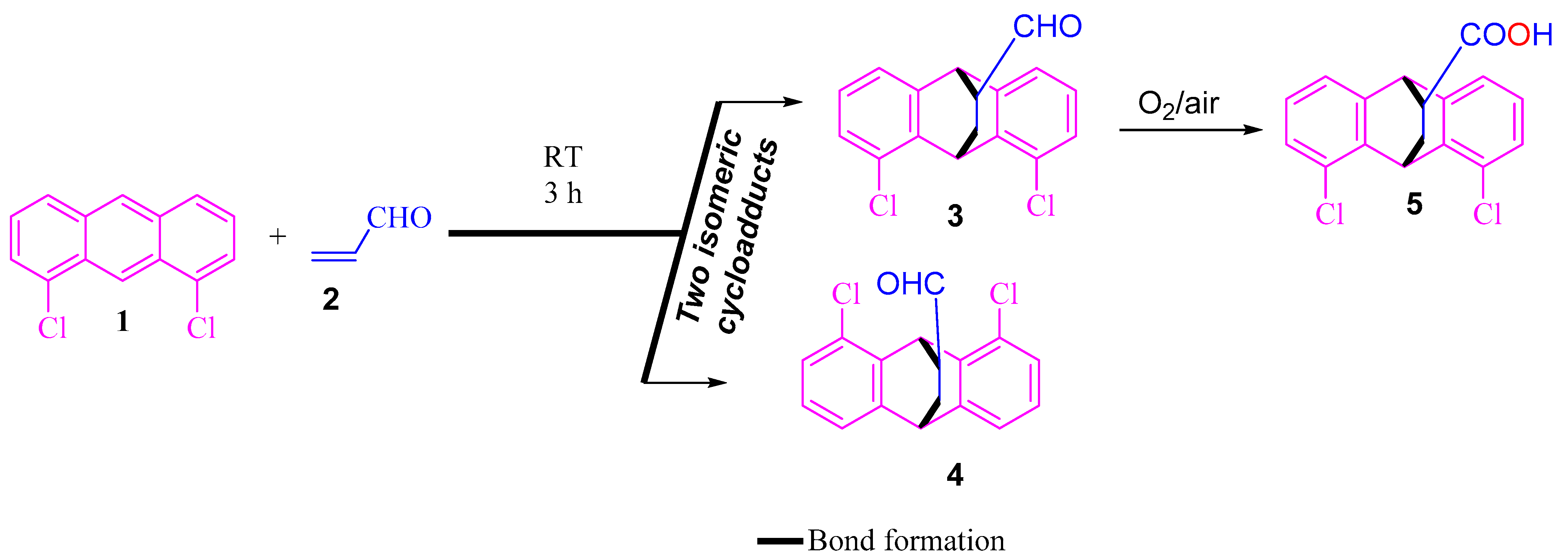

Synthesis, Single Crystal X-ray, Hirshfeld and DFT Studies of 1,8-Dichloro-9,10-dihydro-9,10-ethanoanthracene-11-carboxylic Acid


 , and
, and 
Abstract
1. Introduction
2. Materials and Methods
2.1. Synthesisi of 1,8-dichloro-9,10-dihydro-9,10-ethanoanthracene-11-carboxylic acid 5
2.2. Single-Crystal X-ray Measurements of 5
2.3. Hirshfeld Surface Analysis and Computational Methods
3. Results and Discussion
3.1. Chemistry
3.2. Crystal Structure Description of 5
3.3. Analysis of Molecular Packing
3.4. DFT Studies
3.5. NMR Spectra
4. Conclusions
Supplementary Materials
Author Contributions
Funding
Acknowledgments
Conflicts of Interest
References
- Peng, L.; Yao, J.W.; Wang, M.; Wang, L.Y.; Huang, X.L.; Wei, X.F.; Ma, D.G.; Cao, Y.; Zhu, X.H. Efficient soluble deep blue electroluminescent dianthracenylphenylene emitters with CIE y (y ≤ 0.08) based on triplet-triplet annihilation. Sci. Bull. 2019, 64, 774–781. [Google Scholar] [CrossRef]
- Park, Y.H.; Shim, S.Y.; Seo, Y.; Lee, C.H. Organic Light Emitting Diode of High Efficiency. U.S. Patent 10,559,758, 11 February 2020. [Google Scholar]
- Varol, S.F.; Sayin, S.; Eymur, S.; Merdan, Z.; Ünal, D. Optical performance of efficient blue/near UV nitropyridine-conjugated anthracene (NAMA) based light emitting diode. Org. Electron. 2016, 31, 25–30. [Google Scholar] [CrossRef]
- Yu, Y.H.; Huang, C.H.; Yeh, J.M.; Huang, P.T. Effect of methyl substituents on the N-diaryl rings of anthracene-9, 10-diamine derivatives for OLEDs applications. Org. Electron. 2011, 12, 694–702. [Google Scholar] [CrossRef]
- Chen, L.-Y.; Shiu, Y.J.; Wu, Y.J.; Huang, W.Y. Simple structured color tunable white organic light-emitting diodes utilizing an ambipolar anthracene derivative with low-lying LUMO. Org. Electron. 2020, 76, 105454. [Google Scholar] [CrossRef]
- Lee, A.H.; Jang, Y.; Kim, G.H.; Kim, J.J.; Lee, S.S.; Ahn, B.J. Decolorizing an anthraquinone dye by Phlebia brevispora: Intra-species characterization. Eng. Life Sci. 2017, 17, 125–131. [Google Scholar] [CrossRef]
- Xu, J.; Niu, G.; Wei, X.; Lan, M.; Zeng, L.; Kinsella, J.M.; Sheng, R. A family of multi-color anthracene carboxyimides: Synthesis, spectroscopic properties, solvatochromic fluorescence and bio-imaging application. Dyes Pigm. 2017, 139, 166–173. [Google Scholar] [CrossRef]
- Wadler, S.; Fuks, J.Z.; Wiernik, P.H. Phase I and II agents in cancer therapy: I. Anthracyclines and related compounds. J. Clin. Pharmacol. 1986, 26, 491–509. [Google Scholar] [CrossRef]
- Sunmonu, T.O.; Owolabi, O.D.; Oloyede, O.B. Anthracene-induced enzymatic changes as stress indicators in African catfish, Heterobranchus bidorsalis Geoffroy Saint Hilaire, 1809. Res. J. Environ. Sci. 2009, 3, 677–686. [Google Scholar]
- McNamara, Y.; Bright, S.; Byrne, A.; Cloonan, S.; McCabe, T.; Williams, D.; Meegan, M. Synthesis and antiproliferative action of a novel series of maprotiline analogues. Eur. J. Med. Chem. 2014, 71, 333–353. [Google Scholar] [CrossRef]
- Cloonan, S.M.; Drozgowska, A.; Fayne, D.; Williams, D.C. The antidepressants maprotiline and fluoxetine have potent selective antiproliferative effects against Burkitt lymphoma independently of the norepinephrine and serotonin transporters. Leuk. Lymphoma 2010, 51, 523–539. [Google Scholar] [CrossRef]
- Cloonan, S.M.; Williams, D.C. The antidepressants maprotiline and fluoxetine induce Type II autophagic cell death in drug-resistant Burkitt’s lymphoma. Int. J. Cancer 2011, 128, 1712–1723. [Google Scholar] [CrossRef]
- Huang, H.-S.; Chiu, H.-F.; Hwang, J.-M.; Jen, Y.-M.; Tao, C.-W.; Lee, K.-Y.; Lai, Y.-L. Studies on anthracenes. 2. Synthesis and cytotoxic evaluation of 9-acyloxy 1, 8-dichloroanthracene derivatives. Chem. Pharm. Bull. 2001, 49, 1346–1348. [Google Scholar] [CrossRef]
- Huang, H.-S.; Lin, P.-Y.; Hwang, J.-M.; Tao, C.-W.; Hsu, H.-C.; Lai, Y.-L. Studies on anthracenes. 3. Synthesis, lipid peroxidation and cytotoxic evaluation of 10-substituted 1, 5-dichloro-9 (10H)-anthracenone derivatives. Chem. Pharm. Bull. 2001, 49, 1288–1291. [Google Scholar] [CrossRef][Green Version]
- Bitonti, A.J.; Sjoerdsma, A.; McCann, P.P.; Kyle, D.E.; Oduola, A.; Rossan, R.N.; Milhous, W.K.; Davidson, D.E. Reversal of chloroquine resistance in malaria parasite Plasmodium falciparum by desipramine. Science 1988, 242, 1301–1303. [Google Scholar] [CrossRef]
- Alibert, S.; Santelli-Rouvier, C.; Pradines, B.; Houdoin, C.; Parzy, D.; Karolak-Wojciechowska, J.; Barbe, J. Synthesis and Effects on Chloroquine Susceptibility in Plasmodium f alciparum of a Series of New Dihydroanthracene Derivatives. J. Med. Chem. 2002, 45, 3195–3209. [Google Scholar] [CrossRef]
- Szabó, D.; Szabó, G.; Ocsovszki, I.; Aszalos, A.; Molnár, J. Anti-psychotic drugs reverse multidrug resistance of tumor cell lines and human AML cells ex-vivo. Cancer Lett. 1999, 139, 115–119. [Google Scholar] [CrossRef]
- Karama, U.; Sultan, M.A.; Almansour, A.I.; El-Taher, K.E. Synthesis of chlorinated tetracyclic compounds and testing for their potential antidepressant effect in mice. Molecules 2016, 21, 61. [Google Scholar] [CrossRef]
- Barton, B.; Senekal, U.; Hosten, E.C. Comparing the host behavior of roof-shaped compounds trans-9, 10-dihydro-9, 10-ethanoanthracene-11, 12-dicarboxylic acid and its dimethyl ester in the presence of mixtures of xylene and ethylbenzene guests. CrystEngComm 2021, 23, 4560–4572. [Google Scholar] [CrossRef]
- Wang, Y.; Ghanem, B.S.; Ali, Z.; Hazazi, K.; Han, Y.; Pinnau, I. Recent progress on polymers of intrinsic microporosity and thermally modified analogue materials for membrane-based fluid separations. Small Struct. 2021, 2, 2100049. [Google Scholar] [CrossRef]
- Li, M.; Zhou, Y.; Yao, Y.; Gao, T.; Yan, P.; Li, H. Designing the water-quenching resistant high luminescent europium complexes by regulating the orthogonal arrangement of bis-β-diketone ligands. Dalton Trans. 2021, 50, 9914–9922. [Google Scholar] [CrossRef]
- Fyfe, T.J.; Scammells, P.J.; Lane, J.R.; Capuano, B. Enantioenriched positive allosteric modulators display distinct pharmacology at the dopamine D1 receptor. Molecules 2021, 26, 3799. [Google Scholar] [CrossRef]
- Karama, U.S.; Sultan, M.A.; Almansour, A.I.; Tahir, K.E.; Elnakady, Y.A.; Mahaya, T.A. Halogenated Tetracyclic Compounds. U.S. Patent No. 9498460B1, 22 November 2016. [Google Scholar]
- Sultan, M.A.; Almansour, A.I.; Pillai, R.R.; Kumar, R.S.; Arumugam, N.; Armaković, S.; Armaković, S.J.; Soliman, S.M. Synthesis, theoretical studies and molecular docking of a novel chlorinated tetracyclic:(Z/E)-3-(1, 8-dichloro-9, 10-dihydro-9, 10-ethanoanthracen-11-yl) acrylaldehyde. J. Mol. Struct. 2017, 1150, 358–365. [Google Scholar] [CrossRef]
- Sultan, M.A.; Galil, M.S.A.; Al-Qubati, M.; Omar, M.M.; Barakat, A. Synthesis, Molecular Docking, Druglikeness Analysis, and ADMET Prediction of the Chlorinated Ethanoanthracene Derivatives as Possible Antidepressant Agents. Appl. Sci. 2020, 10, 7727. [Google Scholar] [CrossRef]
- Al-Qubati, M.; Ghabbour, H.A.; Soliman, S.M.; Al-Majid, A.M.; Barakat, A.; Sultan, M.A. Synthesis of N-(anthracen-9-ylmethyl)-N-methyl-2-(phenylsulfonyl)ethanamine via microwave green synthesis method: X-ray characterization, DFT and Hirshfeld analysis. Crystals 2020, 10, 643. [Google Scholar] [CrossRef]
- Sultan, M.A.; Galil, M.S.; Al-Qubati, M.; Al-Majid, A.M.; Barakat, A. Microwave-assisted regioselective synthesis of substituted-9-bromo-9, 10-dihydro-9, 10-ethanoanthracenes via Diels-Alder cycloaddition. J. King Saud Univ. Sci. 2020, 32, 3417–3420. [Google Scholar] [CrossRef]
- Turner, M.J.; McKinnon, J.J.; Wolff, S.K.; Grimwood, D.J.; Spackman, P.R.; Jayatilaka, D.; Spackman, M.A. Crystal Explorer17 2017, University of Western Australia. Available online: http://hirshfeldsurface.net (accessed on 12 June 2017).
- Frisch, M.J.; Trucks, G.W.; Schlegel, H.B.; Scuseria, G.E.; Robb, M.A.; Cheeseman, J.R.; Scalmani, G.; Barone, V.; Mennucci, B.; Petersson, G.A.; et al. GAUSSIAN 09; Revision A02; Gaussian Inc.: Wallingford, CT, USA, 2009. [Google Scholar]
- Dennington, R., II; Keith, T.; Millam, J. (Eds.) GaussView; Version 4.1.; Semichem Inc.: Shawnee Mission, KS, USA, 2007. [Google Scholar]
- Reed, A.E.; Curtiss, L.A.; Weinhold, F. Intermolecular interactions from a natural bond orbital, donor-acceptor viewpoint. Chem. Rev. 1988, 88, 899–926. [Google Scholar] [CrossRef]
- Marten, B.; Kim, K.; Cortis, C.; Friesner, R.A.; Murphy, R.B.; Ringnalda, M.N.; Sitkoff, D.; Honig, B. New Model for Calculation of Solvation Free Energies: Correction of Self-Consistent Reaction Field Continuum Dielectric Theory for Short-Range Hydrogen-Bonding Effects. J. Phys. Chem. 1996, 100, 11775–11788. [Google Scholar] [CrossRef]
- Tannor, D.J.; Marten, B.; Murphy, R.; Friesner, R.A.; Sitkoff, D.; Nicholls, A.; Ringnalda, M.; Goddard, W.A.; Honig, B. Accurate first principles calculation of molecular charge distributions and solvation energies from ab initio quantum mechanics and continuum dielectric theory. J. Am. Chem. Soc. 1994, 116, 11875–11882. [Google Scholar] [CrossRef]
- Cheeseman, J.R.; Trucks, G.W.; Keith, T.A.; Frisch, M.J. A Comparison of Models for Calculating Nuclear Magnetic Resonance Shielding Tensors. J. Chem. Phys. 1996, 104, 5497–5509. [Google Scholar] [CrossRef]
- Wilhelm, M.; Schmidt, P. Synthese und eigenschaften von 1-aminoalkyl-dibenzo[b, e]bicyclo[2.2.2]octadienen. Helv. Chim. Acta 1969, 52, 1385–1395. [Google Scholar] [CrossRef]
- Koteswar Rao, Y.; Nagarajan, M. Diels-Alder reactions of 1,1-bis[benzenesulfonyl]ethene. Synthesis 1984, 9, 757–758. [Google Scholar]
- Burrows, L.; Masnovi, J.; Baker, R.J. [2,3:5,6]Dibenzo[2.2.2]octa-2,5,7-triene (C2/c) and [2,3:5,6]dibenz [2.2.2]octa-2, 5-diene. Acta Crystallogr. C Cryst. Struct. Commun. 1999, 55, 236–239. [Google Scholar] [CrossRef]
- Simpson, M.; Storey, J.M.; Harrison, W.T. Diethyl 9,10-endo-ethano-9,10-dihydroanthracene-11,11-dicarboxylate. Acta Crystallogr. Sect. E Struct. Rep. Online 2004, 60, o1081–o1083. [Google Scholar] [CrossRef]
- Kitamura, M.; Gao, G.; Nakajima, K.; Takahashi, T. Unusual Conformational Isomer of 9,10-Dihydro-1,2,3,4,5,6,7,8-octapropylanthracene in Solid State. Chem. Lett. 2002, 31, 1076–1077. [Google Scholar] [CrossRef]
- Foresman, J.B.; Frisch, Æ. Exploring Chemistry with Electronic Structure Methods, 2nd ed.; Gaussian: Pittsburgh, PA, USA, 1996. [Google Scholar]
- Chang, R. Chemistry, 7th ed.; McGraw-Hill: New York, NY, USA, 2001. [Google Scholar]
- Kosar, B.; Albayrak, C. Spectroscopic investigations and quantum chemical computational study of (E)-4-methoxy-2-[(p-tolylimino) methyl] phenol. Spectrochim. Acta 2011, 78, 160–167. [Google Scholar] [CrossRef]
- Koopmans, T.A. Ordering of wave functions and eigenenergies to the individual electrons of an atom. Physica 1933, 1, 104–113. [Google Scholar] [CrossRef]
- Parr, R.G.; Yang, W. Density-Functional Theory of Atoms and Molecules; Oxford University Press: New York, NY, USA, 1989. [Google Scholar]
- Parr, R.G.; Szentpaly, L.V.; Liu, S. Electrophilicity index. J. Am. Chem. Soc. 1999, 121, 1922–1924. [Google Scholar] [CrossRef]

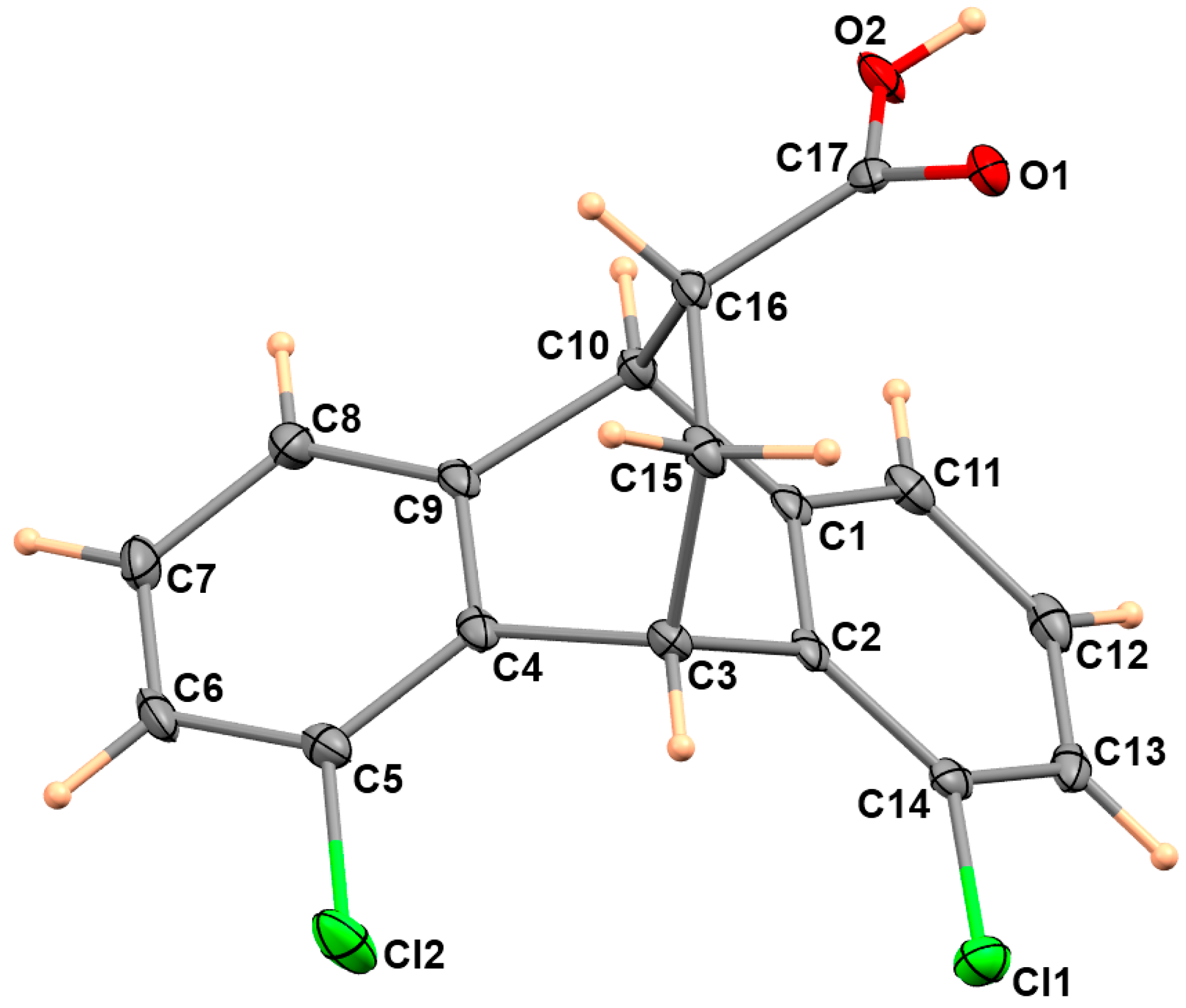



| 5 | |
|---|---|
| empirical formula | C17H12O2Cl2 |
| fw | 319.17 |
| temp (K) | 293(2) |
| λ(Å) | 1.54184 |
| cryst syst | Triclinic |
| space group | P-1 |
| a (Å) | 7.735(2) |
| b (Å) | 8.0225(12) |
| c (Å) | 12.0928(16) |
| α(deg) | 88.430(14) |
| β (deg) | 82.549(13) |
| γ(deg) | 70.46(2) |
| V (Å3) | 701.2(3) |
| Z | 2 |
| ρcalc (Mg/m3) | 1.512 |
| μ(Mo Kα) (mm-1) | 4.171 |
| No. reflns. | 17655 |
| Unique reflns. | 2534 |
| GOOF (F2) | 1.081 |
| Rint | 0.0303 |
| R1 (I ≥ 2σ) | 0.0316 |
| wR2 (I ≥ 2σ) | 0.0838 |
| CCDC No. | 2100042 |
| Atoms | Distance | Atoms | Distance |
|---|---|---|---|
| Cl1-C14 | 1.7472(18) | C4-C9 | 1.400(2) |
| Cl2-C5 | 1.7386(18) | C5-C6 | 1.394(2) |
| O1-C17 | 1.223(2) | C6-C7 | 1.384(3) |
| O2-C17 | 1.320(2) | C7-C8 | 1.393(2) |
| C1-C11 | 1.386(2) | C8-C9 | 1.390(2) |
| C1-C2 | 1.403(2) | C9-C10 | 1.513(2) |
| C1-C10 | 1.516(2) | C10-C16 | 1.564(2) |
| C2-C14 | 1.384(2) | C11-C12 | 1.397(3) |
| C2-C3 | 1.515(2) | C12-C13 | 1.386(3) |
| C3-C4 | 1.517(2) | C13-C14 | 1.397(2) |
| C3-C15 | 1.559(2) | C15-C16 | 1.552(2) |
| C4-C5 | 1.385(2) | C16-C17 | 1.522(2) |
| Atoms | Angle | Atoms | Angle |
| C11-C1-C2 | 121.39(15) | C9-C4-C3 | 113.38(14) |
| C11-C1-C10 | 125.67(15) | C4-C5-C6 | 121.31(16) |
| C2-C1-C10 | 112.91(14) | C4-C5-Cl2 | 120.54(13) |
| C14-C2-C1 | 118.51(15) | C6-C5-Cl2 | 118.12(13) |
| C14-C2-C3 | 127.99(15) | C7-C6-C5 | 119.51(15) |
| C1-C2-C3 | 113.49(14) | C6-C7-C8 | 120.54(16) |
| C2-C3-C4 | 106.94(13) | C9-C8-C7 | 119.02(16) |
| C2-C3-C15 | 106.42(13) | C8-C9-C4 | 121.38(15) |
| C4-C3-C15 | 106.96(13) | ||
| C5-C4-C9 | 118.19(15) | ||
| C5-C4-C3 | 128.42(15) |
| D-H...A | d(D-H) | d(H...A) | d(D...A) | <(DHA) |
|---|---|---|---|---|
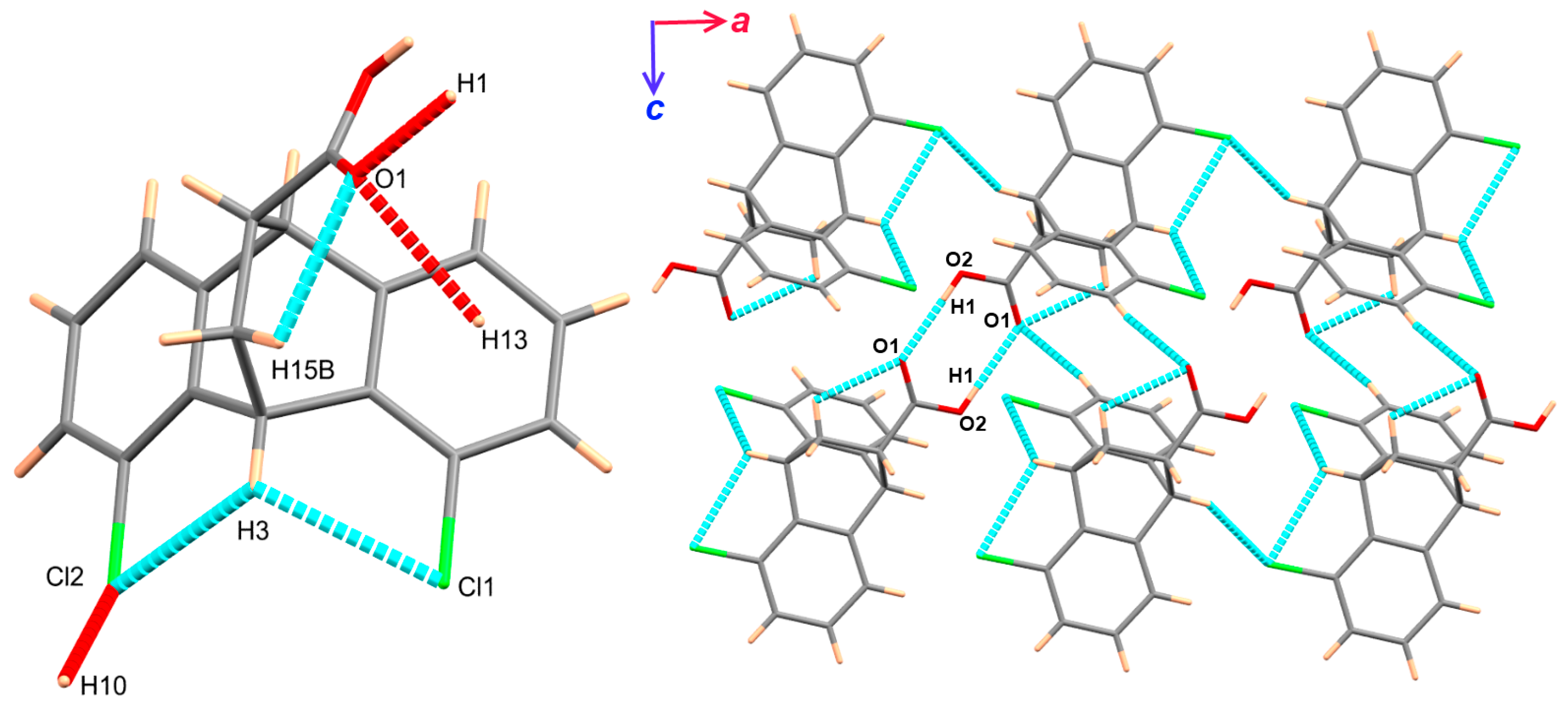
| O2-H1...O1 a | 0.82 | 2.48 | 2.662(2) | 176 |
| C3-H3...Cl1 | 0.98 | 2.76 | 3.211(2) | 109 |
| C3-H3...Cl2 | 0.98 | 2.78 | 3.226(2) | 108 |
| C10-H10...Cl2 b | 0.98 | 2.81 | 3.611(2) | 140 |
| C13-H13...O1 c | 0.93 | 2.48 | 3.394(2) | 168 |
| C15-H15B...O1 | 0.97 | 2.42 | 2.873(2) | 108 |
Publisher’s Note: MDPI stays neutral with regard to jurisdictional claims in published maps and institutional affiliations. |
© 2021 by the authors. Licensee MDPI, Basel, Switzerland. This article is an open access article distributed under the terms and conditions of the Creative Commons Attribution (CC BY) license (https://creativecommons.org/licenses/by/4.0/).
Share and Cite
Altowyan, M.S.; Sultan, M.A.; Soliman, S.M.; Yousuf, S.; Ali, I.; Shawish, I.; Barakat, A. Synthesis, Single Crystal X-ray, Hirshfeld and DFT Studies of 1,8-Dichloro-9,10-dihydro-9,10-ethanoanthracene-11-carboxylic Acid. Crystals 2021, 11, 1161. https://doi.org/10.3390/cryst11101161
Altowyan MS, Sultan MA, Soliman SM, Yousuf S, Ali I, Shawish I, Barakat A. Synthesis, Single Crystal X-ray, Hirshfeld and DFT Studies of 1,8-Dichloro-9,10-dihydro-9,10-ethanoanthracene-11-carboxylic Acid. Crystals. 2021; 11(10):1161. https://doi.org/10.3390/cryst11101161
Chicago/Turabian StyleAltowyan, Mezna Saleh, Mujeeb A. Sultan, Saied M. Soliman, Sammer Yousuf, Israr Ali, Ihab Shawish, and Assem Barakat. 2021. "Synthesis, Single Crystal X-ray, Hirshfeld and DFT Studies of 1,8-Dichloro-9,10-dihydro-9,10-ethanoanthracene-11-carboxylic Acid" Crystals 11, no. 10: 1161. https://doi.org/10.3390/cryst11101161
APA StyleAltowyan, M. S., Sultan, M. A., Soliman, S. M., Yousuf, S., Ali, I., Shawish, I., & Barakat, A. (2021). Synthesis, Single Crystal X-ray, Hirshfeld and DFT Studies of 1,8-Dichloro-9,10-dihydro-9,10-ethanoanthracene-11-carboxylic Acid. Crystals, 11(10), 1161. https://doi.org/10.3390/cryst11101161