


Abstract
A chitosan aerogel catalyzed asymmetric aldol reaction of ketones with isatins in the presence of water is described. This protocol was found to be environmentally benign, because it proceeds smoothly in water and the corresponding aldol products were obtained in excellent yields with good enantioselectivities.
1. Introduction
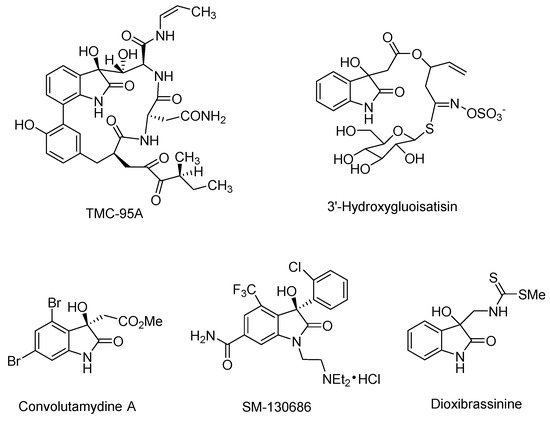
The 3-substituted-3-hydroxy-2-oxindoles have a stereogenic quaternary center at the C-3 position and a core unit that appears in many natural products and biologically active compounds [1,2,3,4,5,6,7,8]. Representative examples are: TMC-95A [9,10], Dioxibrassinine [11,12], SM-130686 [13], 3′-Hydroxygluoisatisin [14], and Convolutamydines (Figure 1) [15]. Consequently, the 3-substituted-3-hydroxy-2-oxindole framework has been an intensively investigatedsynthetic target. To construct 3-substituted-3-hydroxy-2-oxindoles, asymmetric aldol reaction has been considered one of the most powerful and efficient measures for the formation of carbon–carbon bond at C-3 position [16,17,18,19,20,21]. In this context, the asymmetric aldol reaction between isatin and carbonyl compounds has attracted much attention. As a pioneering work in this field, Tomasini and coworkers demonstrated the enantioselective aldol reaction of isatin with acetone catalyzed by a dipeptide-based organocatalyst [22]. Along these lines, Toru et al. employed sulfonamides as catalysts for the enantioselective aldol reaction of acetaldehyde with isatin, and successfully achieved the first highly enantioselective crossed-aldol reaction of acetaldehydes with ketones [23]. Later on, Zhao et al. described the utilization of quinidine thiourea for the highly enantioselective synthesis of 3-alkyl-3-hydroxyindolin-2-ones [24]. Lin et al. disclosed the enzymatic enantioselective aldol reaction of isatin derivatives with cyclic ketones, which produced products in high yields with moderately good stereoselectivity [25]. Very recently, natural amino acid salts were successfully developed to catalyze direct aldol reactions of isatin with ketones [26]. Despite this reported success, it is still important and desirable to develop new catalysts with operational simplicity and high catalytic efficiency for asymmetric aldol reactions.
Figure 1.
Representative examples of 3-substituted-3-hydroxy-2-oxindoles.
Recently, considerable focus has been placed on environmentally-friendly and sustainable resources and processes. In this regard, natural materials have been used directly as supports for catalytic applications, which has made this approach a very attractive strategy. In particular, biopolymers are a diverse and versatile class of materials that are inexpensive and abundant in nature [27]. Chitosan is a very abundant biopolymer obtained from the alkaline deacetylation of chitin, which is ubiquitous in the exoskeletons of crustaceans, the cuticles of insects and the cell walls of most fungi [28]. Chitosan functionalization is based on the presence of amino groups, which easily react with electrophilic reagents such as aldehydes, acid chlorides, acid anhydrides and epoxides [29,30,31,32]. Chitosan is a chiral polyamine and exhibits good flexibility, insolubility in many solvents and an inherent chirality and affinity for metal ions [33,34,35,36]. On the other hand, chitosan is an excellent candidate for building heterogeneous catalysts, since it can act as a support for chiral organic frameworks [37,38]. In addition, there are various advantages to using chitosan to catalyze reactions in water, which is a universally environmentally-friendly solvent.
Although chitosan possesses these properties, the direct use of chitosan in base catalysis has been very poorly investigated. In 2006, Kantam et al. reported the use of chitosan hydrogels as a green and recyclable catalyst for the aldol and Knoevenagel reactions [39]. Since then, as an ideal alternative to organocatalysts, chitosan aerogels were utilized to catalyze the asymmetric aldol reaction in water, giving the desired products in high yields with good stereoselectivity and recyclability [40]. Not long ago, chitosan-supported cinchonine was developed as an organocatalyst for the direct asymmetric aldol reaction in water and this catalyst could be easily recovered and reused several times without a significant loss in activity [41]. In continuation of our previous efforts on asymmetric direct aldol reaction of isatins with ketones [26], herein, we report on the synthesis of 3-substituted-3-hydroxy-2-oxindoles catalyzed by chitosan aerogel in the presence of water.
2. Results and Discussion
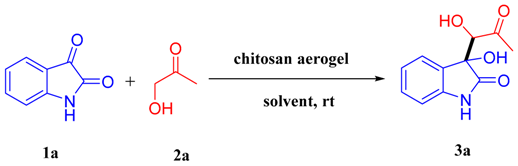
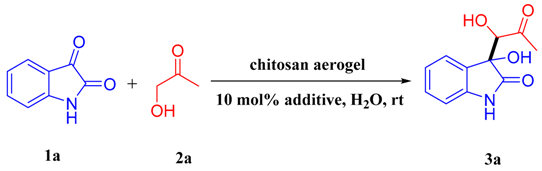
The direct asymmetric aldol reaction of isatin and hydroxyacetone was selected as a template reaction to optimize the conditions for the reaction catalyzed using the chitosan aerogel. Using the optimized conditions, the desired product was obtained in high yield with excellent stereoselectvity and relative configurations assigned by comparison with previously reports [42,43].
Initially, the aldol reaction with hydroxyacetone 2a was examined as the donor substrate and isatin 1a as the acceptor using 10 mol % catalyst at room temperature and the results of this reaction are shown in Table 1.
Table 1.
Screening of the solvents for the enantioselective aldol reaction of isatin and hydroxyacetone catalyzed by chitosan aerogel a.
The data in Table 1 showed that the catalytic activity and stereoselectivity of the reaction were influenced by the reaction media. The solvents employed included EtOAc, MeCN and Et2O which produced the product 3a with 90%–94% yields, but with poor enantiomeric excess (ee) (Table 1, entries 1–3). Other solvents that were also tested produced 3a in excellent yields (90%–97%) and with good ee (31%–40%) (Table 1, entries 4–8), but also produced high diastereoselectivity (syn:ant = 73:27) with water as the solvent (Table 1, entry 8). Although physical properties between hexane and water are greatly different, the product 3a in yield and enantioselectivity in hexane were similar to that in water, this might be because the chitosan aerogel exhibited higher catalytic activity in water and hexane. In addition, compared to water, the solvents MeOH and EtOH exhibited lower yields (88% and 80%) and enantioselectivity (29% ee and 17% ee) (Table 1, entries 9–10). In addition, when dioxane and i-PrOH were used as the solvents, the results were unsatisfactory. Therefore, water was chosen as the solvent due to its good performance in this reaction.
After screening the solvents, the effect of the donor (hydroxyacetone) on the model aldol reaction was investigated. As summarized in Table 2, increasing the amount of hydroxyacetone from 5 to 20 equivalents led to a significant increase in the yields (88% up to 99%) and enantioselectivity (33% ee up to 44%) (Table 2, entries 1–3). A further increase in the hydroxyacetone dosage to over 20 equivalents resulted in a decrease in the enantioselectivity, albeit with excellent yields (99%) (Table 2, entry 4). This suggested that the donor dosage within a certain range can improve the chemoselectivity. Accordingly, 20 equivalents of hydroxyacetone was used as the optimum dosage.
Table 2.
Effect of the amount of isatin for the enantioselective aldol reaction in the presence of water a.
To further enhance the yield and enantioselectivity of 3a, the effect of different types of additives was investigated (Table 3). The results showed that 2,5-dihydroxybenzoic acid was the most effective additive, producing product 3a in a 96% yield with 66% ee (Table 3, entry 16). By contrast, compared to 2,5-dihydroxybenzoic acid, some additives such as sulfamic acid, formic acid and 1,1′-bi-2-naphthol exhibited higher yields but lower enantioselectivity (Table 3, entries 1, 2 and 15). It is also conceivable that the 2,5-dihydroxybenzoic acid that exhibited higher enantioselectivity might also provide an additional asset for chitosan, favoring the recognition of this reagent by the catalyst. Other additives were also tested using the template reaction, which produced product 3a in good yields along with lower enantioselectivity (Table 3, entries 3–14). Moreover, considering that the reaction temperature is related to the enantioselectivity, the reaction was conducted at 0 °C. Fortunately, it was found that the enantioselectivity of the product was significantly increased by maintaining the reaction temperature at 0 °C (Table 3, entry 17). Hence, the optimum conditions for this reaction were found to be the use of 2,5-dihydroxybenzoic acid as an additive and maintaining the reaction at 0 °C.
Table 3.
Effects of additives for the enantioselective aldol reaction in the presence of water a.
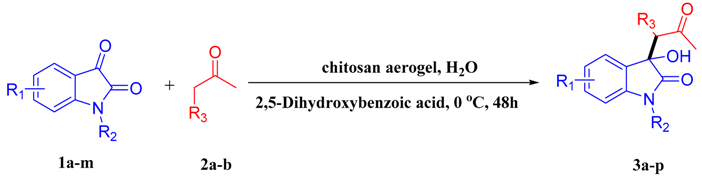
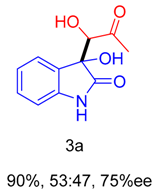
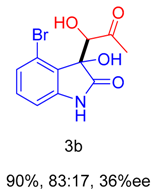
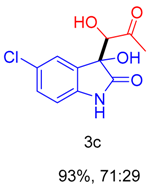
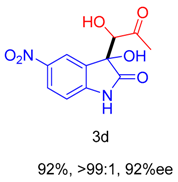
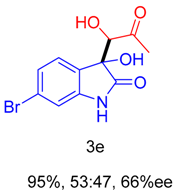
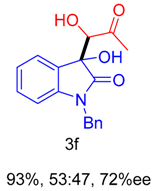
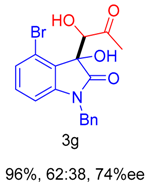
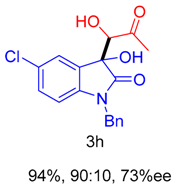
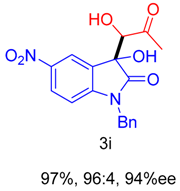
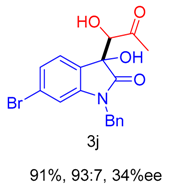
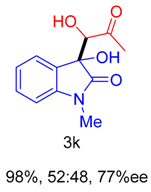
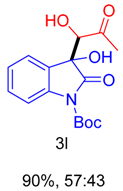
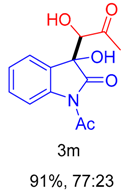
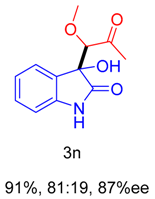
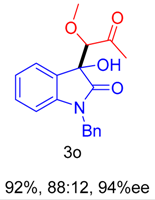
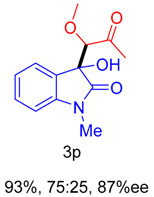
Using these optimized conditions, the scope of this reaction was studied and the results are summarized in Table 4.The results showed that the isatin and hydroxyacetone gave the corresponding aldol product 3a in high yield and good ee (Table 4, 3a). Isatin containing weaker electron-withdrawing groups such as halogens, also gave excellent yields, but lower enantioselectivity (Table 4, 3b and 3e). Unfortunately, although the product 3c was obtained inexcellent yield, the ee could not be determined. Interestingly, isatin containing strong electron-withdrawing substituents, such as 5-nitroisatin, reacted easily with hydroxyacetone to give 3d in high yield (92%) and good enantioselectivity (92% ee), along with excellent diastereoselectivity (Table 4, 3d). Subsequently, N-benzylisatins with various substitution patterns were studied, and the corresponding products 3f–3i were obtained in better yields (93%–97%) and good enantioselectivity (72%–94% ee) (Table 4, 3f–3i). However, the product 3j showed lower enantioselectivity (Table 4, 3j). N-methylisatin was also employed to produce product 3k in higher yield and ee (Table 4, 3k). When N-boc and N-acethylisatins were used, the corresponding products 3l and 3m exhibiting an enantiomeric excess could not be clearly identified. Finally, using methoxyacetone as the donor substrate, the resulting products 3n–3p were obtained in excellent yields and enantioselectivity (Table 4, 3n–3p).
Table 4.
Asymmetric aldol reaction between various isatins and ketones catalyzed by chitosan aerogel under optimized conditions a,b,c,d.
3. Materials and Methods
3.1. General Methods
All solvents and reagents in this work were acquired from different commercial sources and used without further purification. Chitosan aerogel microspheres were prepared as in previous literature [32]. Thin layer chromatography (TLC) was conducted on GF254 silica gel plates, which were visualized by UV at 254 nm. Column chromatography separations were performed using silica gel 300–400 mesh. Chiral High-performance liquid chromatography (HPLC) analysis was conducted with a Waters Alliance 2695 instrument (Waters corporation, Milford, MA, USA), using a UV–visible light (Vis) Waters PDA 2998 detector (Waters corporation), and working at 254 nm. 1H NMR spectra were recorded on a Bruker AM400 NMR spectrometer (Bruker corporation, Karlsruhe, Germany), and NMR spectra were obtained as CDCl3 solutions (reported in ppm), using chloroform as the reference standard (7.26 ppm) or dimethyl sulfoxide-d6 (DMSO-d6) (2.50 ppm). High-resolution mass spectrometry (HRMS) data were recorded using a Waters Q-Tof premier mass spectrometer (Waters corporation).
3.2. General Procedure for the Asymmetric Aldol Reaction of Isatins with Ketones
A reaction mixture of isatin (0.5 mmol), ketone (10 mmol), chitosan aerogel beads (10 mol %) and 2,5-dihydroxybenzoic acid (10 mol %) in water (0.5 mL) was stirred at 0 °C until the complete conversion of the starting material. Then the solvent was removed in vacuo to give the crude product and purified by column chromatography on silica gel (petroleum ether/ethyl acetate) or crystallization from petroleum ether/ethyl acetate to afford the desired compounds.
4. Conclusions
In conclusion, an environmentally-friendly enantioselective aldol reaction to construct the 3-substituted-3-hydroxy-2-oxindoles is established by using isatins and ketones as starting materials. In this reaction, chitosan aerogel is successfully employed as a green organocatalyst and works smoothly in the presence of water. The reaction has a large substrate scope and the corresponding products are all produced in high yields and with high chemoselectivity. Moreover, 2,5-dihydroxybenzoic acid was found to be an effective additive to modulate the asymmetric aldol reactions. Further studies of this system can broaden the scope of this reaction to other ketone donors.
Supplementary Materials
The following are available online at www.mdpi.com/2073-4344/6/12/186/s1, Figures S1–S16: 1H NMR and 13C NMR analysis of compound 3a–3p, Figures S17–S29: Chiral High-performance liquid chromatography (HPLC) analysis of compound 3a–3p.
Acknowledgments
This work was supported by the National Natural Science Foundation of China (81473091, 81673290) and the Fundamental Research Funds for the Central Universities and Distinguished Young Scholars of Sichuan University (2015SCU04A41).
Author Contributions
Lifang Ma and Liang Ouyang conceived and designed the experiments; Hui Dong performed the experiments; Jie Liu analyzed the data; Liang Ouyang and Jie Liu contributed reagents/materials/analysis tools; Hui Dong and Liang Ouyang wrote the paper. All authors read and approved the final manuscript.
Conflicts of Interest
The authors declare no conflict of interest.
References
- Rasmussen, H.B.; Macleod, J.K. Total synthesis of donaxaridine. J. Nat. Prod. 1997, 60, 1152–1154. [Google Scholar] [CrossRef]
- Hibino, S.; Choshi, T. Simple indole alkaloids and those with a nonrearranged monoterpenoid unit. Nat. Prod. Rep. 2001, 18, 66–87. [Google Scholar] [CrossRef] [PubMed]
- Tang, Y.Q.; Sattler, I.; Thiericke, R.; Grabley, S.; Feng, X.Z. Maremycins C and D, new diketopiperazines, and maremycins E and F, novel polycyclic spiro-indole metabolites isolated from Streptomyces sp. Eur.J. Org. Chem. 2001, 261–267. [Google Scholar] [CrossRef]
- Hewawasam, P.; Erway, M.; Moon, S.L.; Knipe, J.; Weiner, H.; Boissard, C.G.; Post-Munson, D.J.; Gao, Q.; Huang, S.; Gribkoff, V.K.; et al. Synthesis and structure−activity relationships of 3-aryloxindoles: A new class of calcium-dependent, large conductance potassium (Maxi-K) channel openers with neuroprotective properties. J. Med. Chem. 2002, 45, 1487–1499. [Google Scholar] [CrossRef] [PubMed]
- Nicolaou, K.C.; Rao, P.B.; Hao, J.; Reddy, M.V.; Rassias, G.; Huang, X. The second total synthesis of diazonamide A. Angew. Chem. Int. Ed. 2003, 42, 1753–1758. [Google Scholar] [CrossRef] [PubMed]
- Suzuki, H.; Morita, H.; Shiro, M.; Kobayashi, J. Celogentin K, a new cyclic peptide from the seeds of Celosia argentea and X-ray structure of moroidin. Tetrahedron 2004, 60, 2489–2495. [Google Scholar] [CrossRef]
- Chen, W.B.; Du, X.L.; Cun, L.F.; Zhang, X.M.; Yuan, W.C. Highly enantioselective aldol reaction of acetaldehyde and isatins only with 4-hydroxydiarylprolinol as catalyst: Concise stereoselective synthesis of (R)-convolutamydines B and E, (−)-donaxaridine and (R)-chimonamidine. Tetrahedron 2010, 66, 1441–1446. [Google Scholar] [CrossRef]
- Niu, R.; Xiao, J.; Liang, T.; Li, X.W. Facile synthesis of azaarene-substituted 3-hydroxy-2-oxindoles via brønsted acid catalyzed sp3 C–H functionalization. Org. Lett. 2012, 14, 676–679. [Google Scholar] [CrossRef] [PubMed]
- Koguchi, Y.; Kohno, J.; Nishio, M.; Takahashi, K.; Okuda, T.; Ohnuki, T.; Komatsubara, S. TMC-95A, B, C, and D, novel proteasome inhibitors produced by Apiospora montagnei Sacc. TC 1093 taxonomy, production, isolation, and biological activities. J. Antibiot. 2000, 53, 105–109. [Google Scholar] [CrossRef] [PubMed]
- Kohno, J.; Koguchi, Y.; Nishio, M.; Nakao, K.; Kuroda, M.; Shimizu, R.; Ohnuki, T.; Komatsubara, S. Structures of TMC-95A−D: Novel proteasome inhibitors from Apiospora montagnei Sacc. TC 1093. J. Org. Chem. 2000, 65, 990–995. [Google Scholar] [CrossRef] [PubMed]
- Monde, K.; Sasaki, K.; Shirata, A.; Takasugi, M. Brassicanal C and two dioxindoles from cabbage. Phytochemistry 1991, 30, 2915–2917. [Google Scholar] [CrossRef]
- Suchý, M.; Kutschy, P.; Monde, K.; Goto, H.; Harada, N.; Takasugi, M.; Dzurilla, M.; Balentova, E. Synthesis, absolute configuration, and enantiomeric enrichment of a cruciferous oxindolephytoalexin, (S)-(−)-spirobrassinin, and its oxazoline analog. J.Org. Chem. 2001, 66, 3940–3947. [Google Scholar] [CrossRef] [PubMed]
- Tokunaga, T.; Hume, W.E.; Umezome, T.; Okazaki, K.; Ueki, Y.; Kumagai, K.; Hourai, S.; Nagamine, J.; Seki, H.; Taiji, M.; et al. Oxindole derivatives as orally active potent growth hormone secretagogues. J. Med. Chem. 2001, 44, 4641–4649. [Google Scholar] [CrossRef] [PubMed]
- Fréchard, A.; Fabre, N.; Péan, C.; Montaut, S.; Fauvel, M.T.; Rollin, P.; Fourasté, I. Novel indole-type glucosinolates from woad (Isatis tinctoria L.). Tetrahedron Lett. 2001, 42, 9015–9017. [Google Scholar] [CrossRef]
- Kamano, Y.; Zhang, H.P.; Ichihara, Y.; Kizu, H.; Komiyama, K.; Pettit, G.R. Convolutamydine A, a novel bioactive hydroxyoxindole alkaloid from marine bryozoan Amathia convolute. Tetrahedron Lett. 1995, 36, 2783–2784. [Google Scholar] [CrossRef]
- Garden, S.J.; Silva, R.B.; Pinto, A.C. A versatile synthetic methodology for the synthesis of tryptophols. Tetrahedron 2002, 58, 8399–8412. [Google Scholar] [CrossRef]
- Chen, J.R.; Liu, X.P.; Zhu, X.Y.; Li, L.; Qiao, Y.F.; Zhang, J.M.; Xiao, W.J. Organocatalytic asymmetric aldol reaction of ketones with isatins: Straightforward stereoselective synthesis of 3-alkyl-3-hydroxyindolin-2-ones. Tetrahedron 2007, 63, 10437–10444. [Google Scholar] [CrossRef]
- Chen, W.B.; Liao, Y.H.; Du, X.L.; Zhang, X.M.; Yuan, W.C. Catalyst-free aldol condensation of ketones and isatins under mild reaction conditions in DMF with molecular sieves 4 Å as additive. Green Chem. 2009, 11, 1465–1476. [Google Scholar] [CrossRef]
- Zhu, B.; Zhang, W.; Lee, R.; Han, Z.; Yang, W.; Tan, D.; Huang, K.W.; Jiang, Z. Direct asymmetric vinylogousaldol reaction of allyl ketones with isatins: divergent synthesis of 3-hydroxy-2-oxindole derivatives. Angew. Chem. Int. Ed. 2013, 52, 6666–6670. [Google Scholar] [CrossRef] [PubMed]
- Kumar, A.S.; Ramesh, P.; Kumar, G.S.; Swetha, A.; Nanubolu, J.B.; Meshram, H.M. A Ru(III)–catalyzed α-cross-coupling aldol type addition reaction of activated olefins with isatins. RSC Adv. 2016, 6, 1705–1709. [Google Scholar] [CrossRef]
- Chen, Q.; Tang, Y.; Huang, T.; Liu, X.; Lin, L.; Feng, X.M. Copper/Guanidine-catalyzed asymmetric alkynylation of isatins. Angew. Chem. Int. Ed. 2016, 55, 5286–5289. [Google Scholar] [CrossRef] [PubMed]
- Luppi, G.; Cozzi, P.G.; Monari, M.; Kaptein, B.; Broxterman, Q.B.; Tomasini, C. Dipeptide-catalyzed asymmetric aldol condensation of acetone with (N-alkylated) isatins. J. Org. Chem. 2005, 70, 7418–7421. [Google Scholar] [CrossRef] [PubMed]
- Nakamura, S.; Hara, N.; Nakashima, H.; Kubo, K.; Shibata, N.; Toru, T. First enantioselective synthesis of (R)-convolutamydine B and E with N-(heteroarenesulfonyl) prolinamides. Chem. Eur. J. 2009, 15, 6790–6793. [Google Scholar]
- Guo, Q.; Bhanushali, M.; Zhao, C. Quinidine thiourea-catalyzed aldol reaction of unactivated ketones: Highly enantioselective synthesis of 3-alkyl-3-hydroxyindolin-2-ones. Angew. Chem. Int. Ed. 2010, 49, 9460–9464. [Google Scholar] [CrossRef] [PubMed]
- Liu, Z.Q.; Xiang, Z.W.; Shen, Z.; Wu, Q.; Lin, X.F. Enzymatic enantioselective aldol reactions of isatin derivatives with cyclic ketones under solvent-free conditions. Biochimie 2014, 101, 156–160. [Google Scholar] [CrossRef] [PubMed]
- Chen, G.; Ju, Y.; Yang, T.; Li, Z.; Wei, A.; Sang, Z.; Liu, J.; Lou, Y. Natural amino acid salt catalyzed aldol reactions of isatins with ketones: Highly enantioselective construction of 3-alkyl-3-hydroxyindolin-2-ones. Tetrahedron Asymmetry 2015, 26, 943–947. [Google Scholar] [CrossRef]
- Kaplan, D.L. Biopolymers from Renewable Resources; Springer: Berlin, Germany, 1998. [Google Scholar]
- Guibal, E. Heterogeneous catalysis on chitosan-based materials: A review. Prog. Polym. Sci. 2005, 30, 71–109. [Google Scholar]
- Roberts, G.A.F.; Taylo, K.E. Chitosan gels, 3. The formation of gels by reaction of chitosan with glutaraldehyde. Makromol. Chem. 1989, 190, 951–960. [Google Scholar] [CrossRef]
- Wei, Y.C.; Hudson, S.M.; Mayer, J.M.; Kaplan, D.L.J. The crosslinking of chitosan fibers. Polym. Sci. Part A 1992, 30, 2187–2193. [Google Scholar] [CrossRef]
- Zeng, X.; Ruckenstein, E. Trypsin purification by p-aminobenzamidine immobilized on macroporous chitosan membranes. Ind. Eng. Chem. Res. 1998, 37, 159–165. [Google Scholar] [CrossRef]
- Quignard, F.; Valentin, R.; Renzo, F.D. Aerogel materials from marine polysaccharides. New J. Chem. 2008, 32, 1300–1310. [Google Scholar] [CrossRef]
- Quignard, F.; Choplin, A.; Domard, A. Chitosan: A natural polymeric support of catalysts for the synthesis of fine chemicals. Langmuir 2000, 16, 9106–9108. [Google Scholar] [CrossRef]
- Sun, W.; Xia, C.G.; Wang, H.W. Efficient heterogeneous catalysts for the cyclopropanation of olefins. New J. Chem. 2002, 26, 755–758. [Google Scholar] [CrossRef]
- Hardy, J.J.E.; Hubert, S.; Macquarrie, D.J.; Wilson, A.J. Chitosan-based heterogeneous catalysts for Suzuki and Heck reactions. Green Chem. 2004, 6, 53–56. [Google Scholar] [CrossRef]
- Chtchigrovsky, M.; Primo, A.; Gonzalez, P.; Molvinger, K.; Robitzer, M.; Quignard, F.; Taran, F. Functionalized chitosan as a green, recyclable, biopolymer-supported catalyst for the [3 + 2] Huisgen cycloaddition. Angew. Chem. Int. Ed. 2009, 48, 5916–5920. [Google Scholar] [CrossRef] [PubMed]
- Macquarrie, D.J.; Hardy, J.J.E. Applications of functionalized chitosan in catalysis. Ind. Eng. Chem. Res. 2005, 44, 8499–8520. [Google Scholar] [CrossRef]
- Zhang, H.; Zhao, W.; Zou, J.; Yi, L.; Li, R.; Cui, Y. Aldol reaction catalyzed by a hydrophilic catalyst in aqueous micelle as an enzyme mimic system. Chirality 2009, 21, 492–496. [Google Scholar] [CrossRef] [PubMed]
- Reddy, K.R.; Rajgopal, K.; Maheswari, C.U.; Kantam, M.L. Chitosan hydrogel: A green and recyclable biopolymer catalyst for aldol and Knoevenagel reactions. New J. Chem. 2006, 30, 1549–1552. [Google Scholar] [CrossRef]
- Gioia, C.; Ricci, A.; Bernardi, L.; Bourahla, K.; Tanchoux, N.; Robitzer, M.; Quignard, F. Chitosan aerogel beads as a heterogeneous organocatalyst for the asymmetric aldol reaction in the presence of water: An assessment of the effect of additives. Eur. J. Org. Chem. 2013, 588–594. [Google Scholar] [CrossRef]
- Zhao, W.; Qu, C.; Yang, L.; Cui, Y. Chitosan-supported cinchonine as an efficient organocatalyst for direct asymmetric aldol reaction in water. Chin. J. Catal. 2015, 36, 367–371. [Google Scholar] [CrossRef]
- Ricci, A.; Bernardi, L.; Gioia, C.; Vierucci, S.; Robitzer, M.; Quignard, F. Chitosan aerogel: A recyclable, heterogeneous organocatalyst for the asymmetric direct aldol reaction in water. Chem. Commun. 2010, 46, 6288–6290. [Google Scholar] [CrossRef] [PubMed]
- Tanimura, Y.; Yasunaga, K.; Ishimaru, K. Asymmetric aldol reaction using a very simple primary amine catalyst: divergent stereoselectivity by using 2,6-difluorophenyl moiety. Tetrahedron 2014, 70, 2816–2821. [Google Scholar] [CrossRef]

© 2016 by the authors; licensee MDPI, Basel, Switzerland. This article is an open access article distributed under the terms and conditions of the Creative Commons Attribution (CC-BY) license (http://creativecommons.org/licenses/by/4.0/).