A Theoretical Study of the Reactive Mechanisms of Alkali Metal Doped Ni-Based Oxygen Carrier During Chemical Looping Combustion

Abstract
1. Introduction
2. Results and Discussion
2.1. Surface Structure of Alkali Metal Doped NiO
2.2. CO Adsorption on the Pure and Doped NiO Surfaces
2.3. Mechanism of CO Oxidation on Pure and Doped NiO Surfaces
2.4. Oxygen Activity for Alkali Metal Doped NiO Surfaces
3. Calculation Method and Model
4. Conclusions
Author Contributions
Funding
Data Availability Statement
Acknowledgments
Conflicts of Interest
Abbreviations
| CLC | Chemical looping combustion |
| GHGs | Greenhouse gases |
| FR | Fuel reactor |
| AR | Air reactor |
| DFT | Density functional theory |
| DOS | Density of states |
| PDOS | Partial density of states |
| HOMO | Highest occupied molecular orbital |
| LUMO | Lowest unoccupied molecular orbital |
| IS | Initial state |
| IM | Intermediate state |
| TS | Transition state |
| FS | Final state |
| CASTEP | Cambridge Sequential Total Energy Package |
| PBE | Perdew–Burke–Ernzerhof |
| GGA | Generalized gradient approximation |
| SCF | Self-consistent field |
| LST/QST | Linear/quadratic synchronous transit |
References
- Naddaf, M. Carbon Capture Nets 2 Billion Tonnes of CO2 Each Year—But It’s Not Enough. Nature, 2023; ahead of print. [Google Scholar] [CrossRef]
- Li, M.; Wang, R. Integrated Technology of CO2 Adsorption and Catalysis. Catalysts 2025, 15, 745. [Google Scholar] [CrossRef]
- Zhou, C.; Liu, D.; Feng, Y.; Dou, B.; Ma, J.; Ma, J. Structure Design and Performance of Coal-Fired Chemical Looping Combustion Systems: A Review. Chem. Eng. J. 2025, 519, 165125. [Google Scholar] [CrossRef]
- Daneshmand-Jahromi, S.; Sedghkerdar, M.H.; Mahinpey, N. A Review of Chemical Looping Combustion Technology: Fundamentals, and Development of Natural, Industrial Waste, and Synthetic Oxygen Carriers. Fuel 2023, 341, 127626. [Google Scholar] [CrossRef]
- Abuelgasim, S.; Wang, W.; Abdalazeez, A. A Brief Review for Chemical Looping Combustion as a Promising CO2 Capture Technology: Fundamentals and Progress. Sci. Total Environ. 2021, 764, 142892. [Google Scholar] [CrossRef]
- Ishida, M.; Jin, H. A Novel Chemical-Looping Combustor without NOx Formation. Ind. Eng. Chem. Res. 1996, 35, 2469–2472. [Google Scholar] [CrossRef]
- Zou, L.; Wu, Y.; Zhu, L.; Yang, K.; Qian, K.; Cui, Y.; Fan, M.; Liu, D. Enhanced Combustion Performance and Reduced NOx Emissions during Chemical Looping Ammonia Combustion with Cu-Fe Oxygen Carrier. Proc. Combust. Inst. 2024, 40, 105548. [Google Scholar] [CrossRef]
- Mei, D.; Zhao, H.; Ma, Z.; Zheng, C. Using the Sol–Gel-Derived CuO/CuAl2O4 Oxygen Carrier in Chemical Looping with Oxygen Uncoupling for Three Typical Coals. Energy Fuels 2013, 27, 2723–2731. [Google Scholar] [CrossRef]
- Mei, D.; Abad, A.; Zhao, H.; Adánez, J. Characterization of a Sol–Gel Derived CuO/CuAl2O4 Oxygen Carrier for Chemical Looping Combustion (CLC) of Gaseous Fuels: Relevance of Gas–Solid and Oxygen Uncoupling Reactions. Fuel Process. Technol. 2015, 133, 210–219. [Google Scholar] [CrossRef]
- Dawa, T.; Sajjadi, B. Exploring the Potential of Perovskite Structures for Chemical Looping Technology: A State-of-the-Art Review. Fuel Process. Technol. 2024, 253, 108022. [Google Scholar] [CrossRef]
- Wu, X.; Liu, X.; Zou, G.; Ma, J.; Kuang, C.; Zhao, H. Design a Novel Ca-Mn Perovskite Oxygen Carrier with Balanced Performance in Chemical Looping Combustion. Proc. Combust. Inst. 2024, 40, 105645. [Google Scholar] [CrossRef]
- Kuang, C.; Wang, S.; Lv, S.; Cai, J.; Luo, M.; Zhao, J. Comparison of Metallic Oxide, Natural Ore and Synthetic Oxygen Carrier in Chemical Looping Combustion Process. Int. J. Hydrogen Energy 2021, 46, 18032–18041. [Google Scholar] [CrossRef]
- Fleiß, B.; Priscak, J.; Hammerschmid, M.; Fuchs, J.; Müller, S.; Hofbauer, H. CO2 Capture Costs of Chemical Looping Combustion of Biomass: A Comparison of Natural and Synthetic Oxygen Carrier. J. Energy Chem. 2024, 92, 296–310. [Google Scholar] [CrossRef]
- de Oliveira, G.P.; Adánez-Rubio, I.; Adánez, J.; de Araújo Melo, D.M.; Braga, R.M. Screening of Fe-, Mn-, and Ni-Based Ores and Mine Residues as Sustainable, Environmentally Friendly, and Cost-Effective Oxygen Carriers for Chemical Looping Processes. Powder Technol. 2025, 457, 120858. [Google Scholar] [CrossRef]
- Ma, Z.; Wang, J.; Liu, G.; Zhang, H.; Lu, Y.; Xiong, J.; Xie, C.; Zou, C. Regeneration of Deactivated Fe2O3/Al2O3 Oxygen Carrier via Alkali Metal Doping in Chemical Looping Combustion. Fuel Process. Technol. 2021, 220, 106902. [Google Scholar] [CrossRef]
- Idziak, K.; Czakiert, T.; Krzywanski, J.; Zylka, A.; Kozlowska, M.; Nowak, W. Safety and Environmental Reasons for the Use of Ni-, Co-, Cu-, Mn- and Fe-Based Oxygen Carriers in CLC/CLOU Applications: An Overview. Fuel 2020, 268, 117245. [Google Scholar] [CrossRef]
- Wang, M.; Xu, Y.; Xia, M.; Zhang, B.; Wei, Y. Experimental Study of Transition Metal-Doped Cu-Based Oxygen Carrier for Chemical Looping with Oxygen Uncoupling. ACS Omega 2025, 10, 10308–10316. [Google Scholar] [CrossRef] [PubMed]
- Choun, M.; Ryun Lee, D.; Gook Kim, Y.; Oh, J.; Baek, J.-I. Effect of Crystallinity of Nickel Hydroxide on Mechanical Strength of Spray-Dried Ni-Based Oxygen Carrier for Chemical Looping Combustion. Fuel 2025, 381, 133211. [Google Scholar] [CrossRef]
- Putra, A.F.P.; Hantoko, D.; Khan, W.U.; Cavagnol, S.; Razzak, S.A.; Hossain, M.M. Promotional Effects of Ce on Fe-CeγAl2O3 Oxygen Carriers for Low-Temperature Chemical Looping Hydrogen Production. Fuel 2026, 404, 136246. [Google Scholar] [CrossRef]
- Wang, M.; Zhang, S.; Xia, M.; Wang, M. A Theoretical Study of the Oxygen Release Mechanisms of a Cu-Based Oxygen Carrier during Chemical Looping with Oxygen Uncoupling. Catalysts 2022, 12, 332. [Google Scholar] [CrossRef]
- Güleç, F.; Okolie, J.A. Chemical Looping Combustion of Low-Volatile Semi-Anthracite Coal with Co-Based Metal Oxide: Performances, Kinetics, and Mechanisms. J. Energy Inst. 2025, 119, 101993. [Google Scholar] [CrossRef]
- Wang, M.; Wang, M.; Xia, M.; Zhang, B.; Wei, Y. Theoretical Study of the Reactive Mechanisms of Li-Doped Ni-Based Oxygen Carrier during Chemical Looping Combustion. ACS Omega 2024, 9, 1714–1722. [Google Scholar] [CrossRef] [PubMed]
- Bayham, S.C.; Tong, A.; Kathe, M.; Fan, L.-S. Chemical Looping Technology for Energy and Chemical Production. WIREs Energy Environ. 2016, 5, 216–241. [Google Scholar] [CrossRef]
- Sun, Z.; Lu, D.Y.; Ridha, F.N.; Hughes, R.W.; Filippou, D. Enhanced Performance of Ilmenite Modified by CeO2, ZrO2, NiO, and Mn2O3 as Oxygen Carriers in Chemical Looping Combustion. Appl. Energy 2017, 195, 303–315. [Google Scholar] [CrossRef]
- Blas, L.; Dorge, S.; Michelin, L.; Dutournié, P.; Lambert, A.; Chiche, D.; Bertholin, S. Influence of the Regeneration Conditions on the Performances and the Microstructure Modifications of NiO/NiAl2O4 for Chemical Looping Combustion. Fuel 2015, 153, 284–293. [Google Scholar] [CrossRef]
- Cheng, X.; Gu, Z.; Li, F.; Zhu, X.; Wei, Y.; Zheng, M.; Tian, D.; Wang, H.; Li, K. Enhanced Resistance to Carbon Deposition in Chemical-Looping Combustion of Methane: Synergistic Effect of Different Oxygen Carriers via Sequence Filling. Chem. Eng. J. 2021, 421, 129776. [Google Scholar] [CrossRef]
- Zhang, J.; Zhang, H.; Yuan, N.; Meng, L.; Geng, C.; Bai, H. Insights into Reactive Behaviors and Mechanisms of Nickel-Based Oxygen Carriers Doped by Fe/Co during Chemical Looping Combustion from Multiple-Scale Molecular Modeling Combined with Experiments. Fuel Process. Technol. 2022, 229, 107181. [Google Scholar] [CrossRef]
- Yuan, N.; Bai, H.; An, M.; Zhang, J.; Hu, X.; Guo, Q. Modulation of Fe-Based Oxygen Carriers by Low Concentration Doping of Cu in Chemical Looping Process: Reactivity and Mechanism Based on Experiments Combined with DFT Calculations. Powder Technol. 2021, 388, 474–484. [Google Scholar] [CrossRef]
- Wang, M.; Liu, J.; Hu, J.; Liu, F. O2–CO2 Mixed Gas Production Using a Zr-Doped Cu-Based Oxygen Carrier. Ind. Eng. Chem. Res. 2015, 54, 9805–9812. [Google Scholar] [CrossRef]
- Qin, L.; Guo, M.; Cheng, Z.; Xu, M.; Liu, Y.; Xu, D.; Fan, J.A.; Fan, L.-S. Improved Cyclic Redox Reactivity of Lanthanum Modified Iron-Based Oxygen Carriers in Carbon Monoxide Chemical Looping Combustion. J. Mater. Chem. A 2017, 5, 20153–20160. [Google Scholar] [CrossRef]
- Imtiaz, Q.; Kierzkowska, A.M.; Broda, M.; Müller, C.R. Synthesis of Cu-Rich, Al2O3-Stabilized Oxygen Carriers Using a Coprecipitation Technique: Redox and Carbon Formation Characteristics. Environ. Sci. Technol. 2012, 46, 3561–3566. [Google Scholar] [CrossRef]
- Bao, J.; Li, Z.; Cai, N. Promoting the Reduction Reactivity of Ilmenite by Introducing Foreign Ions in Chemical Looping Combustion. Ind. Eng. Chem. Res. 2013, 52, 6119–6128. [Google Scholar] [CrossRef]
- Yin, F.; Sun, L.; Wu, S.; Xiao, R. Investigation of the Effects of Alkali and Alkaline Earth Metals on Performance of Oxygen Carrier for Chemical Looping Hydrogen Production. Energy 2025, 339, 138951. [Google Scholar] [CrossRef]
- Liu, L.; Zachariah, M.R. Enhanced Performance of Alkali Metal Doped Fe2O3 and Fe2O3/Al2O3 Composites as Oxygen Carrier Material in Chemical Looping Combustion. Energy Fuels 2013, 27, 4977–4983. [Google Scholar] [CrossRef]
- Huang, W.-C.; Kuo, Y.-L.; Su, P.-C.; Tseng, Y.-H.; Lee, H.-Y.; Ku, Y. Redox Performance of Na-Modified Fe2O3/Al2O3 with Syngas as Reducing Agent in Chemical Looping Combustion Process. Chem. Eng. J. 2018, 334, 2079–2087. [Google Scholar] [CrossRef]
- Day, M.; Tachibana, S.; Bell, J.; Lijewski, M.; Beckner, V.; Cheng, R.K. A Combined Computational and Experimental Characterization of Lean Premixed Turbulent Low Swirl Laboratory Flames: I. Methane Flames. Combust. Flame 2012, 159, 275–290. [Google Scholar] [CrossRef]
- Liu, X.; Ma, Z.; Gao, X.; Bai, M.; Ma, Y.; Meng, Y. Water Gas Shift Reaction Activity on Fe (110): A DFT Study. Catalysts 2022, 12, 27. [Google Scholar] [CrossRef]
- Meng, Y.; Liu, X.-W.; Bai, M.; Guo, W.-P.; Cao, D.-B.; Yang, Y.; Li, Y.-W.; Wen, X.-D. Prediction on Morphologies and Phase Equilibrium Diagram of Iron Oxides Nanoparticles. Appl. Surf. Sci. 2019, 480, 478–486. [Google Scholar] [CrossRef]
- Li, H.; Shi, L.; Jin, C.; Ye, R.; Zhang, R. Co and Ni Incorporated γ-Al2O3(110) Surface: A Density Functional Theory Study. Catalysts 2022, 12, 111. [Google Scholar] [CrossRef]
- Hou, F.; Jin, J.; Liu, D.; Kou, X.; Yang, H.; Wang, Y. Competition between Reduction Reaction and Carbon Deposition for CaSO4 Oxygen Carrier in Chemical-Looping Combustion: A First-Principle Study and Reaction Equilibrium Analysis. Surf. Interfaces 2021, 25, 101314. [Google Scholar] [CrossRef]
- Hou, F.; Kou, X.; Wang, Y.; Wang, K.; Lei, L.; Li, Y. Understanding the Impact of Ash Metal Components for the Characteristics of CaSO4(010) Surface during Chemical Looping Hydrogen Production: A First-Principles Study and Thermodynamics Analysis. Comput. Mater. Sci. 2024, 242, 113101. [Google Scholar] [CrossRef]
- Li, Z. First-Principles-Based Microkinetic Rate Equation Theory for Oxygen Carrier Reduction in Chemical Looping. Chem. Eng. J. 2022, 247, 117042. [Google Scholar] [CrossRef]
- Bai, Z.; Luo, K.H. Mechanisms for Interactions of H2S and Hg0 with Oxygen Carrier LaMnO3 during Chemical Looping Combustion: A DFT Study. Carbon Capture Sci. Technol. 2025, 16, 100480. [Google Scholar] [CrossRef]
- Feng, Y.; Wang, N.; Guo, X. Density Functional Theory Study on Improved Reactivity of Alkali-Doped Fe2O3 Oxygen Carriers for Chemical Looping Hydrogen Production. Fuel 2019, 236, 1057–1064. [Google Scholar] [CrossRef]
- Wang, P.; Qin, Z.; Shen, T.; Shen, L.; Song, T. Transforming Sulfur Paste into Sulfuric Acid through Chemical Looping Combustion of Sulfur with Fe-Based Oxygen Carriers: Thermodynamics, Conversion, and Mechanisms Analysis. Fuel 2025, 385, 134039. [Google Scholar] [CrossRef]
- Feng, Y.; Wang, N.; Guo, X. Influence Mechanism of Supports on the Reactivity of Ni-Based Oxygen Carriers for Chemical Looping Reforming: A DFT Study. Fuel 2018, 229, 88–94. [Google Scholar] [CrossRef]
- Xing, J.; Xia, X.; Jin, F.; Sun, X.; Zhang, H.; Xu, C.; Ye, F. Density Functional Theory Study on Support-Promoted CH4 Reforming in Ni-Based Oxygen Carriers for Chemical-Looping Conversion. Appl. Surf. Sci. 2024, 656, 159691. [Google Scholar] [CrossRef]
- Yuan, Y.; Dong, X.; Ricardez-Sandoval, L. A Multi-Scale Simulation of Syngas Combustion Reactions by Ni-Based Oxygen Carriers for Chemical Looping Combustion. Appl. Surf. Sci. 2020, 531, 147277. [Google Scholar] [CrossRef]
- Cai, X.; Wang, X.; Guo, X.; Zheng, C. Mechanism Study of Reaction between CO and NiO(001) Surface during Chemical-Looping Combustion: Role of Oxygen. Chem. Eng. J. 2014, 244, 464–472. [Google Scholar] [CrossRef]
- Segall, M.D.; Lindan, P.J.D.; Probert, M.J.; Pickard, C.J.; Hasnip, P.J.; Clark, S.J.; Payne, M.C. First-Principles Simulation: Ideas, Illustrations and the CASTEP Code. J. Phys. Condens. Matter 2002, 14, 2717–2744. [Google Scholar] [CrossRef]
- White, J.A.; Bird, D.M. Implementation of Gradient-Corrected Exchange-Correlation Potentials in Car-Parrinello Total-Energy Calculations. Phys. Rev. B Condens. Matter 1994, 50, 4954–4957. [Google Scholar] [CrossRef] [PubMed]
- Perdew, J.P.; Chevary, J.A.; Vosko, S.H.; Jackson, K.A.; Pederson, M.R.; Singh, D.J.; Fiolhais, C. Atoms, Molecules, Solids, and Surfaces: Applications of the Generalized Gradient Approximation for Exchange and Correlation. Phys. Rev. B 1992, 46, 6671–6687. [Google Scholar] [CrossRef] [PubMed]
- Sawatzky, G.A.; Allen, J.W. Magnitude and Origin of the Band Gap in NiO. Phys. Rev. Lett. 1984, 53, 2339–2342. [Google Scholar] [CrossRef]
- Feng, Y.; Guo, X. Study of Reaction Mechanism of Methane Conversion over Ni-Based Oxygen Carrier in Chemical Looping Reforming. Fuel 2017, 210, 866–872. [Google Scholar] [CrossRef]
- Sorescu, D.C. Adsorption and Activation of CO Coadsorbed with K on Fe(100) Surface: A Plane-Wave DFT Study. Surf. Sci. 2011, 605, 401–414. [Google Scholar] [CrossRef]
- Govind, N.; Petersen, M.; Fitzgerald, G.; King-Smith, D.; Andzelm, J. A Generalized Synchronous Transit Method for Transition State Location. Comput. Mater. Sci. 2003, 28, 250–258. [Google Scholar] [CrossRef]



| Model | Ebind/eV | LO–M/Å |
|---|---|---|
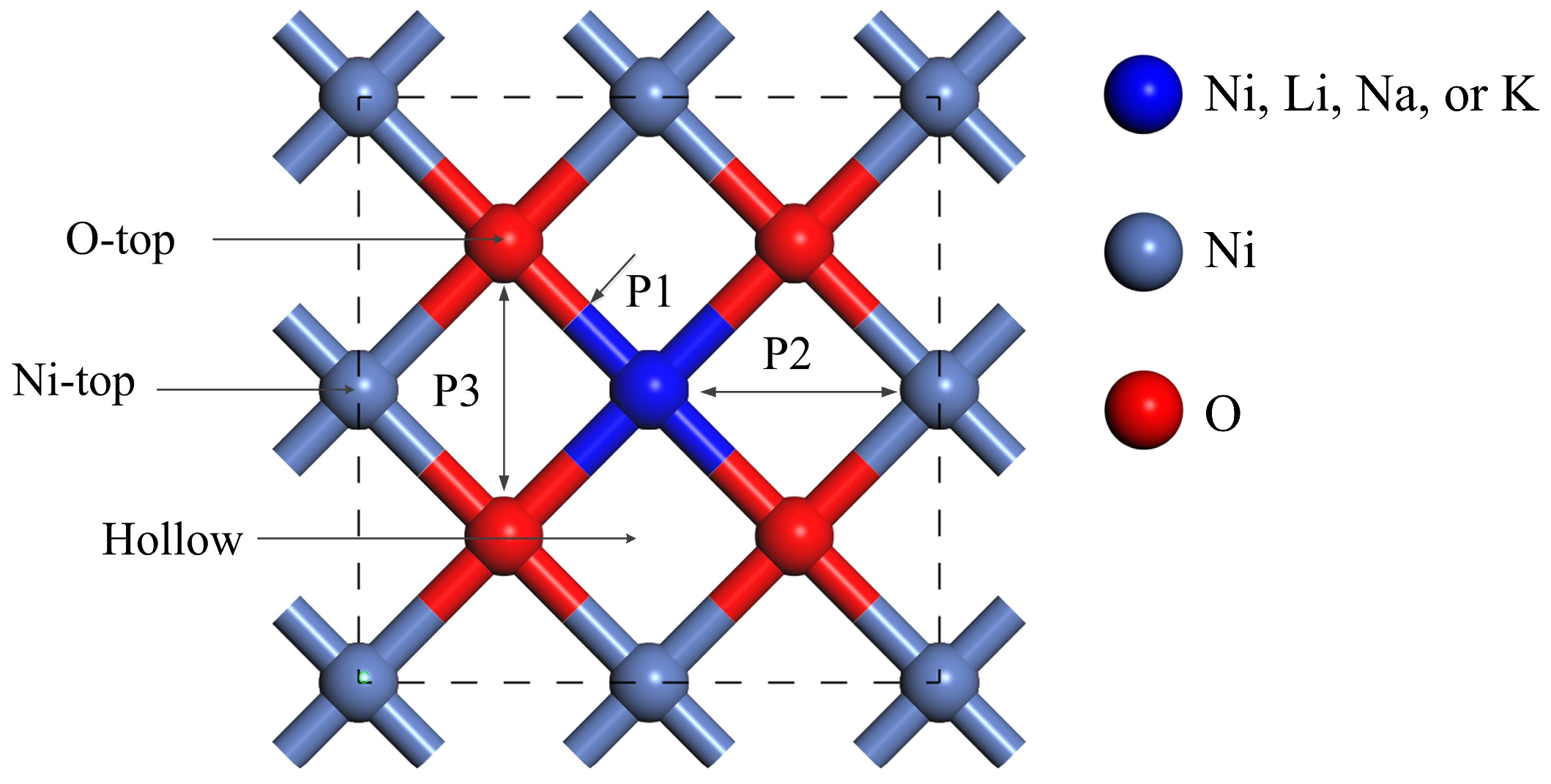
| NiO | — | 2.085 |
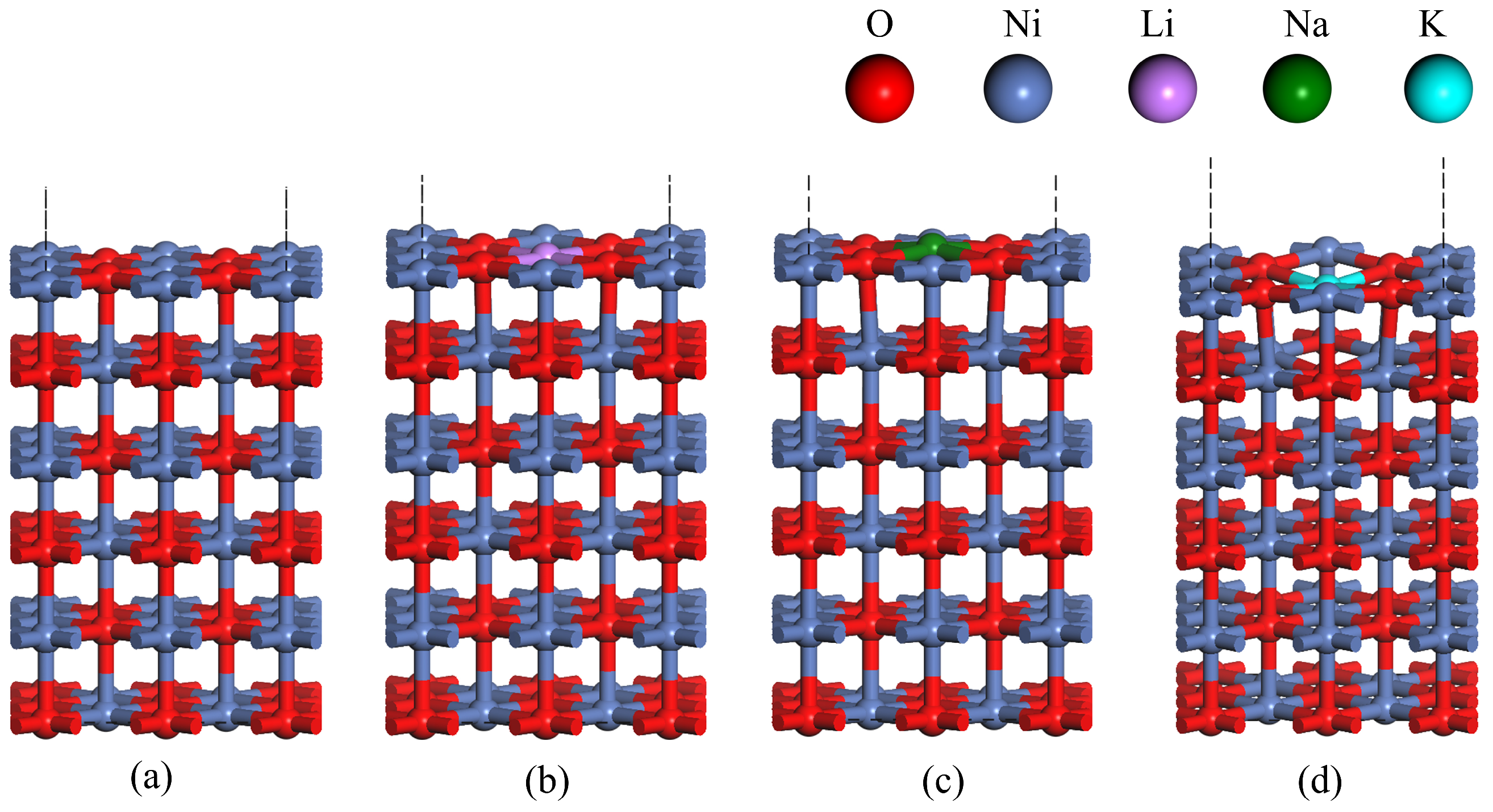
| Li-NiO | −1.67 | 2.146 |
| Na-NiO | 0.17 | 2.249 |
| K-NiO | 0.15 | 2.321 |
| Oxygen Carrier | Eads/eV | Mulliken Charge/e | LC–O/Å | LC–Ni/Å | Preferred Adsorption Site |
|---|---|---|---|---|---|
| CO | — | 0 | 1.154 | — | — |
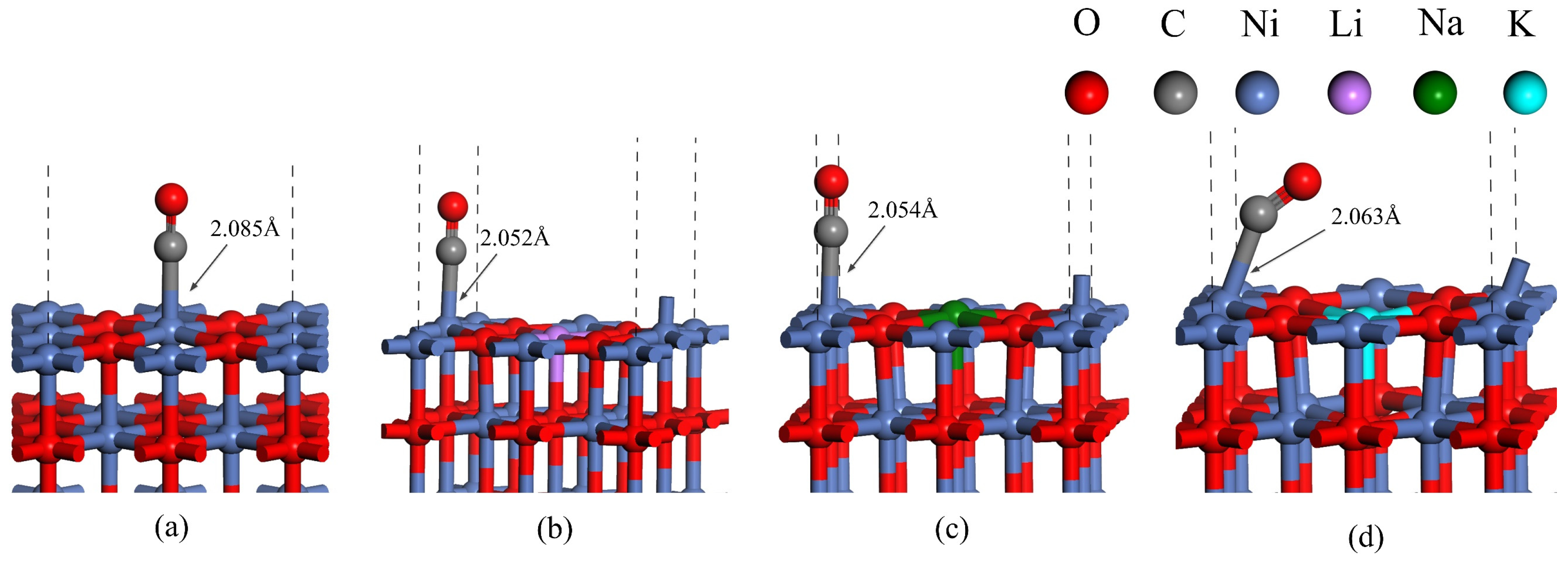
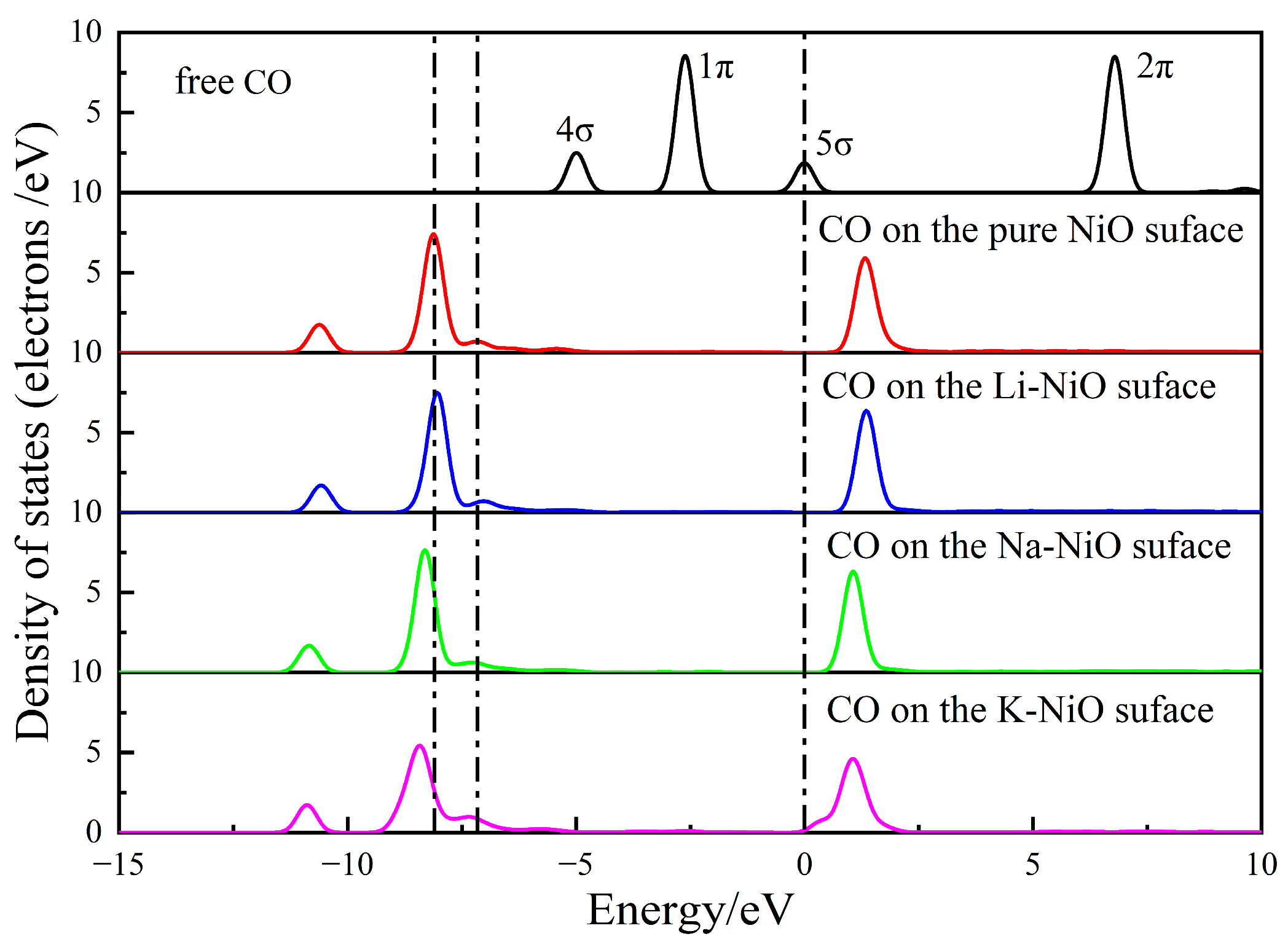
| NiO | −0.41 | 0.04 | 1.155 | 2.085 | Ni-top site |
| Li-NiO | −0.53 | 0.02 | 1.158 | 2.052 | Ni-top site |
| Na-NiO | −0.46 | −0.02 | 1.159 | 2.054 | Ni-top site |
| K-NiO | −0.36 | −0.07 | 1.156 | 2.063 | K…Ni bridge site |
| Performance Metric | Pure NiO | Li-Doped | Na-Doped | K-Doped | Ranking (Best → Good) |
|---|---|---|---|---|---|
| CO adsorption energy, (eV) | −0.41 | −0.53 | −0.46 | −0.36 | Li > Na > NiO > K |
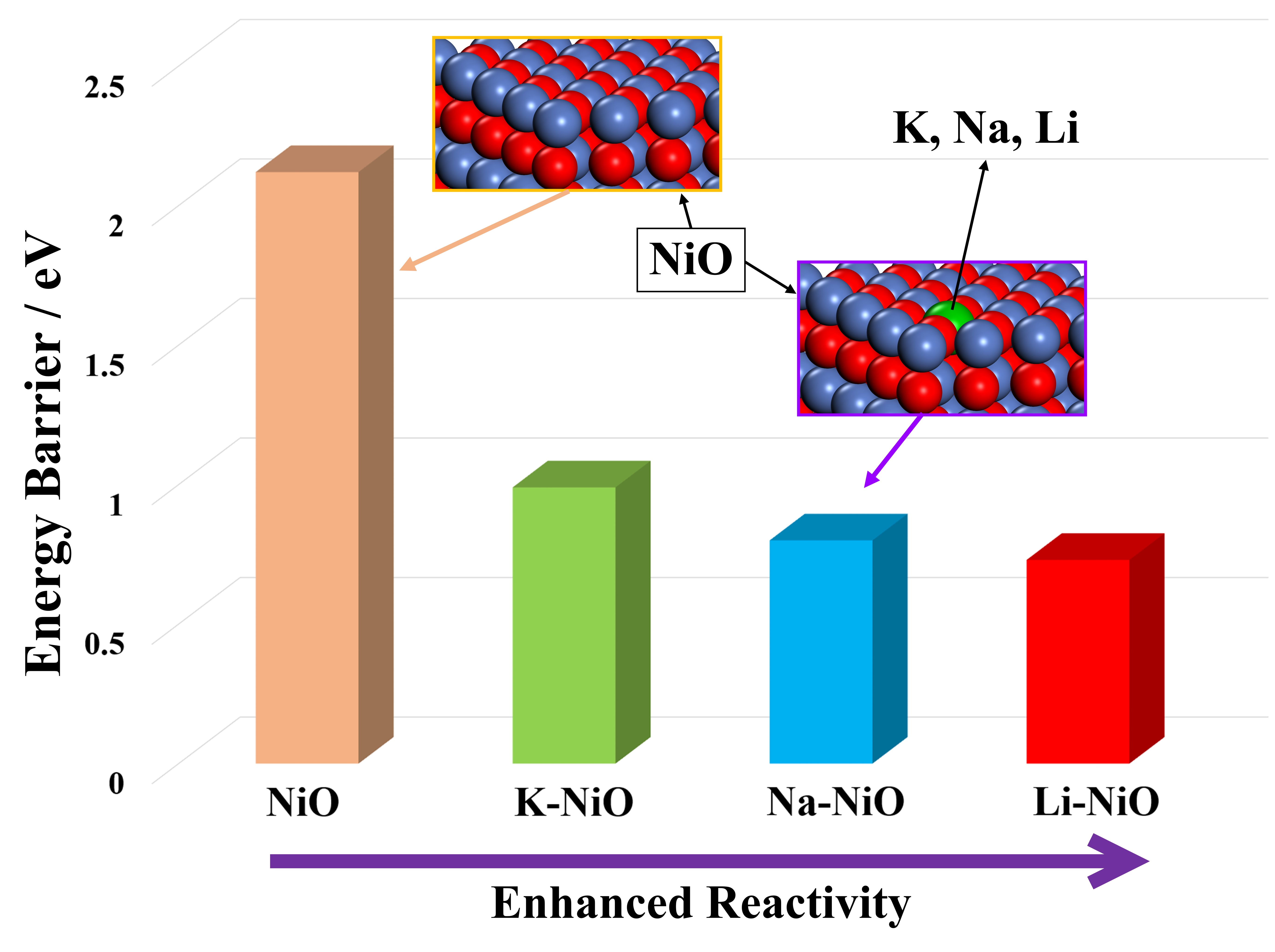
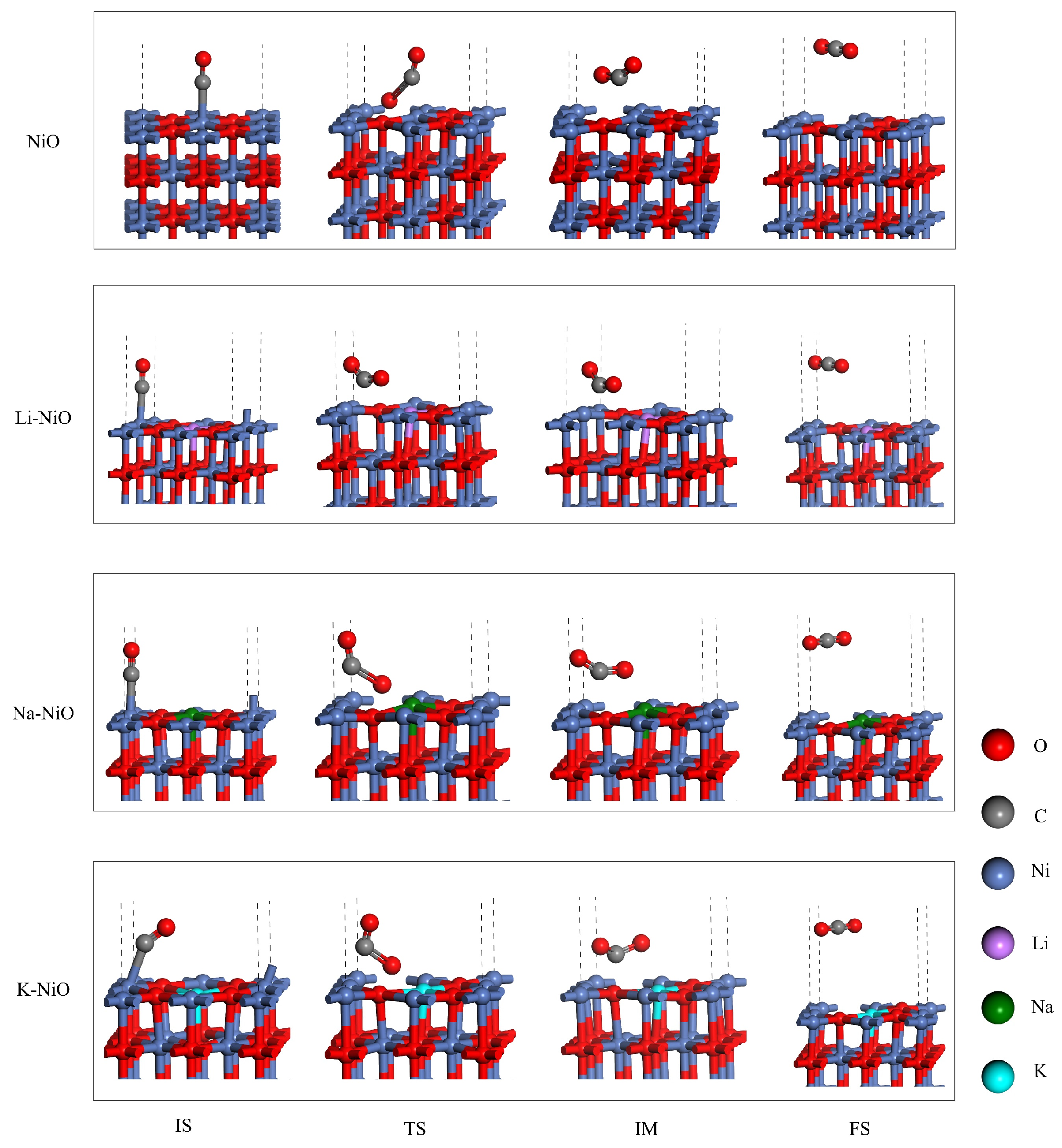
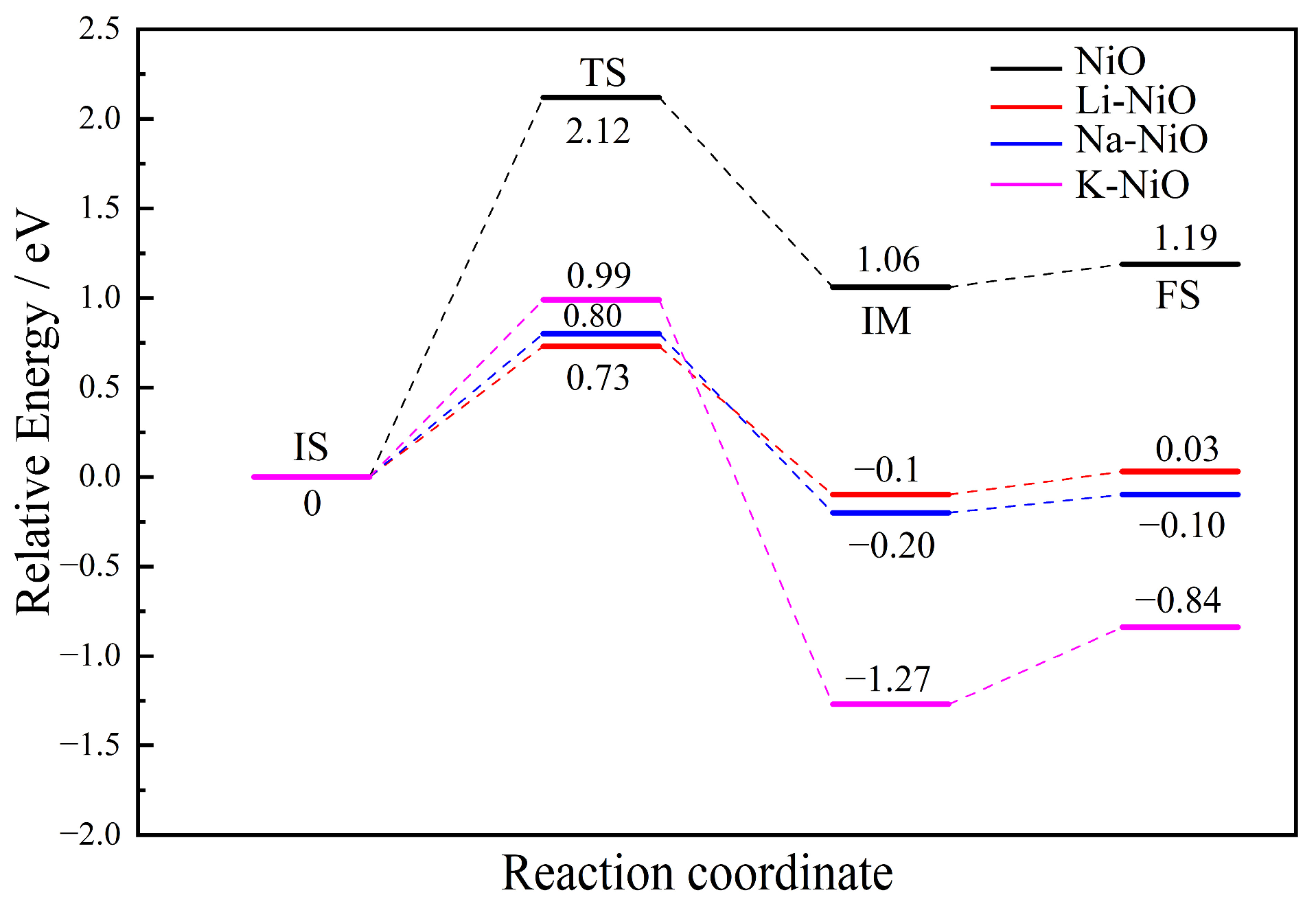
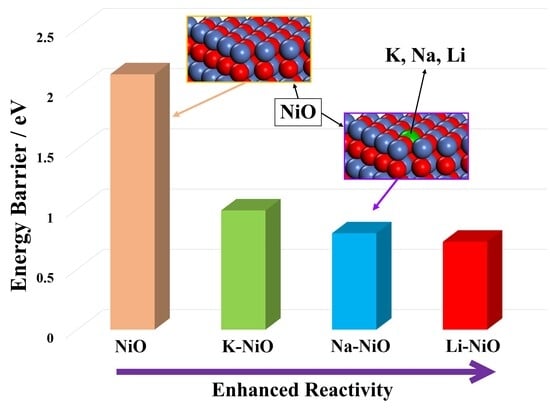
| Barrier for CO2 formation, (eV) | 2.12 | 0.73 | 0.80 | 0.99 | Li < Na < K < NiO |
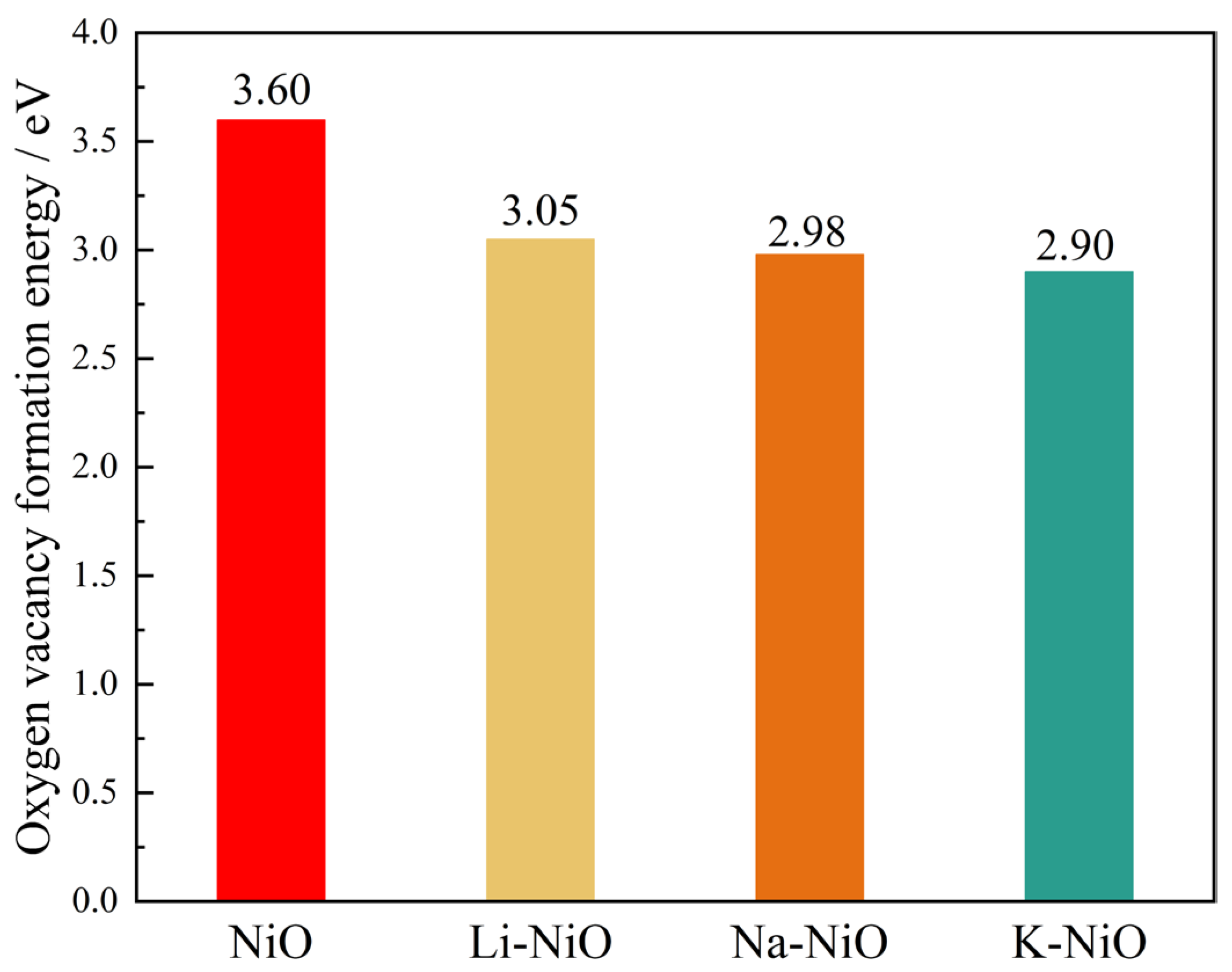
| Oxygen vacancy formation energy, (eV) | 3.60 | 3.05 | 2.98 | 2.90 | K < Na < Li < NiO |
| Overall reaction energy, (eV) | 1.19 | 0.03 | −0.10 | −0.84 | K < Na < Li < NiO |
| Overall promotional effectiveness | – | Effective | Moderately Effective | Effective | Li = K > Na |
Disclaimer/Publisher’s Note: The statements, opinions and data contained in all publications are solely those of the individual author(s) and contributor(s) and not of MDPI and/or the editor(s). MDPI and/or the editor(s) disclaim responsibility for any injury to people or property resulting from any ideas, methods, instructions or products referred to in the content. |
© 2025 by the authors. Licensee MDPI, Basel, Switzerland. This article is an open access article distributed under the terms and conditions of the Creative Commons Attribution (CC BY) license.
Share and Cite
Wang, M.; Nie, X.; Xia, M. A Theoretical Study of the Reactive Mechanisms of Alkali Metal Doped Ni-Based Oxygen Carrier During Chemical Looping Combustion. Catalysts 2026, 16, 14. https://doi.org/10.3390/catal16010014
Wang M, Nie X, Xia M. A Theoretical Study of the Reactive Mechanisms of Alkali Metal Doped Ni-Based Oxygen Carrier During Chemical Looping Combustion. Catalysts. 2026; 16(1):14. https://doi.org/10.3390/catal16010014
Chicago/Turabian StyleWang, Minjun, Xingyao Nie, and Ming Xia. 2026. "A Theoretical Study of the Reactive Mechanisms of Alkali Metal Doped Ni-Based Oxygen Carrier During Chemical Looping Combustion" Catalysts 16, no. 1: 14. https://doi.org/10.3390/catal16010014
APA StyleWang, M., Nie, X., & Xia, M. (2026). A Theoretical Study of the Reactive Mechanisms of Alkali Metal Doped Ni-Based Oxygen Carrier During Chemical Looping Combustion. Catalysts, 16(1), 14. https://doi.org/10.3390/catal16010014