


Comparative Efficiencies for Phenol Degradation on Solar Heterogeneous Photocatalytic Reactors: Flat Plate and Compound Parabolic Collector
 , , and
Abstract
1. Introduction
2. Results and Discussion
2.1. Chemical-Oxygen-Demand Decrease
2.2. Kinetic Analysis
2.3. Fluence Analysis
2.4. Collector Area per Order
2.5. ANCOVA and MANCOVA Results
3. Materials and Methods
3.1. Experimental Phase Location and Operation Timeframe
3.2. Photocatalytic Reactors
3.3. Experimental Conditions
3.4. Chemical Oxygen Demand Quantification
3.5. Kinetic Analysis
3.6. Fluence Analysis
3.7. Collector Area per Order Determination
3.8. Experimental Design
4. Conclusions
Author Contributions
Funding
Institutional Review Board Statement
Informed Consent Statement
Data Availability Statement
Acknowledgments
Conflicts of Interest
References
- Qian, Y.; Ma, D. Covalent Organic Frameworks: New Materials Platform for Photocatalytic Degradation of Aqueous Pollutants. Materials 2021, 14, 5600. [Google Scholar] [CrossRef] [Scilit] [PubMed]
- Rueda-Marquez, J.J.; Levchuk, I.; Fernández Ibañez, P.; Sillanpää, M. A critical review on application of photocatalysis for toxicity reduction of real wastewaters. J. Clean. Prod. 2020, 258, 120694. [Google Scholar] [CrossRef] [Scilit]
- Liang, Y.; Huang, G.; Xin, X.; Yao, Y.; Li, Y.; Yin, J.; Li, X.; Wu, Y.; Gao, S. Black titanium dioxide nanomaterials for photocatalytic removal of pollutants: A review. J. Mater. Sci. Technol. 2022, 112, 239–262. [Google Scholar] [CrossRef] [Scilit]
- Sundar, K.P.; Kanmani, S. Progression of Photocatalytic reactors and it’s comparison: A Review. Chem. Eng. Res. Des. 2020, 154, 135–150. [Google Scholar] [CrossRef] [Scilit]
- Mohamad Said, K.A.; Ismail, A.F.; Abdul Karim, Z.; Abdullah, M.S.; Hafeez, A. A review of technologies for the phenolic compounds recovery and phenol removal from wastewater. Process Saf. Environ. Prot. 2021, 151, 257–289. [Google Scholar] [CrossRef] [Scilit]
- Wang, H.; Li, X.; Zhao, X.; Li, C.; Song, X.; Zhang, P.; Huo, P.; Li, X. A review on heterogeneous photocatalysis for environmental remediation: From semiconductors to modification strategies. Chin. J. Catal. 2022, 43, 178–214. [Google Scholar] [CrossRef] [Scilit]
- Ma, D.; Liu, A.; Li, S.; Lu, C.; Chen, C. TiO2 photocatalysis for C–C bond formation. Catal. Sci. Technol. 2018, 8, 2030–2045. [Google Scholar] [CrossRef] [Scilit]
- Wang, W.; Tadé, M.O.; Shao, Z. Nitrogen-doped simple and complex oxides for photocatalysis: A review. Prog. Mater. Sci. 2018, 92, 33–63. [Google Scholar] [CrossRef] [Scilit]
- Colmenares, J.C. Selective redox photocatalysis: Is there any chance for solar bio-refineries? Curr. Opin. Green Sustain. Chem. 2019, 15, 38–46. [Google Scholar] [CrossRef] [Scilit]
- Zhang, Y.; Hawboldt, K.; Zhang, L.; Lu, J.; Chang, L.; Dwyer, A. Carbonaceous nanomaterial-TiO2 heterojunctions for visible-light-driven photocatalytic degradation of aqueous organic pollutants. Appl. Catal. A Gen. 2022, 630, 118460. [Google Scholar] [CrossRef] [Scilit]
- Ma, D.; Li, J.; Liu, A.; Chen, C. Carbon Gels-Modified TiO2: Promising Materials for Photocatalysis Applications. Materials 2020, 13, 1734. [Google Scholar] [CrossRef] [Scilit] [PubMed]
- Jiang, L.; Yang, J.; Zhou, S.; Yu, H.; Liang, J.; Chu, W.; Li, H.; Wang, H.; Wu, Z.; Yuan, X. Strategies to extend near-infrared light harvest of polymer carbon nitride photocatalysts. Coord. Chem. Rev. 2021, 439, 213947. [Google Scholar] [CrossRef] [Scilit]
- González-González, R.B.; Parra-Arroyo, L.; Parra-Saldívar, R.; Ramirez-Mendoza, R.A.; Iqbal, H.M.N. Nanomaterial-based catalysts for the degradation of endocrine-disrupting chemicals—A way forward to environmental remediation. Mater. Lett. 2022, 308, 131217. [Google Scholar] [CrossRef] [Scilit]
- Shaham-Waldmann, N.; Paz, Y. Away from TiO2: A critical minireview on the developing of new photocatalysts for degradation of contaminants in water. Mater. Sci. Semicond. Process. 2016, 42, 72–80. [Google Scholar] [CrossRef] [Scilit]
- Tawfik, A.; Alalm, M.G.; Awad, H.M.; Islam, M.; Qyyum, M.A.; Al-Muhtaseb, A.H.; Osman, A.I.; Lee, M. Solar photo-oxidation of recalcitrant industrial wastewater: A review. Environ. Chem. Lett. 2022, 20, 1839–1862. [Google Scholar] [CrossRef] [Scilit]
- Iervolino, G.; Zammit, I.; Vaiano, V.; Rizzo, L. Limitations and Prospects for Wastewater Treatment by UV and Visible-Light-Active Heterogeneous Photocatalysis: A Critical Review. Top. Curr. Chem. 2020, 378, 7. [Google Scholar] [CrossRef] [Scilit]
- da Costa Filho, B.M.; Vilar, V.J.P. Strategies for the intensification of photocatalytic oxidation processes towards air streams decontamination: A review. Chem. Eng. J. 2019, 391, 123531. [Google Scholar] [CrossRef] [Scilit]
- Karavasilis, M.V.; Theodoropoulou, M.A.; Tsakiroglou, C.D. Photocatalytic Degradation of Dissolved Phenol by Immobilized Zinc Oxide Nanoparticles: Batch Studies, Continuous Flow Experiments, and Numerical Modeling. Nanomaterials 2021, 12, 69. [Google Scholar] [CrossRef] [Scilit]
- Dossin Zanrosso, C.; Piazza, D.; Lansarin, M.A. Solution mixing preparation of PVDF/ZnO polymeric composite films engineered for heterogeneous photocatalysis. J. Appl. Polym. Sci. 2020, 137, 48417. [Google Scholar] [CrossRef] [Scilit]
- Silerio-Vázquez, F.; Proal Nájera, J.B.; Bundschuh, J.; Alarcon-Herrera, M.T. Photocatalysis for arsenic removal from water: Considerations for solar photocatalytic reactors. Environ. Sci. Pollut. Res. 2021. [Google Scholar] [CrossRef] [Scilit]
- Leblebici, M.E.; Stefanidis, G.D.; Van Gerven, T. Comparison of photocatalytic space-time yields of 12 reactor designs for wastewater treatment. Chem. Eng. Process. Process Intensif. 2015, 97, 106–111. [Google Scholar] [CrossRef] [Scilit]
- Verma, A.; Tejo Prakash, N.; Toor, A.P.; Bansal, P.; Sangal, V.K.; Kumar, A. Concentrating and Nonconcentrating Slurry and Fixed-Bed Solar Reactors for the Degradation of Herbicide Isoproturon. J. Sol. Energy Eng. 2018, 140, 021006. [Google Scholar] [CrossRef] [Scilit]
- Colina-Márquez, J.; Machuca-Martínez, F.; Puma, G.L. Radiation Absorption and Optimization of Solar Photocatalytic Reactors for Environmental Applications. Environ. Sci. Technol. 2010, 44, 5112–5120. [Google Scholar] [CrossRef] [Scilit]
- Abdel-Maksoud, Y.K.; Imam, E.; Ramadan, A.R. TiO2 water-bell photoreactor for wastewater treatment. Sol. Energy 2018, 170, 323–335. [Google Scholar] [CrossRef] [Scilit]
- Malinowski, S.; Presečki, I.; Jajčinović, I.; Brnardić, I.; Mandić, V.; Grčić, I. Intensification of Dihydroxybenzenes Degradation over Immobilized TiO2 Based Photocatalysts under Simulated Solar Light. Appl. Sci. 2020, 10, 7571. [Google Scholar] [CrossRef] [Scilit]
- Talwar, S.; Verma, A.K.; Sangal, V.K.; Štangar, U.L. Once through continuous flow removal of metronidazole by dual effect of photo-Fenton and photocatalysis in a compound parabolic concentrator at pilot plant scale. Chem. Eng. J. 2020, 388, 124184. [Google Scholar] [CrossRef] [Scilit]
- Martínez-Costa, J.I.; Maldonado Rubio, M.I.; Leyva-Ramos, R. Degradation of emerging contaminants diclofenac, sulfamethoxazole, trimethoprim and carbamazepine by bentonite and vermiculite at a pilot solar compound parabolic collector. Catal. Today 2020, 341, 26–36. [Google Scholar] [CrossRef] [Scilit]
- Hama Aziz, K.H.; Miessner, H.; Mueller, S.; Mahyar, A.; Kalass, D.; Moeller, D.; Khorshid, I.; Rashid, M.A.M. Comparative study on 2,4-dichlorophenoxyacetic acid and 2,4-dichlorophenol removal from aqueous solutions via ozonation, photocatalysis and non-thermal plasma using a planar falling film reactor. J. Hazard. Mater. 2018, 343, 107–115. [Google Scholar] [CrossRef] [Scilit]
- Constantino, D.S.M.; Dias, M.M.; Silva, A.M.T.; Faria, J.L.; Silva, C.G. Intensification strategies for improving the performance of photocatalytic processes: A review. J. Clean. Prod. 2022, 340, 130800. [Google Scholar] [CrossRef] [Scilit]
- Lou, W.; Kane, A.; Wolbert, D.; Rtimi, S.; Assadi, A.A. Study of a photocatalytic process for removal of antibiotics from wastewater in a falling film photoreactor: Scavenger study and process intensification feasibility. Chem. Eng. Process. Process Intensif. 2017, 122, 213–221. [Google Scholar] [CrossRef] [Scilit]
- Welter, E.S.; Kött, S.; Brandenburg, F.; Krömer, J.; Goepel, M.; Schmid, A.; Gläser, R. Figures of merit for photocatalysis: Comparison of NiO/La-NaTaO3 and Synechocystis sp. pcc 6803 as a semiconductor and a bio-photocatalyst for water splitting. Catalysts 2021, 11, 1415. [Google Scholar] [CrossRef] [Scilit]
- Camera-Roda, G.; Augugliaro, V.; Cardillo, A.G.; Loddo, V.; Palmisano, L.; Parrino, F.; Santarelli, F. A reaction engineering approach to kinetic analysis of photocatalytic reactions in slurry systems. Catal. Today 2016, 259, 87–96. [Google Scholar] [CrossRef] [Scilit]
- Brucato, A.; Cassano, A.E.; Grisafi, F.; Montante, G.; Rizzuti, L.; Vella, G. Estimating Radiant Fields in Flat Heterogeneous Photoreactors by the Six-Flux Model. AIChE J. 2006, 52, 3882–3890. [Google Scholar] [CrossRef] [Scilit]
- Bolton, J.R.; Bircher, K.G.; Tumas, W.; Tolman, C.A. Figures-of-merit for the technical development and application of advanced oxidation technologies for both electric- and solar-driven systems (IUPAC Technical Report). Pure Appl. Chem. 2001, 73, 627–637. [Google Scholar] [CrossRef]
- Mohamed, A.; Yousef, S.; Nasser, W.S.; Osman, T.A.; Knebel, A.; Sánchez, E.P.V.; Hashem, T. Rapid photocatalytic degradation of phenol from water using composite nanofibers under UV. Environ. Sci. Eur. 2020, 32, 160. [Google Scholar] [CrossRef] [Scilit]
- Bali, U.; Çatalkaya, E.Ç.; Şengül, F. Photochemical Degradation and Mineralization of Phenol: A Comparative Study. J. Environ. Sci. Heal. Part A 2003, 38, 2259–2275. [Google Scholar] [CrossRef] [Scilit]
- Vilhunen, S.; Puton, J.; Virkutyte, J.; Sillanpää, M. Efficiency of hydroxyl radical formation and phenol decomposition using UV light emitting diodes and H2O2. Environ. Technol. 2011, 32, 865–872. [Google Scholar] [CrossRef] [Scilit]
- Nguyen, A.T.; Juang, R.S. Photocatalytic degradation of p-chlorophenol by hybrid H2O2 and TiO2 in aqueous suspensions under UV irradiation. J. Environ. Manag. 2015, 147, 271–277. [Google Scholar] [CrossRef] [Scilit]
- Kanakaraju, D.; Glass, B.D.; Oelgemöller, M. Advanced oxidation process-mediated removal of pharmaceuticals from water: A review. J. Environ. Manag. 2018, 219, 189–207. [Google Scholar] [CrossRef] [Scilit]
- Alrousan, D.M.A.; Dunlop, P.S.M.; McMurray, T.A.; Byrne, J.A. Photocatalytic inactivation of E. coli in surface water using immobilised nanoparticle TiO2 films. Water Res. 2009, 43, 47–54. [Google Scholar] [CrossRef] [Scilit]
- Ola, O.; Maroto-Valer, M.M. Review of material design and reactor engineering on TiO2 photocatalysis for CO2 reduction. J. Photochem. Photobiol. C Photochem. Rev. 2015, 24, 16–42. [Google Scholar] [CrossRef] [Scilit]
- Eskandarian, M.R.; Choi, H.; Fazli, M.; Rasoulifard, M.H. Effect of UV-LED wavelengths on direct photolytic and TiO2 photocatalytic degradation of emerging contaminants in water. Chem. Eng. J. 2016, 300, 414–422. [Google Scholar] [CrossRef] [Scilit]
- Naghmash, M.A.; Saif, M.; Mahmoud, H.R. Transition metal ions doped Bi12SiO20 as novel catalysts for the decomposition of hydrogen peroxide (H2O2). J. Taiwan Inst. Chem. Eng. 2021, 121, 268–275. [Google Scholar] [CrossRef] [Scilit]
- Adishkumar, S.; Kanmani, S. Treatment of phenolic wastewaters in single baffle reactor by solar/TiO2/ H2O2 process. Desalin. Water Treat. 2010, 24, 67–73. [Google Scholar] [CrossRef] [Scilit]
- Bekkouche, S.; Bouhelassa, M.; Salah, N.H.; Meghlaoui, F.Z. Study of adsorption of phenol on titanium oxide (TiO2). Desalination 2004, 166, 355–362. [Google Scholar] [CrossRef] [Scilit]
- Maurya, M.R.; Titinchi, S.J.J.; Chand, S. Oxidation of phenol with H2O2 catalysed by Cu(II), Ni(II) and Zn(II) complexes of N,N′-bis-(salicylidene)diethylenetriamine (H2saldien) encapsulated in Y-zeolite. J. Mol. Catal. A Chem. 2003, 201, 119–130. [Google Scholar] [CrossRef] [Scilit]
- Silerio-Vázquez, F.; Alarcón-Herrera, M.T.; Proal-Nájera, J.B. Solar heterogeneous photocatalytic degradation of phenol on TiO2/quartz and TiO2/calcite: A statistical and kinetic approach on comparative efficiencies towards a TiO2/glass system. Environ. Sci. Pollut. Res. 2022. [Google Scholar] [CrossRef] [Scilit]
- Mino, L.; Zecchina, A.; Martra, G.; Rossi, A.M.; Spoto, G. A surface science approach to TiO2 P25 photocatalysis: An in situ FTIR study of phenol photodegradation at controlled water coverages from sub-monolayer to multilayer. Appl. Catal. B Environ. 2016, 196, 135–141. [Google Scholar] [CrossRef] [Scilit]
- Sabzehei, K.; Hadavi, S.H.; Bajestani, M.G.; Sheibani, S. Comparative evaluation of copper oxide nano-photocatalyst characteristics by formation of composite with TiO2 and ZnO. Solid State Sci. 2020, 107, 106362. [Google Scholar] [CrossRef] [Scilit]
- Murillo-Acevedo, Y.; Bernal-Sanchez, J.; Giraldo, L.; Sierra-Ramirez, R.; Moreno-Piraján, J.C. Initial Approximation to the Design and Construction of a Photocatalysis Reactor for Phenol Degradation with TiO2 Nanoparticles. ACS Omega 2019, 4, 19605–19613. [Google Scholar] [CrossRef] [Scilit]
- Mac Mahon, J.; Pillai, S.C.; Kelly, J.M.; Gill, L.W. Solar photocatalytic disinfection of E. coli and bacteriophages MS2, ΦX174 and PR772 using TiO2, ZnO and ruthenium based complexes in a continuous flow system. J. Photochem. Photobiol. B Biol. 2017, 170, 79–90. [Google Scholar] [CrossRef] [Scilit]
- Ajona, J.I.; Vidal, A. The use of CPC collectors for detoxification of contaminated water: Design, construction and preliminary results. Sol. Energy 2000, 68, 109–120. [Google Scholar] [CrossRef] [Scilit]
- Mehrabadi, A.R.; Kardani, N.; Fazeli, M.; Hamidian, L.; Mousavi, A.; Salmani, N. Investigation of water disinfection efficiency using titanium dioxide (TiO2) in permeable to sunlight tubes. Desalin. Water Treat. 2011, 28, 17–22. [Google Scholar] [CrossRef] [Scilit]
- Alrousan, D.M.A.; Polo-López, M.I.; Dunlop, P.S.M.; Fernández-Ibáñez, P.; Byrne, J.A. Solar photocatalytic disinfection of water with immobilised titanium dioxide in re-circulating flow CPC reactors. Appl. Catal. B Environ. 2012, 128, 126–134. [Google Scholar] [CrossRef] [Scilit]
- Saran, S.; Arunkumar, P.; Devipriya, S.P. Disinfection of roof harvested rainwater for potable purpose using pilot-scale solar photocatalytic fixed bed tubular reactor. Water Supply 2018, 18, 49–59. [Google Scholar] [CrossRef] [Scilit]
- Negishi, N.; Chawengkijwanich, C.; Pimpha, N.; Larpkiattaworn, S.; Charinpanitkul, T. Performance verification of the photocatalytic solar water purification system for sterilization using actual drinking water in Thailand. J. Water Process Eng. 2019, 31, 100835. [Google Scholar] [CrossRef] [Scilit]
- Ochoa-Gutiérrez, K.S.; Tabares-Aguilar, E.; Mueses, M.Á.; Machuca-Martínez, F.; Li Puma, G. A Novel Prototype Offset Multi Tubular Photoreactor (OMTP) for solar photocatalytic degradation of water contaminants. Chem. Eng. J. 2018, 341, 628–638. [Google Scholar] [CrossRef] [Scilit]
- Van Der Linde, A.; Tutz, G. On association in regression: The coefficient of determination revisited. Statistics 2008, 42, 1–24. [Google Scholar] [CrossRef] [Scilit]
- Otálvaro-Marín, H.L.; Mueses, M.A.; Crittenden, J.C.; Machuca-Martinez, F. Solar photoreactor design by the photon path length and optimization of the radiant field in a TiO2 -based CPC reactor. Chem. Eng. J. 2017, 315, 283–295. [Google Scholar] [CrossRef] [Scilit]
- Cámara, R.M.; Portela, R.; Gutiérrez-Martín, F.; Sánchez, B. Photocatalytic activity of TiO2 films prepared by surfactant-mediated sol-gel methods over commercial polymer substrates. Chem. Eng. J. 2016, 283, 535–543. [Google Scholar] [CrossRef] [Scilit]
- Irigoyen-Campuzano, R.; González-Béjar, M.; Pino, E.; Proal-Nájera, J.B.; Pérez-Prieto, J. A Metal-Free, Nonconjugated Polymer for Solar Photocatalysis. Chem. A Eur. J. 2017, 23, 2867–2876. [Google Scholar] [CrossRef] [Scilit] [PubMed]
- Zaruma-Arias, P.E.; Núñez-Núñez, C.M.; González-Burciaga, L.A.; Proal-Nájera, J.B. Solar Heterogenous Photocatalytic Degradation of Methylthionine Chloride on a Flat Plate Reactor: Effect of pH and H2O2 Addition. Catalysts 2022, 12, 132. [Google Scholar] [CrossRef] [Scilit]
- Zhang, Y.; Sivakumar, M.; Yang, S.; Enever, K.; Ramezanianpour, M. Application of solar energy in water treatment processes: A review. Desalination 2018, 428, 116–145. [Google Scholar] [CrossRef] [Scilit]
- Bahnemann, D. Photocatalytic water treatment: Solar energy applications. Sol. Energy 2004, 77, 445–459. [Google Scholar] [CrossRef] [Scilit]
- Hach Company Hach Methods Approved/Accepted by the USEPA. Hach—Downloads—Hach Methods EPA Acceptance Letters. Available online: https://www.hach.com/cms/documents/pdf/EPA/HachMethodsapprovedacceptedbytheUSEPA.pdf (accessed on 6 March 2021).
- Mueses, M.A.; Colina-Márquez, J.; Machuca-Martínez, F.; Li Puma, G. Recent advances on modeling of solar heterogeneous photocatalytic reactors applied for degradation of pharmaceuticals and emerging organic contaminants in water. Curr. Opin. Green Sustain. Chem. 2021, 30, 100486. [Google Scholar] [CrossRef] [Scilit]
- Li, Y.; Yang, B.; Liu, B. MOF assisted synthesis of TiO2/Au/Fe2O3 hybrids with enhanced photocatalytic hydrogen production and simultaneous removal of toxic phenolic compounds. J. Mol. Liq. 2021, 322, 114815. [Google Scholar] [CrossRef] [Scilit]
- Wang, Y.; Zhao, J.; Xiong, X.; Liu, S.; Xu, Y. Role of Ni2+ ions in TiO2 and Pt/TiO2 photocatalysis for phenol degradation in aqueous suspensions. Appl. Catal. B Environ. 2019, 258, 117903. [Google Scholar] [CrossRef] [Scilit]
- Kuhn, H.; Försterling, H.-D.; Waldeck, D.H. Chemical Kinetics. In Principles of Physical Chemistry; John Wiley & Sons, LTD: West Sussex, UK, 2000; pp. 735–794. ISBN 978-0-470-08964-4. [Google Scholar]
- Giménez, J.; Curcó, D.; Queral, M. Photocatalytic treatment of phenol and 2,4-dichlorophenol in a solar plant in the way to scaling-up. Catal. Today 1999, 54, 229–243. [Google Scholar] [CrossRef] [Scilit]
- Malato, S.; Fernández-Ibáñez, P.; Maldonado, M.I.; Blanco, J.; Gernjak, W. Decontamination and disinfection of water by solar photocatalysis: Recent overview and trends. Catal. Today 2009, 147, 1–59. [Google Scholar] [CrossRef] [Scilit]
- Ye, J.; Li, X.; Hong, J.; Chen, J.; Fan, Q. Photocatalytic degradation of phenol over ZnO nanosheets immobilized on montmorillonite. Mater. Sci. Semicond. Process. 2015, 39, 17–22. [Google Scholar] [CrossRef] [Scilit]
- Gutiérrez-Alfaro, S.; Acevedo, A.; Rodríguez, J.; Carpio, E.A.; Manzano, M.A. Solar photocatalytic water disinfection of Escherichia coli, Enterococcus spp. and Clostridium Perfringens using different low-cost devices. J. Chem. Technol. Biotechnol. 2016, 91, 2026–2037. [Google Scholar] [CrossRef] [Scilit]
- Pereira, J.H.O.S.; Vilar, V.J.P.; Borges, M.T.; González, O.; Esplugas, S.; Boaventura, R.A.R. Photocatalytic degradation of oxytetracycline using TiO2 under natural and simulated solar radiation. Sol. Energy 2011, 85, 2732–2740. [Google Scholar] [CrossRef] [Scilit]
- Rincón, A.-G.; Pulgarin, C. Field solar E. coli inactivation in the absence and presence of TiO2: Is UV solar dose an appropriate parameter for standardization of water solar disinfection? Sol. Energy 2004, 77, 635–648. [Google Scholar] [CrossRef] [Scilit]
- Lai, C.-H.; Tang, T. Disaster communication behaviors in the U.S. and China: Which channels do you use and with whom? J. Appl. Commun. Res. 2021, 49, 207–227. [Google Scholar] [CrossRef] [Scilit]
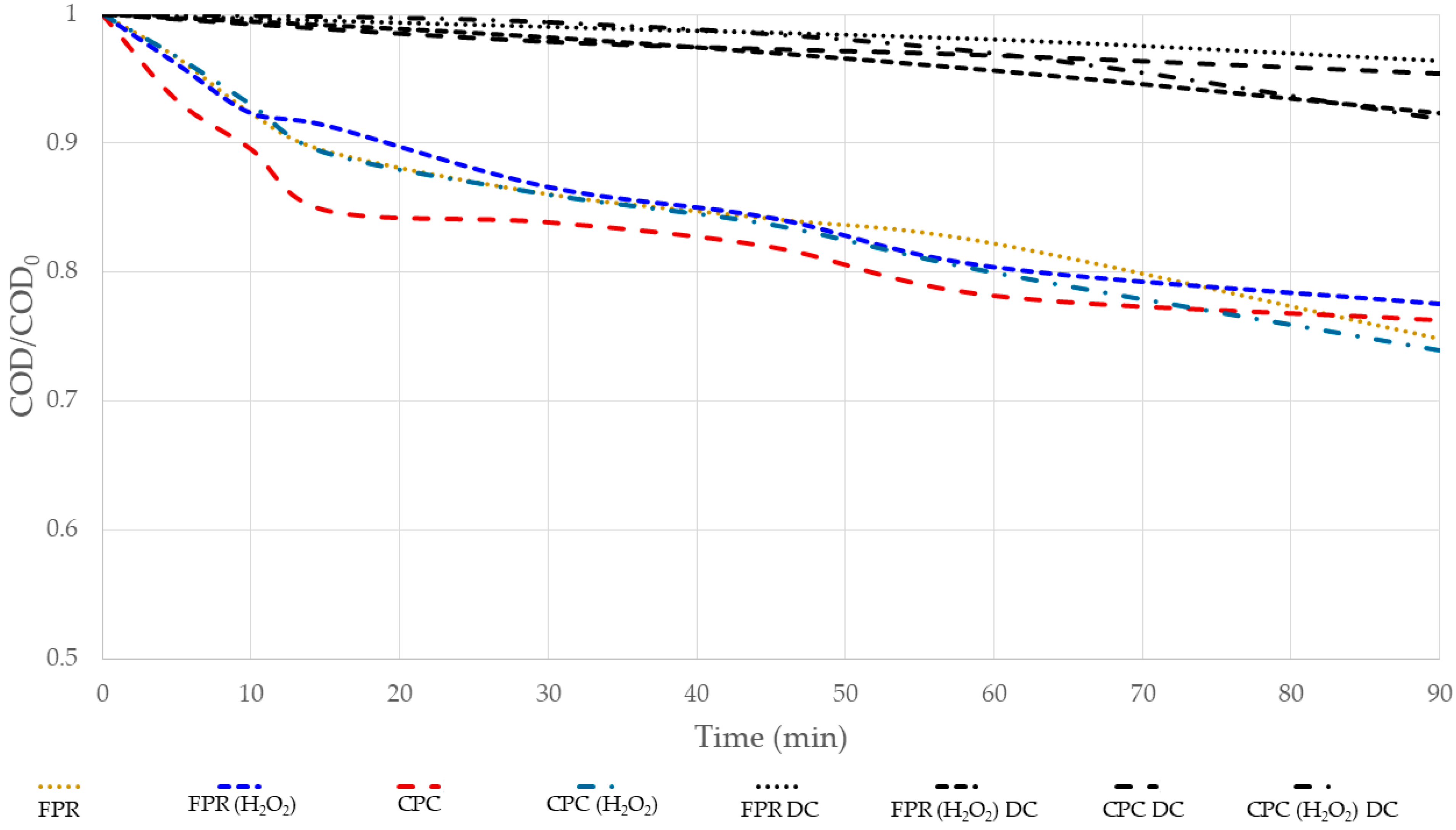
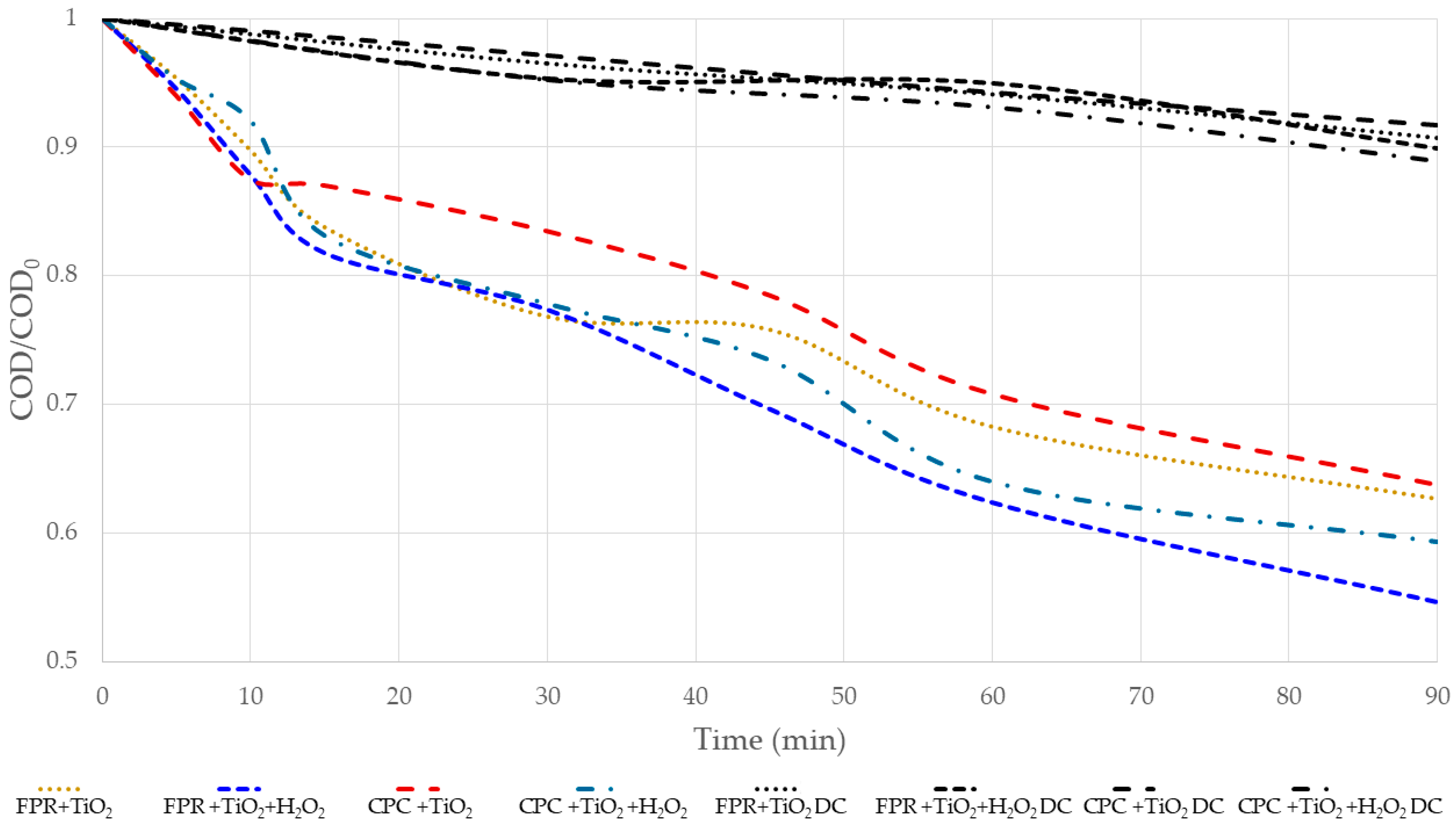

| Reactor/H2O2 | Photolysis (PL) | Heterogeneous Photocatalysis (HP) | ||||||
|---|---|---|---|---|---|---|---|---|
| Photolytic Degradation (%) | Reaction-Rate Constant
(×10−3 min−1) | Reaction Rate with Respect to Fluence
(×10−3 kJ−1 L) | Photocatalytic Degradation (%) | Reaction-Rate Constant
(×10−3 min−1) | Reaction Rate with Respect to Fluence (×10−3 kJ−1 L) | |||
| FPR/No H2O2 | 25.2 ± 1.8 | 2.9 | 74.6 | 3.4 | 37.3 ± 1.5 | 5.0 | 71.2 | 6.4 |
| FPR/1 mM H2O2 | 22.4 ± 1.3 | 2.7 | 74.6 | 3.2 | 45.4 ± 2.9 | 6.6 | 71.2 | 8.5 |
| CPC/No H2O2 | 23.7 ± 3.3 | 2.6 | 105.5 | 2.2 | 36.2 ± 1.2 | 4.6 | 100.6 | 4.1 |
| CPC/1 mM H2O2 | 26.1 ± 0.7 | 3.1 | 105.5 | 2.6 | 40.7 ± 0.5 | 5.9 | 100.6 | 5.2 |
| Reactor/H2O2 | Photolysis Collector Area per Order ACO (m2·m−3-Order) | Photocatalysis Collector Area per Order ACO (m2·m−3-Order) | Efficiency (ε) |
|---|---|---|---|
| FPR/No H2O2 | 111.6 | 65.2 | 41.5% |
| FPR/1 mM H2O2 | 130.2 | 51.7 | 60.2% |
| CPC/No H2O2 | 98.3 | 50.3 | 48.7% |
| CPC/1 mM H2O2 | 77.0 | 42.7 | 44.4% |
| Source | Degrees of Freedom | Sum of Squares (×106) | Mean Square (×106) | F Value | p-Value Probr > F |
|---|---|---|---|---|---|
| Degradation (F = 4.03, p = 0.03, R2 = 0.77) | |||||
| Reactor | 1 | 338.5 | 338.5 | 0.08 | 0.7 |
| Photocatalyst | 1 | 9.6 × 10⁴ | 9.6 × 10⁴ | 22.9 | 0.001 |
| H2O2 | 1 | 3.6 × 10³ | 3.6 × 10³ | 0.8 | 0.3 |
| Reactor*Photocatalyst | 1 | 1.5 × 10³ | 1.5 × 10³ | 0.3 | 0.5 |
| Reactor*H2O2 | 1 | 51.5 | 51.5 | 0.01 | 0.9 |
| Photocatalyst*H2O2 | 1 | 4.2 × 10³ | 4.2 × 10³ | 1.0 | 0.3 |
| Quv | 1 | 1.2 × 10⁴ | 1.2 × 10⁴ | 2.9 | 0.1 |
| Reaction Rate (F = 4.64, p = 0.02, R2 = 0.80) | |||||
| Reactor | 1 | 0.2 | 0.2 | 0.2 | 0.6 |
| Photocatalyst | 1 | 29.4 | 29.4 | 27.1 | 0.001 |
| H2O2 | 1 | 2.5 | 2.5 | 2.3 | 0.1 |
| Reactor*Photocatalyst | 1 | 0.3 | 0.3 | 0.3 | 0.5 |
| Reactor*H2O2 | 1 | 0.02 | 0.02 | 0.02 | 0.8 |
| Photocatalyst*H2O2 | 1 | 1.5 | 1.5 | 1.4 | 0.2 |
| Quv | 1 | 1.1 | 1.1 | 1.0 | 0.3 |
| Reaction Rate (Quv) (F = 5.02, p = 0.01, R2 = 0.81) | |||||
| Reactor | 1 | 7.5 | 0.02 | 7.5 | 0.02 |
| Photocatalyst | 1 | 22.8 | 0.001 | 22.8 | 0.001 |
| H2O2 | 1 | 1.6 | 0.2 | 1.6 | 0.2 |
| Reactor*Photocatalyst | 1 | 1.8 | 0.2 | 1.8 | 0.2 |
| Reactor*H2O2 | 1 | 0.01 | 0.9 | 0.01 | 0.9 |
| Photocatalyst*H2O2 | 1 | 1.2 | 0.3 | 1.2 | 0.3 |
| Quv | 1 | 0.0 | 0.9 | 0.0 | 0.9 |
| Collector area per order (F = 13.1, p = 0.0008, R2 = 0.92) | |||||
| Reactor | 1 | 9.4 × 10⁸ | 9.4 × 10⁸ | 7.5 | 0.02 |
| Photocatalyst | 1 | 9.7 × 10⁹ | 9.7 × 10⁹ | 78.6 | <0.0001 |
| H2O2 | 1 | 2.3 × 10⁸ | 2.3 × 10⁸ | 1.8 | 0.2 |
| Reactor*Photocatalyst | 1 | 2.5 × 10⁸ | 2.5 × 10⁸ | 2.0 | 0.1 |
| Reactor*H2O2 | 1 | 1.3 × 10⁸ | 1.3 × 10⁸ | 1.1 | 0.3 |
| Photocatalyst*H2O2 | 1 | 3.1 × 10⁷ | 3.1 × 10⁷ | 0.2 | 0.6 |
| Quv | 1 | 6.0 × 10⁷ | 6.0 × 10⁷ | 0.4 | 0.5 |
| Source | Roy’s Greatest Root Value | F Value | Numerator Degrees of Freedom | Denominator Degrees of Freedom | Pr > F |
|---|---|---|---|---|---|
| Reactor | 2.6 | 3.3 | 4 | 5 | 0.11 |
| Photocatalyst | 13.8 | 17.2 | 4 | 5 | 0.003 |
| H2O2 | 2.4 | 3.0 | 4 | 5 | 0.12 |
| Reactor*Photocatalyst | 7.2 | 9.0 | 4 | 5 | 0.01 |
| Reactor*H2O2 | 0.8 | 1.0 | 4 | 5 | 0.45 |
| Photocatalyst*H2O2 | 0.3 | 0.3 | 4 | 5 | 0.80 |
| Quv | 7.4 | 9.2 | 4 | 5 | 0.01 |
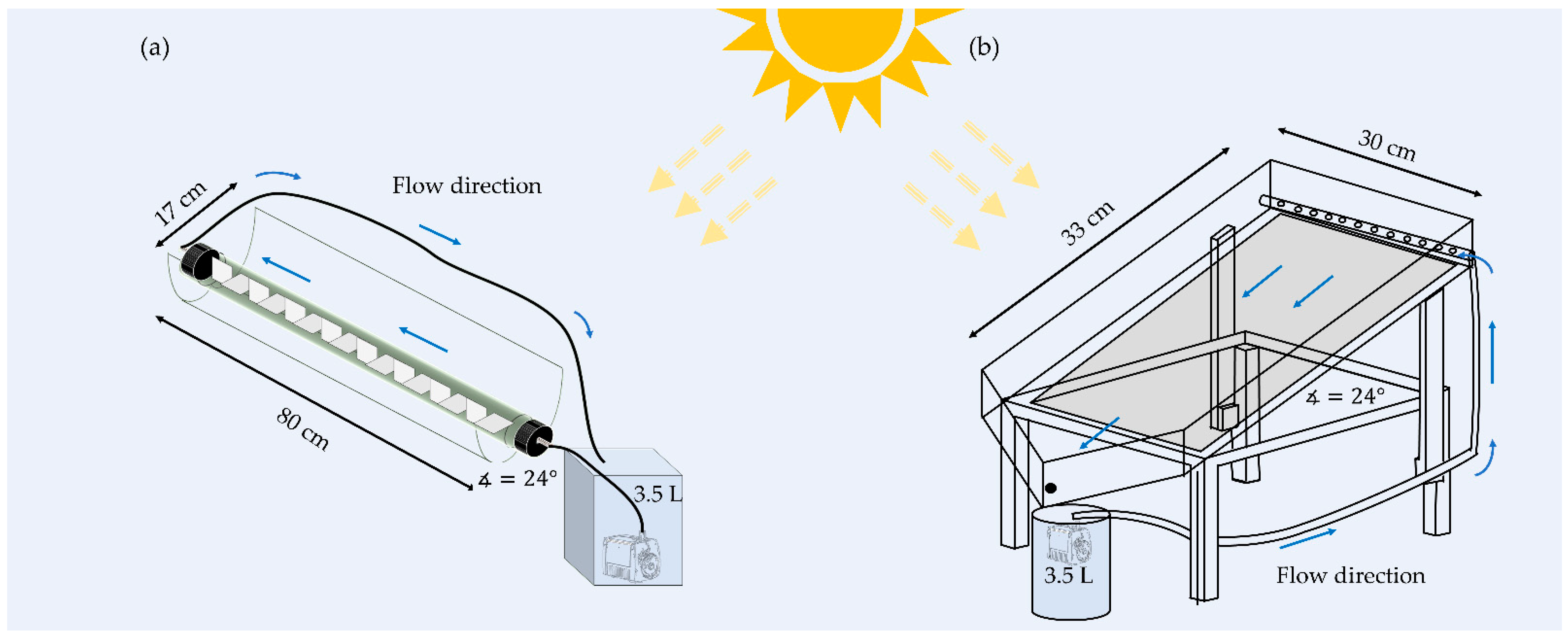
| Reactor | Illuminated Net Area (m2) | Photocatalyst Covered Area (m2) | Volumetric Flow (m3/h) |
|---|---|---|---|
| FPR | 0.10 1 | 0.10 1 | 0.18 |
| CPC | 1.40 2 | 0.07 3 | 1.50 |
Publisher’s Note: MDPI stays neutral with regard to jurisdictional claims in published maps and institutional affiliations. |
© 2022 by the authors. Licensee MDPI, Basel, Switzerland. This article is an open access article distributed under the terms and conditions of the Creative Commons Attribution (CC BY) license (https://creativecommons.org/licenses/by/4.0/).
Share and Cite
Silerio-Vázquez, F.d.J.; Núñez-Núñez, C.M.; Alarcón-Herrera, M.T.; Proal-Nájera, J.B. Comparative Efficiencies for Phenol Degradation on Solar Heterogeneous Photocatalytic Reactors: Flat Plate and Compound Parabolic Collector. Catalysts 2022, 12, 575. https://doi.org/10.3390/catal12060575
Silerio-Vázquez FdJ, Núñez-Núñez CM, Alarcón-Herrera MT, Proal-Nájera JB. Comparative Efficiencies for Phenol Degradation on Solar Heterogeneous Photocatalytic Reactors: Flat Plate and Compound Parabolic Collector. Catalysts. 2022; 12(6):575. https://doi.org/10.3390/catal12060575
Chicago/Turabian StyleSilerio-Vázquez, Felipe de J., Cynthia M. Núñez-Núñez, María T. Alarcón-Herrera, and José B. Proal-Nájera. 2022. "Comparative Efficiencies for Phenol Degradation on Solar Heterogeneous Photocatalytic Reactors: Flat Plate and Compound Parabolic Collector" Catalysts 12, no. 6: 575. https://doi.org/10.3390/catal12060575
APA StyleSilerio-Vázquez, F. d. J., Núñez-Núñez, C. M., Alarcón-Herrera, M. T., & Proal-Nájera, J. B. (2022). Comparative Efficiencies for Phenol Degradation on Solar Heterogeneous Photocatalytic Reactors: Flat Plate and Compound Parabolic Collector. Catalysts, 12(6), 575. https://doi.org/10.3390/catal12060575

