


Updated Prognostic Factors in Localized NSCLC
 , ,
, , 
Abstract
Simple Summary
Abstract
1. Introduction
2. Clinical Prognostic Factors Related to the Patient
2.1. Age, Gender and Performance Status
2.2. Nutritional and Morphometric Parameters
2.3. Smoking and Alcohol Exposure
2.4. Other Comorbidities and Symptoms at Diagnosis

| Reference | Number | Age (Years) | Male Sex | Tobacco | ECOG PS | CCI (vs. 0) | Nutritional Status |
|---|---|---|---|---|---|---|---|
| Powell et al. [8] | 10,991 | 70–74 vs. >85: OR 2.84 (1.71;4.71) | OR 1.37 (1.15;1.63) | NA | 0 vs. 1: OR 1.38 (1.09;1.75) 0 vs. 2: OR 2.40 (1.68;3.41) 0 vs. >2: OR 4.08 (2.37;7.02) | 2–3: OR 1.54 (1.25;1.90) ≥4: OR 1.53 (1.07;2.18) | NA |
| Stoelben et al. [9] | 1281 | ≥75: RR 2.46 (1.17;5.16) | RR 1.51 | NA | NA | NA | NA |
| Currow et al. [39] | 304 | <60 vs. 60–69: HR 1.25 (1.05;1.49) 70–79: HR 1.46 (1.23;1.73) ≥80: HR:1.86 (1.54;2.24) | NS | NA | NA | NA | NA |
| Melvan et al. [30] | 215,645 | NA | OR 1.55 (1.44–1.65) | NA | NA | 1: OR 1.12 (1.04;1.20) ≥2: OR 1.56 (1.43;1.70) | NA |
| Christensen et al. [24] | 2985 | NA | NA | Non-smoker: OR 0.3 (0.1;0.9) | NA | NA | BMI < 18.5 kg/m2 vs. 18.5 ≤ BMI≤ 24.9 kg/m2: OR 2.3; 95% CI (1.4–3.7) |
| Friedel et al. [29] | 595 | NA | NA | ≥40 pack-years: HR 1.40 (1.05;1.86) | NA | NA | NA |
3. Histopathological Prognostic Factors Related to the Tumor
3.1. The TNM Classification
3.1.1. Size (T)
3.1.2. Nodes (N)
3.1.3. Metastatic Invasion (M)
3.1.4. Future Perspectives with the Ninth TNM Staging
3.2. Histological Type
3.3. Histological Subtype of Adenocarcinoma and Grade
| IASLC/ATS/ERS Classification Subtypes | Number (%) | Disease Free Survival 5 Years |
|---|---|---|
| Low grade | ||
| In situ adenocarcinoma | 1 (0.2%) | 100% |
| Minimally invasive adenocarcinoma | 8 (1.2%) | 100% |
| Intermediate grade | ||
| Lepidic predominant | 29 (6%) | 90% |
| Acinar predominant | 232 (45%) | 84% |
| Papillary predominant | 143 (28%) | 83% |
| High grade | ||
| Micropapillary predominant | 12 (2%) | 67% |
| Solid predominant | 67 (13%) | 70% |
| Colloid predominant | 9(2%) | 71% |
| Invasive mucinous adenocarcinoma and invasive mixed (mucinous/non-mucinous) adenocarcinoma | 13 (3%) | 76% |
3.4. Pleural and Lymphovascular Invasion
3.5. Spread through Air Spaces (STAS)
4. Tumor Molecular Alterations
4.1. Molecular Drivers
4.1.1. EGFR
4.1.2. KRAS/BRAF
4.1.3. ALK
4.1.4. MET
4.2. Tumor Suppressor Genes
TP53/STK11/KEAP1
4.3. TMB
4.4. Circulating Tumor DNA (ctDNA)
4.5. Epigenetic
4.6. Signatures
| Marker | Prognostic Value | Predictive Value |
|---|---|---|
| EGFR | discussed-poor | strong: EGFR TKI |
| KRAS | discussed-poor | unknown |
| MET | no prognostic value | unknown |
| ALK | discussed-poor | under evaluation ongoing clinical trial |
| ROS1/RET | unknown | unknown |
| TP53 | discussed-negative prognosis | no predictive value |
| KEAP1/STK11 | negative prognosis | unknown |
| TML | discussed-negative prognosis | under evaluation ongoing clinical trial |
| ctDNA | negative prognosis | - |
| 14 gene signatures | ongoing clinical trial to drive adjuvant chemotherapy in stage I–II | - |
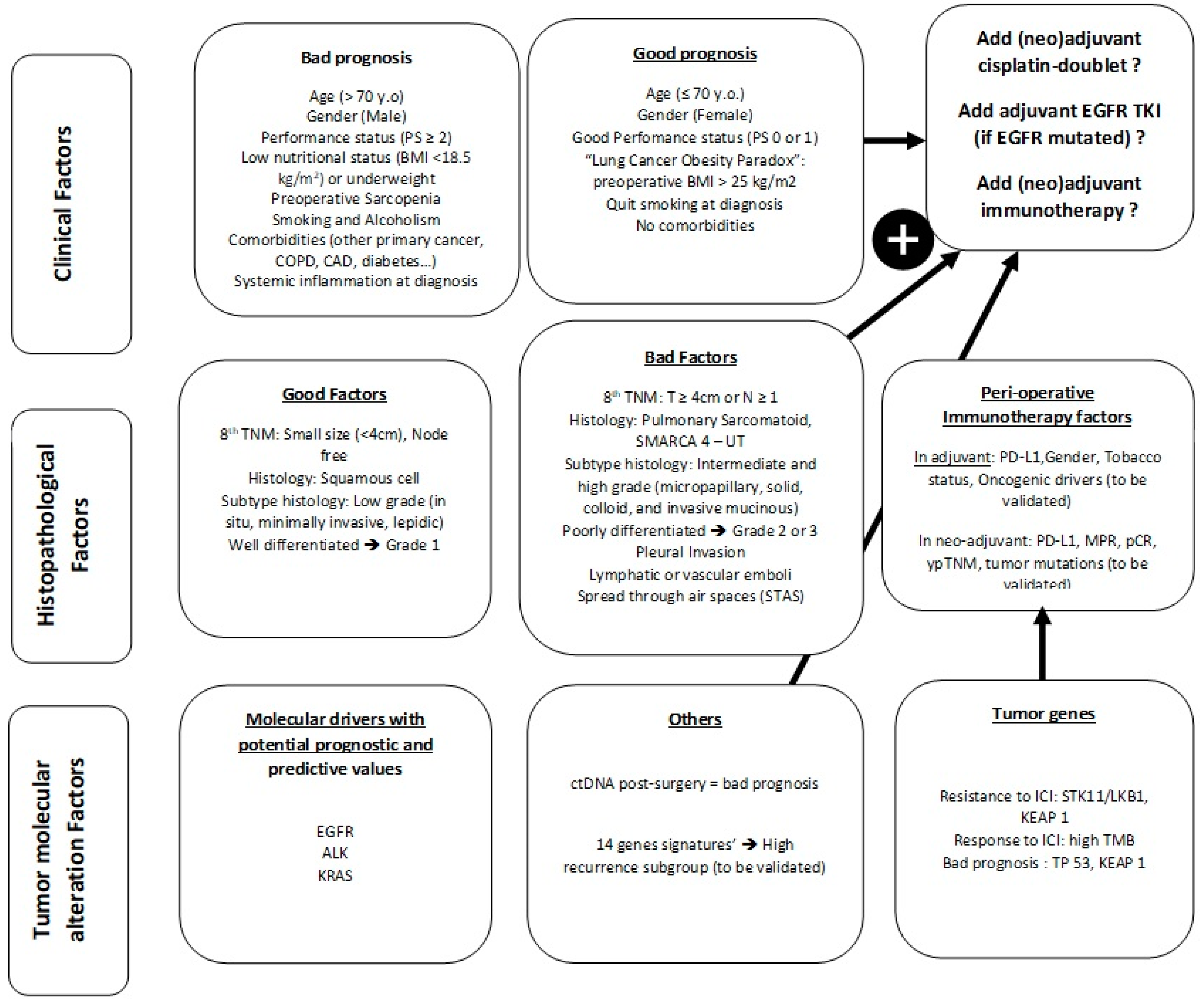
4.7. Clinical and Histopathological Prognostic Factors in the Era of Peri Operative Immunotherapy
4.7.1. Adjuvant Situation
4.7.2. Neoadjuvant Situation
5. Conclusions
Author Contributions
Funding
Acknowledgments
Conflicts of Interest
References
- Sung, H.; Ferlay, J.; Siegel, R.L.; Laversanne, M.; Soerjomataram, I.; Jemal, A.; Bray, F. Global Cancer Statistics 2020: GLOBOCAN Estimates of Incidence and Mortality Worldwide for 36 Cancers in 185 Countries. CA Cancer J. Clin. 2021, 71, 209–249. [Google Scholar] [CrossRef] [PubMed]
- Morgensztern, D.; Ng, S.H.; Gao, F.; Govindan, R. Trends in Stage Distribution for Patients with Non-Small Cell Lung Cancer: A National Cancer Database Survey. J. Thorac. Oncol. 2010, 5, 29–33. [Google Scholar] [CrossRef] [PubMed]
- Siegel, R.L.; Miller, K.D.; Fuchs, H.E.; Jemal, A. Cancer Statistics, 2022. CA Cancer J. Clin. 2022, 72, 7–33. [Google Scholar] [CrossRef] [PubMed]
- Thomas, A.; Liu, S.V.; Subramaniam, D.S.; Giaccone, G. Refining the Treatment of NSCLC According to Histological and Molecular Subtypes. Nat. Rev. Clin. Oncol. 2015, 12, 511–526. [Google Scholar] [CrossRef]
- Chaft, J.E.; Rimner, A.; Weder, W.; Azzoli, C.G.; Kris, M.G.; Cascone, T. Evolution of Systemic Therapy for Stages I–III Non-Metastatic Non-Small-Cell Lung Cancer. Nat. Rev. Clin. Oncol. 2021, 18, 547–557. [Google Scholar] [CrossRef]
- Remon, J.; Soria, J.-C.; Peters, S.; on behalf of the ESMO Guidelines Committee. Early and Locally Advanced Non-Small-Cell Lung Cancer: An Update of the ESMO Clinical Practice Guidelines Focusing on Diagnosis, Staging, Systemic and Local Therapy. Ann. Oncol. 2021, 32, 1637–1642. [Google Scholar] [CrossRef]
- Wu, Y.-L.; Tsuboi, M.; He, J.; John, T.; Grohe, C.; Majem, M.; Goldman, J.W.; Laktionov, K.; Kim, S.-W.; Kato, T.; et al. Osimertinib in Resected EGFR-Mutated Non-Small-Cell Lung Cancer. N. Engl. J. Med. 2020, 383, 1711–1723. [Google Scholar] [CrossRef]
- Paesmans, M. Prognostic and Predictive Factors for Lung Cancer. Breathe 2012, 9, 112–121. [Google Scholar] [CrossRef]
- Sculier, J.-P.; Chansky, K.; Crowley, J.J.; Van Meerbeeck, J.; Goldstraw, P. International Staging Committee and Participating Institutions The Impact of Additional Prognostic Factors on Survival and Their Relationship with the Anatomical Extent of Disease Expressed by the 6th Edition of the TNM Classification of Malignant Tumors and the Proposals for the 7th Edition. J. Thorac. Oncol. 2008, 3, 457–466. [Google Scholar] [CrossRef]
- Powell, H.A.; Tata, L.J.; Baldwin, D.R.; Stanley, R.A.; Khakwani, A.; Hubbard, R.B. Early Mortality after Surgical Resection for Lung Cancer: An Analysis of the English National Lung Cancer Audit. Thorax 2013, 68, 826–834. [Google Scholar] [CrossRef]
- Stoelben, E.; Sauerbrei, W.; Ludwig, C.; Hasse, J. Tumor Stage and Early Mortality for Surgical Resections in Lung Cancer. Langenbecks Arch. Surg. 2003, 388, 116–121. [Google Scholar] [CrossRef] [PubMed]
- Shewale, J.B.; Corsini, E.M.; Correa, A.M.; Brown, E.L.; Leon-Novelo, L.G.; Nyitray, A.G.; Antonoff, M.B.; Hofstetter, W.L.; Mehran, R.J.; Rice, D.C.; et al. Time Trends and Predictors of Survival in Surgically Resected Early-Stage Non-Small Cell Lung Cancer Patients. J. Surg. Oncol. 2020, 122, 495–505. [Google Scholar] [CrossRef] [PubMed]
- Marijon, H.; Bouyon, A.; Vignot, S.; Besse, B. Facteurs Pronostiques et Prédictifs Des Cancers Bronchiques. Bull. Cancer 2009, 96, 391–404. [Google Scholar] [CrossRef] [PubMed]
- Cerfolio, R.J.; Bryant, A.S.; Scott, E.; Sharma, M.; Robert, F.; Spencer, S.A.; Garver, R.I. Women with Pathologic Stage I, II, and III Non-Small Cell Lung Cancer Have Better Survival than Men. Chest 2006, 130, 1796–1802. [Google Scholar] [CrossRef]
- Sachs, E.; Sartipy, U.; Jackson, V. Sex and Survival after Surgery for Lung Cancer: A Swedish Nationwide Cohort. Chest 2021, 159, 2029–2039. [Google Scholar] [CrossRef]
- Nakamura, H.; Ando, K.; Shinmyo, T.; Morita, K.; Mochizuki, A.; Kurimoto, N.; Tatsunami, S. Female Gender Is an Independent Prognostic Factor in Non-Small-Cell Lung Cancer: A Meta-Analysis. Ann. Thorac. Cardiovasc. Surg. 2011, 17, 469–480. [Google Scholar] [CrossRef] [PubMed]
- MacRosty, C.R.; Rivera, M.P. Lung Cancer in Women: A Modern Epidemic. Clin. Chest Med. 2020, 41, 53–65. [Google Scholar] [CrossRef] [PubMed]
- Buccheri, G.; Ferrigno, D.; Tamburini, M. Karnofsky and ECOG Performance Status Scoring in Lung Cancer: A Prospective, Longitudinal Study of 536 Patients from a Single Institution. Eur. J. Cancer 1996, 32, 1135–1141. [Google Scholar] [CrossRef]
- Gester, F.; Paulus, A.; Sibille, A.; Corhay, J.L.; Duysinx, B.; Louis, R. Facteurs pronostiques du cancer pulmonaire non à petites cellules. Rev. Med. De Liege 2016, 71, 34–39. [Google Scholar]
- Kawaguchi, T.; Takada, M.; Kubo, A.; Matsumura, A.; Fukai, S.; Tamura, A.; Saito, R.; Maruyama, Y.; Kawahara, M.; Ou, S.-H.I. Performance Status and Smoking Status Are Independent Favorable Prognostic Factors for Survival in Non-Small Cell Lung Cancer: A Comprehensive Analysis of 26,957 Patients with NSCLC. J. Thorac. Oncol. 2010, 5, 620–630. [Google Scholar] [CrossRef]
- Bhaskaran, K.; Douglas, I.; Forbes, H.; dos-Santos-Silva, I.; Leon, D.A.; Smeeth, L. Body-Mass Index and Risk of 22 Specific Cancers: A Population-Based Cohort Study of 5·24 Million UK Adults. Lancet 2014, 384, 755–765. [Google Scholar] [CrossRef]
- Zhang, X.; Liu, Y.; Shao, H.; Zheng, X. Obesity Paradox in Lung Cancer Prognosis: Evolving Biological Insights and Clinical Implications. J. Thorac. Oncol. 2017, 12, 1478–1488. [Google Scholar] [CrossRef] [PubMed]
- Alifano, M.; Daffré, E.; Iannelli, A.; Brouchet, L.; Falcoz, P.E.; Le Pimpec Barthes, F.; Bernard, A.; Pages, P.B.; Thomas, P.A.; Dahan, M.; et al. The Reality of Lung Cancer Paradox: The Impact of Body Mass Index on Long-Term Survival of Resected Lung Cancer. A French Nationwide Analysis from the Epithor Database. Cancers 2021, 13, 4574. [Google Scholar] [CrossRef] [PubMed]
- Strulov Shachar, S.; Williams, G.R. The Obesity Paradox in Cancer-Moving Beyond BMI. Cancer Epidemiol. Biomark. Prev. 2017, 26, 13–16. [Google Scholar] [CrossRef] [PubMed]
- Icard, P.; Schussler, O.; Loi, M.; Bobbio, A.; Lupo, A.M.; Wislez, M.; Iannelli, A.; Fournel, L.; Damotte, D.; Alifano, M. Pre-Disease and Pre-Surgery BMI, Weight Loss and Sarcopenia Impact Survival of Resected Lung Cancer Independently of Tumor Stage. Cancers 2020, 12, 266. [Google Scholar] [CrossRef] [PubMed]
- Christensen, N.L.; Løkke, A.; Dalton, S.O.; Christensen, J.; Rasmussen, T.R. Smoking, Alcohol, and Nutritional Status in Relation to One-Year Mortality in Danish Stage I Lung Cancer Patients. Lung Cancer 2018, 124, 40–44. [Google Scholar] [CrossRef]
- Sheikh, M.; Mukeriya, A.; Shangina, O.; Brennan, P.; Zaridze, D. Postdiagnosis Smoking Cessation and Reduced Risk for Lung Cancer Progression and Mortality: A Prospective Cohort Study. Ann. Intern. Med. 2021, 174, 1232–1239. [Google Scholar] [CrossRef]
- Andreas, S.; Rittmeyer, A.; Hinterthaner, M.; Huber, R.M. Smoking Cessation in Lung Cancer-Achievable and Effective. Dtsch. Ärzteblatt Int. 2013, 110, 719–724. [Google Scholar] [CrossRef]
- Tan, L.-E.; Razak, A.M.; Lim, C.-S. Association of Chronic Obstructive Pulmonary Disease and Postresection Lung Cancer Survival: A Systematic Review and Meta-Analysis. J. Investig. Med. 2017, 65, 342–352. [Google Scholar] [CrossRef]
- Saji, H.; Miyazawa, T.; Sakai, H.; Kimura, Y.; Tsuda, M.; Wakiyama, Y.; Marushima, H.; Kojima, K.; Nakamura, H. Survival Significance of Coexisting Chronic Obstructive Pulmonary Disease in Patients with Early Lung Cancer after Curative Surgery. Thorac. Cancer 2018, 9, 19–24. [Google Scholar] [CrossRef]
- Hanagiri, T.; Sugio, K.; Mizukami, M.; Ichiki, Y.; Sugaya, M.; Yasuda, M.; Takenoyama, M.; Yasumoto, K. Significance of Smoking as a Postoperative Prognostic Factor in Patients with Non-Small Cell Lung Cancer. J. Thorac. Oncol. 2008, 3, 1127–1132. [Google Scholar] [CrossRef] [PubMed]
- Friedel, G.; Fritz, P.; Goletz, S.; Kristen, R.; Brinkmann, F.; Dierkesmann, R.; Schwab, M.; Ott, G.; Dippon, J.; Alscher, M.D. Postoperative Survival of Lung Cancer Patients: Are There Predictors beyond TNM? Anticancer Res. 2013, 33, 1609–1619. [Google Scholar] [PubMed]
- Melvan, J.N.; Sancheti, M.S.; Gillespie, T.; Nickleach, D.C.; Liu, Y.; Higgins, K.; Ramalingam, S.; Lipscomb, J.; Fernandez, F.G. Nonclinical Factors Associated with 30-Day Mortality after Lung Cancer Resection: An Analysis of 215,000 Patients Using the National Cancer Data Base. J. Am. Coll. Surg. 2015, 221, 550–563. [Google Scholar] [CrossRef]
- Christensen, N.L.; Kejs, A.M.T.; Jakobsen, E.; Dalton, S.O.; Rasmussen, T.R. Early Death in Danish Stage I Lung Cancer Patients: A Population-Based Case Study. Acta Oncol. 2018, 57, 1561–1566. [Google Scholar] [CrossRef]
- Pasini, F.; Pelosi, G.; Valduga, F.; Durante, E.; de Manzoni, G.; Zaninelli, M.; Terzi, A. Late Events and Clinical Prognostic Factors in Stage I Non Small Cell Lung Cancer. Lung Cancer 2002, 37, 171–177. [Google Scholar] [CrossRef]
- Alifano, M.; Falcoz, P.E.; Seegers, V.; Roche, N.; Schussler, O.; Younes, M.; Antonacci, F.; Forgez, P.; Dechartres, A.; Massard, G.; et al. Preresection Serum C-Reactive Protein Measurement and Survival among Patients with Resectable Non-Small Cell Lung Cancer. J. Thorac. Cardiovasc. Surg. 2011, 142, 1161–1167. [Google Scholar] [CrossRef]
- Alifano, M.; Mansuet-Lupo, A.; Lococo, F.; Roche, N.; Bobbio, A.; Canny, E.; Schussler, O.; Dermine, H.; Régnard, J.-F.; Burroni, B.; et al. Systemic Inflammation, Nutritional Status and Tumor Immune Microenvironment Determine Outcome of Resected Non-Small Cell Lung Cancer. PLoS ONE 2014, 9, e106914. [Google Scholar] [CrossRef] [PubMed]
- Goussault, H.; Gendarme, S.; Assié, J.B.; Bylicki, O.; Chouaïd, C. Factors Associated with Early Lung Cancer Mortality: A Systematic Review. Expert Rev. Anticancer Ther. 2021, 21, 1125–1133. [Google Scholar] [CrossRef] [PubMed]
- Currow, D.C.; You, H.; Aranda, S.; McCaughan, B.C.; Morrell, S.; Baker, D.F.; Walton, R.; Roder, D.M. What Factors Are Predictive of Surgical Resection and Survival from Localised Non-Small Cell Lung Cancer? Med. J. Aust. 2014, 201, 475–480. [Google Scholar] [CrossRef][Green Version]
- Goldstraw, P.; Chansky, K.; Crowley, J.; Rami-Porta, R.; Asamura, H.; Eberhardt, W.E.E.; Nicholson, A.G.; Groome, P.; Mitchell, A.; Bolejack, V.; et al. The IASLC Lung Cancer Staging Project: Proposals for Revision of the TNM Stage Groupings in the Forthcoming (Eighth) Edition of the TNM Classification for Lung Cancer. J. Thorac. Oncol. 2016, 11, 39–51. [Google Scholar] [CrossRef]
- Ou, S.-H.I.; Zell, J.A.; Ziogas, A.; Anton-Culver, H. Prognostic Factors for Survival of Stage I Nonsmall Cell Lung Cancer Patients: A Population-Based Analysis of 19,702 Stage I Patients in the California Cancer Registry from 1989 to 2003. Cancer 2007, 110, 1532–1541. [Google Scholar] [CrossRef]
- Gajra, A.; Newman, N.; Gamble, G.P.; Kohman, L.J.; Graziano, S.L. Effect of Number of Lymph Nodes Sampled on Outcome in Patients with Stage I Non-Small-Cell Lung Cancer. J. Clin. Oncol. 2003, 21, 1029–1034. [Google Scholar] [CrossRef] [PubMed]
- Caldarella, A.; Crocetti, E.; Comin, C.E.; Janni, A.; Pegna, A.L.; Paci, E. Prognostic Variability among Nonsmall Cell Lung Cancer Patients with Pathologic N1 Lymph Node Involvement. Epidemiological Figures with Strong Clinical Implications. Cancer 2006, 107, 793–798. [Google Scholar] [CrossRef] [PubMed]
- Riquet, M.; Assouad, J.; Bagan, P.; Foucault, C.; Le Pimpec Barthes, F.; Dujon, A.; Danel, C. Skip Mediastinal Lymph Node Metastasis and Lung Cancer: A Particular N2 Subgroup with a Better Prognosis. Ann. Thorac. Surg. 2005, 79, 225–233. [Google Scholar] [CrossRef] [PubMed]
- Andre, F.; Grunenwald, D.; Pignon, J.P.; Dujon, A.; Pujol, J.L.; Brichon, P.Y.; Brouchet, L.; Quoix, E.; Westeel, V.; Le Chevalier, T. Survival of Patients with Resected N2 Non-Small-Cell Lung Cancer: Evidence for a Subclassification and Implications. J. Clin. Oncol. 2000, 18, 2981–2989. [Google Scholar] [CrossRef] [PubMed]
- Goldstraw, P.; Crowley, J.; Chansky, K.; Giroux, D.J.; Groome, P.A.; Rami-Porta, R.; Postmus, P.E.; Rusch, V.; Sobin, L. The IASLC Lung Cancer Staging Project: Proposals for the Revision of the TNM Stage Groupings in the Forthcoming (Seventh) Edition of the TNM Classification of Malignant Tumours. J. Thorac. Oncol. 2007, 2, 706–714. [Google Scholar] [CrossRef]
- Rami-Porta, R. Future Perspectives on the TNM Staging for Lung Cancer. Cancers 2021, 13, 1940. [Google Scholar] [CrossRef]
- Sakakura, N.; Mizuno, T.; Kuroda, H.; Arimura, T.; Yatabe, Y.; Yoshimura, K.; Sakao, Y. The Eighth TNM Classification System for Lung Cancer: A Consideration Based on the Degree of Pleural Invasion and Involved Neighboring Structures. Lung Cancer 2018, 118, 134–138. [Google Scholar] [CrossRef]
- Travis, W.D.; Brambilla, E.; Müller-Hermelink, H.K.; Harris, C.C. (Eds.) Pathology and Genetics of Tumours of the Lung, Pleura, Thymus and Heart, 3rd ed.; IARC: Lyon, France, 2021; Volume 10, ISBN 978-92-832-2418-1. [Google Scholar]
- Motoaki, Y.; Sawabata, N.; Kawaguchi, T.; Kawai, N.; Nakai, T.; Ohbayashi, C.; Taniguchi, S. Histological Grade: Analysis of Prognosis of Non-Small Cell Lung Cancer After Complete Resection. In Vivo 2018, 32, 1505–1512. [Google Scholar] [CrossRef]
- Gridelli, C.; Rossi, A.; Carbone, D.P.; Guarize, J.; Karachaliou, N.; Mok, T.; Petrella, F.; Spaggiari, L.; Rosell, R. Non-Small-Cell Lung Cancer. Nat. Rev. Dis. Primer 2015, 1, 15009. [Google Scholar] [CrossRef] [PubMed]
- Nicholson, A.G.; Tsao, M.S.; Beasley, M.B.; Borczuk, A.C.; Brambilla, E.; Cooper, W.A.; Dacic, S.; Jain, D.; Kerr, K.M.; Lantuejoul, S.; et al. The 2021 WHO Classification of Lung Tumors: Impact of Advances since 2015. J. Thorac. Oncol. 2022, 17, 362–387. [Google Scholar] [CrossRef] [PubMed]
- Antoine, M.; Vieira, T.; Fallet, V.; Hamard, C.; Duruisseaux, M.; Cadranel, J.; Wislez, M. Carcinomes sarcomatoïdes pulmonaires. Ann. Pathol. 2016, 36, 44–54. [Google Scholar] [CrossRef] [PubMed]
- Martin, L.W.; Correa, A.M.; Ordonez, N.G.; Roth, J.A.; Swisher, S.G.; Vaporciyan, A.A.; Walsh, G.L.; Rice, D.C. Sarcomatoid Carcinoma of the Lung: A Predictor of Poor Prognosis. Ann. Thorac. Surg. 2007, 84, 973–980. [Google Scholar] [CrossRef]
- Remmelink, M.; Rouquette, I. Quel bilan anatomo-pathologique?: What anatomo-pathological assessment? Rev. Mal. Respir. Actual. 2021, 13, 2S26–2S33. [Google Scholar] [CrossRef]
- Fernando, T.M.; Piskol, R.; Bainer, R.; Sokol, E.S.; Trabucco, S.E.; Zhang, Q.; Trinh, H.; Maund, S.; Kschonsak, M.; Chaudhuri, S.; et al. Functional Characterization of SMARCA4 Variants Identified by Targeted Exome-Sequencing of 131,668 Cancer Patients. Nat. Commun. 2020, 11, 5551. [Google Scholar] [CrossRef]
- Roden, A.C. Thoracic SMARCA4-Deficient Undifferentiated Tumor—A Case of an Aggressive Neoplasm—Case Report. Mediastinum 2021, 5. [Google Scholar] [CrossRef] [PubMed]
- Sun, L.; Dai, J.; Chen, Y.; Duan, L.; He, W.; Chen, Q.; Wang, H.; Zhu, Y.; Zhang, H.; Jiang, G.; et al. Pulmonary Sarcomatoid Carcinoma: Experience From SEER Database and Shanghai Pulmonary Hospital. Ann. Thorac. Surg. 2020, 110, 406–413. [Google Scholar] [CrossRef] [PubMed]
- Travis, W.D.; Brambilla, E.; Noguchi, M.; Nicholson, A.G.; Geisinger, K.; Yatabe, Y.; Ishikawa, Y.; Wistuba, I.; Flieder, D.B.; Franklin, W.; et al. Diagnosis of Lung Adenocarcinoma in Resected Specimens: Implications of the 2011 International Association for the Study of Lung Cancer/American Thoracic Society/European Respiratory Society Classification. Arch. Pathol. Lab. Med. 2013, 137, 685–705. [Google Scholar] [CrossRef] [PubMed]
- Yoshizawa, A.; Motoi, N.; Riely, G.J.; Sima, C.S.; Gerald, W.L.; Kris, M.G.; Park, B.J.; Rusch, V.W.; Travis, W.D. Impact of Proposed IASLC/ATS/ERS Classification of Lung Adenocarcinoma: Prognostic Subgroups and Implications for Further Revision of Staging Based on Analysis of 514 Stage I Cases. Mod. Pathol. 2011, 24, 653–664. [Google Scholar] [CrossRef]
- Mansuet-Lupo, A.; Bobbio, A.; Blons, H.; Becht, E.; Ouakrim, H.; Didelot, A.; Charpentier, M.-C.; Bain, S.; Marmey, B.; Bonjour, P.; et al. The New Histologic Classification of Lung Primary Adenocarcinoma Subtypes Is a Reliable Prognostic Marker and Identifies Tumors with Different Mutation Status: The Experience of a French Cohort. Chest 2014, 146, 633–643. [Google Scholar] [CrossRef]
- Moreira, A.L.; Ocampo, P.S.S.; Xia, Y.; Zhong, H.; Russell, P.A.; Minami, Y.; Cooper, W.A.; Yoshida, A.; Bubendorf, L.; Papotti, M.; et al. A Grading System for Invasive Pulmonary Adenocarcinoma: A Proposal from the International Association for the Study of Lung Cancer Pathology Committee. J. Thorac. Oncol. 2020, 15, 1599–1610. [Google Scholar] [CrossRef] [PubMed]
- Giglio, A.D.; Federico, A.D.; Gelsomino, F.; Ardizzoni, A. Prognostic Relevance of Pleural Invasion for Resected NSCLC Patients Undergoing Adjuvant Treatments: A Propensity Score-Matched Analysis of SEER Database. Lung Cancer 2021, 161, 18–25. [Google Scholar] [CrossRef] [PubMed]
- Shimizu, K.; Yoshida, J.; Nagai, K.; Nishimura, M.; Ishii, G.; Morishita, Y.; Nishiwaki, Y. Visceral Pleural Invasion Is an Invasive and Aggressive Indicator of Non-Small Cell Lung Cancer. J. Thorac. Cardiovasc. Surg. 2005, 130, 160–165. [Google Scholar] [CrossRef] [PubMed]
- Travis, W.D.; Brambilla, E.; Rami-Porta, R.; Vallières, E.; Tsuboi, M.; Rusch, V.; Goldstraw, P. Visceral Pleural Invasion: Pathologic Criteria and Use of Elastic Stains: Proposal for the 7th Edition of the TNM Classification for Lung Cancer. J. Thorac. Oncol. 2008, 3, 1384–1390. [Google Scholar] [CrossRef]
- Wang, T.; Zhou, C.; Zhou, Q. Extent of Visceral Pleural Invasion Affects Prognosis of Resected Non-Small Cell Lung Cancer: A Meta-Analysis. Sci. Rep. 2017, 7, 1527. [Google Scholar] [CrossRef]
- Wang, J.; Chen, J.; Chen, X.; Wang, B.; Li, K.; Bi, J. Blood Vessel Invasion as a Strong Independent Prognostic Indicator in Non-Small Cell Lung Cancer: A Systematic Review and Meta-Analysis. PLoS ONE 2011, 6, e28844. [Google Scholar] [CrossRef]
- Strano, S.; Lupo, A.; Lococo, F.; Schussler, O.; Loi, M.; Younes, M.; Bobbio, A.; Damotte, D.; Regnard, J.-F.; Alifano, M. Prognostic Significance of Vascular and Lymphatic Emboli in Resected Pulmonary Adenocarcinoma. Ann. Thorac. Surg. 2013, 95, 1204–1210. [Google Scholar] [CrossRef]
- Mollberg, N.M.; Bennette, C.; Howell, E.; Backhus, L.; Devine, B.; Ferguson, M.K. Lymphovascular Invasion as a Prognostic Indicator in Stage I Non-Small Cell Lung Cancer: A Systematic Review and Meta-Analysis. Ann. Thorac. Surg. 2014, 97, 965–971. [Google Scholar] [CrossRef]
- Kadota, K.; Nitadori, J.; Sima, C.S.; Ujiie, H.; Rizk, N.P.; Jones, D.R.; Adusumilli, P.S.; Travis, W.D. Tumor Spread through Air Spaces Is an Important Pattern of Invasion and Impacts the Frequency and Location of Recurrences after Limited Resection for Small Stage I Lung Adenocarcinomas. J. Thorac. Oncol. 2015, 10, 806–814. [Google Scholar] [CrossRef]
- Warth, A.; Muley, T.; Kossakowski, C.A.; Goeppert, B.; Schirmacher, P.; Dienemann, H.; Weichert, W. Prognostic Impact of Intra-Alveolar Tumor Spread in Pulmonary Adenocarcinoma. Am. J. Surg. Pathol. 2015, 39, 793–801. [Google Scholar] [CrossRef]
- Han, Y.B.; Kim, H.; Mino-Kenudson, M.; Cho, S.; Kwon, H.J.; Lee, K.R.; Kwon, S.; Lee, J.; Kim, K.; Jheon, S.; et al. Correction: Tumor Spread through Air Spaces (STAS): Prognostic Significance of Grading in Non-Small Cell Lung Cancer. Mod. Pathol. 2021, 34, 1038. [Google Scholar] [CrossRef] [PubMed]
- Izar, B.; Sequist, L.; Lee, M.; Muzikansky, A.; Heist, R.; Iafrate, J.; Dias-Santagata, D.; Mathisen, D.; Lanuti, M. The Impact of EGFR Mutation Status on Outcomes in Patients with Resected Stage I Non-Small Cell Lung Cancers. Ann. Thorac. Surg. 2013, 96, 962–968. [Google Scholar] [CrossRef] [PubMed]
- Okamoto, T.; Kitahara, H.; Shimamatsu, S.; Katsura, M.; Takada, K.; Fujishita, T.; Suzuki, Y.; Morodomi, Y.; Tagawa, T.; Maehara, Y. Prognostic Impact of EGFR Driver Mutations on Postoperative Disease Recurrence in Lung Adenocarcinoma. Anticancer Res. 2016, 36, 3057–3063. [Google Scholar] [PubMed]
- Nishii, T.; Yokose, T.; Miyagi, Y.; Daigo, Y.; Isaka, T.; Furumoto, H.; Ito, H.; Murakami, S.; Kondo, T.; Saito, H.; et al. Prognostic Value of EGFR Mutations in Surgically Resected Pathological Stage I Lung Adenocarcinoma. Asia Pac. J. Clin. Oncol. 2017, 13, e204–e211. [Google Scholar] [CrossRef]
- He, Q.; Xin, P.; Zhang, M.; Jiang, S.; Zhang, J.; Zhong, S.; Liu, Y.; Guo, M.; Chen, X.; Xia, X.; et al. The Impact of Epidermal Growth Factor Receptor Mutations on the Prognosis of Resected Non-Small Cell Lung Cancer: A Meta-Analysis of Literatures. Transl. Lung Cancer Res. 2019, 8, 124–134. [Google Scholar] [CrossRef]
- Ramalingam, S.S.; Vansteenkiste, J.; Planchard, D.; Cho, B.C.; Gray, J.E.; Ohe, Y.; Zhou, C.; Reungwetwattana, T.; Cheng, Y.; Chewaskulyong, B.; et al. Overall Survival with Osimertinib in Untreated, EGFR -Mutated Advanced NSCLC. N. Engl. J. Med. 2020, 382, 41–50. [Google Scholar] [CrossRef]
- Masago, K.; Seto, K.; Fujita, S.; Sasaki, E.; Hosoda, W.; Kuroda, H. Long-Term Recurrence of Completely Resected NSCLC. JTO Clin. Res. Rep. 2020, 1, 100076. [Google Scholar] [CrossRef]
- Tsai, M.-F.; Chang, T.-H.; Wu, S.-G.; Yang, H.-Y.; Hsu, Y.-C.; Yang, P.-C.; Shih, J.-Y. EGFR-L858R Mutant Enhances Lung Adenocarcinoma Cell Invasive Ability and Promotes Malignant Pleural Effusion Formation through Activation of the CXCL12-CXCR4 Pathway. Sci. Rep. 2015, 5, 13574. [Google Scholar] [CrossRef]
- Vogelstein, B.; Papadopoulos, N.; Velculescu, V.E.; Zhou, S.; Diaz, L.A.; Kinzler, K.W. Cancer Genome Landscapes. Science 2013, 339, 1546–1558. [Google Scholar] [CrossRef]
- Shepherd, F.A.; Domerg, C.; Hainaut, P.; Jänne, P.A.; Pignon, J.-P.; Graziano, S.; Douillard, J.-Y.; Brambilla, E.; Le Chevalier, T.; Seymour, L.; et al. Pooled Analysis of the Prognostic and Predictive Effects of KRAS Mutation Status and KRAS Mutation Subtype in Early-Stage Resected Non-Small-Cell Lung Cancer in Four Trials of Adjuvant Chemotherapy. J. Clin. Oncol. 2013, 31, 2173–2181. [Google Scholar] [CrossRef]
- Izar, B.; Zhou, H.; Heist, R.S.; Azzoli, C.G.; Muzikansky, A.; Scribner, E.E.F.; Bernardo, L.A.; Dias-Santagata, D.; Iafrate, A.J.; Lanuti, M. The Prognostic Impact of KRAS, Its Codon and Amino Acid Specific Mutations, on Survival in Resected Stage I Lung Adenocarcinoma. J. Thorac. Oncol. 2014, 9, 1363–1369. [Google Scholar] [CrossRef] [PubMed]
- Nakayama, I.; Hirota, T.; Shinozaki, E. BRAF Mutation in Colorectal Cancers: From Prognostic Marker to Targetable Mutation. Cancers 2020, 12, 3236. [Google Scholar] [CrossRef] [PubMed]
- Kinno, T.; Tsuta, K.; Shiraishi, K.; Mizukami, T.; Suzuki, M.; Yoshida, A.; Suzuki, K.; Asamura, H.; Furuta, K.; Kohno, T.; et al. Clinicopathological Features of Nonsmall Cell Lung Carcinomas with BRAF Mutations. Ann. Oncol. 2014, 25, 138–142. [Google Scholar] [CrossRef] [PubMed]
- Liu, Y.; Ye, X.; Yu, Y.; Lu, S. Prognostic Significance of Anaplastic Lymphoma Kinase Rearrangement in Patients with Completely Resected Lung Adenocarcinoma. J. Thorac. Dis. 2019, 11, 4258–4270. [Google Scholar] [CrossRef]
- Fukui, T.; Yatabe, Y.; Kobayashi, Y.; Tomizawa, K.; Ito, S.; Hatooka, S.; Matsuo, K.; Mitsudomi, T. Clinicoradiologic Characteristics of Patients with Lung Adenocarcinoma Harboring EML4-ALK Fusion Oncogene. Lung Cancer 2012, 77, 319–325. [Google Scholar] [CrossRef]
- Zhou, J.X.; Yang, H.; Deng, Q.; Gu, X.; He, P.; Lin, Y.; Zhao, M.; Jiang, J.; Chen, H.; Lin, Y.; et al. Oncogenic Driver Mutations in Patients with Non-Small-Cell Lung Cancer at Various Clinical Stages. Ann. Oncol. 2013, 24, 1319–1325. [Google Scholar] [CrossRef]
- Lee, G.D.; Lee, S.E.; Oh, D.-Y.; Yu, D.; Jeong, H.M.; Kim, J.; Hong, S.; Jung, H.S.; Oh, E.; Song, J.-Y.; et al. MET Exon 14 Skipping Mutations in Lung Adenocarcinoma: Clinicopathologic Implications and Prognostic Values. J. Thorac. Oncol. 2017, 12, 1233–1246. [Google Scholar] [CrossRef]
- Wolf, J.; Seto, T.; Han, J.-Y.; Reguart, N.; Garon, E.B.; Groen, H.J.M.; Tan, D.S.W.; Hida, T.; de Jonge, M.; Orlov, S.V.; et al. Capmatinib in MET Exon 14–Mutated or MET -Amplified Non–Small-Cell Lung Cancer. N. Engl. J. Med. 2020, 383, 944–957. [Google Scholar] [CrossRef]
- Tsao, M.-S.; Aviel-Ronen, S.; Ding, K.; Lau, D.; Liu, N.; Sakurada, A.; Whitehead, M.; Zhu, C.-Q.; Livingston, R.; Johnson, D.H.; et al. Prognostic and Predictive Importance of P53 and RAS for Adjuvant Chemotherapy in Non Small-Cell Lung Cancer. J. Clin. Oncol. 2007, 25, 5240–5247. [Google Scholar] [CrossRef]
- Aggarwal, C.; Davis, C.W.; Mick, R.; Thompson, J.C.; Ahmed, S.; Jeffries, S.; Bagley, S.; Gabriel, P.; Evans, T.L.; Bauml, J.M.; et al. Influence of TP53 Mutation on Survival in Patients With Advanced EGFR-Mutant Non-Small-Cell Lung Cancer. JCO Precis. Oncol. 2018, 2, 1–29. [Google Scholar] [CrossRef]
- Molina-Vila, M.A.; Bertran-Alamillo, J.; Gascó, A.; Mayo-de-las-Casas, C.; Sánchez-Ronco, M.; Pujantell-Pastor, L.; Bonanno, L.; Favaretto, A.G.; Cardona, A.F.; Vergnenègre, A.; et al. Nondisruptive P53 Mutations Are Associated with Shorter Survival in Patients with Advanced Non-Small Cell Lung Cancer. Clin. Cancer Res. 2014, 20, 4647–4659. [Google Scholar] [CrossRef] [PubMed]
- Gu, J.; Zhou, Y.; Huang, L.; Ou, W.; Wu, J.; Li, S.; Xu, J.; Feng, J.; Liu, B. TP53 Mutation Is Associated with a Poor Clinical Outcome for Non-Small Cell Lung Cancer: Evidence from a Meta-Analysis. Mol. Clin. Oncol. 2016, 5, 705–713. [Google Scholar] [CrossRef] [PubMed]
- Saleh, M.M.; Scheffler, M.; Merkelbach-Bruse, S.; Scheel, A.H.; Ulmer, B.; Wolf, J.; Buettner, R. Comprehensive Analysis of TP53 and KEAP1 Mutations and Their Impact on Survival in Localized- and Advanced-Stage NSCLC. J. Thorac. Oncol. 2022, 17, 76–88. [Google Scholar] [CrossRef] [PubMed]
- Di Federico, A.; De Giglio, A.; Parisi, C.; Gelsomino, F. STK11/LKB1 and KEAP1 Mutations in Non-Small Cell Lung Cancer: Prognostic Rather than Predictive? Eur. J. Cancer 2021, 157, 108–113. [Google Scholar] [CrossRef]
- Skoulidis, F.; Goldberg, M.E.; Greenawalt, D.M.; Hellmann, M.D.; Awad, M.M.; Gainor, J.F.; Schrock, A.B.; Hartmaier, R.J.; Trabucco, S.E.; Gay, L.; et al. STK11/LKB1 Mutations and PD-1 Inhibitor Resistance in KRAS-Mutant Lung Adenocarcinoma. Cancer Discov. 2018, 8, 822–835. [Google Scholar] [CrossRef]
- Arbour, K.C.; Jordan, E.; Kim, H.R.; Dienstag, J.; Yu, H.A.; Sanchez-Vega, F.; Lito, P.; Berger, M.; Solit, D.B.; Hellmann, M.; et al. Effects of Co-Occurring Genomic Alterations on Outcomes in Patients with KRAS-Mutant Non-Small Cell Lung Cancer. Clin. Cancer Res. 2018, 24, 334–340. [Google Scholar] [CrossRef]
- Pécuchet, N.; Laurent-Puig, P.; Mansuet-Lupo, A.; Legras, A.; Alifano, M.; Pallier, K.; Didelot, A.; Gibault, L.; Danel, C.; Just, P.-A.; et al. Different Prognostic Impact of STK11 Mutations in Non-Squamous Non-Small-Cell Lung Cancer. Oncotarget 2017, 8, 23831–23840. [Google Scholar] [CrossRef]
- Rizvi, N.A.; Hellmann, M.D.; Snyder, A.; Kvistborg, P.; Makarov, V.; Havel, J.J.; Lee, W.; Yuan, J.; Wong, P.; Ho, T.S.; et al. Cancer Immunology. Mutational Landscape Determines Sensitivity to PD-1 Blockade in Non-Small Cell Lung Cancer. Science 2015, 348, 124–128. [Google Scholar] [CrossRef]
- Galvano, A.; Gristina, V.; Malapelle, U.; Pisapia, P.; Pepe, F.; Barraco, N.; Castiglia, M.; Perez, A.; Rolfo, C.; Troncone, G.; et al. The Prognostic Impact of Tumor Mutational Burden (TMB) in the First-Line Management of Advanced Non-Oncogene Addicted Non-Small-Cell Lung Cancer (NSCLC): A Systematic Review and Meta-Analysis of Randomized Controlled Trials. ESMO Open 2021, 6, 100124. [Google Scholar] [CrossRef]
- Jia, Q.; Wu, W.; Wang, Y.; Alexander, P.B.; Sun, C.; Gong, Z.; Cheng, J.-N.; Sun, H.; Guan, Y.; Xia, X.; et al. Local Mutational Diversity Drives Intratumoral Immune Heterogeneity in Non-Small Cell Lung Cancer. Nat. Commun. 2018, 9, 5361. [Google Scholar] [CrossRef]
- Owada-Ozaki, Y.; Muto, S.; Takagi, H.; Inoue, T.; Watanabe, Y.; Fukuhara, M.; Yamaura, T.; Okabe, N.; Matsumura, Y.; Hasegawa, T.; et al. Prognostic Impact of Tumor Mutation Burden in Patients with Completely Resected Non-Small Cell Lung Cancer: Brief Report. J. Thorac. Oncol. 2018, 13, 1217–1221. [Google Scholar] [CrossRef] [PubMed]
- Yan, D.; Chen, Y. Tumor Mutation Burden (TMB)-Associated Signature Constructed to Predict Survival of Lung Squamous Cell Carcinoma Patients. Sci. Rep. 2021, 11, 9020. [Google Scholar] [CrossRef]
- Lee, R.J.; Gremel, G.; Marshall, A.; Myers, K.A.; Fisher, N.; Dunn, J.A.; Dhomen, N.; Corrie, P.G.; Middleton, M.R.; Lorigan, P.; et al. Circulating Tumor DNA Predicts Survival in Patients with Resected High-Risk Stage II/III Melanoma. Ann. Oncol. 2018, 29, 490–496. [Google Scholar] [CrossRef]
- Wang, Y.; Li, L.; Cohen, J.D.; Kinde, I.; Ptak, J.; Popoli, M.; Schaefer, J.; Silliman, N.; Dobbyn, L.; Tie, J.; et al. Prognostic Potential of Circulating Tumor DNA Measurement in Postoperative Surveillance of Nonmetastatic Colorectal Cancer. JAMA Oncol. 2019, 5, 1118–1123. [Google Scholar] [CrossRef]
- Qiu, B.; Guo, W.; Zhang, F.; Lv, F.; Ji, Y.; Peng, Y.; Chen, X.; Bao, H.; Xu, Y.; Shao, Y.; et al. Dynamic Recurrence Risk and Adjuvant Chemotherapy Benefit Prediction by CtDNA in Resected NSCLC. Nat. Commun. 2021, 12, 6770. [Google Scholar] [CrossRef]
- Peng, M.; Huang, Q.; Yin, W.; Tan, S.; Chen, C.; Liu, W.; Tang, J.; Wang, X.; Zhang, B.; Zou, M.; et al. Circulating Tumor DNA as a Prognostic Biomarker in Localized Non-Small Cell Lung Cancer. Front. Oncol. 2020, 10, 561598. [Google Scholar] [CrossRef] [PubMed]
- Sandoval, J.; Mendez-Gonzalez, J.; Nadal, E.; Chen, G.; Carmona, F.J.; Sayols, S.; Moran, S.; Heyn, H.; Vizoso, M.; Gomez, A.; et al. A Prognostic DNA Methylation Signature for Stage I Non–Small-Cell Lung Cancer. J. Clin. Oncol. 2013, 31, 4140–4147. [Google Scholar] [CrossRef]
- Garinet, S.; Didelot, A.; Denize, T.; Perrier, A.; Beinse, G.; Leclere, J.-B.; Oudart, J.-B.; Gibault, L.; Badoual, C.; Le Pimpec-Barthes, F.; et al. Clinical Assessment of the MiR-34, MiR-200, ZEB1 and SNAIL EMT Regulation Hub Underlines the Differential Prognostic Value of EMT MiRs to Drive Mesenchymal Transition and Prognosis in Resected NSCLC. Br. J. Cancer 2021, 125, 1544–1551. [Google Scholar] [CrossRef]
- Collisson, E.A.; Campbell, J.D.; Brooks, A.N.; Berger, A.H.; Lee, W.; Chmielecki, J.; Beer, D.G.; Cope, L.; Creighton, C.J.; Danilova, L.; et al. Comprehensive Molecular Profiling of Lung Adenocarcinoma. Nature 2014, 511, 543–550. [Google Scholar] [CrossRef]
- Hammerman, P.S.; Lawrence, M.S.; Voet, D.; Jing, R.; Cibulskis, K.; Sivachenko, A.; Stojanov, P.; McKenna, A.; Lander, E.S.; Gabriel, S.; et al. Comprehensive Genomic Characterization of Squamous Cell Lung Cancers. Nature 2012, 489, 519–525. [Google Scholar] [CrossRef]
- Tang, H.; Wang, S.; Xiao, G.; Schiller, J.; Papadimitrakopoulou, V.; Minna, J.; Wistuba, I.I.; Xie, Y. Comprehensive Evaluation of Published Gene Expression Prognostic Signatures for Biomarker-Based Lung Cancer Clinical Studies. Ann. Oncol. 2017, 28, 733–740. [Google Scholar] [CrossRef] [PubMed]
- Venet, D.; Dumont, J.E.; Detours, V. Most Random Gene Expression Signatures Are Significantly Associated with Breast Cancer Outcome. PLoS Comput. Biol. 2011, 7, e1002240. [Google Scholar] [CrossRef] [PubMed]
- Kratz, J.R.; He, J.; Van Den Eeden, S.K.; Zhu, Z.-H.; Gao, W.; Pham, P.T.; Mulvihill, M.S.; Ziaei, F.; Zhang, H.; Su, B.; et al. A Practical Molecular Assay to Predict Survival in Resected Non-Squamous, Non-Small-Cell Lung Cancer: Development and International Validation Studies. Lancet 2012, 379, 823–832. [Google Scholar] [CrossRef]
- Woodard, G.A.; Wang, S.X.; Kratz, J.R.; Zoon-Besselink, C.T.; Chiang, C.-Y.; Gubens, M.A.; Jahan, T.M.; Blakely, C.M.; Jones, K.D.; Mann, M.J.; et al. Adjuvant Chemotherapy Guided by Molecular Profiling and Improved Outcomes in Early Stage, Non-Small-Cell Lung Cancer. Clin. Lung Cancer 2018, 19, 58–64. [Google Scholar] [CrossRef] [PubMed]
- Bueno, R.; Richards, W.G.; Harpole, D.H.; Ballman, K.V.; Tsao, M.-S.; Chen, Z.; Wang, X.; Chen, G.; Chirieac, L.R.; Chui, M.H.; et al. Multi-Institutional Prospective Validation of Prognostic MRNA Signatures in Early Stage Squamous Lung Cancer (Alliance). J. Thorac. Oncol. 2020, 15, 1748–1757. [Google Scholar] [CrossRef] [PubMed]
- Biswas, D.; Birkbak, N.J.; Rosenthal, R.; Hiley, C.T.; Lim, E.L.; Papp, K.; Boeing, S.; Krzystanek, M.; Djureinovic, D.; La Fleur, L.; et al. A Clonal Expression Biomarker Associates with Lung Cancer Mortality. Nat. Med. 2019, 25, 1540–1548. [Google Scholar] [CrossRef]
- Chaft, J.E.; Shyr, Y.; Sepesi, B.; Forde, P.M. Preoperative and Postoperative Systemic Therapy for Operable Non-Small-Cell Lung Cancer. J. Clin. Oncol. 2022, 40, 546–555. [Google Scholar] [CrossRef]
- Felip, E.; Altorki, N.; Zhou, C.; Csőszi, T.; Vynnychenko, I.; Goloborodko, O.; Luft, A.; Akopov, A.; Martinez-Marti, A.; Kenmotsu, H.; et al. Adjuvant Atezolizumab after Adjuvant Chemotherapy in Resected Stage IB–IIIA Non-Small-Cell Lung Cancer (IMpower010): A Randomised, Multicentre, Open-Label, Phase 3 Trial. Lancet 2021, 398, 1344–1357. [Google Scholar] [CrossRef]
- Szeto, C.H.; Shalata, W.; Yakobson, A.; Agbarya, A. Neoadjuvant and Adjuvant Immunotherapy in Early-Stage Non-Small-Cell Lung Cancer, Past, Present, and Future. J. Clin. Med. 2021, 10, 5614. [Google Scholar] [CrossRef]
- Cao, C.; Le, A.; Bott, M.; Yang, C.-F.J.; Gossot, D.; Melfi, F.; Tian, D.H.; Guo, A. Meta-Analysis of Neoadjuvant Immunotherapy for Patients with Resectable Non-Small Cell Lung Cancer. Curr. Oncol. 2021, 28, 4686–4701. [Google Scholar] [CrossRef]
- Ulas, E.B.; Dickhoff, C.; Schneiders, F.L.; Senan, S.; Bahce, I. Neoadjuvant Immune Checkpoint Inhibitors in Resectable Non-Small-Cell Lung Cancer: A Systematic Review. ESMO Open 2021, 6, 100244. [Google Scholar] [CrossRef] [PubMed]
- Weissferdt, A.; Pataer, A.; Swisher, S.G.; Heymach, J.V.; Gibbons, D.L.; Cascone, T.; Sepesi, B. Controversies and Challenges in the Pathologic Examination of Lung Resection Specimens after Neoadjuvant Treatment. Lung Cancer 2021, 154, 76–83. [Google Scholar] [CrossRef] [PubMed]
- Forde, P.M.; Chaft, J.E.; Smith, K.N.; Anagnostou, V.; Cottrell, T.R.; Hellmann, M.D.; Zahurak, M.; Yang, S.C.; Jones, D.R.; Broderick, S.; et al. Neoadjuvant PD-1 Blockade in Resectable Lung Cancer. N. Engl. J. Med. 2018, 378, 1976–1986. [Google Scholar] [CrossRef] [PubMed]
- Cascone, T.; William, W.N.; Weissferdt, A.; Leung, C.H.; Lin, H.Y.; Pataer, A.; Godoy, M.C.B.; Carter, B.W.; Federico, L.; Reuben, A.; et al. Neoadjuvant Nivolumab or Nivolumab plus Ipilimumab in Operable Non-Small Cell Lung Cancer: The Phase 2 Randomized NEOSTAR Trial. Nat. Med. 2021, 27, 504–514. [Google Scholar] [CrossRef] [PubMed]
- Moding, E.J.; Liu, Y.; Nabet, B.Y.; Chabon, J.J.; Chaudhuri, A.A.; Hui, A.B.; Bonilla, R.F.; Ko, R.B.; Yoo, C.H.; Gojenola, L.; et al. Circulating Tumor DNA Dynamics Predict Benefit from Consolidation Immunotherapy in Locally Advanced Non-Small Cell Lung Cancer. Nat. Cancer 2020, 1, 176–183. [Google Scholar] [CrossRef] [PubMed]
- Shu, C.A.; Gainor, J.F.; Awad, M.M.; Chiuzan, C.; Grigg, C.M.; Pabani, A.; Garofano, R.F.; Stoopler, M.B.; Cheng, S.K.; White, A.; et al. Neoadjuvant Atezolizumab and Chemotherapy in Patients with Resectable Non-Small-Cell Lung Cancer: An Open-Label, Multicentre, Single-Arm, Phase 2 Trial. Lancet Oncol. 2020, 21, 786–795. [Google Scholar] [CrossRef]
Publisher’s Note: MDPI stays neutral with regard to jurisdictional claims in published maps and institutional affiliations. |
© 2022 by the authors. Licensee MDPI, Basel, Switzerland. This article is an open access article distributed under the terms and conditions of the Creative Commons Attribution (CC BY) license (https://creativecommons.org/licenses/by/4.0/).
Share and Cite
Garinet, S.; Wang, P.; Mansuet-Lupo, A.; Fournel, L.; Wislez, M.; Blons, H. Updated Prognostic Factors in Localized NSCLC. Cancers 2022, 14, 1400. https://doi.org/10.3390/cancers14061400
Garinet S, Wang P, Mansuet-Lupo A, Fournel L, Wislez M, Blons H. Updated Prognostic Factors in Localized NSCLC. Cancers. 2022; 14(6):1400. https://doi.org/10.3390/cancers14061400
Chicago/Turabian StyleGarinet, Simon, Pascal Wang, Audrey Mansuet-Lupo, Ludovic Fournel, Marie Wislez, and Hélène Blons. 2022. "Updated Prognostic Factors in Localized NSCLC" Cancers 14, no. 6: 1400. https://doi.org/10.3390/cancers14061400
APA StyleGarinet, S., Wang, P., Mansuet-Lupo, A., Fournel, L., Wislez, M., & Blons, H. (2022). Updated Prognostic Factors in Localized NSCLC. Cancers, 14(6), 1400. https://doi.org/10.3390/cancers14061400

