Dietary Intakes and Exposures to Minerals and Trace Elements from Cereal-Based Mixtures: Potential Health Benefits and Risks for Adults



Abstract
1. Introduction
2. Materials and Methods
2.1. Raw Material and Production of Cereal-Based Mixtures
2.2. Sample Preparation
2.3. Mineral and Trace Element Analysis
2.4. Nutritional Intake of Essential Minerals and Trace Elements
2.5. Evaluation of Diet Exposure to Toxic Trace Elements
2.6. Metal Pollution Index Analysis
2.7. Statistical Analysis
3. Results and Discussion
3.1. Mineral and Trace Element Content of Cereal-Based Mixtures
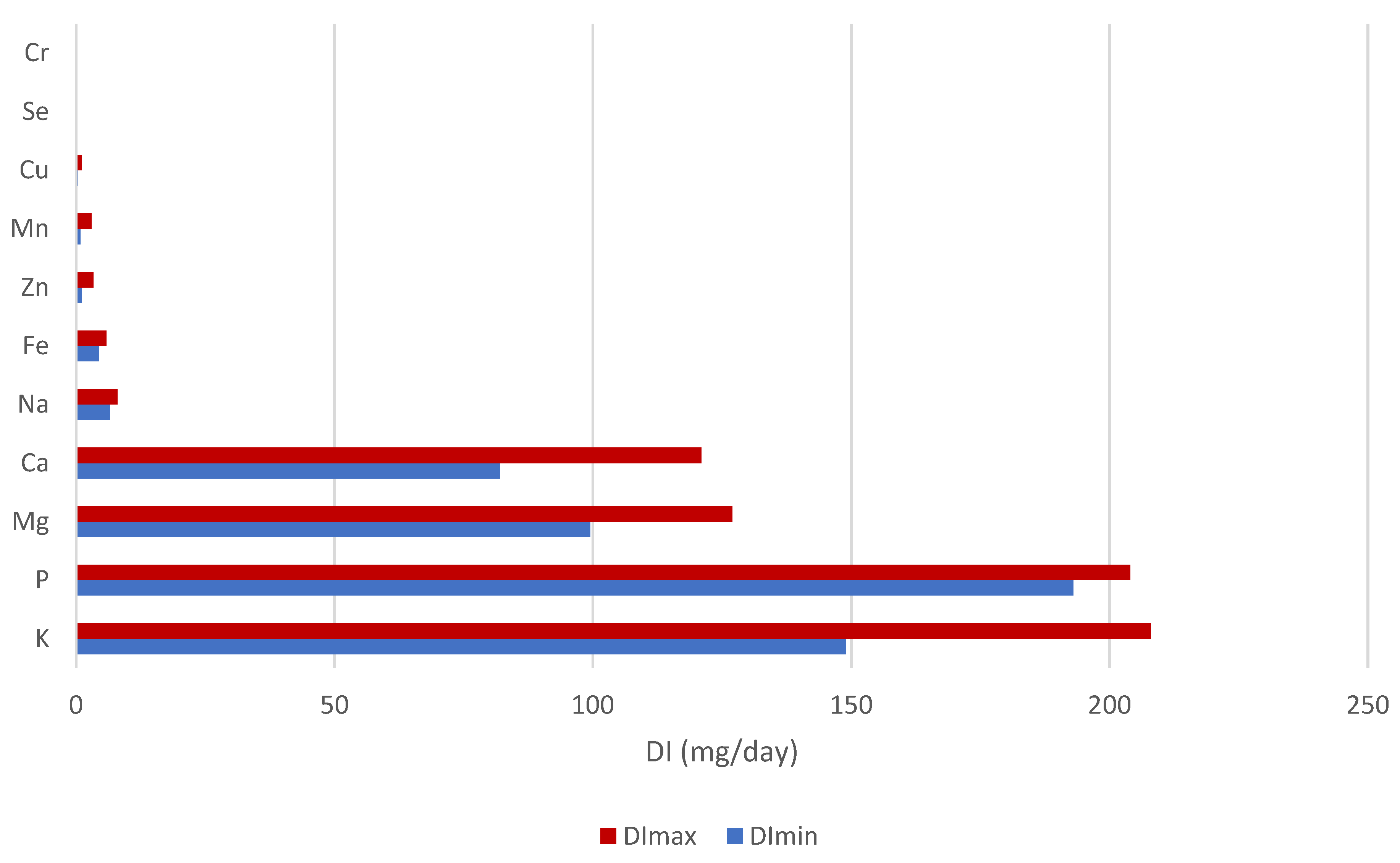
3.2. The Results of Daily Intake of Essential Minerals and Trace Elements
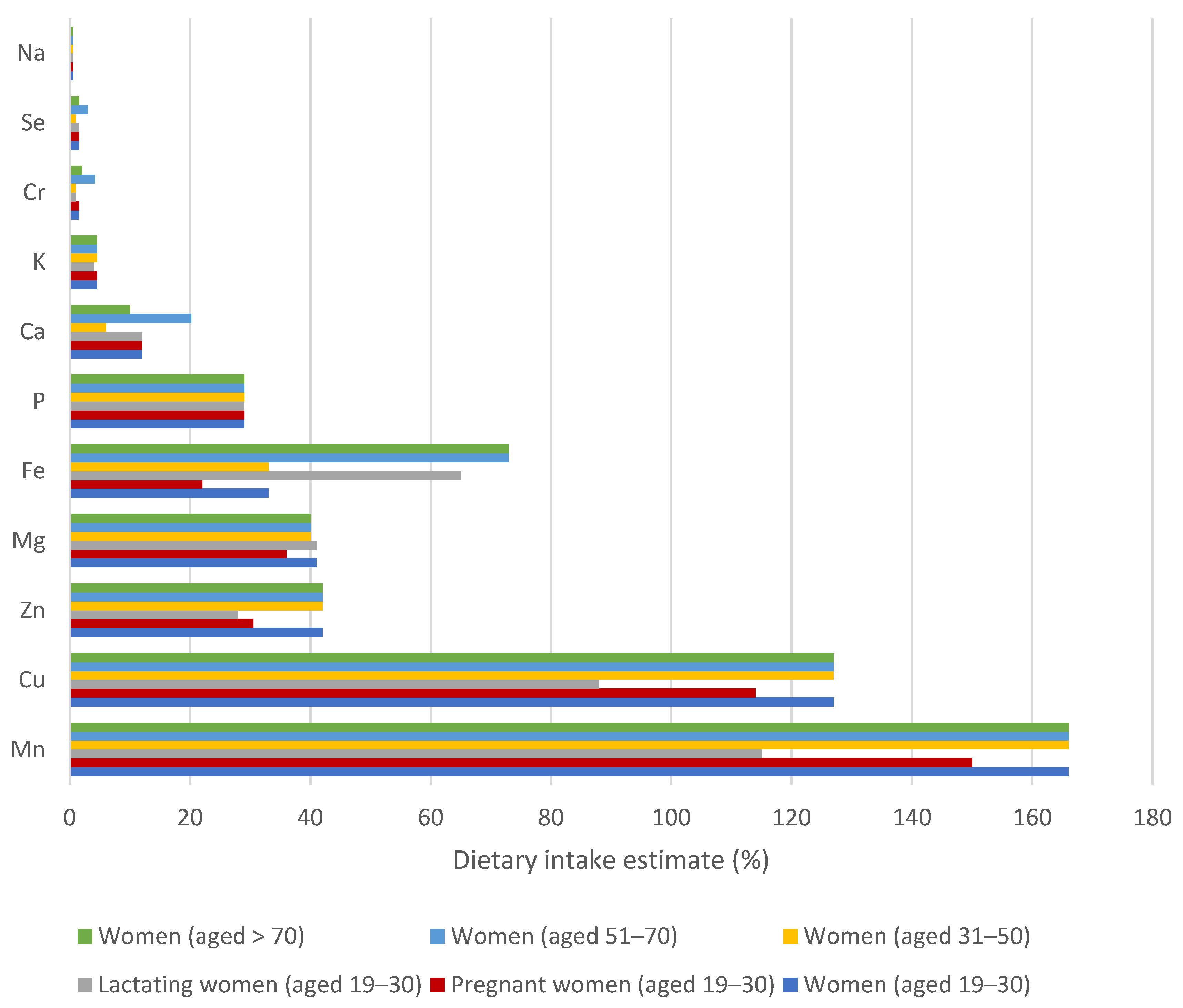
3.3. Evaluation of Dietary Intake Estimates to Reference Values for Essential Elements
3.4. The Results of Dietary Exposures and Dietary Intake Estimates to Toxic Trace Elements
3.5. Results of the Evaluation of the Metal Pollution Index
4. Conclusions
5. Patents
Supplementary Materials
Author Contributions
Funding
Institutional Review Board Statement
Informed Consent Statement
Data Availability Statement
Conflicts of Interest
References
- McLean, E.; Cogswell, M.; Egli, I.; Wojdyla, D.; de Benoist, B. Worldwide prevalence of anemia. WHO vitamin and mineral nutrition information system, 1993–2005. Public Health Nutr. 2009, 12, 444–454. [Google Scholar] [CrossRef] [PubMed]
- Razzaque, M.S.; Wimalawansa, S.J. Minerals and human health: From deficiency to toxicity. Nutrients 2025, 17, 454. [Google Scholar] [CrossRef] [PubMed]
- Affonfere, M.; Chadare, F.J.; Fassinou, F.T.K.; Linnemann, A.R.; Duodu, K.G. In-vitro digestibility methods and factors affecting minerals bioavailability: A review. Food Rev. Int. 2023, 39, 1014–1042. [Google Scholar] [CrossRef]
- Waldmann, A.; Koschizke, J.W.; Leitzmann, C.; Hahn, A. Dietary iron intake and iron status of German female vegans: Results of the German vegan study. Ann. Nutr. Metab. 2004, 48, 103–108. [Google Scholar] [CrossRef]
- Clark, S.F. Iron deficiency anemia. Nutr. Clin. Pract. 2008, 23, 128–141. [Google Scholar] [CrossRef]
- Stevens, G.A.; Beal, T.; Mbuya, M.N.N.; Luo, H.; Neufeld, L.M. Micronutrient deficiencies among preschool-aged children and women of reproductive age worldwide: A pooled analysis of individual-level data from population-representative surveys. Lancet Glob. Health 2022, 10, e1590–e1599. [Google Scholar] [CrossRef]
- Skrajnowska, D.; Bobrowska-Korczak, B. Role of zinc in immune system and anti-cancer defence mechanisms. Nutrients 2019, 11, 2273. [Google Scholar] [CrossRef]
- Kiewlitz, J.; Rybicka, I. Minerals and their bioavailability in relation to dietary fiber, phytates and tannins from gluten and gluten-free flakes. Food Chem. 2020, 305, 125452. [Google Scholar] [CrossRef]
- Bailey, R.L.; Dodd, K.W.; Goldman, J.A.; Gahche, J.J.; Dwyer, J.T.; Moshfegh, A.J. Estimation of total usual calcium and vitamin D intakes in the United States. J. Nutr. 2010, 140, 817–822. [Google Scholar] [CrossRef]
- Kostov, K.; Halacheva, L. Role of magnesium deficiency in promoting atherosclerosis, endothelial dysfunction, and arterial stiff-ening as risk factors for hypertension. Int. J. Mol. Sci. 2018, 19, 1724. [Google Scholar] [CrossRef]
- Grzeszczuk, M.; Stefaniak, A.; Meller, E.; Wysocka, G. Mineral composition of some edible flowers. J. Elem. 2018, 23, 151–162. [Google Scholar] [CrossRef]
- Gu, S.Y.; Shin, H.C.; Kim, D.J.; Park, S.U.; Kim, Y.K. The content and health risk assessment of micro and toxic elements in cereals (oat and quinoa), legumes (lentil and chick pea), and seeds (chia, hemp, and flax). J. Food Compos. Anal. 2021, 99, 103881. [Google Scholar] [CrossRef]
- Kumari, P.; Bhargava, B. Phytochemicals from edible flowers: Opening a new arena for healthy lifestyle. J. Funct. Foods 2021, 78, 104375. [Google Scholar] [CrossRef]
- Gibney, M.J.; Barr, S.I.; Bellisle, F.; Drewnowski, A.; Fagt, S.; Livingstone, B.; Masset, G.; Moreiras, G.V.; Moreno, L.A.; Smith, J.; et al. Breakfast in human nutrition: The international breakfast research initiative. Nutrients 2018, 10, 559. [Google Scholar] [CrossRef] [PubMed]
- Shao, Y.; Hu, Z.; Yu, Y.; Mou, R.; Zhu, Z.; Beta, T. Phenolic acids, anthocyanins, proanthocyanidins, antioxidant activity, minerals and their correlations in non-pigmented, red, and black rice. Food Chem. 2018, 239, 733–741. [Google Scholar] [CrossRef] [PubMed]
- Salami, S.O.; Afolayan, A.J. Evaluation of nutritional and elemental compositions of green and red cultivars of roselle: Hibiscus sabdariffa L. Sci. Rep. 2021, 11, 1030. [Google Scholar] [CrossRef]
- Pirzadah, T.B.; Malik, B. Pseudocereals as super foods of 21st century: Recent technological interventions. J. Agric. Food Res. 2020, 2, 100052. [Google Scholar] [CrossRef]
- Mrázková, M.; Sumczynski, D.; Orsavová, J. Influence of storage conditions on stability of phenolic compounds and antioxidant activity values in nutraceutical mixtures with edible flowers as new dietary supplements. Antioxidants 2023, 12, 962. [Google Scholar] [CrossRef]
- Koubová, E.; Sumczynski, D.; Šenkárová, L.; Orsavová, J.; Fišera, M. Dietary intakes of minerals, essential and toxic trace elements for adults from Eragrostis tef L.: A nutritional assessment. Nutrients 2018, 10, 479. [Google Scholar] [CrossRef]
- Sumczynski, D.; Koubová, E.; Šenkárová, L.; Orsavová, J. Rice flakes produced from commercial wild rice: Chemical compositions, vitamin B compounds, mineral and trace element contents and their dietary intake evaluation. Food Chem. 2018, 264, 386–392. [Google Scholar] [CrossRef]
- Ragaee, S.; Abdel-Aal, E.S.M.; Noaman, M. Antioxidant activity and nutrient composition of selected cereals for food use. Food Chem. 2006, 98, 32–38. [Google Scholar] [CrossRef]
- Alonso-Esteban, J.I.; Torija-Isasa, M.E.; de Cortes Sánchez-Mata, M. Mineral elements and related antinutrients, in whole and hulled hemp (Cannabis sativa L.) seeds. J. Food Compos. Anal. 2022, 109, 104516. [Google Scholar] [CrossRef]
- O’Neil, C.E.; Nicklas, T.A.; Fulgoni III, V.L. Almond consumption is associated with better nutrient intake, nutrient adequacy, and diet quality in adults: National Health and Nutrition Examination Survey 2001–2010. Food Nutr. Sci. 2016, 7, 504. [Google Scholar] [CrossRef]
- Commission Regulation (EU) 2023/915 of April 2023 on Maximum Levels for Certain Contaminants in Food and Repealing Regulation (EC) No 1881/2006. Available online: https://eur-lex.europa.eu/legal-content/EN/TXT/PDF/?uri=CELEX:32023R0915&qid=1733134182119 (accessed on 25 October 2024).
- Mokhtar, S.M.; Swailam, H.M.; Embaby, H.E.S. Physicochemical properties, nutritional value and techno-functional properties of goldenberry (Physalis peruviana) waste powder concise title: Composition of goldenberry juice waste. Food Chem. 2018, 248, 1–7. [Google Scholar] [CrossRef]
- Pereira, C.C.; da Silva, E.D.N.; de Souza, A.O.; Vieira, M.A.; Ribeiro, A.S.; Cadore, S. Evaluation of the bioaccessibility of minerals from blackberries, raspberries, blueberries and strawberries. J. Food Compos. Anal. 2018, 68, 73–78. [Google Scholar] [CrossRef]
- Smanalieva, J.; Iskakova, J.; Oskonbaeva, Z.; Wichern, F.; Darr, D. Investigation of nutritional characteristics and free radical scavenging activity of wild apple, pear, rosehip, and barberry from the walnut-fruit forests of Kyrgyzstan. Europ. Food Res. Technol. 2020, 246, 1095–1104. [Google Scholar] [CrossRef]
- Rebellato, A.P.; Silva, J.G.S.; de Paiva, E.L.; Arisseto-Bragotto, A.P.; Pallone, J.A.L. Aluminium in infant foods: Toxicology, total content, and bioaccessibility. Curr. Opin. Food Sci. 2021, 41, 130–137. [Google Scholar] [CrossRef]
- Ruan, Y.; Fang, X.; Guo, T.; Liu, Y.; Hu, Y.; Wang, X.; Hu, Y.; Gao, L.; Li, Y.; Pi, J.; et al. Metabolic reprogramming in the arsenic carcinogenesis. Ecotoxicol. Environ. Saf. 2022, 229, 113098. [Google Scholar] [CrossRef] [PubMed]
- Wang, X.; Cui, W.; Wang, M.; Liang, Y.; Zhu, G.; Jin, T.; Chen, X. The association between life-time dietary cadmium intake from rice and chronic kidney disease. Ecotoxicol. Environ. Saf. 2021, 211, 111933. [Google Scholar] [CrossRef] [PubMed]
- Regulation No. 18. Regulation for Cereal and Cereal Products, Pasta and Bakery Products; Ministry of Agriculture: Prague, Czech Republic, 2020.
- Institute of Medicine. Dietary Reference Intakes for Calcium, Phosphorus, Magnesium, Vitamin D, and Fluoride; The National Academy Press: Washington, DC, USA, 1997. [Google Scholar]
- Institute of Medicine. Dietary Reference Intakes for Vitamin C, Vitamin E, Selenium, and Carotenoids; The National Academy Press: Washington, DC, USA, 2000. [Google Scholar]
- Institute of Medicine. Dietary Reference Intakes for Vitamin A, Vitamin K, Arsenic, Boron, Chromium, Copper, Iodine, Iron, Manganese, Molybdenum, Nickel, Silicon, Vanadium, and Zinc; The National Academy Press: Washington, DC, USA, 2001. [Google Scholar]
- Institute of Medicine. Dietary Reference Intakes for Water, Potassium, Sodium, Chloride, and Sulfate; The National Academy Press: Washington, DC, USA, 2005. [Google Scholar]
- Kumar, D.; Priyanka; Shukla, V.; Kumar, S.; Ram, R.B.; Kumar, N. Metal pollution index and daily dietary intake of metals through consumption of vegetables. Int. J. Environ. Sci. Technol. 2020, 17, 3271–3278. [Google Scholar] [CrossRef]
- Joint FAO/WHO Expert Committee on Food Additives. Evaluation of Certain Contaminants: Sixty-Fourth Report of the Joint FAO/WHO Expert Committee on Food Additives; WHO Technical Report Series No. 930; WHO Press: Geneva, Switzerland, 2006. [Google Scholar]
- Joint FAO/WHO Expert Committee on Food Additives. Evaluation of Certain Contaminants in Food: Seventy-Second Report of the Joint FAO/WHO Expert Committee on Food Additives; WHO Technical Report Series No. 959; WHO Press: Geneva, Switzerland, 2011. [Google Scholar]
- Joint FAO/WHO Expert Committee on Food Additives. Evaluation of Certain Food Additives and Contaminants: Seventy-Fourth Report of the Joint FAO/WHO Expert Committee on Food Additives; WHO Technical Report Series No. 966; WHO Press: Geneva, Switzerland, 2011. [Google Scholar]
- Joint FAO/WHO Expert Committee on Food Additives. Evaluation of Certain Food Additives and Contaminants: Seventy-Seventh Report of the Joint FAO/WHO Expert Committee on Food Additives; WHO Technical Report Series No. 983; WHO Press: Geneva, Switzerland, 2013. [Google Scholar]
- European Food Safety Authority. Scientific Opinion. Update of the risk assessment of nickel in food and drinking water. EFSA J. 2020, 18, 6268. [Google Scholar]
- Tran, N.L.; Barraj, L.M.; Scrafford, C.; Bi, X.; Troxell, T. Partitioning of dietary metal intake-A metal dietary exposure screening tool. Risk Anal. 2015, 35, 872–881. [Google Scholar] [CrossRef] [PubMed]
- U.S. Environmental Protection Agency; Integrated Risk Information System (IRIS). Silver; CASRN 7440-22-4; U.S. Environmental Protection Agency: Washington, DC, USA. Available online: https://iris.epa.gov/static/pdfs/0099_summary.pdf (accessed on 12 March 2025).
- European Food Safety Authority. Scientific Report of EFSA. Lead dietary exposure in the European population. EFSA J. 2012, 10, 2831. [Google Scholar]
- Available online: https://efsa.onlinelibrary.wiley.com/doi/epdf/10.2903/j.efsa.2012.2831 (accessed on 9 February 2025).
- Mirecki, N.; Agič, R.; Sunić, L.; Milenković, L.; Ilić, Z.S. Transfer factor as indicator of heavy metals content in plants. Fresenius Environ. Bull. 2015, 24, 4212–4219. [Google Scholar]
- Bohn, L.; Meyer, A.S.; Rasmussen, S.K. Phytate: Impact on environment and human nutrition. A challenge for molecular breeding. J. Zhejiang Univ. Sci. B 2008, 9, 165–191. [Google Scholar] [CrossRef]
- Maldonado-Alvarado, P.; Pavón-Vargas, D.J.; Abarca-Robles, J.; Valencia-Chamorro, S.; Haros, C.M. Effect of germination on the nutritional properties, phytic acid content, and phytase activity of quinoa (Chenopodium quinoa Willd). Foods 2023, 12, 389. [Google Scholar] [CrossRef]
- Alvarez-Jubete, L.; Arendt, E.K.; Gallagher, E. Nutritive value and chemical composition of pseudocereals as gluten-free ingredients. Int. J. Food Sci. Nutr. 2009, 60 (Suppl. 4), 240–257. [Google Scholar] [CrossRef]
- Babaahmadifooladi, M.; Jacxsens, L.; Van de Wiele, T.; da Silva Júnior, E.C.; Du Laing, G. Assessment of bioaccessible and dialyzable fractions of nickel in food products and their impact on the chronic exposure of Belgian population to nickel. Food Chem. 2021, 342, 128210. [Google Scholar] [CrossRef]
- Kabata-Pendias, A. Trace Elements in Soils and Plants, 4th ed.; CRC Press Taylor & Francis Group: New York, NY, USA, 2011; pp. 1–153. ISBN 978-1-4200-9368-1. [Google Scholar]
- European Food Safety Authority. Technical Report. Dietary reference values for nutrients. Summary report. Update: 4 September 2019. EFSA Support. Publ. 2017, 14, e15121. [Google Scholar] [CrossRef]
- European Food Safety Authority. Scientific Opinion. Scientific opinion on dietary reference values for iron. EFSA Panel on Dietetic Products, Nutrition and Allergies (NDA). EFSA J. 2015, 13, 4254. [Google Scholar]
- European Food Safety Authority. Scientific Opinion. Scientific opinion on dietary reference values for manganese. EFSA Panel on Dietetic products, Nutrition and Allergies (NDA). EFSA J. 2013, 11, 3419. [Google Scholar]
- European Food Safety Authority. Scientific Opinion. Scientific opinion on dietary reference values for copper. EFSA Panel on Dietetic products, Nutrition and Allergies (NDA). EFSA J. 2015, 13, 4253. [Google Scholar]
- European Food Safety Authority. Scientific Opinion. Re-evaluation of the existing health-based guidance values for copper and exposure assessment from all sources. EFSA J. 2023, 21, 7728. [Google Scholar]
- European Food Safety Authority. Scientific Opinion. Scientific opinion on dietary reference values for selenium. EFSA Panel on Dietetic products, Nutrition and Allergies (NDA). EFSA J. 2014, 12, 3846. [Google Scholar]
- European Food Safety Authority. Scientific Opinion. Scientific opinion on dietary reference values for chromium. EFSA Panel on Dietetic products, Nutrition and Allergies (NDA). EFSA J. 2014, 12, 3845. [Google Scholar]
- Sumczynski, D.; Fišera, M.; Salek, R.N.; Orsavová, J. The effect of flake production and in vitro digestion on releasing minerals and trace elements from wheat flakes: The extended study of dietary intakes for individual life stage groups. Nutrients 2023, 15, 2509. [Google Scholar] [CrossRef]
- European Food Safety Authority. Scientific Opinion. Scientific opinion in dietary reference values for zinc. EFSA Panel on Dietetic products, Nutrition and Allergies (NDA). EFSA J. 2014, 12, 3844. [Google Scholar]
- European Food Safety Authority. Scientific Opinion. Scientific opinion in dietary reference values for magnesium. EFSA Panel on Dietetic products, Nutrition and Allergies (NDA). EFSA J. 2015, 13, 4186. [Google Scholar]
- Regulation (EU) No 1169/2011 of the European Parliament and of the Council of 25 October 20011 on the Provision of Food Information to Consumers. Available online: https://eur-lex.europa.eu/legal-content/EN/TXT/PDF/?uri=CELEX:32011R1169&qid=1751879516200 (accessed on 12 January 2025).
- Regulation (EC) No 1924/2006 of the European Parliament and of the Council of 20 December 2006 on Nutritional and Health Claims Made on Foods. Available online: https://eur-lex.europa.eu/legal-content/EN/TXT/PDF/?uri=CELEX:02006R1924-20141213&qid=1751880341572 (accessed on 9 February 2025).
- Agency for Toxic Substances and Disease Registry. ATSDR’s Substance Priority List. 2022. Available online: https://www.atsdr.cdc.gov/programs/substance-priority-list.html (accessed on 12 January 2025).
- European Food Safety Authority. Safety of aluminium from dietary intake. Scientific Opinion of the Panel on Food Additives, Flavourings, Processing Aids and Food Contact Materials (AFC). EFSA J. 2008, 6, 754. [Google Scholar] [CrossRef]
- Nekvapil, J.; Vilišová, K.; Petřík, Z.; Yalcin, E.; Fišera, M.; Gál, R.; Salek, R.N.; Mrázková, M.; Bučková, M.; Sumczynski, D. The ICP-MS study on the release of toxic trace elements from the non-cereal flour matrixes after in vitro digestion and metal pollution index evaluation. Foods 2025, 14, 1350. [Google Scholar] [CrossRef]
- European Food Safety Authority. Scientific Opinion. Scientific opinion on the risk for public health related to the presence of mercury and methylmercury in food. EFSA Panel on Contaminants in the Food Chain (CONTAM). EFSA J. 2012, 10, 2985. [Google Scholar]
- European Food Safety Authority. Scientific Report of EFSA. Cadmium dietary exposure in the European population. EFSA J. 2012, 10, 2551. [Google Scholar]
- International Agency for Research on Cancer. Nickel and Nickel Compounds in: Arsenic, Metals, Fibres, and Dusts. IARC Monographs on the Evaluation of Carcinogenic Risks to Humans. IARC Monographs Volume 100C; International Agency for Research on Cancer: Lyon, France, 2012; ISBN 978-92-832-1320-8. Available online: https://publications.iarc.fr/120 (accessed on 16 February 2025).
- European Food Safety Authority. Scientific Opinion. Scientific Opinion on the risks to public health related to the presence of nickel in food and drinking water. EFSA J. 2015, 13, 4002. [Google Scholar]
- European Food Safety Authority. Scientific Report of EFSA. Dietary exposure to inorganic arsenic in the European population. EFSA J. 2014, 12, 3597. [Google Scholar]
- Ikem, A.; Odumosu, P.O.; Udousoro, I. Elemental composition of cereal grains and the contribution to the dietary intake in the Nigerian population. J. Food Compos. Anal. 2023, 118, 105207. [Google Scholar] [CrossRef]
- European Medicines Agency. Committee for Human Medicinal Products. ICH Guideline Q3D (R1) on Elemental Impurities; European Medicines Agency: Amsterdam, The Netherlands, 2019; Available online: https://www.ema.europa.eu/en/documents/scientific-guideline/international-conference-harmonisation-technical-requirements-registration-pharmaceuticals-human-use-ich-q3d-elemental-impurities-step-5-revision-1_en.pdf (accessed on 16 March 2025).
- Krupińska, I. Aluminium drinking water treatment residuals and their toxic impact on human health. Molecules 2020, 25, 641. [Google Scholar] [CrossRef]
- Ebrahimi, M.; Ebrahimi, M.; Vergroesen, J.E.; Aschner, M.; Sillanpää, M. Environmental exposures to cadmium and lead as potential causes of eye diseases. J. Trace Elem. Med. Biol. 2023, 82, 127358. [Google Scholar] [CrossRef]
- Joint FAO/WHO Expert Committee on Food Additives. Evaluation of Certain Food Additives and Contaminants: Seventy-Third Report of the Joint FAO/WHO Expert Committee on Food Additives; WHO Technical Report Series No. 960; WHO Press: Geneva, Switzerland, 2011. [Google Scholar]
- Zhang, X.; Wang, Z.; Liu, L.; Zhan, N.; Quin, J.; Lu, X.; Cheng, M. Assessment of the risk from dietary lead exposure in China. J. Hazard. Mater. 2021, 418, 126134. [Google Scholar] [CrossRef]
- Mawari, G.; Kumar, N.; Sarkar, S.; Daga, M.K.; Singh, M.M.; Joshi, T.K.; Khan, N.A. Heavy metal accumulation in fruits and vegetables and human health risk assessment: Findings from Maharashtra, India. Environ. Health Insights 2022, 116, 11786302221119151. [Google Scholar] [CrossRef]
- Shivakumar, L.; Reddy, K.R.; Kalshetty, B.M. Heavy metal contaminations and health risk assessment from fruits and vegetables in Bangalore rural markets, Karnataka, India. Rasayan. J. Chem. 2020, 13, 2498–2507. [Google Scholar]



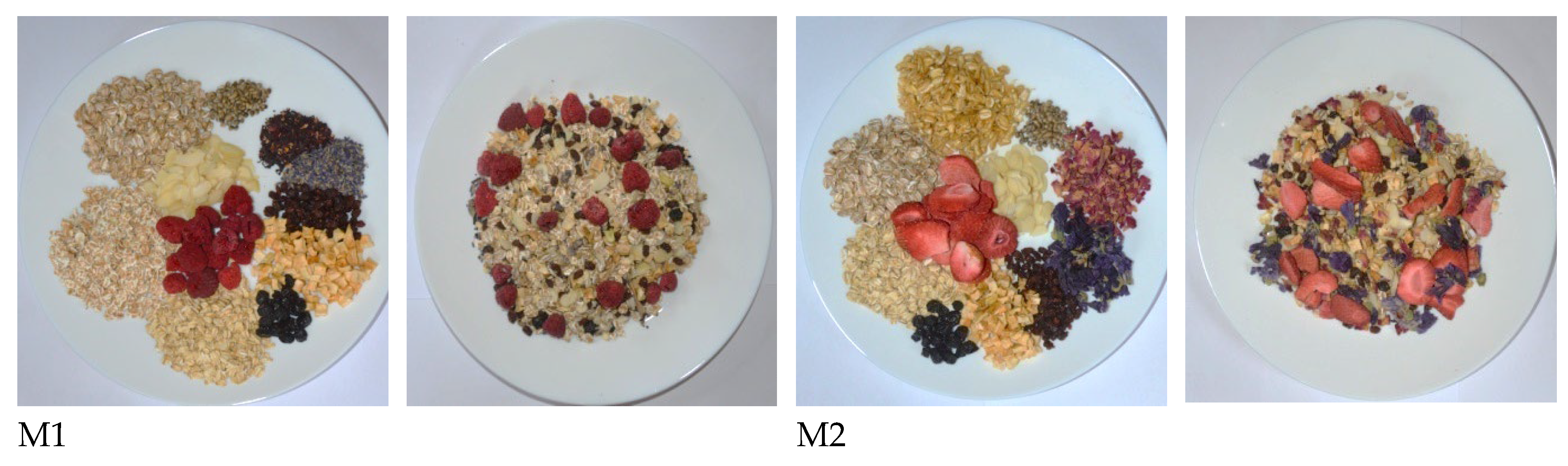
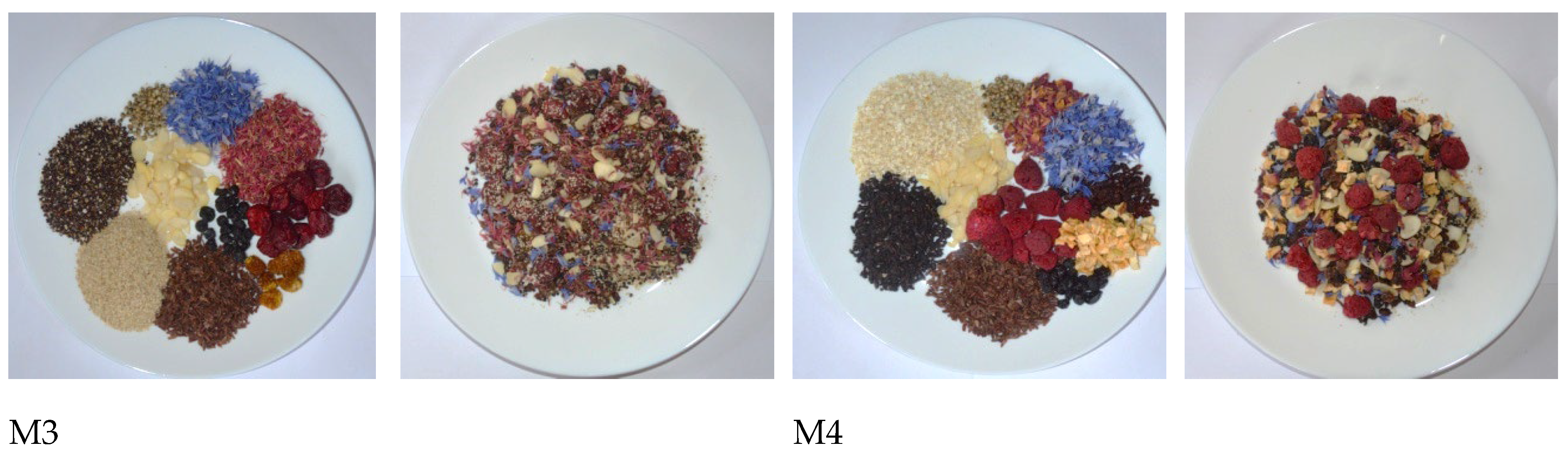
| Mixtures Containing Gluten | Gluten-Free Mixtures | ||||||
|---|---|---|---|---|---|---|---|
| M1 | g | M2 | g | M3 | g | M4 | g |
| oat flakes | 20 | oat flakes | 20 | red rice flakes | 20 | red rice flakes | 20 |
| red wheat flakes | 20 | rye flakes | 20 | white teff flakes | 20 | black rice flakes | 20 |
| rye flakes | 20 | kamut flakes | 20 | black quinoa flakes | 20 | white quinoa flakes | 20 |
| hemp | 2 | hemp | 2 | hemp | 2 | hemp | 2 |
| almond | 8 | almond | 8 | almond | 8 | almond | 8 |
| hibiscus | 2.5 | rose | 2 | red cornflower | 1.5 | rose | 1 |
| lavender | 0.5 | mallow | 1 | blue cornflower | 1.5 | blue cornflower | 2 |
| raspberries | 7 | barberries | 6 | barberries | 7 | raspberries | 7 |
| barberries | 6 | apples | 8 | blueberries | 7 | barberries | 6 |
| apples | 7 | blueberries | 8 | cherries | 7 | apples | 7 |
| blueberries | 7 | strawberries | 5 | goldenberries | 6 | blueberries | 7 |
| Analyte | M1 | M2 | M3 | M4 |
|---|---|---|---|---|
| (µg/g) | ||||
| 23Na | 130 ± 2 a | 137 ± 1 b | 160 ±8 c | 156 ± 7 d |
| 24Mg | 1990 ± 20 a | 2530 ± 25 b | 2290 ± 20 b | 2310 ± 20 c |
| 27Al | 10.8 ± 0.1 a | 12.1 ± 0.1 b | 5.41 ± 0.10 c | 7.72 ± 0.20 d |
| 31P | 3850 ± 20 a | 3950 ± 30 b | 4070 ± 20 c | 3970 ± 20 d |
| 39K | 2970 ± 20 a | 2970 ± 20 a | 4150 ± 30 b | 4050 ± 30 c |
| 40Ca | 1640 ± 20 a | 2420 ± 20 b | 2380 ± 20 c | 2340 ± 20 d |
| 55Mn | 17.4 ± 0.8 a | 17.8 ± 0.7 a | 19.1 ± 1.2 b | 59.7 ± 2.1 c |
| 57Fe | 111 ± 3 a | 117 ± 2 b | 96.4 ± 2.7 c | 87.5 ± 1.4 d |
| 63Cu | 7.04 ± 0.20 a | 6.21 ± 0.20 b | 22.8 ± 0.8 c | 6.21 ± 0.20 b |
| 66Zn | 24.7 ± 0.7 a | 66.9 ± 1.7 b | 37.7 ± 1.1 c | 21.5 ± 0.5 d |
| 137Ba | 3.61 ± 0.10 a | 4.40 ± 0.10 b | 3.84 ± 0.10 c | 4.20 ± 0.10 d |
| (ng/g) | ||||
| 7Li | 15.3 ± 0.3 a | 19.3 ± 0.8 b | 24.8 ± 0.8 c | 24.4 ± 0.7 d |
| 9Be | 12.3 ± 0.4 a | 11.6 ± 0.1 b | 3.84 ± 0.10 c | 6.82 ± 0.10 c |
| 48Ti | 451 ± 8 a | 330 ± 9 b | 460 ± 10 c | 421 ± 8 d |
| 52Cr | 2.11 ± 0.10 a | 8.22 ± 0.20 b | 4.82 ± 0.02 c | 5.61 ± 0.01 d |
| 59Co | 32.9 ± 1.2 a | 26.5 ± 0.8 b | 31.8 ± 1.1 c | 31.4 ± 0.8 c |
| 60Ni | 434 ± 5 a | 375 ± 3 b | 367 ± 5 c | 206 ± 2 d |
| 75As | 28.6 ± 0.7 a | 24.1 ± 1.1 b | 14.2 ± 0.5 c | 31.5 ± 1.2 d |
| 77Se | 7.81 ± 0.10 a | 9.60 ± 0.10 b | 16.3 ± 0.3 c | 17.6 ± 0.3 d |
| 88Sr | 258 ± 3 a | 480 ± 5 b | 389 ± 2 c | 288 ± 3 d |
| 107Ag | 15.4 ± 0.6 a | 12.1 ± 0.4 b | 31.4 ± 0.8 c | 14.2 ± 0.3 d |
| 111Cd | 12.0 ± 0.1 a | 12.4 ± 0.1 a | 15.5 ± 0.10 b | 11.1 ± 0.10 c |
| 118Sn | 1.12 ± 0.01 a | 0.64 ± 0.04 b | 0.52 ± 0.01 c | 0.84 ± 0.05 d |
| 133Cs | 25.6 ± 0.2 a | 23.2 ± 0.5 b | 38.9 ± 1.1 c | 22.8 ± 0.4 b |
| 140Ce | 16.3 ± 0.3 a | 18.4 ± 0.3 b | 44.6 ± 1.4 c | 43.8 ± 1.5 d |
| 165Ho | 0.80 ± 0.01 a | 2.12 ± 0.02 b | 1.00 ± 0.01 c | 0.95 ± 0.01 c |
| 181Ta | <0.01 | <0.01 | <0.01 | <0.01 |
| 202Hg | 15.1 ± 0.1 a | 14.3 ± 0.1 b | 17.6 ± 0.5 c | 14.7 ± 0.1 b |
| 205Tl | 1.80 ± 0.01 a | 2.22 ± 0.01 b | 1.22 ± 0.01 c | 2.20 ± 0.01 d |
| 208Pb | 12.6 ± 0.2 a | 14.1 ± 0.4 b | 31.6 ± 0.4 c | 28.4 ± 0.4 d |
| 238U | <0.01 | <0.01 | <0.01 | <0.01 |
| Analyte | DE60 (µg/kg bw/day) | DE80 (µg/kg bw/day) | DE100 (µg/kg bw/day) |
| Al | 10.1 | 7.56 | 6.05 |
| DE60 (ng/kg bw/day) | DE80 (ng/kg bw/day) | DE100 (ng/kg bw/day) | |
| Sn | 0.93 | 0.70 | 0.56 |
| Hg | 14.7 | 11.0 | 8.80 |
| Cd | 12.9 | 9.69 | 7.75 |
| Ni | 362 | 271 | 217 |
| As | 26.3 | 19.7 | 15.8 |
| Ag | 26.2 | 19.6 | 15.7 |
| Pb | 26.3 | 19.8 | 15.8 |
Disclaimer/Publisher’s Note: The statements, opinions and data contained in all publications are solely those of the individual author(s) and contributor(s) and not of MDPI and/or the editor(s). MDPI and/or the editor(s) disclaim responsibility for any injury to people or property resulting from any ideas, methods, instructions or products referred to in the content. |
© 2025 by the authors. Licensee MDPI, Basel, Switzerland. This article is an open access article distributed under the terms and conditions of the Creative Commons Attribution (CC BY) license (https://creativecommons.org/licenses/by/4.0/).
Share and Cite
Mrázková, M.; Sumczynski, D.; Šenkárová, L.; Salek, R.N. Dietary Intakes and Exposures to Minerals and Trace Elements from Cereal-Based Mixtures: Potential Health Benefits and Risks for Adults. Nutrients 2025, 17, 2848. https://doi.org/10.3390/nu17172848
Mrázková M, Sumczynski D, Šenkárová L, Salek RN. Dietary Intakes and Exposures to Minerals and Trace Elements from Cereal-Based Mixtures: Potential Health Benefits and Risks for Adults. Nutrients. 2025; 17(17):2848. https://doi.org/10.3390/nu17172848
Chicago/Turabian StyleMrázková, Martina, Daniela Sumczynski, Lenka Šenkárová, and Richardos Nikolaos Salek. 2025. "Dietary Intakes and Exposures to Minerals and Trace Elements from Cereal-Based Mixtures: Potential Health Benefits and Risks for Adults" Nutrients 17, no. 17: 2848. https://doi.org/10.3390/nu17172848
APA StyleMrázková, M., Sumczynski, D., Šenkárová, L., & Salek, R. N. (2025). Dietary Intakes and Exposures to Minerals and Trace Elements from Cereal-Based Mixtures: Potential Health Benefits and Risks for Adults. Nutrients, 17(17), 2848. https://doi.org/10.3390/nu17172848