Article

Application of UAV Devices to Assess Post-Drought Canopy Vigor in Two Pine Forests Showing Die-Off


Instituto Pirenaico de Ecología (IPE), Consejo Superior de Investigaciones Científicas (CSIC), Avda. Montañana 1005, 50059 Zaragoza, Spain
*
Author to whom correspondence should be addressed.
Remote Sens. 2026, 18(6), 916; https://doi.org/10.3390/rs18060916
Submission received: 28 January 2026 / Revised: 13 March 2026 / Accepted: 14 March 2026 / Published: 17 March 2026
(This article belongs to the Special Issue Vegetation Mapping through Multiscale Remote Sensing)

Highlights

What are the main findings?
  • High-resolution UAV data enabled accurate tree health assessment.
  • Combining vegetation indices with structural and topographic variables improved tree vigor classification.
What are the implications of the main findings?
  • A robust workflow allows integrating segmentation, classification, and model selection for effective forest die-off assessment.
  • Accounting for structural and topographic variables and their spatial components is key when evaluating vegetation vigor responses to drought.

Abstract

Rising temperatures and droughts are triggering forest die-off in climate warming hotspots such as the Mediterranean Basin. UAVs equipped with LiDAR and multispectral sensors offer a powerful tool for surveys of tree vigor at landscape level. We used UAV-acquired LiDAR data and multispectral camera imagery to segment individual tree crowns, classify species, and assess the health status in two drought-affected forests in northeastern Spain: a mixed Pinus pinasterQuercus ilex forest and a Pinus halepensis forest. Individual trees were segmented and classified using object-based image analysis with the Random Forest algorithm incorporating spectral, structural, and topographic variables. Greenness indices (NDVI and EVI) were analyzed in relation to crown height, topography (slope and elevation) and solar radiation, and their interactions. Analyses showed satisfactory crown segmentation (F-Score = 0.85–0.86) and species classification (Overall accuracy = 0.86–0.99), though distinguishing spectrally similar classes remained challenging. Taller P. pinaster trees exhibited higher NDVI, while taller P. halepensis displayed higher NDVI values in dense neighborhoods and on gentle slopes. These findings highlight the potential of high-resolution UAV-based remote sensing for effective near-real-time detection and attribution of forest die-off. Future research should aim to improve algorithm accuracy and better integrate field-based validation across different forest types.

1. Introduction

Increases in forest defoliation and mortality rates associated with forest die-off events have been reported worldwide over recent decades [1,2,3,4]. These abrupt losses of biomass, reductions in canopy cover and photosynthetic activity and increases in mortality rates have been primarily linked to enhanced drought stress driven by rising temperatures [4,5,6,7]. In turn, these processes can increase forest susceptibility to secondary stressors (e.g., pathogens) and reduce resilience to disturbances such as wildfires [8,9]. The progressive intensification of aridity associated with warming trends [10,11] has positioned the Mediterranean Basin as a global hotspot of forest die-off and mortality [12]. Consequently, the development of methods enabling near-real-time detection and attribution of forest die-off at local to landscape scales represents a critical frontier in forest monitoring and remote sensing research [1].
Canopy dieback includes an elevated loss of leaves (defoliation) and leaf reddening or browning, together with markedly reduced rates of primary and secondary growth. These are among the earliest indicators of drought stress in trees (early-warning signals) and can precede growth decline and high mortality rates [13,14]. Traditional forest health monitoring has relied primarily on field-based surveys, which require substantial investments of human and financial resources and cover only a limited fraction of the landscape [15,16]. In contrast, remote sensing technologies have emerged as an effective alternative approach for the rapid and accurate acquisition of data on a wide range of vegetation properties [17,18]. In this context, unmanned aerial vehicles (UAVs) are distinguished by their ability to acquire high-resolution imagery, relatively low operational costs, and flexibility in sensor deployment [19,20].
Commonly used sensors include LiDAR (Light Detection and Ranging) systems and multispectral or multiband optical cameras, among others such as hyperspectral sensors, which provide more detailed spectral information but require more complex data processing [21]. The LiDAR sensors enable the generation of three-dimensional (3D) point clouds, providing high-resolution information on canopy and terrain structure, through the measurement of multiple LiDAR signal returns [16]. Multispectral optical cameras allow the calculation of vegetation indices such as the Normalized Difference Vegetation Index (NDVI) [22,23] and the Enhanced Vegetation Index (EVI) [24], which are related to canopy cover and photosynthetic activity [25,26]. The derivation of these vegetation indices from high-spatial-resolution aerial imagery facilitates the early detection of drought stress signals, such as loss of greenness and canopy cover associated with photosynthetic apparatus degradation and crown defoliation [16,27].
The automatic classification of tree species using products derived from UAV-based LiDAR and multispectral cameras allow for a more detailed diagnosis and characterization of forest die-off events [28,29]. This process has been successfully implemented using machine learning algorithms, with Random Forest [30] being widely recognized for its efficiency in handling large datasets, robustness to outliers, and ability to operate without prior variable selection [31]. However, classification based on spectral data has limitations, as a single pixel may contain several species and multiple structural components of a tree (leaves, branches, trunk), complicating a homogeneous spectral characterization of each species [32]. Object-based image analysis (OBIA), which uses individual tree crowns, is often considered more appropriate as it segments pixels into tree crown objects using algorithms for individual tree detection (ITD) [32,33].
The canopy height model (CHM) is commonly used to model individual crown shapes in 3D, based on UAV-acquired LiDAR point clouds [34]. Several studies have indicated that the effectiveness of these ITD methods depends on the size or shape of the analysis window [35,36], the resolution [37], or the algorithm employed [38]. Other factors, such as tree species, crown morphology, or forest structure, also determine final accuracy [39].
Combining spectral with structural and topographic variables is essential for the accurate calibration of segmentation and classification methods, as they can enable a better discrimination of tree species and ultimately contribute to characterize forest die-off. Particularly, topographic variables (e.g., elevation, slope) play a crucial role in water availability during drought [40,41,42], especially in Mediterranean forests, where tree growth largely depends on soil water uptake in winter and spring [43,44,45]. For instance, higher-elevation areas often exhibit higher exposure and shallower soils, whereas lower-elevation, and/or concave areas tend to accumulate water and nutrients but are exposed to warmer conditions. Similarly, sun-exposed slopes receive higher levels of direct radiation and are warmer and drier due to increased soil and air moisture evaporation [27], while shaded slopes maintain higher air and soil moisture, organic matter content, and vegetation cover. In addition, steep terrain generates faster runoff compared to flat or rugged areas where water accumulates [46]. These topographic effects can lead to differential tree responses to drought in forest ecosystems with pronounced seasonal water deficit [47,48].
Intrinsic factors, such as tree height, can also influence tree performance to water shortage [49,50,51]. Taller trees may have greater access to deep water reserves due to extensive root systems, which could potentially help them better cope with dry periods [52,53,54,55]. However, the current paradigm holds that larger trees are hydraulically less efficient and therefore more vulnerable to drought-induced mortality [56,57,58,59]. Furthermore, higher canopy exposure increases evaporative demand, although this may be partially offset by more extensive and developed root systems allowing to update deeper water sources during the dry summer season [60,61].
In this study, we focus on two Mediterranean forests located in northeastern Spain: a mixed conifer-broadleaf forest in Miedes de Aragón and a conifer forest in Lanaja, where drought-driven forest die-off of maritime pine (Pinus pinaster Ait.) and Aleppo pine (P. halepensis L.), respectively, has been documented [13,14,62]. The primary aim of this work is to characterize the effects of water deficit on the vigour of P. pinaster and P. halepensis using vegetation indices (NDVI and EVI) derived from remote sensing, and to assess how these responses are influenced by structural traits (tree height) and topographic variables (elevation and slope which influence potential solar radiation) derived from UAV flights.
The specific objectives were to: (i) detect individual trees using UAV-acquired LiDAR data at both sites; (ii) classify the health status of P. pinaster in Miedes de Aragón and P. halepensis in Lanaja; and (iii) analyse the response of tree cover to canopy dieback, crown height, and topography. We hypothesized that: (i) taller pine trees would exhibit lower vigor and higher rates of defoliation and mortality compared to shorter conspecific individuals; and (ii) pine individuals located in topographically unfavourable areas (e.g., sites with higher elevation, steeper slopes and higher solar radiation) will exhibit higher levels of die-off and mortality, as reflected by lower NDVI and EVI values.

2. Materials and Methods

2.1. Study Sites and Tree Species

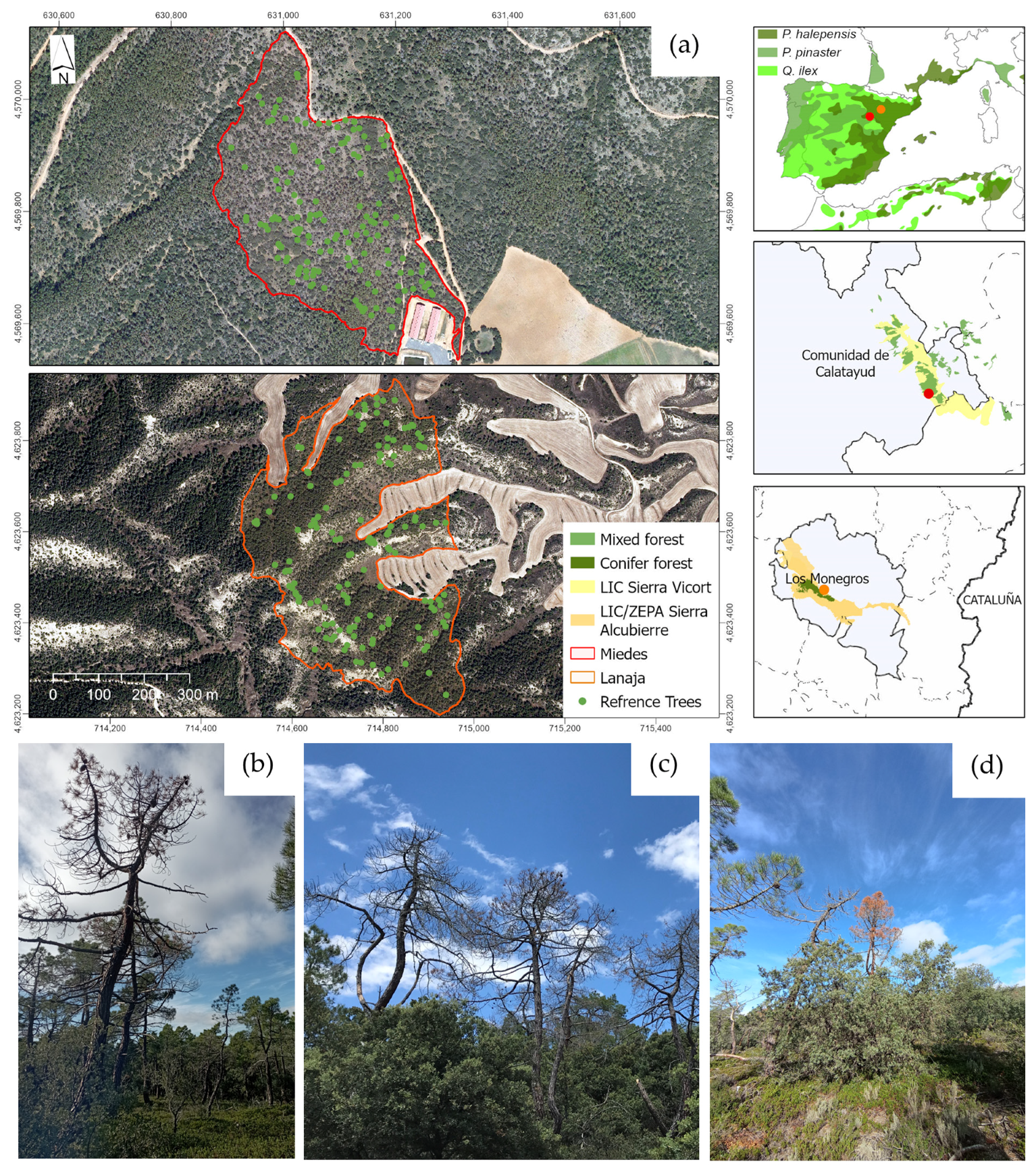
This study was conducted at two sites located in Aragón, north-eastern Spain, and showing ongoing forest decline characterized by elevated mortality and decline rates [13,62,63]. The two sites are subjected to continental Mediterranean climatic conditions but show different temperature and precipitation values and contrasting topography (elevation, slope and aspect) (Figure 1). The Miedes de Aragón site (41°16′13″N, 1°26′9″W) is located in the Iberian System range. It is a mixed forest dominated by maritime pine (Pinus pinaster Ait.) and the sclerophyllous broadleaf holm oak (Quercus ilex L. subsp. rotundifolia), with both species being widely distributed across the western Mediterranean Basin [64]. The understory is dominated by shrub species such as Juniperus communis L., Cistus laurifolius L., and Arctostaphylos uva-ursi L. It is characterized by acidic, stony, shallow soils (20–50 cm depth) with a sandy loam texture developed over quartzite substrates [65]. Elevation ranges between 940 and 1000 m.a.s.l., with generally gentle slopes, mostly below 15°. The Lanaja site (41°41′29″N, 0°21′55″W) is located in the Monegros steppe of the Middle Ebro Basin. It is dominated by Aleppo pine (Pinus halepensis Mill.), and the understory is formed by several shrub species including Quercus coccifera L., Juniperus phoenicea L., Rhamnus alaternus L., Rhamnus lycioides L., and Pistacia lentiscus L [66,67]. It is characterized by basic soils formed over marls and gypsum, lower elevations (540–640 m a.s.l.), and steeper slopes ranging from 0 to 35° compared to the Miedes de Aragón site. Both sites are located on former agricultural lands that were reforested during the 20th and 21st centuries to protect soils and restore degraded areas [64].
Both study sites have similar climatic conditions, characterized by cold winters, dry summers, and relatively wet conditions during spring and autumn. According to data from nearby meteorological stations (Daroca and Lanaja stations; 41°06′51.8″N, 1°24′38.2″W, 779 m a.s.l.; and 41°47′11″N, 0°20′16″W, 360 m a.s.l., respectively), mean annual precipitation ranges from 400 mm at the Miedes de Aragón site to 368 mm at the Lanaja site. Mean annual air temperature ranges from 13.0 °C at the Miedes de Aragón site to 13.7 °C at the Lanaja site. The period of water deficit extends from July to September at the Miedes de Aragón site and from May to September at the Lanaja site, with minimum values occurring in July and August.
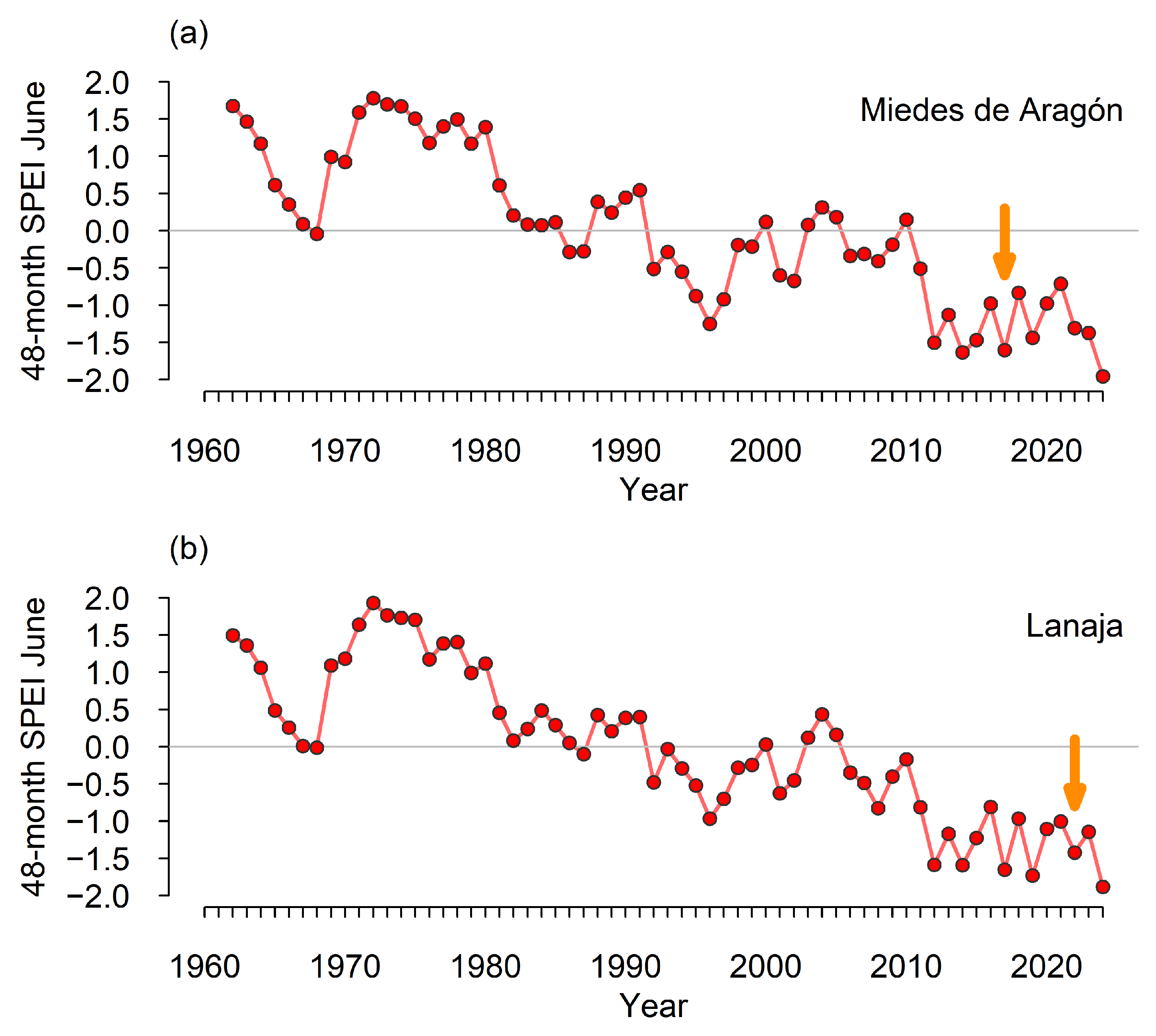
Additionally, the variability in drought intensity through time was assessed using the Standardized Precipitation–Evapotranspiration Index (SPEI) [68] for June at a 48-month temporal scale and a spatial resolution of 4 km, covering the period from 1960 to 2024 (Figure 2). SPEI values were calculated from precipitation and precipitation–evapotranspiration (PET) data obtained from the TerraClimate dataset (https://www.climatologylab.org/terraclimate.html; accessed on 13 March 2026) using the TerraclimateR package v.0.1.0 [69]. Negative SPEI values indicate drought conditions, whereas positive values reflect humid conditions.

2.2. Data Acquisition and Variables Generation

2.2.1. Field Assessment of Tree Vigor

In previous field studies, defoliation and mortality rates were quantified in both sites and nearby locations [13,14,62]. In Miedes de Aragón, defoliation was monitored from 2020 to 2024 after the severe 2017 drought in 30 mature, individually tagged pines, since Q. ilex showed no defoliation [14]. Defoliation was visually assessed by three observers in late summer to avoid bias, and then the mean value for each tree was calculated. We used crown defoliation as a proxy of tree vigour and measured it in classes of 5% following the European ICP-Forest network methodology [70,71]. In Lanaja, defoliation was assessed during field sampling in 2025 also considering 20 randomly selected mature pines.
The mean June SPEI values revealed a severe 2017 drought at Miedes de Aragón (Figure 2a) which caused high mortality and die-off rates in P. pinaster reported by [14]. Subsequent drought events likely contributed to the increase in defoliation (from 34.3 ± 25.9% to 53.8 ± 34.8%) and mortality rates (from 0 to 20% in target trees) observed over the monitoring period. At Lanaja, the 2022 drought, followed by successive dry conditions with the lowest SPEI values recorded in 2024 at both sites, contributed to the defoliation rates observed in P. halepensis (24.3 ± 23.82% to 76.92 ± 19.72% in non-defoliated and defoliated trees, respectively; Figure 2b).

2.2.2. Drone Data Acquisition

The UAV platform used to conduct data acquisitions was a DJI Matrice 300 RTK (SZ DJI Technology Co., Ltd., Shenzhen, China). In this UAV two sensors were mounted in subsequent flights: The Zenmuse L1 Lidar sensor and the Micasense Altum multispectral camera (SZ DJI Technology Co., Ltd., Shenzhen, China).
Based on the previous field dataset from Miedes de Aragón, an initial drone flight was conducted over approximately 13 ha in November 2023, following the summer drought period. Subsequently, a second flight was carried out in Lanaja in December 2024, covering 21 ha. For mission planning (to set UAV with following terrain option), a Digital Terrain Model (DTM) with a spatial resolution of 5 m was downloaded from the National Geographic Institute and used to configure flight parameters and plan the flight path (Table 1). Meteorological conditions, including wind speed and direction, cloud cover, precipitation probability, and solar incidence angle, were taken into account before conducting the flight to guarantee good quality of data acquisition (no cloud cover and low wind speeds [72]). All flights were conducted around local midday to ensure optimal data acquisition conditions.
The LiDAR data acquired during the flights achieved sub-meter positioning accuracy, thanks to the UAV’s GPS with real-time kinematic (RTK) corrections via a virtual connection to the ARAGEA geodetic network in Aragón using the Networked Transport of RTCM vía Internet Protocol (NTRIP). This setup functions like a high-precision GNSS receiver, yielding positioning errors below 2 cm horizontally and 5 cm vertically [72,73].

2.2.3. LiDAR Data Processing: Tree Canopy Height

LiDAR data acquired with the DJI Zenmuse L1 sensor were processed using DJI Terra software v4.3.0 [74]. Processing parameters were set for gentle slopes using default values. Trajectory computation and optimization were then performed to classify and filter surface returns of the final point cloud.
Using the classified 3D point cloud, Digital Elevation Models (DEMs) were generated in CloudCompare v2.14 [75]. The Digital Terrain Models (DTM) were derived by selecting ground-classified points. To ensure a continuous surface, elevation values were interpolated using inverse distance weighting (IDW) within a maximum search radius of 20 m, while values beyond this range were left un-interpolated to preserve accuracy.
The Digital Surface Models (DSMs) were generated using all classified points (ground and non-ground) but without interpolation. Additionally, RGB orthomosaics were also obtained from the point cloud. Tree crown height values were also obtained through a normalized distance calculation. This distance was directly computed by subtracting a TIN derived surface from the ground-classified to the raw point cloud including trees canopies. All products were exported as raster layers in the ETRS89/UTM Zone 30N coordinate reference system with a 0.5 m spatial resolution and used for subsequent spatial analysis.

2.2.4. RGB and Multispectral Image Processing

Multispectral images were processed in Pix4D software v.4.10.1 [76] to generate georeferenced orthomosaics of two vegetation indices, the Normalized Difference Vegetation Index (NDVI) and the Enhanced Vegetation Index (EVI), at the same spatial resolution as LiDAR-derived raster products (0.5 m). Automatic calibration based on reference panel images was applied during processing, and the resulting rasters were exported for subsequent spatial analysis.
The NDVI quantifies the normalized difference between near-infrared (ρnir) and red reflectances (ρred), following the formula [23]:
NDVI   =   ρ nir     ρ red ρ nir   +   ρ red
This index ranges from −1 to +1, with higher positive values indicating dense vegetation and low or negative values non-vegetated surfaces such as water bodies, bare soil, or artificial areas.
The Enhanced Vegetation Index (EVI) is designed to improve vegetation monitoring in areas with high biomass density and to minimize the influence of soil and atmospheric effects. It is calculated from near-infrared, red, and blue reflectances using the formula [24]:
EVI   =   G   × ρ nir     ρ red   ρ nir   +   ( C 1   ×   ρ red     C 2   ×   ρ blue )   +   L
where G is the gain factor, L is a soil adjustment factor, and C1 and C2 are coefficients used to correct aerosol scattering in the red band using the blue band. ρblue, ρred and ρnir represent reflectance at the blue (0.45–0.52 μm), red (0.6–0.7 μm) and near-infrared (NIR; 0.7–1.1 μm), wavelengths, respectively [77]. The coefficients adopted in the EVI algorithm are, L = 1, C1 = 6, C2 = 7.5, and G = 2.5 [25].
As the indices were acquired with a different sensor than the LiDAR data, georeferencing was performed in the software ArcGIS Pro v3.0.3 [78]. The RGB image from the LiDAR point cloud was used as a reference, and manual or virtual control points were identified in the multispectral orthomosaics to correct spatial misalignments caused by differences in the GPS positions between the LiDAR and multispectral sensors and obtaining a Root Mean Square (RMS) of approximately 0.6 m at both sites.

2.2.5. Crown Segmentation

Tree crowns were detected and delineated in R Studio software v. 2025.09.2+418 using the lidR package v. 4.2.3 [79] after evaluating several methods for individual tree detection and crown segmentation previously applied in other forest ecosystems [15,36,38,80].
Normalized height point clouds were used to generate the Canopy Height Models (CHMs) using the point-to-raster algorithm (p2r) within the rasterize_canopy function. Two spatial resolutions were tested (0.4 m and 0.5 m), and the final resolution for each site was selected based on the highest accuracy achieved: 0.4 m for Miedes de Aragón and 0.5 m for Lanaja. No smoothing filters were applied to preserve precise crown height estimates [16,81].
Prior to tree detection, different combinations of window size (ws) were also tested to optimize correspondence between field-observed forest structure and that detected by the canopy delineation algorithm. Individual tree detection and canopy heights were then obtained using a Local Maxima Filter implemented with the locate_trees function. Following previous studies [82], a minimum height threshold of 2.5 m were applied to exclude understory vegetation.
Individual tree segmentation was performed using the Dalponte2016 algorithm [83], which combines the CHM and canopy height layers to assign each tree its corresponding set of LiDAR points. The procedure was implemented with the segment_trees function, producing vector polygons for each tree crown. The concave parameter was used to produce more realistic crown delineation by minimizing polygon area while allowing edges at any angle [36].
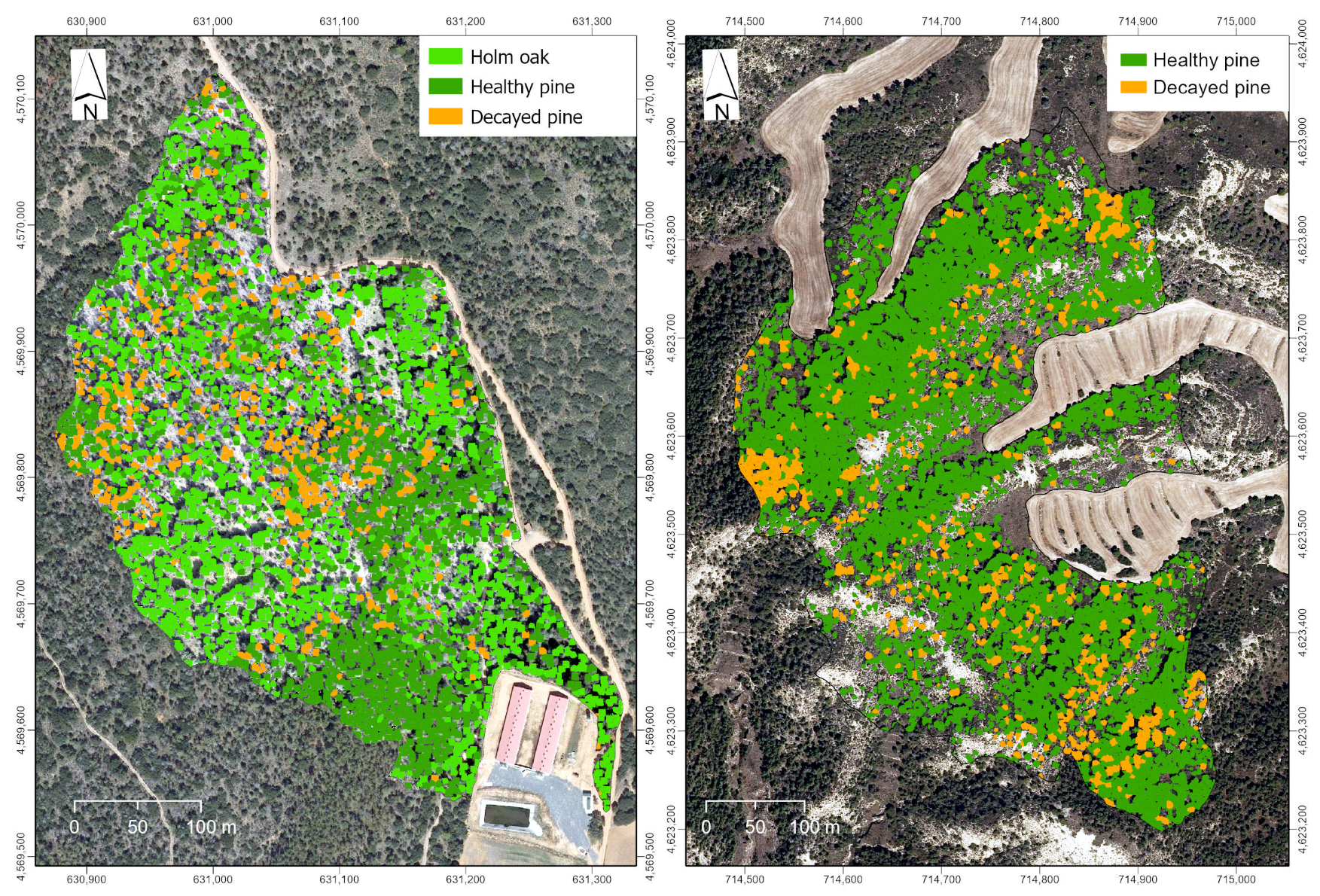
To validate and select the segmentation product, 146 crowns in Miedes de Aragón and 150 in Lanaja were manually digitized as reference trees using the RGB image in ArcGIS Pro. Reference trees were distinguished by species: P. pinaster and Q. ilex in Miedes de Aragón, and P. halepensis in Lanaja (Figure 1).
The accuracy of individual tree detection was quantitatively evaluated by comparing treetop points generated under different segmentation parameters (res and ws) with the reference tree layer [82]. The following validation metrics were calculated in ArcGIS Pro: True Positives (TP), reference crowns containing exactly one detected crown; False Negatives (FN), reference crowns containing no detected crown; and False Positives (FP), reference crowns containing more than one detected crown. Based on these values, recall (r), precision (p), and F-score were computed as follows (Equations (3)–(5)):
r   =   TP TP   +   FN
p = TP TP + FP  
F = 2 rp   r + p  
where r measures the proportion of reference trees correctly detected, p represents the accuracy of detected trees (precision), and F is the harmonic mean of r and p, representing overall detection accuracy. All metrics range from 0 to 1, with 1 indicating perfect detection [16].

2.2.6. Topographic Data Processing

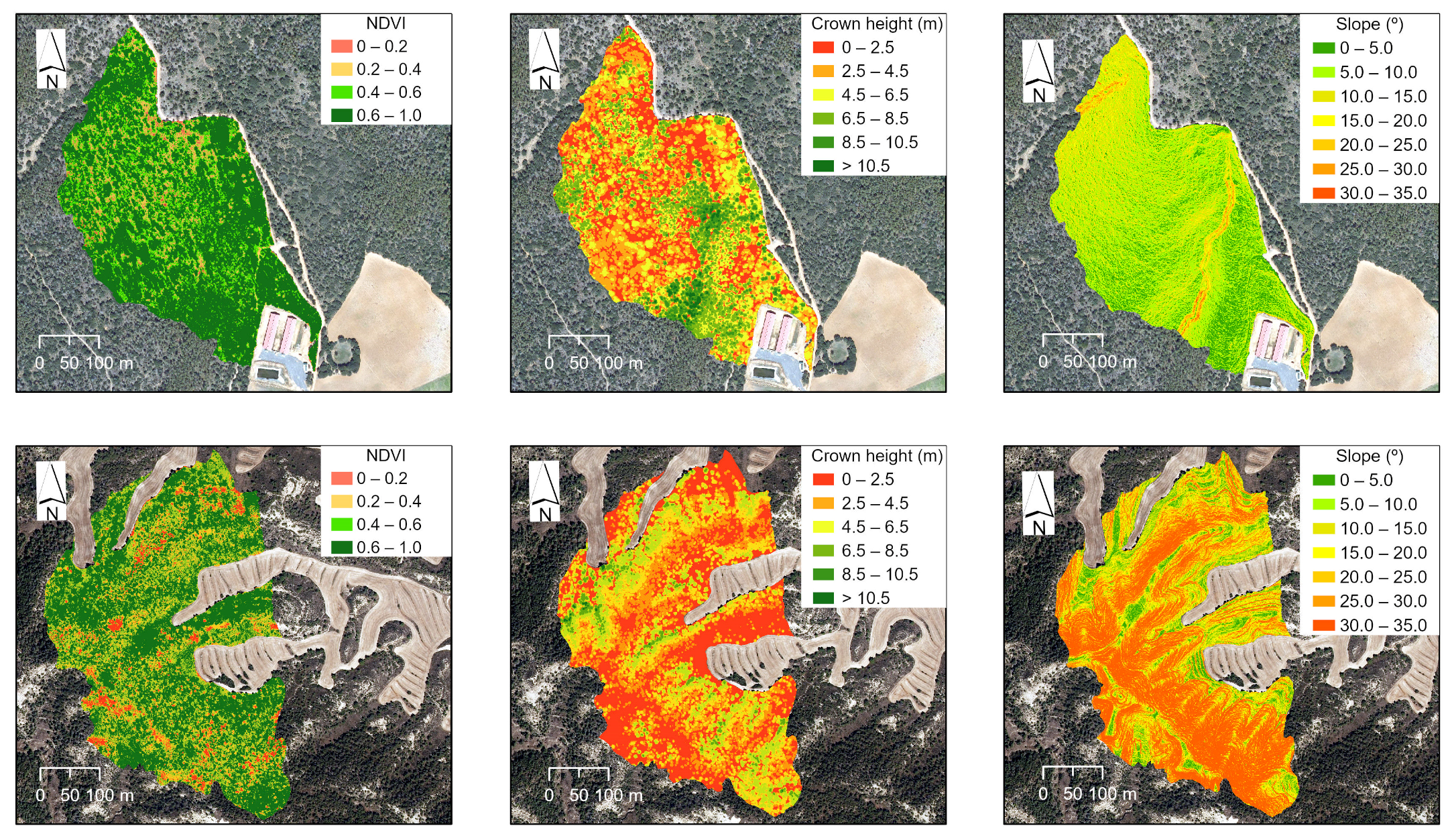
Topographic variables were derived from the DTM in ArcGIS Pro and extracted for both sites, excluding agricultural, livestock, and peripheral high-distortion areas. Slope was calculated as the rate of elevation change between each pixel and its neighbors (0–90°). Potential Solar Radiation was computed as theoretical solar energy (Wh m−2) using a uniform 200 × 200 pixel sky window at 41°N, for the previous 6 months of UAV data acquisition, ensuring that the drought period (late-spring and summer), together with the months before the sampling date, were considered for its calculation (Figure 3 and Figure S1).
For both sites, segmented tree crown polygons were used as a mask for the topography rasters and derived spectral indices, restricting the analysis to the delineated crowns of P. pinaster and Q. ilex at Miedes de Aragón and P. halepensis at Lanaja. Crown-level values of the predictor variables were calculated using zonal statistics, averaging all pixel values within each crown polygon. This approach mitigated the impact of potential georeferencing offsets (RMS) in the spectral indices relative to the LiDAR-derived variables. A shadow mask based on the RGB blue band was applied to minimize canopy and terrain shading. The threshold (<50 digital numbers for shadow, ≥50 for non-shadow) was defined through a supervised sensitivity analysis, in which two independent operators evaluated a range of candidate thresholds (10–80 digital numbers) across 30 reference points to identify the value that best matched the spatial distribution of shaded areas at both sites.
A neighborhood variable (vicinity) was also calculated to assess potential competition between trees, defined as the number of trees within 7 m at Miedes de Aragón and 6 m at Lanaja. These distances were chosen based on the authors’ expertise and the mean tree heights at each site. Circular buffers were generated around treetops, the number of neighboring trees within each buffer was computed and added to the segmented crowns for classification analyses.

2.3. Segmented Classification and Statistical Analysis

2.3.1. Classification of Segmented Crowns

A Random Forest algorithm was used for object-based image analysis (OBIA) [30,84,85]. Classification was performed in R with the randomForest package v. 4.7.1.2 [86], using separate models and target classes for each site. A training dataset was generated for each site through a manual digitization, guided by the identification of individual tree crowns in the 3D LiDAR point cloud in CloudCompare v. 2.14.alpha, which were then located in the RGB orthophoto for accurate delineation and class assignment.
At Miedes de Aragón, four classes were considered: three P. pinaster health-status categories—healthy (green crowns), decayed or recently dead (red or gray crowns), and dead (highly defoliated gray crowns)—and Q. ilex, characterized by large, intensely green crowns. A total of 537 crown points were manually digitized, with sample sizes of approximately 290 healthy pines, 90 decayed pines, 70 dead pines, and 90 holm oaks. This distribution reflects field and visual assessment of RGB orthophoto, where pines were significantly more abundant than holm oaks, and the proportions of healthy, decayed, and dead pines were based on field-measured mortality/degradation rates and previous studies [13,14,62].
At Lanaja, four P. halepensis classes were defined based on health and shading: healthy, decayed, healthy shaded, and decayed shaded, as steep topography limited full correction of illumination even after applying the shadow mask. A total of 510 crown points were digitized: 150 healthy pines, 150 decayed pines, 100 healthy shaded pines, and 110 decayed shaded pines, reflecting field and RGB orthophoto observations and the lower abundance of pines in shaded areas.
The Random Forest model used NDVI, EVI, canopy height, elevation, potential solar radiation, slope, and the three spectral bands of the RGB image (red, green, and blue) as independent variables for classification in the distinct groups (dependent variable) in the two sites. It was built from randomly selected subsets of the training data and predictor variables [30,87,88]. The trained model included 500 trees (ntree) and tested different numbers of predictor variables per split (mtry = 2, 5, 9), with mtry = 2 giving the best performance. Predictor variables importance was ranked by mean decrease in Gini, with higher values indicating greater contribution to class separation.
An additional ablation test was conducted at the Lanaja site to address potential information leakage between annotation criteria and model predictors. The model was re-run excluding the RGB bands while keeping all remaining predictors unchanged to evaluate whether classification performance remained stable without RGB variables linked to visual interpretation and annotator-derived cues.
The trained model was applied to the segmented crown polygons to predict their classes using the train function from the caret package in R v. 4.5.2 [89]. Zonal mean values for each class were then extracted from the predictor variables products, excluding canopy height and vicinity variables already computed for each crown. The resulting dataset was exported for spatial visualization and further statistical analyses.
Model performance was also evaluated using spatial block cross-validation, which accounts for spatial autocorrelation [90]. This procedure was implemented using the trainControl function in caret, with six spatial blocks at both sites, according to the elbow method (i.e., the point at which further increasing the number of blocks yields little reduction in autocorrelation; see Figure S2) to ensure spatially independent validation blocks. Due to the heterogeneous distribution of classes and species, a class-wise spatial clustering using k-means was applied at each site to ensure that each of the seven blocks contained a minimum number of points per class, enabling a more accurate independent cross-validation (see Figure S3). Model accuracy was evaluated using the confusion matrix, from which Overall Accuracy (OA), Producer’s Accuracy (PA), and User’s Accuracy (UA) were derived [91]. For Lanaja, performance metrics were also calculated separately for each spatial fold under both model configurations (with and without RGB bands) to evaluate the consistency of accuracy across blocks.

2.3.2. Statistical Analysis

Finally, data analyses were conducted in R Studio to examine how vegetation vigor (NDVI and EVI) varies with crown structure (canopy height) and topographic variables (elevation, slope, and potential solar radiation) across tree health classes for P. pinaster in Miedes de Aragón and P. halepensis in Lanaja. To account for low sample sizes and shading effects, decayed and dead pines were combined in Miedes de Aragón, while shaded and unshaded healthy or decayed pines were grouped in Lanaja. Homoscedasticity of the data was visually examined using histograms and statistically assessed using the Shapiro–Wilk test [92]. Descriptive statistics for NDVI, EVI, and canopy height were computed for each class, and differences between classes were assessed using one-way ANOVA [93] followed by Tukey’s post hoc test with Bonferroni correction [94]. Q. ilex records from Miedes de Aragón were excluded from subsequent analyses as they did not show drought-related decline.
Correlation matrices were first calculated to detect potential collinearity among variables. Spatial autocorrelation of spectral and predictor variables was then assessed using Moran’s I from the R package spdep [95], indicating negative (I < 0), positive (I > 0), or no autocorrelation (I ≈ 0). Pearson correlation coefficients between spectral indices (NDVI and EVI) and predictors were also computed using 1000 random permutations to ensure robust estimates.
Also, three regression models, a linear model (LM), a spatial lag model (SLM), and a generalized least squares model (GLS), were evaluated to analyze the relationships between pine vegetation vigor and the predictor variables at each site (see Supporting Information). Model selection was based on Akaike Information Criterion (AIC; [96]), Bayesian Information Criterion (BIC; [97] and log-likelihood (logLik). Among the response variables, NDVI showed greater sensitivity to the predictors than EVI (linear model (LM) R2 = 0.68 and 0.23 for NDVI versus R2 = 0.43 and 0.20 for EVI at Miedes and Lanaja, respectively) and was therefore chosen for subsequent analyses.
For each site, only the best-performing model is reported hereafter, given that the aim was to obtain the most accurate explanation of NDVI at each site rather than to compare modelled relationships between sites. In Miedes de Aragón, an SLM was applied using the lagsarlm function from the spdep package to explicitly account for spatial dependence via a spatial weights matrix. The model included predictors (tree height, elevation, slope, radiation, and vicinity) and interaction terms: canopy height × elevation, elevation × radiation, and slope × radiation.
In Lanaja, a GLS model was implemented using the gls function from nlme R package [98], incorporating an exponential spatial correlation structure and a nugget parameter to account for residual covariance. Interactions between tree height and slope, elevation, and vicinity, as well as between elevation and slope, were evaluated, and slope was retained instead of radiation due to high collinearity (Pearson’s r = 0.75) and improved model fit. All predictors were standardized prior to analysis to facilitate interpretation of effect sizes.
The workflow followed to acquire and process the UAV-derived data is illustrated in Figure S4.

3. Results

3.1. Individual Tree Detection

The highest recall (0.85), precision (0.89), and F-score (0.87) for individual tree detection (ITD) and segmentation in Miedes de Aragón were obtained using a spatial resolution of 0.4 m and a window size of 4 m (Table S1). Tree identification showed better performance for P. pinaster, with balanced values of recall, precision, and F-score (r = 0.87, p = 0.87, F = 0.87). Q. ilex exhibited a higher crown detection rate (r = 0.96) but lower precision (p = 0.71) and F-score values (F = 0.82).
In Lanaja, the highest tree detection performance was obtained using a lower spatial resolution (0.5 m) and the same ws (4 m) as in Miedes de Aragón. For P. halepensis, recall values were lower (r = 0.80) than those observed for P. pinaster and Q. ilex in Miedes de Aragón, whereas precision was higher (p = 0.88), possibly reflecting the more homogeneous forest structure at this site.
At both sites and for a given spatial resolution, reducing the window size led to a decrease in overall segmentation precision, whereas increasing it improved precision but resulted in lower recall and F-score values. Additionally, a decrease in spatial resolution reduced recall and F-score in Miedes de Aragón, while it enhanced crown identification performance in Lanaja.

3.2. Species and Health Status Classification

In Miedes de Aragón, a total of 3332 individual (256 trees/ha) tree crowns were classified (Figure 4), where 51% corresponded to P. pinaster (35% healthy trees and 16% declining and dead trees) and 49% to Q. ilex. The overall classification accuracy was 86% (Table 2 and Table S2). The different vigor classes of P. pinaster showed high classification accuracies, with healthy individuals achieving the highest values (producer’s accuracy, PA = 94%; user’s accuracy, UA = 90%). In contrast, Q. ilex exhibited the lowest accuracies (PA = 71%; UA = 79%), with most classification errors attributable to confusion with the “healthy pine” category. The declining (PA = 77%; UA = 86%) and dead pine classes (PA = 90%; UA = 78%) were mainly affected by omission errors.
In Lanaja, a total of 4515 tree crowns (215 trees/ha) were classified, of which 84% corresponded to healthy P. halepensis individuals and 16% to declining conspecifics. Classification errors for healthy and declining P. halepensis were mainly associated with omission errors in shaded areas (Table 2, Tables S3 and S4). This site exhibited higher overall accuracy (OA = 0.99) compared to the Miedes de Aragón site, with performance metrics remaining consistent across cross-validation blocks. When RGB bands were excluded from the RF model, OA was high (0.85), but lower than when RGB bands were included (0.99). The incorporation of RGB bands increased class discrimination between shaded and unshaded crowns, as well as between healthy and decayed crowns (Tables S5 and S7). To take advantage of this improved classification accuracy, RGB data were incorporated in subsequent analyses, enhancing the reliability of the workflow.
Spectral variables contributed most to class prediction at both sites, with NDVI and the blue RGB band distinguishing declining and dead pines from healthy ones. Crown height enabled discrimination between Q. ilex and P. pinaster, while elevation influenced the classification of healthy P. pinaster. Overall, topographic variables were less important than spectral and structural variables, especially at Lanaja (Tables S8 and S9).

3.3. Relationships Between Vegetation Vigour and Structural Variables

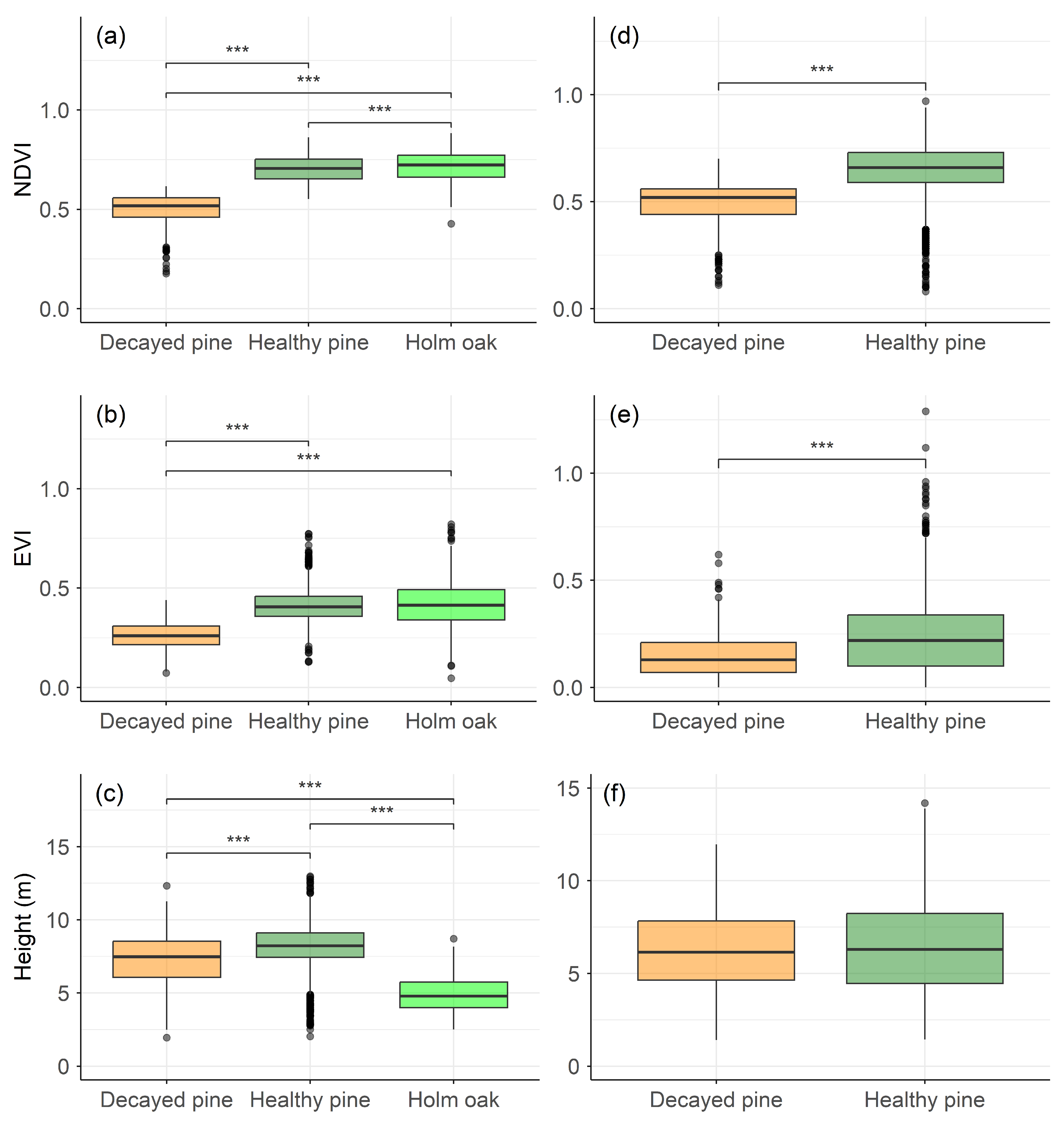
As expected, healthy trees (P. pinaster and P. halepensis) consistently showed higher NDVI and EVI values at both sites (Figure 5 and Figure S5; Tables S10–S14). Tree height differences between pine classes were not significant at Lanaja, whereas at Miedes de Aragón, healthy P. pinaster individuals were taller than decayed individuals, in agreement with 2017 field survey reports. (Figure S6b). Q. ilex individuals were shorter and had higher NDVI values than both healthy and decayed pines, and higher EVI values than decayed pines at the Miedes de Aragón site.

3.4. Spatial Models of NDVI

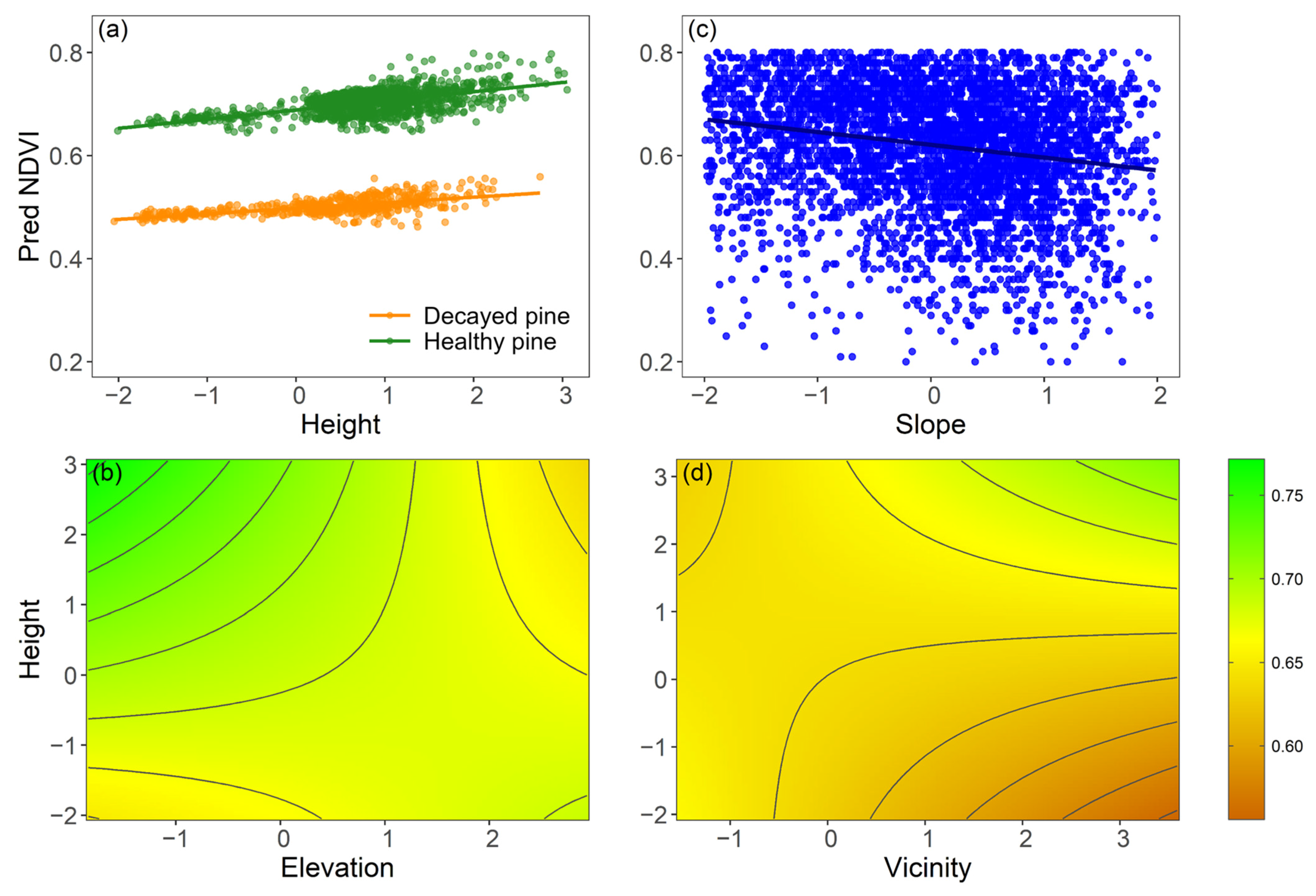
At Miedes de Aragón, the fitted SLM (Rho = 0.39) adequately captured the spatial dependence (Figure S7 and Table S15), as indicated by the non-significant LM test for spatial residual autocorrelation (LM = 0.138; p = 0.710). The model showed higher NDVI values for taller P. pinaster individuals, regardless of their health status (p = 0.03; Figure 6; Table S23) in accordance with correlation analyses (Tables S16–S26). In addition, an interaction between P. pinaster tree height and elevation was observed, with taller trees located at lower elevations exhibiting higher NDVI values and vice versa, although this interaction was not statistically significant (p = 0.08).
At Lanaja, the fitted GLS model indicated spatial dependence at short distances (range = 12.8 m) and a good overall fit (nugget = 0.26; residual standard error = 0.114). The model showed higher vigor in P. halepensis at lower slopes (p = 0.004) and higher vigor of taller trees at higher values of vicinity, i.e., in more dense neighborhoods (p = 0.006; Figure 6; Table S24).

4. Discussion

Overall, our study supports the use of high-resolution UAV-based remote sensing for effective near-real-time detection and attribution of forest die-off. In line with our first hypothesis, dead or highly defoliated trees presented lower NDVI and EVI values than healthy trees with NDVI performing better than EVI. We also found that taller pine trees exhibited higher vigor (i.e., higher NDVI and EVI) and lower rates of defoliation and mortality compared to shorter conspecifics at both sites. However, in Lanaja this relationship was conditioned by pine density, with higher vigor in denser neighborhoods. Finally, we found that pine individuals located in topographically unfavourable areas (e.g., sites with higher slope) would show higher levels of die-off and mortality (lower NDVI and EVI values) in Lanaja.

4.1. Accuracy of Individual Tree Detection

Individual tree detection using LiDAR-based crown segmentation showed satisfactory results, achieved by optimizing key parameters such as point cloud resolution, the size and shape of the window for local maxima detection [35,36], filtering methods [16], and the segmentation algorithm applied across species and at both sites. These factors were critical in preventing crown over-segmentation or under-segmentation of trees [38].
Detection accuracy varied with forest structure and site composition. For instance, [99,100] reported high F-scores (0.81) for conifer plantations, where regular, conical crowns are easier to delineate. In contrast, studies in mixed forests showed lower values (0.38–0.77) due to structural and morphological variability, including overlapping crowns, heterogeneous heights, and complex topography, which often leads to overestimation of tree numbers. Most segmentation algorithms assume conical crown shapes [101] and detect larger trees more accurately [82], which explains why the coarser point cloud resolution in Lanaja produced F-scores similar to those obtained with the finer resolution in Miedes de Aragón. This further highlights that higher spatial resolution data obtained by UAVs [102] can improve detection accuracy, particularly in structurally more complex forests [99].
Among species, individual detection of P. pinaster and P. halepensis achieved higher precision rates and F-scores than Q. ilex, whose open, branched architecture produces complex, overlapping crowns that complicate individ ual tree segmentation [34,87,103] (Table S1). Otherwise, this can also be attributed to using the same window size for both P. pinaster and Q. ilex, despite this parameter varying with forest structure and between species [35]. A relatively less dense forest structure and the presence of a high proportion of more easily identifiable conifers resulted in higher detection accuracies in Miedes de Aragón than those reported for other deciduous forests [16], but consistent with F-scores reported by [104] in mixed Pinus palustris–Quercus laevis forests.

4.2. Accuracy of Classification Model

Individual crown segmentation enabled precise mapping of tree species and health status, showing that high-resolution OBIA-based spectral metrics can improve species and physiological condition discrimination for assessing drought impacts [105].
Previous studies [106,107] have reported good performance in detecting forest decline using spectral indicators such as RGB bands, with vegetation indices such as NDVI further improving health-status classification, especially for conifers whose crown architecture enhances spectral separability [29,108]. Consistent with these findings, our study successfully separated healthy pines and Q. ilex from decayed or dead pine classes based on contrasting crown spectral responses (NDVI, EVI, and RGB bands). However, classification accuracy decreased when discriminating between classes with similar spectral characteristics (e.g., decayed vs. dead pines, or healthy pines vs. Q. ilex in Miedes de Aragón, and shaded healthy vs. shaded decayed pines in Lanaja), as also reported by [16].
The integration of structural and topographic variables alongside spectral metrics improved classification accuracy in Miedes de Aragón, whereas spectral information primarily drove class discrimination in Lanaja. This second site achieved higher overall accuracy than Miedes de Aragón (0.99 vs. 0.86, in that order) due to its more homogeneous species composition, lower tree density and stronger spectral contrast between healthy and decayed pines. In Miedes de Aragón, tree height enabled effective separation of P. pinaster and Q. ilex, consistent with the 4.2% improvement in overall accuracy reported by [109] when incorporating a CHM. Topographic metrics had a more limited effect, except for elevation in Miedes de Aragón, which enhanced discrimination among pine vigor classes, highlighting the added value of UAV-derived metrics for forest monitoring [87,110].
Finally, the die-off patterns observed in Miedes de Aragón were consistent with several studies previously reporting defoliation rates of 13–58% and mortality of 10–35% following the 2017 drought [14,65,111]. This supports the validity and complementary of field and UAV assessments for early diagnosis of vulnerable forest ecosystems. At the Lanaja site, accuracy was consistent across spatial cross-validation folds, supporting the robustness of the classification. Excluding the RGB bands slightly reduced overall accuracy. This led to an overestimation of declining and dead individuals and impaired the model’s ability to distinguish between shaded and unshaded crowns, highlighting that including RGB information strengthens class discrimination. Nevertheless, validation could not be fully performed at Lanaja due to the lack of detailed field data, emphasizing the need to complement algorithm-based results with ground observations to determine whether the model is capturing spatial patterns or truly improving class prediction [112].

4.3. Vegetation Vigor in Relation to Structural and Topographic Metrics

In this study, spectral indices derived from multispectral imagery, particularly NDVI, proved to be effective indicators for detecting early post-drought stress in P. pinaster and P. halepensis, consistent with previous findings [27,113,114,115,116].
Within sites, vegetation vigor was mainly related to species and tree health, with Q. ilex showing the highest vigor, followed by healthy pines. Although drought-induced decline has been reported for Mediterranean Quercus [117], no mortality was observed in Q. ilex in our study. This pattern agrees with [62,118], who attributed lower Q. ilex mortality to soil-depth segregation, with pine species accessing shallow water and Q. ilex reaching deeper soil water reserves during dry periods.
At both sites, tree vigor was influenced by structural traits such as tree height, whose role in drought vulnerability remains debated [119]. While taller trees are often considered more vulnerable due to higher exposure and evaporative demand in temperate and tropical forests [56,58,59] some studies show that in Mediterranean forests shorter trees may be more vulnerable to drought due to limited access to deep soil water [53,55]. Data from North American forest inventories also found no clear evidence that taller trees are more susceptible to drought [120], while other factors such as competition and forest composition may be more important in determining drought vulnerability [121].
Our results partially supported the hypotheses, since, at Miedes de Aragón, taller pines showed higher vigor regardless of health. At higher elevations, however, taller trees exhibited lower NDVI, likely due to shallower, sandy soils with low organic matter [66], although this pattern was not statistically significant (p = 0.08). At Lanaja, pine vigor was lower in steeper areas, where shallow soils, low nutrient concentrations, and limited moisture likely constrained pine growth, as reported by [48,122] who found higher mortality rates and reduced growth in tree species located on upper slopes. Taller trees with more neighbors also showed higher vigor, indicating that individuals located in favorable topographic positions formed hotspots with reduced decline signs due to improved microclimatic (canopy cover reduces soil evapotranspiration) or soil conditions [47], as initially hypothesized. Reference [123] also found higher drought susceptibility at forest edges, where trees were shorter than those in the forest interior, likely due to harsher microclimatic conditions (higher temperatures and solar radiation, and lower relative humidity) and reduced soil water availability.
These synergistic effects between factors align with previous studies, that reported the key role of topography in soil water availability and species’ drought responses [47,48,61,122,124,125,126]. For example, [127] observed reduced conifer vigor with increasing elevation and slope during droughts. In our study, slope was the only topographic factor significantly affecting pine vigor at Lanaja when spatial structure was considered, emphasizing the need for site- and species-specific models to better understand tree vigor responses to drought. However, it is important to highlight that these results are subject to limitations, including structural heterogeneity affecting algorithm performance and limited field measurements, particularly at Lanaja, which makes it difficult to validate model accuracy and interpret the ecological implications; therefore, the results should be interpreted with caution. Forests showing die-off, like the ones studied here, provide valuable scenarios to improve our capacity to detect tree mortality patterns using UAV imagery. A proper identification of dead and alive trees in the field will be rather useful to validate our results.

4.4. Strengths and Limitations

The proposed workflow (see Figure S4) effectively delineated tree crowns and species through optimal parameter selection. It also integrated spectral, structural, and topographic variables to improve classification and assessment of pine vigor, highlighting the importance of considering factor interactions and spatial structure in model selection and interpretation. At Miedes de Aragón, the availability of field data allowed us to further explore these interactions and validate the algorithm’s results.
Limitations included: (i) limited availability of field reference trees for validating height and crown segmentation, particularly at Lanaja, which required manual crown identification and may introduce errors in dense stands or complex crown morphologies; (ii) crown delineation of complex canopy structures, which was constrained by the performance of existing segmentation algorithms; (iii) species classification, which could be improved using more discriminative spectral variables [29] or multi-temporal data to capture spectral variability linked to post-drought decline [16] and better validated with independent field-based data, and (iv) site-specific effects of solar radiation at Lanaja, associated with topographic contrasts that may limited full shadow correction (apparent higher vigor on south-facing slopes and vice versa, due to slope orientation affecting the reflectance captured by the sensor). Future studies should be developed in sites with robust field data, account for topographic constraints, and analyze north- and south-facing slopes separately to avoid potential interpretative errors.

5. Conclusions

This study demonstrated the utility of integrating UAV-based multispectral and LiDAR data for individual tree detection, species classification, and assessment of tree vigor in Mediterranean mixed and pure forests.
Individual crown segmentation was successful in conifer-dominated areas with regular crown morphologies, such as P. pinaster in Miedes de Aragón and P. halepensis in Lanaja. In contrast, segmentation accuracy was lower for dense, overlapping Q. ilex crowns, which tended to result in overestimation of tree numbers, highlighting the need to adjust algorithm parameters to the structural characteristics of each forest. Classification results demonstrated effective discrimination of species and vigor states using structural variables (crown height) and spectral metrics (vegetation indices and RGB bands). The inclusion of topographic variables, such as elevation, further improved model accuracy at Miedes de Aragón. Taller P. pinaster trees exhibited higher vigor in Miedes de Aragón, whereas at the Lanaja site, P. halepensis showed lower vigor on steeper slopes. Larger P. halepensis individuals also displayed higher vigor when surrounded by more neighbors, revealing the synergistic effects of structural and environmental factors in modulating forest vigor responses. Future work should consider diverse forest structures and compositions and focus on optimizing the accuracy of crown detection and classification algorithms, in combination with field validation.

Supplementary Materials

The following supporting information can be downloaded at https://www.mdpi.com/article/10.3390/rs18060916/s1. In addition, the high resolution RGB orthophotos of both study sites are available for download at https://deadtrees.earth/, accessed on 13 March 2026. Figure S1: Spectral, structural and topographic variables of the study area located at both sites; Figure S2: Determination of the optimal number of spatial blocks for cross validation; Figure S3: Spatial distribution of classes within cross-validation blocks; Figure S4: Workflow diagram; Figure S5: Scatter plots of NDVI and EVI as a function of tree height at both sites; Figure S6: Kernel density plots illustrating the distribution of canopy height across different tree classes; Figure S7: Moran correlograms for vigor variables and height of P. pinaster in Miedes de Aragón and P. halepensis in Lanaja. Table S1: Individual tree detection accuracy from LiDAR; Tables S2 and S3: Pearson correlations between variables measured at the Miedes de Aragón and Lanaja sites, respectively; Table S4: Accuracy assessment of random forest classification based on block cross-validation in Miedes de Aragón and Lanaja sites per classes; Table S5: Accuracy assessment of random forest classification without RGB bands based on block cross-validation at Lanaja site; Table S6: Accuracy assessment of random forest classification without RGB bands based on block cross-validation at Lanaja site per classes; Table S7: Balance accuracy (BA) of random forest classification with and without RGB bands based on block cross-validation at Lanaja site per blocks; Tables S8 and S9: Relative importance of classifier variables by category in the Miedes de Aragón and Lanaja sites, respectively; Table S10: Normality assessment of the data based on the Shapiro–Wilk test; Table S11: Summary statistics of NDVI, EVI and canopy height by tree class at both sites; Table S12: Analysis of differences in NDVI values between trees classes at both sites; Table S13: Analysis of differences in EVI values between trees classes at both sites; Table S14: Analysis of differences in tree height values between trees classes at both sites; Table S15: Moran indices for spectral, structural and topographic variables; Table S16: Pearson correlation coefficients of NDVI and EVI with the predictor variables; Tables S17 and S18: Linear model selection table showing all possible combinations of the Miedes and Lanaja sites, respectively; Tables S19 and S20: Fitted statistics of the LM at Miedes de Aragón and Lanaja sites, respectively; Table S21: Fitted statistics of the GLS model at Miedes site; Table S22: Fitted statistics of the SLM at Lanaja site; Table S23: Fitted statistics of the selected SLM at Miedes de Aragón site; Table S24: Fitted statistics of the selected GLS model at Lanaja site; Tables S25 and S26: Statistical comparison of the fitted models at the Miedes de Aragón and Lanaja sites, respectively.

Author Contributions

Conceptualization, E.T., J.R., A.G. and J.J.C.; methodology, E.T., J.R., A.G. and J.J.C.; software, E.T.; validation, E.T.; formal analysis, E.T.; investigation, E.T., J.R., A.G. and J.J.C.; resources, E.T., J.R., A.G. and J.J.C.; data curation, E.T. and J.R.; writing—original draft preparation, E.T.; writing—review and editing, E.T., J.R., A.G. and J.J.C.; visualization, E.T.; supervision, J.R., A.G. and J.J.C.; project administration, J.J.C.; funding acquisition, J.R., A.G. and J.J.C. All authors have read and agreed to the published version of the manuscript.

Funding

This research was funded by the Ministry of Science, Innovation and Universities TED2021-129770B. E.T. was supported by pre-doctoral research grant from Government of Aragón (BOA20241220022) and A.G. was supported by the “Ramón y Cajal” Program of the Spanish MICINN under Grant RyC2020-030647-I and by CSIC under grant PIEe-20223AT003.

Data Availability Statement

The raw data supporting the conclusions of this article will be made available by the authors on request.

Acknowledgments

We acknowledge the sampling permission and facilities provided by forest managers and technicians, Gov. Aragón. We sincerely thank Fernando Pérez-Cabello for his valuable suggestions, which contributed to improving this manuscript. We also thank Francisco Rojas-Heredía for his contribution to drone data processing and Borja Latorre for his helpful recommendations.

Conflicts of Interest

The authors declare no conflicts of interest.

Abbreviations

The following abbreviations are used in this manuscript:
UAVUnmanned Aerial Vehicle
LiDARLight Detection and Ranging
NDVINormalized Difference Vegetation Index
EVIEnhanced Vegetation Index
OBIAObject Based Image Analysis
ITDIndividual Tree Detection
CHMCanopy Height Model
SPEIStandardized Precipitation and Evapotranspiration Index
DTMDigital Terrain Model
DSMDigital Surface Model
RTKReal Time Kinematic
IDWInverse Distance Weighting
TINTriangulated Irregular Network
WSWindows size
resresolution
LMLinear Model
GLSGeneralized Least Square
SLMSpatial Lag Model
AICAkaike Information Criterion
BICBayesian Information Criterion
Log-likLog-likehood
OAOverall Accuracy
PAProducer Accuracy
UAUser Accuracy
pPrecision rate
rRecall rate
TPTrue positive
FNFalse negative
FPFalse positive
RGBRed, Green and Blue bands

References

  1. Allen, C.D.; Macalady, A.K.; Chenchouni, H.; Bachelet, D.; McDowell, N.; Vennetier, M.; Kitzberger, T.; Rigling, A.; Breshears, D.D.; Hogg, E.H.; et al. A Global Overview of Drought and Heat-Induced Tree Mortality Reveals Emerging Climate Change Risks for Forests. For. Ecol. Manag. 2010, 259, 660–684. [Google Scholar] [CrossRef]
  2. Caudullo, G.; Barredo, J.I. A Georeferenced Dataset of Drought and Heat-Induced Tree Mortality in Europe. One Ecosyst. 2019, 4, e37753. [Google Scholar] [CrossRef]
  3. Senf, C.; Buras, A.; Zang, C.S.; Rammig, A.; Seidl, R. Excess Forest Mortality Is Consistently Linked to Drought across Europe. Nat. Commun. 2020, 11, 6200. [Google Scholar] [CrossRef] [PubMed]
  4. Hammond, W.M.; Williams, A.P.; Abatzoglou, J.T.; Adams, H.D.; Klein, T.; López, R.; Sáenz-Romero, C.; Hartmann, H.; Breshears, D.D.; Allen, C.D. Global Field Observations of Tree Die-off Reveal Hotter-Drought Fingerprint for Earth’s Forests. Nat. Commun. 2022, 13, 1761. [Google Scholar] [CrossRef] [PubMed]
  5. Hartmann, H.; Bastos, A.; Das, A.J.; Esquivel-Muelbert, A.; Hammond, W.M.; Martínez-Vilalta, J.; McDowell, N.G.; Powers, J.S.; Pugh, T.A.M.; Ruthrof, K.X.; et al. Climate Change Risks to Global Forest Health: Emergence of Unexpected Events of Elevated Tree Mortality Worldwide. Annu. Rev. Plant Biol. 2022, 73, 673–702. [Google Scholar] [CrossRef]
  6. Mani, Z.A.; Khorram-Manesh, A.; Goniewicz, K. Global Health Emergencies of Extreme Drought Events: Historical Impacts and Future Preparedness. Atmosphere 2024, 15, 1137. [Google Scholar] [CrossRef]
  7. McDowell, N.G.; Sapes, G.; Pivovaroff, A.; Adams, H.D.; Allen, C.D.; Anderegg, W.R.L.; Arend, M.; Breshears, D.D.; Brodribb, T.; Choat, B.; et al. Mechanisms of Woody-Plant Mortality under Rising Drought, CO2 and Vapour Pressure Deficit. Nat. Rev. Earth Environ. 2022, 3, 294–308. [Google Scholar] [CrossRef]
  8. Das, A.K.; Baldo, M.; Dobor, L.; Seidl, R.; Rammer, W.; Modlinger, R.; Washaya, P.; Merganičová, K.; Hlásny, T. The Increasing Role of Drought as an Inciting Factor of Bark Beetle Outbreaks Can Cause Large-Scale Transformation of Central European Forests. Landsc. Ecol. 2025, 40, 108. [Google Scholar] [CrossRef]
  9. Italiano, S.S.P.; Camarero, J.J.; Colangelo, M.; Borghetti, M.; Castellaneta, M.; Pizarro, M.; Ripullone, F. Assessing Forest Vulnerability to Climate Change Combining Remote Sensing and Tree-Ring Data: Issues, Needs and Avenues. Forests 2023, 14, 1138. [Google Scholar] [CrossRef]
  10. Gazol, A.; Sangüesa-Barreda, G.; Granda, E.; Camarero, J.J. Tracking the Impact of Drought on Functionally Different Woody Plants in a Mediterranean Scrubland Ecosystem. Plant Ecol. 2017, 218, 1009–1020. [Google Scholar] [CrossRef]
  11. Lindner, M.; Maroschek, M.; Netherer, S.; Kremer, A.; Barbati, A.; Garcia-Gonzalo, J.; Seidl, R.; Delzon, S.; Corona, P.; Kolström, M.; et al. Climate Change Impacts, Adaptive Capacity, and Vulnerability of European Forest Ecosystems. For. Ecol. Manag. 2010, 259, 698–709. [Google Scholar] [CrossRef]
  12. Giorgi, F.; Lionello, P. Climate Change Projections for the Mediterranean Region. Glob. Planet. Chang. 2008, 63, 90–104. [Google Scholar] [CrossRef]
  13. Camarero, J.J.; Gazol, A.; Sangüesa-Barreda, G.; Oliva, J.; Vicente-Serrano, S.M. To Die or Not to Die: Early Warnings of Tree Dieback in Response to a Severe Drought. J. Ecol. 2015, 103, 44–57. [Google Scholar] [CrossRef]
  14. Moreno-Fernández, D.; Viana-Soto, A.; Camarero, J.J.; Zavala, M.A.; Tijerín, J.; García, M. Using Spectral Indices as Early Warning Signals of Forest Dieback: The Case of Drought-Prone Pinus Pinaster Forests. Sci. Total Environ. 2021, 793, 148578. [Google Scholar] [CrossRef]
  15. Allen, M.J.; Moreno-Fernández, D.; Ruiz-Benito, P.; Grieve, S.W.D.; Lines, E.R. Low-Cost Tree Crown Dieback Estimation Using Deep Learning-Based Segmentation. Environ. Data Sci. 2024, 3, e18. [Google Scholar] [CrossRef]
  16. Savinelli, B.; Tagliabue, G.; Vignali, L.; Garzonio, R.; Gentili, R.; Panigada, C.; Rossini, M. Integrating Drone-Based LiDAR and Multispectral Data for Tree Monitoring. Drones 2024, 8, 744. [Google Scholar] [CrossRef]
  17. Fassnacht, F.E.; White, J.C.; Wulder, M.A.; Næsset, E. Remote Sensing in Forestry: Current Challenges, Considerations and Directions. For. Int. J. For. Res. 2024, 97, 11–37. [Google Scholar] [CrossRef]
  18. Torres, P.; Rodes-Blanco, M.; Viana-Soto, A.; Nieto, H.; García, M. The Role of Remote Sensing for the Assessment and Monitoring of Forest Health: A Systematic Evidence Synthesis. Forests 2021, 12, 1134. [Google Scholar] [CrossRef]
  19. Zhang, J.; Hu, J.; Lian, J.; Fan, Z.; Ouyang, X.; Ye, W. Seeing the Forest from Drones: Testing the Potential of Lightweight Drones as a Tool for Long-Term Forest Monitoring. Biol. Conserv. 2016, 198, 60–69. [Google Scholar] [CrossRef]
  20. Mosig, C.; Vajna-Jehle, J.; Mahecha, M.D.; Cheng, Y.; Hartmann, H.; Montero, D.; Junttila, S.; Horion, S.; Schwenke, M.B.; Koontz, M.J.; et al. Deadtrees. Earth—An Open-Access and Interactive Database for Centimeter-Scale Aerial Imagery to Uncover Global Tree Mortality Dynamics. Remote Sens. Environ. 2026, 332, 115027. [Google Scholar] [CrossRef]
  21. Adão, T.; Hruška, J.; Pádua, L.; Bessa, J.; Peres, E.; Morais, R.; Sousa, J.J. Hyperspectral Imaging: A Review on UAV-Based Sensors, Data Processing and Applications for Agriculture and Forestry. Remote Sens. 2017, 9, 1110. [Google Scholar] [CrossRef]
  22. Revuelto, J.; Gómez, D.; Alonso-González, E.; Vidaller, I.; Rojas-Heredia, F.; Deschamps-Berger, C.; García-Jiménez, J.; Rodríguez-López, G.; Sobrino, J.; Montorio, R.; et al. Intermediate Snowpack Melt-out Dates Guarantee the Highest Seasonal Grasslands Greening in the Pyrenees. Sci. Rep. 2022, 12, 18328. [Google Scholar] [CrossRef]
  23. Rouse, J.W. Monitoring the Vernal Advancement and Retrogradation (Green Wave Effect) of Natural Vegetation; NASA: Washington, DC, USA, 1974. [Google Scholar]
  24. Liu, H.Q.; Huete, A. A Feedback Based Modification of the NDVI to Minimize Canopy Background and Atmospheric Noise. IEEE Trans. Geosci. Remote Sens. 1995, 33, 457–465. [Google Scholar] [CrossRef]
  25. Huete, A.; Didan, K.; Miura, T.; Rodriguez, E.P.; Gao, X.; Ferreira, L.G. Overview of the Radiometric and Biophysical Performance of the MODIS Vegetation Indices. Remote Sens. Environ. 2002, 83, 195–213. [Google Scholar] [CrossRef]
  26. Wang, J.; Sammis, T.; Gutschick, V.; Gebremichael, M.; Dennis, S.; Harrison, R. Review of Satellite Remote Sensing Use in Forest Health Studies. Open Geogr. J. 2010, 3, 28–42. [Google Scholar] [CrossRef]
  27. Wang, Z.; Lyu, L.; Liu, W.; Liang, H.; Huang, J.; Zhang, Q.-B. Topographic Patterns of Forest Decline as Detected from Tree Rings and NDVI. Catena 2021, 198, 105011. [Google Scholar] [CrossRef]
  28. Abdollahnejad, A.; Panagiotidis, D. Tree Species Classification and Health Status Assessment for a Mixed Broadleaf-Conifer Forest with UAS Multispectral Imaging. Remote Sens. 2020, 12, 3722. [Google Scholar] [CrossRef]
  29. Fraser, B.T.; Congalton, R.G. Monitoring Fine-Scale Forest Health Using Unmanned Aerial Systems (UAS) Multispectral Models. Remote Sens. 2021, 13, 4873. [Google Scholar] [CrossRef]
  30. Breiman, L. Random Forests. Mach. Learn. 2001, 45, 5–32. [Google Scholar] [CrossRef]
  31. Revuelto, J.; Billecocq, P.; Tuzet, F.; Cluzet, B.; Lamare, M.; Larue, F.; Dumont, M. Random Forests as a Tool to Understand the Snow Depth Distribution and Its Evolution in Mountain Areas. Hydrol. Process. 2020, 34, 5384–5401. [Google Scholar] [CrossRef]
  32. Sivanandam, P.; Lucieer, A. Tree Detection and Species Classification in a Mixed Species Forest Using Unoccupied Aircraft System (UAS) RGB and Multispectral Imagery. Remote Sens. 2022, 14, 4963. [Google Scholar] [CrossRef]
  33. Franklin, S. Pixel- and Object-Based Multispectral Classification of Forest Tree Species from Small Unmanned Aerial Vehicles. J. Unmanned Veh. Syst. 2018, 6, 195–211. [Google Scholar] [CrossRef]
  34. Wang, Y.; Hyyppä, J.; Liang, X.; Kaartinen, H.; Yu, X.; Lindberg, E.; Holmgren, J.; Qin, Y.; Mallet, C.; Ferraz, A.; et al. International Benchmarking of the Individual Tree Detection Methods for Modeling 3-D Canopy Structure for Silviculture and Forest Ecology Using Airborne Laser Scanning. IEEE Trans. Geosci. Remote Sens. 2016, 54, 5011–5027. [Google Scholar] [CrossRef]
  35. Gao, T.; Gao, Z.; Sun, B.; Qin, P.; Li, Y.; Yan, Z. An Integrated Method for Estimating Forest-Canopy Closure Based on UAV LiDAR Data. Remote Sens. 2022, 14, 4317. [Google Scholar] [CrossRef]
  36. Yurtseven, H.; Coban, S.; Akgul, M.; Akay, A. Individual Tree Measurements in a Planted Woodland with Terrestrial Laser Scanner. Turk. J. Agric. For. 2019, 43, 192–208. [Google Scholar] [CrossRef]
  37. Miraki, M.; Sohrabi, H.; Fatehi, P.; Kneubuehler, M. Individual Tree Crown Delineation from High-Resolution UAV Images in Broadleaf Forest. Ecol. Inform. 2021, 61, 101207. [Google Scholar] [CrossRef]
  38. Marcello, J.; Spínola, M.; Albors, L.; Marqués, F.; Rodríguez-Esparragón, D.; Eugenio, F. Performance of Individual Tree Segmentation Algorithms in Forest Ecosystems Using UAV LiDAR Data. Drones 2024, 8, 772. [Google Scholar] [CrossRef]
  39. Hastings, J.H.; Ollinger, S.V.; Ouimette, A.P.; Sanders-DeMott, R.; Palace, M.W.; Ducey, M.J.; Sullivan, F.B.; Basler, D.; Orwig, D.A. Tree Species Traits Determine the Success of LiDAR-Based Crown Mapping in a Mixed Temperate Forest. Remote Sens. 2020, 12, 309. [Google Scholar] [CrossRef]
  40. Geri, F.; Rocchini, D.; Chiarucci, A. Landscape Metrics and Topographical Determinants of Large-Scale Forest Dynamics in a Mediterranean Landscape. Landsc. Urban Plan. 2010, 95, 46–53. [Google Scholar] [CrossRef]
  41. López-Ballesteros, A.; Rodríguez-Caballero, E.; Moreno, G.; Escribano, P.; Hereş, A.-M.; Yuste, J.C. Topography Modulates Climate Sensitivity of Multidecadal Trends of Holm Oak Decline. Glob. Change Biol. 2023, 29, 6336–6349. [Google Scholar] [CrossRef] [PubMed]
  42. Príncipe, A.; Nunes, A.; Pinho, P.; Aleixo, C.; Neves, N.; Branquinho, C. Local-Scale Factors Matter for Tree Cover Modelling in Mediterranean Drylands. Sci. Total Environ. 2022, 831, 154877. [Google Scholar] [CrossRef] [PubMed]
  43. Martinetti, S.; Molnar, P.; Carminati, A.; Floriancic, M.G. Contrasting the Soil–Plant Hydraulics of Beech and Spruce by Linking Root Water Uptake to Transpiration Dynamics. Tree Physiol. 2025, 45, tpae158. [Google Scholar] [CrossRef] [PubMed]
  44. Martínez-Vilalta, J.; Prat, E.; Oliveras, I.; Piñol, J. Xylem Hydraulic Properties of Roots and Stems of Nine Mediterranean Woody Species. Oecologia 2002, 133, 19–29. [Google Scholar] [CrossRef]
  45. McLaughlin, B.C.; Blakey, R.; Weitz, A.P.; Feng, X.; Brown, B.J.; Ackerly, D.D.; Dawson, T.E.; Thompson, S.E. Weather Underground: Subsurface Hydrologic Processes Mediate Tree Vulnerability to Extreme Climatic Drought. Glob. Change Biol. 2020, 26, 3091–3107. [Google Scholar] [CrossRef]
  46. Camarero, J.J.; Serra-Maluquer, X.; Colangelo, M.; Gazol, A.; Pizarro, M. Latewood Intra-Annual Density Fluctuations Indicate Wet Summer Conditions and Enhanced Canopy Activity in a Mediterranean Ring-Porous Oak. IAWA J. 2023, 45, 213–226. [Google Scholar] [CrossRef]
  47. Ewane, E.B.; Mohan, M.; Bajaj, S.; Galgamuwa, G.A.P.; Watt, M.S.; Arachchige, P.P.; Hudak, A.T.; Richardson, G.; Ajithkumar, N.; Srinivasan, S.; et al. Climate-Change-Driven Droughts and Tree Mortality: Assessing the Potential of UAV-Derived Early Warning Metrics. Remote Sens. 2023, 15, 2627. [Google Scholar] [CrossRef]
  48. Tai, X.; Anderegg, W.R.L.; Blanken, P.D.; Burns, S.P.; Christensen, L.; Brooks, P.D. Hillslope Hydrology Influences the Spatial and Temporal Patterns of Remotely Sensed Ecosystem Productivity. Water Resour. Res. 2020, 56, e2020WR027630. [Google Scholar] [CrossRef]
  49. Anderegg, W.R.L.; Konings, A.G.; Trugman, A.T.; Yu, K.; Bowling, D.R.; Gabbitas, R.; Karp, D.S.; Pacala, S.; Sperry, J.S.; Sulman, B.N.; et al. Hydraulic Diversity of Forests Regulates Ecosystem Resilience during Drought. Nature 2018, 561, 538–541. [Google Scholar] [CrossRef]
  50. Gazol, A.; Fajardo, A.; Camarero, J.J. Contributions of Intraspecific Variation to Drought Tolerance in Trees. Curr. For. Rep. 2023, 9, 461–472. [Google Scholar] [CrossRef]
  51. Tamudo, E.; Gazol, A.; Valeriano, C.; González, E.; Colangelo, M.; Camarero, J.J. Similar Climate–Growth Relationships but Divergent Drought Resilience Strategies in Coexisting Mediterranean Shrubs. J. Ecol. 2024, 112, 1804–1817. [Google Scholar] [CrossRef]
  52. Camarero, J.J.; Sangüesa-Barreda, G.; Vergarechea, M. Prior Height, Growth, and Wood Anatomy Differently Predispose to Drought-Induced Dieback in Two Mediterranean Oak Speciesk. Ann. For. Sci. 2016, 73, 341–351. [Google Scholar] [CrossRef]
  53. Colangelo, M.; Camarero, J.J.; Battipaglia, G.; Borghetti, M.; De Micco, V.; Gentilesca, T.; Ripullone, F. A Multi-Proxy Assessment of Dieback Causes in a Mediterranean Oak Species. Tree Physiol. 2017, 37, 617–631. [Google Scholar] [CrossRef]
  54. González De Andrés, E.; Rosas, T.; Camarero, J.J.; Martínez-Vilalta, J. The Intraspecific Variation of Functional Traits Modulates Drought Resilience of European Beech and Pubescent Oak. J. Ecol. 2021, 109, 3652–3669. [Google Scholar] [CrossRef]
  55. Ripullone, F.; Camarero, J.J.; Colangelo, M.; Voltas, J. Variation in the Access to Deep Soil Water Pools Explains Tree-to-Tree Differences in Drought-Triggered Dieback of Mediterranean Oaks. Tree Physiol. 2020, 40, 591–604. [Google Scholar] [CrossRef]
  56. Bennett, A.C.; McDowell, N.G.; Allen, C.D.; Anderson-Teixeira, K.J. Larger Trees Suffer Most during Drought in Forests Worldwide. Nat. Plants 2015, 1, 15139. [Google Scholar] [CrossRef]
  57. McDowell, N.G.; Allen, C.D. Darcy’s Law Predicts Widespread Forest Mortality under Climate Warming. Nat. Clim. Change 2015, 5, 669–672. [Google Scholar] [CrossRef]
  58. McGregor, I.R.; Helcoski, R.; Kunert, N.; Tepley, A.J.; Gonzalez-Akre, E.B.; Herrmann, V.; Zailaa, J.; Stovall, A.E.L.; Bourg, N.A.; McShea, W.J.; et al. Tree Height and Leaf Drought Tolerance Traits Shape Growth Responses across Droughts in a Temperate Broadleaf Forest. New Phytol. 2021, 231, 601–616. [Google Scholar] [CrossRef] [PubMed]
  59. Stovall, A.E.L.; Shugart, H.; Yang, X. Tree Height Explains Mortality Risk during an Intense Drought. Nat. Commun. 2019, 10, 4385. [Google Scholar] [CrossRef]
  60. Grote, R.; Gessler, A.; Hommel, R.; Poschenrieder, W.; Priesack, E. Importance of Tree Height and Social Position for Drought-Related Stress on Tree Growth and Mortality. Trees 2016, 30, 1467–1482. [Google Scholar] [CrossRef]
  61. Trugman, A.T.; Detto, M.; Bartlett, M.K.; Medvigy, D.; Anderegg, W.R.L.; Schwalm, C.; Schaffer, B.; Pacala, S.W. Tree Carbon Allocation Explains Forest Drought-Kill and Recovery Patterns. Ecol. Lett. 2018, 21, 1552–1560. [Google Scholar] [CrossRef]
  62. Camarero, J.J.; Colangelo, M.; Valeriano, C.; Gazol, A.; González de Andrés, E.; Alonso-Forn, D.; Voltas, J.; Torres-Ruiz, J.M.; Delzon, S.; Badel, E.; et al. Xylem Pit Anatomy and Minimum Leaf Conductance Drive Drought Mortality in Pinus Pinaster. Plant Cell Environ. 2026, 49, 279–294. [Google Scholar] [CrossRef]
  63. Valeriano, C.; Gazol, A.; Colangelo, M.; Camarero, J.J.; Valeriano, C.; Gazol, A.; Colangelo, M.; Camarero, J.J. Drought Drives Growth and Mortality Rates in Three Pine Species under Mediterranean Conditions. Forests 2021, 12, 1700. [Google Scholar] [CrossRef]
  64. Fernandes, P.M.; Rigolot, E. The Fire Ecology and Management of Maritime Pine (Pinus pinaster Ait.). For. Ecol. Manag. 2007, 241, 1–13. [Google Scholar] [CrossRef]
  65. Valeriano, C.; Gazol, A.; Colangelo, M.; González de Andrés, E.; Camarero, J.J. Modeling Climate Impacts on Tree Growth to Assess Tree Vulnerability to Drought During Forest Dieback. Front. Plant Sci. 2021, 12, 672855. [Google Scholar] [CrossRef]
  66. Gazol, A.; González de Andrés, E.; Valverde, Á.; Igual, J.M.; Serrano, A.; Camarero, J.J. The Strong Seasonality of Soil Microbial Community Structure in Declining Mediterranean Pine Forests Depends More on Soil Conditions than on Tree Vitality. Sci. Total Environ. 2024, 957, 177560. [Google Scholar] [CrossRef]
  67. Camarero, J.J.; Gazol, A.; Colangelo, M.; Valeriano, C. Growth, Earlywood Anatomy and Wood Nutrients Respond to Precipitation and Flow in Semi-Arid Riparian Tamarisk Forests. Dendrochronologia 2024, 86, 126234. [Google Scholar] [CrossRef]
  68. Vicente-Serrano, S.M.; Beguería, S.; López-Moreno, J.I. A Multiscalar Drought Index Sensitive to Global Warming: The Standardized Precipitation Evapotranspiration Index. J. Clim. 2010, 23, 1696–1718. [Google Scholar] [CrossRef]
  69. Abatzoglou, J.T.; Dobrowski, S.Z.; Parks, S.A.; Hegewisch, K.C. TerraClimate, a High-Resolution Global Dataset of Monthly Climate and Climatic Water Balance from 1958–2015. Sci. Data 2018, 5, 170191. [Google Scholar] [CrossRef] [PubMed]
  70. Eichhorn, J.; Roskams, P.; Potočić, N.; Timmermann, V.; Ferretti, M.; Mues, V.; Szepesi, A.; Durrant, D.; Seletković, I.; Schroeck, H.-W.; et al. Part IV Visual Assessment of Crown Condition and Damaging Agents; Thünen Institute of Forest Ecosystems: Eberswalde, Germany, 2016. [Google Scholar]
  71. Cools, N.; De Vos, B. Manual on Methods and Criteria for Harmonised Sampling, Assessment, Monitoring and Analysis of the Effect of Air Pollution on Forests; Thünen Institute of Forest Ecosystems: Eberswalde, Germany, 2010. [Google Scholar]
  72. Revuelto, J.; López-Moreno, J.I.; Alonso-González, E. Light and Shadow in Mapping Alpine Snowpack with Unmanned Aerial Vehicles in the Absence of Ground Control Points. Water Resour. Res. 2021, 57, e2020WR028980. [Google Scholar] [CrossRef]
  73. Revuelto, J.; Alonso-Gonzalez, E.; Vidaller-Gayan, I.; Lacroix, E.; Izagirre, E.; Rodríguez-López, G.; López-Moreno, J.I. Intercomparison of UAV Platforms for Mapping Snow Depth Distribution in Complex Alpine Terrain. Cold Reg. Sci. Technol. 2021, 190, 103344. [Google Scholar] [CrossRef]
  74. DJI. DJI Terra—Digitaliza el Mundo—DJI Enterprise. Available online: https://enterprise.dji.com (accessed on 15 January 2026).
  75. Girardeu-Montau, D. CloudCompare—Open Source Project. Available online: https://www.cloudcompare.org/ (accessed on 15 January 2026).
  76. Professional Photogrammetry and Drone Mapping Software. Available online: https://www.pix4d.com/ (accessed on 15 January 2026).
  77. Matsushita, B.; Yang, W.; Chen, J.; Onda, Y.; Qiu, G. Sensitivity of the Enhanced Vegetation Index (EVI) and Normalized Difference Vegetation Index (NDVI) to Topographic Effects: A Case Study in High-Density Cypress Forest. Sensors 2007, 7, 2636–2651. [Google Scholar] [CrossRef]
  78. Desktop GIS Software|Mapping Analytics|ArcGIS Pro. Available online: https://www.esri.com/en-us/arcgis/products/arcgis-pro/overview (accessed on 15 January 2026).
  79. Roussel, J.-R.; Auty, D. lidR, Version 4.1.2; Airborne LiDAR Data Manipulation and Visualization for Forestry Applications; The R Foundation: Kaysville, UT, USA, 2016.
  80. Gonçalves, J.; Pôças, I.; Marcos, B.; Mücher, C.A.; Honrado, J.P. SegOptim—A New R Package for Optimizing Object-Based Image Analyses of High-Spatial Resolution Remotely-Sensed Data. Int. J. Appl. Earth Obs. Geoinf. 2019, 76, 218–230. [Google Scholar] [CrossRef]
  81. Mielcarek, M.; Stereńczak, K.; Khosravipour, A. Testing and Evaluating Different LiDAR-Derived Canopy Height Model Generation Methods for Tree Height Estimation. Int. J. Appl. Earth Obs. Geoinf. 2018, 71, 132–143. [Google Scholar] [CrossRef]
  82. Fraser, B.T.; Congalton, R.G.; Ducey, M.J. Quantifying the Accuracy of UAS-Lidar Individual Tree Detection Methods Across Height and Diameter at Breast Height Sizes in Complex Temperate Forests. Remote Sens. 2025, 17, 1010. [Google Scholar] [CrossRef]
  83. Dalponte, M.; Coomes, D.A. Tree-Centric Mapping of Forest Carbon Density from Airborne Laser Scanning and Hyperspectral Data. Methods Ecol. Evol. 2016, 7, 1236–1245. [Google Scholar] [CrossRef] [PubMed]
  84. Belgiu, M.; Drăguţ, L. Random Forest in Remote Sensing: A Review of Applications and Future Directions. ISPRS J. Photogramm. Remote Sens. 2016, 114, 24–31. [Google Scholar] [CrossRef]
  85. Parmar, A.; Katariya, R.; Patel, V. A Review on Random Forest: An Ensemble Classifier. In Proceedings of the International Conference on Intelligent Data Communication Technologies and Internet of Things (ICICI) 2018; Hemanth, J., Fernando, X., Lafata, P., Baig, Z., Eds.; Springer International Publishing: Cham, Switzerland, 2019; pp. 758–763. [Google Scholar]
  86. Liaw, A.; Wiener, M. CRAN: R News. Available online: https://cran.r-project.org/doc/Rnews/ (accessed on 15 January 2026).
  87. Karthigesu, J.; Owari, T.; Tsuyuki, S.; Hiroshima, T. Improving the Individual Tree Parameters Estimation of a Complex Mixed Conifer—Broadleaf Forest Using a Combination of Structural, Textural, and Spectral Metrics Derived from Unmanned Aerial Vehicle RGB and Multispectral Imagery. Geomatics 2025, 5, 12. [Google Scholar] [CrossRef]
  88. Speiser, J.L.; Miller, M.E.; Tooze, J.; Ip, E. A Comparison of Random Forest Variable Selection Methods for Classification Prediction Modeling. Expert Syst. Appl. 2019, 134, 93–101. [Google Scholar] [CrossRef]
  89. Kuhn, M. caret, Version 7.0-1; Classification and Regression Training; The R Foundation: Kaysville, UT, USA, 2007.
  90. Roberts, D.R.; Bahn, V.; Ciuti, S.; Boyce, M.S.; Elith, J.; Guillera-Arroita, G.; Hauenstein, S.; Lahoz-Monfort, J.J.; Schröder, B.; Thuiller, W.; et al. Cross-Validation Strategies for Data with Temporal, Spatial, Hierarchical, or Phylogenetic Structure. Ecography 2017, 40, 913–929. [Google Scholar] [CrossRef]
  91. Story, M.; Congalton, R.G. Accuracy Assessment: A User’s Perspective. Photogramm. Eng. Remote Sens. 1986, 52, 397–399. [Google Scholar]
  92. Royston, J.P. Algorithm AS 181: The W Test for Normality. Appl. Stat. 1982, 31, 176. [Google Scholar] [CrossRef]
  93. Edwards, A.W.F. RA Fischer, Statistical Methods for Research Workers, First Edition (1925). In Landmark Writings in Western Mathematics 1640–1940; Grattan-Guinness, I., Cooke, R., Corry, L., Crépel, P., Guicciardini, N., Eds.; Elsevier Science: Amsterdam, The Netherlands, 2005; pp. 856–870. ISBN 978-0-444-50871-3. [Google Scholar]
  94. Tukey, H.B. Proceedings of the American Society for Horticultural Science; The American Society for Horticultural Science: Geneva, Switzerland; New York, NY, USA, 1948; Volume 52. [Google Scholar]
  95. Bivand, R. Statistics, Version 1.4-1; Spdep: Spatial Dependence: Weighting Schemes; The R Foundation: Kaysville, UT, USA, 2002.
  96. Akaike, H. Information Theory and an Extension of the Maximum Likelihood Principle. In Selected Papers of Hirotugu Akaike; Parzen, E., Tanabe, K., Kitagawa, G., Eds.; Springer: New York, NY, USA, 1998; pp. 199–213. [Google Scholar]
  97. Schwarz, J.; Skiadaresis, G.; Kohler, M.; Kunz, J.; Schnabel, F.; Vitali, V.; Bauhus, J. Quantifying Growth Responses of Trees to Drought—A Critique of Commonly Used Resilience Indices and Recommendations for Future Studies. Curr. For. Rep. 2020, 6, 185–200. [Google Scholar] [CrossRef]
  98. Pinheiro, J. nlme, Version 3.1-168; Linear and Nonlinear Mixed Effects Models; The R Foundation: Kaysville, UT, USA, 2005.
  99. Liu, K.; Shen, X.; Cao, L.; Wang, G.; Cao, F. Estimating Forest Structural Attributes Using UAV-LiDAR Data in Ginkgo Plantations. ISPRS J. Photogramm. Remote Sens. 2018, 146, 465–482. [Google Scholar] [CrossRef]
  100. Zhou, X.; Ma, K.; Sun, H.; Li, C.; Wang, Y. Estimation of Forest Stand Volume in Coniferous Plantation from Individual Tree Segmentation Aspect Using UAV-LiDAR. Remote Sens. 2024, 16, 2736. [Google Scholar] [CrossRef]
  101. Zhen, Z.; Quackenbush, L.J.; Zhang, L. Trends in Automatic Individual Tree Crown Detection and Delineation—Evolution of LiDAR Data. Remote Sens. 2016, 8, 333. [Google Scholar] [CrossRef]
  102. Sierra, S.; Ramo, R.; Padilla, M.; Cobo, A. Assessing the Impact of LiDAR Density and Input Features on Forest Canopy Height Estimation Through XGBoost, CNN, and CNN + Transformer Approaches. Remote Sens. 2026, 18, 584. [Google Scholar] [CrossRef]
  103. Moe, K.T.; Owari, T.; Furuya, N.; Hiroshima, T.; Morimoto, J. Application of UAV Photogrammetry with LiDAR Data to Facilitate the Estimation of Tree Locations and DBH Values for High-Value Timber Species in Northern Japanese Mixed-Wood Forests. Remote Sens. 2020, 12, 2865. [Google Scholar] [CrossRef]
  104. Mohan, M.; Leite, R.V.; Broadbent, E.N.; Wan Mohd Jaafar, W.S.; Srinivasan, S.; Bajaj, S.; Dalla Corte, A.P.; do Amaral, C.H.; Gopan, G.; Saad, S.N.M.; et al. Individual Tree Detection Using UAV-Lidar and UAV-SfM Data: A Tutorial for Beginners. Open Geosci. 2021, 13, 1028–1039. [Google Scholar] [CrossRef]
  105. Goodbody, T.R.; Coops, N.C.; Hermosilla, T.; Tompalski, P.; Crawford, P. Assessing the Status of Forest Regeneration Using Digital Aerial Photogrammetry and Unmanned Aerial Systems. Int. J. Remote Sens. 2018, 39, 5246–5264. [Google Scholar] [CrossRef]
  106. Bergmüller, K.O.; Vanderwel, M.C. Predicting Tree Mortality Using Spectral Indices Derived from Multispectral UAV Imagery. Remote Sens. 2022, 14, 2195. [Google Scholar] [CrossRef]
  107. Kampen, M.; Lederbauer, S.; Mund, J.-P.; Immitzer, M. UAV-Based Multispectral Data for Tree Species Classification and Tree Vitality Analysis. In Proceedings of the Dreiländertagung der Deutschen Gesellschaft für Photogrammetrie, Fernerkundung und Geoinformation (DGPF), der OVG und der SGPF, Wien, Austria; DGPF: Stuttgart, Germany, 2019. [Google Scholar]
  108. Beloiu, M.; Heinzmann, L.; Rehush, N.; Gessler, A.; Griess, V.C. Individual Tree-Crown Detection and Species Identification in Heterogeneous Forests Using Aerial RGB Imagery and Deep Learning. Remote Sens. 2023, 15, 1463. [Google Scholar] [CrossRef]
  109. Sothe, C.; Dalponte, M.; Almeida, C.M.D.; Schimalski, M.B.; Lima, C.L.; Liesenberg, V.; Miyoshi, G.T.; Tommaselli, A.M.G. Tree Species Classification in a Highly Diverse Subtropical Forest Integrating UAV-Based Photogrammetric Point Cloud and Hyperspectral Data. Remote Sens. 2019, 11, 1338. [Google Scholar] [CrossRef]
  110. Fricker, G.A.; Ventura, J.D.; Wolf, J.A.; North, M.P.; Davis, F.W.; Franklin, J. A Convolutional Neural Network Classifier Identifies Tree Species in Mixed-Conifer Forest from Hyperspectral Imagery. Remote Sens. 2019, 11, 2326. [Google Scholar] [CrossRef]
  111. Camarero, J.J.; Colangelo, M.; Gazol, A.; González De Andrés, E.; Valeriano, C. Lower Growth and Production of Latewood Intra-Annual Density Fluctuations Due to Drought-Triggered Forest Die-Off. Trees For. People 2025, 20, 100843. [Google Scholar] [CrossRef]
  112. Meyer, H.; Reudenbach, C.; Wöllauer, S.; Nauss, T. Importance of Spatial Predictor Variable Selection in Machine Learning Applications—Moving from Data Reproduction to Spatial Prediction. Ecol. Model. 2019, 411, 108815. [Google Scholar] [CrossRef]
  113. Crespo-Antia, J.P.; Gazol, A.; Pizarro, M.; González De Andrés, E.; Valeriano, C.; Rubio Cuadrado, Á.; Linares, J.C.; Camarero, J.J. Matching Vegetation Indices and Tree Vigor in Pyrenean Silver Fir Stands. Remote Sens. 2024, 16, 4564. [Google Scholar] [CrossRef]
  114. Gallardo-Salazar, J.L.; Lindig-Cisneros, R.A.; Lopez-Toledo, L.; Endara-Agramont, A.R.; Blanco-García, A.; Sáenz-Romero, C. Analysis of the Vigor of Pinus Hartwegii Lindl. along an Altitudinal Gradient Using UAV Multispectral Images: Evidence of Forest Decline Possibly Associated with Climatic Change. Forests 2023, 14, 1176. [Google Scholar] [CrossRef]
  115. Ni, M.; Wu, Q.; Li, G.; Li, D. Remote Sensing Technology for Observing Tree Mortality and Its Influences on Carbon–Water Dynamics. Forests 2025, 16, 194. [Google Scholar] [CrossRef]
  116. Verbesselt, J.; Robinson, A.; Stone, C.; Culvenor, D. Forecasting Tree Mortality Using Change Metrics Derived from MODIS Satellite Data. For. Ecol. Manag. 2009, 258, 1166–1173. [Google Scholar] [CrossRef]
  117. Gentilesca, T.; Camarero, J.J.; Colangelo, M.; Ripullone, F.; Nole’, A.; Nolã, A. Drought-Induced Oak Decline in the Western Mediterranean Region: An Overview on Current Evidences, Mechanisms and Management Options to Improve Forest Resilience. IForest 2017, 10, 796–806. [Google Scholar] [CrossRef]
  118. del Castillo, J.; Comas, C.; Voltas, J.; Ferrio, J.P. Dynamics of Competition over Water in a Mixed Oak-Pine Mediterranean Forest: Spatio-Temporal and Physiological Components. For. Ecol. Manag. 2016, 382, 214–224. [Google Scholar] [CrossRef]
  119. Fernández-de-Uña, L.; Martínez-Vilalta, J.; Poyatos, R.; Mencuccini, M.; McDowell, N.G. The Role of Height-driven Constraints and Compensations on Tree Vulnerability to Drought. New Phytol. 2023, 239, 2083–2098. [Google Scholar] [CrossRef]
  120. Hember, R.A.; Kurz, W.A.; Coops, N.C. Relationships between Individual-Tree Mortality and Water-Balance Variables Indicate Positive Trends in Water Stress-Induced Tree Mortality across North America. Glob. Change Biol. 2017, 23, 1691–1710. [Google Scholar] [CrossRef]
  121. Bachofen, C.; Poyatos, R.; Flo, V.; Martínez-Vilalta, J.; Mencuccini, M.; Granda, V.; Grossiord, C. Stand Structure of Central European Forests Matters More than Climate for Transpiration Sensitivity to VPD. J. Appl. Ecol. 2023, 60, 886–897. [Google Scholar] [CrossRef]
  122. Elliott, K.J.; Miniat, C.F.; Pederson, N.; Laseter, S.H. Forest Tree Growth Response to Hydroclimate Variability in the Southern Appalachians. Glob. Change Biol. 2015, 21, 4627–4641. [Google Scholar] [CrossRef] [PubMed]
  123. Buras, A.; Schunk, C.; Zeiträg, C.; Herrmann, C.; Kaiser, L.; Lemme, H.; Straub, C.; Taeger, S.; Gößwein, S.; Klemmt, H.-J.; et al. Are Scots Pine Forest Edges Particularly Prone to Drought-Induced Mortality? Environ. Res. Lett. 2018, 13, 025001. [Google Scholar] [CrossRef]
  124. Carnicer, J.; Vives-Ingla, M.; Blanquer, L.; Méndez-Camps, X.; Rosell, C.; Sabaté, S.; Gutiérrez, E.; Sauras, T.; Peñuelas, J.; Barbeta, A. Forest Resilience to Global Warming Is Strongly Modulated by Local-Scale Topographic, Microclimatic and Biotic Conditions. J. Ecol. 2021, 109, 3322–3339. [Google Scholar] [CrossRef]
  125. Köpp Hollunder, R.; Garbin, M.L.; Rubio Scarano, F.; Mariotte, P. Regional and Local Determinants of Drought Resilience in Tropical Forests. Ecol. Evol. 2022, 12, e8943. [Google Scholar] [CrossRef] [PubMed]
  126. Liu, B.; Wang, Y.; Zhu, H.; Liang, E.; Camarero, J.J. Topography and Age Mediate the Growth Responses of Smith Fir to Climate Warming in the Southeastern Tibetan Plateau. Int. J. Biometeorol. 2016, 60, 1577–1587. [Google Scholar] [CrossRef] [PubMed]
  127. Sang, Y.; Tian, F.; Jin, H.; Cai, Z.; Feng, L.; Dou, Y.; Eklundh, L. Assessing Topographic Effects on Forest Responses to Drought with Multiple Seasonal Metrics from Sentinel-2. Int. J. Appl. Earth Obs. Geoinf. 2024, 128, 103789. [Google Scholar] [CrossRef]
Figure 1. (a) Location of the Miedes de Aragón (top, red) and Lanaja (bottom, orange) study sites (both with same spatial scale). Green points indicate the 146 and 150 tree crowns digitized by photointerpretation in each site, respectively. The inset map of Spain shows the distribution ranges of P. halepensis, P. pinaster, and Q. ilex, obtained from https://data.mendeley.com/datasets/hr5h2hcgg4/18 (accessed on 13 March 2026). LIC Sierra de Vicort and ZEPA Sierra de Alcubierre correspond to a Site of Community Importance and a Special Protection Area for birds, respectively. Points show Miedes de Aragón (red) and Lanaja (orange) locations. The panels below (bd) show Pinus pinaster trees exhibiting decline symptoms (canopy dieback, defoliation and crown reddening), as well as dead individuals, at the Miedes de Aragón site following the severe 2017 drought.
Remotesensing 18 00916 g001
Figure 2. Drought severity based on the 48-month June SPEI calculated at (a) Miedes de Aragón and (b) Lanaja sites for the period 1960–2024. The orange arrow indicated the year of drought triggering pine tree die-off at each site (2017 for Miedes de Aragón and 2022 for Lanaja). Note the aridification trend observed in both study sites.
Remotesensing 18 00916 g002
Figure 3. Spectral, structural, and topographic variables of the study areas at the Miedes (above) and Lanaja (below) sites. The variables shown are: NDVI, Normalized Difference Vegetation Index; Height, Tree crown height; and Slope.
Remotesensing 18 00916 g003
Figure 4. OBIA classification of holm oak and the two vigor states of P. pinaster at Miedes de Aragón (left) and P. halepensis at Lanaja (right) using the Random Forest model. For visualization and analysis, decayed and dead pines were combined into a single decayed class in Miedes, while shaded and non-shaded healthy and decayed pines were merged into healthy and decayed classes in Lanaja.
Remotesensing 18 00916 g004
Figure 5. Box plots showing the distribution of NDVI, EVI and tree height values across tree vigor classes in the Miedes de Aragón (ac) and Lanaja (df) sites. Statistical significance of pairwise comparisons between tree classes is indicated as p < 0.001 (***).
Remotesensing 18 00916 g005
Figure 6. NDVI predicted by LMs as a function of (a) standardized tree height (R2 = 0.17 and 0.15; p < 0.001 for healthy and decayed pines, respectively) and (c) slope (R2 = 0.04; p < 0.001) at the Miedes de Aragón ((a), left) and Lanaja ((c), right) sites. Panels (b,d) illustrate the interactions of tree height with elevation and tree height with vicinity, respectively, and their contributions to NDVI values (color scale), at the Miedes de Aragón (left, (b)) and Lanaja (right, (d)) sites.
Remotesensing 18 00916 g006
Table 1. Summary of UAV sensors and technical details of drone data acquisition in Miedes de Aragón and Lanaja study sites.
ParametersMiedes de AragónLanaja
SensorsZenmuse L1 M. AltumZenmuse L1 M. Altum
Data acquisition (DD/MM/YYYY)14 November 202318 December 2024
Flight height (m)90–10090–100
Point cloud density (points m−2)519-550-
Ground Sampling Distance (GRD, cm/pixel)-6.53 -4.75
Longitudinal and transverse overlap (%)60–7060–70
Table 2. Accuracy assessment of random forest classification based on block cross-validation in Miedes de Aragón and Lanaja sites. Abbreviations: PA, Producer’s Accuracy; UA, User’s Accuracy.
Miedes de Aragón
ClassificationReference
Healthy Pine Holm OakDecayed PineDead PineUA
Healthy pine27027220.90
Holm oak1765000.79
Decayed pine0059180.77
Dead pine008690.90
PA0.940.710.860.78
Lanaja
Healthy PineHealthy Pine ShadedDecayed PineDecayed Pine ShadedUA
Healthy pine1470001.00
Healthy pine shaded098020.98
Decayed pine0015001.00
Decayed pine shaded3101080.96
PA0.980.991.000.98
Disclaimer/Publisher’s Note: The statements, opinions and data contained in all publications are solely those of the individual author(s) and contributor(s) and not of MDPI and/or the editor(s). MDPI and/or the editor(s) disclaim responsibility for any injury to people or property resulting from any ideas, methods, instructions or products referred to in the content.