BAWSeg: A UAV Multispectral Benchmark for Barley Weed Segmentation

Abstract
1. Introduction
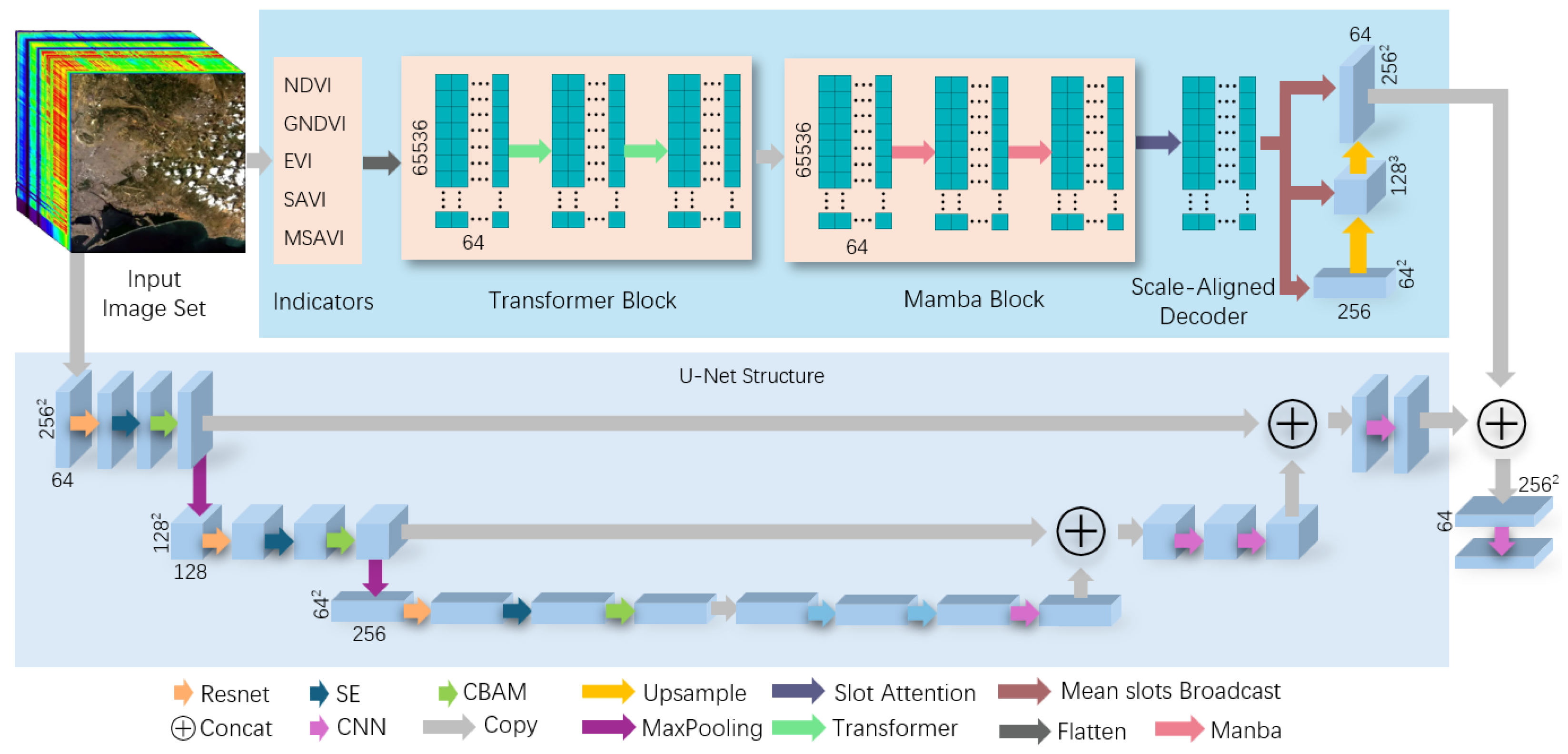
- VISA model: a two-stream network that integrates radiance and vegetation-index reasoning for improved segmentation under mixed canopy scenarios.
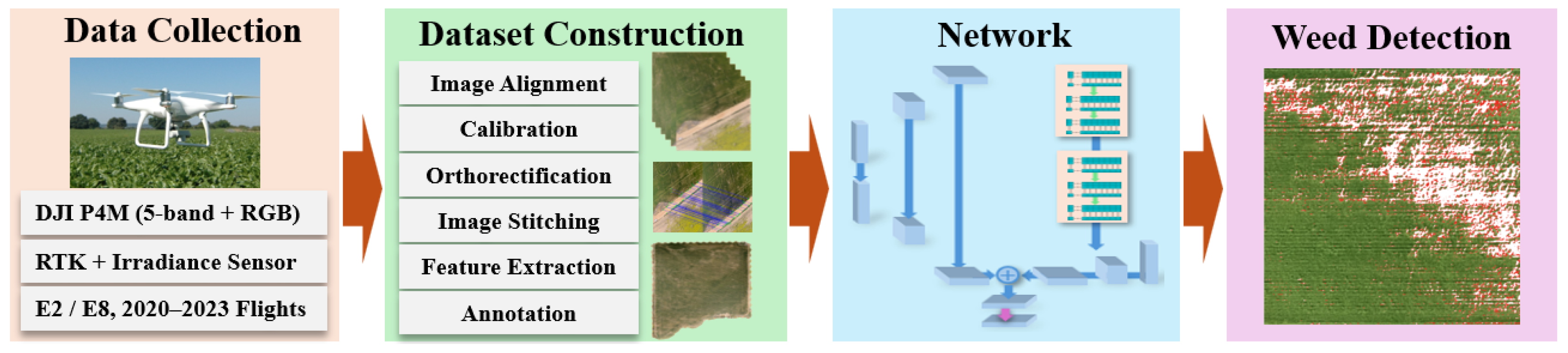
- BAWSeg benchmark: a UAV multispectral dataset for barley fields with high-resolution, pixel-level crop, weed, and soil annotations under realistic field and seasonal variations.
- Evaluation protocol: systematic within-plot, cross-plot, and cross-year benchmarks that demonstrate the utility of BAWSeg for model assessment and precision weed mapping research.
2. Related Work
3. Materials and Methods
3.1. Dataset Construction
3.1.1. Acquisition Platform and Configuration
3.1.2. Flight Mission Geometry and Coverage
3.1.3. Image Preprocessing
3.1.4. Annotation and Dataset Finalization
3.2. Methods
3.2.1. Vegetation-Index Modelling Branch
3.2.2. Spectral Residual Attention Branch
3.2.3. Feature Fusion and Prediction Head
4. Results
4.1. Experimental Setting
4.2. Segmentation Across Plots and Years
4.3. Comparison with Existing Methods
4.4. Ablation Study
5. Discussion
6. Conclusions
Author Contributions
Funding
Data Availability Statement
Acknowledgments
Conflicts of Interest
Abbreviations
| BAWSeg | Barley Weed Segmentation benchmark dataset |
| VISA | Vegetation-Index and Spectral Attention (two-stream segmentation network) |
| UAV | Unmanned Aerial Vehicle |
| RPAS | Remotely Piloted Aircraft System |
| RTK | Real-Time Kinematic |
| RGB | Red, Green, and Blue |
| NIR | Near-Infrared |
| RE | Red Edge |
| NDVI | Normalized Difference Vegetation Index |
| GNDVI | Green Normalized Difference Vegetation Index |
| EVI | Enhanced Vegetation Index |
| SAVI | Soil-Adjusted Vegetation Index |
| MSAVI | Modified Soil-Adjusted Vegetation Index |
| SIFT | Scale-Invariant Feature Transform |
| RANSAC | Random Sample Consensus |
| WSA | Windowed Self-Attention |
| SE | Squeeze-and-Excitation |
| CBAM | Convolutional Block Attention Module |
| GRU | Gated Recurrent Unit |
| mIoU | mean Intersection over Union |
| IoU | Intersection over Union |
| OA | Overall Accuracy |
| CI | Confidence Interval |
| FP16 | 16-bit Floating Point |
| FP32 | 32-bit Floating Point |
References
- ABARES. Australian Crop Report; Technical Report Issue; Australian Bureau of Agricultural and Resource Economics and Sciences (ABARES): Canberra, Australia, 2023. [Google Scholar]
- Grain Industry Association of Western Australia. Barley Council Crop Report and Industry Outlook; Technical Report; Grain Industry Association of Western Australia: Perth, Australia, 2023. [Google Scholar]
- Pacanoski, Z.; Mehmeti, A. Weeds and Their Impact on Crop Production. Plants 2021, 10, 1–18. [Google Scholar]
- Oerke, E.C.; Dehne, H.W.; Schönbeck, F. Yield Losses in Major Crops Due to Weeds and Other Pests. Crop Prot. 2021, 143, 105552. [Google Scholar]
- Llewellyn, R.; Ronning, D.; Ouzman, J.; Walker, S.; Mayfield, A.; Clarke, M. Impact of Weeds on Australian Grain Production; Technical Report; Grains Research and Development Corporation (GRDC): Canberra, Australia, 2016. [Google Scholar]
- Powles, S.B.; Yu, Q. Evolution in Action: Plants Resistant to Herbicides. Annu. Rev. Plant Biol. 2010, 61, 317–347. [Google Scholar] [CrossRef] [PubMed]
- Walsh, M.J.; Harrington, R.B.; Powles, S.B. Harrington Seed Destructor: A New Non Chemical Weed Control Tool for Global Grain Crops. Crop Sci. 2012, 52, 1343–1347. [Google Scholar] [CrossRef]
- Broster, J.C.; Koetz, E.; Wu, H. A Survey of Weed Flora and Weed Management Practices in the Australian Grain Industry. Weed Biol. Manag. 2019, 19, 111–120. [Google Scholar]
- Reeves, T.G.; Code, G.; Sutherland, A. The Effect of Annual Ryegrass (Lolium rigidum) on Yield of Cereals in Mediterranean Type Environments. Aust. J. Exp. Agric. 2018, 58, 412–420. [Google Scholar]
- Eslami, S.V.; Gill, G.S.; Bellotti, B.; McDonald, G. Wild Radish (Raphanus raphanistrum) Interference in Wheat. Weed Sci. 2006, 54, 749–756. [Google Scholar]
- Chlingaryan, A.; Sukkarieh, S.; Whelan, B. Machine Learning Approaches for Crop Yield Prediction and Nitrogen Status Estimation in Precision Agriculture: A Review. Comput. Electron. Agric. 2018, 151, 61–69. [Google Scholar] [CrossRef]
- Lambert, J.; Tisseyre, B.; Guillaume, S. Weed Mapping in Arable Fields Using Low Altitude Imagery Acquired by Unmanned Aerial Vehicles. Precis. Agric. 2018, 19, 684–698. [Google Scholar]
- López-Granados, F. Weed Detection for Site Specific Weed Management: Mapping and Real Time Approaches. Weed Res. 2011, 51, 1–11. [Google Scholar] [CrossRef]
- López-Granados, F.; Torres-Sánchez, J.; De Castro, A.I.; Serrano-Pérez, A.; Mesas-Carrascosa, F.J.; Peña, J.M. Early Season Weed Mapping in Sunflower Using UAV Technology: Variability of Herbicide Treatment Maps Against Weed Thresholds. Precis. Agric. 2016, 17, 183–199. [Google Scholar] [CrossRef]
- Pérez-Ortiz, M.; Peña, J.M.; Gutiérrez, P.A.; Torres-Sánchez, J.; Hervas-Martínez, C.; López-Granados, F. Selecting Patterns and Features for Between and Within Crop Row Weed Mapping Using UAV Imagery. Expert Syst. Appl. 2016, 47, 85–94. [Google Scholar] [CrossRef]
- Jin, X.; Xu, X.; Yang, G.; Feng, H.; Li, Z.; Shen, J. Consistent Improvements in Weed Mapping Performance in Corn Fields Leveraging Multisource Remote Sensing Data and Machine Learning Methods. Front. Plant Sci. 2023, 14, 1237256. [Google Scholar]
- Murad, N.Y.; Mahmood, T.; Forkan, A.R.M.; Morshed, A.; Jayaraman, P.P.; Siddiqui, M.S. Weed detection using deep learning: A systematic literature review. Sensors 2023, 23, 3670. [Google Scholar]
- Ronneberger, O.; Fischer, P.; Brox, T. U Net: Convolutional Networks for Biomedical Image Segmentation. In Proceedings of the Medical Image Computing and Computer Assisted Intervention; Springer International Publishing: Cham, Switzerland, 2015; pp. 234–241. [Google Scholar]
- Badrinarayanan, V.; Kendall, A.; Cipolla, R. SegNet: A Deep Convolutional Encoder Decoder Architecture for Image Segmentation. IEEE Trans. Pattern Anal. Mach. Intell. 2017, 39, 2481–2495. [Google Scholar] [CrossRef]
- Chen, L.C.; Zhu, Y.; Papandreou, G.; Schroff, F.; Adam, H. Encoder Decoder with Atrous Separable Convolution for Semantic Image Segmentation. In Proceedings of the European Conference on Computer Vision; Springer: Berlin/Heidelberg, Germany, 2018; pp. 801–818. [Google Scholar]
- Lottes, P.; Behley, J.; Milioto, A.; Stachniss, C. UAV-based Crop and Weed Classification Using Fully Convolutional Networks. In Proceedings of the ICRA, Singapore, 29 May–3 June 2017; IEEE: Piscataway, NJ, USA, 2017; pp. 5157–5163. [Google Scholar]
- Wang, H.; Ibrahim, M.; Miao, Y.; Severtson, D.; Mansoor, A.; Mian, A.S. Multispectral Remote Sensing for Weed Detection in West Australian Agricultural Lands. In Proceedings of the 2024 International Conference on Digital Image Computing: Techniques and Applications (DICTA); IEEE: Piscataway, NJ, USA, 2024; pp. 624–631. [Google Scholar]
- Peña, J.M.; Torres-Sánchez, J.; de Castro, A.I.; Kelly, M.; López-Granados, F. Weed Mapping in Early Season Maize Fields Using Object Based Analysis of Unmanned Aerial Vehicle Images. PLoS ONE 2013, 8, e77151. [Google Scholar] [CrossRef]
- Wang, H.; Wang, Y.; Wang, X.; Miao, Y.; Zhang, Y.; Zhang, Y.; Mansoor, A. P2MFDS: A Privacy-Preserving Multimodal Fall Detection System for Elderly People in Bathroom Environments. In Proceedings of the International Conference on Artificial Intelligence of Things and Systems; Springer: Berlin/Heidelberg, Germany, 2025; pp. 129–146. [Google Scholar]
- De Castro, A.I.; Torres-Sánchez, J.; Peña, J.M.; Jiménez-Brenes, F.M.; Csillik, O.; López-Granados, F. An Automatic Random Forest OBIA Algorithm for Early Weed Mapping Between and Within Crop Rows Using UAV Imagery. Remote Sens. 2018, 10, 285. [Google Scholar] [CrossRef]
- Castaldi, F.; Pelosi, F.; Pascucci, S.; Casa, R. Assessing the Potential of Images from Unmanned Aerial Vehicles to Support Herbicide Patch Spraying in Maize. Precis. Agric. 2017, 18, 76–94. [Google Scholar] [CrossRef]
- Pérez-Ortiz, M.; Peña, J.M.; Gutiérrez, P.A.; Torres-Sánchez, J.; Hervas-Martínez, C.; López-Granados, F. A Semi Supervised System for Weed Mapping in Sunflower Crops Using Unmanned Aerial Vehicle Imagery. Appl. Soft Comput. 2015, 37, 533–544. [Google Scholar] [CrossRef]
- Ciceklidag, P.; Ibrahim, M.; Wang, H.; Miao, Y.; Hong, J.; Hassan, G.M.; Mian, A.S. High-Definition 3D Point Cloud Mapping of the City of Subiaco in Western Australia. In Proceedings of the DICTA; IEEE: Piscataway, NJ, USA, 2024. [Google Scholar]
- Tamouridou, A.A.; Alexandridis, T.K.; Pantazi, X.E.; Lagopodi, A.L.; Kasampalis, D.A.; Moshou, D. Application of Multilayer Perceptron with Automatic Relevance Determination on Weed Mapping Using UAV Multispectral Imagery. Sensors 2017, 17, 2307. [Google Scholar] [CrossRef]
- Moshou, D.; Pantazi, X.E.; Alexandridis, T.; Bravo, C.; Whetton, R.; Mouazen, A.M. Towards Real Time Weed Detection Using Novelty Detection and UAV Multispectral Imaging. Sensors 2017, 17, 2007. [Google Scholar]
- Ibrahim, M.; Akhtar, N.; Wang, H.; Anwar, S.; Mian, A. Multistream Network for LiDAR and Camera-based 3D Object Detection in Outdoor Scenes. In Proceedings of the 2025 IEEE/RSJ International Conference on Intelligent Robots and Systems (IROS); IEEE: Piscataway, NJ, USA, 2025; pp. 7796–7803. [Google Scholar]
- Ibrahim, M.; Wang, H.; A. Iqbal, I.; Miao, Y.; Albaqami, H.; Blom, H.; Mian, A. Forest stem extraction and modeling (FoSEM): A LiDAR-based framework for accurate tree stem extraction and modeling in radiata pine plantations. Remote Sens. 2025, 17, 445. [Google Scholar] [CrossRef]
- Shahi, T.; Howard, C.; McCool, C. Deep Learning Methods for Weed Mapping in Cropping Systems: A Comparative Study. Drones 2023, 7, 439. [Google Scholar]
- Sa, I.; Chen, Z.; Popović, M.; McCool, R.I.; Dayoub, F.; Corke, P.; Upcroft, B. WeedMap: A Large-Scale Semantic Weed Mapping Framework Using Aerial Multispectral Imaging and Deep Neural Networks. arXiv 2018, arXiv:1809.08938. [Google Scholar] [CrossRef]
- Gupta, A.; Kumar, R.; Sharma, P. Drone-Based Imagery and Deep Learning in Precision Agriculture: A Review. Remote Sens. 2023, 15, 4943. [Google Scholar]
- Olsen, A.; Konovalov, D.A.; Philippa, B.; Ridd, P.; Wood, J.C.; Johns, J.; Banks, W.; Girgenti, B.; Kenny, O.; Whinney, J.; et al. DeepWeeds: A Multiclass Weed Species Image Dataset for Deep Learning. Sci. Rep. 2019, 9, 2058. [Google Scholar] [CrossRef]
- Dosovitskiy, A.; Beyer, L.; Kolesnikov, A.; Weissenborn, D.; Zhai, X.; Unterthiner, T.; Dehghani, M.; Minderer, M.; Heigold, G.; Gelly, S.; et al. An Image is Worth 16 × 16 Words: Transformers for Image Recognition at Scale. In Proceedings of the International Conference on Learning Representations, Virtual Event, Austria, 3–7 May 2021. [Google Scholar]
- Liu, Z.; Lin, Y.; Cao, Y.; Hu, H.; Wei, Y.; Zhang, Z.; Lin, S.; Guo, B. Swin Transformer: Hierarchical Vision Transformer Using Shifted Windows. In Proceedings of the IEEE/CVF International Conference on Computer Vision (ICCV), Montreal, BC, Canada, 11–17 October 2021; IEEE: Piscataway, NJ, USA, 2021; pp. 10012–10022. [Google Scholar]
- Xie, E.; Wang, W.; Yu, Z.; Anandkumar, A.; Alvarez, J.M.; Luo, P. SegFormer: Simple and Efficient Design for Semantic Segmentation with Transformers. In Proceedings of the Advances in Neural Information Processing Systems, Online, 7 December 2021; Curran Associates, Inc.: Red Hook, NY, USA, 2021. [Google Scholar]
- Zuo, X.; Huang, X.; Wang, Y.; Li, J. MSViT: Multi-Scale Vision Transformer for Remote Sensing Image Segmentation. Remote Sens. 2022, 14, 5563. [Google Scholar]
- Liu, Y.; Mei, S.; Zhang, S.; Wang, Y.; He, M.; Du, Q. Semantic Segmentation of High-Resolution Remote Sensing Images Using an Improved Transformer. In Proceedings of the 2022 IEEE International Geoscience and Remote Sensing Symposium (IGARSS); IEEE: Piscataway, NJ, USA, 2022; pp. 3496–3499. [Google Scholar]
- Li, Z.; Chen, H.; He, X.; Li, Y.; Cheng, G.; Li, X. UNetFormer: A UNet-like Transformer for Efficient Semantic Segmentation of Remote Sensing Images. IEEE Trans. Geosci. Remote Sens. 2023, 61, 1–15. [Google Scholar]
- Kong, L.; Ma, L.; Fang, L.; Liu, X. SpectralFormer: Rethinking Hyperspectral Image Classification with Transformers. IEEE Trans. Geosci. Remote Sens. 2022, 60, 1–15. [Google Scholar]
- Ahmad, S.; Chen, Z.; Ikram, S.; Ikram, A. AI-Enabled Vision Transformer for Automated Weed Detection: Advancing Innovation in Agriculture. Int. J. Adv. Comput. Sci. Appl. 2024, 15. [Google Scholar] [CrossRef]
- Guo, Z.; Cai, D.; Jin, Z.; Xu, T.; Yu, F. Research on unmanned aerial vehicle (UAV) rice field weed sensing image segmentation method based on CNN-transformer. Comput. Electron. Agric. 2025, 229, 109710. [Google Scholar] [CrossRef]
- Ma, Y.; Ji, Y.; Cao, J.; Zhang, W. RS3Mamba: Visual State Space Model for Remote Sensing Image Semantic Segmentation. arXiv 2024, arXiv:2404.02457. [Google Scholar] [CrossRef]
- Wang, Y.; Cao, L.; Deng, H. MFMamba: A Mamba-Based Multi-Modal Fusion Network for Semantic Segmentation of Remote Sensing Images. Sensors 2024, 24, 7266. [Google Scholar] [CrossRef] [PubMed]
- Ding, H.; Xia, B.; Liu, W.; Zhang, Z.; Zhang, J.; Wang, X.; Xu, S. A Novel Mamba Architecture with a Semantic Transformer for Efficient Real-Time Remote Sensing Semantic Segmentation. Remote Sens. 2024, 16, 2620. [Google Scholar] [CrossRef]
- Cao, Y.; Liu, C.; Wu, Z.; Zhang, L.; Yang, L. Remote Sensing Image Segmentation Using Vision Mamba and Multi-Scale Multi-Frequency Feature Fusion. Remote Sens. 2025, 17, 1390. [Google Scholar] [CrossRef]
- Li, F.; Wang, X.; Wang, H.; Karimian, H.; Shi, J.; Zha, G. LMVMamba: A Hybrid U-Shape Mamba for Remote Sensing Segmentation with Adaptation Fine-Tuning. Remote Sens. 2025, 17, 3367. [Google Scholar] [CrossRef]
- Zheng, J.; Fu, Y.; Chen, X.; Zhao, R.; Lu, J.; Zhao, H.; Chen, Q. EGCM-UNet: Edge Guided Hybrid CNN-Mamba UNet for Farmland Remote Sensing Image Semantic Segmentation. Geocarto Int. 2025, 40, 2440407. [Google Scholar] [CrossRef]
- Li, R.; Ding, X.; Peng, S.; Cai, F. U-MoEMamba: A Hybrid Expert Segmentation Model for Cabbage Heads in Complex UAV Low-Altitude Remote Sensing Scenarios. Agriculture 2025, 15, 1723. [Google Scholar] [CrossRef]
- Cohen, J. A Coefficient of Agreement for Nominal Scales. Educ. Psychol. Meas. 1960, 20, 37–46. [Google Scholar] [CrossRef]
- Efron, B.; Tibshirani, R.J. An Introduction to the Bootstrap; Chapman & Hall/CRC Monographs on Statistics and Applied Probability; Chapman and Hall/CRC: New York, NY, USA, 1994. [Google Scholar]
- PyTorch Contributors. Reproducibility. PyTorch Documentation. 2025. Available online: https://docs.pytorch.org/docs/stable/notes/randomness.html (accessed on 15 March 2026).
- Loshchilov, I.; Hutter, F. Decoupled Weight Decay Regularization. In Proceedings of the International Conference on Learning Representations, New Orleans, LA, USA, 6–9 May 2019. [Google Scholar]
- Wang, J.; Yang, W.; Zhang, X.; Huang, G.; Qian, J. LoveDA: A Remote Sensing Land-Cover Dataset for Domain Adaptive Semantic Segmentation. arXiv 2021, arXiv:2110.08733. [Google Scholar]
- Breiman, L. Random Forests. Mach. Learn. 2001, 45, 5–32. [Google Scholar] [CrossRef]
- Zhou, Z.; Siddiquee, M.M.R.; Tajbakhsh, N.; Liang, J. UNet++: A Nested U Net Architecture for Medical Image Segmentation. In Proceedings of the Deep Learning in Medical Image Analysis and Multimodal Learning for Clinical Decision Support; Springer International Publishing: Cham, Switzerland, 2018; pp. 3–11. [Google Scholar]
- Chen, L.C.; Papandreou, G.; Schroff, F.; Adam, H. Rethinking Atrous Convolution for Semantic Image Segmentation. arXiv 2017, arXiv:1706.05587. [Google Scholar] [CrossRef]
- Zhao, H.; Shi, J.; Qi, X.; Wang, X.; Jia, J. Pyramid Scene Parsing Network. In Proceedings of the IEEE Conference on Computer Vision and Pattern Recognition; IEEE: Piscataway, NJ, USA, 2017; pp. 2881–2890. [Google Scholar]
- Wang, J.; Sun, K.; Cheng, T.; Jiang, B.; Deng, C.; Zhao, Y.; Liu, D.; Mu, Y.; Tan, M.; Wang, X.; et al. Deep High Resolution Representation Learning for Visual Recognition. IEEE Trans. Pattern Anal. Mach. Intell. 2020, 43, 3349–3364. [Google Scholar] [CrossRef]
- Yu, C.; Gao, J.; Wang, C.; Yu, G.; Shen, C.; Sang, N. BiSeNet V2: Bilateral Network with Guided Aggregation for Real Time Semantic Segmentation. Int. J. Comput. Vis. 2021, 129, 3051–3072. [Google Scholar] [CrossRef]





| Year | Field | mIoU | Per Class IoU | Micro Metrics | Global Metrics | |||||
|---|---|---|---|---|---|---|---|---|---|---|
| Crop | Weed | Other | F1 | OA | ||||||
| 2020 | E2 | 0.748 | 0.842 | 0.621 | 0.781 | 0.838 | 0.846 | 0.842 | 0.943 | 0.784 |
| E8 | 0.751 | 0.844 | 0.623 | 0.786 | 0.840 | 0.848 | 0.844 | 0.944 | 0.786 | |
| 2021 | E2 | 0.754 | 0.845 | 0.626 | 0.791 | 0.842 | 0.850 | 0.846 | 0.945 | 0.789 |
| E8 | 0.759 | 0.848 | 0.630 | 0.800 | 0.844 | 0.852 | 0.848 | 0.946 | 0.791 | |
| 2022 | E2 | 0.762 | 0.850 | 0.636 | 0.801 | 0.846 | 0.854 | 0.850 | 0.947 | 0.795 |
| E8 | 0.760 | 0.849 | 0.633 | 0.798 | 0.845 | 0.853 | 0.849 | 0.947 | 0.793 | |
| 2023 | E2 | 0.757 | 0.846 | 0.632 | 0.794 | 0.843 | 0.851 | 0.847 | 0.946 | 0.792 |
| E8 | 0.763 | 0.851 | 0.638 | 0.800 | 0.848 | 0.856 | 0.852 | 0.948 | 0.799 | |
| Protocol | Train Set | Test Set | mIoU ± CI | Per Class IoU | Micro Metrics | Global Metrics | |||||
|---|---|---|---|---|---|---|---|---|---|---|---|
| Crop | Weed | Other | F1 | OA | |||||||
| Within plot | E2 and E8, 2020 to 2023 | E2 and E8, 2020 to 2023 | 0.847 | 0.635 | 0.794 | 0.851 | 0.843 | 0.847 | 0.946 | 0.794 | |
| Cross plot | E2, 2020 to 2023 | E8, 2020 to 2023 | 0.840 | 0.576 | 0.724 | 0.838 | 0.830 | 0.834 | 0.937 | 0.768 | |
| Cross plot | E8, 2020 to 2023 | E2, 2020 to 2023 | 0.846 | 0.584 | 0.724 | 0.842 | 0.836 | 0.839 | 0.939 | 0.773 | |
| Cross year | 2020 to 2022, E2 and E8 | 2023, E2 and E8 | 0.832 | 0.544 | 0.700 | 0.828 | 0.816 | 0.822 | 0.936 | 0.752 | |
| Method | Year/Venue | Input | mIoU ± CI | Crop IoU | Weed IoU | Others IoU | F1 | OA | Params (M) | |
|---|---|---|---|---|---|---|---|---|---|---|
| RF + Indices [58] | 2021 ML | Indices | 0.674 ± 0.010 | 0.812 | 0.532 | 0.679 | 0.734 | 0.907 | 0.703 | 0.2 |
| SegNet RGB [19] | 2019 TPAMI | RGB | 0.694 ± 0.009 | 0.825 | 0.558 | 0.699 | 0.752 | 0.915 | 0.718 | 29.4 |
| SegNet MSI [19] | 2024 TPAMI | MSI | 0.702 ± 0.009 | 0.831 | 0.567 | 0.708 | 0.759 | 0.918 | 0.724 | 29.5 |
| U-Net RGB [18] | 2023 MICCAI | RGB | 0.712 ± 0.008 | 0.836 | 0.579 | 0.720 | 0.768 | 0.922 | 0.732 | 31.0 |
| U-Net MSI [18] | 2022 MICCAI | MSI | 0.731 ± 0.007 | 0.842 | 0.594 | 0.758 | 0.783 | 0.930 | 0.748 | 31.1 |
| UNet++ MSI [59] | 2024 DLMIA | MSI | 0.735 ± 0.007 | 0.844 | 0.603 | 0.759 | 0.787 | 0.932 | 0.751 | 34.2 |
| DeepLabv3 R50 RGB [60] | 2020 arXiv | RGB | 0.724 ± 0.008 | 0.838 | 0.585 | 0.748 | 0.775 | 0.928 | 0.743 | 41.1 |
| DeepLabv3+ R50 MSI [20] | 2024 ECCV | MSI | 0.738 ± 0.007 | 0.845 | 0.609 | 0.761 | 0.788 | 0.933 | 0.753 | 43.3 |
| PSPNet R50 RGB [61] | 2023 CVPR | RGB | 0.720 ± 0.008 | 0.835 | 0.582 | 0.743 | 0.772 | 0.927 | 0.739 | 46.3 |
| HRNetV2 W18 MSI [62] | 2022 TPAMI | MSI | 0.740 ± 0.007 | 0.846 | 0.611 | 0.763 | 0.792 | 0.934 | 0.756 | 65.8 |
| BiSeNetV2 RGB [63] | 2021 IJCV | RGB | 0.707 ± 0.009 | 0.829 | 0.566 | 0.726 | 0.764 | 0.921 | 0.729 | 13.4 |
| SegFormer B0 RGB [39] | 2021 NeurIPS | RGB | 0.732 ± 0.007 | 0.843 | 0.598 | 0.755 | 0.784 | 0.931 | 0.749 | 13.7 |
| SegFormer B1 RGB [39] | 2021 NeurIPS | RGB | 0.736 ± 0.007 | 0.846 | 0.602 | 0.760 | 0.787 | 0.933 | 0.752 | 27.6 |
| SegFormer B1 MSI [39] | 2023 NeurIPS | MSI | 0.744 ± 0.005 | 0.847 | 0.616 | 0.769 | 0.793 | 0.943 | 0.786 | 27.8 |
| Ours | 2026 | MSI | 0.847 | 0.635 | 0.794 | 0.847 | 0.946 | 0.794 | 22.8 |
| Variant | mIoU ↑ | Weed IoU ↑ | Params (M) ↓ | FLOPs (G) ↓ | Mem (GB) ↓ | FPS ↑ | |
|---|---|---|---|---|---|---|---|
| Module removal or replacement | |||||||
| Full model | 0.635 | 22.8 | 33.6 | 2.60 | 78 | ||
| w/o VIMB (RAW only) | 0.596 | 9.6 | 25.4 | 2.20 | 92 | ||
| w/o relative bias in WSA | 0.626 | 12.8 | 33.4 | 2.60 | 78 | ||
| w/o Slot Attention | 0.618 | 12.3 | 32.4 | 2.50 | 80 | ||
| w/o mean-slot broadcast | 0.622 | 12.3 | 32.4 | 2.50 | 80 | ||
| Single-scale decoder (idx stream) | 0.621 | 12.6 | 32.7 | 2.55 | 80 | ||
| Quantity changes | |||||||
| WSA heads | 0.627 | 12.8 | 33.5 | 2.60 | 78 | ||
| WSA heads (full) | 0.635 | 12.8 | 33.6 | 2.60 | 78 | ||
| WSA heads | 0.637 | 12.9 | 34.4 | 2.70 | 74 | ||
| Mamba layers | 0.610 | 12.2 | 31.5 | 2.50 | 82 | ||
| Mamba layers | 0.624 | 12.5 | 32.5 | 2.55 | 79 | ||
| Mamba layers (full) | 0.635 | 12.8 | 33.6 | 2.60 | 78 | ||
| Mamba layers | 0.637 | 13.1 | 34.9 | 2.70 | 75 | ||
Disclaimer/Publisher’s Note: The statements, opinions and data contained in all publications are solely those of the individual author(s) and contributor(s) and not of MDPI and/or the editor(s). MDPI and/or the editor(s) disclaim responsibility for any injury to people or property resulting from any ideas, methods, instructions or products referred to in the content. |
© 2026 by the authors. Licensee MDPI, Basel, Switzerland. This article is an open access article distributed under the terms and conditions of the Creative Commons Attribution (CC BY) license.
Share and Cite
Wang, H.; Wang, X.; Ibrahim, M.; Severtson, D.; Mian, A. BAWSeg: A UAV Multispectral Benchmark for Barley Weed Segmentation. Remote Sens. 2026, 18, 915. https://doi.org/10.3390/rs18060915
Wang H, Wang X, Ibrahim M, Severtson D, Mian A. BAWSeg: A UAV Multispectral Benchmark for Barley Weed Segmentation. Remote Sensing. 2026; 18(6):915. https://doi.org/10.3390/rs18060915
Chicago/Turabian StyleWang, Haitian, Xinyu Wang, Muhammad Ibrahim, Dustin Severtson, and Ajmal Mian. 2026. "BAWSeg: A UAV Multispectral Benchmark for Barley Weed Segmentation" Remote Sensing 18, no. 6: 915. https://doi.org/10.3390/rs18060915
APA StyleWang, H., Wang, X., Ibrahim, M., Severtson, D., & Mian, A. (2026). BAWSeg: A UAV Multispectral Benchmark for Barley Weed Segmentation. Remote Sensing, 18(6), 915. https://doi.org/10.3390/rs18060915