Article

Long- Versus Short-Term Changes in Seafloor Elevation and Volume of the Upper Florida Keys Reef Tract: 1935–2002 and 2002–2016

St. Petersburg Coastal and Marine Science Center, U.S. Geological Survey, 600 Fourth St. S, St. Petersburg, FL 33701, USA
*
Author to whom correspondence should be addressed.
Remote Sens. 2026, 18(3), 463; https://doi.org/10.3390/rs18030463
Submission received: 2 April 2025 / Revised: 16 January 2026 / Accepted: 24 January 2026 / Published: 1 February 2026

Highlights

What are the main findings?
  • The Upper Florida Keys portion of the Florida Reef Tract experienced a major shift from substantial net elevation and volume loss (−0.1 ± 0.8 m; 13.6 × 10⁶ m3) during 1935–2002 to minimal net gain (0.0 ± 0.3 m; 1.6 × 10⁶ m3) from 2002 to 2016, coinciding with reduced hurricane frequency, persistently low stony coral cover, and proliferation of octocorals and macroalgae.
  • Comprehensive spatial analysis revealed pronounced variability in accretion and erosion patterns across habitats and subregions; coral-dominated substrates—constituting only 15% of the area—experienced the most significant changes over both periods.
What are the implications of the main findings?
  • Despite minimal net elevation gains from 2002 to 2016, persistent benthic community degradation with stony coral cover remaining below 10% indicates insufficient carbonate production for sustainable long-term reef accretion and structural integrity.
  • Spatial heterogeneity in elevation and volume change underscores the need for multidecadal, ecosystem-wide monitoring to establish critical baselines for risk assessment and restoration planning and shows that local changes alone cannot accurately represent broader reef trends.

Abstract

Coral reefs provide immense ecosystem and economic value, supporting biodiversity, fisheries, tourism, and coastal protection worth billions annually. However, widespread degradation from thermal stress, storms, disease, and human impacts has caused significant coral cover and reef structure loss, increasing coastal vulnerability and economic risks. While coral loss is well-documented, degradation of underlying reef infrastructure and surrounding seafloor changes remain poorly understood. This study addresses this knowledge gap by quantifying seafloor elevation and volume changes across 234.2 km2 of the Upper Florida Keys (UFK) reef tract using historical bathymetric and modern lidar (light detection and ranging) data collected from two periods with distinctly different disturbance regimes: 1935–2002 (frequent storms and major coral loss) and 2002–2016 (few storms and persistently low coral cover). Analysis of over 25,000 data points revealed substantial elevation and volume loss during 1935–2002 (−0.1 ± 0.8 m; 13.6 × 10⁶ m3 net loss), shifting to minimal gains by 2002–2016 (0.0 ± 0.3 m; 1.6 × 10⁶ m3 net gain). Despite this shift, benthic cover data showed continued declines in stony coral, with increases in macroalgae and octocorals, indicating that limited reef accretion persists even with reduced storm activity. Spatial analyses highlighted variable accretion and erosion patterns across habitats and subregions, underscoring the limitations of localized measurements for ecosystem-wide assessments. Our findings demonstrate the value of integrating historical and modern datasets for regional reef monitoring, establishing baselines for restoration planning, and emphasizing the need for continued high-resolution monitoring to guide adaptive management amid ongoing environmental change.

1. Introduction

Coral reefs are essential ecosystems that provide a wide array of ecological and socioeconomic benefits. Three-dimensional reef structures, primarily formed by reef-building corals, play a crucial role in biodiversity by offering habitat, refuge, and key functions, such as wave energy dissipation and coastal stability [1,2,3]. This structural complexity enhances reef resilience, influencing sediment movement, shading, refuge availability, and ecosystem connectivity [4,5,6]. Beyond their ecological significance, coral reefs contribute substantially to global economic systems, with their ecosystem services—including coastal protection from storms, seafood provision, recreational opportunities, pharmaceutical compounds, fishery habitat, and the aquarium trade—valued at approximately US $2.7 trillion to US $10 trillion per year [7,8,9,10]. The National Oceanic and Atmospheric Administration (NOAA) estimates that coral reefs in Florida have a socioeconomic value of $8.5 billion, generating $4.4 billion in local sales, $2 billion in local income, and 70,400 jobs [11]. In addition, these reefs protect Florida coastal communities from flooding hazards at an approximate value of US $675 million on an annual basis [12,13].
Despite being highly valued, these diverse and critically important ecosystems have been in decline for decades [14,15,16,17]. For the period of 1957–2007, Eddy et al. [18] estimated a 50% loss in global live coral cover. Multiple biological, chemical, geological, and anthropogenic processes impact reef structure across various timescales. These processes include storms, disease, bioerosion, pollution, overfishing, thermal stress, terrestrial runoff, habitat destruction, eutrophication, acidification, and sea level rise, all contributing to global reef degradation [3,14,15,16,17,19]. For the Florida Keys specifically, reef degradation has been documented since the 1970s [20,21,22], with stony coral cover declining by more than 50% region-wide [23,24,25] and reaching estimated levels of over 90% loss for major reef-building species such as Acropora palmata (elkhorn coral) and Acropora cervicornis (staghorn coral) in historically productive reefs in the UFK [21,26,27] (Figure 1). In fact, Florida Keys-wide stony coral cover has remained below 10% since 1999, among the lowest in the wider Caribbean [28,29], reflecting persistent ecosystem degradation through coral mortality and structural loss.
Most reef degradation research has focused on changes in the percent cover of live stony corals, phase shifts to benthic algae, or changes in reef-associated fish populations [32,33,34]. Less well-documented is the loss of underlying reef infrastructure and changes in the surrounding seafloor of the broader coral reef ecosystem, which includes seagrass, sand, and rubble zones. Historical reef geomorphology assessments prior to the 1990s relied on disparate datasets, including lead-line soundings and aerial photographs. This created significant limitations in spatial scope and temporal coverage for elevation change studies [35]. This sparse baseline data constrains our understanding of long-term structural changes, as many systems underwent substantial degradation before systematic monitoring began.
Addressing this limitation requires accurate, long-term monitoring of seafloor elevation, yet integrating historical and modern datasets presents significant methodological challenges due to fundamental differences in data collection techniques, spatial resolution, and georeferencing accuracy. Fortunately, recent advances in bathymetric technology have transformed seafloor elevation monitoring capabilities on coral reefs. Seafloor measurement technology has evolved from manual lead-line soundings to acoustic systems—first single-beam, and then multibeam echosounders—before the adoption of airborne bathymetric lidar in the late 1990s and early 2000s, which significantly improved shallow water and reef mapping [36]. The 2002 Experimental Advanced Airborne Research Lidar (EAARL) system used in this study represented an early generation of airborne lidar, offering sub-meter resolution and full-waveform digitizing [37]. However, more recent systems like the Riegl VQ-820-G (RIEGL Laser Measurement Systems GmbH, Horn, Austria) used in 2016 are more advanced, featuring much higher pulse rates, denser point clouds, improved horizontal and vertical accuracy, and increased water depth penetration [38]. These improvements enable more detailed, accurate, and extensive mapping of seafloor and coastal environments, supporting robust multitemporal and multiscale spatial analyses and providing critical baselines for reef monitoring and management [39]. Current lidar technologies, however, are still constrained by factors such as water clarity, limited depth penetration, interference from benthic vegetation, and the inability to distinguish live coral from other substrates. Future studies should focus on integrating complementary data sources such as Structure-from-Motion photogrammetry and refining remote-sensing methods to enhance ecological interpretation [40].
Building upon these technological advancements, Yates et al. [35] introduced methods for effectively comparing historical lead line sounding data with contemporary lidar data, demonstrating the feasibility of multidecadal seafloor elevation change analyses. They analyzed historical seafloor elevation data for five regions totaling over 500 km2, comparing historic lead line and lidar measurements across multidecadal time periods. In all five regions, they found the reef systems were net erosional, with erosion of both coral-dominated and non-coral substrates, suggesting that current carbonate production rates are insufficient to support net accretion. Moreover, the loss of seafloor elevation and volume increased current water depths to levels not predicted until near the year 2100 due to sea level rise alone. The value of this type of study was demonstrated when elevation change data were incorporated into economic projections for coastal hazard risk assessment [13,41]. Updated economic projections that include elevation change data estimate that continued degradation of Florida’s coral reefs will conservatively result in the annual loss of US $823.6 million. This represents a $148.6 million increase from the initial estimate of $675 million due to increased storm damage to buildings and businesses [13].
Here, we expand upon the baseline research of [35] by reporting recent seafloor elevation changes from 2002–2016 for the Upper Florida Keys (UFK) study site and comparing rates of elevation and volume change from this decadal period to the multidecadal period from 1935–2002. This expanded analysis addresses a critical gap by examining net elevation changes (the combined effect of all processes affecting seafloor accretion and erosion) during two periods with dramatically different ecological and physical disturbance regimes: 1935–2002 (seven major hurricanes and rapid coral decline) and 2002–2016 (minimal storm activity and stable low coral cover).

2. Materials and Methods

2.1. Study Site

The Florida Keys are a crescent-shaped chain of narrow islands oriented end-to-end and extending for approximately 225 km in a south–southwesterly direction from near Miami to Key West [42]. These islands are often divided into the groups Upper, Middle, and Lower Keys based on geological and environmental conditions [43]. The Upper and Middle Keys are Key Largo limestone consisting of the fossilized remnants of patch reefs, associated reef sands, and skeletal remains of marine organisms from ~125,000 years ago during the Pleistocene Epoch, when the sea level was ~6 m higher than present [42,44,45]. The Lower Keys are oolitic Miami limestone that were tidal bars, which also formed around 125,000 years ago, and their northwest–southeast orientation is indicative of tidal current flow direction [45].
Located ~5–10 km offshore of the southeast Florida coast and the Florida Keys, the Florida Reef Tract (FRT) is the only living coral reef in the continental United States, extending from Martin County in the north to the Dry Tortugas in the southwest [46]. The portion of the reef tract located offshore of the Florida Keys lies predominantly in waters 6–10 m deep [45] and includes more than 6000 patch reefs as well as outer shelf reefs [47]. A 234.2 km2 area of the Upper Florida Keys (UFK) portion of the reef tract and surrounding habitats—extending from Triumph Reef to Pickles Reef (25°28′35.0156″N, 80°06′34.2645″W–24°57′56.0589″N, 80°27′54.0085″W)—was chosen as the study site based on the availability of seafloor elevation data from multiple time periods (Figure 2). This region overlaps with 97% of the UFK study site in the previous work by [35]. The slightly smaller size is primarily due to limited bathymetric lidar coverage in 2016 along the seaward edge of the reef tract between Carysfort Reef (25°13′20.177″N, 80°12′40.655″W) and The Elbow (25°8′33.694″N, 80°15′38.901″W). Consequently, the total number of elevation points was reduced from 26,341 to 25,926. Yates et al. [35] identified three subregional patterns in elevation change for the 1935 to 2002 period. These subregions roughly divide the study site into thirds, which were also analyzed in this study (Figure 2).

2.2. Bathymetric Data Processing

To allow direct comparison of elevation and volume change results between the time periods of 1935–2002 and 2002–2016, we repeated the methods of Yates et al. [35] for analysis of their Upper Florida Keys site using the overlapping study area defined by the areal extent of the 2016 lidar data and the corresponding historical hydrographic survey (H-sheet) sounding and 2002 lidar data (Table S1). Briefly, the process began with acquisition and preparation of historical data to ensure the data were transformed into a common vertical datum and corrected for sea level rise [48] (Supplementary Methods S1.1). Historical points were spatially clipped to match the extent of modern DEMs (Digital Elevation Models), and modern elevation values were extracted at the exact locations of historical measurements (Section 2.3 and Supplementary Methods S1.2). The mean elevation change, standard deviation, and volume change statistics were calculated across the entire site, subregions, and habitat types, as well as for combined habitat classifications (coral-dominated and non-coral) (Supplementary Methods S1.3 and S1.4). Habitat type designations were determined using Level 2 classifications from the Florida Fish and Wildlife Conservation Commission’s Unified Florida Reef Tract Map v1.2 [49,50]. Elevation change was calculated as the difference between modern and historical elevations at each point (Supplementary Methods S1.3). Volume change statistics were calculated from three-dimensional TIN (Triangulated Irregular Network) surface models (X, Y, Z - change ) for both time periods. Minimum and maximum net volume changes were computed by summing gains and losses above and below threshold values (Supplementary Methods S1.4).
Pearson correlation and simple linear regression analyses were subsequently performed using open-source R Statistical Software (v4.4.3; https://www.r-project.org/) for both time periods to quantify the relationships between the mean water depth and mean elevation change for each habitat within each subregion. Correlation coefficients provided measures of association strength, while regression slopes (β) and R2 values quantified the direction and proportion of variance explained by the relationship, respectively. These statistical measures were interpreted within the framework of coastal sediment transport processes. Regression slopes served as indicators of sediment transport direction and magnitude: negative slopes suggested net offshore/downslope sediment transport, positive slopes indicated net onshore/upslope transport, and slopes near zero suggested minimal net transport or local sediment redistribution patterns. The statistical significance of both correlation and regression analyses was evaluated using p-values, with α = 0.05 as the threshold for significance.
This processing workflow enables robust, regional-scale quantification of net seafloor elevation and volume changes over decadal to multidecadal timescales and is described in detail in [35]; therefore, we present only methodological modifications made to incorporate the 2016 data in the elevation and volume change analyses. For comprehensive information on the data-processing steps, as well as calculation of elevation changes and volume changes with related statistics, refer to Yates et al.’s study [35] and our Supplementary Methods. These sources provide additional details of the 1935–2002 data transformations and sea level rise corrections (Supplementary Section S1.1), selection and extraction of elevation data points (Supplementary Section S1.2), calculation of elevation change and related statistics, including habitat designations (Supplementary Section S1.3), and calculation of volume changes (Supplementary Section S1.4).

2.3. Data Incorporation for 2016

The 2016 lidar data were acquired between July and November 2016 by NOAA’s National Ocean Service, the National Geodetic Survey (NGS), the Remote Sensing Division, using a Riegl VQ-820-G system. The data extend from Virginia Key, off the coast of Miami, Florida, down to Key West, Florida, and are organized into four DEMs. In this study, we used three lidar datasets that overlapped with the 2002 lidar, including (1) 2016 NOAA NGS Topobathy Lidar: Florida Keys Outer Reef Block 02 [51]; (2) 2016 NOAA NGS Topobathy Lidar: Florida Keys Outer Reef Block 03 [52]; and (3) 2017 NOAA NGS Topobathy Lidar: Florida Keys Outer Reef Block 04 [53]. These datasets were downloaded from NOAA’s Digital Coast Data Access Viewer [54]. Note that these datasets are point clouds, not DEMs. Point clouds allowed for more accurate alignment with historical sounding data locations. Table S2 lists the settings we used to generate DEMs from the three-point cloud data sets. The grid method of “TIN” was chosen because it is comparable to the grid method used to create the 2002 U.S. Geological Survey (USGS) DEMs. Global Mapper v19.1 [55] was used to merge the three NOAA DEMs into a single DEM. Importantly, the current Data Access Viewer does not support older versions of the NAD83 horizontal datum. Since the 2002 USGS lidar data were only available in NAD83 (1986 adjustment), Global Mapper [55] was also used to transform the merged NOAA DEM into this older NAD83 horizontal datum. The merged 2016 NOAA DEM covers a larger area than the 2002 USGS DEM, and both DEMs have data gaps of different sizes and in different locations. These gaps or data dropouts represent points where the detected return signal was too noisy or weak. To ensure consistency in our analyses, we clipped the NOAA DEM to match the areal extent of the USGS DEM and then removed the drop-out areas in one DEM from the other and vice versa. This process ensured that both resultant DEMs had identical footprints with the same data gaps.
Next, we visually inspected both DEMs to identify subaerial regions and anomalous data points. The NOAA DEM contained two small subaerial areas totaling 0.047 km2 and 56 individual subaerial points. To maintain consistency during elevation and volume change calculations, we assigned all subaerial regions and points a “No Data” value.

2.4. Error Analyses

Yates et al. [35] provide a detailed treatment of horizontal error in both the 1935 sounding data and the 2002 USGS lidar data. They reported horizontal uncertainties of 4 m and better than 1 m for the 1935 soundings and 2002 lidar, respectively. Those authors chose to sum these estimated sources of error to provide a more conservative error estimate instead of calculating a root-mean-squared error (RMSE). Moreover, they demonstrated that shifting the historical sounding data by twice this error (10 m) relative to the lidar data produced no more than a 10% difference in net and area-normalized volume change results in the UFK due to the large geographic extent of the study site.
The metadata for the 2016 NOAA lidar states latitudinal and longitudinal resolutions of 0.0000001 decimal degrees, or roughly 0.01 m at the 25°N nominal latitude of our study site, but does not provide any value for horizontal accuracy or uncertainty. However, NOAA’s National Geodetic Survey Remote Sensing Division did confirm that the horizontal uncertainty is better than 0.3 m [56]. Although the horizontal uncertainties for the two lidar datasets are markedly less than those for the 1935 sounding data, we still performed a horizontal shift analysis between the 2002 and 2016 lidar data, similar to Yates et al. [35], but using a shift of 2 m, which was approximately twice the combined lidar horizontal uncertainties (Table S3). This approach allowed assessment of how modest spatial error could affect volume change calculations and demonstrated that, even in a conservative scenario, horizontal uncertainty did not substantially alter the study conclusions.
Yates et al. [35] reported vertical uncertainties (RMSE values) of 0.23 m and 0.15 m for the 1935 soundings and 2002 USGS lidar measurements, respectively. The VDatum transformation of the soundings from mean low water to NAVD88 introduced an additional uncertainty of 0.081 m. Although the 2016 lidar metadata did not provide any value for vertical accuracy or uncertainty, NOAA did state that the vertical uncertainty is better than 0.15 m [56]. Following Yates et al. [35], we calculated the composite vertical RMSETotal for each study period as
R M S E T o t a l 1935 ,   2002 = R M S E S o u n d i n g 2 + R M S E V D a t u m 2 + R M S E 2002 2 ,
R M S E T o t a l 2002 ,   2016 = R M S E 2002 2 + R M S E 2016 2
which combine the appropriate uncertainty terms for each case (Table S4).
We then calculated a more conservative RMSETotal for each time period by using the normal inverse cumulative distribution function to establish a threshold value. Since RMSETotal serves as a proxy for standard deviation, we used it to approximate the variability in elevation change values. In a normal distribution, approximately 68% of the data falls within ±1 standard deviation of the mean, while 95% falls within ±2 standard deviations. Using the normal inverse cumulative distribution function, we determined that 90% of elevation change values would be contained within ±1.65 standard deviations of the mean. To account for this range, we then multiplied RMSETotal by 1.65, ensuring our threshold captured about 90% of the variability in depth differences while minimizing the influence of outliers. This approach ensured a statistically rigorous representation of variability by leveraging established probability distributions rather than arbitrarily selecting a cutoff.
Applying this threshold necessarily excludes some elevation change values from further analysis, which can influence the significance of elevation and volume change results. To assess this impact, we conducted statistical testing on the reduced datasets for both the 1935–2002 and 2002–2016 time periods. We used a two-tailed t-test to determine if the mean elevation change ( Z - change ) was statistically zero for a given dataset and RMSE value. If the null hypothesis was rejected, a one-tailed t-test was conducted to determine whether the mean elevation change was significantly greater than or less than zero. All t-tests were performed at the 5% significance level.

3. Results

The results for the period of 1935–2002 were calculated using this smaller point set (see Section 2.1 and Supplementary Section S1.2), and some of the results may slightly differ from those in Yates et al.’s study [35]. Unless otherwise stipulated, volume change values stated in the following sections pertain to our most conservative, lower-bound values.

3.1. Error Analyses

The results from the horizontal shift analysis between the 2002 and 2016 lidar datasets indicate that 2 m of horizontal error produced no more than a 11% difference in the net and area-normalized volume change results (Table S3). These findings are comparable to those between 1935 and 2002 reported by Yates et al. [35], reinforcing that even conservative estimates of spatial uncertainty have a relatively minor effect on volume change outcomes across this broad study area.
Our vertical RMSE calculations yielded 0.15 m for the 2002–2016 period and 0.23 m for the 1935–2002 study period (Table S4). This difference was due to the improved accuracy of modern lidar measurements over manually collected soundings. Applying the RMSE thresholds necessarily excluded some elevation change points from further analysis.
For each study period, we tallied the number of remaining points after applying the relevant RMSE threshold values both for the total study site and for each habitat type (Table 1). Following Yates et al. [35], our most conservative RMSE value was 0.5 m, which was the 1.65 × RMSETotal (1935, 2002) value rounded to one significant figure.
For the 1935–2002 period, 34% of the Z - change values exceeded the 0.5 m RMSE, i.e., were either less than −0.5 m or greater than +0.5 m, and 6% exceeded that threshold for the 2002–2016 period. At this RMSE threshold, the habitats “aggregate reef,” “pavement with sand channels,” “scattered coral/rock in unconsolidated sediment,” and “spur and groove” still retained >50% of their points for the 1935–2002 period, three of which represent coral-dominated habitats. No habitat retained more than 15% of its original elevation-change points for the 2002–2016 period.
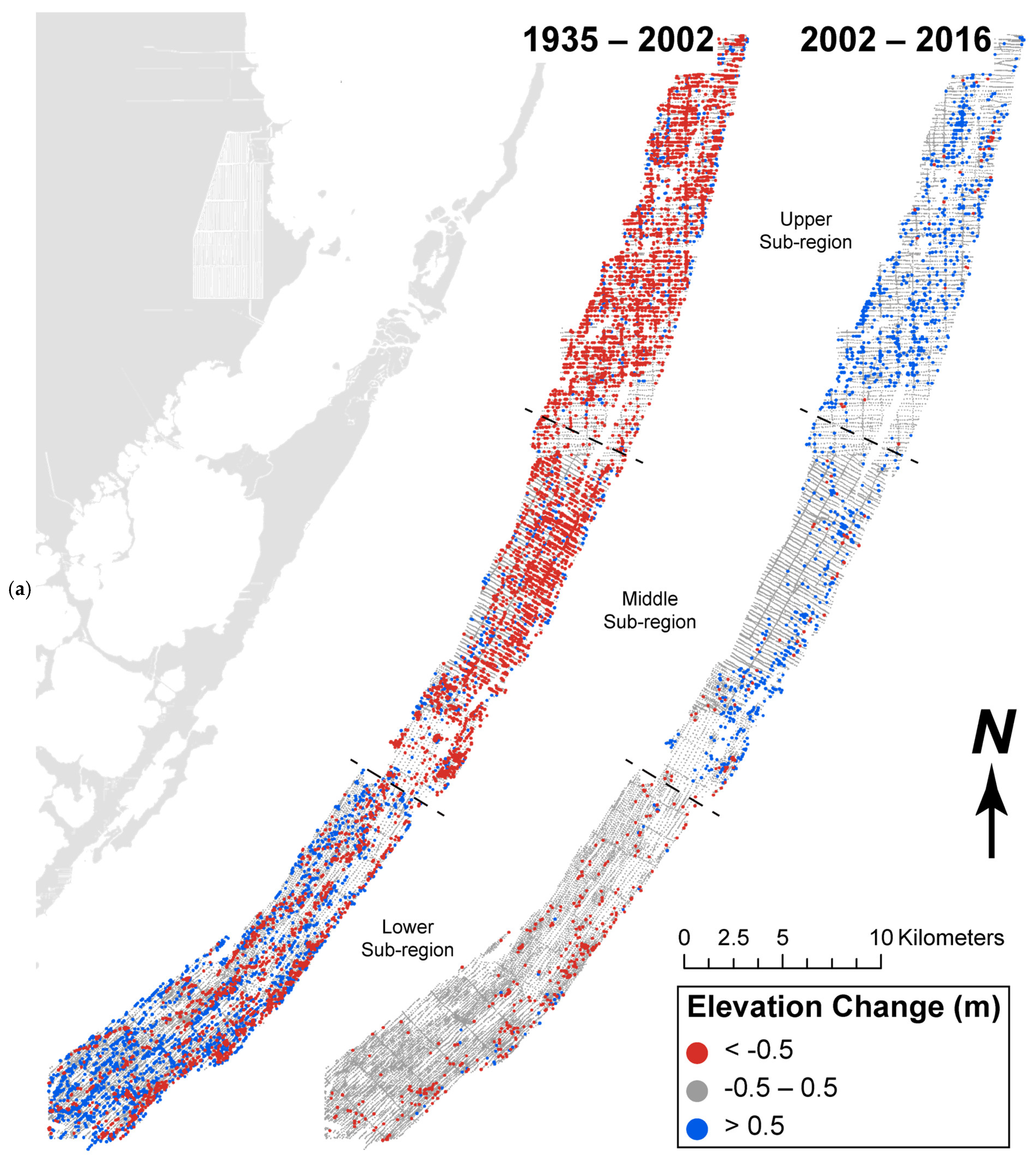
The total study site, two-tailed t-tests for all RMSEs, and both time periods rejected the null hypothesis of a statistical zero-mean elevation change (Table 2). Subsequent one-tailed t-tests for the 1935–2002 period supported the hypothesis of a mean elevation change of less than zero, i.e., net elevation loss, for all RMSEs. For the 2002–2016 period, one-tailed t-tests supported the hypothesis of a mean elevation change of greater than zero, i.e., net elevation gain, for all RMSEs. Note that for a given t-test, the value of the t-statistic at the 5% significance level (tcritical) was identical for all RMSEs. This outcome was due to the large number of elevation change points (>1000) being evaluated, even after applying the 0.5 m RMSE, and to maintaining a large sample size, which ensured the statistical power of the t-tests. Also, note that the absolute value of the t-statistic for every RMSE was significantly larger than the critical value (|t| ≥ tcritical), which was indicative of the remaining Z - change values being non-zero. Following Yates et al. [35], all data points were used for both the elevation change and upper-bound volume change analyses (Table 3 and Table 4). The 0.5 m RMSE was only used for the lower-bound volume change analyses (Table 4). Note in Table 3 that the mean elevation change for 2002–2016, including all data points, was reported as 0.0 m, but the actual numerical mean was 0.0046 m. However, the vertical uncertainty in the lidar data was 0.15 m (Table S4), so rounding the mean elevation change to one significant figure yielded 0.0 m. This result underscores the caution that must be used when reporting and interpreting mean values, and the importance of hypothesis testing as part of interpreting mean values. In addition, the standard deviations for both study periods were extremely large relative to the means, indicating significant heterogeneity in the elevation values, which is evident in Figure 2a,b.

3.2. Overall Seafloor Elevation Changes

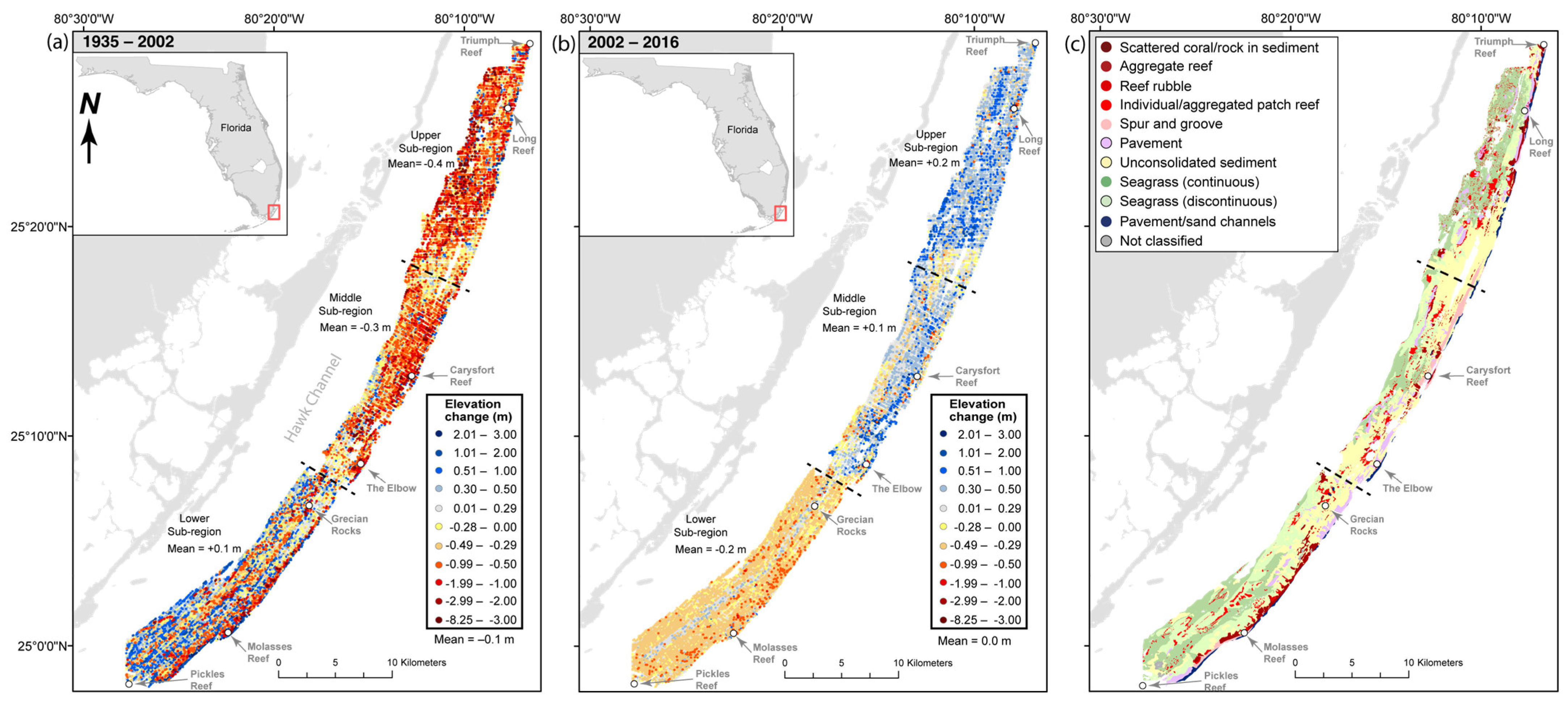
The reduction in elevation points had no significant effect on the elevation change results for the multidecadal 1935–2002 period when compared with those reported in Yates et al.’s study [35]. The same patterns and trends were still evident. Namely, there was a net decrease in seafloor elevation and a transition from net erosion to net accretion from north to south within the study site (Figure 2a). The overall mean elevation change and standard deviation were −0.1 ± 0.8 m (Table 3). Among the 25,926 individual elevation change values, 14,730 (57%) showed decreasing elevation, with a mean of −0.6 m and a maximum of −8.3 m; 11,196 (43%) showed elevation increases, with a mean of 0.4 m and a maximum of 6.5 m. In contrast, the results for the 2002–2016 period showed a zero mean elevation change (see discussion in Section 3.1; Table 3), as well as an apparent shift from net erosion to no change or possibly minimal net accretion from north to south. The overall mean elevation change and standard deviation were 0.0 ± 0.3 m. The number of elevation loss points (14,179 or 55%) still exceeded gain points (11,747 or 45%), with a mean of −0.2 m and a maximum of −2.2 m. The mean elevation gain and maximum were 0.2 m and 8.9 m, respectively. The differences between the two study periods were even more evident when considering just the elevation change points that exceeded our most conservative RMSE threshold of ±0.5 m (Figure 3a). For the earlier, multidecadal time period, approximately one-third of elevation change points exceeded the threshold (Table 1: 8815 or 34%) with 5641 points having losses of more than 0.5 m, and 3174 points having gains of more than 0.5 m. Spatially, these 8815 points were relatively evenly distributed throughout the study site (Figure 3a). In contrast, few points exceeded the threshold for the more recent 14-year time period (Table 1: 1682 or 6%), with 431 points having losses of more than 0.5 m, and 1251 points having gains of more than 0.5 m. Most of these 1682 points were located in the upper subregion (Figure 3a).

3.3. Subregional Seafloor Elevation Changes

For the three subregions of the UFK study site, the total number of elevation change points increased from north to south, with 6070 points in the upper to 7088 in the middle and 12,768 in the lower (Tables S5 and S6). The spatial distribution of elevation change values was complex for both time periods, with varying degrees of gains and losses intermingled throughout the study site (Figure 2a,b). However, some general patterns and trends were evident. For the 1935–2002 period, there was an overall transition from predominantly elevation loss in the upper and middle subregions to a slight elevation gain in the lower subregion. Mean elevation changes showed net losses in the upper (−0.4 m) and middle (−0.3 m) subregions, and a net elevation gain in the lower subregion (+0.1 m; Figure 2a; Table S5). The largest elevation loss (−8.3 m) and gain (6.5 m) points were both located in the middle subregion. For the 2002–2016 period, elevation change values exhibited a reverse pattern across subregions. Both the upper and middle subregions had small positive mean elevation changes of 0.2 and 0.1 m, respectively, and the lower subregion had a negative mean change of −0.2 m (Figure 2b; Table S6). The largest elevation loss (−2.2 m) was located in the upper subregion, and the largest gain (8.9 m) was in the middle subregion.
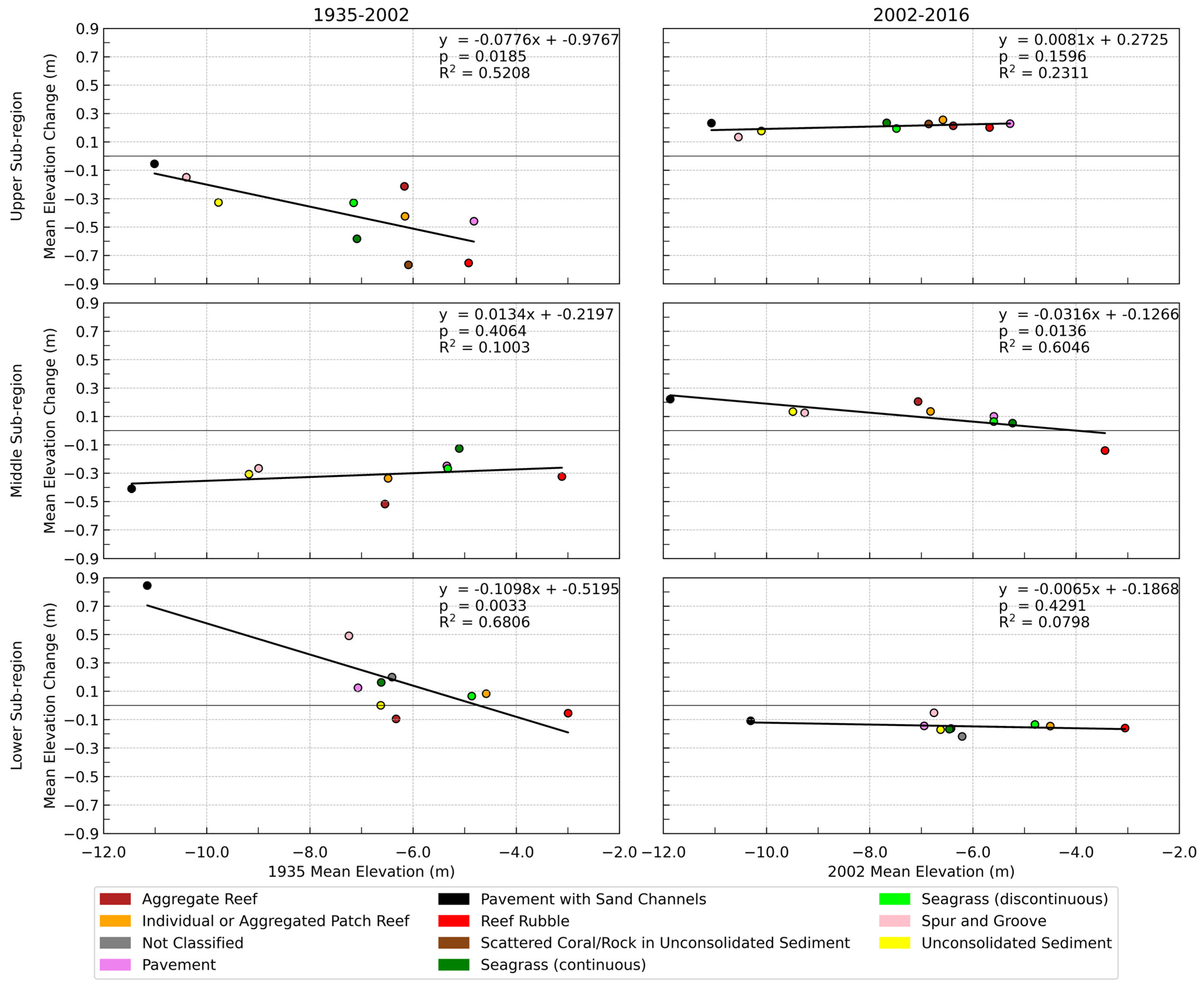
The correlation and regression analyses revealed contrasting patterns between the two temporal periods across all three subregions (Figure 4). During the 1935–2002 period, significant negative relationships dominated two of the three subregions. The lower subregion exhibited the strongest negative correlation (r = −0.825; p = 0.003) between depth and elevation change, with the regression model explaining 68% of the variance (y = −0.110x − 0.520; R2 = 0.681). The upper subregion also demonstrated a strong negative relationship (r = −0.722; p = 0.0185), accounting for 52% of the variance (y = −0.078x − 0.977; R2 = 0.521). In contrast, the middle subregion showed a weak, non-significant positive correlation (r = 0.317; p = 0.406; R2 = 0.100). The 2002–2016 period showed markedly different patterns with reduced correlation strengths across all the subregions. The middle subregion maintained the only significant relationship, showing a moderate negative correlation (r = −0.778; p = 0.014; R2 = 0.605), though with a substantially reduced slope magnitude (y = −0.032x − 0.127). Both upper and lower subregions exhibited weak, non-significant correlations (r = 0.48, p = 0.160, and R2 = 0.231; and r = −0.28, p = 0.429, and R2 = 0.08, respectively). The magnitude of elevation changes was generally greater during the earlier period, with values ranging from approximately −0.8 m to +0.2 m, compared with the more compressed range of −0.3 m to +0.3 m in the recent period.

3.4. Habitat-Specific Changes in Seafloor Elevation

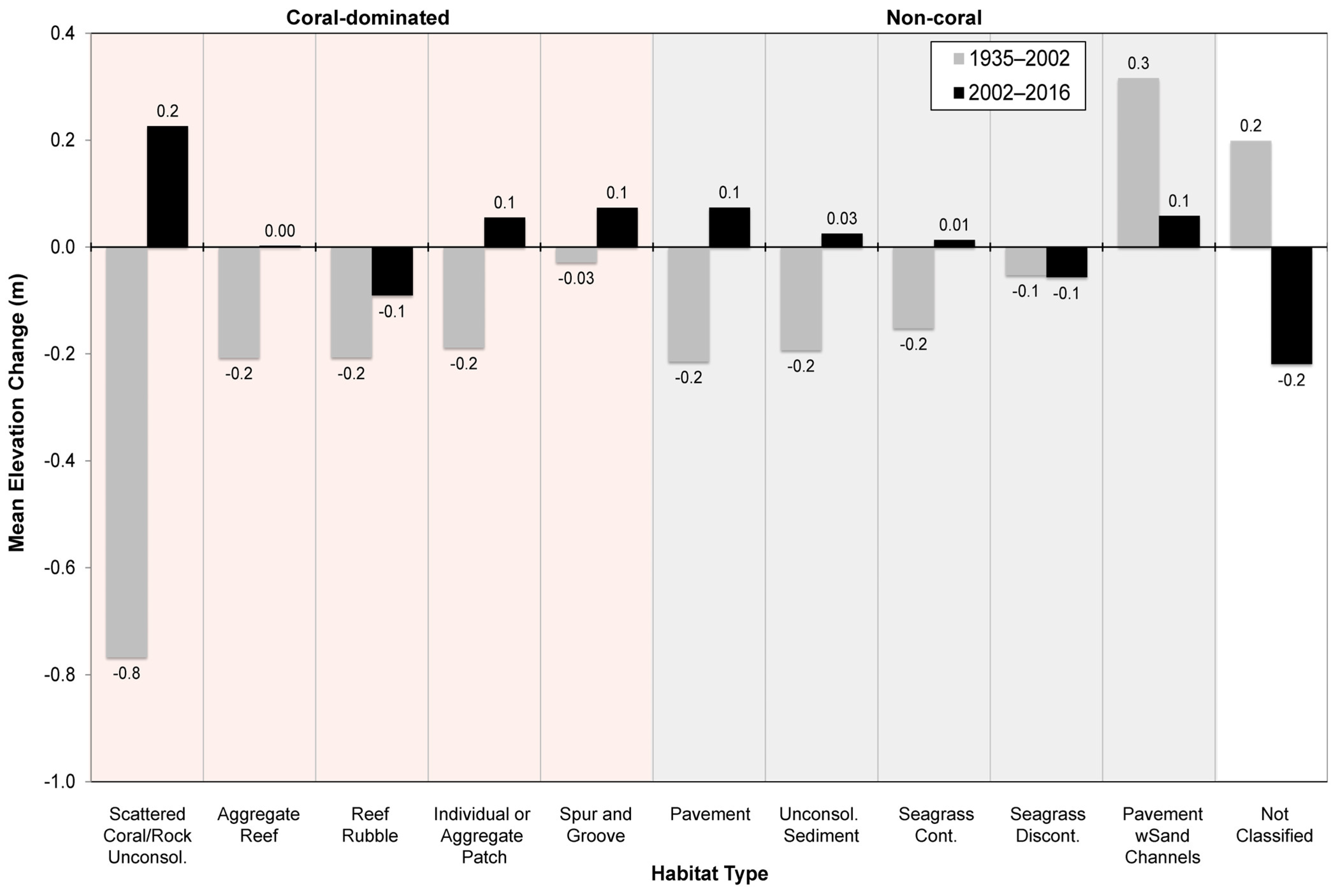
The spatial distribution of benthic habitats is depicted in Figure 2c. More than 73% of the points (19,026 of 25,926) were located in the habitats “seagrass discontinuous,” “seagrass continuous,” and “unconsolidated sediment.” Only 2 of 11 habitats had positive mean elevation changes (“not classified,” 0.2 m, and “pavement with sand channels,” 0.3 m) during the 1935–2002 period (Table 3 and Figure 4). A maximum elevation loss of −8.3 m occurred in “seagrass discontinuous,” and the largest magnitude mean elevation loss of −1.1 m occurred in “scattered coral/rock in unconsolidated sediment.” The largest overall elevation gain and mean elevation gain were 6.5 m (“spur and groove”) and 1.1 m (“pavement with sand channels”), respectively. More broadly, non-coral substrates had more elevation change points and spanned a larger geographic area than coral-dominated substrates (21,403 vs. 4410 points; Table 3). Eighty-three percent of the elevation points were located in non-coral substrates, and of these, 57% (12,135) represented elevation loss. Points in coral-dominated substrates showed similar results, with 58% of the total points (2561 of 4410) indicating elevation loss.
The mean elevation changes during the 2002–2016 period exhibited gains across most habitats (Table 3 and Figure 5), except for “aggregate reef” (0.0 m), “not classified” (−0.2 m), “reef rubble” (−0.1 m), and “seagrass discontinuous” (−0.1 m). Losses in the latter two continued declines from the prior study period. Only “pavement with sand channels” showed a continued increase in elevation, with a mean elevation change of +0.1 m. The largest overall elevation loss and mean elevation loss were −2.2 m (“pavement”) and −0.3 m (“aggregate reef” and “not classified”), respectively. A maximum elevation gain of 8.9 m occurred in “aggregate reef,” and the largest mean elevation gain of 0.2 m occurred in “scattered coral/rock in unconsolidated sediment.” As in the prior study period, the majority of elevation points, both for coral-dominated and non-coral substrates, indicated elevation losses, 51% (2234 points) and 55% (11,845 points), respectively.

3.5. Overall Seafloor Volume Changes

The study site exhibited net volume loss for the 1935–2002 period, indicating export of sediments from the system (Table 4). Our lower-bound values for gross erosion, gross accretion, and net volume changes (calculated by excluding elevation change data within a vertical range of ±0.5 m (see | Z - change | > 1.65 × RMSETotal in Table 1) provided conservative estimates for these quantities. All stated volume change values corresponded to these conservative estimates unless indicated otherwise. Gross erosion (21.0 × 10⁶ m3) was 2.8 times gross accretion (7.4 × 10⁶ m3), leading to a net volume loss of 13.6 × 10⁶ m3 (Table 4). In contrast, there was a small net volume gain of 1.6 × 10⁶ m3 over the 2002–2016 period. Gross accretion exceeded gross erosion, at 1.7 × 10⁶ m3 versus 0.1 × 10⁶ m3. This net volume gain only represented about 12% of the volume lost from 1935 to 2002. Maximum net volume changes, i.e., including all elevation change data, shifted from −35.7 × 10⁶ to +7.5 × 10⁶ m3 between the two study periods. This stark difference in volume changes is visually evident in Figure 3b, which shows side views of the 3D change surfaces used in the volume change calculations.

3.6. Subregional Seafloor Volume Changes

Among the three subregions, the lower subregion covered the most area (96.8 km2) and the middle the least (64.8 km2; Table S7). The net volume change values for the 1935–2002 period exhibited a shift from losses in the upper (−10.6 × 10⁶ m3) and middle (−5.4 × 10⁶ m3) subregions to a modest gain in the lower subregion (2.4 × 10⁶ m3; Table S7). Gross accretion was greatest in the lower subregion (4.6 × 10⁶ m3) and lowest in the middle (1.2 × 10⁶ m3); gross erosion was the largest in the upper subregion (12.2 × 10⁶ m3) and smallest in the lower (2.2 × 10⁶ m3). Net volume change values in these subregions from 2002 to 2016 showed a reverse pattern from the previous period, with meager net gains of 0.8 × 10⁶ m3 in both the upper and middle and 0.1 × 10⁶ m3 in the lower subregion (Table S8). Gross accretion was 0.8 × 10⁶ m3 in both the upper and middle subregions, and 0.1 × 10⁶ m3 in the lower. Gross erosion was 0.03 × 10⁶ m3 in both the upper and middle subregions, and 0.1 × 10⁶ m3 in the lower.
The magnitude of volume loss in the upper subregion (−10.6 × 10⁶ m3) was 4.4 times greater than the gain in the lower subregion (2.4 × 10⁶ m3) for the 1935–2002 period, yet the upper subregion was ~26% smaller in area. Normalizing for the difference in areal extent, this loss was approximately six times greater in magnitude than the gain. Coral substrates accounted for most of the normalized net area and volume change (losses) in the upper and middle subregions; both coral and non-coral substrates showed the same amount of gain in the lower region. During the 2002–2016 period, modest net volume gains occurred in all subregions, and, as before, the absolute magnitude of change decreased from the upper to lower subregions, at 0.81 × 10⁶ m3, 0.80 × 10⁶ m3, and 0.001 × 10⁶ m3, respectively (Table S8). Coral-dominated substrates experienced larger gains in area-normalized volume change in all three subregions. These gains only offset 10.5% and 15.3% of the volume losses for the upper and middle subregions in the 1935–2002 study period. Gains in the non-coral substrates of the upper and middle subregions offset 7.2% and 12.9% of the previous losses, respectively, and the loss in the lower region was only 1% of the previous gain.

3.7. Habitat-Specific Changes in Seafloor Volume

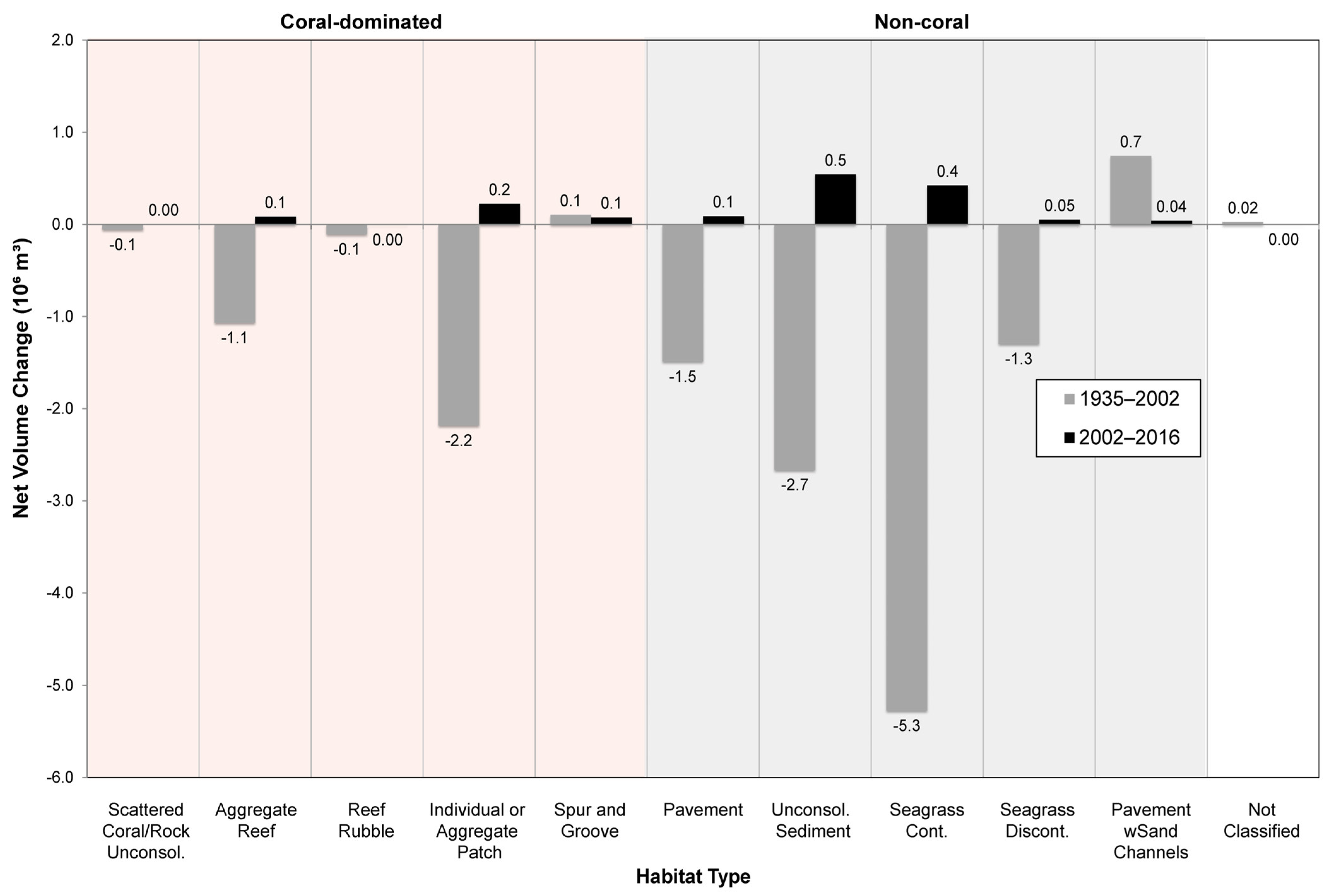
During the 1935–2002 period, only the “not classified,” “pavement with sand channels,” and “spur and groove” habitats exhibited net gains in seafloor volume (0.02 × 10⁶ m3, 0.7 × 10⁶ m3, and 0.1 × 10⁶ m3, respectively), but only represented ~4% of the total study site area (Table 4, lower bound values; Figure 6). The three habitats with the largest net volume losses were “seagrass continuous” (−5.3 × 10⁶ m3), “unconsolidated sediment” (−2.7 × 10⁶ m3), and “individual or aggregated patch reef” (−2.2 × 10⁶ m3), which covered a combined area of 141.8 km2 or approximately 61% of the study site. The grouping of coral-dominated substrates had a combined net volume loss of −3.2 × 10⁶ m3, covering 35.6 km2, and non-coral substrates showed a net loss of −10.0 × 10⁶ m3, covering 197.9 km2 or ~84% of the study site. The ratio of gross volume loss to gain in coral-dominated substrates was 2.4 versus 3.2 in non-coral substrates. On an area-normalized basis, the net loss in coral-dominated substrates was ~60% greater than in non-coral substrates, at −0.08 × 10⁶ m3 km−2 versus −0.05 × 10⁶ m3 km−2.
During the 2002–2016 study period, all habitats showed either zero or minimally positive net volume change (Table 4, lower bound values; Figure 6). The three biggest net volume gains were in “unconsolidated sediment” (0.5 × 10⁶ m3), “seagrass continuous” (0.4 × 10⁶ m3), and “individual or aggregated patch reef” (0.2 × 10⁶ m3). These same habitats exhibited the largest net volume losses for the 1935–2002 period. The net volume gains in “pavement with sand channels” and “spur and groove” habitats were observed during both study periods. Coral-dominated substrates showed a net volume gain of 0.4 × 10⁶ m3, whereas non-coral substrates had a net increase of 1.1 × 10⁶ m3. These volume increases were just ~10% of the magnitude of the losses for the 1935–2002 period for both categories. The respective ratios of gross volume loss to gain were 0.1 versus 0.05 for coral and non-coral substrates, respectively. On an area-normalized basis, the net volume increase in coral-dominated substrates was nearly double that in non-coral substrates (0.01 × 10⁶ m3 km−2 versus 0.006 × 10⁶ m3 km−2).

4. Discussion

Multidecadal studies of seafloor elevation change in coral reef ecosystems provide valuable insight and perspective on structural stability, as well as the accretional and erosional patterns within them at the vertical resolution of the data. We quantified changes in seafloor elevation and volume across a 234 km2 area of the UFK over two distinct periods: 1935–2002 (67 years) and 2002–2016 (14 years). Notably, only a small portion of the study site (15% or approximately 35.6 km2) consisted of coral-dominated substrates. The UFK study site exhibited a pronounced geomorphological transition from substantial net elevation and volume loss (−0.1 ± 0.8 m; 13.6 × 10⁶ m3) during 1935–2002 to minimal net gain (0.0 ± 0.3 m; 1.6 × 10⁶ m3) by 2002–2016. This shift in mean elevation and volume change from major loss to minimal gain coincides with a 60% reduction in hurricane frequency and persistent dominance of non-accreting benthic communities (stony coral cover < 10%; octocoral cover increasing to 35–45%). Importantly, more than half (59%) of the elevation change points that shifted from net loss to net gain in the 2002–2016 period were located in coral-dominated habitats, with 8 of the 11 habitats transitioning from loss to gain. However, despite these localized or modest gains, the cumulative volume increase since 2002 (1.6 × 10⁶ m3) represents only about 12% of the total volume lost during the preceding decades. These patterns prompt further examination of the drivers behind this transition, including the roles of disturbance frequency, sediment dynamics, and changes in benthic community composition, which are explored in the following sections.

4.1. Spatial Patterns and Habitat Differences

The subregional analyses clearly indicated that the transition did not uniformly occur throughout the entire study site (Figure 2a and Figure 3a; Tables S5 and S7). From 1935 to 2002, most of the elevation losses occurred in the upper and middle subregions, producing corresponding losses in net volume change, while a positive elevation and volume change occurred in the lower subregion (Figure 2a and Figure 3a; Tables S5 and S7). An opposite pattern in both elevation and volume change manifested for the 2002–2016 period, with gains in the upper and middle subregions and losses in the lower subregion (Figure 2b and Figure 3a,b; Tables S6 and S8). As noted in Yates et al.’s study [35], patterns of seafloor accretion and erosion vary spatially, which most likely is due to the different biological, chemical, and physical processes affecting the various reef habitats on different spatial and temporal scales. Whether on a full-site or subregional basis, the observed spatial variability in seafloor elevation changes underscores the importance of a comprehensive collection of elevation measurements throughout a region of interest, as the results from a single patch reef or small area cannot necessarily be extrapolated to other areas of the overall coral reef ecosystem.
Additionally, the relationship between mean elevation and mean elevation change for each habitat (Figure 4) provides insight into the movement of sediments within the subregions for each study period [35]. For 1935–2002, the upper and lower subregion plots showed the mean elevation change generally increasing with decreasing mean elevation; deeper areas gained more elevation through deposition than shallow areas lost through erosion. This pattern suggests that sediment was transported downslope and offshore. This is supported by relatively high coefficients of determination, with R2 values of 0.5208 for the upper subregion and 0.6806 for the lower subregion. In contrast, the middle subregion exhibited little variation in the mean elevation change, with the mean elevation across most habitats, as indicated by a near-zero slope and a low coefficient of determination (R2 = 0.1003; Figure 4). For 2002–2016, the mean elevation change remained relatively constant, with habitat mean elevations for each subregion, as indicated by the near-zero slopes in the regression plots. The coefficients of determination for this period were lower in the upper and lower subregions (R2 = 0.2311 and 0.0798, respectively), but notably higher in the middle subregion (R2 = 0.6046). These patterns suggest that sediments mostly remained in place or were redistributed locally, creating localized areas of accretion and erosion rather than being transported to deeper water.
In considering how to interpret the observed shifts in seafloor elevation and volume change, we note that in a broad context, most reefs worldwide were significantly degraded by 1900 [15], and long-term degradation of coral reefs is well-documented, especially in the wider Caribbean [14,57]. Coral reefs in the Florida Keys began declining by approximately 2–4 ka in response to the flooding of Florida Bay caused by sea level rise [43,58]. Reefs were so deteriorated by the early 1970s that Voss (1973) [20] stated that “Florida’s coral reefs are dying.” In the subsequent decades, reefs in the wider Caribbean continued to degrade, with coral cover decreasing by 80% between 1977 and 2001 [14], and these losses continued throughout the 2002–2016 study period [22,24]. Based on these historical and current trends, it is unlikely that the transition from net elevation and volume loss to net gain between the two time periods in this study represents a broad-scale improvement of coral cover in the Florida Keys. Therefore, we examined both storm occurrences and percent cover of benthic fauna to identify potential explanations for gains in elevation during the 2002–2016 study period. Positions and types of geomorphic features of interest were verified via in-situ observation by SCUBA divers using the methods of Fehr and Yates [59] throughout the complete study site.

4.2. Storms as Drivers of Change

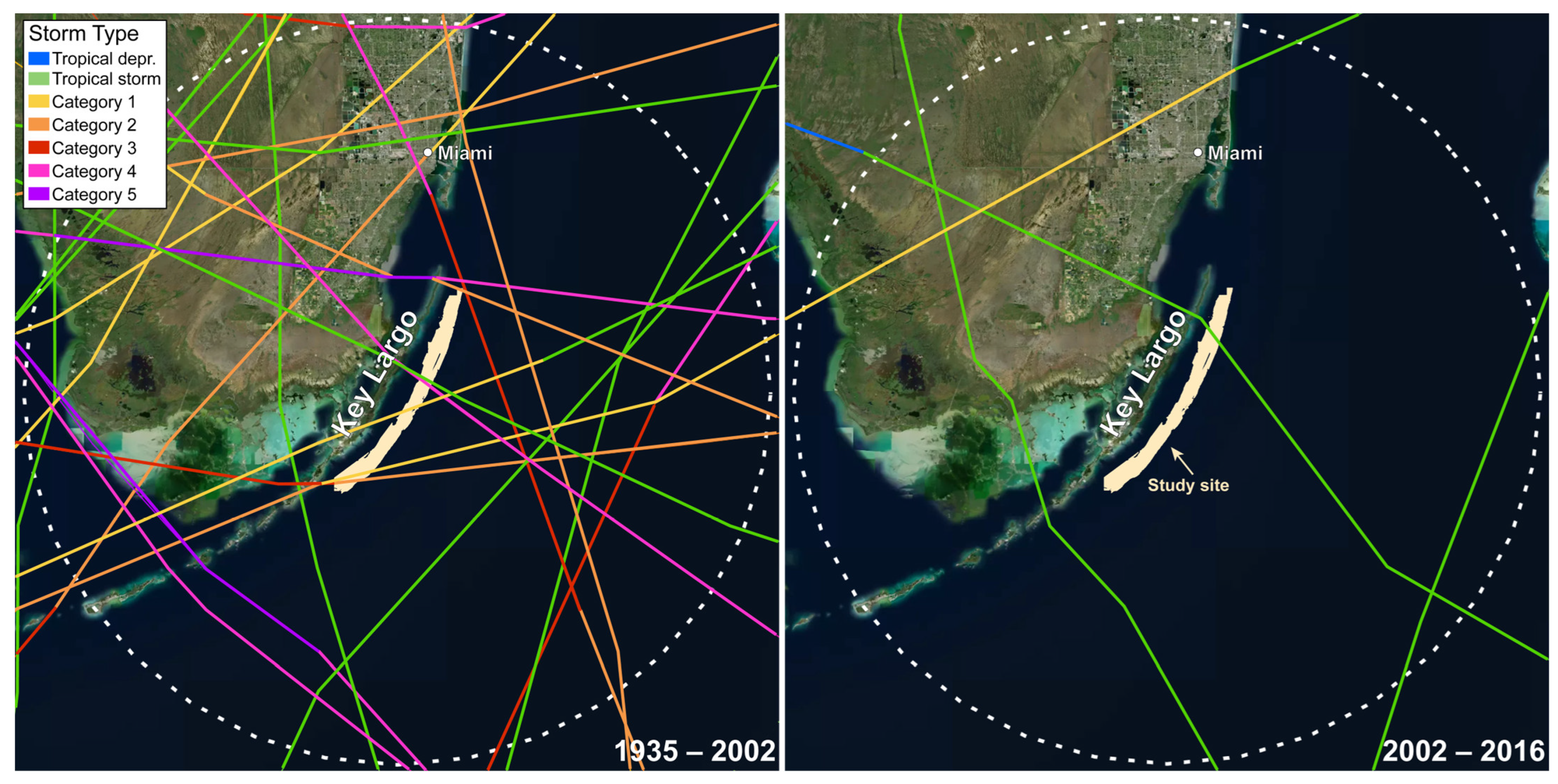
Between 1935 and 2002, 24 storms (8 tropical storms and 16 hurricanes) passed within 100 km of our study site, approximately one major storm every three years [60] (Figure 7). The last hurricane to make direct landfall in the study area during this timeframe was Floyd in 1987, a category 1 storm with a maximum wind speed of 120 km h−1. In 1992, Hurricane Andrew, a strong category 5 storm (with a maximum wind speed of 278 km h−1), affected the site, but direct landfall was about 2.2 km to the north. Between 2002 and 2016, four storms (three tropical storms and one hurricane) passed within 100 km of our study site, with approximately one major storm every four years (Figure 7). In 2005, Hurricane Katrina, then a category 1 storm with a wind speed of 130 km h−1, tracked ~60 km NW of the study site. The frequency of significant storm passage was remarkably similar; however, the earlier time period included 16 hurricanes, with 6 passing directly through the study site, while in the latter period, only 1 hurricane came within 100 km, and only Tropical Storm Bonnie in 2010, with a wind speed of 65 km h−1, passed through it.
Hurricanes and intense tropical storms have long been known to play a critical role in coral reef dynamics [6,61,62,63,64,65]. The extreme waves, surge, and currents associated with hurricanes can impart substantial physical damage to reefs, which includes breakage, detachment, overturning, and death of corals and other benthic fauna, as well as cause scouring of the seabed and redistribution of substantial amounts of sediment, leading to burial of corals, sponges, seagrass beds, and other benthic fauna [6,61,62,66,67,68,69]. Moreover, in reef systems similar to our study site, major storms are responsible for transporting large amounts of sediment off reefs, effectively flushing the system by exporting carbonate sand, rubble, and other detritus downslope and, for some reefs, are the only such transport mechanism [6,63,69,70].
During quiescent periods without hurricanes, sand and rubble accumulate in place due to biological and physical erosion of corals, production by calcareous algae, and the deposition of skeletal remains of foraminifera and mollusks [71,72,73,74]. Non-storm-related currents and waves can be strong enough to transport this sediment, but the typical effect is merely to redistribute it on the reef platform, where it can be trapped in seagrass beds or pile up as unconsolidated sediment but not exported downslope and out of the system [5,46,75]. Such processes would explain the increases in seafloor elevation and volume change observed in the seagrass and unconsolidated sediment habitats, which, combined, represent more than 75% of our study site (Table 3 and Table 4).
These processes and the near absence of hurricanes likely contributed to the reduced rates of seafloor erosion, minimal accretion, and the marked change in the relationship between estimated mean water depth versus mean elevation change (Figure 4) during the 2002–2016 time period. Further evidence is provided by Yates et al. [6], who performed a quantitative assessment of the impact of Hurricane Irma on a ~16 km2 area encompassing Looe Key Reef (LKR), FL, located ~120 km southwest of the current study site. Hurricane Irma passed directly over LKR on 10 September 2017 as a category 4 hurricane, with sustained winds of 213 km h−1.
Yates et al. [6] performed seafloor elevation and volume change analyses for LKR using a lidar-derived DEM collected on 23 July 2016 (13.5 months before the storm), two multibeam-derived DEMs collected in December 2017 and February–March 2018 (three to six months after passage of the storm), and a second lidar-derived DEM collected 8–31 January 2019 (approximately 17 months after passage of the storm). Their 2016–2017 change results showed that Hurricane Irma was primarily a depositional event that caused broad-scale deposition of sediments across all benthic habitats and increased the mean seafloor elevation and volume by 0.34 m and up to 5.4 Mm3, respectively. Moreover, there was a strong linear relationship between mean habitat water depth and mean elevation change, indicating that mean elevation gains increased significantly with increasing water depth (i.e., decreasing seafloor elevation), which they attributed to sediment transport from shallower to deeper water (Figure 5a in [6]). A similar relationship exists in the upper and lower subregions for the 1935–2002 period in this study (Figure 4).
For the post-Irma 2017–2019 period, those authors found decreased elevation across all habitats, with mean elevation losses significantly greater in habitats with larger mean elevation gains during 2016–2017, and that approximately 50% of sediment deposited during Hurricane Irma was eroded by 2019 due to physical transport away from LKR. There was a moderate linear relationship between the mean habitat water depth and mean elevation change (Figure 5c in [6]), suggesting the rapid initiation of sediment re-equilibration after the storm that may have continued beyond the 16.5-month post-storm period in their study. In fact, no other major storms impacted LKR in the 16.5 months post Hurricane Irma. The 2002–2016 period in this study did not exhibit such dramatic erosion, but instead modest gains in both elevation and volume change in most habitats. This fourteen-year period was tranquil, with no direct hurricane impacts. If similar rapid initiation of sediment re-equilibration occurred after Tropical Storm Ernesto in 2006, which passed south of the study site, and/or Bonnie in 2010, those relatively “instant” responses would have been averaged out by the effects of the persistent forces and processes continually at work within this coral reef ecosystem.

4.3. Benthic Community as Drivers of Change

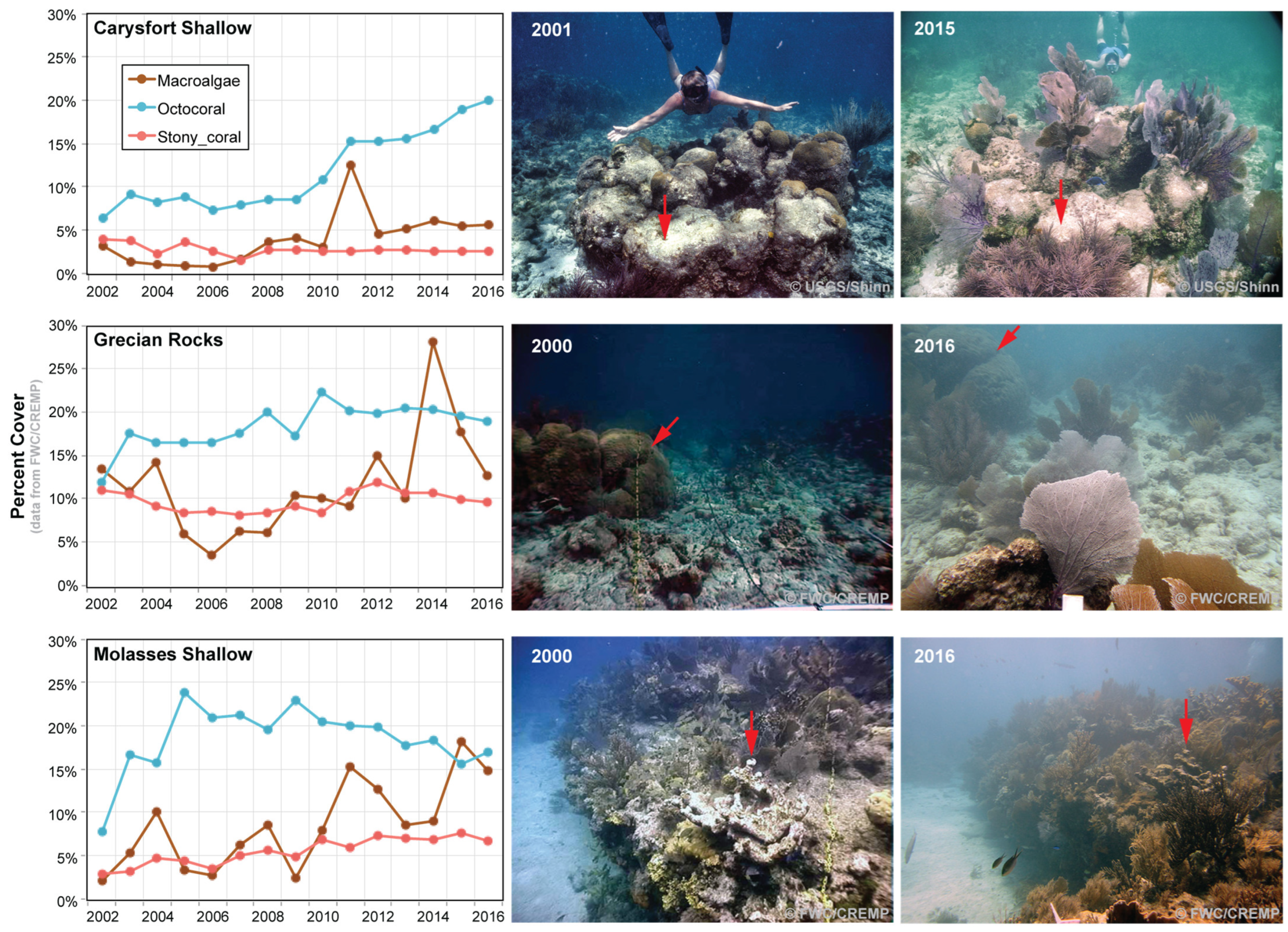
Changes in the percent cover of different benthic fauna for the 2002–2016 period provide additional insights for the observed changes in seafloor elevation and volume. Since 1996, the Florida Fish and Wildlife Conservation Commission, the Fish and Wildlife Research Institute, has been collecting coral reef-related data throughout the Florida Keys as part of its Coral Reef Evaluation and Monitoring Project (CREMP) [76]. Three of their monitoring sites lie within our study area (Carysfort Reef, Grecian Rocks, and Molasses Reef; Figure 1 and Figure 8). Trends in percent cover of stony coral, macroalgae, and octocorals (e.g., sea fans, sea whips, etc.) are all indicative of a degraded coral reef ecosystem. The live coral cover at these reefs varied little over the 14-year period and never exceeded 12% (Figure 8). Carysfort Reef and Grecian Rocks both showed slight decreases in coral cover, and Molasses Reef showed only a slight increase in coral cover between 2002 and 2016, with coral cover remaining generally below 10% for all three reefs. Importantly, Caribbean reefs generally exhibit negative net carbonate production rates when live coral cover falls below ~10% [77,78,79]. In contrast, both macroalgae and octocorals exhibited increases in percent cover (Figure 8), consistent with similar trends on other Caribbean reefs over the same general time period. Octocorals, in particular, are becoming the dominant benthic cover on shallow forereefs, replacing stony corals [24,80]. In many instances, macroalgae and octocorals have grown on top of dead coral, as is evident in the photographs in Figure 8. Octocorals attach themselves to the seafloor with holdfasts and so require a hard substrate, making them direct competitors with stony corals [24]. They also have fast linear growth rates, which enable them to quickly rise above the seafloor, minimizing competition with macroalgae and stony corals [81]. Moreover, they can create dense canopies that provide habitat for a variety of organisms, ranging from bacteria to fish [80,82]. The vertical morphology of octocorals and the canopies they create can obscure the underlying substrate from lidar and other remote-sensing technologies, resulting in elevation estimates that are above the actual seafloor and appear in elevation change analyses as increases in seafloor elevation. We documented octocoral growth on top of dead corals during field validation exercises at several coral-dominated habitats where elevation-change results indicated slight increases in seafloor elevation [59]. These results underscore the importance of acquiring quality ground-truthing and consulting complementary datasets when interpreting elevation and volume change data, as well as the challenges in accurately determining seafloor elevation from remote-sensing data such as lidar.

4.4. Implications for Management and Restoration

Remote-sensing technologies provide the most effective means for conducting assessments of coral reef ecosystems over regional or larger spatial scales. Lidar-derived DEMs were the only data available covering hundreds of square kilometers of the FRT that allowed us to quantify changes in seafloor elevation volume, which represent the net result of all constructive and destructive processes on the entire reef system. Our findings support other coastal hazards research, such as the vulnerability of coasts to wave damage. Declining seafloor elevation accentuates the effects of rising sea level, allowing larger waves to impact adjacent shorelines. Elevation change results can potentially guide site selection for coral restoration efforts by complementing other driving factors, such as light level, depth, and absence of macroalgae. Identifying areas exhibiting minimal vertical change over a period of years may inform the prioritization of coral outplanting efforts and contribute to the identification of restoration sites that have been previously overlooked.

5. Conclusions

This study provides the first comprehensive, multidecadal analysis of seafloor elevation and volume changes in a 234.2 km2 area of the UFK reef tract, revealing a transition from significant net loss (−0.1 ± 0.8 m in elevation and 13.6 × 10⁶ m3 in volume) between 1935 and 2002 to minimal net gain (0.0 ± 0.3 m in elevation and 1.6 × 10⁶ m3 in volume) from 2002 to 2016. However, the recent stabilization in elevation is not matched by ecological recovery, as stony coral cover continues to decline and macroalgae and octocorals proliferate, signaling persistent ecosystem stress and insufficient carbonate production to support long-term reef accretion. The pronounced spatial variability in accretion and erosion across habitats and subregions underscores the importance of collecting elevation-change data at multiple scales, as localized measurements alone are inadequate for understanding or managing ecosystem-wide trends.
Our approach advances the field by overcoming major methodological challenges in aligning disparate bathymetric datasets, enabling spatially explicit tracking of reef geomorphology over nearly eight decades. By integrating historical bathymetric soundings with modern lidar, this study establishes a robust framework for quantifying net structural changes in coral reef ecosystems and highlights the importance of regional-scale, high-resolution monitoring. These data provide essential baselines for coastal hazard assessments, provide information that can inform restoration planning by identifying stable zones for coral outplanting, and support ecosystem management strategies. The elevation change datasets can also be incorporated into hydrodynamic and coastal hazard models to better predict the impacts of reef degradation on coastal communities, and frequent mapping enables tracking of post-disturbance resilience and recovery.
This multitemporal approach can be applied to other reef systems worldwide, utilizing emerging technologies such as multibeam sonar and Structure-from-Motion photogrammetry to achieve finer spatial and temporal resolution of seafloor changes. Long-term elevation and volume monitoring across diverse reef regions and habitats would enhance our understanding of biological, physical, and human-driven processes affecting reef geomorphology. Such comprehensive monitoring approaches would provide valuable tools for enhancing reef adaptability and supporting management strategies amid ongoing environmental change.

Supplementary Materials

The following supporting information can be downloaded at https://www.mdpi.com/article/10.3390/rs18030463/s1. Methods Section S1.1: 1935–2002 data transformations and sea level rise corrections; Methods Section S1.2: Selection and extraction of elevation data points; Methods Section S1.3: Calculation of elevation change and related statistics; Methods Section S1.4: Calculation of volume change; Table S1: Bathymetric and habitat data sources and descriptions; Table S2: Custom DEM-download settings; Table S3: 2002 USGS vs. 2016 NOAA lidar horizontal shift analysis results; Table S4: Vertical error analysis results; Table S5: Elevation change on a subregional basis for 1935–2002; Table S6: Elevation change on a subregional basis for 2002–2016; Table S7: Volume change on a subregional basis for 1935–2002; Table S8: Volume change on a subregional basis for 2002–2016. References [83,84,85,86,87,88,89,90,91,92,93,94] are cited in the Supplementary Materials.

Author Contributions

Conceptualization, D.G.Z. and K.K.Y.; methodology, D.G.Z. and K.K.Y.; data analysis, D.G.Z. and K.K.Y.; writing—original draft preparation, D.G.Z. and K.K.Y.; writing—review and revisions, S.A.J., D.G.Z. and K.K.Y.; data visualization, S.A.J., D.G.Z., K.K.Y. and C.M.J. All authors have read and agreed to the published version of the manuscript.

Funding

This research was funded by the U.S. Geological Survey, the Coastal and Marine Hazards and Resources Program project number MN00UG8.

Data Availability Statement

The bathymetric sounding and lidar data used in this study are publicly available from the sources listed in Table S1. The elevation change data; shapefiles for the subregion boundary definitions and lidar overlap area; and the clipped benthic habitat map presented in this study are openly available at [95].

Acknowledgments

This work was conducted under Florida Keys National Marine Sanctuary permit numbers KNMS-2013-097-A1 and FKNMS-2016-068. Any use of trade, firm, or product names is for descriptive purposes only and does not imply endorsement by the U.S. Government.

Conflicts of Interest

The authors declare no conflicts of interest.

Abbreviations

The following abbreviations were used in this manuscript:
FRTFlorida Reef Tract
UFKUpper Florida Keys
USGSU.S. Geological Survey
NOAANational Oceanic and Atmospheric Administration
DEMDigital Elevation Model
NGSNational Geodetic Survey (division of NOAA)
EAARLExperimental Advanced Airborne Research Lidar
CREMPCoral Reef Evaluation and Monitoring Project
FWCFlorida Fish and Wildlife Conservation Commission
FWRIFish and Wildlife Research Institute (Agency Within FWC)
H-sheetHydrographic Survey Sheet (Historical Bathymetric Data)

References

  1. Carlot, J.; Vousdoukas, M.; Rovere, A.; Karambas, T.; Lenihan, H.S.; Kayal, M.; Adjeroud, M.; Pérez-Rosales, G.; Hedouin, L.; Parravicini, V. Coral reef structural complexity loss exposes coastlines to waves. Sci. Rep. 2023, 13, 1683. [Google Scholar] [CrossRef] [PubMed]
  2. Harris, D.L.; Rovere, A.; Casella, E.; Power, H.; Canavesio, R.; Collin, A.; Pomeroy, A.; Webster, J.M.; Parravicini, V. Coral reef structural complexity provides important coastal protection from waves under rising sea levels. Sci. Adv. 2018, 4, eaao4350. [Google Scholar] [CrossRef]
  3. Moberg, F.; Folke, C. Ecological goods and services of coral reef ecosystems. Ecol. Econ. 1999, 29, 215–233. [Google Scholar] [CrossRef]
  4. Graham, N.A.J.; Nash, K.L. The importance of structural complexity in coral reef ecosystems. Coral Reefs 2013, 32, 315–326. [Google Scholar] [CrossRef]
  5. Torres-Garcia, L.M.; Dalyander, P.S.; Long, J.W.; Zawada, D.G.; Yates, K.K.; Moore, C.; Olabarrieta, M. Hydrodynamics and sediment mobility processes over a degraded senile coral reef. J. Geophys. Res. Ocean. 2018, 123, 7053–7066. [Google Scholar] [CrossRef]
  6. Yates, K.K.; Fehr, Z.; Johnson, S.; Zawada, D. Impact of Hurricane Irma on coral reef sediment redistribution at Looe Key Reef, Florida, USA. Ocean Sci. 2024, 20, 661–688. [Google Scholar] [CrossRef]
  7. Costanza, R.; de Groot, R.; Sutton, P.; van der Ploeg, S.; Anderson, S.J.; Kubiszewski, I.; Farber, S.; Turner, R.K. Changes in the global value of ecosystem services. Glob. Environ. Change 2014, 26, 152–158. [Google Scholar] [CrossRef]
  8. Reguero, B.G.; Storlazzi, C.D.; Gibbs, A.E.; Shope, J.B.; Cole, A.D.; Cumming, K.A.; Beck, M.W. The value of US coral reefs for flood risk reduction. Nat. Sustain. 2021, 4, 688–698. [Google Scholar] [CrossRef]
  9. Souter, D.; Planes, S.; Wicquart, J.; Logan, M.; Obura, D.; Staub, F. Status of Coral Reefs of the World: 2020 Report; Global Coral Reef Monitoring Network (GCRMN) and International Coral Reef Initiative (ICRI): Townsville, Australia, 2021; p. 200. [Google Scholar] [CrossRef]
  10. Spalding, M.; Burke, L.; Wood, S.A.; Ashpole, J.; Hutchison, J.; zu Ermgassen, P. Mapping the global value and distribution of coral reef tourism. Mar. Policy 2017, 82, 104–113. [Google Scholar] [CrossRef]
  11. Towle, E.; Geiger, E.; Grove, J.; Groves, S.; Viehman, S.; Johnson, M.; Blondeau, J.; Stein, J.; Gorstein, M.; Borque, A.; et al. Coral Reef Condition: A Status Report for Florida’s Coral Reef; United States, National Oceanic Atmospheric, Administration Coral Reef Conservation, Program: Silver Spring, MD, USA, 2020; pp. 1–7. [Google Scholar] [CrossRef]
  12. Beck, M.W.; Losada, I.J.; Menéndez, P.; Reguero, B.G.; Díaz-Simal, P.; Fernández, F. The global flood protection savings provided by coral reefs. Nat. Commun. 2018, 9, 2186. [Google Scholar] [CrossRef]
  13. Storlazzi, C.D.; Reguero, B.G.; Yates, K.K.; Cumming, K.A.; Cole, A.; Shope, J.B.; Gaido, C.; Zawada, D.G.; Arsenault, S.R.; Fehr, Z.W. Rigorously Valuing the Impact of Projected Coral Reef Degradation on Coastal Hazard Risk in Florida; Open-File Report 2021-1055; U.S. Geological Survey: Reston, VA, USA, 2021; p. 27. [Google Scholar] [CrossRef]
  14. Gardner, T.A.; Côté, I.M.; Gill, J.A.; Grant, A.; Watkinson, A.R. Long-term region-wide declines in Caribbean corals. Science 2003, 301, 958–960. [Google Scholar] [CrossRef]
  15. Pandolfi, J.M.; Bradbury, R.H.; Sala, E.; Hughes, T.P.; Bjorndal, K.A.; Cooke, R.G.; McArdle, D.; McClenachan, L.; Newman, M.J.; Paredes, G. Global trajectories of the long-term decline of coral reef ecosystems. Science 2003, 301, 955–958. [Google Scholar] [CrossRef]
  16. Bellwood, D.R.; Hughes, T.P.; Folke, C.; Nyström, M. Confronting the coral reef crisis. Nature 2004, 429, 827–833. [Google Scholar] [CrossRef]
  17. Wilkinson, C. Status of Coral Reefs of the World: 2008 Global Coral Reef Monitoring Network and Reef and Rainforest Research Centre; Global Coral Reef Monitoring Network and Reef and Rainforest Research Centre: Cairns, Australia, 2008; p. 296. Available online: https://icriforum.org/documents/status-of-coral-reefs-of-the-world-2008/ (accessed on 13 December 2023).
  18. Eddy, T.D.; Lam, V.W.Y.; Reygondeau, G.; Cisneros-Montemayor, A.M.; Greer, K.; Palomares, M.L.D.; Bruno, J.F.; Ota, Y.; Cheung, W.W.L. Global decline in capacity of coral reefs to provide ecosystem services. One Earth 2021, 4, 1278–1285. [Google Scholar] [CrossRef]
  19. Hughes, T.P.; Barnes, M.L.; Bellwood, D.R.; Cinner, J.E.; Cumming, G.S.; Jackson, J.B.C.; Kleypas, J.; van de Leemput, I.A.; Lough, J.M.; Morrison, T.H.; et al. Coral reefs in the Anthropocene. Nature 2017, 546, 82–90. [Google Scholar] [CrossRef]
  20. Voss, G.L. Sickness and death in Floridas coral reefs. Nat. Hist. 1973, 82, 41–47. [Google Scholar]
  21. Dustan, P.; Halas, J.C. Changes in the reef-coral community of Carysfort Reef, Key Largo, Florida: 1974 to 1982. Coral Reefs 1987, 6, 91–106. [Google Scholar] [CrossRef]
  22. Somerfield, P.J.; Jaap, W.C.; Clarke, K.R.; Callahan, M.; Hackett, K.; Porter, J.; Lybolt, M.; Tsokos, C.; Yanev, G. Changes in coral reef communities among the Florida Keys, 1996–2003. Coral Reefs 2008, 27, 951–965. [Google Scholar] [CrossRef]
  23. Alevizon, W.S.; Porter, J.W. Coral loss and fish guild stability on a Caribbean coral reef: 1974–2000. Environ. Biol. Fishes 2015, 98, 1035–1045. [Google Scholar] [CrossRef]
  24. Ruzicka, R.; Colella, M.; Porter, J.; Morrison, J.; Kidney, J.; Brinkhuis, V.; Lunz, K.; Macaulay, K.; Bartlett, L.; Meyers, M. Temporal changes in benthic assemblages on Florida Keys reefs 11 years after the 1997/1998 El Niño. Mar. Ecol. Prog. Ser. 2013, 489, 125–141. [Google Scholar] [CrossRef]
  25. Porter, J.W.; Dustan, P.; Jaap, W.C.; Patterson, K.L.; Kosmynin, V.; Meier, O.W.; Patterson, M.E.; Parsons, M. Patterns of spread of coral disease in the Florida Keys. In The Ecology and Etiology of Newly Emerging Marine Diseases; Porter, J.W., Ed.; Springer: Dordrecht, The Netherlands, 2001; pp. 1–24. [Google Scholar] [CrossRef]
  26. Porter, J.W.; Meyers, M.; Ruzicka, R.; Callahan, M.; Colella, M.; Kidney, J.; Rathbun, S.; Sutherland, K. Catastrophic loss of Acropora palmata in the Florida Keys: Failure of the ‘Sorcerer’s Apprentice Effect’ to aid recovery following the 2005 Atlantic hurricane season. In Proceedings of the 12th International Coral Reef Symposium, Cairns, Australia, 9–13 July 2012; p. 5. [Google Scholar]
  27. Jaap, W.; Halas, J.; Muller, R. Community dynamics of stony corals (Milleporina and Scleractinia) at Key Largo National Marine Sanctuary, Florida during 1981–1986. In Proceedings of the 6th International Coral Reef Symposium, Townsville, Australia, 8–12 August 1988; pp. 237–243. Available online: https://www.aoml.noaa.gov/general/lib/CREWS/mlrf_26.pdf (accessed on 1 March 2024).
  28. Florida Fish and Wildlife Conservation: CREMP Dashboard. Available online: https://myfwc.maps.arcgis.com/apps/dashboards/275adbe06cac4e8da1a1d2e8e49318f2 (accessed on 10 June 2025).
  29. Schutte, V.G.; Selig, E.R.; Bruno, J.F. Regional spatio-temporal trends in Caribbean coral reef benthic communities. Mar. Ecol. Prog. Ser. 2010, 402, 115–122. Available online: https://www.int-res.com/articles/meps_oa/m402p115.pdf (accessed on 10 June 2025).
  30. Haas, A.F.; Guibert, M.; Foerschner, A.; Co, T.; Calhoun, S.; George, E.; Hatay, M.; Dinsdale, E.; Sandin, S.A.; Smith, J.E.; et al. Can we measure beauty? Computational evaluation of coral reef aesthetics. PeerJ 2015, 3, e1390. [Google Scholar] [CrossRef]
  31. Shinn, E.A.; Kuffner, I.B. Florida Keys Corals—A Photographic Record of Changes from 1959 to 2015: U.S. Geological Survey Data Release. 2017. Available online: https://www.usgs.gov/data/usgs-coral-photo-archiveflorida-keys-corals-a-photographic-record-changes-1959-2015 (accessed on 8 August 2024).
  32. Castro-Sanguino, C.; Ortiz, J.C.; Thompson, A.; Wolff, N.H.; Ferrari, R.; Robson, B.; Magno-Canto, M.M.; Puotinen, M.; Fabricius, K.E.; Uthicke, S. Reef state and performance as indicators of cumulative impacts on coral reefs. Ecol. Indic. 2021, 123, 107335. [Google Scholar] [CrossRef]
  33. Goatley, C.H.; Bonaldo, R.M.; Fox, R.J.; Bellwood, D.R. Sediments and herbivory as sensitive indicators of coral reef degradation. Ecol. Soc. 2016, 21, 17. [Google Scholar] [CrossRef]
  34. Pratchett, M.S.; Hoey, A.S.; Wilson, S.K. Reef degradation and the loss of critical ecosystem goods and services provided by coral reef fishes. Curr. Opin. Environ. Sustain. 2014, 7, 37–43. [Google Scholar] [CrossRef]
  35. Yates, K.K.; Zawada, D.G.; Smiley, N.A.; Tiling-Range, G. Divergence of seafloor elevation and sea level rise in coral reef ecosystems. Biogeosciences 2017, 14, 1739–1772. [Google Scholar] [CrossRef]
  36. Brock, J.C.; Purkis, S.J. The emerging role of lidar remote sensing in coastal research and resource management. J. Coast. Res. 2009, 10053, 1–5. [Google Scholar] [CrossRef]
  37. Brock, J.; Wright, C.W.; Patterson, M.; Nayegandhi, A.; Patterson, J.; Harris, M.S.; Mosher, L. EAARL Submarine Topography: Biscayne National Park; Open-File Report 2006-1118; U.S. Geological Survey: Reston, VA, USA, 2006. [Google Scholar] [CrossRef]
  38. Parrish, C.E.; Dijkstra, J.A.; O’Neil-Dunne, J.P.; McKenna, L.; Pe’eri, S. Post-Sandy benthic habitat mapping using new topobathymetric lidar technology and object-based image classification. J. Coast. Res. 2016, 76, 200–208. [Google Scholar] [CrossRef]
  39. Harris, D.L.; Webster, J.M.; Vila-Concejo, A.; Duce, S.; Leon, J.X.; Hacker, J. Defining multi-scale surface roughness of a coral reef using a high-resolution LiDAR digital elevation model. Geomorphology 2023, 439, 108852. [Google Scholar] [CrossRef]
  40. Zawada, D.G.; Brock, J.C. A Multiscale Analysis of Coral Reef Topographic Complexity Using Lidar-Derived Bathymetry. J. Coast. Res. 2009, 2009, 6–15. [Google Scholar] [CrossRef]
  41. Storlazzi, C.D.; Reguero, B.G.; Cole, A.; Lowe, E.; Shope, J.B.; Gibbs, A.E.; Nickel, B.A.; McCall, R.T.; van Dongeren, A.R.; Beck, M.W. Rigorously Valuing the Role of US Coral Reefs in Coastal Hazard Risk Reduction; Open File Report: 2019-1027; U.S. Geological Survey: Reston, VA, USA, 2019; p. 42. [Google Scholar] [CrossRef]
  42. Hoffmeister, J.E.; Multer, H.G. Geology and origin of the Florida Keys. Geol. Soc. Am. Bull. 1968, 79, 1487–1502. [Google Scholar] [CrossRef]
  43. Lidz, B.H.; Shinn, E.A. Paleoshorelines, reefs, and a rising sea: South Florida, USA. J. Coast. Res. 1991, 7, 203–229. [Google Scholar]
  44. Hine, A.C. Geologic History of Florida: Major Events That Formed the Sunshine State; University Press of Florida: Gainesville, FL, USA, 2013; p. 256. [Google Scholar]
  45. Shinn, E.A.; Lidz, B.H. Geology of the Florida Keys; University Press of Florida: Gainesville, FL, USA, 2018; p. 176. [Google Scholar]
  46. Enos, P. PART I: Holocene Sediment Accumulations of the South Florida Shelf Margin. In Geological Society of America Memoirs; Geological Society of America: Boulder, CO, USA, 1977; Volume 147, pp. 1–130. [Google Scholar]
  47. Marszalek, D.; MR, N.; DR, W. Reef distribution in south Florida. In Proceedings of the Third International Coral Reef Symposium, Miami, FL, USA, May 1977; pp. 223–229. [Google Scholar]
  48. NOAA Tides and Currents: Relative Sea Level Trend. Available online: https://tidesandcurrents.noaa.gov/sltrends/sltrends_station.shtml?id=8724580 (accessed on 1 March 2024).
  49. Florida Fish and Wildlife Conservation Commission. Florida’s Unified Reef Map. Available online: https://myfwc.com/research/gis/fisheries/unified-reef-map/ (accessed on 10 May 2024).
  50. Mapping Guide for Partners of the Florida Reef Tract: Report for the Coordinated Coral and Hardbottom Ecosystem Mapping, Monitoring and Management Project (DEP Agreement No. CM619); Florida Fish and Wildlife Conservation Commission Fish and Wildlife Research Institute: St. Petersburg, FL, USA, 2016; p. 13. Available online: https://myfwc.com/media/20090/unifiedreefmap-mappingguide.pdf (accessed on 10 June 2025).
  51. NOAA Digital Coast: Data Access Viewer: 2016 NOAA NGS Topobathy Lidar: Florida Keys Outer Reef Block 02. Available online: https://coast.noaa.gov/dataviewer/#/lidar/search/where:ID=6272 (accessed on 29 May 2018).
  52. NOAA Digital Coast: Data Access Viewer. 2016 NOAA NGS Topobathy Lidar: Florida Keys Outer Reef Block 03. Available online: https://coast.noaa.gov/dataviewer/#/lidar/search/where:ID=6321 (accessed on 29 May 2018).
  53. NOAA Digital Coast: Data Access Viewer. 2017 NOAA NGS Topobathy Lidar: Florida Keys Outer Reef, Block 04. Available online: https://coast.noaa.gov/dataviewer/#/lidar/search/where:ID=8412 (accessed on 30 May 2018).
  54. NOAA Data Digital Coast: Data Access Viewer. Available online: https://coast.noaa.gov/dataviewer/#/ (accessed on 29 May 2018).
  55. Global Mapper, 19.1; Blue Marble Geographics: Hallowell, ME, USA, 2018.
  56. White, S.R. (NOAA National Geodetic Survey/Remote Sensing Division, Silver Spring, MD, USA). Personal communication, 2018.
  57. Pandolfi, J.M.; Connolly, S.R.; Marshall, D.J.; Cohen, A.L. Projecting coral reef futures under global warming and ocean acidification. Science 2011, 333, 418–422. [Google Scholar] [CrossRef]
  58. Lidz, B.H. Pleistocene corals of the Florida Keys: Architects of imposing reefs—Why? J. Coast. Res. 2006, 22, 750–759. [Google Scholar] [CrossRef]
  59. Fehr, Z.W.; Yates, K.K. Underwater Photographic Reconnaissance and Habitat Data Collection in the Florida Keys—A Procedure for Ground Truthing Remotely Sensed Bathymetric Data; Open-File Report 2020-1118; U.S. Geological Survey: Reston, VA, USA, 2020; p. 13. [Google Scholar] [CrossRef]
  60. NOAA Office for Coastal Management: Historical Hurricane Tracks. Available online: https://coast.noaa.gov/hurricanes/#map=4/32/-80 (accessed on 1 March 2024).
  61. Ball, M.M.; Shinn, E.A.; Stockman, K.W. The Geologic Effects of Hurricane Donna in South Florida. J. Geol. 1967, 75, 583–597. [Google Scholar] [CrossRef]
  62. Highsmith, R.C.; Riggs, A.C.; D’Antonio, C.M. Survival of hurricane-generated coral fragments and a disturbance model of reef calcification/growth rates. Oecologia 1980, 46, 322–329. [Google Scholar] [CrossRef]
  63. Hubbard, D.K.; Sadd, J.L.; Roberts, H.H. The Role of Physical Processes in Controlling Sediment Transport Patterns on the Insular Shelf of St. Croix, U.S. Virgin Islands. In Proceedings of the Fourth International Coral Reef Symposium, Manila, Phillipines, 18–22 May 1981; pp. 399–404. Available online: https://www.aoml.noaa.gov/general/lib/CREWS/Cleo/St.%20Croix/salt_river61.pdf (accessed on 1 March 2024).
  64. Wilson, S.S.; Furman, B.T.; Hall, M.O.; Fourqurean, J.W. Assessment of Hurricane Irma Impacts on South Florida Seagrass Communities Using Long-Term Monitoring Programs. Estuaries Coasts 2020, 43, 1119–1132. [Google Scholar] [CrossRef]
  65. Kench, P.S.; McLean, R.F. Hydrodynamics and sediment flux of hoa in an Indian Ocean atoll. Earth Surf. Process. Landf. 2004, 29, 933–953. [Google Scholar] [CrossRef]
  66. Gardner, T.A.; Côté, I.M.; Gill, J.A.; Grant, A.; Watkinson, A.R. Hurricanes and Caribbean Coral Reefs: Impacts, Recovery Patterns, and Role in Long-Term Decline. Ecology 2005, 86, 174–184. [Google Scholar] [CrossRef]
  67. Harmelin-Vivien, M.L. The Effects of Storms and Cyclones on Coral Reefs: A Review. J. Coast. Res. 1994, 211–231. Available online: https://www.jstor.org/stable/25735600 (accessed on 1 March 2024).
  68. Kobelt, J.N.; Sharp, W.C.; Miles, T.N.; Feehan, C.J. Localized Impacts of Hurricane Irma on Diadema antillarum and Coral Reef Community Structure. Estuaries Coasts 2020, 43, 1133–1143. [Google Scholar] [CrossRef]
  69. Scoffin, T.P. The geological effects of hurricanes on coral reefs and the interpretation of storm deposits. Coral Reefs 1993, 12, 203–221. [Google Scholar] [CrossRef]
  70. Hubbard, D.K. Hurricane-induced sediment transport in open-shelf tropical systems; an example from St. Croix, U.S. Virgin Islands. J. Sediment. Res. 1992, 62, 946–960. [Google Scholar] [CrossRef]
  71. Bellwood, D.R. Direct estimate of bioerosion by two parrotfish species, Chlorurus gibbus and C. sordidus, on the Great Barrier Reef, Australia. Mar. Biol. 1995, 121, 419–429. [Google Scholar] [CrossRef]
  72. Castro-Sanguino, C.; Bozec, Y.-M.; Mumby, P.J. Dynamics of carbonate sediment production by Halimeda: Implications for reef carbonate budgets. Mar. Ecol. Prog. Ser. 2020, 639, 91–106. [Google Scholar] [CrossRef]
  73. Lidz, B.H.; Hallock, P. Sedimentary Petrology of a Declining Reef Ecosystem, Florida Reef Tract (U.S.A.). J. Coast. Res. 2000, 16, 675–697. [Google Scholar]
  74. Perry, C.T.; Kench, P.S.; O’Leary, M.J.; Morgan, K.M.; Januchowski-Hartley, F. Linking reef ecology to island building; parrotfish identified as major producers of island-building sediment in the Maldives. Geology 2015, 43, 503–506. [Google Scholar] [CrossRef]
  75. Hubbard, D.K. Sedimentation as a control of reef development: St. Croix, U.S.V.I. Coral Reefs 1986, 5, 117–125. [Google Scholar] [CrossRef]
  76. Florida Fish and Wildlife Conservation: CREMP Overview. Available online: https://myfwc.com/research/habitat/coral/cremp/overview/ (accessed on 1 March 2024).
  77. Perry, C.T.; Murphy, G.N.; Kench, P.S.; Smithers, S.G.; Edinger, E.N.; Steneck, R.S.; Mumby, P.J. Caribbean-wide decline in carbonate production threatens coral reef growth. Nat. Commun. 2013, 4, 1402. [Google Scholar] [CrossRef]
  78. Roff, G.; Zhao, J.X.; Mumby, P.J. Decadal-scale rates of reef erosion following El Niño-related mass coral mortality. Glob. Change Biol. 2015, 21, 4415–4424. [Google Scholar] [CrossRef]
  79. Toth, L.T.; Courtney, T.A.; Colella, M.A.; Kupfner Johnson, S.A.; Ruzicka, R.R. The past, present, and future of coral reef growth in the Florida Keys. Glob. Change Biol. 2022, 28, 5294–5309. [Google Scholar] [CrossRef] [PubMed]
  80. Tsounis, G.; Edmunds, P.J. Three decades of coral reef community dynamics in St. John, USVI: A contrast of scleractinians and octocorals. Ecosphere 2017, 8, e01646. [Google Scholar] [CrossRef]
  81. Borgstein, N.; Beltrán, D.M.; Prada, C. Variable Growth Across Species and Life Stages in Caribbean Reef Octocorals. Front. Mar. Sci. 2020, 7. [Google Scholar] [CrossRef]
  82. Jaap, W.C. Ecology of the South Florida Coral Reefs: A Community Profile; U.S. Fish and Wildlife Service: Washington, DC, USA, 1984; p. 152. Available online: https://pubs.usgs.gov/publication/fwsobs82_08 (accessed on 1 March 2024).
  83. NOAA National Centers for Environmental Information: Report for H05879. Available online: https://www.ngdc.noaa.gov/nos/H04001-H06000/H05879.html (accessed on 10 June 2024).
  84. NOAA National Centers for Environmental Information: Report for H05878A. Available online: https://www.ngdc.noaa.gov/nos/H04001-H06000/H05878A.html (accessed on 10 June 2024).
  85. NOAA National Centers for Environmental Information: Report for H05726A. Available online: https://www.ngdc.noaa.gov/nos/H04001-H06000/H05726A.html (accessed on 10 June 2024).
  86. NOAA National Centers for Environmental Information: Report for H05578. Available online: https://www.ngdc.noaa.gov/nos/H04001-H06000/H05578.html (accessed on 10 June 2024).
  87. NOAA National Centers for Environmental Information: Report for H05536. Available online: https://www.ngdc.noaa.gov/nos/H04001-H06000/H05536.html (accessed on 10 June 2024).
  88. NOAA National Centers for Environmental Information: Bathymetric Data Viewer. Available online: https://www.ncei.noaa.gov/maps/bathymetry/ (accessed on 22 March 2025).
  89. NOAA National Ocean Service: Estimation of Vertical Uncertainties in VDatum. Available online: http://vdatum.noaa.gov/docs/est_uncertainties.html (accessed on 1 March 2024).
  90. Brock, J.; Wright, C.W.; Nayegandhi, A.; Patterson, M.; Travers, L.J.; Wilson, I. EAARL Submarine Topography-Northern Florida Keys Reef Tract; U.S. Geological Survey: Reston, VA, USA, 2007; Open-File Report 2007-1432. [Google Scholar] [CrossRef]
  91. Hodgson, M.E.; Bresnahan, P. Accuracy of airborne lidar-derived elevation. Photogramm. Eng. Remote Sens. 2004, 70, 331–339. [Google Scholar] [CrossRef]
  92. Zitello, A.G.; Bauer, L.J.; Battista, T.A.; Mueller, P.W.; Kendall, M.S.; Monaco, M.E. Shallow-Water Benthic Habitats of St. John, US Virgin Islands; NOAA Technical Memorandum NOS NCCOS 96; NOAA: Silver Spring, MD, USA, 2009; p. 53. [Google Scholar]
  93. ArcGIS Desktop, 10.6; ESRI Inc.: Redlands, CA, USA, 2018.
  94. Fundamentals of TIN Triangulation in ArcGIS. Available online: https://desktop.arcgis.com/en/arcmap/10.6/manage-data/tin/fundamentals-of-tin-triangulation.htm (accessed on 21 November 2025).
  95. Johnson, S.A.; Zawada, D.G.; Yates, K.K. Seafloor eElevation and Volume Change Along the Upper Florida Keys Reef Tract: 1934 to 2002 and 2002 to 2016; U.S. Geological Survey Data Release; U.S. Geological Survey: Reston, VA, USA, 2026. [Google Scholar]
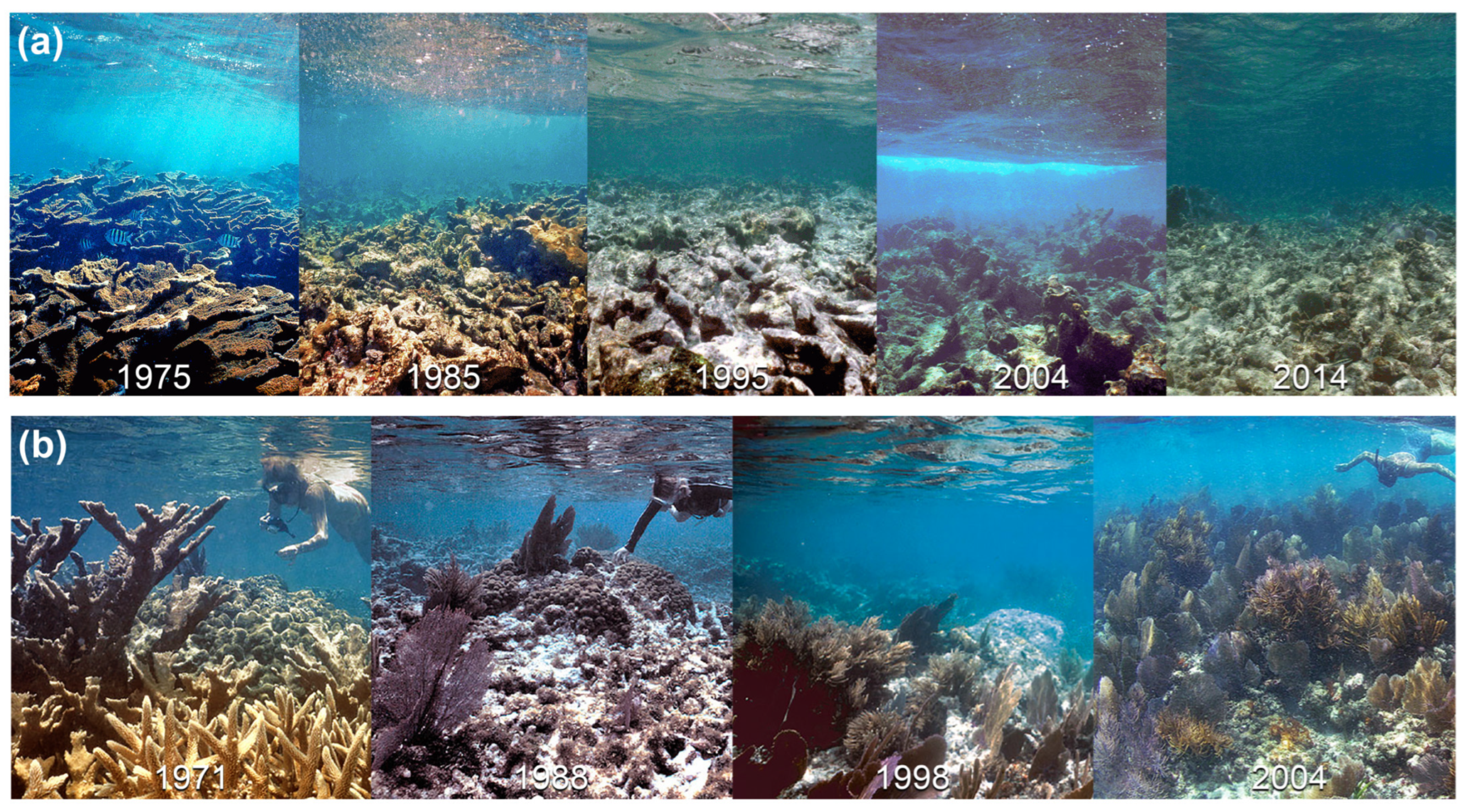
Figure 1. Time-series visualizations depicting coral reef changes in the UFK from previously published imagery. (a) Carysfort Reef demonstrates a dramatic loss in reef structure over time. Photo credit: Phil Dustan [21,30]. (b) Grecian Rocks shows initial loss of reef structure, followed by subsequent increases in gorgonian cover. Photo credit: USGS [31].
Remotesensing 18 00463 g001
Figure 2. Elevation changes for (a) 1935–2002 and (b) 2002–2016, and (c) benthic habitat maps. Color scales in panels (a,b) use the same 11 colors; however, the yellow and gray colors in both panels correspond to the RMSE values for each time period, ±0.29 m and ±0.21, respectively (see the Methods Section 2.4). In panels (ac), the black dashed lines delineate the upper, middle, and lower subregions of the UFK study site.
Remotesensing 18 00463 g002
Figure 3. (a) Elevation change values color-coded to emphasize points outside of the ±0.5 m 1.65 × RMSETotal threshold: red points fall below the lower threshold, blue points exceed the upper threshold, and gray points lie within the threshold range. (b) Side view of the 3D Triangulated Irregular Network (TIN) surfaces created from the elevation change points that were used to compute seafloor volume changes. View is looking west (shoreward) and extends from south to north, and the same vertical scale was used for both time periods. The black dashed lines delineate the upper, middle, and lower subregions of the UFK study site.
Remotesensing 18 00463 g003aRemotesensing 18 00463 g003b
Figure 4. Estimated mean water depth versus mean elevation change per habitat for each subregion and study period. Colored dots represent the habitat types present in each region (see Tables S5 and S6). Solid black lines denote the linear regression fit of the data.
Remotesensing 18 00463 g004
Figure 5. Mean elevation change per habitat type for each of the two study periods.
Remotesensing 18 00463 g005
Figure 6. Mean volume changes for lower bound values.
Remotesensing 18 00463 g006
Figure 7. Storm tracks that passed near our study site. Dashed circle has a radius of 100 km. Data and background image obtained from the Historical Hurricane Tracks Tool available at [60].
Remotesensing 18 00463 g007
Figure 8. Changes in percent cover different benthic organisms at Carysfort Reef, Grecian Rocks Reef, and Molasses Reef between 2002 and 2016. Photographs depict changes at approximately the same location at each of the three reefs. Red arrows indicate common features between each pair of photographs. Carysfort Shallow photographs are from [31]; the remaining photographs were provided by [76].
Remotesensing 18 00463 g008
Table 1. Elevation change values exceeding different RMSE (root-mean-squared error) thresholds.
Total Points | Z - change | RMSETotal (0.29 m)% of Total | Z - change | > 1.65 × RMSETotal (0.47 m)% of Total | Z - change | > 0.5 m% of Total
1935–2002(No.)(No.) (No.) (No.)
Total study site25,92614,50856946036881534
Scattered coral/rock in uncon. sed. *17137612711271
Aggregate reef *14221032738015677354
Reef rubble *291187641384712944
Individual or aggregated patch reef *20701365669794793045
Spur and groove *610461763656035258
Pavement18991308699785294049
Unconsolidated sediment5341279652165231151828
Seagrass continuous6742373755239636221433
Seagrass discontinuous6943316946176825158823
Pavement with sand channels479379793337032568
Not classified113615438343430
Total study site25,92614,50856946036881534
Total Points| Z - change |> RMSETotal (0.21m)% of Total| Z - change |> 1.65 × RMSETotal (0.35m)% of Total| Z - change |>0.5m% of Total
2002–2016(No.)(No.) (No.) (No.)
Total study site25,92610,5474142551616826
Scattered coral/rock in uncon. sed. *17105942400
Aggregate reef *1422715503522515711
Reef rubble *291120415118197
Individual or aggregated patch reef *2070946464582223511
Spur and groove *61028547158268514
Pavement1899867464362319010
Unconsolidated sediment5341219341896173366
Seagrass continuous67422778411055163716
Seagrass discontinuous6943233634681102113
Pavement with sand channels47923148141297115
Not classified1136658232076
* Indicates coral-dominated habitat. Note: The summation of the total points for all habitats is 25,927 because a single point fell on the border between “seagrass discontinuous” and “unconsolidated sediment.” This point was treated as a member of both classes because arbitrarily removing it from one or the other would not change the results.
Table 2. Total study site t-test results for a non-zero mean elevation change ( Z - change ).
2-Tailed t-Test1-Tailed t-Test1-Tailed t-Test
H0 :   Z ¯ c h a n g e = 0H0 :   Z ¯ c h a n g e > 0H0 :   Z ¯ c h a n g e < 0
RMSETotalNo. of Points Z ¯ c h a n g e SDt-StatistictcriticalResulttcriticalResulttcriticalResult
1935–2002(m)(No.)(m)(m) (m)(±, P)(m)(±, P)(m)(±, P)
25,926−0.130.78−27.341.96−, 0.001.65−, 0.001.65+, 1.00
0.2914,509−0.231.02−27.211.96−, 0.001.65−, 0.001.65+, 1.00
0.479461−0.331.22−26.481.96−, 0.001.65−, 0.001.65+, 1.00
0.508816−0.351.25−26.161.96−, 0.001.65−, 0.001.65+, 1.00
2-Tailed t-Test1-Tailed t-Test1-Tailed t-Test
H0: Z ¯ c h a n g e = 0H0: Z ¯ c h a n g e > 0H0: Z ¯ c h a n g e < 0
RMSETotalNo. of Points Z ¯ c h a n g e SDt-StatistictcriticalResulttcriticalResulttcriticalResult
2002–2016(m)(no.)(m)(m) (m)(±, P)(m)(±, P)(m)(±, P)
25,9260.000.302.441.96−, 0.021.65+, 0.991.65−, 0.01
0.2110,5590.040.458.551.96−, 0.001.65+, 1.001.65−, 0.00
0.3542610.170.6118.521.96−, 0.001.65+, 1.001.65−, 0.00
0.5016820.410.7622.191.96−, 0.001.65+, 1.001.65−, 0.00
NOTE: All tests were performed at the 5% significance level. ‘SD’ is the standard deviation of the mean elevation change, Z ¯ c h a n g e . Results of t-tests with ‘+’ indicate acceptance of the corresponding null hypothesis, H0.
Table 3. Elevation changes: 1935–2002 and 2002–2016.
Total PointsMean Elev. for 1935Mean Elev. for
2002
Mean
Elev.
Change
SD∆Elev. Loss PointsMax LossMean LossSD∆Elev Gain
Points
Max GainMean GainSD
1935–2002(No.)(m)(m)(m)(m)(No.)(m)(m)(no.)(no.)(m)(m)(m)
Total study site25,926−6.5−6.6−0.10.814,730−8.3−0.60.711,1966.50.40.5
Scattered coral/rock in uncon. sed. *17−6.1−6.9−0.80.913−2.0−1.10.741.20.50.5
Aggregate reef *1422−6.3−6.5−0.21.1848−5.1−0.80.85744.70.70.7
Reef rubble *291−3.4−3.6−0.20.8196−2.6−0.60.5953.20.60.7
Individual or aggregated patch reef *2070−5.6−5.8−0.21.11162−6.6−0.80.99085.20.60.7
Spur and groove *610−8.6−8.7−0.031.3342−4.6−0.80.82686.51.01.0
Pavement1899−5.7−5.9−0.21.01215−6.2−0.70.76844.90.70.7
Unconsolidated sediment5341−8.3−8.5−0.20.63408−6.8−0.50.519333.40.30.3
Seagrass continuous 6742−6.5−6.7−0.20.83586−8.0−0.60.831563.20.40.3
Seagrass discontinuous 6943−5.2−5.2−0.10.53720−8.3−0.40.432232.60.30.3
Pavement with sand channels479−11.2−10.90.31.3206−3.2−0.80.72735.71.10.9
Not classified113−6.4−6.20.20.534−2.0−0.40.4792.00.40.3
Coral-dominated substrates4410−6.1−6.3−0.21.12561−6.6−0.80.818496.50.70.8
Non-coral substrates21,403−6.6−6.7−0.10.712,135−8.3−0.50.692685.70.40.4
Total PointsMean Elev. for 2002Mean Elev. for
2016
Mean
Elev.
Change
SD∆Elev Loss PointsMax LossMean LossSD∆Elev Gain
Points
Max GainMean GainSD
2002–2016(No.)(m)(m)(m)(m)(No.)(m)(m)(No.)(No.)(m)(m)(m)
Total study site25,926−6.6−6.60.0050.314,179−2.2−0.20.111,7478.90.20.3
Scattered coral/rock in uncon. sed. *17−6.9−6.60.20.23−0.1−0.050.0140.50.30.2
Aggregate reef *1422−6.5−6.50.00.4743−1.8−0.30.26798.90.30.4
Reef rubble *291−3.6−3.7−0.10.3195−1.5−0.20.2961.20.20.2
Individual or aggregated patch reef *2070−5.8−5.70.10.41006−1.4−0.20.210643.40.30.3
Spur and groove *610−8.7−8.60.10.4287−0.9−0.20.23232.60.30.4
Pavement1899−5.9−5.80.10.3806−2.2−0.20.210933.00.30.3
Unconsolidated sediment5341−8.5−8.50.030.32688−1.5−0.20.126537.70.20.3
Seagrass continuous 6742−6.7−6.60.010.33641−0.9−0.20.131012.50.20.2
Seagrass discontinuous 6943−5.2−5.3−0.10.24477−1.1−0.20.124662.40.20.2
Pavement with sand channels479−10.9−10.80.10.4233−1.4−0.20.22462.30.30.3
Not classified113−6.2−6.4−0.20.2101−0.6−0.30.1120.20.10.1
Coral-dominated substrates4410−6.3−6.20.030.42234−1.8−0.20.221768.90.30.4
Non-coral substrates21,403−6.7−6.70.00.311,844−2.2−0.20.195597.70.20.2
* Indicates coral-dominated substrate. ∆Elev = elevation change. All data points were used to compute tabulated values to be consistent with [27], i.e., no RMSE was applied. Points belonging to the “not classified” habitat were excluded from the non-coral substrates analyses. Note: The summation of the total points for all habitats is 25,927 because a single point fell on the border between “seagrass discontinuous” and “unconsolidated sediment.” This point was treated as a member of both classes because arbitrarily removing it from one or the other would not change the results.
Table 4. Volume changes for 1935–2002 and 2002–2016.
1935–2002Habitat AreaGross
Volume Loss
Gross
Volume Gain
Net
Volume Change
Area-Normalized Volume Change
(km2)(106 m3)(106 m3)(106 m3)(106 m3 km−2)
LowerUpperLowerUpperLowerUpperLowerUpper
Total study site234.221.067.07.431.3−13.6−35.7−0.1−0.2
Scattered coral/rock in uncon. sed. *0.20.10.10.00.0−0.1−0.1−0.3−0.7
Aggregate reef *11.71.94.50.82.3−1.1−2.2−0.1−0.2
Reef rubble *1.50.20.60.10.2−0.1−0.4−0.1−0.2
Individual or aggregated patch reef *16.82.76.70.52.1−2.2−4.6−0.1−0.3
Spur and groove *5.40.81.90.91.70.1−0.30.01−0.1
Pavement16.92.36.50.82.4−1.5−4.1−0.1−0.2
Unconsolidated sediment62.93.516.20.95.6−2.7−10.50.04−0.2
Seagrass continuous 62.16.418.71.18.1−5.3−10.6−0.1−0.2
Seagrass discontinuous 52.02.09.80.76.0−1.3−3.9−0.02−0.1
Pavement with sand channels4.10.51.21.22.00.70.80.20.2
Not classified0.70.00.00.00.20.020.10.030.2
Coral-dominated substrates35.65.613.82.46.4−3.2−7.5−0.09−0.2
Non-coral substrates197.914.652.44.623.9−10.0−28.5−0.05−0.1
2002–2016
Total study site234.20.119.41.726.91.67.50.0070.03
Scattered coral/rock in uncon. sed. *0.20.00.00.00.00.00.040.00.2
Aggregate reef *11.70.01.20.11.40.10.30.0070.02
Reef rubble *1.50.00.20.00.1−0.004−0.03−0.003−0.02
Individual or aggregated patch reef *16.80.01.00.22.70.21.70.010.1
Spur and groove *5.40.00.40.10.70.10.40.010.1
Pavement16.90.01.20.12.30.11.10.0050.1
Unconsolidated sediment62.90.04.60.67.50.52.90.010.05
Seagrass continuous 62.10.05.10.48.00.43.00.0070.05
Seagrass discontinuous 52.00.05.20.13.20.05−2.00.001−0.04
Pavement with sand channels4.10.00.30.00.70.040.40.010.1
Not classified0.70.00.20.00.00.0−0.20.0−0.2
Coral-dominated substrates35.60.02.70.45.00.42.30.00.1
Non-coral substrates197.90.116.31.221.71.15.50.00.0
* Indicates coral-dominated substrate. Lower-bound values were computed using only those elevation change points exceeding our most conservative RMSE value, | Z - change | > 0.5 m. The “not classified” habitat was excluded from the non-coral substrates analyses.
Disclaimer/Publisher’s Note: The statements, opinions and data contained in all publications are solely those of the individual author(s) and contributor(s) and not of MDPI and/or the editor(s). MDPI and/or the editor(s) disclaim responsibility for any injury to people or property resulting from any ideas, methods, instructions or products referred to in the content.