Study on the Spatiotemporal Variation of Vegetation Characteristics in the Three River Source Region Based on the CatBoost Model

 ,
,  , and
, and
Highlights
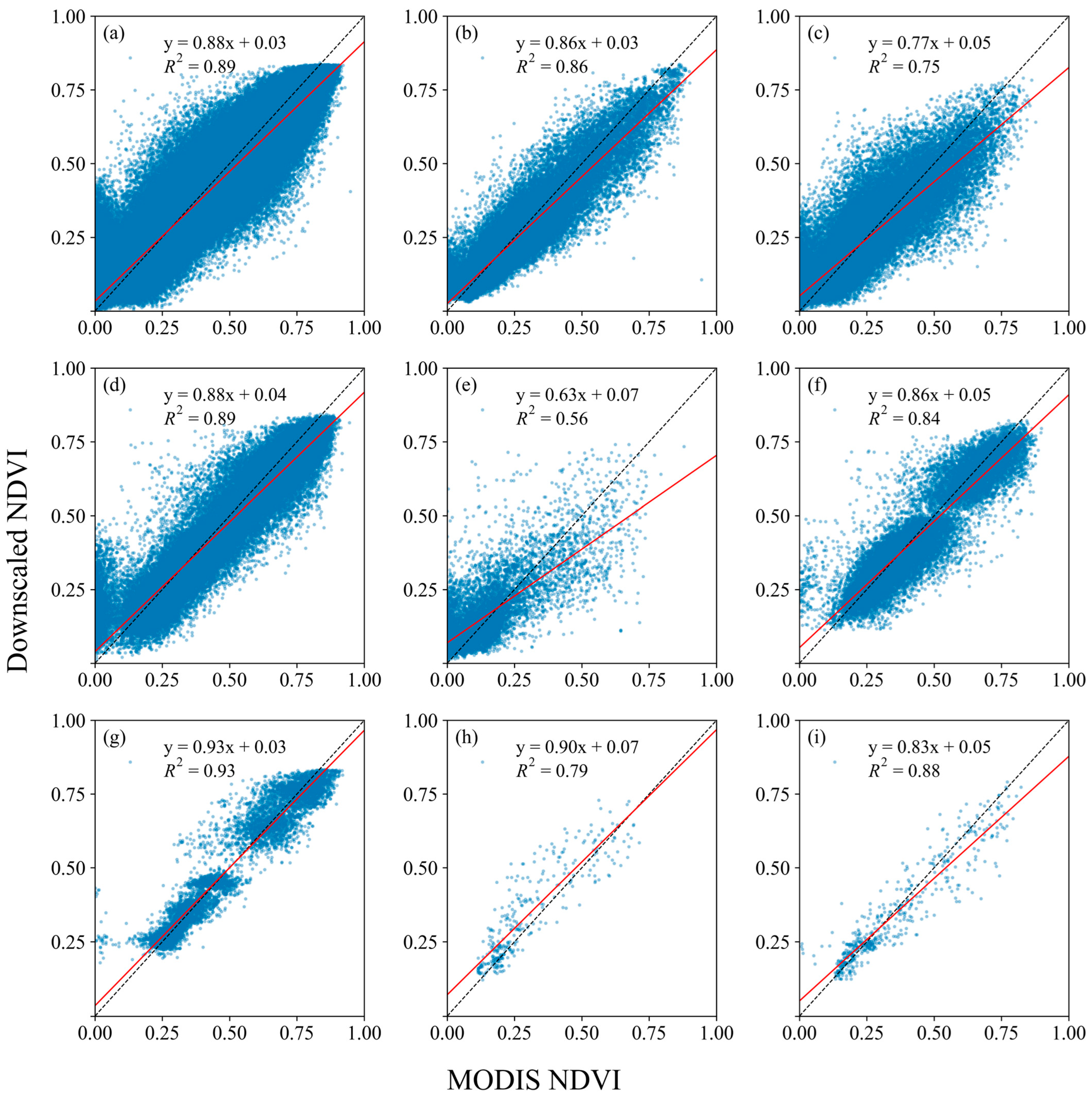
- The CatBoost model outperformed RF and LightGBM in NDVI data fusion, reconstructing a 1 km, long-term (1982–2014) GIMMS-MODIS NDVI dataset for the Three River Source Region.
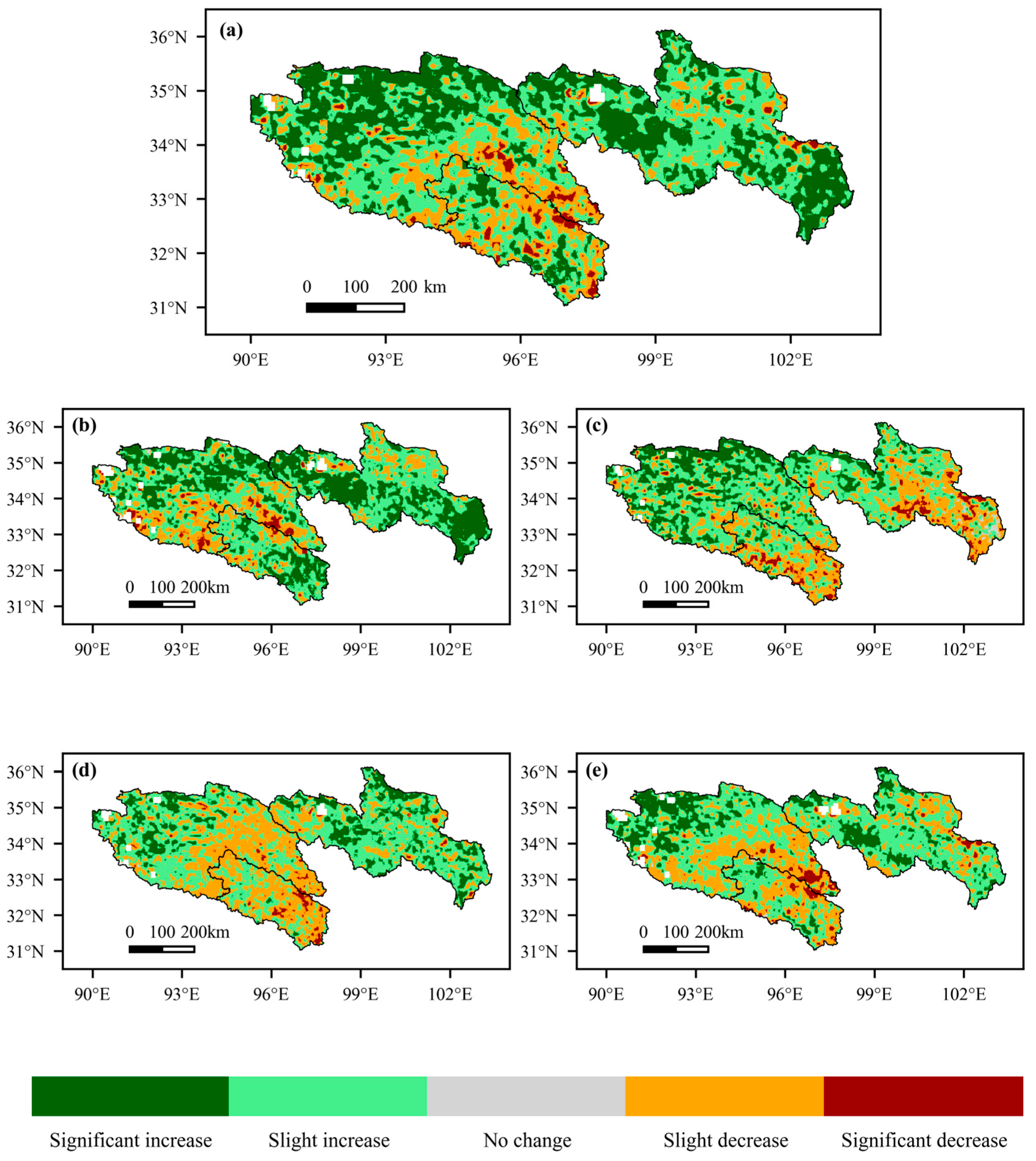
- Vegetation in the Three River Source Region exhibited a significant greening trend from 1982 to 2014 (0.0020/10a), with clear spatial heterogeneity—strongest in the Yellow River Source Region and weakest in the Lancang River Source Region.
- The fused NDVI dataset improved the accuracy of long-term vegetation monitoring in the Three River Source Region.
- The results offer insights for ecological restoration and sustainable management in alpine ecosystems.
Abstract
1. Introduction
2. Materials and Methods
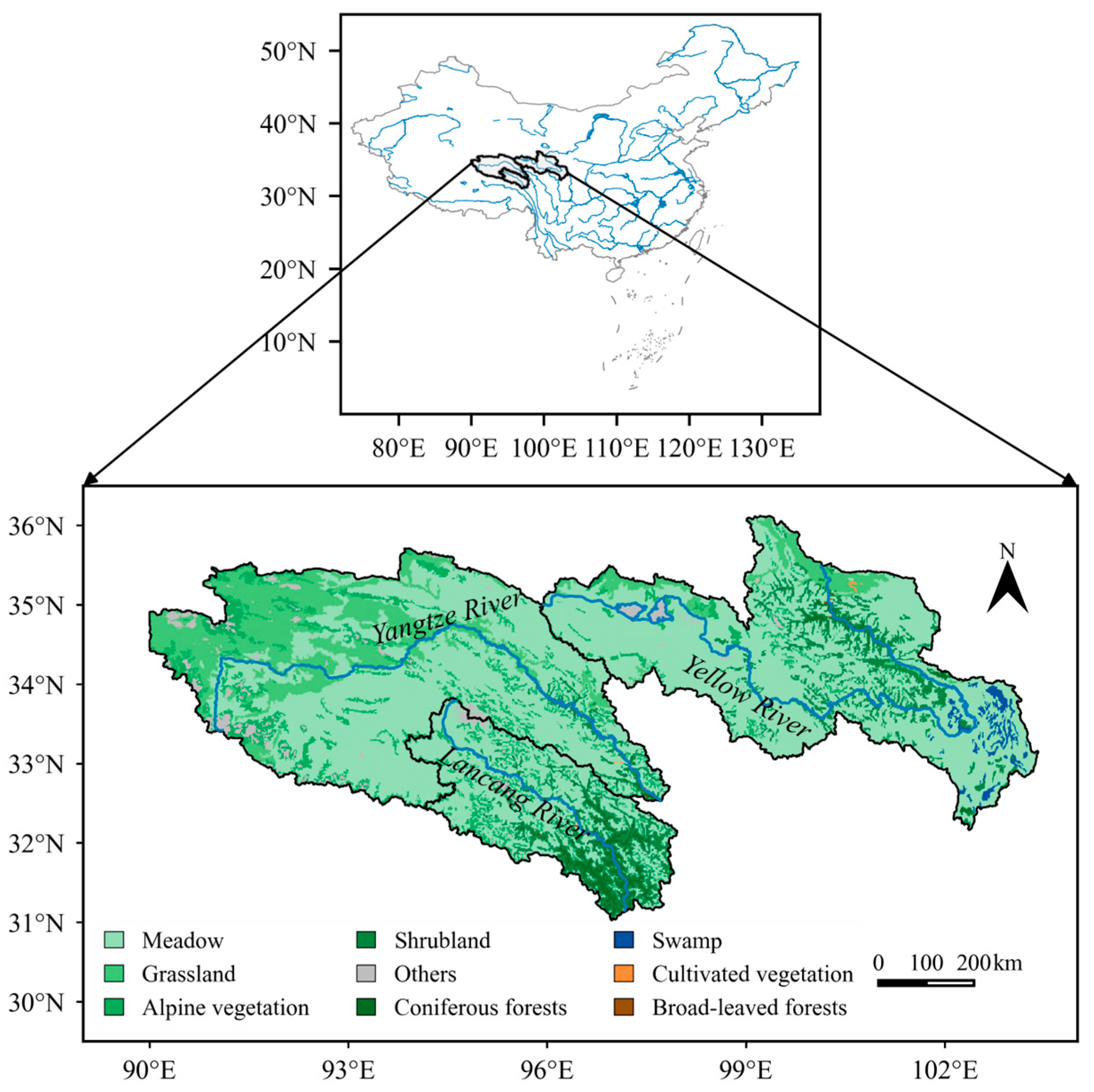
2.1. Study Area
2.2. Data
2.2.1. NDVI
2.2.2. DEM
2.2.3. Vegetation Type Data
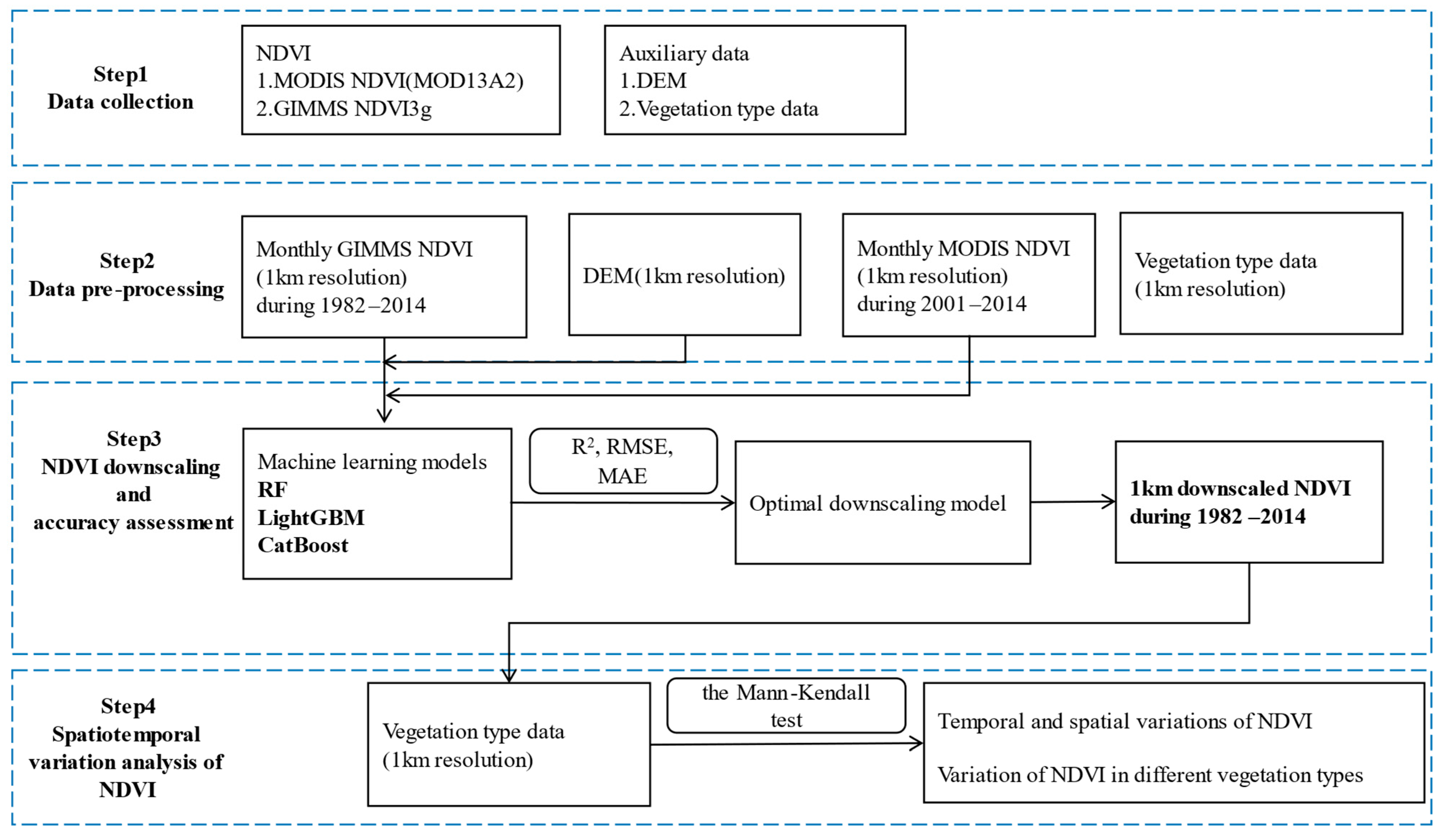
2.3. Methods
2.3.1. Machine Learning Algorithms
2.3.2. Evaluation Metrics
2.3.3. Correlation Analysis
2.3.4. Trend Analysis
3. Results
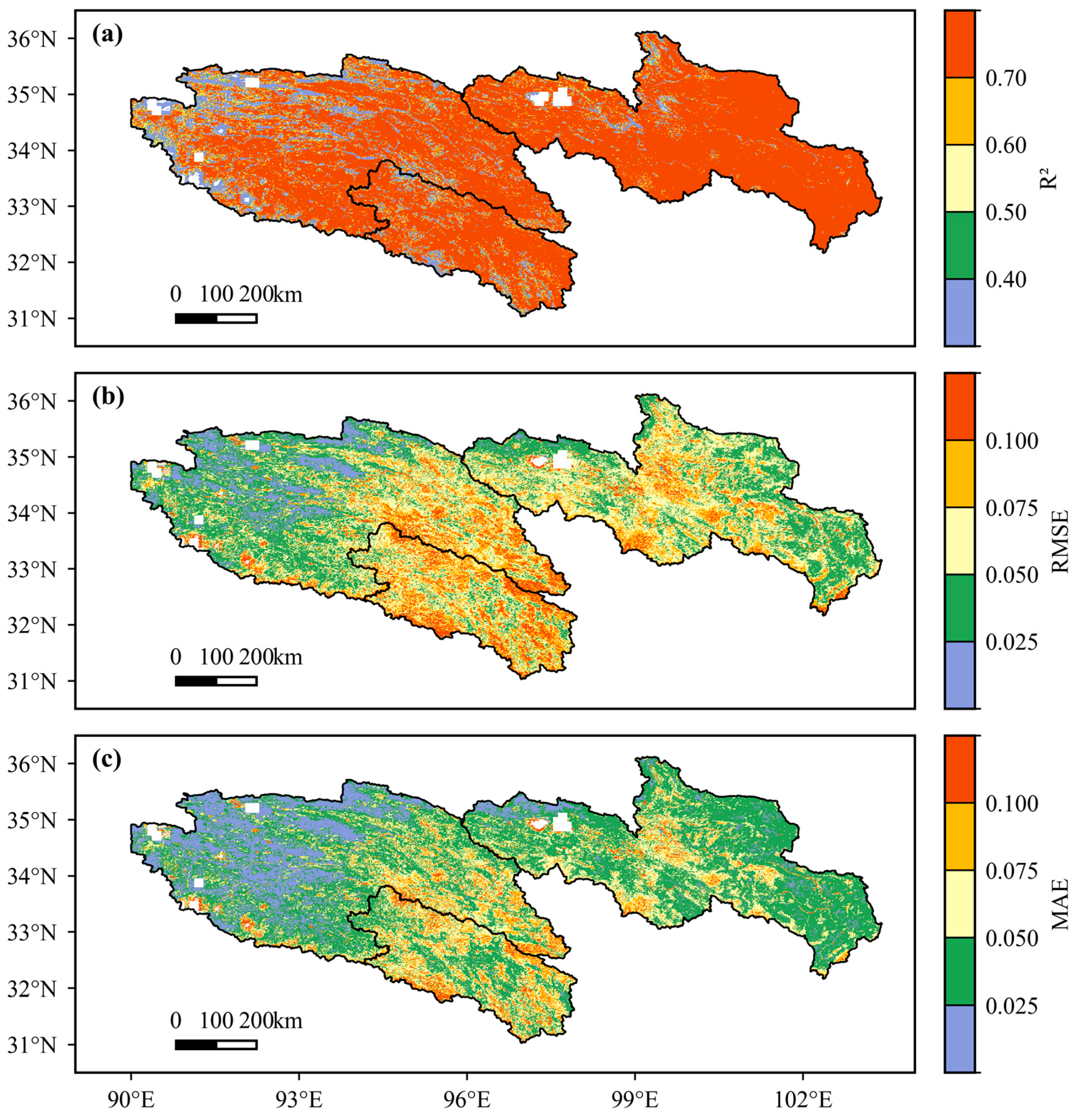
3.1. Model Evaluation
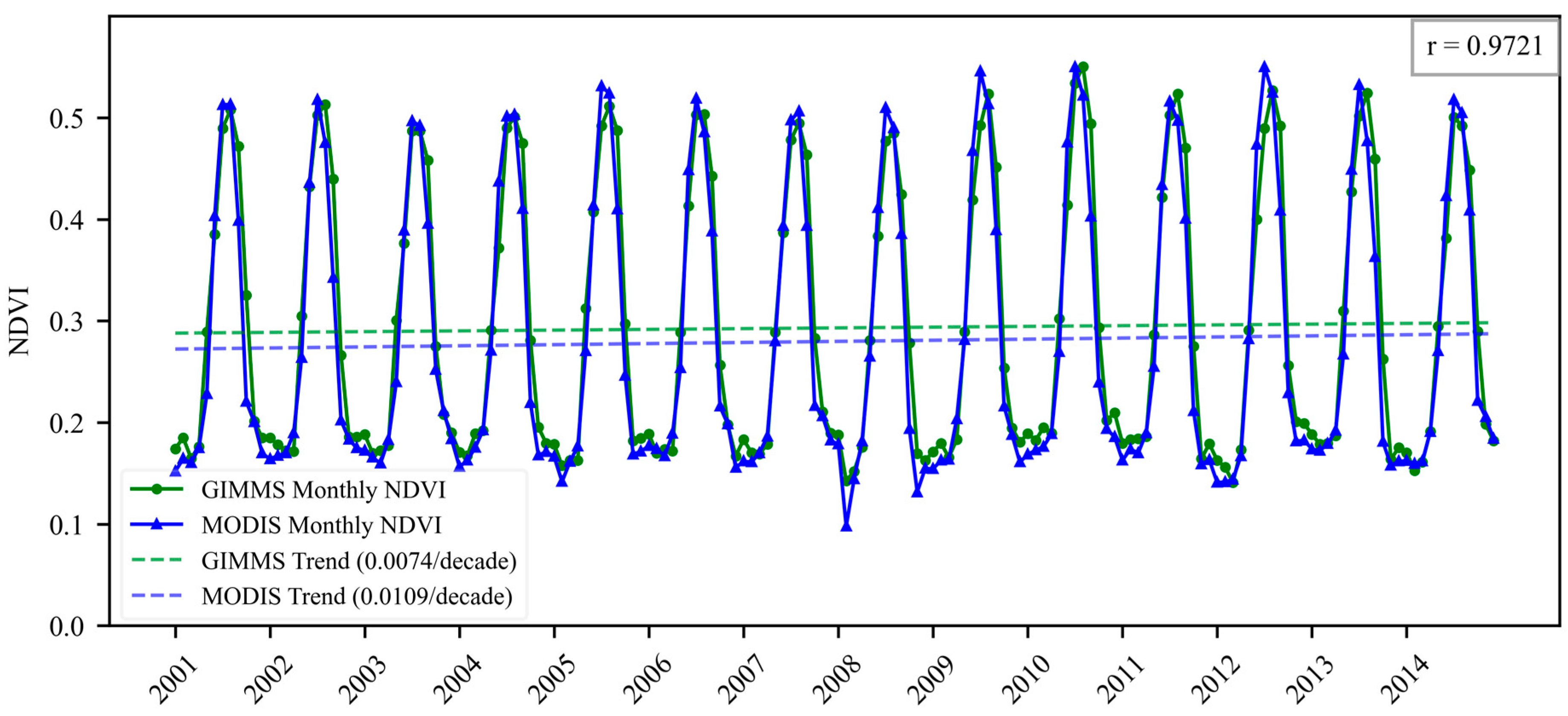
3.2. Time Variation of Downscaled NDVI
3.3. Spatial Variation of Downscaled NDVI
3.4. Statistical Analysis of Vegetation Trend Changes
4. Discussion
4.1. Value of the Downscaling Model
4.2. The Spatiotemporal Dynamics of NDVI in the TRSR
4.3. Vegetation Trend Variations Among Regions
4.4. Limitations and Uncertainties of the Downscaled NDVI
5. Conclusions
- (1)
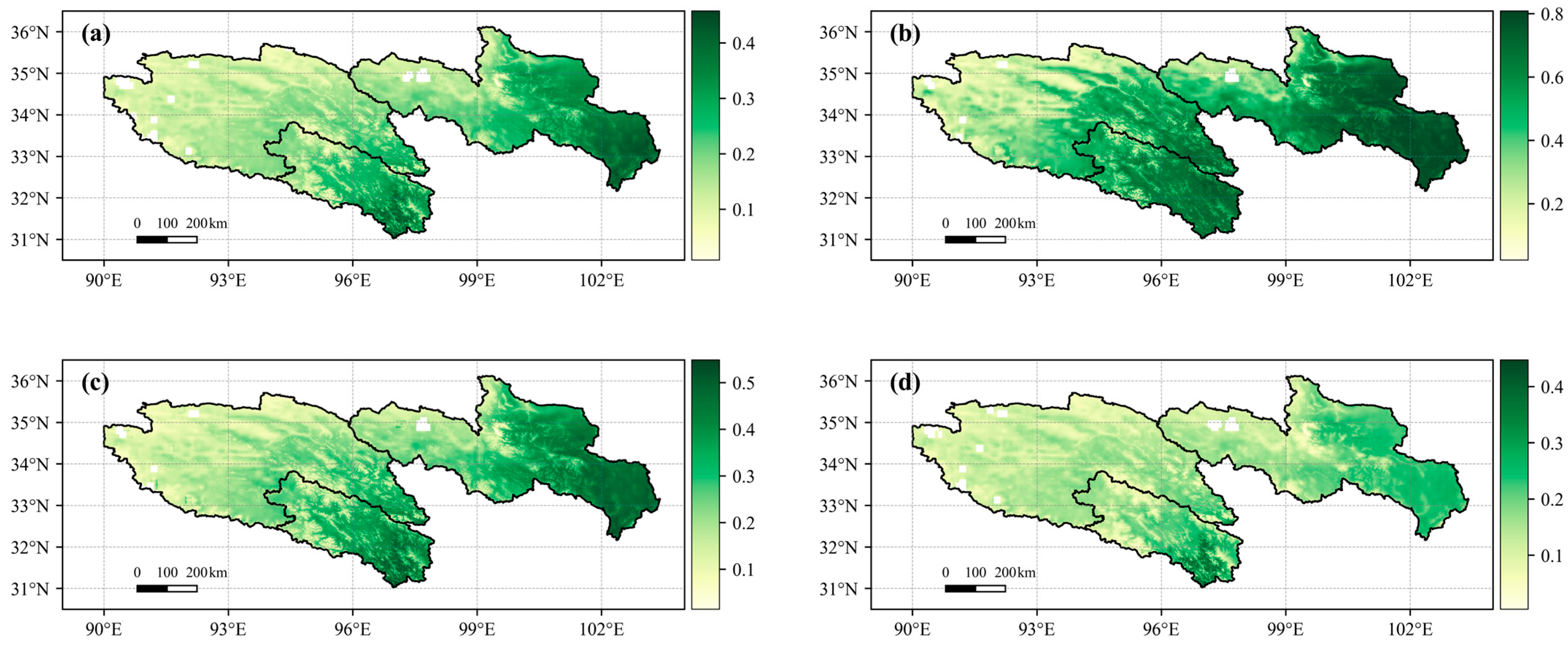
- The vegetation changes in the TRSR showed an increasing trend, with the most significant increases occurring in swamp, coniferous and broad-leaved forests, meadow, and grassland. NDVI generally decreased from southeast to northwest.
- (2)
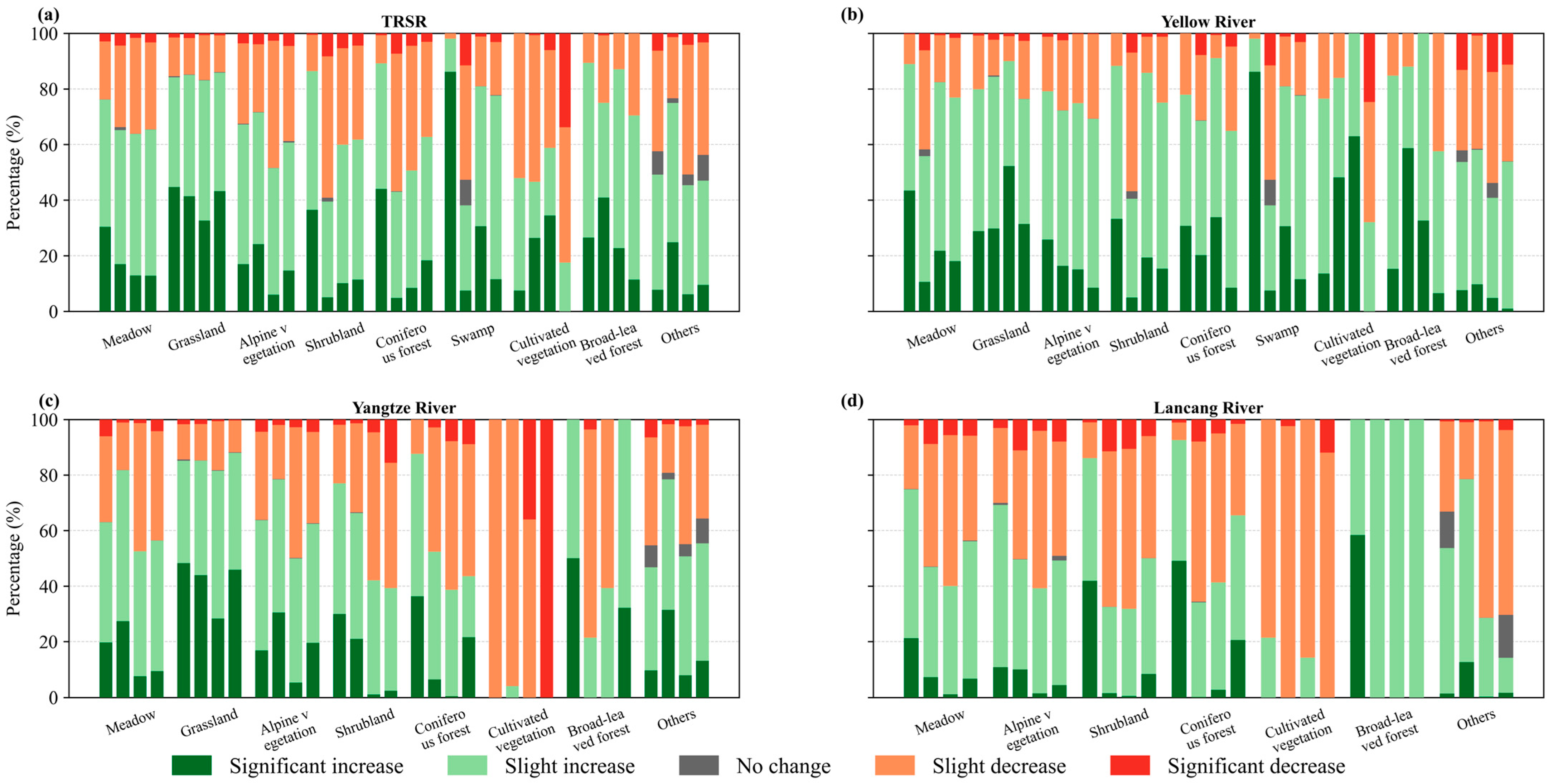
- Most vegetation types showed improvement. Most vegetation types exhibited improvement, with the area of greening far exceeding degradation. Swamp improved most notably in spring, while cultivated vegetation experienced more degradation.
- (3)
- Regional differences were evident: the Yellow River Source Region showed the strongest vegetation recovery; the Yangtze River Source Region exhibited grassland improvement but cultivated vegetation decline; and the Lancang River Source Region showed notable broad-leaved forests recovery, though overall change was moderate.
Author Contributions
Funding
Data Availability Statement
Acknowledgments
Conflicts of Interest
References
- Meng, X.; Chen, H.; Li, Z.; Zhao, L.; Zhou, B.; Lv, S.; Deng, M.; Liu, Y.; Li, G. Review of climate change and its environmental influence on the Three-River Regions. Plateau Meteorol. 2020, 39, 1133–1143. [Google Scholar]
- Zheng, Y.; Han, J.; Huang, Y.; Fassnacht, S.R.; Xie, S.; Lv, E.; Chen, M. Vegetation response to climate conditions based on NDVI simulations using stepwise cluster analysis for the Three-River Headwaters region of China. Ecol. Indic. 2018, 92, 18–29. [Google Scholar] [CrossRef]
- Fang, Y. Managing the Three-Rivers Headwater Region, China: From Ecological Engineering to Social Engineering. Ambio 2013, 42, 566–576. [Google Scholar] [CrossRef]
- Lian, L.; Shu, J.; Li, C. The impacts of grassland degradation on regional climate over the origin area of three rivers in Qinghai-Tibet Plateau, China. Acta Meteorol. Sin. 2009, 67, 580–590. [Google Scholar]
- Li, H.; Liu, G.; Fu, B. Response of vegetation to climate change and human activity based on NDVI in the Three-River Headwaters region. Shengtai Xuebao/Acta Ecol. Sin. 2011, 31, 5495–5504. [Google Scholar]
- Li, X.-L.; Brierley, G.; Shi, D.-J.; Xie, Y.-L.; Sun, H.-Q. Ecological Protection and Restoration in Sanjiangyuan National Nature Reserve, Qinghai Province, China. In Perspectives on Environmental Management and Technology in Asian River Basins; Higgitt, D., Ed.; Springer: Dordrecht, The Netherlands, 2012; pp. 93–120. [Google Scholar]
- Ma, N.; Cao, S.; Bai, T.; Yang, Z.; Cai, Z.; Sun, W. Assessment of Vegetation Dynamics in Xinjiang Using NDVI Data and Machine Learning Models from 2000 to 2023. Sustainability 2025, 17, 306. [Google Scholar] [CrossRef]
- Sun, Z.; Wang, J. The 30m-NDVI-Based Alpine Grassland Changes and Climate Impacts in the Three-River Headwaters Region on the Qinghai-Tibet Plateau from 1990 to 2018. J. Resour. Ecol. 2022, 13, 186–195. [Google Scholar]
- Anderson, M.C.; Yang, Y.; Xue, J.; Knipper, K.R.; Yang, Y.; Gao, F.; Hain, C.R.; Kustas, W.P.; Cawse-Nicholson, K.; Hulley, G.; et al. Interoperability of ECOSTRESS and Landsat for mapping evapotranspiration time series at sub-field scales. Remote Sens. Environ. 2021, 252, 112189. [Google Scholar] [CrossRef]
- Shen, X.; An, R.; Feng, L.; Ye, N.; Zhu, L.; Li, M. Vegetation changes in the Three-River Headwaters Region of the Tibetan Plateau of China. Ecol. Indic. 2018, 93, 804–812. [Google Scholar] [CrossRef]
- Liu, X.; Zhang, J.; Zhu, X.; Pan, Y.; Liu, Y.; Zhang, D.; Lin, Z. Spatiotemporal changes in vegetation coverage and its driving factors in the Three-River Headwaters Region during 2000–2011. J. Geogr. Sci. 2014, 24, 288–302. [Google Scholar] [CrossRef]
- Bei, X.; Yao, Y.; Zhang, L.; Xu, T.; Jia, K.; Zhang, X.; Shang, K.; Xu, J.; Chen, X. Long-Term Spatiotemporal Dynamics of Terrestrial Biophysical Variables in the Three-River Headwaters Region of China from Satellite and Meteorological Datasets. Remote Sens. 2019, 11, 1633. [Google Scholar] [CrossRef]
- Yang, X.; Huang, X.; Ma, Y.; Li, Y.; Feng, Q.; Liang, T. Development of long-term spatiotemporal continuous NDVI products for alpine grassland from 1982 to 2020 in the Qinghai–Tibet Plateau, China. Grassl. Res. 2024, 3, 100–112. [Google Scholar] [CrossRef]
- Jian, L.; Hao, S.; Shanqi, W. Temporal and spatial variation of vegetation cover and its response to extreme climate in Shandong Province based on AVHRR and MODIS data sources. Bull. Soil Water Conserv. 2023, 43, 173–182. [Google Scholar]
- Li, X.; Peng, Q.; Shen, R.; Xu, W.; Qin, Z.; Lin, S.; Ha, S.; Kong, D.; Yuan, W. Long-term reconstructed vegetation index dataset in China from fused MODIS and Landsat data. Sci. Data 2025, 12, 152. [Google Scholar] [CrossRef] [PubMed]
- Zhang, Z.; Ao, Z.; Wu, W.; Wang, Y.; Xin, Q. Developing a Multi-Scale Convolutional Neural Network for Spatiotemporal Fusion to Generate MODIS-like Data Using AVHRR and Landsat Images. Remote Sens. 2024, 16, 1086. [Google Scholar] [CrossRef]
- Settle, J.J.; Drake, N.A. Linear mixing and the estimation of ground cover proportions. Int. J. Remote Sens. 1993, 14, 1159–1177. [Google Scholar] [CrossRef]
- Tan, X.Q.; Luo, S.Q.; Li, H.M.; Hao, X.H.; Wang, J.Y.; Dong, Q.X.; Chen, Z.H. Investigating the Effects of Snow Cover and Vegetation on Soil Temperature Using Remote Sensing Indicators in the Three River Source Region, China. Remote Sens. 2022, 14, 4114. [Google Scholar] [CrossRef]
- Xu, M.; Kang, S.; Chen, X.; Wu, H.; Wang, X.; Su, Z. Detection of hydrological variations and their impacts on vegetation from multiple satellite observations in the Three-River Source Region of the Tibetan Plateau. Sci. Total Environ. 2018, 639, 1220–1232. [Google Scholar] [CrossRef] [PubMed]
- Zhang, Y.; Ye, A. Spatial and temporal variations in vegetation coverage observed using AVHRR GIMMS and Terra MODIS data in the mainland of China. Int. J. Remote Sens. 2020, 41, 4238–4268. [Google Scholar] [CrossRef]
- Lu, Q.; Kang, H.L.; Zhang, F.Q.; Xia, Y.P.; Yan, B. Impact of climate and human activity on NDVI of various vegetation types in the Three-River Source Region, China. J. Arid. Land 2024, 16, 1080–1097. [Google Scholar] [CrossRef]
- Breiman, L. Random Forests. Mach. Learn. 2001, 45, 5–32. [Google Scholar] [CrossRef]
- Ostroumova, L.; Gusev, G.; Vorobev, A.; Dorogush, A.V.; Gulin, A. CatBoost: Unbiased boosting with categorical features. In Proceedings of the Neural Information Processing Systems, Long Beach, CA, USA, 4–9 December 2017. [Google Scholar]
- Ke, G.; Meng, Q.; Finley, T.; Wang, T.; Chen, W.; Ma, W.; Ye, Q.; Liu, T.-Y. LightGBM: A Highly Efficient Gradient Boosting Decision Tree. In Proceedings of the Neural Information Processing Systems, Long Beach, CA, USA, 4–9 December 2017. [Google Scholar]
- Yu, T.-K.; Chang, I.C.; Chen, S.-D.; Chen, H.-L.; Yu, T.-Y. Predicting potential soil and groundwater contamination risks from gas stations using three machine learning models (XGBoost, LightGBM, and Random Forest). Process Saf. Environ. Prot. 2025, 199, 107249. [Google Scholar] [CrossRef]
- Wei, J.; Li, Z.; Pinker, R.T.; Wang, J.; Sun, L.; Xue, W.; Li, R.; Cribb, M. Himawari-8-derived diurnal variations in ground-level PM2.5 pollution across China using the fast space-time Light Gradient Boosting Machine (LightGBM). Atmos. Chem. Phys. 2021, 21, 7863–7880. [Google Scholar] [CrossRef]
- Lavagnini, I.; Badocco, D.; Pastore, P.; Magno, F. Theil–Sen nonparametric regression technique on univariate calibration, inverse regression and detection limits. Talanta 2011, 87, 180–188. [Google Scholar] [CrossRef]
- Hamed, K.H.; Ramachandra Rao, A. A modified Mann-Kendall trend test for autocorrelated data. J. Hydrol. 1998, 204, 182–196. [Google Scholar] [CrossRef]
- Li, Z.Q.; Luo, S.Q.; Tan, X.Q.; Wang, J.Y. Trend Analysis of High-Resolution Soil Moisture Data Based on GAN in the Three-River-Source Region During the 21st Century. Remote Sens. 2024, 16, 4367. [Google Scholar] [CrossRef]
- Yang, Y.-H.; Piao, S.-L. Variations in grassland vegetation cover in relation to climatic factors on the Tibetan Plateau. Chin. J. Plant Ecol. 2006, 30, 1. [Google Scholar]
- Zhang, Y.; Zhang, C.; Wang, Z.; Yang, Y.; Li, J. Spatiotemporal dynamics of grassland coverage in response to climate change from 1982 to 2012 in the Three Rivers Source Region, China. Pratacult. Sci. 2017, 34, 1977–1990. [Google Scholar]
- Zhang, Y.; Zhang, C.; Wang, Z.; Chen, Y.; Gang, C.; An, R.; Li, J. Vegetation dynamics and its driving forces from climate change and human activities in the Three-River Source Region, China from 1982 to 2012. Sci. Total Environ. 2016, 563–564, 210–220. [Google Scholar] [CrossRef]
- Sun, Q.; Liu, W.; Gao, Y.; Li, J.; Yang, C. Spatiotemporal Variation and Climate Influence Factors of Vegetation Ecological Quality in the Sanjiangyuan National Park. Sustainability 2020, 12, 6634. [Google Scholar] [CrossRef]
- Ma, Z.; Dong, C.; Lin, K.; Yan, Y.; Luo, J.; Jiang, D.; Chen, X. A Global 250-m Downscaled NDVI Product from 1982 to 2018. Remote Sens. 2022, 14, 3639. [Google Scholar] [CrossRef]
- Liu, J.; Liu, S.; Tang, X.; Ding, Z.; Ma, M.; Yu, P. The Response of Land Surface Temperature Changes to the Vegetation Dynamics in the Yangtze River Basin. Remote Sens. 2022, 14, 5093. [Google Scholar] [CrossRef]
- Cao, W.; Liu, L.; Wu, D.; Huang, L. Spatial and temporal variations and the importance of hierarchy of ecosystem functions in the Three-river-source National Park. Acta Ecol. Sin 2019, 39, 1361–1374. [Google Scholar]
- Du JiZeng, D.J.; Wang GenXu, W.G.; Li YuanShou, L.Y. Rate and causes of degradation of alpine grassland in the source regions of the Yangtze and Yellow Rivers during the last 45 years. Acta Pratacult. Sin. 2015, 24, 5–15. [Google Scholar]



| Slope | Z | Trend Classifications | Trend Characteristics |
|---|---|---|---|
| β > 0 | > 1.96 | 2 | Significant increasing trend |
| ≤ 1.96 | 1 | Slight increasing trend | |
| β = 0 | 0 | No change | |
| β < 0 | ≤ 1.96 | −1 | Slight decreasing trend |
| > 1.96 | −2 | Significant decreasing trend |
| Model | Train_RMSE | Test_RMSE | Train_MAE | Test_MAE | Train_R2 | Test_R2 |
|---|---|---|---|---|---|---|
| RF | 0.0772 | 0.0808 | 0.0509 | 0.0539 | 0.8661 | 0.8585 |
| LightGBM | 0.0705 | 0.0737 | 0.0467 | 0.0494 | 0.8886 | 0.8821 |
| CatBoost | 0.0639 | 0.0674 | 0.0418 | 0.0445 | 0.9083 | 0.9014 |
| Region | Vegetation Type | Max | Min | Growth Rate (/10a) |
|---|---|---|---|---|
| TRSR | Meadow | 0.3080 (2010) | 0.2778 (1983) | 0.0037 * |
| Grassland | 0.1854 (2010) | 0.1635 (1985) | 0.0027 * | |
| Alpine vegetation | 0.2045 (2010) | 0.1816 (1983) | 0.0011 | |
| Shrubland | 0.4106 (2010) | 0.3870 (2008) | 0.0015 | |
| Coniferous forests | 0.4380 (2010) | 0.4207 (1983) | 0.0017 * | |
| Swamp | 0.4903 (2010) | 0.4643 (1982) | 0.0037 * | |
| Cultivated vegetation | 0.3521 (2010) | 0.3293 (1995) | 0.0009 | |
| Broad-leaved forests | 0.3768 (2010) | 0.3502 (1995) | 0.0032 * | |
| Others | 0.1570 (2010) | 0.1412 (2014) | 0.0003 | |
| Yellow River | Meadow | 0.3582 (2010) | 0.3230 (1983) | 0.0033 * |
| Grassland | 0.2815 (2010) | 0.2462 (1995) | 0.0039 * | |
| Alpine vegetation | 0.2317 (2010) | 0.1934 (1983) | 0.0027 * | |
| Shrubland | 0.4243 (2010) | 0.3953 (2008) | 0.0027 * | |
| Coniferous forests | 0.4187 (2010) | 0.3950 (1984) | 0.0024 * | |
| Swamp | 0.4903 (2010) | 0.4643 (1982) | 0.0037 * | |
| Cultivated vegetation | 0.3487 (2019) | 0.3064 (1995) | 0.0037 * | |
| Broad-leaved forests | 0.3541 (2010) | 0.3229 (1995) | 0.0035 * | |
| Others | 0.2000 (2002) | 0.1708 (2014) | −0.0009 | |
| Yangtze River | Meadow | 0.2505 (2010) | 0.2230 (1983) | 0.0016 |
| Grassland | 0.1642 (2010) | 0.1442 (1985) | 0.0025 * | |
| Alpine vegetation | 0.1900 (2010) | 0.1689 (1983) | 0.0012 | |
| Shrubland | 0.3590 (2010) | 0.3232 (2008) | 0.0006 | |
| Coniferous forests | 0.3847 (2010) | 0.3525 (2008) | 0.0009 | |
| Cultivated vegetation | 0.3542 (1998) | 0.3176 (2008) | −0.0040 * | |
| Broad-leaved forests | 0.4458 (2004) | 0.4162 (1996) | 0.0025 | |
| Others | 0.1389 (2011) | 0.1234 (1995) | 0.0013 | |
| Lancang River | Meadow | 0.3188 (1988) | 0.2948 (2008) | 0.0003 |
| Alpine vegetation | 0.2327 (1988) | 0.2119 (1983) | −0.0002 | |
| Shrubland | 0.4081 (1988) | 0.3903 (2008) | 0.0003 | |
| Coniferous forests | 0.4560 (2004) | 0.4366 (1983) | 0.0016 * | |
| Cultivated vegetation | 0.3757 (1990) | 0.3556 (2008) | −0.0016 | |
| Broad-leaved forests | 0.3986 (2010) | 0.3767 (1982) | 0.0023 * | |
| Others | 0.1966 (1994) | 0.1781 (1983) | 0.0012 |
| Region | Vegetation Type | Growth Rate Spring (/10a) | Growth Rate Summer (/10a) | Growth Rate Autumn (/10a) | Growth Rate Winter (/10a) |
|---|---|---|---|---|---|
| TRSR | Meadow | 0.0026 * | 0.0023 | 0.0014 | 0.0030 |
| Grassland | 0.0017 * | 0.0040 * | 0.0023 * | 0.0028 * | |
| Alpine vegetation | 0.0011 | 0.0019 | 0.0004 | 0.0012 | |
| Shrubland | 0.0035 * | −0.0006 | 0.0011 | 0.0027 | |
| Coniferous forests | 0.0036 * | −0.0003 | 0.0004 | 0.0031 | |
| Swamp | 0.0092 * | −0.0004 | 0.0032 | 0.0034 | |
| Cultivated vegetation | 0.0010 | 0.0039 | 0.0009 | −0.0018 | |
| Broad-leaved forests | 0.0028 | 0.0042 | 0.0031 | 0.0027 | |
| Others | 0.0007 | −0.0000 | −0.0012 | 0.0013 | |
| Yellow River | Meadow | 0.0043 * | 0.0016 | 0.0033 | 0.0050 * |
| Grassland | 0.0022 | 0.0060 * | 0.0050 * | 0.0029 * | |
| Alpine vegetation | 0.0030 * | 0.0033 | 0.0022 | 0.0033 | |
| Shrubland | 0.0043 * | −0.0005 | 0.0034 | 0.0045 | |
| Coniferous forests | 0.0031 | 0.0016 | 0.0037 * | 0.0019 | |
| Swamp | 0.0092 * | 0.0092 * | 0.0032 | 0.0034 | |
| Cultivated vegetation | 0.0030 | 0.0090 * | 0.0041 | −0.0007 | |
| Broad-leaved forests | 0.0024 | 0.0066 * | 0.0045 * | 0.0010 | |
| Others | 0.0003 | 0.0023 | −0.0016 | 0.0002 | |
| Yangtze River | Meadow | 0.0009 | 0.0041 | 0.0001 | 0.0015 |
| Grassland | 0.0016 * | 0.0037 * | 0.0017 | 0.0028 * | |
| Alpine vegetation | 0.0006 | 0.0026 | −0.0002 | 0.0010 | |
| Shrubland | 0.0024 | 0.0020 | −0.0008 | −0.0013 | |
| Coniferous forests | 0.0029 * | 0.0003 | −0.0010 | 0.0017 | |
| Cultivated vegetation | −0.0019 | −0.0021 | −0.0046 * | −0.0073 * | |
| Broad-leaved forests | 0.0043 * | −0.0022 | −0.0012 | 0.0077 * | |
| Others | 0.0002 | 0.0005 | 0.0002 | 0.0014 | |
| Lancang River | Meadow | 0.0018 | −0.0003 | −0.0007 | 0.0003 |
| Alpine vegetation | 0.0012 | −0.0006 | −0.0006 | 0.0014 | |
| Shrubland | 0.0028 * | −0.0012 | −0.0012 | 0.0000 | |
| Coniferous forests | 0.0039 * | −0.0009 | −0.0003 | 0.0022 | |
| Cultivated vegetation | −0.0012 | −0.0023 | −0.0019 | 0.0037 | |
| Broad-leaved forests | 0.0022 * | 0.0010 | 0.0020 | −0.0005 | |
| Others | 0.0043 * | 0.0013 | −0.0014 | 0.0014 |
Disclaimer/Publisher’s Note: The statements, opinions and data contained in all publications are solely those of the individual author(s) and contributor(s) and not of MDPI and/or the editor(s). MDPI and/or the editor(s) disclaim responsibility for any injury to people or property resulting from any ideas, methods, instructions or products referred to in the content. |
© 2025 by the authors. Licensee MDPI, Basel, Switzerland. This article is an open access article distributed under the terms and conditions of the Creative Commons Attribution (CC BY) license (https://creativecommons.org/licenses/by/4.0/).
Share and Cite
Wang, J.; Luo, S.; Ren, H.; Wang, X.; Wang, J.; Zhao, Z. Study on the Spatiotemporal Variation of Vegetation Characteristics in the Three River Source Region Based on the CatBoost Model. Remote Sens. 2025, 17, 4024. https://doi.org/10.3390/rs17244024
Wang J, Luo S, Ren H, Wang X, Wang J, Zhao Z. Study on the Spatiotemporal Variation of Vegetation Characteristics in the Three River Source Region Based on the CatBoost Model. Remote Sensing. 2025; 17(24):4024. https://doi.org/10.3390/rs17244024
Chicago/Turabian StyleWang, Jun, Siqiong Luo, Hongrui Ren, Xufeng Wang, Jingyuan Wang, and Zisheng Zhao. 2025. "Study on the Spatiotemporal Variation of Vegetation Characteristics in the Three River Source Region Based on the CatBoost Model" Remote Sensing 17, no. 24: 4024. https://doi.org/10.3390/rs17244024
APA StyleWang, J., Luo, S., Ren, H., Wang, X., Wang, J., & Zhao, Z. (2025). Study on the Spatiotemporal Variation of Vegetation Characteristics in the Three River Source Region Based on the CatBoost Model. Remote Sensing, 17(24), 4024. https://doi.org/10.3390/rs17244024