


Highlights
What are the main findings?
- ET and NDVI increased across all burn severity levels and dominant vegetation classes during both dry and wet seasons, with high-severity burned areas showing the most rapid post-fire recovery.
- Despite increases in ET and NDVI, most burned Forest and Shrub areas have remained as Grassland, with only limited reestablishment of pre-fire vegetation types.
What are the implications of the main findings?
- Increases in ET and NDVI reflect partial functional recovery, but vegetation structure has not returned to pre-fire conditions.
- Grassland in formerly forested areas indicates a potential ecosystem shift. Continued use of remote sensing for post-fire monitoring and targeted management is essential to support vegetation recovery and reduce vulnerability to future fires.
Abstract
Wildfires can drastically alter ecological landscapes in just a few days, while it takes years of post-fire recovery for vegetation to return to its former pre-fire state. Assessing changes in vegetation can help with understanding how the hydrological components in the wildfire-affected areas contribute to potential vegetation shifts. This case study of the Los Angeles Bobcat Fire in 2020 uses Google Earth Engine (GEE) and Python 3.10.18 to access and visualize variations in Difference Normalized Burn Ratio (dNBR) area, Normalized Difference Vegetation Index (NDVI), and OpenET’s evapotranspiration (ET) across three dominant National Land Cover Database (NLCD) vegetation classes and dNBR classes via monthly time series and seasonal analysis from 2016 to 2024. Burn severity was determined based on Landsat-derived dNBR thresholds defined by the United Nations Office for Outer Space Affairs UN-Spider Knowledge Portal. Our study showed a general reduction in dNBR class area percentages, with High Severity (HS) dropping from 15% to 0% and Moderate Severity (MS) dropping from 45% to 10%. Low-Severity (LS) areas returned to 25% after increasing to 49% in May of 2022, led by vegetation growth. The remaining area was classified as Unburned and Enhanced Regrowth. Within our time series analysis, HS areas showed rapid growth compared to MS and LS areas for both ET and NDVI. Seasonal analysis showed most burn severity levels and vegetation classes increasing in median ET and NDVI values while 2024’s wet season median NDVI decreased compared to 2023’s wet season. Despite ET and NDVI continuing to increase post-fire, recent 2024 NLCD data shows most Forests and Shrubs remain as Grasslands, with small patches recovering to pre-fire vegetation. Using GEE, Python, and available satellite imagery demonstrates how accessible analytical tools and data layers enable wide-ranging wildfire vegetation studies, advancing our understanding of the impact wildfires have on ecosystems.
1. Introduction
In 2020, the 50 largest fires in the United States (each exceeding 161.8 km2) in total burned approximately 32,072 km2, with California accounting for 44% of the fires which burned 18,262 km2 [1]. These fires are part of an increasing trend of wildfires in the United States, with Southern California seeing an increase of 28.5 km2 per year from 1984 to 2017 [2]. Los Angeles has faced multiple large wildfires such as the 2009 Station Fire, 2018 Woolsey Fire, 2020 Bobcat Fire and 2024 Bridge Fire, with the Bobcat Fire burning up approximately 468.61 km2 of Angeles National Forest’s San Gabriel Mountain Range (SGM) [3]. The Bobcat Fire, which started in September of 2020, was amid a heatwave in Los Angeles with temperatures past 37.7 °C (100 °F). The 5-year drought from 2012 to 2016, followed by the beginning of another set of dry years in the beginning of 2020 resulted in dry vegetation that lead to large amounts of fuel for fires to burn [4]. In the early 20th century, the policy for fire suppression resulted in accumulated fuel loads, which ultimately created larger fires [5]. Solutions to mitigate wildfire fuel loads were integrated into national United States policy in 1978 with methods such as prescribed burns [6]. Despite fire mitigation practices, fires have continued to occur in Los Angeles County and surrounding counties, with multiple fire events burning simultaneously, such as the Angeles National Forest’s Bridge Fire, San Bernardino National Forest’s Line Fire, and Santa Ana Mountain’s Airport Fire in September of 2024 and the San Gabriel Mountain’s Eaton and Santa Monica Mountain’s Palisades fires in January of 2025.
Wildfires in Southern California, and mainly in Los Angeles County, are difficult to predict as wildfires can be caused by various human factors, such as smoking, campfires, [7] or human infrastructure such as power lines [8]. Data from the updated 2020 Spatial wildfire occurrence dataset by the United States Department of Agriculture (USDA) shows that 64.7% of wildfires in Los Angeles County were caused by humans between 2000 and 2020 [9]. When excluding unknown causes, human-caused wildfires jump to 96.75% [9]. In Los Angeles County, many sources play a part in human-caused wildfires, such as equipment and vehicle use, arson, smoking, and power generation [9]. These wildfires are a catalyst for change as they could clear out large plots of land, allowing non-native species to grow quickly and outcompete native species [10].
Los Angeles’s climatic characteristics tend to favor drought-adapted vegetation; high summer temperatures range from the coasts to the deserts [11]. Los Angeles County’s Mediterranean climate has overall low precipitation and elevated temperatures, contributing to drier vegetation [12]. Los Angeles observes its wet-season months from November to April, while May to October represents the dry-season months [13]. In recent decades, high rainfall and fire suppression have been correlated to higher fire frequency and intensity due to increased vegetation fuel loads [5,14,15]. Monitoring vegetation health is a key step to identify where a fire may likely occur, as vegetation with lower moisture leads to fires igniting quickly with little resistance [13]. Additionally, increasing temperatures are a crucial component in high evapotranspiration (ET) rates, as they are likely to cause an increase in fire frequency [16]. Vegetation health, moisture, and high temperatures impacting ET may lead to fires [13,14,15,16], which can change native flora into non-native flora, leading to large fuel loads consisting of annual grasses [10,12]. Monitoring these variables can help identify areas which experienced a large impact due to fire events and identify areas of non-native flora occupying native spots, which may drive preventative management of large fuel load areas [10].
Burn severity is a metric based mostly on the loss of organic matter in the soil and above ground [17]. In some Mediterranean climates, low and moderate impacts of fires led to the termination of select plant types [18], while areas experiencing high impacts from the fire may lose all their species due to extreme heat and the destruction of the seed bank [3,19]. In a study by Lentile et al., 2007 [20], in moderately and lightly burned areas, fires can leave behind organic matter, which can be used for plants to survive and establish. Normalized Difference Vegetation Index (NDVI), a measure of vegetation greenness [21], is influenced by burn severity, with highly and moderately burned areas observing a sharp decrease immediately after the fire, but after a year, these areas recovered faster compared to lightly burned and unburned areas [22]. Time series visualization of NDVI can help with determining vegetation growth after a fire [23], and in some Mediterranean areas, NDVI would grow to pre-fire levels after 7 years of post-fire recovery [24].
Burn severity also impacts ET, which is the linkage between water and energy flux through evaporation and transpiration [25]. One study found that ET dropped dramatically for areas experiencing a large reduction in tree canopy and understory vegetation due to high fire intensity a year after the fire in various ecosystem types, such as Broadleaf Forests, Conifer Forests, Mixed Forests, and Shrubland [26]. In another study, higher ET was found in the areas with highest burn severity for the 2020 Bobcat Fire, and ET was also considered the most important predictor for burn severity for the Southern California Mountains [27]. ET recovery varies with plant species; with one study observing Eucalyptus in highly burned areas taking more than 8 years to recover, while moderately and lightly burned areas recovered after 2 to 5 years [28].
In this study, we build upon previous work which measured burn severity [3,27,29,30], and ET [27,31] in the Bobcat Fire region, leveraging OpenET’s evapotranspiration as well as using Landsat 8 to monitor vegetation health both structurally and functionally within our study area. This study also aims to understand the variation in vegetation growth between the wet and dry seasons within each burn severity class and the National Land Cover Database (NLCD) vegetation class. Furthermore, this study expands the study period to 2016–2024. Including pre-fire years from 2016 to 2019 provides data for comparison. Analyzing additional years of post-fire recovery (2020–2024) helps reveal how vegetation in Southern California’s Mediterranean climate recovers since it has seen the largest magnitude of reduction in evapotranspiration [32,33]. Understanding vegetation health within these parameters could help forest management determine areas of highest and lowest priority based on vegetation types and their recovery.
2. Materials and Methods
2.1. Study Area
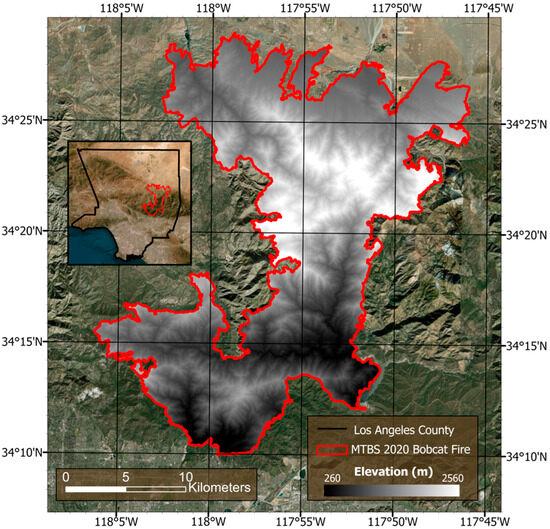
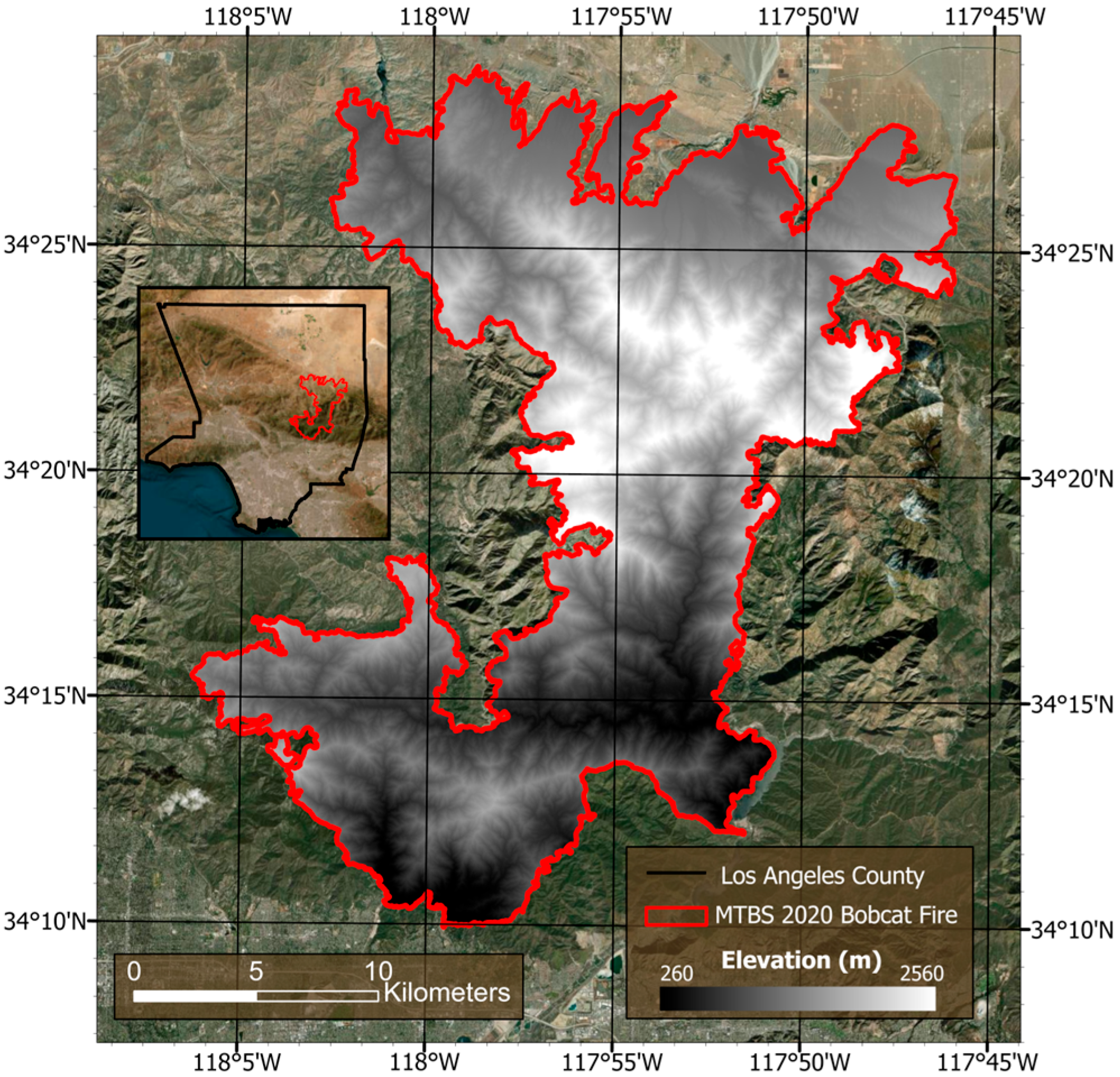
This study focuses on the Bobcat Fire located in SGM of Los Angeles, California. Los Angeles County has a Mediterranean climate, which is characterized by mild, wet winters and hot, dry summers [3,34]. The San Gabriel Mountain range has a max elevation of 3072 m at Mt. San Antonio [35]. Within the Bobcat Fire boundary, elevation ranges from 261.3 m to 2558.4 m as shown in Figure 1. The SGM predominantly consists of chaparral [36,37] with chamise chaparral and coastal sage scrub being the third-most dominant plant types [37]. The SGM are prone to the Santa Ana winds, which are hot, dry winds from the desert that flow towards the coast of Los Angeles [38]. These winds can help propagate existing fires and convert any small brush fire into a large controllable wildfire. The Bobcat Fire started near September 6th, 2020, and was contained near December 18th [39], while burning 468.61 km2 [3].
Figure 1.
The 2020 Bobcat Fire boundary from MTBS and its elevation range in the San Gabriel Mountains of Los Angeles, California.
The 2020 Bobcat Fire boundary used for this study is from Monitoring Trends of Burn Severity (MTBS). MTBS is a program formed by the United States Geological Survey (USGS), Earth Resources Observations and Sciences (EROS) and the USDA. MTBS’s goal is to remotely assess the location, extent, burned area boundaries, and burn severity of large wildfires in the conterminous United States [40,41]. Beginning in 2007, the MTBS program began incorporating the standard dNBR and RdNBR into the MTBS mapping workflow in order to provide a starting point for analysts to define burn area boundaries [41]. The Bobcat Fire boundary was used as the main filter for scene overlaps as well as for clipping each raster for analysis.
2.2. Landsat
Landsat 8 is a sun-synchronous satellite measuring spectral responses with its Optical Land Imager (OLI) and Thermal Infrared Sensors (TIRS) [42]. The Landsat product used for this study is Landsat 8’s 30 by 30 m, atmospherically corrected Level 2, Collection 2, Tier 1 product obtained from Google Earth Engine (GEE). Landsat 8 images intersecting the MTBS 2020 Bobcat Fire boundary from 1 January 2016 to 31 December 2024 were used. Code provided by the United Nations Burn Severity mapping exercise and GEE’s Landsat 8 example code helped in adjusting the Landsat scenes for analysis. The USGS applies scale factors to their Landsat 8 products to convert floating point data to 16-bit integers to conserve memory. Once each band is adjusted to the USGS scale factors, a bit mask is applied to mask out snow and cloud pixels using Landsat 8’s SR’s Quality Assurance (QA) layer. Each scene is then clipped by the Bobcat Fire boundary to remove any unused area. Depending on the variable, either Band 4 (Red Band: 0.64–0.67 µm), Band 5 (Near-Infrared (NIR): 0.85–0.88 µm), or Band 7 (Short Wave Infrared 2 (SWIR-2): 2.11–2.29 µm) are extracted to calculate NDVI and difference Normalized Burn Ratio (dNBR). This study only uses Landsat 8 to avoid issues with alternate spectral measurements.
2.3. OpenET
OpenET is a platform that provides ET data at a 30 by 30 m resolution. It uses an ensemble of six different ET estimation models: Alexi/DisAlexi, eeMETRIC, geeSEBAL, PT-JPL, SIMS, and SSEBop [43]. This ET product provides estimates for cumulative monthly ET in millimeters (mm), which is computed as the mean of the ensemble after filtering outliers [44]. Ensemble products can help reduce uncertainties and incorporate each model’s strengths in ET measurements [43]. The primary satellite for OpenET is Landsat; however, it also uses data from GOES, Senetinel-2, Soumi NPP, Terra, Aqua, and more to provide ET data. OpenET’s ET data has been compared to various in situ measurements across the contiguous United States, in which ET values had high accuracy in croplands and error margins within OpenET’s set ranges [45]. The OpenET product used for this analysis was the monthly ensemble product within GEE. This product was filtered for the same date range as the Landsat scenes (January 2016 to December 2024) and was clipped to the MTBS Bobcat Fire boundary.
2.4. NLCD
NLCD, by USGS, has been categorizing land cover and land cover change in various years since 2001. USGS collaborates with the Multi-Resolution Land Characteristics Consortium (MRLC) to create NLCD for Continental United States. This study uses NLCD’s yearly Land Cover product as the primary vegetation classes. Land Cover for the United States is in a 30 by 30 m spatial resolution with 16 classes [46]. NLCD uses a mix of unsupervised classification of Landsat data and other land classification datasets to establish the current 16 NLCD classes. There is an NLCD product for 2020; however, this product could have been influenced by the Bobcat Fire, so NLCD 2019 was used for this study. The 2019 NLCD image was clipped to the MTBS Bobcat Fire boundary to obtain the most prominent land classes.
2.5. Burn Severity
Burn severity can be portrayed as the difference between the pre-fire Normalized Burn Ratio (NBR) and the post-fire NBR, known as dNBR. The NBR [Equation (1)] is calculated by dividing the difference between NIR and SWIR 2 by the sum of NIR and SWIR 2 [Equation (2)]. A 1-year dNBR was created to match MTBS’s 1-year dNBR boundary calculation. The data used for this calculation are Landsat 8’s NIR and Shortwave Infrared bands. This results in a raster with low or negative dNBR values representing growth and values closer to or greater than 1 representing higher burn severity [47].
To split each time series into the burn severity categories, we calculated a 1-year dNBR scene using a clear Landsat 8 scene in early August 2020, and a clear scene in early August 2021. We used this 1-year dNBR scene to identify different burn severity areas based on the dNBR classification thresholds provided by the United Nations Office for Outer Space Affairs UN-Spider Knowledge Portal. The UN-Spider’s Moderate–Low Severity and Moderate–High Severity categories were combined into a single severity level, Moderate Severity (MS). Similarly, the Enhanced Regrowth–Low and Enhanced Regrowth–High categories were merged into a single level, Enhanced Regrowth (ER). Other severity levels of LS, HS, and Unburned (UB) remain the same as the UN-Spider’s classification as shown in Table 1. This facilitates interpretation of post-fire recovery patterns, which aligns with the burn severity defined in Pascolini-Campbell et al. [27]. The three main severity levels of HS, MS, and LS were used as masks and applied to the dNBR, vegetation indexes, and ET products.
Table 1.
Burn severity levels and their dNBR ranges.
2.6. NDVI
NDVI is, in short, a measure of plant greenness by dividing the difference in the NIR and RED bands by their sum [Equation (3)]. The RED band shows areas that absorb red light, mostly in areas with plant chlorophyll, while the NIR band shows areas where NIR wavelength is reflected by plants [2].
NDVI is used to characterize vegetation recovery after fires [48]. This vegetation index uses Landsat 8’s NIR and RED bands, which have 30 by 30 m spatial resolution. NDVI values range from −1 to 1 with values close to +1 representing healthy vegetation [21]. For this study, NDVI was calculated for each available Landsat scene within the study period and converted into monthly averages.
2.7. Data Processing
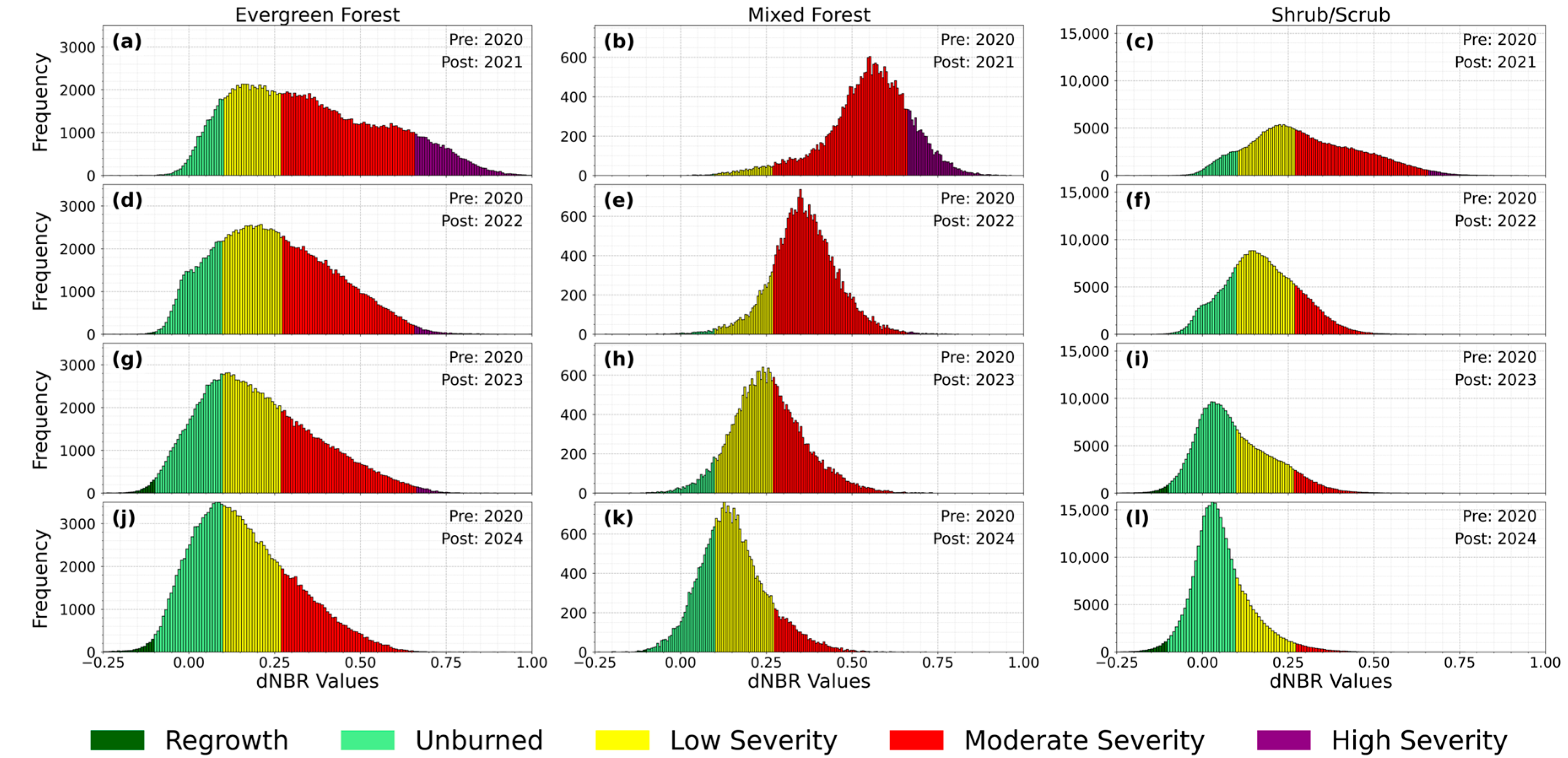
This study produced four dNBR images with a 1-year increment. By using the same pre-fire NBR on 4 August 2020, 1-year, 2-year, 3-year, and 4-year dNBRs were created using the earliest, clear Landsat scene in August 2021, 2022, 2023, and 2024, respectively. Then, the dNBR histograms were generated by clipping each yearly dNBR based on the top three dominant NLCD vegetation classes found in the Bobcat Fire area. In total, there are 12 histograms detailing overall dNBR distribution throughout the 4 years of post-fire recovery for three dominant vegetation classes.
The monthly dNBR time series was also created to monitor dNBR severity level at the monthly scale and examine how areas shrink or grow as time progresses. This monthly time series used an averaged monthly pre-fire NBR of August 2020, while the post-fire NBR was a variable beginning in September 2020 and progressing through each month for four years after the fire. In this format, the time series represents the change in the dNBR through time in relation to August 2020.
Time series of NDVI and ET were created using their averaged monthly data from January 2016 to December 2024. The HS, MS, and LS areas identified in the 1-year dNBR scene were used as masks to clip NDVI and ET within the Bobcat Fire region. Once each variable was clipped, the average value for the entire clipped boundary was used as that scene’s data point. The resulting time series illustrates how each variable changes across the three major burn severity levels covering pre- and post-fire.
Seasonal analyses were conducted for ET and NDVI during wet and dry months, where November–April are wet months and May–October are dry months [13]. These months are determined when California experiences most of its precipitation (wet) and when California receives the least amount of precipitation monthly (dry). For NDVI and ET, the wet- and dry-month temporal clips were used in GEE to create an average NDVI and ET scene within the monthly period. These scenes were later clipped by vegetation classes or burn severity levels to view patterns in vegetation growth within these clipped variables.
2.8. Statistical Analysis
This study conducted two statistical analyses, one analysis between the NDVI and ET time series, and the other one for the seasonal median observations within each burn severity and vegetation class for NDVI and ET. Spearman’s correlation coefficient was computed to determine the relationship between the monthly NDVI and ET and examine how they vary with each other post-fire for each burn severity. Only the months present in NDVI were correlated to the monthly ET averages. The Mann–Kendall test was performed on the monthly median NDVI and ET to examine their trends in the wet and dry seasons post-fire under different burn severity and vegetation class. Every month in NDVI and OpenET were used for this statistical analysis.
3. Results
3.1. Vegetation Classes
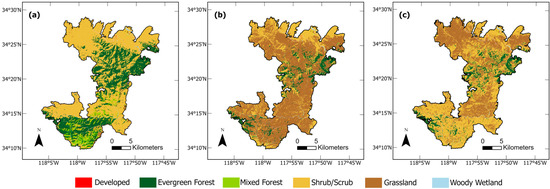
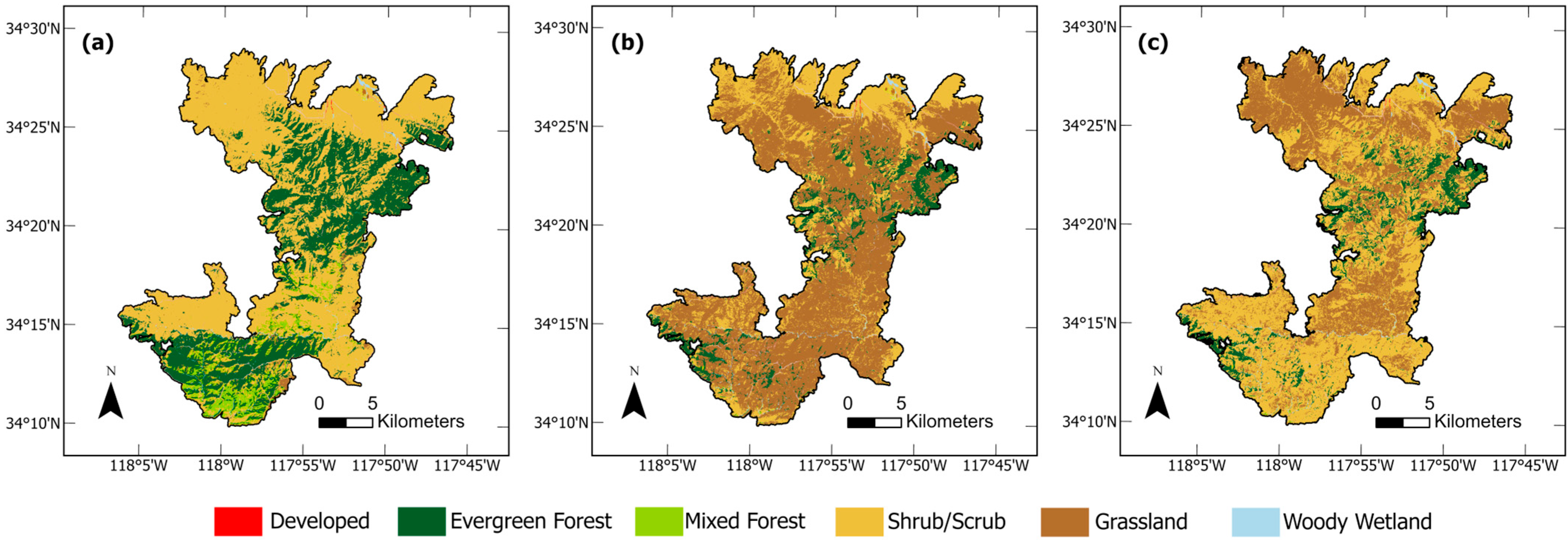
Our study identified seven land classes with more than 1000 pixels within the Bobcat Fire boundary (Table 2). Of these seven classes, Evergreen Forest, Mixed Forest, and Shrubs were the most populated (see Figure 2). The top three vegetation classes were used to clip various images for time series and seasonal analysis to show the different vegetation regrowth via NDVI and ET in each burn severity and season. NLCD vegetation classes within the Bobcat Fire boundary are shown in Figure 2. Three years are depicted with NLCD 2019 (Figure 2a) representing the pre-fire years, NLCD 2021 (Figure 2b) representing the first year after the fire, and NLCD 2024 (Figure 2c) showing the latest NLCD vegetation class. Vegetation classes have changed from mostly Evergreen Forest, Mixed Forest, and Shrubs in 2019 to mainly Grasslands in 2021 (Figure 2a,b). In 2024, these affected areas recovered to mainly Shrubs and Grasslands (Figure 2c).
Table 2.
Seven National Land Cover Database (NLCD) classes identified within the Bobcat Fire boundary.
Figure 2.
National Land Cover Database (NLCD) images before the fire in 2019 (a), 1 year after the fire in 2021 (b), and 4 years after the fire in 2024 (c). The most recent data available from NLCD was for the year 2024. Developed Open Space and Developed Low Intensity were merged into the class “Developed” for visualization.
In Table 3 below, NLCD 2019 and NLCD 2024 were compared to determine how Evergreen Forest, Mixed Forest, and Shrub pixels from 2019 were either transformed or recovered in 2024. The percentages are the ratio between pixels found classified as the current NLCD class in 2024 compared to the same pixel classified in 2019 (e.g., the percentage of LS Evergreen Pixels converted to Shrubs in 2024 was 82.92%). In all burn severity levels, Evergreen Forests mostly became all Shrubs, while Shrubs recovery increased with increasing burn severities. Mixed Forests were re-classified to Shrubs at LS level but to Shrubs/Grasslands at MS and HS levels. Shrubs were re-classified to Grasslands at LS level after four years but recovered predominantly to Shrubs classification at HS level.
Table 3.
Shows the percentages of pixels from NLCD 2024 (columns) that recovered to pre-fire 2019 NLCD pixel classes (rows) within each burn severity.
3.2. dNBR
3.2.1. Yearly dNBR
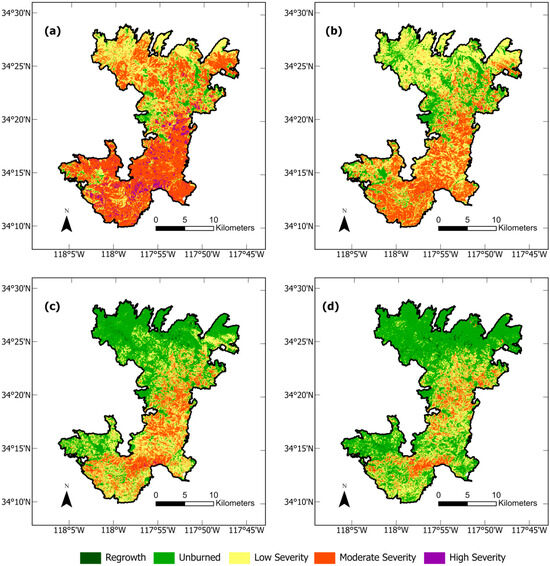
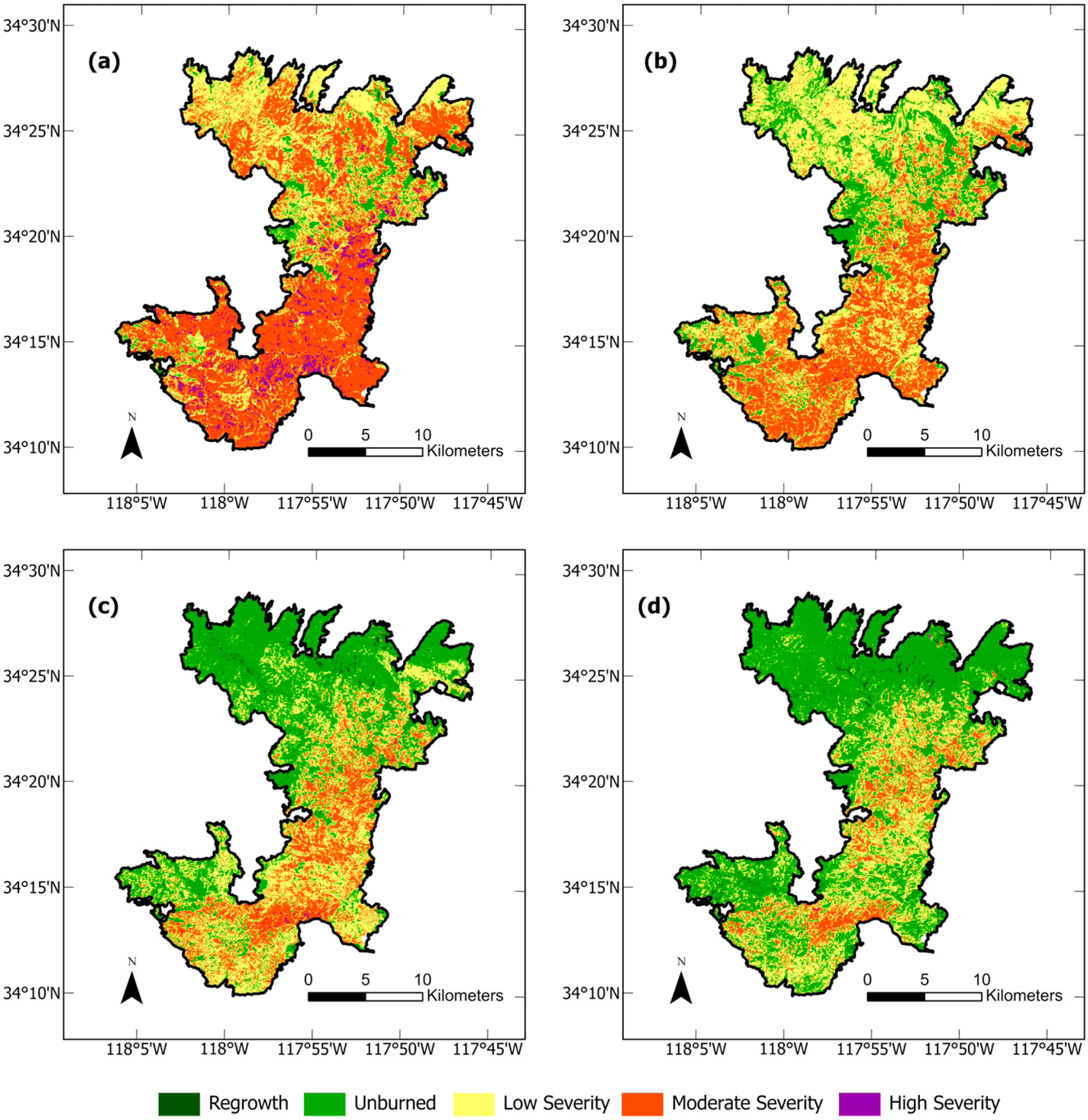
Four annual dNBR images were created to monitor spatial changes in burn severity levels over the four years following the Bobcat Fire. This study used the same pre-fire scene on 4 August 2020 while having the post-fire image be August 2021, 2022, 2023 and 2024 to produce 1-year dNBR, 2-year dNBR, 3-year dNBR, and 4-year dNBR, respectively (Figure 3). As seen in the first year of post-fire recovery (Figure 3a), most areas below the latitude of 34.20°N with an elevation around or below 1500 m have been categorized as moderately burned and concentrated. In the 2-year dNBR scene (Figure 3b), most of the northern areas have recovered to LS status while the southern areas have seen a mild reduction in areas classified as MS. The 3-year dNBR showed a more distinct change in dNBR burn severity distribution, with the northern areas displaying a change into UB area while central and southern parts of the study area are still classified as LS and MS areas (Figure 3c). In the final post-fire year of this study (Figure 3d), most of the area is classified as either LS or UB areas, and most MS areas are observed in sections that were once classified as HS in the 1-year dNBR.
Figure 3.
Multi-year dNBR images, including (a) 1-year dNBR, (b) 2-year dNBR, (c) 3-year dNBR, and (d) 4-year dNBR. All scenes used were in the month of August.
3.2.2. Monthly Time Series
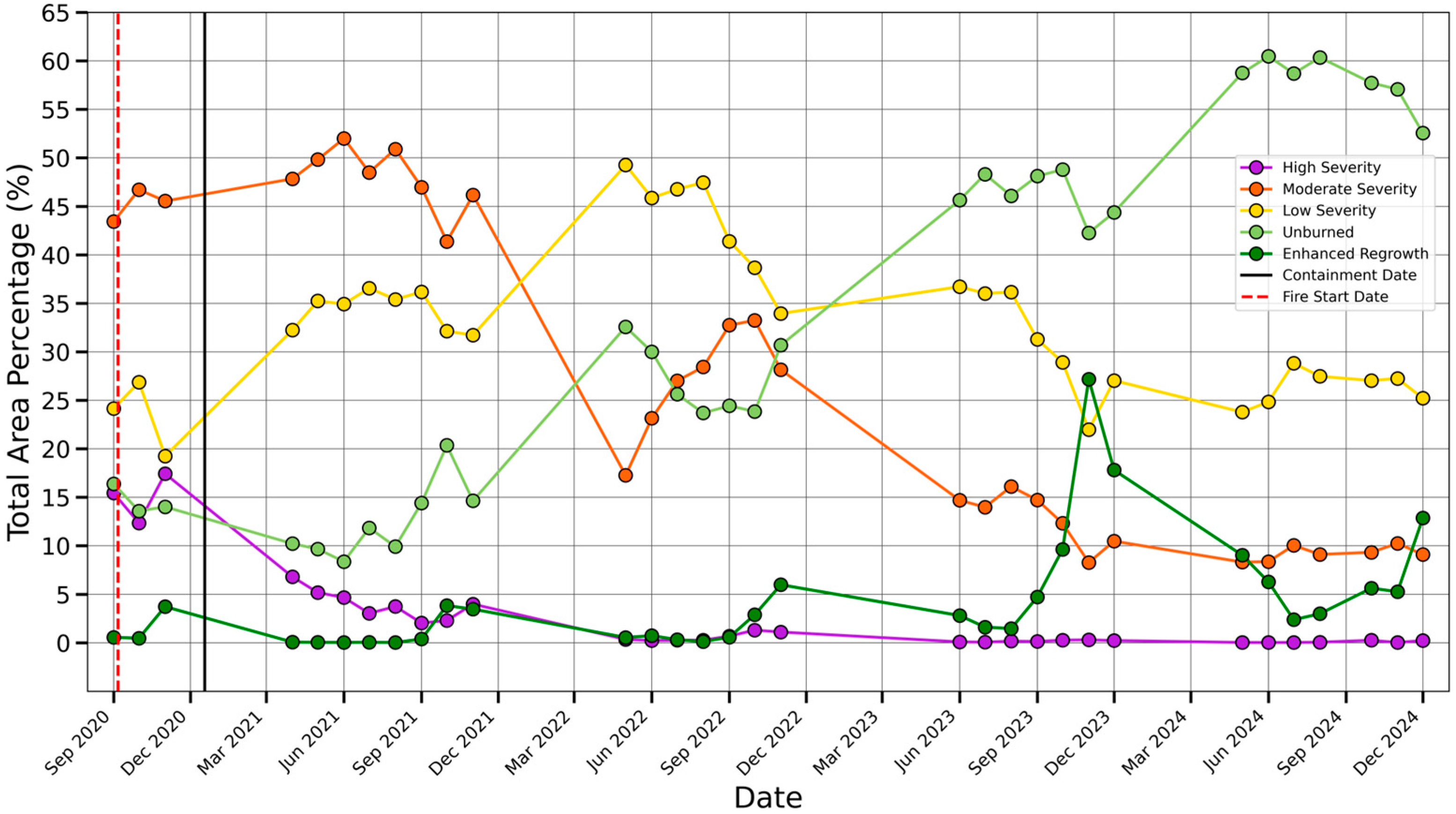
The monthly dNBR time series was created to examine the temporal variations across the five burn severity levels, including HS, MS, LS, UB, and ER, for post-fire within the Bobcat Fire region. This time series uses the averaged monthly scene for August 2020 (pre-fire) and compares this image to the monthly averaged scene from 2020 to 2024. Several individual months were filtered out of the time series due to cloud and snow coverage which can, in some cases, result in patches of missing data. Cloud and snow coverage was mostly seen in the early months of each year.
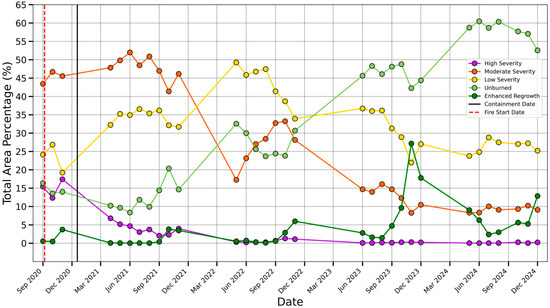
As seen in Figure 4, the dNBR monthly time series showed a pattern of vegetation growth, with decreasing burn severity in general. After the fire, the Bobcat Fire area consisted of 15% for HS, 44% for MS, 24% for LS, 16% for UB, and 1% for ER. The area percentage of MS and LS increased during the 2021 spring season as the percentage of HS areas dropped. This can be explained by the restoration of vegetation in highly burned areas. During the spring months of 2022, the area percentage of MS dropped to 16% from the previous value of 47% in November 2021. This drop in area percentage of MS fueled the increase in area percentage for LS to nearly 50% of the total Bobcat Fire region. In the fall of 2022, the increase in area percentage of MS could be attributed to vegetation which died out in LS areas due to severe drought conditions recorded in October of 2022 [49]. As HS, MS, and LS areas declined in general, the remaining portions of UB and ER areas increased, exhibiting vegetation levels that either resemble or exceed those observed in August 2020. As of the end of 2024, the dNBR severity compared to August 2020 showed a steady area percentage of 0% for HS, 10% for MS, 25% for LS, 52% for UB, and 13% for ER.
Figure 4.
Time series of monthly area percentage of dNBR HS (purple line), MS (orange line), LS (yellow line), UB (light green line), and ER (dark green line) within the Bobcat Fire Region.
3.2.3. dNBR Growth in Vegetation Classes
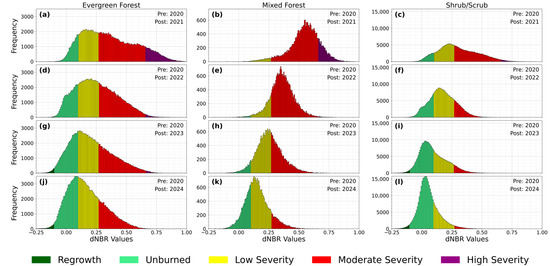
Histograms were produced to assess how dNBR values change over time for the top three vegetation classes within the Bobcat Fire region, including Evergreen Forest, Mixed Forest, and Shrub/Scrub. As shown in Figure 5, the histograms for all three vegetation classes shifted from larger dNBR values towards lower dNBR values as the post-fire year progressed. Mixed Forest saw the largest shift, with the peak shift from the dNBR value of 0.55 to that of nearly 0.15 (Figure 5b,e,h,k). Forest’s dNBR distribution retained most of its shape throughout the 4 years of post-fire recovery compared to Evergreen Forests and Shrubs. Shrubs also observed a shift from mostly MS areas to UB areas, representing a close resemblance to its pre-fire values (Figure 5c,f,i,l). Evergreen Forests exhibits the least change in dNBR values with HS areas diminishing, and UB and LS areas dominating within four years post-fire (Figure 5a,d,g,j).
Figure 5.
dNBR histograms separated by post-fire year (rows) and vegetation classes (columns), including Evergreen Forest in post-fire year of 2021 (a), 2022 (d), 2023 (g), and 2024 (j); Mixed Forest in post-fire year of 2021 (b), 2022 (e), 2023 (h), and 2024 (k); and Shrub/Scrub in post-fire year of 2021 (c), 2022 (f), 2023 (i), and 2024 (l). Dark green color represents Enhanced Regrowth (ER), light green color represents Unburned (UB), yellow color represents Moderate Severity (MS), and purple color represents High Severity (HS).
3.3. NDVI
3.3.1. Monthly NDVI Time Series
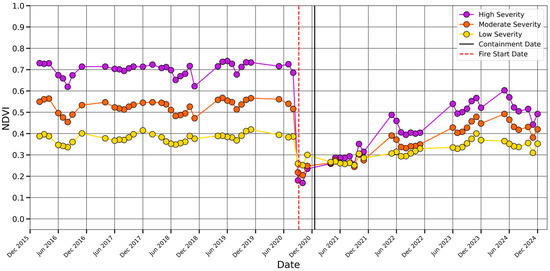
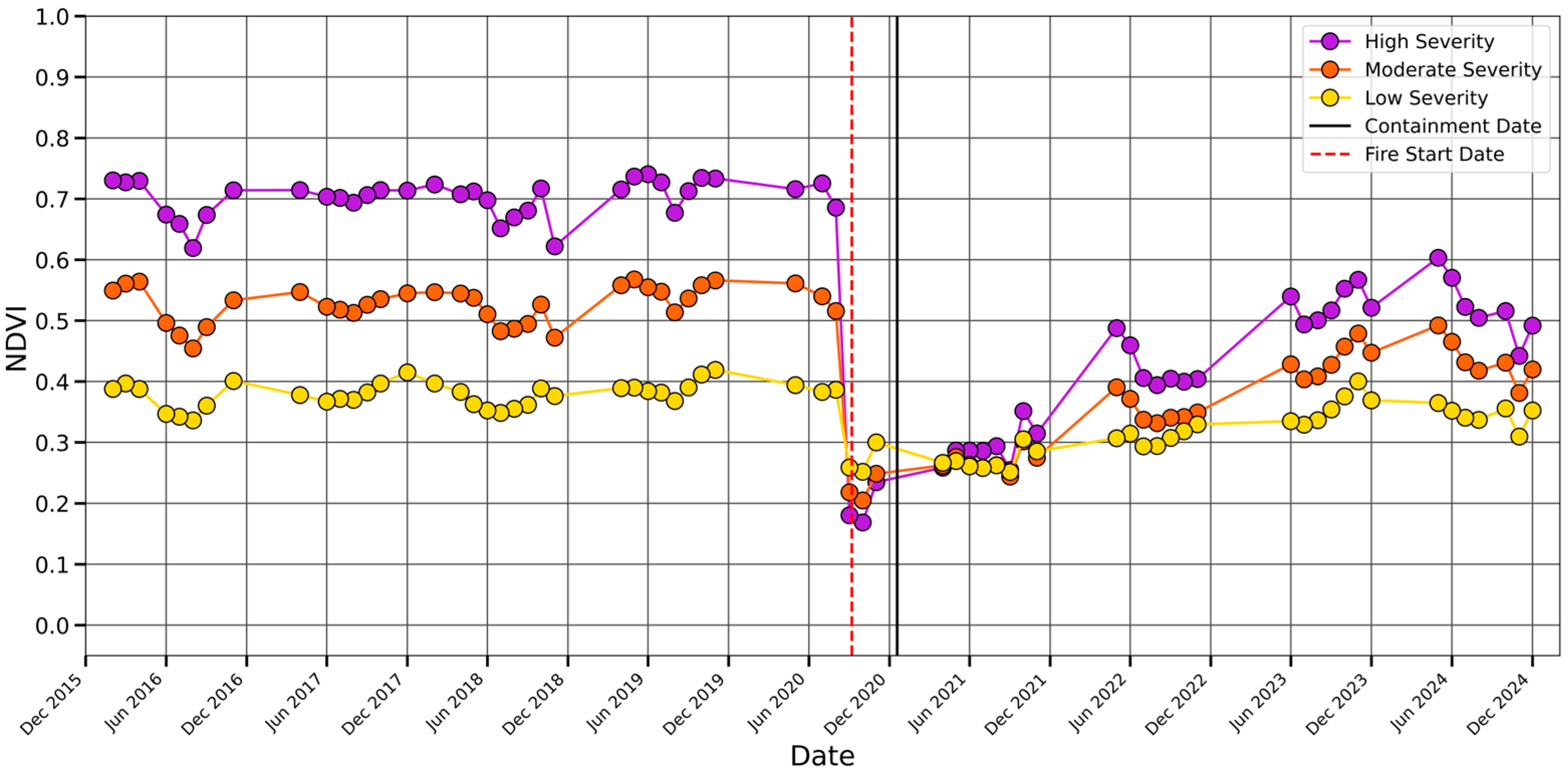
This study constructed monthly NDVI time series to illustrate how NDVI varies across the three major burn severity levels (HS, MS, and LS) covering pre- and post-fire (2016–2024). As seen in Figure 6, NDVI values in HS areas were the highest during pre-fire years with values near 0.7, while MS areas had values around 0.52 and LS areas had the lowest values below 0.4. After the start of the fire, HS areas had the largest drop with a difference of 0.5 in NDVI; MS and LS areas also had a decrease, although not in the same magnitude as HS areas. Interestingly, despite having the highest difference in NDVI after the fire, areas grew rapidly to reach a peak of 0.6 after 4 years. MS areas reached a peak of 0.5, which is slightly below its pre-fire values, and with a couple more years, may reach an average NDVI that resembles its pre-fire trends. LS areas were the only burn severity level that had NDVI values matching its pre-fire conditions. After 4 years of vegetation growth, NDVI has increased across the three burn severity levels; however, HS areas still need more post-fire recovery years to reach pre-fire values. Similar results were found in a study by Zahabnazouri et al., 2025 [50], where they observed how fires recovered over time by monitoring NDVI; however, not one of the burned areas have recovered to their pre-fire states.
Figure 6.
Monthly NDVI time series for dNBR’s LS, MS, and HS areas within the Bobcat Fire region from January 2016 to December 2024.
3.3.2. Seasonal NDVI
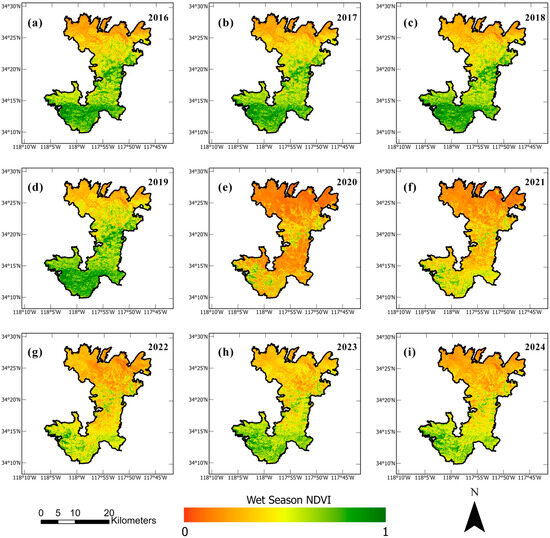
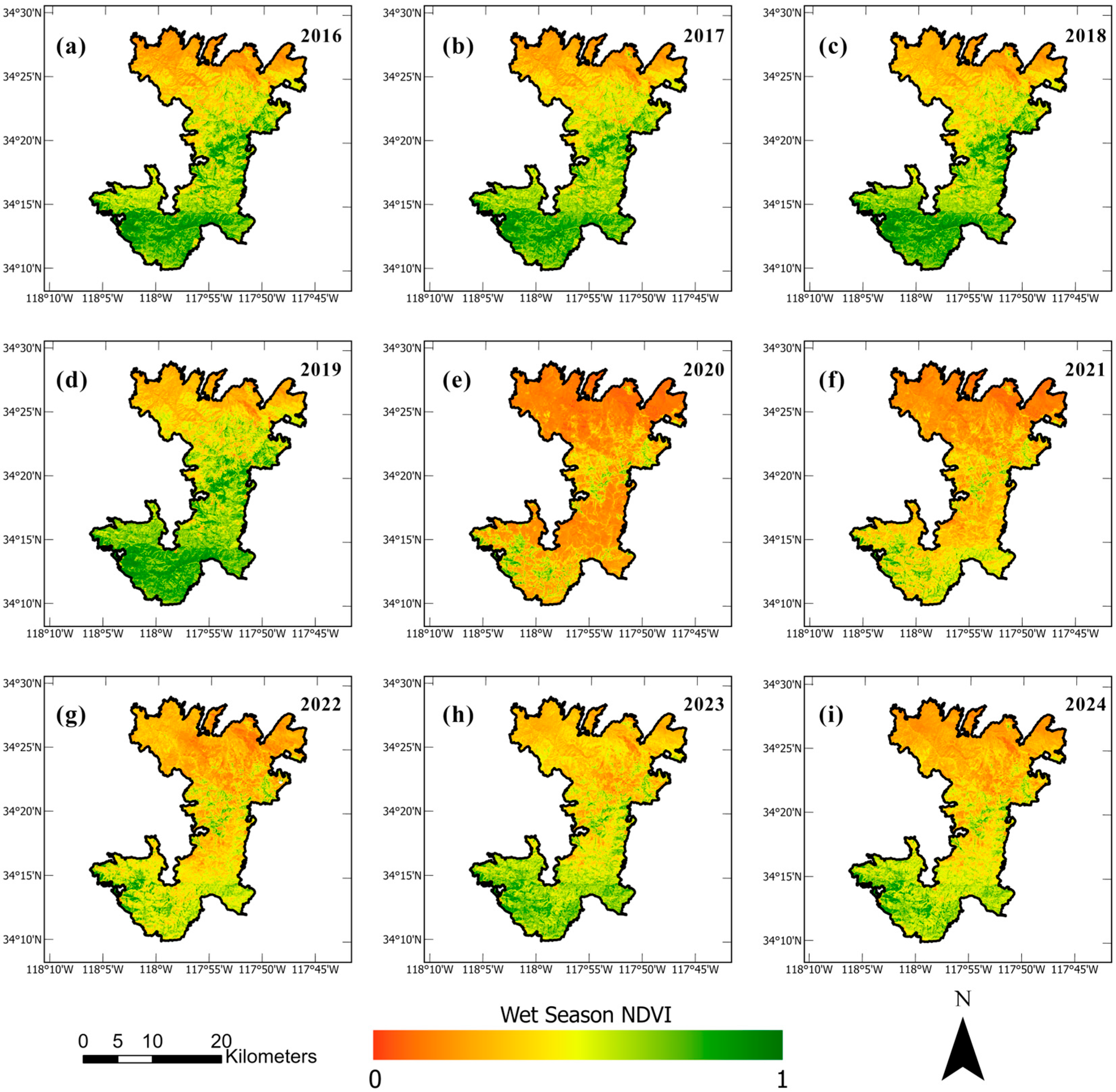
To further analyze the spatial changes in NDVI under different seasons, this study created spatial maps of NDVI within the Bobcat Fire region for wet seasons in Figure 7 and dry seasons in Figure 8, covering pre- and post-fire from 2016 to 2024. It should be noted that the 2020 dry season included the fire-burning months of September and October, and the 2020 wet season included the fire-burning months of November and December. The 2021 dry season is the first full dry season after the Bobcat Fire. Post-fire NDVI values are lower compared to pre-fire years in general. Southwest areas of Bobcat Fire region in the wet season show NDVI values greater than 0.7. After the fire, the southern section of the study area, below the latitude of 34.20°N, experienced NDVI values below 0.6 in most years, with 2023 showing slightly higher NDVI values compared to 2024. Additionally, most of the north and north–central regions show NDVI values lower than their pre-fire years after 4 years of recovery.
Figure 7.
NDVI images for wet seasons (November–April) in (a) 2016, (b) 2017, (c) 2018, (d) 2019, (e) 2020, (f) 2021, (g) 2022, (h) 2023, and (i) 2024.
Figure 8.
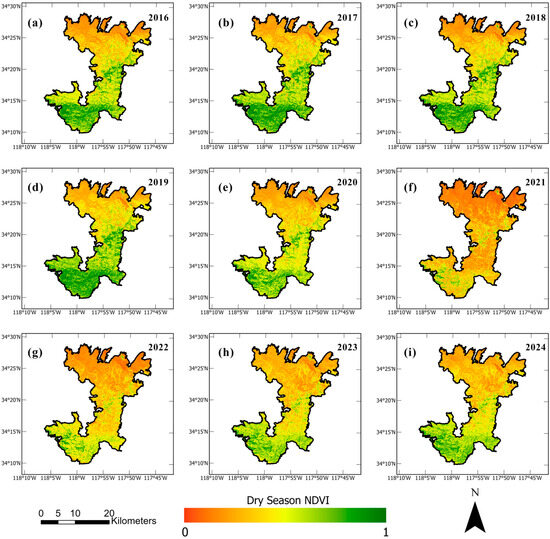
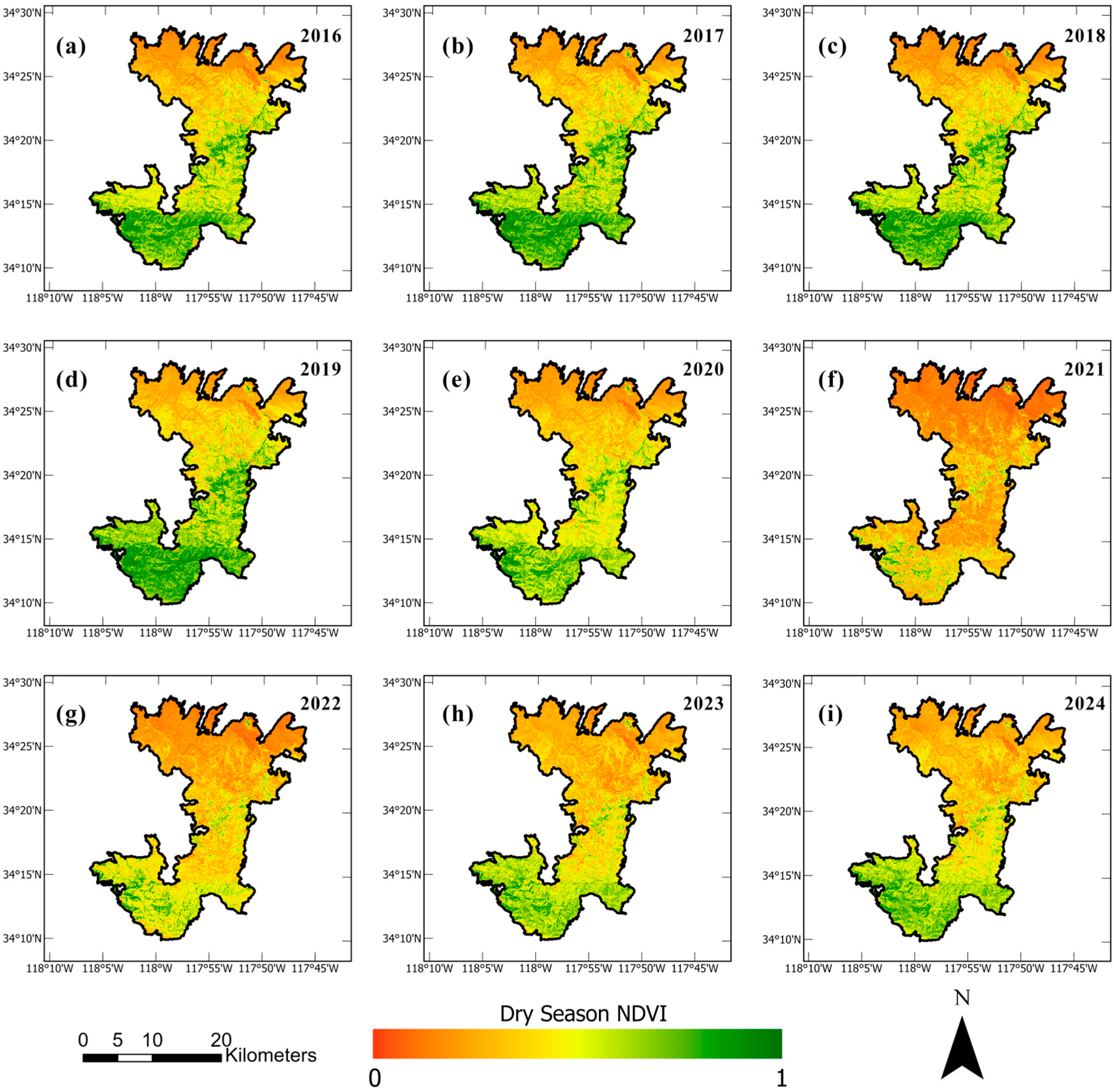
NDVI images for dry seasons (May–October) in (a) 2016, (b) 2017, (c) 2018, (d) 2019, (e) 2020, (f) 2021, (g) 2022, (h) 2023, and (i) 2024.
As observed in Figure 8, areas below the latitude of 34.20°N show NDVI values higher than 0.7. Pre-fire NDVI was stable in pre-fire years. NDVI levels throughout the Bobcat Fire area have lowered in the dry season of 2020 (Figure 8e). This drop is due to the fire months being integrated within the later months of 2020’s dry season. In the following dry season, 2022, we see the impact the Bobcat Fire has on NDVI about a year after the fire. The majority of the Bobcat Fire area consists of NDVI levels below 0.5, with areas in the north having values below 0.2. Three years after 2021, vegetation greenness began to recover, mostly below the latitude of 34.15°N and in the southwestern areas. Areas in the central Bobcat Fire region observed a slight increase in NDVI. The northern sections above the latitude of 34.25°N, contained NDVI values in 2024 that were slightly better than pre-fire levels in 2016. Overall, areas of high NDVI experienced a decrease after 4 years of post-fire recovery, while areas in the north section of the Bobcat Fire area saw slight increases in NDVI.
3.4. Evapotranspiration
3.4.1. Monthly ET Time Series
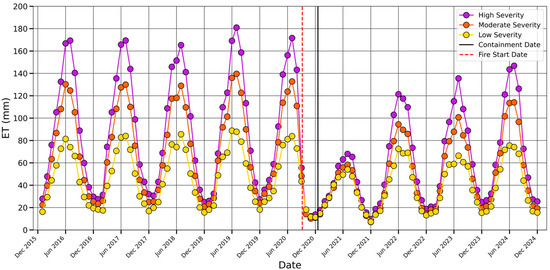
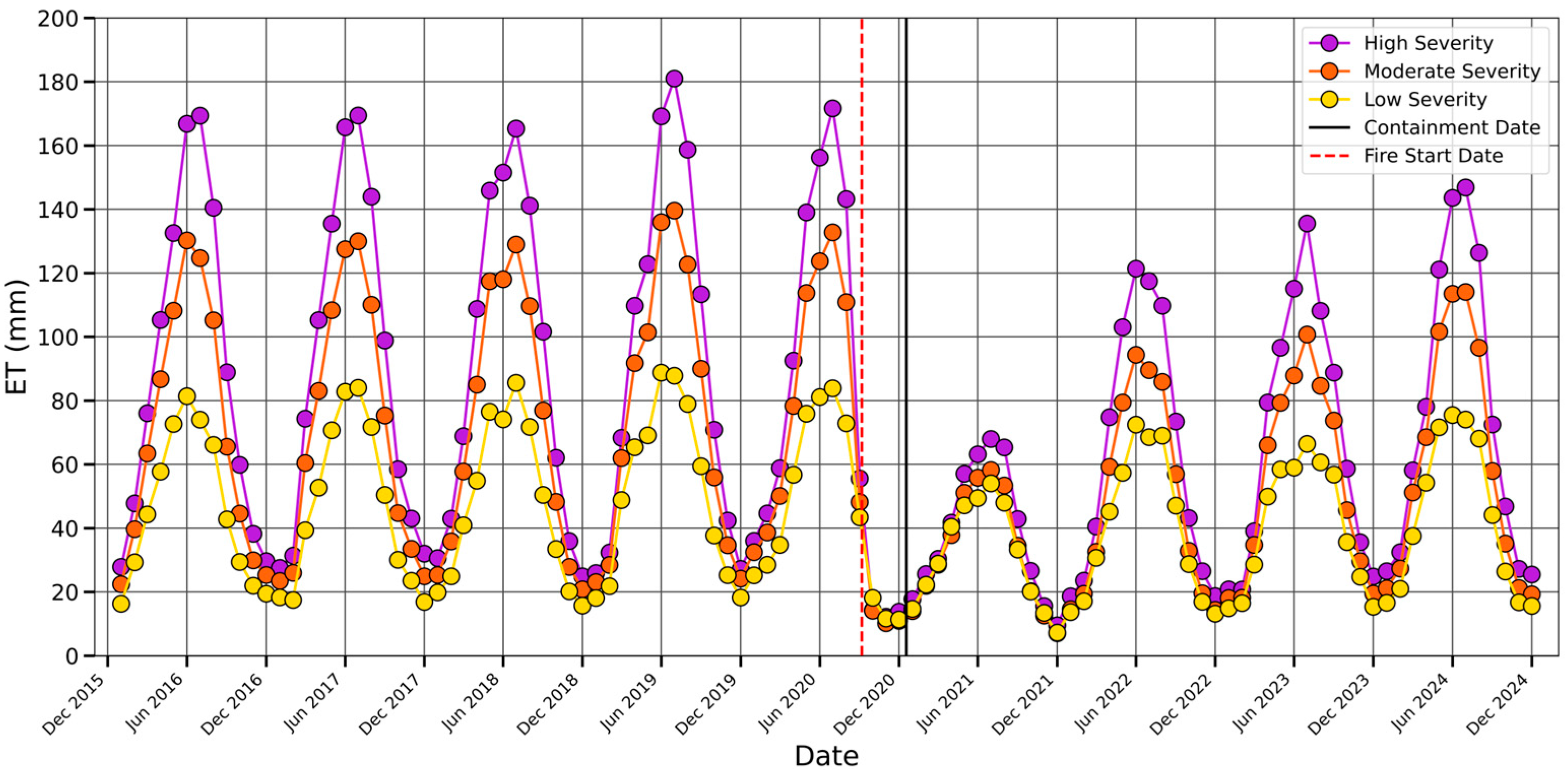
Similar to NDVI, this study also constructed a monthly ET time series which assessed the changes in ET across the three major burn severity levels covering pre- and post-fire. As seen in Figure 9, ET was the highest in the HS areas. During the summer of 2021, about a year after the fire, the difference between peak ET was around 13 mm with LS areas having a peak ET value of 54 mm and HS areas having that of 67 mm in July 2021. The value of ET for LS areas changed slightly compared to MS and HS areas with peak summer LS areas, with ET remaining below 80 mm after 4 years of vegetation recovery. ET values in HS areas increased by more than double of their post-fire values in the summer of 2021, with a new peak of 146 mm in the summer months of 2024. This increasing trend of ET was seen in MS areas, as well during its post-fire recovery. In general, ET values are approaching their pre-fire levels for all three severity levels after just 4 years, despite some recent warm years.
Figure 9.
Monthly ET time series within the Bobcat Fire’s LS, MS, and HS areas from January 2016 to December 2024.
3.4.2. Seasonal ET
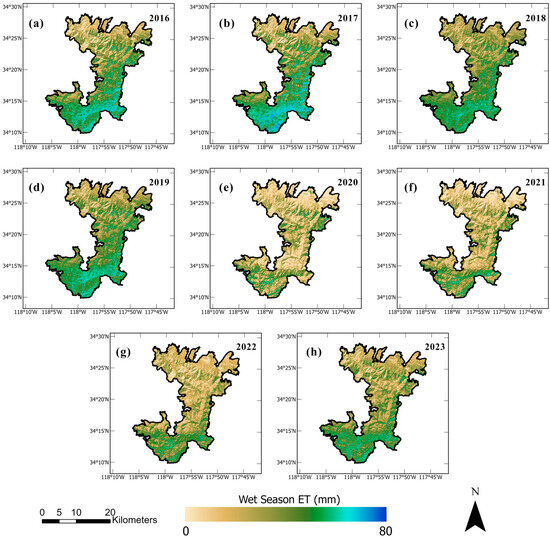
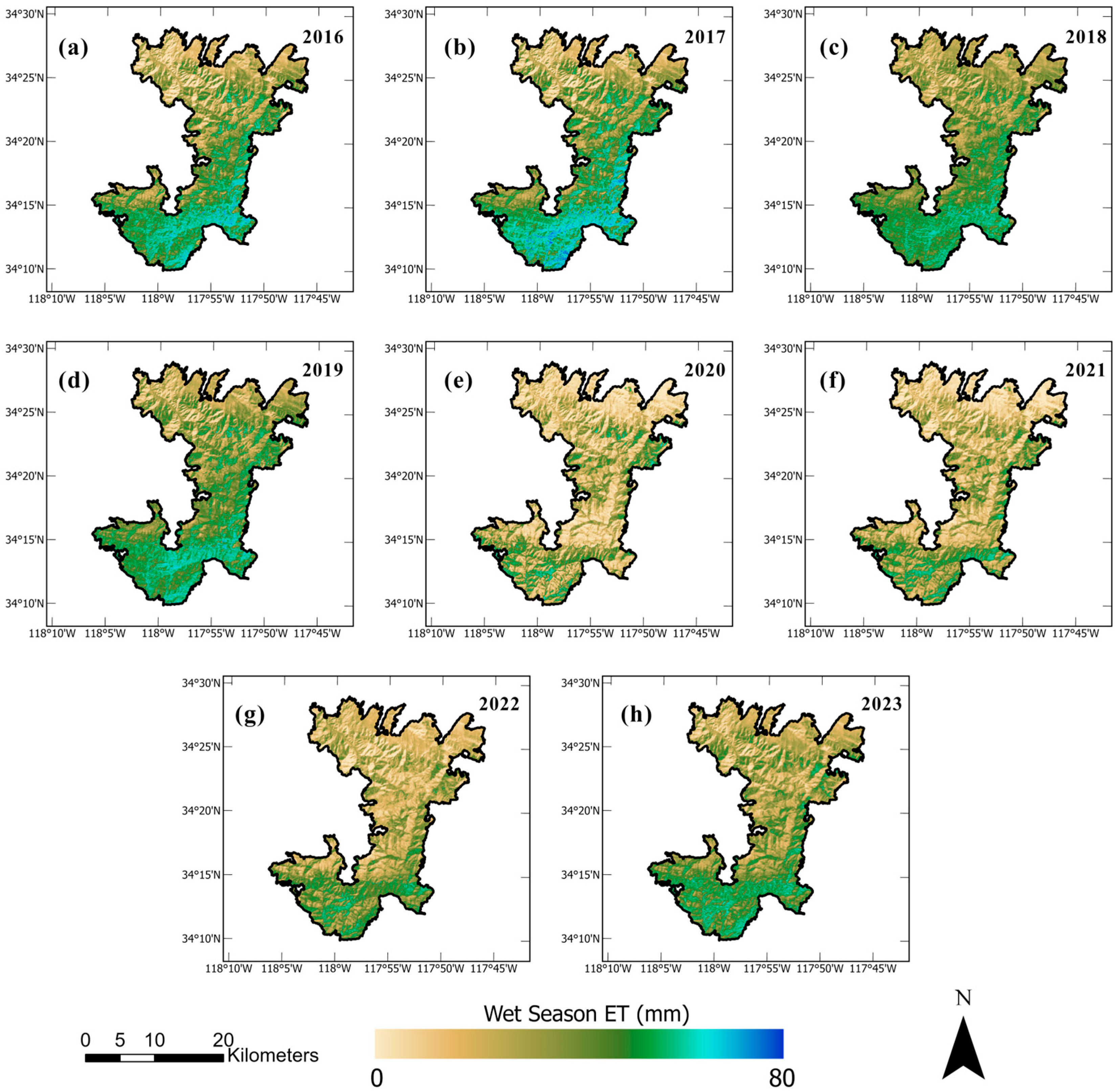
ET’s seasonal analysis was performed to observe its spatial variability in wet and dry seasons during this study period (2016–2024). Figure 10 and Figure 11 show the seasonal monthly averages for wet seasons and dry seasons, respectively. The wet season maps show high ET values in the southern section of the study region, with most values hovering around 70 mm during 2016, 2017, and 2019 (Figure 10). After the fire, the wet-season ET dropped in all areas, with most of the area having low ET (<20 mm tan colored). In the recent year of 2023, there was an increase in ET within the southern section. This area was once classified as mostly Evergreen and Mixed Forest in 2019. It should be noted that the most recent complete wet-season ET year is 2023. The data for the 2024 wet season was not fully available as GEE does not have the early months of 2025 in their ensemble product.
Figure 10.
ET images for wet seasons (November–April) in (a) 2016, (b) 2017, (c) 2018, (d) 2019, (e) 2020, (f) 2021, (g) 2022, and (h) 2023.
Figure 11.
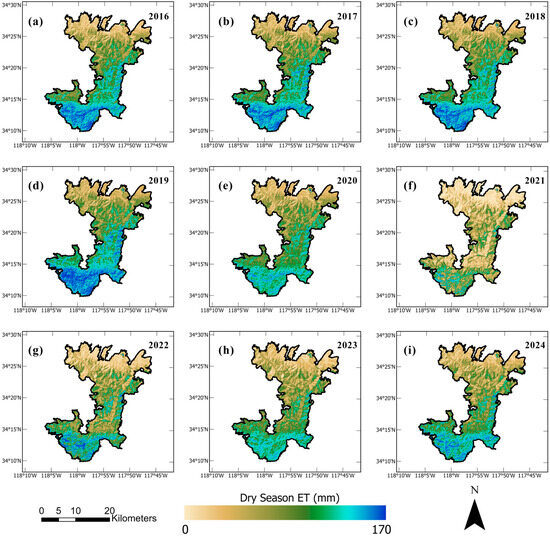
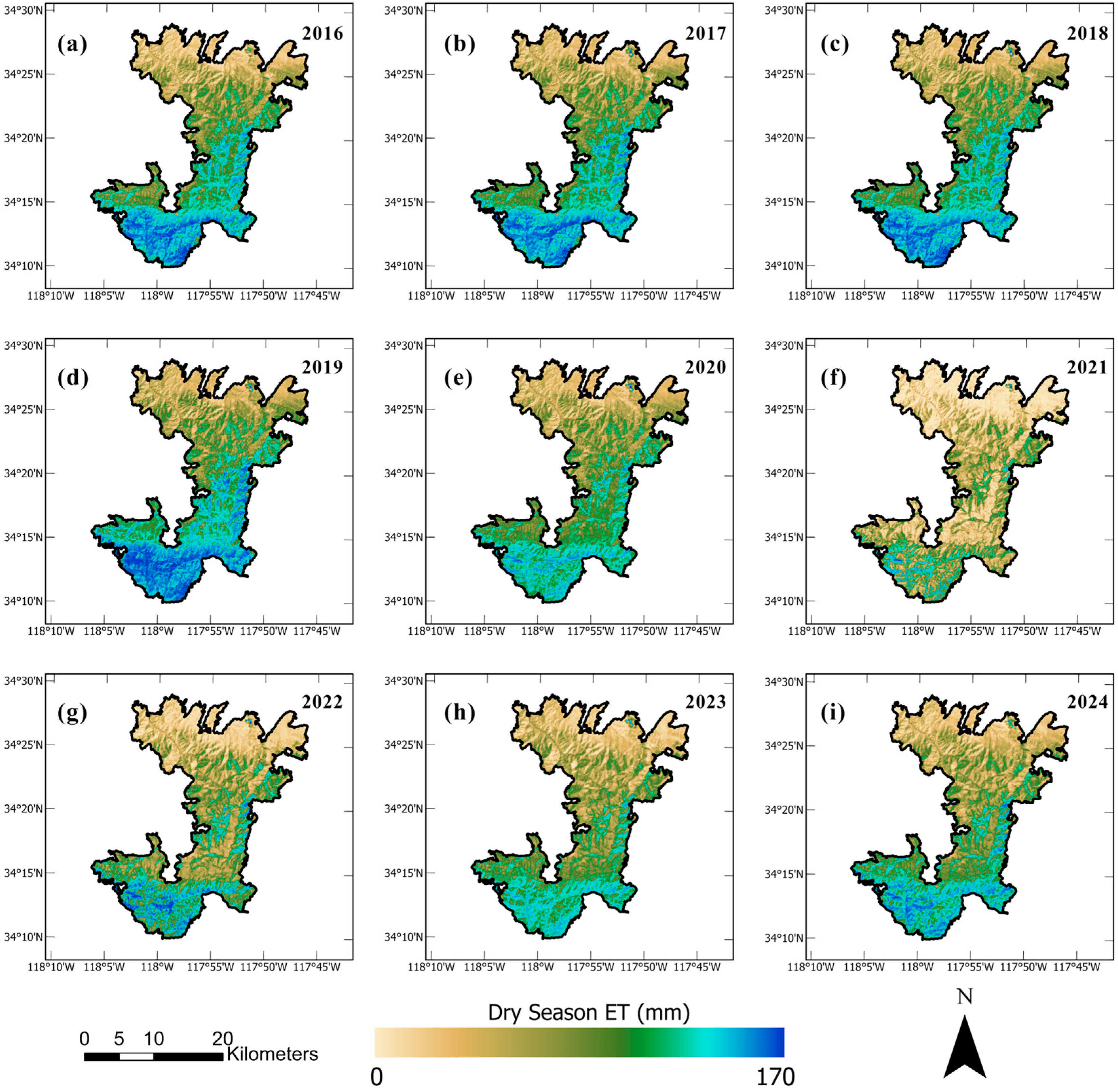
ET images for dry seasons (May–October) in (a) 2016, (b) 2017, (c) 2018, (d) 2019, (e) 2020, (f) 2021, (g) 2022, (h) 2023, and (i) 2024.
The dry season ET results are shown in Figure 11. In this figure, the dry season for 2020 does not show its expected values due to September and October being influenced by the fire, which impacted the seasonal averages. In the pre-fire years, the highest ET values of over 150 mm were in the southern region where most of the Evergreen Forest and Mixed Forest are located. In the 2021 dry season, most of the area displayed a noticeable decrease in ET values, with higher ET areas now showing ET values of below 150 mm. Most of the areas in 2021 are colored as tan and brown, signifying mid-to-low ET. In 2024, ET increased in all areas; however, ET in the central and southern regions are not yet the same as in the pre-fire years. Despite this, ET values seem to approach pre-fire ET values within a few more years of recovery. Lastly, comparing Figure 10 and Figure 11, wet-season ET is noticeably drier than actual dry season with the decrease in overall ET values, which is likely due to lag between rainfall and precipitation-induced vegetation growth.
3.5. Analysis of NDVI and ET
3.5.1. Correlation Analysis of NDVI and ET
Spearman correlation coefficients were computed between monthly NDVI and ET post-fire for each burn severity. The Spearman correlation analysis measures how NDVI and ET varied with each other based on their value ranks [51,52]. The Spearman analysis provided a spearman_rho and a p_value for each burn severity class. HS areas received a spearman_rho of 0.43, which is statistically significant. MS and LS areas obtained a spearman rho of 0.30 and 0.05, respectively; however both coefficients were not statistically significant. For HS areas, this moderate positive correlation between NDVI and ET indicates that vegetation recovery was progressing in highly burned areas, with newly grown vegetation demonstrating a moderate linkage between greenness (structure) and transpiration (function).
3.5.2. Seasonal Analysis of NDVI and ET
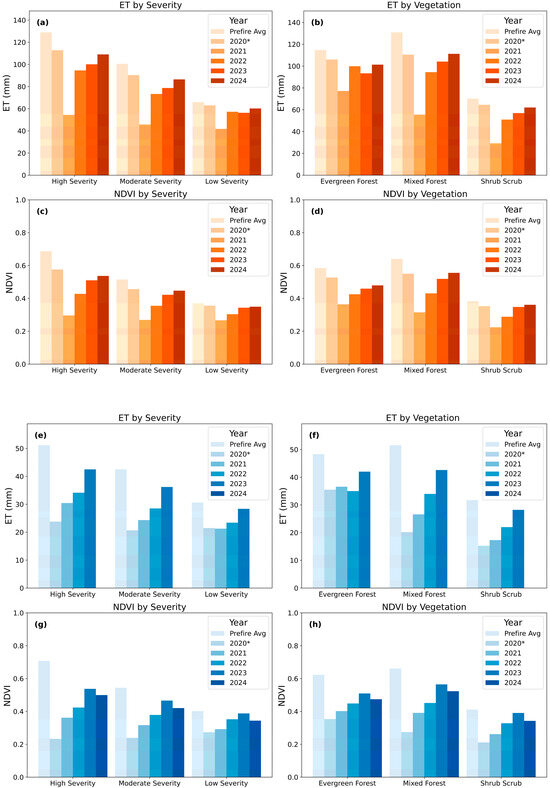
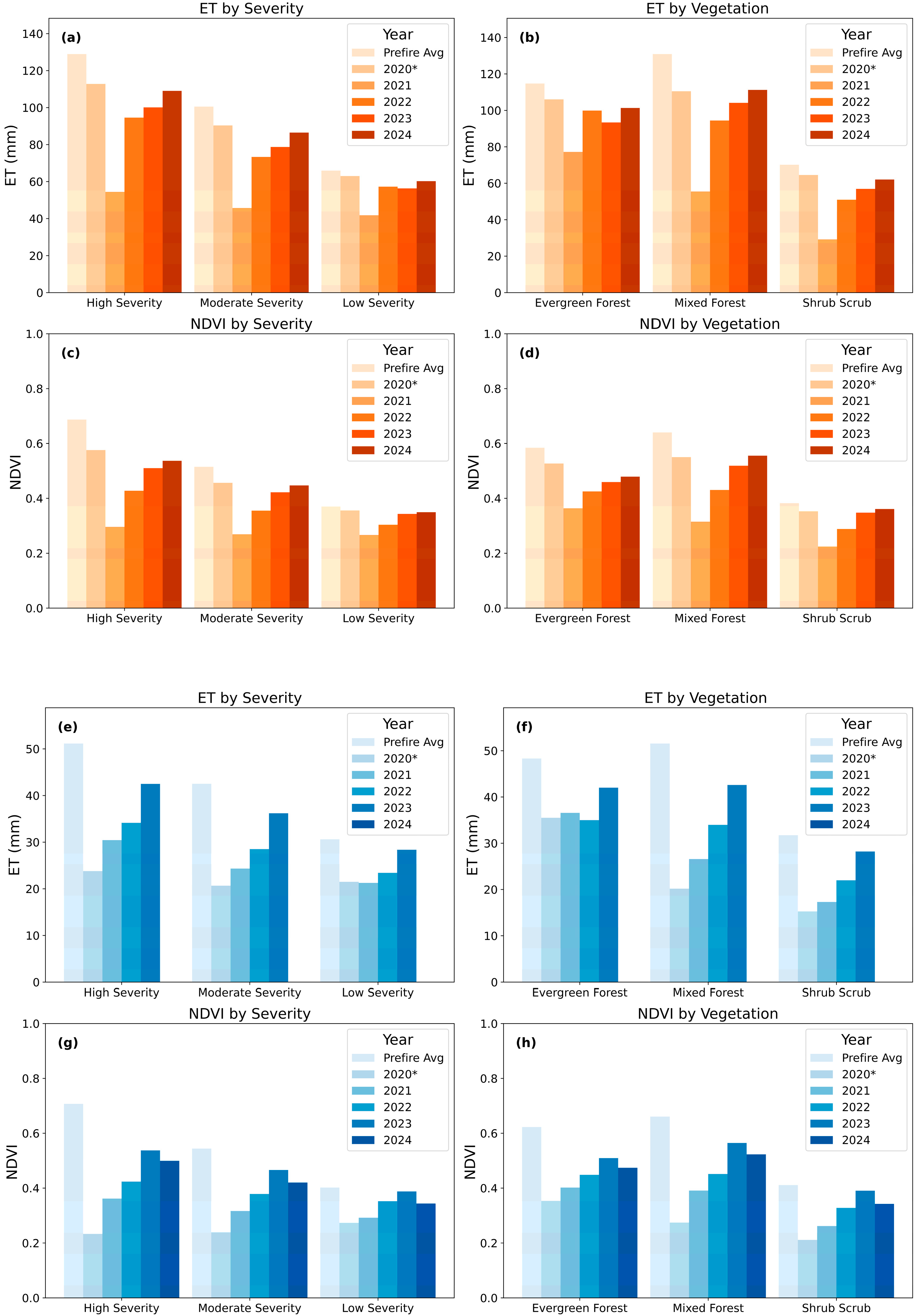
Bar plots of median values for NDVI and ET were generated to analyze their overall behaviors in wet seasons and dry seasons pre- to post-fire across different burn severity levels and vegetation classes (Figure 12). In the figure, pre-fire averages were the average of NDVI and ET from 2016 to 2019. Within the dry season results (Figure 12a–d), the 2020 median values of NDVI and ET were influenced by the fire event during the late months of the dry season; therefore, the seasonal average dropped slightly compared to pre-fire averages. HS areas’ ET dropped about 80 mm from its pre-fire median value of 132 mm to 53 mm one year after the fire in 2021. MS and LS areas also experienced drops in their ET values of around 68 mm and 30 mm, respectively. Similar to ET, NDVI exhibited a decrease between pre-fire and 2021 (Figure 12c), where HS areas had the largest decrease of 0.45, and MS and LS areas had a decrease of 0.28 and 0.11, respectively. This trend of decreasing between pre-fire and 2021 repeats with ET and NDVI for all vegetation classes (Figure 12b,d). Within all vegetation classes, Mixed Forests displayed the largest decrease in ET and NDVI, with ET values dropping by 79.8 mm and NDVI dropping by 0.34. Evergreen Forests experienced the smallest decrease of 38.8 mm in ET values compared to Shrubs’ drop of 48 mm. NDVI drops for Evergreen Forests and Shrubs were 0.27 and 0.15, respectively. After 2021, ET and NDVI increased significantly in 2022 for all burn severities and vegetation classes. In 2023, there was an increase in nearly all dry season cases, except for Evergreen Forests, where there was a slight decrease in ET of 6.35 mm. Despite this, in the most recent year of 2024, median ET and NDVI values are at their highest after the fire.
Figure 12.
Bar plots of median values for ET and NDVI per each burn severity level and vegetation class in dry seasons and wet seasons during the study period. Dry seasons’ ET is shown in (a) by burn severity levels and (b) by vegetation classes. Dry seasons’ NDVI is shown in (c) by burn severity levels and (d) by vegetation classes. Wet seasons’ ET is shown in (e) by burn severity levels and (f) by vegetation classes. Wet seasons’ NDVI is shown in (g) by burn severity levels and (h) by vegetation classes. The year 2020 has an * noting the effects of the Bobcat Fire during the late months of the 2020 dry season and the early months of the 2020 wet season.
The wet season results are shown in Figure 12e–h. For the year 2020, the wet season values used to calculate the median were immediately after the fire. The first two months (November and December) were between the ignition and containment dates. ET values for 2024 are not included in this analysis due to missing months for 2025. Similar trends observed in the dry season analysis are also evident in wet season analysis. HS areas had the largest decrease in median ET between pre-fire and 2020 but had the largest increase after the fire. MS and LS areas present the same pattern. In all burn severity levels, ET values increased post-fire year by year but have not yet reached pre-fire values (Figure 12e). Among vegetation classes, Mixed Forest’s ET values experienced the largest decrease of 34.4 mm, followed by Shrubs with a decrease of 19.1 mm and Evergreen Forests with a decrease of about 13 mm. ET values for each vegetation class also increased post-fire, except for a small decrease in Evergreen Forests in 2023 (Figure 12f). For NDVI, a decrease was observed between pre-fire and 2000, followed by an increase post-fire from 2020 to 2023 and a subsequent decline from 2023 to 2024 across burn severity and vegetation classes (Figure 12g,h). The largest decrease in NDVI caused by the fire was observed in HS areas with a decrease of 0.49, while the largest decrease post-fire from 2023 to 2024 was identified in LS areas for about 0.06.
To test the trend and its significance of how seasonal NDVI and ET progress under different burn severity levels and vegetation classes, a Mann–Kendall test was carried out for post-fire values, starting from January 2021 in wet and dry seasons. Table 4 summarizes the trend result for each seasonal median analysis. All of the trends showed increases and were statistically significant, except for the wet season’s ET in the Evergreen Forest, which showed no trend. This matches the results we observed from Figure 12.
Table 4.
Mann–Kendall trend analysis for every month within the seasonal averages across all burn severity levels and vegetation classes. Months after fire containment (December 2020) were used for this study. Asterisk * indicates significant trend based on p-values less than 0.05.
4. Discussion
Our study observed changes in ET and NDVI before and after the 2020 Bobcat Fire under different dNBR burn severities. According to our time series analysis, HS areas had the fastest regrowth of NDVI and ET, despite having the largest decrease between pre- and initial post-fire years. MS areas also experienced a moderately fast increase in NDVI and ET. The fast recovery of NDVI for HS and MS areas during the 4 years of post-fire recovery aligns with the results observed by Koltsida et al. 2024 [22], in which they also identified greater increases in NDVI over the moderately and highly burned areas after a year of post-fire recovery. Our study has demonstrated this increasing trend throughout the entire 4 years of post-fire recovery across the HS, MS, and LS areas.
Our study examined how major vegetation types have been affected by the Bobcat Fire and how they have been influencing ET and NDVI. As shown in Figure 2, most of the Bobcat Fire area in 2021 were Grasslands, while Shrubs began to grow and replace Grasslands areas in NLCD 2024. Table 3 indicates that the majority of Evergreen Forest and Mixed Forest pixels in HS areas and MS areas converted to either Shrubs or Grasslands in 2024. Shrubs recovered to 82.2% of pre-fire Shrub coverage in HS areas, while in LS areas, Shrubs had a recovery of merely 15%. This may explain the higher ET recovery rates in HS areas compared to MS and LS areas as the Shrub–Grassland ecosystem has higher ET values compared to Grasslands as discussed in Tang et al., 2024 [53]. Similarly, NDVI levels fluctuated within the HS, MS, and LS areas, where HS areas saw higher levels of NDVI with more Shrub coverage compared to Grasslands. LS areas saw the lowest concentration of NDVI, and a lower concentration of Shrubs compared to Grasslands within LS areas. These findings align with Martinez and Labib, 2023 [54], where their study observed that Shrubs influence NDVI more than Grasses. The shift between Forests to Shrubs in all severity areas can cause various changes to region’s biodiversity and hydrological processes. When wildfires occur frequently under drought conditions, non-native grass often takes over burned down forested areas, making the recovery of forests more difficult and leading to a loss in biodiversity as Shrubs align with birds and mammalian communities [55,56]. A shift from Forest to Grassland also impacts rain runoff as Forests have been observed to have the strongest runoff and sediment retention effects compared to other vegetation types [57,58]. Ultimately, Forests and Shrubs offer more biodiversity, as well as benefits to water and sediment retention, compared to Grasslands. As of 2024 NLCD vegetation classes (Figure 2), a shift to Shrubs from Grasslands areas has been shown.
Seasonal analysis of ET and NDVI shows how vegetation responds to different climate conditions such as the mild, wet winters and hot, dry summers of California. In Figure 12, our results show increases in both NDVI and ET between 2020 and 2023. However, beginning in 2024, median values for wet season NDVI, in all burn severities and vegetation classes, are lower than in 2023. This is not the case during the dry season, where ET and NDVI have both increased between 2023 and 2024. Apart from vegetation type influencing NDVI, this decrease in NDVI could have been a result of near-record high summer temperatures [59] and historically low precipitation for Los Angeles, where some areas received less than 0.2 inches of rain between May–December of 2024 [60]. This seven-month period of low precipitation ranked as the second-driest on record in Los Angeles history [60]. ET and NDVI have a strong correlation [61]; however, during times of high temperatures, ET could increase water consumption, significantly reduce water availability and limit vegetation growth [62]. While ET and NDVI have increased throughout the study period, stretches of dry summers and low precipitation winters could result in a delay of vegetation recovery, ultimately delaying the recovery process to forested areas.
Forest management could be guided by our results as LS areas tend to already have low NDVI and would result in low-intensity burns while areas of forests see the hardest impacts of fire. Burned forests have nearly all been converted to Shrubs and Grasslands 4 years after the fire. Management efforts should be aimed at helping forested areas impacted by high-intensity fires, as not a single burned Evergreen Forests pixel was recovered within HS areas. This could be attributed to young saplings not being classified as Evergreen Forests by NLCD, and some seedlings of Shrubs and trees in the mix that are imperceptible at this point. However, care must be provided in these areas to promote growth and improve soil retention to help mitigate runoff [57]. Areas of LS also require assistance to promote shrublands recovery, as the retention of Grasslands may result in non-native annual grasses, which can reduce biodiversity [56] and increase the risk of frequent fires, leading to a challenging recovery process for trees and Shrubs [55]. To promote forest and Shrubs, forest management should focus on seeding paired with mulching in order to propagate vegetation recovery [63].
While this study shows an overall increasing trend in NDVI and ET after wildfires, it is important to note some limitations with the analysis. Data acquired from any remote sensing has the chance to have unusable data due to snow and clouds. Gaps in data due to the snow and clouds lead to spotty, unusable data. Between the summer and fall months of 2022, there were limited scenes available for each individual month to be considered for analysis within the dNBR and NDVI time series. Early months of each year were removed from the dNBR and NDVI monthly time series due to clouds and snow. Averaging monthly values used for the dNBR, NDVI, and ET time series simplify the month-to-month observations by calculating averages over multiple scenes into a single image for analysis. A single month could skew results due to some climatical factors such as increased precipitation or drought conditions. In recent decades, California has experienced narrower rainy seasons, which concentrate rain within a tighter group of months [64]. This concentration of rain in later months can lower the average ET and NDVI and may require updating the defined months for dry and wet seasons to account for the possible shift in California’s precipitation patterns.
NLCD and dNBR masks used for this analysis also have uncertainties with classification and oversimplification. NLCD does a great job in categorizing vegetation; however, it does limit itself to 13 vegetation types. Other options were available, such as CalFire’s 2022 Vegetation product (fveg22); however, this dataset did not reflect changes caused by the fire after 2020, with most of its area being classified from before 2011. NLCD provided yearly products for our study period, with updating classes every year allowing for visual observation of vegetation change. NLCD mainly classifies Evergreen Forest, Mixed Forests and Shrubs within the study area, which underestimates the flora, grouping many plant types into one of these three categories. The mask made using dNBR thresholds also has uncertainties as dNBR does not only measure burn severity for vegetation but also for soil burn severity. Additionally, dNBR thresholds can vary with combinations of pre-fire vegetation density and levels of fire severity. In a study by Miller and Thode, 2007 [65], a severe fire affecting a moderate-percentage canopy coverage plot could have a similar dNBR value as an area of high-percentage canopy coverage affected by a less severe fire. Essentially, dNBR thresholds (HS, MS, and LS) can vary depending on vegetation type, vegetation density, and fire severity. A single fire event may not burn at the same intensity throughout an entire study area that has varying vegetation types, which may misclassify dNBR thresholds based on the combination of vegetation density and fire severity.
5. Conclusions
This study analyzed ET and NVDI within dNBR burn severity and NLCD vegetation classes to track vegetation growth with the 2020 Bobcat Fire in Los Angeles, California. Using time series of NDVI and ET, our study observed that HS areas experienced the fastest recovery rate to pre-fire value compared to MS and LS areas. These ET and NDVI recovery rates could be attributed to the HS areas converting from mostly all Grasslands in 2021 to Shrubs in 2024. MS and LS areas also contain Shrubs; however, LS areas contain more Grasslands than Shrubs, leading to lower recovery rates. Seasonal analysis was conducted for wet (November–April) and dry (May–October) months to assess changes in ET and NDVI during different climactic conditions. ET and NDVI median values increased steadily during 4 years of post-fire recovery in wet and dry seasons; however, during the wet months of 2024, NDVI values displayed a slight decline, which was not seen in the dry months. This decline in NDVI may have been caused by the hot, dry season of 2024 and the low precipitation during the wet season of 2024. Vegetation within the 2020 Bobcat Fire boundary has not recovered to its pre-fire ET and NDVI levels and has instead converted to Grasslands and Shrubs. LS areas had majority of their Shrubs remain as Shrubs, while in HS areas, Shrubs were able to repopulate. Additional years of post-fire observation are needed to detect the potential ecosystem shift. However, forest management practices, such as seeding and propagating the growth of trees in HS areas and Shrubs in LS areas, can help suppress Grassland dominance, hence benefiting the mountain range and biodiversity.
Author Contributions
Conceptualization, A.A., J.L. and A.F.; methodology, A.A., J.L., A.F. and M.P.-C.; software, A.A.; validation, J.L. and A.F.; formal analysis, A.A.; investigation, A.A.; data curation, A.A.; writing—original draft preparation, A.A.; writing—review and editing, J.L., A.F., M.P.-C. and C.L.; visualization, A.A.; funding acquisition, J.L. and A.F.; All authors have read and agreed to the published version of the manuscript.
Funding
This research was funded by the U.S. Department of Energy under Grant No. DE-SC0024604. The contributions of Jingjing Li and Alireza Farahmand were partially supported by the NASA MOSAICS program under Grant No. 80NSSC24K1074.
Data Availability Statement
The 2020 Bobcat Fire burn boundary was obtained from the Monitoring Trends and Burn Severity download portal and is available at https://www.mtbs.gov/direct-download, accessed on 7 May 2024; Landsat 8 data (LANDSAT/LC08/C02/T1_L2) acquired for dNBR and NDVI analysis were extracted directly from Google Earth Engine (GEE) and is available at https://developers.google.com/earth-engine/datasets/catalog/LANDSAT_LC08_C02_T1_L2, accessed on 15 March 2025. Evapotranspiration (ET) data (OpenET/ENSEMBLE/CONUS/GRIDMET/MONTHLY/v2_0) was also obtained from GEE and is available at https://developers.google.com/earth-engine/datasets/catalog/OpenET_ENSEMBLE_CONUS_GRIDMET_MONTHLY_v2_0, accessed on 15 March 2025. NLCD data, used for vegetation classes, was extracted from both GEE (USGS/NLCD_RELEASES/2019_REL/NLCD) and MRLC’s Map viewer website obtainable at https://developers.google.com/earth-engine/datasets/catalog/USGS_NLCD_RELEASES_2019_REL_NLCD, accessed on 27 August 2025; and https://www.mrlc.gov/viewer/, accessed on 12 August 2025, respectively.
Acknowledgments
During the preparation of this study, the author used GitHub’s Visual Studio Code’s Integrated Copilot Large Language Model (LLM) GPT-4o for Visual Studio Code (Version 1.106.3) for the purpose of creating figures for results. The authors have reviewed and edited the output and take full responsibility for the content of this publication. Additionally, the authors would like to give special thanks to the organizations mentioned in this paper for providing free access to the data necessary to complete this study.
Conflicts of Interest
The authors declare no conflicts of interest.
Abbreviations
The following abbreviations are used in this manuscript:
| GEE | Google Earth Engine |
| dNBR | Difference Normalized Burn Ratio |
| NDVI | Normalized Difference Vegetation Difference |
| ET | Evapotranspiration |
| NLCD | National Land Classification Database |
| LS | Low Severity |
| MS | Moderate Severity |
| HS | High Severity |
| UB | Unburned |
| ER | Enhanced Regrowth |
| NICC | National Interagency Coordination Center |
| USDA | United States Department of Agriculture |
| USGS | Unite States Geological Survey |
| SGM | San Gabriel Mountains |
| MTBS | Monitoring Trends and Burn Severity |
| EROS | Earth Resources Observations and Sciences |
| SR | Surface Reflectance |
| RIT | Rochester Institute of Technology |
| NASA | National Aeronautics and Space Administration |
| JPL | Jet Propulsion Lab |
| TIRS | Thermal Infrared Sensors |
| WRS-2 | Worldwide Reference System 2 |
| OLI | Optical Land Imager |
| QA | Quality Assurance |
| NIR | Near-Infrared |
| SWIR-2 | Short Wave Infrared 2 |
References
- National Interagency Coordination Center. Wildland Fire Summary and Statistics Annual Report 2020; National Interagency Fire Center: Boise, Idaho, 2020. Available online: https://www.nifc.gov/sites/default/files/NICC/2-Predictive%20Services/Intelligence/Annual%20Reports/2020/annual_report_0.pdf (accessed on 10 October 2025).
- Salguero, J.; Li, J.; Farahmand, A.; Reager, J.T. Wildfire Trend Analysis over the Contiguous United States Using Remote Sensing Observations. Remote Sens. 2020, 12, 2565. [Google Scholar] [CrossRef] [Scilit]
- Liu, Q.; Fu, B.; Chen, Z.; Chen, L.; Liu, L.; Peng, W.; Liang, Y.; Chen, L. Evaluating Effects of Post-Fire Climate and Burn Severity on the Early-Term Regeneration of Forest and Shrub Communities in the San Gabriel Mountains of California from Sentinel-2(MSI) Images. Forests 2022, 13, 1060. [Google Scholar] [CrossRef] [Scilit]
- Littell, J.S.; Peterson, D.L.; Riley, K.L.; Liu, Y.; Luce, C.H. A Review of the Relationships between Drought and Forest Fire in the United States. Glob. Change Biol. 2016, 22, 2353–2369. [Google Scholar] [CrossRef] [Scilit] [PubMed]
- Busenberg, G. Wildfire Management in the United States: The Evolution of a Policy Failure. Rev. Policy Res. 2004, 21, 145–156. [Google Scholar] [CrossRef] [Scilit]
- van Wagtendonk, J.W. Dr. Biswell’s Influence on the Development of Prescribed Burning in California. In The Biswell Symposium: Fire Issues and Solutions in Urban Interface and Wildland Ecosystems, Walnut Creek, CA, USA, 15–17 February 1994; US Department of Agriculture, Forest Service, Pacific Southwest Research Station: Albany, CA, USA, 1995; Volume 158, p. 11. [Google Scholar]
- Keeley, J.E.; Syphard, A.D. Historical Patterns of Wildfire Ignition Sources in California Ecosystems. Int. J. Wildland Fire 2018, 27, 781. [Google Scholar] [CrossRef] [Scilit]
- Mitchell, J.W. Power Line Failures and Catastrophic Wildfires under Extreme Weather Conditions. Eng. Fail. Anal. 2013, 35, 726–735. [Google Scholar] [CrossRef] [Scilit]
- Short, K.C. Spatial Wildfire Occurrence Data for the United States, 1992–2020 [FPA_FOD_20221014], 6th ed.; Forest Service Research Data Archive: Fort Collins, CO, USA, 2022. [CrossRef] [Scilit]
- Stork, N.; Mainzer, A.; Martin, R. Native and Non-native Plant Regrowth in the Santa Monica Mountains National Recreation Area after the 2018 Woolsey Fire. Ecosphere 2023, 14, e4567. [Google Scholar] [CrossRef] [Scilit]
- Tayyebi, A.; Darrel Jenerette, G. Increases in the Climate Change Adaption Effectiveness and Availability of Vegetation across a Coastal to Desert Climate Gradient in Metropolitan Los Angeles, CA, USA. Sci. Total Environ. 2016, 548–549, 60–71. [Google Scholar] [CrossRef] [Scilit]
- Keeley, J.E.; Syphard, A.D. Twenty-First Century California, USA, Wildfires: Fuel-Dominated vs. Wind-Dominated Fires. Fire Ecol. 2019, 15, 24. [Google Scholar] [CrossRef] [Scilit]
- Crimmins, M.A.; Comrie, A.C. Interactions between Antecedent Climate and Wildfire Variability across South-Eastern Arizona. Int. J. Wildland Fire 2004, 13, 455–466. [Google Scholar] [CrossRef] [Scilit]
- Goss, M.; Swain, D.L.; Abatzoglou, J.T.; Sarhadi, A.; Kolden, C.A.; Williams, A.P.; Diffenbaugh, N.S. Climate Change Is Increasing the Likelihood of Extreme Autumn Wildfire Conditions across California. Environ. Res. Lett. 2020, 15, 094016. [Google Scholar] [CrossRef] [Scilit]
- Chavda, D.; Li, J.; Farahmand, A. Assessing the Influence of El Niño on the California Precipitation Regime during the Satellite Precipitation Era. Hydrol. Process. 2024, 38, e15160. [Google Scholar] [CrossRef] [Scilit]
- Flannigan, M.D.; Wotton, B.M.; Marshall, G.A.; De Groot, W.J.; Johnston, J.; Jurko, N.; Cantin, A.S. Fuel Moisture Sensitivity to Temperature and Precipitation: Climate Change Implications. Clim. Change 2016, 134, 59–71. [Google Scholar] [CrossRef] [Scilit]
- Keeley, J.E. Fire Intensity, Fire Severity and Burn Severity: A Brief Review and Suggested Usage. Int. J. Wildland Fire 2009, 18, 116. [Google Scholar] [CrossRef] [Scilit]
- Marzano, R.; Lingua, E.; Garbarino, M. Post-Fire Effects and Short-Term Regeneration Dynamics Following High-Severity Crown Fires in a Mediterranean Forest. Iforest-Biogeosciences For. 2012, 5, 93. [Google Scholar] [CrossRef] [Scilit]
- Turner, M.G.; Hargrove, W.W.; Gardner, R.H.; Romme, W.H. Effects of Fire on Landscape Heterogeneity in Yellowstone National Park, Wyoming. J. Veg. Sci. 1994, 5, 731–742. [Google Scholar] [CrossRef] [Scilit]
- Lentile, L.B.; Morgan, P.; Hudak, A.T.; Bobbitt, M.J.; Lewis, S.A.; Smith, A.M.S.; Robichaud, P.R. Post-Fire Burn Severity and Vegetation Response Following Eight Large Wildfires Across the Western United States. Fire Ecol. 2007, 3, 91–108. [Google Scholar] [CrossRef] [Scilit]
- Lacouture, D.L.; Broadbent, E.N.; Crandall, R.M. Detecting Vegetation Recovery after Fire in A Fire-Frequented Habitat Using Normalized Difference Vegetation Index (NDVI). Forests 2020, 11, 749. [Google Scholar] [CrossRef] [Scilit]
- Koltsida, E.; Mamassis, N.; Baltas, E.; Andronis, V.; Kallioras, A. Assessment of Post-Fire Impacts on Vegetation Regeneration and Hydrological Processes in a Mediterranean Peri-Urban Catchment. Remote Sens. 2024, 16, 4745. [Google Scholar] [CrossRef] [Scilit]
- Oikonomou, P.; Karathanassi, V.; Andronis, V.; Papoutsis, I. Assessing and Forecasting Natural Regeneration in Mediterranean Landscapes After Wildfires. Remote Sens. 2025, 17, 897. [Google Scholar] [CrossRef] [Scilit]
- Gemitzi, A.; Koutsias, N. Assessment of Properties of Vegetation Phenology in Fire-Affected Areas from 2000 to 2015 in the Peloponnese, Greece. Remote Sens. Appl. Soc. Environ. 2021, 23, 100535. [Google Scholar] [CrossRef] [Scilit]
- Wang, L.; Good, S.P.; Caylor, K.K. Global Synthesis of Vegetation Control on Evapotranspiration Partitioning. Geophys. Res. Lett. 2014, 41, 6753–6757. [Google Scholar] [CrossRef] [Scilit]
- Fernández-Guisuraga, J.M.; Quintano, C.; Fernández-Manso, A.; Roberts, D.A. Biophysical Drivers of Short-Term Change in Evapotranspiration after Fire as Estimated through the SSEBop Landsat-Based Model. For. Ecol. Manag. 2025, 594, 122945. [Google Scholar] [CrossRef] [Scilit]
- Pascolini-Campbell, M.; Lee, C.; Stavros, N.; Fisher, J.B. ECOSTRESS Reveals Pre-fire Vegetation Controls on Burn Severity for Southern California Wildfires of 2020. Glob. Ecol. Biogeogr. 2022, 31, 1976–1989. [Google Scholar] [CrossRef] [Scilit]
- Dimitriadou, S.; Nikolakopoulos, K.G. Evapotranspiration Trends and Interactions in Light of the Anthropogenic Footprint and the Climate Crisis: A Review. Hydrology 2021, 8, 163. [Google Scholar] [CrossRef] [Scilit]
- An, K.; Jones, C.E.; Lou, Y. Assessment of Pre- and Post-Fire Fuel Availability for Wildfire Management Based on L-Band Polarimetric SAR. Earth Space Sci. 2024, 11, e2023EA002943. [Google Scholar] [CrossRef] [Scilit]
- Horton, D.; Johnson, J.T.; Baris, I.; Jagdhuber, T.; Bindlish, R.; Park, J.; Al-Khaldi, M.M. Wildfire Threshold Detection and Progression Monitoring Using an Improved Radar Vegetation Index in California. Remote Sens. 2024, 16, 3050. [Google Scholar] [CrossRef] [Scilit]
- Poulos, H.M.; Barton, A.M.; Koch, G.W.; Kolb, T.E.; Thode, A.E. Wildfire Severity and Vegetation Recovery Drive Post-fire Evapotranspiration in a Southwestern Pine-oak Forest, Arizona, USA. Remote Sens. Ecol. Conserv. 2021, 7, 579–591. [Google Scholar] [CrossRef] [Scilit]
- Collar, N.M.; Saxe, S.; Rust, A.J.; Hogue, T.S. A CONUS-Scale Study of Wildfire and Evapotranspiration: Spatial and Temporal Response and Controlling Factors. J. Hydrol. 2021, 603, 127162. [Google Scholar] [CrossRef] [Scilit]
- Collar, N.M.; Ebel, B.A.; Saxe, S.; Rust, A.J.; Hogue, T.S. Implications of Fire-Induced Evapotranspiration Shifts for Recharge-Runoff Generation and Vegetation Conversion in the Western United States. J. Hydrol. 2023, 621, 129646. [Google Scholar] [CrossRef] [Scilit]
- Ball, J.E.; Bêche, L.A.; Mendez, P.K.; Resh, V.H. Biodiversity in Mediterranean-Climate Streams of California. Hydrobiologia 2013, 719, 187–213. [Google Scholar] [CrossRef] [Scilit]
- Williams, J.E. Land Forms of the San Gabriel Mountains, California. In Yearbook of the Association of Pacific Coast Geographers; University of Hawai’i Press: Honolulu, HI, USA, 1941; Volume 7, pp. 16–32. [Google Scholar]
- Keeley, J.E.; Brennan, T.J.; Syphard, A.D. The Effects of Prolonged Drought on Vegetation Dieback and Megafires in Southern California Chaparral. Ecosphere 2022, 13, e4203. [Google Scholar] [CrossRef] [Scilit]
- Bohlman, G.N.; Underwood, E.C.; Safford, H.D. Estimating Biomass in California’s Chaparral and Coastal Sage Scrub Shrublands. Madroño 2018, 65, 28–46. [Google Scholar] [CrossRef] [Scilit]
- Raphael, M.N. The Santa Ana Winds of California. Earth Interact. 2003, 7, 1–13. [Google Scholar] [CrossRef] [Scilit]
- Mukherjee, S.; Siroratttanakul, K.; Vargas-Sanabria, D.; Patial, S.; Silwal, A.; Atienza, K.J. Supplementing Earth Observation with Twitter Data to Improve Disaster Assessments: A Case Study of 2020 Bobcat Fire in Southern California. In Proceedings of the 72nd International Astronautical Congress (IAC), Dubai, United Arab Emirates, 25–29 October 2021; pp. 25–29. [Google Scholar]
- Eidenshink, J.; Schwind, B.; Brewer, K.; Zhu, Z.-L.; Quayle, B.; Howard, S. A Project for Monitoring Trends in Burn Severity. Fire Ecol. 2007, 3, 3–21. [Google Scholar] [CrossRef] [Scilit]
- Picotte, J.J.; Bhattarai, K.; Howard, D.; Lecker, J.; Epting, J.; Quayle, B.; Benson, N.; Nelson, K. Changes to the Monitoring Trends in Burn Severity Program Mapping Production Procedures and Data Products. Fire Ecol. 2020, 16, 16. [Google Scholar] [CrossRef] [Scilit]
- U.S. Geological Survey. Landsat 8 (L8) Data Users Handbook, Version 5.0, LSDS-1574; U.S. Geological Survey: Reston, VA, USA, 2019. Available online: https://www.usgs.gov/media/files/landsat-8-data-users-handbook (accessed on 18 July 2025).
- Volk, J.M.; Huntington, J.L.; Melton, F.S.; Allen, R.; Anderson, M.; Fisher, J.B.; Kilic, A.; Ruhoff, A.; Senay, G.B.; Minor, B.; et al. Assessing the Accuracy of OpenET Satellite-Based Evapotranspiration Data to Support Water Resource and Land Management Applications. Nat. Water 2024, 2, 193–205. [Google Scholar] [CrossRef] [Scilit]
- Bai, Y.; Zhang, S.; Bhattarai, N.; Mallick, K.; Liu, Q.; Tang, L.; Im, J.; Guo, L.; Zhang, J. On the Use of Machine Learning Based Ensemble Approaches to Improve Evapotranspiration Estimates from Croplands across a Wide Environmental Gradient. Agric. For. Meteorol. 2021, 298–299, 108308. [Google Scholar] [CrossRef] [Scilit]
- Melton, F.S.; Huntington, J.; Grimm, R.; Herring, J.; Hall, M.; Rollison, D.; Erickson, T.; Allen, R.; Anderson, M.; Fisher, J.B.; et al. OpenET: Filling a Critical Data Gap in Water Management for the Western United States. J. Am. Water Resour. Assoc. 2022, 58, 971–994. [Google Scholar] [CrossRef] [Scilit]
- Wickham, J.; Stehman, S.V.; Sorenson, D.G.; Gass, L.; Dewitz, J.A. Thematic Accuracy Assessment of the NLCD 2019 Land Cover for the Conterminous United States. GIScience Remote Sens. 2023, 60, 2181143. [Google Scholar] [CrossRef] [Scilit]
- Konkathi, P.; Shetty, A. Inter Comparison of Post-Fire Burn Severity Indices of Landsat-8 and Sentinel-2 Imagery Using Google Earth Engine. Earth Sci. Inform. 2021, 14, 645–653. [Google Scholar] [CrossRef] [Scilit]
- Viana-Soto, A.; Aguado, I.; Salas, J.; García, M. Identifying Post-Fire Recovery Trajectories and Driving Factors Using Landsat Time Series in Fire-Prone Mediterranean Pine Forests. Remote Sens. 2020, 12, 1499. [Google Scholar] [CrossRef] [Scilit]
- Sheffield, A.; Kalansky, J. California-Nevada Drought Status Update, October 18, 2022; National Integrated Drought Information System (NIDIS), NOAA, Drought.gov.: Boulder, CO, USA, 2022. Available online: https://www.drought.gov/drought-status-updates/california-nevada-drought-status-update-10-18-22 (accessed on 22 November 2025).
- Zahabnazouri, S.; Belmont, P.; David, S.; Wigand, P.E.; Elia, M.; Capolongo, D. Detecting Burn Severity and Vegetation Recovery After Fire Using dNBR and dNDVI Indices: Insight from the Bosco Difesa Grande, Gravina in Southern Italy. Sensors 2025, 25, 3097. [Google Scholar] [CrossRef] [Scilit] [PubMed]
- Virtanen, P. SciPy Developers. spearmanr—SciPy v1.16.2 Manual. SciPy Documentation. Available online: https://docs.scipy.org/doc/scipy/reference/generated/scipy.stats.spearmanr.html (accessed on 23 November 2025).
- Kadakatla, P.K.; Reddi, V. Significance of Spearman’s Rank Correlation Coefficient. Int. J. Multidiscip. Res. (IJFMR) 2023, 5, 1–4. [Google Scholar]
- Tang, E.; Zeng, Y.; Wang, Y.; Song, Z.; Yu, D.; Wu, H.; Qiao, C.; van der Tol, C.; Du, L.; Su, Z. Understanding the Effects of Revegetated Shrubs on Fluxes of Energy, Water, and Gross Primary Productivity in a Desert Steppe Ecosystem Using the STEMMUS–SCOPE Model. Biogeosciences 2024, 21, 893–909. [Google Scholar] [CrossRef] [Scilit]
- De La Iglesia Martinez, A.; Labib, S.M. Demystifying Normalized Difference Vegetation Index (NDVI) for Greenness Exposure Assessments and Policy Interventions in Urban Greening. Environ. Res. 2023, 220, 115155. [Google Scholar] [CrossRef] [Scilit]
- Stephens, S.L.; Foster, D.E.; Battles, J.J.; Bernal, A.A.; Collins, B.M.; Hedges, R.; Moghaddas, J.J.; Roughton, A.T.; York, R.A. Forest restoration and fuels reduction work: Different pathways for achieving success in the Sierra Nevada. Ecol. Appl. 2024, 34, e2932. [Google Scholar] [CrossRef] [Scilit]
- Syphard, A.D.; Brennan, T.J.; Keeley, J.E. Extent and drivers of vegetation type conversion in Southern California chaparral. Ecosphere 2019, 10, e02796. [Google Scholar] [CrossRef] [Scilit]
- Tuo, M.; Qiao, H.; Xu, G.; Wang, B.; Wan, S.; Wang, X.; Xie, X. Effects of Vegetation Types on Hillslope Runoff and Soil Erosion on the Loess Plateau. Catena 2025, 260, 109487. [Google Scholar] [CrossRef] [Scilit]
- Liu, Y.-F.; Liu, Y.; Shi, Z.-H.; López-Vicente, M.; Wu, G.-L. Effectiveness of Re-Vegetated Forest and Grassland on Soil Erosion Control in the Semi-Arid Loess Plateau. Catena 2020, 195, 104787. [Google Scholar] [CrossRef] [Scilit]
- NOAA Climate Program Office. Weather and Climate Influences: January 2025 Fires Around Los Angeles; Climate.gov.: Silver Spring, MD, USA, 2025. Available online: https://www.climate.gov/news-features/event-tracker/weather-and-climate-influences-january-2025-fires-around-los-angeles (accessed on 22 November 2025).
- KTLA News Staff. La Niña: Los Angeles Sees Second Driest Period in History, Data Shows; KTLA: Los Angeles, CA, USA, 2025. Available online: https://ktla.com/news/local-news/la-nina-los-angeles-sees-second-driest-period-in-history-data-shows (accessed on 22 November 2025).
- Cihlar, J.; Laurent, L.S.; Dyer, J.A. Relation between the Normalized Difference Vegetation Index and Ecological Variables. Remote Sens. Environ. 1991, 35, 279–298. [Google Scholar] [CrossRef] [Scilit]
- Dai, X.; Yu, Z.; Matheny, A.M.; Zhou, W.; Xia, J. Increasing Evapotranspiration Decouples the Positive Correlation between Vegetation Cover and Warming in the Tibetan Plateau. Front. Plant Sci. 2022, 13, 974745. [Google Scholar] [CrossRef] [Scilit] [PubMed]
- Natural Resources Conservation Service (NRCS). After the Fire–Seeding. USDA NRCS Guides and Instructions. Available online: https://www.nrcs.usda.gov/resources/guides-and-instructions/after-the-fire-seeding (accessed on 23 November 2025).
- Luković, J.; Chiang, J.C.H.; Blagojević, D.; Sekulić, A. A Later Onset of the Rainy Season in California. Geophys. Res. Lett. 2021, 48, e2020GL090350. [Google Scholar] [CrossRef] [Scilit]
- Miller, J.D.; Thode, A.E. Quantifying Burn Severity in a Heterogeneous Landscape with a Relative Version of the Delta Normalized Burn Ratio (dNBR). Remote Sens. Environ. 2007, 109, 66–80. [Google Scholar] [CrossRef] [Scilit]

Disclaimer/Publisher’s Note: The statements, opinions and data contained in all publications are solely those of the individual author(s) and contributor(s) and not of MDPI and/or the editor(s). MDPI and/or the editor(s) disclaim responsibility for any injury to people or property resulting from any ideas, methods, instructions or products referred to in the content. |
© 2025 by the authors. Licensee MDPI, Basel, Switzerland. This article is an open access article distributed under the terms and conditions of the Creative Commons Attribution (CC BY) license (https://creativecommons.org/licenses/by/4.0/).