A 2D-CFAR Target Detection Method in Sea Clutter Based on Copula Theory Using Dual-Observation Channels

 ,
,
Highlights
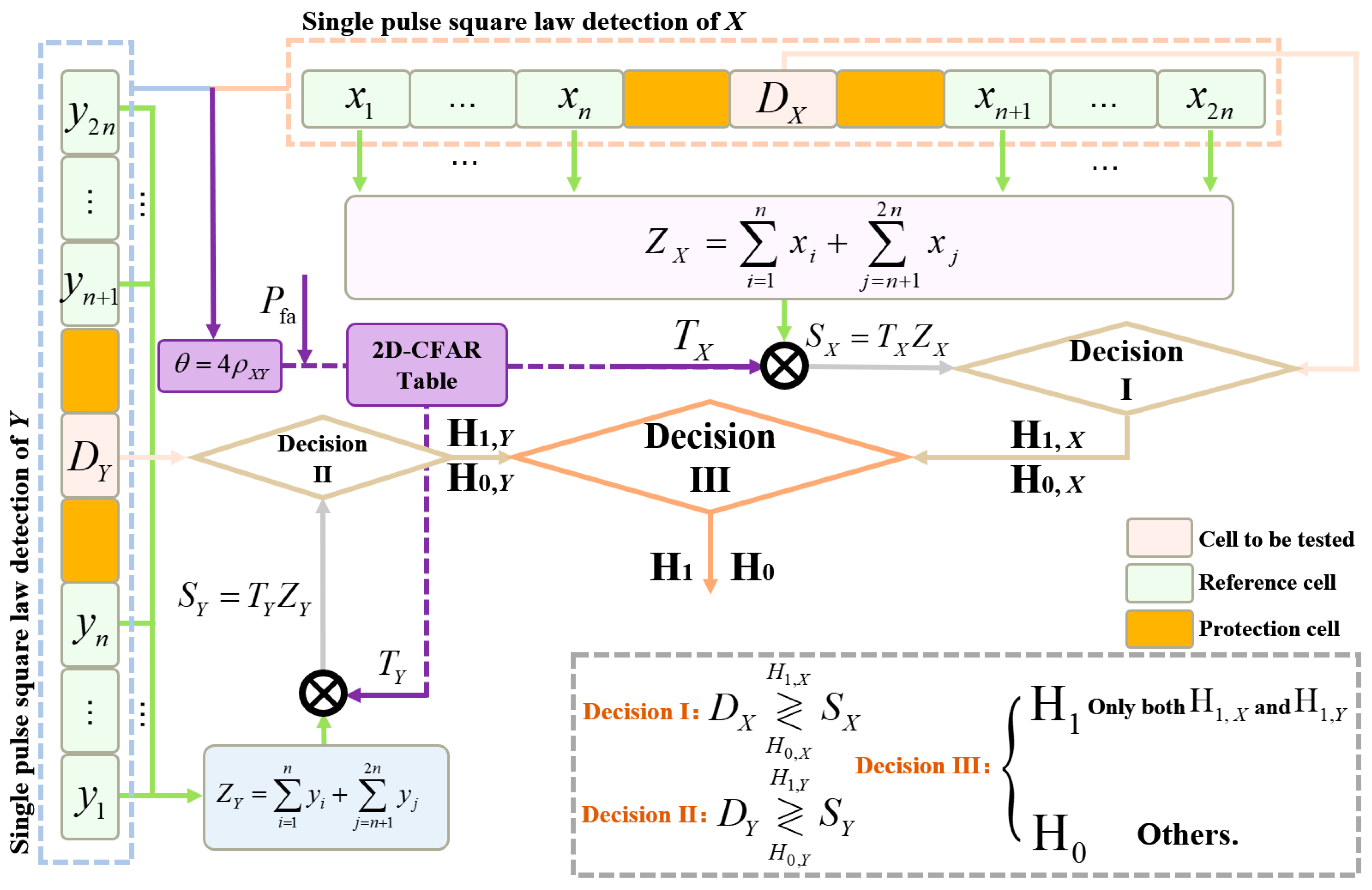
- A novel two-dimensional CFAR detector is proposed by rigorously integrating dual-observation (HH/VV) channel echoes using Copula theory.
- Statistical modeling and a correlation analysis of sea clutter amplitudes in HH and VV channels are validated under identical observational conditions.
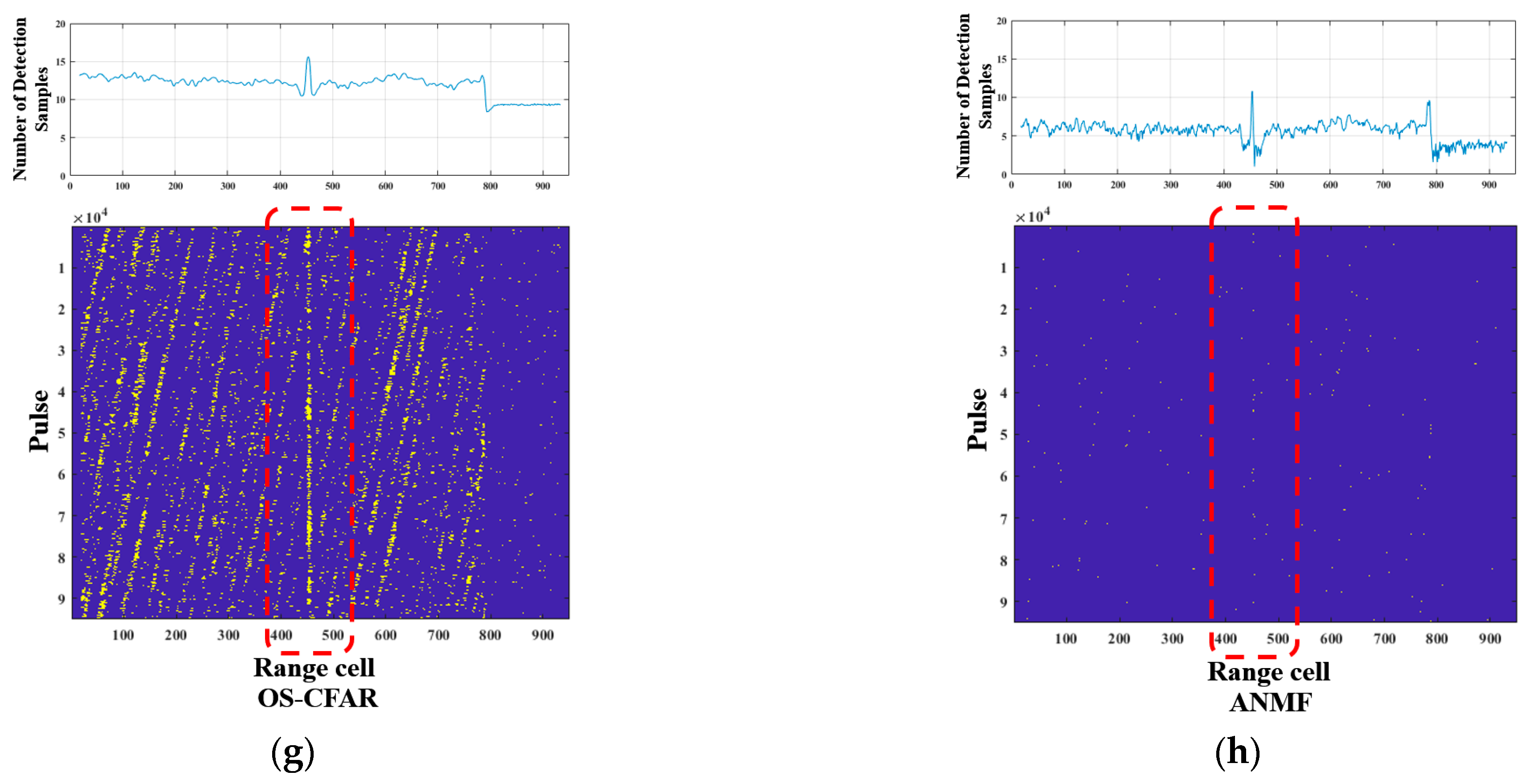
- The proposed method achieves adaptive false alarm control and significantly improves the detection performance over conventional one-dimensional CFAR detectors.
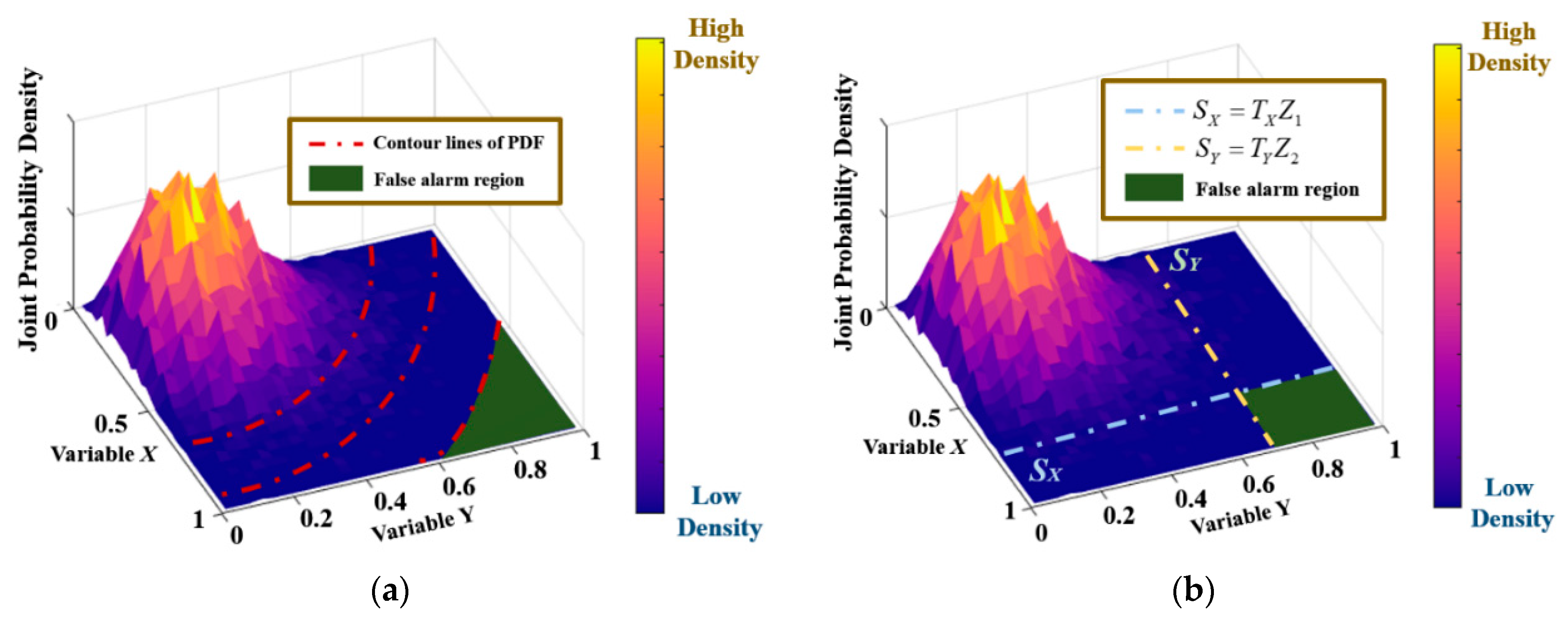
- The derived joint probability density function via Copula theory provides a rigorous mathematical foundation for extending CFAR detection from one-dimensional to two-dimensional statistics.
Abstract
1. Introduction
2. Analysis of Characteristics of Dual-Polarization Observational Channel Echo Data
2.1. Analysis of Amplitude Characteristics
2.2. Inter-Channel Correlation Analysis of Observations
3. A 2D-CFAR Target Detection Method Based on Copula Theory
3.1. Binary Description of Sea Surface Small Target Detection
3.2. Copula Theory
3.3. Mathematical Derivation of 2D-CFAR Detection
4. Experimental Results and Performance Comparison
4.1. False Alarm Control Experiment
4.2. Comparison of Target Detection Performance
5. Conclusions
Author Contributions
Funding
Data Availability Statement
Conflicts of Interest
Abbreviations
| ANMF | Adaptive Normalized Matched Filter |
| CA-CFAR | Cell Average Constant False Alarm Rate |
| CUT | Cell Under Test |
| HH | Horizontal–Horizontal |
| IID | Independent and Identically Distributed |
| OS-CFAR | Ordered Statistic Constant False Alarm Rate |
| Probability Density Function | |
| RAA | Relative Average Amplitude |
| RC | Reference Cell |
| ROC | Receiver Operating Characteristic |
| SCR | Signal-to-Clutter Ratio |
| SDRDSP | Sea-Detecting Radar Data-Sharing Program |
| VV | Vertical–Vertical |
References
- Liu, N.; Yang, H.; Wang, G.; Ding, H.; Dong, Y.; Xue, W. A Spectral Mode Reconstruction Method for Floating Target Detection Under Strong Sea Clutter Conditions. Remote Sens. 2025, 17, 3155. [Google Scholar] [CrossRef] [Scilit]
- Xu, S.; Niu, X.; Ru, H.; Chen, X. Classification of Small Targets on Sea Surface Based on Improved Residual Fusion Network and Complex Time–Frequency Spectra. Remote Sens. 2024, 16, 3387. [Google Scholar] [CrossRef] [Scilit]
- Shui, P.-L.; Zhang, L.-X.; Bai, X.-H. Small Target Detection in Sea Clutter by Weighted Biased Soft-Margin SVM Algorithm in Feature Spaces. IEEE Sens. J. 2024, 24, 10419–10433. [Google Scholar] [CrossRef] [Scilit]
- Zhao, J.; Xu, W.; Kneip, L. A Certifiably Globally Optimal Solution to Generalized Essential Matrix Estimation. In Proceedings of the 2020 IEEE/CVF Conference on Computer Vision and Pattern Recognition (CVPR), Seattle, WA, USA, 13–19 June 2020; pp. 12031–12040. [Google Scholar] [CrossRef] [Scilit]
- Guan, B.; Zhao, J. Affine Correspondences between Multi-Camera Systems for Relative Pose Estimation. IEEE Trans. Pattern Anal. Mach. Intell. 2025, 1–18. [Google Scholar] [CrossRef] [Scilit] [PubMed]
- Zhang, C.; Liu, G.; Cao, C.; Sun, J.; Dai, Y.; Zhang, X. SCA-Net: A Network Based on Multi-task Learning for Sea Clutter Amplitude Distribution Prediction of SAR Images. IEEE Geosci. Remote Sens. Lett. 2025, 22, 1–5. [Google Scholar] [CrossRef] [Scilit]
- Guan, Y.; Zhang, X.; Gao, G.; Cao, C.; Li, Z.; Fu, S.; Liu, G. A New Indicator for Assessing Fishing Ecological Pressure Using Multi-source Data: A Case Study of the South China Sea. Ecol. Indic. 2025, 170, 113096. [Google Scholar] [CrossRef] [Scilit]
- Kan, Q.; Xu, J.; Liao, G.; Zhang, Y.; Xu, Y.; Wang, W. Clutter Characteristics Analysis and Range-Dependence Compensation for Space-Air Bistatic Radar. IEEE Trans. Geosci. Remote Sens. 2024, 62, 5101615. [Google Scholar] [CrossRef] [Scilit]
- Xu, S.W.; Wang, Z. Optimum and Near-Optimum Coherent False Alarm Rate Detection of Radar Targets in Compound-Gaussian Clutter with Generalized Inverse Gaussian Texture. IEEE Trans. Aerosp. Electron. 2022, 58, 1692–1706. [Google Scholar] [CrossRef] [Scilit]
- Xiong, G.; Wang, L. Radar Sea Clutter Reconstruction Based on Statistical Singularity Power Spectrum and Instantaneous Singularity Exponents Distribution. IEEE Trans. Geosci. Remote Sens. 2021, 59, 5687–5697. [Google Scholar] [CrossRef] [Scilit]
- Shui, P.L.; Liu, M. Sub-Band Adaptive GLRT-LTD for Weak Moving Targets in Sea Clutter. IEEE Trans. Aerosp. Electron. 2016, 52, 423–437. [Google Scholar] [CrossRef] [Scilit]
- Shi, S.N.; Shui, P.L. Detection of Low-Velocity and Floating Small Targets in Sea Clutter via Income-Reference Particle Filters. Signal Process. 2018, 148, 78–90. [Google Scholar] [CrossRef] [Scilit]
- Jiménez, L.P.J.; García, F.D.A.; Alvarado, M.C.L.; Fraidenraich, G.; Lima, E.R.D. A General CA-CFAR Performance Analysis for Weibull-Distributed Clutter Environments. IEEE Geosci. Remote Sens. Lett. 2022, 19, 4025305. [Google Scholar] [CrossRef] [Scilit]
- Melebari, A.; Mishra, A.K.; Abdul Gaffar, M.Y. Comparison of Square Law, Linear and Bessel Detectors for CA and OS CFAR Algorithms. In Proceedings of the 2015 IEEE Radar Conference, Johannesburg, South Africa, 27–30 October 2015; pp. 383–388. [Google Scholar]
- Sahed, M.; Kenane, E.; Khalfa, A.; Djahli, F. Exact Closed-Form PFA Expressions for CA- and GO-CFAR Detectors in Gamma-Distributed Radar Clutter. IEEE Trans. Aerosp. Electron. 2023, 59, 4674–4679. [Google Scholar] [CrossRef] [Scilit]
- Draskovic, G.; Pascal, F.; Breloy, A.; Tourneret, J.-Y. New Asymptotic Properties for the Robust ANMF. In Proceedings of the 2017 IEEE International Conference on Acoustics, Speech and Signal Processing (ICASSP), New Orleans, LA, USA, 5–9 March 2017; pp. 3429–3433. [Google Scholar]
- Shi, S.N.; Shui, P.L. Sea-Surface Floating Small Target Detection by One-Class Classifier in Time-Frequency Feature Space. IEEE Trans. Geosci. Remote Sens. 2018, 56, 6395–6411. [Google Scholar] [CrossRef] [Scilit]
- Shui, P.L.; Li, D.C. Tri-Feature-Based Detection of Floating Small Targets in Sea Clutter. IEEE Trans. Aerosp. Electron. Syst. 2014, 50, 1416–1430. [Google Scholar] [CrossRef] [Scilit]
- Xie, J.; Xu, X. Phase-Feature-Based Detection of Small Targets in Sea Clutter. IEEE Geosci. Remote Sens. Lett. 2022, 19, 1–5. [Google Scholar] [CrossRef] [Scilit]
- Guo, Z.X.; Shui, P.L.; Bai, X.H. Small Target Detection in Sea Clutter Using All-Dimensional Hurst Exponents of Complex Time Sequence. Digit. Signal Process. 2020, 101, 102707. [Google Scholar] [CrossRef] [Scilit]
- Li, C.; Shui, P.L. Floating Small Target Detection in Sea Clutter via Normalized Doppler Power Spectrum. IET Radar Sonar Navig. 2016, 10, 699–706. [Google Scholar] [CrossRef] [Scilit]
- Qu, Q.; Wang, Z.; Wang, Y.L. A False Alarm Controllable Detection Method Based on CNN for Sea-Surface Small Targets. IEEE Geosci. Remote Sens. Lett. 2022, 19, 1–5. [Google Scholar] [CrossRef] [Scilit]
- Shi, Y.L.; Guo, Y.X. Sea-Surface Small Floating Target Detection via Recurrence Plots and FAC Classification Based on CNN. IEEE Trans. Geosci. Remote Sens. 2022, 60, 1–13. [Google Scholar]
- Shui, P.L.; Guo, Z.X. Feature-Compression-Based Detection of Sea-Surface Small Targets. IEEE Access 2020, 8, 8371–8385. [Google Scholar] [CrossRef] [Scilit]
- Guo, Z.X.; Shui, P.L. Anomaly-Based Sea-Surface Small Target Detection Using K-Nearest-Neighbor Classification. IEEE Trans. Aerosp. Electron. Syst. 2020, 56, 4947–4964. [Google Scholar] [CrossRef] [Scilit]
- Su, N.; Chen, X. Radar Maritime Target Detection via Spatial-Temporal Feature Attention Graph Convolutional Network. IEEE Trans. Geosci. Remote Sens. 2024, 62, 1–15. [Google Scholar] [CrossRef] [Scilit]
- Liu, N.; Dong, Y.; Wang, G. Annual Progress. of the Sea-Detecting X-Band. Radar and Data Acquisition Program. J. Radars 2021, 10, 173–182. [Google Scholar]
- Guan, J.; Liu, N.; Wang, G. Sea-Detecting Radar Experiment and Target Feature Data Acquisition for Dual Polarization Multistate Scattering Dataset of Marine Targets. J. Radars 2023, 12, 456–469. [Google Scholar]
- Wang, J.; Wang, Z.; He, Z. GLRT-Based Polarimetric Detection in Compound-Gaussian Sea Clutter with Inverse-Gaussian Texture. IEEE Geosci. Remote Sens. Lett. 2022, 19, 1–5. [Google Scholar] [CrossRef] [Scilit]
- Mohsenzadeh, M.S.; Hodtani, G.A. FGM Copula Based Analysis of Outage Probability for Wireless Three-User Multiple Access Channel with Correlated Channel Coefficients. In Proceedings of the 2023 31st International Conference on Electrical Engineering (ICEE), Tehran, Iran, 9–11 May 2023; pp. 492–495. [Google Scholar]
- Xu, F.-X.; Dong, Y.-Q. Concordance Measures of a Class of Two-Parameter with Cube Generalized FGM Copulas. In Proceedings of the 2010 Third International Symposium on Information Science and Engineering, Shanghai, China, 24–26 December 2010; pp. 62–65. [Google Scholar] [CrossRef] [Scilit]
- Lv, W.; Sang, L.; Shen, G. Risk Concentration Based on the Tail Distortion Risk Measure under Generalized FGM Copula. In Proceedings of the 2016 International Conference on Identification, Information and Knowledge in the Internet of Things (IIKI), Beijing, China, 20–21 October 2016; pp. 567–572. [Google Scholar] [CrossRef] [Scilit]
- Sun, Y.; Geng, J. Simulation of Coherent Correlated K-distribution Sea Clutter Based on SIRP. Sci. Technol. Eng. 2009, 9, 5144–5147. [Google Scholar]





Disclaimer/Publisher’s Note: The statements, opinions and data contained in all publications are solely those of the individual author(s) and contributor(s) and not of MDPI and/or the editor(s). MDPI and/or the editor(s) disclaim responsibility for any injury to people or property resulting from any ideas, methods, instructions or products referred to in the content. |
© 2025 by the authors. Licensee MDPI, Basel, Switzerland. This article is an open access article distributed under the terms and conditions of the Creative Commons Attribution (CC BY) license (https://creativecommons.org/licenses/by/4.0/).
Share and Cite
Jiang, X.; Tan, J.; Dong, Y.; Li, J.; Guan, J.; Wang, G.; Liu, N. A 2D-CFAR Target Detection Method in Sea Clutter Based on Copula Theory Using Dual-Observation Channels. Remote Sens. 2025, 17, 3885. https://doi.org/10.3390/rs17233885
Jiang X, Tan J, Dong Y, Li J, Guan J, Wang G, Liu N. A 2D-CFAR Target Detection Method in Sea Clutter Based on Copula Theory Using Dual-Observation Channels. Remote Sensing. 2025; 17(23):3885. https://doi.org/10.3390/rs17233885
Chicago/Turabian StyleJiang, Xingyu, Jiyuan Tan, Yunlong Dong, Juan Li, Jian Guan, Guoqing Wang, and Ningbo Liu. 2025. "A 2D-CFAR Target Detection Method in Sea Clutter Based on Copula Theory Using Dual-Observation Channels" Remote Sensing 17, no. 23: 3885. https://doi.org/10.3390/rs17233885
APA StyleJiang, X., Tan, J., Dong, Y., Li, J., Guan, J., Wang, G., & Liu, N. (2025). A 2D-CFAR Target Detection Method in Sea Clutter Based on Copula Theory Using Dual-Observation Channels. Remote Sensing, 17(23), 3885. https://doi.org/10.3390/rs17233885