Abstract
The present work showcases a model for holistic, sustainable healthcare in indigenous communities worldwide through the implementation of traditional healing practices. The implementation of this model promotes public health and community wellness while addressing crucially important themes such as in situ and ex situ conservation of medicinal plant resources and associated biodiversity, generational transmission of knowledge, and the preservation of biological and cultural diversity for future generations. Being envisaged and implemented by Q’eqchi’ Maya traditional healers of the southern Maya Mountains, Belize, this model can be replicated in other communities worldwide. A ethnobotany study in collaboration with these healers led to collection of 102 medicinal species from Itzama, their traditional healing cultural center and medicinal garden. Of these 102 species, 40 of prior reported 106 consensus study plants were present in the garden. There were 62 plants not previously reported growing in the garden as well. A general comparison of these plants was also made in relation to species reported in TRAMIL network, Caribbean Herbal Pharmacopoeia (CHP), the largest regional medicinal pharmacopoeia. A relative few species reported here were found in the CHP. However, the majority of the CHP plants are common in Belize and many are used by the nearby Mopan and Yucatec Maya. Since these 102 species are relied upon heavily in local primary healthcare, this Q’eqchi’ Maya medicinal garden represents possibilities toward novel sustainable, culturally relative holistic health promotion and community based conservation practices.
1. Introduction
The following discusses a novel, indigenous Q’eqchi’ Maya traditional healing cultural center and medicinal plant garden which can serve as a model internationally. The traditional healing cultural center and garden was envisaged and implemented by Q’eqchi’ Maya traditional healers for the promotion of community health and wellness through the utilization of effective traditional healing practices in primary healthcare. Importantly, since traditional healing relies heavily on the local biodiversity, the success of the project necessitates and facilitates in situ and ex situ conservation of medicinal plant species used in regular practice by Q’eqchi’ Maya traditional healers of the southern Maya Mountains region of Belize, Central America. This model could well serve global health through widespread replication. The present work compares the inventory of the garden to prior regional ethnobotanical works and highlights successes and areas for potential improvement. In doing so, this work begins advancement of a model for cost effective, holistic, sustainable healthcare that can be applied in indigenous communities worldwide. The implementation of this model would then promote public health and community wellness through the implementation of traditional healing practices while addressing crucially important themes of global import such as in situ and ex situ conservation of medicinal plant resources and their associated biodiversity, generational transmission of traditional healing knowledge, and the preservation of both biological and cultural diversity for future generations.
1.1. Maya Mountains Region
The Maya Mountains and surrounding areas of Belize, Central America, support a large area of varied tropical rainforest ecosystems. Given model conservation practices the ecosystems remain among the most intact and diverse in Central America [1]. Diversity of the regional flora is supported by numerous factors including high levels of regionally specific precipitation, complex topography, and unique variation in geomorphology [1,2,3,4].
There are four predominant ecosystem types in the Maya Mountains [1,5,6] which rise in the southern half of Belize and extend roughly 90km in a southwest-northeast direction and then extend westward at the northernmost point [2,3]. The granitic-volcanic range ascends steeply from coastal limestone plains to the east, peaks at generally 1000m and then gently descends to a western plateau of roughly 500m in elevation. The prevailing winds, which blow in from the Caribbean, drop their precipitation on the southern slopes and thus contribute much to the botanical diversity of the southern slopes compared to northern slopes [2,3,4]. Indeed, annual rainfall ranges from approximately 431.8 cm in the south to 127 cm in the north [2,3]. North of the divide, the two predominant ecosystems are lowland broad-leaved moist forest and submontane broad-leaved moist forest. The regions to the south of the divide are dominated by submontane broad-leaved wet forest and lowland broad-leaved wet forest [1,5,6].
Recent surveys of the mountains have produced new botanical records which may include species new to science [4,7]. The remote nature of the Maya Mountains also allows for the maintenance of rich cultural traditions. This finding is in keeping with the fact that internationally traditional cultures persist most notably in regions of mountainous topography [8]. Along with this cultural diversity, the area is host to a rich, intact traditional healing system among the indigenous Q’eqchi’ Maya who live in the southern Maya Mountains [9].
The Government of Belize has entered into an agreement for co-management of the area with the local Maya inhabitants to ensure its sustainable use and management. This is an innovative exercise of extreme importance given the global need for answers to complex questions in conservation of culture and biodiversity. It is well known that the earth’s diversity is being lost at a staggering rate [10,11] and that the rate of rainforest deforestation is unsustainable [12]. Cultural and biocultural diversity are disappearing along with the areas that bore these variations in humanity. It has been advanced by Jeffrey McNeely, chief scientist for International Union for the Conservation of Nature (IUCN), that preservation of tropical forests and the cultures which call them home can only be accomplished together. One strategy in accomplishing this is the integration of traditional healing in national healthcare systems [4,13,14,15].
1.2. Itzama
Itzama (“home of the Maya god of wisdom, Itzamna”, and place of healing spiritually and with herbs) is the name chosen by the Belize Indigenous Training Institute (BITI) and associated Q’eqchi’ Healers Association (QHA). Itzama describes their innovative traditional healing practice and cultural center, based in their medicinal garden, which promotes health and wellness in a traditional manner and in the context of the preservation of their rainforests and deep cultural traditions [16].
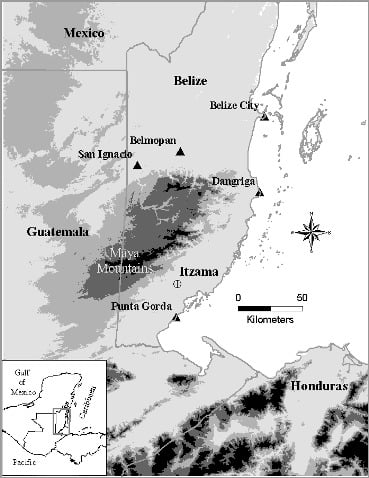
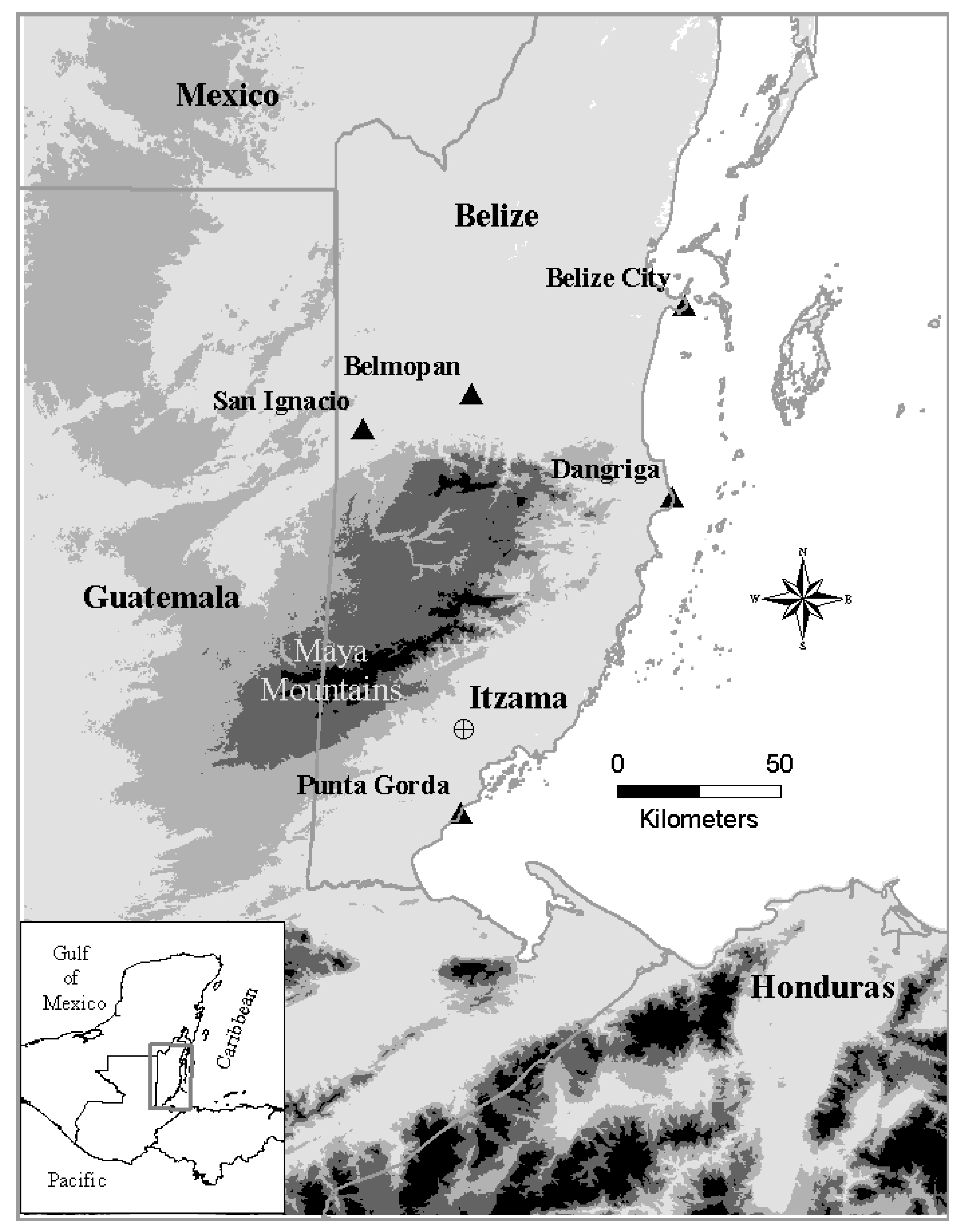
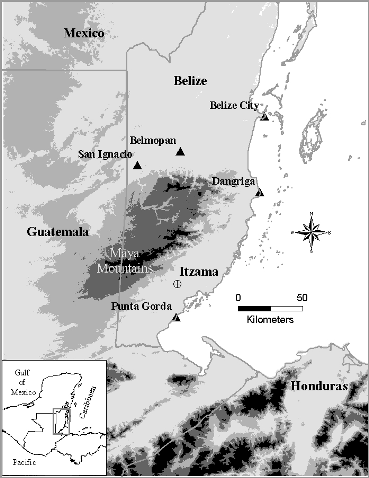
The Itzama project is based at a site in the foothills of the Maya Mountains of southern Belize where approximately 75 acres are being selectively cultivated by the healers as a medicinal garden (Figure 1). Medicinal plants being cultivated in the garden have been transplanted from the varied ecosystem niches throughout the Maya Mountains in an effort of ex situ conservation [4,16]. It is an innovative strategy in application of traditional knowledge as a vehicle for improving healthcare, culturally appropriate sustainable development and community based conservation of culture and biodiversity.
Figure 1.
Itzama and Maya Mountains Region: Maya Mountains Ethnobotany and Ecology Project Map. 1:1,544,427. GIS Data Sources: CGIAR Consortium for Spatial Information. 2008. http://srtm.csi.cgiar.org/, and, BioGeo Berkley. 2008. http://biogeo.berkeley.edu/bgm/gdata.php [GIS and spatial data warehouses]: Pesek, L. 2008. Using: ArcView GIS [GIS Software]. Version 9.3. Redlands, CA: Environmental Systems Research Institute, Inc., 2008.
Itzama grew from an initiative that began in 1995 when Inuit of Canada met with four Indigenous groups of Belize (Q’eqchi’ Council, Toledo Maya Cultural Council, National Garifuna Council and the Xunantunich Organization). The purpose in meeting was to explore opportunities for collaboration and joint ventures. The Inuit had come to Belize from recognition that they needed to consider development opportunities beyond their own circumpolar region. They considered that, as newcomers to the world of international development, both their interests and those of their prospective southern partners could best be served on an indigenous-to-indigenous basis. The connected indigenous peoples could bring to the table similar development issues, strong connections to culture and traditions, some similar development activities and practices and a clear linkage to issues of indigenous learning styles, language, healing traditions, and spirituality.
Over the following two years, the Inuit group, ICC, examined with its Belizean partners the needs of indigenous peoples in the southern districts of Belize. Together they determined that practical training was the principle concern of the four Belizean indigenous groups. The ICC, under a partnership agreement with its sister organization in Greenland, secured funding from Danish International Development Agency (DANIDA) for the creation of BITI. BITI was legally incorporated in Belize in 1998 and had as its Board of Directors one member from each of the four Belizean indigenous groups, with ICC representative Kevin Knight, providing council, technical assistance and project management support.
Each of the Belizean groups was provided with organizational strengthening resources in the form of office space, computers, related equipment and staff support. It was agreed that the headquarters for BITI should be in Punta Gorda (Figure 1) in order to service both the Q’eqchi’ and Mopan Maya and to be close to the poorest and largest population of indigenous peoples in Belize. Once established, BITI, under the leadership of its Board of Directors and founding Manager, Victor Cal, immediately set to the challenge of generating a variety of development and training projects. Specifically, BITI set out to provide practical training to local peoples in developing income generation and employment for communities. They did so principally through capacity building and training in the areas of traditional knowledge and cultural heritage.
While BITI was initially supported by DANIDA, the ICC continued to secure funding from International Labour Organization (ILO), United Nations Development Programme (UNDP), Government of Belize, ICC, Trekforce (a British NGO with a field base in Belize), and others.
The QHA, an organized group of traditional Q’eqchi’ Maya healers was established by BITI in 1999. In the beginning, QHA was initiated by bringing together 11 traditional healers and two understudies. The founding healers were all male, but since inception the QHA has invited female healers participation. The healers knew of each other, but had never worked together. Theirs was a practice known to the communities and others but conducted in secret. They had each learned their profession passed down through generations but thus far had not shared between healers their lessons learned or their knowledge. Each had lessons they had learned and each had different locations that they would forage for their traditional medicinal plants. The healing tradition was and is such that the healers must be approached for treatment not the other way around. Treatments were closely guarded.
In 1999, BITI/QHA secured a 50 acre site from the Government of Belize upon which they proposed developing a traditional healing garden and cultural center. They engaged Trekforce to assist with building a small house type structure on site. After a series of workshops, BITI/QHA had determined a set of objectives aimed at the promotion of respect for their traditional healing knowledge and practice and in 1999 invited the expertise of John Arnason, University of Ottawa (UO), to assist in these endeavors. This was a critically important connection. It bridged ethnobotanical and ethnopharmacological science with traditional healing knowledge toward the furtherance of projects that augment activities of the garden. One of the healers’ objectives was respect for their knowledge via scientific findings in support of their traditional healing knowledge. The QHA and UO began ethnobotanical studies of the region but than was set back by the regional devastation of hurricane Iris in 2001. Iris reduced the newly built infrastructure to its foundation and felled much of the primary forest of their 50 acre site.
After recovery, the collaboration continued onward in 2003 with research and development and invited the expertise of Todd Pesek, Cleveland State University (CSU), to assist in their endeavors. This was another critically important connection in bridging ethnobotany, ecology of medicinal plants, traditional healing and health sciences toward the integration of traditional healing in national healthcare, another objective set by the healers.
The collaboration then secured funding and support from Naturaleza Foundation and International Development Research Center (IDRC) which made possible “Visioning our Traditional Health Care: Workshop on Q’eqchi’ Healers Center, Botanical Garden and Medicinal Plant Biodiversity Project in Southern Belize.” In effect, this workshop brought together BITI, QHA, and external collaborators for the careful planning and articulation of the healers’ goals for the traditional healing cultural center and garden [14].
Following the workshop, the collaboration secured modest funding for renovation and development of the center and garden, subsequent to Iris, from The World Bank. These funds and their deliverables as well as the workshop report to IDRC [14] articulating the future goals of the healers led to a subsequent IDRC award for “Itzama Project: sustainable indigenous development based on the ethnobotanical garden and traditional medicine concept.” This award made possible a formal policy recommendations document submitted to the Government of Belize regarding a practical proactive draft protocol for indigenous intellectual property protection in research. The framework of the protocol is the Itzama collaborations model practice [17].
During 2005, the size of the site was enlarged from 50 to 75 acres and the access road improved with the support of the Government of Belize. And, the healers continue to make improvements to the garden including paths, ornamental plantings, and updated facilities. In 2008, the QHA, established membership criteria and a constitution for governance of their operations. They selected leadership roles and elected representative peers. They have reached out to their communities in offering healthcare and bolstering their membership, and they have partnered with local schools in transmission of traditional knowledge to youth.
Since 2000, the traditional healing cultural center and garden has also been a site at which traditional spiritual ceremonies have been reintroduced as part of the process of Q’eqchi’ Maya cultural revival in Belize. Maya spiritual ceremonies in Belize had not been practiced openly for as long as could be remembered. Given the culturally important interconnectedness of the practice of traditional healing to Q’eqchi’ Maya spirituality, spiritual ceremonies were reintroduced at Itzama.
The ICC along with its partners had been instrumental in bringing together for the first time the four Belizean organizations to participate in a truly important sustainable development organization—BITI. In addition, BITI had itself brought together traditional Q’eqchi’ Maya traditional healers also for the first time, who had until then been practicing in secrecy from mainstream society and in isolation from each other.
Despite its biodiversity riches, this area has many challenges of economic development and remains one of the poorest areas of Belize. There is an urgent need for better training, education, and employment. There is also a fairly broad desire amongst the local Maya community to maintain a traditional culture and lifestyle, particularly in primary healthcare, both as a means to support elders in the community and also to pass on traditional beliefs to younger generations [14].
The Itzama project sets out to address these issues in a novel attempt at indigenously run sustainable development, biodiversity conservation and health promotion through the use of traditional healing systems. Traditional healing systems are supportive of holistic health as they involve axes in health promotion including mind, body and spirit in the context of healthful environmental surroundings [15]. Traditional healers and their practice advocates for environmental respect and conservation in health promotion [15]. The project supports the coalescence of individualized house plots and small scale gardens as well as technological improvements for propagation of endangered plant species; research and training in more effective plant propagation and harvesting techniques; and establishment of community-managed, sustainable forest-based enterprises for income generation. While relatively modest, the program holds real promise for enhancing the sustainable management of the medicinal plant resources of the area in a way that will enable local communities to reap economic benefits of these resources without depleting the forests and endangered plant species.
1.3. Present Study
The present study is a botanical inventory of the Itzama project garden, now host to numerous species from rich and varied ecosystem niches, and a comparison to prior consensus ethnobotany of the Q’eqchi’ Maya of the region [9]—knowledge essential to the continued development of innovative in situ and ex situ conservation of Q’eqchi’ medicinal plant resources.
2. Methods
2.1. Informed Consent and Ethics
Our study and informed consent protocol was approved by the Institutional Review Board of CSU, Cleveland, Ohio, USA, and the Research Ethics Board of the UO, Ottawa, Canada. This study was accomplished with informed consent of the Q’eqchi’ Maya with whom we work in collaborative form as a participatory research team. The identities of the healers are not revealed due to ethical guidelines. In order to provide intellectual property protection, the specific medicinal applications of each species are not given. Our work is carried out with the much appreciated support of the Government of Belize via permits issued through the Belize Forest Department.
2.2. Q’eqchi’ Maya Healers
Five healers from the QHA participated in the present study as participatory researchers and informants. They assisted in the refinement of the methodologies, the actual collections and preparation of specimens, and the refinement of data. The healers are representative of well-respected, senior healers of the region.
2.3. Study Sites and Collections
Field excursions were made for data and specimen collections between February and May 2006. Comprehensive, general collections were made throughout the garden with the assistance of the healers. As the plants were collected for final identification, they were labeled with Q’eqchi’ Maya names, the conditions treated with the plants, plant preparations and approximate scientific names. Herbarium specimens were collected in duplicate and in minimally invasive fashion. One set was delivered for taxonomic identification and deposited at Herbario Nacional, Universidad Nacional, Costa Rica, Central America for identification by tropical botanical experts Luis Poveda and Pablo Sanchez, and the other was left for reference on site in Belize.
3. Results
On the whole, 102 medicinal species were collected from the Itzama garden and identified to species (Table 1 and Table 2). Of these 102 species, 40 of the 106 consensus ethnobotany plants previously reported by Treyvaud-Amiguet et al. (2005) [9] were present in the gardens (Table 1). There were 62 plants not previously reported growing in the garden as well (Table 2).
Table 1.
Previously identified Q’eqchi’ medicinal plants from consensus ethnobotany and current status in Itzama gardens.
| Family | Scientific name | Q'eqchi' name | In Garden |
|---|---|---|---|
| Acanthaceae | Aphelandra scabra (Vahl.) Sm. | Saxjolom chacmut #2 (Sita pim) | Y |
| Blechum pyramidatum (Lam.) Urb. | None | N | |
| Justicia aff.fimbriata (Nees) V.A.W. Graham | Saxjolom chacmut #1 | N | |
| Justicia pectoralis Jacq. | Santa Maria kejen | Y | |
| Mendoncia lindavii Rusby | None | N | |
| Adiantaceae | Adiantum petiolatum Desv. | None | Y |
| Adiantum pulverulentum L. | Sis' bi pim | N | |
| Adiantum wilsonii Hook. | Ruj' i' rak' aj tza | N | |
| Annonaceae | Annona aff. glabra L. | Ho' lo' bob | N |
| Apiaceae | Eryngium foetidum L. | Samat | N |
| Apocynaceae | Thevetia ahouai (L.) A.DC. | Chi' chi tyak | N |
| Araceae | Anthurium willdenowii Kunth. | Xchich ma'us | Y |
| Araliaceae | Dendropanax arboreus (L.) Decne.& Planch. | Cojl | Y |
| Aspleniaceae | Bolbitis pergamentacea (Maxon) Ching. | None | N |
| Elaphoglossum herminieri (Bory ex Fée) T. Moore | Rubelsa' i' xul #2 | N | |
| Elaphoglossum peltatum (Sw.) Urb. | Culantro pim | N | |
| Asteraceae | Baccharis trinervis Pers. | None | N |
| Chromolaena odorata (Lam.) R.M. King & H. Rob. | None | Y | |
| Mikania micrantha H.B.K. | Cha' ko' nob #1 | N | |
| Neurolaena lobata (L.) R. Br.ex Cass. | Q'an mank | Y | |
| Piptocarpha poeppigiana (DC.) Baker | Chu' nac kejen #2 | N | |
| Pluchea odorata (L.) Cass. | None | N | |
| Asteraceae | Vernonia stellaris La Llave & Lex. | Hob' lob' te | N |
| Begoniaceae | Begonia glabra Aubl. | Kak' i' pim #1 (Pa'u'lul #3) | N |
| Begonia heracleifolia Schltdl.& Cham.. | Xac' peck (Pa'u'lul #1) | N | |
| Begonia nelumbiifolia Schltdl.& Cham. | Pa' u' lul #2 | Y | |
| Burseraceae | Bursera simaruba (L.) Sarg. | Kakajl | N |
| Cactaceae | Epiphyllum phyllanthus (L.) Haw. var strictum (Lem.) Kimnach Wilmattea minutiflora (Britton & Rose) Britton & Rose. | Chic' ba' bac #2Chic’ ba’ bac #1 | YN |
| Campanulaceae | Hippobroma longiflora (L.) G. Don. | None | Y |
| Clusiaceae | Vismia baccifera (L.) Triana & Planch. | Q’an para’ quay | N |
| Combretaceae | Combretum fruticosum (Loefl.) Stuntz. | Kan shan cahan | N |
| Commelinaceae | Dichorisandra hexandra (Aubl.) Standl. | Tzima’aj pim | N |
| Tripogandra grandiflora (Donn.Sm.) Woodson | Tzima'aj kejen #2 | N | |
| Convolvulaceae | Merremia dissecta (Jacq.) Hallier f. | Is caham | Y |
| Merremia tuberosa (L.) Rendle | None | N | |
| Costaceae | Costus laevis Ruiz & Pav. | Chu’ un | Y |
| Cucurbitaceae | Gurania makoyana (Lem.) Cogn. | Cu’ um pim | N |
| Melothria pendula L. | Sandia cho' | N | |
| Momordica charantia L. | Ya’ mor | N | |
| Davalliaceae | Nephrolepis biserrata (Sw.) Schott. | Xqu’q moco’ ch | N |
| Dilleniaceae | Davilla kunthii A. St.-Hil. | Kak’ I’ caham | N |
| Euphorbiaceae | Chamaesyce hyssopifolia (L.) Small. | None | N |
| Croton schiedeanus Schltdl. | Copal chi | N | |
| Euphorbia lancifolia Schltdl. | None | N | |
| Fabaceae-Caesalpinioideae | Senna alata (L.) Roxb. | Bajero pim | N |
| Senna hayesiana (Britton & Rose) H.S. Irwin & Barneby | Carabans’ I’ che | N | |
| Fabaceae-Mimosoideae | Desmodium adscendens (Sw.) DC. | Ch'in pim | Y |
| Fabaceae-Papilionoideae | Acosmium panamense (Benth.) Yakovlev | Ka che | Y |
| Machaerium cirrhiferum Pittier | Lokoch kix | Y | |
| Tephrosia multifolia Rose | Chalam | N | |
| Gesneriaceae | Besleria laxiflora Benth. | Kehal pim | Y |
| Columnea sulfurea Donn. Sm. | Kak’ I’ pim #2 | Y | |
| Haemodoraceae | Xiphidium caeruleum Aubl. | Xcual’ I’ cu’ uch | Y |
| Lamiaceae | Hyptis capitata Jacq. | Se’ ruj’ kaway | N |
| Hyptis verticillata Jacq. | Chu pim | N | |
| Loganiaceae | Strychnos panamensis Seem. | Curux kix | N |
| Malvaceae | Sida acuta Burm. f. | Mes’ beel | N |
| Marattiaceae | Danaea aff. nodosa (L.) Sm. | None | N |
| Marcgraviaceae | Souroubea gilgii V.A. Richt. | Hu’ bub | N |
| Melastomataceae | Adelobotrys adscendens (Sw.) Triana | Chu’ nac kejen #1 | N |
| Arthrostemma ciliatum Pav. ex D. Don. | Roq za’ ak | Y | |
| Blakea cuneata Standl. | Oxlaju chajom | Y | |
| Clidemia capitellata (Bonpl.) D. Don. var dependens (D. Don.) J.F. Macbr. | Ix pim #2 | Y | |
| Miconia oinochrophylla Donn. Sm. | None | Y | |
| Menispermaceae | Abuta panamensis (Standl.) Krukoff & BarnebyCissampelos pareira L. | NoneChup’ I’ al #3 | YY |
| Cissampelos tropaeolifolia DC. | Chup’ I’ al #1 | N | |
| Monimiaceae | Mollinedia guatemalensis Perkins | Sak’ I’ kejen #1 | Y |
| Moraceae | Dorstenia contrajerva L. | Chup’ I’ al #2 | Y |
| Ficus insipida Willd. | Hu’u | Y | |
| Myrtaceae | Calyptranthes chytraculia (L.) Sw. | Noone | N |
| Eugenia rhombea (O. Berg.) Krug & Urb. | Lamush pim | N | |
| Passifloraceae | Passiflora oerstedii Mast. var choconiana (S. Watson) | Tu’ key #1 | N |
| Passiflora guatemalensis S. Watson | Tu’ key #2 | N | |
| Piperaceae | Peperômia hispidula (Sw.) A. Dietr. | Xcua’ I’ xul | Y |
| Peperomia matlalucaensis C. DC. | None | N | |
| Piper amalago L. | Tzi’ ritok | Y | |
| Piper hispidum Sw. | Kan pom | N | |
| Piper peltatum L. | Tyut’ it | Y | |
| Piper schiedeanum Steud. | None | Y | |
| Piper tuerckeimii C.DC. ex Donn. Sm. | Cux’ sawe | N | |
| Piper yucatanense C. DC. | Tzu’ lub pim | N | |
| Polygalaceae | Securidaca diversifolia (L.) S.F. Blake | Seru qantyaj or Chup qantyaj | N |
| Polypodiaceae | Campyloneurum brevifolium (Lodd.ex Link) Link | Rix’ I’ xul | N |
| Rhamnaceae | Gouania lupuloides (L.) Urb. | Cha’ jom caham #1 | N |
| Rubiaceae | Chiococca alba (L.) Hitchc. | Par’ I’ pim | N |
| Gonzalagunia panamensis (Cav.) K.Schum. | Tzu’ ul che | Y | |
| Morinda citrifolia L. | Q’an I’ che | Y | |
| Psychotria glomerulata (Donn.Sm.) Steyerm. | None | Y | |
| Sabicea villosa Willd. ex Roem.& Schult. | Tu’ zub caham #1 | N | |
| Spermacoce tenuior L. | None | N | |
| Rutaceae | Zanthoxylum petenense Lundell | None | N |
| Schizaeaceae | Lygodium heterodoxum Kunze | Ruxb’ I’ kaak #1 | N |
| Lygodium venustum Sw. | Ruxb’ I’ kaak #2 | Y | |
| Selaginellaceae | Selaginella umbrosa Lem. ex Hieron. | None | Y |
| Selaginella aff. stellata Spring | None | N | |
| Tectariaceae | Dictyoxiphium panamense Hook. | Usi’ xu’ ul kejen | Y |
| Tiliaceae | Triumfetta semitriloba Jacq. | Cuo’ yo | N |
| Verbenaceae | Aegiphila monstrosa Moldenke | Roq xa’an | N |
| Lantana trifolia L. | Tu’ lush | Y | |
| Phyla dulcis (Trevir.) Moldenke | None | N | |
| Stachytarpheta jamaicensis (L.) Vahl. | Tye’ aj’ pak | Y | |
| Vitaceae | Cissus microcarpa Vahl. | Roq’ hab | N |
| Vitis tiliifolia Humb. & Bonpl.ex Roem.& Schult. | Tu’ zub caham #2 | Y | |
| Zamiaceae | Zamia picta Dyer. | Cykad | N |
Table 2.
Q’eqchi’ medicinal species in the Itzama gardens not recorded in the prior consensus study.
| Family | Scientific name | Q’eqchi name |
|---|---|---|
| Acanthaceae | Aphelandra aurantiaca (Scheidw.) Lindl. | Sa’x jolom Chacmut |
| Acanthaceae | Justicia aurea Schltdl. | Chak Mut K’ak |
| Acanthaceae | Ruellia matagalpae Lindau | Kuuw Kub K’ejen |
| Adiantaceae | Pteris pungens Willd. | Rok Chicuan’ |
| Amaranthaceae | Iresine diffusa Willd. | Birritak |
| Araceae | Alocasia macrorrhizos (L.) G. Don | Marak’a |
| Araliaceae | Oreopanax obtusifolius L. O. Williams | Bak Pim |
| Aristolochiaceae | Aristolochia tonduzii O. C. Schmidt | San Sar K’egem |
| Aspleniaceae | Asplenium serratum L. | Rix I Xul |
| Asteraceae | Mikania guaco Humb. & Bonpl. | Ramn Kantiaj |
| Asteraceae | Porophyllum punctatum (Mill.) S. F. Blake | Só Sol Pim |
| Bignoniaceae | Tynanthus guatemalensis Donn. Sm. | Chi Vi Vayal |
| Boraginaceae | Cordia spinescens L. | Ekex eb |
| Buddlejaceae | Buddleja americana L. | Job lo Te |
| Burseraceae | Protium glabrum (Rose) Pittier | Pon Te |
| Caesalpinaceae | Senna hayesiana (Britton & Rose) H. S. Irwin & Barneby | Keenk Maus |
| Caesalpinaceae | Dialium guianense (Aubl.) Sandwith | Holobob |
| Combretaceae | Terminalia amazonica (J. F. Gmel.) Excell | Kaa Chan |
| Commelinaceae | Tradescantia zebrina hort. ex Bosse | Simak |
| Crassulaceae | Kalanchoe pinnata (Lam.) Pers. | None |
| Dracaenaceae | Dracaena americana Donn. Sm. | Tut |
| Euphorbiaceae | Croton xalapensis H. B. K. | Nok Te |
| Euphorbiaceae | Acalypha arvensis Poepp. | Káak Ukuub |
| Lamiaceae | Scoparia dulcis L. | Chúu Pim / Ix Ye Kavay |
| Loganiaceae | Strychnos brachistantha Standl. | Curux K'ix |
| Loganiaceae | Spigelia humboldtiana Cham. & Schltdl. | Se Ru Ixúl |
| Lomariopsidaceae | Elaphoglossum herminieri (Bory ex Fée) T. Moore | X'na Tulux |
| Malpighiaceae | Byrsonima crassifolia (L.) Kunth | Chii |
| Malvaceae | Malvaviscus arboreus Cav. Var. Mexicanus Schltdl. | Ix |
| Malvaceae | Heliocarpus mexicanus (turcz.) Sprague | Saky baych |
| Malvaceae | Pavonia paniculata Cav. | Mul Tzi |
| Margraviaceae | Souroubea gilgii V. A. Richt. | Hub’ ub’ |
| Melastomataceae | Arthrostemma ciliatum Pav. Ex D. Don | |
| Melastomataceae | Clidemia crenulata Gleason | Tzó Pim |
| Meliaceae | Guarea grandifolia DC. | Bol bo |
| Mimosaceae | Mimosa pudica L. | Wara Kix |
| Monimiaceae | Siparuna thecaphora (Poepp. & Endl.) A. DC. | Chú che |
| Myrtaceae | Pimenta guatemalensis (Lundell) Lundell | Pens |
| Onagraceae | Hauya elegans DC. Subsp. Lucida (Donn. Sm. & Rose) P. H. Raven & Breedlove | Conop |
| Passifloraceae | Passiflora guatemalensis S. Watson | A’tzam Pim |
| Passifloraceae | Passiflora sexflora Juss. | Pepem pim |
| Phytolaccaceae | Rivina humilis L. | None |
| Phytolaccaceae Piperaceae | Petiveria alliacea L. Piper aff. aequale Vahl | Paara PimPuchush Kamil |
| Piperaceae | Peperomia tetraphylla (G. Forst.) Hook. & Arm. | Puchsh Retzul |
| Piperaceae | Piper arboreum Aubl. | Saki Puchuu |
| Piperaceae | Piper marginatum Jacq. | Kan Puchuu |
| Piperaceae | Piper umbellatum L. | Obel |
| Piperaceae | Peperomia obtusifolia (L.) A. Dietr. | Ix Wa Ajauchán |
| Rhizophoraceae | Cassipourea guianensis Aubl. | Zeruj Jauyán |
| Rosaceae | Photinia microcarpa Standl. | |
| Rubiaceae | Posoqueria latifolia (Rudge) | Jom Che |
| Rubiaceae | Spermacoce assurgens Ruiz & Pav. | Ix Warriba I Chookl |
| Rubiaceae | Hamelia rovirosae Wernham | Chaaj Max / Jolom Ipos |
| Rubiaceae | Psychotria poeppigiana Müll. Arg. | X Jolom Tzó Chilan |
| Solanaceae | Cestrum racemosum Ruiz & Pav. | Akap Kelém |
| Solanaceae | Solanum megalophyllum Dunal | Ic Pim |
| Solanaceae | Solanum rudepanum Dunal | Pajla |
| Tiliaceae | Trichospermum grewiifolium (A. Rich) Kosterm | |
| Verbenaceae | Stachytarpheta frantzii Pol. | Tye Aj Pak |
| Verbenaceae | Cornutia grandifolia (Schltdl. & Cham.) Schauer | Rok Xan |
| Vittariaceae | Ananthacorus angustifolius (Sw.) Underw. & Maxon | Rujrak Xul |
4. Discussion
A general comparison of these plants was made to the TRAMIL network, Carribean Herbal Pharmacopoeia (CHP), the largest regional medicinal pharmacopoeia. A relatve few species reported here were found in the CHP. However, the majority of the CHP plants are common in Belize and many are used by the nearby Mopan Maya [18] and Yucatec Maya of Belize [19]. When asked about the CHP plants, the Q’eqchi’ healers are aware of them and occasionally use them but prefer the primary forest species reported here. Thus these Q’eqchi’ Maya medicinal gardens represent possibilities toward novel culturally relative holistic health promotion and community based conservation practices given the uniqueness of their pharmacopoeia.
The Q’eqchi’ Maya preferentially gravitate to traditional healing, even where modern medical healthcare is available [9,14,16]. This is in keeping with global realities that approximately 80% of the world’s population rely on traditional healing for primary healthcare [13,20].
Typical maladies in southern Belize can be generally categorized into several main types; tropical medicine and hygiene and encompassing maladies attributable to living conditions, infectious agents, inflammatory conditions, mental health, age-related degenerative disorders, and emergency situations including wild animal attacks and snake bites [14,16]. Of note, there is unanimous concern being expressed over increasing incidence and prevalence of cancer, HIV/AIDS, inflammatory conditions (in particular arthritis), and diabetes mellitus type 2 [14,16]. These growing health concerns could-well be addressed by preventive measures. These, by necessity, would be aimed at the groups via culturally relative strategies including the development of novel treatments from traditional medicines as well as general educational programming via traditional healers. The most common overall health concerns and presenting symptoms are mental health, headache, low back pain, arthritis, fever, fatigue, cough, loose stool, vomiting, skin irritations, infections, parasites, and general malaise. All of these are dealt with initially quite successfully by traditional healers who then refer difficult cases to the district hospital in Punta Gorda [14,16].
Many of the plants relied upon by traditional healers and global markets are taken from the wild—this threatens extirpation, ecosystem devastation, and biodiversity loss. Appropriate implementation of sustainable growing and harvesting programs must be adopted. Indeed, medicinal plant conservation is an important part of conservation programming in Belize and the rest of the world.
The healers continually refer to their concern for having to go further and further from their homes in procuring their healing plants due to deforestation and development, and they explained that this is one of the main reasons that they established the Itzama garden. They were obligated not only to the revival and promotion of respect for their traditional healing ways, but also to the conservation of the Maya Mountains rainforest for future generations to learn their ancestral ways. To date, the healers have been extremely successful in transplanting and propagating medicinal plants that they would have otherwise had to search out and collect in the surrounding forest which is under increasing pressures and becoming increasingly fragmented. Particular success has been attained with transplantation, cultivation and propagation of trees, shrubs and understory species at the gardens. In interviews, they indicated that this was not achieved without considerable effort. Many round trips to the forest sites were required. They had considerable problems with desiccation and high mortality of transplants. Success was higher when they brought larger amounts of soil and irrigated well after transplantation. They have had continued difficulties as their gardens are not primary old-growth forest from which much of their botanical pharmacopoeia derives. Additional mortality occurred during the dry season, which appears to be due to the hotter conditions in the lowland secondary forest location of the garden. In a previous study Bourbonnais-Spear et al. (2005) [21] analyzed and documented some of these changed conditions by comparing environmental conditions at collection sites to those within the garden.
A comparative analysis of the garden plants and the plants previously identified in the previously mentioned consensus ethnobotany indicates that there are no major families that were not transplanted successfully, although there were a number of species that did not survive. The healers mentioned that they had considerable difficulty transplanting small epiphytes (scotophylls, homeohydric) such as peperomias, lycopods and ferns but found a solution by using a large Ceiba pentandra nurse log which provided a mossy wet environment for them. They have developed a series of other innovative ecosystem microhabitats to approximate natural growing conditions. For example, they were also able to use moist riparian and dry upland sites to accommodate a wide variety of species. The healers themselves believe that the garden is representative but not a complete ex situ collection of their pharmacopoeia. The one habitat that they were unable to duplicate is the plants that grow on the cool limestone outcrop wall of the karst topography of the Maya Mountains, which supports a number of vines, epiphytic Piperaceae, ferns, lycopds, Begonias and other species.
5. Conclusions
The healers are serving as primary healthcare providers and are improving public health accordingly. The plant availability problem is being actively addressed in novel fashion by the healers themselves. Through their efforts, they are preserving the biodiversity both in situ by providing viable sustainable options to wild harvesting and ex situ by transplanting and propagating pressured and rare species. It is then possible for these threatened plants to be further propagated through transplantation to house gardens and added to the wild stocks according to traditions in sustainable forest use.
They are also working to transmit knowledge to the next generation, by collaborating with the traditional knowledge class at the local high school. In the program, the youngsters come together with their elders to work in not only collections, cultivation and propagation of plants, but also traditional healing practices and participatory scientific studies.
Acknowledgements
This work was supported by IDRC, Naturaleza Foundation, UO, and CSU.
References
- Biodiversity & Environmental Resource Data System (BERDS); World Wide Web Electronic Publication: Belmopan, Belize, 2008. Available online: http://www.biodiversity.bzv (accessed on 1 December 2008).
- Hartshorn, G.; Nicolait, L; Hartshorne, L.; Bevier, G.; Brightman, R.; Cal, J.; Cawich, A.; Davidson, W.; DuBois, R.; Dyer, C.; Gibson, J.; Hawley, W.; Leonard, J.; Nicolait, R.; Weyer, D.; White, H.; Wright, C. Belize, Country Environmental Profile; Trejos, H., San, J., Costa, R., Eds.; Robert Nicolait and Associates: Belize City, Belize, 1984. [Google Scholar]
- Balick, M.; Nee, M.; Atha, D. Checklist of Vascular Plants of Belize, with Common Names and Uses; New York Botanical Garden Press: New York, NY, USA, 2001. [Google Scholar]
- Pesek, T.; Cal, M.; Cal, V.; Fini, N.; Minty, C.; Dunham, P.; Arnason, J. Rapid ethnobotanical survey of the Maya Mountains range in Southern Belize: A pilot study. Trees Life J. 2006, 1, 1–12. [Google Scholar]
- Pesek, T.; Abramiuk, M.; Fini, N.; Otarola-Rojas, M.; Collins, S.; Cal, V.; Sanchez, P.; Poveda, L.; Arnason, J. Q’eqchi’ Maya healers traditional knowledge in prioritizing conservation of medicinal plants: culturally relative conservation in sustaining traditional holistic health promotion. Biodivers. Conserv. 2010, 19, 1–20. [Google Scholar]
- Pesek, T.; Abramiuk, M.; Garagic, D.; Fini, N.; Meerman, J.; Cal, V. Sustaining plants and people: Traditional Q’eqchi’ Maya botanical knowledge and interactive spatial modeling in prioritizing conservation of medicinal plants for culturally relative holistic health promotion. Ecohealth 2009, 6, 79–90. [Google Scholar]
- Ironmonger, S.; Leisnerm, R.; Sayre, R. Plant records from the natural forest communities in the Bladen Nature Reserve, Maya Mountains, Belize. Caribb. J. Sci. 1995, 3, 30–48. [Google Scholar]
- Stepp, J.; Castaneda, H.; Cervone, S. Mountains and biocultural diversity. Mt. Res. Dev. 2005, 25, 223–227. [Google Scholar]
- Treyvaud-Amiguet, V.; Arnason, J.; Maquin, P.; Cal, V.; Sanchez-Vindaz, P.; Poveda, L. A consensus ethnobotany of the Q’eqchi’ Maya of southern Belize. Econ. Bot. 2005, 59, 29–42. [Google Scholar]
- World Wildlife Fund. Living Planet Report 2004; World Wildlife Fund: Gland, Switzerland, 2004.
- Hanski, I. Landscape fragmentation, biodiversity loss and the societal response. EMBO Rep. 2005, 6, 388–392. [Google Scholar]
- United Nations Food and Agricultural Organization. Global Forest Resources Assessment, 2000. Available online: ftp://ftp.fao.org/docrep/fao/003/Y1997E/FRA%202000%20Main%20report.pdf (accessed on 3 August 2005).
- Traditional Medicine Strategy 2002–2005; World Health Organization: Geneva, Switzerland, 2002.
- Arnason, J.; Cal, V.; Assinewe, V.; Poveda, L.; Waldram, J.; Cameron, S.; Pesek, T.; Cal, M.; Jones, N. Visioning Our Traditional Health Care: Workshop on Q’eqchi’ Healers Center, Botanical Garden and Medicinal Plant Biodiversity Project in Southern Belize; Final Report; Submitted to International Development Research Center (IDRC): Ottawa, Canada, 1 December 2004. [Google Scholar]
- Pesek, T.; Helton, L.; Nair, M. Healing across cultures: Learning from traditions. Ecohealth 2006, 3, 114–118. [Google Scholar]
- Pesek, T.; Cal, V.; Fini, N.; Cal, M.; Rojas, M.; Sanchez, P.; Poveda, L.; Collins, S.; Knight, K.; Arnason, J. Itzama: Revival of traditional healing by the Q’eqchi’ Maya of Southern Belize. HerbalGram 2007, 76, 34–43. [Google Scholar]
- Cal, V.; Arnason, J.; Walshe-Rouusel, B.; Audet, P.; Ferrier, J.; Knight, K.; Pesek, T. The Itzama Project: Sustainable Indigenous Development Based on the Ethnobotanical Garden and Traditional Medicine Concept; Final Report Submitted to International Development Research Center (IDRC): Ottawa, Canada, 31 August 2009. [Google Scholar]
- Arvigo, R.; Balick, M. Rainforest Remedies; Lotus Press: Twin Lakes, WI, USA, 1998. [Google Scholar]
- Arnason, J.T.; Uck, F.; Hebda, R.; Lambert, J. Maya medicinal plants of San Jose Succotz, Belize. J. Ethnopharmacol. 1980, 2, 345–364. [Google Scholar]
- Farnsworth, N.; Akerele, O.; Bingel, A.; Soejarto, D.; Guo, Z. Medicinal plants in therapy. Bull. World Health Organ. 1985, 63, 965–981. [Google Scholar]
- Bourbonnais-Spear, N.; Poissant, J.; Cal, V.; Arnason, J. Culturally important plants from southern Belize: Domestication by Q’eqchi’ Maya healers and conservation. Ambio 2005, 35, 138–140. [Google Scholar]
© 2010 by the authors; licensee MDPI, Basel, Switzerland. This article is an open access article distributed under the terms and conditions of the Creative Commons Attribution license (http://creativecommons.org/licenses/by/3.0/).