The Role of Blockchain Technology in Reducing Information Asymmetry and Enhancing Trust in Circular Construction


Abstract
1. Introduction
2. Methodology
2.1. Data Retrieval
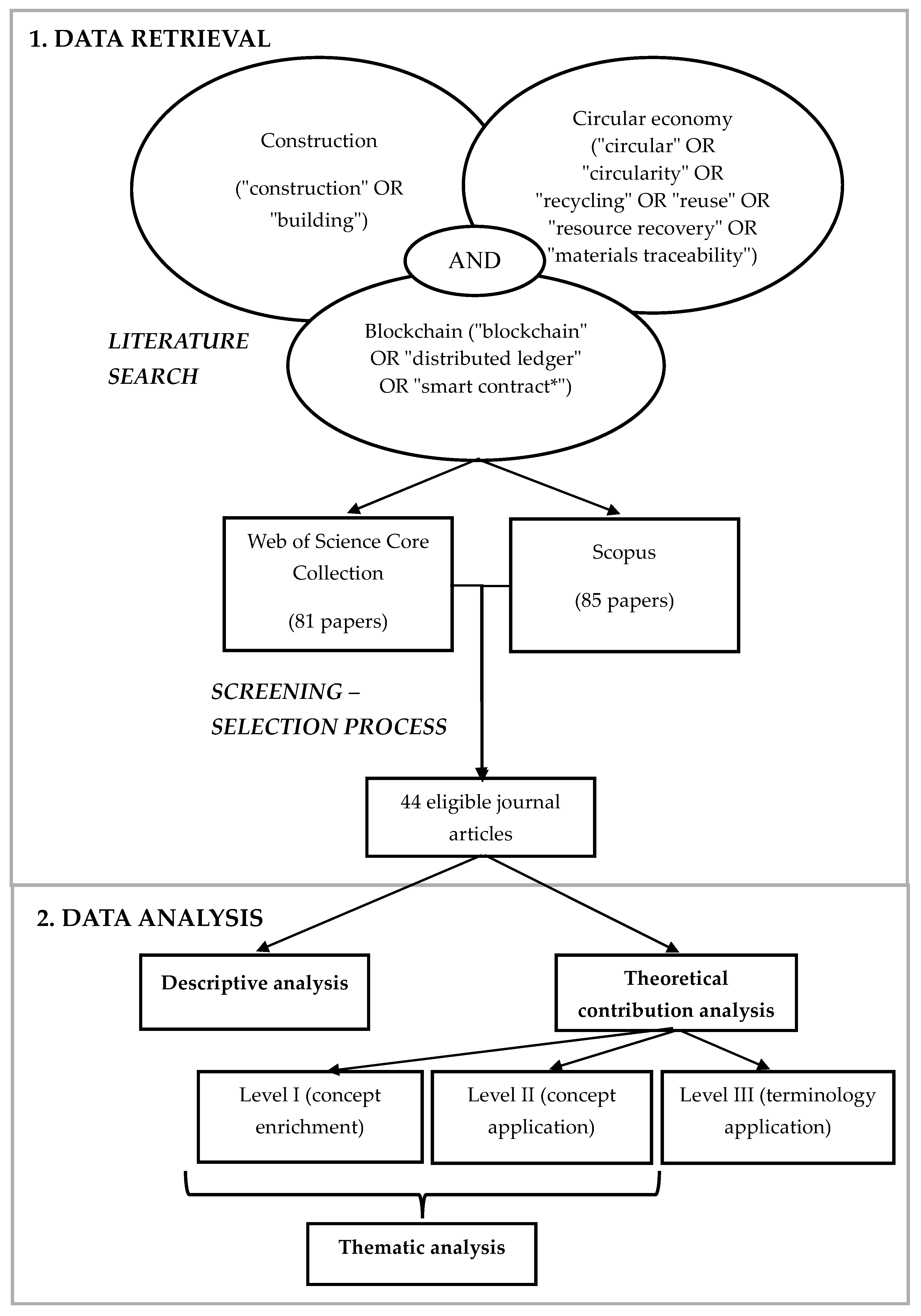
- Construction domain: (“construction” OR “building”);
- Circular economy (CE): (“circular” OR “circularity” OR “recycling” OR “reuse” OR “re-source recovery” OR “materials traceability”);
- Blockchain technology: (“blockchain” OR “distributed ledger” OR “smart contract*”).
2.2. Data Analysis
3. Results
3.1. Research Context
3.1.1. Publication Timeframe
3.1.2. Journal Source
3.1.3. Research Methods
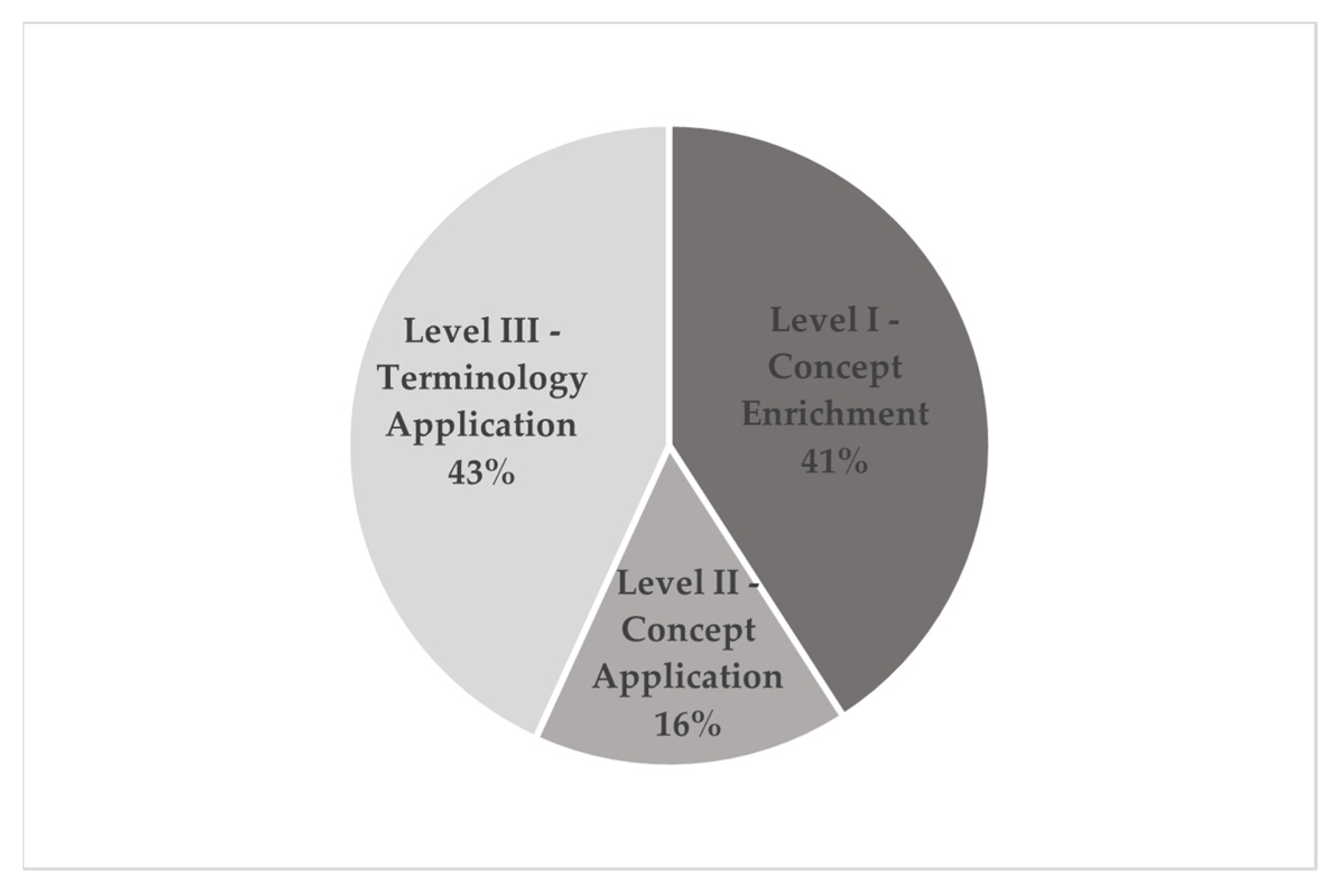
3.1.4. Theoretical Contributions
Level I (Concept Enrichment) Studies
Level II (Concept Application) Studies
Level III (Terminology Application) Studies
3.2. Blockchain Applications in Circular Construction
3.3. Blockchain Contribution in Building Trust and Reducing Information Asymmetry
3.3.1. Transparent and Immutable Data Records
3.3.2. Decentralized, Peer-Reviewed Data Validation
3.3.3. Smart Contract Automation
3.3.4. Selective Transparency and Data Control
3.3.5. Multi-Stakeholder Collaboration
3.3.6. Institutional Transparency
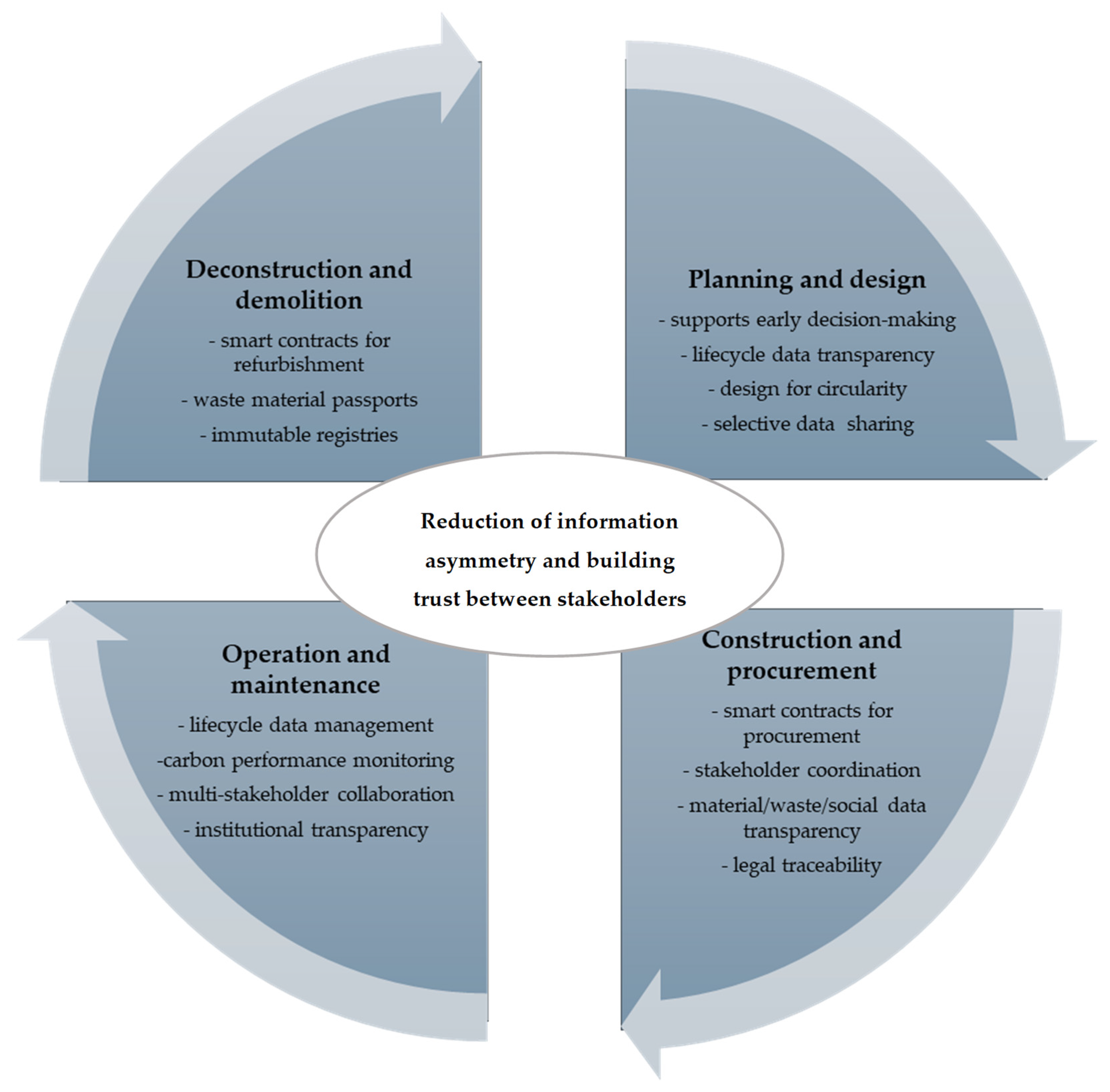
3.3.7. Conceptual Framework of Blockchain Reducing Information Asymmetry and Building Trust Across Project Lifecycle
3.4. Blockchain Implementation Challenges
3.4.1. Technical Challenges
3.4.2. Organizational Challenges
3.4.3. Legal Challenges
4. Discussion
4.1. Current Research Gaps
4.2. Future Research
5. Conclusions and Future Directions
Author Contributions
Funding
Institutional Review Board Statement
Informed Consent Statement
Data Availability Statement
Conflicts of Interest
References
- Çetin, S.; de Wolf, C.; Bocken, N.M.P. Circular digital built environment: An emerging framework. Sustainability 2021, 13, 6348. [Google Scholar] [CrossRef] [Scilit]
- Liu, Z.; Wu, T.; Wang, F.; Osmani, M.; Demian, P. Blockchain enhanced construction waste information management: A conceptual framework. Sustainability 2022, 14, 12145. [Google Scholar] [CrossRef] [Scilit]
- Çetin, S. Towards a Circular Building Industry Through Digitalisation. Doctoral Dissertation, Delft University of Technology, Delft, The Netherlands, 2023. [Google Scholar]
- Mankata, L.M.; Antwi-Afari, P.; Ng, S.T. A blockchain-based supply chain framework for advancing circular economy in the construction industry. J. Clean. Prod. 2025, 519, 145966. [Google Scholar] [CrossRef] [Scilit]
- Jäger, C. The Principal-Agent Theory Within the Context of Economic Sciences; Herstellung und Verlag, Books on Demand GmbH: Norderstedt, Germany, 2008. [Google Scholar]
- Ivić, I.; Cerić, A. Mitigation measures for information asymmetry between participants in construction projects: The impact of trust. Sustainability 2024, 16, 6808. [Google Scholar] [CrossRef] [Scilit]
- Cerić, A. Trust in Construction Projects; Routledge: Oxon, UK, 2016. [Google Scholar]
- Ling, F.Y.Y.; Ning, Y.; Ke, Y.; Kumaraswamy, M.M. Modeling relational transaction and relationship quality among team members in public projects in Hong Kong. Autom. Constr. 2013, 36, 16–24. [Google Scholar] [CrossRef] [Scilit]
- Zheng, X.; Zhang, S.; Wang, C. Trust repair after opportunistic behaviors in Chinese construction projects. Sustainability 2018, 10, 2339. [Google Scholar] [CrossRef] [Scilit]
- Wong, W.K. A Trust Inventory for Use in the Construction Industry. Master’s Thesis, City University of Hong Kong, Hong Kong, China, 2007. [Google Scholar]
- Cerić, A.; Legac, G.; Ivić, I. Dynamics of trust in construction projects. In Proceedings of the 16th Organization, Technology and Management International Conference (OTMC) & 2nd IPMA Global Project Profession Forum, Šibenik, Croatia, 25–28 September 2024. [Google Scholar]
- Xu, J. In the shadow of a negative past: Repairing and developing trust in construction projects. Proc. Inst. Civ. Eng. Manag. Procure. Law 2020, 173, 5–13. [Google Scholar] [CrossRef] [Scilit]
- Zheng, X.; Song, X.; Zhang, S.; Gao, Y. Identification of trust-repair strategies and their effectiveness in the Chinese construction industry. J. Manag. Eng. 2017, 33, 04017032. [Google Scholar] [CrossRef] [Scilit]
- Heiskanen, A. The technology of trust: How the Internet of Things and blockchain could usher in a new era of construction productivity. Constr. Res. Innov. 2017, 8, 66–70. [Google Scholar] [CrossRef] [Scilit]
- Cerić, A. Reducing information asymmetry and building trust in projects using blockchain technology. Građevinar 2021, 73, 967–978. [Google Scholar] [CrossRef] [Scilit]
- Bucher, D.F.; Hunhevicz, J.J.; Byers, B.S.; Honic, M.; de Wolf, C.; Hall, D.M. Decentralized data networks for lifecycle management in the built environment. J. Inf. Technol. Constr. 2025, 30, 034. [Google Scholar] [CrossRef] [Scilit]
- Elghaish, F.; Hosseini, M.R.; Kocatürk, T.; Arashpour, M.; Bararzadeh Ledari, M. Digitalised circular construction supply chain: An integrated BIM–blockchain solution. Autom. Constr. 2023, 148, 104746. [Google Scholar] [CrossRef] [Scilit]
- Wilson, S.; Adu-Duodu, K.; Li, Y.; Sham, R.W.H.; Almubarak, M.; Wang, Y.; Solaiman, E.; Perera, C.; Ranjan, R.; Rana, O.F. Blockchain-enabled provenance tracking for sustainable material reuse in construction supply chains. Future Internet 2024, 16, 135. [Google Scholar] [CrossRef] [Scilit]
- Zhang, R.; Zhang, Y.; Sun, G.; Wei, H. Low-Carbon and Recycled Mineral Composite Materials for Sustainable Infrastructure: A Comprehensive Review. Sustainability 2025, 17, 7908. [Google Scholar] [CrossRef] [Scilit]
- Ivić, I.; Cerić, A. Risks Caused by Information Asymmetry in Construction Projects: A Systematic Literature Review. Sustainability 2023, 15, 9979. [Google Scholar] [CrossRef] [Scilit]
- Littau, P.; Jujagiri, N.J.; Gerald, A. 25 Years of Stakeholder Theory in Project Management Literature (1984–2009). Proj. Manag. J. 2010, 41, 17–29. [Google Scholar] [CrossRef] [Scilit]
- Cerić, A.; Vukomanović, M.; Ivić, I.; Kolarić, S. Trust in megaprojects: A comprehensive literature review of research trends. Int. J. Proj. Manag. 2021, 39, 325–338. [Google Scholar] [CrossRef] [Scilit]
- Knott, E.; Rao, A.H.; Summers, K.; Teeger, C. Interviews in the social sciences. Nat. Rev. Methods Primers 2022, 2, 73. [Google Scholar] [CrossRef] [Scilit]
- Teisserenc, B.; Sepasgozar, S.M.E. Adoption of blockchain technology through digital twins in the construction industry 4.0: A PESTELS approach. Buildings 2021, 11, 670. [Google Scholar] [CrossRef] [Scilit]
- Teisserenc, B.; Sepasgozar, S.M.E. Project data categorization, adoption factors, and non-functional requirements for blockchain based digital twins in the construction industry 4.0. Buildings 2021, 11, 626. [Google Scholar] [CrossRef] [Scilit]
- Voorter, J.; Koolen, C. The traceability of construction and demolition waste in Flanders via blockchain technology: A match made in heaven? J. Eur. Environ. Plan. Law 2021, 18, 347–369. [Google Scholar] [CrossRef] [Scilit]
- Choudhuri, B.; Srivastava, P.R.; Mangla, S.K.; Kazancoglu, Y. Enterprise architecture as a responsible data driven urban digitization framework: Enabling circular cities in India. Ann. Oper. Res. 2023, 354, 05187–05188. [Google Scholar] [CrossRef] [Scilit]
- Movaffaghi, H.; Yitmen, I. Framework for dynamic circular economy in the building industry: Integration of blockchain technology and multi-criteria decision-making approach. Sustainability 2023, 15, 15914. [Google Scholar] [CrossRef] [Scilit]
- Sadeghi, M.; Mahmoudi, A.; Deng, X.; Luo, X. Prioritizing requirements for implementing blockchain technology in construction supply chain based on circular economy: Fuzzy ordinal priority approach. Int. J. Environ. Sci. Technol. 2023, 20, 4991–5012. [Google Scholar] [CrossRef] [Scilit]
- Wu, L.; Lu, W.W.; Peng, Z.; Webster, C.J. A blockchain non-fungible token-enabled ‘passport’ for construction waste material cross-jurisdictional trading. Autom. Constr. 2023, 149, 104783. [Google Scholar] [CrossRef] [Scilit]
- Herrador, M.; de Jong, W.; Nasu, K.; Granrath, L. RE-HAK: A novel refurbish-to-host solution using AI-driven blockchain to advance circular economy and revitalize Japan’s akiyas. Buildings 2025, 15, 1883. [Google Scholar] [CrossRef] [Scilit]
- Herrador, M.; Margono, R.B.; Dewancker, B.J. AKI2ALL: Integrating AI and blockchain for circular repurposing of Japan’s akiyas—A framework and review. Buildings 2025, 15, 2629. [Google Scholar] [CrossRef] [Scilit]
- Rathnayake, B.; Gunathilake, L.; Edirisinghe, R.; Perera, S. EcoConstruct: A blockchain-based system for carbon trading in construction projects. Constr. Innov. 2025, 25, 213–234. [Google Scholar] [CrossRef] [Scilit]
- Santos, P.F.A.; Cervantes Puma, G.C.; Zaragoza-Benzal, A.; Byrne, A.; Karaca, F.; Ferrández, D.; Salles, A.; Bragança, L. Circular material usage strategies and principles in buildings: A review. Buildings 2024, 14, 281. [Google Scholar] [CrossRef] [Scilit]
- Zandee, D.; Zutshi, A.; Creed, D.A.; Nijhof, A.H.J. Aiming for bullseye: A novel gameplan for circular economy in the construction industry. Eng. Constr. Archit. Manag. 2024, 31, 593–617. [Google Scholar] [CrossRef] [Scilit]
- Lin, Y.; Wang, J.; Niu, D.; Nwetlawung, Z.E. Evaluating stakeholders’ decisions in a blockchain-based recycling construction waste project: A hybrid evolutionary game and system dynamics approach. Buildings 2024, 14, 2205. [Google Scholar] [CrossRef] [Scilit]
- Yuan, H.; Du, W.; Zuo, J.; Ma, X. Paving a traceable green pathway towards sustainable construction: A fuzzy ISM-DEMATEL analysis of blockchain technology adoption barriers in construction waste management. Ain Shams Eng. J. 2024, 15, 102627. [Google Scholar] [CrossRef] [Scilit]
- Talla, A.; McIlwaine, S.J. Industry 4.0 and the circular economy: Using design-stage digital technology to reduce construction waste. Smart Sustain. Built Environ. 2024, 13, 179–198. [Google Scholar] [CrossRef] [Scilit]
- Jayarathna, H.S.N.M.; Perera, B.A.K.S.; Atapattu, D.; Rodrigo, M.N.N. Circular economy and blockchain-integrated road map to improve construction waste management. Constr. Innov. 2025, 25, 23–49. [Google Scholar] [CrossRef] [Scilit]
- Xiao, J.; Ma, S.; Wang, S.; Huang, G.Q. Fine-grained digital twin sharing framework for smart construction through an incentive mechanism. Int. J. Prod. Econ. 2024, 276, 109382. [Google Scholar] [CrossRef] [Scilit]
- Lin, Y.; Wang, J.; Niu, D.; Tao, X. Blockchain-driven framework for construction waste recycling and reuse. J. Build. Eng. 2024, 89, 109355. [Google Scholar] [CrossRef] [Scilit]
- Flores Lara, J.C.; El-Fadel, M.; Khalfan, M.M.A. Integrating Industry 4.0 and circular economy in the UAE construction sector: A policy-aligned framework. Built Environ. Proj. Asset Manag. 2025, 15, 535–556. [Google Scholar] [CrossRef] [Scilit]
- Saradara, S.M.; Khalfan, M.M.A.; Jaya, S.V.; Swarnakar, V.; Rauf, A.; El-Fadel, M.E. Advancing building construction: A novel conceptual framework integrating circularity with modified lean project delivery systems. Dev. Built Environ. 2024, 20, 100531. [Google Scholar] [CrossRef] [Scilit]
- Abbas, Z.; Myeong, S. A comprehensive study of blockchain technology and its role in promoting sustainability and circularity across large-scale industry. Sustainability 2024, 16, 4232. [Google Scholar] [CrossRef] [Scilit]
- Arshad, M.O.; Haleem, A.; Nadeem, M. Understanding the energy retrofit strategies towards net zero energy building in sync with the SDGs: A review and bibliometric analysis. J. Build. Eng. 2025, 106, 112574. [Google Scholar] [CrossRef] [Scilit]
- Elghaish, F.; Matarneh, S.T.; Edwards, D.J.; Rahimian, F.P.; El-Gohary, H.O.; Ejohwomu, O.A. Applications of Industry 4.0 digital technologies towards a construction circular economy: Gap analysis and conceptual framework. Constr. Innov. 2022, 22, 647–670. [Google Scholar] [CrossRef] [Scilit]
- Shishehgarkhaneh, M.B.; Moehler, R.C.; Moradinia, S.F. Blockchain in the construction industry between 2016 and 2022: A review, bibliometric, and network analysis. Smart Cities 2023, 6, 819–845. [Google Scholar] [CrossRef] [Scilit]
- Banihashemi, S.; Meskin, S.; Sheikhkhoshkar, M.; Mohandes, S.R.; Hajirasouli, A.; LeNguyen, K. Circular economy in construction: The digital transformation perspective. Clean. Eng. Technol. 2024, 18, 100715. [Google Scholar] [CrossRef] [Scilit]
- Eze, E.C.; Sofolahan, O.; Ugulu, R.A.; Ameyaw Effah, E.E. Bolstering circular economy in construction through digitalisation. Constr. Innov. 2024, 25, 1774–1796. [Google Scholar] [CrossRef] [Scilit]
- KC, A.C.; Senaratne, S.; Perera, S.; Nanayakkara, S. Review of current digital technologies for material passports to enhance circularity towards net zero. Built Environ. Proj. Asset Manag. 2024, 15, 1055–1072. [Google Scholar] [CrossRef] [Scilit]
- Keles, C.; Cruz-Rios, F.; Hoque, S.T. Digital technologies and circular economy in the construction sector: A review of lifecycle applications, integrations, potential, and limitations. Buildings 2025, 15, 553. [Google Scholar] [CrossRef] [Scilit]
- Lai, K.E.; Rahiman, N.A.; Othman, N.; Ali, K.N.; Lim, Y.W.; Moayedi, F.; Dzahir, M.A.M. Quantification process of carbon emissions in the construction industry. Energy Build. 2023, 289, 113025. [Google Scholar] [CrossRef] [Scilit]
- Li, X.; Xu, J.; Su, Y. Research status and emerging trends in green building materials based on bibliometric network analysis. Buildings 2025, 15, 884. [Google Scholar] [CrossRef] [Scilit]
- Ma, W.; Yuan, H.; Hao, J. A bibliometric visual analysis of the system dynamics approach for construction and demolition waste management. Clean. Waste Syst. 2022, 1, 100004. [Google Scholar] [CrossRef] [Scilit]
- Markou, I.; Sinnott, D.; Thomas, K. Current methodologies of creating material passports: A systematic literature review. Case Stud. Constr. Mater. 2025, 22, e04267. [Google Scholar] [CrossRef] [Scilit]
- Rayhan, D.S.A.; Bhuiyan, I.U. Review of construction and demolition waste management tools and frameworks with the classification, causes, and impacts of the waste. Waste Dispos. Sustain. Energy 2024, 6, 95–121. [Google Scholar] [CrossRef] [Scilit]
- Rodrigo, M.N.N.; Omrany, H.; Chang, R.; Zuo, J. Leveraging digital technologies for circular economy in construction industry: A way forward. Smart Sustain. Built Environ. 2024, 13, 85–116. [Google Scholar] [CrossRef] [Scilit]
- Senaratne, S.; Rodrigo, M.N.N.; Almeida, L.M.M.C.E.; Perera, S.; Jin, X. Systematic review on stakeholder collaboration for a circular built environment: Current research trends, gaps and future directions. Resour. Conserv. Recycl. Adv. 2023, 19, 200169. [Google Scholar] [CrossRef] [Scilit]
- Sharma, N.; Kalbar, P.P.; Salman, M. Global review of circular economy and life cycle thinking in building demolition waste management: A way ahead for India. Build. Environ. 2022, 222, 109413. [Google Scholar] [CrossRef] [Scilit]
- Shishehgarkhaneh, M.B.; Keivani, A.; Moehler, R.C.; Jelodari, N.; Roshdi Laleh, S. Internet of things (IoT), building information modeling (BIM), and digital twin (DT) in construction industry: A review, bibliometric, and network analysis. Buildings 2022, 12, 1503. [Google Scholar] [CrossRef] [Scilit]
- Wu, Z.; Pei, T.; Bao, Z.; Ng, S.T.; Lu, G.; Chen, K. Utilizing intelligent technologies in construction and demolition waste management: From a systematic review to an implementation framework. Front. Eng. Manag. 2025, 12, 1–23. [Google Scholar] [CrossRef] [Scilit]



| Code | Description of Code |
|---|---|
| Context and key findings | The type of study and the main conclusion or contribution of the article |
| Blockchain application in circular construction | How blockchain is used (or proposed to be used) in circular construction |
| Technological mechanisms used | The technical elements of blockchain mentioned or analyzed (for example, smart contracts, tokenization, etc.) |
| Trust and information asymmetry | How blockchain helps to build trust and reduce information asymmetry |
| Implementation challenges | The barriers and limitations to using blockchain in circular construction |
| Research gaps and future directions | The identification of knowledge gaps and the formulation of future research directions |
| Application Area | Technological Mechanisms | Circular Economy Principles Supported | Exemplar Sources |
|---|---|---|---|
| 1. Material and waste passports | Distributed ledger; decentralized data networks (IPFS off-chain storage); NFTs | Design for disassembly, reuse at high value, transparency in secondary markets | [1,16,18,30] |
| 2. Construction waste reuse and recycling | Smart contracts; public/private/consortium networks; tokenization | Reuse and recycling; resource optimization; market efficiency | [2,26,36,37,41] |
| 3. Blockchain integration with other technologies | Smart contracts; reusable BIM families; municipal permissioned networks; DT sharing frameworks | Design for adaptability, lifetime extension, and knowledge reuse across projects | [17,24,25,28,40] |
| 4. Refurbishment, reuse, and lifecycle optimization | Smart contracts; municipal permissioned networks | Extending asset life; embodied carbon preservation; adaptive reuse | [31,32] |
| 5. Carbon emissions tracking | Smart contracts; NFTs; incentives | Regeneration; responsible sourcing; measurable circular performance | [33,45] |
| 6. Circular supply chain coordination | Permissioned or consortium chains; public chains/NFTs | Keeping products/materials in use; transparency in secondary markets | [4,46,47] |
| 7. Legal traceability | Consortium/permissioned networks; supervisory dashboards; standardized registries; smart contracts | Standardized traceability; secure data sharing; regulatory accountability | [2,16,26,36,41,44] |
| 8. Ethical/social transparency | Smart contracts; tokenization; immutable ethical/social records; transparent consumer interfaces | Fair work; social responsibility | [29] |
| Blockchain Contribution | Examples | Effect on Trust/Information Asymmetry |
|---|---|---|
| 1. Transparent and immutable data records | Distributed ledger, consensus, cryptographic hashing | Removes data manipulation and hidden information |
| 2. Decentralized, peer-reviewed data validation | Material and waste passports | Enhances trust in material origins and quality |
| 3. Smart contract automation | Rule-based, self-executing contracts | Reduces human bias; ensures fair, transparent transactions |
| 4. Selective transparency and data control | Encryption, decentralized identifiers (DIDs), zero-knowledge proofs (ZKPs), permissioned networks | Builds trust through privacy and secure sharing |
| 5. Multi-stakeholder collaboration | Shared ledgers, open interfaces, interoperable BIM/IoT/DT systems | Reduces information asymmetry and improves coordination |
| 6. Institutional transparency | Decentralized supervision and open verification | Builds public trust in governance and circular policy enforcement |
Disclaimer/Publisher’s Note: The statements, opinions and data contained in all publications are solely those of the individual author(s) and contributor(s) and not of MDPI and/or the editor(s). MDPI and/or the editor(s) disclaim responsibility for any injury to people or property resulting from any ideas, methods, instructions or products referred to in the content. |
© 2026 by the authors. Licensee MDPI, Basel, Switzerland. This article is an open access article distributed under the terms and conditions of the Creative Commons Attribution (CC BY) license.
Share and Cite
Cerić, A.; Ivić Jazvec, I. The Role of Blockchain Technology in Reducing Information Asymmetry and Enhancing Trust in Circular Construction. Sustainability 2026, 18, 2328. https://doi.org/10.3390/su18052328
Cerić A, Ivić Jazvec I. The Role of Blockchain Technology in Reducing Information Asymmetry and Enhancing Trust in Circular Construction. Sustainability. 2026; 18(5):2328. https://doi.org/10.3390/su18052328
Chicago/Turabian StyleCerić, Anita, and Ivona Ivić Jazvec. 2026. "The Role of Blockchain Technology in Reducing Information Asymmetry and Enhancing Trust in Circular Construction" Sustainability 18, no. 5: 2328. https://doi.org/10.3390/su18052328
APA StyleCerić, A., & Ivić Jazvec, I. (2026). The Role of Blockchain Technology in Reducing Information Asymmetry and Enhancing Trust in Circular Construction. Sustainability, 18(5), 2328. https://doi.org/10.3390/su18052328