1. Introduction
Corrosion inhibitors are substances that are added in small amounts (typically in the ppm range) to corrosive environments to reduce the rate of metal corrosion [
1,
2]. Among various types, organic compounds containing functional groups capable of adsorbing onto metal surfaces have attracted significant attention [
3]. These compounds often include atoms with high electron density, such as oxygen, sulphur, and nitrogen, which can participate in adsorption by donating electrons to the vacant orbitals of metal atoms [
4]. The efficiency of an inhibitor largely depends on its adsorption strength and stability on the metal surface. In aqueous environments, the adsorption process typically involves the replacement of water molecules on the metal surface with inhibitor molecules. The effectiveness of this replacement is governed by the electrostatic interactions between the inhibitor and the metal surface [
5,
6].
In light of increasing environmental concerns and the need to avoid toxic substances, the use of green corrosion inhibitors has become a focus of research. Green corrosion inhibitors generally refer to inhibitors extracted from various parts of plants (leaves, roots, branches, stems, and fruits) [
7,
8]. These natural compounds can absorb onto metal surfaces via heteroatoms or π-electron interactions and inhibit corrosion through various mechanisms [
9]. The heteroatoms in these inhibitors are usually found within their polar functional groups: –OH, –COOH, –NH
2, –NO
2, –CN, –OCH
3, and –COOC
2H
5 [
10,
11].
The uncontrolled and unregulated use of corrosion inhibitors in aggressive and highly corrosive environments can significantly compromise the durability and long-term effectiveness of protective systems. Over time, the protective action of freely dissolved inhibitors tends to diminish due to various factors such as dilution, chemical degradation, or leaching, leading to a progressive decline in corrosion resistance. As a result, maintaining the desired level of protection requires repeated additions or continuous dosing, which not only increases the operational complexity but also adds substantial costs, especially in large-scale or long-term applications [
12,
13].
To address these limitations, researchers have explored advanced strategies for delivering corrosion inhibitors in a more controlled, efficient, and sustainable manner. One of the most promising approaches is the incorporation of corrosion inhibitors into nanocarriers [
14,
15]. In this method, inhibitor molecules are adsorbed or encapsulated onto the surface of specially engineered nanoparticles serving as delivery vehicles. These nanocarriers release the inhibitors in a regulated fashion through specific mechanisms such as pH responsiveness, ion exchange, redox triggers, or diffusion, only when and where needed in the corrosive environment [
16,
17]. This targeted and stimulus-responsive release not only enhances the efficiency of inhibitor utilisation, but also prolongs the protective effect, reduces environmental impact, and lowers the overall cost of corrosion protection [
18].
Kahkesh and Zargar [
19] developed a novel green smart corrosion inhibition system using a nanocarrier composed of soy protein isolate (SPI) and chitosan (CS), designed to provide long-term protection for mild steel in 3.5 wt% NaCl solution. In their approach, the nanocarrier was loaded with an aqueous extract of Allium jesdianum (AEAJ), a plant-based inhibitor, forming the hybrid material SPI/CS@AEAJ. Characterisation via FTIR and SEM confirmed successful encapsulation of the extract. Electrochemical studies, including EIS and polarisation tests, revealed that the system exhibited pH-responsive release behaviour and achieved an impressive corrosion inhibition efficiency of 93.57%. Furthermore, incorporation of Zn
2+ ions enhanced the protective performance by promoting the formation of a stable chelate-based surface film. After 24 h of immersion, the corrosion resistance increased dramatically from 1172 Ω·cm
2 to 18,255 Ω·cm
2 in the optimised system. This work highlights the potential of biopolymer-based smart nanocarriers in delivering plant-derived inhibitors for sustainable and efficient corrosion protection.
Jasim et al. [
20] synthesised sulphur nanoparticles (SNPs) using a green approach involving sodium thiosulfate and Alhagi plant extract, with the successful formation of nanoparticles indicated by a colour change from yellow to brown. The resulting SNPs, with an average size of 82.39 nm (confirmed via AFM analysis), were applied as corrosion inhibitors for aluminium alloys in acidic media at various temperatures. Electrochemical testing revealed that the inhibition efficiency was highest at lower temperatures, indicating that the SNPs act as effective inhibitors under such conditions. Thermodynamic analyses showed higher activation parameters in the presence of SNPs compared to the uninhibited system. Moreover, the negative values of activation enthalpy (∆H*) in both cases confirmed the exothermic nature of the corrosion process. These results demonstrate the potential of plant-mediated sulphur nanoparticles as temperature-sensitive and eco-friendly inhibitors for aluminium corrosion in acidic environments.
Naghizade et al. [
21] explored the corrosion inhibition performance of Viola plant extract both in bulk and nanoscale forms on mild steel immersed in 0.5 M phosphoric acid and 1 M hydrochloric acid solutions. Various electrochemical techniques, including potentiodynamic polarisation, electrochemical impedance spectroscopy (EIS), and optical microscopy, were employed to evaluate the protective behaviour of the extract. The results demonstrated that both forms of the Viola extract effectively inhibited corrosion across different concentrations, with the nanoscale extract generally showing superior performance. The effect of temperature was also investigated, and thermodynamic parameters such as activation energy and enthalpy were calculated to understand the nature of the inhibition process. Adsorption behaviour followed the Langmuir isotherm, revealing a mixed adsorption mechanism: chemisorption dominated for the nanoscale extract in HCl, whereas physisorption was more prominent in other conditions (bulk in HCl and both forms in H
3PO
4). SEM and optical microscopy confirmed surface protection, with smoother morphologies observed in the presence of the extract, especially in its nano-form.
The present study aims to develop a green and intelligent corrosion inhibition system based on zinc oxide nanoparticles synthesised using
Descurainia sophia extract, which acts both as a precipitating and capping agent for nanoparticle formation and as a source of corrosion-inhibiting phytochemicals. It was selected in this study for several specific reasons. First, this plant is known to be rich in bioactive phytochemicals, including flavonoids, phenolic acids, glucosinolates, and polysaccharides, all of which contain abundant oxygen-rich functional groups (–OH, –COOH, –C=O). Such groups are well-documented to facilitate strong adsorption onto metal surfaces, a key requirement for effective corrosion inhibition [
22]. Second, the reducing and capping abilities of these phytochemicals make it particularly suitable for the green synthesis of metal oxide nanoparticles such as ZnO, without the need for hazardous chemical reagents. Third, the plant is locally abundant, low-cost, and has been traditionally used in herbal medicine, but its application as a corrosion inhibitor, especially in a nanocarrier system, has remained largely unexplored. Therefore, its selection offers both scientific novelty and practical advantages over more commonly studied plants (e.g.,
Urtica dioica,
Allium jesdianum, or Viola extract) in the context of smart corrosion inhibition.
Descurainia sophia extract was selected due to its high content of flavonoids (quercetin, kaempferol), phenolic acids (gallic, caffeic), glucosinolates, and polysaccharides. Flavonoids and phenolic acids act as reducing and capping agents for ZnO synthesis, while also providing oxygen-rich functional groups for steel surface adsorption. Glucosinolates decompose to isothiocyanates containing sulphur atoms, which enhance chemisorption. This unique combination of oxygen- and sulfur-donor ligands is rarely found in a single plant extract, making
Descurainia sophia particularly effective for dual-function applications.
In addition, zinc oxide (ZnO) nanoparticles offer several distinct advantages for nanocarrier systems. Compared to carbon-based carriers such as graphene oxide or carbon nanotubes, ZnO can be synthesised through plant-mediated routes without the need for toxic reducing agents or harsh chemical functionalisation [
23]. In contrast to clay nanotubes (e.g., halloysite) or polymer-based carriers (e.g., chitosan, soy protein isolate) that mainly act as physical containers, ZnO nanoparticles contribute actively to the corrosion protection mechanism; the released Zn
2+ ions can form zinc hydroxide or zinc complexes on the cathodic sites of steel, providing synergistic inhibition [
24]. Furthermore, ZnO is cost-effective, biocompatible, and thermally stable compared to many organic nanocarriers that may degrade under harsh conditions. Therefore, it was selected in this study as a smart, pH-responsive, and multifunctional nanocarrier platform. The novelty of this work lies in the dual functionality of the plant extract, which serves both as a natural precipitating/capping agent for ZnO nanoparticle synthesis and as a source of corrosion-inhibiting phytochemicals. This approach offers a potentially eco-friendly and efficient strategy to enhance the durability of steel structures while minimising the need for repeated dosing.
2. Materials and Methods
2.1. Materials
All chemicals used in this study were of analytical grade and used without further purification. Zinc nitrate hexahydrate (Zn(NO3)2·6H2O, ≥98%) was used as the zinc precursor. Hydrochloric acid (HCl, 37%) served as the corrosion medium. Fresh Descurainia sophia seeds were used for extract preparation, and deionized water was used throughout.
2.2. Preparation of Plant Extract
To prepare the aqueous extract, 20 g of Descurainia sophia seeds were rinsed and soaked in 200 mL of deionized water and gently heated at 60 °C for 1 h under continuous stirring. The mixture was then cooled to room temperature and filtered using Whatman No.1 filter paper (Sigma-Aldrich, St. Louis, MO, USA) to obtain a clear yellow extract, which was stored at 4 °C and used within 48 h.
2.3. Green Synthesis of ZnO Nanoparticles
The ZnO nanoparticles were synthesised via a green precipitation method using the extract. Briefly, 0.1 M of Zn(NO3)2·6H2O solution was prepared in 100 mL of deionized water and heated to 70 °C. Then, 50 mL of the plant extract was added dropwise under continuous stirring. The mixture was maintained at 70 °C for 2 h, during which a white precipitate gradually formed. The resulting suspension was centrifuged at 5000 rpm for 10 min, and the precipitate was washed three times with deionized water and ethanol. The purified precipitate was dried at 80 °C overnight and then calcined at 250 °C for 2 h in a muffle furnace to obtain crystalline ZnO nanoparticles.
2.4. Characterisation of Nanoparticles
The phase structure and crystallinity of the synthesised ZnO nanoparticles were analysed using X-ray diffraction (XRD) with a Bruker D8 Advance diffractometer (Bruker AXS GmbH, Karlsruhe, Germany), operated at 40 kV and 40 mA using Cu Kα radiation (λ = 1.5406 Å). The surface functional groups and plant-derived compounds present were identified by Fourier transform infrared spectroscopy (FTIR) using a Thermo Nicolet Nexus 670 spectrometer (Thermo Fisher Scientific, Madison, WI, USA) in the range of 400–4000 cm−1. The surface morphology and particle size distribution were studied using field emission scanning electron microscopy (FESEM) with a MIRA3 TESCAN microscope equipped with energy-dispersive X-ray spectroscopy (EDS) for elemental analysis (TESCAN ORSAY HOLDING, Brno, Czech Republic). High-resolution transmission electron microscopy (HRTEM) analysis was carried out to investigate the internal structure, crystallinity, and lattice fringes. The HRTEM images were acquired using a JEOL JEM-2100 instrument operating at an accelerating voltage of 200 kV (JEOL Ltd., Tokyo, Japan). A small amount of the ZnO nanopowder was ultrasonically dispersed in ethanol for 15 min, and a drop of the resulting suspension was placed onto a carbon-coated copper grid, followed by air drying before imaging.
2.5. Preparation for Corrosion Test Solutions
Corrosion experiments were performed on mild steel (St37) specimens with dimensions of 2 cm × 2 cm × 0.2 cm. The surface of the samples was polished using 400–1200 grit emery papers, rinsed with distilled water and ethanol, and dried. The electrolyte was a 1 M HCl solution with and without the addition of ZnO nanocarriers containing Descurainia sophia extract. The inhibitor-containing solution was prepared by dispersing 200 mg/L of the nanocarrier powder into the acidic medium with ultrasonication for 15 min.
2.6. Electrochemical Measurements
Electrochemical tests were carried out using a Metrohm Autolab PGSTAT302N potentiostat/galvanostat (Metrohm Autolab B.V., Utrecht, The Netherlands) controlled by NOVA software v2.1. A conventional three-electrode system was used, consisting of the prepared mild steel sample as the working electrode, a platinum wire as the counter electrode, and a saturated Ag/AgCl electrode as the reference. Open circuit potential (OCP) was monitored for 30 min prior to each electrochemical test to ensure stabilisation. Electrochemical impedance spectroscopy (EIS) was performed in the frequency range of 100 kHz to 10 mHz with an amplitude of 10 mV around the OCP. Potentiodynamic polarisation curves were recorded in the potential range of –250 mV to +250 mV relative to the OCP at a scan rate of 1 mV/s.
All experiments were carried out at room temperature (25 ± 1 °C), and each test was repeated at least three times to ensure reproducibility.
3. Results and Discussion
3.1. FESEM and HRTEM Analyses
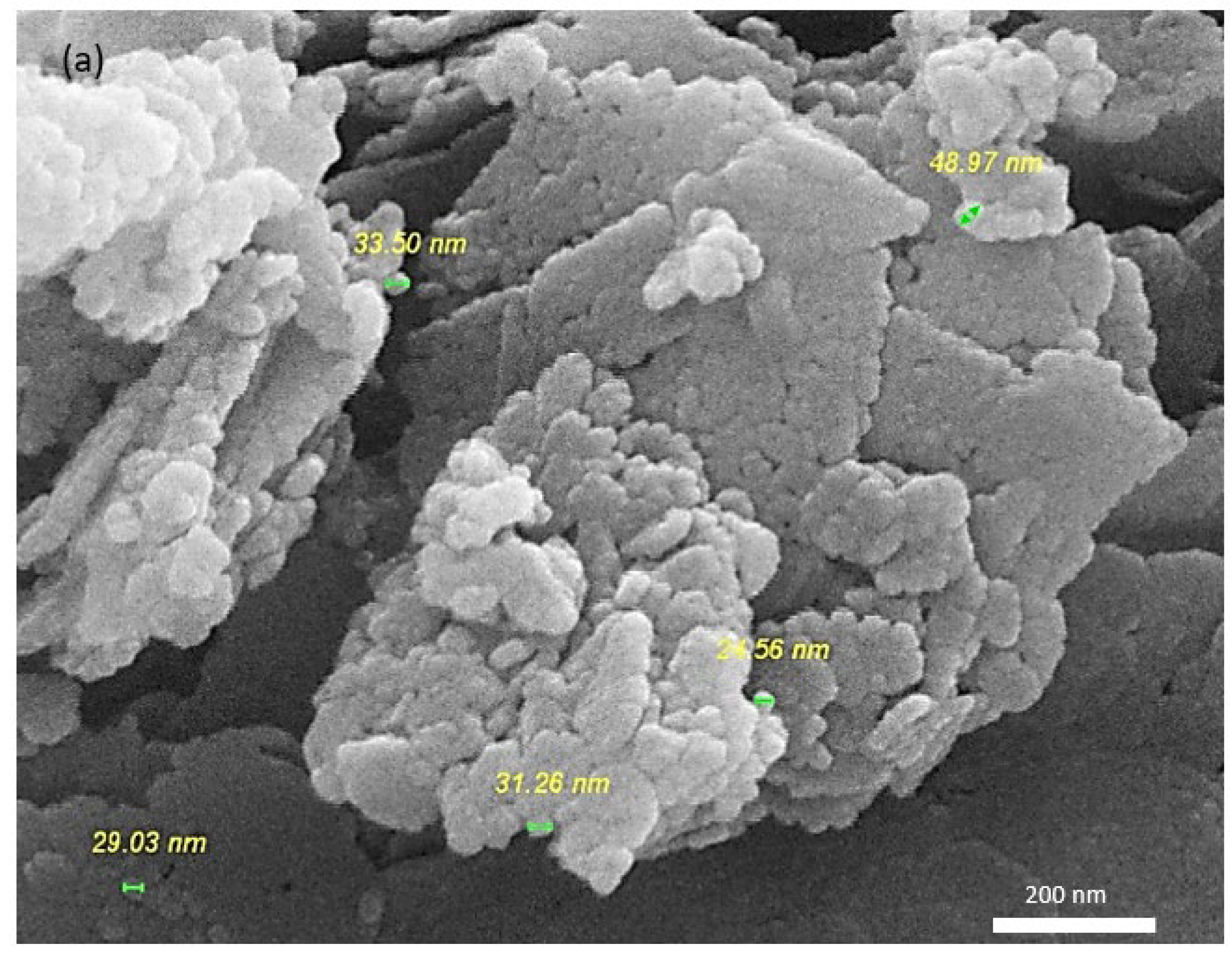
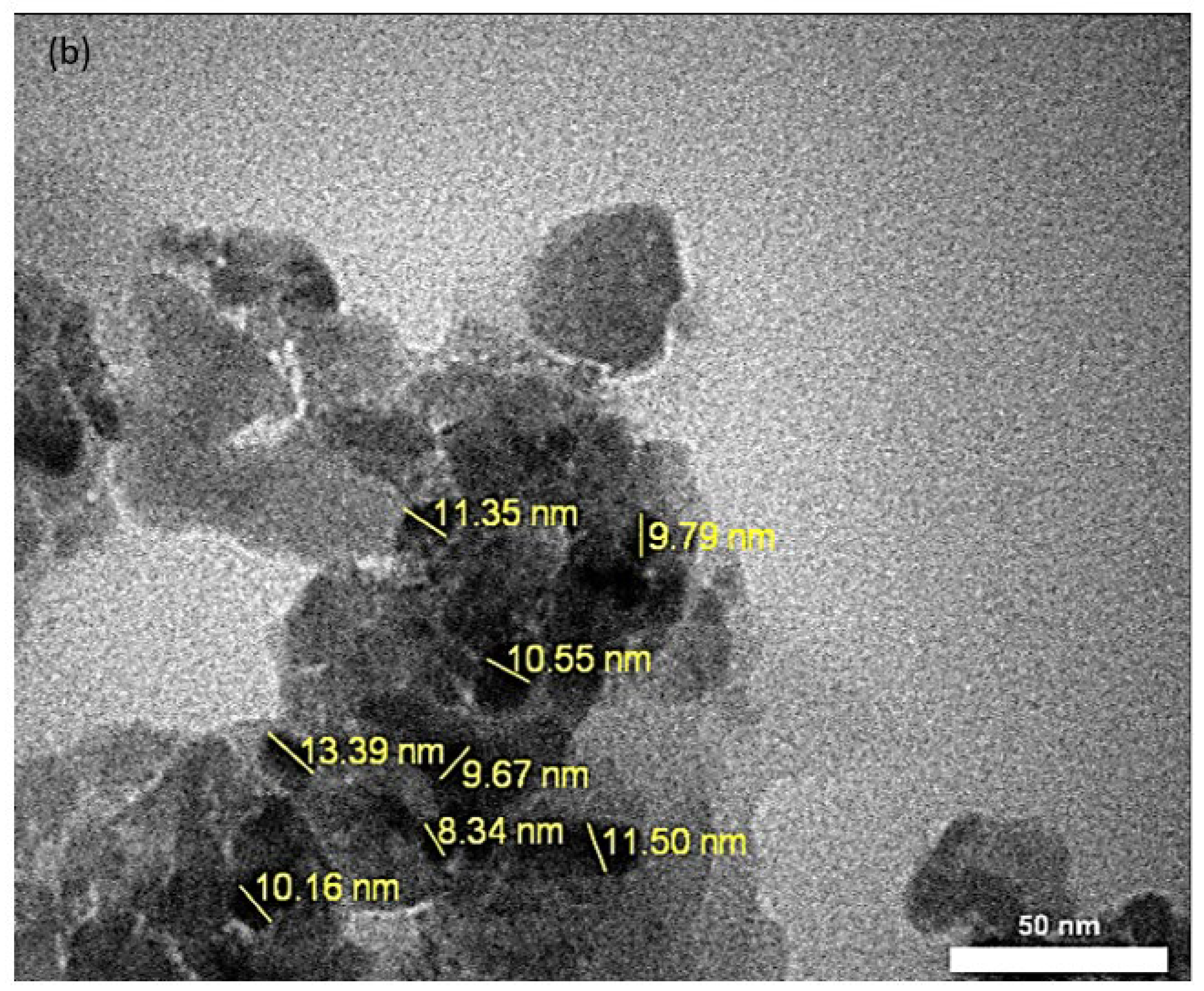
The surface morphology and particle size distribution of the green-synthesised ZnO nanoparticles were investigated using FESEM and HRTEM analyses. The obtained micrographs, shown in
Figure 1, revealed that the ZnO particles exhibit a quasi-spherical morphology with a relatively uniform distribution and slight agglomeration, which is commonly observed in nanoparticles synthesised via plant-mediated methods due to the presence of phytochemicals acting as both capping and stabilising agents [
23].
From the HRTEM micrograph, the individual particles appeared to be in the nanometre range, forming clusters or aggregates likely due to van der Waals interactions and the drying process during sample preparation. Despite the aggregation, the primary particle size was visually estimated to fall within the range of approximately 20 to 50 nm, which is in good agreement with the crystallite size calculated from the XRD data.
The smooth and homogeneous surface texture of the nanoparticles indicates effective capping by the biomolecules present in the Descurainia sophia extract, which likely contributed to controlled nucleation and growth during the synthesis process. These surface-bound organic compounds may also play a role in the subsequent corrosion inhibition behaviour, acting synergistically with the ZnO matrix.
No significant morphological defects or secondary phases were observed in the FESEM images, further confirming the successful formation of nanostructured ZnO with desirable size and morphology for use as a nanocarrier in corrosion inhibition applications.
3.2. XRD and FTIR Analyses
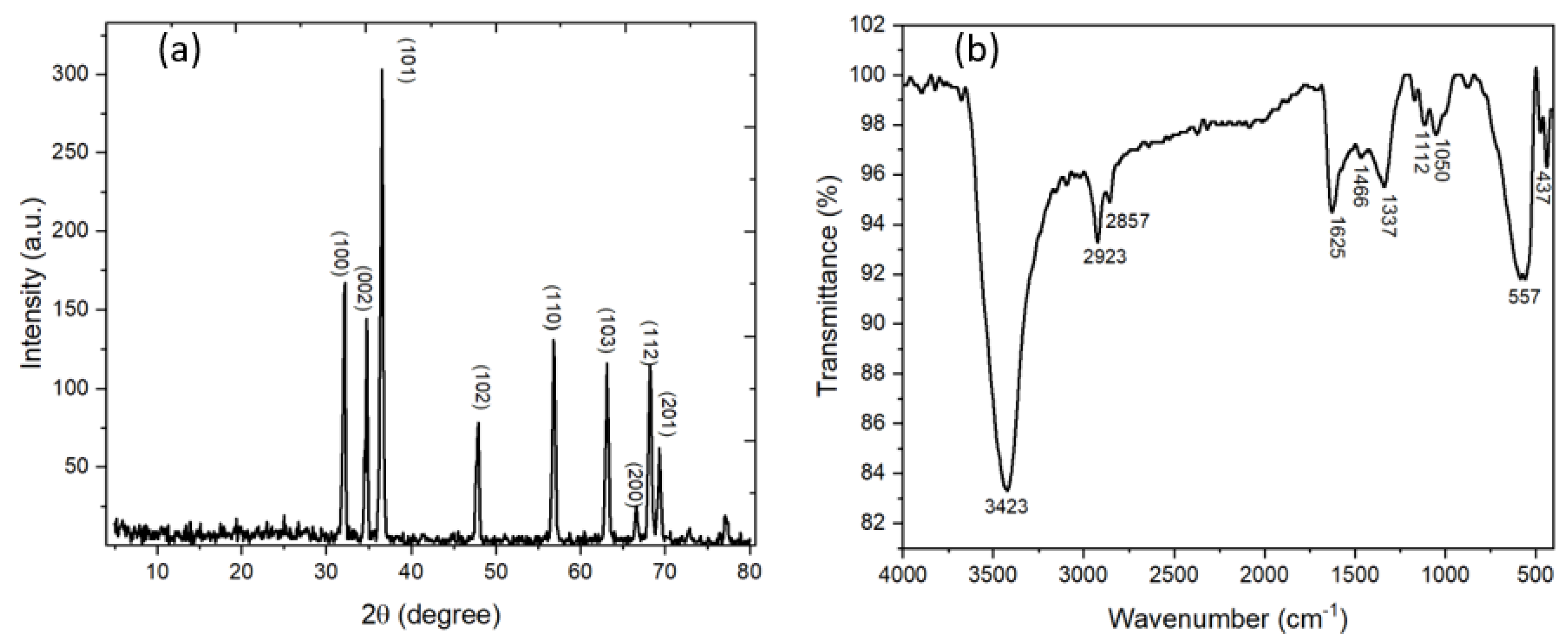
From
Figure 2a, the crystalline structure and phase purity of the green-synthesised ZnO nanoparticles were examined using X-ray diffraction. The XRD pattern revealed distinct diffraction peaks located at 2θ values of approximately 31.77°, 34.42°, 36.25°, 47.53°, 56.59°, 62.84°, 66.38°, 67.96°, and 69.09°, corresponding to the (100), (002), (101), (102), (110), (103), (200), (112), and (201) crystal planes, respectively. These diffraction lines are consistent with the hexagonal wurtzite structure of ZnO and are in good agreement with the standard JCPDS card No. 36-1451. The absence of any additional or impurity peaks indicates the successful formation of phase-pure ZnO without the presence of secondary phases or unreacted organic residues from the plant extract.
The sharpness and intensity of the diffraction peaks suggest a high degree of crystallinity in the synthesised nanoparticles. The complete conversion of the precursor into ZnO during the calcination process at 250 °C is confirmed by the lack of detectable peaks related to intermediate species such as Zn(OH)2 or metallic Zn.
To estimate the average crystallite size of the ZnO nanoparticles, the Debye–Scherrer equation was applied to the most intense peak, which appeared at 2θ ≈ 36.25°, corresponding to the (101) plane [
25]. The crystallite size (D) was calculated using the equation D = Kλ/(β cosθ), where K is the shape factor (0.9), λ is the wavelength of Cu Kα radiation (1.5406 Å), β is the full width at half maximum (FWHM) in radians, and θ is the Bragg angle. Based on this calculation, the average crystallite size of the synthesised ZnO nanoparticles was found to be approximately 21.4 nm, confirming the nanocrystalline nature of the material and demonstrating the effectiveness of the green synthesis route in controlling particle growth at the nanoscale.
FTIR spectroscopy was employed to identify the functional groups associated with the nanoparticles and to confirm the presence of phytochemical compounds derived from the
Descurainia sophia extract (
Figure 2b). The spectrum displayed several characteristic absorption bands. A broad band observed around 3423 cm
−1 corresponds to the O–H stretching vibrations of hydroxyl groups, which may arise from phenolic compounds or residual moisture adsorbed on the surface of the nanoparticles [
26]. The peaks at approximately 2923 cm
−1 and 2857 cm
−1 are attributed to C–H stretching vibrations, and the peaks at 1112 cm
−1 and 1050 cm
−1 are related to C–H bending vibrations of aliphatic chains, indicating the presence of organic residues from the plant extract [
27].
A sharp band observed near 1625 cm
−1 can be assigned to the C=O stretching vibration of amide or carboxylic groups, suggesting the involvement of proteins or carboxyl-containing phytochemicals in the capping and stabilisation of the ZnO nanoparticles [
27]. Additional bands detected at 1112 cm
−1 and 1050 cm
−1 correspond to C–N and C–O stretching vibrations, respectively, further confirming the interaction of biomolecules with the nanoparticle surface [
28].
Importantly, strong absorption bands appeared around 557 cm
−1 and 437 cm
−1, which are characteristic of Zn–O stretching vibrations, confirming the formation of ZnO nanoparticles [
29,
30]. The presence of both Zn–O bonds and plant-derived functional groups supports the dual role of the extract as a precipitating and capping agent and a surface modifier during the green synthesis process.
These results not only confirm the successful formation of ZnO but also provide evidence for the surface adsorption of organic molecules, which may play a key role in the corrosion inhibition mechanism through slow and controlled release in acidic environments.
3.3. Open Circuit Potential (OCP) Measurements
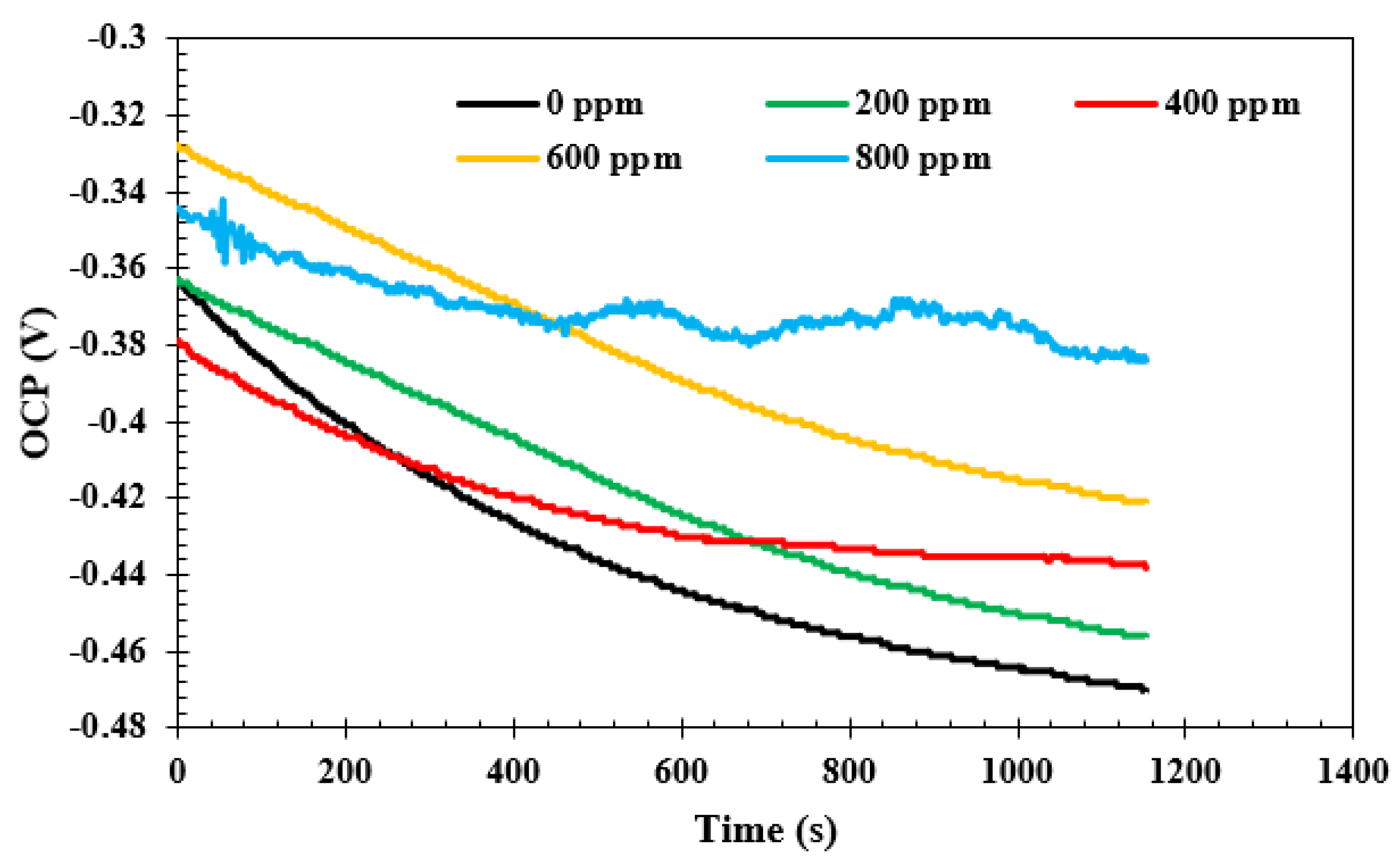
The evolution of the open circuit potential (OCP) of mild steel in 1 M HCl solution in the absence and presence of various concentrations of the ZnO nanocarrier loaded with the extract (200, 400, 600, and 800 ppm) was monitored over a 30 min immersion period. The results are shown in
Figure 3.
According to
Figure 3, the OCP profiles exhibited a decreasing trend with time during the initial immersion period, which can be attributed to the formation and gradual stabilisation of the passive layer on the metal surface in the corrosive medium. This behaviour indicates an initial interaction between the metal surface and the active species of the inhibitor system.
After approximately 1000 s, the OCP curves reached a relatively stable plateau for all tested concentrations, suggesting that equilibrium conditions were established at the electrode/electrolyte interface. This stabilisation point marks the establishment of a quasi-steady-state condition, suitable for initiating further electrochemical tests. Consequently, all subsequent electrochemical impedance spectroscopy (EIS) and potentiodynamic polarisation (PDP) measurements were performed after the OCP had stabilised, ensuring accurate and consistent evaluation of the inhibitor performance.
In the uninhibited solution (0 ppm), the OCP value stabilised around –470 mV vs. Ag/AgCl, indicating an active dissolution state of the steel in the aggressive acidic medium. Upon addition of the nanocarrier, a gradual shift in the OCP values towards more positive potentials was observed with increasing inhibitor concentration. At 200 ppm, the stabilised potential shifted to approximately –456 mV; while at 400 and 600 ppm, the potentials were recorded around –438 mV and –421 mV, respectively. The most significant anodic shift was observed at 800 ppm, where the OCP stabilised at –380 mV.
This progressive shift in OCP towards less negative values suggests that the nanocarrier system effectively reduces the anodic dissolution rate of the steel surface. The adsorption and accumulation of phytochemical constituents released from the ZnO surface act as a protective barrier, delaying the electrochemical activity at the metal-electrolyte interface.
Although the OCP shifts are not sufficient to conclusively determine the inhibition type, the observed trends indicate a predominant influence on the anodic reaction. These results are in line with subsequent polarisation measurements and confirm the dose-dependent inhibitory effect of the plant-loaded ZnO nanocarriers.
3.4. Potentiodynamic Polarisation Measurements and Kinetic Studies
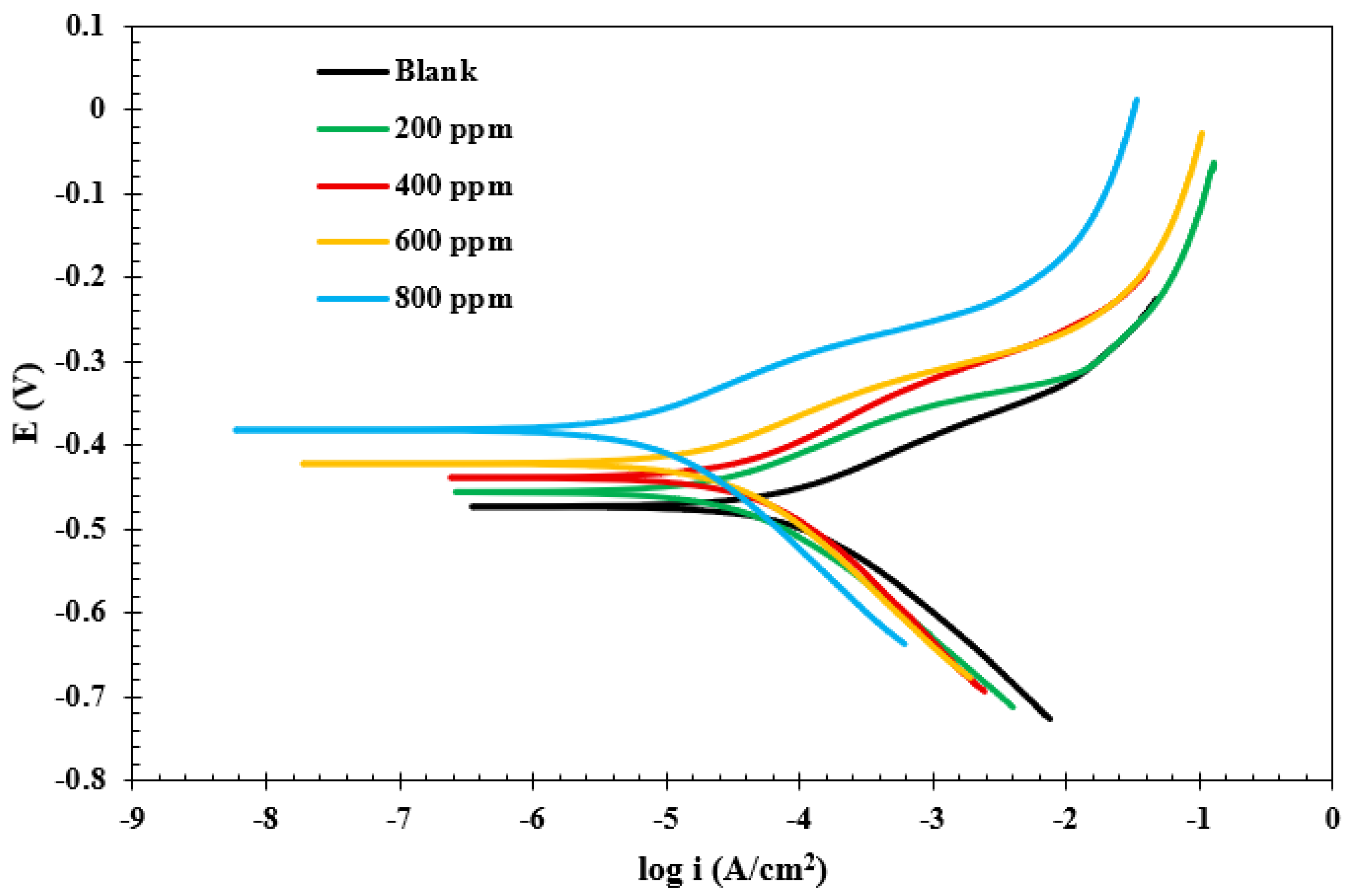
The corrosion behaviour of mild steel in 1 M HCl solution with and without various concentrations of ZnO nanocarriers loaded with the plant extract was evaluated using potentiodynamic polarisation measurements. The polarisation curves are presented in
Figure 4, and the corresponding electrochemical parameters, including corrosion potential (E
corr), corrosion current density (i
corr), polarisation resistance (R
p), corrosion rate (v
corr), and inhibition efficiency (IE%), are summarised in
Table 1.
In the blank solution (0 ppm), the mild steel exhibited an active corrosion behaviour with an Ecorr of –472 mV and an icorr of 125.3 µA·cm−2. Upon addition of the nanocarrier at 200 ppm, the icorr decreased to 82.6 µA·cm−2, indicating a partial suppression of corrosion. Further increases in inhibitor concentration led to a consistent reduction in icorr values: 65.4 µA·cm−2 at 400 ppm, 43.8 µA·cm−2 at 600 ppm, and a minimum value of 18.9 µA·cm−2 at 800 ppm. The corresponding corrosion potentials shifted slightly in the anodic direction, suggesting that the extract-loaded nanocarrier primarily affects the anodic dissolution of iron but also influences the cathodic hydrogen evolution reaction, indicating a mixed-type inhibition mechanism.
The polarisation resistance (R
p) was calculated using the Stern-Geary equation (Equation (1)) [
31]:
where βa and βc are the anodic and cathodic Tafel slopes (mV/decade); i
corr is the corrosion current density (µA/cm
2); and 2.303 is the conversion factor from natural to base-10 logarithms.
Accordingly, the Rp for the blank solution was estimated to be approximately 169 Ω·cm2. With increasing inhibitor concentration, Rp increased to 256, 322, 488, and 1024 Ω·cm2 for 200, 400, 600, and 800 ppm, respectively.
The corrosion rate (v
corr, in mm/year) was calculated using Equation (2) [
32]:
where
EW is the equivalent weight of iron (27.92 g/equiv); ρ is the density (7.87 g/cm
3); and i
corr is in µA/cm
2. Based on these values, the corrosion rate decreased from 0.93 mm/year in the blank solution to 0.21 mm/year at 800 ppm.
The inhibition efficiency (IE%) was calculated using Equation (3) [
33]:
At 800 ppm, the maximum inhibition efficiency was found to be approximately 85%, confirming the strong protective effect of the plant-based ZnO nanocarrier. These results demonstrate that the corrosion inhibition performance improves with increasing concentration of the nanocarrier, mainly through the adsorption and controlled release of phytochemical constituents that form a protective film on the steel surface. The inhibition mechanism is identified as mixed-type, involving both anodic and cathodic suppression.
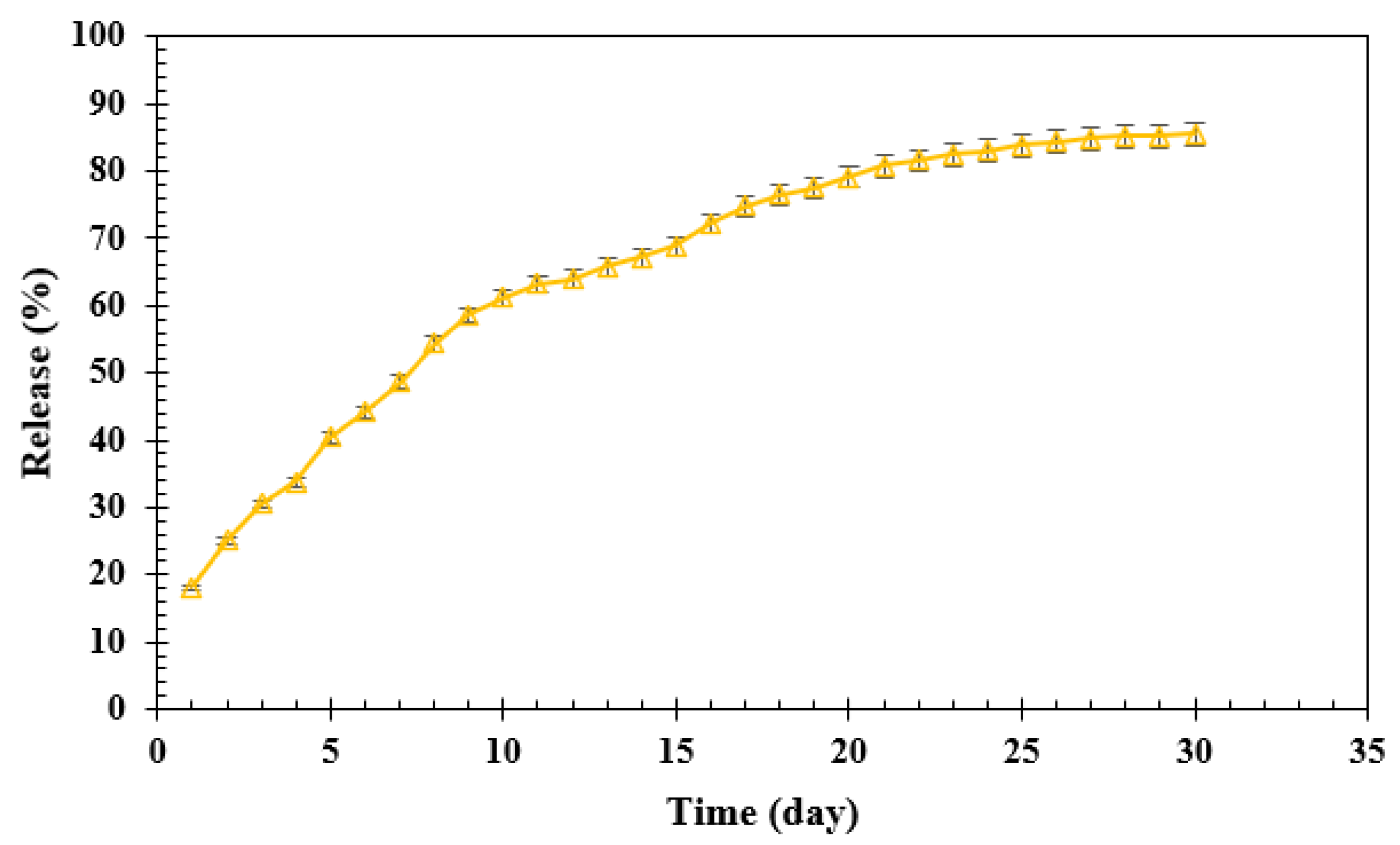
The release profile of the plant extract from the ZnO nanoparticles was monitored over 30 days in 1 M HCl solution at room temperature (25 ± 1 °C) as a quantitative evaluation of the nanocarrier. The cumulative release percentage of the extract was measured at regular time intervals (
Figure 5).
As shown in
Figure 5, the release profile exhibits a relatively uniform and slow trend over time. From the beginning of the test up to approximately day 10, the release rate is nearly linear with a gentle slope, indicating a steady and controlled diffusion of phytochemical molecules from the ZnO nanostructure. After day 20, a slight decrease in the release rate is observed, which may be attributed to the gradual depletion of adsorbed extract molecules or to the partial saturation of the surrounding medium. The final cumulative release percentage reached approximately 85% after 30 days, demonstrating that the ZnO nanocarrier effectively retains the active inhibitor species and releases them gradually over an extended period. This sustained release behaviour is highly desirable for long-term corrosion protection applications, as it ensures a continuous supply of inhibitor molecules to the metal/electrolyte interface without the need for frequent re-dosing.
The observed release kinetics can be attributed to the following mechanisms: (i) desorption of surface-adsorbed phytochemicals from the ZnO nanoparticles; (ii) partial dissolution of the ZnO matrix in acidic HCl medium (pH-responsive behaviour); and (iii) diffusion of released species through the boundary layer into the bulk solution. The nearly linear release profile during the first 10 days suggests that diffusion-controlled release (Fickian or quasi-Fickian behaviour) is the dominant mechanism [
34]. It should be noted that the relatively slow release rate and the high cumulative release (85%) confirm that the green-synthesised ZnO nanoparticles serve as an effective pH-responsive nanocarrier for
Descurainia sophia extract. These results directly support the "controlled release" functionality claimed throughout this manuscript and address the need for quantitative kinetic validation.
3.5. Electrochemical Impedance Spectroscopy (EIS)
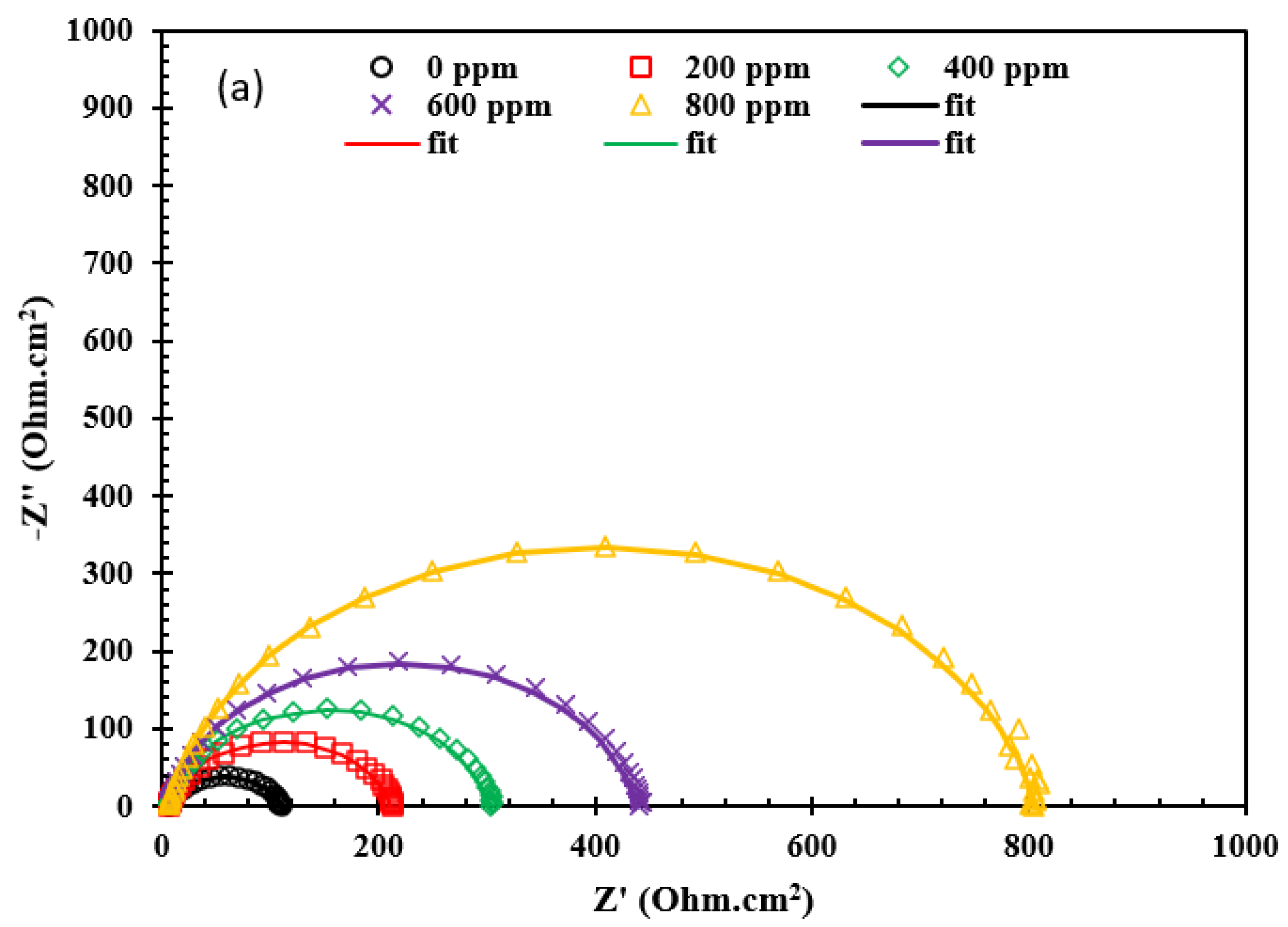
Electrochemical impedance spectroscopy was employed to further investigate the inhibition performance of the phytochemical-loaded ZnO nanocarrier on mild steel in 1 M HCl solution. The Nyquist and Bode plots recorded after 30 min of immersion are shown in
Figure 6. The corresponding impedance parameters, derived from fitting the data to an appropriate Randles equivalent circuit model, are listed in
Table 2.
The Nyquist plots (
Figure 6a) exhibited depressed semicircular shapes for all samples, indicating charge-transfer-controlled corrosion processes and surface heterogeneity. In the absence of the inhibitor (0 ppm), the diameter of the semicircle was relatively small, corresponding to a low charge transfer resistance (R
ct) of approximately 108 Ω·cm
2. The addition of a 200 ppm nanocarrier increased the R
ct to 212 Ω·cm
2, and further enhancements were observed with higher concentrations: 318 Ω·cm
2 (400 ppm); 440 Ω·cm
2 (600 ppm); and a maximum of 804 Ω·cm
2 at 800 ppm.
This consistent increase in R
ct with increasing inhibitor concentration reflects a significant suppression of the corrosion reaction due to the formation of an adsorbed protective layer on the steel surface. Simultaneously, the double-layer capacitance (C
dl) decreased from 98.3 μF·cm
−2 for the uninhibited sample to 74.5, 65.8, 51.1, and 34.2 μF·cm
−2 for 200, 400, 600, and 800 ppm, respectively. The reduction in C
dl is attributed to a decrease in local dielectric constant and/or an increase in the thickness of the electrical double layer, further confirming the adsorption of inhibitor molecules on the metal surface [
35].
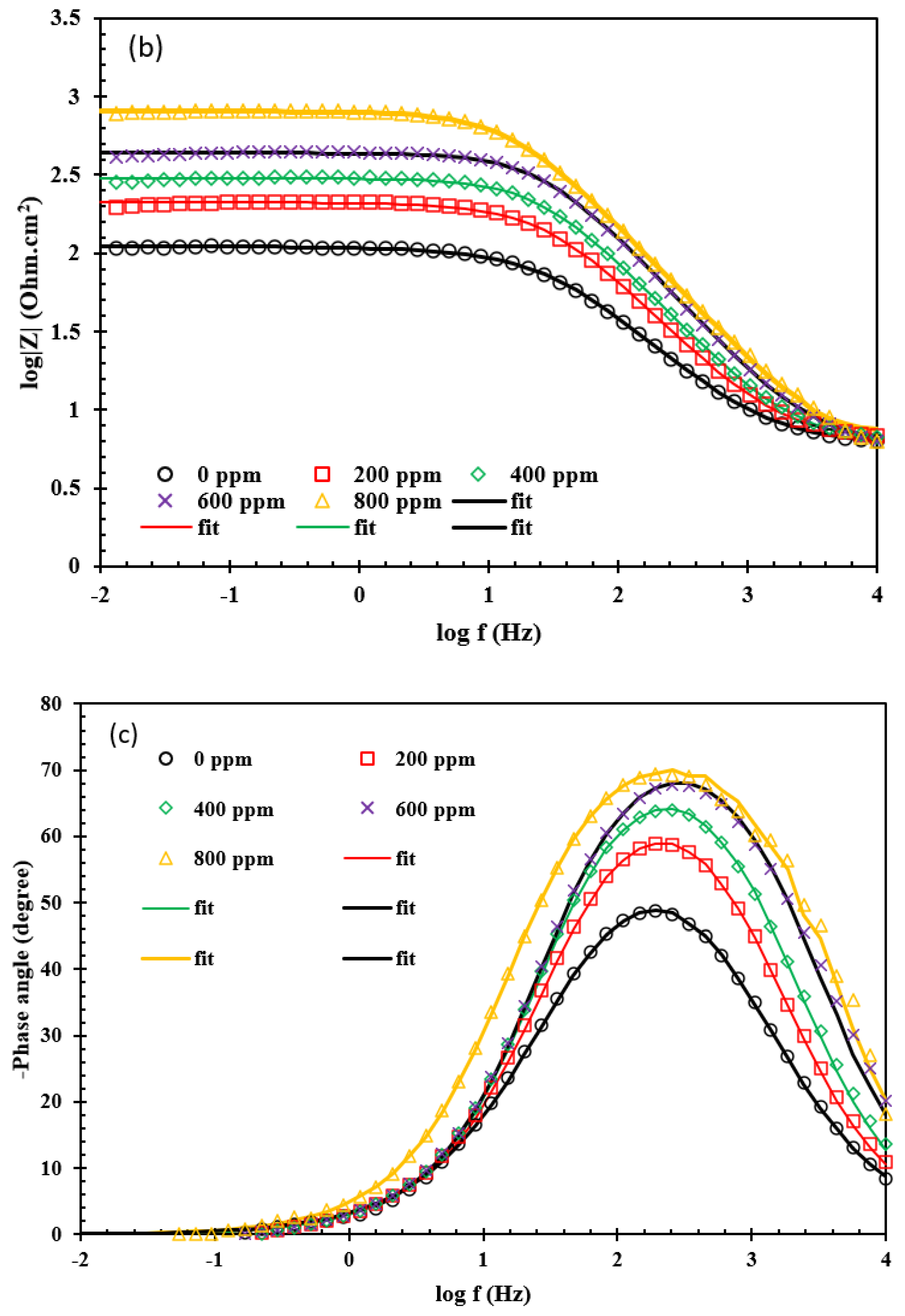
The Bode plots (
Figure 6b,c) supported these findings, as the |Z| values at low frequency and the phase angle maxima increased with increasing inhibitor concentration, indicating enhanced corrosion resistance and improved surface coverage.
The inhibition efficiency (IE%) based on the R
ct was calculated using Equation (4):
yielding efficiencies of approximately 49.1%, 66.0%, 75.5%, and 86.6% for 200, 400, 600, and 800 ppm, respectively.
These EIS results demonstrate that the ZnO-based nanocarrier loaded with the extract effectively inhibits mild steel corrosion in an acidic medium via adsorption and barrier film formation. The increasing Rct and decreasing Cdl values confirm the development of a more resistive and less capacitive interface, consistent with a mixed-type inhibition mechanism dominated by charge transfer suppression. In addition to phytochemical release, the dissolution of ZnO in the acidic medium releases Zn2+ ions, which may precipitate as Zn(OH)2 on cathodic sites, further suppressing the corrosion reaction.
3.6. Adsorption Isotherm Studies
To gain a deeper understanding of the interaction between the nanocarrier (loaded with the plant extract) and the mild steel surface, adsorption isotherm modelling was performed. The adsorption behaviour of inhibitor molecules on the metal surface is crucial because the formation of a protective adsorbed layer is the primary mechanism of corrosion inhibition. In this study, the experimental data obtained from potentiodynamic polarisation measurements at different concentrations (200–800 ppm) were fitted to two commonly used adsorption isotherm models: Langmuir and Freundlich.
The Langmuir isotherm assumes monolayer adsorption onto a homogeneous surface with no interaction between adsorbed molecules. The linear form of the Langmuir isotherm is expressed as [
36]:
where Ce (mg/L) is the equilibrium concentration of the inhibitor; Qe (mg/g) is the amount of inhibitor adsorbed per unit mass of the nanocarrier; Qmax (mg/g) is the maximum adsorption capacity; and KL (L/mg) is the Langmuir adsorption equilibrium constant.
The Freundlich isotherm is an empirical model that describes multilayer adsorption onto heterogeneous surfaces. Its linear form is given by [
36]:
where KF (mg/g)(L/mg)(1/n) is the Freundlich constant related to adsorption capacity, and n is the heterogeneity factor indicating adsorption intensity (n > 1 indicates favourable adsorption).
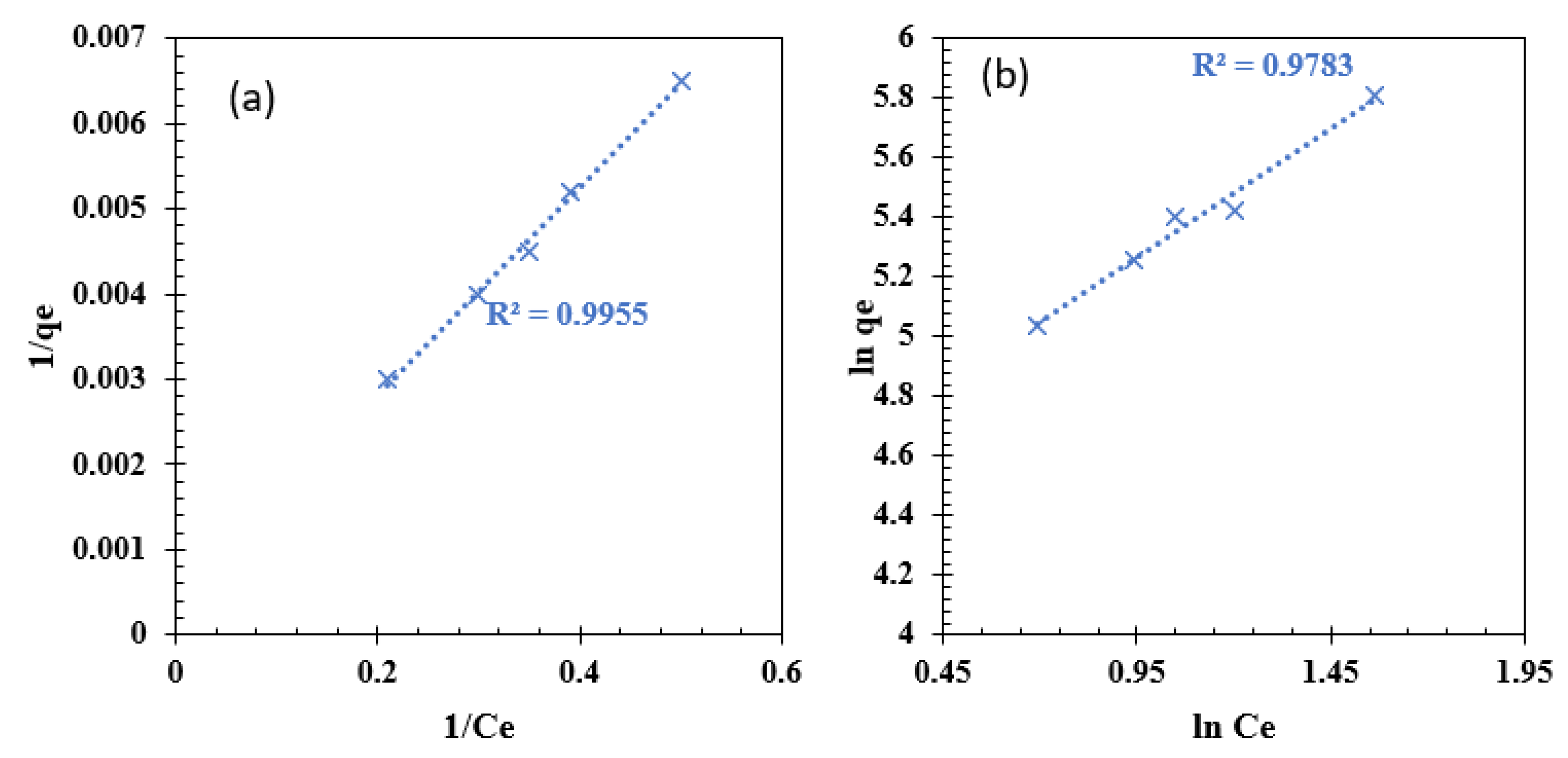
Figure 7 shows the Langmuir and the Freundlich adsorption isotherm plots for the extract-loaded ZnO nanocarrier on a mild steel surface in 1 M HCl solution.
As presented in
Figure 7, the Langmuir isotherm yielded an excellent correlation coefficient (R
2 = 0.9955), which is significantly higher than that obtained from the Freundlich model (R
2 = 0.9783). This indicates that the adsorption of the phytochemical constituents from the ZnO nanocarrier onto the mild steel surface follows the Langmuir adsorption isotherm. The calculated maximum adsorption capacity (Qmax) is 2521.15 mg/g, demonstrating a remarkably high affinity of the inhibitor molecules with the steel surface.
The Langmuir constant (KL) was determined to be 0.32 L/mg. The positive value of the KL confirms spontaneous adsorption of the inhibitor molecules onto the metal surface. Moreover, the fact that the experimental data perfectly fit the Langmuir model suggests that the adsorbed inhibitor molecules form a monolayer on the steel surface without significant intermolecular interactions. This monolayer coverage is consistent with the formation of a protective barrier that isolates the metal from the aggressive acidic environment.
From the Freundlich model, the value of n was found to be 1.99 (greater than 1), which also indicates favourable adsorption conditions. However, the lower R2 value confirms that the Freundlich model is less suitable for describing the adsorption behaviour in this system, implying that surface heterogeneity is not the dominant characteristic of the adsorption process.
The Gibbs free energy of adsorption (ΔG°
ads) can be estimated from the Langmuir constant KL using the following equation [
36]:
where R is the universal gas constant (8.314 J/mol·K); T is the absolute temperature (298 K); and the value 55.5 represents the molar concentration of water in the solution (mol/L). Based on this calculation, ΔG°
ads was found to be approximately –34.2 kJ/mol.
The negative value of ΔG°ads confirms the spontaneous nature of the adsorption process. Generally, ΔG°ads values around –20 kJ/mol or less negative are associated with physisorption (electrostatic interactions); while values around –40 kJ/mol or more negative indicate chemisorption (charge transfer or covalent bonding). The calculated ΔG°ads of –34.2 kJ/mol suggests a mixed adsorption mechanism, involving both physisorption and chemisorption. This mixed-type adsorption is consistent with the potentiodynamic polarisation results, which identified the inhibitor as a mixed-type inhibitor. The chemisorption component likely involves the formation of coordinate bonds between the electron-rich functional groups (–OH, –COOH, –C=O) of the phytochemicals and the vacant d-orbitals of iron atoms on the steel surface. The physisorption component may arise from electrostatic attraction between protonated inhibitor molecules and negatively charged chloride ions pre-adsorbed on the steel surface.
These adsorption isotherm results provide strong evidence that the Descurainia sophia extract released from the ZnO nanocarrier effectively adsorbs onto the mild steel surface, forming a protective monolayer that suppresses both anodic dissolution and cathodic hydrogen evolution reactions. The excellent fit to the Langmuir model further supports the homogeneity of the steel surface under the experimental conditions and the absence of significant lateral interactions among adsorbed inhibitor molecules.
4. State of the Art: Comparison with Preceding Nanocarrier-Based Corrosion Inhibition Systems
To better position the novelty of the present work within the existing literature, a systematic comparison with previously reported nanocarrier-based corrosion inhibition systems is provided below.
Edraki and Zaarei [
37] intercalated azole derivatives (MBT and MBI) into sodium montmorillonite clay (Na
+-MMT) as nanocarriers for mild steel corrosion protection in 3.5 wt% NaCl solution. Using UV-Vis spectroscopy, they demonstrated that the release of MBI species from clay nanocarriers at neutral pH (27%) was lower than that of MBT (42%). The inhibition efficiency reached ~88.3% for MMT+MBT. However, their system relied on physical intercalation without pH-responsive behaviour, and the clay nanocarriers did not actively contribute to inhibition beyond serving as a reservoir.
In 2025, Kahkesh and Zargar [
19] developed a green smart nanocarrier using soy protein isolate/chitosan (SPI/CS) encapsulating Allium jesdianum extract (AEAJ) for mild steel in 3.5 wt% NaCl. The system showed pH-dependent release and achieved 93.57% inhibition efficiency with Zn
2+ synergy. Nevertheless, the polymer-based nanocarrier exhibited limited thermal stability and did not provide intrinsic corrosion inhibition by itself.
Earlier, Hu and Liu [
38] had designed chitosan/tannic acid phenamine networks on hollow mesoporous silica capsules (CS/TA@SM@HMSs) for reversible pH-responsive release of a syringaldehyde-methionine (SM) green inhibitor. The system achieved 93.2% efficiency in 3.5 wt% NaCl and demonstrated reversible on/off release. However, the synthesis was relatively complex, involving multiple steps, and the silica core remained non-biodegradable.
In 2024, Kiani and Javidi [
39] synthesised ZIF-8 nanoparticles for pH-sensitive release of 2-mercaptobenzothiazole in 3.5 wt% NaCl solution. The ZIF-8 structure broke down in acidic pH, releasing the inhibitor. While effective, ZIF-8 synthesis required organic solvents (DMF) and high temperatures, raising environmental concerns compared to fully green routes.
Also in 2024, Ahmad et al. [
40] modified Ni-Al layered double hydroxides (LDHs) with phosphate ions as a self-healing anticorrosion system in polyurethane coatings. The LDH nanocarriers released inhibitors via chloride-triggered ion exchange, achieving ~98% efficiency. However, the system was designed for coating applications rather than direct solution inhibition, and the synthesis involved non-green precursors.
In [
41], Ramamoorthy et al. reported green synthesis of ZnO nanoparticles using Neem extract for corrosion protection. However, their work focused on coating Zn plates rather than using ZnO as a nanocarrier for inhibitor delivery. No controlled release mechanism was proposed or demonstrated.
Lastly, Messina et al. [
42] synthesised Mg-Al layered double hydroxides storing glutamine amino acid as a green inhibitor for reinforced mortar. The system offered dual protection via inhibitor release and chloride entrapment. Nevertheless, the application was limited to high-pH mortar environments, and the synthesis was not performed via a green route.
Table 3 provides a systematic comparison between the present study and previously reported nanocarrier-based corrosion inhibition systems. Taken together, the comparative analysis in
Table 3 reveals several important insights. Most previous nanocarrier systems suffer from at least one of the following drawbacks: (a) use of non-green synthesis methods or toxic solvents [
37,
39,
40,
42]; (b) the nanocarrier acts only as a passive reservoir without active inhibition contribution (all previous studies except Ramamoorthy et al., whose work did not involve inhibitor loading); (c) application in mild NaCl environments rather than aggressive acidic media (most studies); or (d) lack of experimental evidence for controlled release [
37,
40,
41,
42]. The present work addresses several of these gaps by offering a fully green, dual-function ZnO nanocarrier derived from a previously unexplored plant source, designed specifically for an aggressive 1 M HCl medium. However, like many previous studies, it shares the limitation of lacking quantitative release kinetic data, which is openly acknowledged and proposed for future investigation.
5. Discussion
The comparison in
Table 3 provides a quantitative benchmark for the performance of the developed ZnO nanocarrier system. It focuses on key parameters, including inhibitor type, nanocarrier, corrosive environment, concentration, exposure time, maximum inhibition efficiency, and whether controlled release was experimentally demonstrated.
As shown in
Table 3, the inhibition efficiency achieved in the present work (~85–87% at 800 ppm in 1 M HCl) is comparable to or higher than several recent studies. For instance, Edraki and Zaarei [
37] reported 88.3% efficiency for MBT-loaded clay nanocarriers in 3.5 wt% NaCl, but their system did not employ a green synthesis route nor demonstrate controlled release. While Kahkesh and Zargar [
19] achieved a higher efficiency (93.6%) using a biopolymer-based nanocarrier (SPI/CS) with Allium jesdianum extract in 3.5 wt% NaCl, their nanocarrier did not actively contribute to inhibition; whereas this study’s ZnO nanocarrier provides dual functionality (carrier + Zn
2+ release). Moreover, the corrosive environment in their study (neutral NaCl) is significantly less aggressive than the 1 M HCl used in the present work.
Hu and Liu [
38] reported 93.2% efficiency using a reversible pH-responsive silica-based capsule loaded with a syringaldehyde-methionine inhibitor in 3.5 wt% NaCl. Despite the higher efficiency, their synthesis involved multiple steps and non-biodegradable silica, whereas this study’s system is fully green and cost-effective. Kiani and Javidi [
39] developed ZIF-8 nanoparticles for pH-sensitive release but did not report a quantitative efficiency value, and their synthesis required organic solvents (DMF). Ahmad et al. [
40] achieved 98% efficiency using phosphate-loaded LDH in a polyurethane coating, but their work focused on coating applications rather than solution-phase inhibition, and the synthesis was not green.
Importantly, the present study stands out as one of the few that provides quantitative release kinetic data (cumulative release ~85% after 30 days) and adsorption isotherm modelling. Many previous studies, including some listed in
Table 3, lack these quantitative validations. In terms of concentration, this system achieved ~85% efficiency at 800 ppm in 1 M HCl. While this concentration is higher than some reported systems (e.g., 200 ppm for Hu and Liu), it is important to note that the aggressive acidic medium (1 M HCl) inherently requires higher inhibitor concentrations to achieve comparable protection. Furthermore, the use of a low-cost, green synthesis route compensates for the higher concentration from an economic and environmental perspective.
From this quantitative comparison, several conclusions can be drawn. First, the inhibition efficiency of the present system (~85–87%) is respectable given the highly aggressive 1 M HCl environment, which is substantially more corrosive than the 3.5 wt% NaCl used in most comparative studies. Second, the present work is among the few that have quantitatively demonstrated controlled release over an extended period (30 days) with cumulative release reaching 85%. Third, the dual functionality of the ZnO nanocarrier (serving as both a pH-responsive vehicle and an active inhibitor via Zn2+ release) is unique among the compared systems. Fourth, the fully green synthesis route using Descurainia sophia extract distinguishes this work from most previous reports that rely on non-green precursors or organic solvents.
Despite the promising results, several limitations should be acknowledged. All experiments were performed at room temperature (25 °C); therefore, the performance at elevated temperatures remains unknown. Long-term stability beyond 30 days was not evaluated. Control experiments, including bare ZnO nanoparticles (without extract) and free Descurainia sophia extract (without nanocarrier), were not performed; thus, the exact synergistic contribution of phytochemical release versus intrinsic ZnO inhibition could not be fully deconvoluted. Additionally, the system was tested only in the solution phase, not incorporated into a coating matrix. Future studies should address these limitations through temperature-dependent tests, extended stability assessments, inclusion of appropriate controls, and coating integration studies. These findings suggest that, after further validation of long-term stability and performance under industrial conditions (e.g., elevated temperatures and extended immersion), the developed ZnO nanocarrier could serve as an alternative to conventional synthetic inhibitors. A control experiment with free Descurainia sophia extract (without the ZnO nanocarrier) was not performed in this study. Such a comparison is necessary to quantify the synergistic benefit of the nanocarrier system and is recommended for future work. Moreover, the claimed eco-friendliness of the system is currently based on the green synthesis route, and future studies should include direct toxicity and biodegradability assessments to fully support this claim.