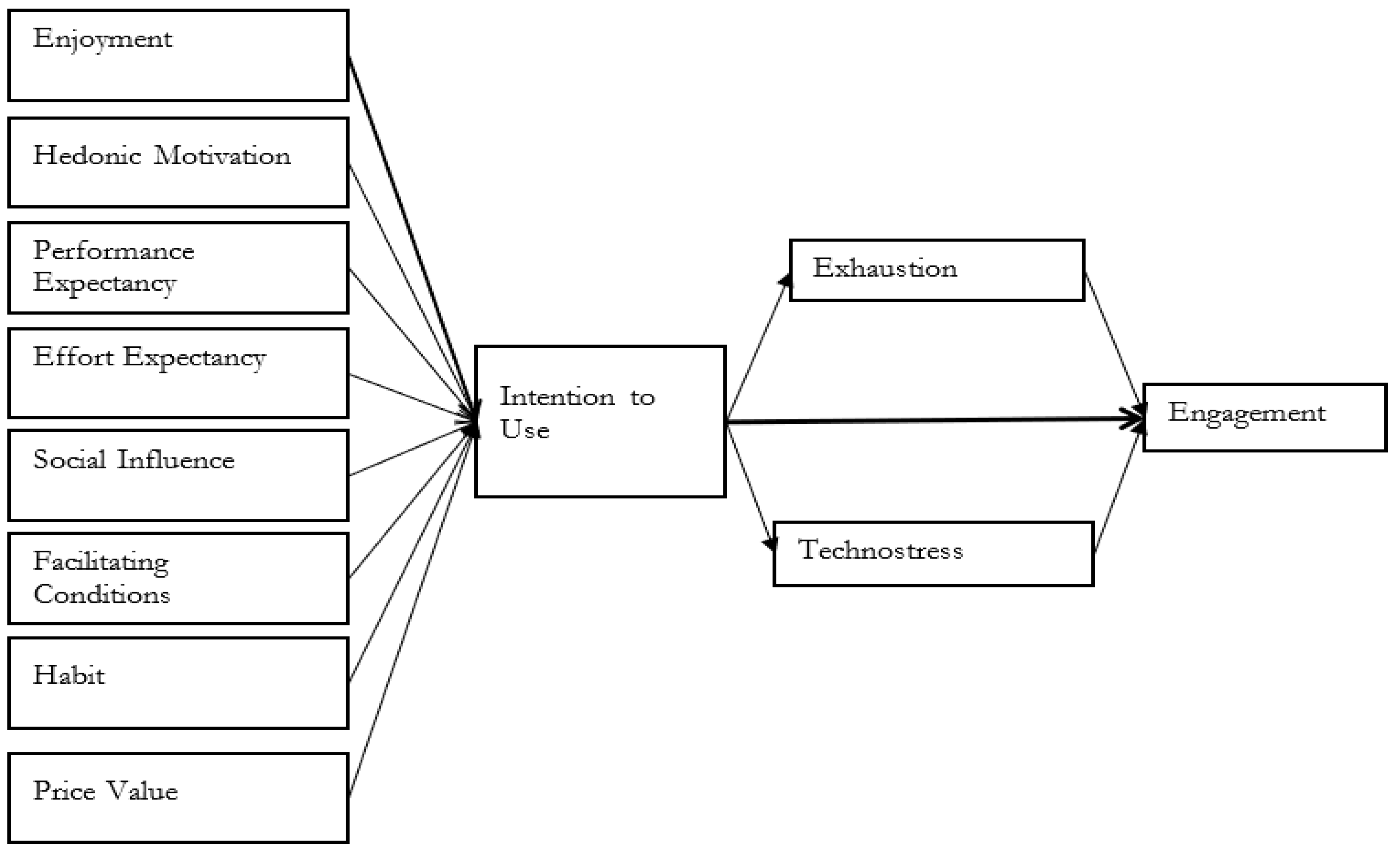
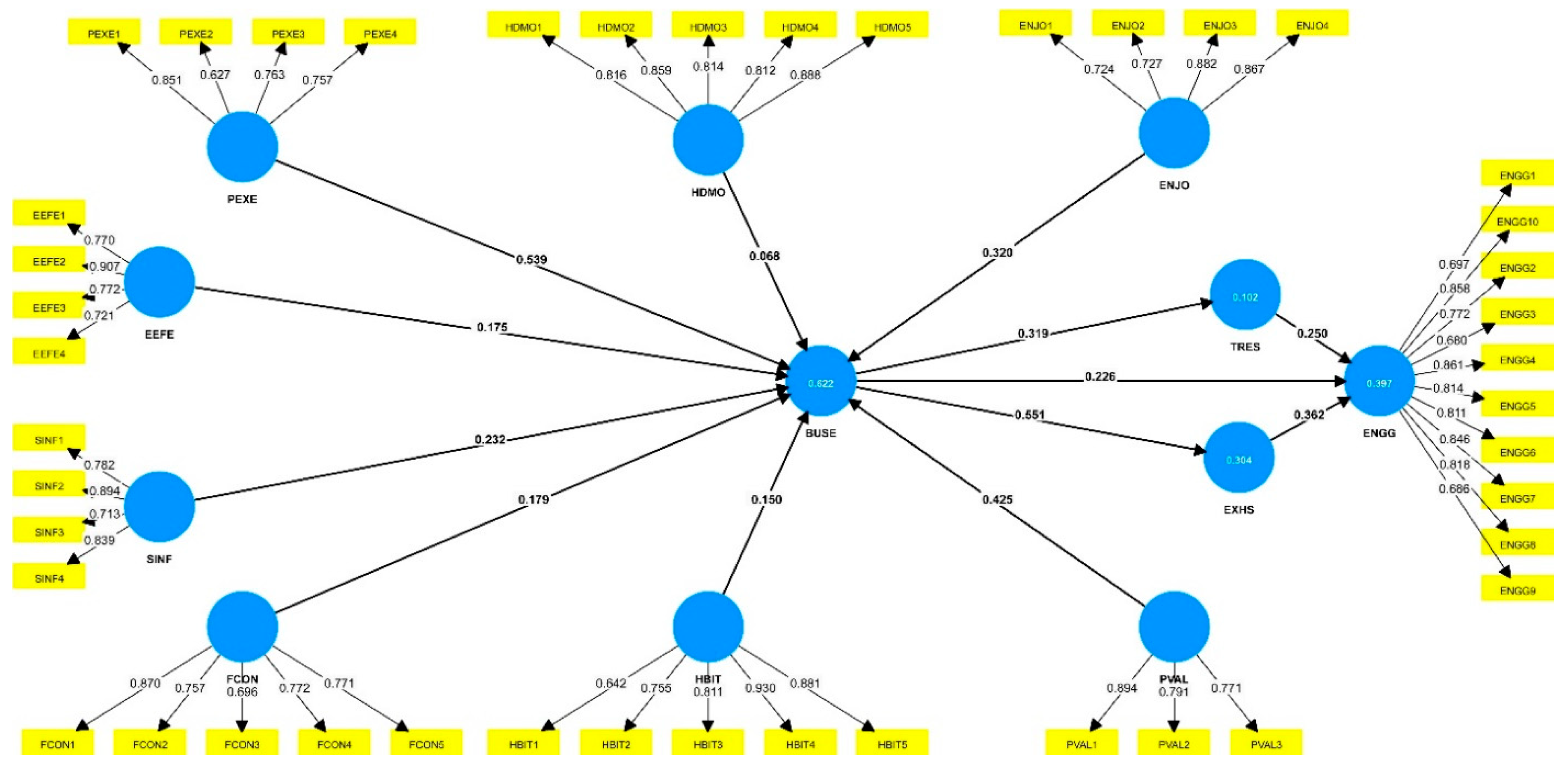
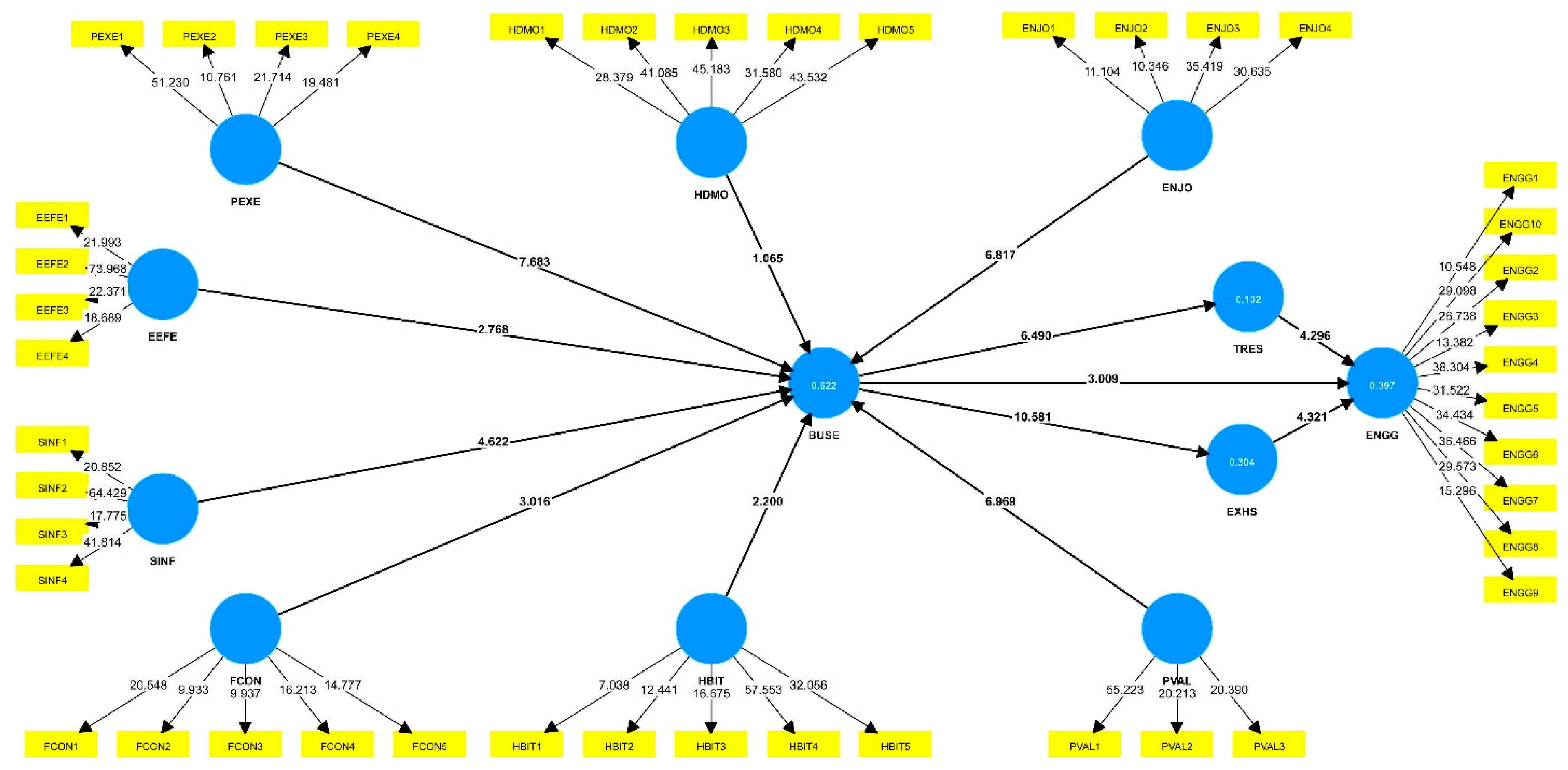
This study adopted a quantitative approach to examine Saudi undergraduate students’ adoption of m-learning use and the adoption of UTAUT2 as the underpinning model. This study is unique in that it included additional factors of technostress and exhaustion as mediating variables affecting the m-learning engagement of Saudi undergraduate students. The study sample consisted of chosen undergraduate students representing diversity throughout different demographics (age, gender, academic disciplines and prior experience with m-learning), and their size was determined using statistical power analysis, which ensured that the study findings were valid and robust.
Surveys were distributed to the sample for collecting data, within which 12 factors were included, such as enjoyment, hedonic motivation, and performance expectancy. The surveys contained items measuring technostress and exhaustion levels among the sample in light of their experiences with m-learning. Electronic distribution of the survey was available, and the items within the survey were developed based on the scales of past studies dedicated to m-learning. The validity and reliability of the instruments was ensured by conducting a pilot test on a subset of participants before the actual phase of data collection.
To strengthen procedural transparency for Internet-based survey research, responses were screened prior to analysis using predefined criteria. First, incomplete submissions were removed. Second, responses showing invariant patterns (e.g., identical responses across all items) were excluded as potential inattentive responding. Third, the final dataset was checked for extreme multicollinearity and abnormal response distributions. These steps were implemented to improve data quality and replicability in line with established guidance for survey-based PLS-SEM studies.
A total of 500 undergraduate students had access to the questionnaire, and 264 students replied, yielding a 52.8% response rate. The questionnaire was distributed electronically through the university’s learning management system over a four-week period during the second semester of the 2023–2024 academic year. Access was granted to students enrolled in eight departments, namely Islamic Studies, Laws, Management, Medicine and Health Sciences, Applied Sciences, Computing, Engineering, and Languages and Translation, as well as students classified under “Others,” representing smaller interdisciplinary programs. Participation was voluntary, and the survey link was available to all undergraduate students registered in these departments.
The sampling strategy and data processing procedures adopted in this study are consistent with prior empirical research on online and mobile learning adoption conducted during and after the COVID-19 period. Similarly to studies employing the Push–Pull–Mooring (PPM) perspective to examine technology switching and adoption behaviors in educational contexts, the present study targeted active users with direct and recent experience of digital learning platforms.
Participation was therefore restricted to undergraduate students who had prior exposure to mobile-based learning systems through institutional learning management systems or course-related mobile applications. This criterion ensured that all respondents possessed sufficient usage experience to meaningfully evaluate m-learning adoption, engagement, technostress, and exhaustion, thereby enhancing data quality and construct validity.
Data collected were exposed to advanced statistical analysis, with the initial steps involving the use of descriptive statistical methods to obtain the characteristics of the sample. Data were analyzed using Partial Least Squares Structural Equation Modeling (PLS-SEM), which is suitable for complex research models involving multiple latent constructs and mediation relationships. PLS-SEM enables the simultaneous assessment of the measurement model and structural model and is appropriate for prediction-oriented studies in educational technology research.
In this study, PLS-SEM was employed to examine (1) the direct effects of UTAUT2 constructs on behavioral intention to use m-learning, (2) the direct effect of behavioral intention on student engagement, and (3) the mediating effects of technostress and exhaustion. Bootstrapping procedures were applied to test the significance of path coefficients and indirect effects. PLS-SEM was employed in this study due to the complexity and explanatory nature of the proposed research model. The model includes multiple latent constructs derived from UTAUT2, as well as parallel mediating mechanisms (technostress and exhaustion), which makes PLS-SEM suitable for simultaneously estimating measurement and structural relationships. In addition, the study adopts a prediction-oriented objective aimed at explaining variance in behavioral intention and student engagement rather than confirming an established covariance structure. PLS-SEM is also appropriate given the moderate sample size (n = 264) and the use of Likert-scale survey data, as it does not require multivariate normality and provides robust parameter estimation under such conditions. Accordingly, the use of PLS-SEM in this study is theoretically and methodologically justified.
The study adhered to stringent ethical standards, which involved briefing the participants on the study’s objectives, obtaining their consent, and assuring them that the anonymity of their responses would be upheld throughout the study.
3.1. Model Development
This section is dedicated to presenting the development of the study model. In every study, the concepts need to be defined and conceptualized prior to the study to establish their relationship and importance to the research and to explain misunderstandings of their use in a specific field. Thus, the definitions of the examined concepts are presented in detail in this section.
Enjoyment is a feeling full of pleasure and joy and encapsulates experiences in which these emotions are felt [
62]. For instance, in the m-learning context, perceived enjoyment is the level at which the student expects mobile learning to be enjoyable [
63]. The concept of this variable is crucial to explaining the engagement and adoption of the user of technology-based learning platforms, specifically m-learning.
Chellappa [
64] confirms that perceived enjoyment significantly influences both students’ attitudes toward using the app and their behavioral intention to continue its use. Thus, this study proposes that user’s enjoyment of m-learning and its environment has a significant effect on their intention to use it—this is consistent with the findings in ICT-dedicated literature, which underlines the general role of system enjoyment in developing users’ intentions [
65]. In this regard, the more the user finds m-learning to be an enjoyable experience, the higher his/her intentions towards using its platforms will be.
In this case, the relationship between enjoyment and behavioral intention is based on the notion that enjoyment is a positive emotional response to m-learning and can thus promote user’s motivation and engagement of the platform, affecting their behavioral intentions. Thus, this study proposes the following hypothesis:
H1.
There is a significant positive relationship between perceived enjoyment and behavioral intention to use m-learning platforms among students.
- 2.
Hedonic Motivation
This motivation type refers to the pleasure or enjoyment felt from technology use, and it has a key role in adopting and using technology. The concept covers various elements, namely playfulness, joy, and entertainment, which are crucial for understanding the interaction of users and their adoption of technology. In the m-learning context, hedonic motivation refers to the joy or pleasure felt while engaging in m-learning platforms.
This hypothesis is based on Venkatesh and Thong’s [
52] theory, which relates hedonic motivation to behavioral intention to adopt technology. According to Yang [
66], hedonic motivation contributes to the development of the user’s technology adoption, indicating that the user’s derived joy/pleasure from technology use is pertinent in technology acceptance and use.
Moreover, in mobile technology, the user’s acceptance is frequently affected by hedonic motivation more than rational considerations [
37,
67], and this is relevant in m-learning, whereby engagement and enjoyable feelings towards technology are top determinants of its use. Based on the above empirical and theoretical bases, this study hypothesizes the following:
H2. There is a significant positive relationship between hedonic motivation and use of m-learning platforms among students in HLIs.
- 3.
Performance Expectancy
Another critical factor in technology acceptance models is performance expectancy, which is described as the level to which an individual is convinced that system use will assist in reaping job performance gains [
68]. This study refers to it as the level to which higher education institution students believe that using smartphones for m-learning will lead to enhanced academic performance, and thus it affects their use of the platform [
69].
As the primary tool for m-learning, smartphones provide various capabilities for accessing various educational contents, materials and resources with advanced search functionalities and access to sources, making them invaluable to students studying in different faculties [
58]. In this study, it is proposed that students’ perception of using smartphones for m-learning positively contributes to their enhanced academic performance and will be more likely to use them to achieve their educational objectives. Thus, this study proposes the following hypothesis:
H3. Performance expectancy has a significant positive influence on the behavioral intention of students in HLIs to use m-learning platforms.
- 4.
Effort Expectancy
In UTAUT, Venkatesh and Bala [
70] referred to effort expectancy as the level of ease related to using IT system, and in this study, it relates to the expectations of the students concerning the use of smartphones for m-learning that is free of effort.
The principle governing this construct states that technology’s perceived ease of use is a top determinant of its adoption and use; Ref. [
71] further explained that it is the relationship between effort and work in a way that performance and rewards are viewed as results of the invested effort. In m-learning, this refers to the belief of the students that using smartphones is easy and free of effort for m-learning, and if this is so, then they will have a more positive behavioral intention towards using smartphones for their learning purposes. Thus, this study hypothesizes the following:
H4. Effort expectancy has a significant positive influence on the behavioral intention of students in HLIs to use m-learning platforms.
- 5.
Social Influence
In adopting technology, social influence is the effect of perceived opinions, behaviors or expectations of essential others on the user’s behavior or decisions [
57,
58]. This construct is one of the top determinants of adopting new technologies in the educational field, like m-learning, because behaviors of peers, instructors, and institutional culture can influence the individual’s behavior [
31].
This study proposes that social influence has a key role to play in forming the behavioral intentions of students towards m-learning platforms use and adoption in higher learning institutions, and as such, the corresponding hypothesis is as follows:
H5. Social influence has a significant positive influence on the behavioral intention of students in HLIs to use m-learning platforms.
- 6.
Facilitating Conditions
The level to which an individual is convinced that sufficient organizational and technical infrastructure exists to support system use is known as facilitating conditions [
31]. In the m-learning case among higher learning institutions, these are pertinent as they cover different aspects like the availability of resources, support systems, technical systems, and infrastructure, which are prerequisites of effective m-learning implementation and use.
The above is based on the premise that the existing facilitating conditions have a significant effect on the users’ behavioral intention towards engaging in technology and it is consistent with the general technology acceptance models framework, which contends that ease of use and support structure for technology determine its adoption and use [
69]. In a related study, Yang and Qian [
72] found that facilitating conditions significantly and positively influence students’ behavioral intention to adopt e-learning technologies. Their findings support the formulation of this hypothesis by demonstrating that when students perceive adequate support is available, they are more likely to engage with digital learning platforms.
Hence, in m-learning, higher education institutions need to facilitate support mechanisms for learners to make sure that their experience with m-learning technological system use is flawless [
33]. In other words, facilitating conditions are significant as a determinant of intention to use m-learning, and therefore, this study proposes the following hypothesis:
H6. Facilitating conditions within higher learning institutions have a significant positive influence on the behavioral intention of students and faculty to use m-learning platforms.
- 7.
Habit
Habit refers to the level to which individuals view a behavior as an automatic behavior that stems from repetitive learning and practice [
53,
55], and it is a construct that is important to explaining adoption of technological innovations, as well as their frequent use in the field of education. According to Venkatesh and Brown [
73], habit predicts intention towards technology use and actual use, and thus it holds great significance in technology adoption.
Habit in m-learning reflects the past experiences of the students and faculty members with mobile internet and related technologies [
74]. This is because their habitual use of technologies can significantly influence their attitudes and intention towards using similar technologies for education [
75]. The UTAUT2 model was adopted in the investigation into the university students’ behavioral intention to use mobile phones for studying by Nikolopoulou, Gialamas [
39], and the findings indicated that habit, performance expectancy and hedonic motivation were top predictors.
H7. Habit has a significant positive influence on the behavioral intention of students in HLIs to use m-learning platforms.
- 8.
Price Value
In value-based pricing strategy, price value is the product/service pricing that is based on the customers’ perceived worth of the product/services as opposed to the cost of production/past pricing of it [
55,
59]. This construct holds importance in technology adoption as the perceived value of technology does have a significant role as predictor of behaviors and decisions of users.
In m-learning in higher learning institutions, price value can be referred to as the perceived economic value or the affordability of mobile internet access and mobile devices purchased for the purpose of education [
35,
76]. A positive correlation was found by Wong and Leong [
77] between price value and the students and instructors’ behavioral intention in using mobile internet. Based on the above discussion, this study hypothesizes the following:
H8. Price value has a significant positive influence on the behavioral intention of students in HLIs to use m-learning platforms.
- 9.
Mobile Learning Use and Students’ Engagement
In technology adoption, behavioral intention is the individual’s intention to perform a behavior (to use IT) and is a predictor of actual use behavior [
78]. Most studies in the topic have investigated the effects of different factors on using technology with the help of UTAUT, through behavioral intention to use [
37,
79,
80]. In the education sector, student engagement refers to the students’ attention level, interest, curiosity, optimism and passion for learning and this encapsulates their motivation to learn [
81,
82].
This reflects students’ engagement with the learning activities and their engagement with the curriculum design as well as their decision-making when it comes to their learning process. More current definitions of the concept emphasize the students’ overall participation in their social and educational academic surroundings.
Studies such as Hameed and Qayyum [
78] and ref. [
83] stressed the role of m-learning in boosting students’ engagement. It can be stated that students’ true and actual engagement goes beyond learning just to pass exams, to complete assignments and learning activities, but also covers the students’ full investment in their learning process, their willingness to learn and to work towards learning by really understanding the course curriculum, and this has a significant influence over the students use of m-learning platforms. Thus, this study hypothesizes the following:
H9. The use of m-learning platforms has a significant relationship with the students’ engagement in HLIs.
- 10.
Exhaustion
Exhaustion refers to the physical or mental inability to remain alert due to lack of sleep during the operation of heavy machinery, inability to achieve activity completion, the feeling of tiredness, or difficulty in focusing on the task being carried, or difficulty in retaining or obtaining normal emotions [
84]. In the context of IT users, this represents techno-exhaustion, and it could result in psychological strain [
46,
47,
85] and has an adverse impact on the individual’s well-being and welfare, as evidenced in Luqman and Masood’s [
86] study.
For smartphone users, Kamal, Rabbani [
84] found that techno-exhaustion is the feeling of mental and physical tiredness because of using smartphones excessively, and this is the definition adopted in this study. Smartphones enable easy access to social networking sites, but using them excessively could lead to psychological exhaustion [
87], and users of social networks frequently feel this [
88], as well as frequent users of IT [
89].
According to [
90,
91] both technostress and exhaustion are essential constructs in adopting m-learning and through a developed model within which four stimuli, namely social overload, information overload, life invasion and privacy invasion, with two organisms, namely technostress and exhaustion, and with response considering decreased intention towards m-learning use through social media. Data was gathered from 384 university students using an online survey and PLS-SEM was used for data analysis. Based on the findings, technostress and exhaustion explained over half of the respective variances, highlighting their top role in adopting technology. Thus, this study proposes the following hypothesis for testing:
H10. Exhaustion mediates the relationship between m-learning use and engagement among students in HLIs.
- 11.
Technostress
The negative effect of technology use on psychology, attitudes, beliefs and behaviors on users is known as technostress, and it covers sub-factors, namely techno-overload, techno-invasion, techno-insecurity, techno-uncertainty, and techno-complexity [
47,
60]. In HLIs, the students’ mitigated inclination towards m-learning has worsened post-pandemic due to technostress, exhaustion, and related issues employed in online learning [
13,
92]. According to Khlaif, Sanmugam [
14], there is a need for future studies to examine technostress moderating influence between perceived usefulness and attitude towards m-technology to predict behavioral intention towards using such technology. Therefore, this study proposes the following hypothesis:
H11. Technostress mediates the relationship between m-learning use and engagement of students in HLIs.