Article

Developing a Morphological Sustainability Index (MSI) for UNESCO Historic Urban Landscape Areas: A Pilot Study in the Bursa Khans District, World Heritage Site


by
İmran Gümüş Battal
Department of Architecture, Faculty of Architecture and Design, Bursa Technical University, 16310 Bursa, Türkiye
Sustainability 2026, 18(3), 1229; https://doi.org/10.3390/su18031229
Submission received: 21 November 2025 / Revised: 8 January 2026 / Accepted: 14 January 2026 / Published: 26 January 2026
(This article belongs to the Special Issue Socially Sustainable Urban and Architectural Design)

Abstract

Sustainability assessment in UNESCO World Heritage city centres often treats spatial configuration, functional accessibility, and heritage governance as separate analytical domains. This study addresses this fragmentation by developing a composite assessment framework to evaluate morphological sustainability in historic urban cores. The Morphological Sustainability Model (MSM) and its numerical expression, the Morphological Sustainability Index (MSI), are applied to the Bursa Khans District for the 2020–2025 period. The model integrates Space Syntax variables (integration, connectivity, choice, and intelligibility), 15-Minute City indicators related to proximity, pedestrian accessibility, active mobility, and inclusivity, and Historic Urban Landscape-based governance evaluations derived from UNESCO-compliant management plans. These components are synthesised into six weighted composite indicators (BKH1–BKH6). Results show that the MSI increases from 0.38 in 2020 to 0.51 in 2025 (+34.2%), indicating a strengthened alignment between spatial configuration, pedestrian-oriented functional performance, and heritage governance capacity. The findings reveal a shift from car-oriented axial dominance toward a more pedestrian-centred spatial structure along the historic bazaar spine. Overall, the study demonstrates that the MSI provides a transferable, decision-support-oriented framework for assessing morphological sustainability in historic urban environments.

1. Introduction

Urban sustainability research has increasingly moved beyond sectoral indicator sets toward integrated frameworks capable of capturing the long-term structural performance of urban systems. Within this shift, urban morphology provides a critical foundation by conceptualizing cities as structured spatial systems composed of interrelated street networks, plots, built fabric, and land-use organization, rather than as isolated physical objects [1]. Building on this premise, morphological sustainability can be defined as the long-term capacity of urban forms—understood as an integrated spatial system—to sustain and reproduce functional, social, and cultural vitality over time. Operationally, this concept evaluates the enduring performance of urban form through measurable spatial attributes such as network accessibility and integration, public-space continuity and permeability, and land-use diversity, which have been empirically linked to everyday movement patterns, social interaction, and urban functioning [2,3].
Morphological sustainability is conceptually distinct from related frameworks frequently employed in sustainability discourse. Unlike urban resilience, which primarily focuses on the capacity of urban systems to absorb and recover from external shocks, morphological sustainability foregrounds the sustained organization of everyday urban life through spatial configuration and long-term structural performance [4]. Similarly, while morphological continuity within the Conzenian tradition emphasizes the persistence of historical layers and physical fabric, morphological sustainability extends this perspective by incorporating relational and functional dimensions—such as accessibility, spatial integration, diversity, and institutional capacity—thereby enabling a broader evaluation of how urban form performs over time [5].
Recent heritage-led urban regeneration studies emphasize that sustainability in UNESCO World Heritage contexts cannot be reduced to physical conservation alone but must also address governance capacity, institutional coordination, and long-term management effectiveness [6]; building on this perspective, the present study advances the field by operationalizing these dimensions within a measurable, spatially explicit framework through the Morphological Sustainability Model.
In historic urban contexts, this perspective is inseparable from governance and management capacity. This aligns closely with UNESCO’s Historic Urban Landscape (HUL) approach, which conceptualizes historic cities as layered spatial, social, and cultural processes and explicitly links physical form and spatial organization to policy frameworks, governance structures, and stakeholder engagement [7,8]. Accordingly, in UNESCO World Heritage Sites, long-term sustainability depends not only on physical conservation but also on the continued functional performance and governability of spatial configurations. Assessing sustainability in historic city centers therefore requires a simultaneous reading of spatial form, functional accessibility, and governance capacity.
Despite a strong tradition of composite indexing in urban sustainability research, existing models rarely address this triadic relationship. Widely used frameworks such as the City Sustainability Index (CSI) [9] and the Urban Sustainability Index (USI) [10] normalize heterogeneous indicators to a 0–1 scale and facilitate cross-city comparison, yet they predominantly rely on macro-scale socioeconomic and environmental indicators. Approaches that jointly capture morphological structure, accessibility, and governance at a fine spatial resolution—particularly in historic urban cores—remain limited in the literature.
Responding to this gap, the present study develops a Morphological Sustainability Model (MSM) and its composite expression, the Morphological Sustainability Index (MSI), tailored to historic city centers and UNESCO World Heritage contexts. By integrating spatial form through space syntax theory [2], functional accessibility and diversity through the 15-Minute City framework [11,12], and conservation–governance capacity through the HUL Recommendation [7,8] within a unified normalization regime, the MSI provides an operational tool for evaluating how historic urban environments perform over time. The model is applied to the Bursa Khans District to compare two management-plan periods, offering empirical insight into the spatial, functional, and governance dynamics underpinning morphological sustainability in historic urban cores.

1.1. Characteristics of City Centers Designated as UNESCO World Heritage Sites

Urban spaces function as multi-layered environments where sustainable development emerges from the interaction between human activity and spatial configuration [13,14]. In historic city centers, urban morphology reflects not only physical form but also social, economic, and environmental dimensions of sustainability, while supporting meaningful and safe human interactions [15]. UNESCO World Heritage city centers, endowed with “outstanding universal value,” also embody a cultural dimension of sustainability through their unique spatial qualities and historic atmosphere. These environments strongly evoke a sense of place—an experiential bond shaped by accessibility, legibility, and connectivity [16].
Heritage, increasingly understood as a dynamic product shaped by contemporary practices and evolving cultural habits [17,18,19], encompasses buildings, monuments, cultural landscapes, and traditional urban fabrics [20]. However, fragmented governance between core and buffer zones often weakens functional relationships, despite their essential role in safeguarding universal values [21].
The 2011 Historic Urban Landscape (HUL) Recommendation offers a holistic planning framework that recognizes the layered, dynamic nature of historic urban environments [22]. It encourages integrating diverse analytical tools to strengthen sustainable heritage management. Recent HUL-based studies [23,24] aim to operationalize this framework by producing measurable indicators.
Building on these perspectives, this study proposes a sustainable morphological model and its numerical expression, the Morphological Sustainability Index (MSI), designed for UNESCO World Heritage city centers. The model incorporates the HUL framework, the 15-Minute City concept, and space syntax theory into a unified indicator structure, applied to the Bursa Khans District for 2020 and 2025. This approach enables a comparative assessment of morphological, functional, and governance-related transformations before and after the urban design competition.

Selection of Pilot Area for Index Development: Bursa Khans District as a UNESCO World Heritage Site

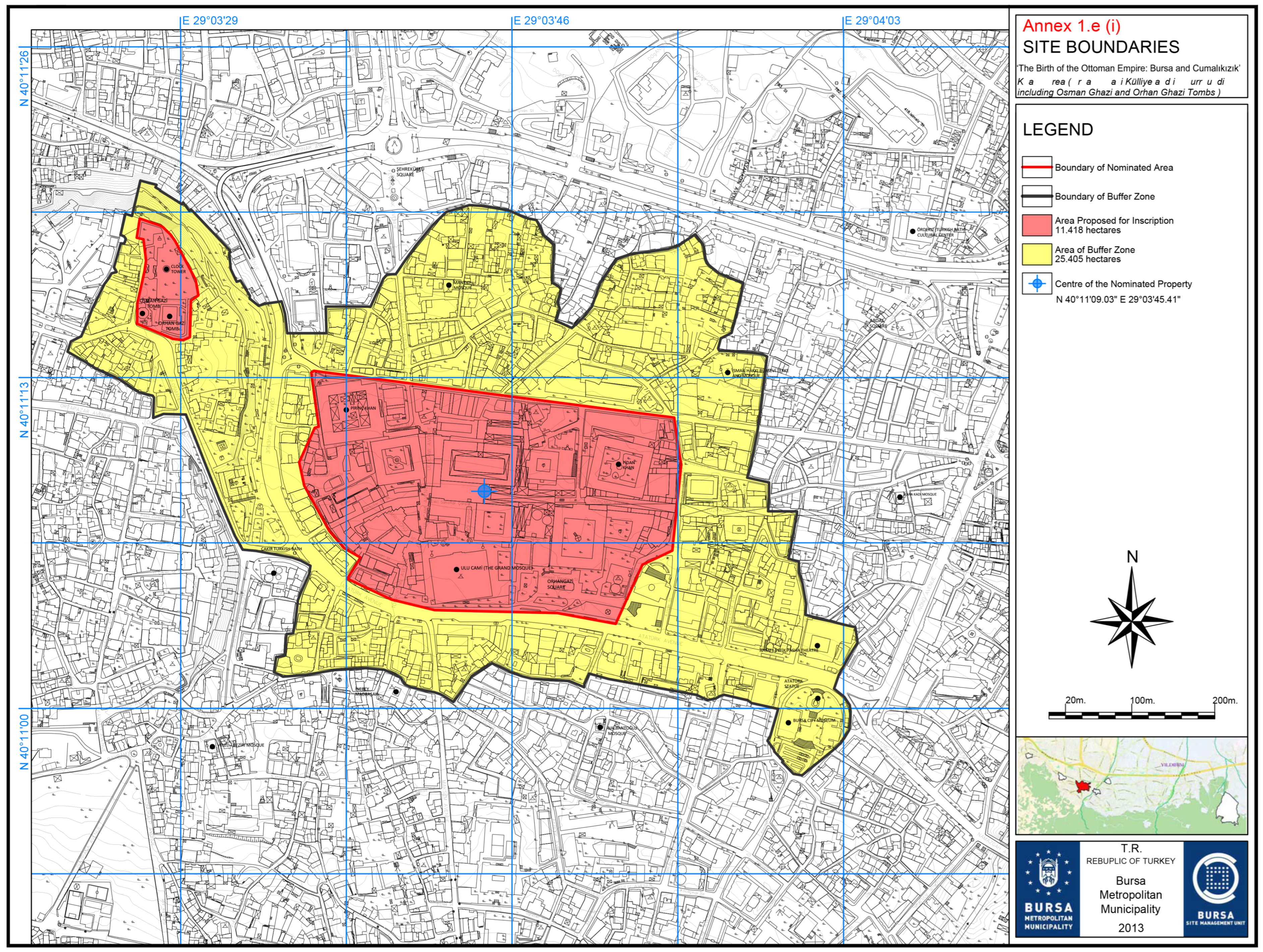
This study examines the Bursa Khans District, located in the historic core of Bursa, Turkey, and designated a UNESCO World Heritage Site in 2014 under the title “Bursa and Cumalıkızık: The Birth of the Ottoman Empire.” The district represents one of the most significant early Ottoman commercial and civic ensembles, characterized by a dense network of khans, covered bazaars, mosques, and public squares embedded within a layered urban morphology shaped from the 14th century to the present. Its spatial identity is defined by organic street patterns, courtyard-based commercial typologies, and pedestrian-oriented public spaces, reflecting a longstanding interplay between trade, culture, and daily life (Figure 1).
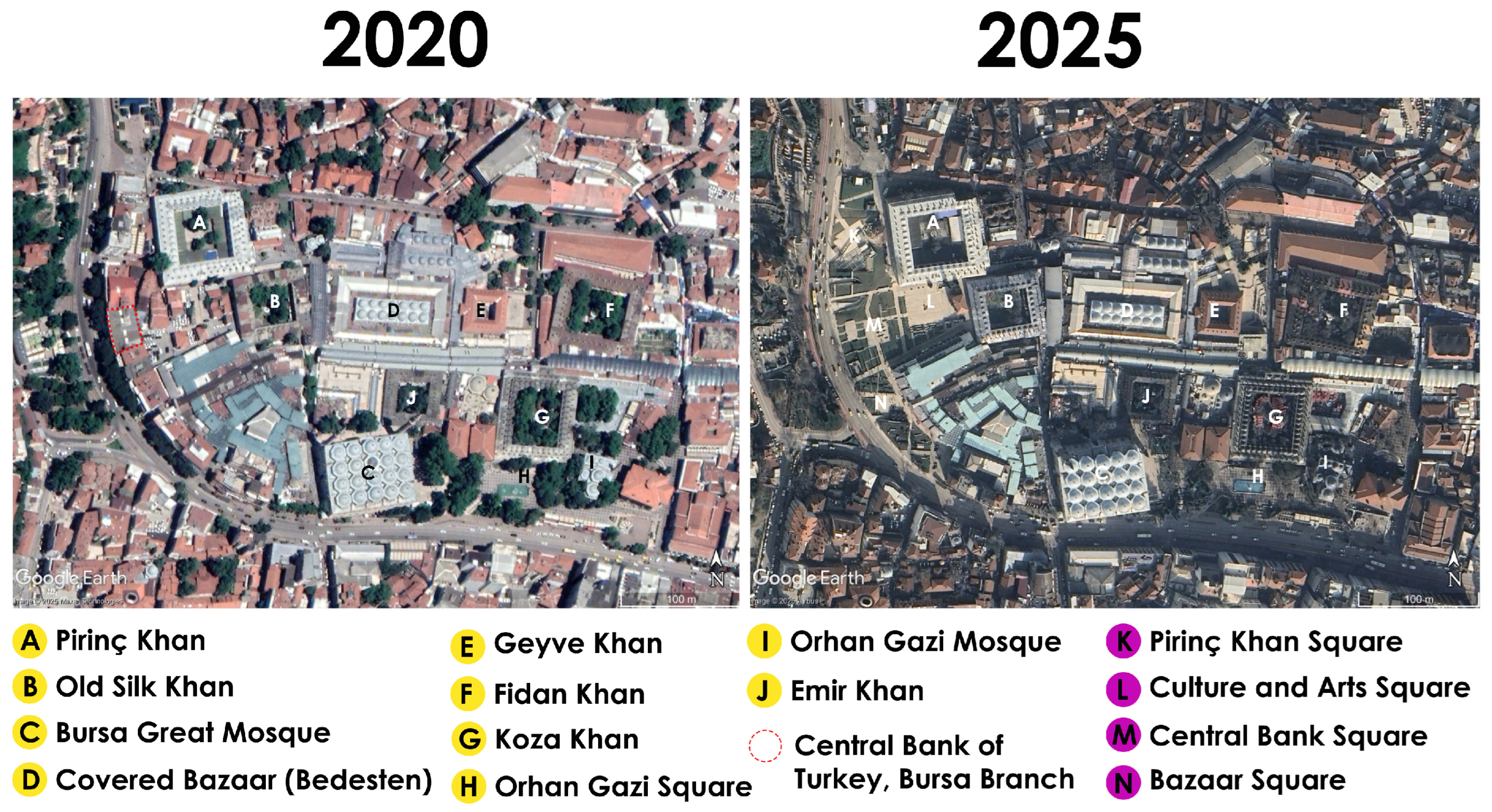
According to the Bursa Site Management Plan (2021–2026), the Khans District constitutes the core heritage area, enclosed by a buffer zone integrating contemporary urban development [25]. Following the “Bursa Historical Bazaar and Khans District–Çarşıbaşı Urban Design Project Competition” launched in 2020, the district underwent substantial spatial transformations, including the reopening of pedestrian axes, the creation of new public squares, and the reorganization of commercial and touristic functions. These interventions significantly reshaped the district’s integration, connectivity, and intelligibility within the wider urban system. Pre- and post-competition spatial structures are illustrated in Figure 2, where newly introduced public spaces and the demolition of the Central Bank building—replaced by a new square—are highlighted.
The broader UNESCO property encompasses the Khans District and Orhan Gazi Complex, along with the Hüdavendigar, Yıldırım, Yeşil, and Muradiye Complexes and Cumalıkızık Village. Within this ensemble, the Khans District forms the commercial and cultural nucleus of the Ottoman city, incorporating major historic structures such as Orhan Mosque, Koza Khan, and Pirinç Khan. The management plan defines the core zone (Orhan Gazi and surroundings) as covering 10,680 hectares, with a 25,405-hectare buffer zone. Spatial interventions implemented between 2020 and 2025—including redesigned pedestrian routes, new open squares, and façade restorations—have reconfigured the area’s morphological and social connectivity, offering a valuable setting to examine the relationship between heritage management, spatial form, and performance.

1.2. Theoretical Background of the Study

1.2.1. Historic Urban Landspace Approach

The primary conceptual foundation of this study is the Historic Urban Landscape (HUL) approach, as defined by UNESCO’s 2011 Recommendation [7]. The HUL framework views historic cities not as static objects but as evolving socio-spatial systems shaped by layered cultural and natural values over time. By linking tangible and intangible heritage, the approach emphasizes the continuity of cultural practices and the dynamic interaction between built form, landscape, and community [7]. The New Urban Agenda [27] and the 2030 Agenda for Sustainable Development [28] further highlight HUL as a key instrument for rethinking heritage-led urban policies.
Following the inscription of “Bursa and Cumalıkızık: The Birth of the Ottoman Empire” on the World Heritage List in 2014, the core and buffer zones—including the Khans District and the surrounding sultan complexes—became focal areas for sustainable management planning. The establishment of the Site Management Unit strengthened the institutional framework for integrated heritage governance. Recent studies stress the need to address Bursa’s historic core holistically, moving beyond monument-centered preservation to a comprehensive landscape perspective [29]. Within this scope, the HUL approach provides a scalable and operational framework for guiding spatial, cultural, and environmental decision-making in historic urban areas.

1.2.2. The 15-Minute City (15MC) Approach

The 15-Minute City (15MC) is a contemporary urban model that conceptualizes cities through the lens of chrono-urbanism, advocating for everyday activities—living, working, education, healthcare, shopping, and leisure—to be accessed within a 15-minute walk or bicycle trip. Moreno et al. (2021) define proximity, diversity, density, and ubiquity as the core principles of this model, framing it as a paradigm that reinforces local living and revitalizes historic centers as active public realms rather than passive conservation zones [11]. Post–COVID-19 urban strategies in Paris, Melbourne, and Valencia further positioned the 15MC as a key framework for reducing car dependency, mitigating emissions, and promoting low-carbon mobility [30].
Recent scholarly work has expanded the conceptual basis of the 15MC [31,32]. Allam et al. (2022) highlight its alignment with net-zero targets, compact mixed-use forms, and pedestrian-oriented mobility networks [12]. The approach has also been integrated into walkability and accessibility research: EPA’s Walkability Index (2021) identifies the design attributes that enhance pedestrian access, while Lam et al. (2022) examine x-minute city models in relation to topography, population density, and service distribution [31]. Liu et al. (2024) demonstrate the variability of functional access times across urban typologies, supporting the adaptability of the 15MC [32]. Similarly, Pozoukidou and Chatziyiannaki (2021) emphasize its applicability for polycentric and historic cities [33]. Beyond these analytical contributions, this approach defines the development of walkable environments, increased pedestrian access to social services, the flexible use of public spaces, and the strengthening of social interaction, public health, and quality of life as its primary objectives [34].
Moreno’s 2024 [35] keynote extends the model to eight principles, including proximity to essential services, organic density, mixed use, quality public spaces, efficient public transport, active low carbon mobility, inclusivity, and ubiquity. Recent studies reveal that operationalizing the 15MC requires integrating walkability, accessibility, and perceptual quality indicators. Research from Montreal identifies safe pedestrian access and environmental quality as key determinants [36]. Advances in deep learning and big data analytics underline the need to incorporate perceptual and subjective measures into street-level evaluations [37]. Studies in post-industrial areas further demonstrate that accessibility, diversity, safety, and perceptual quality must be addressed simultaneously when evaluating 15-minute environments [38]. Collectively, the literature positions the 15MC as a robust framework that integrates sustainability, health, inclusivity, and spatial justice across diverse urban contexts, including historic areas [39].

1.2.3. Space Syntax as Theory and Analytical Tool

Space syntax, as both a theoretical framework and analytical method, offers a powerful lens for understanding how spatial configuration influences social behaviour and movement. Within heritage urbanism, the method provides valuable insights into how historic areas evolve through everyday practices and spatial cultures. Palaiologou and Griffiths (2019) argue that incorporating spatial configuration into heritage management supports the creation of sustainable and inclusive urban environments, particularly when combined with interdisciplinary approaches [40].
Historic city centers, as living cultural landscapes, are continuously shaped by socio-spatial practices. Space syntax analyses move beyond physical form to reveal patterns of accessibility, connectivity, and movement that influence cultural continuity and spatial resilience. Griffiths (2012) emphasizes the method’s potential for historical enquiry when combined with multi-layered spatial data [41]. Empirical studies demonstrate that access and connectivity measures play a critical role in linking heritage areas and enhancing visitor experience [21].
Historic urban cores—containing architectural landmarks, traditional streets, and layered urban fabrics—function as cultural and touristic anchors [42]. Research in urban morphology shows that highly accessible axes shape traditional street networks and support sustainable tourism routes [43]. While Conzen’s morphological regionalization (1960, 1966) contributes to understanding landscape processes [44,45], critics note that rigid zoning and buffer systems may conflict with holistic heritage landscape approaches by overlooking dynamic socio-spatial interactions [46,47,48,49].
Space syntax research underscores the strong interplay between land use and pedestrian movement, while recent work highlights its relevance for analyzing cultural resilience and heritage management [21,42,50,51]. Together, these studies position space syntax as a robust analytical tool for interpreting spatial performance, accessibility, and morphological change in UNESCO World Heritage urban areas.

2. Materials and Methods

2.1. Index-Based Approaches in Urban Sustainability Research

Index-based approaches to urban sustainability assessment have developed along three principal strands: (i) composite sustainability indices at the city scale, (ii) accessibility- and walkability-oriented models derived from the 15-Minute City (15MC) framework, and (iii) governance-focused assessment frameworks rooted in the Historic Urban Landscape (HUL) approach. Although these models differ in scope and emphasis, they share a common objective: translating multidimensional urban performance into measurable and comparable indicators. Table 1 synthesizes the objectives, indicator scopes, normalization techniques, and weighting strategies of representative models widely cited in the literature.
Composite city-scale indices such as CSI [9] and USI [10] offer cross-city comparability through standardized normalization but remain predominantly macro-oriented. Accessibility-oriented 15MC studies [11,12,30] focus on proximity, pedestrian isochrones, POI distribution, and network-based travel times, typically applying min–max or z-score normalization and equal or AHP-based weighting. Walkability indices complement these approaches by incorporating micro-spatial qualities such as pedestrian infrastructure and perceptual comfort [37,38]. Governance-oriented frameworks, most notably UNESCO’s HUL Recommendation [7,8], operationalize institutional capacity through Likert-based indicators but are rarely integrated with spatial or accessibility metrics.
Overall, existing approaches remain largely single-dimensional. None systematically integrate spatial morphology, functional accessibility, and governance capacity at a shared spatial resolution. The Morphological Sustainability Model (MSM) developed in this study addresses this gap by combining Space Syntax, the 15-Minute City framework, and the HUL approach within a unified analytical structure tailored to UNESCO World Heritage urban areas.

2.2. Structure of the Morphological Sustainability Model (MSM)

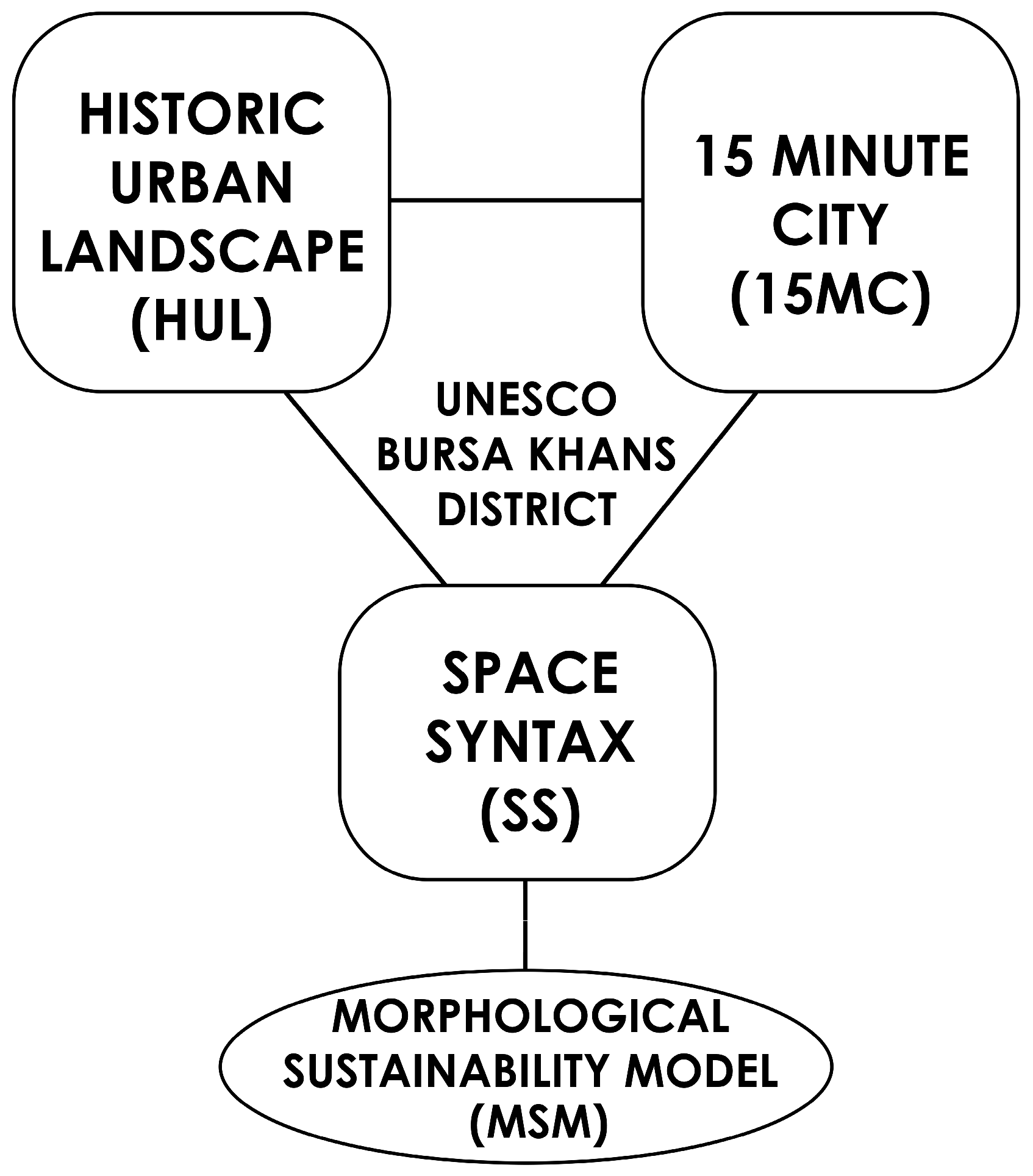
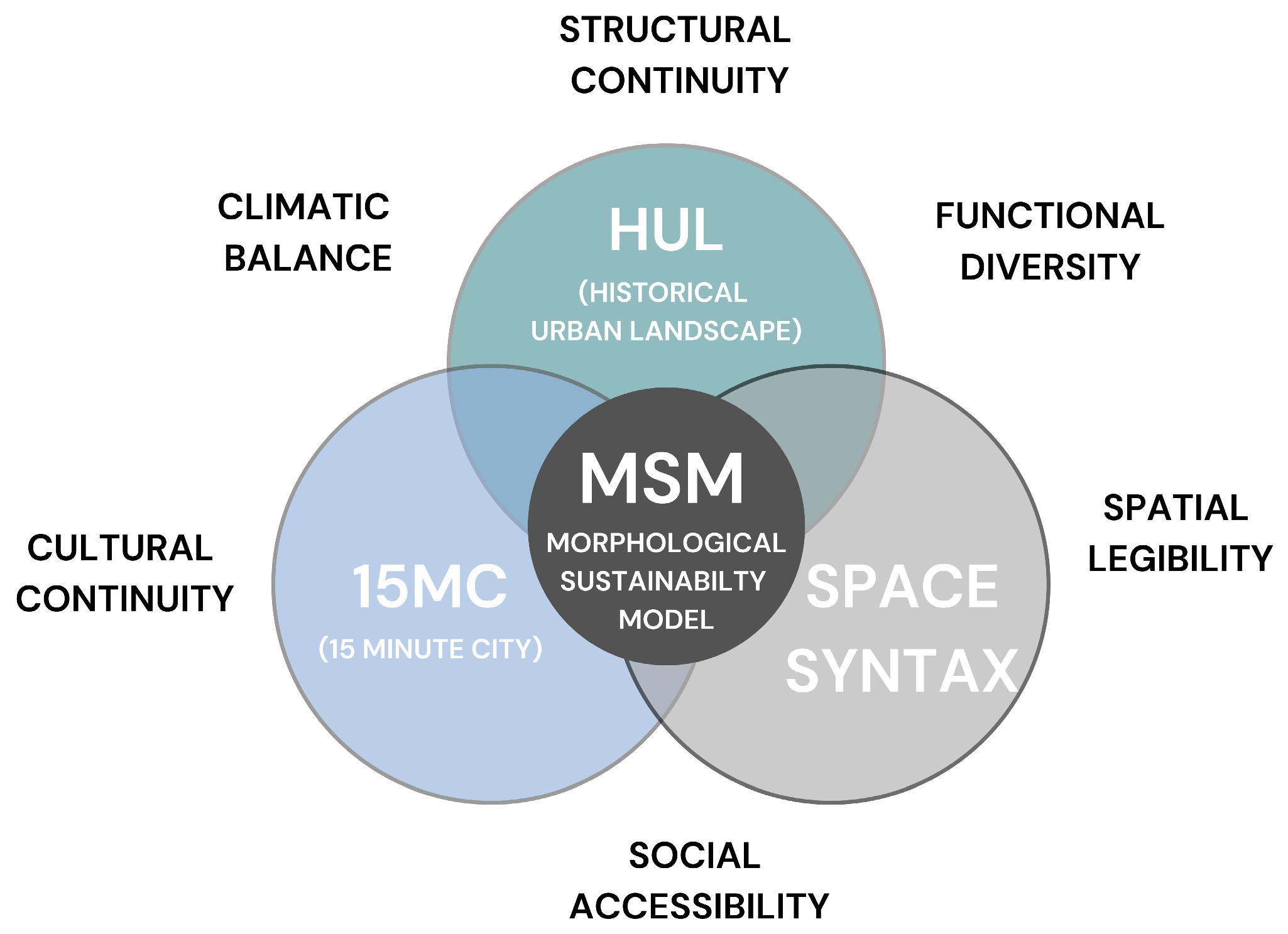
This study integrates the Historic Urban Landscape (HUL), 15-Minute City (15MC), and Space Syntax approaches to assess morphological sustainability in the UNESCO-listed Bursa Khans District. The HUL framework repositions urban morphology within socio-economic and environmental processes, emphasizing resource integration, participation, resilience, vulnerability assessment, and governance. Its seven principles (HUL1–HUL7) provide a structured guide for reading the district’s historical stratification.
The 15-Minute City (15MC) model operationalizes equitable proximity to daily needs by promoting the integration of living, working, education, recreation, and nature within walking distance. Moreno’s eight principles—proximity, density, mixed use, public-space quality, transit efficiency, low-carbon mobility, inclusivity, and ubiquity—are translated here into functional accessibility and diversity indicators (XC1–XC8).
Space Syntax theory [2] quantitatively evaluates spatial configuration through Connectivity (SS1), Global and Local Integration (SS2–SS3), Choice (SS4), Intelligibility (SS5), and Mean Depth (SS6). These metrics illuminate patterns of spatial permeability, pedestrian flow potential, and configurational coherence essential for understanding historic urban systems.
Integrating these three axes, the Morphological Sustainability Model (MSM) is structured into three dimensions:
  • Morphological Dimension: form, connectivity, syntactic performance (SS1–SS6).
  • Functional Dimension: proximity, accessibility, diversity (XC1–XC8).
  • Governance Dimension: heritage management and institutional processes (HUL1–HUL7) (Figure 3).
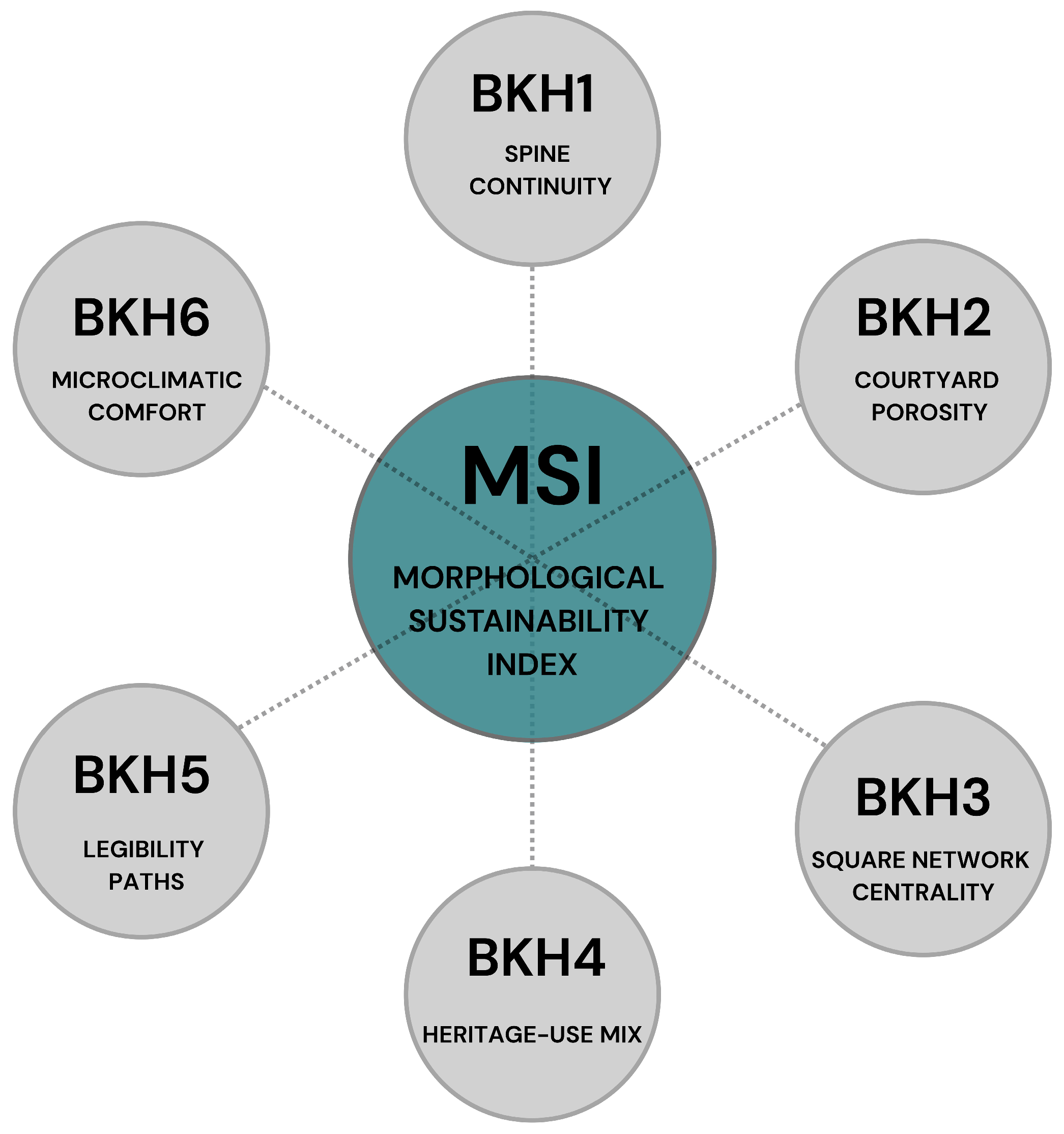
The intersection of these layers yields the district-specific indicators BKH1–BKH6, capturing spine continuity, courtyard porosity, square-network centrality, heritage–use mix, legibility paths, and microclimatic comfort.
A composite Morphological Sustainability Index (MSI) was generated by normalizing all sub-indicators—numerical, ratio-based, or Likert-coded—to a 0–1 scale and assigning weights to each dimension due to the unequal number of sub-indicators. The three analytical layers are (Table 2):
  • SS (Space Syntax): spatial integration, connectivity, choice, legibility
  • HUL (Governance): Likert-coded indicators from UNESCO management plans
  • XC (15MC): functional accessibility, density, mixed-use, mobility indicators
Table 2 summarizes the coding scheme and variable definitions.

2.2.1. Space Syntax Indicators

Space Syntax analysis was employed to quantify the configurational properties of the Bursa Khans District through axial mapping, which represents the urban system using the fewest and longest lines of sight and movement [2]. The analysis produced six core syntactic indicators: Connectivity (SS1), measuring the number of directly connected segments; Global Integration Rn (SS2) and Local Integration R3 (SS3), capturing system-wide and neighborhood-scale accessibility; Choice (SS4), expressing route-based movement potential; Intelligibility (SS5), defined as the correlation between Integration and Connectivity; and Mean Depth (SS6), reflecting configurational hierarchy. All syntactic indicators were computed using Depthmap X and normalized using z-score transformation, log10 scaling, or inverse scaling, following established methodological recommendations [53,54]. Indicator definitions, calculation logic, and scaling procedures are summarized in Table 3.
To explicitly relate Space Syntax measures to morphological sustainability, syntactic indicators were interpreted as proxies for the long-term functional performance and structural stability of urban form. In this framework, Integration (SS2–SS3) represents the capacity of the spatial configuration to sustain accessibility and centrality across scales, while Choice (SS4) captures the robustness of route-based movement and the continuity of urban flows.
Connectivity (SS1) and Intelligibility (SS5) are interpreted as indicators of local coherence and spatial legibility, reflecting the ability of the urban system to support everyday navigation and social interaction. Conversely, Mean Depth (SS6) is treated as a negatively oriented indicator, as increasing depth values signal configurational segregation and reduced functional stability. Together, these indicators operationalize morphological sustainability as the capacity of the spatial network to maintain integrated, legible, and accessible configurations under changing functional and governance conditions.
To ensure comparability among syntactic indicators with different units and statistical distributions, all values were transformed to a common 0–1 scale. A min–max normalization was applied to all positively oriented indicators:
X n o r m = X X m i n X   m a x X m i n
Because lower Mean Depth values indicate better spatial performance, this indicator was inverted after normalization:
MD* = 1 − MDnorm
The Space Syntax sub-index (SS′) was then calculated as the arithmetic mean of the six normalized indicators:
SS = (GInorm + LInorm + Connnorm + Choicenorm + MD* + Intellnorm)/6
This procedure ensures that all syntactic variables follow the same interpretive logic, where higher values consistently represent better configurational performance. Although Global Integration (Rn) and Mean Depth (MD) are mathematically inversely related, both measures were retained in the model to capture complementary aspects of configurational performance: Rn reflects global accessibility potential, whereas MD expresses hierarchical depth within the system. Nevertheless, this partial redundancy is acknowledged as a methodological limitation of the index. Since intelligibility is expressed as an R2 value bounded between 0 and 1, it was not subjected to additional normalization procedures.
SS′ was calculated as the arithmetic mean of the normalized segment/axial-level GI, LI, Connectivity, Choice, the inverted Mean Depth (MD), and Intelligibility indicators for the core focus area.

2.2.2. Historic Urban Landscape (HUL) Indicators

The governance dimension of the MSM is structured around UNESCO’s Historic Urban Landscape (HUL) framework [7,8]. Governance performance was assessed using a structured Likert-based rubric (1–5) developed to allow a consistent comparison between the 2013–2018 and 2021–2026 Bursa World Heritage Site Management Plans (Table 4). The seven indicators (HUL1–HUL7) capture participation, resilience, institutional coordination, vulnerability assessment, public–private partnerships, monitoring systems, and awareness and visitor management.
The Total HUL Score was calculated as the arithmetic mean of the seven indicators. To ensure compatibility with the spatial and functional layers of the model, the aggregated HUL score was subsequently normalized to the 0–1 range using the same min–max transformation described above. The resulting HUL′ value represents the governance and institutional capacity component of morphological sustainability.
Governance performance within the MSM was quantified using a Likert-based scoring system derived from the UNESCO Historic Urban Landscape (HUL) framework. Each of the seven governance principles (HUL1–HUL7) was scored on a 1–5 scale based on the level of implementation and institutionalization described in the 2013–2018 and 2021–2026 Bursa World Heritage Site Management Plans.
For each period, the individual HUL scores were aggregated by calculating their arithmetic mean to obtain the Total HUL Score:
Total_HUL_Score = (HUL1 + HUL2 + HUL3 + HUL4 + HUL5 + HUL6 + HUL7)/7
To ensure comparability with the spatial and functional layers of the MSM, the Total HUL Score was subsequently rescaled from the 1–5 Likert range to a continuous 0–1 index using min–max normalization:
HUL′ = (Total_HUL_Score − 1)/4
The resulting normalized HUL′ value represents the governance capacity component of morphological sustainability and is integrated into the MSI formulation alongside the spatial (SS′) and functional (XC′) sub-indices

2.2.3. 15-Minute City Functional Indicators (XC1–XC6)

The functional layer evaluates spatial and service accessibility through the 15-Minute City (15MC) framework [11]. Six indicators—Density (XC1), Proximity (XC2), Mixed Use (XC3), Accessibility (XC4), Active Mobility (XC5), and Inclusivity (XC6)—were calculated within a 15-minute pedestrian isochrone (Table 5).
In this study, functional accessibility and diversity in the Bursa Khans District were evaluated using six core indicators (XC1–XC6) derived from the 15-Minute City (15MC) framework. Due to the unavailability of the official post-competition vector dataset, the indicators were constructed through a comparative morphological observation approach based on satellite imagery, functional maps, pedestrian-network representations, and visual datasets provided in site management reports.
The six indicators capture complementary dimensions of functional sustainability. Density (XC1) represents the ratio of built-up area to total study area and reflects changes in built mass. Proximity (XC2) measures access to functional zones or points of interest (POIs) within a 15-minute pedestrian isochrone. Mixed Use (XC3) evaluates land-use balance using the Shannon entropy index. Accessibility (XC4) reflects network-based pedestrian movement potential, calculated as the mean of normalized closeness and choice values. Active Mobility (XC5) assesses walkability and bicycle accessibility through the presence and continuity of pedestrian and cycling infrastructure. Inclusivity (XC6) measures the availability and accessibility of public and social functions within the study area.
  • Density indicator (XC1): The density indicator XC1 represents the relative built-up ratio of building masses within the bazaar fabric. It is calculated by dividing the total built-up area by the total study area.
    Formula: XC1 = Built-up Area/Total Study Area
    Demolitions and new square–open space arrangements implemented after the design competition resulted in a decrease in XC1 in 2025.
  • Proximity indicator (XC2): The proximity indicator XC2 is based on the distribution of functional zones within the 15-minute isochrone for 2020, and on POI accessibility for 2025.
    Formulas:
    2020: XC2 = Functional Zones within Isochrone/Total Functional Zones
    2025: XC2 = Accessible POI/Total POI
    The creation of continuous public squares and the strengthening of the pedestrian network caused XC2 to increase in 2025.
  • Mixed-use indicator (XC3): The mixed-use indicator XC3 measures the balance of functional distribution. It is calculated using the Shannon entropy index.
    Formula: XC3 = −Σ pᵢ ln(pᵢ)
    Visual analysis indicates that although some commercial functions declined in 2025, the overall mixed-use pattern remained largely preserved.
  • Accessibility indicator (XC4): The accessibility indicator XC4 focuses on network connectivity and movement potential within the pedestrian system. It is computed by averaging normalized closeness and choice values.
    Formula: XC4 = (Norm(Closeness) + Norm(Choice))/2
    Increased pedestrian continuity during the post-competition period contributed to the rise of XC4 in 2025.
  • Active mobility indicator (XC5): The active mobility indicator XC5 evaluates walkability and bicycle accessibility together.
    Formula: XC5 = Walkability Score + Bikeability Score
    New pedestrian arrangements and continuous open-space connections caused XC5 to increase in 2025.
  • Inclusivity indicator (XC6): The inclusivity indicator XC6 represents the accessibility of public services within the area. In 2020, it reflects the proportion of public-function areas; in 2025, the proportion of accessible public POIs.
    Formulas:
    2020: XC6 = Public Function/Total Function
    2025: XC6 = Accessible Public POI/Total Public POI
    New public-space interventions contributed to higher XC6 values in 2025.
Indicator calculations were adapted to data availability. For 2020, proximity and inclusivity indicators were derived from functional zoning within pedestrian isochrones, whereas for 2025 they were based on accessible POIs identified through validated spatial datasets. All indicators were normalized to a 0–1 scale to ensure comparability across time periods and thematic dimensions. The resulting values therefore represent relative trend measures rather than exact geometric quantities, allowing consistent comparison between 2020 and 2025 within the Morphological Sustainability Model. Because these indicators operate in different units and measurement logics, all values were normalized to the 0–1 range using min–max normalization to ensure comparability across dimensions. The Functional Accessibility sub-index (XC′) was then computed as the arithmetic mean of the six normalized indicators:
XC = (XC1norm + XC2norm + XC3norm + XC4norm + XC5norm + XC6norm)/6
This approach aligns with recent 15MC operationalizations that emphasize relative performance and trend comparison rather than absolute geometric precision. Following the normalization of all spatial, functional, and governance indicators, the Morphological Sustainability Index (MSI) was calculated as a weighted linear combination of the three sub-indices:
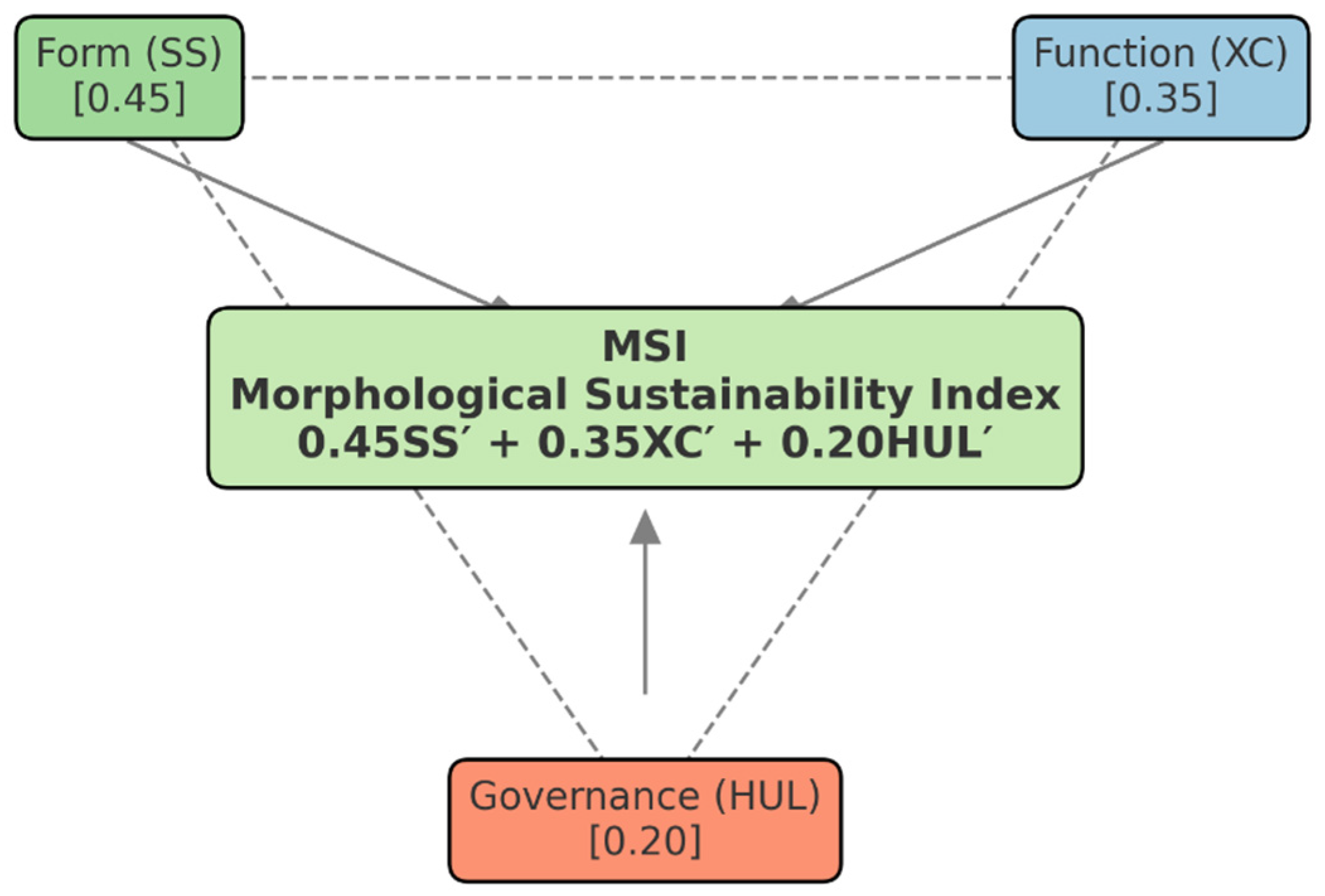
MSIw = 0.45SS′ + 0.35XC′ + 0.20HUL
Weights were determined through expert-based assessment supported by factor-analytic reasoning and subsequently tested through Monte Carlo–based sensitivity analysis (see Validation Section 3.5).

2.3. Construction of the Morphological Sustainability Index (MSI)

Following the normalization of all spatial, functional, and governance-related indicators, the Morphological Sustainability Model (MSM) was operationalized through its composite numerical expression, the Morphological Sustainability Index (MSI). As conceptually illustrated in Figure 4, the MSM is structured around the interaction of three analytical layers—spatial form (Space Syntax), functional accessibility (15-Minute City), and governance capacity (Historic Urban Landscape)—which together define morphological sustainability as a multidimensional condition rather than a purely physical attribute.
All indicators within each layer were first transformed to a common 0–1 scale to ensure cross-dimensional comparability. Layer weights were assigned through expert-based assessment supported by factor-analytic reasoning, resulting in weights of wSS = 0.45, wXC = 0.35, and wHUL = 0.20. While this formulation defines the conceptual balance between form, function, and governance, the operational calculation of the MSI is performed through six district-specific composite indicators (BKH1–BKH6), which translate these layers into spatially explicit and heritage-sensitive variables.
The internal logic of this aggregation is illustrated in Figure 5, which shows how the three analytical layers inform the construction of the MSI through intermediary indicators rather than functioning as directly additive components.
The MSI is calculated as the weighted composite of six indicators (BKH1–BKH6), each representing a specific morphological or functional attribute of the Bursa Khans District. Indicators BKH1 (Spine Continuity), BKH3 (Square Network Centrality), and BKH5 (Legibility Paths) are predominantly informed by Space Syntax metrics, whereas BKH2 (Courtyard Porosity), BKH4 (Heritage–Use Mix), and BKH6 (Microclimatic Comfort) integrate functional accessibility (15MC) and governance-related (HUL) dimensions.
Table 6 summarizes the conceptual definition of each BKH indicator and its relationship to the three analytical layers.
All BKH indicators were normalized to the 0–1 range and aggregated using indicator-specific weights (wᵏ), yielding the MSI as
M S I = k = 1 6 w k ·   B K H k
where wᵏ denotes the relative contribution of each indicator and BKH′ represents its normalized value. The final weights assigned to each BKH indicator are reported in Table 7.
For interpretative clarity, the contribution of each analytical layer to the MSI can be expressed as
MSIw = 0.45(SS′: BKH1, BKH3, BKH5) + 0.35(XC′: BKH2, BKH4) + 0.20(HUL′: BKH1, BKH2, BKH4)
This formulation clarifies that the three layers do not operate as parallel additive indices, but rather as theoretical and empirical inputs shaping the BKH indicators themselves. The resulting structure of the MSI and the contribution of each BKH indicator are visually summarized in Figure 6.
To enhance interpretative clarity, the conceptual meaning and analytical role of each BKH indicator are briefly summarized below:
  • BKH1—Spine Continuity: Measures the spatial continuity along the historic bazaar axis connecting khans, covered markets, and public spaces. Higher values indicate uninterrupted pedestrian movement and reflect the functioning of the historic core as an integrated spatial spine.
  • BKH2—Courtyard Porosity: Represents the degree of openness and pedestrian permeability of khan courtyards. This indicator reflects courtyard configurations that support spatial openness, accessibility, and everyday public use.
  • BKH3—Square Network Centrality: Measures the hierarchical position of public squares within the spatial network and their potential to support social interaction. It captures the capacity of central squares to organize gathering, orientation, and public life.
  • BKH4—Heritage–Use Mix: Reflects the functional diversity and intensity of everyday use within registered heritage buildings. This indicator evaluates not only the conservation of cultural heritage but also its activation through continued and diversified use.
  • BKH5—Legibility Paths: Represents the relationship between visual connectivity and pedestrian orientation. Higher legibility indicates an urban structure that supports intuitive navigation and spatial comprehension for users.
  • BKH6—Microclimatic Comfort: Expresses microclimatic conditions within the built environment, including shading, airflow, and temperature mitigation. This indicator represents environmental performance factors that influence pedestrian comfort and the usability of open spaces.

2.4. Data Processing and Validation

In this study, AI-based image processing techniques were employed not as the final means of spatial data production, but as a pre-analytical exploratory and comparative validation tool. The Gemini Vision model and k-means clustering were applied to satellite imagery to generate initial classifications of built-up areas, open spaces, and green areas. Preliminary tests revealed that spectral similarities between shaded surfaces and roof materials can introduce uncertainties in automated classifications (Appendix A.1).
For this reason, all AI-generated outputs were subjected to a manual validation process. Representative sub-areas with distinct morphological characteristics were examined through expert visual inspection, misclassified pixels were filtered out, and spatial layers were corrected accordingly. The spatial datasets used in the final analyses were constructed by rasterizing OSM building footprints for built-up areas, using OSM highway layers for the street network, and integrating visually interpreted and corrected classifications for open and green spaces.
Accordingly, the 15-Minute City (15MC) indicators (XC1–XC6) were not derived directly from AI outputs but were calculated using validated, corrected, and contextually controlled spatial datasets. In this framework, GenAI tools played a supportive and assistive role, while analytical decisions were shaped through human oversight and spatial-theoretical reasoning.
The reliability of the model’s decision structure was further examined through a two-stage validation process. In the first stage, the weights assigned to the Space Syntax (SS), functional accessibility (XC), and governance (HUL) dimensions were determined using a Delphi technique conducted with an interdisciplinary expert panel. In the second stage, the robustness of this weighting scheme under uncertainty was tested using a Monte Carlo–based sensitivity analysis (n = 5000). The simulation results demonstrate that, despite random variations in weights, the direction of MSI change remains consistent across all iterations, indicating that the model outputs are not sensitive to a single weighting assumption and exhibit strong methodological stability.

3. Results

The proposed model was applied to the Bursa Khans District by comparing two governance and intervention contexts: the pre-2020 phase represented by the 2013–2018 Management Plan, and the post-competition phase represented by the 2021–2026 Management Plan. The 2020 urban design competition constitutes a critical turning point, as it triggered a series of pedestrianisation, public-space, and open-space interventions that reshaped both the spatial configuration and the functional performance of the historic core.

3.1. Spatio-Morphological Shifts Based on Space Syntax Analysis

Space Syntax results indicate that the configurational transformation of the Khans District between 2020 and 2025 is characterised less by absolute increases in integration metrics and more by a redistribution of spatial hierarchy and an improvement in legibility. At the system level (Table 8), Global Integration, Local Integration, and Connectivity show modest declines (−2.16%, −4.49%, and −3.30%, respectively), indicating a slight weakening of overall integrative dominance across the entire grid. In contrast, Intelligibility (R2) increases by +8.78%, implying that the relationship between local connectivity cues and global structure became clearer for users. Choice decreases by −12.02%, pointing to a reduction in route diversity and a tendency toward more channelled movement patterns, while Mean Depth shows only a marginal decline (−1.04%), consistent with a subtle improvement in overall navigability.
In this study, space syntax indicators were primarily evaluated using an extended analytical field that includes the core of the Khans District, its buffer zone, and the surrounding urban fabric. However, to isolate the spatial response of the area where transformation is most direct and concentrated, syntactic values were also calculated separately for the UNESCO heritage core zone only and are presented in Table 9. This micro-scale reading enables a clearer interpretation of the spatial effects of the interventions in the Khans District, particularly in contrast to the more diffuse and context-driven morphological changes observed across the wider urban fabric (Appendix A.2).
Although limited decreases are observed in the raw mean values of some syntactic indicators related to the extended analysis area in Table 9, when the spatial configuration sub-index (SS′) is recalculated specifically for the core focus area—where the effects of interventions are most directly observed—it increased from 0.317 in 2020 to 0.373 in 2025, representing a 17.4% rise. This increase was obtained by transforming the indicators to a 0–1 scale using the min–max method, reversing Mean Depth (MD* = 1 − MD_norm), and taking the arithmetic mean of the six normalized indicators.
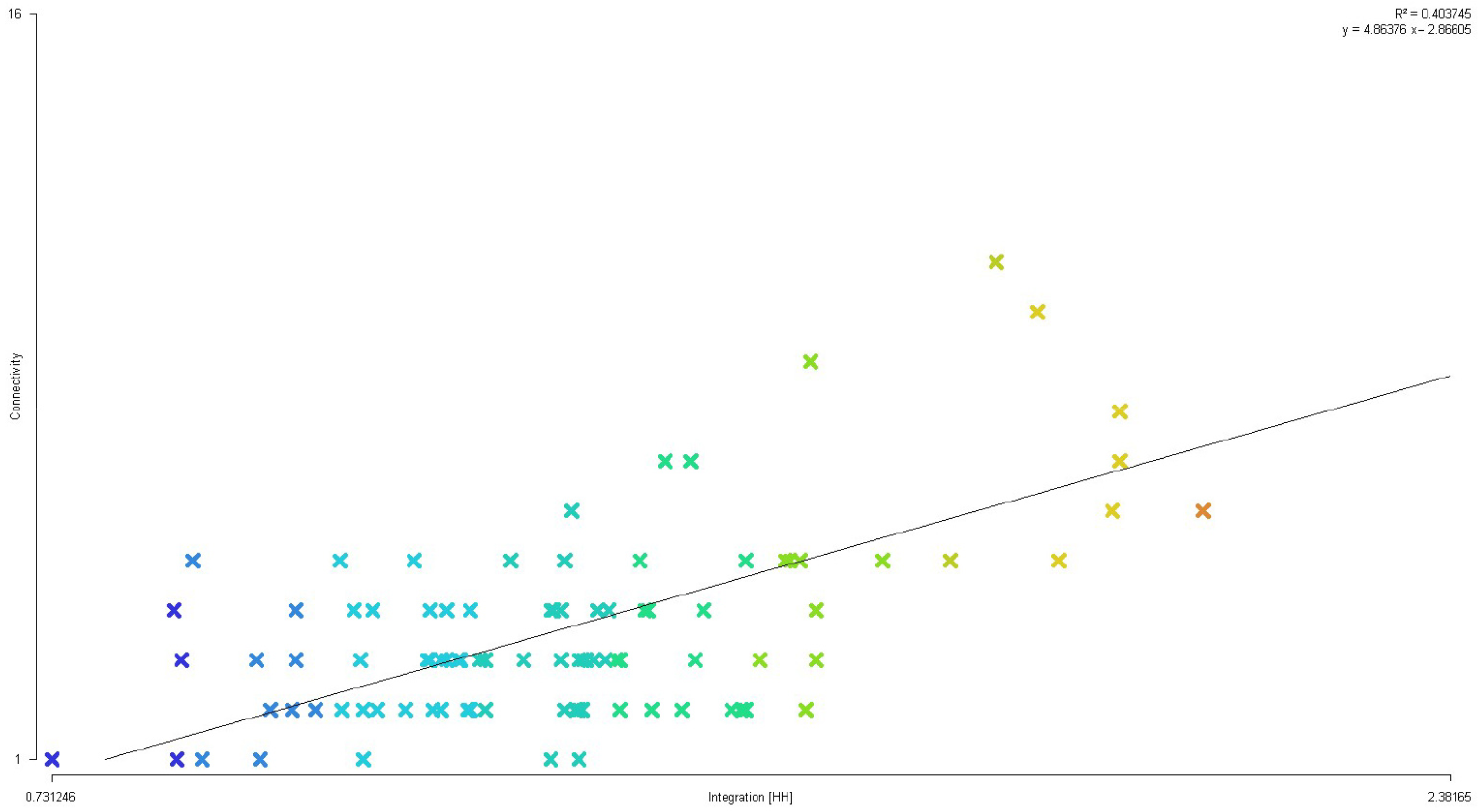
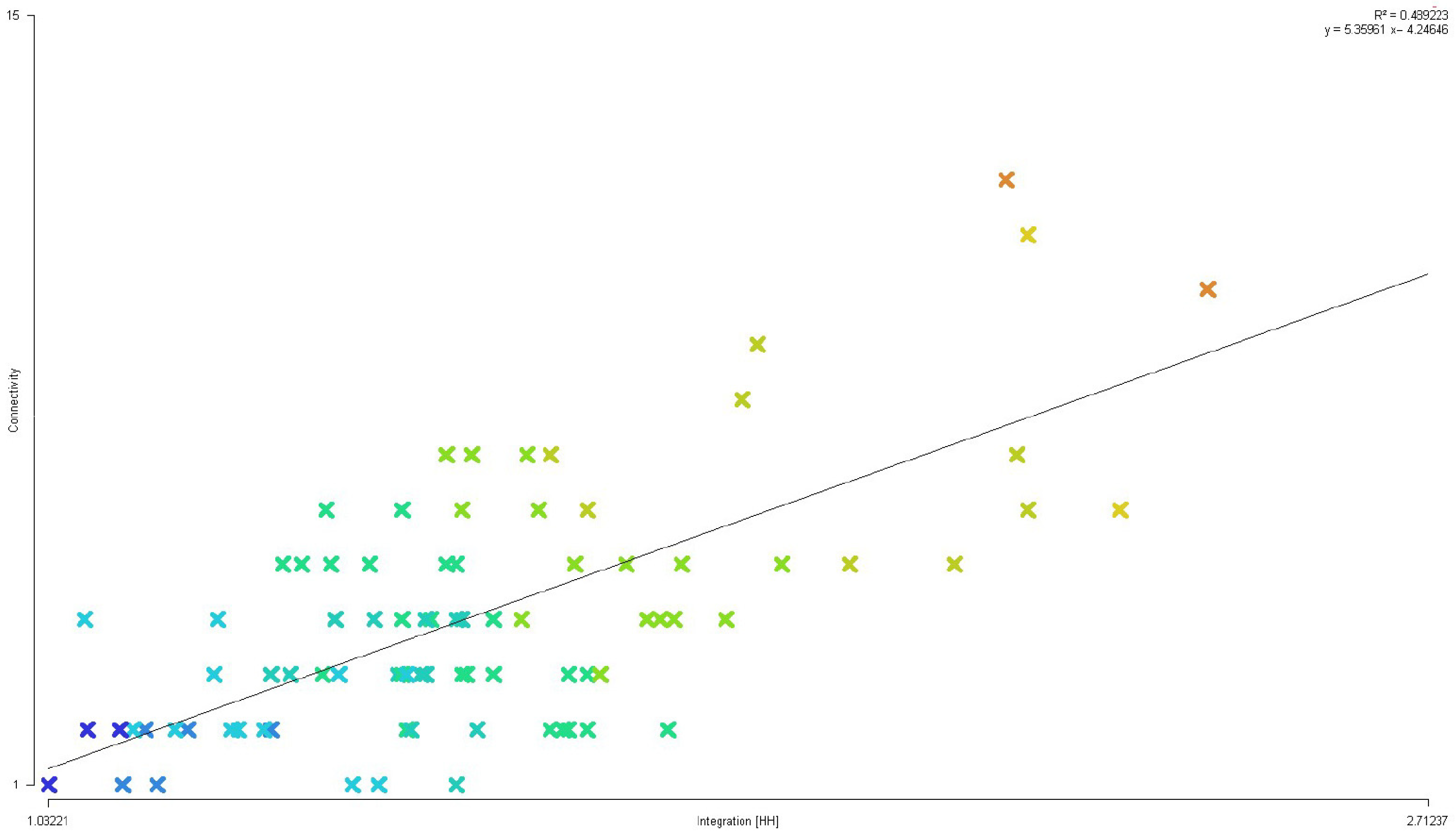
The intelligibility scatterplots (Figure 7 and Figure 8) support this interpretation. Although the values remain within a low-intelligibility range, the increase from R2 = 0.403745 (2020) to R2 = 0.489223 (2025) suggests a gradual strengthening of wayfinding clarity and street-hierarchy readability. This aligns with the notion that intelligibility reflects how effectively users infer global structure from local cues, as discussed by Hillier and Iida (2005) [55]. Comparable evidence from the Yushan Historic District similarly shows that low intelligibility constrains wayfinding and limits the capacity of local streets to communicate the overall configuration [56]. The modest rise observed in Bursa therefore indicates not a radical reconfiguration, but an incremental improvement in the system’s cognitive accessibility.
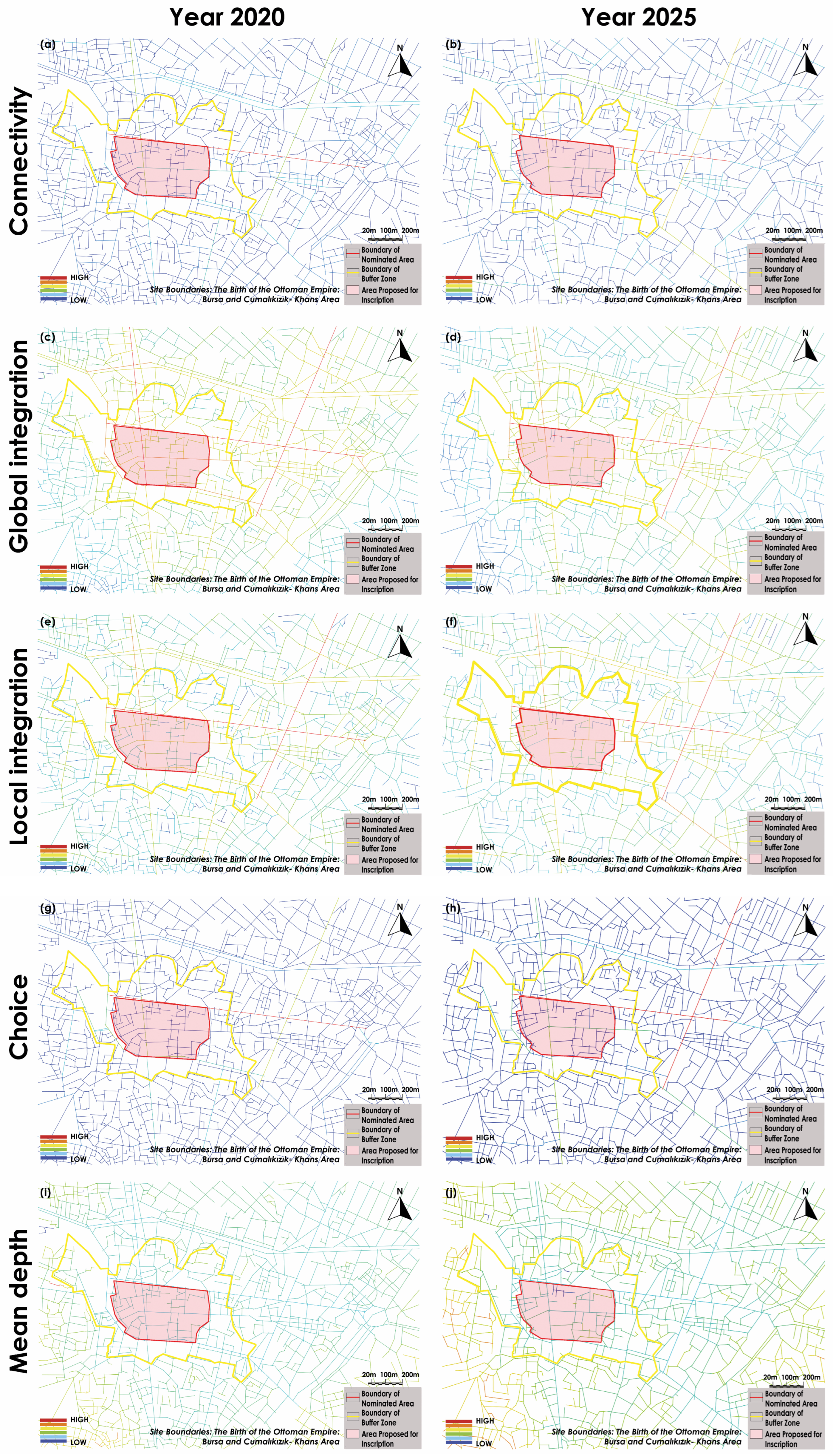
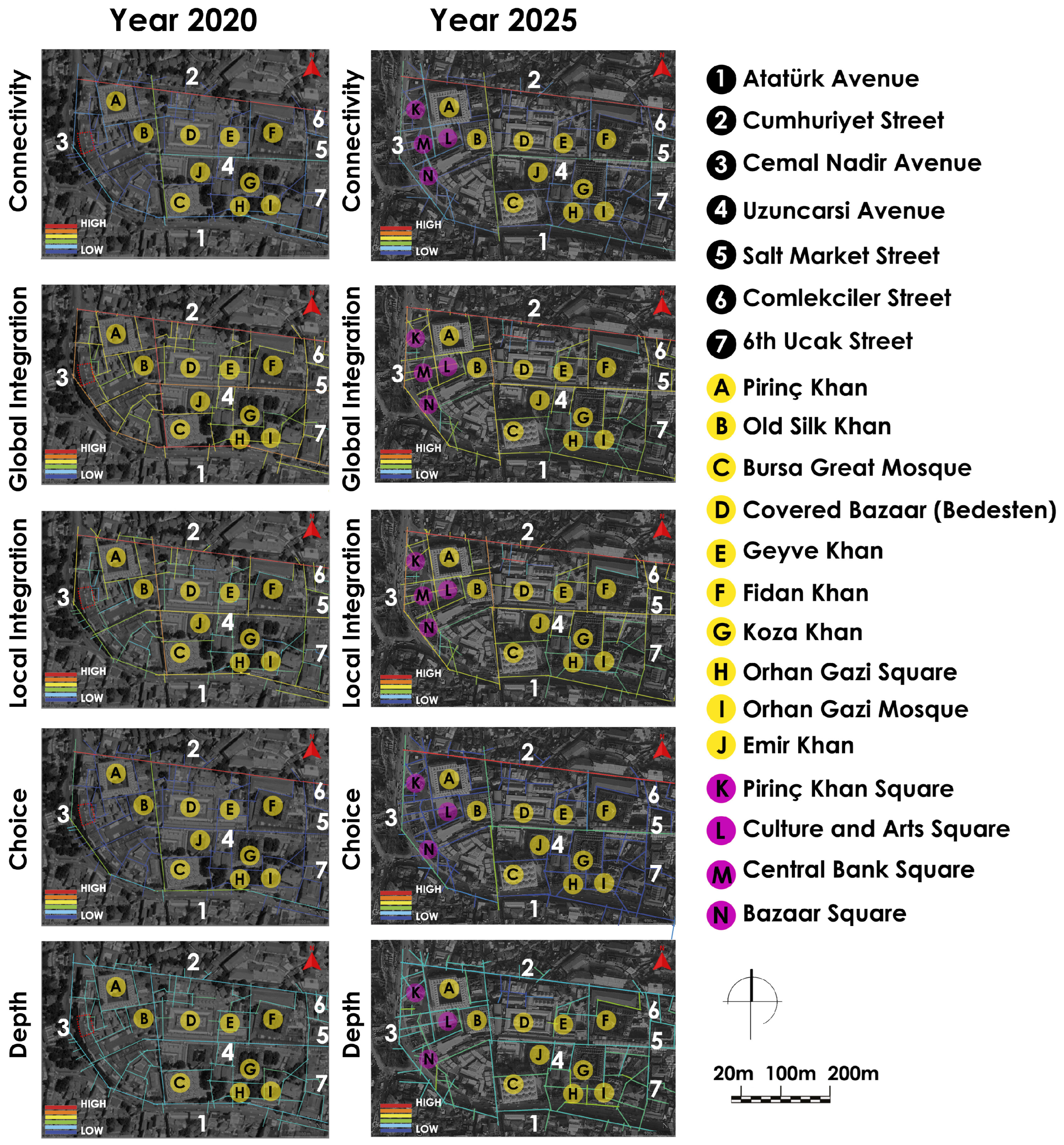
The spatial patterns mapped in Figure 9 show visible intensifications in the UNESCO heritage core zone and buffer zones for Connectivity (a–b), Global Integration (Rn) (c–d), and Local Integration (R3) (e–f), suggesting that the network structure became more consolidated around key pedestrian corridors and newly emphasised public spaces. As shown in Figure 9, the comparison between 2020 and 2025 indicates a rebalancing of spatial hierarchy rather than a uniform increase in syntactic values. While connectivity and integration values become more concentrated within the historic core and along the bazaar spine, the Choice and Mean Depth maps reveal that movement potential is redirected toward fewer and more legible routes. This pattern suggests that post-2020 interventions have contributed to a more pedestrian-oriented and cognitively readable spatial structure. Figure 10 further illustrates how centrality shifts concentrate around the internal bazaar spine and newly opened northern squares (K–N). While the colour-scale intensification in Connectivity and Integration values indicates increased prominence of these spaces, the cooling of Choice in 2025 suggests that route decisions became less dispersed and more organized around fewer dominant movement channels. In combination, these changes point to a more readable and pedestrian-oriented spatial structure, where the historic core gains configurational clarity even as some arterial-street dominance is reduced.
Street-level results (Table 10) indicate that the post-2020 interventions altered the internal balance between arterial streets and the bazaar network. Integration declines on major avenues such as Atatürk Avenue and Cemal Nadir Avenue, whereas the Uzunçarşı/Salt Market spine shows a slight increase, indicating a relative strengthening of the historic commercial corridor. Choice values show the most pronounced redistribution: decreases on formerly vehicle-dominant arteries coincide with a sharp increase along Uzunçarşı, suggesting a shift in movement potential toward the inner bazaar after 2025. Mean Depth generally increases on some main streets while decreasing along Uzunçarşı, consistent with a more direct and navigable internal spine.
Overall, the Space Syntax findings indicate that the district’s transformation is best described as a rebalancing: arterial dominance is reduced, the internal bazaar spine becomes more prominent in movement logic, and intelligibility improves modestly—together supporting a more pedestrian-centred and user-oriented spatial configuration.

3.2. HUL (Governance) Findings

The HULSCORE assessment based on management plan documents indicates a substantial strengthening of governance capacity between the 2013–2018 and 2021–2026 periods (Table 11). Improvements are most pronounced in participation, institutional coordination, vulnerability assessment, and monitoring/indicator systems, while progress is also observed in PPP-related actions and visitor management. The rise in the average HUL score from 2.00 to 3.57 is reflected in the increase in the normalised governance layer score from 0.25 to 0.64, indicating that governance tools evolved from relatively limited capacity to a more systematic, multi-stakeholder, and accountable structure after 2020.
The weighted governance layer increase from 0.62 to 0.68 (+9.7%) suggests that heritage governance mechanisms became more embedded in planning and implementation processes. Interpreted alongside spatial and functional results, the governance gains provide an institutional basis that supports the broader transformation captured by the Morphological Sustainability Model.

3.3. Functional Accessibility and 15-Minute City Findings

Functional accessibility and diversity indicators (XC1–XC6) show a clear post-2020 shift toward improved pedestrian performance and inclusive public-space provision (Table 12). Density (XC1) decreases (–22.6%), consistent with demolition of selected building blocks and expansion of open space. In contrast, proximity (XC2), accessibility (XC4), active mobility (XC5), and inclusivity (XC6) all increase substantially (+30.9%, +26.8%, +34.0%, and +47.3%, respectively), indicating strengthened pedestrian continuity, improved wayfinding conditions, growth of open-space connections, and expanded accessible public areas. Mixed-use (XC3) remains relatively stable (–5.1%), suggesting that overall functional diversity was largely preserved despite partial decline in certain commercial uses.
Because the official post-competition vector dataset has not been released, these values should be interpreted as normalised trend measures derived from validated spatial layers rather than as exact geometric outputs. Importantly, the AI-assisted pre-classification step did not function as a black-box determinant of results: final indicator layers were produced through corrected and validated datasets (e.g., OSM-based building/road layers and manually verified open/green space layers). Consistency checks showed that the main direction of change remains stable under alternative processing choices, supporting the robustness of the functional accessibility trends reported here.
According to the formulation defined in the Methods section (Equation (12)), the Functional Accessibility sub-index (XC) values for 2020 and 2025 were calculated as follows:
XC 2020   =   0.62   +   0.55   +   0.78   +   0.41   +   0.47   +   0.38 6   =   0.535
XC 2025 = 0.48 + 0.72 + 0.74 + 0.52 + 0.63 + 0.56 6   =   0.6083
Although Table 8 shows modest declines in several configurational averages—namely Global Integration, Local Integration, Connectivity, and Choice—the functional accessibility indicators in Table 12 reveal a clear improvement in pedestrian-oriented performance. This divergence reflects a structural scale difference between network-level syntactic hierarchy and user-scale experiential accessibility. Moreover, the analytical field extends beyond the core and buffer zones of the Khans District, encompassing a wider urban fabric; therefore, syntactic values are also influenced by morphological changes in the surrounding context. Nevertheless, the most pronounced transformation is observed within the Khans District itself. Axis-based evidence supports this interpretation: local integration values along the internal bazaar spine increased between 2020 and 2025, with Uzunçarşı and Tuzpazarı streets rising from 3.08414 to 3.10607. Likewise, connectivity values increased on key arteries, including Atatürk Avenue (7 to 9), Cemal Nadir Avenue (6 to 11), and 6th Uçak Street (7 to 8) (Table 10). These findings indicate that, despite slight declines in overall syntactic means, the spatial system has evolved toward a more balanced, legible, and pedestrian-friendly configuration, pointing to a functional–configurational trade-off centred on the Khans District. This trend is also quantitatively confirmed by the Functional Accessibility sub-index, which—according to the Formulation (12)—rises from 0.535 in 2020 to 0.6083 in 2025. Moreover, when syntactic indicators are recalculated at the micro scale for the Khans District core area only, the spatial effects of the interventions become more clearly visible; this is also explicitly confirmed by the findings presented in Table 9, which provide a reading isolated from the broader, context-driven morphological changes observed across the wider urban fabric.

3.4. MSI Comparison and Integrated Interpretation

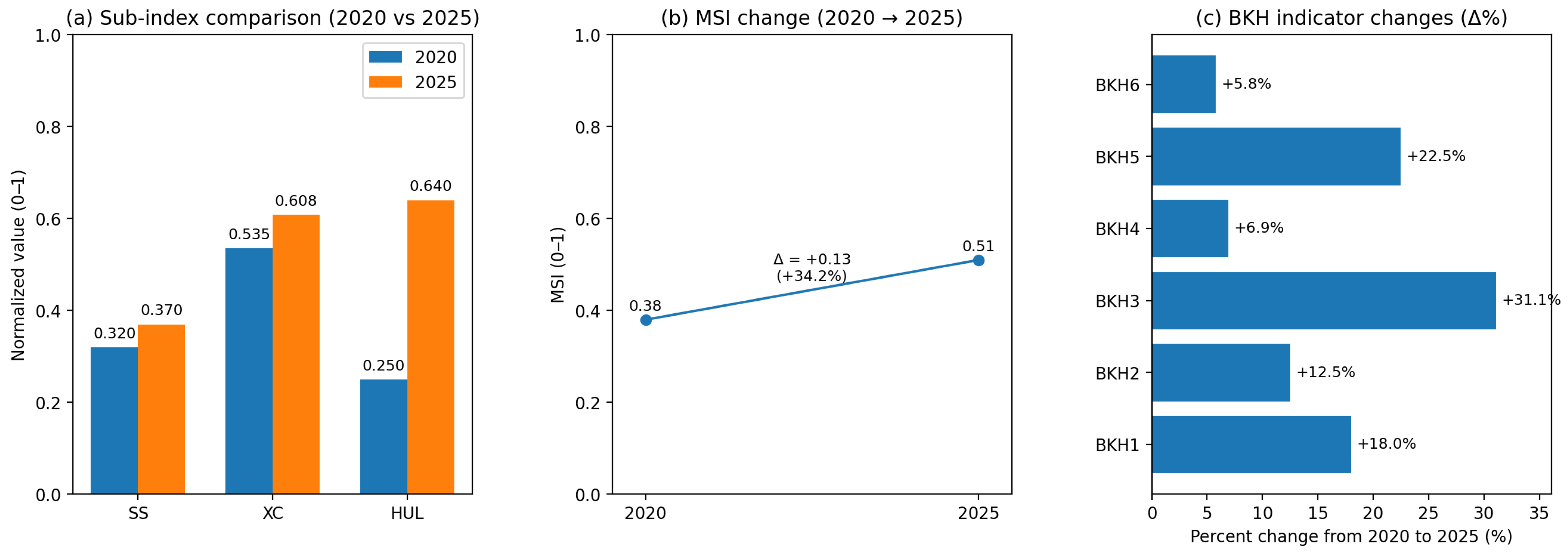
The sub-index results demonstrate that the district’s morphological sustainability performance improved between 2020 and 2025. The Space Syntax sub-index increases from 0.32 to 0.37, indicating stronger configurational performance overall. The governance component (HUL) shows the most pronounced rise (0.25 to 0.64), reflecting strengthened institutional capacity and management coherence. The functional accessibility sub-index also improves (0.535 to 0.608), consistent with gains in proximity, accessibility, active mobility, and inclusivity (Table 13).
The composite MSI increases from 0.38 to 0.51 (+34.2%), suggesting a consistent improvement in the overall morphological sustainability capacity of the heritage core. This rise is supported by the combined effect of (i) rebalanced spatial hierarchy and modestly improved intelligibility in the bazaar network, (ii) strengthened governance capacity and monitoring practices, and (iii) enhanced functional accessibility and inclusivity resulting from post-competition public-space interventions.
To link the MSI change to the district-specific components, Table 14 reports the temporal shifts in BKH1–BKH6. The most notable increases occur in Square Network Centrality (BKH3) and Legibility Paths (BKH5), indicating strengthened node hierarchy and improved wayfinding structure, while Spine Continuity (BKH1) also improves. Courtyard Porosity (BKH2) increases moderately, whereas Heritage–Use Mix (BKH4) and Microclimatic Comfort (BKH6) show smaller but positive gains.
As illustrated in Figure 11, the graphical summary highlights a consistent improvement across all analytical dimensions between 2020 and 2025. While the Space Syntax (SS) and 15-Minute City (XC) sub-indices show moderate but steady increases, the most pronounced change is observed in the Historic Urban Landscape (HUL) governance dimension, indicating a substantial strengthening of institutional and management capacity. This combined effect results in a clear rise in the Morphological Sustainability Index (MSI), which increases from 0.51 to 0.59. The BKH indicator changes further demonstrate that the MSI improvement is primarily driven by gains in square network centrality (BKH3) and legibility paths (BKH5), confirming that post-2020 interventions enhanced both spatial readability and functional performance of the historic core.

3.5. Robustness and Validation of MSI Findings

3.5.1. Delphi-Based Validation of the Weighting Scheme

The weighting structure of the Morphological Sustainability Index (MSI) was first validated through a Delphi-based expert survey involving 12 specialists with expertise in space syntax and network analysis, urban morphology, 15-Minute City accessibility frameworks, and UNESCO–Historic Urban Landscape (HUL) governance. The expert panel included academics, professional practitioners, and institutional stakeholders with substantial experience in historic city centers and World Heritage contexts.
Experts were asked to allocate percentage-based weights summing to 100% across the three core dimensions of the model: Space Syntax (SS), 15-Minute City functional accessibility (XC), and HUL-based governance capacity (HUL). The results show a clear convergence, with weights clustering around SS (≈45–50%), XC (≈30–35%), and HUL (≈20–25%), indicating strong consensus on the relative importance of spatial configuration as the primary driver of morphological sustainability, followed by functional accessibility and governance capacity.
This convergence supports both the transparency and interpretability of the adopted weighting scheme and confirms that the MSM framework is consistent with expert judgement on sustainability dynamics in UNESCO-listed historic urban cores.

3.5.2. Monte Carlo Sensitivity Analysis

To test the robustness of MSI results under weighting uncertainty, a Monte Carlo–based sensitivity analysis was conducted using 5000 iterations. In each iteration, weights for SS, XC, and HUL were randomly generated and normalized so that their sum equaled 1.00. The MSI values for 2020 and 2025 were recalculated for each random weight combination, and the resulting distributions were analyzed.
The simulation results demonstrate that the mean values of the randomly generated weights closely match the Delphi-derived baseline weights, confirming internal consistency between expert judgement and stochastic testing (Table 15). More importantly, MSI (2025) exceeds MSI (2020) in 100% of iterations, indicating that the direction of change is fully preserved across a wide range of plausible weighting scenarios. The magnitude of MSI increase also remains stable, with narrow confidence intervals despite substantial variation in the weight space.
These findings indicate that the reported improvement in morphological sustainability is not sensitive to a single deterministic weighting assumption. Instead, the MSI increase reflects a structurally robust outcome driven by consistent gains across spatial configuration, functional accessibility, and governance performance. Table 15 summarizes the key results of the Monte Carlo sensitivity analysis, including the distribution of weights, MSI values, and percentage change between 2020 and 2025.

4. Discussion and Limitations of the Study

This study demonstrates that morphological sustainability in historic city centres emerges not from the preservation of physical fabric alone, but from the interdependent interaction of spatial configuration, everyday accessibility, and governance capacity. In this respect, the proposed Morphological Sustainability Index (MSI) departs conceptually and methodologically from widely used composite sustainability indices. While city-scale models such as the City Sustainability Index (CSI) and Urban Sustainability Index (USI) successfully normalize indicators to a 0–1 scale for cross-city comparison, they largely overlook the relational dynamics between urban form, access patterns, and governance processes in historic cores [9,10]. These approaches typically rely on macro-scale environmental, social, and economic indicators, positioning urban morphology as a background condition rather than a constitutive element of sustainability.
The 15-Minute City and chronourbanism literature has reframed sustainability through proximity, diversity, density, and ubiquity [12,30,35,39]. However, accessibility is often treated as an isolated performance metric, with limited integration of spatial network structure and the configurational properties of historic urban form. Similarly, the Historic Urban Landscape (HUL) approach foregrounds governance, participation, and monitoring, yet these principles are frequently operationalized through qualitative or semi-quantitative assessments and remain weakly connected to spatial analysis [7,8,23].
This study addresses this fragmentation by integrating Space Syntax, the 15-Minute City, and HUL within a unified analytical framework and at a shared spatial resolution. Morphological sustainability is thus conceptualized not as formal continuity or accessibility alone, but as a relational system in which spatial intelligibility, movement potential, functional diversity, and institutional capacity mutually reinforce one another. By situating the Space Syntax concepts of movement economy and intelligibility within sustainability debates, the study repositions urban morphology as an active generator of sustainable performance rather than a passive spatial [2,55].
Findings from the Bursa Khans District indicate that post-2020 interventions did not radically reconfigure urban form, but instead rebalanced the internal spatial hierarchy of the historic core. The reduced dominance of major arterial streets and the relative strengthening of the inner bazaar spine point toward a more pedestrian-oriented, legible, and distributed spatial structure. This suggests that sustainability in historic centres is less about maximizing integration values and more about enhancing user-scale intelligibility and configurational balance. Improvements observed in the governance layer alongside spatial interventions further demonstrate that morphological transformation is shaped not only by design decisions but also by institutional capacity and implementation mechanisms.
The weighting scheme was validated through a Delphi-based expert consensus, followed by a Monte Carlo sensitivity analysis, confirming that the MSI results are not dependent on a single weighting assumption. The preservation of both the direction and magnitude of MSI change under randomly generated weight combinations demonstrates the robustness and methodological stability of the model. This indicates that the MSI constitutes a transferable and reproducible analytical framework applicable to other historic urban contexts.
Several limitations should be acknowledged. Due to the absence of up-to-date vector datasets, some 15-Minute City indicators were derived from validated secondary sources and comparative morphological observations rather than direct geometric measurements. Automated satellite-based classifications proved insufficiently reliable due to surface similarity and shadow effects, and GenAI outputs were therefore not directly used in the final analysis. In addition, the MSI is based on a linear weighted composite structure, leaving potential non-linear interactions between configuration, accessibility, and governance beyond the scope of this study. Despite these constraints, the proposed framework offers a robust and policy-relevant foundation for the quantitative assessment of morphological sustainability in historic urban centres.

5. Conclusions

This study develops and applies the Morphological Sustainability Model (MSM) by integrating spatial configuration (Space Syntax), functional accessibility (15-Minute City), and governance capacity (Historic Urban Landscape) into a single composite index (MSI) for the Bursa Khans District. The comparative assessment between 2020 and 2025 demonstrates a clear improvement in morphological sustainability, driven by enhanced spatial intelligibility, strengthened square-network centrality, improved spine continuity, and measurable gains in pedestrian accessibility and inclusivity. At the same time, the relative stability of mixed-use patterns and microclimatic conditions indicates that recent interventions have reinforced, rather than disrupted, the historic urban structure.
Methodologically, the study contributes to the literature by operationalizing three conceptually distinct frameworks—Space Syntax, 15-Minute City, and HUL—within a shared spatial resolution and normalization regime and by defining heritage-sensitive morphological indicators (BKH1–BKH6) tailored to historic city centers. The combined use of expert-based Delphi weighting and Monte Carlo-based sensitivity testing further enhances the transparency and robustness of the index, demonstrating that the observed MSI increase is not dependent on a single weighting assumption.
From a practical perspective, the MSM framework offers UNESCO site managers a transferable decision-support tool for monitoring management-plan performance, prioritizing spatial interventions, and linking governance outcomes to measurable spatial evidence. By enabling comparative, time-sensitive evaluations of form, function, and governance, the model supports more accountable, evidence-based, and adaptive heritage management strategies. Future research may extend the applicability of the model through higher-resolution environmental data, longitudinal POI datasets, and comparative applications across different UNESCO historic urban contexts.

Funding

This research received no external funding.

Institutional Review Board Statement

This study has been exempt from ethical review and approval. According to relevant Turkish regulations (the Ethical Principles of the Turkish Council for Scientific and Technological Research, Personal Data Protection Law No. 6698, and the Code of Ethics for Scientific Research and Publication of the Higher Education Commission), experimental or clinical research involving human subjects and research involving the processing of personal data typically requires formal ethics committee approval. The Delphi study conducted in this manuscript was conducted solely as an expert consultation and methodological validation activity. No experimental or interventional procedures were involved in the study, and no personal or sensitive data was collected at any stage. Therefore, it does not meet the standards for mandatory ethics committee approval.

Informed Consent Statement

Informed consent was obtained from all subjects involved in the study.

Data Availability Statement

All spatial maps, space syntax visualizations, and 15-minute city (15MC) indicator values produced and analyzed in this study are fully presented within the article. No additional data were generated or archived externally. The AI-assisted processing workflow and Python scripts used for intermediate classification and normalization steps were executed in a cloud-based environment (Google Colab) between September 2025 and January 2026, using the standard publicly available versions of the platform during that period (Python 3.11 runtime). As Google Colab operates as a continuously updated service, fixed user-level version numbers are not assigned; therefore, the official platform information is provided here: https://colab.research.google.com. In addition, Gemini AI was used as an external large language model interface to support selected preprocessing and scripting tasks. Since Gemini is also delivered as a continuously updated cloud service, a fixed software version is not applicable. Relevant platform information is available at: https://ai.google.dev, accessed on 20 November 2025. Due to technical and methodological restrictions, the AI-assisted workflow and scripts are not publicly available but can be described in further detail upon reasonable request.

Acknowledgments

The author gratefully acknowledges Mert Sinan Öz for his valuable comments and methodological support regarding the mathematical formulation and validation of the Mor-phological Sustainability Index during the revision process. In addition, the author acknowledges the use of AI-assisted tools, including Google Colab (https://colab.research.google.com/, accessed on 21 November 2025) and Gemini AI (https://gemini.google.com/app, accessed on 21 November 2025), for selected preprocessing, scripting, and intermediate analytical tasks. These tools were used solely to support technical workflows and did not contribute to the conceptual development, interpretation of results, or scholarly conclusions of the study.

Conflicts of Interest

The author declares no conflicts of interest.

Appendix A

Appendix A.1

The Gemini Vision model was prompted using the following instruction: “Classify the satellite image into built-up areas, open spaces, and green areas by identifying roof textures, surface materials, vegetation cover, and shadow patterns. Prioritize conservative classification and mark ambiguous areas for manual verification.”

Appendix A.2

(1) Global Integration (GI_norm)
GI_norm2020 = (1.33183 − 1.03221)/(2.71237 − 1.03221) = 0.17833
GI_norm2025 = (1.54264 − 1.03221)/(2.71237 − 1.03221) = 0.30380
(2) Local Integration (LI_norm)
LI_norm2020 = (1.73722 − 0.884683)/(3.26533 − 0.884683) = 0.35811
LI_norm2025 = (1.86915 − 0.884683)/(3.26533 − 0.884683) = 0.41353
(3) Connectivity (Conn_norm)
Conn_norm2020 = (3.61165 − 1)/(16 − 1) = 0.17411
Conn_norm2025 = (4.02151 − 1)/(15 − 1) = 0.21582
(4) Choice (Choice_norm)
Choice_norm2020 = (0.0723191 − 0.00524627)/(0.871965 − 0.00524627) = 0.07739
Choice_norm2025 = (0.0685766 − 0.00519031)/(0.643398 − 0.00519031) = 0.09932
(5) Mean Depth (MD_norm → MD*)
MD_norm2020 = (6.97316 − 3.66811)/(15.1806 − 3.66811) = 0.28708 → MD*2020 = 1 − 0.28708 = 0.71292
MD_norm2025 = (8.44712 − 3.50365)/(20.7913 − 3.50365) = 0.28595 → MD*2025 = 1 − 0.28595 = 0.71405
(6) Intelligibility (R2)
Intell2020 = 0.403745
Intell2025 = 0.489223
SS′2020 = (0.17833 + 0.35811 + 0.17411 + 0.07739 + 0.71292 + 0.403745)/6 = 0.31743
SS′2025 = (0.30380 + 0.41353 + 0.21582 + 0.09932 + 0.71405 + 0.489223)/6 = 0.37262

References

  1. Moudon, A.V. Urban morphology as an emerging interdisciplinary field. Urban Morphol. 1997, 1, 3–10. [Google Scholar] [CrossRef]
  2. Hillier, B.; Hanson, J. The Social Logic of Space; Cambridge University Press: Cambridge, UK, 1984. [Google Scholar]
  3. Zhang, P.; Ghosh, D.; Park, S. Spatial measures and methods in sustainable urban morphology: A systematic review. Landsc. Urban Plan. 2023, 237, 104776. [Google Scholar] [CrossRef]
  4. Meerow, S.; Newell, J.P.; Stults, M. Defining urban resilience: A review. Landsc. Urban Plan. 2016, 147, 38–49. [Google Scholar] [CrossRef]
  5. Whitehand, J.W.R. Conzenian urban morphology and urban landscapes. In Proceedings of the 6th International Space Syntax Symposium, Istanbul, Türkiye, 12–15 June 2007. [Google Scholar]
  6. El Faouri, B.F.; Sibley, M. Balancing Social and Cultural Priorities in the UN 2030 Sustainable Development Goals (SDGs) for UNESCO World Heritage Cities. Sustainability 2024, 16, 5833. [Google Scholar] [CrossRef]
  7. UNESCO. Recommendation on the Historic Urban Landscape; UNESCO World Heritage Centre: Paris, France, 2011. [Google Scholar]
  8. Bandarin, F.; van Oers, R. The Historic Urban Landscape: Managing Heritage in an Urban Century; Wiley-Blackwell: Chichester, UK, 2012. [Google Scholar]
  9. Mori, K.; Yamashita, T. Methodological Framework of Sustainability Assessment in City Sustainability Index (CSI): A Concept of Constraint and Maximisation Indicators. Habitat Int. 2015, 45, 10–14. [Google Scholar] [CrossRef]
  10. Shen, L.-Y.; Ochoa, J.J.; Shah, M.N.; Zhang, X. The Application of Urban Sustainability Indicators—A Comparison between Various Practices. Habitat Int. 2011, 35, 17–29. [Google Scholar] [CrossRef]
  11. Moreno, C.; Allam, Z.; Chabaud, D.; Gall, C.; Pratlong, F. Introducing the “15-Minute City”: Sustainability, Resilience and Place Identity in Future Post-Pandemic Cities. Smart Cities 2021, 4, 93–111. [Google Scholar] [CrossRef]
  12. Allam, Z.; Bibri, S.E.; Chabaud, D.; Moreno, C. The ‘15-Minute City’ Concept Can Shape a Net-Zero Urban Future. Humanit. Soc. Sci. Commun. 2022, 9, 126. [Google Scholar] [CrossRef]
  13. Vaughan, L. The Spatial Syntax of Urban Segregation. Prog. Plan. 2007, 67, 205–294. [Google Scholar] [CrossRef]
  14. Valipour, E.; Mobaraki, A.; Nikoofam, M.; Tayyebisoudkolaei, S. Establishment of Space Syntax to Read and Analyze Urban Network: The Case Study of Famagusta City of Cyprus. J. Contemp. Urban Aff. 2019, 3, 154–160. [Google Scholar] [CrossRef][Green Version]
  15. Erinsel Önder, D.; Gigi, Y. Reading Urban Spaces by the Space-Syntax Method: A Proposal for the South Haliç Region. Cities 2010, 27, 260–271. [Google Scholar] [CrossRef]
  16. Mohamed, A.M.R.M.; Samarghandi, S.; Samir, H.; Mohammed, M.F.M. The Role of Placemaking Approach in Revitalising AL-ULA Heritage Site: Linkage and Access as Key Factors. Int. J. Sustain. Dev. Plan. 2020, 15, 921–926. [Google Scholar] [CrossRef]
  17. Harvey, D.C. Heritage Pasts and Heritage Presents: Temporality, Meaning and the Scope of Heritage Studies. Int. J. Herit. Stud. 2001, 7, 319–338. [Google Scholar] [CrossRef]
  18. Lefebvre, H. Éléments de Rythmanalyse; Éditions Syllepse: Paris, France, 1992. [Google Scholar]
  19. Smith, L. Uses of Heritage; Routledge: Abingdon, UK, 2006. [Google Scholar]
  20. He, Y.; Chen, K.; Han, X. Residential Urban Heritage Space Identification, Delimitation, and Potential Assessment Model Based on Space Syntax. J. Chin. Archit. Urban. 2024, 6, 1732. [Google Scholar] [CrossRef]
  21. Mohammed, S.; Fadhil, R.A. World Heritage Potential: The Role of Heritage Sites on the Development of Hilla’s City Center. Sustain. Archit. Civ. Eng. 2025, 37, 84–96. [Google Scholar] [CrossRef]
  22. Bandarin, F.; van Oers, R. Reconnecting the City: The Historic Urban Landscape Approach and the Future of Urban Heritage; John Wiley & Sons: Chichester, UK, 2014. [Google Scholar]
  23. Veldpaus, L.; Pereira Roders, A.; Colenbrander, B.J.F. Urban Heritage: Putting the Past into the Future. Hist. Environ. Policy Pract. 2013, 4, 3–18. [Google Scholar] [CrossRef]
  24. Palaiologou, G. Viewpoint—Urban Morphology and World Heritage Practice. Urban Morphol. 2017, 21, 3–6. [Google Scholar] [CrossRef]
  25. Bursa Metropolitan Municipality. Bursa Site Management Plan (2021–2026); Bursa Metropolitan Municipality: Bursa, Türkiye, 2021; Available online: https://alanbaskanligi.bursa.bel.tr/wp-content/uploads/2021/12/Bursa_YP_2021-2026_ENG.pdf (accessed on 20 November 2025).
  26. Bursa Metropolitan Municipality. The Khans District and Çarşıbaşı Urban Design Project; Elbas, A., Ed.; Bursa Metropolitan Municipality: Bursa, Türkiye, 2023. [Google Scholar]
  27. UNESCO. The New Urban Agenda; United Nations Human Settlements Programme (UN-Habitat): Nairobi, Kenya, 2016. [Google Scholar]
  28. United Nations. Transforming Our World: The 2030 Agenda for Sustainable Development; United Nations: New York, NY, USA, 2015. [Google Scholar]
  29. Öksüz Kuşçuoğlu, G.; Taş, M. Sürdürülebilir Kültürel Miras Yönetimi. Yalvaç Akad. Derg. 2017, 2, 58–67. [Google Scholar]
  30. Carot, J.M.; Villalba, A. A Quantitative Model of the City in 15 Minutes for Decision-Making. J. Sustain. Dev. Energy Water Environ. Syst. 2024, 12, 1120502. [Google Scholar] [CrossRef]
  31. Lam, T.M.; Wang, Z.; Vaartjes, I.; Karssenberg, D.; Ettema, D.; Helbich, M.; Timmermans, E.J.; Frank, L.D.; den Braver, N.R.; Wagtendonk, A.J.; et al. Development of an objectively measured walkability index for the Netherlands. Int. J. Behav. Nutr. Phys. Act. 2022, 19, 50. [Google Scholar] [CrossRef]
  32. Liu, D.; Kwan, M.-P.; Wang, L.; Kan, Z.; Wang, J.; Huang, J. Development of a Chrono-Urbanism Status Composite Index under the 5/10/15-Minute City Concept Using Social Media Big Data. Tijdschr. Econ. Soc. Geogr. 2024, 115, 554–570. [Google Scholar] [CrossRef]
  33. Pozoukidou, G.; Chatziyiannaki, Z. 15-Minute City: Decomposing the New Urban Planning Eutopia. Sustainability 2021, 13, 928. [Google Scholar] [CrossRef]
  34. Türkoğlu, H. 15 Dakikalık Şehir Kavramı Üzerine. Kentli 2025, 54, 9–15. [Google Scholar]
  35. Moreno, C. The 15-Minute City: A Solution to Saving Our Time & Our Planet; John Wiley & Sons: Hoboken, NJ, USA, 2024. [Google Scholar]
  36. Brodeur-Ouimet, P.; Cloutier, M.-S. Walkable and Safe Route to Transit for Pedestrians in Greater Montréal: An Environmental Justice Approach. Transp. Res. Rec. 2024, 2678, 562–573. [Google Scholar] [CrossRef]
  37. Huang, X.; Zeng, L.; Liang, H.; Li, D.; Yang, X.; Zhang, B. Comprehensive walkability assessment of urban pedestrian environments using big data and deep learning techniques. Sci. Rep. 2024, 14, 26993. [Google Scholar] [CrossRef]
  38. Xu, X.; Zhang, B.; Wang, Y.; Wang, R.; Li, D.; White, M.; Huang, X. Evaluating and Optimizing Walkability in 15-Min Post-Industrial Community Life Circles. Buildings 2025, 15, 3143. [Google Scholar] [CrossRef]
  39. Branco da Silva, J.; Ricardo da Costa, A.; Morais de Sá, A. The 15-Minute City: Application to Two Parishes of the City of Lisbon. Sustainability 2025, 17, 1461. [Google Scholar] [CrossRef]
  40. Palaiologou, G.; Griffiths, S. The uses of space syntax historical research for policy development in heritage urbanism. In Cultural Urban Heritage: Development, Learning and Landscape Strategies; Obad Šćitaroci, M., Bojanić Obad Šćitaroci, B., Mrđa, A., Eds.; Springer: Cham, Switzerland, 2019; pp. 19–34. [Google Scholar]
  41. Griffiths, S. The Use of Space Syntax in Historical Research: Current Practice and Future Possibilities. In Proceedings of the Eighth International Space Syntax Symposium, Santiago, Chile, 3–6 January 2012; Greene, M., Reyes, J., Castro, A., Eds.; Pontificia Universidad Católica de Chile: Santiago, Chile, 2012; pp. 1–10, Paper 8193. [Google Scholar]
  42. Ertürk, F.; Özkan Özbek, M. Investigation of the Change of Edirne City Centre Texture in Historical Periods by Space Syntax Method. A+ Arch Des. Int. J. Archit. Des. 2024, 10, 37–56. [Google Scholar] [CrossRef]
  43. Şahin Körmeçli, P. Accessibility of Urban Tourism in Historical Areas: Analysis of UNESCO World Heritage Sites in Safranbolu. Sustainability 2024, 16, 2485. [Google Scholar] [CrossRef]
  44. Whitehand, J. The Structure of Urban Landscapes: Strengthening Research and Practice. Urban Morphol. 2009, 13, 5–27. [Google Scholar] [CrossRef]
  45. McDonnell, M.J.; Pickett, S.T.A. Ecosystem Structure and Function along Urban–Rural Gradients: An Unexploited Opportunity for Ecology. Ecology 1990, 71, 1232–1237. [Google Scholar] [CrossRef]
  46. Elliot, D.L. A Better Way to Zone: Ten Principles to Create More Livable Cities; Island Press: Washington, DC, USA, 2008. [Google Scholar]
  47. Peterson, A. Buffer Planning: Historical Overview. In Integrated Buffer Planning: Towards Sustainable Development; Kozlowski, J., Peterson, A., Eds.; Ashgate: Aldershot, UK, 2005; pp. 79–116. [Google Scholar]
  48. Rodwell, D. Sustainability and the Holistic Approach to the Conservation of Historic Cities. J. Archit. Conserv. 2003, 9, 58–73. [Google Scholar] [CrossRef]
  49. Mürner, J. Preface. In World Heritage and Buffer Zones; World Heritage Papers 25; UNESCO: Paris, France, 2009; pp. 11–13. [Google Scholar]
  50. Kubat, A.S.; Rab, S.; İnce Güney, Y.; Özer, Ö.; Kaya, S. Application of Space Syntax in Developing a Regeneration Framework for Sharjah’s Heritage Area. In Proceedings of the Eighth International Space Syntax Symposium, Santiago, Chile, 3–6 January 2012; Greene, M., Reyes, J., Castro, A., Eds.; Pontificia Universidad Católica de Chile: Santiago, Chile, 2012; pp. 1–12, Paper 8040. [Google Scholar]
  51. Ibrahim, I.; Soussi, I.; Al Qaysi, H. A Space Syntax Comparative Study on Sustainable Historic Districts: Al-Fahidi, UAE and Al-Darb Al-Ahmar, Egypt. City Territ. Archit. 2025, 12, 24. [Google Scholar] [CrossRef]
  52. United States Environmental Protection Agency (EPA). National Walkability Index: Methodology and User Guide; U.S. EPA: Washington, DC, USA, 2021.
  53. Hillier, B.; Penn, A.; Hanson, J.; Grajewski, T.; Xu, J. Natural movement: Or, configuration and attraction in urban pedestrian movement. Environ. Plan. B Plan. Des. 1993, 20, 29–66. [Google Scholar] [CrossRef]
  54. Turner, A.; Doxa, M.; O’Sullivan, D.; Penn, A. From isovists to visibility graphs: A methodology for the analysis of architectural space. Environ. Plan. B Plan. Des. 2001, 28, 103–121. [Google Scholar] [CrossRef]
  55. Hillier, B.; Iida, S. Network and Psychological Effects in Urban Movement. In Spatial Information Theory. COSIT 2005; Cohn, A.G., Mark, D.M., Eds.; Lecture Notes in Computer Science; Springer: Berlin/Heidelberg, Germany, 2005; Volume 3693, pp. 475–490. [Google Scholar] [CrossRef]
  56. Lyu, Y.; Abd Malek, M.I.; Ja‘afar, N.H.; Sima, Y.; Han, Z.; Liu, Z. Unveiling the potential of space syntax approach for revitalizing historic urban areas: A case study of Yushan Historic District, China. Front. Archit. Res. 2023, 12, 1144–1156. [Google Scholar] [CrossRef]
Figure 1. Bursa UNESCO Khans District, Management Site Boundaries (Source: https://whc.unesco.org/).
Sustainability 18 01229 g001
Figure 2. Matched-view and map-based comparison of the Khans District before (2020) and after (2025) the regeneration interventions. (Source: Maps were produced by the author using Google Earth imagery. Visual materials are adapted from The Khans District and Çarşıbaşı Urban Design Project, 2023 (Bursa Metropolitan Municipality, Bursa, Türkiye) [26].
Sustainability 18 01229 g002
Figure 3. Analytical Dimensions of the Morphological Sustainability Model (MSM). (created by the author).
Sustainability 18 01229 g003
Figure 4. Morphological Sustainability Model (MSM)—Conceptual Diagram (Source: Author, 2025).
Sustainability 18 01229 g004
Figure 5. Morphological Sustainability Index (MSI)—Model Relationship Diagram (Source: Author, 2025).
Sustainability 18 01229 g005
Figure 6. Structure of the Morphological Sustainability Index (MSI) and Its Component Indicators (BKH1–BKH6).
Sustainability 18 01229 g006
Figure 7. Scatter Plot of Axial Intelligibility for the Bursa Hanlar District (2020). (Source: The Author, 2025).
Sustainability 18 01229 g007
Figure 8. Scatter Plot of Axial Intelligibility for the Bursa Khans District (2025). (Source: The Author, 2025).
Sustainability 18 01229 g008
Figure 9. Space syntax model analysis result. (a) Connectivity value 2020, (b) Connectivity value 2025, (c) Global integration value 2020 (Rn), (d) Global integration value 2025 (Rn), (e) Local integration value 2020 (R3), (f) Local integration value 2025 (R3), (g) Choice value 2020, (h) Choice value 2025, (i) Mean depth value 2020 (MD), (j) Mean depth value 2025 (MD). (Source: The Author, 2025).
Sustainability 18 01229 g009
Figure 10. Comparative Space Syntax analysis of major urban axes within the nominated core area of the Khans District (2020 and 2025) (Source: The Author, 2025).
Sustainability 18 01229 g010
Figure 11. Graphical Summary of MSI results (2020–2025) (Source: The Author, 2025).
Sustainability 18 01229 g011
Table 1. Comparison of major urban sustainability, accessibility, and governance index models.
IndexScope and IndicatorsScoring Method
City Sustainability Index (CSI)Environmental, social, economic indicators (>20)Min–max (0–1)
Urban Sustainability Index (USI) Economic, social, environmental, institutionalMin–max; entropy method
15-Minute City (15MC) Proximity, density, diversity, access, mobility, inclusivity, carbon reduction, public space qualityConceptual; min–max or z-score
Carot et al. (2024) [30]Composite 15MC indicatorsZ-score
UNESCO (2011) [7]; Bandarin & van Oers (2012) [8]—Historic Urban Landscape (HUL)Seven governance principlesLikert (1–5)
Walkability Indices (EPA [52]; Huang et al. [37])Density, land use, transit stops, pedestrian infrastructureMin–max (0–1)
Table 2. Coding Scheme and Indicator Framework of the MSM Subdimensions.
DimensionIndicator CodeDefinition/MeasurementData Source
HUL (Governance)HUL1–HUL7Multi-actor governance, participation, resilience, vulnerabilityUNESCO Bursa Management Plan (2013–2018, 2021–2026)
15-Minute City (Function)XC1–XC6Proximity, Density, Mixed Use, Accessibility, InclusivityAINO, ITDP Atlas, TravelTime API
Space Syntax (Form)SS1–SS5Connectivity, Integration (global/local), Choice, IntelligibilityDepthmapX
Table 3. Space Syntax Indicators and Normalization Procedures.
IndicatorCalculation MethodScaling
Connectivity (SS1)Number of links per segmentNone (0–n)
Integration Rn (SS2)Global integrationZ-score or min–max
Integration R3 (SS3)Local integrationZ-score or min–max
Choice (SS4)Betweenness-based choicelog10 or z-score
Intelligibility (SS5)R2 of Integration–ConnectivityDirect correlation
Depth (SS6)Mean depthInverse scaling (1/Depth)
Table 4. HUL Governance Rubric (Likert-based scoring of HUL1–HUL7).
PrinciplesCriterion12345
HUL1—
Participation 1,2
Stakeholder participation and consultationNo participationStakeholders listed but inactiveAdvisory/coordination board exists, no meeting evidenceRegular meetings, some decisions reflected in action plansMulti-actor system with documented monitoring and feedback
HUL2—
Resilience 1,2
Disaster, resilience, and adaptation strategyNoneSingle initiative/intentRisk objective identifiedPlans and risk maps availableRisk-reduction plan implemented and updated
HUL3—
Governance 1,2
Institutional coordination, legislation, monitoringInstitutions not definedInstitutions listed, unclear rolesOrganizational structure existsActive coordination mechanisms (board/committee)Systematic reporting and institutional monitoring
HUL4—
Vulnerability 1,2
Risk and vulnerability assessmentNoneMentioned but no analysisAssessment objective existsRisk maps/inventory completedRisk-reduction measures monitored
HUL5—PPP 1,2Public–private partnerships, financingNoneConceptual stageFinancing column included in action tablesImplemented PPP projectsEstablished financial sustainability model
HUL6—
Monitoring and Indicators 1,2
Indicator systemNonePartial monitoringIndicators definedRegular reportingIndicators integrated into decision-making
HUL7—
Awareness/Education and Visitor Management 1,2
Awareness, education, visitor managementNoneSingle eventProgram/plan definedRegular implementation and reportingContinuous monitoring and impact-evaluation mechanism
1 Each principle follows UNESCO’s HUL Recommendation (2011) [12] and is scored on a 1–5 Likert scale to compare the governance performance of the 2013–2018 and 2021–2026 management plans. 2 These scores constitute the HUL Layer within the MSM and form the numerical basis of the HULSCORE index.
Table 5. Sub-indicators of the 15-Minute City Functional Layer.
IndicatorDefinitionData Source/InputOutput
XC1—DensityNumber of buildings/POIs per unit areaBuilding and POI layers, gridDensity score
XC2—ProximityDistance to nearest public servicePOIs (education, health, parks, markets, transit)Proximity score
XC3—Mixed UseLand-use diversityPOI/land-use classesMixed-use score
XC4—AccessibilityAverage pedestrian access timePedestrian network + isochronesAccessibility score
XC5—Active MobilityActive mobility infrastructurePedestrian paths, bicycle lanes, green/open spacesActive mobility score
XC6—InclusivityAccessible public-space ratioSlope (DEM), barrier-free data, public spacesInclusivity score
Table 6. Relationship Between BKH Indicators and MSM Subdimensions (SS–15MC–HUL).
CodeIndicatorDescriptionRelated Dimension
BKH1Spine ContinuityContinuity of the bazaar district axis connecting key khans and bazaarsSpace Syntax + HUL
BKH2Courtyard PorosityDegree of spatial openness and pedestrian permeability in khan courtyards15MC + HUL
BKH3Square Network CentralityNode hierarchy among public squares influencing social gatheringSpace Syntax
BKH4Heritage–Use MixFunctional diversity of registered heritage assets15MC + Governance
BKH5Legibility PathsCorrelation between visual connectivity and pedestrian orientationSpace Syntax
BKH6Microclimatic ComfortShading, airflow, and temperature mitigation within built morphologyEnvironmental/15MC
Table 7. Weights of the BKH Indicators.
CodeIndicatorTotal Weight (wᵏ)
BKH1Spine Continuity (SS + HUL)0.16
BKH2Courtyard Porosity (15MC + HUL)0.17
BKH3Square Network Centrality (SS)0.15
BKH4Heritage–Use Mix (15MC + HUL)0.20
BKH5Legibility Paths (SS)0.15
BKH6Microclimatic Comfort (Env + 15MC)0.17
Total 1.00
Table 8. Comparative Space Syntax metrics for 2020 and 2025 and percentage change (Δ%).
Indicator 20202025Δ (%)
Global IntegrationMinimum0.3333330.436278
Mean0.9586760.937974−2.16
Maximum1.700471.74511
Local IntegrationMinimum0.3333330.333333
Mean1.592171.5207−4.49
Maximum4.06663.70966
ConnectivityMinimum01
Mean2.952912.85536−3.30
Maximum4125
ChoiceMinimum00
Mean10,524.39259.67−12.02
Maximum660,997546,402
Mean DepthMinimum11
Mean9.453769.35525−1.04
Maximum19.24916.8016
Intelligibility (R2) 0.1153410.125471+8.78
Table 11. Comparative HUL Scores for the Khans District (2013–2018 and 2021–2026 Management Plan Periods).
YearHUL1HUL2HUL3HUL4HUL5HUL6HUL7TOTAL
HUL SCORE
NORMALIZED HUL SCORE
2020 (2013–2018)22321222.000.25
2025 (2021–2026)44443333.570.64
Table 12. Temporal Change in Functional Accessibility and Diversity Indicators (XC1–XC6).
Indicator20202025Δ (%)Morphological Interpretation
XC1—Density0.620.48–22.6%Demolition of building blocks; increase in open space
XC2—Proximity0.550.72+30.9%Continuity of squares; increase in pedestrian flow
XC3—Mixed Use0.780.74–5.1%Mixed-use structure preserved but some commercial uses decline
XC4—Accessibility0.410.52+26.8%Improved pedestrian continuity; stronger wayfinding
XC5—Active Mobility0.470.63+34.0%Growth in open-space connections and pedestrian areas
XC6—Inclusivity0.380.56+47.3%Expansion of public, social, and accessible open spaces
Table 13. Comparative Index Values for 2020 and 2025.
Index/Year20202025Δ (%)
SS—Space Syntax Sub-Index0.320.37+17.4%
HUL—Historic Urban Landscape Score 0.250.64+156.0%
XC—15-Minute City Sub-Index0.5350.608+13.6%
MSI—Morphological Sustainability Index0.380.51+34.2%
The values were highlighted in bold because they represent the pilot study area score in this research.
Table 14. Comparative Performance of BKH Indicators within the Morphological Sustainability Model.
Indicator (BKH)20202025Δ (%)Method
BKH1 Spine Continuity0.610.72+18.0DepthmapX—Global Integration (Rn)
BKH2 Courtyard Porosity0.480.54+12.5GIS-based courtyard openness/permeability
BKH3 Square Network Centrality0.450.59+31.1Segment Choice (top 10% density)
BKH4 Heritage–Use Mix0.580.62+6.9Heritage inventory + land-use layers
BKH5 Legibility Paths0.400.49+22.5Intelligibility R2 (0.403 → 0.489)
BKH6 Microclimatic Comfort0.520.55+5.8Shading + airflow indicators
Table 15. Summary of Monte Carlo sensitivity analysis (n = 5000).
IndicatorMeanSDMinMax%95 Interval (2.5–97.5)
wSS0.4510.0430.3100.6300.370–0.539
wXC0.3490.0410.1920.4940.269–0.431
wHUL0.1990.0430.0350.3390.111–0.282
MSI (2020)0.4850.0200.4600.5450.459–0.528
MSI (2025)0.6110.0200.5870.6640.585–0.650
ΔMSI (2025–2020)0.1260.0140.0710.1720.096–0.153
%ΔMSI12.591.427.0817.209.64–15.29
ΔMSI > 0100%1
1 “—” indicates that summary statistics are not applicable for ΔMSI > 0, as this indicator is reported only as a proportion (percentage).
Table 9. Space Syntax indicators for the core area of the Khans District (micro-scale analysis).
Indicator 20202025Δ (%)
Global IntegrationMinimum0.731461.03221
Mean1.331831.54264+15.83%
Maximum2.381652.71237
Local IntegrationMinimum0.7857140.884683
Mean1.737221.86915+7.59%
Maximum3.382233.26533
ConnectivityMinimum11
Mean3.611654.02151+11.35%
Maximum1615
ChoiceMinimum0.005246270.00519031
Mean0.07231910.0685766−5.17%
Maximum0.8719650.643398
Mean Depth *Minimum3.668113.50365
Mean6.973168.44712+21.15%
Maximum15.180620.7913
Intelligibility (R2) 0.4037450.489223+21.18%
* An increase in Mean Depth is syntactically negative, as greater depth implies reduced accessibility.
Table 10. The spatial variables of seven major streets in Bursa UNESCO Khans District.
Street NameGlobal Integration ValueLocal Integration ValueConnectivity Value Choice ValueMean
Depth Value
2020202520202025202020252020202520202025
Atatürk
Avenue
1.592391.235773.085782.4225779373,87125,6985.840167.08566
Cumhuriyet Ave.1.700471.679124.06663.682044125660,997551,2855.532535.49143
Cemal Nadir Ave.1.552961.517893.068692.95052611328,651245,6035.963055.97836
Uzuncarsi St.1.433271.461683.084143.10607131260,947245,8646.377516.1596
Salt Market St.1.433271.461683.084143.10607131260,947245,8646.377516.1596
Comlekcıler St.1.404321.385642.899852.5275832742514206.488356.44274
6th Ucak St.1.324461.255252.525862.482037816,78455926.819287.00812
Disclaimer/Publisher’s Note: The statements, opinions and data contained in all publications are solely those of the individual author(s) and contributor(s) and not of MDPI and/or the editor(s). MDPI and/or the editor(s) disclaim responsibility for any injury to people or property resulting from any ideas, methods, instructions or products referred to in the content.