Article

Towards a Circular Economy Scheme in Jordan: Environmental and Socio-Economic Appraisal of Municipal Solid Waste Recycling Pathways

by
Husam A. Abu Hajar
*,
Zahra H. Mustafa
,
Ayham A. AlAmaren
,
Abrar A. Jawabreh
,
Bahieh A. Slehat
,
Bayan O. Alkhawaldeh
and
Rahaf A. Alrahamneh
Civil Engineering Department, School of Engineering, The University of Jordan, Amman 11942, Jordan
*
Author to whom correspondence should be addressed.
Sustainability 2026, 18(3), 1230; https://doi.org/10.3390/su18031230
Submission received: 15 November 2025 / Revised: 31 December 2025 / Accepted: 3 January 2026 / Published: 26 January 2026

Abstract

The transition toward a circular economy (CE) is progressively recognized as a strategic pathway to reconcile economic growth with environmental sustainability. Municipal solid waste management in Jordan remains mostly linear, with over 90% of the generated waste disposed of in landfills and open dumpsites. This study critically examines the prospects of adopting CE principles in Jordan’s waste sector by evaluating current practices, policy frameworks, and potential recycling pathways. A mixed-methods approach was adopted, combining quantitative modeling with qualitative insights from stakeholders and public surveys. Three recycling scenarios were assessed against the baseline scenario: 25%, 50%, and 75% waste recovery by 2034. The U.S. EPA WARM model was used to estimate greenhouse gas (GHG) emissions and energy savings. It was inferred that the net avoided emissions (against the baseline) for Scenarios 1, 2, and 3 are 14.5%, 29.0%, and 44%, respectively, with paper/cardboard contributing most to avoided emissions. Nonetheless, only Scenarios 2 and 3 were deemed environmentally sustainable, as their projected net GHG emissions for 2034 were lower than those recorded in the base year. Socio-economic analysis identified the major barriers as limited public awareness and participation, infrastructural gaps, and financial and institutional constraints. The analysis further reveals that despite the relatively high capital and operating costs associated with advancing toward CE in waste management, the long-term environmental and socio-economic gains are expected to outweigh the associated costs, particularly in terms of avoided GHG emissions and reduced landfill dependency.

1. Introduction

Since the 2015 Paris climate summit, numerous governments have committed to achieving mid-century net-zero climate goals. This ambitious level of climate action requires a profound and transformative overhaul of the existing consumption-production systems, moving far beyond marginal adjustments. Because current systems rely heavily on fossil fuels and generate substantial greenhouse gas (GHG) footprints, governing for net zero must shift away from a simple pollution control framework to strategic and policy pathways focused on inducing transformative system change across various sectors [1]. The debate on the circular economy (CE) has emerged as a new paradigm positioned around drifting away from the traditional linear economy to a more sustainable one. This shift is attributed to the growing concern over natural resource depletion and the extensive generation of waste from anthropogenic sources [2]. One of the key features of CE is the physical circular flow of materials within a closed-loop system via reuse and remanufacture of intermediate and used products [3]. Globally, CE has increasingly been embedded within policy frameworks and strategic planning, both at government and corporate levels. Leading economies such as the European Union, Japan, and China have incorporated CE principles into their environmental and economic agendas [2,3].
The transition toward a CE model entails considerable opportunities and significant challenges. In the realm of challenges, limited consumer awareness and the reluctance of enterprises to firmly embrace CE principles are often quoted as cultural barriers. Additionally, technological constraints and financial limitations continue to hinder the large-scale implementation of a CE model. Conversely, CE presents many opportunities such as the technological innovations in waste reduction and recycling, as well as the potential to decouple economic growth from resource depletion and environmental degradation. A well-designed and implemented CE model can also contribute to enhanced social welfare by fostering job creation and promoting more sustainable production and consumption patterns. Sustainable waste management, a central element of CE, often revolves around recycling and resource recovery of different waste categories such as metals, plastics, paper and cardboard, glass, batteries, e-waste, and organic waste [2]. Recycling and recovery can be carried out manually, mechanically, or biologically [4,5]. Implementing recycling and recovery programs yields substantial socio-economic and environmental gains. From an environmental perspective, such practices play a pivotal role in conserving natural resources and mitigating climate change by significantly lowering GHG emissions stemming from raw material extraction, manufacturing, and landfilling [4]. From an economic standpoint, sustainable waste management systems such as material recovery facilities and composting plants contribute to revenue generation and job creation while enhancing resource efficiency [6].
The relevance of CE principles becomes particularly evident for countries such as Jordan, where waste management systems remain largely linear and disposal-oriented. The growing quantities of municipal solid waste (MSW) coupled with rising operational expenses and minimal cost recovery underline the need for more efficient resource use. Jordan is an upper middle-income country in the Middle East. Jordan’s population grew rapidly from 7 million in 2011 to over 9.5 million in 2015 as a result of refugee influxes from neighboring countries [7,8]. Waste management in Jordan is predominantly controlled by municipalities operating under a traditional linear model [9]. Waste collection coverage is estimated at 90% in urban areas and 70% in rural areas, while the majority of collected waste ends up disposed of rather than recycled or recovered [10,11]. Broadly speaking, the waste management sector in Jordan faces several systematic limitations. In particular, the MSW costs, ranging from $60 to $100 per ton, are largely driven by the collection and transport expenses [6]. Nearly half of the MSW generated in Jordan is disposed of in sanitary landfills, while recycling rates remain below 10% [6,10]. The recycling sector in Jordan is underdeveloped, with minimal formal sector involvement that is often limited to small pilot projects supported by national or international organizations. The majority of waste recycling and recovery in Jordan is carried out by the informal sector, which is composed of socially vulnerable groups [6,10,11].
Jordan is proactively promoting the adoption of the green growth and CE models. The waste management sector is specifically identified as a priority sector within the National Green Growth Plan, which is also reflected in the National Solid Waste Management Strategy (NSWMS) of 2015. This strategy sets a roadmap to shift from the classic disposal-driven systems toward more sustainable models built around reuse, recycling, and recovery [6,9]. The NSWMS sets a goal to divert 50% of recyclable waste (primarily glass, paper, plastic, and metal) and 75% of organic waste from landfills by 2034 [9]. To advance this strategy, the Jordanian Parliament enacted the Waste Management Framework Law No. 16 of 2020, which integrates key principles such as the Polluter Pays Principle (PPP) and Extended Producer Responsibility (EPR). Nevertheless, implementing an integrated waste management approach within the CE model faces a multitude of challenges in Jordan. Financial challenges, including low cost recovery and high operating expenses, require substantial subsidies from municipal budgets [9]. Technical, logistic, and operational issues have also been reported as key challenges due to the lack of adequate equipment, shortage of trained staff, and inefficient resources [12,13]. The weak coordination among governmental bodies in Jordan results in overlapping responsibilities, which hinders effective private sector involvement and restricts the application of market mechanisms [11,12]. Despite the aforementioned challenges, the adoption of a CE model promises substantial benefits and economic gains. The long-term environmental and socio-economic benefits of a well-designed CE model will likely outweigh the associated costs and burdens.
Although several national strategies in Jordan emphasize CE principles, existing research on MSW management remains fragmented and often limited to either technical assessments or general policy reviews. Comprehensive evaluations that link recycling pathways to measurable environmental outcomes, particularly long-term GHG mitigation and energy savings, are still scarce. Likewise, the socio-economic conditions that shape the feasibility of large-scale recycling have not been fully explored using integrated methodological approaches. Building on these gaps, this study aims to provide a more holistic appraisal of Jordan’s MSW system by examining the country’s progression toward a CE model through both environmental and socio-economic lenses. The potential gains associated with improved recycling are assessed using three alternative scenarios benchmarked against a baseline that assumes no change in current practices over the 2024–2034 period. In parallel, the social and institutional factors influencing recycling uptake are analyzed to better understand the practical constraints that could affect implementation. To achieve these objectives, a mixed-methods approach combining quantitative modeling with qualitative insights from stakeholders was adopted, thereby offering a more grounded and context-specific evaluation of recycling feasibility in Jordan.

2. Data and Methods

This study employed a mixed-method research design by integrating qualitative and quantitative methods to analyze the environmental and socio-economic aspects of recycling, as well as to investigate the challenges impeding the large-scale implementation of a circular economy model in Jordan.

2.1. Data Sources, MSW Characterization, and Assumptions

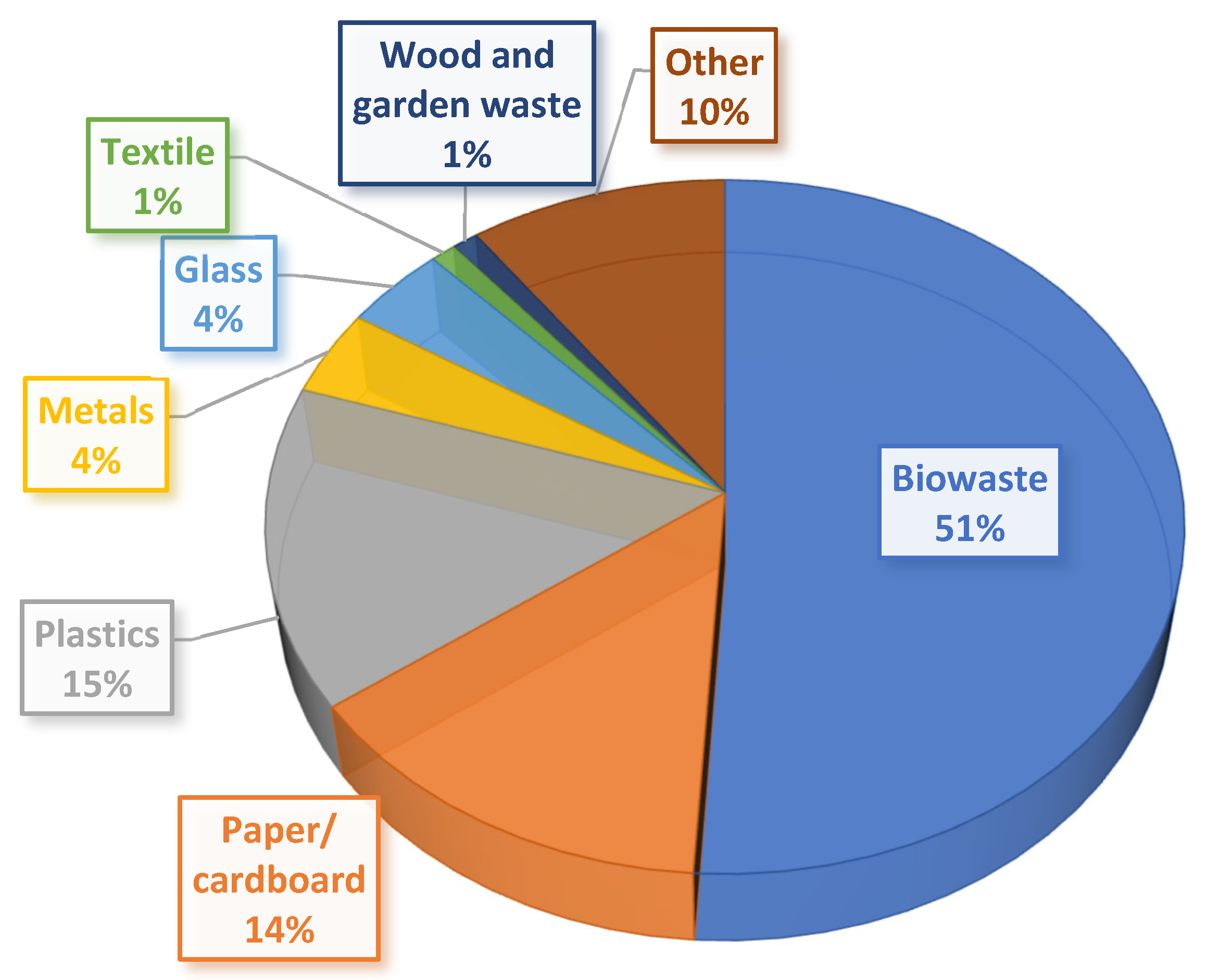
Primary datasets were sourced from publicly available and validated reports issued by key governmental entities in Jordan, including the Ministry of Environment (MoEnv), the Ministry of Local Administration (MoLA), and the Department of Statistics (DoS). Additionally, peer-reviewed literature studies addressing circular economy strategies, MSW management practices, and green growth policies within the Jordanian context were thoroughly reviewed. The baseline MSW composition adopted in this study, as shown in Figure 1, is based on data reported by the Jordan Green Building Council [14]. For the purpose of scenario modeling, the MSW composition shown in Figure 1 is treated as fixed and is assumed to remain constant over the study period. Nonetheless, the composition depicted in Figure 1 does not provide disaggregated information on material subtypes. For example, metal waste is presented as a single category without distinction among subtypes, namely aluminum and ferrous waste.
Al-Athamin et al. [15] conducted a study in Al-Karak, Jordan, and provided a detailed characterization of plastic waste. However, as their analysis focused primarily on commercial (non-residential) waste streams, the applicability to MSW could be limited. To enable a more thorough assessment, several assumptions on the waste categories presented in Figure 1 were made. Due to the absence of polymer-level MSW composition data in Jordan, OECD’s global polymer distribution values were adopted [16]. Although this extrapolation introduces a degree of uncertainty, the selected shares reflect the dominant polymer types commonly found in urbanized economies with comparable consumption patterns. These assumptions were therefore used as the most reasonable basis available for disaggregating plastic waste, while acknowledging that deviations in local consumption behavior could influence the precision of the modeled results. The polyethylene terephthalate (PET), high-density polyethylene (HDPE), polyvinyl chloride (PVC), low-density polyethylene (LDPE), and polypropylene (PP) account for 5%, 12%, 11%, 12%, and 16% of the global plastic waste stream, respectively. Reflecting these figures on Jordan’s MSW, the corresponding fractions (with respect to the total MSW) are 0.75% for PET, 1.8% for HDPE, 1.65% for PVC, 1.8% for LDPE, and 2.4% for PP.
Similarly, the paper and cardboard category was further disaggregated based on U.S. EPA [17] estimates, which indicate that mixed paper (office paper, tissue, newspapers, magazines, and books) comprises approximately 52% of this waste stream, while the remaining 48% is mainly cardboard. Accordingly, cardboard and mixed paper are estimated to constitute 6.72% and 7.28% of the total MSW composition in Jordan, respectively. For metal waste, the United Nations Environment Programme [18] reports that ferrous metal represents 80–90% of the total global metal waste, with non-ferrous metal comprising the remaining 10–20%. Given these assumptions, ferrous metal and aluminum waste are estimated at 3.4% and 0.6% of Jordan’s MSW, respectively.
Data on the quantities of MSW generated in Jordan were drawn from multiple sources. The Department of Statistics [19] provides official figures for total annual MSW generation up to the year 2022. On the other hand, the Ministry of Local Administration (formerly named Ministry of Municipal Affairs) provided long-term projections, which predicted that the total MSW generation would reach 6.12 million tons by 2039 [20]. In this study, the year 2024 was selected as the base year, with a recorded population of 11,734,000 and a national average annual population growth rate of 1.9% according to DoS data, which is markedly lower than the growth rate observed during the 2012–2017 period, when Jordan experienced a sharp growth driven by forced migration from neighboring countries with political conflicts [6]. Using a per capita MSW generation rate of 0.99 kg/person/day [14], the total MSW generated quantities for 2024 and subsequent years were estimated. The projected population growth, MSW quantities and composition are summarized in Table 1.
Three future development scenarios for the Jordanian MSW management sector were defined based on different recycling rates to be achieved by the year 2034. The scenarios correspond to target recycling rates of 25%, 50%, and 75%. These targets represent three predefined levels of recycling uptake, associated with differing assumptions regarding technical, economic, and institutional capacity within the waste management system. The 50% target is directly aligned with the NSWMS 2034 objective for key recyclable streams (e.g., paper, plastic, metal), while the 25% and 75% scenarios represent alternative recycling pathways characterized by increasing target recycling rates. These targets were applied as predefined scenario levels for comparative analysis. A key modeling assumption is that the recycling rate starts at 0% in 2024 and increases linearly until reaching the target value in 2034. For example, the annual increase in recycling rate for the 25% scenario is 2.5%. The target recycling rates are calculated only with respect to specific recyclable categories; mainly plastics (PET, HDPE), metals (ferrous and aluminum), and paper/cardboard. Therefore, 25% recycling rate means that a quarter of the target recyclable categories is recycled and recovered. This will be significantly lower than 25% when expressed with respect to the total MSW stream.

2.2. Environmental Analysis

Several scenarios were considered for the waste management practices in Jordan over the 2024–2034 study period. The baseline scenario considers that the existing waste management practices in Jordan will remain unchanged over the study period, where nearly half of the MSW is sanitary landfilled while the other half is disposed in uncontrolled disposal sites [6]. Simultaneously, three alternative scenarios for recycling were evaluated where different target recycling rates were assumed. The environmental assessment is based on two indicators: Total GHG emissions and changes in energy use relative to the baseline scenario. The environmental impacts of the different scenarios were evaluated using U.S. EPA WARM model (version 16), which is an M.S. Excel-based tool for GHG emissions estimation by accounting for multiple sources/sinks such as decomposition, transportation, and forest carbon storage [21]. This model also enables users to compare GHG emissions across various waste management approaches throughout a product’s lifecycle. The model also accounts for GHG savings from avoided virgin material production through recycling which bypasses energy-intensive processes linked to raw material extraction, refining, and manufacturing. For example, recycling paper-based products contributes to forest carbon storage while reducing the dependence on harvested wood fiber. The materials considered for environmental analysis are those targeted for recycling (aluminum and ferrous waste, paper/cardboard, PET/HDPE). The difference in emissions estimated using the WARM model are combined with the baseline scenario to evaluate the net GHG emissions of each waste management alternative.

2.2.1. Baseline Scenario Emissions

This subsection describes the analytical technique used to estimate baseline GHG emissions from waste disposal, which is based on the IPCC first-order decay model. The baseline scenario emissions were computed assuming that the existing waste management scheme will remain unchanged throughout the study period. That is, nearly half of the MSW is sanitary landfilled, while the other half is disposed of in open dumpsites. Baseline GHG emissions were calculated using the IPCC first-order decay model, which serves as the primary analytical model for estimating methane emissions from waste disposal. Only methane emissions are considered in the IPCC model, while carbon dioxide emissions from biogenic sources are excluded from the inventory, as shown in Equation (1) [22]:
C H 4   e m i s s i o n s = M S W T × M S W F × M C F × D O C × D O C F × F × 16 / 12 R × ( 1 O X )
where C H 4   e m i s s i o n s are the annual landfilling methane emissions (Gg CH4/y), M S W T is the total MSW generated (Gg/y), M S W F is the fraction of MSW disposed in landfills (disposal sites), M C F is the methane correction factor (default value = 1 for sanitary landfilling), D O C is the degradable organic carbon content of the MSW (kg C/kg MSW), D O C F is the fraction of DOC dissimilated (default value = 0.5), F is the fraction of methane in landfill biogas (default value = 0.5), 16 / 12 is a conversion factor (molecular weight ratio of methane to carbon), R is the recovered methane gas (Gg/y), and O X is the oxidation factor (default value = 0.1) [6,22]. The value of D O C can be determined based on proportions of different waste types in the mixed MSW as follows [23]:
D O C = 0.4   A + 0.17   B + 0.15   C + 0.3   D
where A is the paper and textiles fraction of MSW, B is the fraction of garden and non-food organic putrescible waste, C is the fraction of food waste, and D is the wood and straw fraction. The first-order decay model estimates the net methane emissions in year t as a result of undegraded, previously disposed MSW, as shown in Equation (3):
C H 4 ( t ) = x A × k × M S W T x × M S W F ( x ) × C H 4   p o t e n t i a l × e k t x
where A is a normalization factor = ( 1 e k ) / k ; k is the methane generation rate constant (default value = 0.05); x covers years for which data is added; M S W T is the total quantity of MSW generated in year x ; and M S W F is the fraction of MSW [6].

2.2.2. GHG Avoided Emissions from Recycling

Avoided emissions associated with recycling are quantified using the U.S. EPA WARM tool, which estimates life-cycle GHG and energy impacts of material recovery relative to virgin production. The avoided GHG emissions from recycling can be quantified by accounting for material recovery and energy savings. For the material recovery part, the net reduction in GHG emissions is quantified as the sum of multiple components, collectively referred to as the Recycled Input Credit (RIC), as shown in Equation (4) [21]:
GHG reduction = RIC (process energy) + RIC (transportation energy) + RIC (non-energy processes) + Forest carbon storage
All units in Equation (4) are in metric tons of carbon dioxide equivalent (MT CO2-eq). A summary of the net GHG emission savings as obtained from the WARM model (recycling against virgin material production) is provided in Table 2. In order to ensure consistency with the MSW composition in this study, the net GHG emission savings per ton of recycled material (adapted from WARM model) were aggregated using a weighted average formula.
The avoided GHG emissions from energy recovery were also included in this analysis. Recycling typically leads to energy savings by utilizing recycled feedstock instead of producing materials from virgin resources. The energy savings are commonly expressed as net savings in million BTUs (MBTU) per metric ton of recycled material. Landfilling, on the other hand, incurs energy consumption due to waste collection and transport as well as landfill operations. A comparison of the net energy savings from recycling vs. energy consumption from landfilling is presented in Table 3. The net emissions corresponding to the energy factors presented in Table 3 are based on an emission factor of 0.05306 MtCO2-eq per 1 MBTU for natural gas [24].

2.3. Socio-Economic Assessment

A questionnaire was developed and conducted to explore the public’s perspectives on recycling. The questionnaire was distributed electronically through university networks, social media platforms, and community groups, using a non-probabilistic convenience sampling method. A total of 105 valid responses were collected from different age groups, genders, and educational backgrounds. The aim of the questionnaire was exploratory, intended to capture general trends in public awareness and attitudes of Jordanians while focusing on obstacles and barriers preventing the adoption of an integrated recycling scheme within Jordanian households and the potential actions that may incentivize participation in recycling programs. The questionnaire was divided into sections covering general demographic information, status of knowledge and participation in recycling programs, challenges and barriers, impacts of incentives on participation, and the role of local communities and public institutions in promoting recycling. To complement the findings of the questionnaire and gain insight into the barriers and the dynamics influencing Jordan’s recycling industry, a series of semi-structured interviews (phone and in-person) were carried out with workers in the waste management and recycling sector. A purposive sampling approach was used to select interviewees with direct experience in the recycling sector, including informal waste pickers, workers at sorting facilities, transfer station operators, and recycling shop owners. This approach ensured that the sample included participants with relevant knowledge and expertise of MSW management practices in Jordan. The interview questions were open-ended, covering multiple aspects such as methods of operation, types of recyclable materials targeted, recycling market in Jordan, economic feasibility, destination of recovered materials, and key obstacles facing the informal recycling industry in Jordan.

3. Results and Discussion

The findings reported in this section are based on the analytical methods and assumptions described in Section 2. The discussion that follows is intended to interpret these results and place them within a broader policy and socio-economic context.

3.1. MSW Management Outlook in Jordan and Future Scenarios

This study aimed at investigating the current MSW management scheme in Jordan and to develop future pathways on the premise of increased recycling targets with respect to the baseline scenario. The base year for this study was 2024, which had an estimated 4.24 million tons of MSW generated and disposed. The growth of MSW quantities over the study period was projected based on a 1.9% population growth rate, according to the DoS reports. Regardless of the scenario, the annual MSW quantities are forecasted to grow to 5.12 million tons by the year 2034. The baseline scenario reflects the status quo of MSW collection and disposal practices in Jordan, as quantified by the projected MSW quantities and disposal pathways summarized in Table 1. In other words, nearly half of the produced MSW will be sanitary landfilled, whereas the other half will be disposed of in uncontrolled dumpsites with no significant recycling activities.
The Government of Jordan has introduced numerous policies and strategies that collectively aim to steer national growth toward a greener and more sustainable trajectory. Notably, the National Green Growth Plan has highlighted six priority sectors with considerable green growth potential; among those was the waste management sector, which contributes roughly 10–12% of Jordan’s GHG emissions [9,25]. More specifically, the National Solid Waste Management Strategy of Jordan, which was launched in 2015, advocated for embedding the circular economy principles through recycling and composting. The strategy calls for raising the recycling rate of multiple waste categories (paper, plastic, metal, and glass) to 50% and diverting 75% of biowaste from landfills via composting or other sustainable management practices [9]. The Strategy also promotes the transition from uncontrolled disposal methods to more sustainable practices such as sanitary landfilling, material recovery facilities, mechanical biological treatment facilities, anaerobic digestion, and composting plants [11].
The recycling scenarios in this study were designed to focus on recyclable materials with strong market potential rather than presenting recycling targets for commingled categories. In Scenario 1, the recycling rate is projected to increase linearly from 0% in 2024 to 25% by 2034, while Scenarios 2 and 3 aim for recycling end targets of 50% and 75%, respectively. It is key to emphasize that these recycling rates apply specifically to the recyclable materials (plastics, metals, and paper/cardboard) and not the entire MSW quantity. In reality, not all plastic sub-categories can be recycled due to technical and economic constraints. The recycling targets in the present study were determined and computed to reflect practical technical considerations and market conditions.
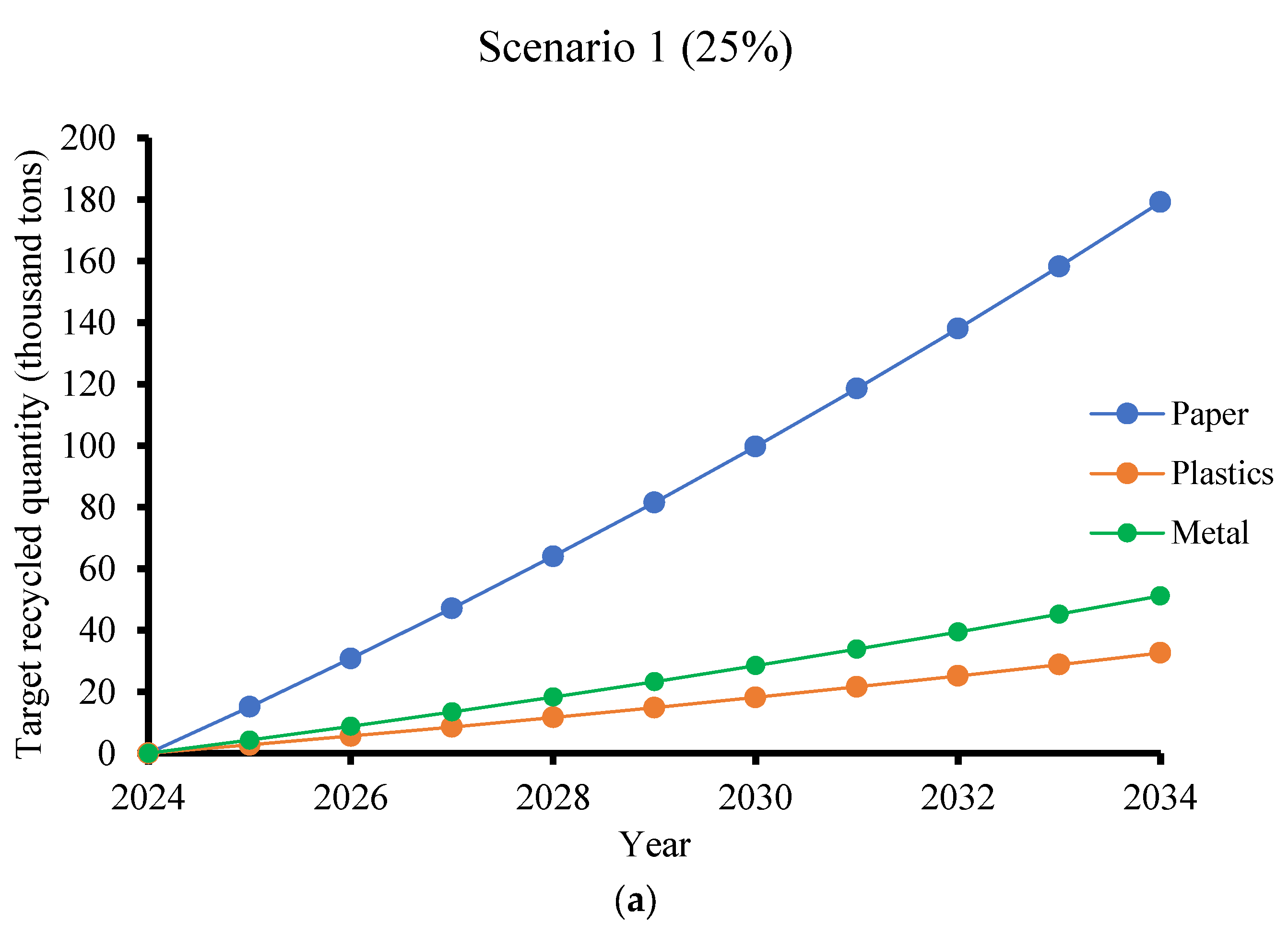
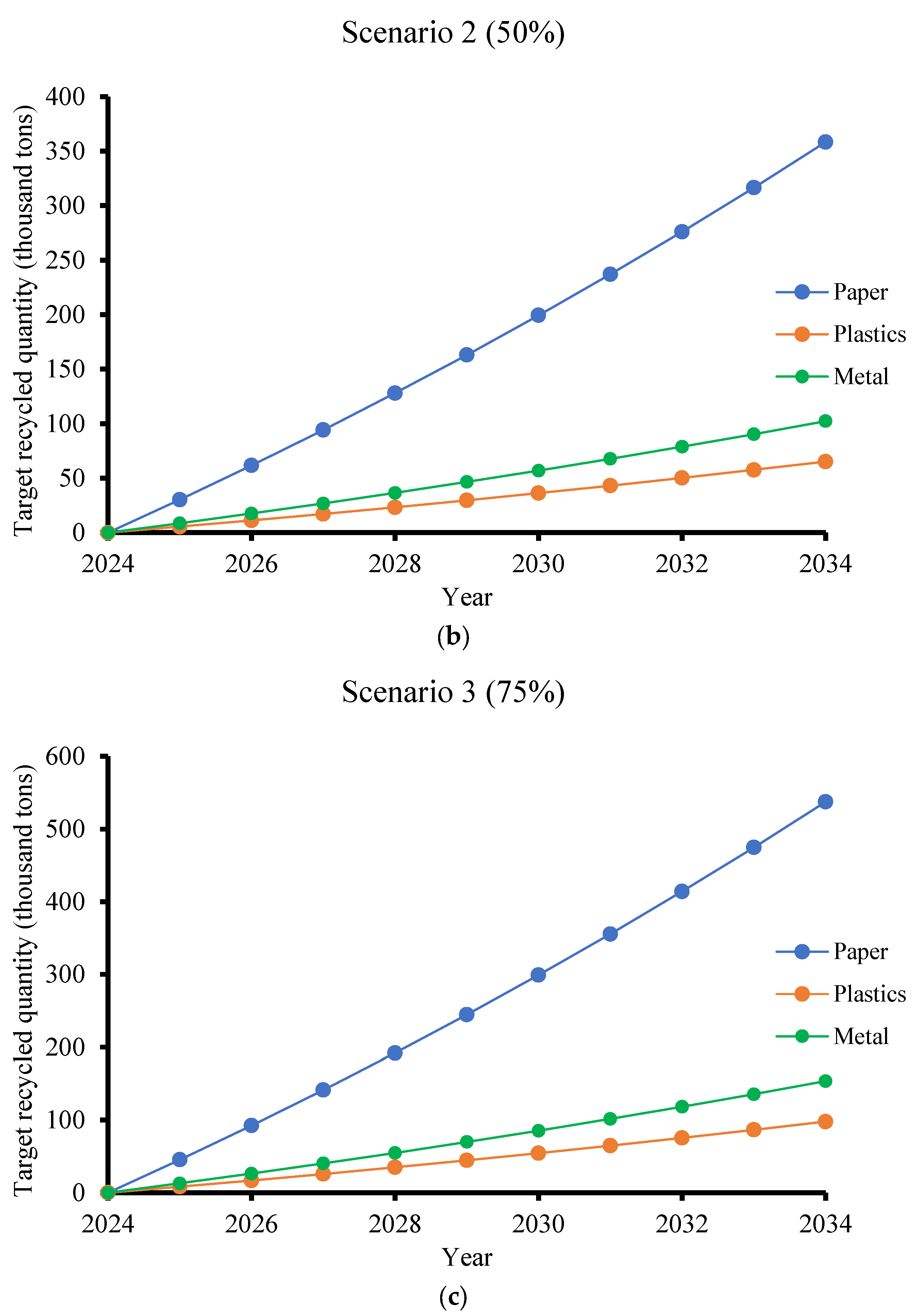
The figures presented in this section are directly derived from the assumptions, indicators, and analytical models defined in Section 2. Specifically, they visualize the temporal evolution of waste quantities, recycling scenarios, and associated environmental indicators as computed using the IPCC first-order decay model and the U.S. EPA WARM model. Figure 2 depicts the projected quantities of recyclables by category over the study period. For Scenario 1, the quantities of recovered recyclables are estimated to start at 15,122 tons of paper, 2754 tons of plastics, and 4321 tons of metals, increasing to 179,136 tons, 32,628 tons, and 51,181 tons, respectively, by the year 2034. Based on a projected total MSW quantity of 5.12 million tons in 2034, the overall recycling rate for Scenario 1 would be 5.14%. Similarly, the final recycling rates for Scenarios 2 and 3 are 10.28% and 15.41%, respectively. Ikhlayel et al. [26] conducted a study comparing various waste management alternatives. They projected that by 2025, the total amount of MSW would reach 4 million tons, which is close to the estimated amount in this study (4.32 million tons). They also proposed MSW management scenarios by defining the recycling target as a percentage of the total MSW, without further breaking down the recyclable materials.

3.2. Environmental Assessment of MSW Management Scenarios

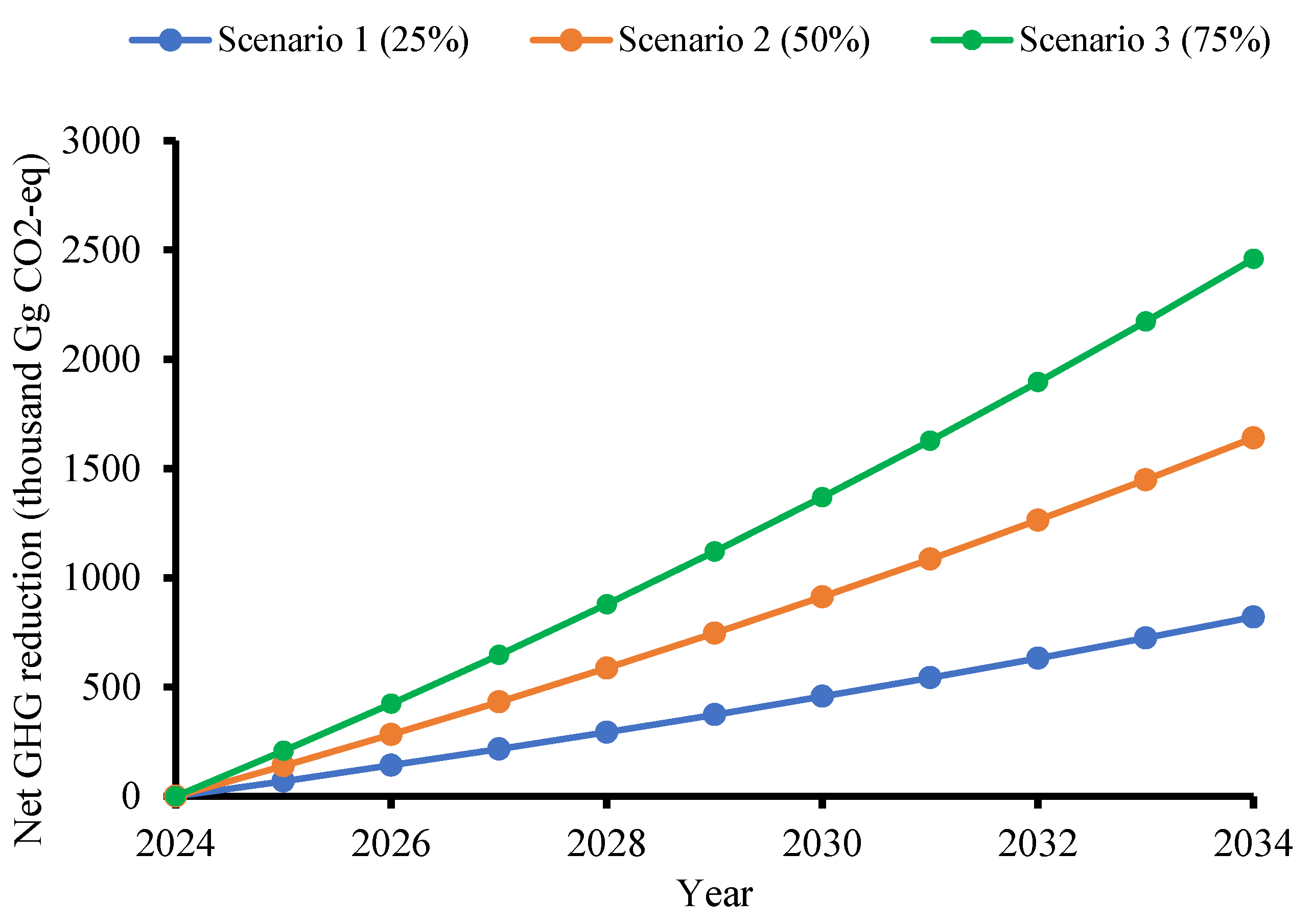
The environmental impact of the different MSW management scenarios was carried out using the GHG emissions indicator, where the proposed recycling scenarios were assessed against the baseline scenario. As demonstrated earlier, the GHG emission reductions due to recycling can be attributed to material recovery and energy savings. A summary of the avoided GHG emissions linked to material recovery for the three proposed scenarios is presented in Figure 3. The net GHG emission reductions are anticipated to reach 819.9 Gg CO2-eq, 1640 Gg CO2-eq, and 2460 Gg CO2-eq by 2034 for Scenarios 1, 2, and 3, respectively. The avoided GHG emissions shown in Figure 3 are computed using the emission factors obtained from the U.S. EPA WARM model and represent the material recovery component of the environmental indicators defined in Section 2.2. The majority of avoided emissions is attributed to the paper/cardboard category, accounting for approximately 75% of total avoided emissions by 2034. This can be explained by the large quantities assumed to be recycled and the relatively high emission factors as per the WARM model. Despite the high emission factors for metal waste recycling, the contribution to the avoided emissions is limited by the lower quantities of recycled metal waste. Likewise, the lower quantities of PET and HDPE result in a much lower GHG reduction contribution in comparison to the paper/cardboard category.
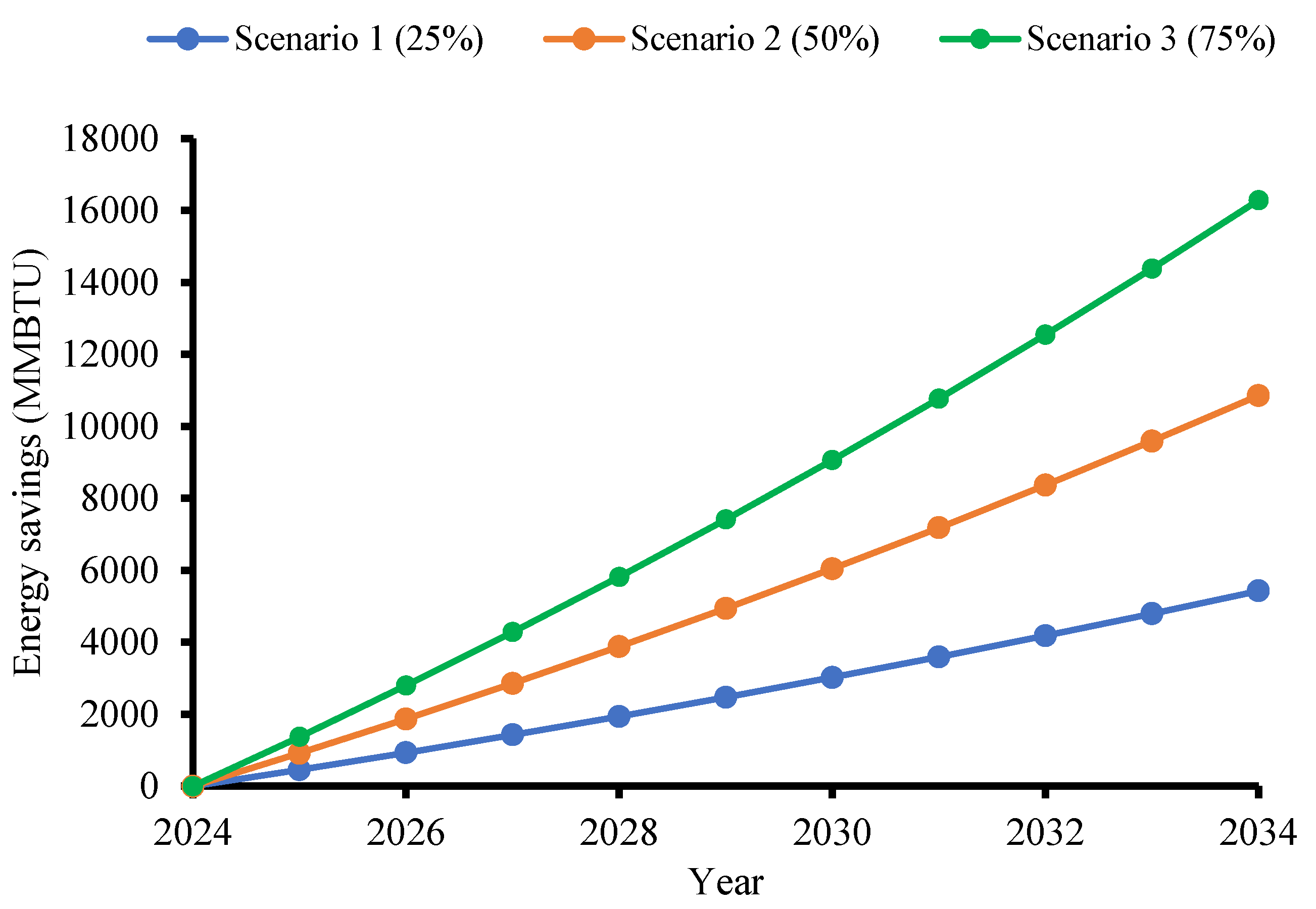
Figure 4 illustrates the energy-related indicator used in this study, showing the net energy savings associated with recycling relative to landfilling, as quantified using WARM energy factors and converted to GHG equivalents following the methodology described in Section 2.2.2. The GHG savings are projected to reach 5.43, 10.86, and 16.29 MMBTU by the year 2034 for Scenarios 1, 2, and 3, respectively. An emission factor of 0.05306 Gg CO2-eq per 1 MMBTU was utilized to convert the energy savings to GHG emission equivalents, and the corresponding values were 288.1 Gg CO2-eq, 576.1 Gg CO2-eq, and 864.2 Gg CO2-eq, respectively. The highest contributor to energy savings is the paper/cardboard category (50%), followed by aluminum (20%) and ferrous waste (18%), and the remaining 12% is attributed to mixed plastic waste. Despite the fact that the mass of paper/cardboard waste is substantially greater than that of metal waste, their respective contributions to energy savings are comparable, which is evident from the comparable contributions shown in Figure 4. This can be explained by the markedly higher energy emission factors for metal recycling (particularly aluminum).
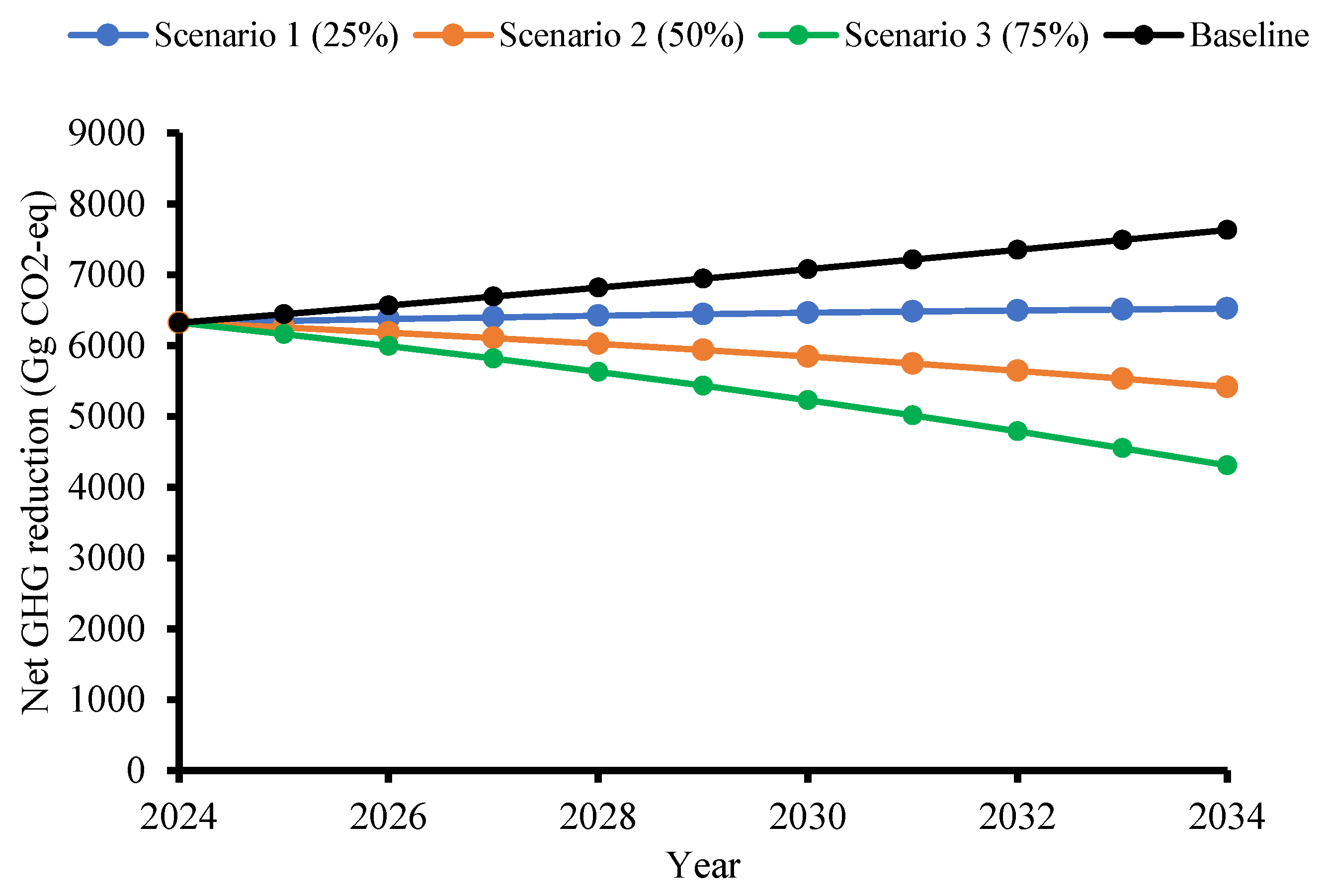
The avoided GHG emissions from material recovery and energy savings were combined to yield the net avoided emissions for each scenario. The baseline scenario emissions were computed using the mass balance and first-order decay approach as described earlier. The net GHG emissions for the proposed scenarios were estimated by taking into account the baseline scenario and the avoided emissions computed above as shown in Figure 5.
Figure 5 integrates the baseline emissions estimated using the IPCC first-order decay model with the avoided emissions from recycling; hence, visualizing the net GHG emissions indicator used to assess environmental sustainability across the different scenarios. The GHG emissions are projected to grow steadily throughout the study period for the baseline scenario. This trend is driven by population growth and the corresponding increase in the generated MSW quantities. According to this scenario, the total GHG emissions will increase from 6323 Gg CO2-eq in 2024 to 7632 Gg CO2-eq in 2034. Under Scenario 1, the net GHG emission reductions (with respect to the baseline scenario) range from 0% in 2024 to 14.5% in 2034. Regardless, this scenario still exhibits a modest steady increase in the net GHG emissions since the avoided emissions due to recycling are outweighed by population growth and the corresponding increase in MSW generation. Conversely, a decline in the net GHG emissions is projected for Scenarios 2 and 3, where the 2034 net emissions are estimated at 5416, and 4308 Gg CO2-eq, respectively, with percent reductions (against the baseline scenario) of 29.0% and 43.6% by 2034, respectively. The scenarios were further examined using strong vs. weak sustainability indicators within the green growth context. Luukkanen et al. [27] discussed the concept of strong and weak sustainability indicators for the appraisal of green growth potential using the novel Sustainability Window analysis tool. For instance, GHG emissions per ton of waste managed is regarded as a weak environmental indicator, which will often result in a more lenient assessment of environmental sustainability. In contrast, the total GHG emissions (regardless of the MSW quantity) is a strong indicator, often leading to a more stringent evaluation of sustainability [6]. On this basis, all scenarios (including the baseline scenario) can be considered environmentally sustainable using the GHG emissions per ton of waste managed due to the fact that the indicator values either remain constant or decline with time. If the total GHG emissions is the environmental indicator, only Scenarios 2 and 3 are considered environmentally sustainable based on the total net GHG emissions indicator, where 2034 emissions decline below the base-year level (Figure 5). Relying solely on weak indicators may result in higher tolerated emission levels relative to strong sustainability thresholds. This divergence illustrates the limitations of weak indicators in rapidly growing economies, where the improvement in emissions per ton may mask the absolute environmental degradation. In the case of Jordan, the increasing MSW generation driven by population growth results in rising total emissions even when management efficiencies improve, which necessitates the use of strong sustainability indicators, most notably total GHG emissions, when assessing environmental performance.
Ikhlayel et al. [26] studied several scenarios for waste management in Jordan. They reported that increasing the recycling rate from 7% to 14% was projected to achieve a 28% reduction in the net GHG emissions. This is comparable to Scenario 2 of the present study, which corresponds to a 10.28% recycling ratio (with respect to the gross MSW quantity), where the avoided GHG emissions in 2034 are projected to reach 29%. Abu Hajar et al. [6] explored several green growth pathways for waste management in Jordan, and concluded that recycling 100,000 tons of mixed recyclables could yield a 287 Gg CO2-eq reduction. Compared to the present study, recycling the same quantity is expected to yield a 435 Gg CO2-eq reduction. The difference between the two studies can be attributed to the breakdown of recyclable categories adopted in this study (e.g., PET, HDPE, aluminum, ferrous waste, paper, cardboard) as opposed to the commingled recyclable categories as presented by [6].
The recycling scenarios proposed in the present study are in line with the National Solid Waste Management Strategy of Jordan. Setting higher targets without corresponding institutional and infrastructural capacity may increase the risk of implementation challenges, as reported in Abu Hajar et al. [12]. According to Gibellini et al. [8], recycling in MENA countries is often hindered by the lack of planning, inadequate collection and disposal services, inappropriate technologies, and insufficient funding. As a result, the baseline waste management scenarios in most MENA countries are centered around collection, transportation, and disposal. The lack of long-term legislation and strategies, along with effective enforcement mechanisms, is regarded as a key barrier to the transition to green growth and circular economy models at a large scale. Insufficient public and societal awareness poses a significant risk to the success of waste sorting and recycling initiatives in Jordan. Enhancing awareness is likely to contribute to the effectiveness of such programs, as suggested by the survey responses and previous studies [6,8,12].

3.3. Socio-Economic Analysis

This study examined the socio-economic aspects pertaining to recycling and the obstacles hindering the broader transition toward a circular economy model in Jordan by means of a structured questionnaire and a series of semi-structured interviews. The questionnaire was designed to address several thematic areas which provide a deeper understanding of the key factors constraining the expansion of recycling activities in Jordan, as well as the limitations of a large-scale circular economy model in the country. The questionnaire was distributed electronically and yielded a total of 105 valid responses. In terms of demographic characteristics, approximately 43% of respondents were males and 57% were females, with the majority holding at least a bachelor’s degree and residing in urban areas in Jordan.
Despite the fact that all respondents confirmed their knowledge of recycling, only 13% stated that they practice recycling in their homes on a daily basis, 53% stated that they sometimes practice recycling, while the remaining stated that they do not practice any recycling activities. The majority of the respondents indicated that the main barriers preventing household recycling include the lack of special sorting bins or containers, lack of awareness and knowledge among the community, the inability to sort or separate different waste categories, lack of incentives or direct benefit to the citizens, the inefficiency of sorting and downstream recycling in Jordan, and the insufficient support from authorities, as evidenced by the questionnaire results. Nonetheless, it appears that most respondents are aware of the benefits of recycling, as most stated that recycling programs are essential for environmental protection, resource conservation, and the potential for job creation. In terms of the target categories for recycling, the categories which were selected most by the respondents as target recycling categories were plastics (58%), paper/cardboard (44%), and glass (35%). One of the interesting questions that the survey included was on the consumer’s preference for purchasing a product manufactured from recycled materials or another slightly less expensive one manufactured from raw materials. Only 42% selected the former, which proves that the incentives and the financial aspects are key to the success of sorting and recycling programs.
Since sorting and recycling programs rely strongly on awareness, the respondents were asked about the most influential agency or organization in terms of raising awareness and educating the public on recycling. Most respondents (52%) believe that it is the government, i.e., municipalities’ role to educate and raise awareness among the citizens about the recycling process and its long-term impacts and benefits. Other key players are schools and colleges, which, according to 28% of the respondents, are vital players for conveying knowledge and raising awareness on this key issue. Less weight was given to other channels, including media, civil society organizations, and individuals. Another significant issue raised in the questionnaire was the informal sector’s role in recycling in Jordan. It was found that more than 95% of the respondents are aware of the informal recycling activities and contributions. The respondents indicated that informal recycling is generally beneficial in reducing the amount of waste being disposed of in landfills, alleviating the financial burdens on municipalities, conserving materials and natural resources, and ultimately contributing to mitigating GHG emissions. However, some of the respondents underscored the challenging socioeconomic circumstances experienced by scavengers and informal recyclers, calling for immediate action by the government to develop an inclusive plan with the aim of improving the socioeconomic conditions of this group.
The questionnaire responses highlighted a range of recommendations to enhance recycling practices in Jordan. Participants emphasized the importance of widespread awareness campaigns through schools, universities, media platforms, and community workshops, along with integrating recycling concepts into educational curricula as early as possible. Respondents also stressed the need for accessible infrastructure, particularly the provision of color-coded collection containers in residential areas, public spaces, and institutions, coupled with the establishment of local sorting and recycling centers. Economic incentives were repeatedly suggested, including financial rewards, tax reductions, discount programs, and point-based systems to encourage participation. Several participants advocated for stronger governmental involvement, such as enforcing strict regulations, introducing penalties for non-compliance, and fostering public–private partnerships to support recycling initiatives. Collectively, these recommendations point to the necessity of a comprehensive approach that combines education, infrastructure development, economic motivation, and regulatory enforcement to promote the culture of recycling in Jordan. The findings of the questionnaire are in line with those reported by Abu Hajar et al. [12], where the lack of strict regulations, inefficient management, insufficient financial capacity, and lack of public awareness and contribution were reported as the key challenges facing the Jordanian waste management sector.
In addition to the questionnaire, semi-structured interviews were conducted with key stakeholders including waste scavengers and informal pickers, staff at recycling and sorting facilities, and managers of transfer stations. The findings indicated that approximately 15–35% of the waste received at the transfer stations and recycling facilities comprises recyclable materials, whereas the remaining 65–85% is directed to landfills or disposal sites. Sorting activities in Jordan are predominantly manual, relying on the expertise of trained workers and scavengers to separate and collect different categories of recyclable materials. For instance, the Zarqa transfer station (located northeast of the capital Amman) receives nearly 800 tons of waste daily, 120 tons of which are recovered as recyclable materials (e.g., PET plastics, nylon, paper/cardboard, and ferrous metal).
In Jordan, recovered paper/cardboard waste was primarily exported to Saudi Arabia and Egypt for recycling; however, a substantial share is now recycled locally as a result of the establishment of a new recycling plant in Al-Qastal (south of Amman). Most plastic waste in Jordan is recycled locally, although certain categories (e.g., PET) are compacted and exported. Ferrous metal waste is recycled locally in steel factories, whereas aluminum waste is often exported. Glass recycling remains limited in Jordan due to the high energy requirements and comparatively low market value relative to virgin production.
The recycling sector in Jordan remains underdeveloped, with limited structural and organizational frameworks to support its long-term sustainability as consistently indicated by stakeholder interviews conducted at transfer stations and recycling facilities. Current practices operate below their potential efficiency, resulting in modest recovery rates compared to what could be achieved with better coordination and investment. A particular gap often encountered is in organic waste management, which makes up nearly 50% of Jordan’s MSW mix. Organic waste continues to receive far less attention than recyclables such as plastics, metals, and paper/cardboard when it comes to private sector involvement. Nonetheless, recent initiatives have started to promote composting as a viable pathway for organic waste management. To truly advance towards CE objectives, greater engagement of the private sector emerges as an important factor from a policy perspective, ensuring that waste management strategies move beyond a narrow focus on conventional recyclable streams.
In summary, the development of Jordan’s recycling sector continues to be constrained by a range of financial, legislative, social, and technical barriers, with recovery rates estimated at only 7–10% [10,11]. Financially, the sector suffers from weak cost recovery and limited economic viability. Municipalities cover a substantial portion of waste management expenses, with service cost recovery reaching no more than 50% [9]. The comparatively low cost of landfilling and uncontrolled disposal practices further diminishes the economic attractiveness of more sustainable alternatives [6]. In addition, market demand for certain recyclables remains unstable or underdeveloped; for example, glass waste holds little to no value due to the absence of local recycling infrastructure [6,9]. The predominance of government control over MSW management also restricts the application of market-based mechanisms and economic incentives, thereby undermining financial sustainability [6]. On the other hand, institutional and regulatory shortcomings hinder integrated waste management and delay the adoption of practices that prioritize recycling and resource recovery [10,13]. These challenges explain why formal recycling initiatives remain limited, while informal recycling and scavenging continue to play a more prominent role in the sector. Although the informal sector contributes substantially to material recovery in Jordan, the exact quantities recovered cannot be reliably quantified due to the absence of formal reporting and the highly variable nature of informal activities. Nonetheless, integrating informal recyclers into structured collection and sorting systems, whether through cooperative models, incentive mechanisms, or contracting arrangements, could enhance recovery rates, improve working conditions, and strengthen the long-term sustainability of the recycling sector.
This study is subject to several limitations that should be acknowledged. The analysis relies primarily on secondary MSW composition data, and the disaggregation of certain waste categories (e.g., plastics) required extrapolations that introduce uncertainty. The application of the WARM model also carries context-adaptation limitations that may affect the precision of emission estimates. Additionally, the questionnaire employed non-probabilistic sampling, which may limit the representativeness of the entire population. Finally, the modeling framework cannot dynamically capture policy or legislative changes that may occur through 2034. While these factors may influence the quantitative accuracy, they do not alter the overall directional validity of the findings.


4. Conclusions

This study demonstrates the potential role of embedding CE principles in reducing GHG emissions from Jordan’s MSW management sector. Despite the notable progress in policy frameworks, current waste management practices in Jordan remain largely linear, with recycling rates below 10%. Three scenarios were developed and critically evaluated against the baseline scenario over the 2024–2034 study period. The recycling rate was assumed to start at 0% in 2024, increasing linearly to 25%, 50%, and 75% for Scenarios 1, 2, and 3, respectively. It was concluded that under the baseline scenario, the net GHG emissions will increase steadily from 6323 Gg CO2-eq in 2024 to reach 7632 Gg CO2-eq in 2034. The 2034 net emissions for Scenarios 1, 2, and 3 are 6524, 5416, and 4308 Gg CO2-eq, respectively. Despite the GHG emissions reduction under Scenario 1 with respect to the baseline scenario, this scenario still exhibited a steady increase in the net GHG emissions with respect to the base year emissions. On the contrary, Scenarios 2 and 3 yielded lower emissions compared to the base year, suggesting that these two scenarios are considered environmentally sustainable scenarios if strong environmental indicators (such as the net GHG emissions) are considered. Among the target recyclable categories, paper/cardboard was identified as the candidate with the highest potential for avoided emissions, owing to its substantial generation volumes and relatively high emission factors.
A qualitative assessment was conducted to comprehend several socio-economic aspects pertaining to the recycling industry in Jordan by means of a questionnaire and semi-structured interviews. Only 13% of the questionnaire respondents reported that they practice waste sorting and recycling on a daily basis, while more than half engage only occasionally. The qualitative assessment highlighted critical barriers, including inadequate infrastructure, lack of incentives, weak regulatory framework, and insufficient public awareness campaigns. Despite these challenges, respondents recognized the environmental and socioeconomic benefits of recycling, particularly in reducing landfill dependency, conserving resources, and alleviating municipal financial burdens. Stakeholder interviews revealed that recyclable materials still account for 15–35% of waste at transfer stations, with recovery activities focused on plastics, paper/cardboard, and metals, while organic waste is often overlooked despite representing nearly half of the MSW stream. The findings suggest that adopting an integrated approach that combines public education, provision of infrastructure such as color-coded collection containers, economic incentives, stricter regulations and enforcement mechanisms, and inclusive policies toward the informal recycling sector in Jordan may support progress toward national CE objectives.
In addition to identifying key obstacles, this study highlights practical awareness-raising interventions that can support the transition to a circular economy model in Jordan such as incorporating basic recycling education into school and university curricula, implementing targeted municipal outreach campaigns to clarify sorting practices, and introducing simple community-level incentives to encourage household participation. Collaborations with local organizations can further support the application of these measures and enhance their reach. Future studies should explore more detailed life-cycle assessments of key waste streams, assess long-term performance of recycling initiatives, and investigate practical mechanisms for integrating the informal sector within formal MSW systems.

Author Contributions

Conceptualization: H.A.A.H., Z.H.M., A.A.A., A.A.J., B.A.S., B.O.A. and R.A.A.; Methodology: H.A.A.H., Z.H.M. and A.A.A.; Formal analysis: H.A.A.H., Z.H.M., A.A.A., A.A.J., B.A.S., B.O.A. and R.A.A.; Original draft preparation: H.A.A.H., Z.H.M., A.A.A., A.A.J., B.A.S., B.O.A. and R.A.A.; Writing, review and editing: H.A.A.H. All authors have read and agreed to the published version of the manuscript.

Funding

This research received no external funding.

Institutional Review Board Statement

Questionnaires are exempted from ethical review as per the University of Jordan regulations https://research.ju.edu.jo/Pages/Scientific-Research-Ethics.aspx, accessed on 1 October 2025. Research that entails the use of a questionnaire(s), and in case the questionnaire is to be distributed as paper-based, verbal consent by the participant should be sufficient since actual participation by filling in the questionnaire can be considered consent by itself, whereas if the questionnaire is online-based, the requested information must be provided before the questionnaire starts, so once the questionnaire is filled either paper-based or electronic, the consent of the participant is provided.

Informed Consent Statement

Informed consent was obtained from all subjects involved in the study.

Data Availability Statement

The original contributions presented in this study are included in the article. Further inquiries can be directed to the corresponding author.

Conflicts of Interest

The authors declare no conflicts of interest.

References

  1. Meadowcroft, J.; Rosenbloom, D. Governing the Net-Zero Transition: Strategy, Policy, and Politics. Proc. Natl. Acad. Sci. USA 2023, 120, e2207727120. [Google Scholar] [CrossRef] [PubMed]
  2. Bongers, A.; Casas, P. The Circular Economy and the Optimal Recycling Rate: A Macroeconomic Approach. Ecol. Econ. 2022, 199, 107504. [Google Scholar] [CrossRef]
  3. Christensen, T.B. Towards a Circular Economy in Cities: Exploring Local Modes of Governance in the Transition towards a Circular Economy in Construction and Textile Recycling. J. Clean. Prod. 2021, 305, 127058. [Google Scholar] [CrossRef]
  4. Kassab, A.; Al Nabhani, D.; Mohanty, P.; Pannier, C.; Ayoub, G.Y. Advancing Plastic Recycling: Challenges and Opportunities in the Integration of 3D Printing and Distributed Recycling for a Circular Economy. Polymers 2023, 15, 3881. [Google Scholar] [CrossRef]
  5. Mrayyan, B.; Hamdi, M.R. Management Approaches to Integrated Solid Waste in Industrialized Zones in Jordan: A Case of Zarqa City. Waste Manag. 2006, 26, 195–205. [Google Scholar] [CrossRef] [PubMed]
  6. Abu Hajar, H.A.; Tweissi, A.; Abu Hajar, Y.A.; Al-Weshah, R.; Shatanawi, K.M.; Imam, R.; Murad, Y.Z.; Abu Hajer, M.A. Assessment of the Municipal Solid Waste Management Sector Development in Jordan towards Green Growth by Sustainability Window Analysis. J. Clean. Prod. 2020, 258, 120539. [Google Scholar] [CrossRef]
  7. Abu Hajar, H. Exploring Different Approaches for Computing the Standardized Precipitation Index to Characterize Dry and Wet Periods in the Yarmouk River Basin, Jordan. Environ. Model. Assess. 2023, 28, 55–67. [Google Scholar] [CrossRef]
  8. Gibellini, S.; Abu Qdais, H.; Vaccari, M. Municipal Solid Waste Management in Refugee Hosting Communities: Analysis of a Case Study in Northern Jordan. Waste Manag. Res. 2022, 40, 165–173. [Google Scholar] [CrossRef]
  9. Abu-Qdais, H.A.; Shatnawi, N.; Al-Shahrabi, R. Modeling the Impact of Fees and Circular Economy Options on the Financial Sustainability of the Solid Waste Management System in Jordan. Resources 2023, 12, 32. [Google Scholar] [CrossRef]
  10. Aldayyat, E.A.; Saidan, M.N.; Abu Saleh, M.A.; Hamdan, S.; Linton, C. Solid Waste Management in Jordan: Impacts and Analysis. J. Chem. Technol. Metall. 2019, 54, 454–462. [Google Scholar]
  11. Hemidat, S.; Achouri, O.; El Fels, L.; Elagroudy, S.; Hafidi, M.; Chaouki, B.; Ahmed, M.; Hodgkinson, I.; Guo, J. Solid Waste Management in the Context of a Circular Economy in the MENA Region. Sustainability 2022, 14, 480. [Google Scholar] [CrossRef]
  12. Abu Hajar, H.A.; Al-Qaraleh, L.A.; Moqbel, S.Y.; Alhawarat, A.M. Prospects of Sustainable Waste Management in Developing Countries: A Case Study from Jordan. Environ. Monit. Assess. 2021, 193, 732. [Google Scholar] [CrossRef] [PubMed]
  13. Aljaradin, M.; Persson, K.M. Solid Waste Management in Jordan. Int. J. Acad. Res. Bus. Soc. Sci. 2014, 4, 138–150. [Google Scholar] [CrossRef] [PubMed]
  14. Jordan Green Building Council. Your Guide to Waste Management in Jordan; JGBC: Amman, Jordan, 2016; ISBN 978-9957-8751-0-7. [Google Scholar]
  15. Al-Athamin, E.A.A.; Hemidat, S.; Al-Hamaiedeh, H.; Aljbour, S.H.; El-Hasan, T.; Nassour, A. A Techno-Economic Analysis of Sustainable Material Recovery Facilities: The Case of Al-Karak Solid Waste Sorting Plant, Jordan. Sustainability 2021, 13, 13043. [Google Scholar] [CrossRef]
  16. Organisation for Economic Co-operation and Development. Global Plastics Outlook: Economic Drivers, Environmental Impacts and Policy Options; OECD Publishing: Paris, France, 2022. [Google Scholar]
  17. U.S. Environmental Protection Agency (EPA). Paper and Paperboard: Material Specific Data. In Facts and Figures About Materials, Waste and Recycling. 2024. Available online: https://www.epa.gov/facts-and-figures-about-materials-waste-and-recycling/paper-and-paperboard-material-specific-data (accessed on 1 April 2025).
  18. United Nations Environment Programme. Metal Recycling: Opportunities, Limits, Infrastructure; UNEP: Nairobi, Kenya, 2013. [Google Scholar]
  19. Department of Statistics (DoS). Municipal Solid Waste Quantities by Governorate and Disposal Methods; Department of Statistics: Amman, Jordan, 2022. [Google Scholar]
  20. Ministry of Municipal Affairs. Development of a National Strategy to Improve the Municipal Solid Waste Management Sector in the Hashemite Kingdom of Jordan; MoMA: New York, NY, USA, 2014. [Google Scholar]
  21. U.S. Environmental Protection Agency Waste Reduction Model (WARM) 2025. Available online: https://www.epa.gov/waste-reduction-model (accessed on 1 April 2025).
  22. Intergovernmental Panel on Climate Change (IPCC). Climate Change 2021: The Physical Science Basis; Cambridge University Press: Cambridge, UK, 2021. [Google Scholar]
  23. Intergovernmental Panel on Climate Change (IPCC). 2019 Refinement to the 2006 IPCC Guidelines for National Greenhouse Gas Inventories; IPCC: Geneva, Switzerland, 2019. [Google Scholar]
  24. U.S. Environmental Protection Agency. Default CO2 Emission Factors and High Heat Values for Various Types of Fuel; EPA: Washington, DC, USA, 2016. [Google Scholar]
  25. Abu Hajar, H.A.; Abu Hajer, M.A. A Multi-Dimension Sustainability Assessment of the Economic Growth in Jordan Using the Sustainability Window Analysis. J. Knowl. Econ. 2023, 15, 7171–7193. [Google Scholar] [CrossRef] [PubMed]
  26. Ikhlayel, M.; Higano, Y.; Yabar, H.; Mizunoya, T. Introducing an Integrated Municipal Solid Waste Management System: Assessment in Jordan. J. Sustain. Dev. 2016, 9, 43–57. [Google Scholar] [CrossRef]
  27. Luukkanen, J.; Kaivo-oja, J.; Vähäkari, N.; O’Mahony, T.; Korkeakoski, M.; Panula-Ontto, J.; Hogarth, N. Green Economic Development in Lao PDR: A Sustainability Window Analysis of Green Growth Productivity and the Efficiency Gap. J. Clean. Prod. 2019, 211, 818–829. [Google Scholar] [CrossRef]
Figure 1. MSW composition in Jordan (adapted from JGBC [14]).
Sustainability 18 01230 g001
Figure 2. Projected increase in recycled MSW quantities throughout the study period under the three recycling scenarios, assuming a linear increase in recycling rates from 0% in 2024 to the target values: (a) Scenario 1 (25%), (b) Scenario 2 (50%), (c) Scenario 3 (75%).
Sustainability 18 01230 g002aSustainability 18 01230 g002b
Figure 3. Avoided GHG emissions (material recovery) for the proposed recycling scenarios.
Sustainability 18 01230 g003
Figure 4. Net energy savings for the proposed recycling scenarios.
Sustainability 18 01230 g004
Figure 5. Net GHG emissions for the baseline and the three proposed scenarios.
Sustainability 18 01230 g005
Table 1. Projected population growth, MSW quantities and composition for the 2024–2034 period.
YearPopulation (Millions)MSW Quantities (Million Tons)
TotalBiowastePaper/CardboardPlasticsMetalsGlassOther
202411.734.242.160.590.640.170.170.51
202511.964.322.200.600.650.170.170.52
202612.184.402.250.620.660.180.180.53
202712.424.492.290.630.670.180.180.54
202812.654.572.330.640.690.180.180.55
202912.894.662.380.650.700.190.190.56
203013.144.752.420.660.710.190.190.57
203113.394.842.470.680.730.190.190.58
203213.644.932.510.690.740.200.200.59
203313.905.022.560.700.750.200.200.60
203414.165.122.610.720.770.200.200.61
Table 2. Net GHG emission savings (virgin material production vs. recycled material manufacturing) in MT CO2-eq per metric ton.
CategoryProcess EnergyTransport EnergyProcess Non-EnergyForest Carbon SequestrationNet Reduction
Aluminum 5.1640.0333.803-9.000
Ferrous2.0170.0550.000-2.072
Cardboard0.1210.0440.0113.3733.549
Mixed paper0.5650.0110.0082.8003.384
HDPE0.8600.0110.220-1.091
PET1.1020.0440.430-1.576
Table 3. Net energy savings (virgin vs. recycled production) and net energy consumption for landfilling (MBTU per ton).
CategoryNet Energy Savings (Virgin vs. Recycled)Net Energy Consumption (Landfilling)
Aluminum143.3166.2
Ferrous metal22.540.0
Cardboard15.330.0
Mixed paper15.042.4
HDPE20.529.1
PET17.132.1
Disclaimer/Publisher’s Note: The statements, opinions and data contained in all publications are solely those of the individual author(s) and contributor(s) and not of MDPI and/or the editor(s). MDPI and/or the editor(s) disclaim responsibility for any injury to people or property resulting from any ideas, methods, instructions or products referred to in the content.