1. Introduction
Within the contemporary urban paradigm, cities are increasingly confronted with overlapping crises that challenge established planning paradigms and everyday spatial practices. Ecological degradation, extreme climate events, socio-political instability, widening economic inequalities, and post-disaster reconstruction pressures collectively reshape how urban life unfolds [
1,
2]. These multi-scalar disruptions not only expose infrastructural vulnerabilities but also intensify the fragility of social relations, making it harder for communities to sustain continuity in their daily routines [
3,
4]. As a result, the capacity of urban environments to host resilient forms of collective life has emerged as a central concern across urban theory, planning studies, and environmental humanities [
5,
6].
Within this landscape of uncertainty, the spaces that mediate between private, communal, and public domains gain heightened relevance. Such in-between spaces—often perceived as marginal, residual, or secondary—reveal their structural importance precisely under conditions of crisis [
7,
8]. They have the potential to accommodate flexible uses, support mutual care networks, and sustain forms of social cohesion that rigid spatial typologies fail to enable [
9]. In cities undergoing long-term transformation, post-disaster recovery, or rapid socio-economic shifts, these transitional spatial layers function as everyday infrastructures of resilience, capable of absorbing change while maintaining the rhythms and relationships that define urban life.
In light of increasing urban vulnerabilities brought by ecological degradation, socio-political unrest, and economic uncertainty, the significance of socially resilient spatial practices has grown ever more critical. In-between spaces—those transitional zones bridging private, collective, and public realms—offer untapped potential for cultivating continuity, adaptability, and cohesion within the urban fabric. Particularly in cities facing post-crisis reconstruction or long-term transformation challenges, such spaces can function as key mediators in fostering sustainable everyday life. This study emphasizes the relevance of re-evaluating these spatial layers within contemporary cooperative housing settlements, where participatory design and long-term user engagement offer fertile ground for understanding spatial resilience.
The concept of the in-between has long occupied a significant place within architectural and urban discourse, particularly as an alternative to the rigid dichotomies of public and private, individual and collective, formal and informal. These spaces corridors, courtyards, thresholds, streets, and voids act not merely as connective tissue in the urban context, but as zones of encounter where social relations are negotiated and redefined through everyday practices [
8,
10,
11,
12]. In recent years, the growing emphasis on social sustainability has brought renewed attention to such spatial conditions, inviting a reconsideration of how the in-between contributes to the quality and resilience of urban life.
This study revisits the everyday potential of in-between spaces from the perspective of social sustainability, proposing that these marginal yet dynamic spatial realms constitute the core of lived urban experience. Rather than viewing them as residual or undefined territories, this research frames them as productive grounds for interaction, participation, and a sense of belonging—elements essential to sustainable social structures [
8,
10,
11,
12,
13]. The theoretical framework draws upon architectural humanism and structuralist principles, emphasizing the reciprocal relationship between built form and social behavior [
14,
15].
Batıkent, a large-scale housing settlement in Ankara, provides an ideal context for such an inquiry. Developed during the late twentieth century as a cooperative-driven urban experiment, Batıkent represents both the ideals and limitations of modern Turkish urban planning [
16]. Its modular organization, communal open spaces, and layered social structure offer fertile ground for exploring how in-between spaces evolve through the rhythms of everyday life.
Methodologically, the research adopts a multi-scalar morphogenetic framework that integrates diachronic spatial mapping, typomorphological sequencing, layered interface analysis, and on-site morphological surveys. This mixed qualitative approach enables a systematic examination of how the spatial configuration of in-between layers transforms over time and how these transformations’ structure everyday social practices. By engaging with both the lived experience of residents and the socio-spatial affordances embedded within the settlement, the study reveals how subtle interactions occurring across intermediary spaces contribute to social cohesion and support socially sustainable urban living.
Motivated by the growing disjunction between spatial design intentions and everyday social practices in contemporary housing environments, this study seeks to critically examine the role of intermediate spaces as potential mediators of social sustainability. While existing research has extensively addressed public space and housing form, the everyday functioning, transformation, and lived appropriation of in-between spaces—particularly within cooperative housing contexts—remain underexplored. Against this backdrop, the primary objective of this study is to investigate how intermediate spaces are spatially configured, transformed, and used in practice, and to what extent they support or constrain social interaction, participation, and a sense of belonging. Focusing on the Batıkent Project, the study aims to bridge architectural analysis with lived experience by situating spatial form within its social, economic, and governance contexts. In doing so, it seeks to contribute to broader debates on socially sustainable urban design by demonstrating that the effectiveness of intermediate spaces depends not only on their physical characteristics but also on the socio-institutional frameworks and everyday practices that shape their use.
In the contemporary context of rapid urbanization, social fragmentation, and the commodification of residential environments, the question of how spaces in-between contribute to the sustainability of collective life has become increasingly urgent. The privatization of public space and the standardization of housing typologies often undermine the subtle social infrastructures that once supported neighborhood interaction and belonging [
17,
18]. Within this landscape, revisiting the in-between not only offers an architectural and morphological inquiry, but also a critical social one—addressing how spatial design can sustain inclusive, participatory, and adaptable urban communities. The Batıkent Project, as both a historical manifestation of cooperative urbanism and a living laboratory of everyday spatial negotiation, provides valuable insights into the evolving relationship between built form and social sustainability [
19]. By foregrounding the lived potentials of intermediary spaces, this research contributes to contemporary debates on resilient urban form, participatory design, and the underline humanistic scale of architecture within the contemporary condition of profound ecological crisis and social precarity.
Gap in the Literature and Contribution of This Study
Although research addressing urban resilience, cooperative housing, and the socio-spatial dynamics of everyday life has expanded in recent years, the existing literature remains limited in three critical respects.
First, existing studies tend to conceptualize in-between spaces either as residual physical buffers or as aesthetic by-products of planning decisions, rather than as socially productive intermediaries that actively sustain urban continuity. While international scholarship increasingly highlights the socio-ecological value of such transitional zones, research has yet to fully explore their role in shaping long-term social resilience within cooperative housing frameworks.
Second, within the Turkish context, analyses of large-scale planned settlements often emphasize architectural typologies, governance structures, or historical development trajectories, but rarely examine how micro-scale spatial interfaces mediate collective life over multiple generations. In particular, Ankara’s Batıkent—a pioneering cooperative housing project and one of the most significant planned settlements in Turkey—has been widely studied for its participatory planning model and socio-political formation yet understudied in terms of how its semi-public and communal in-between spaces function as everyday infrastructures of adaptability, cohesion, and social sustainability. Existing studies seldom address the long-term effects of these intermediary layers on interaction rhythms, place attachment, or neighborhood cohesion.
Third, long-term transformation processes—including demographic shifts, governance-related changes, and evolving user practices—have received limited analytical attention in Batıkent-focused scholarship. The literature rarely examines how spatial thresholds such as courtyards, pedestrian connectors, green corridors, and collective-use platforms are reshaped through these transitions or how they may reinforce resilience under contemporary urban conditions. As a result, the relationship between the morphological evolution of in-between spaces and the long-term social sustainability of cooperative housing environments remains underdeveloped both theoretically and empirically.
Accordingly, there is a significant knowledge gap regarding how in-between spaces within cooperative housing settlements like Batıkent function as socio-spatial mediators that support continuity and adaptability under changing social, economic, and environmental conditions. By foregrounding the everyday performance of these spatial layers, this study aims to contribute a nuanced perspective to resilience-focused urban research, offering an analytical lens that remains largely absent from both the international literature and the Turkish scholarship on Batıkent.
2. Materials and Methods
The primary aim of this research is to explore how in-between spaces within the Batıkent housing settlement contribute to the formation and maintenance of social sustainability in everyday urban life. By reinterpreting these spaces not merely as transitional or residual, but as active social mediators, the study seeks to reveal their potential as spatial frameworks that support community interaction, shared identity, and collective well-being.
This inquiry is grounded in the hypothesis that in-between spaces, when designed and inhabited with a sensitivity to social rhythms, play a vital role in nurturing sustainable modes of living. Accordingly, the research pursues three interconnected objectives:
To identify the morphological and spatial characteristics of in-between spaces in Batıkent’s urban structure.
To examine how these spaces are appropriated and transformed through the everyday practices of residents.
To evaluate how such spatial dynamics align with or challenge the broader principles of social sustainability.
The study adopts a qualitative, interpretive methodology that integrates spatial analysis with ethnographic inquiry. Following the structuralist approach, the investigation treats Batıkent as a living structure—a system composed of interrelated spatial, social, and temporal layers.
2.1. Methodological Framework
The multi-scalar morphogenetic methodology adopted in this study enables an analytical shift from a static reading of spatial form toward an understanding of space as a dynamic and evolving socio-spatial process. Rather than treating intermediate spaces as fixed architectural entities, this approach examines how spatial configurations are produced, transformed, and reinterpreted over time through everyday practices, incremental modifications, and socio-economic conditions. By operating across multiple scales—from the dwelling unit to the cluster and settlement levels—the methodology captures how small-scale spatial interventions (such as the enclosure of balconies or entry zones) accumulate and interact with larger spatial systems, including circulation networks and shared open spaces.
Crucially, the morphogenetic perspective allows the study to trace the reciprocal relationship between spatial form and social practice, emphasizing how space is continuously reshaped through use, appropriation, and regulation. This temporal and relational framework makes it possible to identify not only physical transformations but also shifts in patterns of accessibility, interaction, and participation. As a result, the methodology moves beyond descriptive morphology and reveals how intermediate spaces either sustain or lose their social potential over time. In doing so, it provides a robust analytical lens for understanding the long-term social sustainability of housing environments, particularly in contexts where original cooperative or participatory design intentions are gradually altered by changing urban, institutional, and economic conditions.
The methodological process unfolds in three stages. The study adopts a qualitative and interpretive research framework that combines spatial analysis with field-based observation in order to examine the formation, transformation, and everyday use of in-between spaces within cooperative housing settlements.
A deliberate use of hand-drawn and analytical diagrams constitutes a central component of this methodological approach. Rather than serving as illustrative or aesthetic representations, these diagrams function as analytical tools designed to abstract, compare, and synthesize spatial relations, hierarchical layers, and transformation processes that cannot be fully captured through conventional architectural drawings alone. While floor plans, sections, and elevations document physical configurations at specific moments in time, the analytical diagrams enable a relational and diachronic reading of spatial evolution, revealing how in-between space layers are gradually reconfigured through everyday practices. In this sense, hand-drawn diagrams operate as interpretive devices that bridge static architectural representation and dynamic socio-spatial processes.
Detailed spatial mappings were conducted to identify and classify different forms of in-between spaces—such as courtyards, pedestrian corridors, semi-public thresholds, and communal voids—across multiple scales. Morphological parameters including spatial permeability, density, accessibility, and hierarchical sequencing were examined to understand how physical configuration informs social interaction. Comparative mappings of original design layouts and current spatial conditions were used to trace patterns of continuity, reduction, and privatization within in-between space layers over time.
- 2.
Study Field: Observation and Documentation
Field observations, informal interviews, and photographic documentation were employed to capture everyday spatial practices and behavioral patterns within the selected housing settlements. This stage aimed to uncover how residents interpret, appropriate, and transform in-between spaces as mediums of social connection, negotiation, and adaptation.
- 3.
Analytical Synthesis Through Case Study
Findings from spatial, typological, and ethnographic analyses were synthesized to construct a relational understanding of space and society. Through the combined reading of floor plans, sections, and analytical diagrams, the study highlights the dynamic reciprocity between spatial form and social life—revealing how structure and agency are continuously negotiated within the urban milieu. This integrative approach allows spatial evolution to be examined not only as a physical transformation but also as a socio-spatial process embedded in everyday life.
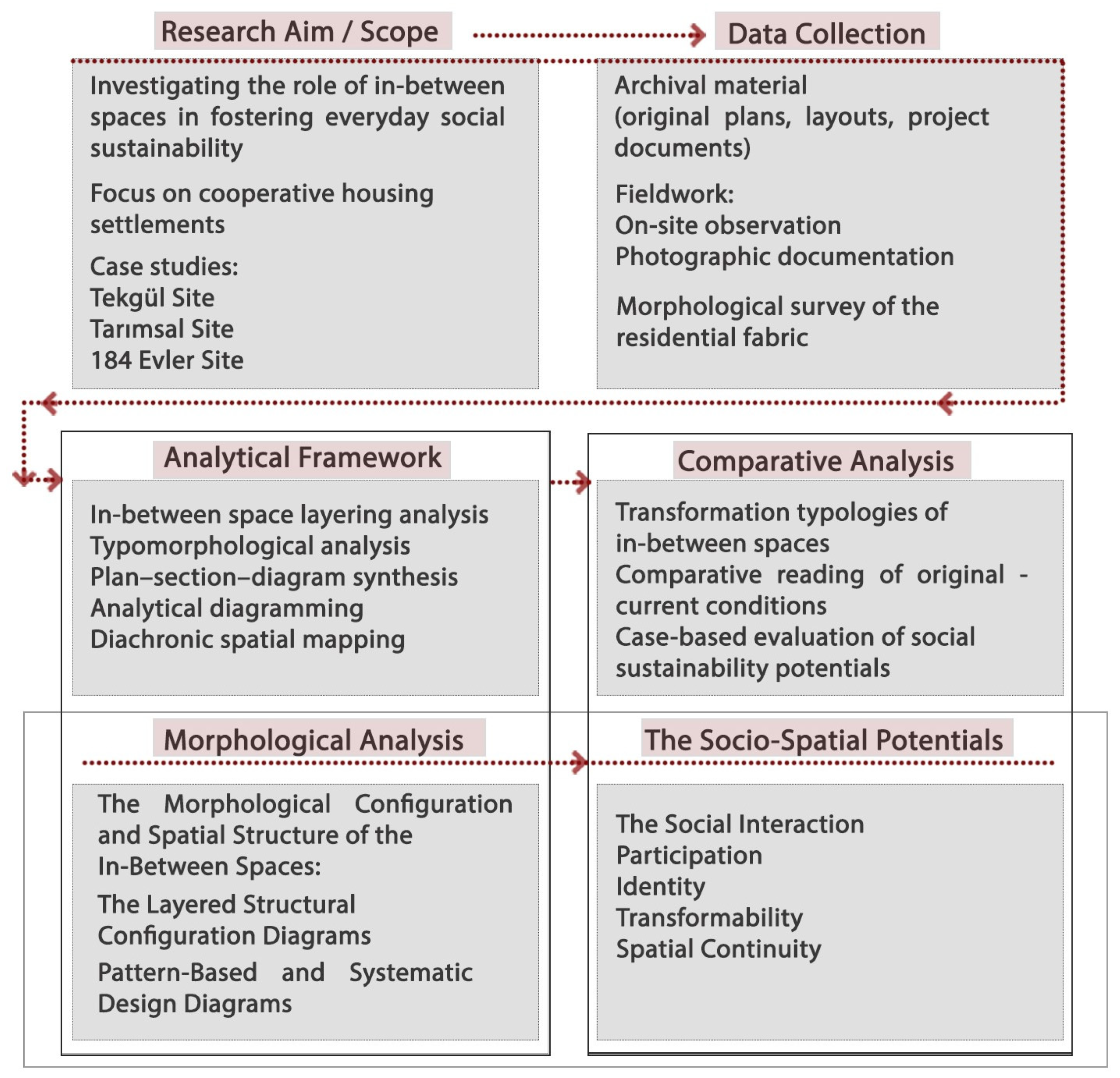
To enhance the clarity and readability of the methodological structure, the overall research process is summarized through the workflow diagram presented below (
Figure 1). The diagram visually synthesizes the sequential and interrelated stages of the study, illustrating how spatial mapping, field-based observation, and analytical synthesis are integrated within a unified methodological framework.
2.2. Theoretical Framework
The concept of the in-between occupies a crucial position in architectural and urban theory as a spatial condition that both connects and differentiates. It functions simultaneously as a transitional zone between layers of space and as an autonomous realm that enables encounter, dialog, and transformation. Rather than serving as a static boundary, the in-between is understood as a dynamic and generative field—an arena of becoming and movement [
20,
21].
Following the philosophical lineage of Plato’s chora and Bergson’s notion of continuous flux, the in-between emerges as a site where transformation and relationality unfold through the lived experience of space [
22,
23]. It thus transcends the physical definition of boundaries, evolving into a field of negotiation where architecture and life meet. The city, therefore, should offer environments that stimulate sensory engagement, creativity, and collective experience. Yet, contemporary urbanization, characterized by rigid zoning and segregated typologies, increasingly limits the potential for social encounter and physical contact [
8,
10,
11,
24].
This tension underscores the need to restore permeability and continuity between urban functions. Within this framework, the in-between becomes a key mediator for rebuilding spatial coherence and supporting social interaction as an essential dimension of social sustainability.
From the mid-twentieth century onwards, architectural discourse witnessed a growing interest in the social dimensions of urban space. The in-between gained theoretical prominence as architects sought to counteract the alienation and fragmentation of modernist planning. Various terms—such as doorstep/space between [
25,
26,
27,
28], in-between realm [
11,
29,
30,
31], in-between space [
10], interface, threshold, soft edge [
8,
32], ambiguous boundary [
33], intermediate space [
34], liminal space and buffer zone [
7,
35], hybrid zone [
36]—emerged to articulate this spatial phenomenon and its relational potential.
At the 1956 CIAM conference, Alison and Peter Smithson introduced the foundational concepts of identity, association, growth patterns, and mobility. Their notion of the “doorstep,” a space articulating between private dwelling and collective realm, embodied the shift toward participatory and human-centered urbanism. Over time, the Smithsons reframed this concept as the space between, emphasizing the continuity and social potential embedded in everyday urban spaces [
25].
Aldo van Eyck significantly expanded this discourse through his notion of the in-between realm, which he described as a “dialogical field” reconciling opposites such as inside/outside, private/public, and individual/collective [
30,
31]. Van Eyck’s idea of twin phenomena proposed that architectural design should not dissolve dichotomies but integrate them in a mutually enriching dialog.
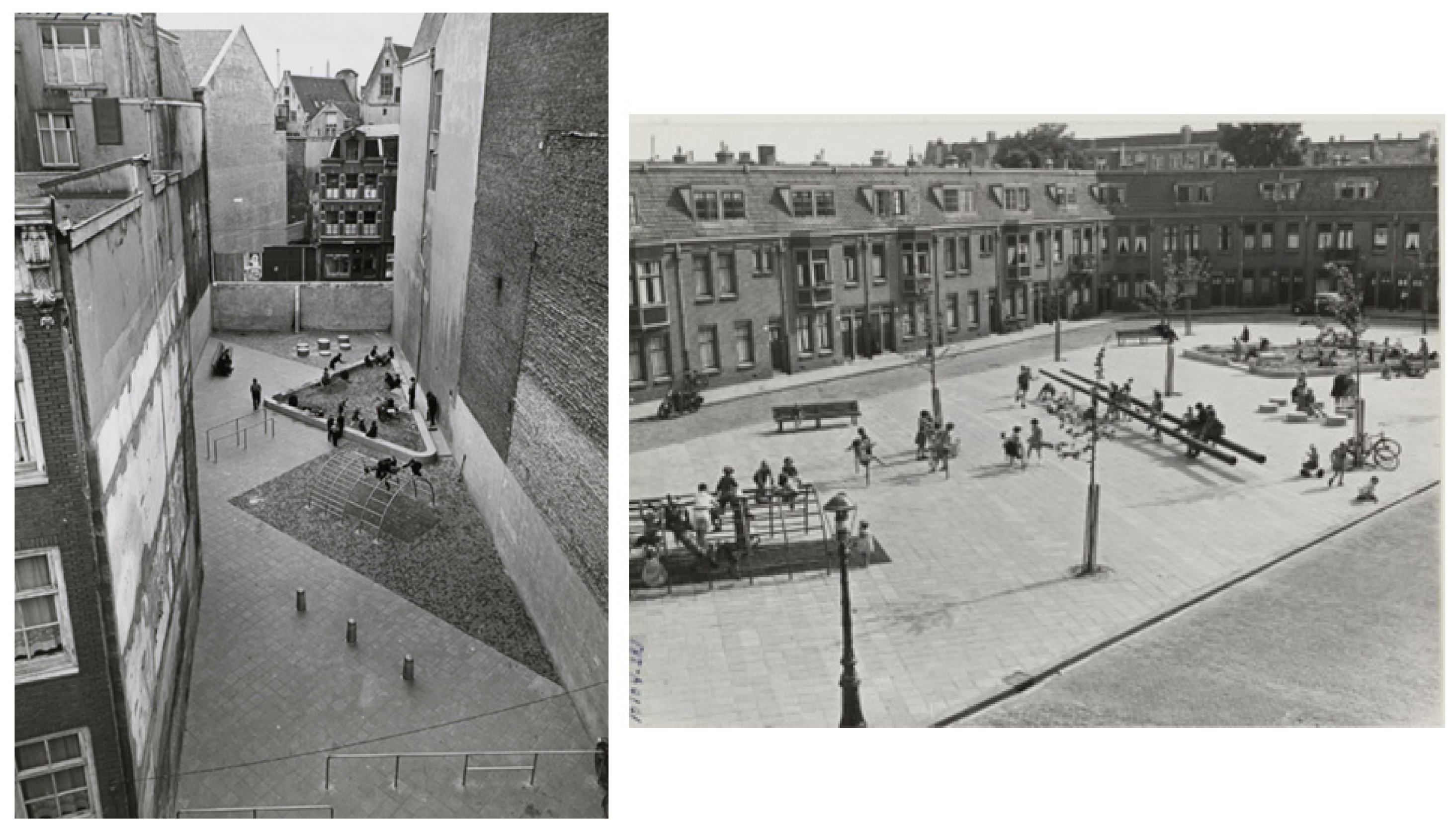
His architectural works, such as the Amsterdam Orphanage (1959), exemplify this philosophy. The project organizes modular spatial units through clearly articulated intermediate zones that emphasize transitions rather than blur them [
37,
38]. Similarly, Van Eyck’s post-war playgrounds in Amsterdam—over 700 designed between 1947 and 1978—served as experimental fields where participation, creativity, and encounter redefined the social role of space. These playgrounds acted as articulating layers between the domestic and the civic, the child and the collective, echoing his belief that architecture’s mission is to bridge and humanize the spaces in-between (
Figure 2).
In parallel, Jan Gehl’s soft edge theory (1971/2011) reinforced the social relevance of transitional zones in sustaining urban life [
8]. Gehl advocated for porous and flexible boundaries between public and private realms, emphasizing that spatial permeability encourages longer outdoor activities, spontaneous interactions, and a stronger sense of belonging.
Spaces such as front gardens, stoops, courtyards, and verandas operate as soft edges—zones that mediate visual and social contact [
32]. Studies in Scandinavian and North American contexts further demonstrate how such spatial conditions foster participation and reinforce the continuity between interior and exterior environments. Gehl’s framework thus translates the in-between into an active strategy for designing socially sustainable neighborhoods.
Within the framework of theoretical trajectories, the in-between can be understood as both a physical and social field where structural form and human activity interweave. Drawing from structuralist and phenomenological perspectives, it emerges as a critical spatial condition for achieving social sustainability in contemporary urban contexts.
By focusing on the in-between as a site of negotiation rather than separation, architecture gains the capacity to bridge opposites, stimulate dialog, and sustain the social fabric of everyday life. Sustainable urbanism depends not only on ecological or economic factors but also on the continuous renewal of spatial relationships—the lived, shared, and transformative spaces in-between.
3. Results
Within the methodological framework developed to examine the formation and potential of in-between spaces in urban morphology, the analytical focus of this study is set at the scale of the urban context unit—the residential texture. The urban context, combining the spatial patterns of public areas, intermediate zones, and built structures, represents the morphological scale at which neighborhood identity and structural continuity can be observed. It also provides the most appropriate lens through which spatial transformations and their guiding principles can be interpreted.
The primary case of this study is the Batıkent Housing Project in Ankara, a large-scale cooperative housing development initiated in 1979. Batıkent represented a radical departure from speculative and top-down housing production models [
39]. It proposed a participatory, community-driven structure in which residents, cooperatives, and local government collaborated in all phases of the project—from design to implementation. By 1983, the first 516 housing units were completed, marking the beginning of an incremental urban formation process. Over time, the project evolved into a fully developed urban district, comprising nearly 50,000 housing units, public facilities, commercial areas, and green spaces. With a population exceeding 200,000, Batıkent has grown into one of Ankara’s most significant suburban extensions [
40].
The project emerged as a response to the socio-economic pressures of the 1970s, characterized by rapid population growth, inadequate housing supply, and escalating land prices. To institutionalize cooperative participation, Kent-Koop was established in 1979 as a federation uniting various professional associations and citizen cooperatives. The project’s foundational philosophy was articulated in the 1977 document Principles of Batıkent Organization and Implementation, which stated:
“Ankara Municipality shall act not as a supervisor but as a producer, redistributing urban land value to society, producing or supervising housing environments, and ensuring the public’s participation in urban governance” [
41]. This cooperative mechanism introduced a transparent and multi-actor decision-making process, ensuring that housing production was not only economically accessible but also socially inclusive.
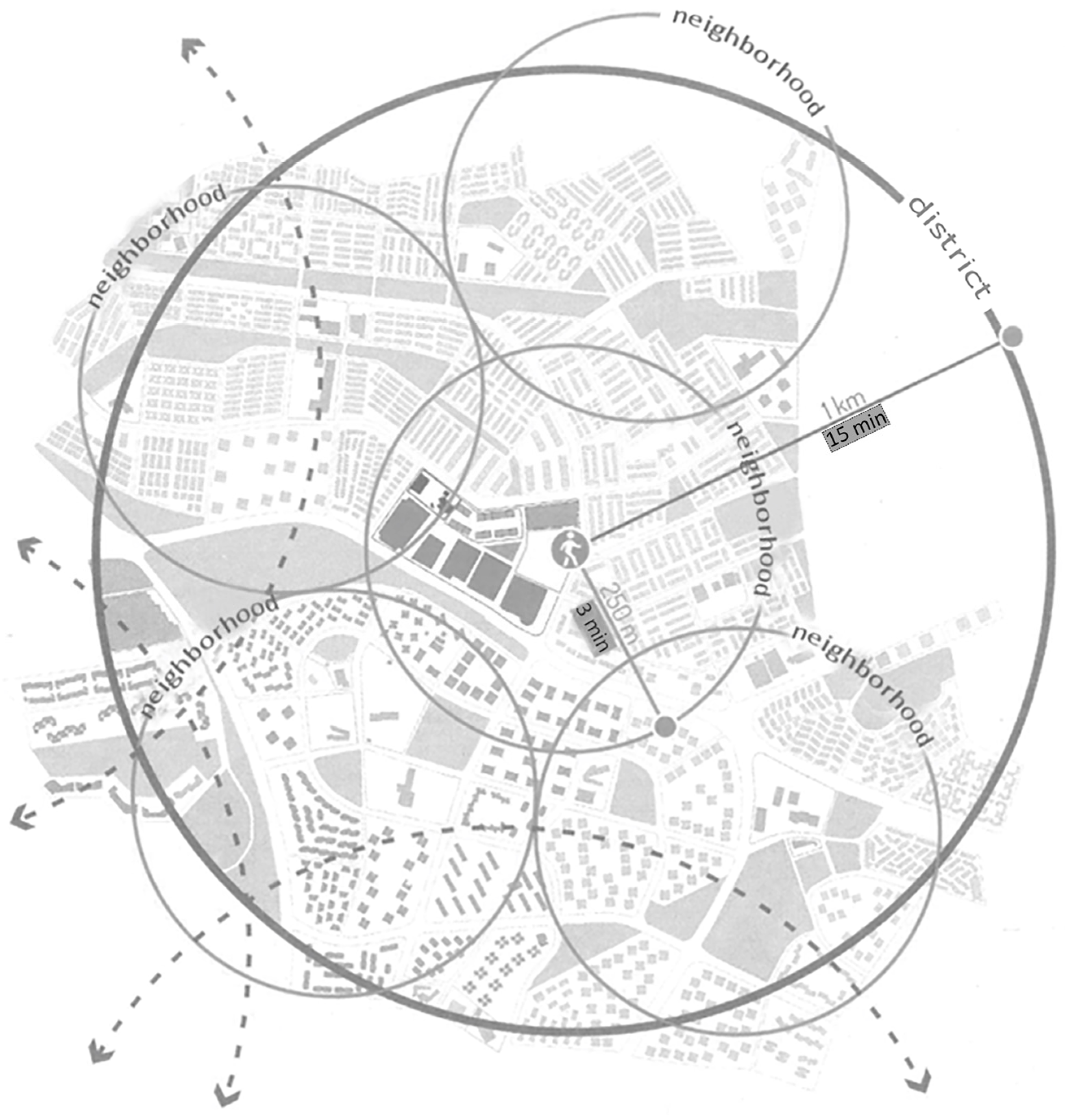
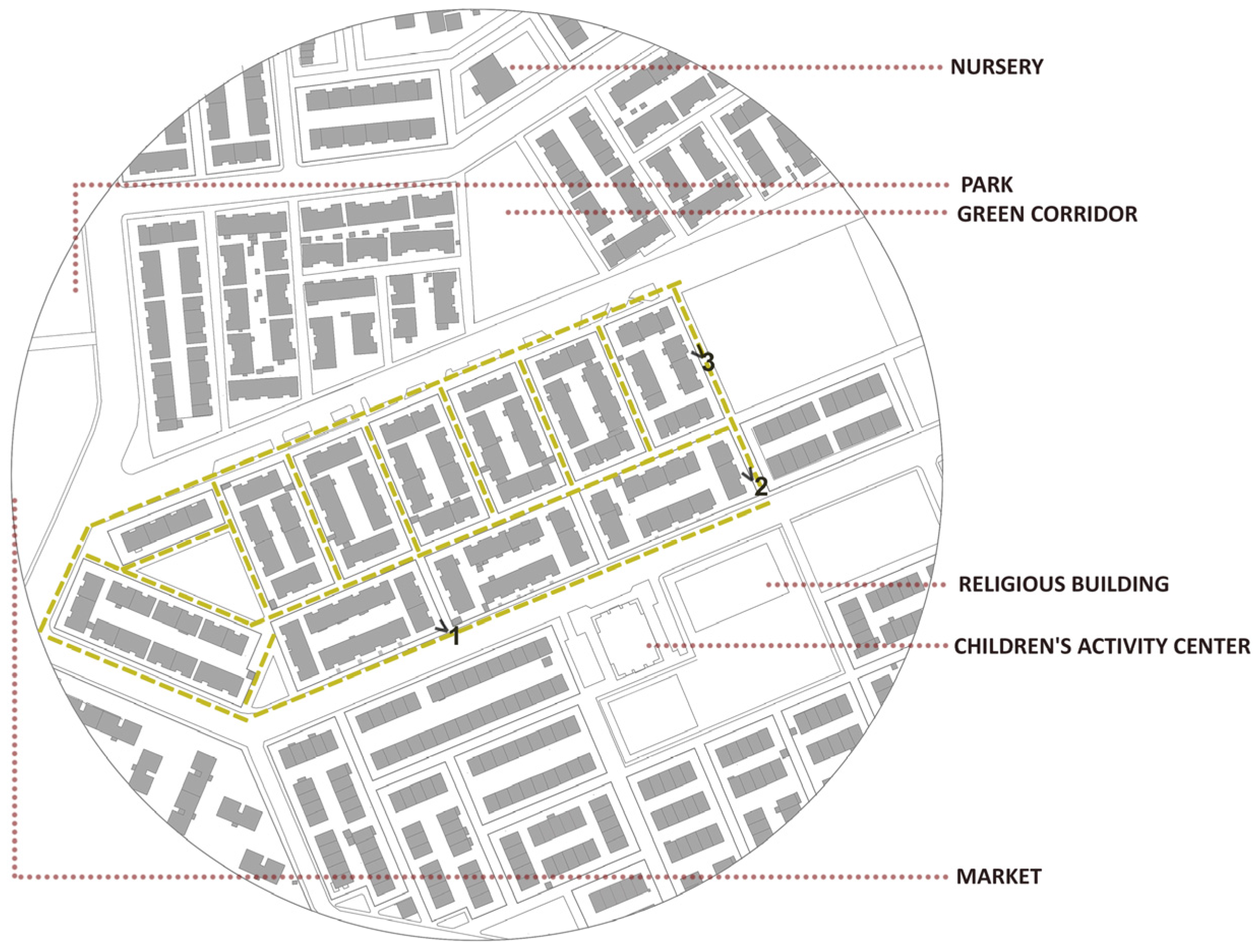
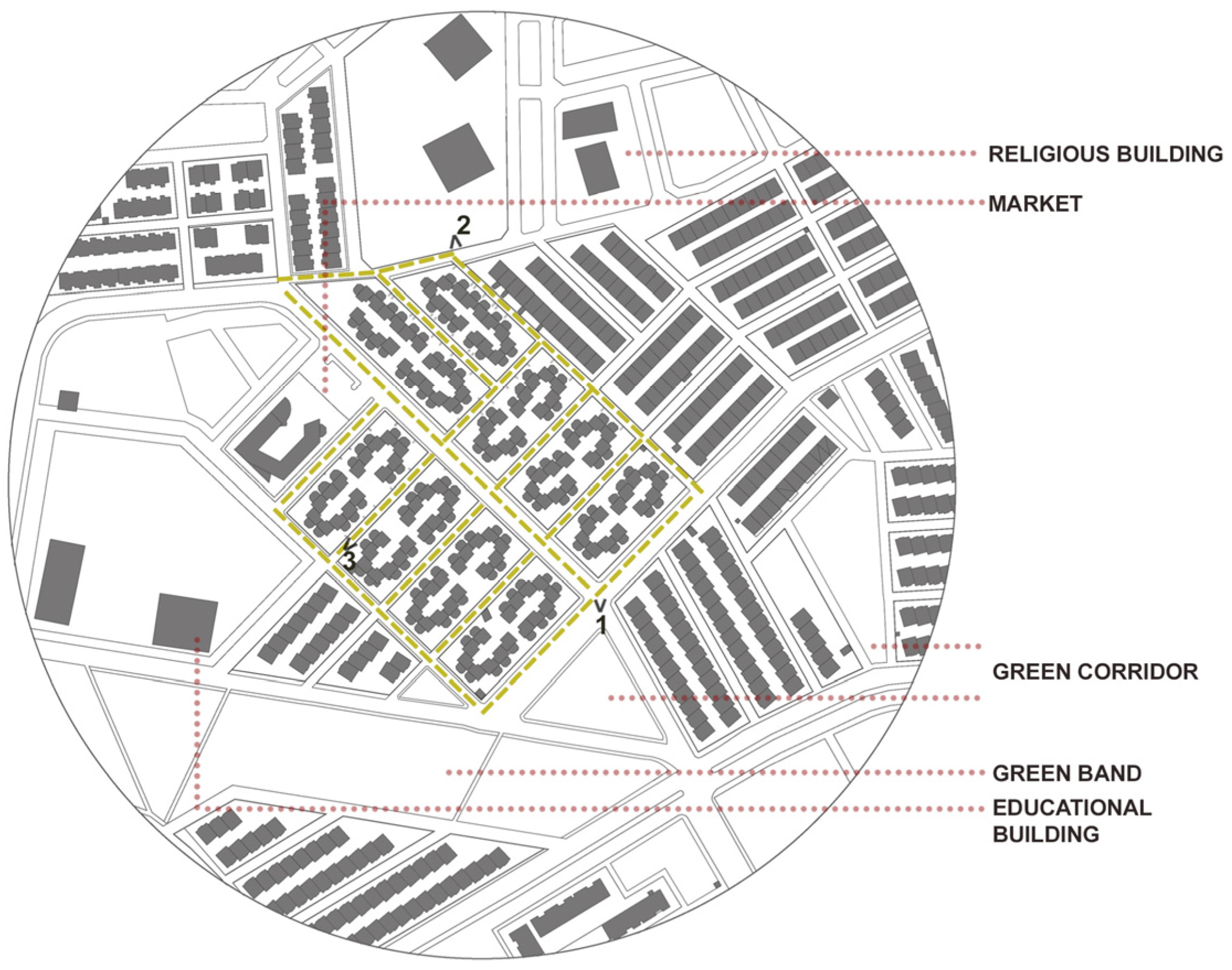
At the spatial level, Batıkent was designed as a pedestrian-oriented urban context emphasizing accessibility and community integration. Within one-kilometer radius—approximately 15 min walk—residents could reach local commercial and public services (
Figure 3). At the neighborhood scale, smaller clusters were designed to provide everyday facilities such as local shops, playgrounds, and cultural amenities within a six-minute walking distance [
40]. This layered accessibility structure encouraged the creation of in-between spaces that facilitated social interaction, reinforcing the project’s broader goals of collective living and urban sustainability.
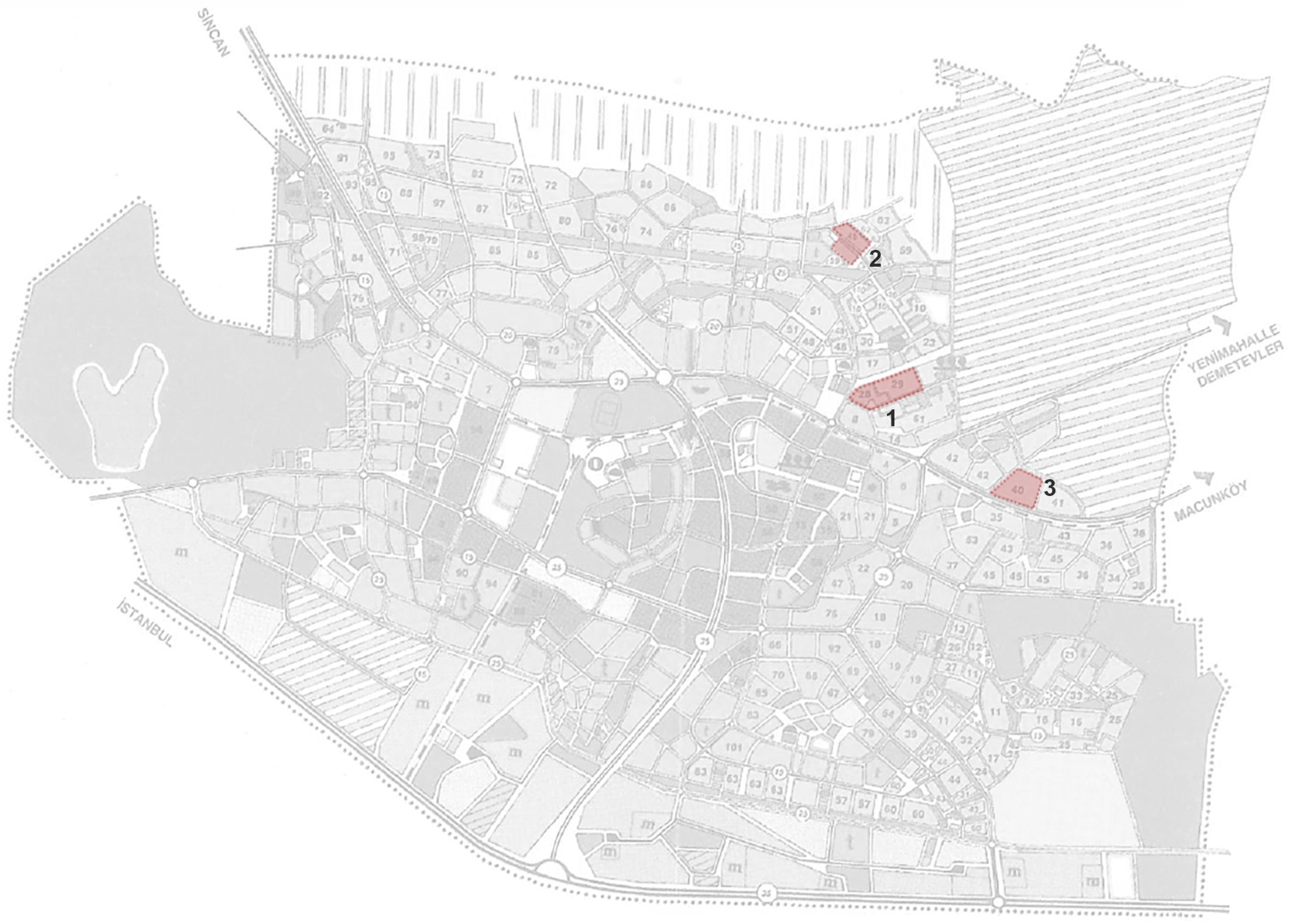
The three housing settlements examined in this study were selected from among the examples developed during the initial implementation phase of the Batıkent Project, extending into the early 1980s, in line with the principles of participatory planning and collective production. These settlements are of representative value as they spatially embody the founding ideals of the project—social participation, cooperative organization, and human-scaled environmental design. In this regard, they are evaluated as early implementation areas that allow for an examination of how Batıkent evolved beyond a mere physical planning practice to shape processes of social sustainability, collective modes of living, and the production of in-between spaces. The cases discussed in this section were selected for their potential to represent distinct spatial and social characteristics within the multi-layered urban structure of Batıkent. Each settlement is comparatively analyzed for the different patterns through which in-between spaces manifest in relation to social sustainability, identity formation, and spatial adaptability (
Figure 4).
3.1. Tekbank–Gendarmerie Officers Housing Cooperative (Tekgül Site)
Within the framework of the Batıkent Project, the Tekgül Sit was developed in 1981 as a joint initiative between the Türkiye Emlak Kredi Bankası (Tekbank) and the Gendarmerie Officers Housing Cooperative. Located within the initial development phase of Batıkent, the site exemplifies a low-density row-house typology organized around private gardens and shared open spaces, comprising a total of 242 housing units [
42].
Tekgül Site was selected for this study due to its representative spatial characteristics: it maintains a typological and morphological consistency with its surrounding urban context, exhibits a clearly legible hierarchical spatial order, and occupies a central location enriched by green networks and communal amenities. As one of the earliest examples reflecting Batıkent’s human-centered design principles, the site offers a valuable context for analyzing the morphological and social potentials of in-between spaces.
3.1.1. The Morphological Configuration and Spatial Structure of the In-Between in Tekgül Site
This section presents a morphological and spatial analysis of the in-between spaces within the Tekgül Site, focusing on its multi-layered structure, pattern-based organization, and systematic design of spatial hierarchy.
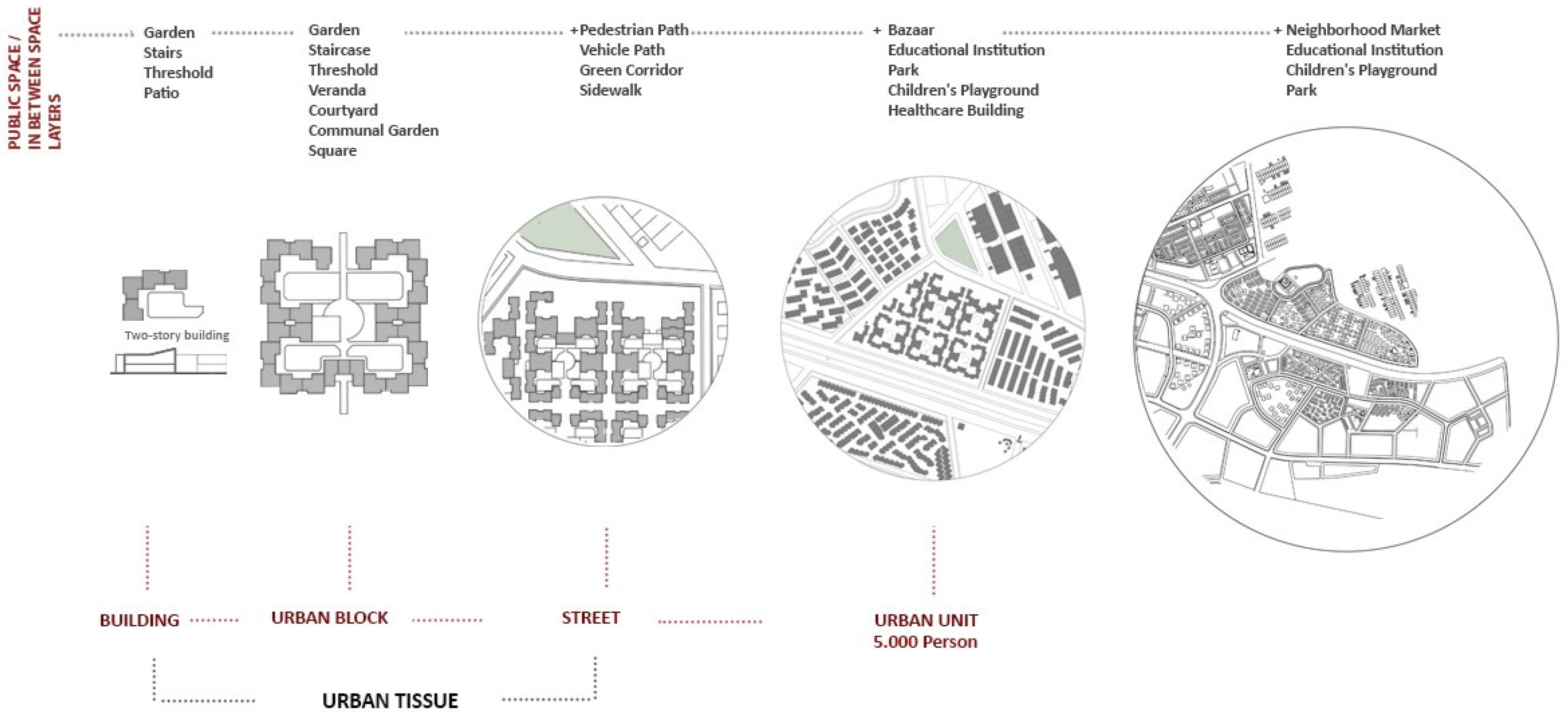
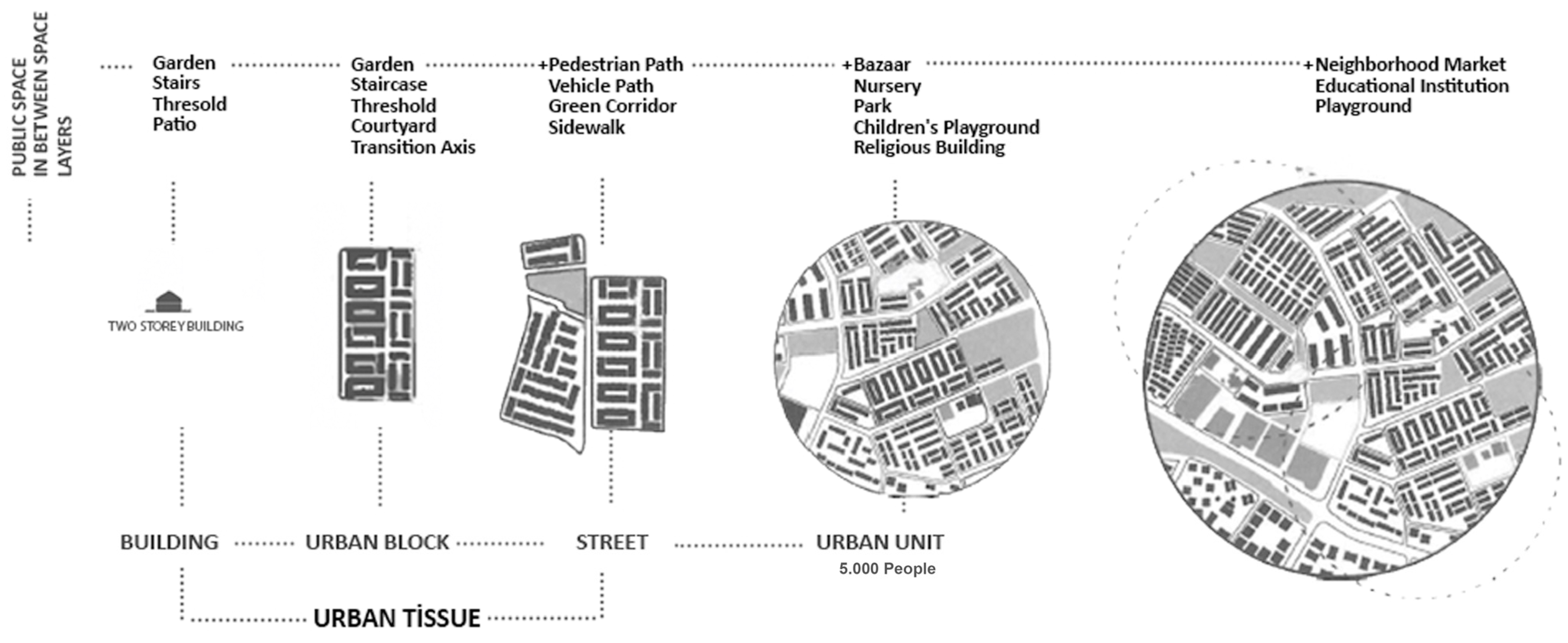
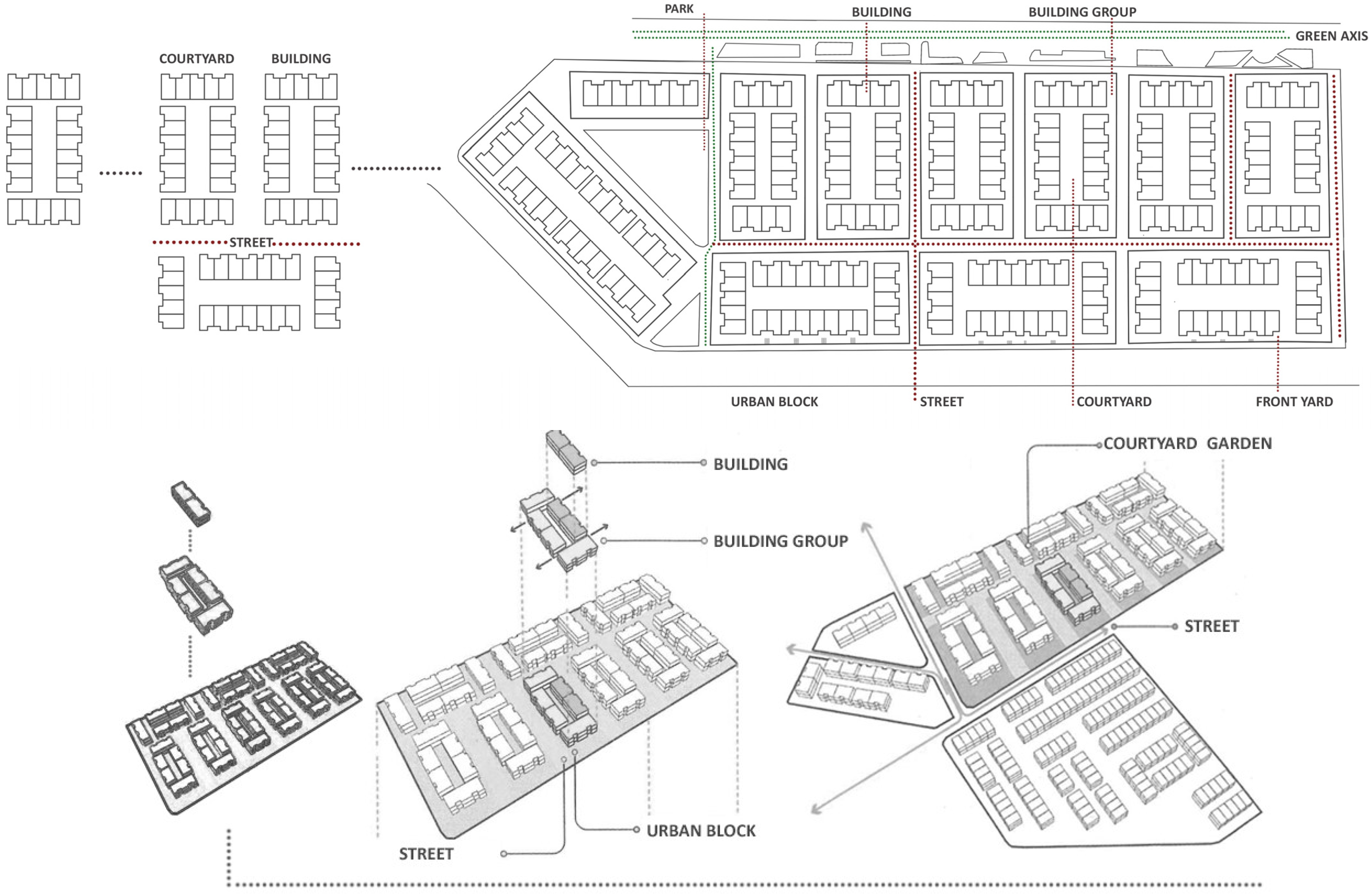
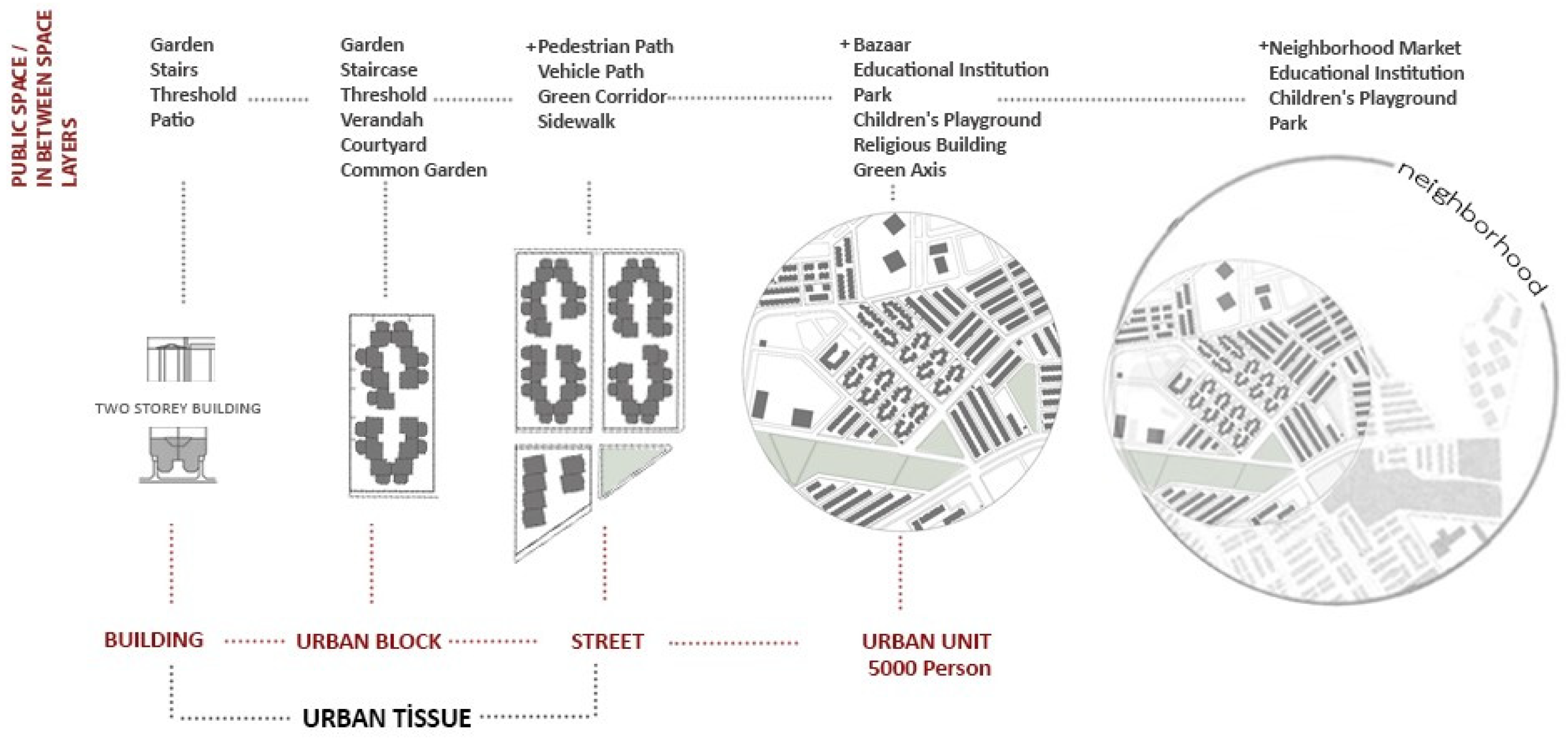
The Tekgül Site housing settlement was designed based on a hierarchical model of organization at the scale of the urban fabric. The settlement exhibits a hierarchical structure extending from the macro to the micro scale, establishing a consistent system of relationships across the levels of district, neighborhood, residential environment, and housing fabric. Within the developed design, various spatial layers of in-between and public spaces can be identified: at the building scale, individual gardens and threshold spaces; at the block scale, shared gardens and inner courtyards; at the urban fabric scale, streets, pedestrian pathways, and green corridors; and at the residential environment scale, public amenities such as local shopping areas, kindergartens, parks, and playgrounds. The settlement is situated in a central part of Batıkent that accommodates multiple urban functions and demonstrates spatial permeability with its surrounding urban context. Within this structure, in-between spaces function as multi-scalar connectors between public and private domains, ensuring the continuity of collective life (
Figure 5).
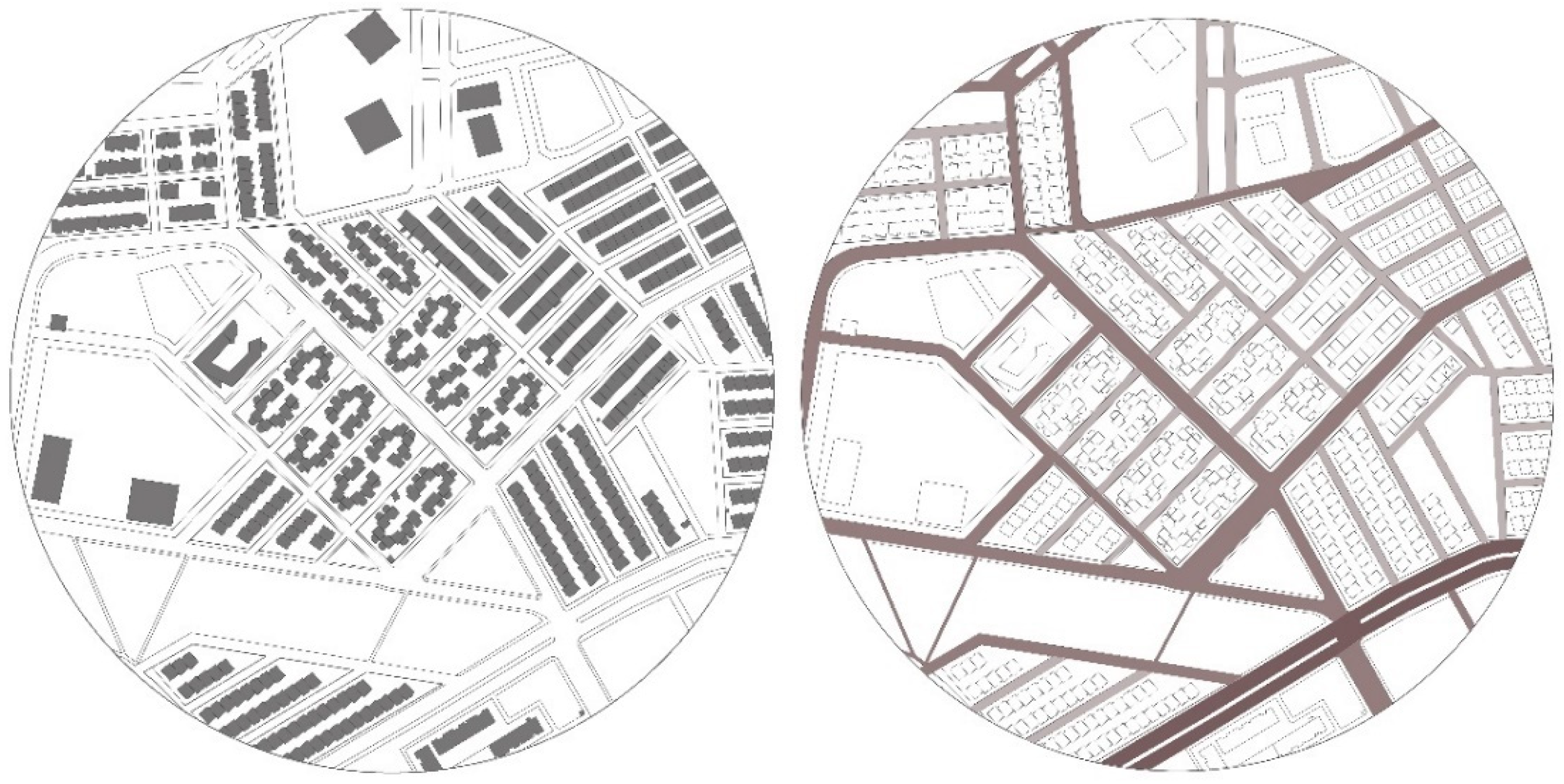
Morphological analyses conducted at the tissue-unit scale reveal that a formal and social continuity has been established between the settlement and its surrounding residential environment, particularly in terms of spatial relationships and accessibility. At the block scale, the original design of the settlement defined transitional axes providing access to the inner courtyard, which functioned as a shared open space intended for collective use. As illustrated in
Figure 6,
Figure 7,
Figure 8 and
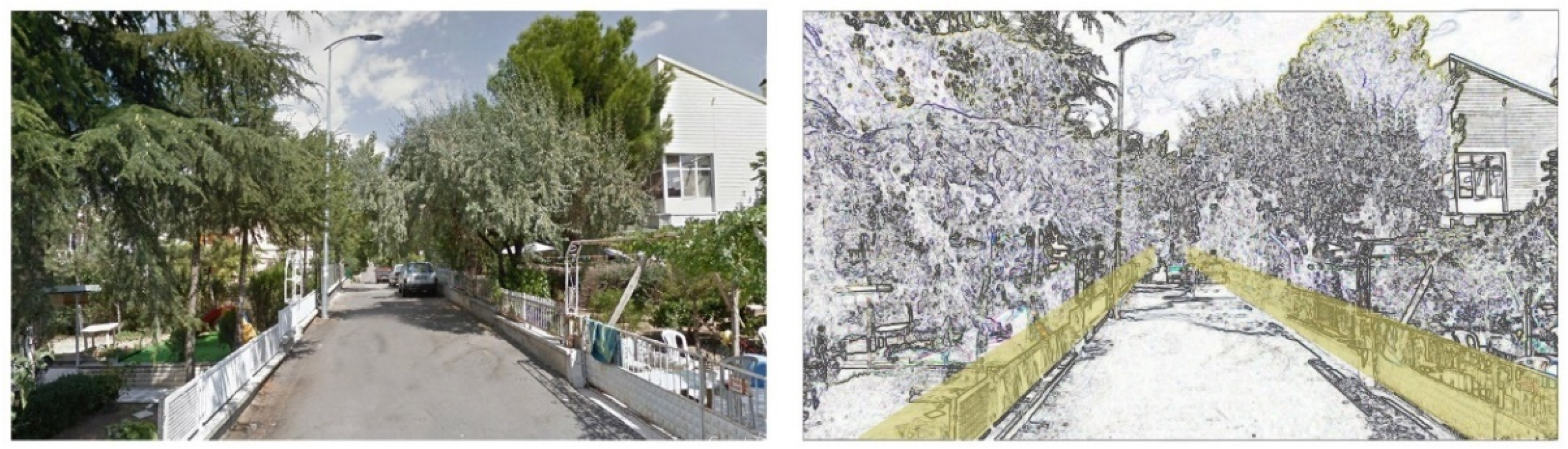
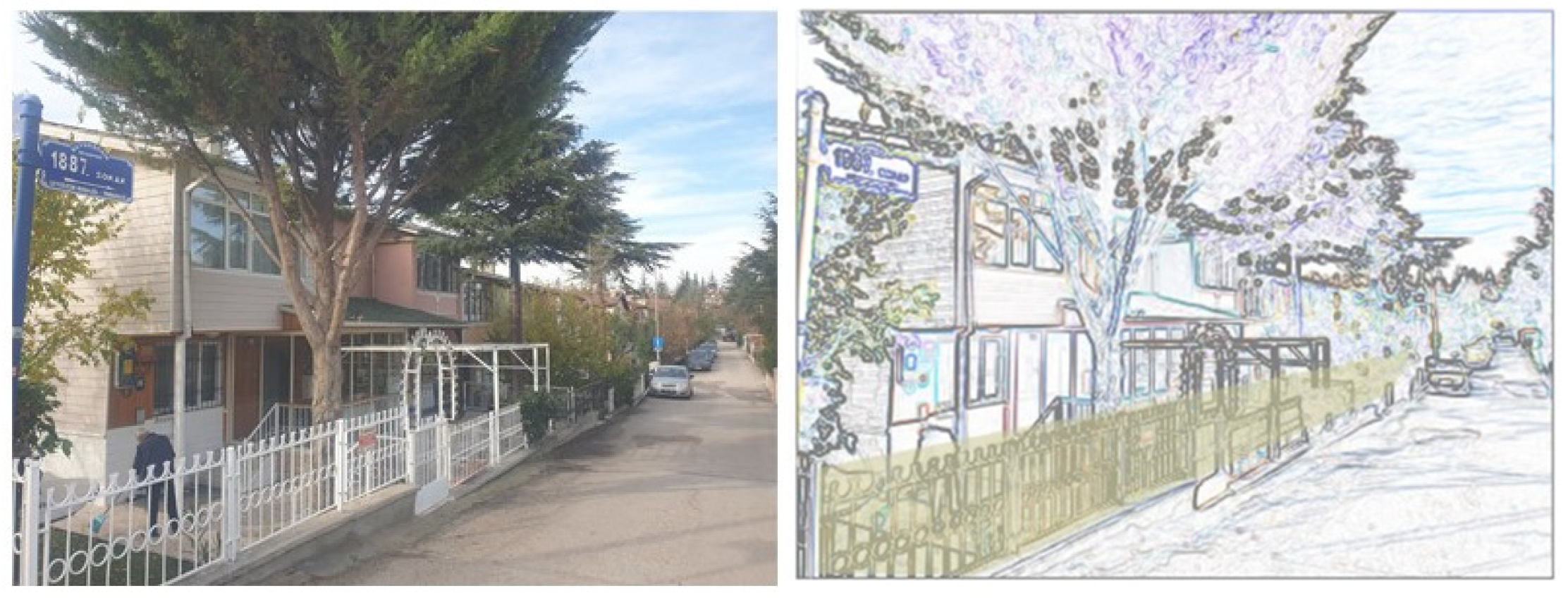
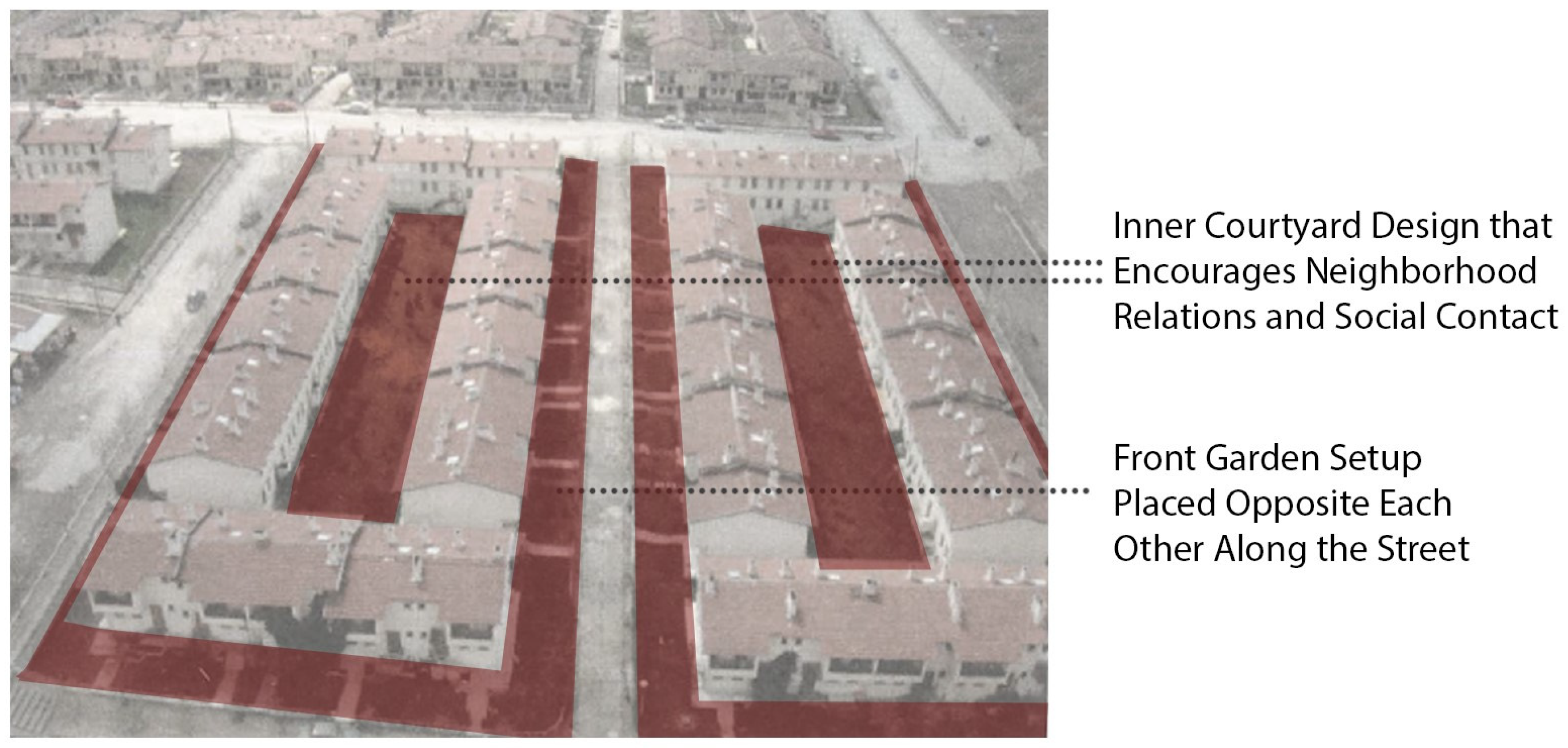
Figure 9, the interfaces between the street grid and housing blocks were designed to encourage permeability rather than separation. Especially along the block edges, front gardens, low fences, and semi-open entrance canopies act as soft boundary elements that maintain visual continuity between public and private realms while moderating their separation. Spatial components such as entrance axes, stairways, front gardens, and balconies oriented toward these axes create transitional zones that support the individual’s engagement with public space and enable social interaction practices such as sitting, observing, greeting, and conversing. The row-house configuration, in turn, reinforces not only visual but also auditory and social contact, strengthening the continuity of everyday interactions and the sense of neighborhood identity (
Figure 6,
Figure 7,
Figure 8 and
Figure 9).
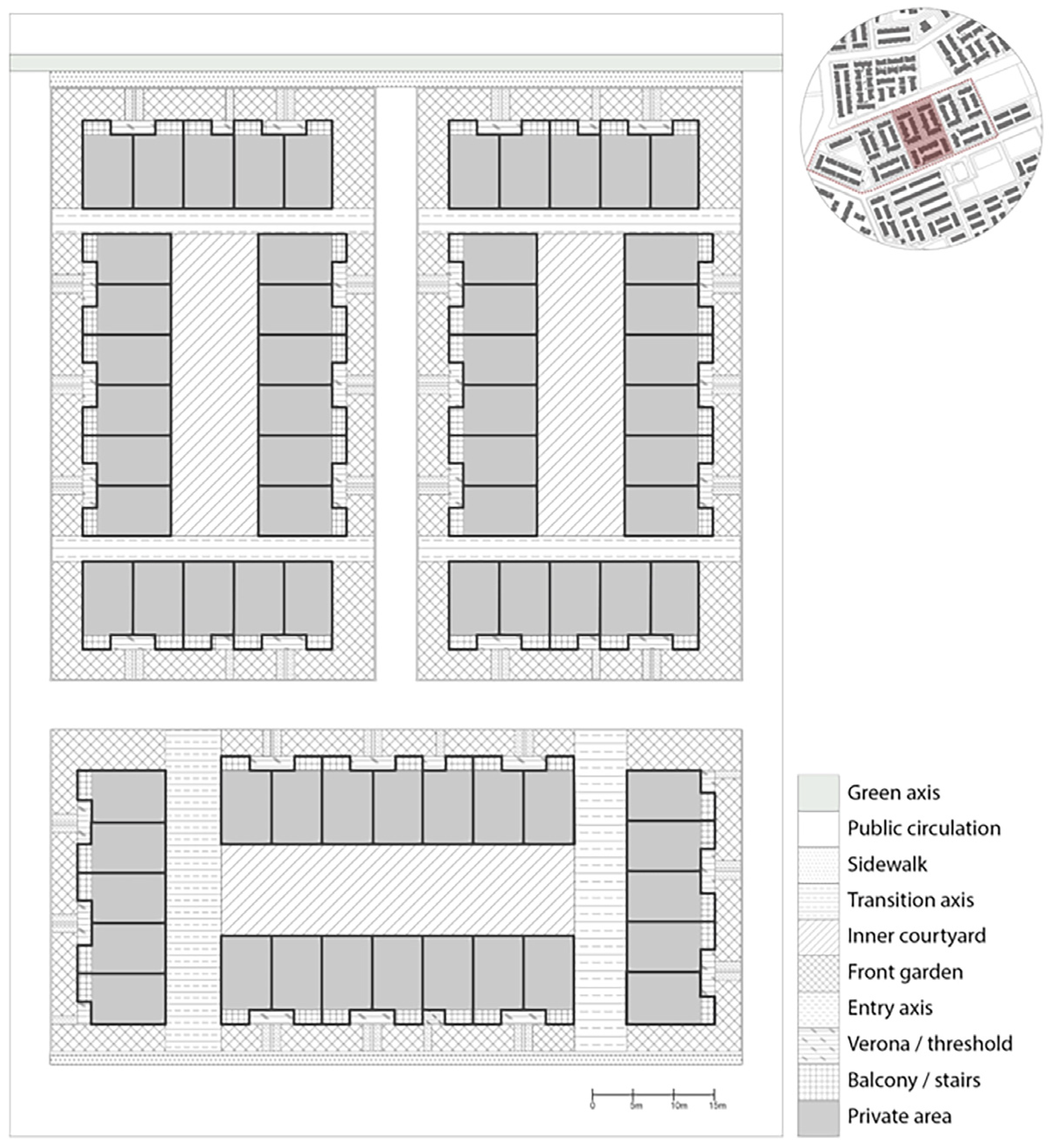
In the Tekgül Site Housing Settlement, the selected sample area was examined through the morphological analysis method focusing on the layers of in-between spaces (
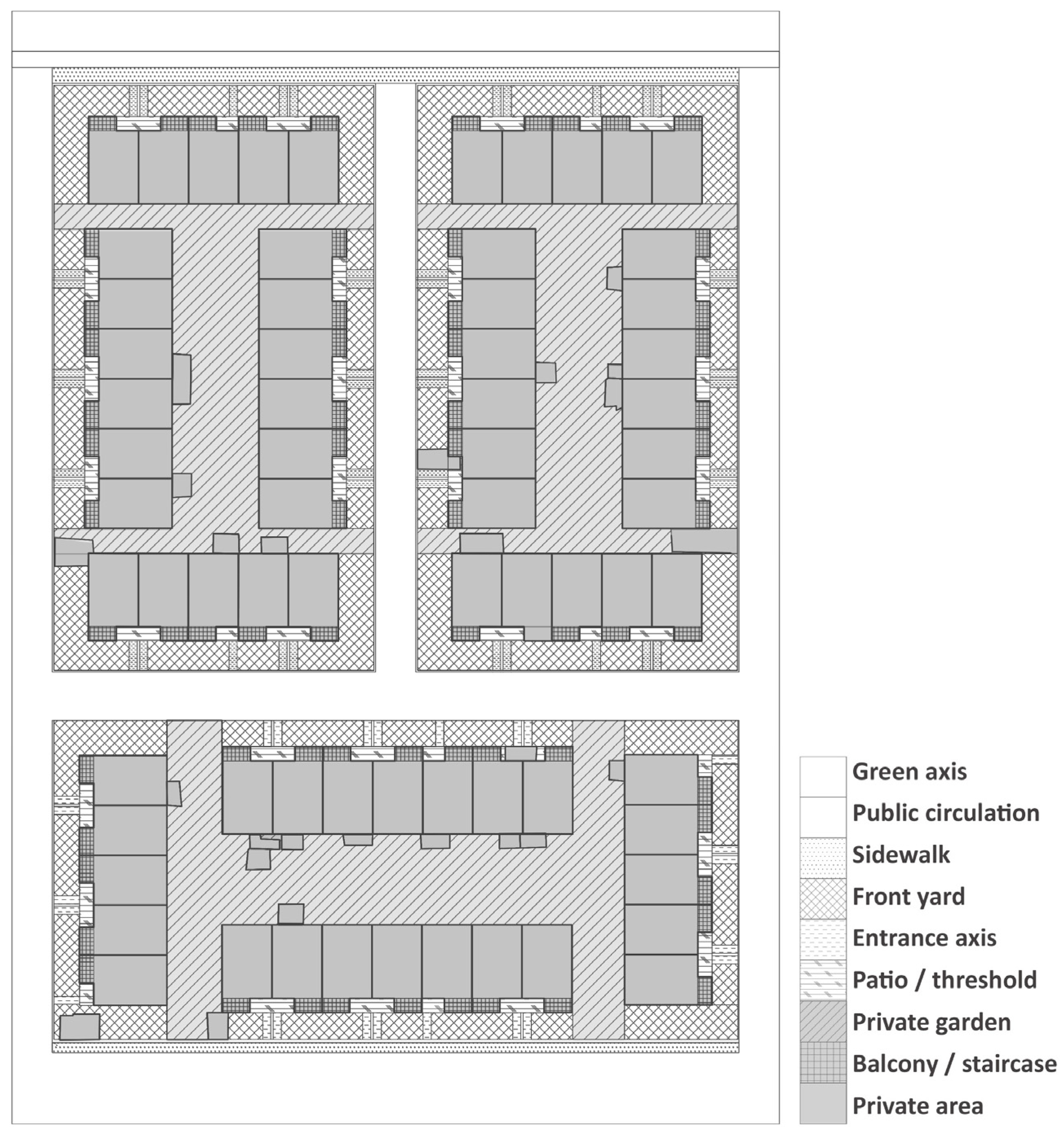
Figure 10). The area was chosen to allow for a clear interpretation of the spatial relationships established between the settlement and its inner and peripheral streets, as well as the continuity among the layers of in-between spaces. Within the spatial transition sequence extending from private to public domains, nine distinct layers of in-between spaces were identified: balcony, veranda, entrance axis, front garden, inner courtyard, passage axis, sidewalk, public circulation area, and green corridor. These in-between layers, defined at different spatial scales, were found to be organized within a permeable spatial structure that ensures continuity from the public to the private realm.
Beyond its hierarchical layering, the spatial organization of the Tekgül Site is also structured through a pattern-based and systematic design logic. Analyses of the housing settlement reveal that the residential fabric possesses a multi-layered and component-based structural organization (
Figure 11). This design approach, derived from a modular unit, is characterized by a pattern-based spatial logic formed through a system of interrelated subcomponents. The part–whole relationship is coherently structured: each housing block functions as a system composed of subordinate spatial units while simultaneously operating as a constituent of a broader urban context.
At the urban scale, the built environment can be interpreted as a morphological composition formed by repetitive spatial patterns that maintain unity within the whole. At the building and block scales, front gardens and inner courtyards generate in-between spatial configurations that strengthen the transitions between public and private realms and enhance opportunities for social interaction (
Figure 12). The plan scheme serves as an analytical framework that visualizes spatial distribution, proportional balance, and interrelations among components, thereby revealing the settlement’s capacity for transformation and its potential for spatial evolution over time.
Within the residential fabric, the modular design approach provides flexibility in terms of transformability and expandability, ensuring both spatial coherence and contextual integrity. In doing so, it significantly contributes to the continuity of urban identity and the integrity of the built environment. The systematic assembly of spatial elements also facilitated the emergence of a shared architectural language during the construction process. The modular structure thus provides a framework for user participation and adaptability over time.
3.1.2. The Socio-Spatial Potentials of In-Between Spaces in Tekgül Site
This section examines the socio-spatial potentials of in-between spaces in the Tekgül Site by focusing on their role in fostering social interaction and participation, supporting spatial identity, and enabling transformation over time. These potentials are approached not as isolated qualities, but as interrelated dimensions emerging from the settlement’s multi-layered spatial organization and everyday use patterns.
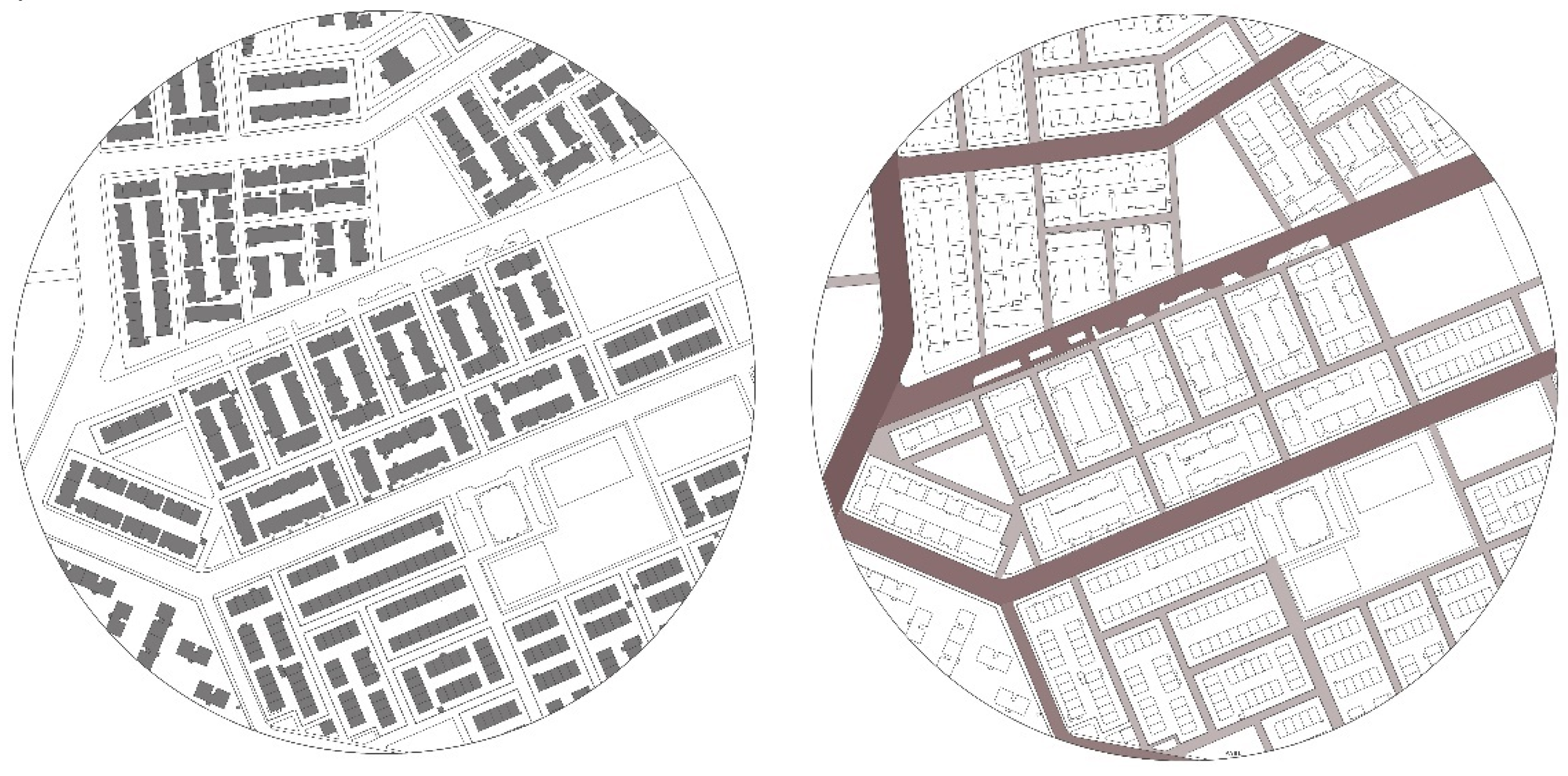
The capacity of in-between spaces in the Tekgül Site to foster social interaction and participation emerges from the interrelation between morphological structure, green-space continuity, and the spatial distribution of everyday social amenities across multiple spatial scales. The multi-layered spatial organization of the Tekgül Site supports independent yet interrelated decision-making processes at both individual and collective levels, enabling residents to intervene in and adapt their living environments. The solid–void analysis conducted at the scale of the urban context reveals a coherent morphological pattern language that shares common formal and behavioral characteristics with adjacent settlements. This collectively oriented spatial configuration can thus be interpreted as a socio-spatial organization that reinforces users’ relationships with their environment (
Figure 13).
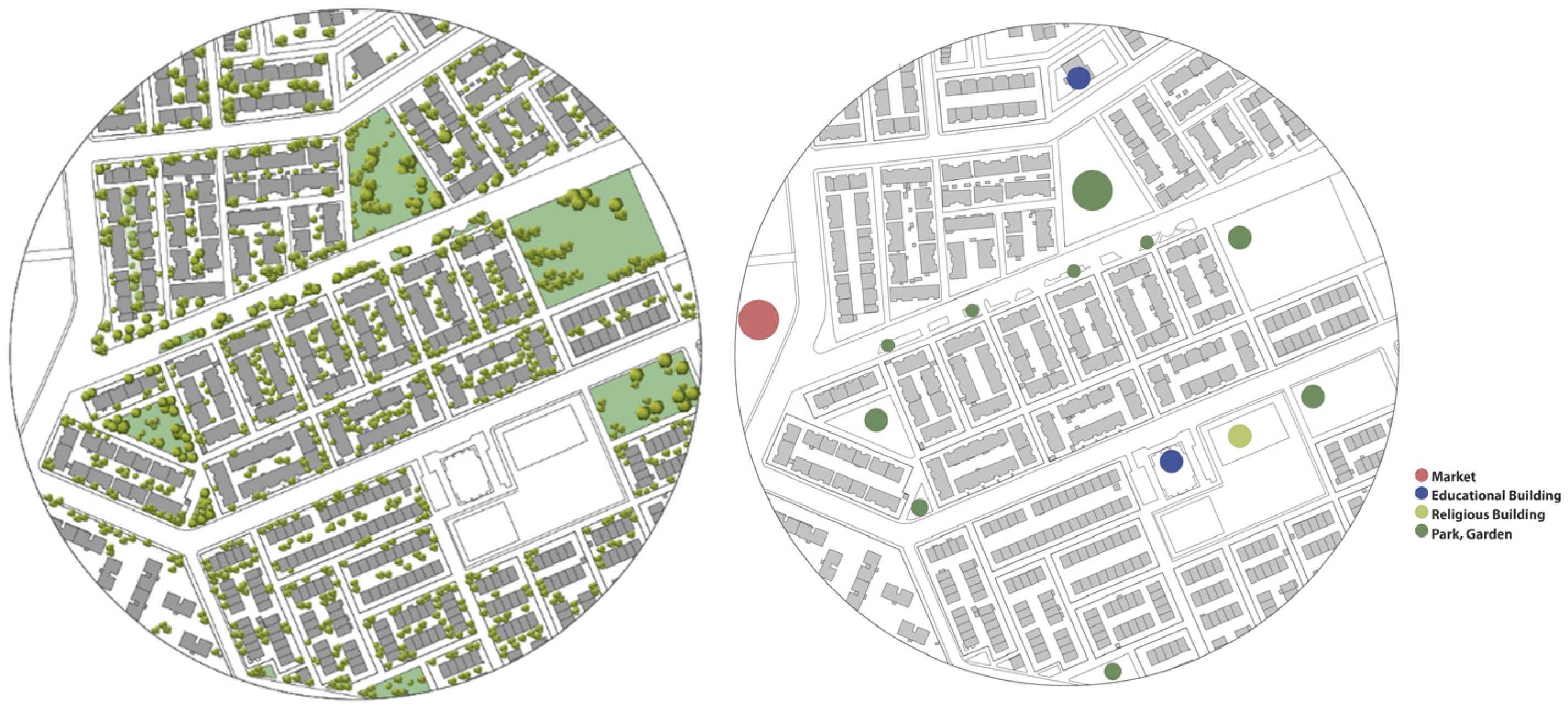
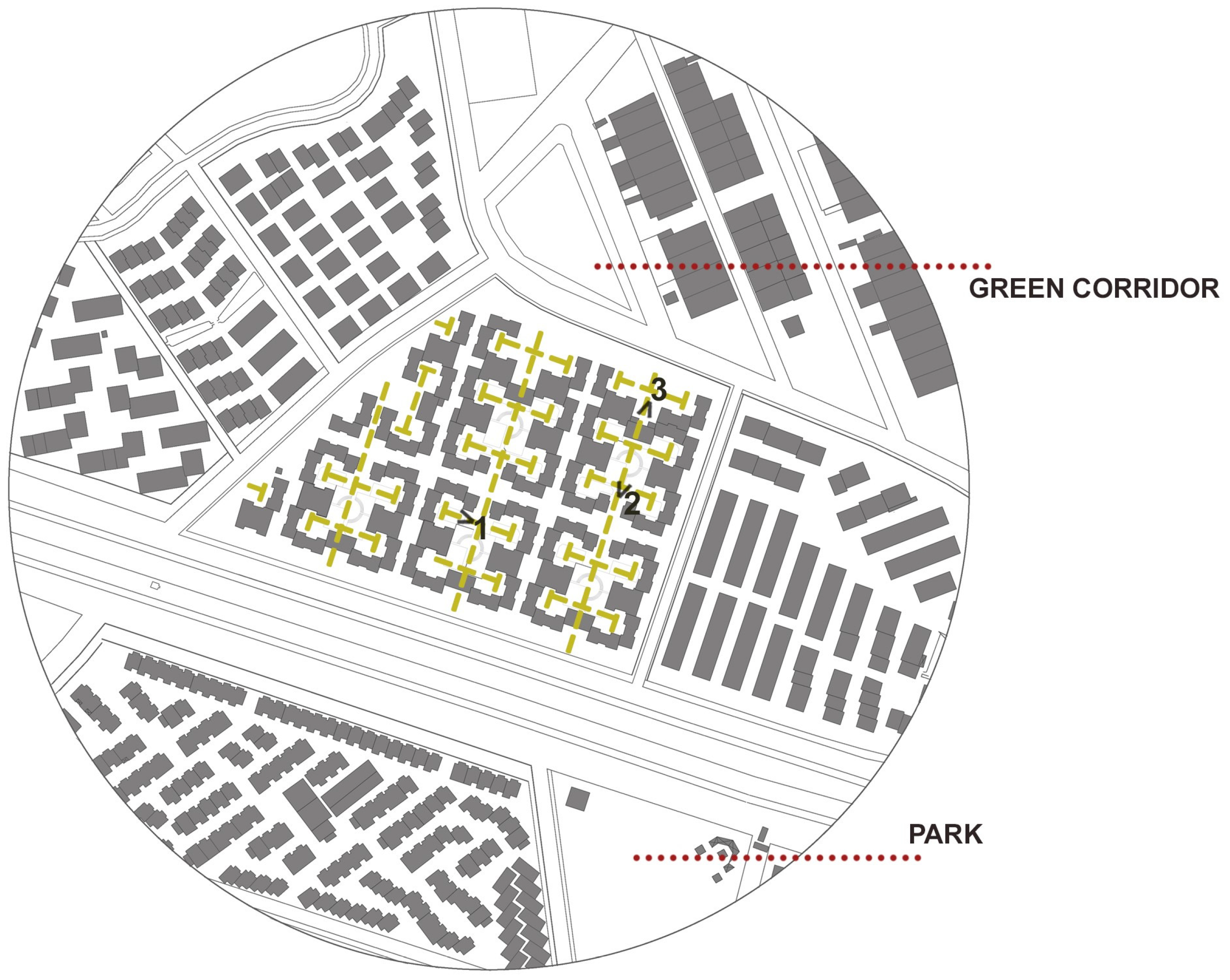
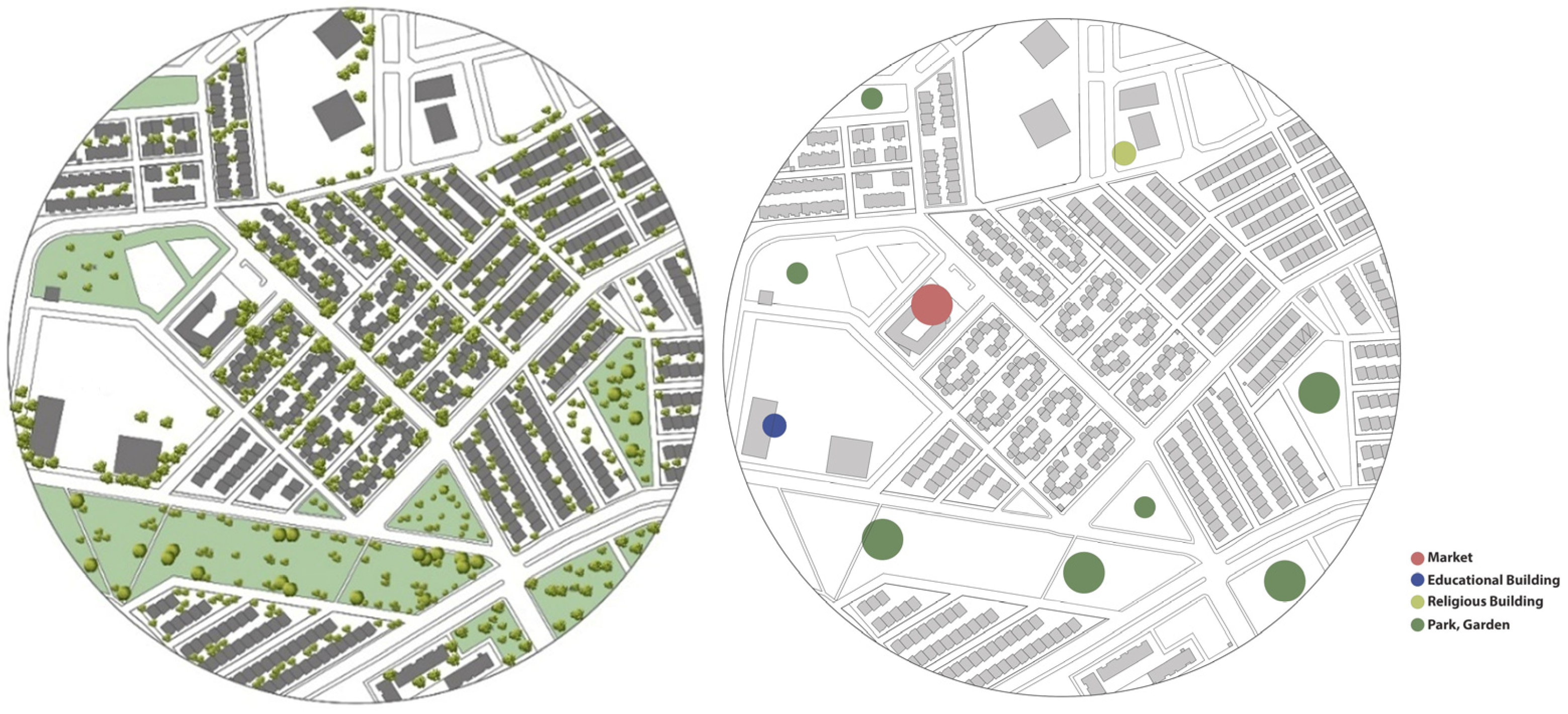
Green-space analyses indicate that the green corridors designed between housing blocks ensure spatial continuity throughout the settlement (
Figure 14). At the building scale, front and rear gardens form private green zones, while at the street and neighborhood scales, continuous green axes, playgrounds, and parks generate an integrated ecological fabric at the public level. In particular, the green corridor along the northern axis constitutes a key component of this continuity. These public green areas function not only as landscape elements but also as nodes of encounter and interaction, offering opportunities for rest, socialization, and collective experience. Their accessibility and permeability strengthen social sustainability by encouraging participation in everyday public life.
The analysis of social facilities demonstrates the presence of local amenities—such as markets, small businesses, and public squares—within walking distance (
Figure 15). This spatial arrangement reflects Batıkent’s planning principle of ensuring access to essential services within a six-minute walking radius, which can be considered an early precursor to the contemporary “15-min city” concept emphasizing accessibility, livability, and sustainable urban life [
40].
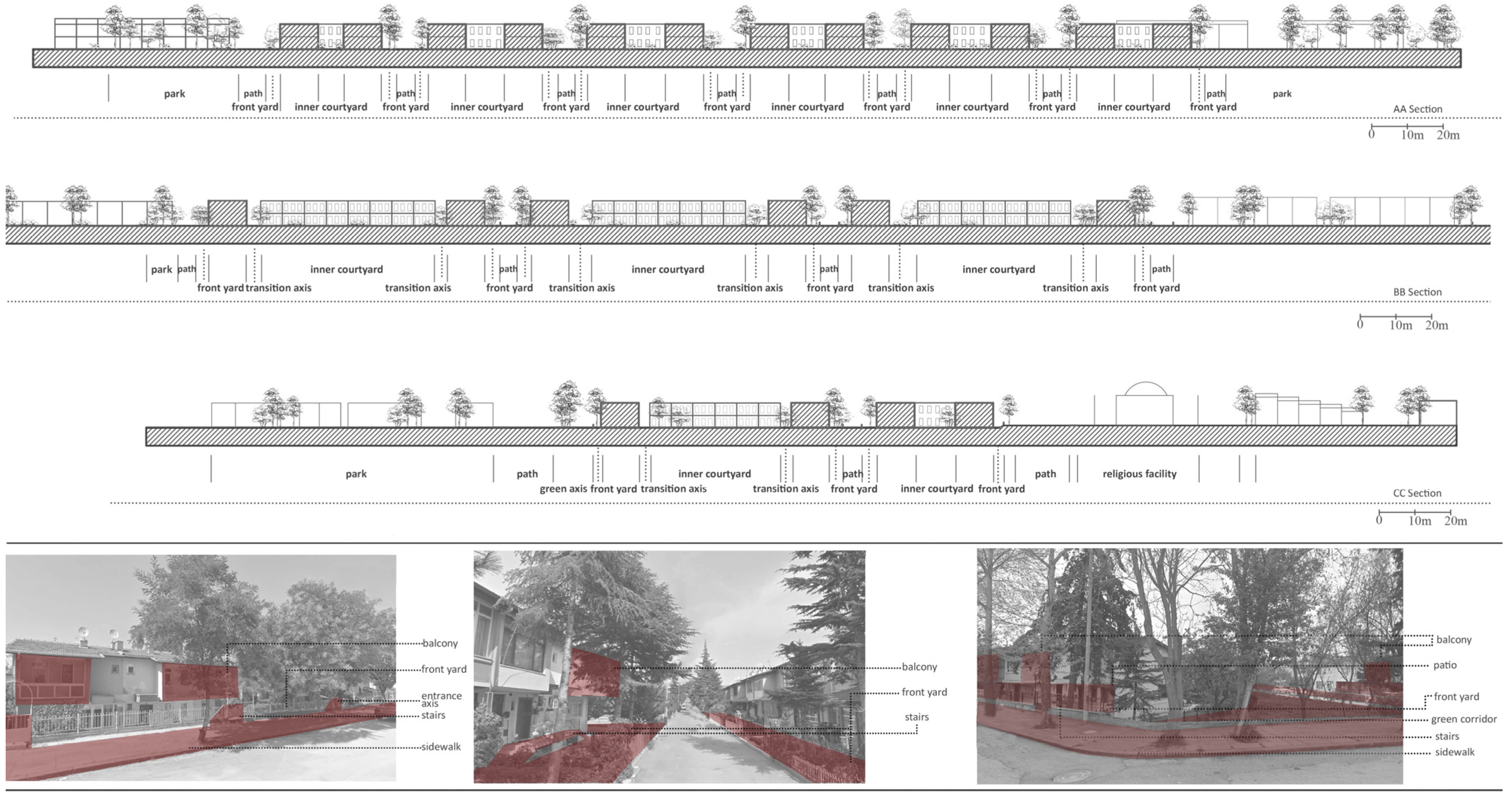
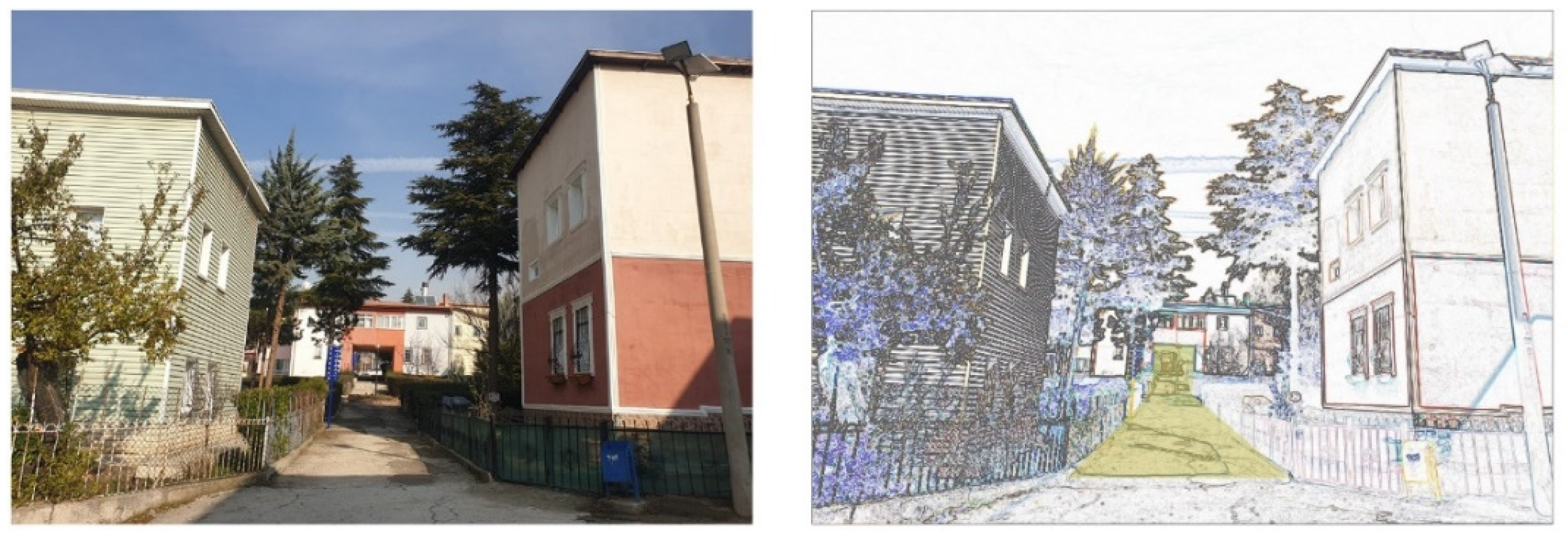
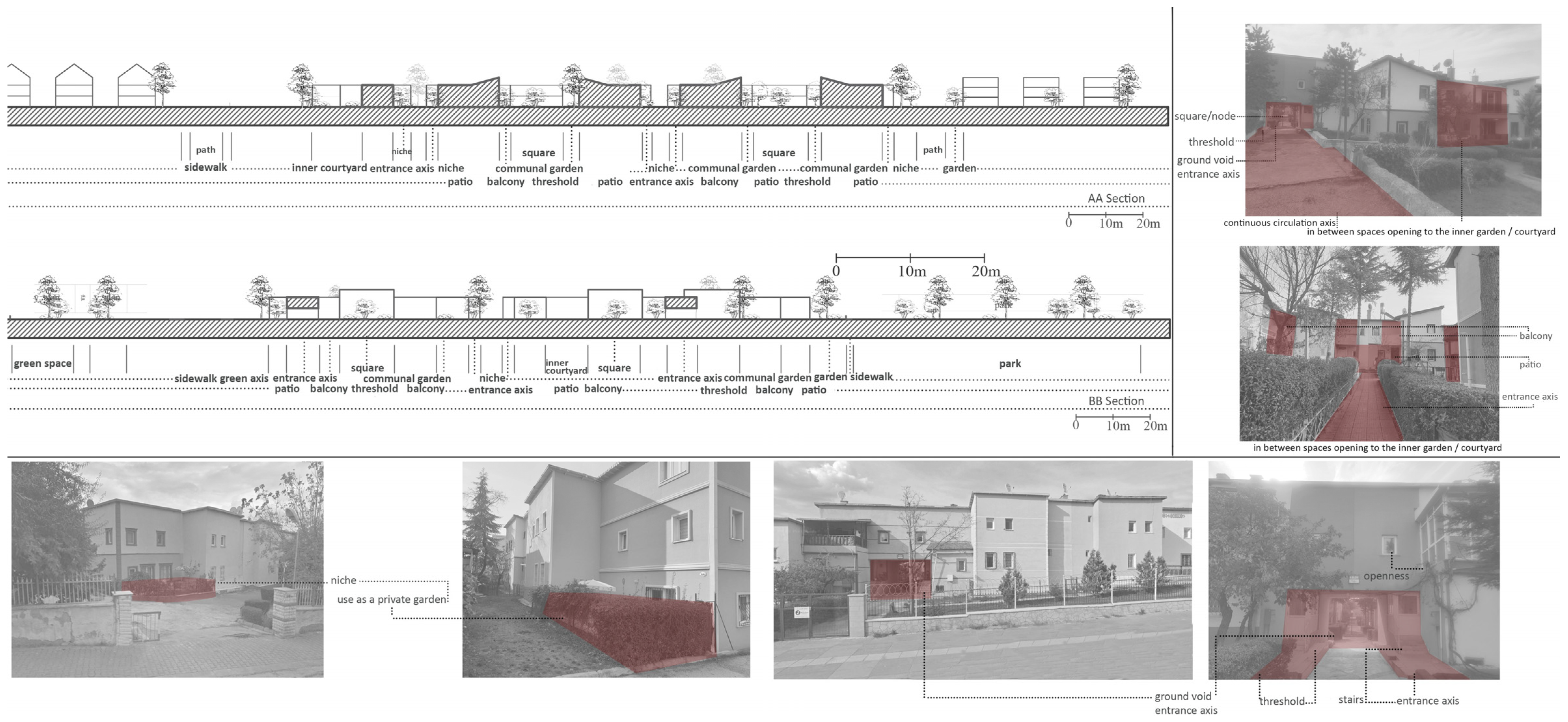
The reciprocal placement of front gardens in the Tekgül Site housing settlement establishes a spatial arrangement that enhances visual relationships between residential units within the row-house typology. This configuration fosters everyday encounters among residents and supports the continuity of social interaction. The positioning of garden passages and staircases increases the likelihood of planned encounters along spatial movement paths, thereby sustaining patterns of social engagement. The inner courtyard, conceived as a collective open space, further strengthens the capacity of the physical environment to generate social cohesion. In this regard, in-between spaces emerge as spatial settings where shared ownership, collective belonging, and social relationships—formed through everyday practices—are spatially articulated and reinforced. The section and perspective diagrams presented below illustrate how in-between space layers are structured as a multi-layered and relational continuum between the building and the street. This visual–analytical representation demonstrates that in-between spaces function not merely as physical transition zones, but as permeable interfaces that enable visual contact and everyday social interaction between public and semi-private realms (
Figure 15 and
Figure 16).
Beyond facilitating everyday social interaction and participation, the in-between spaces of the Tekgül Site also play a crucial role in the formation and expression of spatial identity. The ways in which these spaces are configured, appropriated, and gradually transformed reveal how collective values and individual practices become materially embedded in the built environment.
The configuration and arrangement of spatial components, shaped by local design principles and shared social values, enable the emergence of a context-specific spatial language grounded in collective meanings. The continuity and relational nature of the urban context provide a strong foundation for the formation and long-term preservation of spatial identity. The systematic design approach and the capacity for patterned adaptability allow users to express their individual identities and social positions within the built environment.
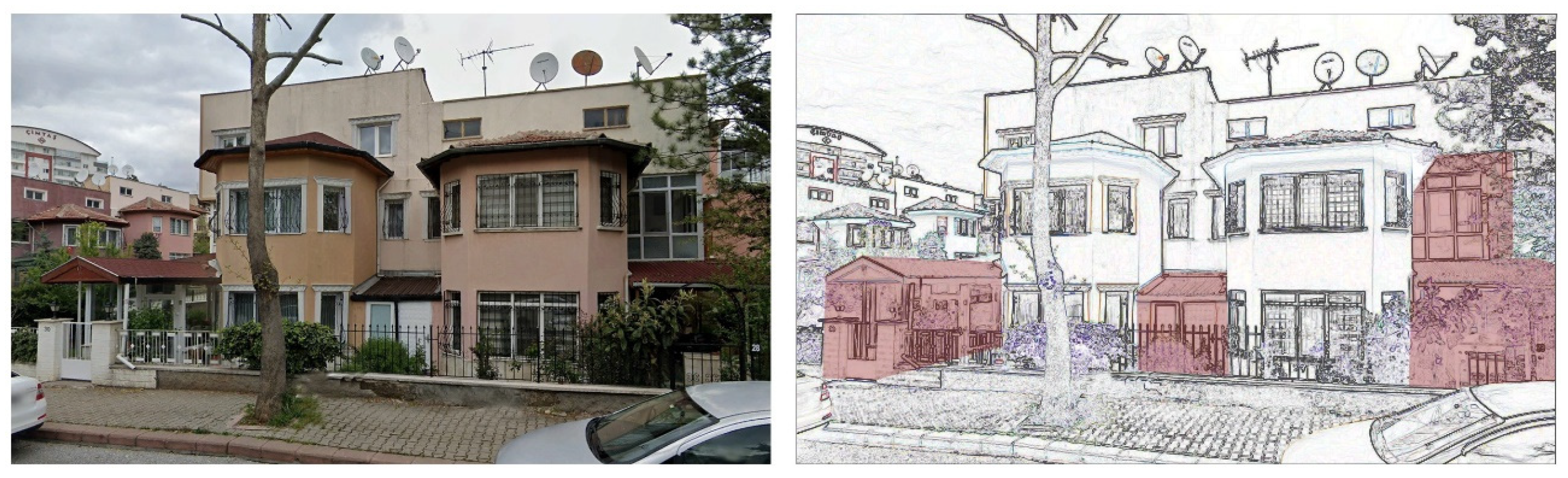
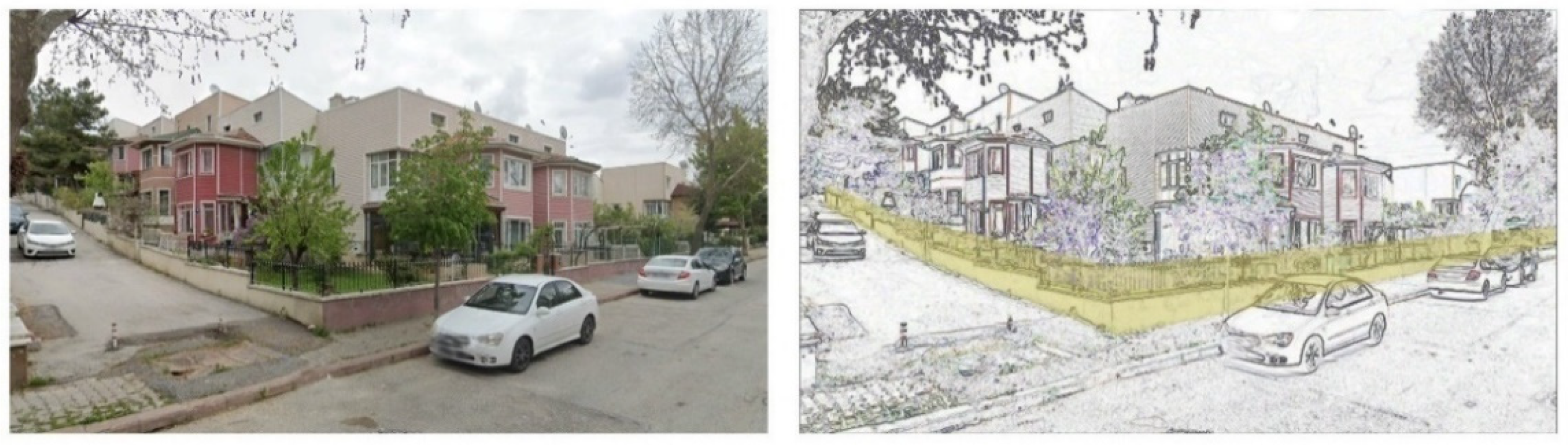
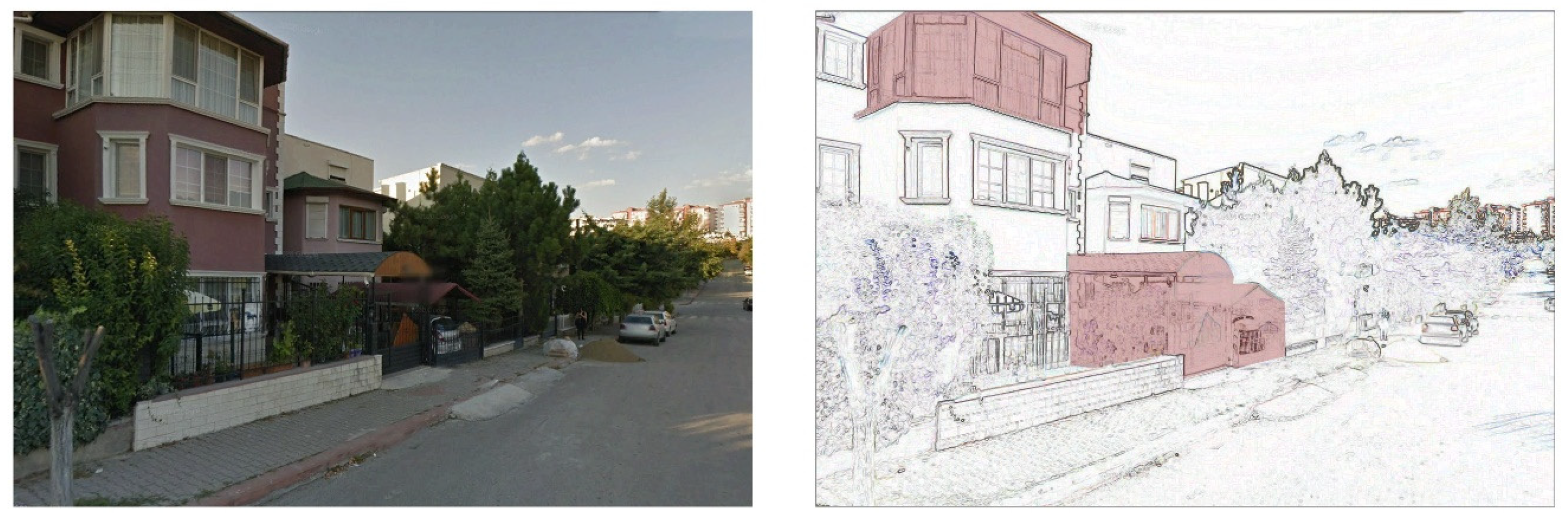
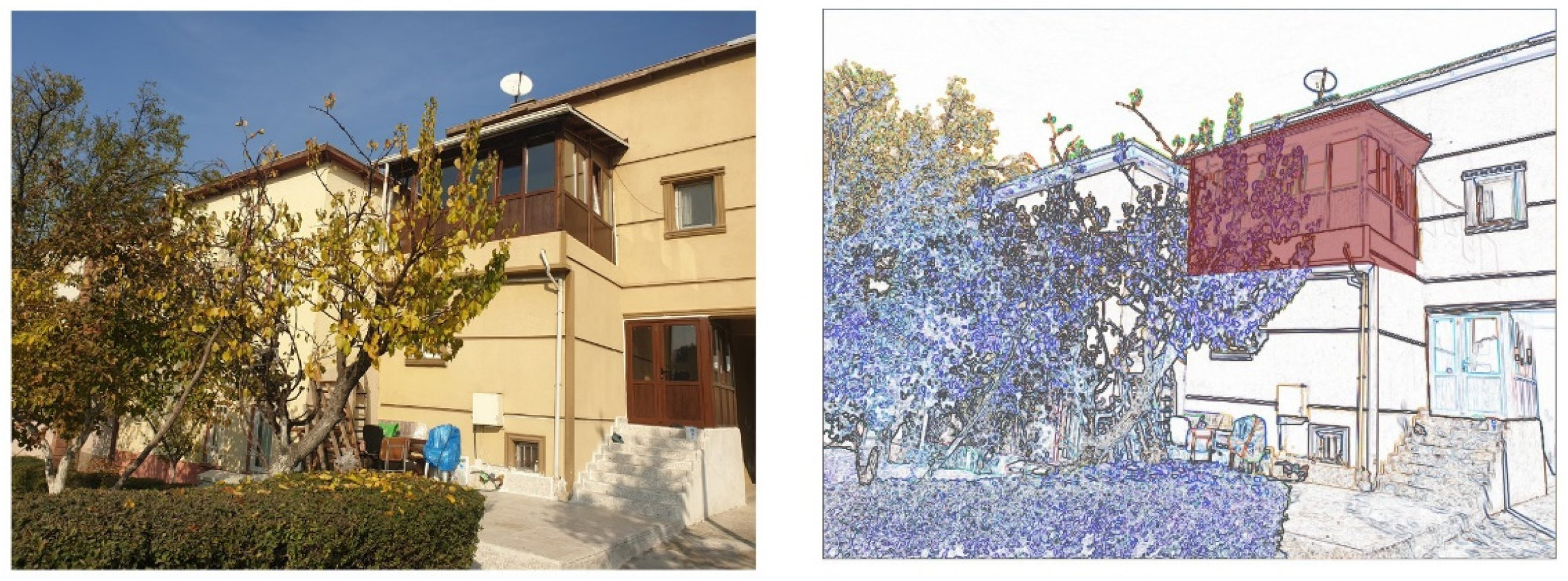
The Tekgül Site housing settlement exhibits a pattern-based approach similar to other housing typologies in the surrounding area. In-between spaces can be regarded as potential fields that reflect the social structure and identity of the city through their ability to engage both private and public realms, carry multiple meanings, and transform in relation to collective memory. Contemporary field studies reveal that in-between spaces located at the interface between the dwelling and the urban fabric are reconfigured according to individuals’ needs, everyday practices, and aesthetic preferences, reflecting the identities of their inhabitants (
Figure 17). This condition can also be interpreted as an indicator of the residents’ sense of belonging to their living environments.
Closely related to the formation of spatial identity, the capacity of in-between spaces to accommodate change over time constitutes another critical dimension of their socio-spatial potential. In the Tekgül Site, identity is not a fixed attribute, but an evolving condition shaped through incremental transformations, everyday adaptations, and user-led spatial interventions.
The layered structure of Tekgül, composed of interdependent subcomponents, provides an adaptive urban context with the capacity for transformation over time. The in-between spaces that constitute this system function as autonomous yet reconfigurable elements, accommodating evolving user needs and activities. This condition demonstrates that the settlement was designed as a flexible framework capable of adapting to change while preserving its morphological integrity.
The pattern-based organization and typological system support the reproducibility and flexibility of spatial components. The hierarchical stratification allows for simultaneous processes of change and control, whereby housing blocks remain stable as urban units while individual buildings undergo gradual transformation.
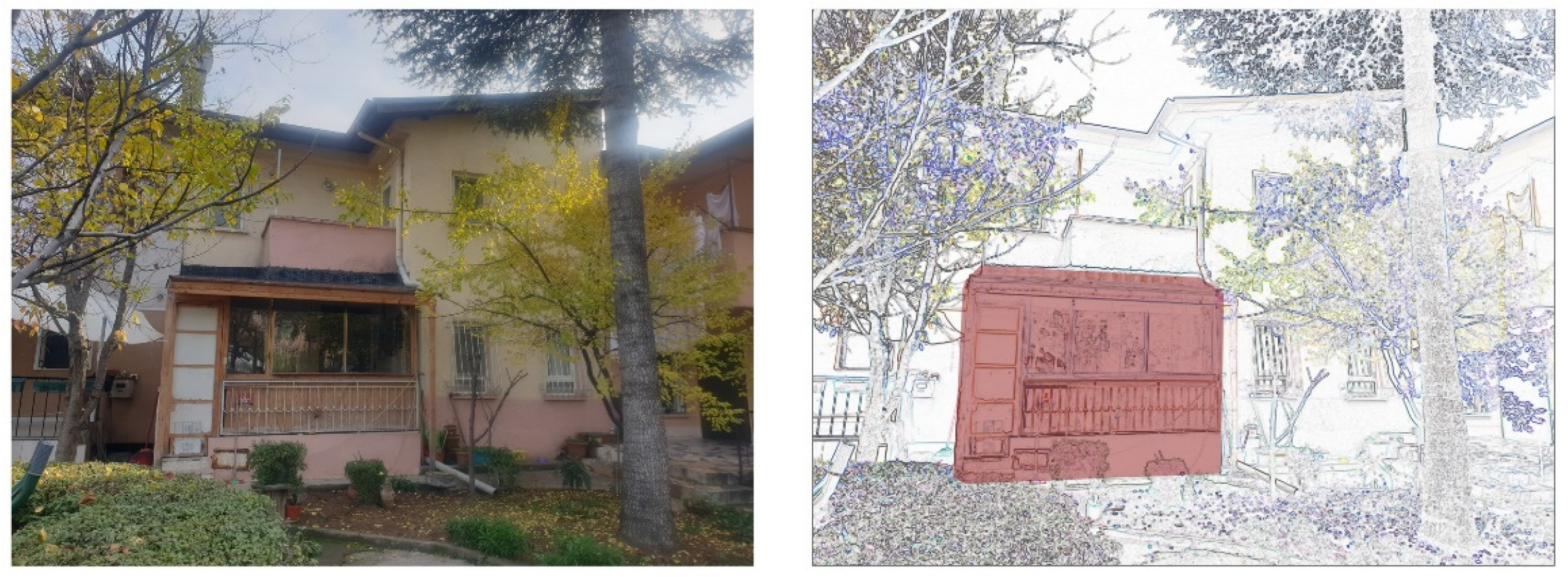
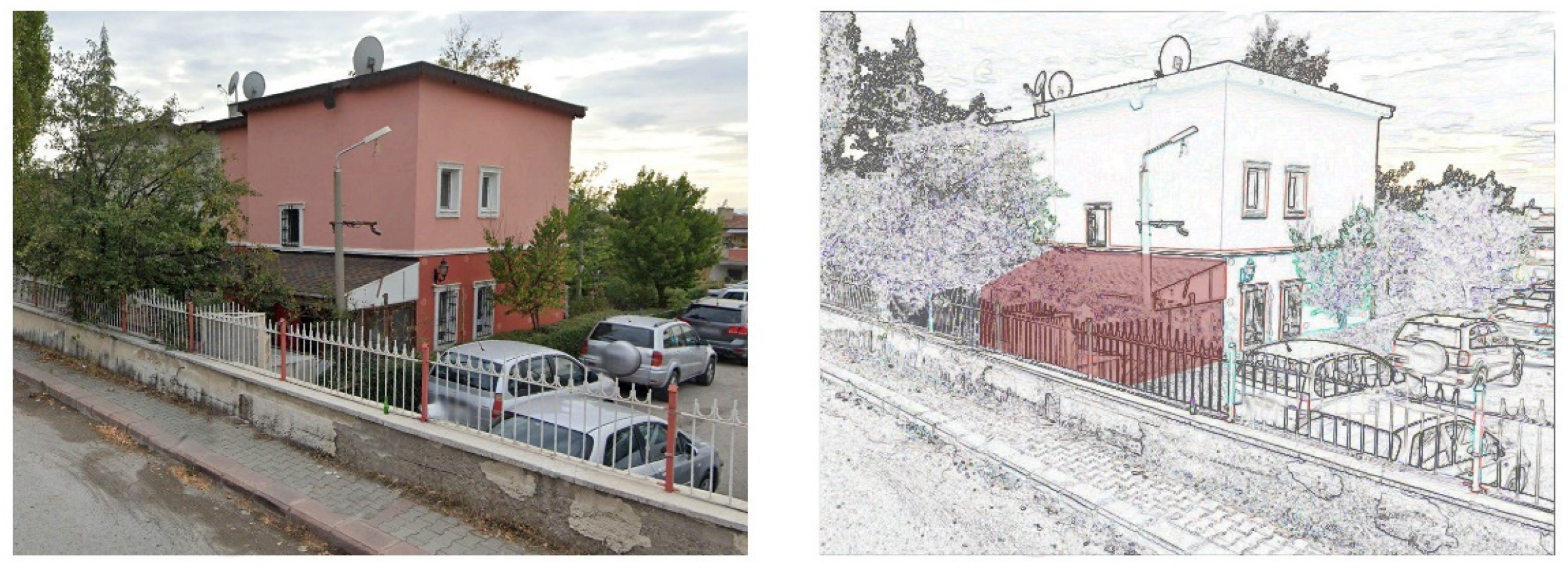
The diagram presented below visually and analytically demonstrates how the multi-layered in-between space system allows for incremental transformation without disrupting the overall spatial order. Through a comparative reading of the plan-based analytical diagram, it becomes evident that the reconfiguration of in-between space layers and the spatial additions occur primarily at the scale of the individual dwelling unit, while spatial continuity is preserved at the block and neighborhood scales. In this respect, the diagram goes beyond merely depicting physical change and instead analytically reveals the typological logic that enables controlled and guided transformation within an otherwise stable morphological framework (
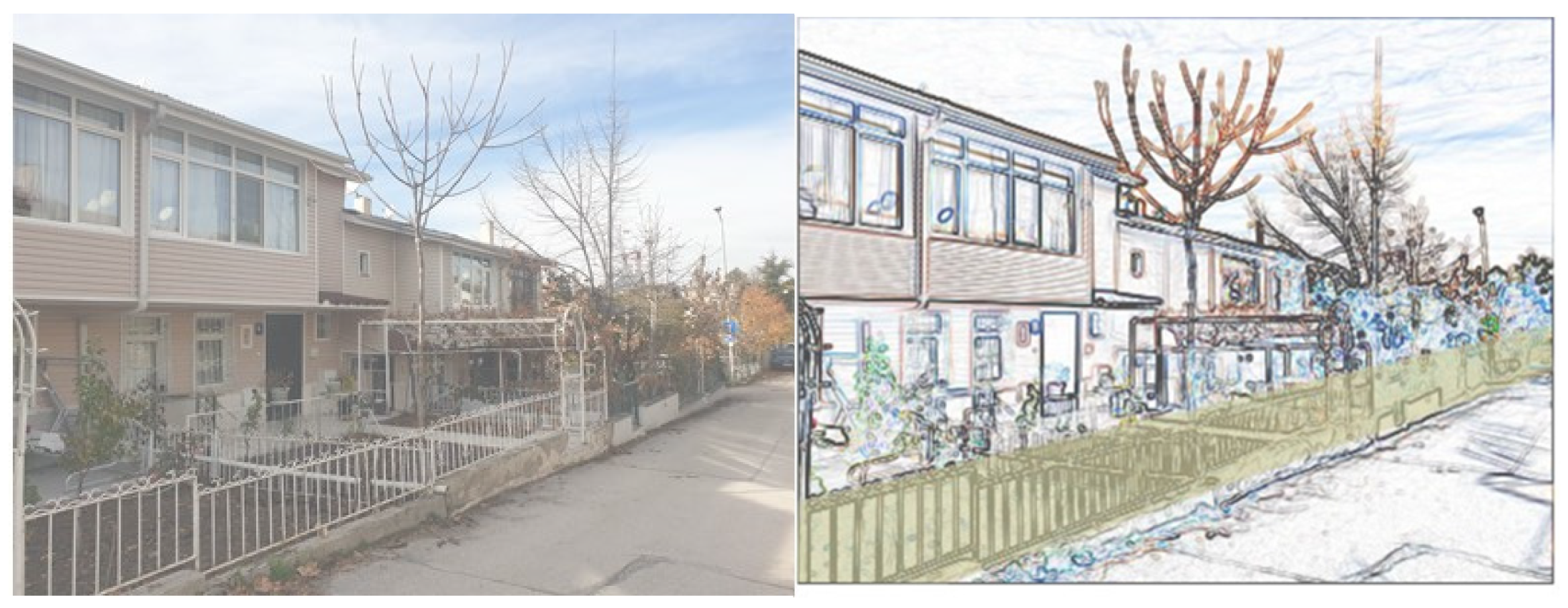
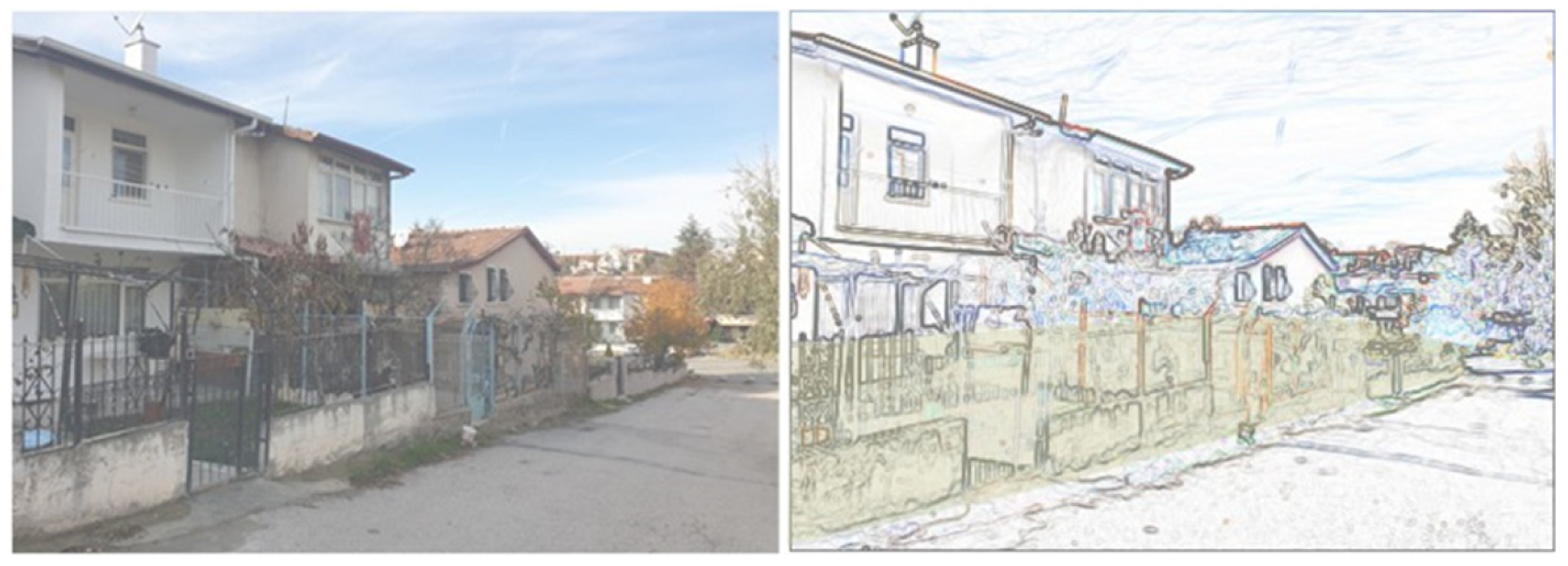
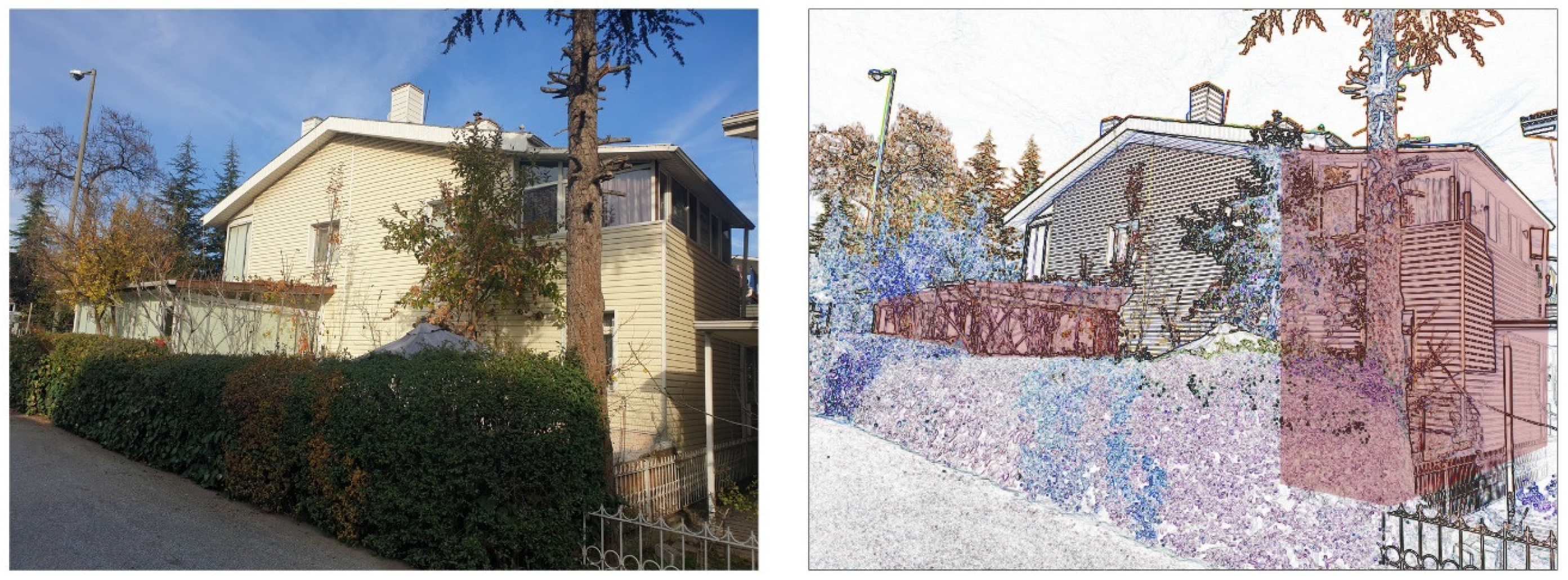
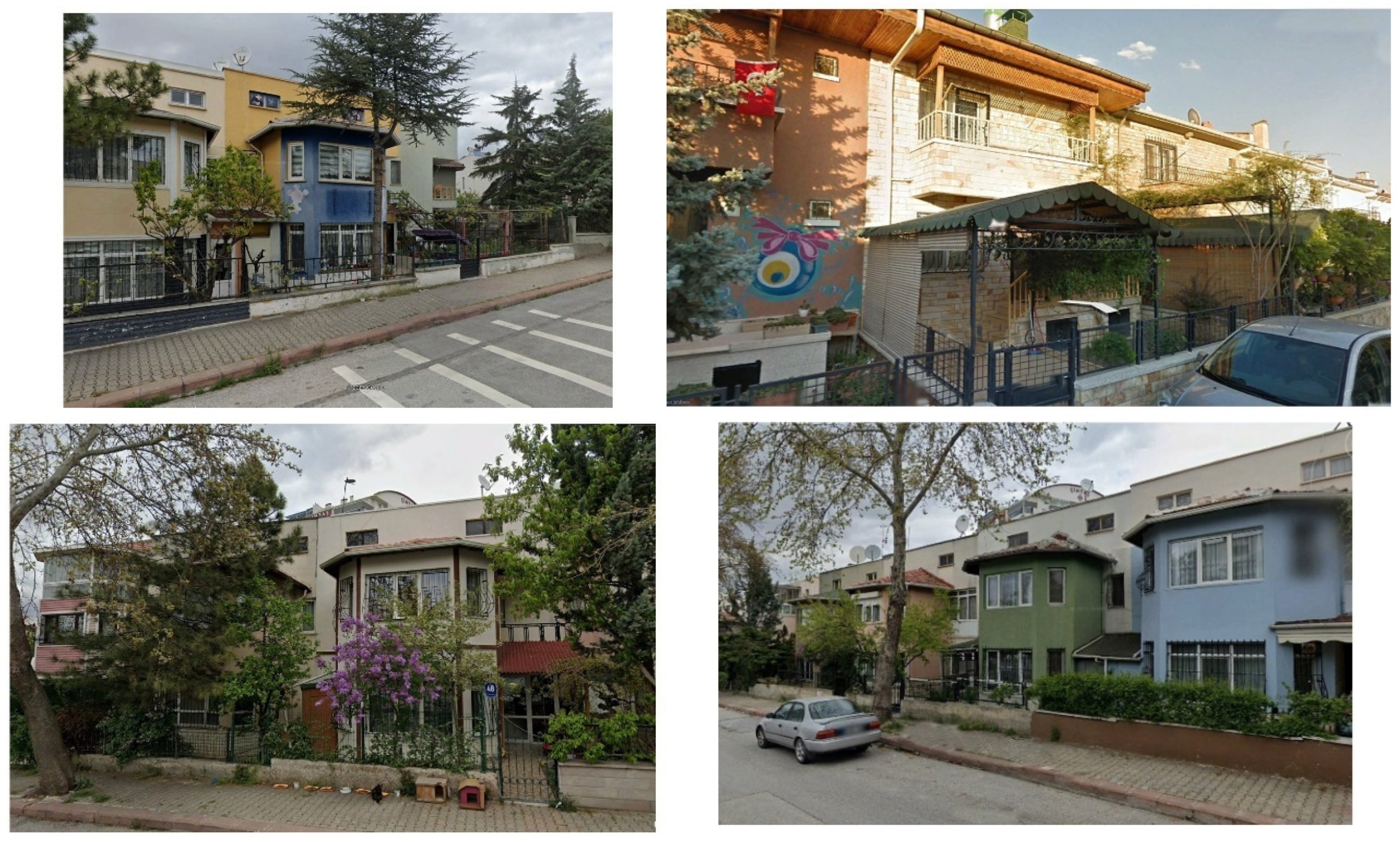
Figure 18). The spatial conditions identified through the plan-based analytical diagram are further substantiated through photographic documentation, which reflects the current state of the settlement and provides empirical evidence of the observed transformations (
Figure 19,
Figure 20 and
Figure 21).
At the housing-unit scale, the open-plan layout of the ground floor allows for flexible zones adaptable to different uses. The incorporation of balconies into interior spaces in many dwellings exemplifies the system’s inherent capacity for incremental modification. Along the southern façade, facing the boulevard axis, seven housing units have been functionally transformed over time to accommodate uses such as restaurants, beauty salons, veterinary clinics, accounting offices, and art studios.
These transformations demonstrate the settlement’s ability to absorb social and economic change without losing its structural coherence or community identity—an indication of its adaptive resilience.
3.1.3. Spatial Continuity and Transformation over Time in Tekgül Site
The evolutionary processes examined in this section are documented through a combined reading of floor plans, sections, and analytical diagrams, allowing spatial change to be assessed both structurally and relationally. Morphogenetic analyses confirm that Tekgül Site possesses a spatial framework capable of adapting to changing user needs and preferences over time. The spatial configuration of in-between space layers supports incremental processes of modification and expansion, reflecting the adaptive capacity embedded in the original design. At the same time, this transformation process has led to a decline in collective use within the inner courtyards of housing blocks, thereby weakening the communal dimension of shared spaces.
Mapping results reveal that in-between space layers initially designed for public or collective use have gradually been transformed into areas of private ownership. Courtyards originally intended for shared activities have been converted into semi-open verandas or enclosed storage extensions, while access routes leading to these courtyards have been closed off, reallocating these areas to private use. This transformation has disrupted the continuity of public space (
Figure 22).
Field studies conducted in 2024 indicate that the original spatial permeability between street and housing block scales has been largely preserved, although certain physical boundaries have been added over time. Initially designed with open access axes leading toward the inner courtyards, the settlement has gradually experienced spatial interruptions as these shared courtyards were privatized and turned into back gardens. While this transformation limits collective movement, the overall visual and auditory permeability across the settlement remains intact due to the presence of low or transparent boundary elements.
In contrast, the front gardens continue to function as active transitional zones that maintain visual openness and social accessibility, supporting everyday interactions such as greeting, observing, and informal conversation. These spaces, despite structural modifications, sustain the continuity of social bonds. However, transformations such as enclosing balconies into interior spaces or converting front gardens into parking or storage areas have diminished opportunities for interaction at the street level, weakening the mediating social role of in-between spaces.
Overall, the findings suggest that Tekgül Site largely preserves its hierarchical order and social permeability—from street to housing block to individual dwelling—yet increasing tendencies toward privatization and enclosure have redefined the function of in-between spaces. These areas, once intended for collective interaction, have gradually evolved into semi-private or individual domains, revealing the delicate balance between collective ideals and everyday practices of appropriation within Batıkent’s broader framework of social sustainability.
3.2. Agricultural Housing Cooperative (Tarımsal Site)
The Agricultural Housing Cooperative, known today as Tarımsal Site, represents a low-density residential complex in the Batıkent district, characterized by a courtyard-based group housing typology. Tarımsal Site is included in this study because, as a representative example of courtyard-oriented group housing, it contains in-between spatial layers of varying degrees and qualities compared to the other settlements examined, while also being situated relatively farther from Batıkent’s central core. The settlement comprises a total of 132 housing units.
3.2.1. The Morphological Configuration and Spatial Structure of the In-Between in Tarımsal Site
This section presents an analysis and evaluation of the formal characteristics of the in-between spaces within the Tarımsal Site housing settlement—focusing on the multi-layered spatial configuration, the patterned structure composed of interrelated components, and the systematic design of the spatial texture.
Within this framework, the settlement’s spatial organization is examined across multiple scales—ranging from the building and block levels to the broader urban context—to reveal how different layers of in-between spaces are articulated and interrelated. The residential fabric in which Tarımsal Site is situated is organized according to a hierarchical system defined across the scales of district, neighborhood, residential environment, and housing fabric. Within this multi-layered structure, a series of in-between spaces and public areas are articulated at different scales (
Figure 23). At the building scale, individual-use spaces such as gardens, threshold areas, entrance axes, and stairways are defined. At the block scale, inner courtyards, shared gardens, and corner gardens constitute the primary spatial elements. At the urban context scale, streets, pedestrian pathways, and green corridors function as in-between spaces, while at the residential environment scale, local markets, parks, green areas, and educational facilities form the main public amenities. Considering the settlement’s relative distance from Batıkent’s central area, access to commercial units and socio-cultural facilities remains relatively limited. In response to this condition, a local commercial complex named ‘Barış Çarşısı’ was incorporated within the settlement to meet residents’ daily needs on-site, thus reinforcing self-sufficiency and everyday social interaction within the community.
Morphological analyses conducted at the tissue-unit scale reveal that the Tarımsal Site settlement establishes both formal and social continuity with its surrounding residential fabric, particularly in terms of spatial relations and accessibility. As illustrated in
Figure 24,
Figure 25 and
Figure 26, spatial elements positioned between streets and front gardens are organized to maintain visual continuity across the settlement. However, level differences observed in the northern part occasionally limit visibility while simultaneously enhancing the semi-private character and privacy of garden areas. As shown in
Figure 27, the narrow street profiles between building blocks promote social interaction through spatial proximity, while topography-induced one-way vehicular circulation contributes to a pedestrian-oriented, human-scaled environment (
Figure 24,
Figure 25,
Figure 26 and
Figure 27).
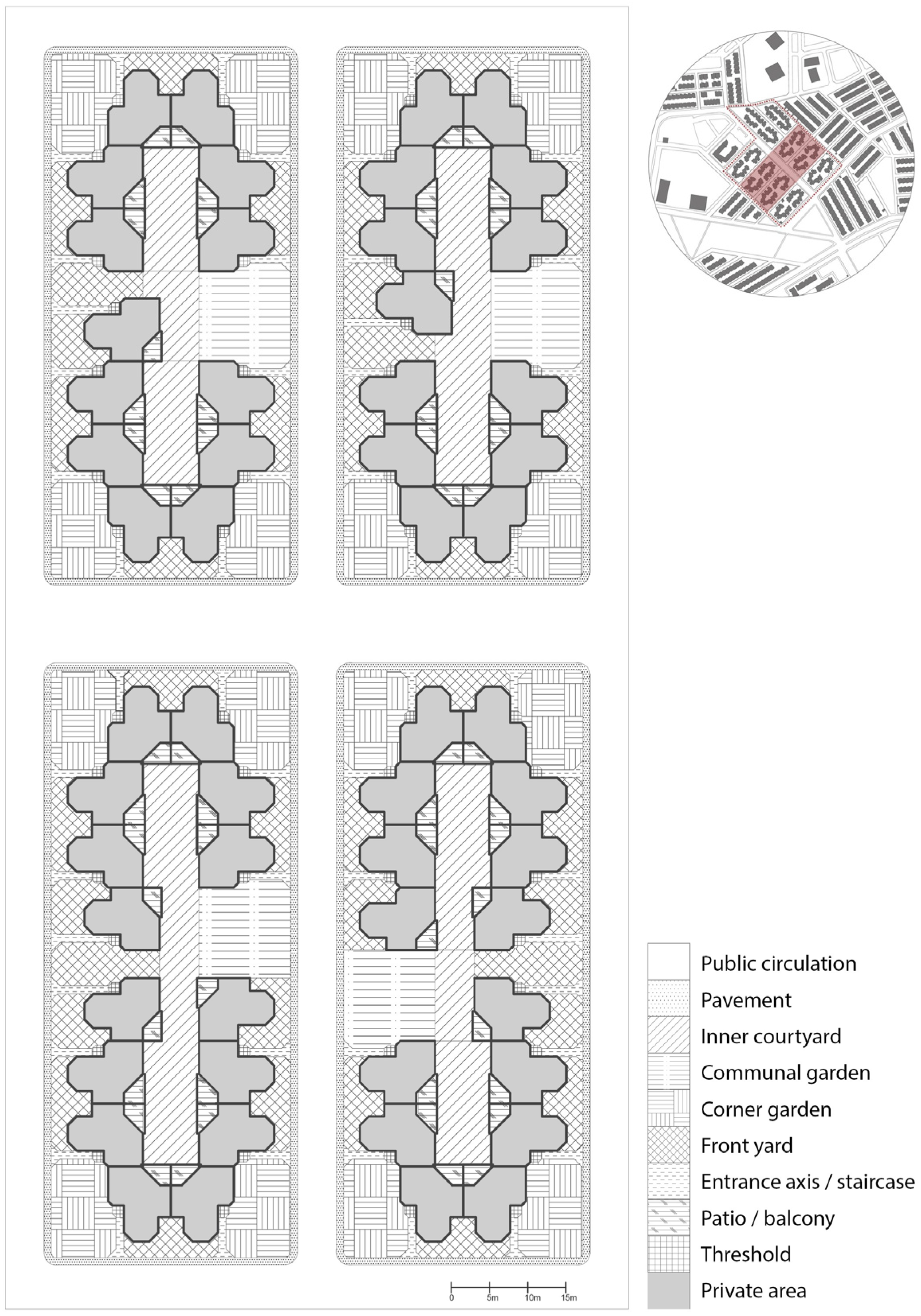
At the block scale, morphological analysis indicates that access to inner courtyards was originally provided through shared garden areas designed for collective use. Balconies facing the courtyards function as architectural elements that foster visual and social interaction. Smaller shared gardens are provided for paired housing units, while corner units feature larger collective green areas. Additionally, niche spaces formed between paired dwellings act as transitional zones encouraging informal encounters.
The in-between space between street and building serves as a visual, physical, and functional interface, enabling social contact and everyday encounters. The sequential arrangement of entrance axes, stairs, front gardens, and aligned balconies generates opportunities for interaction, enriching the spatial experience.
A selected portion of the Tarımsal Site was examined using the morphological analysis method to explore the layers of in-between spaces (
Figure 28). The study identified nine distinct in-between layers—threshold, veranda, entrance axis, front garden, corner garden, shared garden, inner courtyard, sidewalk, and public circulation. These layers are organized differently across housing clusters, revealing spatial strategies that promote social interaction and collective use within the settlement.
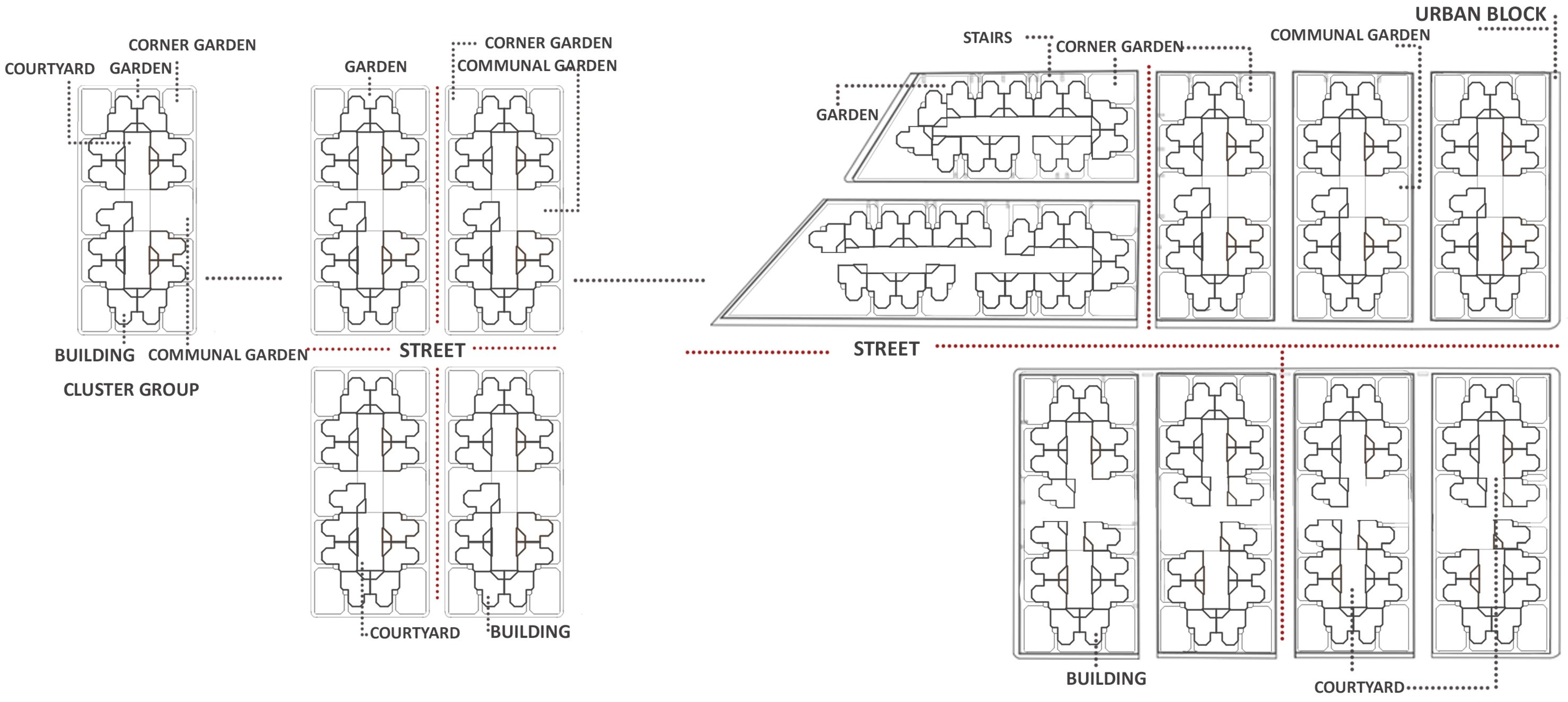
Beyond the layered configuration of in-between spaces, the spatial logic of the Tarımsal Site is further defined by a pattern-based and systematic design approach grounded in interrelated spatial components. The Tarımsal Site housing settlement exhibits a layered spatial organization composed of interrelated subcomponents (
Figure 29). Within the settlement, these sub-spatial units are combined according to specific design principles to form a group housing arrangement at the cluster scale. This organization establishes an integrated spatial composition grounded in part–whole relationships that operate both at the block level and within the broader urban context.
The housing blocks, composed of sub-spatial elements such as front gardens, inner courtyards, and threshold areas, simultaneously function as continuous components of a larger urban system. The spatial arrangement of the housing units reflects a localized spatial character that is contextually appropriate to their surrounding environment. The group housing typology organized around front gardens and inner courtyards allows individual dwellings to be aggregated within a coherent order. This spatial organization ensures the continuity of in-between spaces, supports the legibility of transitions between public and private realms, and enhances the potential for social interaction (
Figure 30).
The spatial configuration composed of subcomponents also allows for the independent reorganization of these elements, enabling the settlement to adapt over time to evolving spatial and functional needs. This adaptability highlights the flexibility and resilience of the design, which accommodates transformation while maintaining morphological coherence.
3.2.2. The Socio-Spatial Potentials of In-Between Spaces in Tarımsal Site
This section examines the socio-spatial potentials of in-between spaces in the Tarımsal Site through a focused analysis of their capacity to support social interaction and participation, articulate spatial identity, and accommodate processes of transformation over time. These dimensions are addressed in relation to one another, reflecting how in-between spaces operate as relational interfaces shaped by both spatial configuration and everyday use.
Within the Tarımsal Site, the potential of in-between spaces to support social interaction and participation can be understood through the relationship between morphological coherence, green-space distribution, and the spatial organization of everyday amenities. Void–solid analyses conducted at the urban context scale reveal that the Tarımsal Site settlement presents a morphologically coherent and legible pattern. The size, form, and layout of the housing units align with the design principles of the surrounding residential fabric. Although row-house typologies dominate the neighboring context, proportional dimensions and settlement arrangements display notable similarities, reflecting a shared spatial understanding of domestic life. The patterned relationships established among housing units create an integrated organizational system. Within this framework, multi-scalar layers of in-between spaces define permeable boundaries between public and private realms, thereby reinforcing spatial continuity and enhancing social interaction (
Figure 31).
Green-space analyses conducted at the same scale indicate a concentration of public green areas along the southern axis of the settlement (
Figure 32). On the building scale, the front and rear gardens function as private green spaces within individual property boundaries, serving as semi-private outdoor environments directly accessible to residents. In contrast, the publicly accessible green areas surrounding the settlement largely consist of passive open spaces without a defined functional program or user-oriented spatial design. Consequently, their capacity to support public life and social interaction remains limited.
Analyses of social amenities within the urban context reveal the presence of a small-scale commercial unit functioning as a local market in the northwestern part of the area. Within the settlement, commercial, educational, and religious facilities also exist to meet residents’ daily needs. However, these facilities are not spatially integrated in a centralized manner that would facilitate social encounters and interaction; rather, they are dispersed around the housing blocks (
Figure 32). Furthermore, the settlement’s distance from Batıkent’s central commercial and social hubs accentuates the deficiency of public spaces and the absence of spatial nodes capable of revitalizing community life. This spatial condition restricts everyday social encounters and weakens the continuity of public life.
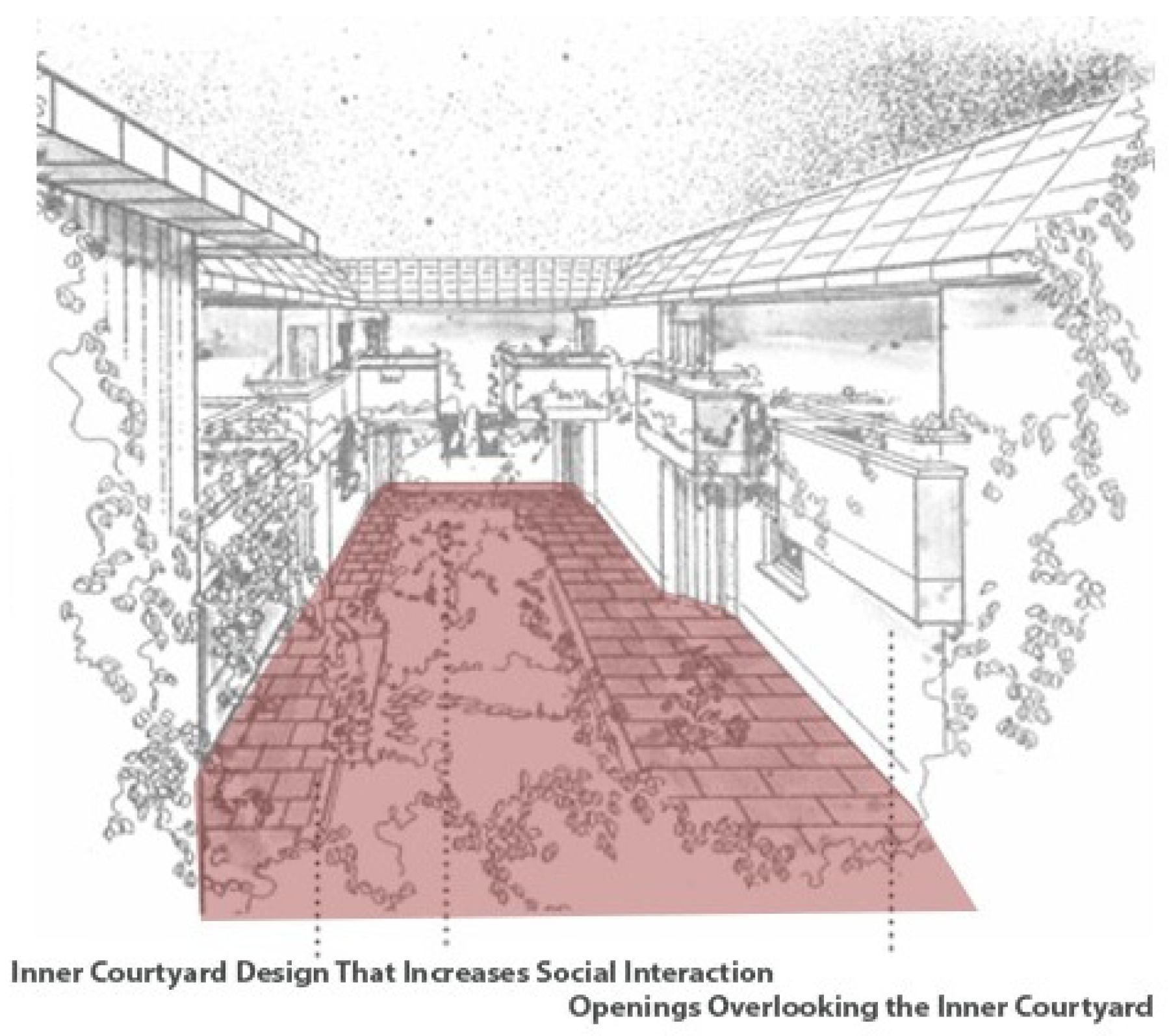
At the block scale, the spatial configuration formed through the intermediate-space layers between housing units exhibits a significant potential for social interaction. The patterned continuity and permeability of these spaces shape both their social and physical qualities, generating a structure that enhances diversity of use and opportunities for interaction. In the case of the Tarımsal Site, the housing units are arranged within a group-housing typology organized around inner courtyards, supported by shared front and corner gardens. The courtyard configuration fosters everyday encounters, providing a spatial setting conducive to the development of social relations (
Figure 33).
Axial shifts within the housing layout create spatial voids and recesses that form micro-scale interaction zones, further encouraging social encounters. Additionally, balconies oriented toward shared courtyards and gardens facilitate visual connections and everyday interactions, reinforcing the social vitality of the environment.
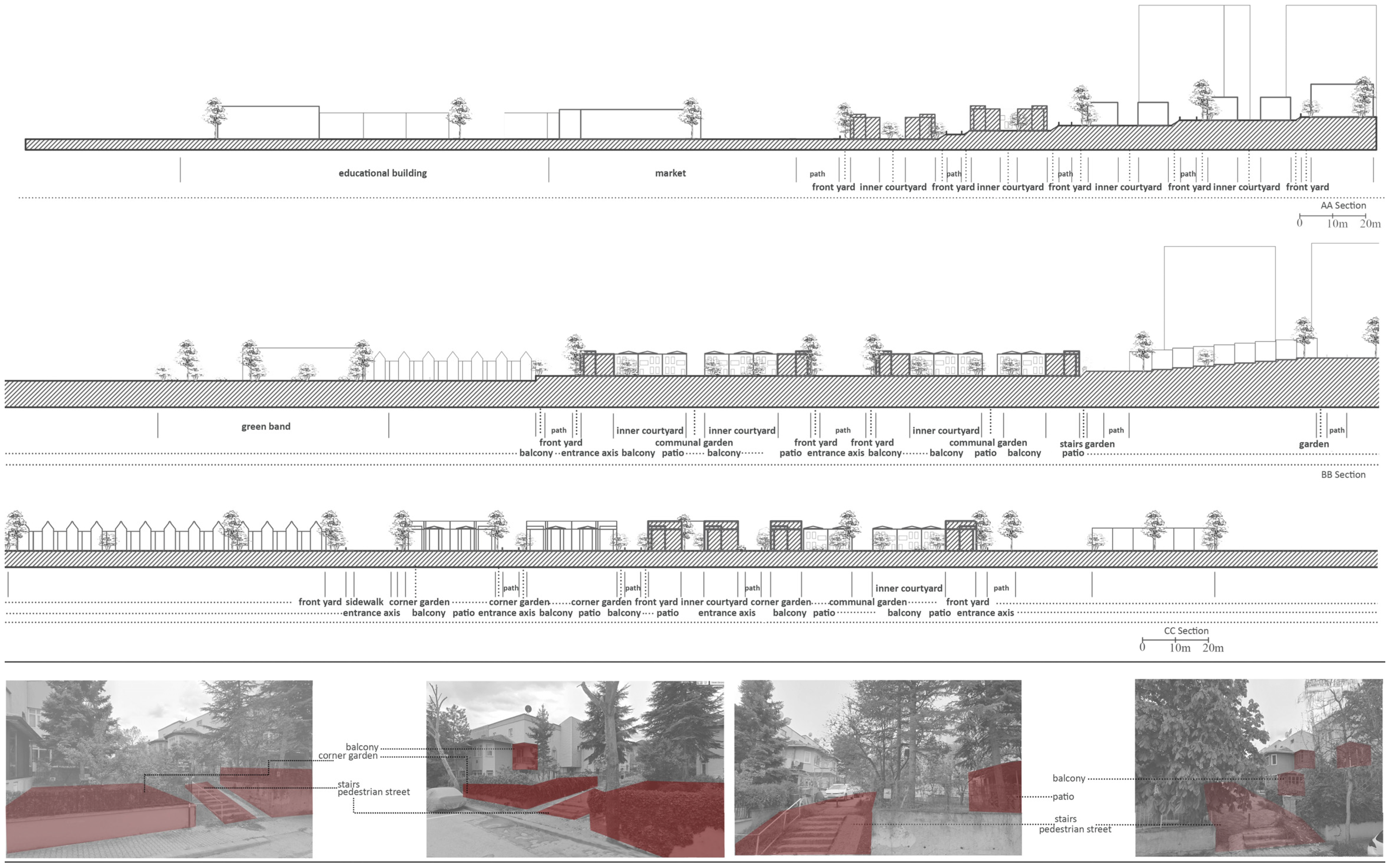
The section and perspective diagrams presented below illustrate how in-between space layers are organized as a hierarchical and interrelated spatial system within the Tarımsal Housing Settlement. This visual–analytical representation demonstrates how these layers mediate between the dwelling units, shared courtyards, and the street, functioning not merely as physical transition zones but as permeable interfaces that enable visual contact and everyday social interaction between collective and semi-private realms (
Figure 34). Beyond their capacity to structure everyday interaction, the in-between spaces of the Tarımsal Site also play a significant role in the formation and expression of spatial identity, both at the collective and individual levels.
The configuration of the housing units in the Tarımsal Site has been shaped with reference to the surrounding environmental context and local building typologies. The two-story housing typology with front gardens, observed throughout the settlement, goes beyond a mere formal resemblance to neighboring structures; it can be interpreted as an expression of a collective spatial understanding and social consensus within the urban context. Similarly, the use of protruding façade elements—also present in nearby buildings—indicates the existence of a shared formal language, reinforcing the coherence of urban identity.
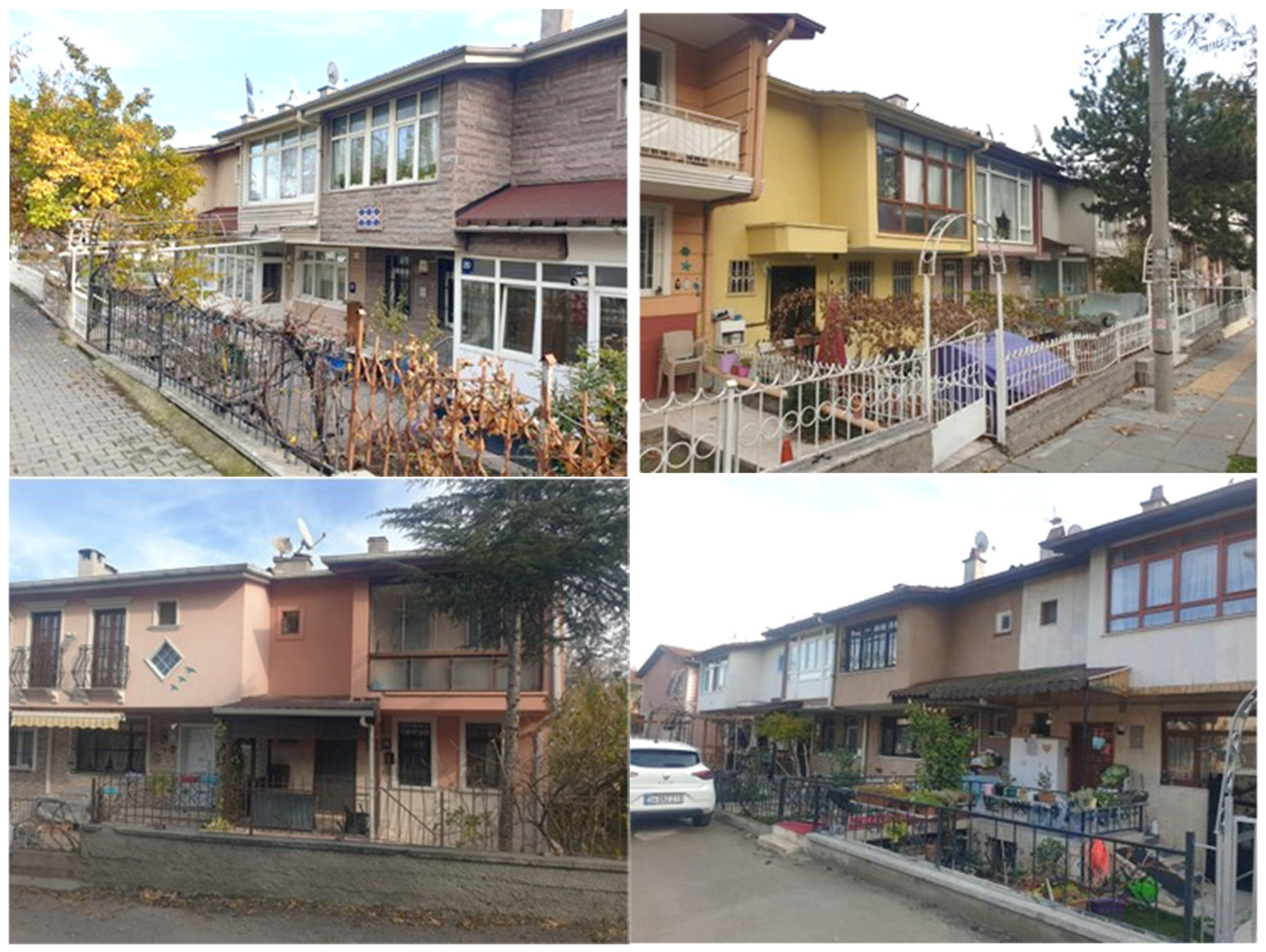
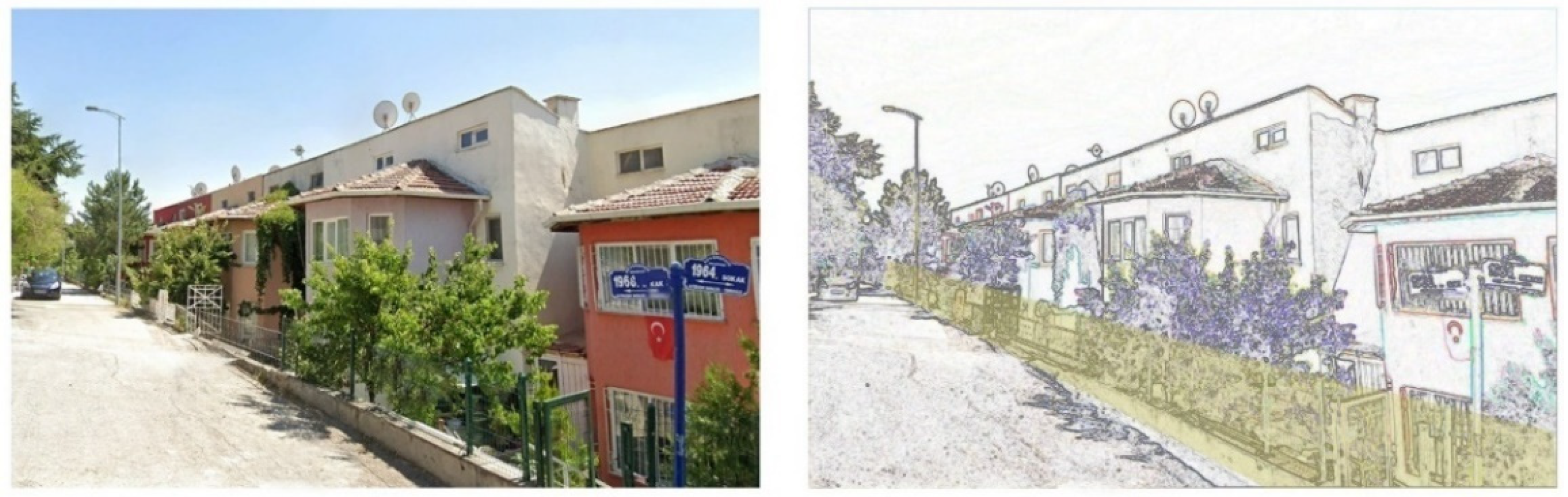
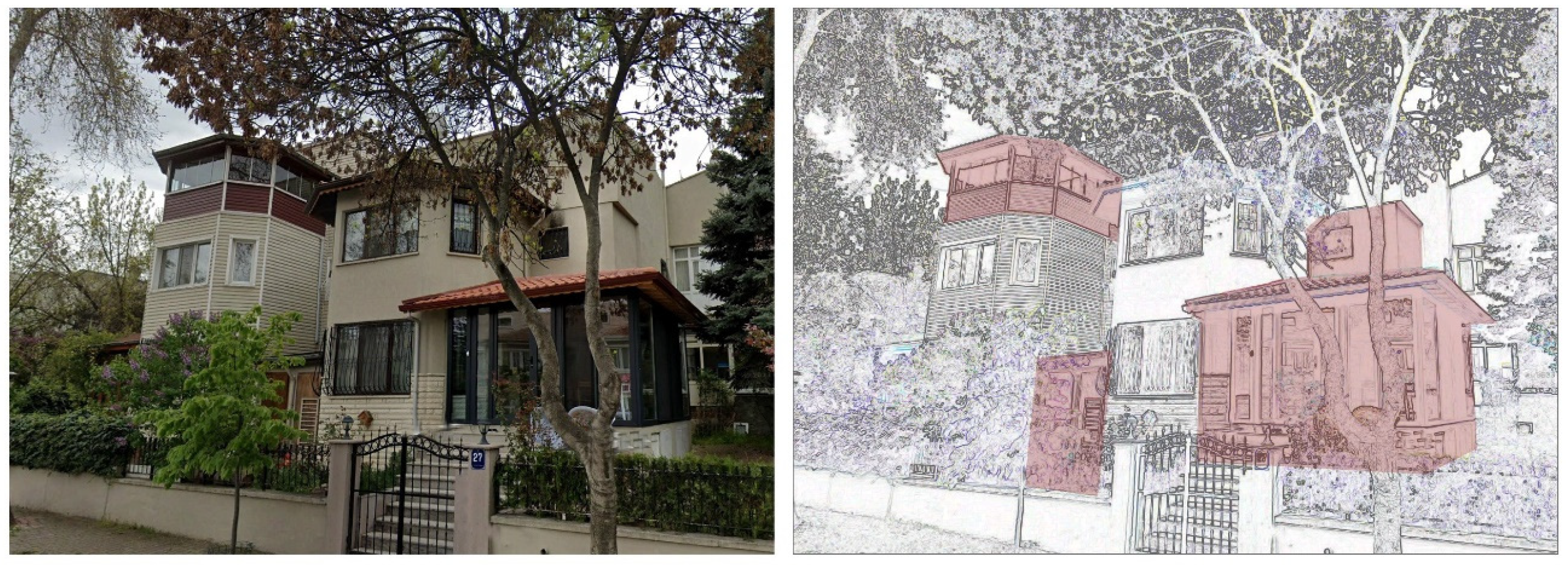
Recent field studies conducted in the residential areas reveal that the in-between spaces located at the interface between the dwelling and the urban context have been adapted according to individual preferences and spatial needs. It has been observed that housing units are configured in ways that reflect the personal identities of their inhabitants. The openness of in-between spaces to subjective configurations enhances the interaction between users and the built environment, thereby strengthening the sense of belonging to the living environment (
Figure 35).
Beyond contributing to spatial identity, the in-between spaces of the Tarımsal Site also constitute a flexible framework that enables incremental transformation while preserving the overall morphological order of the settlement.
The typological system of the Tarımsal Site housing fabric presents a flexible structure that allows for multiple variations and transformation over time. The relatively autonomous operation of hierarchically organized layers ensures the preservation of the settlement’s overall identity at the macro scale, while defining at the micro scale a system that is open to user interventions and spatial adaptations. The presence of multi-scalar in-between space layers emerges as a key attribute enhancing the flexibility and transformability of the spatial organization. This condition reflects not only physical modifications but also the capacity of space to adapt to temporal processes, changing user profiles, and emerging functional needs (
Figure 35).
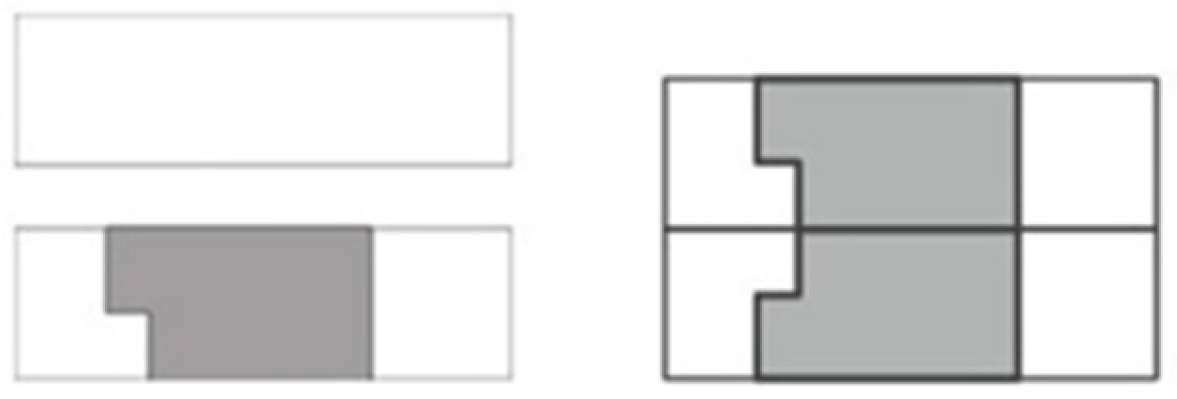
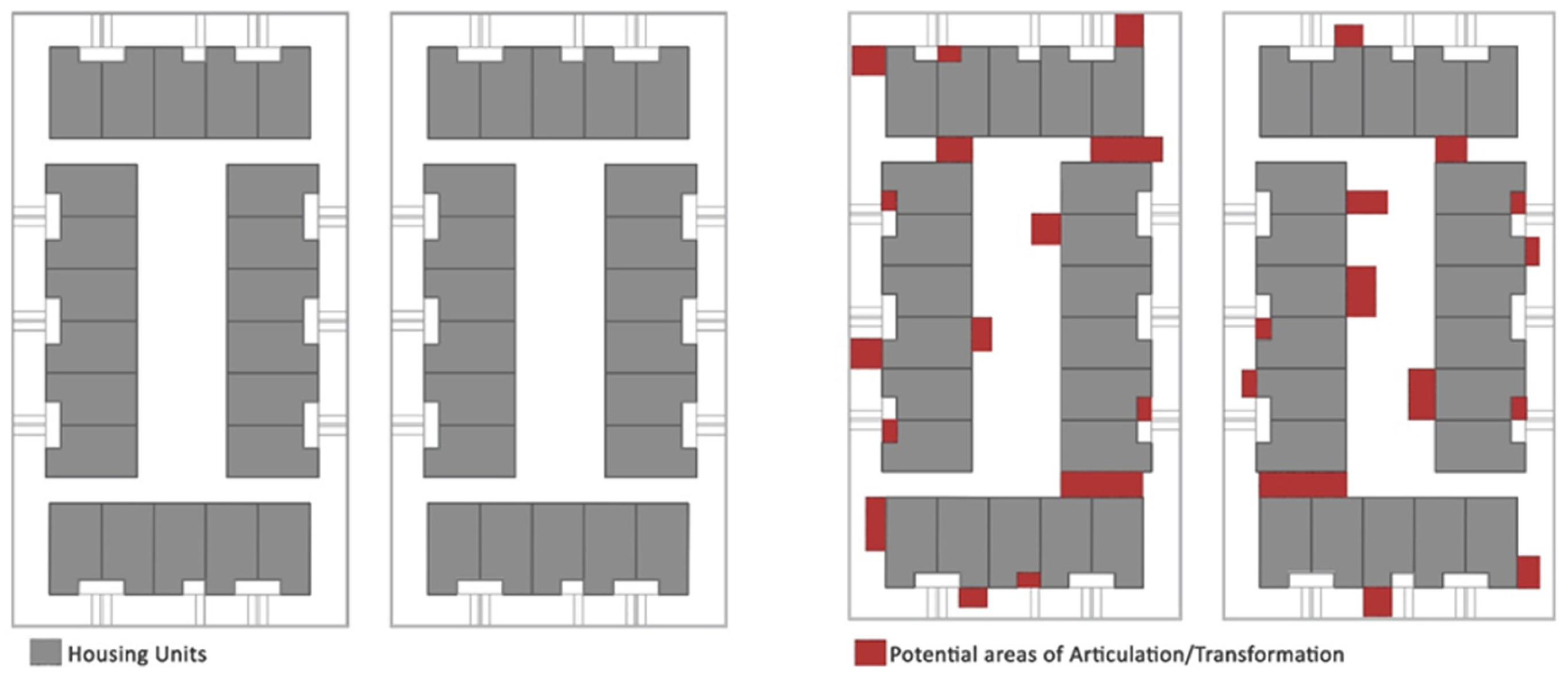
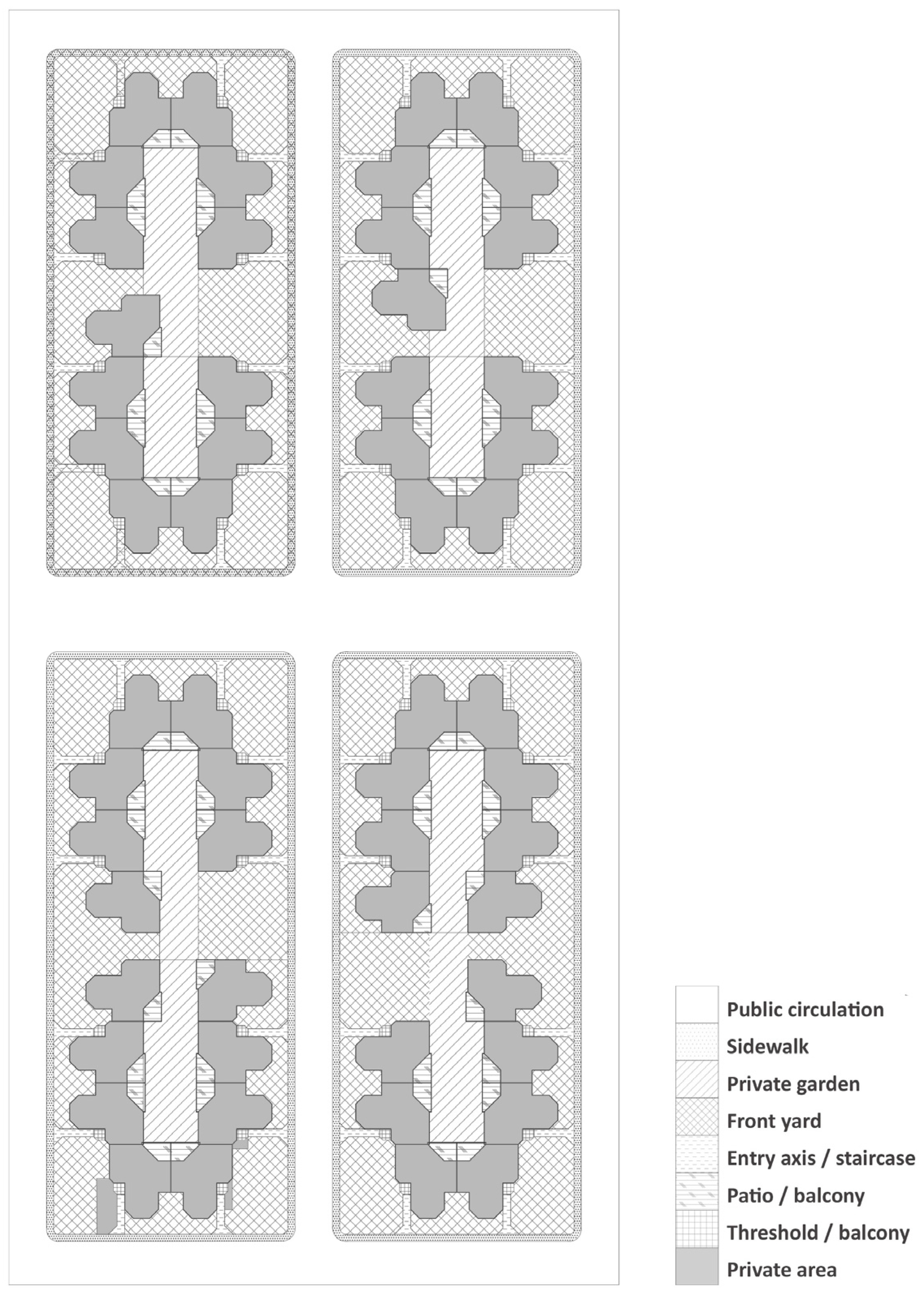
The diagram presented below is developed to reveal the transformation potential of in-between space layers within the settlement. While the left part of the diagram represents the original spatial configuration of the settlement, the right part reflects the additions and transformation practices that have emerged over time.
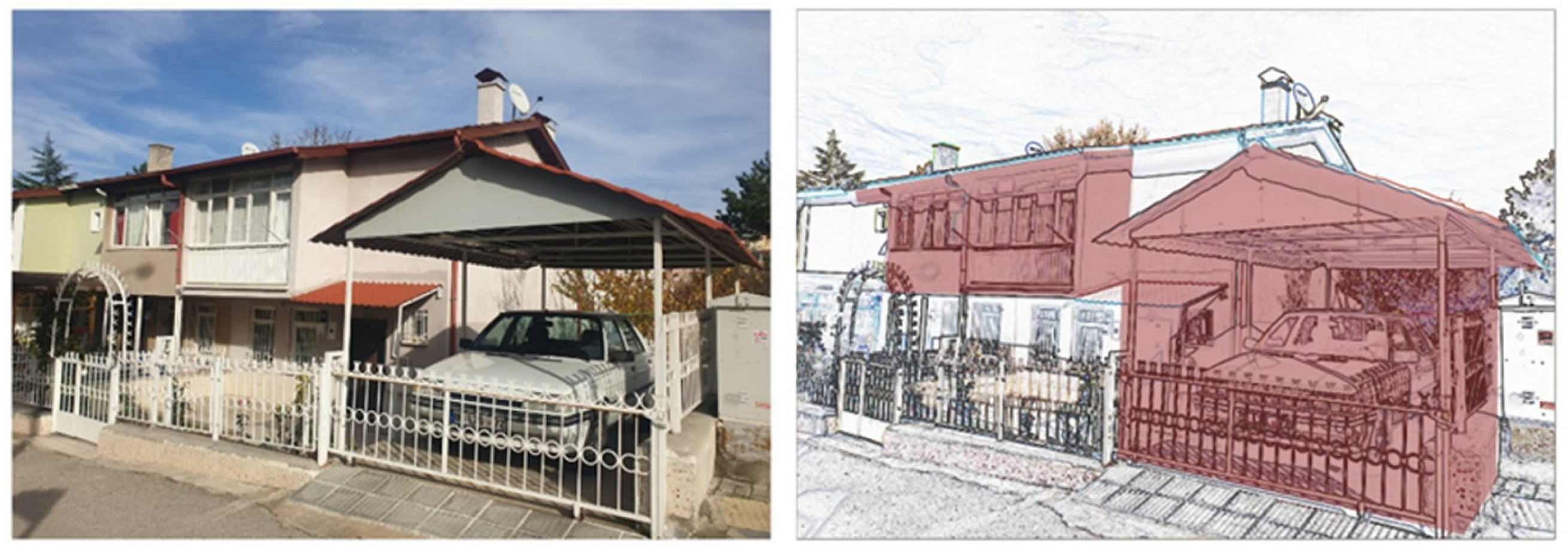
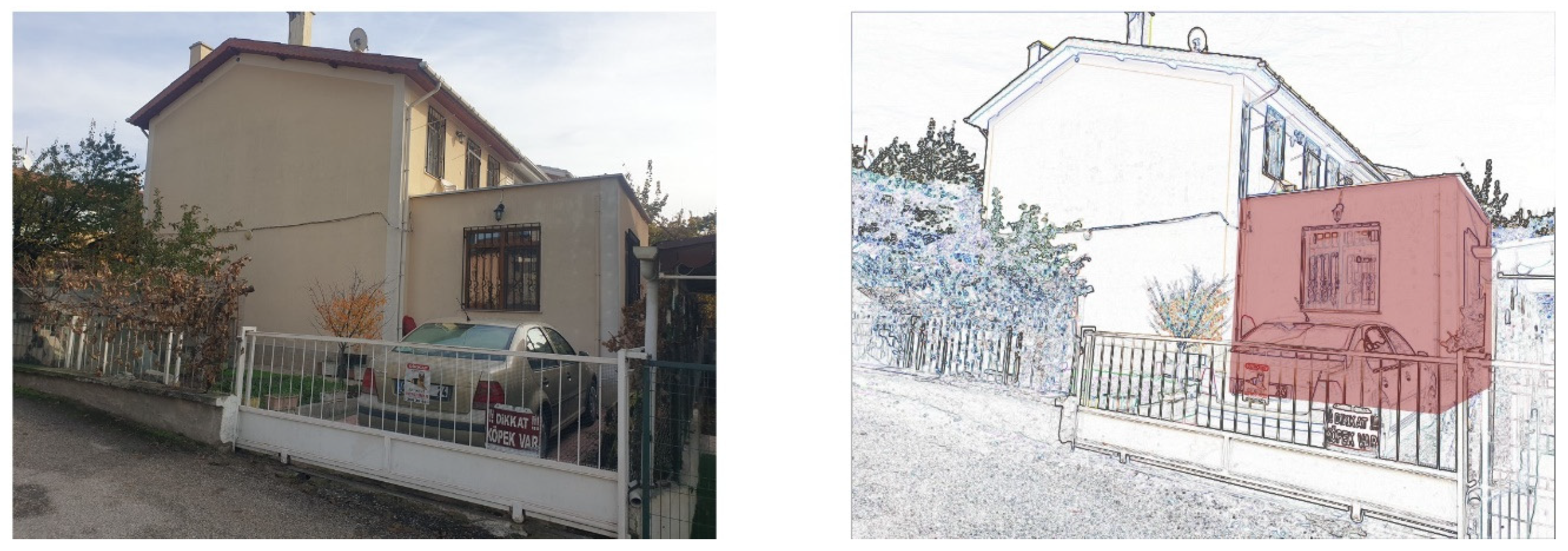
A comparative reading of the plan-based diagram demonstrates that spatial transformations occur primarily not through radical changes to the primary structural system, but through the reconfiguration, enclosure, or functional adaptation of in-between space layers—such as thresholds, verandas, and shared open spaces. While these interventions alter the spatial character at the scale of the individual dwelling unit, the overall morphological order and hierarchical continuity of the settlement are largely preserved (
Figure 36). The spatial tendencies identified through this analytical reading are further supported by photographic documentation of the current condition of the settlement, providing empirical evidence of how in-between spaces have been selectively transformed, enclosed, or repurposed in response to changing everyday practices (
Figure 37,
Figure 38 and
Figure 39).
In this context, in-between spaces can be regarded as fundamental components that maintain pattern continuity and support typological transformation processes. Allowing individual interventions at the dwelling scale strengthens users’ participation in spatial decision-making, thereby reinforcing spatial belonging and a sense of ownership over the living environment. In Tarımsal Site, the open-plan approach adopted on the ground floor level provides flexibility in interior organization, enabling the development of diverse functional scenarios. This design principle enhances the potential for transformation by allowing living spaces to be reconfigured in response to changing user needs. In some housing units, the integration of balcony volumes into the interior serves as a typical example of transformation occurring at the infill level while maintaining structural constancy.
3.2.3. Spatial Continuity and Transformation over Time in Tarımsal Site
The morphological map developed to analyze the transformation of in-between space layers—based on the assessment of the settlement’s current condition—reveals that spaces initially designed for public and collective use have gradually evolved toward individualized forms of occupation (
Figure 40). Quantitatively, the number of in-between space layers has decreased over time; shared gardens and inner courtyards belonging to cluster units, as well as corner gardens designed for paired housing groups, have been converted into private gardens. The analysis indicates that communal gardens providing access to inner courtyards have been appropriated and enclosed by users, with these transitional areas physically blocked by new boundary elements. Similarly, the transformation of inner courtyards into private gardens has led to an increase in semi-open and enclosed extensions, thereby raising the overall built density within the settlement.
Field studies conducted in 2024 reveal that front and corner gardens—originally designed for shared use between paired housing units—have been gradually individualized through the introduction of boundary elements, while the niche spaces between dwellings have frequently been enclosed and repurposed as storage areas. Semi-open veranda extensions have become widespread at dwelling entrances, and in some cases, balcony openings have been incorporated into interior spaces to expand private living areas. Furthermore, the elevation of garden walls along the street edge has restricted visual communication with the surrounding environment, reducing overall spatial permeability.
The morphogenetic analyses conducted indicate that Tarımsal Site has evolved over time in response to changing spatial needs and everyday practices of its residents. The addition of boundary elements between dwellings and the subdivision of shared spaces in various forms have progressively produced a more individualized spatial structure within the settlement fabric. These spatial interventions demonstrate that the collective living model originally envisioned at the block scale has weakened over time, resulting in a measurable decline in both visual and physical permeability and, consequently, in the social interaction potential of the settlement.
3.3. TUSAŞ–184 Housing Cooperative (184 Evler Site)
TUSAŞ–184 Housing Cooperative, known today as the 184 Evler Site, represents a low-density, courtyard-based group housing typology within the Batıkent Project. The settlement consists of a total of 184 housing units. Organized around a central square, the 184 Evler settlement adopts a group-housing configuration incorporating hierarchical layers of in-between spaces with varying depths. Moreover, the settlement exhibits planimetric and organizational characteristics comparable to structuralist housing projects developed in the Netherlands. Within this context, the 184 Evler Site serves as a significant case through which to examine how structuralist design principles were interpreted and implemented in the Turkish context, and to evaluate the spatial correspondences between theoretical frameworks and built outcomes.
3.3.1. The Morphological Configuration and Spatial Structure of the In-Between in 184 Evler Site
This section presents analyses and evaluations of the formal characteristics of in-between spaces within the 184 Evler Housing Settlement—focusing on its multi-layered spatial configuration, the patterned structure composed of interrelated components, and the systematic design of its spatial fabric.
Within this framework, the spatial organization of the 184 Evler Housing Settlement can be understood through a hierarchical system operating across multiple scales. The spatial fabric in which the 184 Evler Housing Settlement is situated exhibits a hierarchical organization that can be defined across multiple scales—district, neighborhood, residential environment, and housing fabric. Within this spatial system, different layers of spatial organization are identified: at the building scale, gardens and threshold spaces; at the block scale, inner courtyards, shared gardens, and small squares; at the urban fabric scale, streets, pedestrian paths, and green corridors; and at the residential environment scale, public amenities such as marketplaces, kindergartens, parks, and playgrounds. At higher scales, the neighborhood level includes facilities such as local marketplaces, educational units, and playgrounds, while the district level comprises larger-scale public functions, including district centers, educational and health institutions, markets, large parks, and religious buildings—all serving as key components of the spatial system. The settlement is in proximity to Batıkent’s central zone, where the main commercial and social hubs are concentrated (
Figure 41).
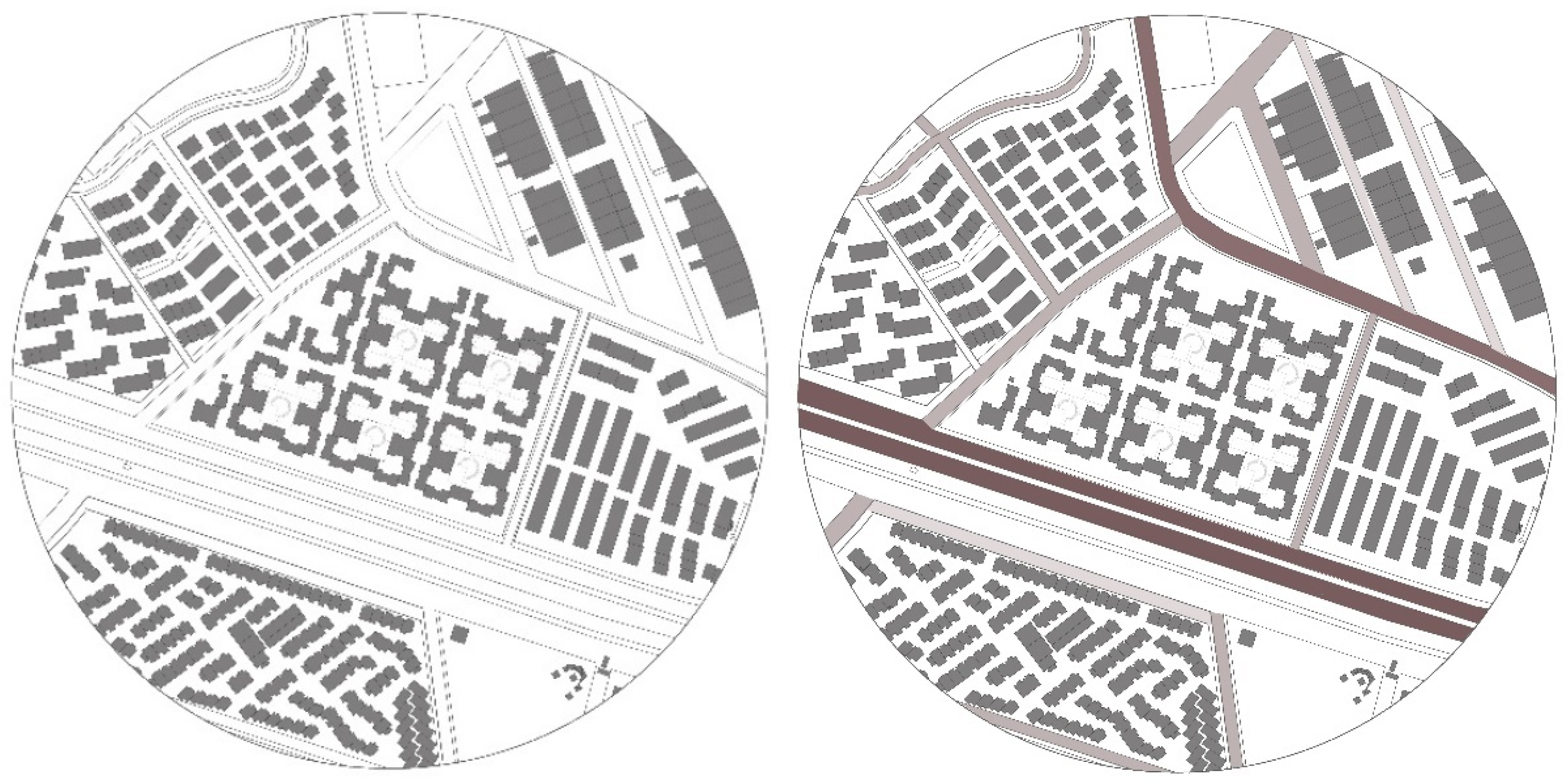
Morphological analyses conducted at the tissue-unit scale reveal the spatial relationships, accessibility, and hierarchical stratification of the 184 Evler housing settlement. Despite this originally open and multi-layered spatial logic, morphological analyses conducted at the tissue-unit scale reveal a significant shift in the spatial functioning of the settlement over time. The findings indicate that the settlement has gradually transformed into a gated community, a shift that has significantly reduced permeability between spatial layers and weakened the continuity of its multi-layered structure. Entrances to the area are now controlled by coded gates that restrict access to residents only, interrupting the continuity between public spaces and in-between areas, and creating a pronounced sense of spatial enclosure. Furthermore, the wide vehicular road along the southern axis and its heavy traffic limit both the physical and visual connections with the adjacent residential fabric, thereby weakening the social and functional integration of the settlement within the broader urban system.
The internal spatial organization of the settlement is structured around a continuous pedestrian axis running in a northeast–southwest direction. Buildings positioned along this axis feature open ground-floor passages connecting to inner courtyards, which act as public nodes resembling small plazas. These transitional spaces facilitate pedestrian movement while maintaining spatial continuity between public areas and in-between spaces (
Figure 42,
Figure 43,
Figure 44 and
Figure 45).
At the block scale, the analysis demonstrates that the original design sought to establish a permeable relationship with the surrounding urban fabric. Multi-scalar continuity of in-between spaces was achieved through a coherent and integrated spatial pattern extending from the main public circulation axis to individual housing units. At the micro scale, housing units are organized around shared courtyards, while clusters of four dwellings are grouped around common squares, forming neighborhood-scale hierarchical units. These clusters are articulated along the main pedestrian circulation axis, ensuring the continuity of public space throughout the settlement and producing a cohesive and interconnected spatial composition.
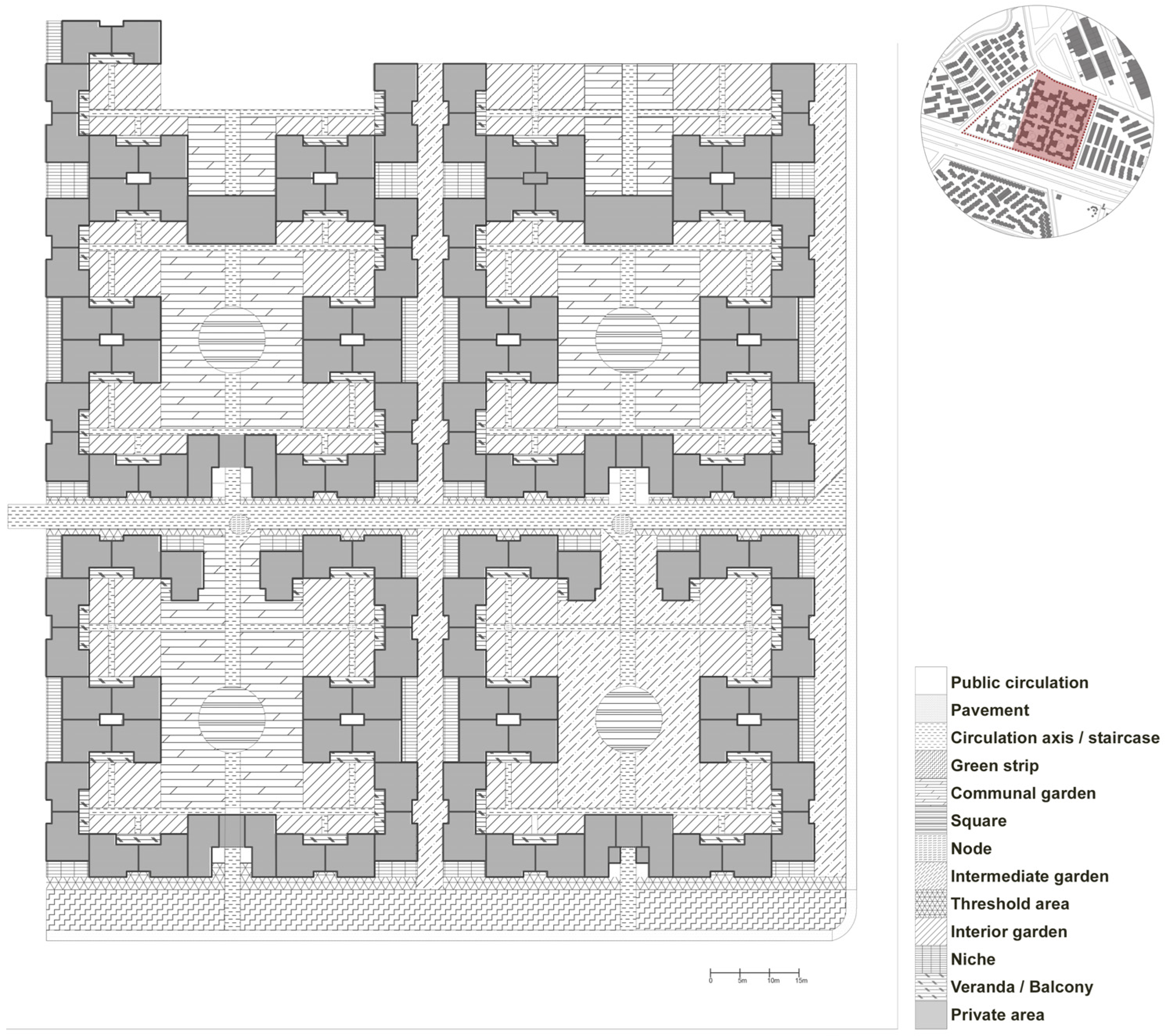
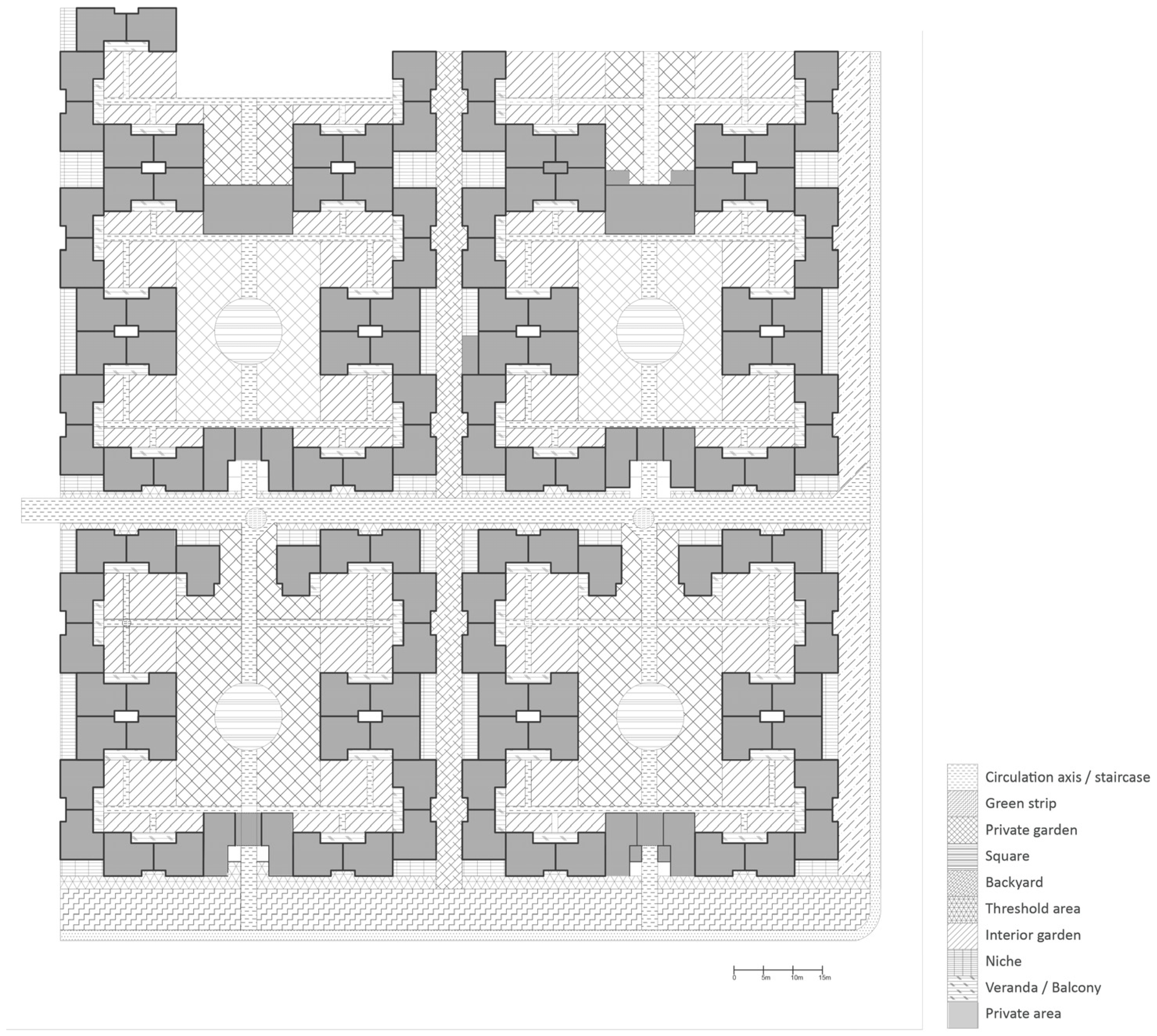
The morphological analysis conducted for the 184 Evl0er settlement examined the spatial patterns that constitute the residential fabric in relation to the sequence of in-between spaces extending from private areas to public circulation zones. The analysis identified eleven distinct layers of in-between spaces—veranda, niche, inner garden, threshold zone, intermediate garden, node, square, communal garden, green belt, circulation axis, and sidewalk. These layers vary across different scales and are organized to foster social interaction among housing clusters (
Figure 46).
Within the overall layout, the circulation axis connecting the clusters gains continuity through ground-floor passages integrated into the building masses. Along this axis, a sequential spatial hierarchy unfolds—from public nodes to semi-public courtyards and finally to private spaces—offering a gradual and cohesive transition from the public to the private realm. This configuration reflects a core design strategy aimed at achieving permeability and relational coherence within the settlement’s hierarchical spatial system.
Within this hierarchical spatial structure, the organizational logic of the settlement can be further understood through its pattern-based and modular design approach.
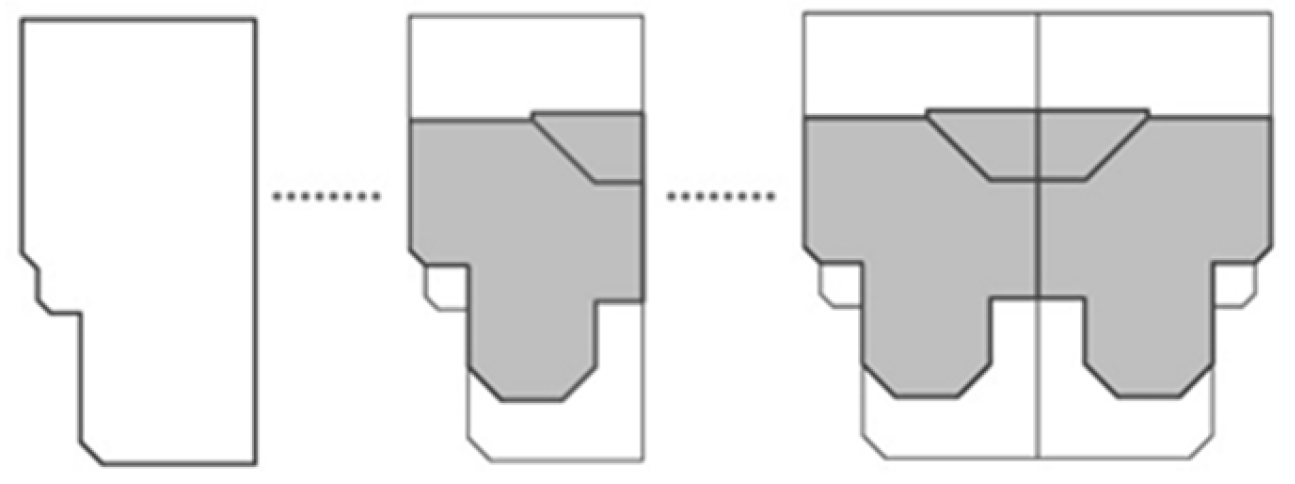
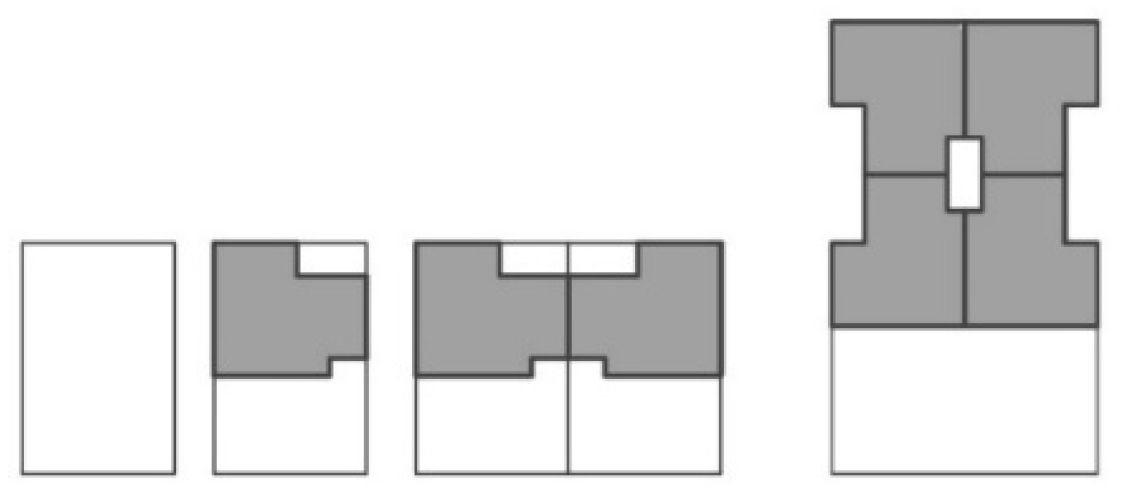
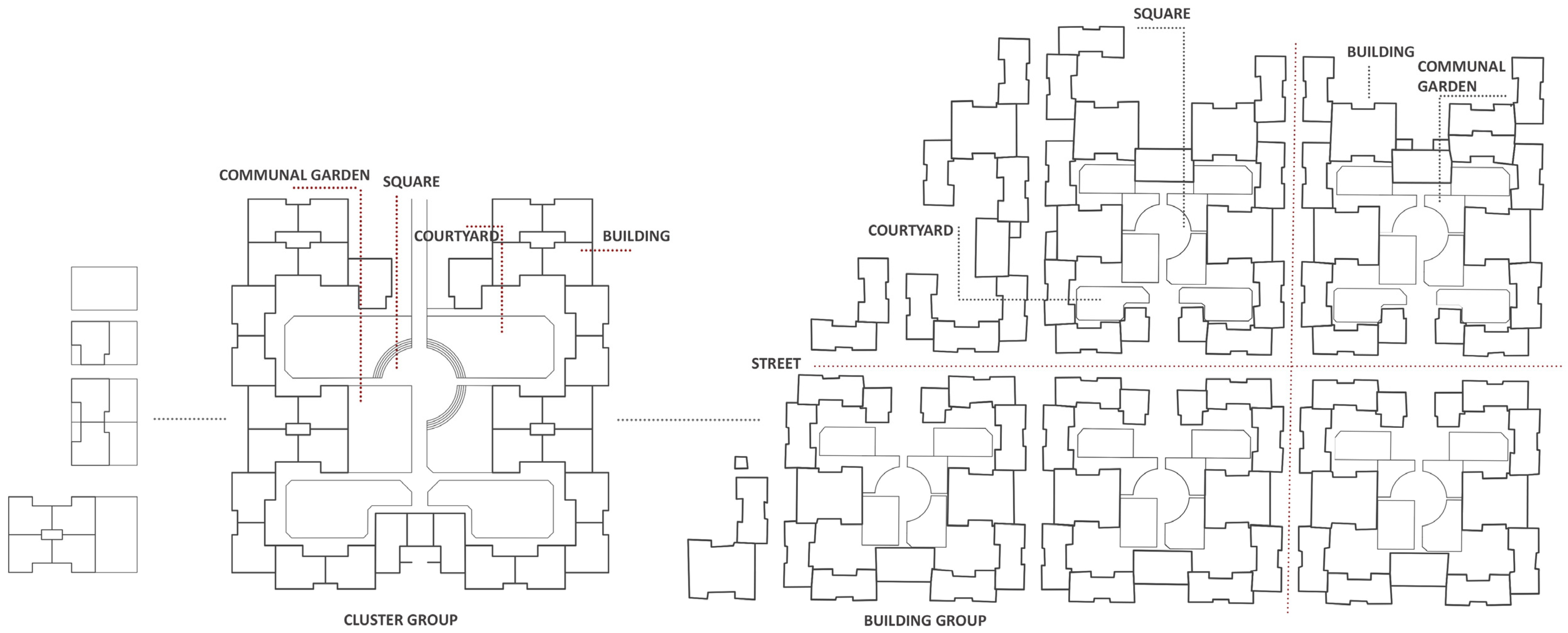
An examination of the 184 Evler housing settlement reveals a modular design logic extending from the building scale to the broader urban context. Through the repetition and aggregation of a defined housing module, a cluster-based and integrated urban component has been produced. The housing units are organized within a pattern-based configuration structured around inner courtyards and clustered groupings, where binary and quaternary variations in the basic module combine to generate larger-scale spatial patterns (
Figure 47).
In this system, four housing units are grouped around an inner courtyard, and the reassembly of these quaternary clusters forms larger neighborhood nodes. Within this clustering organization, axial shifts in the placement of housing units, along with the incorporation of spatial thresholds, niches, and transitional zones, enable the formation of a multi-layered system of in-between spaces. These spaces act as connective tissues providing permeability between housing units; by generating micro-scale transitional zones, they strengthen both physical continuity and social interaction. Consequently, the overall spatial organization of the settlement attains a cohesive, flexible, and interactive character (
Figure 48).
The modular design approach developed for the configuration of housing units provides a systematic spatial framework while supporting adaptability and expandability in response to changing needs over time. By integrating modularity with adaptability, the design establishes a coherent, flexible, and sustainable structural system that preserves formal unity while enabling incremental evolution at smaller scales.
3.3.2. The Socio-Spatial Potentials of In-Between Spaces in 184 Evler Site
This section examines the socio-spatial potentials of in-between spaces in the 184 Evler Housing Settlement by addressing their role in supporting social interaction and participation, contributing to the formation of spatial identity, and accommodating processes of transformation over time.
The analysis initially focuses on the capacity of in-between spaces to facilitate everyday social interaction and resident participation, which serves as the primary analytical lens for evaluating their socio-spatial performance.
Void–solid analyses and morphological pattern readings conducted at the urban-context scale indicate that the surroundings of the 184 Evler settlement are predominantly characterized by a row-house typology (
Figure 49). In this respect, 184 Evler distinguishes itself from its context through its open-space layers and the organizational logic of a group-housing typology. The building dimensions, designed in reference to the human scale, reflect a coherent and legible spatial organization. The continuity and diversity of in-between space layers within the settlement point to a design approach that effectively promotes social interaction among residents. However, the enclosure of the area with physical boundaries has disrupted the spatial continuity between the settlement and its urban context, weakening the connections established with public spaces.
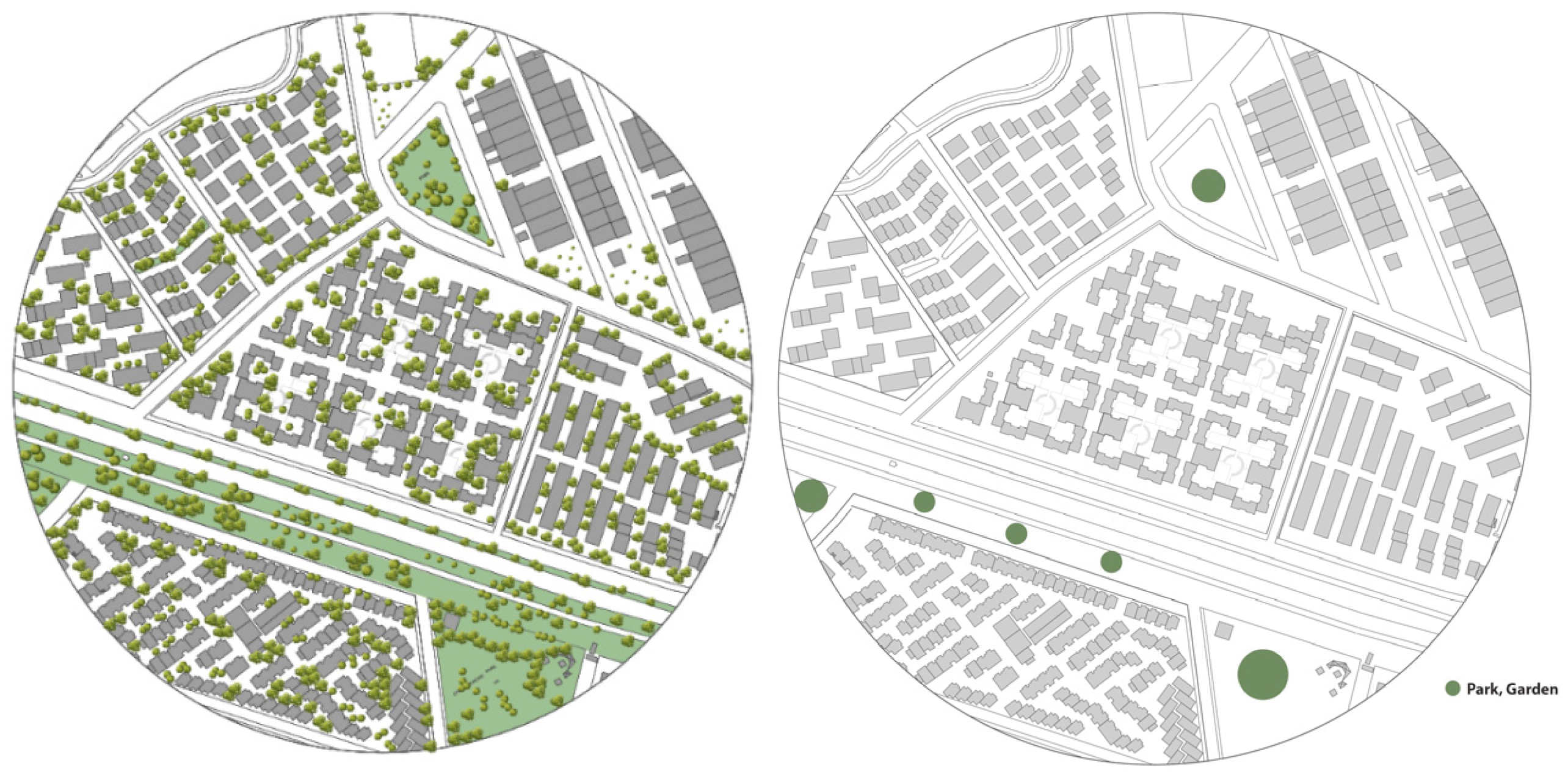
Green space analyses indicate the presence of a green corridor to the south of the 184 Evler settlement (
Figure 50). However, the main road separating this green area from the settlement disrupts physical continuity, limiting pedestrian access and reducing opportunities for interaction. The green area to the north functions as a passive open space without a defined programmatic or social function, thus contributing minimally to public life within the settlement. This condition restricts residents’ access to diverse public life experiences in their daily routines and highlights the lack of high-quality public spaces that could foster encounters and social interaction. Within the settlement itself, inner courtyards generate micro-scale green spaces with varying densities of vegetation; however, the absence of complementary collective programs confines the scope of social engagement.
According to the social facility analysis conducted at the urban fabric scale, social amenities in the vicinity of the 184 Evler housing settlement are limited (
Figure 47). Commercial units and local markets are located approximately one kilometer away, while educational and recreational facilities exist within a closer radius. However, the wide arterial roads surrounding the area hinder continuous pedestrian access, creating spatial disconnection that reduces accessibility and restricts the effective use of the existing social infrastructure.
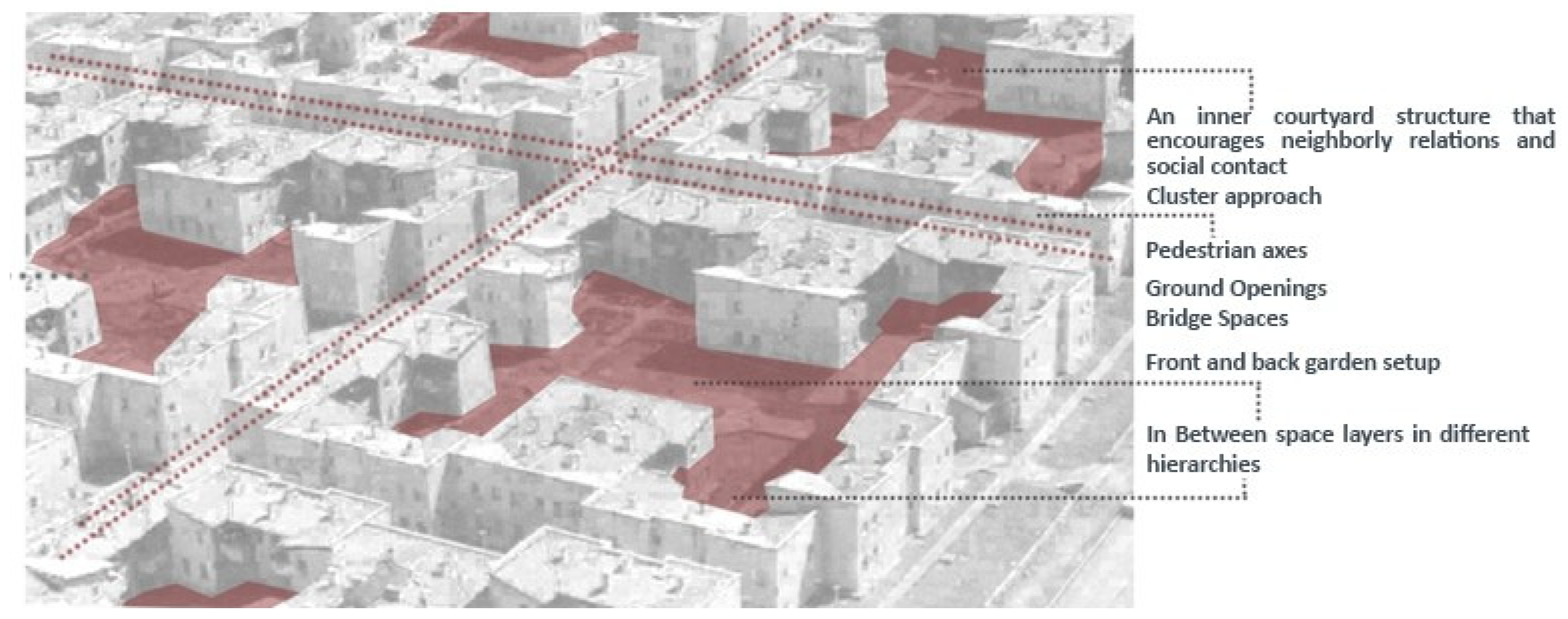
The spatial organization developed within the 184 Evler Housing Cooperative settlement fosters neighborly relations and social interaction through an integrated relationship between open spaces and in-between areas. The patterned continuity and permeability of these intermediary spaces play a fundamental role in shaping both social and physical qualities, enhancing diversity of use and opportunities for interaction. Based on a clustered group-housing typology, the settlement’s design organizes each housing cluster around semi-enclosed inner courtyards that function as focal points for social engagement.
The configuration of four housing units surrounding a shared courtyard establishes a spatial structure that supports everyday encounters through entrance axes and balcony openings. Circulation axes passing through the centers of these clusters and extending toward the inner squares promote social interaction through façade permeability, while the small niche spaces located along these axes operate as micro-public areas that facilitate pausing, observing, and informal social contact. In contrast, the main pedestrian axis situated between the clusters exhibits a more introverted character, as the closed façade arrangements of the adjacent dwellings limit visual and social permeability.
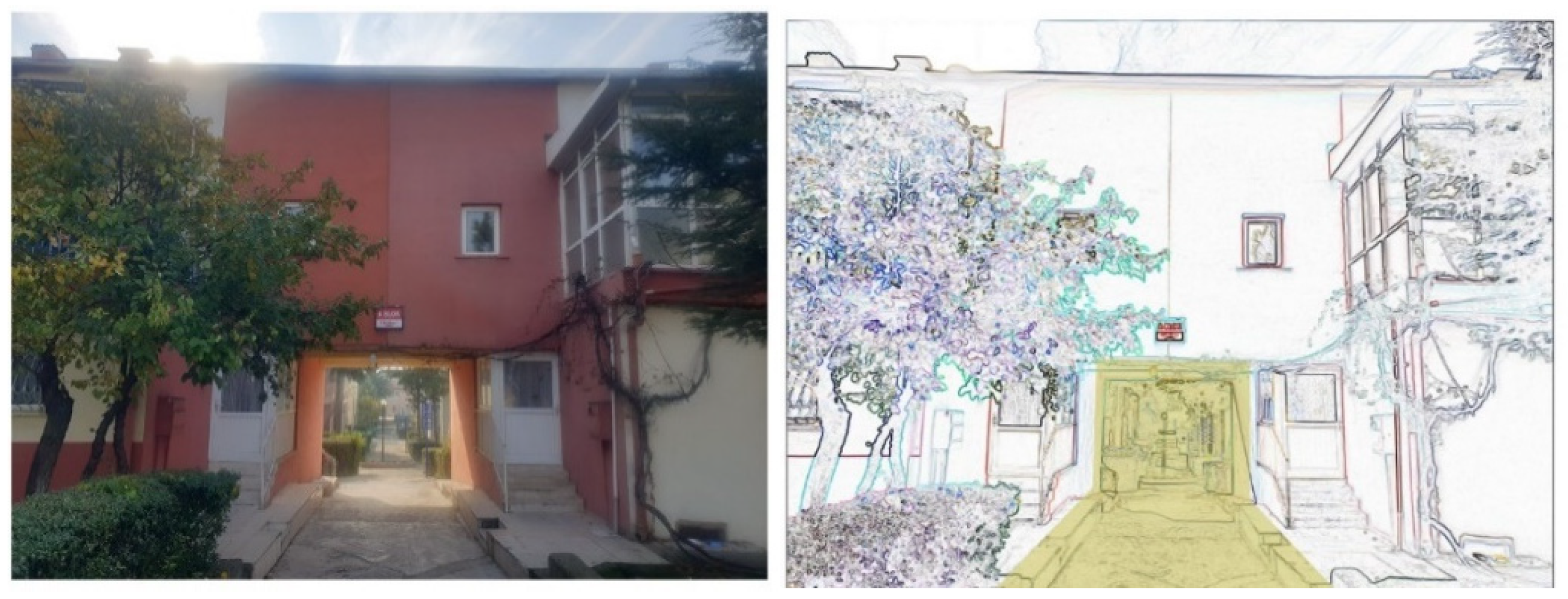
The section and perspective diagrams presented below illustrate how in-between space layers are structured as a multi-layered and hierarchical spatial system within the 184 Evler Housing Settlement. This visual–analytical representation demonstrates how these intermediary layers mediate between private dwellings, shared courtyards, and internal pedestrian circulation, functioning not merely as physical transition zones but as permeable interfaces that enable visual continuity and everyday social interaction within the settlement (
Figure 51 and
Figure 52).
In addition to their role in shaping everyday social interaction, the in-between spaces in the 184 Evler Housing Settlement are examined in relation to their contribution to the formation and expression of spatial identity at both individual and collective levels.
The housing units within the 184 Evler Housing Cooperative were designed at a similar scale and in a two-story typology consistent with the surrounding built fabric. The spatial configuration featuring private gardens and inner courtyards, as observed in other projects developed in Batıkent during the same period, exemplifies a human-scaled and user-centered design approach. However, the clustering scheme adopted at the scale of the residential fabric diverges to some extent from the city’s local morphological language, reflecting an experimental exploration of alternative housing forms within the broader urban context.
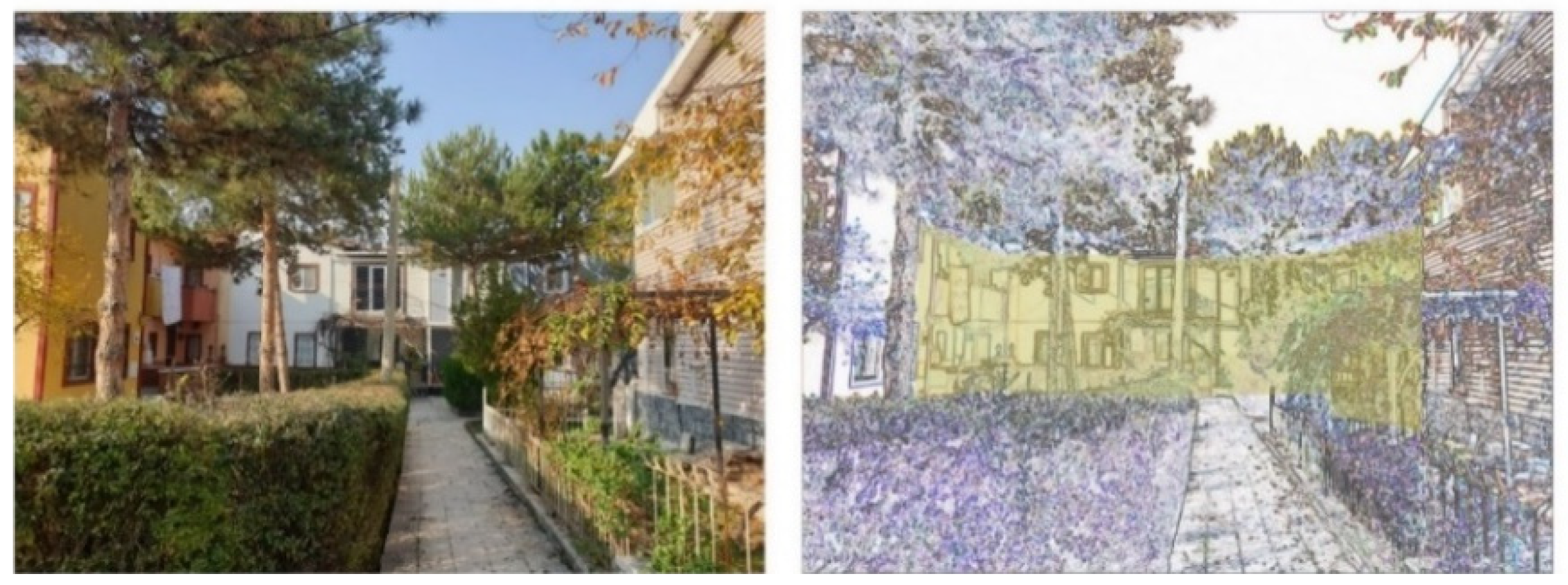
The in-between spaces within the settlement inherently exhibit a multi-layered and adaptable character; while maintaining interaction between public and private realms, they can be reconfigured according to individual preferences and everyday practices (
Figure 53). Nevertheless, field observations of the current condition of 184 Evler reveal that the transformation of living spaces in accordance with individual identities remains comparatively limited when contrasted with the other settlements examined in this study.
A further dimension of the socio-spatial performance of in-between spaces in the 184 Evler Housing Settlement concerns their capacity to accommodate gradual transformation over time, particularly in relation to changing user needs and everyday practices.
The multi-layered structure and typological system of the residential fabric, composed of smaller-scale spatial components, provide a framework that allows for diversification and gradual transformation over time. The presence of in-between space layers defined at multiple scales enhances the adaptive capacity of the physical organization, enabling the settlement to be reconfigured in response to changing user needs and preferences. However, field observations and on-site evaluations indicate that, despite this inherent potential for transformation, the extent of structural change within the settlement remains relatively limited compared to the other cases examined.
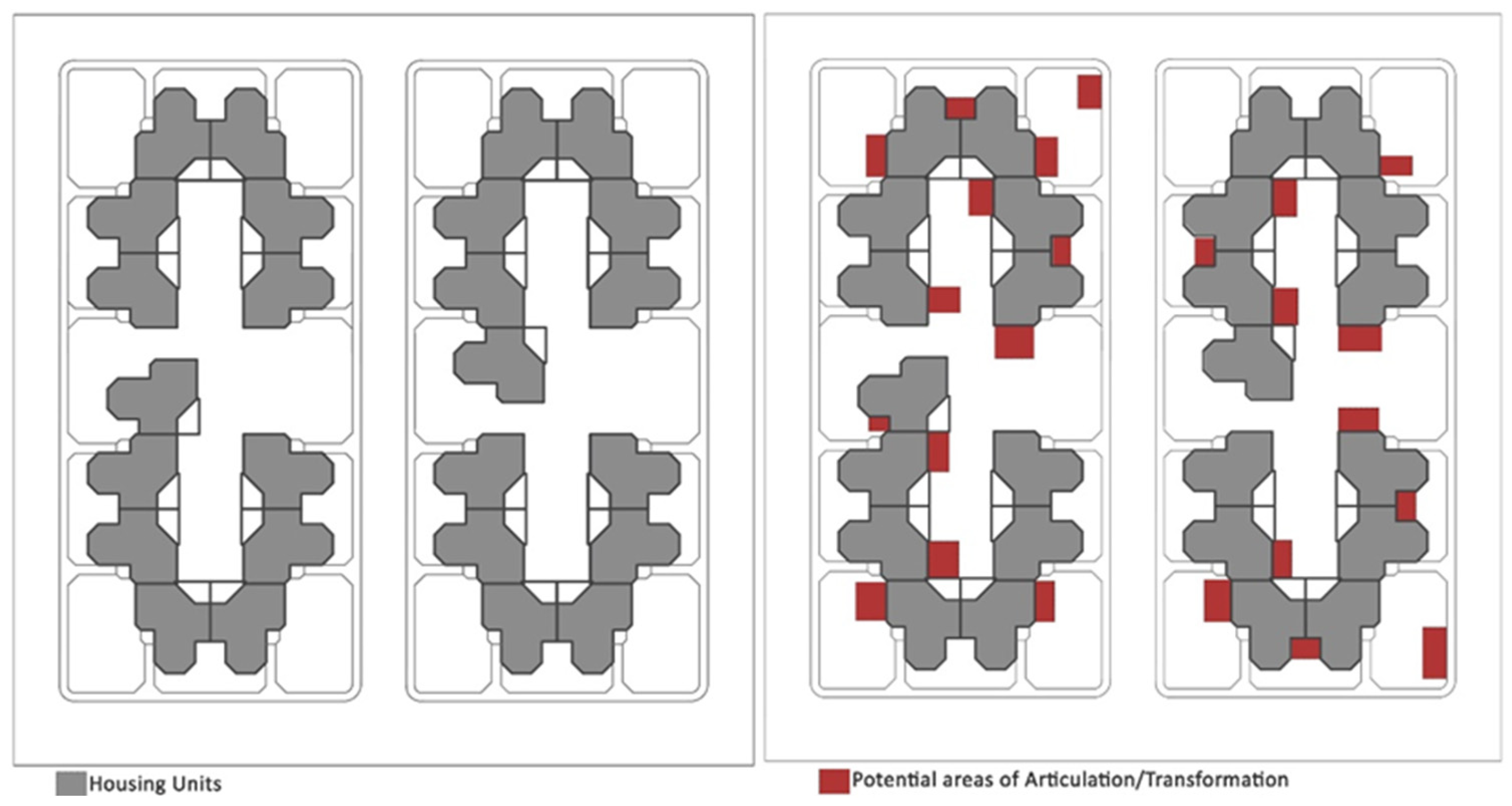
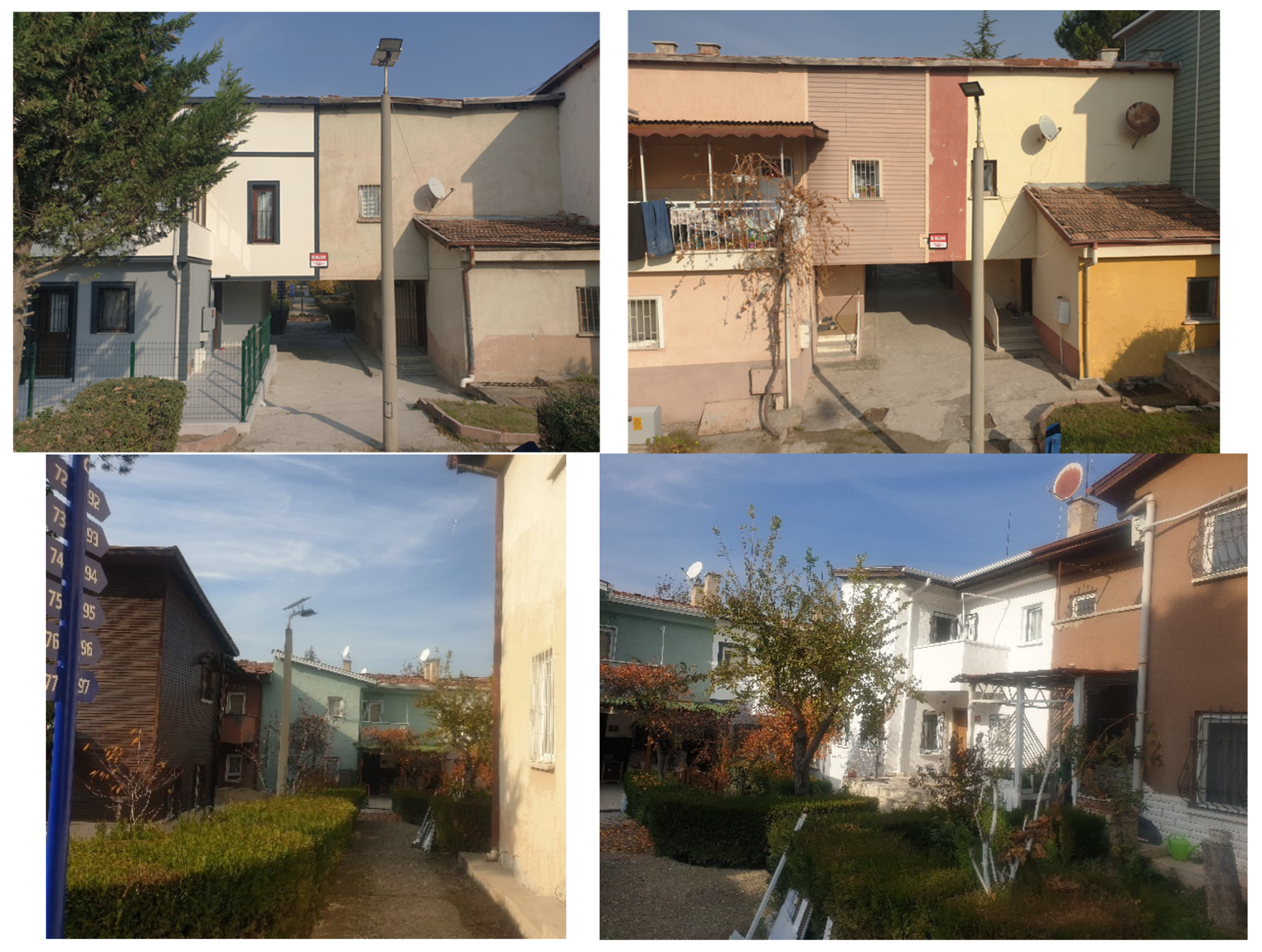
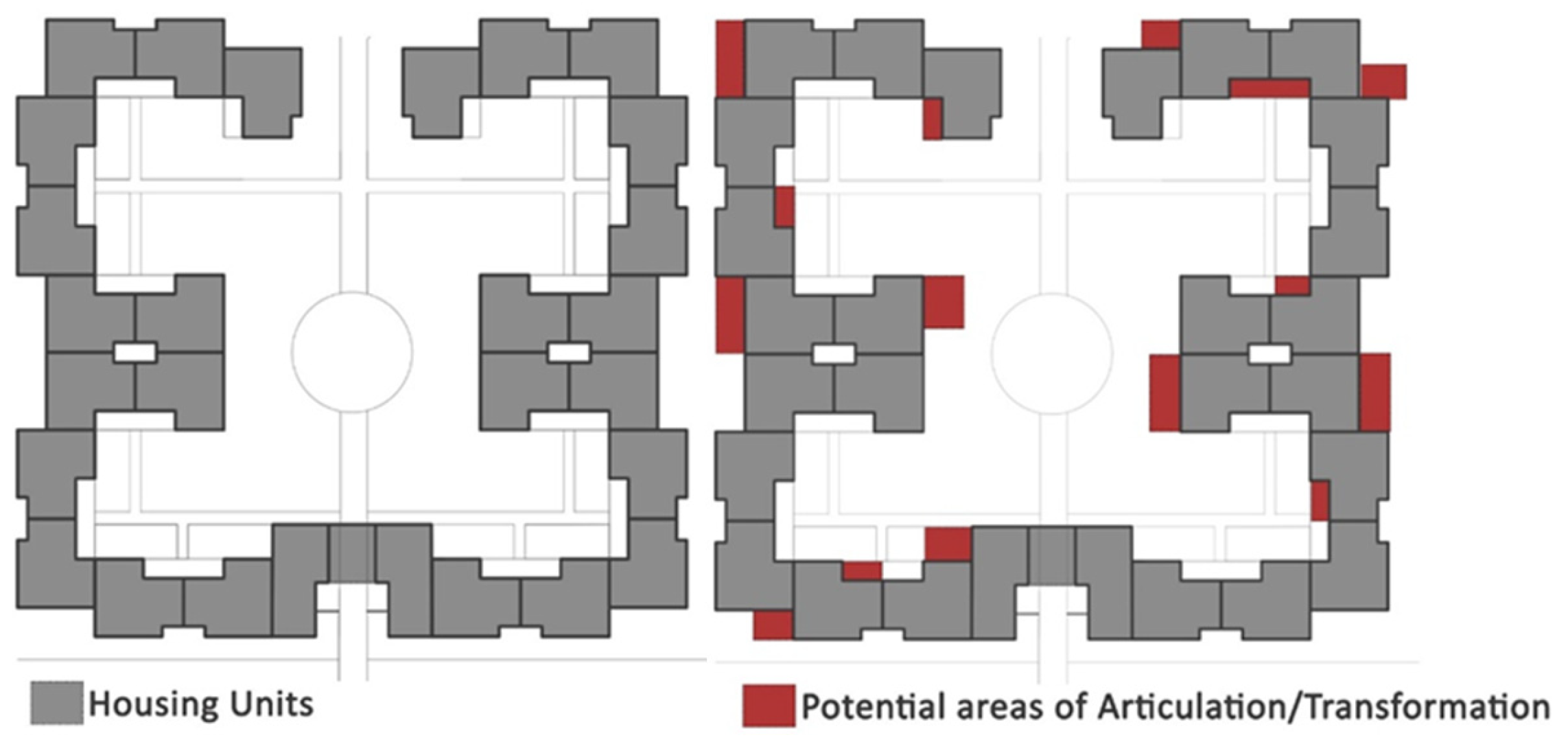
The diagram presented below is developed to illustrate how the transformation and expandability potential of the settlement is mediated through its in-between space layers. The left plan diagram represents the original spatial configuration of the 184 Evler Site, while the right diagram reflects the current condition shaped by incremental additions and spatial adaptations over time. A comparative reading of these plan-based diagrams reveals that spatial change is primarily accommodated through the reconfiguration of intermediary layers—such as entrance zones, balconies, and semi-public courtyard interfaces—rather than through modifications to the primary structural system. In this respect, the diagram demonstrates that in-between spaces operate as flexible spatial reserves, enabling controlled transformation at the dwelling-unit scale while preserving morphological continuity at the block and settlement scales (
Figure 54). The spatial tendencies identified through this analytical reading are further supported by contemporary photographic documentation, which reflects the current condition of the settlement and provides empirical evidence of how in-between spaces have been selectively adapted, enclosed, or repurposed in response to changing everyday practices (
Figure 55,
Figure 56 and
Figure 57).
In the housing units of the 184 Evler settlement, the ground-floor layout demonstrates the use of an open-plan approach. This configuration allows the main living area to be divided into two distinct sections, thereby increasing flexibility and enabling functional adaptations over time. The flexible organization of the interior facilitates modifications based on individual needs, reflecting the potential for transformation at the unit scale. Furthermore, observations reveal that in some dwellings, balcony volumes have been enclosed and integrated into the interior space, extending the living area without altering the building’s external form.
3.3.3. Spatial Continuity and Transformation over Time in 184 Evler Site
Analyses of the current condition of the 184 Evler housing settlement reveal that the spatial transformations and accretions that have occurred over time can be interpreted through their relationship with the layers of in-between spaces. As in the other two case studies, the in-between spaces in 184 Evler—originally designed for public and collective use—have gradually evolved toward individualized forms of use. The morphological mapping developed based on the current condition indicates a quantitative reduction in these layers, showing that several communal gardens have been transformed into private ones. In particular, some of the shared gardens located along the north–south-oriented main axis have been restricted for individual use, thereby losing their collective function. Although the main pedestrian axis running through the center of the clusters and opening onto the courtyards has maintained its physical continuity, the privatization of many adjoining communal gardens has reduced permeability and interrupted spatial flow (
Figure 58).
In several housing units, entrance zones and balcony volumes oriented toward the courtyards have been enclosed and incorporated into private living areas. Secondary pedestrian connections between building clusters have also been closed off over time and repurposed as private gardens or storage areas. While the entrance axes and balcony openings facing the courtyards continue to sustain visual and physical connections between individual dwellings and shared open spaces, their enclosure in some units has weakened the perceptual and functional integrity of collective space.
Moreover, the enclosure of most rear gardens with fences has diminished the spatial relationship between private dwellings, courtyard spaces, and pedestrian circulation routes. This transformation process signifies a gradual shift from the originally envisioned collective spatial configuration toward more individualized patterns of use, thereby constraining social interaction and reducing public permeability within the settlement. Nonetheless, it should be noted that the extent of such interventions remains more limited in scope compared to the other settlements examined in this study.
4. Discussion
The comparative analysis of Tekgül Site, Tarımsal Site, and 184 Evler reveals that the social effectiveness of in-between spaces is shaped less by their formal presence than by their degree of urban integration, spatial continuity, and everyday appropriation. Although all three settlements were originally designed within cooperative housing frameworks that emphasized gradated transitions between public and private realms, they have followed divergent socio-spatial trajectories over time. Tekgül Site demonstrates how permeable boundaries, multi-scalar intermediate spaces, and strong physical and visual connections to the surrounding urban fabric can sustain social interaction even amid incremental spatial transformations. In contrast, Tarımsal Site illustrates a gradual erosion of collective spatial logic, where originally shared in-between spaces have been progressively privatized, weakening public continuity and reducing opportunities for everyday encounters.
The case of 184 Evler further underscores that morphological complexity alone does not guarantee social vitality. Despite its clearly articulated hierarchy of intermediate spaces and internally continuous pedestrian structure, the settlement exhibits limited social activation of these spaces. The inward-oriented configuration resulting from later enclosure, combined with physical disconnections from adjacent urban areas, has constrained the integration of internal intermediate layers with broader urban flows.
As a result, in-between spaces in 184 Evler tend to function primarily as circulation or residual zones rather than socially productive environments. This comparison highlights a critical distinction between settlements where intermediate spaces operate as extensions of public life and those where such spaces remain internally contained and socially passive.
Taken together, the findings suggest that the social sustainability of in-between spaces emerges from a reciprocal relationship between spatial design, urban context, and socio-economic conditions. Tekgül’s relative success can be attributed to its continued permeability and adaptability within an active urban setting, whereas the limitations observed in Tarımsal Site and 184 Evler reflect the combined effects of spatial privatization, reduced public continuity, and weakening collective practices. These cases demonstrate that in-between spaces function most effectively when supported by long-term urban integration, participatory use patterns, and socio-institutional continuity. Accordingly, the discussion reinforces the argument that socially sustainable housing environments cannot be achieved through spatial form alone, but require an integrated approach that considers morphology, everyday practices, and the broader socio-economic context in tandem.
4.1. Interpretation of Findings Across Different Case Studies
Across Turkey, cooperative housing has often been characterized by an initial commitment to collective living—manifested in shared open spaces, gradated thresholds, and pedestrian-oriented layouts—followed by uneven long-term outcomes shaped by governance continuity, socio-economic change, and urban integration. When the Batıkent cases are read against broader cooperative experiences in Ankara (including other cooperative districts that expanded through similar membership-based production logics) as well as cooperative settlements developed around major metropolitan growth corridors, a recurring pattern becomes visible: the social promise of in-between spaces tends to persist where cooperatives remain embedded in a connected street network and where everyday services, transit access, and neighborhood amenities sustain routine public life. In such contexts, intermediate zones more readily operate as extensions of the public realm, enabling informal encounters and reinforcing place-based belonging.
Conversely, the transformations observed in Tarımsal Site and 184 Evler resonate with a wider tendency in Turkish cooperative environments toward progressive privatization and enclosure. Many cooperative settlements that were initially planned around collective grounds have, over time, experienced individualized spatial interventions—such as the appropriation of shared gardens, the enclosure of semi-public thresholds, and the strengthening of boundary elements—often justified through concerns about security, maintenance responsibilities, or shifting household preferences. This trajectory is particularly pronounced where cooperative decision-making structures weaken, where tenure/ownership profiles diversify, and where the surrounding urban fabric provides limited external stimulation (e.g., fewer amenities and weaker pedestrian connectivity). In these settings, in-between spaces frequently drift from socially “productive” commons into residual circulation zones, diminishing their capacity to support sustained community interaction.
From a comparative standpoint comparing Batıkent with broader Turkish cooperative precedents reinforces a key discussion point: social sustainability in cooperative housing is not an automatic outcome of spatial morphology, but an emergent condition produced through the interplay of spatial continuity, institutional stewardship, and everyday practices within a supportive urban context. The relative strength of Tekgül Site aligns with cooperative examples in Turkey where permeability and public continuity remain intact and where residents continue to negotiate shared space through incremental, collectively tolerable adaptations. By contrast, the limitations evident in Tarımsal Site and 184 Evler parallel cases where inward-oriented configurations, gated logics, and the erosion of collective governance constrain participation and weaken the lived meaning of common spaces. This suggests that sustaining the cooperative ethos requires not only designing intermediate layers but also maintaining the socio-institutional arrangements and urban connections that keep those layers socially active over time.
4.2. Contribution of the Present Study and Its Position Within the Existing Literature
This study positions the concept of the in-between space as a critical notion that warrants renewed attention within contemporary urban transformation processes. In the discussion, in-between spaces are not treated merely as residual or transitional spatial elements, but as socially productive interfaces that have the capacity to mediate everyday life, collective practices, and urban continuity. By examining well-established cooperative housing environments, the study argues that recalling and re-articulating this concept through empirical and comparative analysis is particularly relevant at a time when urban renewal practices increasingly prioritize densification, enclosure, and privatization.
Recent contributions within the international literature have further strengthened this line of inquiry by expanding the range of methodological approaches used to examine the relationship between spatial configuration and social life. In particular, the growing diversification of analytical frameworks has enabled researchers to move beyond purely descriptive or normative accounts, allowing for the systematic investigation of in-between spaces across different urban contexts and geographical settings. These methodological advancements have made it possible to compare spatial and social dynamics across varied cultural, economic, and morphological conditions, thereby enhancing the generalizability and analytical depth of such studies.
Among these approaches, research employing space syntax has been especially influential in enabling the quantitative assessment of spatial properties related to accessibility, permeability, and integration [
21,
43]. By translating spatial configurations into measurable parameters, space syntax-based studies have provided empirical evidence linking spatial structure to patterns of movement, encounter, and co-presence. This quantitative dimension has not only enriched discussions on in-between spaces but has also complemented qualitative and socio-morphological analyses, offering a more comprehensive understanding of how spatial form shapes everyday social practices. As such, the integration of these methodological tools has played a critical role in advancing contemporary debates on socially sustainable urban environments.
Moreover, particularly in contexts where urban transformation has become a recurring and dominant condition, research on in-between spaces offers a significant contribution as a form of urban data [
44]. Such studies enable the identification and interpretation of city-specific conditions, supporting comprehensive and context-sensitive readings of urban environments. By capturing the nuanced relationships between spatial configuration, everyday practices, and socio-cultural dynamics, in-between space research facilitates a deeper understanding of how urban transformation processes unfold differently across cities and neighborhoods.
Within this context, the research seeks to situate itself in the broader international literature by addressing a central question: whether such a socio-morphological research methodology can offer a forward-looking framework for emerging approaches to urban transformation. The findings suggest that methodologies which integrate spatial morphology with everyday use patterns and socio-economic conditions provide a valuable lens for understanding the long-term social consequences of design decisions. Rather than proposing universal solutions, the study demonstrates the importance of context-sensitive analytical frameworks that can reveal how in-between spaces are produced, transformed, and socially negotiated over time.
4.3. Implications for Policy and Urban Planning
This study contributes to contemporary debates on urban transformation by reasserting the relevance of in-between spaces as a critical spatial and social concept that merits renewed consideration. Within the discussion, in-between spaces are framed not as marginal or leftover zones, but as relational environments that structure everyday practices, mediate between public and private realms, and sustain forms of social continuity over time. At a moment when urban redevelopment processes are increasingly shaped by pressures of densification, standardization, and privatization, the study argues that revisiting this concept through empirical and comparative inquiry offers an important corrective to design approaches that overlook lived social dynamics.
The research positions its socio-morphological methodology as a potentially horizon-expanding framework for emerging urban approaches. By integrating spatial configuration, transformation processes, and patterns of everyday use, the study responds to broader questions within the international literature regarding how social sustainability can be assessed beyond formal design intentions. Rather than treating social interaction as an outcome that can be prescribed through spatial form alone, the methodology foregrounds the contingent and processual nature of social life, emphasizing the importance of long-term spatial continuity, adaptability, and user appropriation. In this sense, the study aligns with scholarship that calls for more nuanced, context-sensitive analytical tools capable of capturing the evolving relationship between space and society.
Building on this perspective, the study suggests that future research should further develop this framework by incorporating place-specific parameters that reflect local socio-economic conditions, governance structures, and cultural practices. As a sub-domain within the broader discourse on social sustainability, the focus on social continuity connects spatial production with everyday experience and collective meaning-making. This approach resonates with contemporary agendas associated with Sustainable Development Goal 11, particularly those concerned with inclusive public spaces, participatory urban processes, and resilient urban communities. By opening up these lines of discussion, the study aims to encourage further research that expands the analytical and practical relevance of in-between spaces within socially sustainable urban transformation strategies.
4.4. Limitations of the Study and Directions for Future Research
Within this broader framework, the study emphasizes that addressing social sustainability in urban transformation requires moving beyond static design solutions toward an understanding of spatial continuity as an ongoing social process. In-between spaces emerge as key arenas where everyday interaction, informal practices, and collective routines are negotiated and reproduced. By foregrounding social continuity as an analytical category, the research highlights how the persistence of shared spatial practices—rather than the mere provision of semi-public areas—plays a decisive role in sustaining meaningful social relations. This perspective underscores the need to evaluate urban environments not only through their formal spatial attributes but also through their capacity to support long-term engagement, adaptability, and lived social experience.
In this sense, the study situates itself within contemporary discussions on socially sustainable urban development by aligning its analytical focus with the objectives of Sustainable Development Goal 11. By linking in-between spaces to issues such as inclusive access, participatory use, and resilient neighborhood structures, the research opens a platform for future studies that explore how spatial morphology and social behavior intersect under varying urban conditions. The findings suggest that advancing socially sustainable urban transformation depends on interdisciplinary approaches that integrate spatial analysis with socio-economic and cultural dimensions, encouraging further empirical research that refines the role of in-between spaces as active components of everyday urban life.
5. Conclusions
This study has explored the role of in-between spaces as critical spatial interfaces that mediate between public and private realms and shape the social sustainability of everyday urban life. By adopting a comparative socio-morphological framework, the research responds directly to its primary objective: to examine how spatial continuity, urban integration, and patterns of everyday use influence the social performance of intermediate spaces within housing environments. This relationship is reciprocal: while spatial continuity and integration enhance social interaction, their absence significantly constrains the social potential of in-between spaces. The findings confirm that in-between spaces are not merely auxiliary design elements, but fundamental components of socially resilient urban systems whose effectiveness depends on long-term spatial, social, and institutional conditions.
One of the study’s original contributions lies in its re-articulation of in-between space as an analytical category capable of capturing the dynamic relationship between spatial form and lived experience. Rather than treating social sustainability as an abstract or policy-driven concept, the research grounds it in the everyday practices that unfold within intermediate spatial layers. In doing so, it demonstrates that social continuity—understood as the sustained reproduction of shared routines, encounters, and spatial practices—emerges as a key mechanism through which social sustainability is materialized in the built environment.
The comparative findings further reveal that spatial design alone cannot guarantee socially productive outcomes. While all examined environments incorporate gradated transitions and semi-public spaces, their social activation varies significantly depending on urban embeddedness, permeability, and adaptability over time. Housing environments that maintain continuity with surrounding pedestrian networks, public amenities, and everyday urban flows are more likely to support active use of intermediate spaces. Conversely, inward-oriented configurations, enclosure strategies, and the erosion of public-space continuity tend to transform these areas into passive or residual zones, limiting their capacity to support collective life.
In this respect, the study responds to broader questions within contemporary urban transformation debates by demonstrating the value of socio-morphological research methodologies. By integrating spatial analysis with observations of use, transformation processes, and socio-economic context, the research offers a comprehensive reading of how urban form and social practices co-evolve. Such an approach is particularly relevant in contexts where urban transformation is frequent and rapid, as it enables planners and designers to anticipate the long-term social implications of spatial decisions beyond their initial formal intentions.
The findings also contribute to current urban design discussions by foregrounding the importance of permeability, adaptability, and intermediate spatial continuity as design principles rather than fixed solutions. From a design perspective, this suggests a shift away from closed, controlled, and highly privatized residential models toward more open-ended spatial systems that can accommodate incremental change while preserving collective accessibility. In-between spaces, when conceived as flexible and socially legible environments, have the potential to function as everyday infrastructures of interaction that support informal encounter, participation, and a sense of belonging.
At a broader scale, the study aligns with contemporary frameworks of socially sustainable urban development, particularly those associated with Sustainable Development Goal 11. By emphasizing inclusive access, participatory use, and resilient neighborhood structures, the research situates in-between spaces within global discussions on sustainable cities while maintaining sensitivity to local socio-cultural and spatial conditions. This dual positioning highlights the capacity of intermediate spaces to serve as a bridge between global sustainability agendas and context-specific urban practices.
In conclusion, the study argues that socially sustainable urban environments are produced through the reciprocal relationship between spatial continuity, everyday social practices, and urban integration. The originality of the research lies in demonstrating that in-between spaces operate as active social interfaces rather than residual zones, and that their effectiveness depends on how they are designed, inhabited, and transformed over time. By offering a holistic socio-morphological perspective, the study provides a conceptual and methodological foundation for future urban design and planning approaches that seek to foster long-term social resilience, collective well-being, and meaningful engagement in the context of ongoing urban transformation.