1. Introduction
1.1. Context and Justification
The global agenda for sustainable development, materialized in the Sustainable Development Goals (SDGs) and reinforced by frameworks such as the Principles for Responsible Investment in Agriculture and Food Systems (CFS-RAI) [
1], necessitates innovative solutions to complex socio-environmental challenges [
2,
3]. In this context, the Food Bank Chair (FBC) was established in 2013 on the initiative of the Spanish Federation of Food Banks (FESBAL) and the GESPLAN Research Group at UPM, with the firm purpose of promoting rational consumption through training, research, and knowledge transfer. Its mission closely aligns with mitigating the paradox of food waste and food insecurity, a critical situation where resource disposal coexists with the lack of access to adequate nutrition for vulnerable sectors [
4,
5,
6].
To strengthen this work and effectively link knowledge with action, the FBC has implemented the WWP model [
7]. Its three components (ethical–social, technical–business, and political–contextual) facilitate connection with society through pedagogical strategies such as PBL. These methodologies enable postgraduate students to acquire solid technical training while solving real-world problems, promoting values of sustainability, solidarity, and ethics. Given that the effectiveness of these initiatives depends on understanding the social and territorial context, the FBC has incorporated Geographic Information Systems (GISs), which are established instruments for addressing territorial problems under the premise that every phenomenon occurs in a specific place [
8].
The capacity of GISs to represent and analyze information facilitates communities’ ability to identify issues and design collaborative solutions, leading to their evolution into PGIS. Through the awareness-raising efforts of the Food Banks (FBs), this study analyzes the perception of utility, accessibility, and practical learning resulting from the construction of a geographic portal, as well as its contribution to the CFS-RAI principles and the SDGs, particularly SDG 2 (Zero Hunger) and SDG 12 (Responsible Consumption and Production). This methodological combination not only incentivizes students to develop solutions adapted to local problems [
9] but also strengthens resilience by involving civil society actors and public–private entities in current challenges [
10,
11].
Integrating the WWP and PBL methodologies from a geographical perspective constitutes the central axis of this work. This integration has facilitated the design and implementation of the FESBAL–UPM Geoportal. A geoportal is essentially a web-based gateway that provides a single point of access to spatial information and services [
12]; in this study, it is applied as a PGIS, designed to involve students in decision-making and foster community collaboration [
10]. In this regard, the general objective of this article is to analyze how the integration of participatory methodologies in the geoportal’s design strengthens learning and collaborative management among the stakeholders linked to the FBC.
To achieve this, the study pursues three specific objectives: first, to design a participatory geoportal that functions as a visualization and analysis tool for FBC projects, raising awareness about rational and responsible food consumption; secondly, to evaluate the tool’s contribution across the strategic action lines of teaching, community engagement, and the promotion of applied research, while also analyzing evidence regarding the geoportal’s contribution to the CFS-RAI principles and the SDGs; finally, to validate the geoportal as a replicable model of educational and territorial innovation based on PGIS, capable of systematizing the multidimensional impact of the 54 FBs, thereby transcending surplus management to encompass social, environmental, and governance dimensions.
This work contributes to the literature on GIS and sustainability by demonstrating that the integration of PGIS into collaborative frameworks, specifically through the WWP model and PBL, allows for a joint approach to social, environmental, and governance dimensions, overcoming fragmented applications of geospatial technology. The primary scientific contribution lies in providing a transferable methodological framework that operationalizes global ethical principles (CFS-RAI) into local action. Furthermore, it offers an evidence-based governance approach supported by geospatial transparency, which empowers stakeholders to move beyond data management toward sustainable decision-making.
1.2. Theoretical Framework
1.2.1. Participatory Geographic Information Systems
GISs constitute fundamental technological tools in the information age, enabling the storage, analysis, and representation of spatially referenced data through the integration of hardware, software, and complex processes [
10]. Their capacity to manage and cross-reference socio-economic and environmental variables allows the understanding of the spatial factors that influence territorial development, making them essential instruments for monitoring social change processes and advancing the achievement of the SDGs, whose success largely depends on the precise geographical localization of interventions [
13,
14]. Nevertheless, traditional GISs were initially criticized for their technocratic nature, restricted to institutions with privileged access and excluding the local knowledge of communities, which is a key asset for generating contextualized and socially relevant data [
14,
15].
To overcome these limitations of exclusion and verticality, PGISs emerged. These systems integrate expert technical knowledge with the practical knowledge of society, functioning as dynamic spatial laboratories oriented toward social transformation [
15,
16,
17]. This approach has strengthened the inclusion of civil society, allowing local perspectives to be incorporated into territorial planning and significantly improving the quality and relevance of the data generated [
18]. PGISs have demonstrated their utility in diverse fields such as urban planning, natural resource management, and rural development, although their success depends on the meaningful participation of stakeholders, democratic access to technology, and institutional commitment [
15]. In the educational field, they represent a unique opportunity for students and communities to develop geo-spatial skills and become actively involved in territorial development, thereby making the work of actors like the FBs visible and reinforcing their role in the governance of local food systems [
7,
14].
1.2.2. Project-Based Learning
PBL is defined as a comprehensive pedagogical methodology that fuses theory and practice, enabling students to develop technical, analytical, and professional competencies through the research and resolution of authentic territorial problems [
19,
20]. This approach substantially improves learning by compelling students to apply knowledge in real contexts, and, in addition to strengthening technical training in territorial planning and resource management, it promotes cooperative learning and teamwork, which are essential competencies for modern project management [
20,
21]. By confronting real-world problems, students transition from a passive role to an active one, generating contextualized viable proposals that are adjusted to available resources, thereby increasing their ethical commitment to the environment [
22,
23].
Within this framework, the combination of PBL with PGIS constitutes a highly effective, integrated methodology for addressing the complex challenges of sustainable development [
7,
15]. While PGIS provides the advanced tools necessary to collect, analyze, and visualize spatial data, PBL structures the learning process around applied projects that give social meaning and utility to that data. This synergy facilitates the design of solutions aligned with the CFS-RAI principles, establishing a fundamental framework for guiding projects with positive environmental, social, and economic impact, and promoting a more inclusive and equitable management of food systems [
24].
1.2.3. Principles for Responsible Investment in Agriculture and Food Systems
The CFS-RAI principles have the fundamental objective of ensuring that investments in agriculture and food systems effectively contribute to sustainable development, promoting social equity, respect for the rights of local communities, and the generation of fair benefits for all involved stakeholders [
1]. In parallel, the 2030 Agenda coherently articulates social, economic, and environmental targets through the 17 SDGs, considering them an “indivisible whole” that requires an integral approach [
25]. In this context, the CFS-RAI principles are key to the sustainability of the FBC’s projects, as they promote practices that respect human rights, foster environmental sustainability, and generate positive social impacts, addressing critical challenges such as hunger and food waste from a holistic perspective that considers social, environmental, economic, and governance dimensions [
26,
27].
The incorporation of technologies like PGIS significantly amplifies the scope and applicability of these principles, facilitating the necessary data collection and analysis to evaluate environmental impacts, conserve natural resources, and raise societal awareness [
28]. The combination of local knowledge with robust technological tools strengthens communities’ capacity to develop resilient projects, aligned with both the CFS-RAI principles and the SDGs. Ultimately, these principles emphasize innovation and research as drivers for strengthening food systems, promoting technologies that increase food security without compromising the resources of future generations.
Table 1 details the intrinsic relationship between these principles and the SDGs.
2. Materials and Methods
2.1. Methodological Approach
The research was developed under a qualitative, interpretive, and participatory methodological approach aimed at understanding how the integration of PGIS, PBL, and the WWP metamodel contributes to strengthening learning, collaboration, and project management within the framework of the FBC UPM–FESBAL Chair. This approach is suitable for analyzing educational, social, and technological phenomena whose understanding depends on the interaction between stakeholders, local knowledge, spatial information, and organizational dynamics. The use of qualitative methods allowed for the identification of perceptions, experiences, and processes of technological appropriation that cannot be captured through conventional quantitative metrics.
Within this framework, the development of the FESBAL–UPM Geoportal was based on the WWP metamodel, which articulates community participation with training processes and collaborative planning. It integrates PGIS with the PBL approach and the CFS-RAI principles, positioning communities at the center of the decision-making process, ensuring that technological and educational solutions respond to their needs and aspirations [
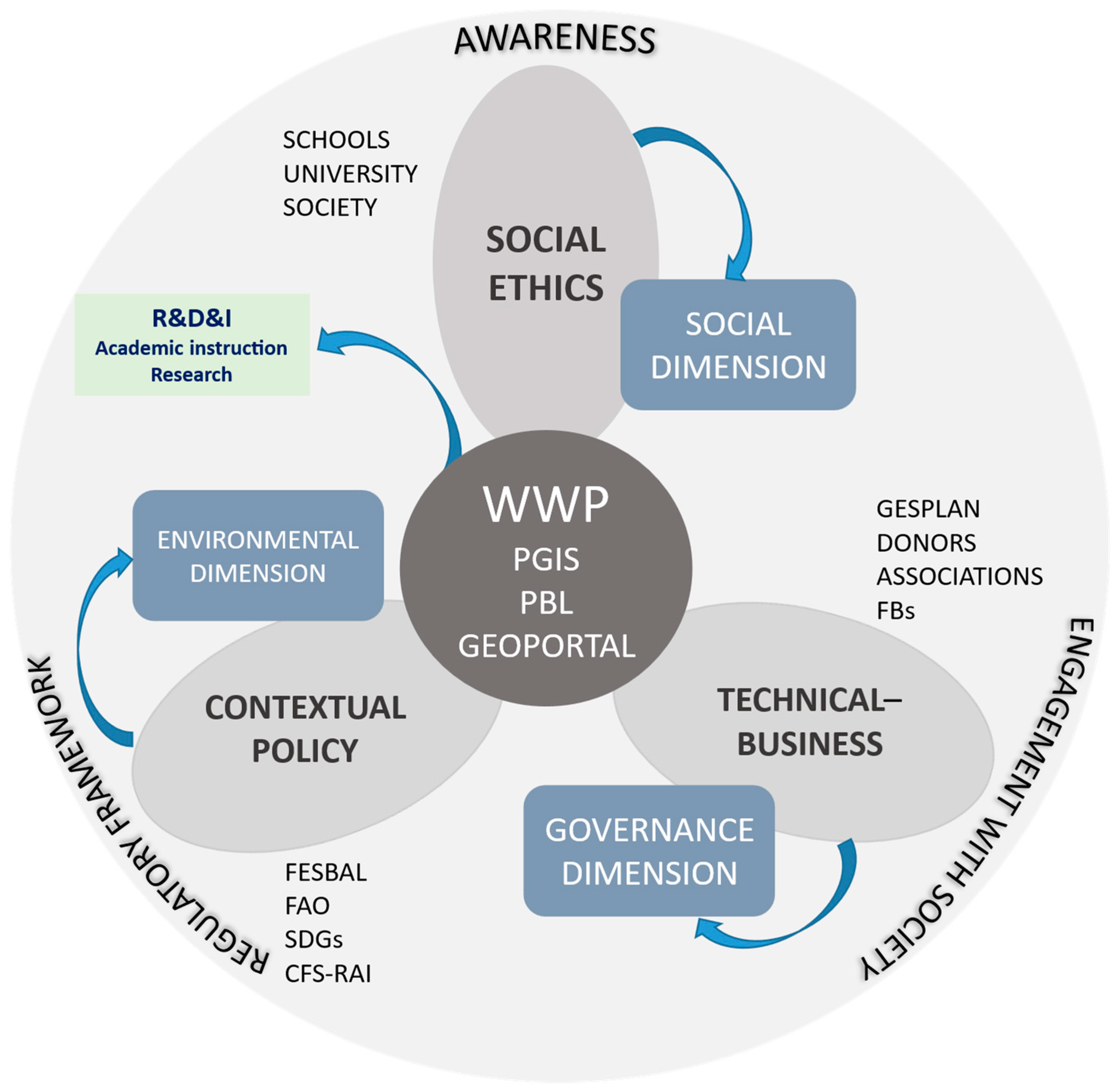
10]. This metamodel is synthesized in three fundamental components, closely aligned with the dimensions of sustainable development [
26], as detailed below and illustrated in
Figure 1:
Ethical–Social: linked to the social dimension, this component emphasizes cooperation, solidarity, and social responsibility, guiding projects toward generating tangible benefits for vulnerable groups.
Technical–Business: related to the environmental dimension, this connects technical knowledge and geo-spatial tools with social reality through collaboration with associations, donor companies, and FBs.
Political–Contextual: coherent with the governance dimension, this integrates the institutional and normative environment (FESBAL, FAO, CFS-RAI, SDGs), ensuring the coherence, viability, and sustainability of the initiatives developed through participatory decision-making processes and clear regulatory frameworks.
The methodological design was structured using qualitative triangulation, which combined three complementary sources of evidence:
Documentary and Technical Analysis: analysis of the materials and products developed for the geoportal to define its structure and verify its coherence with the project objectives.
Participatory Processes: processes conducted with faculty, students, and FESBAL volunteers through workshops and co-design sessions; these allowed for the identification of needs, the interpretation of use experiences, and the observation of how meaningful interactions with the technological tools occurred.
Reflective Analysis: analysis derived from the implementation of PBL applied to the use of PGIS following the WWP model; this examined technological appropriation, spatial reasoning processes, and the integration of the geoportal into real learning and management activities.
The articulation of these three sources made it possible to obtain an integrated and robust vision of the geoportal’s role in improving learning, participation, and collaborative management.
The evaluation of the results regarding improvements in governance, transparency, and sustainability was conducted through a qualitative approach, focusing on the analysis of the geoportal’s design, implementation, and effective use. The assessment criteria included the degree of stakeholder engagement, the structure and accessibility of geospatial information, and its traceability. Furthermore, the alignment of these processes with international frameworks, such as the SDGs and the CFS-RAI principles, was analyzed. This allowed for an evaluation not only of the system’s technical performance (outputs) but also of its impact on coordination dynamics, institutional trust, and shared information management (impacts).
2.2. Methodological Positioning Within the State of the Art
To situate the methodological approach developed in this work within the panorama of similar studies and reinforce its conceptual validity, a comparative analysis was conducted against research that combines participatory, technological, and educational approaches applied to sustainability and food security. The review of the state of the art evidenced that, although relevant studies exist on PGIS for community empowerment, such as those by Orban-Ferauge [
15], or on environmental decision-making described by Jankowski [
19], these lack explicit educational integration. Furthermore, more recent proposals, such as the Web-GIS modules by Luo and Park [
29], while addressing service-learning, do not integrate global governance principles.
Table 2 synthesizes these differences, highlighting the originality of the FESBAL–UPM Geoportal by proposing a solution that not only manages spatial data but also operationalizes ethical (CFS-RAI) and educational (WWP) principles simultaneously.
The comparative analysis performed allows the FESBAL–UPM Geoportal proposal to be situated within the field of participatory and territorial studies, evidencing its added value through the simultaneous integration of educational frameworks (PBL and WWP), CFS-RAI principles, and PGIS tools. This articulation strengthens the study’s methodological coherence and offers a conceptual basis for the interpretation of results in subsequent sections.
2.3. Participatory Implementation and Stakeholder Roles
The social, environmental, and governance dimensions underpinning the WWP model are key to maximizing the impact of the FBC’s actions. The social dimension drives awareness, volunteering, and collaboration to improve food security for vulnerable groups. The governance dimension promotes transparent and participatory management through collaboration between the university, the public sector, private companies, and civil society. The environmental dimension strengthens sustainability by reducing food waste and ensuring the responsible use of resources, in line with the SDGs.
The geoportal’s operationalization was supported by the participation and coordination of the stakeholders linked to the FBC, under the guidance of the WWP model, which fostered horizontality and collective learning. Initially, an interdisciplinary focus group was established with researchers, students, and volunteers to diagnose needs and evaluate technological readiness, which allowed the PGIS objectives to be aligned with the real challenges of food security [
9]. FESBAL played a crucial role by providing operational data and validating the content, facilitating interaction with volunteers, and promoting the systematization of best practices at the national level. Its participation was decisive in consolidating the project’s social capital and collaborative structure.
Once the priority intervention areas were identified, students from the Master’s and Doctoral programs in Rural Development Project Planning and Sustainable Management with GIS training were selected, applying the PBL approach to promote active learning and the resolution of real-world problems. The teams designed technological proposals aimed at managing food surpluses, raising social awareness, and strengthening community commitment [
9]. They contributed to the collection, organization, and analysis of data, the design of thematic maps, dashboards, and story maps, and the documentation of best practices. Their participation strengthened both technical and digital competencies and social skills oriented toward responsible action, which constitutes a fundamental pillar of the WWP model’s technical–business component.
Table 3 details the specific roles and contributions, evidencing how this synergy strengthens human capital (SDG 4) and institutional transparency (CFS-RAI principle 7), ensuring that the technology responds to the expectations and values of the Food Bank network.
The meetings and workshops organized by the FBC allowed for consensus on the geoportal’s priorities, defining its implementation to achieve the following:
Territorially analyze the beneficiaries of food aid.
Map areas with high vulnerability to food insecurity (AROPE indicator).
Monitor the CORAL program (Rational Food Consumption), active since 2014.
Identify best practices implemented by the FBs.
Evaluate and compare the carbon footprint derived from the FBs’ activities with that associated with food waste.
Each of these projects was subsequently linked to its corresponding dimension within the WWP model (social, environmental, and governance), as shown in
Table 4.
2.4. Procedural Operationalization: WWP and Geoportal Lifecycle
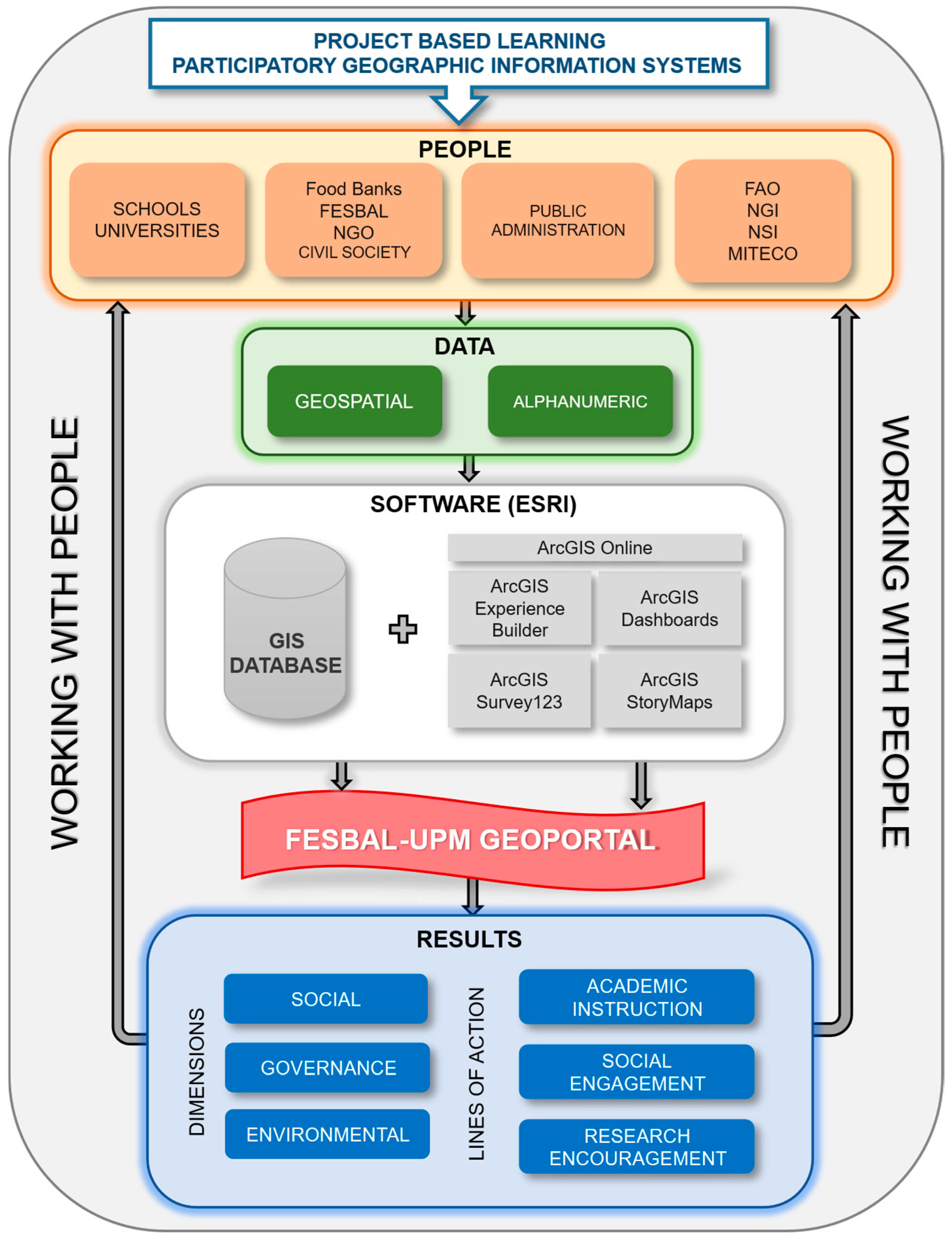
To ensure methodological reproducibility and address the practical implementation of the WWP model, the process was structured in four operational phases that follow the flow illustrated in
Figure 2. This structure ensures that the technical development of the geoportal is deeply rooted in social learning and institutional governance:
Phase 1: Multisectoral Stakeholder Engagement (Ethical–Social Dimension): Following the creation of a multisectoral group (FBs, FESBAL, academia, and Non-Governmental Organizations (NGOs)), this phase operationalized the Ethical–Social dimension. It focused on co-diagnosis workshops to align the geoportal’s objectives with the real needs and social values of the food aid network.
Phase 2: Database Structuring and PBL (Technical–Business Dimension): In this stage, spatial and alphanumeric information was organized within a GIS environment. Students, applying the PBL approach, acted as technical links to ensure the database structure responded to the community’s operational requirements.
Phase 3: Technological Implementation (Technical–Business Dimension): Using Esri technology, raw data were transformed into accessible geospatial resources (maps, dashboards). This phase represents the technical–business dimension, where social learning occurs through the iterative validation of the tools by the stakeholders.
Phase 4: Synthesis of Results and Governance (Political–Contextual Dimension): Finally, the results were organized into three strategic dimensions: social, environmental, and governance. This stage ensures that the geoportal’s outputs are coherent with the institutional framework (CFS-RAI and SDGs), providing a tool for transparent decision-making.
To further clarify the procedural dynamics,
Table 5 provides a synthetic matrix of the roles and responsibilities of each stakeholder throughout the geoportal’s lifecycle. This matrix operationalizes the interaction between the PBL activities, where postgraduate students lead the technical development and broader WWP dimensions.
2.5. Technical Implementation of the Geoportal
2.5.1. Geoportal Concept and Its Application at FBC FESBAL–UPM
While the general definition of a geoportal as a single point of access to spatial data [
12] was introduced earlier, its conceptual and functional complexity warrants further detail in the context of this research. Maguire and Longley [
30] describe it as a gateway on the World Wide Web that organizes content and services such as directories, search tools, community information, support resources, data, and applications. For Tait [
31], it is simply a website where geographical content can be discovered. Based on these criteria, the FBC implemented the FESBAL–UPM Geoportal as a dissemination and awareness tool with the objective of raising consciousness and promoting rational food consumption through training, knowledge transfer, and the fostering of Research, Development, and Innovation (R&D&I).
Figure 2 synthesizes the geoportal implementation flow, which begins with the creation of a multisectoral group of stakeholders made up of the FBs, FESBAL, academic institutions, NGOs, public administrations, and civil society. The system’s database, structured within a GIS environment, is fed by spatial and alphanumeric information. Using Esri technology, these data are transformed into geospatial resources accessible through the geoportal. Finally, the results are organized in three strategic dimensions: social, environmental, and governance, which reinforce the main action lines of the FBC: teaching, social engagement, and research promotion.
2.5.2. Construction and Validation of the Spatial Database
The data collection procedure was rigorously designed to ensure the traceability, reproducibility, and quality of the spatial and alphanumeric information, thus ensuring its coherence with the project objectives. The study area encompasses the entire national territory, integrating the 54 FBs that are part of FESBAL. This constitutes the complete universe of study, not a statistical sample, thereby reinforcing the territorial representativeness of the results. To ensure the reliability of this heterogeneous information, an iterative validation scheme was applied according to the WWP model: the instruments were preliminarily reviewed by the research team and subsequently subjected to cross validation in working sessions with volunteers. Inconsistencies detected were resolved proactively through direct communication with the personnel of each FB, guaranteeing the completeness of the database before its integration. It is important to note that no conflicts of interest existed, as all data were supplied voluntarily under the existing institutional collaboration framework, ensuring the protection of sensitive information.
Operational information primarily originated from the FBs, from whom structural, volunteer, and beneficiary entity data were collected via census surveys. Of particular note is the collection of empirical primary data for the calculation of the carbon footprint using a standardized instrument based on the GHG Protocol [
32]. This procedure allowed for the rigorous quantification of emissions in three categories: Scope 1 (direct emissions from fuel and refrigerant consumption), Scope 2 (indirect emissions from electricity consumption), and Scope 3 (other indirect emissions, including donor mobility and waste management), which represents a significant innovation in the sector’s environmental management. All this operational information was geocoded and linked to the provincial administrative boundaries layer of the NGI (National Geographic Institute) [
33] for cartographic representation.
To provide the territorial and socio-economic context for the FBs’ activity, official external indicators and data from complementary programs were integrated. From the NSI (National Statistics Institute), the annual population census [
34] and the AROPE index (At Risk of Poverty and/or Social Exclusion) [
35] were incorporated; these are essential indicators for spatially correlating the supply of food aid with social demand and territorial vulnerability. Additionally, within the framework of the CORAL awareness program, participating educational centers in the annual drawing contest were geolocated by postal address, allowing for the visualization of the penetration of awareness campaigns.
Table 6 summarizes the data sources, typology, and technical description, evidencing the diversity of sources integrated into the system.
2.5.3. Technical Architecture and Tools
Once the projects to be included in the database were selected, a series of software applications were used to configure the geoportal’s user interface, defining the mode of access, visualization, and analysis of the geospatial information.
The FESBAL–UPM Geoportal was conceived as a dissemination and awareness tool, aligned with definitions of a geoportal as a unified access point to distributed geospatial resources [
12,
30,
33]. The implementation flow, synthesized in
Figure 2, starts with the integration of the multisectoral database described above and culminates in the visualization of results organized across the strategic dimensions (social, environmental, and governance).
The technological development was based on the Esri application suite, whose selection is justified by its capacity to guarantee the solidity, interoperability, and technical quality required for a national-scale project. The specific tools were integrated in a complementary manner to cover the entire data lifecycle:
ArcGIS Online (available online:
https://www.arcgis.com/ (accessed on 25 November 2025)): This served as the cloud-based infrastructure, allowing spatial information to be created, analyzed, and shared. Its architecture ensures that all members of the working group have simultaneous collaborative access for viewing, editing, and generating new data.
ArcGIS Survey 123 (available online:
https://survey123.arcgis.com/ (accessed on 16 November 2025)): This was implemented for the data collection phase, allowing for the generation of smart forms for the surveys. Its main contribution was the automatic recording of the geographical location of the information source, minimizing manual geocoding errors.
ArcGIS Dashboard (available online:
https://www.esri.com/en-us/arcgis/products/arcgis-dashboards/overview (accessed on 16 November 2025)): This is a key tool for business intelligence, used to create interactive control panels. These dashboards allow for the monitoring, analysis, and communication of critical information in real-time, facilitating informed decision-making based on spatial evidence.
ArcGIS StoryMaps (available online:
https://storymaps.arcgis.com/ (accessed on 25 November 2025)): These were used as a narrative tool to combine heterogeneous content (maps, 3D scenes, multimedia, and text). Their use was fundamental for “telling the story” behind the data, making complex information (like the carbon footprint) comprehensible to a non-specialized audience.
The use of technology developed by an entity with the trajectory of Esri, especially its specialization towards the SDGs [
31], ensures the technological sustainability of the project. Compliance with internationally recognized geospatial standards (such as those defined by the OGC) guarantees that the generated products present the levels of reliability, interoperability, and consistency necessary to achieve the stated objectives and allow for future scalability.
3. Results
3.1. Visualization, Dissemination, and Territorial Analysis
The geoportal’s results are structured across the three strategic dimensions of sustainable development, demonstrating its capacity to transform operational data into territorial knowledge.
3.1.1. Social Dimension
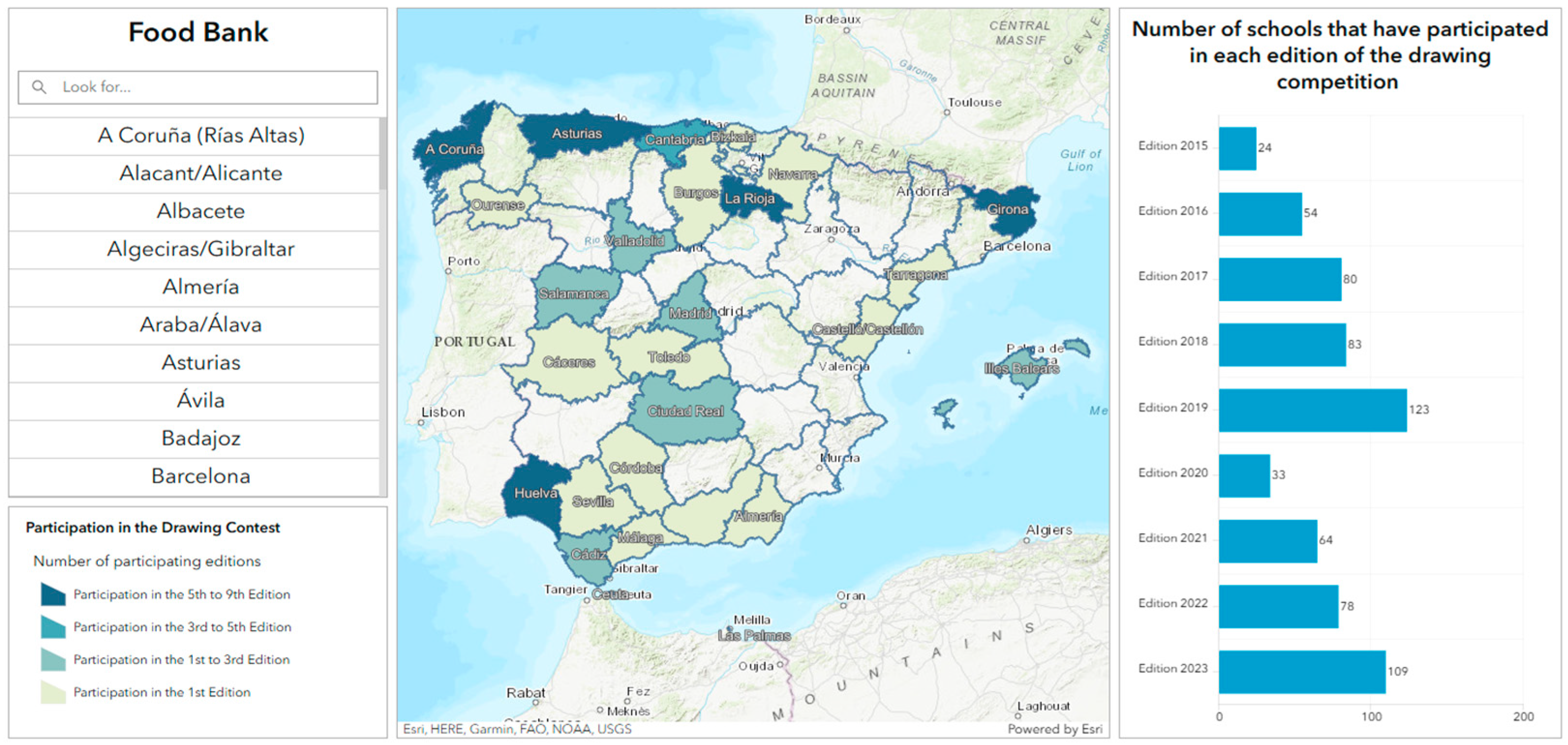
In this dimension, the tool has proven effective for awareness-raising and vulnerability identification.
Figure 3 illustrates the integration of the CORAL Program results, where the participation of educational centers in the fight against food waste and hunger. is georeferenced. This visualization allows not only for the recognition of school commitment but also for the analysis of the contest’s temporal evolution, identifying participation patterns that serve to guide future promotional campaigns [
36] and strengthening the institutional image of participating centers through their public testimony of social commitment [
37].
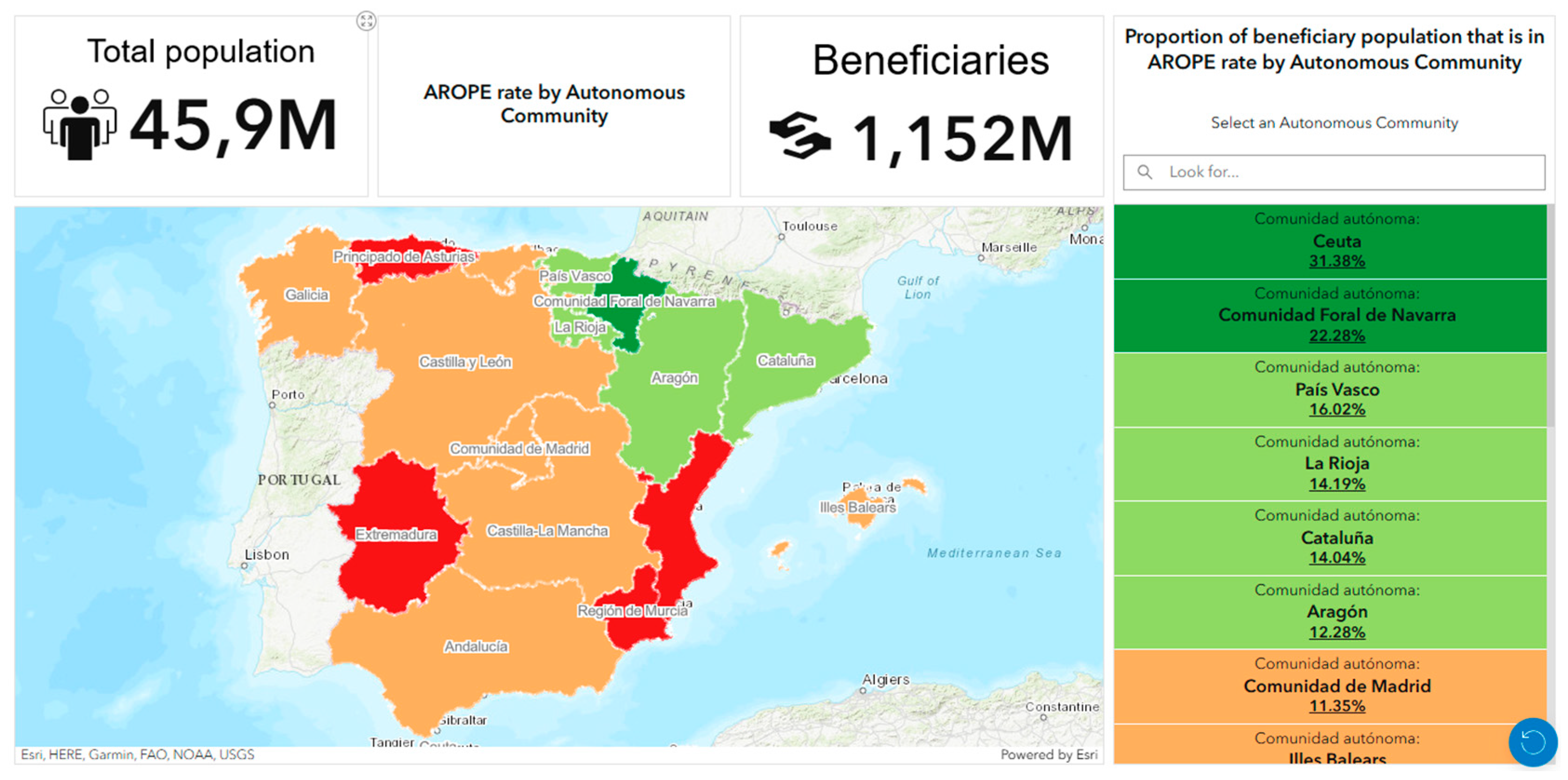
Furthermore,
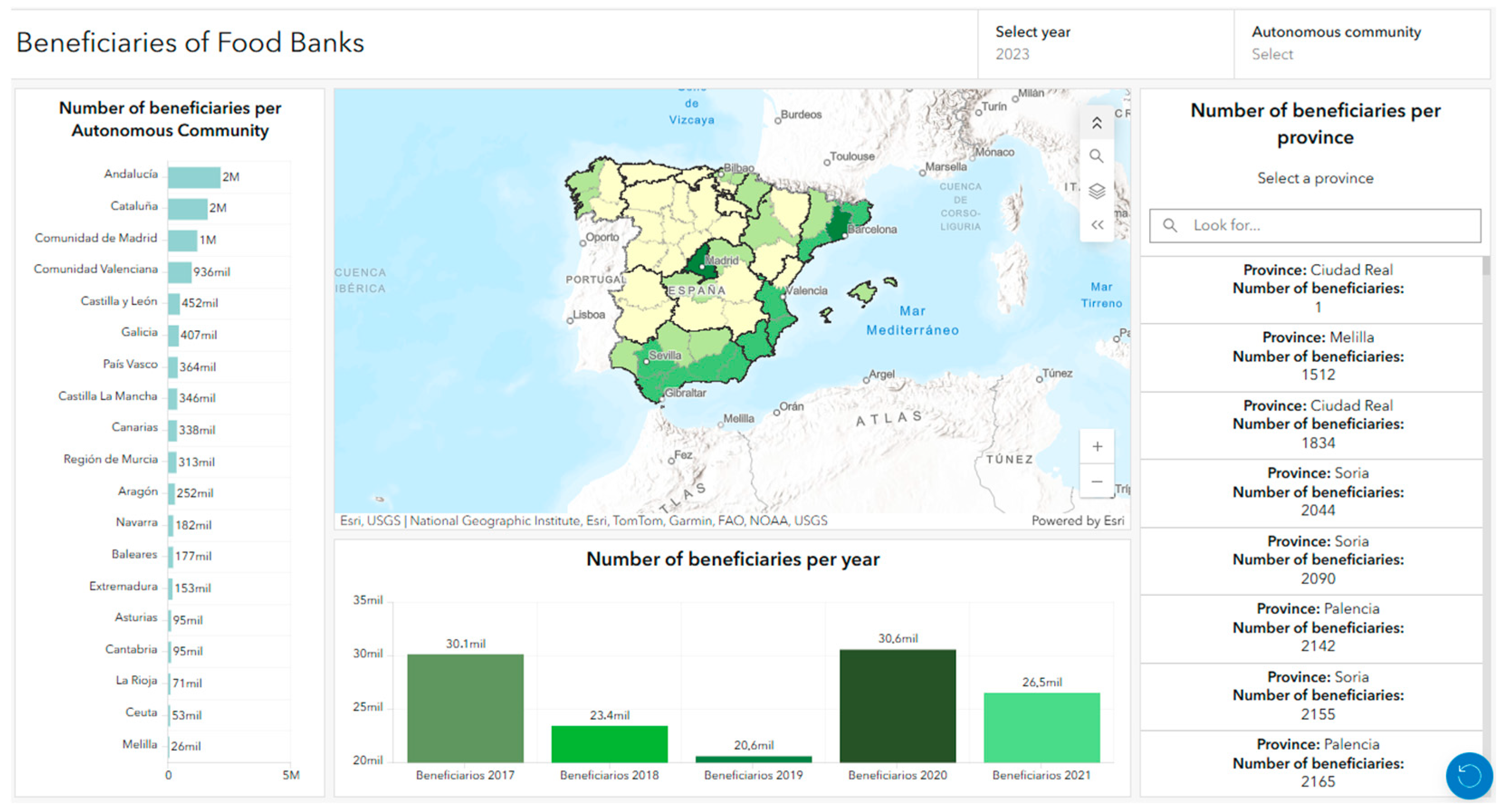
Figure 4 presents the spatial overlay between the distribution of FB aid and the AROPE Indicator. This territorial analysis allows for the correlation of solidarity actions with areas of higher risk of social exclusion, transforming abstract statistics into visual evidence of the humanitarian impact in the most needed areas [
35].
Complementarily,
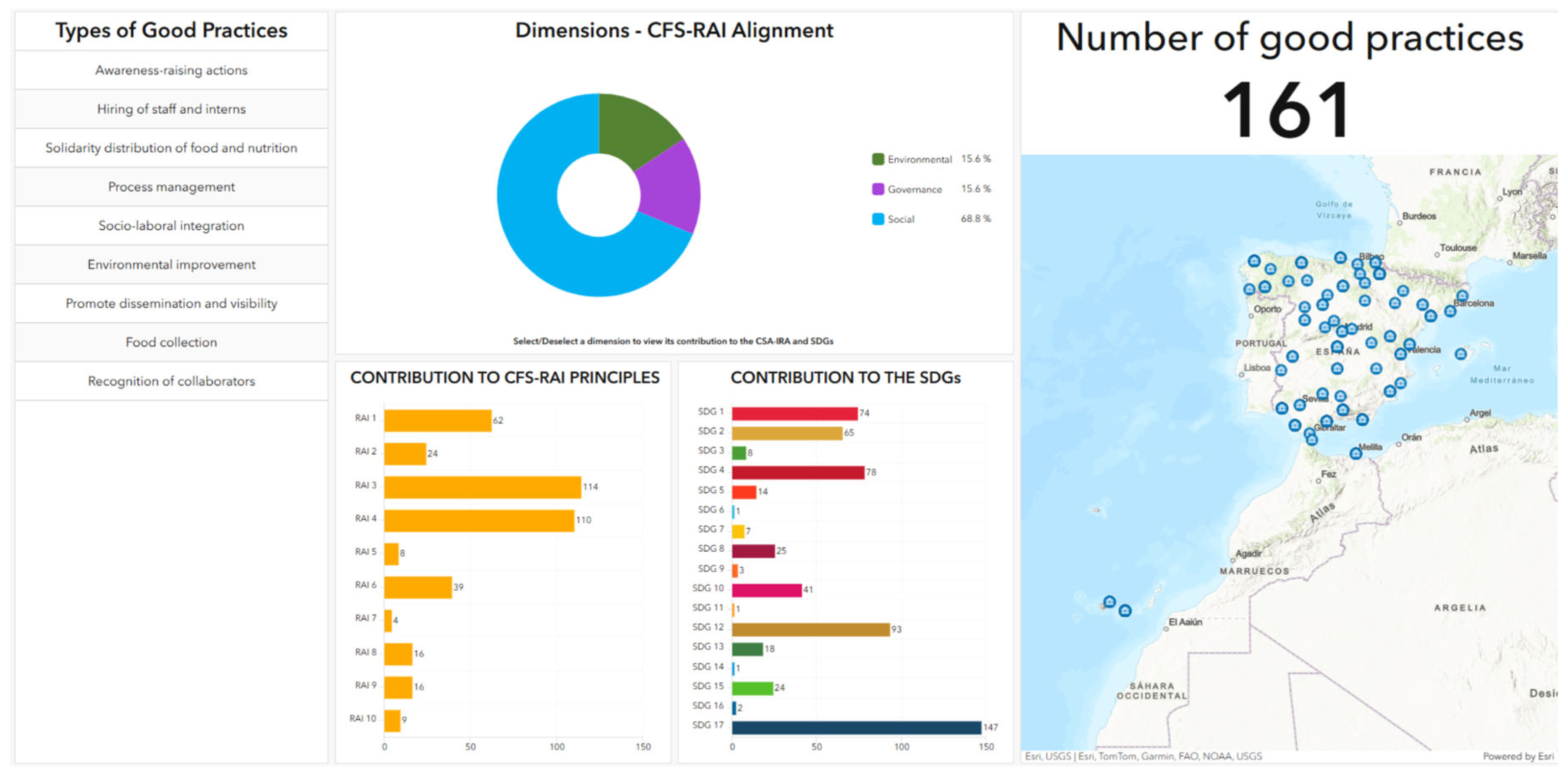
Figure 5 details the localization of the 24 identified Social Best Practices [
37], functioning as a reference catalog for the replicability of successful initiatives.
3.1.2. Environmental Dimension
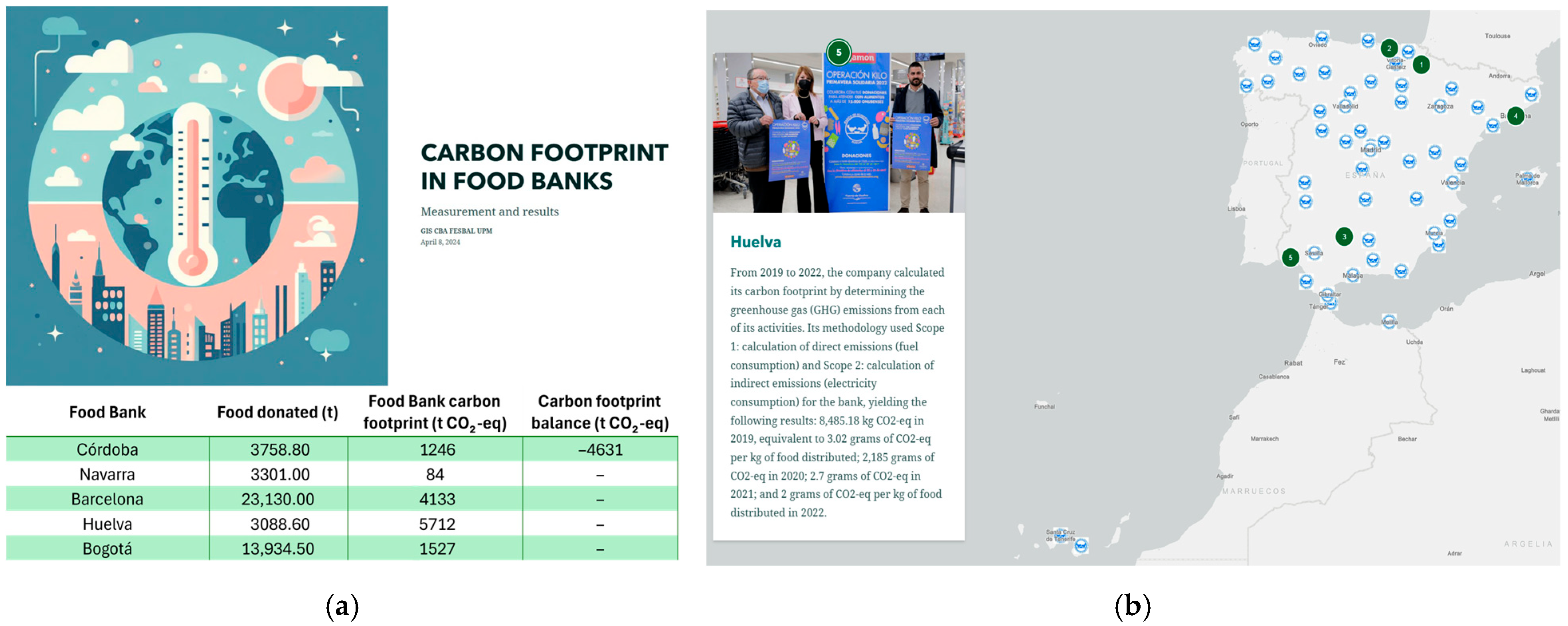
In the environmental dimension, the geoportal acts as a pioneer observatory for sustainability management through the “Carbon Footprint (CF) Reduction” project [
38,
39]. The environmental dimension measures the FBs’ effect on the environment, as they play a relevant role in reducing the greenhouse gases (GHG) emitted into the atmosphere by taking advantage of goods and resources that would primarily be wasted. This Indicator exposes the amount of emissions released into the atmosphere as a result of any activity and, based on this knowledge, allows for the establishment of effective reduction measures [
40]. With this focus, the geoportal is perceived as an observatory of the FBs’ CF, both in terms of knowledge generation and dissemination. Furthermore, the spatial analysis tools inherent to GIS and incorporated into the geoportal allow for the quantification of the scope of food transport by collaborating and charitable entities in the CF calculation using GIS network analysis tools [
39].
The results obtained regarding the CF should not be interpreted as direct evidence of emission reductions; instead, they represent the establishment of a homogeneous and verifiable environmental baseline for the entire network FBs. The geoportal serves as a monitoring infrastructure that enables the systematic collection, validation, and representation of emissions associated with FB activities, creating the technical conditions necessary for future longitudinal comparative analysis.
It is also important to highlight that the geoportal includes nine Environmental Best Practices [
41] linked to 15 FBs, offering a model for other FBs to replicate these initiatives and contribute to natural environment protection. This opportunity for replication in the fight against climate change allows FBs to receive support and participate in public calls, acknowledging their commitment to environmental responsibility in line with CFS-RAI principles 5 and 6. Within the educational environment, this initiative is framed as an innovative and transferable concept aimed at raising awareness among future generations [
4,
5,
6]. Finally, the StoryMaps application has been used to display the project’s evolution through maps and narratives (
Figure 6).
3.1.3. Governance Dimension
The geoportal transcends its technical function to be validated as a replicable model of territorial innovation that operationalizes the SDG. The governance dimension is linked to the management of the FBs as entities that operate with transparency and independence, promoting efficiency and strengthening trust in their work. This contributes to generating a more positive image of the FBs in society and fostering a better perception of their labor.
This dimension is aligned with CFS-RAI principle 7 (respect heritage rights and provide for transparency), as the geoportal acts as a mechanism for public disclosure and legal–administrative clarity regarding food aid distribution. Furthermore, it integrates principles 9 (innovation) and 10 (cooperation) by enhancing the organization’s capacity to adapt to changes and innovate in its processes, such as incorporating new technologies and promoting food culture [
41]. It also considers the FBs’ ability to effectively involve the different stakeholders in the food chain, such as producers, distributors, retailers, and consumers. These processes of collaborative governance contribute to better coordination of activities and the definition of joint policies and strategies [
9,
42,
43].
The geoportal, therefore, becomes a tool that facilitates the linkage and participation of these interest groups in the FBs’ governance and represents an opportunity for all in-volved stakeholders to work collaboratively toward a more inclusive and sustainable food security. The linking of FESBAL’s annual reports with the geolocation of the FBs, donors, and beneficiary entities allows for the monitoring of distributed food quantities over time, effectively operationalizing the transparency and accountability requirements of principle 7, while promoting the dissemination of the banks’ actions.
The geoportal incorporates the four Governance Best Practices [
41], which are linked to awareness campaigns and dissemination actions on social networks. These contribute to bringing the reality of the FBs and their volunteers closer to society, acting with complete transparency and solidarity.
Figure 7 shows how the geoportal facilitates the visibility of the FBs’ transparent and solidarity-based management through the implementation of the Governance Best Practices and the number of beneficiaries of the aid.
3.2. Strengthening Teaching, Societal Engagement, and Research
The FBC’s mission is to reinforce actions aimed at combating hunger, poverty, and food waste through awareness and sensitization projects developed by GESPLAN in collaboration with FESBAL. Its initiatives are articulated around three fundamental axes: teaching, societal engagement, and the promotion of research. In this framework, the FESBAL–UPM Geoportal is consolidated as a strategic tool that supports territorial planning and management, integrating academic knowledge with social action to generate real and sustainable impact.
3.2.1. Teaching and Educational Transfer
The geoportal compiles the final Master’s degree projects developed from the PBL educational innovation strategy [
44], the volunteer actions of university students, and the workshops conducted in schools, thereby reinforcing training and educational cooperation from school to university. This allows for the connection of different educational levels and learning modalities, generating a holistic vision of the FBC’s work.
Furthermore, the geoportal incorporates into its database the reports and conclusions derived from conferences, seminars, and roundtables involving professionals and volunteers linked to the FBs. This documentary integration makes it possible to identify and analyze the relationship between the FBC’s work and competencies such as leadership, sustainability, social responsibility, and community cohesion [
6,
45].
Collectively, these functionalities transform the geoportal into an educational innovation transfer tool, while simultaneously acting as a shared knowledge repository that facilitates the systematization of practices and the strengthening of educational cooperation among stakeholders.
3.2.2. Societal Engagement
Societal engagement materializes through the dissemination and transfer of knowledge from the university to the citizenry. In this sense, the geoportal has been designed as a collaborative tool to provide visibility to the FBC’s activities, facilitating content organization, information retrieval, community participation, and data access [
30]. When designing the geoportal interface using interactive panels and dashboards, care was taken to ensure that the system is accessible to all users, including those with limited technical knowledge, thereby promoting equitable and transparent participation [
29] and greater inclusion in food security-related decision-making processes. By extending access to data and tools, transparency and collaboration among all involved stakeholders are reinforced.
The FESBAL–UPM Geoportal increases the visibility of food security initiatives, attracting the interest of society, public and private entities, as well as potential collaborators who wish to participate in the FBs’ activities. The operability offered by the geoportal facilitates the understanding of projects both over time and across space, showing their impact in different geographical locations. The platform encourages citizen participation by motivating their collaboration and serving as a gateway for new partners, not only from the university sphere but also NGOs, private companies, public administrations, and committed citizens.
Throughout the years of the geoportal’s development, various dissemination activities have been carried out to highlight its utility and operation, such as: “The FESBAL-UPM Food Bank Chair uses smart maps to fight against waste,” “Geospatial technology against food waste,” and “The FBC FESBAL-UPM uses smart maps in the Great Food Collection to fight against waste” [
44,
45,
46].
Table 7 illustrates this evolution by selecting four key temporal milestones: the beginning (2014), model consolidation (2018), the pandemic period (2021), and the present (2024). The data evidence an exponential growth in annual participation, rising from barely 19 entities in the first year to 1454 in the last year, especially highlighting the mobilization of civil society. Analyzing the complete period, the geoportal has managed to integrate an accumulated historical volume of 4988 collaborating entities. This massive increase empirically validates the tool’s capacity to mobilize social capital, transform transparency into trust, and strengthen SDG 17 (Partnerships for the Goals), consolidating a robust multisectoral network around food security.
3.2.3. Promotion of Research
The geoportal’s contribution to promoting R&D&I is reflected in the research projects and doctoral theses currently underway. These objectives are directly related to the analytical capacity of GIS, such as the identification of spatial patterns and trends of specific socio-economic indicators, the measurement of the FBs’ carbon footprint (incorporating the digitalization of food and volunteer transport networks), or the territorial study of aid to individuals at risk of social exclusion. Effectively, the geoportal’s ability to display information that might have otherwise gone unnoticed without map visualization, alongside the incorporation of socio-temporal variables, has allowed for a more complete and detailed vision of reality, especially in the context of food security [
45].
The FESBAL–UPM Geoportal not only facilitates the visibility, analysis, and dissemination of the FBC’s projects but also plays a crucial role in strengthening ties between the university and society, supporting education, research, innovation, and citizen collaboration [
4].
Table 8 illustrates the implemented projects in the geoportal, differentiated by the FBC’s action line to which they are linked.
3.3. Model Validation and Contribution to the SDGs
The geoportal, as a result of the PGIS approach, not only facilitates access to the results of projects in research, training, and societal engagement but also becomes an innovative tool that drives the fulfillment of several SDGs. Although it originated aligned with SDG 2 (Zero Hunger) and SDG 12 (Responsible Consumption) by supporting food security projects and responsible consumption awareness, its scope extends to other SDGs. It strengthens SDG 4 (Quality Education) by providing practical project-based learning, developing students’ digital, analytical, and critical skills, especially in the use of geospatial technologies, and fostering applied research and knowledge transfer. Similarly, it contributes to SDG 11 (Sustainable Cities and Communities) by facilitating more informed territorial decision-making through the integration of data on phenomena occurring within the territory, promoting participatory and transparent planning. Finally, it drives SDG 17 (Partnerships for the Goals) by strengthening collaboration among universities, governments, and civil society.
4. Discussion
The results confirm that this study proposes and validates a methodological framework based on the WWP metamodel. By integrating PGIS for the monitoring and evaluation of projects implemented through the PBL strategy, this model focuses on responsible consumption and food security. It is guided by the CFS-RAI principles as a normative and value-based reference, showing clear potential for transferability to other sustainable development contexts. This approach combines methodological innovation, participatory technology, and ethical criteria in project management. Ultimately, the study advances holistic governance, aligning with the SDGs and overcoming fragmented applications of geospatial technology.
From the perspective of the CFS-RAI principles, the FESBAL–UPM Geoportal improves food security and nutrition by generating territorialized evidence. This evidence guides food distribution and fosters transparent participatory governance by integrating multiple stakeholders in data analysis. Moreover, it strengthens human capital by serving as a pedagogical instrument for technical capacity building. It also contributes to environmental and socioeconomic sustainability (principles 4 and 7) by enabling effective balanced planning with reduced environmental impact. Beyond a technical tool, the geoportal is an academic infrastructure for transformative action, strengthening the link between knowledge, participation, and sustainability.
In contrast to traditional static approaches, the geoportal transforms data management into a dynamic collaborative process. The centralization and standardization of operational data for the complete universe of 54 FBs within an interoperable environment is a significant contribution. Unlike previous studies focusing on partial samples, this model enables operational coherence and an emergency response capacity unprecedented in the sector. By providing a unified territorial vision, it ensures that decision-making is based on real-time evidence rather than fragmented reports, facilitating a rapid and coordinated institutional response.
Regarding environmental sustainability, the systematization of CF calculation represents a significant methodological advance. While current literature demands immediate quantitative indicators to evaluate climate impact, this study demonstrates that—particularly within the third-sector context, characterized by high operational heterogeneity and scarce standardized historical data—the construction of an environmental baseline constitutes a necessary scientific contribution. In this sense, the geoportal acts as an enabling infrastructure for environmental monitoring by establishing a standardized methodology based on the GHG protocol and a system for homogeneous data collection and validation across the entire FB network.
This framework lays the technical foundation required for the future development of rigorous longitudinal quantitative analyses. The value of the geoportal resides in its capacity to establish a reliable baseline, without which it would be impossible to accurately measure future emission reductions [
38,
39,
40]. By prioritizing the creation of this monitoring infrastructure, the model addresses the specific challenges of non-profit organizations, ensuring that future environmental interventions are supported by a solid and traceable data structure. This methodological reflection justifies the study’s focus on baseline construction as a prerequisite for any meaningful climate impact assessment within the sector.
However, the current lack of consolidated longitudinal metrics to evaluate CF reduction is a relevant limitation. While the system is operational, its recent implementation precludes temporal trend analysis at this stage. Nevertheless, this work establishes the methodological foundations for future evaluation by defining a replicable baseline for all 54 FBs. This will eventually allow for the assessment of the medium- and long-term impact of environmental interventions through periodic data updates. By acknowledging this limitation, the study provides a structured plan for future research, aligning methodological innovation with actual environmental performance monitoring over time.
From a governance perspective, the study addresses consistency and quality challenges in data generated by non-specialized volunteers. The risk of heterogeneity was effectively mitigated through the WWP collaborative model. The results demonstrate that GIS technology alone is insufficient without cross-validation protocols and social appropriation of information. The FESBAL–UPM Geoportal sets a PGIS standard by linking validation procedures directly to trust-building and institutional transparency (CFS-RAI principle 7; SDGs 16/17). Unlike other citizen science initiatives, this model ensures that reliability stems from social consensus and technical rigor, emphasizing human capital as the core of the system.
Regarding transferability, the study validates the geoportal as a replicable model provided a university–society alliance exists to sustain the pedagogical dimension. Unlike projects focused on isolated technical aspects, this proposal integrates human capital as a structural component, ensuring innovation is social and educational as well as technological. However, challenges such as the digital divide and varying competencies among volunteers must be addressed. Strengthening continuous training and exploring hybrid architectures are necessary for long-term resilience. While developed with Esri tools, the model is adaptable to open-source solutions like QGIS Cloud, enhancing its viability in resource-limited contexts.
Beyond immediate operational outputs, potential impacts transcend the system’s initial effects. In governance, a shared environment of validated information strengthens coordination and accountability across the network. Regarding transparency, a single traceable source reduces information asymmetries, fostering a culture of data-driven management. Integrating social, environmental, and governance dimensions allows the geoportal to monitor progress toward the 2030 Agenda, particularly SDG 12. This approach reinforces strategic coherence in the third sector and its international replicability regardless of territorial scales or technological availability, facilitating complex systems analysis through transdisciplinary knowledge.
5. Conclusions
The implementation of the FESBAL–UPM Geoportal demonstrates the value of integrating geospatial tools with participatory approaches to strengthen social initiatives. By articulating the PGIS strategy with the WWP metamodel, PBL, and CFS-RAI principles, this research transformed dispersed and heterogeneous data from 54 Food Banks (FBs) into a unified territorial strategy. This process certified the model’s pedagogical capacity, where the PBL methodology acted as a driver of practical innovation, developing essential geospatial and social management skills in students and volunteers, thereby strengthening the organization’s human capital.
From an academic perspective, this study expands the PGIS literature by demonstrating its potential as an integrative infrastructure for learning and social action. The integration of methodological frameworks with a global normative ethical framework (CFS-RAI) provides a holistic approach that addresses the limitations of previous research, which often focused on isolated technological or participatory dimensions. This multidimensional model serves as a validated transferable framework for sustainable project management, effectively moving beyond a traditional purely technical application of GIS.
The geoportal has become a structural pillar for FESBAL’s accountability and transparency strategy. By operationalizing CFS-RAI principle 7, the system facilitates public disclosure and legal-administrative clarity regarding food aid distribution. This multidisciplinary approach not only promotes participatory governance but also contributes to raising public awareness of poverty and food waste. Through accessible cartographic resources, the project has successfully institutionalized transparency, allowing for the replication of territorial initiatives and expanding the social impact of the national FB network.
Furthermore, the structured architecture (PGIS–PBL–WWP) provides a robust academic infrastructure capable of aggregating information at a national level without losing the link to local realities. The systematization of indicators, such as the carbon footprint (CF), establishes a replicable framework for sustainable monitoring and longitudinal evaluation. As a policy-relevant tool, this research bridges the gap between digital innovation and social accountability, offering a roadmap for policymakers to optimize resource allocation and align institutional governance with the global sustainability agenda and the SDGs.
Finally, the study acknowledges that long-term viability transcends technology, requiring permanent stakeholder collaboration to ensure data validation and effective use. Future research lines are oriented toward developing predictive demand models and logistics optimization through Artificial Intelligence (AI). Additionally, exploring hybrid data architectures will be crucial to reinforcing system resilience against the digital divide. Ultimately, this model positions geospatial technology as an essential driver of social inclusion, ensuring that digital transformation remains an ethical engine for sustainable development and a structural pillar for evidence-based public policy.
Author Contributions
M.R.-B., I.J.F.E., C.V.-L. and C.M.-F.; methodology, M.R.-B., I.J.F.E., C.V.-L. and C.M.-F.; validation, M.R.-B., I.J.F.E., C.V.-L. and C.M.-F.; formal analysis, M.R.-B., I.J.F.E., C.V.-L. and C.M.-F.; investigation, M.R.-B. and I.J.F.E.; resources, M.R.-B. and I.J.F.E.; data curation, M.R.-B., I.J.F.E., C.V.-L. and C.M.-F.; writing—original draft preparation, M.R.-B. and I.J.F.E.; writing—review and editing, C.V.-L. and C.M.-F.; visualization, M.R.-B., I.J.F.E., C.V.-L. and C.M.-F.; supervision, C.V.-L. and C.M.-F.; project administration, I.J.F.E. and C.V.-L.; funding acquisition, I.J.F.E. All authors have read and agreed to the published version of the manuscript.
Funding
This research received no external funding.
Institutional Review Board Statement
Ethical review and approval were waived for this study because it did not involve human participants or animals, and no personal data were collected. The Ethics Committee of the Polytechnic University of Madrid and the GESPLAN Research Group reviewed the documentation for this study and concluded that as no personal information from participants was used, the project did not require institutional ethical approval or review. Therefore, a formal waiver was granted.
Informed Consent Statement
Informed consent was obtained from all subjects involved in the study.
Data Availability Statement
Acknowledgments
The authors would like to thank the Universidad Politécnica de Madrid (UPM) for providing access to the ArcGIS Online platform used in this study. We also express our gratitude to the volunteers and staff of the 54 Spanish Food Banks for their active participation, as well as to the managers of FESBAL for their collaboration and outstanding social work in support of the most disadvantaged populations.
Conflicts of Interest
The authors declare no conflicts of interest.
References
- Committee on World Food Security (CFS). Principles for Responsible Investment in Agriculture and Food Systems; Food and Agriculture Organization (FAO): Rome, Italy, 2014; Available online: http://www.fao.org/3/a-au866s.pdf (accessed on 30 December 2025).
- United Nations. Transforming Our World: The 2030 Agenda for Sustainable Development; United Nations: New York, NY, USA, 2015; Available online: https://sustainabledevelopment.un.org/content/documents/21252030%20Agenda%20for%20Sustainable%20Development%20web.pdf (accessed on 30 December 2025).
- FAO. Food Wastage Footprint. Impacts on Natural Resources; Natural Resources Management and Environment Department: Rome, Italy, 2013; Available online: https://www.fao.org/3/i3347e/i3347e.pdf (accessed on 30 December 2025).
- De los Ríos-Carmenado, I.; Afonso-Gallegos, A.; Quintanero-Lahoz, S.; Ortega-Rincón, R.; Nole-Correa, P.; Zuluaga, L.C.; Roncancio-Burgos, M. FESBAL-UPM Food Bank Chair and the Service-Learning Projects from the ‘Working with People’ Perspective. In Proceedings of the International Conference on Economic Scientific Research—Theoretical, Empirical and Practical Approaches, Bucharest, Romania, 9–10 December 2021; Springer International Publishing: Cham, Switzerland, 2021; pp. 79–90. [Google Scholar] [CrossRef] [Scilit]
- Nole Correa, P.L. Proyectos de Aprendizaje Servicio Desde el Modelo Working with People: Aplicación al Consumo Responsable Desde la Cátedra Bancos de Alimentos. Doctoral Thesis, Universidad Politécnica de Madrid (UPM), Madrid, España, 2025. [Google Scholar] [CrossRef] [Scilit]
- Nole Correa, P.; Farias Estrada, I.J.; Aliaga, G.; Zuluaga, C. Service Learning Projects and CFS-IRA Principles: Application to the Food Bank Chair from the Working with People Model. Sustainability 2025, 17, 10212. [Google Scholar] [CrossRef] [Scilit]
- Cazorla, A.; De los Ríos, I.; Salvo, M. Working with People (WWP) in Rural Development Projects: A Proposal from Social Learning. Cuad. Desarro. Rural. 2013, 10, 131–157. [Google Scholar]
- Longley, P.A.; Goodchild, M.F.; Maguire, D.J.; Rhind, D.W. Geographic Information Science and Systems, 4th ed.; John Wiley & Sons: Hoboken, NJ, USA, 2015. [Google Scholar]
- Hammelman, C.; Levkoe, C.; Agyeman, J.; Kharod, S.; Moragues Faus, A.; Munoz, E.; Oliva, J.; Wilson, A. Integrated Food Systems Governance: Scaling Equitable and Transformative Food Initiatives through Scholar-Activist Engagement. J. Agric. Food Syst. Community Dev. 2020, 9, 71–86. [Google Scholar] [CrossRef] [Scilit]
- McCall, M.K.; Dunn, C.E. Geo-Information Tools for Participatory Spatial Planning: Fulfilling the Criteria for ‘Good’ Governance? Geoforum 2012, 43, 81–94. [Google Scholar] [CrossRef] [Scilit]
- Nyerges, T. Understanding the Scope of GIS: Its Relationship to Environmental Modeling. In Environmental Modeling with Geographic Information Systems; Goodchild, M., Steyaert, L., Parks, B., Eds.; Oxford University Press: London, UK, 1993; pp. 75–93. [Google Scholar]
- Esri. What Is a Geoportal? Esri Support. Available online: https://enterprise.arcgis.com/en/inspire/10.8/get-started/introduction-to-geoportals.htm (accessed on 20 November 2024).
- Sastre-Merino, S.; Dorado-Martín, G.; De los Ríos-Carmenado, I. Los Sistemas de Información Geográfica Participativos como Herramientas para el Desarrollo Rural Sostenible: Análisis Conceptual y Revisión de Experiencias. In Actas del XIV Congreso Internacional de Ingeniería de Proyectos; AEIPRO: Madrid, España, 2010; Available online: https://oa.upm.es/39271/1/INVE_MEM_2010_216170.pdf (accessed on 30 December 2025).
- United Nations Committee of Experts on Global Geospatial Information Management (UN-GGIM). The SDGs Geospatial Roadmap; United Nations: New York, NY, USA, 2022; Available online: https://ggim.un.org/meetings/GGIM-committee/11th-Session/documents/The_Geospatial_SDGs_Roadmap_WGGI_IAEG_SDGs_20210804.pdf (accessed on 5 January 2026).
- Orban-Ferauge, F. Participatory Geographic Information Systems and Land Planning: Life Experiences for People Empowerment and Community Transformation; Presses Universitaires de Namur: Brussels, Belgium, 2011; Available online: https://www.iapad.org/wp-content/uploads/2015/07/orban.pdf (accessed on 5 January 2026).
- Rambaldi, G.; Kyem, P.; McCall, M.; Weiner, D. Participatory Spatial Information Management and Communication in Developing Countries. Electron. J. Inf. Syst. Dev. Ctries. 2006, 25, 1–9. [Google Scholar] [CrossRef] [Scilit]
- Corbett, J.; Rambaldi, G.; Kyem, P.; Olson, R.; Wiener, D.; Muchemi, J.; McCall, M.; Chambers, R. Overview: Mapping for Change-the emergence of a new pratice. In Mappirng for Change: Practice, Technologies and Communication; IIED Publications: London, UK, 2006; Available online: https://www.iied.org/sites/default/files/pdfs/migrate/14507IIED.pdf (accessed on 5 January 2026).
- Dunn, C. Participatory GIS: A People’s GIS? Prog. Hum. Geogr. 2007, 31, 616–637. [Google Scholar] [CrossRef] [Scilit]
- Jankowski, P. Towards Participatory Geographic Information Systems for Community-Based Environmental Decision Making. J. Environ. Manag. 2009, 90, 1966–1971. [Google Scholar] [CrossRef] [Scilit]
- Blumenfeld, P.; Soloway, E.; Marx, R.; Krajcik, J.; Guzdial, M.; Palincsar, A. Motivating Project-Based Learning: Sustaining the Doing, Supporting the Learning. Educ. Psychol. 1991, 26, 369–398. [Google Scholar] [CrossRef] [Scilit]
- De los Ríos, I.; Rodriguez, F.; Pérez, C. Promoting Professional Project Management Skills in Engineering Higher Education: Project-Based Learning Strategy. Int. J. Eng. Educ. 2015, 31, 184–198. [Google Scholar]
- Martí, J.A.; Heydrich, M.; Rojas, M.; Hernández, A. Aprendizaje basado en proyectos: Una experiencia de innovación docente. Rev. Univ. EAFIT 2010, 46, 11–21. [Google Scholar]
- Cobo Gonzales, G.; Valdivia-Cañotte, S.M. Aprendizaje Basado en Proyectos; Materiales de Apoyo a la Docencia. Colección Metodologías de Enseñanza y Aprendizaje; Pontificia Universidad Católica del Perú: Lima, Perú, 2017; Available online: https://repositorio.pucp.edu.pe/server/api/core/bitstreams/8e87d1d4-0655-4336-9add-6afa7e2679ee/content (accessed on 5 January 2026).
- Villanueva Morales, C.; Ortega Sánchez, G.; Díaz Sepúlveda, L. Aprendizaje Basado en Proyectos: Metodología para Fortalecer tres habilidades transversales. Rev. Estud. Exp. Educ. 2022, 21, 433–445. [Google Scholar] [CrossRef] [Scilit]
- Kim, M. Project-based community participatory action research using geographic information technologies. J. Geogr. High. Edu. 2018, 42, 61–79. [Google Scholar] [CrossRef] [Scilit]
- Nilsson, M.; Griggs, D.; Visbeck, M. Policy: Map the Interactions between Sustainable Development Goals. Nature 2016, 534, 320–322. [Google Scholar] [CrossRef] [Scilit] [PubMed]
- Cazorla, A.; De los Ríos, I. Hacia una Metauniversidad para un desarrollo sostenible: Inversión Responsable en agricultura y Sistemas Alimentarios. In Actas del XXVIII Congreso Internacional de Dirección e Ingeniería de Proyectos; AEIPRO: Jaén, España, 2024. [Google Scholar] [CrossRef] [Scilit]
- Creswell, J.W. Research Design: Qualitative, Quantitative, and Mixed Methods Approaches, 5th ed.; Sage Publications: Thousand Oaks, CA, USA, 2018. [Google Scholar]
- Luo, X.; Park, W. Development of a Web-Based GIS Learning Module for Community Asset Mapping to Enhance Service Learning in Social Work Education. Int. J. Librariansh. 2020, 5, 36–52. [Google Scholar] [CrossRef] [Scilit]
- Maguire, D.J.; Longley, P.A. The emergence of geoportals and their role in spatial data infrastructures. Comput. Environ. Urban Syst. 2005, 29, 3–14. [Google Scholar] [CrossRef]
- Tait, M.G. Implementing geoportals: Applications of distributed GIS. Comput. Environ. Urban Syst. 2005, 29, 33–47. [Google Scholar] [CrossRef]
- World Resources Institute (WRI); World Business Council for Sustainable Development (WBCSD). The Greenhouse Gas Protocol: A Corporate Accounting and Reporting Standard, Revised Edition; WRI/WBCSD: Washington, DC, USA, 2014; Available online: http://pdf.wri.org/ghg_protocol_2004.pdf (accessed on 5 January 2026).
- Instituto Geográfico Nacional (IGN). Cartografía Base de España del Atlas Nacional de España. Centro de Descargas. Available online: https://centrodedescargas.cnig.es (accessed on 15 November 2024).
- Instituto Nacional de Estadística (INE). Censo Anual de Población. Available online: https://www.ine.es/jaxiT3/Tabla.htm?t=67988&L=0 (accessed on 15 November 2024).
- Instituto Nacional de Estadística (INE). Riesgo de Pobreza y/o Exclusión Social (Estrategia Europa 2020): Indicador AROPE. Available online: https://www.ine.es/jaxiT3/Tabla.htm?t=10011 (accessed on 15 November 2024).
- Esri. GIS for SDGs. Available online: https://www.esri.com/en-us/industries/sustainable-development/sdg (accessed on 20 November 2024).
- Delpish, R.; Jiang, S. Visualization of Food Bank/Agency Distribution. Proc. Hum. Factors Ergon. Soc. Annu. Meet. 2019, 63, 1879–1882. [Google Scholar] [CrossRef] [Scilit]
- Farías Estrada, I.; De Los Ríos Carmenado, I. The Carbon Footprint of the Food Banks: Conceptual Framework and Review of Experiences. In Proceedings of the 27 th International Congress on Project Management and Engineering, San Sebastián, España, 10–13 July 2023; pp. 1219–1235. [Google Scholar] [CrossRef] [Scilit]
- Farías Estrada, I.; De los Ríos, I.; Velilla, C.; Marín Ferrer, C. Los SIG como herramienta para el cálculo de la Huella de Carbono de los Bancos de Alimentos. AEIPRO 2024. [Google Scholar] [CrossRef] [Scilit]
- MITECO. Guía Para el Cálculo de la Huella de Carbono y para la Elaboración de un Plan de Mejora de una Organización. Ministerio de Transición Ecológica, España. 2025. Available online: https://www.miteco.gob.es/es/cambio-climatico/temas/mitigacion-politicas-y-medidas/guia_huella_carbono_tcm30-479093.pdf (accessed on 5 January 2026).
- Mur Nuño, C.; De los Ríos, I.; Mejía, J.; Nole, P. Buenas Prácticas de Gobernanza en los Bancos de Alimentos: Criterios. In Proceedings of the Actas del VII Congreso Internacional Sobre Aprendizaje, Innovación y Cooperación, CINAIC 2023, Madrid, España, 18–20 October 2023; Available online: https://zaguan.unizar.es/record/131992/files/084.pdf (accessed on 5 January 2026).
- Aiking, H.; de Boer, J. Food sustainability: Diverging interpretations. Br. Food J. 2004, 106, 359–365. [Google Scholar] [CrossRef] [Scilit]
- Cárcaba, A.; González, E.; Ventura, J.; Arrondo, R. How Does Good Governance Relate to Quality of Life? Sustainability 2017, 9, 631. [Google Scholar] [CrossRef] [Scilit]
- Cazorla-Montero, A.; De los Ríos-Carmenado, I.; Pasten, J.I. Sustainable development planning: Master’s based on a project-based learning approach. Sustainability 2019, 11, 6384. [Google Scholar] [CrossRef] [Scilit]
- Rocancio Burgos, M.; De Los Ríos Carmenado, I.; Zuluaga, C. GIS Applied in the Management of Responsible Consumption Awareness Projects. In Proceedings of the 27 th International Congress on Project Management and Engineering, San Sebastián, España, 10–13 July 2023. [Google Scholar]
- Esri España. La Tecnología Geoespacial Contra el Desperdicio Alimentario. FESBAL & Cátedra Banco de Alimentos. Available online: https://www.esri.es/es-es/descubre-los-gis/casos-de-exito/otros/cs-bancoalimentos-desperdicio (accessed on 5 January 2026).
| Disclaimer/Publisher’s Note: The statements, opinions and data contained in all publications are solely those of the individual author(s) and contributor(s) and not of MDPI and/or the editor(s). MDPI and/or the editor(s) disclaim responsibility for any injury to people or property resulting from any ideas, methods, instructions or products referred to in the content. |




 ,
,