


Abstract
Poultry farming ranks among the most rapidly expanding sectors of global agriculture, significantly contributing to food availability, improved dietary quality, and economic stability in rural areas. The sector’s efficiency stems from short production cycles and the ability to convert agricultural by-products into high-quality protein, energy, and essential nutrients. Despite these benefits, the growing scale of poultry production raises serious environmental concerns, including intensive use of land and water, high feed demand, and impacts on greenhouse gas emissions, soil nutrient balance, and water quality. This study examines the poultry industry in the Republic of Moldova, where it forms a crucial component of the agricultural economy. Drawing on recent statistical data and scientific literature, the article reviews production dynamics, farm structures, and technological adoption, offering a comprehensive overview of the sector’s current state. The findings highlight both the sector’s essential role in strengthening food security and rural livelihoods and its susceptibility to resource limitations and environmental pressures. The analysis emphasizes the importance of implementing precision livestock farming technologies, improving biosecurity, and promoting environmentally sustainable practices as key strategies for long-term sector resilience. These insights aim to support policymakers and stakeholders in developing effective strategies to ensure a competitive and sustainable poultry industry in Moldova.
1. Introduction
Agriculture is vital to the global economy, supporting food, raw materials, and livelihoods for billions. Poultry farming, one of the fastest-growing sectors, significantly contributes to food security and economic development, offering nutritious and affordable meat and eggs [1].
Globally, poultry production has experienced rapid growth. According to FAO [1], annual poultry meat production exceeds 140 million tonnes, while egg production reaches approximately 80 million tonnes, with China, the United States, and Brazil being the primary producers. This expansion is driven by high profitability, efficient feed conversion, faster growth cycles compared to other livestock, and relatively lower environmental impacts [2].
Poultry farming impacts ecosystems through greenhouse gas emissions, water and land use, and waste pollution. Although emissions are lower than ruminants, intensive feed production can cause soil degradation, deforestation, and biodiversity loss [3,4]. Sustainable management practices, including waste treatment, alternative feed sources, and emission reduction technologies, are essential to minimize these effects [5]. At the same time, it plays a strategic role in global food security. Chicken meat and eggs are affordable sources of high-quality protein, particularly important in developing countries where access to other animal proteins is limited [6].
Rising global poultry consumption is driven by population growth, shifts in dietary preferences towards lighter proteins, and the need for more sustainable resource use [7].
In the national economy of the Republic of Moldova, the agricultural sector plays a crucial role, encompassing agriculture, forestry, and fisheries.
The sector is also a major foreign exchange earner, with agro-food products comprising about 60% of merchandise exports. According to the World Bank this sector contributed approximately 7.1% to the country’s gross domestic product (GDP) in 2024 [8] while in previous years it accounted for around 13–14%). In recent years, the sector, together with food processing, has accounted for over 18% of GDP and approximately 45% of the country’s export revenues [9]. Agriculture remains one of the key pillars of Moldova’s rural economy, ensuring food security, employment, and export potential.
Moldovan farmers have experience in a wide variety of agricultural activities. These factors, combined with affordable labor costs, especially in rural areas, favor the production of high-yield, labor-intensive crops that are competitive in export markets. Farmland covers 2.49 million hectares, or 75% of the country’s territory, including 1.82 million hectares of arable land [10,11]. The agricultural sector employs over 27% of the country’s labor force, and agricultural production usually accounts for around 12% of Moldova’s GDP. Combined with the food processing industry, the sector represents more than 16% of GDP and approximately 45% of total exports [12].
According to the latest agricultural census, there are around 240,000–250,000 agricultural households in Moldova, of which about 78–80% are engaged in livestock activities. In rural areas, mixed farming systems are widespread, where farmers typically keep multiple types of animals such as pigs, poultry, cattle, and sheep alongside crop production [13].
Poultry farming is one of the most common forms of livestock production in rural households in Moldova and is the second-largest meat-producing sector after pig farming. Poultry is raised both in small household farms and in medium and large commercial enterprises.
In 2020, according to the National Bureau of Statistics, over 180,000 households were involved in poultry raising. Among them, 85% kept fewer than 50 birds, 12% kept between 50 and 200 birds, and about 3% kept more than 200 birds [13]. The types of poultry raised include chickens, ducks, turkeys, and geese, used for both meat and egg production.
About 70% of poultry keepers have small flocks under 200 birds, with smaller percentages involved in waterfowl, semi-commercial, and large industrial farms. Growth drivers include population, income, lower prices, and changing dietary preferences [14].
Poultry farming is also one of the most rapidly evolving livestock sectors worldwide, and Moldova exemplifies this trend. According to the Food and Agriculture Organization of the United Nations, global poultry meat production exceeded 140 million tones, with egg production surpassing 90 million tons annually, supplying a significant share of high-quality protein worldwide. This growth is fueled by the sector’s economic efficiency, birds’ high reproductive rates, short production cycles, and relatively low feed conversion ratios [15,16].
The sector’s development is shaped by factors such as domestic consumption, export prospects, feed availability, veterinary standards, and policy frameworks. Recently, Moldovan producers have increasingly aligned with EU standards, particularly regarding veterinary regulations and animal welfare, reflecting the country’s ongoing European integration efforts.
Leading poultry farms in Moldova are modernizing facilities, enhancing biosecurity, and implementing digital technologies like automated feeding, climate control, and health monitoring systems. Nonetheless, many small and medium-sized farms continue to face barriers related to financing, veterinary access, and technical expertise [17].
An expanding segment of the sector is dedicated to organic and backyard poultry farming, especially in rural areas where production often remains a household activity. These systems contribute to local food security and create opportunities for women’s employment and entrepreneurship [18]. Additionally, climate change and rising temperatures have sparked interest in heat-tolerant breeds and eco-friendly feed additives, including phytobiotics and insect-based proteins [19].
Previous analyses of Moldovan poultry farming have largely overlooked recent EU-related developments. While earlier studies focused on structural typologies and long-term trends, recent policy changes—such as EU recognition of Moldova’s sanitary and food safety standards and authorization to export fresh poultry meat—have reshaped the sector.
The specific objectives of the study were to: (i) evaluate long-term trends in poultry population and production performance; (ii) assess the role of feed resources and production technologies in shaping sectoral efficiency; (iii) analyze trade patterns, regulatory frameworks, and sanitary compliance; and (iv) determine the main economic, environmental, and institutional factors constraining or enabling sector development.
The central hypothesis of the study posits that the modernization of production systems, improvements in feed management, and alignment with international sanitary regulations have a significant positive impact on productivity growth and the competitiveness of Moldova’s poultry sector.
This research provides a comprehensive assessment of poultry farming in the Republic of Moldova, examining current trends, farm structures, and technological adoption within the sector. It highlights best practices and approaches to product quality assurance that enhance efficiency, food safety, and consumer confidence. In addition, the research analyzes sustainability challenges associated with poultry production, emphasizing environmental impacts and recommending strategies such as precision livestock farming, improved biosecurity, and resource-efficient practices. By integrating these aspects, the research offers valuable insights and actionable recommendations for policymakers and stakeholders, contributing to the sustainable development and long-term resilience of the Moldovan poultry industry.
2. Materials and Methods
This review was developed based on a comprehensive analysis of secondary data and scientific literature related to the poultry sector in the Republic of Moldova for the period 2014–2025. The study aimed to identify major developments, production dynamics, and structural changes in the industry, as well as the main challenges and perspectives for sustainable growth.
The principal sources of information included official statistical data published by the National Bureau of Statistics of the Republic of Moldova (NBS), annual and sectoral reports of the Ministry of Agriculture and Food Industry, and regulatory and sanitary materials provided by the National Food Safety Agency (ANSA). These documents supplied quantitative indicators on poultry population, production volumes, feed resources, and trade flows.
To ensure a broader regional and international context, the review also incorporated data from FAOSTAT, Eurostat, and the OECD–FAO Agricultural Outlook, which provided comparative insights into poultry production trends, consumption levels, and market dynamics across Europe and globally.
Scientific open-access articles from and academic publications were selected from Scopus, Web of Science, Google Scholar, and journals such as Animal Science and Biotechnology and Bulletin of the Academy of Sciences of Moldova [20].
The literature selection focused on studies addressing poultry productivity, feeding strategies, carcass quality, economic efficiency, and environmental aspects of production systems.
The gathered materials were analyzed using methods of data systematization and, comparative evaluation. This approach enabled the identification of key tendencies and factors influencing the evolution of poultry production in Moldova, as well as the formulation of conclusions regarding its performance and development prospects in the context of national and international agri-food systems.
3. Results and Discussion
3.1. Current State of Poultry Production and Farming Systems Worldwide
Animal production plays a crucial role in meeting the growing global demand for essential dietary protein of animal origin. According to the United Nations, the world’s population is projected to increase by nearly 2 billion over the next 30 years [21]. An increase in population increases food demand and supply.
Poultry farming offers affordable, high-quality protein to consumers while creating income-generating opportunities throughout the value chain, thus contributing to both economic and social sustainability [22].
One of the sector’s key strengths is its adaptability: production systems vary according to flock purpose, feed and nutrient requirements, production orientation, and housing type [23].
Poultry can be easily integrated into diverse agricultural systems worldwide, especially within rural communities at subsistence and small-scale levels, thereby supporting sustainable livelihoods.
Over recent decades, the poultry industry has undergone substantial transformation to meet rising demand for affordable and safe meat and eggs. Between 1990 and 2020, poultry meat production grew at an average annual rate of 4–5% [24] outpacing the growth of pig meat (2–3% per year) and bovine meat (1–1.5% per year) [25]. By 2022, poultry accounted for roughly 41% of global meat production, compared to about 15% in the 1980s -a shift driven by cost efficiency, short production cycles, and technological advancements [26]. Global egg production also expanded significantly, reaching approximately 87 million tons in 2021 [24]. Despite ongoing challenges, such as avian influenza outbreaks and rising feed costs, innovations in genetics, automation, and farm management continue to propel the sector’s growth [27].
Given poultry’s importance as a source of high-quality protein and essential nutrients, its demand is expected to rise by 15% over the next decade, with global consumption projected to reach 91 million tons by 2032. Meeting this demand sustainably will require significant improvements in production efficiency for both eggs and chicken meat-maximizing output while minimizing input use [28].
Poultry farming remains one of the fastest-growing sectors within global animal agriculture, playing a critical role in meeting the protein demands of a growing population. According to recent projections by the FAO and OECD, global poultry meat production is expected to reach, with consumption projected to rise to 173 million tons by 2034. This growth is largely attributed to the efficiency of poultry production-marked by short reproductive cycles, low feed conversion rates, and high profitability. The leading producers remain the United States, China, Brazil, and India, with rising demand also driven by shifts in consumer preferences toward animal proteins with a lower environmental footprint [29]. In the European Union, the poultry industry is shaped by strict legislative frameworks, such as Regulation (EC) No 1831/2003, which prohibits the use of antibiotic growth promoters, aligning production systems with higher standards of animal welfare and food safety [30].
Technological progress, including advancements in genetics, feed formulation, and farming practices, is already enabling more efficient production. In parallel, ongoing research and development efforts-focused on optimizing feed composition, enhancing breeding programs, and improving farm management-continue to drive efficiency gains.
In any farming system, the scale of production is a determining factor, shaping the type and number of inputs required, their costs, and the potential revenue from product sales. Clear distinctions between subsistence, small-scale, and commercial operations are essential. As noted by the authors, a major challenge in agricultural development is the persistent failure to fully recognize the diversity of farming systems that will be responsible for feeding the global population in the coming decades, as well as the shortcomings of policies designed to support them [31].
Recent trends in the sector reflect a growing emphasis on sustainability, biosecurity, and digital transformation. Advanced technologies, such as automated feeding, climate control, and precision health monitoring, are increasingly implemented across commercial operations. Simultaneously, interest in organic and small-scale poultry farming is rising, particularly within European markets. Climate change has also intensified the focus on heat-tolerant breeds and environmentally friendly feed additives. Scientific studies confirm that heat stress negatively impacts poultry growth, immune function, and gut health, underlining the need for adaptive strategies [32,33,34].
3.2. Regional and Socioeconomic Disparities in Poultry Production Dynamics (With European Context)
Poultry production trends vary significantly across countries, reflecting differences in economic development, infrastructure, and market orientation. The most notable growth has occurred in lower-middle-income nations, where poultry meat production has consistently expanded at an average annual rate exceeding 8% over the past two decades. In contrast, low-income countries, starting from a low production base, have seen much slower growth. Egg production mirrors these patterns.
In high-income countries, extensive or free-range poultry systems represent a minor share of overall production, though specialized segments-such as organic poultry and hobby flocks-have recently gained traction in niche markets. Meanwhile, in low- and middle-income countries, industrial systems are expanding and gaining market share, yet the majority of producers still rely on small-scale, extensive methods characterized by low biosecurity and narrow profit margins. A considerable number of independent small commercial producers still operate under semi-intensive conditions with limited access to inputs and markets.
In many developing economies, the expansion of poultry production has outpaced the development of slaughtering and processing infrastructure. As a result, live-bird markets remain crucial, even for large-scale operations, driven by consumer preferences, lack of adequate facilities, or tax policies that penalize formal abattoirs. This leads to “spent” hens from commercial layer units often entering rural informal markets.
Export-oriented countries tend to exhibit more advanced, vertically integrated poultry value chains with stronger risk-management systems. Regional disparities within countries also reflect local economic dynamics and proximity to inputs and markets-such as faster growth in eastern China, central-region concentration of broiler production in Thailand, or the westward shift in Brazil’s poultry sector following the movement of grain production.
In the European Union, the poultry industry operates under strict regulatory frameworks regarding animal welfare, environmental sustainability, and food safety. These policies encourage the development of vertically integrated production systems and certified value chains, while simultaneously stimulating consumer demand for poultry products from alternative systems, such as free-range and organic farming. For example, the European Commission’s portal outlines the structure and regulations of the EU poultry sector [35].
Over the past decade, global poultry production and consumption have grown by nearly 4%, whereas the overall increase in European poultry consumption has been more modest. In Europe, most notable consumption trends are qualitative rather than quantitative, reflecting a shift toward greater chicken consumption at the expense of turkey, along with changing consumer preferences that favor meat cuts and, in particular, processed poultry products. The rapid expansion of this product category-often marketed without highlighting the origin of the raw material-has encouraged imports from emerging production regions that are highly competitive on the global market.
Animal welfare has become a key priority of EU agricultural policy. According to a study by the European Commission, rural development instruments of the Common Agricultural Policy (CAP) significantly contribute to improved animal welfare and reductions in antimicrobial use [36].
At the same time, the growth of industrial-scale “megafarms”-housing tens of thousands of poultry-has raised environmental and ethical concerns. Investigative research published by The Guardian revealed the presence of over 24,000 such large-scale farms across Europe, including in the UK, France, Germany, Italy, and Poland, and highlighted challenges related to pollution, waste management, and enforcement of EU welfare regulations [37].
Civil society organizations and scientific institutions continue to call for stronger reform of poultry welfare legislation, particularly to address the limitations of current intensive systems and better reflect public demand for sustainable animal farming [38].
Expansion of the poultry industry has been driven by both demand-side and supply-side factors. Key elements contributing to an outward shift in the demand curve include: rising income levels; increases in the prices of substitute meats, such as pork or beef; stronger consumer preference for poultry; and reductions in the cost of complementary poultry products. Influencing factors also encompass population growth, higher real per capita incomes, the income elasticity of demand, urbanization, and fluctuations in real prices. Moreover, in many nations, evolving consumer tastes and preferences have led to a shift from “inferior” foods toward those considered “superior.” The fastest income growth is occurring in regions such as Africa (4.2%), Asia (3.5%), and Latin America (2.3%), which also experience high population growth rates from 1.2% to 2.2% [39].
As incomes rise, meat consumption generally increases [40], and the high expenditure elasticity of poultry highlights its leading role in diets across both developed and developing countries (Table 1).

Table 1.
Expenditure elasticities for major livestock products [41].
Researchers developed four prospective scenarios based on different assumptions about the three components (Figure 1).
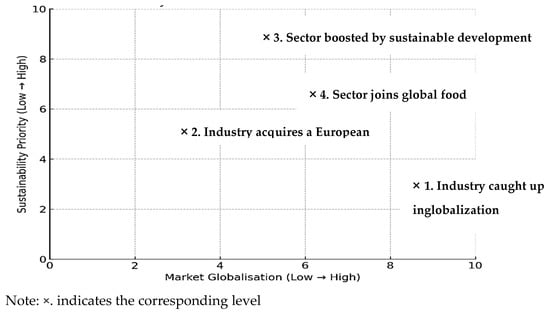
Figure 1.
Poultry Production in 2025: Four Potential Pathways.
Two scenarios project a continuation of current trends:
Scenario 1—“The Poultry Industry in the Grip of Globalization”—envisions a future shaped by increasingly liberalized agricultural markets.
Scenario 2—“The Poultry Industry Gains a European Identity”—assumes a reorientation of EU policies prioritizing job creation and protection.
The remaining two scenarios describe more substantial shifts:
Scenario 3—“The Poultry Sector Driven by Sustainable Development”—places environmental considerations at the forefront, influencing the attitudes and choices of French and European consumers.
Scenario 4—“The Poultry Sector under Global Food Governance”—unfolds in a context of recurring food crises, prompting the establishment of worldwide regulations on food trade to safeguard both food security and natural resources.
The four prospective scenarios outlined above highlight the complex interplay of regional, socioeconomic, and global factors shaping the future of poultry production in Europe. Each scenario underscores distinct pathways, from the continuation of globalized market trends and sustainability-driven transformations to policy-driven European reorientation and responses to global food crises. These scenarios provide a framework for stakeholders to anticipate potential challenges and opportunities, guiding strategic decision-making to balance economic viability, environmental sustainability, and food security in the evolving poultry sector.
Animal production, particularly poultry farming, is vital for meeting the increasing global demand for high-quality dietary protein. The sector has experienced rapid growth, with poultry meat production expanding at an average annual rate of 4–5% from 1990 to 2020, surpassing pig and bovine meat growth rates. By 2022, poultry accounted for approximately 41% of global meat production, a significant increase from 15% in the 1980s, driven by technological advancements and cost efficiencies. Globally, egg production reached about 87 million tons in 2021, highlighting the sector’s expanding contribution to food security. Projections indicate that poultry consumption will reach 91 million tons by 2032, with total global poultry meat production expected to hit 173 million tons by 2034. This growth underscores the importance of improving production efficiency, especially in terms of feed conversion and sustainable practices, to meet the rising demand while minimizing environmental impact. Quantitative comparisons reveal that poultry’s rapid expansion outpaces other livestock sectors, emphasizing its critical role in future food systems.
3.3. State of Poultry Farming in Moldova: Challenges and Pathways to Sustainability
Poultry farming is a cornerstone of Moldova’s livestock sector, significantly contributing to food security and rural employment. This article synthesizes data from national and international sources to evaluate the state of poultry farming in Moldova and propose strategies for its sustainable development.
Poultry production in Moldova, primarily focused on chickens for meat and eggs, involves both commercial farms and smallholder operations. Approximately 68% of rural households in lower-middle-income countries like Moldova engage in poultry farming, utilizing the nation’s 2.2 million hectares of arable land [28]. In 2023, the poultry population was approximately 4.3 million birds, a 12% decline from 2020, with 65% managed by private households [41]. The industrial sector lags behind European Union standards, limiting scalability.
Moldova produced about 600 million eggs and 38,000 tons of poultry meat in 2023, yet domestic demand for poultry meat reached 76,000 tons, requiring imports of 22,000 tons to address a 29% shortfall [42]. Poultry meat constitutes a significant share of national meat output, and eggs are a dietary staple.
The sector benefits from short production cycles, enabling rapid market responses. Over the past decade, moderate growth has occurred through facility modernization, improved breeds, and better feeding practices [24].
However, challenges include outdated infrastructure, high feed costs, and reliance on imported feed components like soybean meal. Fluctuating grain prices, biosecurity risks such as avian influenza, logistical constraints, and other factors further impede progress [42].
Despite gaining EU export rights in 2023, low adoption of modern technologies and market volatility hinder competitiveness [41].
To ensure sustainable development, Moldova can invest in modern equipment, such as automated feeding systems and climate-controlled housing, to enhance efficiency. Strengthening biosecurity through vaccination programs and robust protocols can mitigate disease risks. Expanding access to low-interest loans and subsidies will support infrastructure upgrades and quality input procurement. Training programs on best practices and market access, alongside leveraging EU export opportunities, can boost productivity and competitiveness [28].
By addressing these challenges and leveraging its agricultural strengths, Moldova’s poultry sector can reduce import dependency, enhance food security, and contribute to long-term economic growth [37].
Poultry farming in Moldova is characterized by a mix of backyard, semi-intensive, and intensive production systems. While intensive systems can increase productivity, they also raise significant environmental concerns. These include soil and water contamination from manure and slurry, greenhouse gas emissions, and local ecosystem disruption [24,42]. Improper waste management can lead to nutrient runoff, eutrophication of water bodies, and contamination of groundwater [43].
Backyard and semi-intensive systems, which are predominant in Moldova, present different challenges. Although they generally have lower environmental footprints compared to large-scale industrial farms, they often lack standardized biosecurity measures, proper waste management, and access to veterinary support, potentially impacting both animal health and local ecosystems [44].
Sustainable poultry farming in Moldova must consider both environmental and animal welfare aspects. Welfare-friendly housing, adequate feeding, and controlled stocking densities are crucial for minimizing stress and disease prevalence in birds [40]. Moreover, integrating environmentally sound waste management practices, such as composting or biogas production, can reduce environmental pollution while providing additional economic benefits [45].
There are 43 poultry farms and nearly 227,000 individual households raising up to six million birds in Moldova. Additionally, there are 24 poultry slaughterhouses in the republic, which annually supply almost 45,000 tons of meat, and 12 egg collection centers package nearly 253 million eggs each year [46]. Most poultry farms in Moldova are with only a small percentage employing modern intensive methods. Table 2 summarizes the distribution of farm types based on size and production system.
Table 2.
Distribution of Poultry Farms in Moldova (2023). (Adapted from regional agricultural surveys and FAO data).
3.4. Development Pathways
The Republic of Moldova’s poultry industry currently produces approximately 54,000 tons of poultry meat annually across its specialized enterprises. However, domestic consumption significantly exceeds this output, reaching around 76,000 tons per year. This results in a shortfall of approximately 22,000 tons, or about 29% of the demand, which is met through imports.
Sustainability in Moldovan poultry production requires a multifaceted approach. On the environmental side, adoption of renewable energy, improved manure management, and reduction in greenhouse gas emissions are key strategies [24]. On the socio-economic side, supporting smallholder farmers through training and access to finance can help improve both production efficiency and sustainability outcomes (Intensification of production, low emission pathways and sustainable strategies for backyard, layer and broiler chickens [47].
Ensuring food quality and safety remains a critical aspect of sustainable poultry development. Implementation of hazard analysis and critical control point (HACCP) systems, regular monitoring of pathogens, and proper handling and storage of products are essential to meet international standards [48].
Finally, promoting environmentally friendly and welfare-conscious practices across both backyard and semi-intensive systems can contribute to long-term sustainability. By combining productivity improvements with ecosystem protection and animal welfare standards, Moldova can advance a poultry sector that is economically viable, socially responsible, and environmentally sustainable [47].
According to the Ministry of Agriculture and Food Industry of the Republic of Moldova, the country’s population of 2.682 million requires an estimated 85,000 tons of poultry meat annually to meet nutritional needs [49].
In terms of per capita poultry meat production among Commonwealth of Independent States (CIS) countries, Moldova ranks near the bottom with 13.5 kg per person per year. For comparison, Belarus leads with 52.9 kg per capita, followed by Ukraine (27.8 kg), Kazakhstan (18.7 kg), Armenia (12.5 kg), Azerbaijan (9.6 kg), Uzbekistan (2.1 kg), and both Turkmenistan and Tajikistan (1.3 kg) [50].
In a significant development for Moldova’s poultry sector, the European Union granted permission in 2023 for the export of processed poultry meat and table eggs to EU countries. This decision followed a February 2023 meeting of the Plants, Animals, Food, and Feed (PAFF) Committee, where EU member states supported the European Commission’s draft legislation to include Moldova as an authorized exporter of these products. In 2024, Moldova successfully initiated its first exports of chilled poultry meat to the EU, marking a milestone in its agricultural trade.
Ensuring the quality and safety of poultry products represents a key element in the sustainable development of the poultry sector in the Republic of Moldova. Quality assurance systems are designed to protect consumer health, improve competitiveness, and facilitate access to international markets, particularly the European Union.
The assurance of poultry product quality is based on a combination of international, European, and national legislative frameworks. At the international level, the Codex Alimentarius establishes fundamental guidelines for food hygiene and safety [51,52]. Within the European Union, poultry production is governed by Regulation (EC) No 852/2004 on the hygiene of foodstuffs and Regulation (EC) No 853/2004 laying down specific hygiene rules for food of animal origin.
In Moldova, the Law on Food Safety (No. 113/2012) and the Law on Veterinary and Sanitary Control (No. 221/2007) provide the legal foundation for food safety and animal health. These are harmonized progressively with EU acquis, in line with the EU–Moldova Association Agreement [48].
Modern poultry farms are required to implement Hazard Analysis and Critical Control Points (HACCP), Good Manufacturing Practices (GMP), and Good Hygiene Practices (GHP) to minimize risks along the production chain. In Moldova, HACCP implementation has become mandatory for enterprises engaged in processing poultry products, supervised by the National Agency for Food Safety (ANSA).
Laboratory monitoring includes microbiological testing (e.g., Salmonella spp., Campylobacter spp.) and chemical residue analysis (antibiotics, heavy metals, mycotoxins) to ensure compliance with EU maximum residue limits (MRLs) [52].
Increasingly, traceability systems and digital databases are introduced to strengthen transparency in the production chain.
To secure approval for exporting Class A eggs-the highest quality category-Moldova implemented a Salmonella control program for laying hen flocks. The program underwent evaluation by the European Commission, with compliance verified during an audit in April 2022. These efforts align with Moldova’s broader aspirations, including its application for EU membership in March 2022, and demonstrate progress in aligning with EU standards for food safety, veterinary, and phytosanitary policies [21].
Table 3 presents the production volumes of key agricultural products across all categories of producers in Moldova from 2020 to 2023. The data encompass livestock farming (measured in live weight, thousand tons), cow’s milk (thousand tons), and egg production (million pieces). The analysis below examines trends, fluctuations, and key insights derived from the data.
Table 3.
Production of Main Agricultural Products in All Categories of Producers.
Total livestock production (in live weight) shows an overall upward trend from 147.5 thousand tonnes in 2021 to 170.3 thousand tonnes in 2023, despite a dip in 2021 compared to 2020 (159.2 thousand tonnes). The increase of 15.4% from 2021 to 2023 indicates growth in the livestock sector. The recovery in 2022 (160.5 thousand tonnes) and further growth in 2023 suggest improved production capacity or market demand, particularly in specific livestock categories.
Poultry production, a significant contributor to total livestock output, saw a decline from 60.6 thousand tonnes in 2020 to 53.3 thousand tonnes in 2021 (a 12.0% drop), followed by a recovery to 59.6 thousand tonnes in 2022 and further growth to 65.0 thousand tonnes in 2023 (a 22.0% increase from 2021). This growth aligns with Moldova’s recent authorization to export poultry meat to the EU, indicating potential market-driven expansion.
Figure 2 presents the annual poultry production (in thousand tons, live weight) in Moldova from 2015 to 2024 [12]. The data provide insights into the trends and fluctuations in the poultry sector, a key component of Moldova’s agricultural industry. The analysis examines production patterns, identifies key trends, and contextualizes the findings within the broader agricultural landscape.
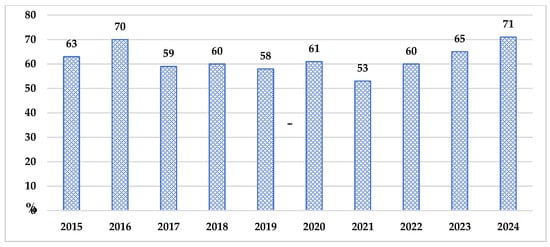
Figure 2.
Poultry Production in Moldova 2015–2024 (thousand tons).
Poultry production in Moldova increased from 62.7 thousand tonnes in 2015 to 70.5 thousand tonnes in 2024, reflecting a net growth of 12.5% over the decade. Despite fluctuations, the overall trajectory indicates a strengthening poultry sector. The highest production was recorded in 2016 (69.9 thousand tonnes), while the lowest was in 2021 (53.3 thousand tonnes). The recovery from 2021 to 2024 (a 32.3% increase) suggests resilience and potential market-driven expansion.
The significant increase in production from 2022 to 2024 corresponds with Moldova’s approval to export processed poultry meat to the EU, following the February 2023 decision by the Plants, Animals, Food, and Feed (PAFF) Committee. The first export of chilled poultry meat in 2024 likely incentivized producers to scale up operations.
The fluctuations between 2016 and 2021 suggest vulnerabilities in the poultry sector, potentially due to inconsistent investment, disease risks (e.g., avian influenza), or reliance on imports to meet domestic demand, which is estimated at 76 thousand tonnes annually [53].
The recovery from the 2021 low point demonstrates the poultry sector’s adaptability, likely supported by improved biosecurity measures (e.g., Salmonella control programs for EU compliance) and government efforts to align with EU food safety standards.
The average annual egg production per laying hen (in pieces) across Moldova from 2015 to 2024 reflect the productivity of the poultry sector, specifically in egg production, and provide insights into trends, fluctuations, and potential influencing factors such as farming practices, feed quality, and biosecurity measures (Figure 3).
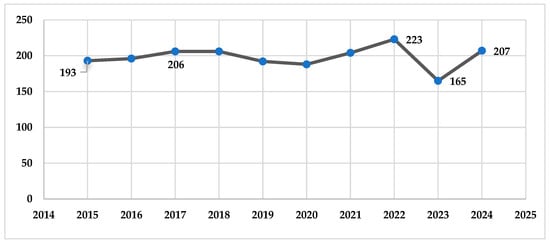
Figure 3.
Average Annual Egg Production per Layer (pieces) [12].
The average annual egg production per layer ranged from a low of 165 pieces in 2023 to a high of 223 pieces in 2022. Over the decade, there is no clear linear trend, with productivity showing periods of growth, stability, and decline. From 193 pieces per layer in 2015 to 207 pieces in 2024, there is a modest net increase of 7.3%. However, significant year-to-year fluctuations indicate variability in production efficiency. A recovery began in 2021 with 204 pieces per layer (an 8.5% increase from 2020), followed by a significant jump to 223 pieces in 2022 (a 9.3% increase from 2021). The 2022 peak, the highest in the decade, aligns with Moldova’s efforts to meet EU standards for egg exports (e.g., Salmonella control programs), suggesting improvements in biosecurity and farm management. Productivity rebounded to 207 pieces per layer in 2024, a 25.5% increase from 2023, returning to levels seen in 2017–2018. This recovery likely reflects improved conditions, such as stabilized feed supply, enhanced biosecurity, or increased investment following Moldova’s first egg exports to the EU in 2024 [12].
The peak in 2022 and recovery in 2024 align with Moldova’s authorization to export Class A eggs to the EU, following the 2023 PAFF Committee decision and compliance with EU Salmonella control standards [21].
Improved farm management to meet these standards likely boosted productivity in 2022 and 2024. To sustain and enhance productivity, Moldova’s poultry industry should focus on improving feed quality, adopting advanced breeding techniques, and strengthening biosecurity measures to meet both domestic demand and export opportunities.
Figure 4 presents data on poultry consumption in Moldova, measured in thousand capita (likely referring to thousand kilograms or tonnes per capita, adjusted for population), from 2015 to 2025. The data provide insights into consumption trends, reflecting changes in dietary preferences, economic conditions, and market dynamics. The analysis examines patterns, fluctuations, and contextual factors influencing poultry consumption in Moldova over this period.
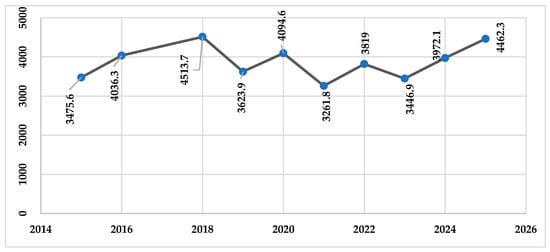
Figure 4.
Poultry Consumption in Moldova 2014–2025 (thousand capita).
Poultry consumption in Moldova increased from 3475.6 thousand capita in 2015 to 4462.3 thousand capita in 2025, reflecting a net growth of approximately 28.4% over the decade. This upward trend suggests rising demand for poultry, likely driven by its affordability, nutritional value, and increasing consumer preference for white meat.
The highest consumption was recorded in 2018 (4513.7 thousand capita), while the lowest was in 2021 (3261.8 thousand capita). The recovery from 2021 to 2025 (a 36.8% increase) indicates a strong rebound in demand. Consumption rebounded to 3819.0 thousand capita in 2022, followed by a dip to 3446.9 in 2023 (a 9.8% decrease), before rising steadily to 3972.1 in 2024 and 4462.3 in 2025. The 29.5% increase from 2023 to 2025 aligns with increased poultry production (70.5 thousand tonnes in 2024) and Moldova’s entry into the EU export market for poultry meat in 2023, which may have stabilized supply and reduced prices.
With Moldova’s population estimated at approximately 2.682 million (Ministry of Agriculture and Food Industry, Republic of Moldova), the 2025 consumption of 4462.3 thousand capita translates to roughly 1.66 kg per person per year. This is significantly lower than the previously cited domestic demand of 76 thousand tonnes (approximately 28.3 kg per capita), suggesting the “thousand capita” unit may reflect a specific subset of consumption or a data scaling issue. Alternatively, the data may represent production rather than total consumption, requiring clarification. The projected 2025 consumption of 4462.3 thousand capita suggests growing consumer preference for poultry, possibly driven by its affordability compared to other meats (e.g., cattle production dropped to 7.1 thousand tonnes in 2023) and increasing awareness of its nutritional benefits. Strategic investments in production capacity, biosecurity, and market development are essential to sustain growth and reduce import dependency.
The analysis of the provided tables on livestock production, poultry production, poultry consumption, and egg production per layer, combined with contextual material, offers a comprehensive view of Moldova’s poultry sector from 2015 to 2025. The data reveal a sector characterized by growth potential, significant volatility, and emerging opportunities, particularly in the context of Moldova’s integration into the European Union (EU) market [54,55].
Total livestock production increased from 147.5 thousand tonnes in 2021 to 170.3 thousand tonnes in 2023, with poultry and pigs driving growth.
Poultry meat production grew from 62.7 thousand tonnes in 2015 to 70.5 thousand tonnes in 2024, a 12.5% increase, despite a low of 53.3 thousand tonnes in 2021. The recovery from 2022 to 2024 aligns with Moldova’s authorization to export poultry meat to the EU in 2023, reflecting market-driven expansion and improved production capacity.
Moldova’s poultry sector demonstrates resilience and growth potential, particularly in poultry meat and egg production, supported by access to EU markets following the 2023 approval for exporting processed poultry meat and Class A eggs. The first exports of chilled poultry meat in 2024 and compliance with EU Salmonella control standards have driven improvements in production efficiency and biosecurity. However, the sector faces challenges: including production shortfalls, low per capita output compared to regional peers, and volatility due to economic disruptions, feed price fluctuations, and disease risks.
To sustain and accelerate growth, Moldova’s poultry sector should focus on enhancing production capacity through investments in modern farming technologies, high-yield poultry breeds, and feed optimization to boost both meat and egg production and reduce import dependency. Despite a comprehensive analysis of current trends, best practices, and sustainable development strategies in the poultry industry in Moldova, there are some limitations to the study. One of them is the limited availability of data in certain regions and aspects of production, which may have affected the completeness of the assessment of all factors contributing to the industry’s development. Additionally, market dynamics and regulatory changes require regular updates of information and approaches.
In the future, it is recommended to expand the research by including a broader range of data, such as analytical indicators and opinions from various stakeholders, including farmers, experts, and regulatory bodies. The exploration of innovative technologies, such as automation, biotechnology, and quality monitoring systems, and their impact on product quality and ecological sustainability, is also promising. For example, Ben et al. [56] emphasize the importance of applying modern technologies to improve efficiency in poultry farming, while Zhang [57] address issues of environmental sustainability and product quality in the industry. These directions will help to better understand the challenges and opportunities for the development of poultry farming in Moldova and to formulate effective recommendations for further industry improvement.
Furthermore, further exploration of innovative alternatives and alignment of feeding practices with circular economy principles, supported by supportive policies, will enable the poultry industry to make a significant contribution to global food security and environmental sustainability [58]. Strengthening biosecurity by maintaining adherence to EU standards, such as Salmonella control programs, is critical to preserving export market access and improving productivity. Addressing volatility requires policies to stabilize feed costs, improve disease management, and support farmers during economic disruptions. Leveraging EU market access by expanding exports of poultry meat and eggs can drive economic growth, provided quality and safety standards are consistently met.
4. Conclusions
Moldova’s poultry sector from 2014 to 2025 experienced significant growth, reflecting its resilience, adaptability, and strategic efforts to align with EU standards and market opportunities. The sector’s expansion, characterized by increased production, consumption, and improvements in productivity, underscores its vital role in contributing to food security and rural livelihoods. The adoption of EU compliance measures has been instrumental in elevating product safety, quality standards, and market competitiveness, thereby facilitating access to international markets and fostering modernization within the industry.
However, despite these positive developments, the sector continues to face notable challenges that could impede its long-term sustainability and growth potential. Persistent gaps in domestic production, low per capita poultry output, and market volatility—exacerbated by external pressures such as global economic shifts and climate-related factors—highlight the need for strategic policy interventions. Addressing infrastructure deficiencies, strengthening biosecurity measures, and expanding market development initiatives are critical steps to enhance sector resilience, reduce import dependency, and ensure sustainable growth. Intensive poultry farming in Moldova poses risks to human health and the environment due to pollutant emissions and the spread of antibiotic-resistant bacteria. Sustainable development of the sector requires biosecurity measures, product quality control, and environmental monitoring to reduce negative impacts and ensure long-term sector resilience.
From a policy perspective, targeted investments and supportive regulatory frameworks can serve as catalysts for sector modernization, increased productivity, and improved competitiveness. These measures will not only bolster Moldova’s position within the EU agricultural landscape but also contribute to broader regional stability and economic integration in Eastern Europe. Additionally, fostering innovation and capacity-building among poultry producers can help mitigate risks associated with external shocks and market fluctuations.
Economically, a well-developed poultry industry holds the promise of generating employment, stimulating rural economies, and attracting investment. It can serve as a model for sustainable agricultural practices by emphasizing biosecurity, environmental stewardship, and resource-efficient production methods. Moreover, the sector’s growth aligns with the global sustainability discourse by promoting food security, reducing waste, and supporting climate-resilient practices.
Looking forward, future research should focus on evaluating the long-term impacts of policy reforms, exploring innovative technologies, and assessing environmental sustainability within the poultry industry. Investigating supply chain resilience, market diversification, and export strategies will be essential for crafting comprehensive development plans. Furthermore, understanding how the sector can contribute to regional sustainability goals and climate change mitigation efforts will be vital for ensuring its enduring contribution to Moldova’s socio-economic development.
Moldova’s poultry sector has demonstrated promising progress over the past decade, but realizing its full potential requires strategic policy support, investment in infrastructure, and a commitment to sustainable practices. By addressing current limitations and leveraging opportunities within the EU market, Moldova can strengthen its poultry industry as a key driver of economic growth, food security, and regional sustainability in Eastern Europe.
Author Contributions
Conceptualization: L.C.; Writing—Original Draft: L.C.; Visualization: L.C. and E.S.; Supervision: L.C.; Writing—Review and Editing: L.C. and E.S. All authors have read and agreed to the published version of the manuscript.
Funding
This research was funded by the National Agency for Research and Development within the project “Innovative methods for the use of feed obtained through the biological conversion of waste, processed using the black soldier fly (BSF—Hermetia illucens), in broiler nutrition”, project code 24.80015.5107.01PI.
Institutional Review Board Statement
Not applicable.
Informed Consent Statement
Not applicable.
Data Availability Statement
No new data were created or analyzed in this study.
Acknowledgments
This work was supported by NARD within the project “Innovative methods for the use of feed obtained through the biological conversion of waste, processed using the black soldier fly (BSF—Hermetia illucens), in broiler nutrition”, project code 24.80015.5107.01PI. During the preparation of this manuscript, the authors used ChatGPT (OpenAI, 2023, https://openai.com/chatgpt; accessed on 25 October 2025) to assist with language refinement in parts of the manuscript. Scientific ideas, analyses, and conclusions were entirely developed by the authors. The authors have reviewed and edited the output and take full responsibility for the content of this publication.
Conflicts of Interest
The authors declare no conflicts of interest.
References
- FAO. FAO Statistical Yearbook 2024: World Food and Agriculture; FAO: Rome, Italy, 2024. [Google Scholar]
- Mottet, A.; de Haan, C.; Falcucci, A.; Tempio, G.; Opio, C.; Gerber, P. Livestock: On our plates or eating at our table? A new analysis of the feed/food debate. Glob. Food Secur. 2017, 14, 1–8. [Google Scholar] [CrossRef]
- Gerber, P.J.; Steinfeld, H.; Henderson, B.; Mottet, A.; Opio, C.; Dijkman, J.; Falcucci, A.; Tempio, G. Tackling Climate Change Through Livestock: A Global Assessment of Emissions and Mitigation Opportunities; FAO: Rome, Italy, 2013. [Google Scholar]
- Steinfeld, H.; Gerber, P.; Wassenaar, T.; Castel, V.; Rosales, M.; de Haan, C. Livestock’s Long Shadow: Environmental Issues and Options; FAO: Rome, Italy, 2006. [Google Scholar]
- van Huis, A.; van Itterbeeck, J.; Klunder, H.; Mertens, E.; Halloran, A.; Muir, G.; Vantomme, P. Edible Insects: Future Prospects for Food and Feed Security; FAO Forestry Paper 171; FAO: Rome, Italy, 2013. [Google Scholar]
- Fouilleux, E.; Bricas, N.; Alpha, A. ‘Feeding 9 billion people’: Global food security debates and the productionist trap. J. Eur. Public Policy 2017, 24, 1658–1677. [Google Scholar] [CrossRef]
- Godfray, H.C.J.; Beddington, J.R.; Crute, I.R.; Haddad, L.; Lawrence, D.; Muir, J.F.; Pretty, J.; Robinson, S.; Thomas, S.M.; Toulmin, C. Food security: The challenge of feeding 9 billion people. Science 2010, 327, 812–818. [Google Scholar] [CrossRef] [PubMed]
- Agriculture, Forestry, and Fishing, Value Added (% of GDP)—Moldova. Country Official Statistics, National Statistical Organizations and/or Central Banks; National Accounts Data Files, Organization for Economic Co-Operation and Development (OECD); Staff Estimates, World Bank (WB). Available online: https://data.worldbank.org/indicator/NV.AGR.TOTL.ZS (accessed on 21 October 2025).
- Food Processing and Livestock. Republic of Moldova. 2019. Available online: https://www.invest.gov.md/attached_files/2020/10/22/Agriculture.pdf (accessed on 26 November 2025).
- Food Processing and Livestock. Republic of Moldova. 2024. Available online: https://www.invest.gov.md/wp-content/uploads/2024/07/11-06-Agriculture-2024.pdf (accessed on 26 November 2025).
- Moldova Country Commercial Guide Official Website of the International Trade Administration. 2024. Available online: https://www.trade.gov/country-commercial-guides/moldova-agriculture?utm_source=chatgpt.com (accessed on 14 August 2025).
- National Bureau of Statistics of the Republic of Moldova (NBS). Agricultural Production and Livestock Statistics 2024. 2024. Available online: https://statistica.gov.md/en/gross-agricultural-production-in-2024-9515_61675.html (accessed on 17 September 2025).
- National Bureau of Statistics of the Republic of Moldova (NBS). Statistical Yearbook of the Republic of Moldova. 2024. Available online: https://statistica.gov.md/files/files/publicatii_electronice/Anuar_Statistic/2025/16_AS.pdf (accessed on 18 September 2025).
- Mocanu, N.; Pila, M.; Stanciu, S. Understanding Food Consumption Patterns: An Analysis of Regional Disparities and Socio-Economic Factors in Moldova. J. EIA 2024, 1, 125–131. [Google Scholar] [CrossRef]
- Food and Agriculture Organization of the United Nations (FAO). Global Meat Production to Grow in 2024, Led by Poultry. June 2024. Available online: https://www.efeedlink.com/contents/06-25-2024/9bd3634b-3ae4-4e75-baf6-8839035ec484-0501.html (accessed on 26 November 2025).
- Alexandratos, N.; Bruinsma, J. World Agriculture Towards 2030/2050: The 2012 Revision (ESA Working Paper No. 12-03); FAO: Rome, Italy, 2012. [Google Scholar]
- Zbancă, A.; Rusu, T.; Panuța, S.; Negritu, G. Conservation Agriculture as a Pathway to Climate and Economic Resilience for Farmers in the Republic of Moldova. Sustainability 2025, 17, 10916. [Google Scholar] [CrossRef]
- Food and Agriculture Organization of the United Nations (FAO). The State of Food and Agriculture 2020: Overcoming Water Challenges in Agriculture; FAO: Rome, Italy, 2020. [Google Scholar] [CrossRef]
- Asaniyan, E.K. Sustainable Poultry Production: Impact of Alternative Feed Ingredients, Litter Types, and Phytogenics on the Performance of Broiler Chicken; IntechOpen: Rijeka, Croatia, 2025. [Google Scholar] [CrossRef]
- Radlińska, K. Changes in the Structure of Agriculture in Central and Eastern Europe in the Light of the European Green Deal. Sustainability 2025, 17, 104. [Google Scholar] [CrossRef]
- Food Safety News. Moldova Allowed to Send Poultry Meat and Eggs to Europe. 2023. Available online: https://www.foodsafetynews.com/2023/03/moldova-allowed-to-send-poultry-meat-and-eggs-to-europe/ (accessed on 26 November 2025).
- United Nations. Global Issues: Population. 2025. Available online: https://www.un.org/en/global-issues/population (accessed on 26 November 2025).
- Rodić, V.; Perić, L.; Đukić-Stojčić, M.; Vukelić, N. The environmental impact of poultry production. Biotechnol. Anim. Husb. 2011, 27, 1673–1679. [Google Scholar] [CrossRef]
- Mottet, A.; Tempio, G. Global poultry production: Current state and future outlook and challenges. World’s Poult. Sci. J. 2017, 73, 1–12. [Google Scholar] [CrossRef]
- Food and Agriculture Organization of the United Nations (FAO). Gateway to Poultry Production and Products. 2021. Available online: https://www.fao.org/poultry-production-products/en/ (accessed on 26 November 2025).
- USDA. Livestock and Poultry: World Markets and Trade. 2023. Available online: https://apps.fas.usda.gov/psdonline/circulars/livestock_poultry.pdf (accessed on 18 December 2025).
- Ozan, S. The Economic Ripple: Avian Influenza’s Grip on the Poultry Industry. 2024. Available online: https://www.reportlinker.com/article/9067 (accessed on 21 December 2025).
- Vaarst, M.; Steenfeldt, S.; Horsted, K. Sustainable development perspectives of poultry production. World’s Poult. Sci. J. 2015, 71, 609–620. [Google Scholar] [CrossRef]
- Food and Agriculture Organization of the United Nations (FAO). Poultry Production in Lower-Middle-Income Countries: A Global Perspective; FAO: Rome, Italy, 2021. [Google Scholar]
- FAO; OECD. OECD-FAO Agricultural Outlook 2025–2034: Meat; OECD Publishing: Paris, France, 2025; Available online: https://www.oecd.org/en/publications/2025/07/oecd-fao-agricultural-outlook-2025-2034_3eb15914/full-report/meat_5462e384.html (accessed on 26 November 2025).
- European Union. Regulation (EC) No 1831/2003 of the European Parliament and of the Council of 22 September 2003 on Additives for Use in Animal Nutrition. Off. J. Eur. Union 2003, 268, 29–43. Available online: https://eur-lex.europa.eu/legal-content/EN/TXT/?uri=CELEX%3A32003R1831 (accessed on 26 November 2025).
- Herrero, M.; Thornton, P.K.; Notenbaert, A.M.; Wood, S.; Msangi, S.; Freeman, H.A.; Bossio, D.; Dixon, J.; Peters, M.; van de Steeg, J.; et al. Smart Investments in Sustainable Food Production: Revisiting Mixed Crop-Livestock Systems. Science 2010, 327, 822–825. [Google Scholar] [CrossRef] [PubMed]
- Food Technologies. FAO Meat Market Review: Global Meat Market Trends for 2024. Messe Frankfurt. 30 April 2024. Available online: https://foodtechnologies.messefrankfurt.com/global/en/news-insights/markets-trends/global-meat-market-2024.html (accessed on 26 November 2025).
- Ahmad, R.; Yu, Y.-H.; Hsiao, F.S.-H.; Su, C.-H.; Liu, H.-C.; Tobin, I.; Zhang, G.; Cheng, Y.-H. Influence of heat stress on poultry growth performance, intestinal inflammation, and immune function and potential mitigation by probiotics. Animals 2022, 12, 2297. [Google Scholar] [CrossRef] [PubMed]
- Oluwagbenga, E.M.; Fraley, G.S. Heat stress and poultry production: A comprehensive review. Poult. Sci. 2023, 102, 103141. [Google Scholar] [CrossRef] [PubMed]
- European Commission. Poultry. 2025. Available online: https://agriculture.ec.europa.eu/farming/animal-products/poultry_en (accessed on 26 November 2025).
- European Commission. EU–Moldova Association Agreement: Progress Report; European Commission: Brussels, Belgium, 2022.
- Ducrot, C.; Barrio, M.B.; Boissy, A.; Charrier, F.; Even, S.; Mormède, P.; Petit, S.; Pinard-van der laan, M.-H.; Schelcher, F.; Casabianca, F.; et al. Animal board invited review: Improving animal health and welfare in the transition of livestock farming systems: Towards social acceptability and sustainability. Animal 2024, 18, 101100. [Google Scholar] [CrossRef]
- Food Times. EU Poultry Welfare: Call for Reform. 2025. Available online: https://www.foodtimes.eu/food-system/eu-poultry-welfare-call-for-reform/ (accessed on 26 November 2025).
- Milford, A.B.; Le Mouël, C.; Bodirsky, B.L.; Rolinski, S. Drivers of meat consumption. Appetite 2019, 141, 104313. [Google Scholar] [CrossRef] [PubMed]
- Delgado, C.; Rosegrant, M.; Steinfeld, H.; Ehui, S.; Courbois, C. Livestock to 2020: The Next Food Revolution; International Food Policy Research Institute: Washington, DC, USA, 1999; Available online: https://hdl.handle.net/10568/333 (accessed on 26 November 2025).
- Seidavi, A.R.; Zaker-Esteghamati, H.; Scanes, C.G. Present and potential impacts of waste from poultry production on the environment. World’s Poult. Sci. J. 2019, 75, 29–42. [Google Scholar] [CrossRef]
- FAO. Smallholders and Family Farms in the Republic of Moldova; Country study report 2019; FAO: Budapest, Hungary, 2020. [Google Scholar] [CrossRef]
- Bist, R.B.; Bist, K.; Poudel, S.; Subedi, D.; Yang, X.; Paneru, B.; Mani, S.; Wang, D.; Chai, L. Sustainable poultry farming practices: A critical review of current strategies and future prospects. Poult. Sci. 2024, 103, 104295. [Google Scholar] [CrossRef] [PubMed] [PubMed Central]
- Chadwick, D.; Sommer, S.; Thorman, R.; Fangueiro, D.; Cardenas, L.; Amon, B.; Misselbrook, T. Manure management: Implications for greenhouse gas emissions. Anim. Feed. Sci. Technol. 2011, 166–167, 514–531. [Google Scholar] [CrossRef]
- National Bureau of Statistics of the Republic of Moldova (NBS). Agricultural Production and Livestock Statistics 2023; NBS: Chisinau, Moldova, 2023.
- Montagna, F.; Scripnic, E.; Forabosco, F. Intensification of production, low emission pathways and sustainable strategies for backyard, layer and broiler chickens. S. Afr. J. Anim. Sci. 2019, 49, 534–545. [Google Scholar] [CrossRef]
- Ianioglo, N.; Cara, A. Development the poultry sector of the Republic of Moldova through clusterisation. IJAAES Int. J. Anatolia Agric. Eng. Sci. 2022, 4, 10–16. Available online: https://dergipark.org.tr/en/download/article-file/1613987 (accessed on 26 November 2025).
- Mybusiness.md. Moldova Produces Less Poultry Meat than It Consumes. August 2024. Available online: http://www.evedomosti.md/news/moldova-proizvodit-myasa-pticy-menshe-chem-potreblyaet (accessed on 26 November 2025).
- Agrobusiness. Moldova Chicken Eggs: Eu Market Access & Hurdles. 8 July 2025. Available online: https://moldova1.md/p/52501/moldovan-chicken-eggs-eu-market-access--hurdles (accessed on 26 November 2025).
- Ministry of Agriculture and Food Industry of Moldova. Annual Agricultural Report 2020. Available online: https://www.madrm.gov.md (accessed on 26 November 2025).
- FAO/WHO. Codex Alimentarius: Food Hygiene. Basic Texts; FAO: Rome, Italy, 2020. [Google Scholar]
- European Commission. New Study Unveils How CAP is Contributing to Animal Welfare and Antimicrobial Use Reduction. 11 May 2022. Available online: https://agriculture.ec.europa.eu/media/news/new-study-unveils-how-cap-contributing-animal-welfare-and-antimicrobial-use-reduction-2022-05-11_en (accessed on 26 November 2025).
- EFSA. Scientific Opinion on the public health risks associated with poultry meat. EFSA J. 2021, 19, 6578. [Google Scholar]
- Food and Agriculture Organization of the United Nations (FAO). FAOSTAT: Poultry Meat and Egg Production Statistics. 2024. Available online: https://www.fao.org/faostat/en/#data/QCL (accessed on 26 November 2025).
- Ben Sassi, N.; Averós, X.; Estevez, I. Technology and Poultry Welfare. Animals 2016, 6, 62. [Google Scholar] [CrossRef] [PubMed]
- Zhang, D. Environmental regulation and firm product quality improvement: How does the greenwashing response? Int. Rev. Financ. Anal. 2022, 80, 102058. [Google Scholar] [CrossRef]
- Vlaicu, P.A.; Untea, A.E.; Oancea, A.G. Sustainable Poultry Feeding Strategies for Achieving Zero Hunger and Enhancing Food Quality. Agriculture 2024, 14, 1811. [Google Scholar] [CrossRef]
Disclaimer/Publisher’s Note: The statements, opinions and data contained in all publications are solely those of the individual author(s) and contributor(s) and not of MDPI and/or the editor(s). MDPI and/or the editor(s) disclaim responsibility for any injury to people or property resulting from any ideas, methods, instructions or products referred to in the content. |
© 2026 by the authors. Licensee MDPI, Basel, Switzerland. This article is an open access article distributed under the terms and conditions of the Creative Commons Attribution (CC BY) license.