You are currently viewing a new version of our website. To view the old version click .
Sustainability
  • Article
  • Open Access

2 May 2025

Integrating AHP and GIS for Sustainable Surface Water Planning: Identifying Vulnerability to Agricultural Diffuse Pollution in the Guachal River Watershed


,
,
,
and
1
Agro-Industrial By-Product Utilization Group (ASUBAGROIN), College of Agrarian Sciences, Universidad del Cauca, Street 5, No. 4-70, Popayán 190003, Colombia
2
Regional Autonomous Corporation of Valle del Cauca (CVC), Street 56, No. 11-36, Cali 760032, Colombia
3
School of Environmental & Natural Resources Engineering (EIDENAR), College of Engineering, Universidad del Valle, Street 13, No. 100-00, Cali 760032, Colombia
4
Environmental Studies Research Group (GEA), Department of Biology, Universidad del Cauca, Street 5, No. 4-70, Popayán 190003, Colombia

Abstract

Diffuse agricultural pollution is a leading contributor to surface water degradation, particularly in regions undergoing rapid land use change and agricultural intensification. In many developing countries, conventional assessment approaches fall short of capturing the spatial complexity and cumulative nature of multiple environmental drivers that influence surface water vulnerability. This study addresses this gap by introducing the Integral Index of Vulnerability to Diffuse Contamination (IIVDC), a spatially explicit, multi-criteria framework that combines the Analytical Hierarchy Process (AHP) with Geographic Information Systems (GIS). The IIVDC integrates six key indicators—slope, soil erodibility, land use, runoff potential, hydrological connectivity, and observed water quality—weighted through expert elicitation and mapped at high spatial resolution. The methodology was applied to the Guachal River watershed in Valle del Cauca, Colombia, where agricultural pressures are pronounced. Results indicate that 33.0% of the watershed exhibits high vulnerability and 4.3% very high vulnerability, with critical zones aligned with steep slopes, limited vegetation cover, and strong hydrological connectivity to cultivated areas. By accounting for both biophysical attributes and pollutant transport pathways, the IIVDC offers a replicable tool for prioritizing land management interventions. Beyond its technical application, the IIVDC contributes to sustainability by enabling evidence-based decision-making for water resource protection and land use planning. It supports integrated, spatially targeted actions that can reduce long-term contamination risks, guide sustainable agricultural practices, and improve institutional capacity for watershed governance. The approach is particularly suited for contexts where data are limited but spatial planning is essential. Future refinement should consider dynamic water quality monitoring and validation across contrasting hydro-climatic regions to enhance transferability.

1. Introduction

Diffuse pollution from agricultural activities represents one of the most pervasive and complex challenges for water resource management worldwide. Unlike point-source pollution, which originates from specific, traceable discharge locations, diffuse pollution stems from widespread and variable sources, including agricultural runoff, atmospheric deposition, and urban stormwater [1,2]. Among these, agricultural diffuse or non-point source pollution (NPP) is particularly damaging due to its impact on surface and groundwater quality through the transport of nutrients, pesticides, and sediments. These pollutants disrupt aquatic ecosystems, reduce water availability for human consumption and agriculture, and undermine efforts to maintain ecological integrity. Globally, point-source pollution still accounts for approximately one-third of the total pollution load to water bodies, while NPP sources make up the other two-thirds [3]. However, in rural and agricultural landscapes, NPP is now recognized as the predominant driver of contamination, highlighting the need for spatially explicit assessment tools and management strategies tailored to the unique characteristics of agricultural watersheds [4].
The excessive application of agrochemicals in intensive agricultural systems contributes significantly to the mobilization of contaminants, which are transported by surface runoff and infiltrate hydrological networks [5]. The spatially diffuse nature of this pollution, coupled with its dependence on climatic, topographic, and soil conditions, makes it difficult to monitor and regulate effectively [6]. This complexity challenges conventional water quality management approaches, which are often better suited to addressing localized, point-source contamination.
In Colombia, where agriculture is central to the national economy and rural livelihoods, the lack of robust regulatory frameworks and technical methodologies to assess NPP compounds the problem. Current tools for identifying and mitigating vulnerable areas often lack the spatial resolution and adaptability needed to reflect watershed-specific dynamics. This gap is particularly evident in the Guachal River Watershed (GRW), where agricultural expansion and intensification have placed increasing pressure on water resources, but where decision-makers lack spatially explicit instruments to guide land management strategies.
This study is grounded in the broader aim of supporting sustainability in agro-environmental systems. By equipping stakeholders—such as environmental authorities, planning agencies, and farming communities—with spatial tools to identify and prioritize vulnerable areas, this research facilitates the integration of scientific evidence into land use planning and watershed governance. In this way, the proposed framework contributes to long-term water security, environmental protection, and sustainable agricultural development.
Despite considerable research on water quality modeling and risk assessment, many existing approaches remain limited in scope. Some rely on single-factor analyses or empirical coefficients that fail to generalize across different hydro-ecological settings [7]. Others employ powerful tools like the Soil and Water Assessment Tool (SWAT) or Geographic Information Systems (GIS)-based hydrological models but still do not fully integrate the combined effects of land use, topography, connectivity, and pollutant transport mechanisms in a structured decision-support framework [7,8].
To address this methodological gap, this study introduces the Integral Index of Vulnerability to Diffuse Contamination (IIVDC), a spatially explicit tool that integrates GIS with multicriteria decision analysis using the Analytical Hierarchy Process (AHP) [9]. By incorporating key environmental variables—including slope, soil erodibility, land use, runoff potential, hydrological connectivity, and observed water quality—into a composite index, the IIVDC aims to identify critical zones of vulnerability within agricultural watersheds. The approach was applied in the GRW to demonstrate its utility in capturing spatial heterogeneity and supporting targeted interventions. In doing so, this research contributes to the development of decision-support tools aligned with integrated water resources management and the goals of sustainable land and water use planning.
We hypothesize that surface water vulnerability to diffuse agricultural pollution in the GRW is not uniformly distributed, but rather shaped by the spatial convergence of biophysical drivers such as slope, soil erodibility, hydrological connectivity, and land use. Furthermore, we posit that the integration of AHP with GIS in the IIVDC framework will enable accurate identification and classification of these heterogeneous vulnerability zones, offering a viable decision-support tool (DST) for targeted intervention in regions with limited monitoring capacity.

3. Methods

3.1. Study Area

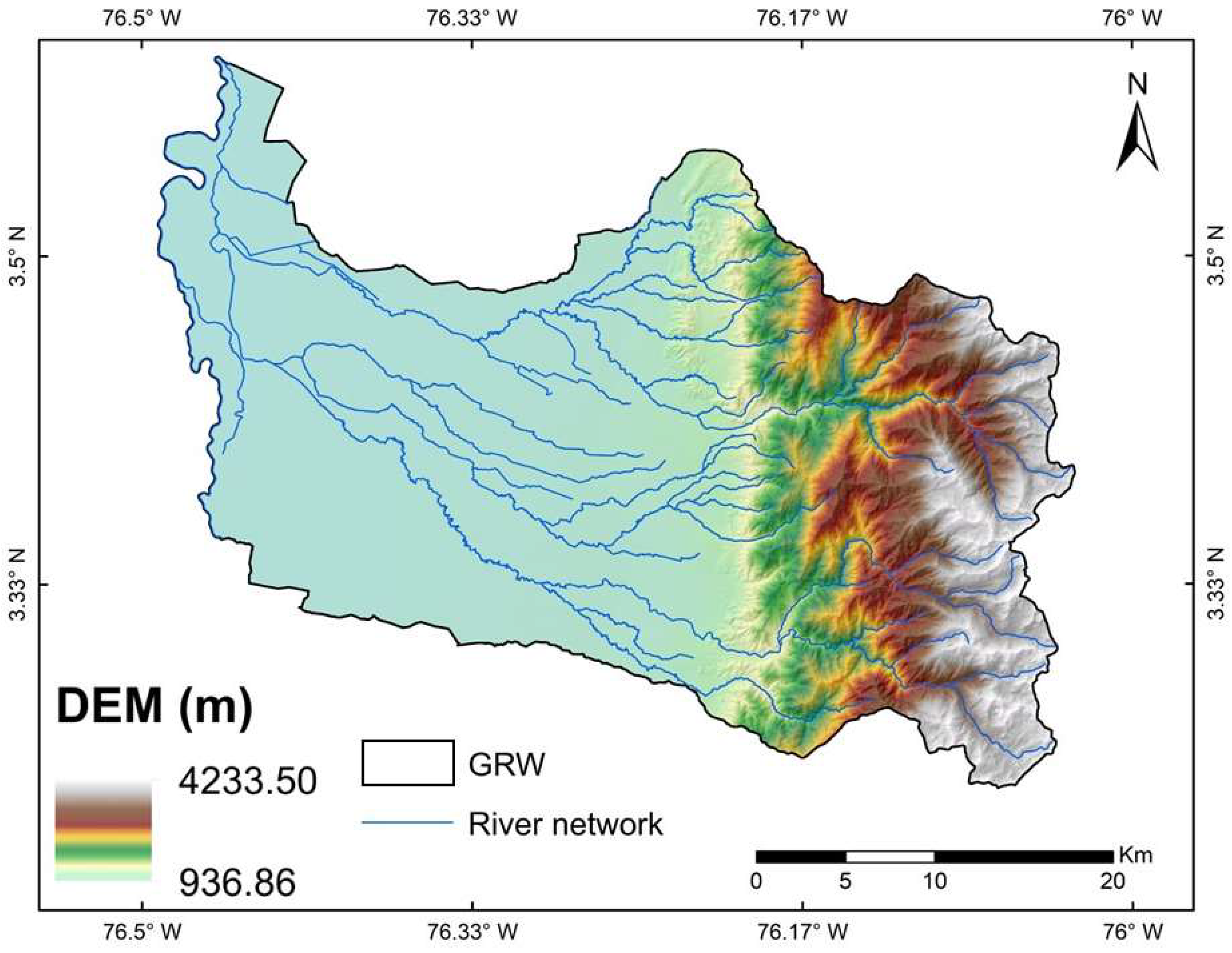
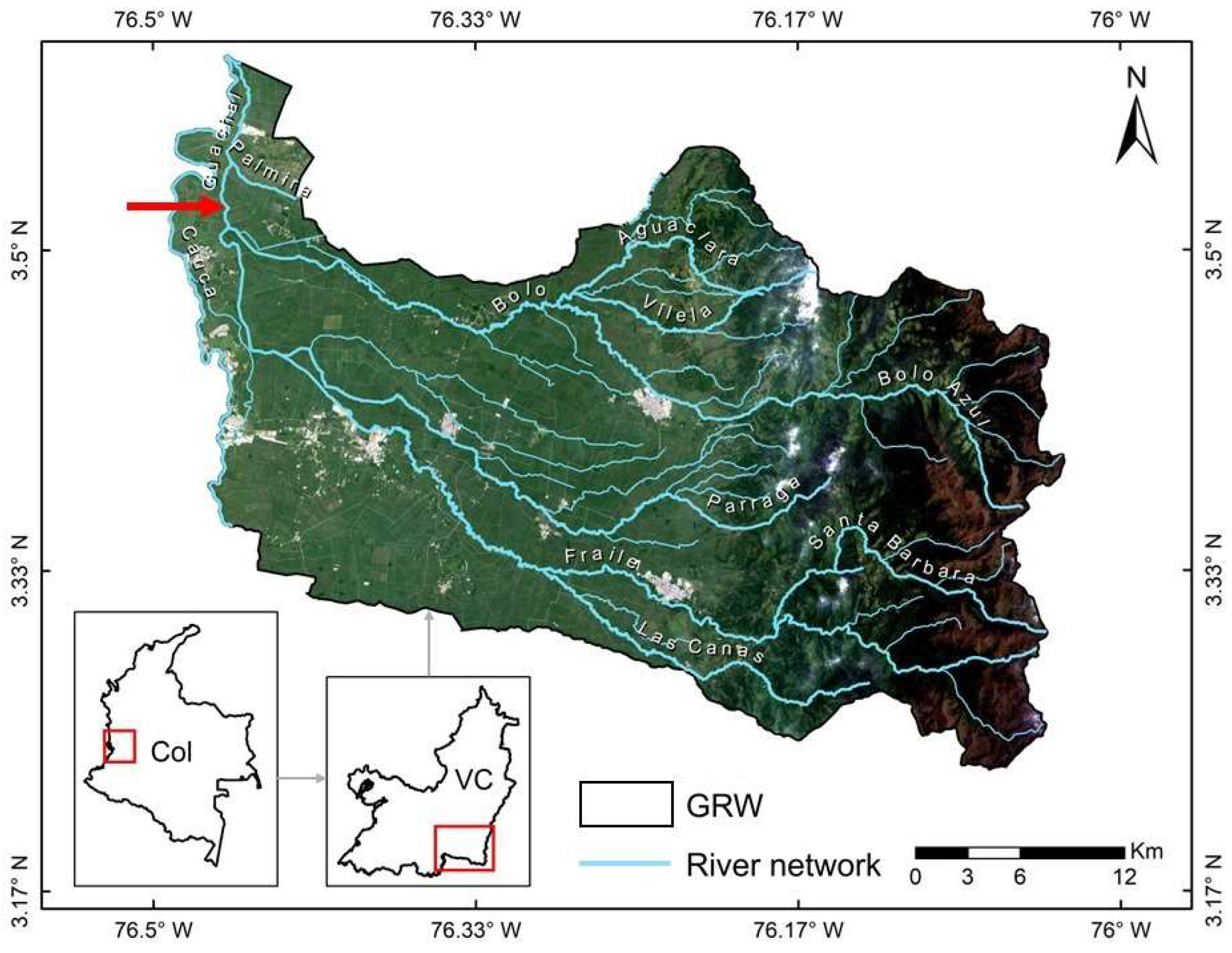
The study was conducted in the GRW, located in the southernmost region of Valle del Cauca, southwestern Colombia (Figure 1). This watershed spans approximately 116,140 hectares and is characterized by intensive agricultural activity, with land use dominated by permanent crops, extensive pastures, and significant agro-industrial infrastructure, including industrial-scale sugarcane mills (“ingenios” in Spanish). The GRW was selected as a representative case study due to several critical factors: the widespread presence of agricultural land use, recurring surface water quality concerns reported in prior research, and the availability of spatial and monitoring data. Additionally, the watershed features marked topographic variation (Figure 2), making it suitable for evaluating how terrain complexity influences surface water vulnerability to diffuse agricultural pollution.
Figure 1. Study area (Col: Colombia; VC: Valle del Cauca region; GRW: Guachal river watershed; red arrow points to the Guachal river).
Figure 2. DEM of the GWR depicting its contrasting topography.

3.2. Development of the IIVDC

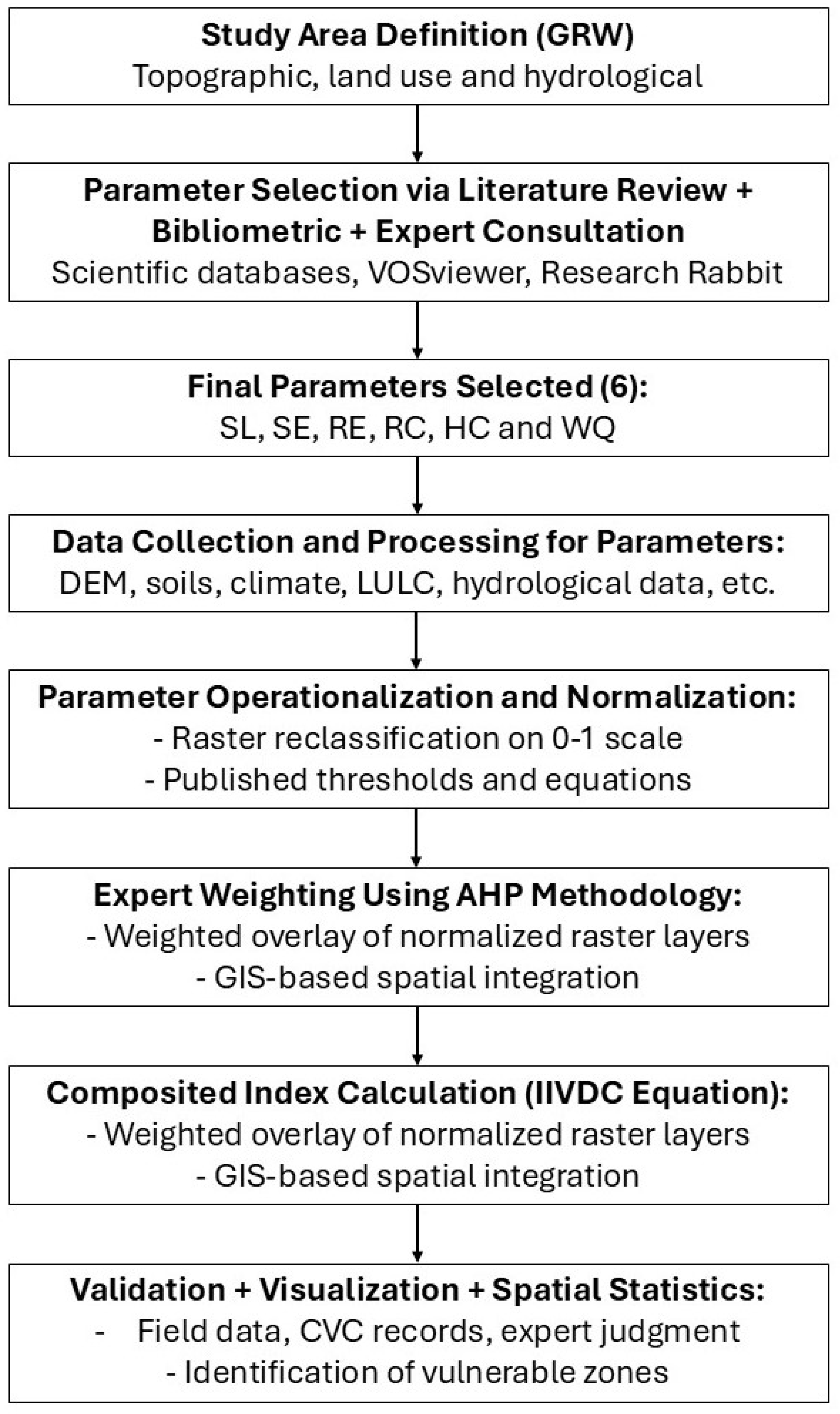
To evaluate surface water vulnerability to diffuse agricultural pollution, this study developed the IIVDC. The index integrates an MCDA framework with the AHP and GIS, providing a spatially explicit and replicable methodology. The IIVDC enables the systematic assessment of multiple biophysical and hydrological parameters contributing to water quality degradation. This framework was applied to the GRW, a region experiencing significant pressures from agricultural intensification and documented water quality deterioration. The methodological design aimed to capture the spatial heterogeneity of vulnerability factors, support decision-making, and prioritize areas for targeted land and water management interventions (Figure 3).
Figure 3. Workflow followed.
The choice to combine AHP with GIS—rather than graph theory or deep learning—was driven by three methodological considerations specific to diffuse pollution vulnerability assessment:
  • Structured MCDM: AHP provides a hierarchical framework to integrate heterogeneous spatial datasets (slope, land use, connectivity) with stakeholder priorities, aligning with the need for participatory decision-making in sustainability planning. Unlike graph theory, which focuses on network topology (e.g., clustering nodes in structured doubly stochastic graphs), AHP explicitly weights criteria based on their relative importance to water vulnerability, a critical requirement for prioritization in land use governance.
  • Data Constrains and Interpretability: Deep learning approaches like capsule attention networks require large-labeled datasets for training, which are unavailable in many developing regions like the GRW. AHP’s reliance on expert elicitation and pairwise comparisons make it robust in data-limited contexts while maintaining interpretability for stakeholders—a key advantage over “black-box” neural networks.
  • Spatial Explicitness vs. Feature Learning: While graph theory could model hydrological connectivity as a network, and deep learning could extract complex patterns from hyperspectral data, neither inherently combines biophysical parameters with human judgment. The AHP-GIS framework bridges this gap by embedding expert-derived weights into spatially continuous vulnerability maps, enabling direct translation of results into watershed management actions.
The followed approach aligns with established practices in spatially explicit sustainability science, where AHP-GIS hybrids have been successfully applied to prioritize conservation areas, assess ecological vulnerability, and guide land use zoning. Future work could explore hybrid models integrating AHP-weighted outputs with graph-based connectivity analysis or ML refinement where data availability permits.

3.2.1. Selection of Vulnerability Parameters

A rigorous literature review combined with expert consultation was conducted to identify the most influential parameters affecting the vulnerability of surface waters to diffuse agricultural pollution. To ensure methodological robustness, a bibliometric analysis was performed using four major scientific databases: Scopus, ScienceDirect, Web of Science, and SpringerLink. The search strategy included targeted keywords such as “Surface Water Vulnerability Index to Diffuse Water Pollution”, “Surface Water Diffuse Pollution”, “Diffuse Pollution Assessment”, “Agricultural Runoff Vulnerability”, and “Decision Support Tools”.
Bibliometric outputs were analyzed using VOSviewer and Research Rabbit to generate co-occurrence maps and identify high-frequency terms associated with vulnerability assessment. This process yielded a systematic list of 98 peer-reviewed scientific articles, which were used to identify the most applied indicators in vulnerability models [2,5,6,7,8,26,39,40,41,42,43,46,47,48,49,50,51,52,53,54,55,56,57,58,59,60,61,62,63,64,65,66,67,68,69,70,71,72,73,74,75,76,77,78,79,80,81,82,83,84,85,86,87,88,89,90,91,92,93,94,95,96,97,98,99,100,101,102,103,104,105,106,107,108,109,110,111,112,113,114,115,116,117,118,119,120,121,122,123,124,125,126,127,128,129,130,131,132,133]. Parameters were selected based on their citation frequency, with a threshold of >30% across the reviewed literature (Table 1). The full list of reviewed publications is available in the Supplementary Materials (Supplementary S1). These parameters formed the basis of the hierarchical structure used in the IIVDC framework. Specifically, this 30% threshold refers to the proportion of reviewed studies in which a given parameter appeared (i.e., number of articles citing the parameter divided by the total number of reviewed articles). Parameters with a citation frequency of 30% or higher were retained for inclusion in the IIVDC.
Table 1. Summary of selected vulnerability parameters based on the scientific articles’ review.

3.2.2. Parameter Definition, Classification, and Normalization

The selected parameters were structured within a hierarchical framework for surface water vulnerability assessment, with relative importance weights assigned through the AHP. Each parameter was operationalized using quantitative or categorical indicators derived from spatial and environmental data. These indicators were then classified into discrete vulnerability levels to reflect their influence on pollutant transport potential. To ensure comparability and integration into a composite index, all parameters were normalized to a common scale ranging from 0 to 1, where higher values indicate greater vulnerability. The classification thresholds and normalization schemes were based on established criteria and peer-reviewed methodologies from previous studies (Table 2).
Table 2. References used for normalization of the parameters.

3.2.3. Spatial Operationalization and Normalization of Parameters

Each of the six selected parameters—SL, SE, RE, RC, HC, and WQ—was operationalized using geospatial datasets and standardized methodologies. All layers were processed in raster format at a 30 m resolution using ArcMap 10.8 (ESRI, Redlands, CA, USA). Vulnerability classes for each parameter were defined using criteria derived from peer-reviewed literature, expert consultation, and environmental relevance to pollutant mobilization processes. To enable integration into the IIVDC framework, each parameter was normalized on a scale of 0 to 1, with higher values indicating greater vulnerability. Normalization thresholds, classification rules, and sub-index functions were based on published methodologies (Supplementary S9). Final parameter rasters were generated by applying reclassification schemes consistent with hydrological and environmental processes in the GRW.
  • SL: Derived from a 30 m DEM and categorized into seven vulnerability classes following [135]. Steeper slopes were associated with higher vulnerability due to increased runoff velocity and erosion potential.
  • SE: Calculated using the USDA equation for the K-factor based on soil texture and OMC. Reclassified based on sediment detachment potential. Detailed calculation steps and values are included in Supplementary S2.
  • RE: Estimated using rainfall intensity and kinetic energy functions from the Colombian Institute of Hydrology, Meteorology and Environmental Studes (IDEAM) meteorological stations. Vulnerability classes were defined based on annual erosivity thresholds (Supplementary S9).
  • RC: Computed using the CN method from USDA-NRCS, combining land use/land cover (LULC) and hydrologic soil group (HSG) data. Reclassification schemes for HSGs and LULC are provided in Supplementary S3 and S4, respectively.
  • HC: Assessed using proximity and spatial connection between agricultural land uses and nearby water bodies. A raster model incorporating buffer zones and connectivity values was generated following the methodology adapted from [42]. Class definitions are included in Supplementary S9.
  • WQ: Integrated using the ICAUCA methodology, which combines physical, chemical, and biological indicators into sub-indices (Supplementary S6 and S7). Vulnerability levels were assigned based on mean values across 12 sampling stations within the GRW. The WQ data obtained from 12 monitoring stations were pre-processed to ensure temporal consistency and reliability. Records with incomplete parameter sets or inconsistent timestamps relative to other datasets were excluded from the final analysis. For isolated missing values (i.e., single gaps within an otherwise consistent time series), interpolation was performed using either monthly averages from the same station or spatially neighboring stations. Temporal harmonization ensured that the WQ dataset used for the IIVDC preserved seasonal representativeness and spatial coverage across the watershed. Additionally, statistical screening was conducted to detect outliers, which were removed if not supported by nearby measurements or physical plausibility.
Each normalized raster layer was subsequently weighted using the AHP-derived coefficients and overlaid in ArcMap to produce the final vulnerability index, IIVDC. The IIVDC was then reclassified into five vulnerability categories ranging from “Very Low” to “Very High” based on natural breaks in the data distribution.

3.2.4. IIVDC Application to the GRW

The final parameter weights, derived from the geometric mean of expert rankings, were validated using the CR ≤ 0.1 to ensure robustness. The final assigned weights were (a) SL: 0.20, (b) RE: 0.20, (c) RC: 0.18, (d) HC: 0.16, (e) SE: 0.15, and (f) WQ: 0.11 (Supplementary S9). The IIVDC was computed as a weighted sum of normalized parameter values (Equation (1), Supplementary S9):
IIVDC = (0.20 × SL) + (0.20 × RE) + (0.18 × CN) + (0.16 × HC) + (0.15 × SE) + (0.11 × WQ)
The final IIVDC map was generated by overlaying parameter layers and applying Equation (1). The final vulnerability index values were categorized into five levels (Table 3). Twelve experts participated in the AHP consultation process, representing academic and technical sectors with backgrounds in environmental science, water resources, and land management. A summary of expert affiliations, professional background, and years of experience is provided in Table S1 (Supplementary S9, Figure S9-1 and Table S9-4).
Table 3. Categories for IIVDC.
The results of the IIVDC were analyzed using spatial statistics techniques to identify patterns and trends in vulnerability distribution. The findings were validated in comparison with previous research, data from CVC, IGAC, and expert reviews (Supplementary S8 and S9). All data sources can be found in Supplementary S9 (Table S9-8). In the Results section, the term “indicator” is used to refer to the six parameters previously defined in the IIVDC framework. This terminological shift reflects their role as mapped outputs representing normalized and classified spatial indicators of surface water vulnerability.
Limitations and Applicable Condition Exploration
While the IIVDC effectively identifies vulnerable areas under typical conditions in the GRW, its performance may be affected by more complex or extreme scenarios:
Extreme Weather Events: The current IIVDC does not explicitly model short-term impacts of intense rainfall or prolonged droughts. In extreme rainfall events, surface runoff pathways and pollutant loading dynamics may deviate significantly from those captured by the static hydrological connectivity parameter, potentially underestimating vulnerability in certain areas. Conversely, during extended droughts, reduced surface flow may concentrate pollutants in isolated water bodies, which is not accounted for in the index. To address this, future iterations could integrate dynamic hydrological modeling or time-series analysis of water quality data to capture transient vulnerability patterns under varying climatic conditions. For example, incorporating diffusion priors could refine the model’s sensitivity to rapid changes in pollutant dispersion.
Land Use Change and Management Practices: The IIVDC relies on current land use data and expert-derived weights, which may not reflect the impacts of rapid land use conversions (e.g., deforestation, urbanization) or shifts in agricultural management practices (e.g., adoption of conservation tillage). In areas undergoing significant land use change, the vulnerability scores may become outdated quickly. To mitigate this, the IIVDC could be coupled with land change models or remote sensing techniques to update land use parameters dynamically. Additionally, incorporating multi-prior guidance and domain transfer methods could help adapt the model to new land use scenarios by leveraging information from similar regions.
Complex Pollutant Interactions: The IIVDC aggregates multiple vulnerability parameters into a single index, which may oversimplify complex interactions between pollutants and environmental factors. For instance, the synergistic effects of multiple pesticides or the influence of soil properties on pollutant transport are not explicitly modeled. In areas with complex pollutant mixtures or unique hydrogeological conditions, the IIVDC may not fully capture the nuanced vulnerability patterns. To address this, future refinements could integrate physically based models or ML techniques to simulate pollutant transport and transformation processes more mechanistically, potentially fusing physical models with image translation networks to better represent real-world conditions.
These limitations highlight the need for continuous refinement and validation of the IIVDC under diverse scenarios to ensure its robustness and applicability across different contexts. By explicitly acknowledging these constraints, we provide a balanced view and help practitioners understand the applicable conditions for the model.

4. Results

4.1. Application of the IIVDC in the GRW

4.1.1. SL Indicator

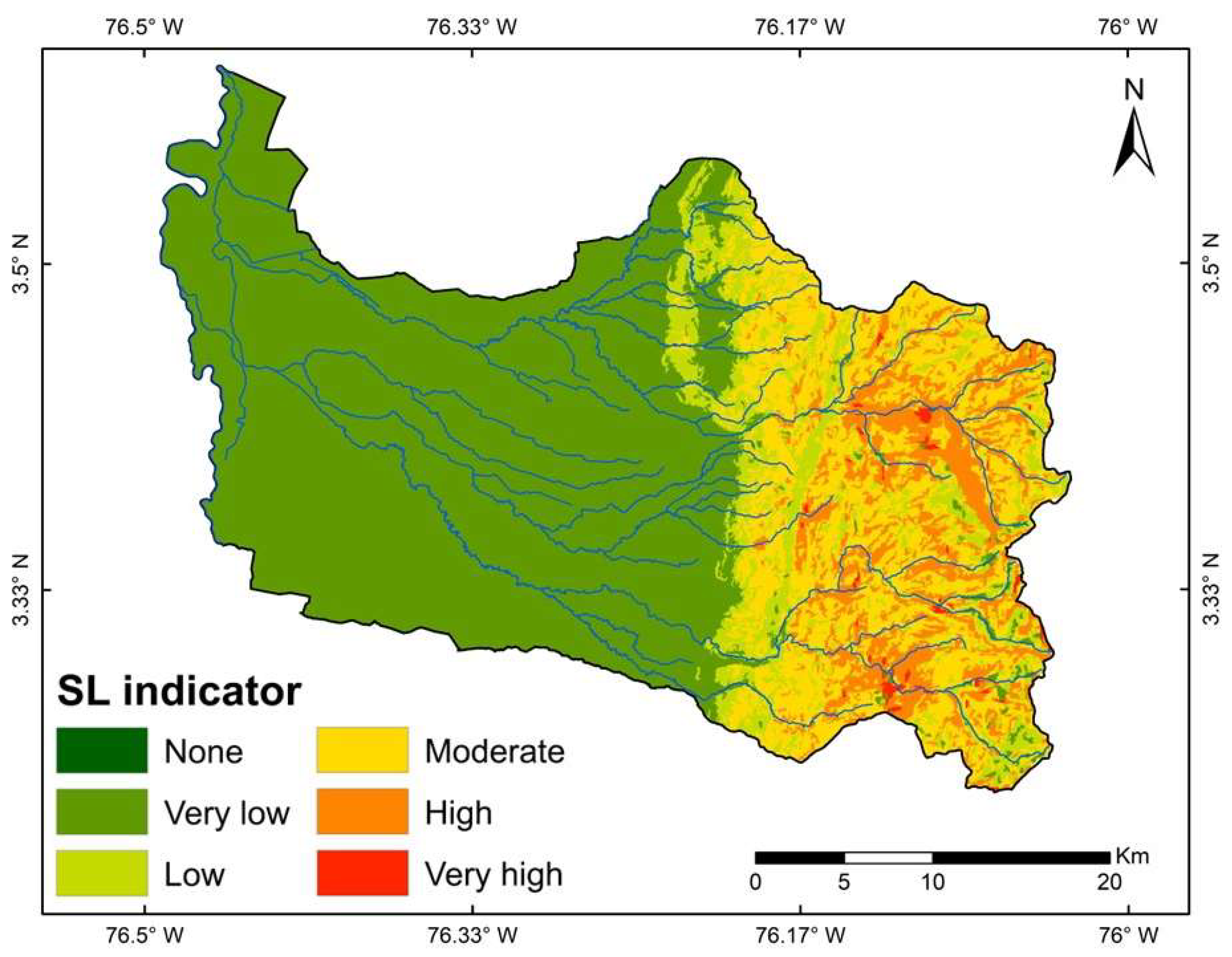
The spatial distribution of slope-derived vulnerability (SL) indicates that approximately 60% of the GRW consists of flat terrain, corresponding to areas with minimal susceptibility to surface runoff and sediment transport. An additional 20% of the watershed falls within low to moderate slope classes, which contribute to erosion-driven pollutant mobility to a lesser extent. Notably, only 0.4% of the area exhibits steep slopes, yet these zones show high vulnerability due to their elevated runoff acceleration and erosion potential. These high-risk areas are concentrated along the eastern mountainous fringe of the watershed (Figure 4), where topographic steepness enhances surface flow generation and promotes direct hydrological connectivity with nearby water bodies.
Figure 4. SL indicator.

4.1.2. SE Indicator

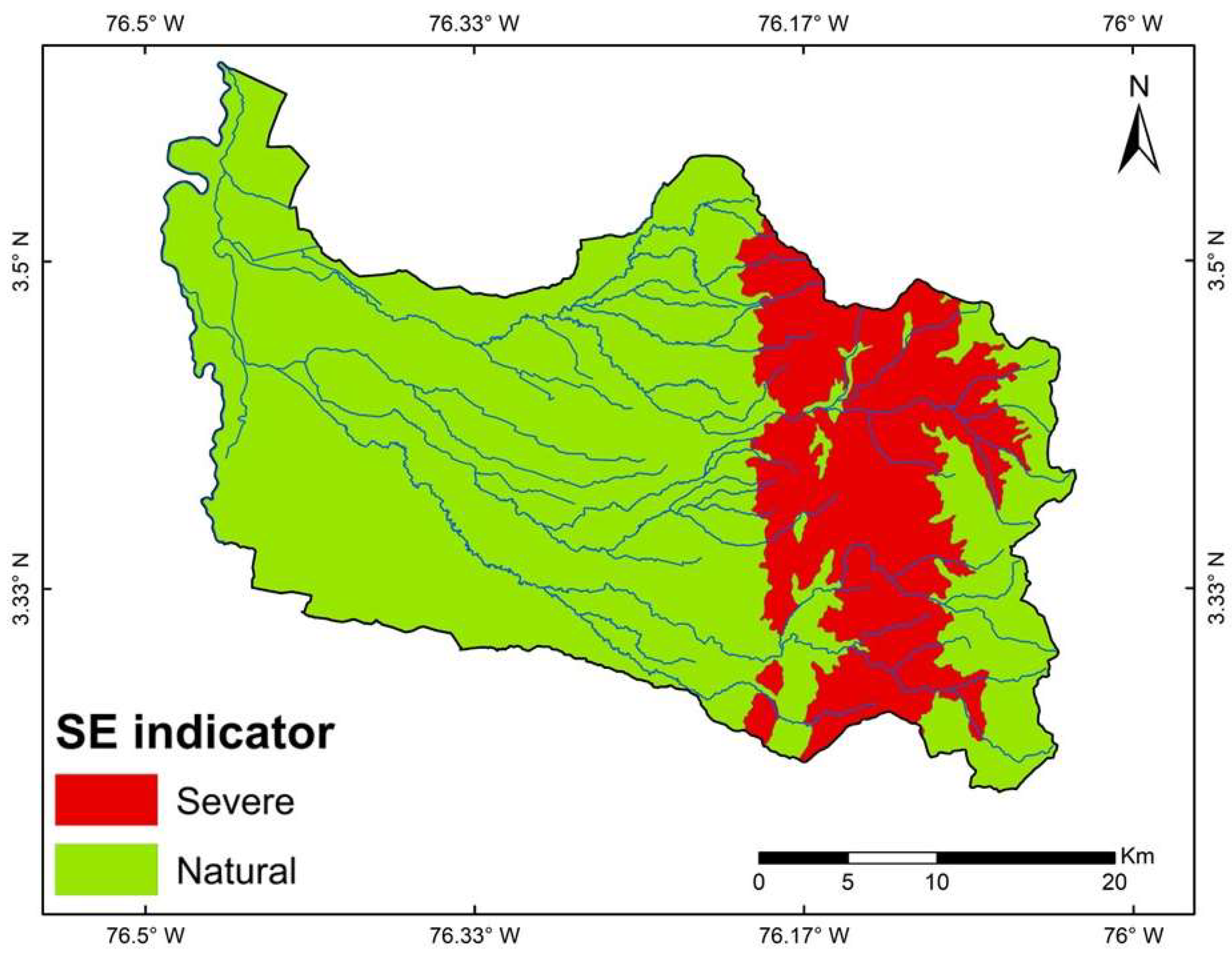
The spatial distribution of soil erodibility-derived vulnerability (SE) shows that approximately 77.3% of the GRW is characterized by low erodibility, reflecting relatively stable soil conditions with limited susceptibility to detachment under rainfall or surface runoff. In contrast, 22.6% of the watershed exhibits high erodibility vulnerability, primarily concentrated in agricultural fields with fine-textured and unconsolidated soils. These zones are particularly prone to sediment detachment and contribute significantly to sediment-bound pollutant transport. The resulting vulnerability map (Figure 5) reveals localized hotspots of elevated soil erodibility in cultivated areas, underscoring the influence of land use on spatial patterns of erosion risk.
Figure 5. SE indicator.

4.1.3. RE Indicator

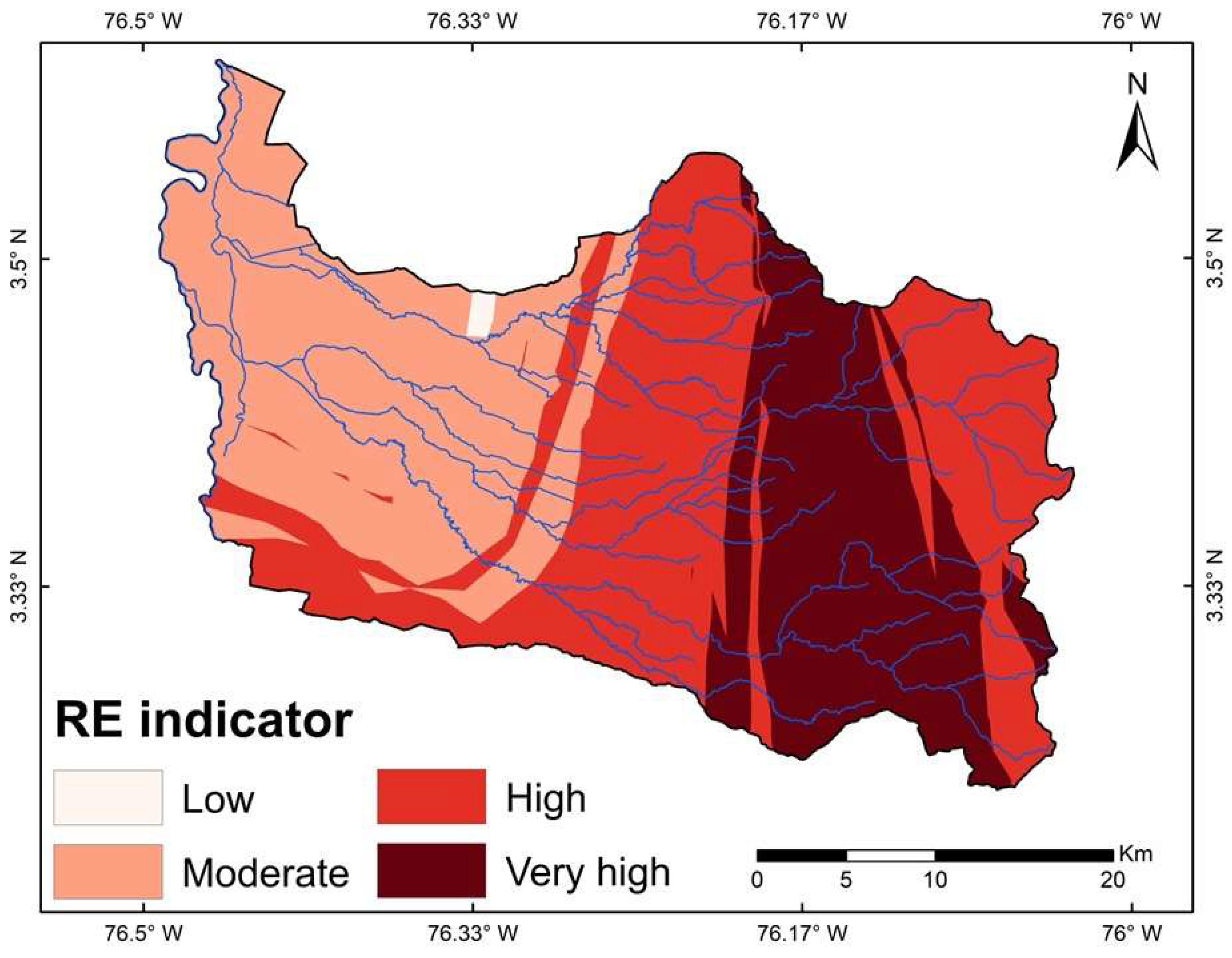
The spatial distribution of rainfall erosivity-derived vulnerability (RE) indicates that approximately 26% of the GRW exhibits high vulnerability, with elevated values concentrated in the upper watershed where intense rainfall events are more frequent. These upland zones are particularly susceptible to rainfall-driven soil detachment and runoff initiation. The remaining 74% of the watershed falls within medium to low vulnerability categories, corresponding to areas with less aggressive precipitation regimes. As shown in Figure 6, the erosivity pattern highlights a clear spatial gradient linked to the intensity and distribution of rainfall, which plays a key role in shaping erosion-related vulnerability across the watershed.
Figure 6. RE indicator.

4.1.4. CN and RC Indicator

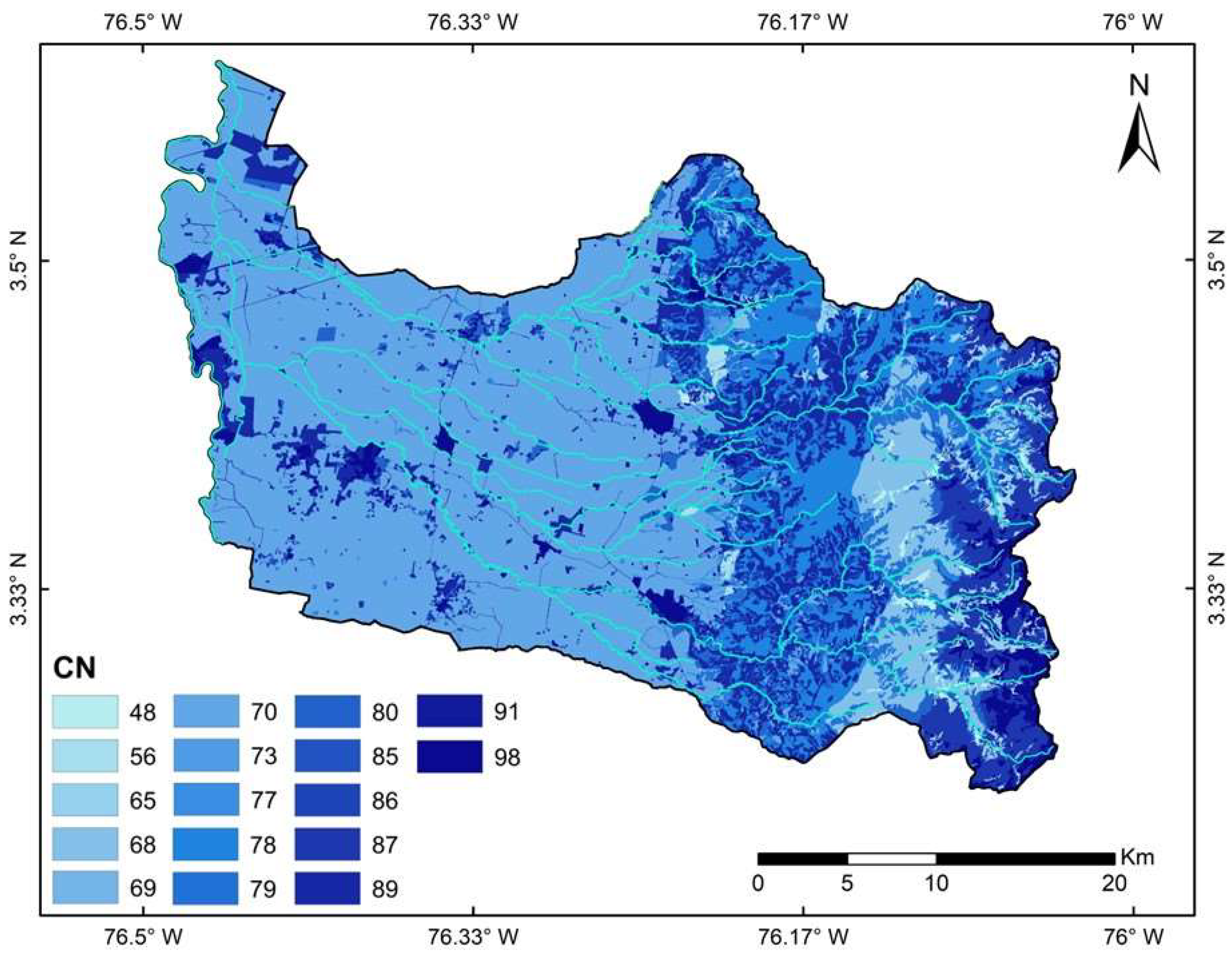
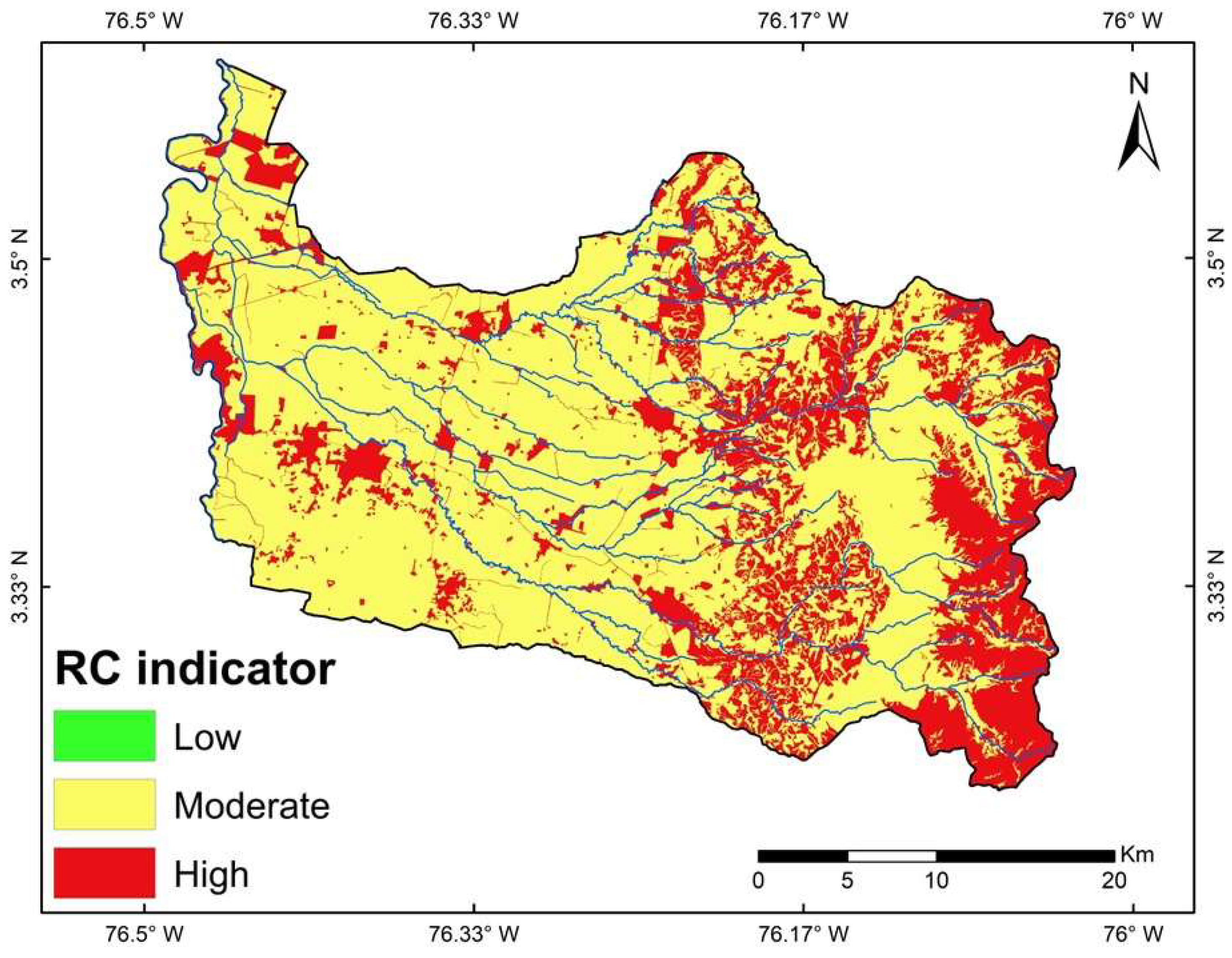
The spatial distribution of runoff coefficient-derived vulnerability (RC) reveals that approximately 71.5% of the GRW exhibits moderate runoff potential, reflecting a mixed hydrological response characterized by both infiltration and surface flow. High runoff potential was observed in 27.9% of the watershed, particularly concentrated in urbanized zones and intensively cultivated agricultural areas, including regions dominated by sugarcane production. In contrast, only 0.5% of the area was classified with low runoff potential, mainly in forested or densely vegetated zones where infiltration capacity remains high. These spatial patterns highlight how land use intensity and vegetative cover influence runoff generation and associated vulnerability (Figure 7).
Figure 7. CN.
The spatial concentration of high runoff potential areas (Figure 8) is most pronounced around urban centers and intensively managed agricultural estates. These zones are characterized by impervious surfaces, compacted soils, and sparse vegetation, all of which reduce infiltration capacity and enhance surface runoff generation. As a result, these areas represent critical zones where surface waters are highly exposed to the mobilization and transport of agricultural pollutants, reinforcing their importance for targeted mitigation strategies.
Figure 8. RC indicator.

4.1.5. HC Indicator

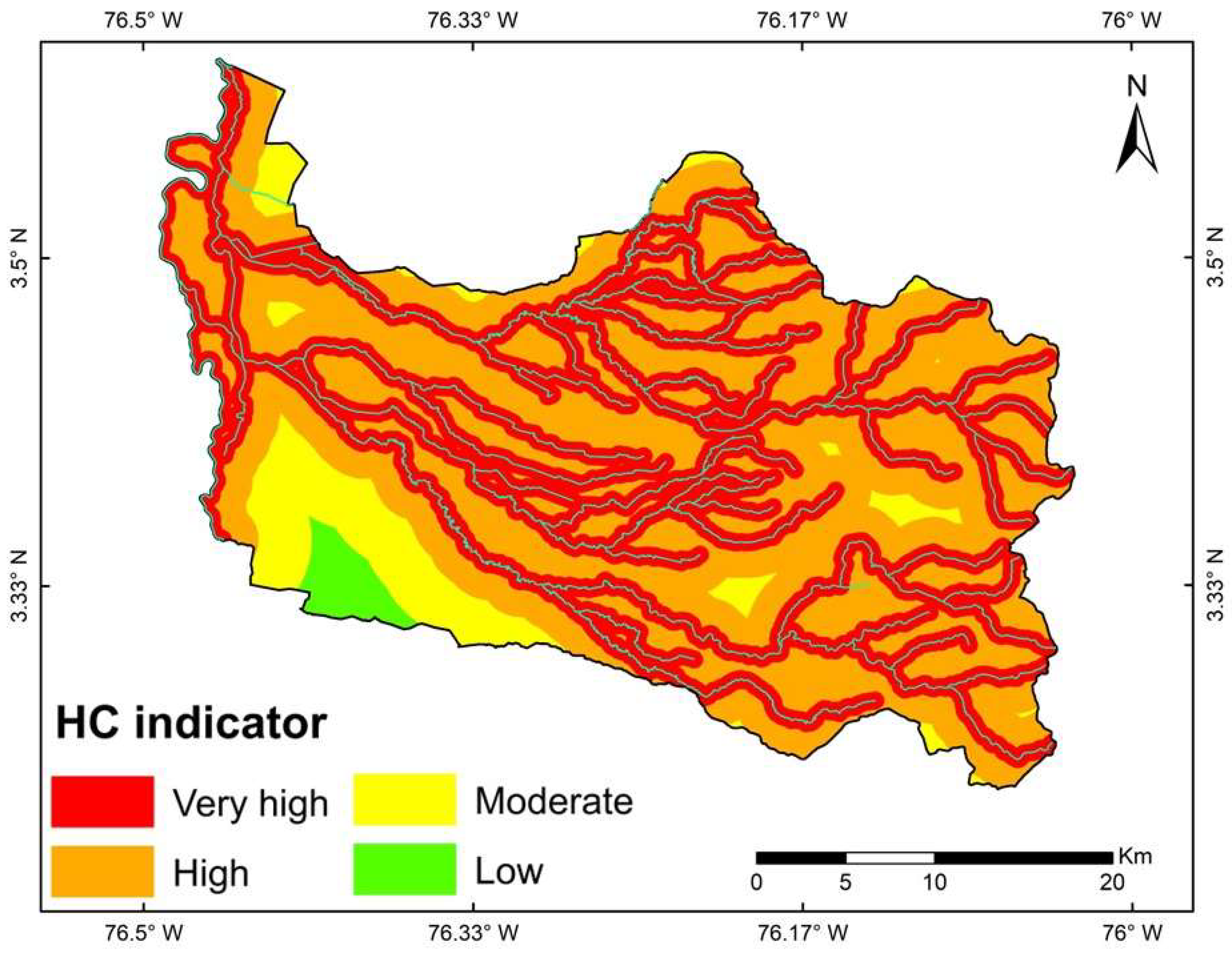
The spatial distribution of hydrological connectivity-derived vulnerability (HC) reveals that 35% of the GRW exhibits very high connectivity, indicating areas where surface water bodies are directly exposed to agricultural runoff due to minimal landscape buffering. An additional 44% of the watershed falls within the high vulnerability category, reflecting regions where pollutant transport pathways are only weakly attenuated by riparian vegetation or topographic separation. Moderate vulnerability was observed in 19% of the area, while only 2% was categorized as low vulnerability, mainly in zones with well-preserved riparian buffers. These spatial patterns underscore the extent of agricultural encroachment near stream networks and highlight widespread exposure of aquatic systems to diffuse pollution inputs (Figure 9).
Figure 9. HC indicator.

4.1.6. WQ Indicator

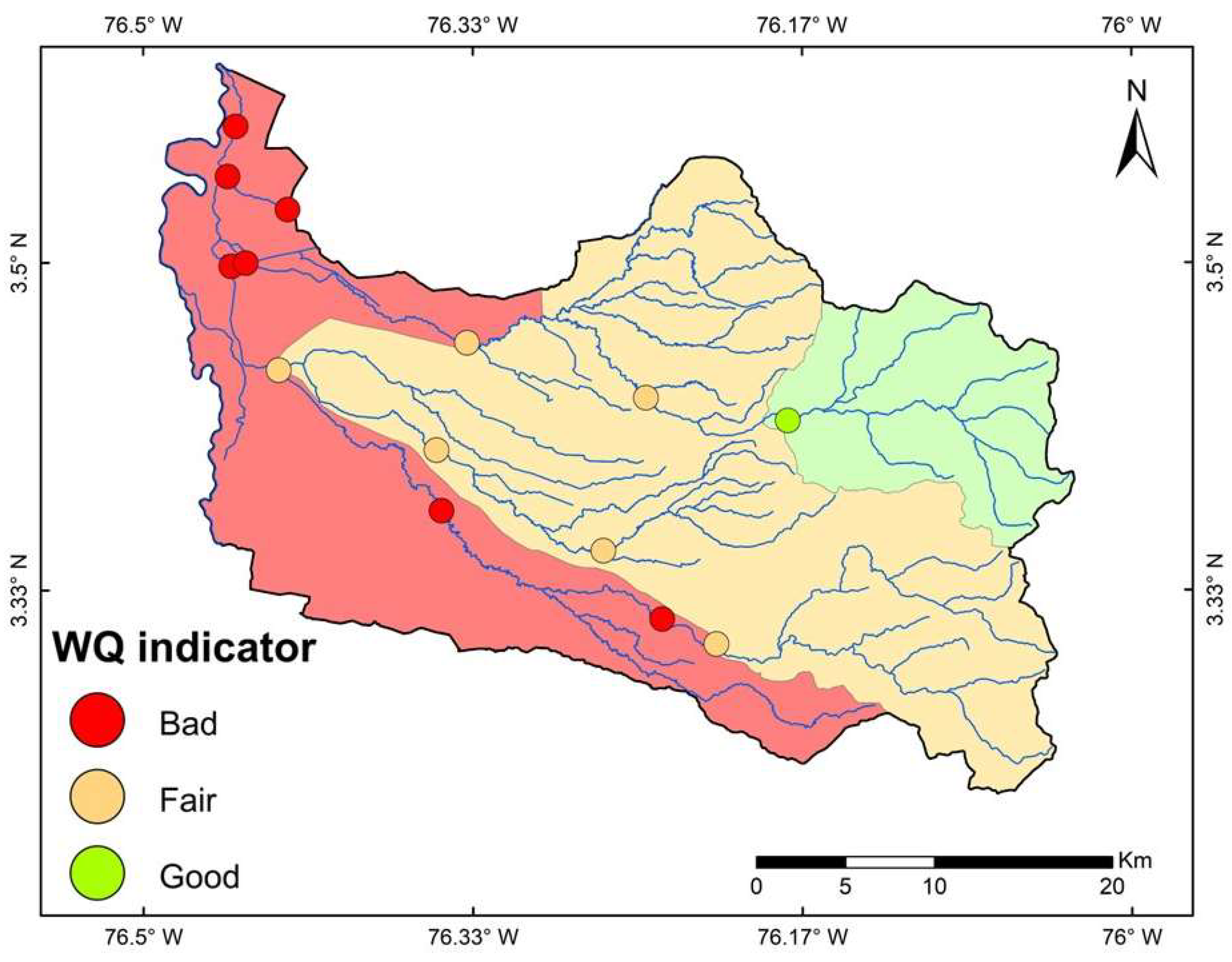
The spatial distribution of water quality-derived vulnerability (WQ) indicates that approximately 52% of the GRW falls within the moderate vulnerability category, corresponding to areas where pollutant dilution capacity is limited but not severely compromised. High vulnerability was observed in 34% of the watershed, primarily in zones affected by agricultural and urban runoff, where cumulative contaminant loads surpass the natural assimilation capacity of receiving waters. In contrast, 14% of the watershed exhibited low vulnerability, located in upstream areas with relatively intact ecological conditions and minimal pollutant input. The lowest water quality levels were consistently found in the downstream sections of the GRW, where sediment and nutrient accumulation from upstream sources intensify overall vulnerability (Figure 10).
Figure 10. WQ indicator.

4.1.7. IIVDC

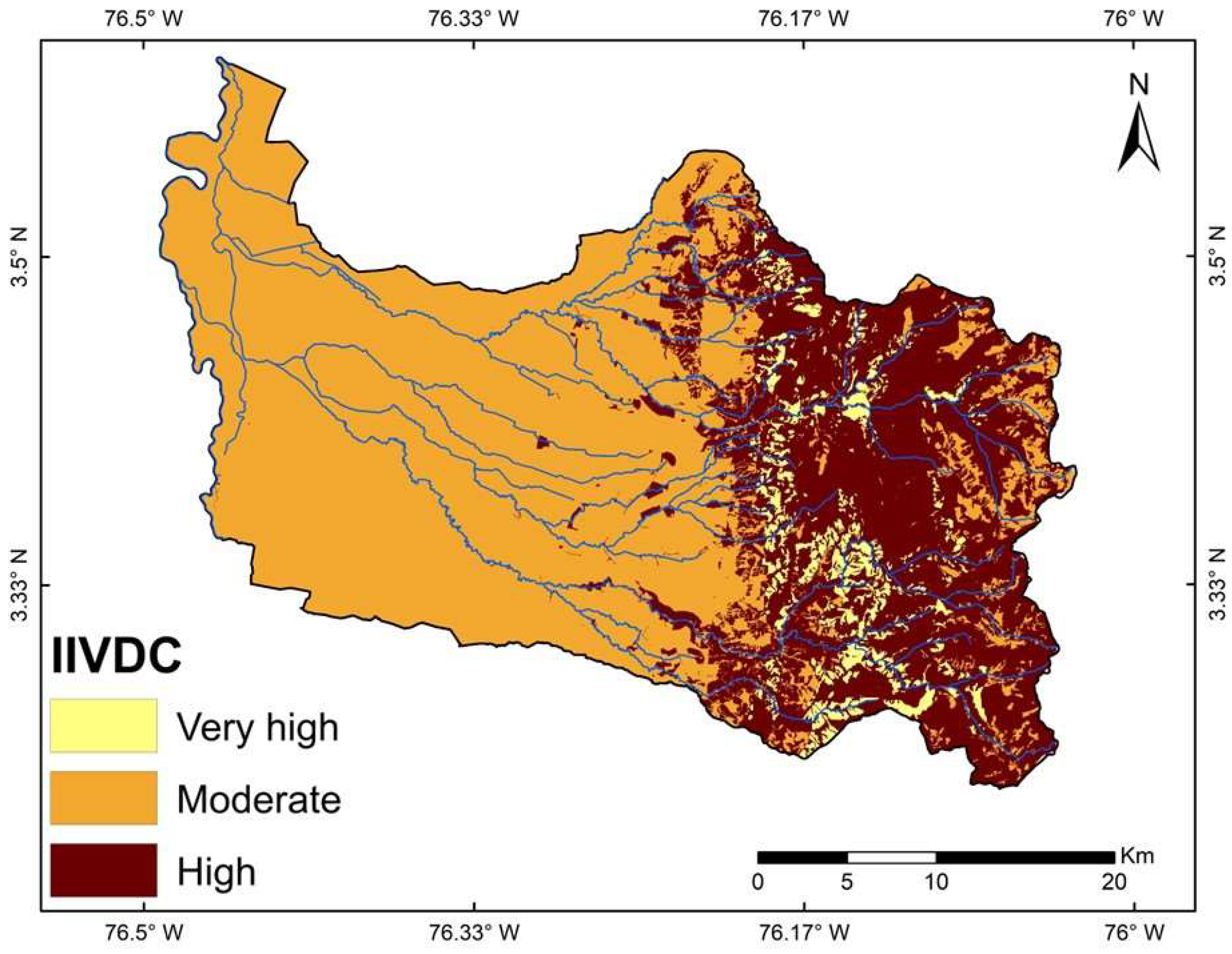
The final IIVDC map (Figure 11) reveals the cumulative spatial distribution of surface water vulnerability across the GRW, reflecting the combined influence of six environmental indicators. Approximately 63% of the watershed falls within the moderate vulnerability category, making it the most widespread classification in the study area. The remaining area is distributed among low, high, and very high vulnerability classes, with the greatest concentration of higher-risk zones occurring where multiple biophysical stressors converge. Notably, areas classified as moderate vulnerability frequently coincide with elevated values of RC and WQ, indicating their strong influence on the overall vulnerability landscape. The integrative vulnerability map provides a spatially detailed overview of risk intensity, identifying priority areas for intervention based on the compounded effects of runoff potential, pollutant transport, and hydrological exposure.
Figure 11. IIVDC.
Approximately 33.03% of the GRW was classified as having high vulnerability, indicating substantial exposure of surface waters to diffuse pollution in these zones (Table 4). This class most frequently overlapped with elevated values of SE, HC, and WQ, which contributed to widespread areas of high vulnerability despite localized variation. A smaller but critical portion of the watershed—4.25%—was identified as having very high vulnerability. These zones represent the spatial convergence of maximum risk values for RE, HC, and SE, and are concentrated in areas with intense pollutant mobilization and limited buffering capacity. Although SL received the highest weight during the parameter ranking process, its limited spatial extent in the GRW constrained its influence on the final vulnerability classification. Collectively, the results demonstrate that over one-third of the watershed faces high or very high vulnerability, underscoring the need for geographically targeted management and mitigation strategies.
Table 4. Vulnerable areas according to the IIVDC.

5. Discussion

5.1. Spatial Distribution of Vulnerability and Driving Factors

The IIVDC results reveal distinct spatial patterns of vulnerability throughout the GRW. The finding that over one-third (37.3%) of the watershed area exhibits high to very high vulnerability to agricultural diffuse pollution reflects the significant environmental challenges facing this region. This vulnerability distribution is not random but follows discernible landscape patterns that correspond to the interaction of key biophysical and anthropogenic factors. These patterns highlight the need to understand how physical terrain and land use practices converge to influence spatially differentiated vulnerability outcomes.
The concentration of high vulnerability zones in areas characterized by steep slopes, limited vegetation cover, and strong hydrological connectivity to agricultural land represents a critical finding with important implications for watershed management. This pattern aligns with fundamental hydrological principles regarding the transport of agricultural pollutants, where topography and landscape structure significantly influence pollutant movement and accumulation [111,141]. In particular, the positive relationship between slope gradient and vulnerability reflects the increased potential for surface runoff and erosion on steeper terrain, accelerating the transport of sediments and associated contaminants to surface water bodies. This confirms that slope is not only a biophysical factor but also a key vulnerability amplifier in areas undergoing agricultural intensification.
The influence of land use patterns on vulnerability distribution merits special attention. Our findings suggest that agricultural intensification, particularly in areas with limited buffer zones or riparian vegetation, significantly increases surface water vulnerability [142]. This relationship between land use and pollution vulnerability supports the findings of [39], who similarly identified land cover change—specifically deforestation—as a key driver of watershed vulnerability in the Dong Nai River system. The critical role of vegetation cover in mitigating diffuse pollution is further underscored by the negative correlation between forest/wetland presence and vulnerability scores in our assessment which goes in line with previous research [86]. These observations reinforce the importance of preserving or restoring natural vegetation to mitigate pollution risks in vulnerable agricultural zones.
Hydrological connectivity emerged as a particularly influential parameter in the IIVDC, highlighting the importance of understanding landscape configuration beyond simple land use proportions. Areas with high connectivity between pollution sources (agricultural fields) and receptors (water bodies) consistently showed elevated vulnerability scores, regardless of other factors. These results have been supported by similar research in agricultural watersheds worldwide [73,78,95,109,110]. The integration of connectivity metrics into vulnerability assessment represents a methodological advancement over approaches that consider land use in isolation from hydrological pathways. This finding underscores the value of incorporating spatial connectivity into future vulnerability models to better reflect the real-world dynamics of pollutant transport.

5.2. Methodological Novelty and Limitations

The IIVDC methodology developed in this study offers several innovations compared to existing approaches for assessing agricultural diffuse pollution. First, the integration of AHP with GIS provides a structured framework for incorporating expert knowledge into spatial decision-making, addressing the challenge of parameter weighting that often plagues multi-criteria analyses. The use of pairwise comparisons to derive parameter weights ensures a systematic consideration of relative importance, while maintaining transparency in the decision process. This approach improves upon purely statistical methods that may lack contextual understanding of watershed-specific dynamics. Therefore, the AHP-GIS integration enhances the interpretability and credibility of spatial vulnerability assessments, especially where stakeholder engagement is essential.
Second, the inclusion of hydrological connectivity as an explicit parameter represents a significant advancement over conventional vulnerability assessments. Many existing indices focus on biophysical properties (slope, soil type) and land use patterns without adequately capturing the pathways through which pollutants travel from source to receptor. By incorporating connectivity, the IIVDC acknowledges the critical role of landscape configuration in determining pollution risk, like the approach reported by [42] in their QuBES model. This reinforces the importance of spatial relationships in vulnerability modeling, especially in agricultural regions with fragmented or poorly buffered landscapes.
Third, the IIVDC methodology achieves a balance between complexity and applicability that makes it particularly suitable for contexts with limited data availability. Unlike physically based models such as SWAT, which require extensive parameterization and calibration [8], the IIVDC can be implemented with readily available spatial data while still capturing the essential drivers of vulnerability. This makes it especially valuable for regions like Colombia where comprehensive monitoring networks may be lacking. This operational flexibility expands the model’s relevance to decision-making in developing contexts and data-scarce regions.
Fourth, the methodology relies on publicly available spatial datasets, expert knowledge, and can be implemented using open-source GIS platforms such as QGIS (version 3.40.3)—avoiding the need for proprietary software (as used in this study), expensive sensors, or long-term field monitoring programs. This makes the approach particularly accessible for environmental authorities and municipalities with limited technical or financial resources, especially in developing regions.
Despite these strengths, several methodological limitations warrant acknowledgment. The static nature of the IIVDC means it does not capture temporal dynamics in vulnerability, such as seasonal variations in rainfall intensity or agricultural practices, which play a fundamental role in pollutants control [62,98]. This limitation is particularly relevant in tropical watersheds like the GRW, where pronounced wet and dry seasons can significantly alter pollutant transport patterns. Future iterations of the index could incorporate temporal dimensions by developing seasonal vulnerability maps or integrating climate change scenarios like those explored by [39]. Addressing temporal variability would enhance the index’s ability to support adaptive watershed management under changing hydro-climatic conditions.
The reliance on expert judgment for parameter weighting, while structured through AHP, introduces an element of subjectivity that could influence results. Although consistency ratios were calculated to validate the weighting process, alternative weighting schemes might yield different vulnerability patterns. Sensitivity analysis of parameter weights would provide valuable insights into the robustness of the IIVDC results. Additionally, the fuzzy-logic approach employed by [41] could offer a complementary method for handling uncertainty in parameter classification and weighting. Incorporating alternative weighting methods or uncertainty quantification could further strengthen the model’s analytical robustness and stakeholder trust.
An important methodological limitation of the AHP framework applied in this study concerns the spatial discriminatory power of parameters with high weights, such as SL. Although slope received a weight of 0.20 through expert consultation, the spatial distribution of this parameter in the GRW revealed that most of the area exhibits low slope values, converging toward a normalized vulnerability score of ~0.19. This results in reduced variability and limited influence of the slope indicator in distinguishing vulnerable zones. This discrepancy highlights a general limitation of expert-based weighting systems: the assigned importance may not always align with the actual heterogeneity of spatial data. Future improvements may consider dynamic or data-driven weighting approaches or introduce region-specific adjustment factors to better reflect the spatial expression of each parameter.
This observation also highlights a broader limitation of the AHP-derived weighting scheme: even when weights are theoretically justified, the actual influence of parameters can be muted when their spatial variability is low or when their distributions are skewed. In such cases, high weights may not translate into meaningful discrimination between vulnerability classes, potentially reducing the sensitivity of the index. Therefore, incorporating preliminary spatial analysis into the weighting process or applying post hoc sensitivity tests could enhance alignment between theoretical importance and spatial influence.
As part of this study, the spatial results of the IIVDC were compared with historical water quality measurements across the GRW, using field data from 12 monitoring stations. While not a full-scale validation, this cross-referencing helped assess spatial consistency and detect potential mismatches between predicted vulnerability and empirical conditions. Additionally, preliminary trials were conducted to test alternative classification schemes and parameter ranking thresholds (e.g., using quantiles and equal intervals), indicating that classification sensitivity has a tangible effect on final outputs. These internal checks, while not exhaustive, increase confidence in the IIVDC’s reliability and suggest that the framework already incorporates elements of adaptive refinement.
The spatial resolution of input data represents another limitation, particularly for parameters like soil erodibility and water quality, which may exhibit significant fine-scale heterogeneity. The use of interpolation techniques to generate continuous surfaces from point measurements inevitably introduces uncertainty that propagates through the model. Improvements in monitoring networks and remote sensing capabilities could enhance the spatial resolution and accuracy of these parameters in future applications. Another limitation concerns the classification scheme used to define vulnerability thresholds. While natural breaks were selected to reflect the underlying distribution of index values, the resulting classification led to 37.3% of the watershed being categorized as high or very high vulnerability—potentially limiting the ability to distinguish among the most critical subzones. Future work could include sensitivity analysis of classification thresholds and alternative reclassification methods (e.g., quantiles or expert-informed thresholds) to improve the discriminatory capacity of the index for resource prioritization. This highlights the ongoing need to improve data quality and spatial granularity to reduce propagation of uncertainty in vulnerability assessments.
Compared to alternative modeling frameworks such as physically based models (e.g., SWAT), ML algorithms, or fuzzy logic, AHP offers a transparent and interpretable structure for incorporating expert knowledge and prioritizing variables, particularly when empirical data are sparse. In contrast to data-driven approaches that require extensive calibration and training datasets, AHP is well-suited for early-stage assessments or planning efforts in regions with limited monitoring infrastructure. However, AHP does not capture non-linear relationships or probabilistic interactions among parameters, which limits its predictive capacity. As such, the IIVDC is best positioned as a spatial diagnostic and prioritization tool, rather than a forecasting model. For future applications, the AHP framework could be hybridized with other approaches—such as ML-based weighting refinements or graph-based modeling—to improve sensitivity in more complex or dynamic contexts while preserving stakeholder inclusiveness and spatial clarity.

5.3. Implications for Watershed Management and Policy

The IIVDC results offer a spatially explicit and evidence-based framework for prioritizing interventions aimed at reducing agricultural diffuse pollution in the GRW. By delineating areas of high and very high vulnerability—together, comprising 37.3% of the watershed—the index enables decision-makers to strategically allocate limited resources toward zones where mitigation efforts are likely to yield the greatest environmental benefit. This targeted approach is consistent with contemporary principles of efficient resource allocation in watershed management and reinforces the need for spatially differentiated policies over uniform regulatory measures. It is particularly aligned with the concepts of Hydrologically Sensitive Areas (HSAs) and Critical Source Areas (CSAs), which emphasize the disproportionate role of certain landscape units in driving pollutant export [58,61,93,101,102,117,126]. Accordingly, the IIVDC can serve as a prioritization tool to focus both regulatory and conservation efforts where they are most urgently needed.
For the high vulnerability zones characterized by steep slopes and strong hydrological connectivity, several management implications emerge. First, these areas should be prioritized for implementation of soil conservation practices such as contour farming, terracing, and reduced tillage to minimize erosion and sediment transport. If possible, technologies such as LiDAR could be used to improve our understanding of the microtopography features that might affect pollutants transport in the landscape [143]. Second, the establishment or enhancement of riparian buffer zones along streams traversing these vulnerable areas could significantly reduce pollutant transfer to surface waters. These site-specific measures offer practical, evidence-based strategies for addressing the most acute risks identified by the IIVDC.
The relationship between land use and vulnerability suggests that land use planning represents a powerful tool for reducing diffuse pollution. Strategic placement of land uses with low pollution potential (forests, protected areas) in critical landscape positions could substantially alter vulnerability patterns. This finding supports integrated approaches to watershed management that consider not only the proportion of different land uses but also their spatial configuration relative to hydrological networks. Thus, landscape planning should be viewed not only as a zoning exercise but as a key strategy for pollution prevention at the watershed scale.
For agricultural areas specifically, the IIVDC results highlight the need for targeted best management practices (BMPs) that address both source reduction and transport interception. In high vulnerability zones, emphasis should be placed on precision agriculture techniques to minimize excess application of fertilizers and pesticides, coupled with structural measures like grassed waterways and sediment ponds to intercept pollutants along transport pathways [42,116]. This multi-barrier approach acknowledges that vulnerability results from the interaction of multiple factors that must be addressed comprehensively. Consequently, BMP implementation should be spatially guided by vulnerability profiles to maximize their effectiveness and efficiency.
From a policy perspective, the IIVDC methodology provides a scientific foundation for developing spatially differentiated regulations and incentives. Areas identified as having very high vulnerability might warrant stricter controls on agricultural practices, while incentive programs for BMP adoption could be strategically focused on high vulnerability zones to maximize cost-effectiveness. The spatially explicit nature of the IIVDC enables the formulation of parameter-specific intervention strategies tailored to localized conditions. For example, subzones exhibiting high hydrological connectivity and elevated runoff potential (e.g., midstream agricultural margins near Santa Rosa and El Placer) would benefit from buffer restoration, stormwater retention structures, and vegetative filters to interrupt pollutant transport pathways. Areas dominated by high soil erodibility and steep slopes (e.g., eastern highland fringes) should be prioritized for soil stabilization measures, including cover cropping and terracing. In zones with poor water quality scores but moderate physical vulnerability (e.g., lowland irrigation districts), improved fertilizer management and wastewater control are more relevant than structural changes. This spatial disaggregation of drivers supports more precise allocation of resources and ensures that management actions are aligned with the dominant vulnerability mechanisms present in each zone.
The approach also supports monitoring program design by identifying critical areas where water quality sampling should be intensified to track the effectiveness of interventions. By aligning technical assessments with regulatory and financial mechanisms, the IIVDC can enhance the coordination between environmental diagnostics and actionable watershed policy.
While the spatial analysis revealed that urbanized zones tend to exhibit higher vulnerability and less developed zones lower vulnerability, such outcomes—though intuitive—highlight critical gaps in spatial governance and land use planning. These results underscore the need to incorporate spatial vulnerability mapping, such as the IIVCD, into municipal planning frameworks and watershed management programs. Specifically, urban–rural interfaces characterized by high hydrological connectivity and low vegetative buffers should be prioritized for the implementation of riparian buffer restoration, enforcement of runoff mitigation infrastructure, and zoning restrictions on agrochemical usage near surface water bodies. Furthermore, the IIVCD can serve as a DST for identifying semi-urban expansion areas where proactive vulnerability mitigation strategies should be incorporated into environmental licensing and infrastructure development. By translating vulnerability scores into actionable planning zones, this research supports the design of more spatially explicit and equitable water quality protection policies.

5.4. Integration with Existing Frameworks and Future Research Directions

The IIVDC methodology complements existing water quality management frameworks in Colombia and has potential for integration with broader initiatives for sustainable watershed management. For instance, the spatial vulnerability assessment could inform the development and implementation of Planes de Ordenamiento y Manejo de Cuencas (POMCA, Watershed Management Plans) by identifying priority areas for intervention and monitoring. The approach also aligns with Colombia’s commitments under the Sustainable Development Goals, particularly SDG 6 (Clean Water and Sanitation) and SDG 15 (Life on Land). Thus, the IIVDC can support the operationalization of national and international sustainability goals through improved spatial targeting of watershed interventions.
The integration of the IIVDC with existing hydrological and water quality models presents an opportunity for enhancing predictive capabilities. While the IIVDC identifies vulnerability based on intrinsic watershed characteristics, coupling it with process-based models like SWAT could enable scenario analysis to evaluate the potential impacts of climate change, land use modifications, or implementation of specific BMPs. This integration would leverage the strengths of both approaches—the spatial prioritization capabilities of the IIVDC and the process representation of physical models. Such hybrid modeling approaches could provide decision-makers with both diagnostic insights and future-oriented projections.
Several promising directions for future research emerge from this study. First, validation of the IIVDC through expanded water quality monitoring would strengthen confidence in its predictive capacity. Longitudinal sampling across vulnerability gradients could test the hypothesis that water quality degradation correlates with vulnerability scores. Second, the development of dynamic vulnerability indices that incorporate temporal variability in rainfall, agricultural practices, and hydrological connectivity would enhance the application of the IIVDC for seasonal planning and climate adaptation. These improvements would increase the model’s temporal resolution and relevance under conditions of hydro-climatic variability.
Third, exploration of scale dependencies in vulnerability assessment merits further investigation. The current application at the watershed scale might mask important sub-watershed dynamics or fail to capture transboundary effects. This is not an uncommon issue that needs to be addressed [5]. Multi-scale approaches that nest local assessments within broader regional contexts could provide more comprehensive understanding of vulnerability patterns. Moreover, stakeholder engagement could be systematically integrated into the IIVDC framework to incorporate local knowledge, values, and contextual insights—particularly from agricultural communities whose land management practices directly affect watershed health. Farmers often possess detailed understanding of their soils, microclimates, and field-specific challenges, which can enhance the relevance and accuracy of vulnerability assessments. Embedding such participatory approaches not only improves model applicability but also fosters local ownership of proposed mitigation strategies [58,144,145,146]. Incorporating both spatial scaling and participatory components would make the IIVDC a more inclusive and context-sensitive decision-support tool.
The IIVDC framework represents a significant step toward bridging scientific analysis and practical watershed management. By translating complex environmental dynamics into spatially explicit vulnerability maps, the index supports evidence-based decision-making and helps identify priority zones for intervention. In the case of the GRW, results underscore the need for integrated strategies—such as land use planning, riparian buffer restoration, and implementation of BMPs—specifically targeted at areas classified as high or very high vulnerability. These insights reaffirm the value of the IIVDC as a bridge between spatial analysis and on-the-ground action.
While the parameter weights and classifications may require adjustment to suit different ecological or agricultural contexts, the core structure of the IIVDC is adaptable and transferable. Testing the framework in contrasting watersheds—from humid Andean environments to drier coastal basins—would further validate its robustness and scalability. The spatial heterogeneity observed in the GRW highlights the importance of context-specific, adaptive management approaches, a principle increasingly emphasized in modern environmental governance. Therefore, future applications of the IIVDC should be tailored to local environmental conditions while preserving its replicable methodological foundation.
By offering a transparent, multicriteria methodology for assessing diffuse pollution risk, the IIVDC contributes meaningfully to the scientific and operational toolkit for sustainable watershed management in data-limited and agriculturally stressed regions.

6. Conclusions

This study developed the IIVDC, a spatially explicit AHP-GIS framework, to assess surface water vulnerability to agricultural NPP in the GRW. The IIVDC integrates terrain, soil properties, hydrological connectivity, land use, runoff dynamics, and observed water quality into high-resolution vulnerability maps that support targeted mitigation strategies.
The application of the IIVDC revealed that 37.3% of the watershed is classified as high to very high vulnerability, while an additional 62.7% exhibits moderate vulnerability, indicating that nearly the entire GRW faces non-negligible exposure to NPP. Vulnerability hotspots were concentrated in areas with steep slopes, poorly vegetated or intensively cultivated soils, and limited landscape buffers, particularly where HC and RC intersected with high SE values. Although SL had the highest individual weight, its limited spatial footprint in the GRW reduced its influence on the overall vulnerability map, illustrating how spatial distribution can moderate parameter influence.
By offering a spatially detailed, operationally simple, and locally adaptable tool, the IIVDC contributes directly to sustainability efforts in land and water governance. It enables the identification and ranking of vulnerable areas, informing the prioritization of mitigation investments, adaptive land management practices, and institutional responses. In doing so, it supports long-term water resource protection and landscape resilience in agricultural regions facing socio-environmental pressures.
Methodologically, the IIVDC advances conventional vulnerability assessments by explicitly incorporating hydrological connectivity and expert-derived AHP weighting, ensuring transparency and adaptability in data-scarce environments. The framework’s reliance on publicly available spatial data enhances its replicability across regions facing similar agricultural pressures.
Looking ahead, future research should focus on incorporating temporal dynamics through time-series hydrological modeling and remote sensing, expanding field validation, and integrating ML for sensitivity analysis and parameter optimization. With appropriate modifications, the IIVDC holds potential for evaluating vulnerability to other pollution sources, aligning with global efforts to advance sustainable land and water use planning in the face of agricultural intensification and climatic variability. Ultimately, this study demonstrates that combining multicriteria decision analysis with spatial modeling offers a scientifically sound and operationally feasible approach for bridging scientific analysis and policy action at the watershed scale.

Supplementary Materials

The following supporting information can be downloaded at: https://www.mdpi.com/article/10.3390/su17094130/s1, Supplementary S1 (List of references and bibliometric figures), Supplementary S2 (K-factor calculation results for soil erodibility (K)), Supplementary S3 (Reclassification of soils into hydrologic groups), Supplementary S4 (Land use/land cover-LULC reclassification), Supplementary S5 (Reclassification of land covers neighboring the Guachal River Watershed), Supplementary S6 (Functions of the sub-indices for each parameter of the ICAUCA methodology), Supplementary S7 (ICAUCA calculation for the GRW), Supplementary S8 (Paired comparison scale of parameters) and Supplementary S9 (Classification and normalization criteria for IIVDC parameters).

Author Contributions

V.F.T.-G.: Conceptualized and designed the data acquisition campaigns; directed and conducted the field campaigns; analyzed and interpreted the data; drafted and revised the manuscript. A.F.E.-S. and A.M.B.-R.: Conceptualized and designed the data acquisition campaigns; contributed to data analysis and interpretation; collaborated in drafting and revising the manuscript. A.F.-C. and J.A.B.-B.: Contributed to data analysis, interpretation and collaborated in drafting final version of the manuscript. All authors have read and agreed to the published version of the manuscript.

Funding

This research received no funding.

Data Availability Statement

All relevant data have been organized in Supplementary sections.

Acknowledgments

We are deeply appreciative of the valuable comments and suggestions provided by the anonymous reviewers, which have significantly contributed to the improvement of this paper.

Conflicts of Interest

The authors declare no conflicts of interest.

References

  1. Hao, C.L.; Yan, D.H.; Xiao, W.H.; Yin, J. Research framework & key issues for non-point source pollution in agriculture induced by water-loss and soil-erosion. Adv. Mater. Res. 2013, 726, 3855–3866. [Google Scholar] [CrossRef]
  2. Ongley, E.D. Non-point source water pollution in China: Current status and future prospects. Water Int. 2004, 29, 299–306. [Google Scholar] [CrossRef]
  3. Stagnari, F.; Jan, S.; Angelica, G.; Michele, P. Sustainable agricultural practices for water quality protection. In Water Stress and Crop Plants: A Sustainable Approach; Ahmad, P., Ed.; John Wiley and Sons: Hoboken, NJ, USA, 2016; Volume 1, pp. 75–85. ISBN 978-111-905-445-0. [Google Scholar]
  4. Macintosh, K.A.; Mayer, B.K.; McDowell, R.W.; Powers, S.M.; Baker, L.A.; Boyer, T.H.; Rittmann, B.E. Managing diffuse phosphorus at the source versus at the sink. Environ. Sci. Technol. 2018, 52, 11995–12009. [Google Scholar] [CrossRef]
  5. Harrison, S.; McAree, C.; Mulville, W.; Sullivan, T. The problem of agricultural ‘diffuse’ pollution: Getting to the point. Sci. Total Environ. 2019, 677, 700–717. [Google Scholar] [CrossRef] [PubMed]
  6. Panagopoulos, Y.; Makropoulos, C.; Mimikou, M. Decision support for diffuse pollution management. Environ. Model. Softw. 2012, 30, 57–70. [Google Scholar] [CrossRef]
  7. Pang, S.; Wang, X.; Melching, C.S.; Guo, H.; Li, W. Identification of multilevel priority management areas for diffuse pollutants based on streamflow continuity in a water-deficient watershed. J. Clean. Prod. 2022, 351, 131322. [Google Scholar] [CrossRef]
  8. Liu, R.; Zhang, P.; Wang, X.; Wang, J.; Yu, W.; Shen, Z. Cost-effectiveness and cost-benefit analysis of BMPs in controlling agricultural nonpoint source pollution in China based on the SWAT model. Environ. Monit. Assess. 2014, 186, 9011–9022. [Google Scholar] [CrossRef]
  9. Saaty, T.L. The modern science of multicriteria decision making and its practical applications: The AHP/ANP approach. Oper. Res. 2013, 61, 1101–1118. [Google Scholar] [CrossRef]
  10. Asfaw, D.; Mengistu, D. Modeling Megech watershed aquifer vulnerability to pollution using modified DRASTIC model for sustainable groundwater management, Northwestern Ethiopia. Groundw. Sustain. Dev. 2020, 11, 100375. [Google Scholar] [CrossRef]
  11. Paul, M.; Negahban-Azar, M.; Shirmohammadi, A.; Montas, H.J. Developing a multicriteria decision analysis framework to evaluate reclaimed wastewater use for agricultural irrigation: The case study of Maryland. Hydrology 2021, 8, 4. [Google Scholar] [CrossRef]
  12. Gad, M.; Saleh, A.; Hussein, H.; Elsayed, S.; Farouk, M. Water quality evaluation and prediction using irrigation indices, artificial neural networks, and partial least square regression models for the Nile River, Egypt. Water 2023, 15, 2244. [Google Scholar] [CrossRef]
  13. Chen, H.; Fu, Y.; Brown, L.C. GIS-based Environmental Analysis Method for Rural Areas. In Proceedings of the 2013 ASABE Annual International Meeting, Kansas City, MO, USA, 21–24 July 2013; American Society of Agricultural and Biological Engineers: St. Joseph, MI, USA, 2013. [Google Scholar]
  14. Husen, S.; Khamitkar, S.; Bhalchandra, P.; Tamsekar, P.; Kulkarni, G.; Hambarde, K. Integrated Use of AHP and GIS Techniques for Selection of Artificial Water Recharge Sites. In Information and Communication Technology for Sustainable Development, Proceedings of the ICT4SD 2018, Goa, India, 30–31 August 2018; Tuba, M., Akashe, S., Joshi, A., Eds.; Advances in Intelligent Systems and Computing; Springer: Singapore, 2020; Volume 933, pp. 171–181. [Google Scholar] [CrossRef]
  15. Do, T.N.; Nguyen, D.-M.T.; Ghimire, J.; Vu, K.-C.; Do Dang, L.-P.; Pham, S.-L.; Pham, V.-M. Assessing surface water pollution in Hanoi, Vietnam, using remote sensing and machine learning algorithms. Environ. Sci. Pollut. Res. 2023, 30, 82230–82247. [Google Scholar] [CrossRef] [PubMed]
  16. Lai, E.; Lundie, S.; Ashbolt, N.J. Review of multi-criteria decision aid for integrated sustainability assessment of urban water systems. Urban Water J. 2008, 5, 315–327. [Google Scholar] [CrossRef]
  17. Saeed, M.O.; Aziz, H.A.; Azizli, K.A. The art of integrated GIS/AHP for siting landfill: A review. Appl. Mech. Mater. 2014, 567, 144–149. [Google Scholar] [CrossRef]
  18. Tone, K.; Tsutsui, M. Dynamic DEA with network structure: A slacks-based measure approach. Omega 2014, 42, 124–131. [Google Scholar] [CrossRef]
  19. Lee, E.H. eXplainable DEA approach for evaluating performance of public transport origin-destination pairs. Res. Transp. Econ. 2024, 108, 101491. [Google Scholar] [CrossRef]
  20. Yılmaz, B.; Yurdusev, M.A. Use of data envelopment analysis as a multi-criteria decision tool—A case of irrigation management. Math. Comput. Appl. 2011, 16, 669–679. [Google Scholar] [CrossRef]
  21. Wątróbski, J.; Jankowski, J.; Ziemba, P.; Karczmarczyk, A.; Zioło, M. Generalised framework for multi-criteria method selection. Omega 2018, 86, 107–124. [Google Scholar] [CrossRef]
  22. Izadikhah, M. Modeling bank performance: A novel fuzzy two-stage DEA approach. Fuzzy Inf. Eng. 2020, 11, 149–174. [Google Scholar] [CrossRef]
  23. Andersson, T.D.; Hartman, T. Productivity and efficiency in restaurants: A data envelopment approach. J. Hosp. Financ. Manag. 1995, 4, 1–20. [Google Scholar] [CrossRef]
  24. De Angeli, S.; Malamud, B.D.; Rossi, L.; Taylor, F.E.; Trasforini, E.; Rudari, R. A multi-hazard framework for spatial-temporal impact analysis. Int. J. Disaster Risk Reduct. 2022, 73, 102829. [Google Scholar] [CrossRef]
  25. Zhang, H.; Huang, G.H. Assessment of non-point source pollution using a spatial multicriteria analysis approach. Ecol. Model. 2011, 222, 313–321. [Google Scholar] [CrossRef]
  26. Grimene, C.; Mghirbi, O.; Louvet, S.; Bord, J.-P.; Le Grusse, P. Spatial characterization of surface water vulnerability to diffuse pollution related to pesticide contamination: Case of the Gimone watershed in France. Environ. Sci. Pollut. Res. 2022, 29, 17–39. [Google Scholar] [CrossRef] [PubMed]
  27. Kumar, A.; Pant, S. Analytical hierarchy process for sustainable agriculture: An overview. MethodsX 2023, 10, 101954. [Google Scholar] [CrossRef]
  28. Sanchez, E.F.; Alvarez, C.I. Prioritization of hydrological restoration areas using AHP and GIS in Dulcepamba River Basin in Bolivar–Ecuador. Hydrology 2024, 11, 81. [Google Scholar] [CrossRef]
  29. Kucuker, D.M.; Cedano Giraldo, D. Assessment of soil erosion risk using an integrated approach of GIS and Analytic Hierarchy Process (AHP) in Erzurum, Turkiye. Ecol. Inform. 2022, 71, 101788. [Google Scholar] [CrossRef]
  30. Pramanik, M.K. Site suitability analysis for agricultural land use of Darjeeling district using AHP and GIS techniques. Model. Earth Syst. Environ. 2016, 2, 56. [Google Scholar] [CrossRef]
  31. Topuz, M.; Deniz, M. Application of GIS and AHP for land use suitability analysis: Case of Demirci district (Turkey). Humanit. Soc. Sci. Commun. 2023, 10, 342. [Google Scholar] [CrossRef]
  32. Agyenim, J.B.; Gupta, J. IWRM and developing countries: Implementation challenges in Ghana. Phys. Chem. Earth 2012, 47–48, 46–57. [Google Scholar] [CrossRef]
  33. Croke, B.F.W.; Ticehurst, J.L.; Letcher, R.A.; Norton, J.P.; Newham, L.T.H.; Jakeman, A.J. Integrated assessment of water resources: Australian experiences. Water Resour. Manag. 2007, 21, 351–373. [Google Scholar] [CrossRef]
  34. Guzman, C.D.; Hoyos-Villada, F.; Da Silva, M.; Zimale, F.A.; Chirinda, N.; Botero, C.; Morales Vargas, A.; Rivera, B.; Moreno, P.; Steenhuis, T.S. Variability of soil surface characteristics in a mountainous watershed in Valle del Cauca, Colombia: Implications for runoff, erosion, and conservation. J. Hydrol. 2019, 576, 273–286. [Google Scholar] [CrossRef]
  35. Hamel, P.; Riveros-Iregui, D.; Ballari, D.; Browning, T.; Célleri, R.; Chandler, D.; Chun, K.P.; Destouni, G.; Jacobs, S.; Jasechko, S.; et al. Watershed services in the humid tropics: Opportunities from recent advances in ecohydrology. Ecohydrology 2018, 11, e1921. [Google Scholar] [CrossRef]
  36. Hoyos, N.; Waylen, P.R.; Jaramillo, Á. Seasonal and spatial patterns of erosivity in a tropical watershed of the Colombian Andes. J. Hydrol. 2005, 314, 177–191. [Google Scholar] [CrossRef]
  37. Tiwari, A.K.; Suozzi, E.; Silva, C.; De Maio, M.; Zanetti, M. Role of integrated approaches in water resources management: Antofagasta region, Chile. Sustainability 2021, 13, 1297. [Google Scholar] [CrossRef]
  38. Villamizar, M.L.; Brown, C.D. Modelling triazines in the valley of the River Cauca, Colombia, using the annualized agricultural non-point source pollution model. Agric. Water Manag. 2016, 177, 24–36. [Google Scholar] [CrossRef]
  39. Hung, P.; Le, T.V.; Vo, P.L.; Duong, H.C.; Rahman, M.M. Vulnerability assessment of water resources using GIS, remote sensing and SWAT model—A case study: The upper part of Dong Nai river basin, Vietnam. Int. J. River Basin Manag. 2022, 20, 517–532. [Google Scholar] [CrossRef]
  40. Kiesling, R.L.; Elliott, S.M.; Kennedy, J.L.; Hummel, S.L. Validation of a vulnerability index of exposure to chemicals of emerging concern in surface water and sediment of Great Lakes tributaries of the United States. Sci. Total Environ. 2022, 830, 154618. [Google Scholar] [CrossRef] [PubMed]
  41. Ghiasvand, F.; Babaei, A.A.; Yazdani, M.; Birgani, Y.T. Spatial modeling of environmental vulnerability in the biggest river in Iran using geographical information systems. J. Environ. Health Sci. Eng. 2021, 19, 1069–1074. [Google Scholar] [CrossRef] [PubMed]
  42. Weissteiner, C.J.; Pistocchi, A.; Marinov, D.; Bouraoui, F.; Sala, S. An indicator to map diffuse chemical river pollution con-sidering buffer capacity of riparian vegetation—A pan-European case study on pesticides. Sci. Total Environ. 2014, 484, 64–73. [Google Scholar] [CrossRef]
  43. Fernandes, A.C.P.; Terêncio, D.P.S.; Pacheco, F.A.L.; Fernandes, L.F.S. A combined GIS-MCDA approach to prioritize stream water quality interventions, based on the contamination risk and intervention complexity. Sci. Total Environ. 2021, 798, 149322. [Google Scholar] [CrossRef]
  44. Drohan, P.J.; Bechmann, M.; Buda, A.; Djodjic, F.; Doody, D.; Duncan, J.M.; Iho, A.; Jordan, P.; Kleinman, P.J.; McDowell, R.; et al. A global perspective on phosphorus management decision support in agriculture: Lessons learned and future directions. J. Environ. Qual. 2019, 48, 1218–1233. [Google Scholar] [CrossRef] [PubMed]
  45. Rose, D.C.; Sutherland, W.J.; Parker, C.; Lobley, M.; Winter, M.; Morris, C.; Twining, S.; Ffoulkes, C.; Amano, T.; Dicks, L.V. Decision support tools for agriculture: Towards effective design and delivery. Agric. Syst. 2016, 149, 165–174. [Google Scholar] [CrossRef]
  46. Anandhi, A.; Kannan, N. Vulnerability assessment of water resources—Translating a theoretical concept to an operational framework using systems thinking approach in a changing climate: Case study in Ogallala Aquifer. J. Hydrol. 2018, 557, 460–474. [Google Scholar] [CrossRef]
  47. Caković, M.; Beloica, J.; Simić, S.B.; Miljković, P.; Lukić, S.; Baumgertel, A.; Schwaiger, F. Diffuse pollution and ecological risk assessment in Ludaš Lake Special Nature Reserve and Palić Nature Park (Pannonian Basin). Forests 2021, 12, 11461. [Google Scholar] [CrossRef]
  48. Candido, L.A.; Coêlho, G.A.G.; de Moraes, M.M.G.A.; Florêncio, L. Review of decision support systems and allocation models for integrated water resources management focusing on joint water quantity-quality. J. Water Resour. Plan. Manag. 2022, 148, 04021149. [Google Scholar] [CrossRef]
  49. Chen, G.; Liu, L.; Wang, W.; Wang, R.; Li, Y.; Tang, X.; Li, X. Effectiveness of best management practices for non-point source pollution in intensively managed agricultural watersheds. J. Clean. Prod. 2025, 495, 145076. [Google Scholar] [CrossRef]
  50. Chen, H.; Wang, C.; Ren, Q.; Liu, X.; Ren, J.; Kang, G.; Wang, Y. Long-term water quality dynamics and trend assessment reveal the effectiveness of ecological compensation: Insights from China’s first cross-provincial compensation watershed. Ecol. Indic. 2024, 169, 112853. [Google Scholar] [CrossRef]
  51. Chen, T.; Li, Y.; Wu, Z.; Guo, H.; Huang, Z. Contribution of the ratoon sugarcane with planting years to river pollution evidenced from the four-year watershed observation. Agric. Ecosyst. Environ. 2024, 373, 109099. [Google Scholar] [CrossRef]
  52. Chen, W.; Chen, Y.; Feng, Y. Assessment and prediction of water resources vulnerability based on a NRS-RF model: A case study of the Song-Liao River Basin, China. Entropy 2021, 23, 882. [Google Scholar] [CrossRef]
  53. Chhetri, R.; Kumar, P.; Pandey, V.P.; Singh, R.; Pandey, S. Vulnerability assessment of water resources in hilly region of Nepal. Sustain. Water Resour. Manag. 2020, 6, 39. [Google Scholar] [CrossRef]
  54. Cool, G.; Rodriguez, M.J.; Bouchard, C.; Levallois, P.; Joerin, F. Evaluation of the vulnerability to contamination of drinking water systems for rural regions in Québec, Canada. J. Environ. Plan. Manag. 2010, 53, 615–638. [Google Scholar] [CrossRef]
  55. Das, A. Surface water quality evaluation, apportionment of pollution sources and aptness testing for drinking using water quality indices and multivariate modelling in Baitarani River basin, Odisha. HydroResearch 2025, 8, 244–264. [Google Scholar] [CrossRef]
  56. de Ataide, L.C.P.; Silva, M.T.; Serrão, E.A.O.; Dantas, L.G.; Almeida, G.S.S.; Campos, J.H.B.C.; da Silva, V.P.R.; Silva, F.D.D.S. Application of factor analysis to determine hydrometeorological vulnerability for the Middle São Francisco. Rev. Bras. Meteorol. 2022, 37, 405–417. [Google Scholar] [CrossRef]
  57. Djodjic, F.; Markensten, H. From single fields to river basins: Identification of critical source areas for erosion and phosphorus losses at high resolution. Ambio 2019, 48, 1129–1142. [Google Scholar] [CrossRef]
  58. Djodjic, F.; Elmquist, H.; Collentine, D. Targeting critical source areas for phosphorus losses: Evaluation with soil testing, farmers’ assessment and modelling. Ambio 2018, 47, 45–56. [Google Scholar] [CrossRef] [PubMed]
  59. Ebrahimi, E.; Asadi, H.; Rahmani, M.; Farhangi, M.B.; Ashrafzadeh, A. Effect of precipitation and sediment concentration on the loss of nitrogen and phosphorus in the Pasikhan River. Aqua Water Infrastruct. Ecosyst. Soc. 2022, 71, 211–228. [Google Scholar] [CrossRef]
  60. El-Mahdy, M.E.S. A unified index of water resources systems vulnerability assessment—Translating the theoretical approach into a simple tool to assess climate change impact: Case study in Limpopo River Basin, Africa. Ain Shams Eng. J. 2022, 13, 101687. [Google Scholar] [CrossRef]
  61. Evenson, G.R.; Kalcic, M.; Wang, Y.C.; Robertson, D.; Scavia, D.; Martin, J.; Aloysius, N.; Apostel, A.; Boles, C.; Brooker, M.; et al. Uncertainty in critical source area predictions from watershed-scale hydrologic models. J. Environ. Manag. 2021, 279, 111506. [Google Scholar] [CrossRef]
  62. Moraes, J.F.S.; Cantalice, J.R.B.; Singh, V.P.; Piscoya, V.C.; Cunha Filho, M.; Guerra, S.M.; Almeida, P.L.R. Lateral sediment connectivity by curve number and a proposed approach to soil erodibility at the watershed scale. Catena 2024, 234, 107611. [Google Scholar] [CrossRef]
  63. Fernandes, A.C.P.; de Oliveira Martins, L.M.; Pacheco, F.A.L.; Fernandes, L.F.S. The consequences for stream water quality of long-term changes in landscape patterns: Implications for land use management and policies. Land Use Policy 2021, 109, 105679. [Google Scholar] [CrossRef]
  64. Ganasri, B.P.; Ramesh, H. Assessment of soil erosion by RUSLE model using remote sensing and GIS—A case study of Nethravathi Basin. Geosci. Front. 2016, 7, 953–961. [Google Scholar] [CrossRef]
  65. Giri, S.; Nejadhashemi, A.P.; Zhang, Z.; Woznicki, S.A. Integrating statistical and hydrological models to identify implementation sites for agricultural conservation practices. Environ. Model. Softw. 2015, 72, 327–340. [Google Scholar] [CrossRef]
  66. Giri, S.; Qiu, Z.; Zhang, Z. Assessing the impacts of land use on downstream water quality using a hydrologically sensitive area concept. J. Environ. Manag. 2018, 213, 309–319. [Google Scholar] [CrossRef]
  67. Giuliani, C.; Veisz, A.C.; Piccinno, M.; Recanatesi, F. Estimating vulnerability of water body using Sentinel-2 images and environmental modelling: The study case of Bracciano Lake (Italy). Eur. J. Remote Sens. 2019, 52 (Suppl. 4), 64–73. [Google Scholar] [CrossRef]
  68. Gui, Z.; Chen, X.; He, Y. Spatiotemporal analysis of water resources system vulnerability in the Lancang River Basin, China. J. Hydrol. 2021, 601, 126614. [Google Scholar] [CrossRef]
  69. Hai, D.T.; Phin, T.T. Determine the vulnerability of urban surface water resources in Rach Gia city, Vietnam using geographic information system. Int. J. GEOMATE 2019, 17, 340–346. [Google Scholar] [CrossRef]
  70. Hou, G.; Zheng, J.; Cui, X.; He, F.; Zhang, Y.; Wang, Y.; Li, X.; Fan, C.; Tan, B. Suitable coverage and slope guided by soil and water conservation can prevent non-point source pollution diffusion: A case study of grassland. Ecotoxicol. Environ. Saf. 2022, 241, 113804. [Google Scholar] [CrossRef] [PubMed]
  71. Hu, C.; Wu, Q.; Liu, G.; Ran, H.; Guo, M.; Zhu, J.; Zeng, J. Nitrogen and phosphorus non-point source pollution in the upper Wujiang River Karst Basin: Critical source areas identification and influencing factors. Ecol. Indic. 2025, 170, 112989. [Google Scholar] [CrossRef]
  72. Hu, J.; Ouyang, W.; Hou, C.; Ji, K.; Yang, Z. Effects of urban stormwater pollution on watershed diffuse loads under extreme precipitation conditions. J. Hydrol. 2025, 654, 132802. [Google Scholar] [CrossRef]
  73. Jiang, F.; Preisendanz, H.E.; Veith, T.L.; Cibin, R.; Drohan, P.J. Riparian buffer effectiveness as a function of buffer design and input loads. J. Environ. Qual. 2020, 49, 1599–1611. [Google Scholar] [CrossRef]
  74. Jun, K.S.; Chung, E.S.; Sung, J.Y.; Lee, K.S. Development of spatial water resources vulnerability index considering climate change impacts. Sci. Total Environ. 2011, 409, 5228–5242. [Google Scholar] [CrossRef] [PubMed]
  75. Kamalamma, A.G.; Babel, M.S.; Sridhar, V.; Vellingiri, G. A novel approach to vulnerability assessment for adaptation planning in agriculture: An application to the Lower Bhavani Irrigation Project, India. Clim. Serv. 2023, 30, 100358. [Google Scholar] [CrossRef]
  76. Kaur, L.; Rishi, M.S.; Arora, N.K. Deciphering pollution vulnerability zones of River Yamuna in relation to existing land use land cover in Panipat, Haryana, India. Environ. Monit. Assess. 2021, 193, 204. [Google Scholar] [CrossRef]
  77. Lee, G.; Jun, K.S.; Kang, M. Framework to prioritize watersheds for diffuse pollution management in the Republic of Korea: Application of multi-criteria analysis using the Delphi method. Nat. Hazards Earth Syst. Sci. 2019, 19, 2767–2779. [Google Scholar] [CrossRef]
  78. Lei, M.; Long, Y.; Li, T.; Ma, Y.; Zhang, G.; Peng, B.; Li, Z.; Liu, Y. Nitrogen dynamic transport processes shaped by watershed hydrological functional connectivity. J. Hydrol. 2024, 645, 132218. [Google Scholar] [CrossRef]
  79. Li, W.; Zhao, Z.; Lv, S.; Zhao, W.; Su, W. Vulnerability assessment of water resources in a karst mountainous area based on GIS/RS technology: A case study of Guiyang, Southwest China. Water Supply 2022, 22, 5206–5220. [Google Scholar] [CrossRef]
  80. Liu, X.; Zhou, S.; Qi, S.; Yang, B.; Chen, Y.; Huang, R.; Du, P. Zoning of rural water conservation in China: A case study at Ashihe River Basin. Int. Soil Water Conserv. Res. 2015, 3, 130–140. [Google Scholar] [CrossRef]
  81. Lou, H.; Yang, S.; Zhao, C.; Shi, L.; Wu, L.; Wang, Y.; Wang, Z. Detecting and analyzing soil phosphorus loss associated with critical source areas using a remote sensing approach. Sci. Total Environ. 2016, 573, 397–408. [Google Scholar] [CrossRef]
  82. Maniquiz, M.C.; Lee, S.; Min, K.S.; Kim, J.H.; Kim, L.H. Diffuse pollutant unit loads of various transportation land uses. Desalin. Water Treat. 2012, 38, 222–229. [Google Scholar] [CrossRef]
  83. Mansir, I.; Bouchaou, L.; Chebli, B.; Ait Brahim, Y.; Choukr-Allah, R. A specific indicator approach for the assessment of water resource vulnerability in arid areas: The case of the Souss-Massa Region (Morocco). Hydrol. Sci. J. 2021, 66, 1151–1168. [Google Scholar] [CrossRef]
  84. Mansour, S.; Kouz, T.; Belkendil, A.; Dekkaki, H.C. A comparative study to assess surface water’s anthropic and natural vulnerability using the DKPR and RUSLE approaches. Case of the watershed of the Joumouaa dam (Coastal basin of Ghiss, North East Morocco). E3S Web Conf. 2021, 298, 05005. [Google Scholar] [CrossRef]
  85. Samareh Hashemi, M.; Bagheri, A.; Rizzoli, A.E. The role of ex-post and ex-ante integrated assessment frameworks in conceptualization of the modeling process in the context of integrated water resources management. Water Resour. 2019, 46, 296–307. [Google Scholar] [CrossRef]
  86. Meng, X.; Xu, F.; Huang, Y.; Zhang, X.; Zhang, M. Evolution characteristics and driving factors of potential non-point source pollution risks in a watershed affected by land use changes. Heliyon 2024, 10, e37247. [Google Scholar] [CrossRef]
  87. Moncada, A.M.; Escobar, M.; Betancourth, A.; Vélez Upegui, J.J.; Zambrano, J.; Alzate, L.M. Modelling water stress vulnerability in small Andean basins: Case study of Campoalegre River Basin, Colombia. Int. J. Water Resour. Dev. 2021, 37, 640–657. [Google Scholar] [CrossRef]
  88. Mosquera, D.C.; López, C.M.; Flores, J.C.M. Evaluation of models to estimate rainfall erosivity in Valle del Cauca, Colombia. Acta Agron. 2021, 70, 164–170. [Google Scholar] [CrossRef]
  89. Ngene, B.U.; Nwafor, C.O.; Bamigboye, G.O.; Ogbiye, A.S.; Ogundare, J.O.; Akpan, V.E. Integrated water resources management in Nigeria: Implications for sustainable national development. IOP Conf. Ser. Mater. Sci. Eng. 2019, 640, 012101. [Google Scholar] [CrossRef]
  90. Nguyen, T.T.; Ngo, H.H.; Guo, W.; Nguyen, H.Q.; Luu, C.; Dang, K.B.; Liu, Y.; Zhang, X. New approach of water quantity vulnerability assessment using satellite images and GIS-based model: An application to a case study in Vietnam. Sci. Total Environ. 2020, 737, 139784. [Google Scholar] [CrossRef]
  91. Nuruzzaman, M.; Bahar, M.M.; Naidu, R. Diffuse soil pollution from agriculture: Impacts and remediation. Sci. Total Environ. 2025, 962, 178398. [Google Scholar] [CrossRef]
  92. Orlikowski, D.; Bugey, A.; Périllon, C.; Julich, S.; Guégain, C.; Soyeux, E.; Matzinger, A. Development of a GIS method to localize critical source areas of diffuse nitrate pollution. Water Sci. Technol. 2011, 64, 892–898. [Google Scholar] [CrossRef]
  93. Packham, I.; Mockler, E.; Archbold, M.; Mannix, A.; Daly, D.; Deakin, J.; Bruen, M. Catchment Characterisation Tool: Prioritising critical source areas for managing diffuse nitrate pollution. Environ. Model. Assess. 2020, 25, 23–39. [Google Scholar] [CrossRef]
  94. Pan, J.; Cai, F.; Yi, Z.; Zhang, W.; Yan, B.; Xue, C.; Yu, B.; Li, R. Landscape connectivity significantly influences the spatial spillover effects of soil erosion: Based on examples from typical karst watersheds. Ecol. Indic. 2025, 173, 113373. [Google Scholar] [CrossRef]
  95. Pang, S.; Wang, X.; Melching, C.S.; Feger, K.-H. Development and testing of a modified SWAT model based on slope condition and precipitation intensity. J. Hydrol. 2020, 588, 125098. [Google Scholar] [CrossRef]
  96. Park, Y.; Park, S.R.; Lee, S.W.; Lee, J. Impacts of watershed and meteorological characteristics on stream water quality resilience. J. Hydrol. 2025, 652, 132663. [Google Scholar] [CrossRef]
  97. Patiño-Gutiérrez, S.E.; Domínguez-Rivera, I.C.; Daza-Torrez, M.C.; Ochoa-Tocachi, B.F.; Oviedo-Ocaña, E.R. Effects of rainfall seasonality and land use change on soil hydrophysical properties of high-Andean dry páramo grasslands. Catena 2024, 238, 107866. [Google Scholar] [CrossRef]
  98. Peng, K.; Li, J.K.; Hao, G.R.; Liu, Y.W.; Zhou, X.; Xie, W.F. Characteristics of non-point source pollution based on monitoring experiment in the Yingwugou small watershed, China. Ecohydrol. Hydrobiol. 2023, 23, 1–14. [Google Scholar] [CrossRef]
  99. Pujiono, E.; Prasetyo, B.D.; Setyowati, R.; Kurniadi, R. Vulnerability assessment of water resources to climate variability in Noelmina watershed, Timor Island, Indonesia. IOP Conf. Ser. Earth Environ. Sci. 2021, 874, 012007. [Google Scholar] [CrossRef]
  100. Qin, J.; Ding, Y.J.; Zhao, Q.D.; Wang, S.P.; Chang, Y.P. Assessments on surface water resources and their vulnerability and adaptability in China. Adv. Clim. Change Res. 2020, 11, 381–391. [Google Scholar] [CrossRef]
  101. Reaney, S.M.; Mackay, E.B.; Haygarth, P.M.; Fisher, M.; Molineux, A.; Potts, M.; Benskin, C.M.H. Identifying critical source areas using multiple methods for effective diffuse pollution mitigation. J. Environ. Manag. 2019, 250, 109366. [Google Scholar] [CrossRef] [PubMed]
  102. Sharpley, A.N.; Kleinman, P.J.A.; Flaten, D.N.; Buda, A.R. Critical source area management of agricultural phosphorus: Experiences, challenges and opportunities. Water Sci. Technol. 2011, 64, 945–952. [Google Scholar] [CrossRef]
  103. Shi, C.; Liang, Y.; Qin, W.; Ding, L.; Cao, W.; Zhang, M.; Zhang, Q. Review of sediment connectivity: Conceptual connotations, characterization indicators, and their relationships with soil erosion and sediment yield. Earth-Sci. Rev. 2025, 264, 105091. [Google Scholar] [CrossRef]
  104. Shi, W.; Xia, J.; Gippel, C.J.; Chen, J.X.; Hong, S. Influence of disaster risk, exposure and water quality on vulnerability of surface water resources under a changing climate in the Haihe River basin. Water Int. 2017, 42, 462–485. [Google Scholar] [CrossRef]
  105. Singh, S.; Bhardwaj, A.; Verma, V.K. Remote sensing and GIS based analysis of temporal land use/land cover and water quality changes in Harike wetland ecosystem, Punjab, India. J. Environ. Manag. 2020, 262, 110355. [Google Scholar] [CrossRef]
  106. Stathatou, P.; Kampragou, E.; Grigoropoulou, H.; Assimacopoulos, D.; Karavitis, C.; Porto, M.F.A.; Gironás, J.; Vanegas, M.; Reyna, S. Vulnerability of water systems: A comprehensive framework for its assessment and identification of adaptation strategies. Desalin. Water Treat. 2016, 57, 2243–2255. [Google Scholar] [CrossRef]
  107. Sun, M.; Kato, T. Spatial-temporal analysis of urban water resource vulnerability in China. Ecol. Indic. 2021, 133, 108436. [Google Scholar] [CrossRef]
  108. Taloor, A.K.; Khajuria, V.; Parsad, G.; Bandral, S.; Mahajan, S.; Singh, S.; Sharma, M.; Kothyari, G.C. Geospatial assessment of soil erosion in the Basantar and Devak watersheds of the NW Himalaya: A study utilizing USLE and RUSLE models. Geosyst. Geoenviron. 2025, 4, 100355. [Google Scholar] [CrossRef]
  109. Thomas, I.A.; Jordan, P.; Mellander, P.E.; Fenton, O.; Shine, O.; hUallacháin, D.Ó.; Creamer, R.; McDonald, N.T.; Dunlop, P.; Murphy, P.N.C. Improving the identification of hydrologically sensitive areas using LiDAR DEMs for the delineation and mitigation of critical source areas of diffuse pollution. Sci. Total Environ. 2016, 556, 276–290. [Google Scholar] [CrossRef] [PubMed]
  110. Thomas, I.A.; Mellander, P.E.; Murphy, P.N.C.; Fenton, O.; Shine, O.; Djodjic, F.; Dunlop, P.; Jordan, P. A sub-field scale critical source area index for legacy phosphorus management using high resolution data. Agric. Ecosyst. Environ. 2016, 233, 238–252. [Google Scholar] [CrossRef]
  111. Torres, P.; Cruz, C.H.; Patiño, P.; Escobar, J.C.; Pérez, A. Aplicación de índices de calidad de agua-ICA orientados al uso de la fuente para consumo humano. Ing. Investig. 2010, 30, 86–95. [Google Scholar] [CrossRef]
  112. Tran, N.H.; Reinhard, M.; Khan, E.; Chen, H.; Nguyen, V.T.; Li, Y.; Goh, S.G.; Nguyen, Q.B.; Saeidi, N.; Gin, K.Y.H. Emerging contaminants in wastewater, stormwater runoff, and surface water: Application as chemical markers for diffuse sources. Sci. Total Environ. 2019, 676, 252–267. [Google Scholar] [CrossRef]
  113. Troian, A.; Gomes, M.C.; Tiecher, T.; Berbel, J.; Gutiérrez-Martín, C. The drivers-pressures-state-impact-response model to structure cause-effect relationships between agriculture and aquatic ecosystems. Sustainability 2021, 13, 9365. [Google Scholar] [CrossRef]
  114. Turunen, J.; Markkula, J.; Rajakallio, M.; Aroviita, J. Riparian forests mitigate harmful ecological effects of agricultural diffuse pollution in medium-sized streams. Sci. Total Environ. 2019, 649, 495–503. [Google Scholar] [CrossRef]
  115. Viessman, W.; Lewis, G.L. Introduction to Hydrology, 5th ed.; Pearson Education: Upper Saddle River, NJ, USA, 2003; ISBN 9780673993373. [Google Scholar]
  116. Wallace, C.W.; McCarty, G.; Lee, S.; Brooks, R.P.; Veith, T.L.; Kleinman, P.J.A.; Sadeghi, A.M. Evaluating concentrated flow-paths in riparian forest buffer contributing areas using LiDAR imagery and topographic metrics. Remote Sens. 2018, 10, 614. [Google Scholar] [CrossRef]
  117. Walter, M.T.; Walter, M.F.; Brooks, E.S.; Steenhuis, T.S.; Boll, J.; Weiler, K.R. Hydrologically sensitive areas: Variable source area hydrology implications for water quality risk assessment. J. Soil Water Conserv. 2000, 55, 277–284. [Google Scholar] [CrossRef]
  118. Wang, H.; Guan, Y.; Hu, M.; Hou, Z.; Ping, Y.; Zhang, Z.; Zhang, Q.; Shang, F.; Lin, K.; Feng, C. Enhancing pollution management in watersheds: A critical review of total maximum daily load (TMDL) implementation. Environ. Res. 2025, 264, 120394. [Google Scholar] [CrossRef] [PubMed]
  119. Wang, J.; Yin, W.; Wang, L.X.; Li, N.X.; Hao, R.; Xu, J.F.; Xiao, H.B.; Zhong, Z.M.; Zhang, Y.P.; Shi, Z.H. Unraveling the effects of hydrological connectivity and landscape characteristics on reservoir water quality. J. Hydrol. 2022, 613, 128410. [Google Scholar] [CrossRef]
  120. Wang, L.; Zhang, F.; Shi, X.; Zeng, C.; Ahmad, I.; Wang, G.; Thapa, S.; Xu, X. Water resources system vulnerability in high mountain areas under climate change. J. Clean. Prod. 2023, 403, 136789. [Google Scholar] [CrossRef]
  121. Wang, S.; Wang, Y.; Wang, Y.; Wang, Z. Assessment of influencing factors on non-point source pollution critical source areas in an agricultural watershed. Ecol. Indic. 2022, 141, 109084. [Google Scholar] [CrossRef]
  122. Wang, T.; Zhong, M.; Lu, M.; Xu, D.; Xue, Y.; Huang, J.; Blaney, L.; Yu, G. Occurrence, spatiotemporal distribution, and risk assessment of current-use pesticides in surface water: A case study near Taihu Lake, China. Sci. Total Environ. 2021, 782, 146826. [Google Scholar] [CrossRef]
  123. Wischmeier, W.H.; Smith, D.D. Predicting Rainfall Erosion Losses. A Guide to Conservation Planning. The USDA Agricultural Handbook No. 537; USDA: Washington, DC, USA, 1981. Available online: https://www.ars.usda.gov/ARSUserFiles/60600505/RUSLE/AH_537%20Predicting%20Rainfall%20Soil%20Losses.pdf (accessed on 4 March 2025).
  124. Xiang, Z.; Chen, X.; Lian, Y. Quantifying the vulnerability of surface water environment in humid areas based on DEA method. Water Resour. Manag. 2016, 30, 5101–5112. [Google Scholar] [CrossRef]
  125. Xu, Q.; Zhai, L.; Guo, S.; Wang, C.; Yin, Y.; Min, X.; Liu, H. Using surface runoff to reveal the mechanisms of landscape patterns driving on various forms of nitrogen in non-point source pollution. Sci. Total Environ. 2024, 954, 176338. [Google Scholar] [CrossRef]
  126. Xu, Y.; Li, P.; Ma, F.; Liu, X.; Zhang, N.; Pan, J.; Meng, Y. Watershed landscape characteristics and connectivity drive river water quality under seasonal dynamics. J. Clean. Prod. 2024, 473, 143533. [Google Scholar] [CrossRef]
  127. Xue, J.; Wang, Q.; Zhang, M. A review of non-point source water pollution modeling for the urban–rural transitional areas of China: Research status and prospect. Sci. Total Environ. 2022, 826, 154146. [Google Scholar] [CrossRef] [PubMed]
  128. Xue, S.; He, Y.; Cai, H.; Li, J.; Zhu, L.; Ye, C. Risk assessment of non-point source pollution in tropical watersheds considering water functional zones. Ecol. Indic. 2025, 171, 113128. [Google Scholar] [CrossRef]
  129. Yang, S.; Yang, G.; Li, B.; Wan, R. Water quality improves with increased spatially surface hydrological connectivity in plain river network areas. J. Environ. Manag. 2025, 377, 124703. [Google Scholar] [CrossRef]
  130. Yao, L.; Shuai, Y.; Chen, X. Regional water system vulnerability evaluation: A bi-level DEA with multi-followers approach. J. Hydrol. 2020, 589, 125160. [Google Scholar] [CrossRef]
  131. Zeleňáková, M.; Kubiak-Wojcicka, K.; Weiss, R.; Weiss, E.; Elhamid, H.F.A. Environmental risk assessment focused on water quality in the Laborec River watershed. Ecohydrol. Hydrobiol. 2021, 21, 641–654. [Google Scholar] [CrossRef]
  132. Zhang, H.; Zhou, X.; Lv, X.; Xu, X.; Weng, Q.; Lei, K. Exploration of the factors that influence total phosphorus in surface water and an evaluation of surface water vulnerability based on an advanced algorithm and traditional index method. J. Environ. Manag. 2023, 342, 118155. [Google Scholar] [CrossRef] [PubMed]
  133. Zhang, X.; Tian, Y.; Dong, N.; Wu, H.; Li, S. The projected futures of water resources vulnerability under climate and socioeconomic change in the Yangtze River Basin, China. Ecol. Indic. 2023, 147, 109933. [Google Scholar] [CrossRef]
  134. Cardinali, A.; Carletti, P.; Nardi, S.; Zanin, G. Design of riparian buffer strips affects soil quality parameters. Appl. Soil Ecol. 2014, 80, 67–76. [Google Scholar] [CrossRef]
  135. Echeverri, A.F.; Urrutia Cobo, N.; Barona Ramírez, S.M. Vulnerabilidad de fuentes hídricas superficiales de la cuenca del río Cerrito a la contaminación difusa agrícola. Rev. Investig. Agrar. Ambient. 2020, 11, 117–130. [Google Scholar] [CrossRef]
  136. Ramírez, O.F.A.; Hincapié, G.E.; Sadeghian, K.S. Erodabilidad de los suelos de la zona central cafetera del departamento de Caldas. Cenicafé 2009, 60, 58–71. [Google Scholar]
  137. Chow, V.T.; Maidment, D.R.; Mays, L.W. Applied Hydrology, 1st ed.; McGraw-Hill: New York, NY, USA, 1988; ISBN 9780070108103. [Google Scholar]
  138. McCuen, R.H. Hydrologic Analysis and Design, 4th ed.; Pearson: Upper Saddle River, NJ, USA, 2016; ISBN 978-0-13-431312-2. [Google Scholar]
  139. Urban Hydrology for Small Watersheds: Technical Release 55 (TR-55). USDA NRCS. Available online: https://www.nrc.gov/docs/ML1421/ML14219A437.pdf (accessed on 2 January 2025).
  140. National Engineering Handbook, Part 630: Hydrology; U.S. Department of Agriculture, Natural Resources Conservation Service. USDA NRCS. Available online: https://directives.nrcs.usda.gov/sites/default/files2/1712930592/29495.pdf (accessed on 2 January 2025).
  141. Buda, A.R.; Kleinman, P.J.A.; Srinivasan, M.S.; Bryant, R.B.; Feyereisen, G.W. Effects of hydrology and field management on phosphorus transport in surface runoff. J. Environ. Qual. 2009, 38, 2273–2284. [Google Scholar] [CrossRef] [PubMed]
  142. Buda, A.R.; Kleinman, P.J.A.; Srinivasan, M.S.; Bryant, R.B.; Feyereisen, G.W. Factors influencing surface runoff generation from two agricultural hillslopes in central Pennsylvania. Hydrol. Process. 2009, 23, 1295–1312. [Google Scholar] [CrossRef]
  143. Agnew, L.J.; Lyon, S.; Gérard-Marchant, P.; Collins, V.B.; Lembo, A.J.; Steenhuis, T.S.; Walter, M.T. Identifying hydrologically sensitive areas: Bridging the gap between science and application. J. Environ. Manag. 2006, 78, 63–76. [Google Scholar] [CrossRef]
  144. Young, E.O.; Ross, D.S. Total and labile phosphorus concentrations as influenced by riparian buffer soil properties. J. Environ. Qual. 2016, 45, 294–304. [Google Scholar] [CrossRef]
  145. Kuria, A.W.; Barrios, E.; Pagella, T.; Muthuri, C.W.; Mukuralinda, A.; Sinclair, F.L. Farmers’ knowledge of soil quality indicators along a land degradation gradient in Rwanda. Geoderma Reg. 2019, 16, e00199. [Google Scholar] [CrossRef]
  146. Suhardiman, D.; Giordano, M.; Leebouapao, L.; Keovilignavong, O. Farmers’ strategies as building block for rethinking sustainable intensification. Agric. Hum. Values 2016, 33, 563–574. [Google Scholar] [CrossRef]
Disclaimer/Publisher’s Note: The statements, opinions and data contained in all publications are solely those of the individual author(s) and contributor(s) and not of MDPI and/or the editor(s). MDPI and/or the editor(s) disclaim responsibility for any injury to people or property resulting from any ideas, methods, instructions or products referred to in the content.

Article Metrics

Citations

Article Access Statistics

Multiple requests from the same IP address are counted as one view.