


Abstract
In Brazil, several silicic rocks can be used as powder-based K sources, which can reduce production costs in agriculture. The optimized supply of K not only increases yield but also contributes to soil fertility preservation and long-term sustainability by curtailing nutrient losses and reducing the risk of nutrient imbalances. Therefore, this study aimed to investigate the effects of K application timing, source, and doses on nodulation, productive components, and productivity of soybeans in a not-tillage system in the Savannah. The experiment was carried out in the field, for two years, in an Oxisol, with a clayey texture. The experimental design was in random blocks, in a 2 × 4 × 3 factorial scheme, as follows: two application timings (early and sowing), four K2O rates (0, 40, 80, and 120 kg ha−1), and three sources (KCl, Potasil, and Ekosil), with four replicates. Potassium fertilizer was broadcasted on the soil without incorporation into the soil. Due to the interactions between doses and K2O sources, there was a linear adjustment for KCl sources, the higher the dose, the lower the nodule mass. Also, for nodule mass, the interaction between dose and application time was significant for the early application of the Ecosil and Potasil sources for 80 kg ha−1. The highest estimated soybean grain productivity was 3262 kg ha−1 with 78 kg ha−1 of K2O, being the most suitable for growing soybeans under a no-tillage system.
1. Introduction
The increasing cultivated area and production of the soybean raised doubts about adequate nutrition and greater returns to the producer [1]. Brazil obtained 155 million tons of soybeans in the 2022/2023 harvest, accounting for 42% of the world’s harvest [2]. The country is responsible for around 8% of global fertilizer consumption, occupying the fourth position, behind only China, India, and the United States. Soybeans, corn, and sugarcane account for more than 73% of fertilizer consumption in the country [3]. To achieve maximum crop production, soil fertility is one of the main factors to be monitored in production areas; after all, low productivity is due not only to low nutrient levels in the soil but also to the inadequate use of liming and fertilization, especially with N and K [4]. After N, K is the nutrient absorbed in the largest quantities by plants, with 30% of this nutrient being exported in grains. Insufficient application of potassium fertilizer can lead to the depletion of soil reserves, and excessive application can intensify leaching losses even in soils with medium and high cation exchange capacity [5]. In this context, optimizing the dose, timing, and source of K fertilization is essential to maximize soybean performance in Oxisols. Proper fertilizer management strategies not only increase crop yields but also contribute to cost-effective and environmentally sound agricultural practices.
In Brazil, several abundant silicate rocks can be used as sources of K in their powder form [6], such as Ekosil (8% K2O and 25% Si) and Potasil (12% K2O and 25% Si). The product releases K and Si gradually, thus being able to better meet the needs of each crop, with a more homogeneous and prolonged distribution [7]. In addition, it is known that K participates in biochemical processes, such as respiration and photosynthesis [8], and Si promotes greater resistance to pests, diseases, and abiotic stresses [9]. Therefore, studies about potassium have been progressively attracting interest, since approximately 80% to 95% of this nutrient consumed in Brazil is imported from other countries. Canada and Russia are the main producers of this fertilizer, whose main sources are potassium chloride (KCl)—58 to 60% K2O; potassium sulfate (K2SO4)—48 to 53% K2O; potassium and magnesium sulfate (K2SO4.2MgSO4)—21 to 22% K2O; and potassium nitrate (KNO3) or potassium saltpeter—44 to 46% K2O [10]. Potassium chloride has stood out as the main imported product in Brazil due to its high concentration of K2O, resulting in a lower cost per unit of potassium [11]. However, after the application of this nutrient, losses due to K leaching in the soil profile can occur, in the order of 50 to 70% [12].
Although the study focused on the doses and sources of potassium, the time of application is a crucial factor, as it is possible to fraction the dose of the nutrient, allowing the plant to make better use of the element. After all, it will be able to absorb it fractionally according to its needs, which can, consequently, improve productivity, as when the application is synchronized with the critical phenological stages, it can optimize the use of the fertilizer [13].
The National Association for the Diffusion of Fertilizers (ANDA) revealed that more than 70% of the fertilizers used in Brazilian agriculture are imported, with the country’s largest external dependencies being potassium chloride (95%), nitrogen (80%), and phosphate (60%). This justifies the search for alternative sources of potassium, especially those that promote the recycling of this and other plant nutrients. Disbursements increased from USD 8.59 billion in 2018 to USD 24.76 billion in 2022 [14].
Given the above, it is believed that the application of phonolite or hydrothermalized phonolite, because they slowly release K, provide Si, and do not contain Cl, may be more interesting than fertilization with KCl in the soybean/corn succession. Therefore, the objective was to verify the effect of application times and doses of alternative sources of potassium to KCl on the nodulation, productive components, and productivity of soybean in a no-tillage system in the Brazilian Cerrado, as well as to verify the reliability and agronomic efficiency of using these rock powders as fertilizers.
2. Materials and Methods
The experiment was conducted under rainfed conditions in the 2021/2022 and 2022/2023 seasons in an experimental area in the municipality of Selvíria, State of Mato Grosso do Sul, Brazil (22°25′5″ S and 51°20′30″ W), at an altitude of 335 m. The climate classification of the region, according to Köppen, is Aw, with an average annual rainfall of 1370 mm and an average annual temperature of 23.5 °C [15]. The monthly climate data during the experiment are presented in Figure 1.
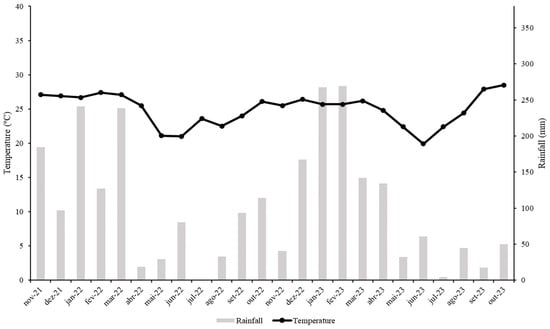
Figure 1.
Rainfall and average temperature recorded by the meteorological station during the experiments, from December 2021 to September 2023, in Selvíria—MS.
The soil in the experimental area was classified as Oxisol, clayey texture [16], cultivated over the last 17 years in a no-tillage system (S.P.D.) with castor beans and corn as predecessor crops.
The experiment was designed in randomized blocks in a 2 × 4 × 3 factorial scheme with four replications. The treatments consisted of two application times (30 days before soybean sowing and at the time of sowing), four K2O doses (0, 40, 80, and 120 kg ha−1), and three sources (KCl, with 60% K2O, Potasil “phonolite”, with 12% K2O and 25% silicon (3% K2O is soluble in 5% tartaric acid and 0.5% NaF), and Ekosil “hydro-thermalized phonolite/potassium rock”, 8% K2O, and 25% silicon (1% K2O is soluble in 2% citric acid), equivalent to 24 treatments. Each plot consisted of five-meter-long rows, allocated exactly in the same place in both experiments, eight rows with 0.50 m between rows, having a population of 68 thousand plants per ha, with the useful area being the four central rows.
The soybean cultivar used was TMG7063, with 18 seeds sown per linear meter. Potassium fertilization treatments were applied manually and without soil incorporation. Based on soil analysis (Table 1), fertilization was performed with 62 kg ha−1 of P2O5 using triple superphosphate fertilizer, applied below and next to the seeds, in the soybean sowing furrow. In addition, cobalt and molybdenum (CoMo) were applied in the furrow, at a dose of 150 mL ha−1 (with 1.5% de Co and 19.5% de Mo). Conventional inoculation (dose of 75 mL of inoculant for 50 kg of seed) with Bradyrhizobium japonicum strains SEMIA 5079 and SEMIA 5080 guaranteed that 5 × 10⁹ CFU mL−1 in fluid form was performed on soybean seeds.

Table 1.
Initial chemical characterization of the soil at a depth of 0–0.20 m.
At soybean flowering (R2 stage), three representative plants per plot were manually and randomly collected to determine the dry mass of nodules and the dry mass of aerial parts. After collection, the samples were placed in a forced air circulation oven at 60 °C for 72 h. After the mass stabilization, the samples were weighed. At harvest time, 10 representative soybean plants were randomly and manually sampled to obtain the number of grains per plant by manual counting; mass of 100 grains; moisture, determined on a 0.01 g precision scale, at 13% (wet basis); grain yield, determined by collecting the plants contained in the four useful lines of each plot. After mechanical threshing, the grains were quantified, and the data were transformed into kg ha−1 at 13% (wet basis). Agronomic efficiency (AE) was calculated with the following equation (Equation (1)):
The data obtained were subjected to preliminary tests of normality and homoscedasticity. After this, the results were analyzed using analysis of variance (ANOVA) and a Tukey test at 5% probability to compare the means of the times of application of K and potassium sources. The effect of K2O doses was adjusted to regression equations using the SISVAR program [18].
3. Results and Discussion
There was no significant effect (p > 0.05) of the sources and doses of potassium fertilizers on the dry mass of nodules and dry mass of the shoot in both years of soybean cultivation (Table 2). The sources and application times of K2O also did not influence (p > 0.05) the dry mass of nodules and shoots in both crops. The effect of the interaction of sources and application times of potassium fertilizers on the mass of nodules was significant in Exp I. In Exp. II, there was a significant effect of the interaction between the three factors (doses x source x application times) for the mass of nodules.
Table 2.
Means and probability (F-test) of nodule mass (MNOD) and shoot dry mass (SDM) for Exp. I and Exp. II of soybean under different sources, doses, and application times of potassium fertilizers.
There was a significant interaction between the doses and sources of K2O for nodule mass, with adjustment to the decreasing linear function for the KCl source, that is, the higher the dose (up to 120 kg ha−1 of K2O), the lower the nodule mass per plant, given that the Cl provided by the fertilizer can reduce nodulation by accumulating toxic amounts, in addition to causing competitive inhibition with NO3− [19], which, consequently, affects crop production. In contrast, rocks with potassium silicate allow greater absorption and accumulation of nitrogen, improving production due to the silicon present in the fertilizer [20]. With the application of 80 and 120 kg ha−1 of K2O, the sources Potasil, equivalent to 666.7 kg ha−1 and 1000 kg ha−1, and Ekosil, equivalent to 1000 kg ha−1 and 1500 kg ha−1, provided higher nodule mass values compared to KCl (Table 3), depending on the salinity (the higher the dose) [21].
Table 3.
Average nodule mass (g plant−1) of soybean under interaction between sources and application rates of potassium fertilizers from Exp. II.
The early application of Ekosil provided a greater mass of nodules in relation to the early application of KCl; in addition, the greater mass of nodules was observed when Ekosil was applied in advance in relation to that applied at sowing (Figure 2).
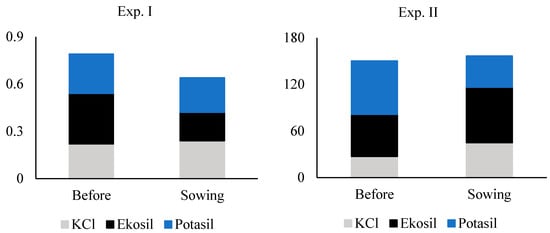
Figure 2.
Averages of soybean nodule mass (g plant−1) under interaction between different sources and application times of potassium fertilizers.
The largest nodule mass was observed under a dose of 120 kg ha−1 of K2O, 114% higher compared to the non-application of potassium fertilizer in soybean (Figure 2). The increase in nodule mass because of early application of K can increase the activity of rhizobia in the root region, promoting an increase in the efficiency of biological nitrogen fixation in soybean [22]. The greater presence of nodules in plants with an early supply of Ekosil may be related to increased nodulation, an effect previously observed under silicate fertilization in soybean, which, under the effect of Si fertilization, provided an increase in the number and mass of nodules compared to the non-use of Si [23]. According to the authors, Potasil and Ekosil are fertilizers that provide Si, and one of the effects observed using this beneficial element in soybean plants is the increase in root growth and nodulation of soybean roots. Since Ekosil is a source of K and Si, it is possible that this source has benefited the symbiosis between Bradyrizobium sp. and soybean plants. An increase in nodule mass was observed as the K2O doses increased (Figure 3).
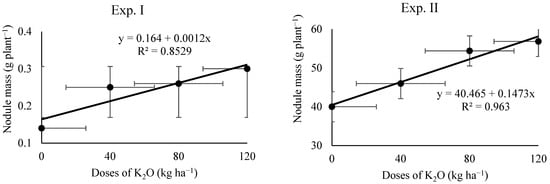
Figure 3.
Average nodule mass in soybeans as a function of K2O doses in Exp. I and Exp. II.
When comparing the K2O doses in the interaction of sources and application times. it was observed that it was significant for KCl and Ekosil at sowing and for Potasil applied in advance (Figure 4), the use of sources with the capacity to release the nutrient for longer periods is an effective practice for agriculture [24]. For the effect of the sources in the interaction between dose and application times, it was significant for the early form, which was higher for the Ekosil and Potasil sources at the dose of 80 kg ha−1 of K2O. While, for the dose of 120 kg ha−1, it was higher only for Potasil.
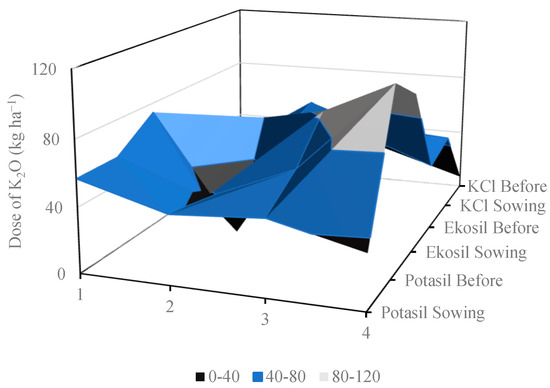
Figure 4.
Averages of soybean nodule mass in Exp. II under interaction between different sources, doses, and application times of potassium fertilizers.
Regarding the mass of soybean nodules, with the application at sowing, this variable was higher in the control treatment (dose 0 kg ha−1) for the Ekosil and Potasil sources; for the dose of 80 kg ha−1 of K2O, it was positive for the sources KCl and Ekosil, while, for the dose of 120 kg ha−1, there was significance only for the Potasil source (Figure 4).
For the application times, in the interaction between source and dose, KCl was the source that provided the greatest mass of soybean nodules, when applied in advance at a dose of 80 kg ha−1 of K2O. However, Ekosil, when applied at sowing, required this same dose of K2O. Potasil conditioned the greatest mass of soybean nodules when applied during sowing at a dose of 120 kg ha−1 of K2O (Figure 4). A significant effect (p < 0.01) was observed in the interaction between doses and sources on the mass of 100 grains and productivity in the soybean treatments (Table 4).
Table 4.
Means and probability (F-Test) of the quantity of grains per plant (Grains) and mass of 100 grains (M100) of soybeans under different sources, doses, and application times of potassium fertilizers.
A significant effect was observed for the application of Potasil in relation to the variation of the K2O doses, with the highest mass of 100 grains when using KCl or Potasil in relation to Ekosil, obtained at the dose of 40 kg ha−1 of K2O (Table 5). As observed, with the increase in the doses, the mass of 100 grains was reduced (Figure 5a); in addition, there was no adjustment with the use of the Ekosil source (Figure 5b). Excess K ends up competing with the absorption of Ca, which is part of the formation of the cell wall, and, Mg, the central ion of chlorophyll, like K, an important enzyme activator, which participates in grain filling [21].
Table 5.
The average mass of 100 soybean grains under the interaction between sources and application times of potassium fertilizers in Exp. II.
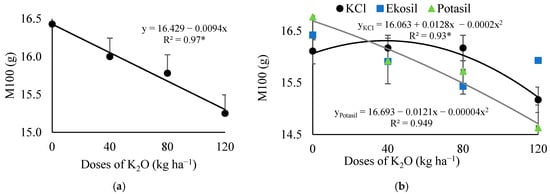
Figure 5.
(a) Mass of 100 soybean grains as a function of K2O doses in the Exp. II harvest. (b) Mass of 100 soybean grains under the interaction between doses and sources of potassium fertilizers. *—significant at p ≤ 0.05 in F test.
The sources and application times of K2O did not influence (p > 0.05) the mass of 100 soybean grains, as well as the grain yield; however, there was an adjustment to the linear regression for the soybean grain yield (Table 6). This is due to the fact that the soil in the experimental area has an average cation exchange capacity (CEC) for tropical conditions, that is, between 45 and 100 mmolc dm−3 according to Cantarella et al. (2022) [17], in addition to there not having been a high rainfall, but rather well-distributed rainfall in the rainiest months (Figure 1).
Table 6.
Means and probability (F-Test) of grain productivity (PROD) and agronomic efficiency (AE) of soybeans under sources, doses, and application times of potassium fertilizers.
For the interaction between application times and K2O source, the application of KCl early stood out over the sowing fertilization when compared to the other K2O sources. With the application at sowing, the Ekosil source was superior to the other K2O sources (Table 6).
The sources and application times of K2O alone did not influence (p > 0.05) grain yield; however, there was an adjustment to linear regression, and it was significant for agronomic efficiency. There was a significant effect (p < 0.01) in the interaction between doses and sources on the mass of 100 grains and soybean yield (Table 6).
The highest estimated soybean grain productivity was 3262 kg ha−1 of grains, at the estimated dose of 78 kg ha−1 of K2O in the first year, and soybean grain productivity increased linearly with the increase in potassium fertilization in the second year of cultivation (Figure 6). K has a very important physiological function in plants, improving water balance in plants, stomatal conductance, and reducing the effects of the periods of water restriction, with reduced pod and leaf abortion [25]. As seen in Figure 1, in Exp. II, there was a greater volume of rainfall than in Exp. I, providing more volume of water available to the crop; therefore, there is an increase in soybean grain productivity and improved production capacity in the field.
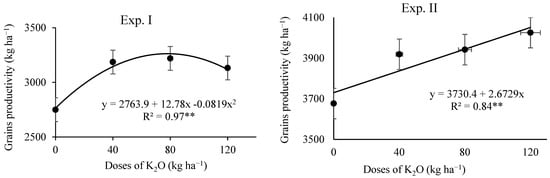
Figure 6.
Soybean grain productivity as a function of K2O doses in Exp. I and Exp. II harvests. **—significant at p ≤ 0.01 in F test.
The highest agronomic efficiency, 42.73%, was observed at a dose of 40 kg ha−1 of K2O, both in the Ekosil and Potasil sources applied in advance and at sowing in relation to the same sources and application methods at doses of 80 and 120 kg ha−1 of K2O (Figure 7); meanwhile, for KCl, it was higher at a dose of 40 kg ha−1 of K2O when applied at sowing. Thus, it is possible to identify the dose with the highest productive efficiency and reduce the number of fertilizers applied in soybean cultivation. On the other hand, the K2O sources that contain Si in their formulation increased agronomic efficiency at a dose of 40 kg ha−1, including Ekosil, when applied in advance, and Potasil, when applied at sowing. The increase in agronomic efficiency with the use of Si in fertilization was also previously reported in wheat and corn cultivation [20] with the application of calcium and magnesium silicate, and in corn crop with the application of Nepheline syenite and phonolite sources [26], that are Igneous rocks.
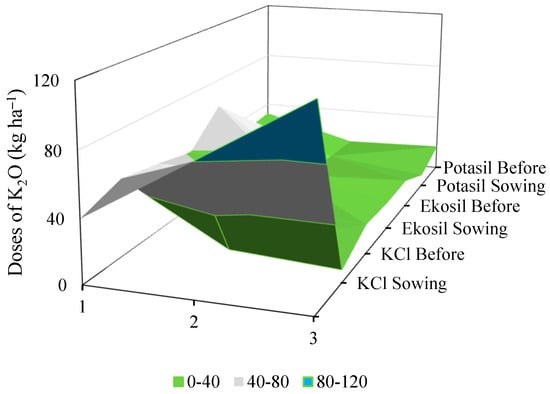
Figure 7.
Averages of soybean agronomic efficiency under the interaction between sources, doses, and application times of potassium fertilizers in the year (Exp. II).
4. Conclusions
Regardless of the potassium source and time of application, the supply of 78 kg ha−1 of K2O provided greater soybean grain productivity in the first year, and there was a linear increase in soybean grain productivity in the second year, in a dryland system under no-tillage in a clayey Oxisol.
The early supply of Ekosil increased the mass of nodules compared to Potasil and Potassium Chloride. Higher doses of KCl decreased the mass of nodules per soybean plant. Ekosil and Potasil are less susceptible to leaching and have a prolonged effect on K release. They are viable options for the supply of potassium in relation to the use of KCl.
There were beneficial effects of using K2O sources associated with Si in soybean cultivation, whose early application of Ekosil, at a dose of 40 kg ha−1 of K2O, promoted outstanding agronomic efficiency of soybeans. Therefore, they possess the potential for use as an alternative source to KCl in soybean cultivation, with adequate levels of this nutrient in the soil.
By pursuing these avenues, future research can solidify our understanding of how alternative potassium sources such as Ekosil and Potasil contribute to root nodulation processes, mycorrhizal associations, and plant physiological responses. Also, life-cycle analyses should be conducted to evaluate the environmental footprint of rock-based fertilizers relative to conventional K sources.
Author Contributions
Conceptualization, M.C.B. and M.C.M.T.F.; methodology, M.C.B. and C.E.d.S.O.; software, C.E.d.S.O.; validation, M.C.B. and C.E.d.S.O.; formal analysis: M.C.B., L.G.P.R., W.C.N.I. and G.C.F.; resources, M.C.M.T.F.; data curation, M.C.B., C.E.d.S.O., G.C.F. and B.H.L.; writing—original draft preparation, M.C.B. and C.E.d.S.O.; writing—review and editing, M.C.M.T.F., A.J., B.B.G. and T.A.R.N.; visualization, B.H.L., L.G.P.R., W.C.N.I., L.F.R.d.S. and G.C.F.; supervision, M.C.M.T.F.; project administration, M.C.B. and M.C.M.T.F.; funding acquisition, M.C.B. and M.C.M.T.F. All authors have read and agreed to the published version of the manuscript.
Funding
This review received funding from “Coordenação de Aperfeiçoamento de Pessoal de Nível Superior” (CAPES) for the Master studies of the first author, and National Council for Scientific and Technological Development (CNPq) productivity research grant (award number 314497/2023-4) of the corresponding author.
Institutional Review Board Statement
Not applicable.
Informed Consent Statement
Not applicable.
Data Availability Statement
The original contributions presented in this study are included in the article. Further inquiries can be directed to the corresponding author.
Acknowledgments
We acknowledge CAPES and CNPq for their financial support, and the fertilizer company “Yoorin Fertilizantes”.
Conflicts of Interest
The authors declare no conflicts of interest.
References
- Natale, W.; Lima Neto, A.J.D.; Rozane, D.E.; Parent, L.E.; Corrêa, M.C.D.M. Mineral Nutrition Evolution in the Formation of Fruit Tree Rootstocks and Seedlings. Rev. Bras. Frutic. 2018, 40, e-133. [Google Scholar] [CrossRef]
- CONAB Safra Brasileira de Grãos. Available online: https://www.conab.gov.br/info-agro/safras/graos (accessed on 27 November 2023).
- Plano Nacional de Fertilizantes. Available online: https://www.gov.br/agricultura/pt-br/assuntos/insumos-agropecuarios/insumos-agricolas/fertilizantes/plano-nacional-de-fertilizantes/plano-nacional-de-fertilizantes-1 (accessed on 9 September 2024).
- Brunetto, G.; Marques, A.; Martins, A.; Miotto, A.; Tiecher, T.; Tiecher, T.; Pias, O.; Ambrosini, V.; Ferreira, P.; Souza da Silva, L.; et al. Fertilidade do solo e nutrição para cultura da soja. In Tecnologias Aplicadas para o Manejo Rentável e Eficiente da Cultura da Soja; GR: Santa Maria, CA, USA, 2022; pp. 11–46. ISBN 9786589469575. [Google Scholar]
- Rodrigues, M.A.D.C.; Buzetti, S.; Teixeira Filho, M.C.M.; Garcia, C.M.P.; Andreotti, M. Adubação com KCl revestido na cultura do milho no Cerrado. R. Bras. Eng. Agríc. Ambient. 2014, 18, 127–133. [Google Scholar] [CrossRef]
- Neves, M.A.; Santos, M.A.A.; Taguchi, S.P.; Rangel, C.V.G.T.; Raymundo, V. Interações ambientais e resistência física de um depósito de resíduos finos da indústria de rochas ornamentais. Eng. Sanit. Ambient. 2019, 24, 785–797. [Google Scholar] [CrossRef]
- Silva, P.H.M.D.; Poggiani, F.; Silva, A.A.; Prada Neto, I.; Paula, R.C.D. Mortalidade, Crescimento e Solução do Solo em Eucalipto com Aplicação de Fertilizante de Liberação Lenta. Cerne 2015, 21, 473–481. [Google Scholar] [CrossRef][Green Version]
- Cavalini, P.F.; Sevilha, A.; da Cruz, R.M.S.; Alberton, O. Resposta da Soja à Épocas de Aplicação de Potássio em Cobertura. Arq. Ciências Veterinárias Zool. UNIPAR 2018, 21, 23–28. [Google Scholar] [CrossRef]
- Coelho, P.H.M.; Benett, K.S.S.; Arruda, N.; Benett, C.G.S.; Nascimento, M.V. Crescimento e Produtividade de dois Cultivares de Soja em Função de Doses de Silício. Rev. Agric. Neotrop. 2019, 6, 60–65. [Google Scholar] [CrossRef][Green Version]
- International Plant Nutrition Institute–IPNI. 4R Plant Nutrition: A Manual for Improving the Management of Plant Nutrition; IPNI: Peachtree Corners, GA, USA, 2016; 148p, Available online: https://plantnutrition.ca/wp-content/uploads/2021/04/4R-Manual-METRIC-2016-17_lowres.pdf (accessed on 30 September 2024).
- Yamada, T.; Roberts, T.L. Potássio Na Agricultura Brasileira; POTAFOS: Piracicaba, Brazil, 2005. [Google Scholar]
- Wu, L.; Liu, M. Preparation and Properties of Chitosan-Coated NPK Compound Fertilizer with Controlled-Release and Water-Retention. Carbohydr. Polym. 2008, 72, 240–247. [Google Scholar] [CrossRef]
- ANDA. ANDA Arquivos; ANDA: Sao Paulo, Brazil, 2023. [Google Scholar]
- Hernandez, F.B.T. Sistema de Monitoramento Climático—UNESP Ilha Solteira. Available online: https://clima.feis.unesp.br/recebe_formulario.php (accessed on 11 December 2023).
- dos et Santos, H.G.S.; Jacomine, P.K.T.; Anjos, L.H.C.; Oliveira, V.Á. Sistema Brasileiro de Classificação de Solos, 5th ed.; Embrapa: Brasília, Brazil, 2018; ISBN 978-85-7035-817-2. [Google Scholar]
- Ferreira, D.F. Sisvar: Um Programa para Análises e Ensino de Estatística. Available online: https://des.ufla.br/~danielff/programas/sisvar.html (accessed on 8 December 2023).
- Cantarella, H.; Quaggio, J.A.; Junior, D.M.; Boareto, R.M.; Raij, B.V. Bulletin 100: Fertilization and Liming Recommendations for the State of São Paulo; Instituto Agronômico de Campinas: Campinas, Brazil, 2022. [Google Scholar]
- Wang, Y.; Cheng, C.; Du, Z.; Yu, B. Pre-Inoculation with Bradyrhizobium japonicum Confers NaCl Tolerance by Improving Nitrogen Status and Ion Homeostasis in Wild Soybean (Glycine max L.) Seedlings. Acta Physiol. Plant. 2022, 44, 21. [Google Scholar] [CrossRef]
- Galindo, F.S.; Pagliari, P.H.; Rodrigues, W.L.; Fernandes, G.C.; Boleta, E.H.M.; Santini, J.M.K.; Jalal, A.; Buzetti, S.; Lavres, J.; Teixeira Filho, M.C.M. Silicon Amendment Enhances Agronomic Efficiency of Nitrogen Fertilization in Maize and Wheat Crops under Tropical Conditions. Plants 2021, 10, 1329. [Google Scholar] [CrossRef] [PubMed]
- Prado, R.D.M. Nutrição De Plantas; Editora Unesp: São Paulo, Brazil, 2008; ISBN 978-85-7139-676-0. [Google Scholar]
- do Cunha, L.S.; Júnior, J.B.D.; do Lana, M.C.; Ribeiro, L.L.O.; Shimada, B.S.; Richart, A.; da Costa, A.C.T.; Rosa, W.B. Agronomic characteristics of soybean as a function of inoculation, co-inoculation and N doses on eutrophic red latosol: Caracteres agronômicos da soja em função da inoculação, co-inoculação e doses de N em latossolo vermelho eutroferrico. Concilium 2023, 23, 473–488. [Google Scholar] [CrossRef]
- Steiner, F.; Zuffo, A.M.; Bush, A.; Santos, D.M.D.S. Silicate Fertilization Potentiates the Nodule Formation and Symbiotic Nitrogen Fixation in Soybean1. Pesqui. Agropecuária Trop. 2018, 48, 212–221. [Google Scholar] [CrossRef]
- Ribeiro, B.N.; Coelho, A.P.; Souza, J.R.D.; Gissi, L.D.; Lemos, L.B. Leaching and Availability of Potassium in Soil Affected by Conventional and Coated Fertilizer Sources. Rev. Bras. Eng. Agríc. Ambient. 2022, 26, 924–929. [Google Scholar] [CrossRef]
- Steiner, F.; Zuffo, A.M.; Oliveira, C.E.D.S.; Ardon, H.J.V.; Sousa, T.D.O.; Aguilera, J.G. Can Potassium Fertilization Alleviate the Adverse Effects of Drought Stress on Soybean Plants? Rev. Agro. Amb. 2022, 15, 99–112. [Google Scholar] [CrossRef]
- Silva, A.P.R.; Rodrigues, W.P.; Cavalcante, T.L.; Carmo, E.L.; de Taimundo, C.S. Desenvolvimento da Soja sob Doses de Potássio. Rev. Cult. Agron. 2022, 31, 55–63. [Google Scholar] [CrossRef]
- Nogueira, T.A.R.; Miranda, B.G.; Jalal, A.; Lessa, L.G.F.; Teixeira Filho, M.C.M.; Marcante, N.C.; Abreu-Junior, C.H.; Jani, A.D.; Capra, G.F.; Moreira, A.; et al. Nepheline Syenite and Phonolite as Alternative Potassium Sources for Maize. Agronomy 2021, 11, 1385. [Google Scholar] [CrossRef]
Disclaimer/Publisher’s Note: The statements, opinions and data contained in all publications are solely those of the individual author(s) and contributor(s) and not of MDPI and/or the editor(s). MDPI and/or the editor(s) disclaim responsibility for any injury to people or property resulting from any ideas, methods, instructions or products referred to in the content. |
© 2025 by the authors. Licensee MDPI, Basel, Switzerland. This article is an open access article distributed under the terms and conditions of the Creative Commons Attribution (CC BY) license (https://creativecommons.org/licenses/by/4.0/).