Integrating Active Learning in an Undergraduate Corrosion Science and Engineering Course—KFUPM’s Active Learning Initiative


Abstract
1. Introduction
Transforming Engineering Education at KFUPM-University Initiative
2. Materials and Methods
2.1. Corrosion Course Details
- (a)
- Introduce the fundamentals of electrochemistry and thermodynamics of electrochemical reactions to predict corrosion tendency.
- (b)
- Familiarize students with the basic concepts of electrochemical kinetics to predict corrosion rates.
- (c)
- Describe the major industrial corrosion forms, their main degradation features, and primary prevention methods.
- (d)
- Introduce industrial measures for uniform corrosion prevention, including coatings, anodic and cathodic protection, inhibitors, and corrosion-resistant alloys.
2.2. Active Learning Implementation Details
3. Results and Discussion
3.1. In-Class Active Learning Activities Implementation Strategy
3.1.1. Teaching Fundamentals/Basics of Corrosion
3.1.2. Teaching Thermodynamics of Corrosion/Pourbaix Diagram
3.1.3. Teaching Material Failure Modes/Corrosion Types
3.2. In-Class Active Learning Activities Implementation Evaluation/Grading Strategy
3.3. Pre-/Post-Assessment Sample of AL Implementation
3.4. Project-Based Learning
Project-Based Learning Methodology
3.5. Student Feedback Regarding Active Learning and Project-Based Learning
3.6. Study Limitations
4. Conclusions
- The paper presents a well-structured and sustainable active learning implementation methodology for each component of the course.
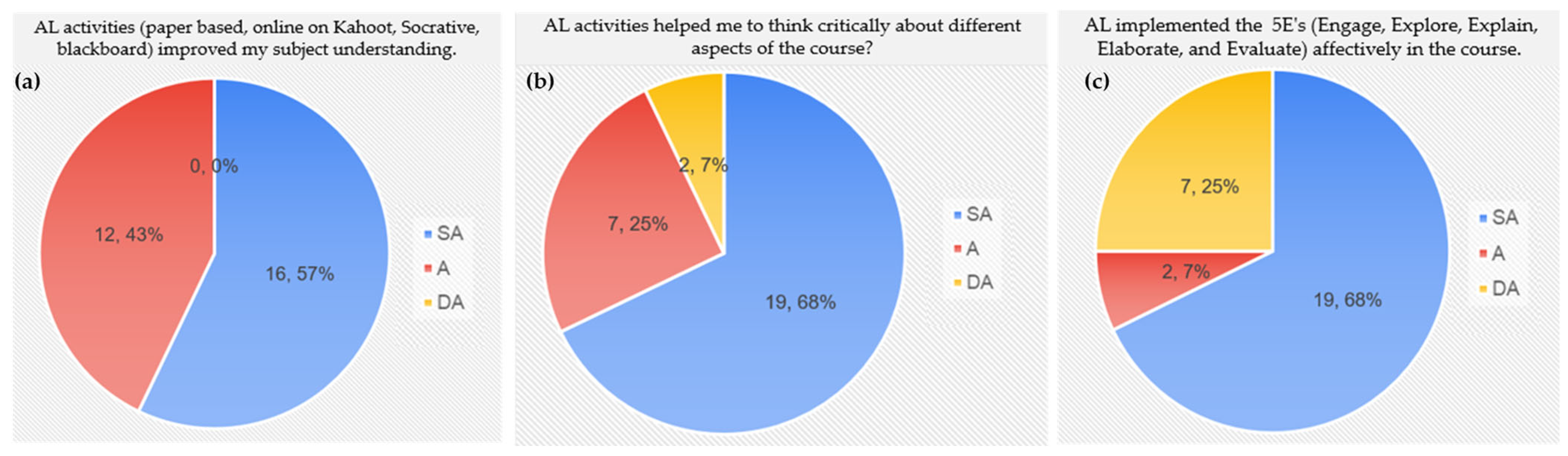
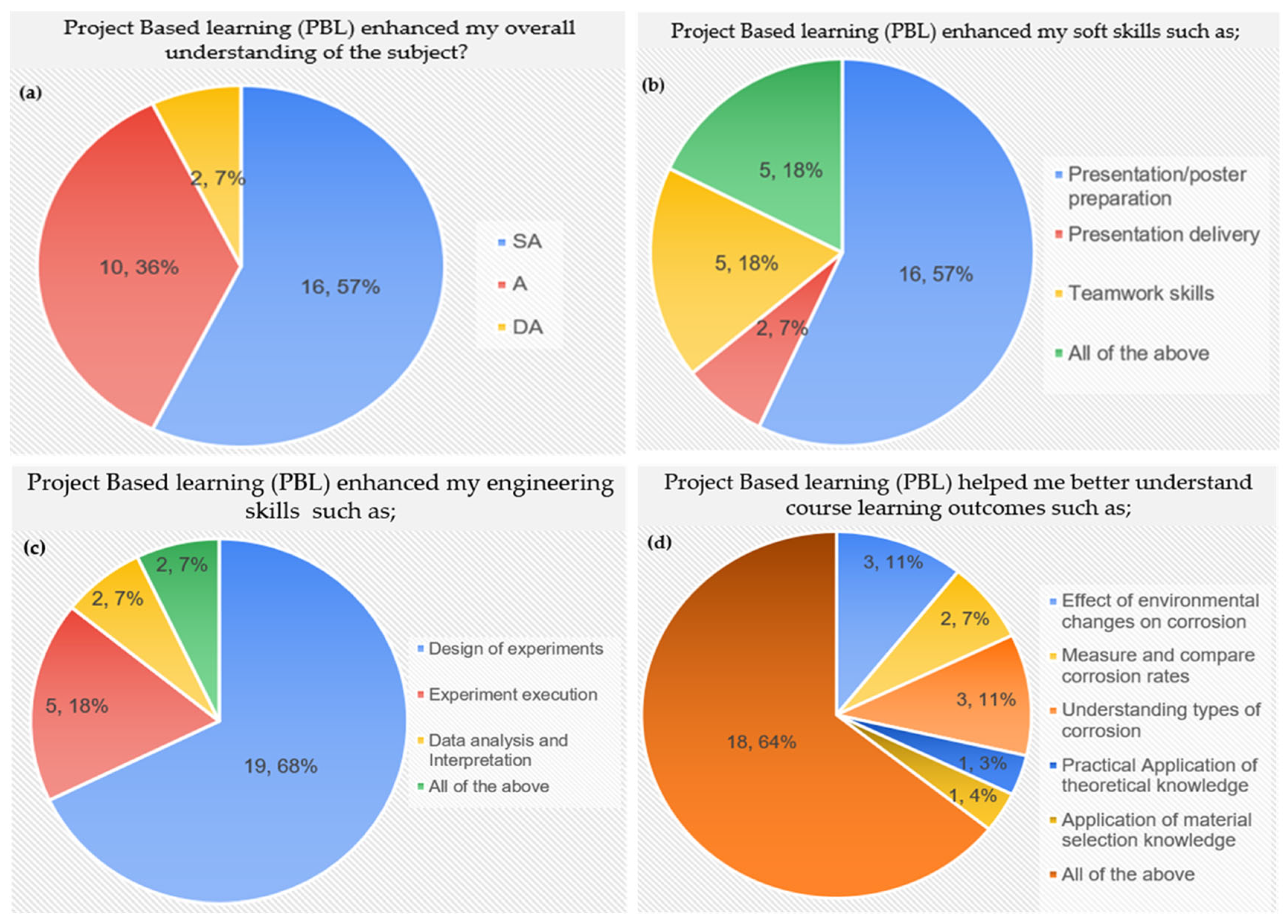
- The use of active and project-based learning in an undergraduate corrosion engineering course at KFUPM has considerably improved student engagement and conceptual understanding, as the overwhelming majority (up to 90%) responded positively.
- The redesigned course, to implement active learning activities such as TPS and CBIs, enhanced collaboration, critical thinking, and lifelong learning competencies among students, as more than 90% voted in favor.
- The adoption of formative and diagnostic assessments with continuous feedback was helpful to reduce anxiety among the students without compromising the quality of the evaluation process.
- The Cronbach’s alpha value for the questionnaire was found to be 0.75, indicating good internal reliability.
- The developed active learning–PBL framework provided a sustainable model for a student-centered and outcome-oriented learning environment.
Funding
Institutional Review Board Statement
Informed Consent Statement
Data Availability Statement
Acknowledgments
Conflicts of Interest
References
- Kim, J.; Ryu, S.J. Enhancing Sustainable Design Thinking Education Efficiency: A Comparative Study of Synchronous Online and Offline Classes. Sustainability 2023, 15, 13293. [Google Scholar] [CrossRef]
- Lima, R.M.; Andersson, P.H.; Saalman, E. Active Learning in Engineering Education: A (Re)Introduction. Eur. J. Eng. Educ. 2017, 42, 1–4. [Google Scholar] [CrossRef]
- Bishop, J.L.; Verleger, M.A. The Flipped Classroom: A Survey of the Research. In Proceedings of the 120th ASEE Annual Conference & Exposition, Atlanta, GA, USA, 23–26 June 2013; pp. 1–18. [Google Scholar]
- Asgari, S.; Penzenstadler, B.; Monge, A.; Richardson, D. Computing to Change the World for the Better: A Research-Focused Workshop for Women. In Proceedings of the IEEE Conference on Computing Education, Portland, OR, USA, 11–14 March 2020. [Google Scholar]
- Prince, M.J.; Felder, R.M. Inductive Teaching and Learning Methods: Definitions, Comparisons, and Research Bases. J. Eng. Educ. 2006, 95, 123–138. [Google Scholar] [CrossRef]
- Hou, B.; Li, X.; Ma, X.; Du, C.; Zhang, D.; Zheng, M.; Xu, W.; Lu, D.; Ma, F. The cost of corrosion in China. Npj Mater. Degrad. 2017, 1, 4. [Google Scholar] [CrossRef]
- Bender, R.; Féron, D.; Mills, D.; Ritter, S.; Bäßler, R.; Bettge, D.; De Graeve, I.; Dugstad, A.; Grassini, S.; Hack, T.; et al. Corrosion challenges towards a sustainable society. Mater. Corros. 2022, 73, 1730–1751. [Google Scholar] [CrossRef]
- Koch, G.H.; Varney, J.; Thompson, N.G.; Moghissi, O.; Gould, M.; Payer, J.H. International Measures of Prevention, Application, and Economics of Corrosion Technologies Study; Jacobson, G., Ed.; NACE International: Houston, TX, USA, 2016. [Google Scholar]
- Little, B.; Blackwood, D.; Hinks, J.; Lauro, F.; Marsili, E.; Okamoto, A.; Rice, S.; Wade, S.; Flemming, H.-C. Microbially influenced corrosion—Any progress? Corros. Sci. 2020, 170, 108641. [Google Scholar] [CrossRef]
- Tylek, I.; Kuchta, K.; Rawska-Skotniczny, A. Human errors in the design and execution of steel structures—A case study. Struct. Eng. Int. 2017, 27, 370. [Google Scholar] [CrossRef]
- Groysman, A. The Role of Corrosion Management in Prevention of Corrosion Failures. In Proceedings of the CORROSION 2016, Houston, TX, USA, 6–10 March 2016; Paper No. 7252. NACE International: Houston, TX, USA, 2016. [Google Scholar]
- National Research Council. Research Opportunities in Corrosion Science and Engineering; The National Academies Press: Washington, DC, USA, 2011; Available online: http://www.nap.edu/catalog/13032.html (accessed on 5 October 2025).
- Freeman, S.; Eddy, S.L.; McDonough, M.; Smith, M.K.; Okoroafor, N.; Jordt, H.; Wenderoth, M.P. Active Learning Increases Student Performance in Science, Engineering, and Mathematics. Proc. Natl. Acad. Sci. USA 2014, 111, 8410–8415. [Google Scholar] [CrossRef]
- Doolittle, P.; Wojdak, K.; Walters, A. Defining Active Learning: A Restricted Systematic Review. Teach. Learn. Inq. 2023, 11, 1–18. [Google Scholar] [CrossRef]
- Guimaraes, L.M.; da Silva Lima, R. Active Learning Application in Engineering Education: Effect on Student Performance Using Repeated Measures Experimental Design. Eur. J. Eng. Educ. 2021, 46, 813–833. [Google Scholar] [CrossRef]
- Castano, C.; Caballero, R.; Noguera, J.C.; Chen Austin, M.; Bernal, B.; Jaén-Ortega, A.A.; Ortega-Del-Rosario, M.D.L.A. Developing Sustainability Competencies Through Active Learning Strategies Across School and University Settings. Sustainability 2025, 17, 8886. [Google Scholar] [CrossRef]
- Prosek, T.; Keil, P.; Popova, K. Corrosion Protection and Sustainability: Why Are the Two Concepts Inherently Intertwined. Corros. Mater. Degrad. 2025, 6, 38. [Google Scholar] [CrossRef]
- Lavi, R.; Bertel, L.B. Active Learning Pedagogies in High School and Undergraduate STEM Education. Educ. Sci. 2024, 14, 1011. [Google Scholar] [CrossRef]
- Lo, N.P.-K. From Theory to Practice: Unveiling the Synergistic Potential of Design and Maker Education in Advancing Learning. SN Comput. Sci. 2024, 5, 360. [Google Scholar] [CrossRef]
- Lo, N.P.-K. The Confluence of Digital Literacy and Eco-Consciousness: Harmonizing Digital Skills with Sustainable Practices in Education. Platforms 2024, 2, 15–32. [Google Scholar] [CrossRef]
- Torralba, K.D.; Doo, L. Active Learning Strategies to Improve Progression from Knowledge to Action. Rheum. Dis. Clin. N. Am. 2020, 46, 1–19. Available online: https://www.sciencedirect.com/science/article/pii/S0889857X19300778 (accessed on 1 March 2025). [CrossRef] [PubMed]
- Fazio, C. Active Learning Methods and Strategies to Improve Student Conceptual Understanding: Some Considerations from Physics Education Research. In Research and Innovation in Physics Education: Two Sides of the Same Coin; Guisasola, J., Zuza, K., Eds.; Springer International Publishing: Cham, Switzerland, 2020; pp. 15–35. [Google Scholar] [CrossRef]
- Muñoz Alvarez, G.; Greca, I.M.; Arriassecq, I. Problem-Based Learning as a Strategy for Teaching Physics in Technical–Professional Higher Education: A Case Study in Chile. Educ. Sci. 2025, 15, 941. [Google Scholar] [CrossRef]
- Hill, G.W. Group versus Individual Performance: Are N + 1 Heads Better than One? Psychol. Bull. 1982, 91, 517–539. [Google Scholar] [CrossRef]
- Gross Davis, B. Tools for Teaching; Jossey-Bass: San Francisco, CA, USA, 1993. [Google Scholar]
- Zeidner, M. Test Anxiety: The State of the Art; Springer Science & Business Media: New York, NY, USA, 1998. [Google Scholar] [CrossRef]
- Lucan, S.G.; Bernstein, D.A. Teaching Psychology: A Step-by-Step Guide; Lawrence Erlbaum Associates: Mahwah, NJ, USA, 2005. [Google Scholar]
- Benjamin, L.T., Jr. Lecturing. In The Teaching of Psychology: Essays in Honor of Wilbert J. McKeachie and Charles L. Brewer; Perlman, B., McCann, L.I., McFadden, S.H., Eds.; Lawrence Erlbaum Associates: Mahwah, NJ, USA, 2002; pp. 57–67. [Google Scholar]
- Wankat, P.C. The Effective, Efficient Professor: Teaching, Scholarship, and Service; Allyn and Bacon: Boston, MA, USA, 2002. [Google Scholar]
- Owens, D.C.; Sadler, T.D.; Barlow, A.T.; Smith-Walters, C. Student Motivation from and Resistance to Active Learning Rooted in Essential Science Practices. Res. Sci. Educ. 2020, 50, 253–277. [Google Scholar] [CrossRef]
- Emily, C.; Clark, J.; Post, G. Preparation and Synchronous Participation Improve Student Performance in a Blended Learning Experience. Australas. J. Educ. Technol. 2021, 37, 187–199. Available online: https://ajet.org.au/index.php/AJET/article/view/6811 (accessed on 28 December 2024). [CrossRef]
- Yıldız, E.; Doğan, U.; Özbay, O.; Seferoğlu, S.S. Flipped Classroom in Higher Education: An Investigation of Instructor Perceptions through the Lens of TPACK. Educ. Inf. Technol. 2022, 27, 10757–10783. [Google Scholar] [CrossRef]
- Wang, K.; Zhu, C. MOOC-Based Flipped Learning in Higher Education: Students’ Participation, Experience and Learning Performance. Int. J. Educ. Technol. High. Educ. 2019, 16, 33. [Google Scholar] [CrossRef]
- Collado-Valero, J.; Rodriguez-Infante, G.; Romero-Gonzalez, M.; Gamboa-Ternero, S.; Navarro-Soria, I.; Lavigne-Cervan, R. Flipped Classroom: Active Methodology for Sustainable Learning in Higher Education during Social Distancing Due to COVID-19. Sustainability 2021, 13, 5336. [Google Scholar] [CrossRef]
- van Alten, D.C.; Phielix, C.; Janssen, J.; Kester, L. Effects of Flipping the Classroom on Learning Outcomes and Satisfaction: A Meta-Analysis. Educ. Res. Rev. 2019, 28, 100281. [Google Scholar] [CrossRef]
- Nguyen, K.A.; Borrego, M.; Finelli, C.J.; DeMonbrun, M.; Crockett, C.; Tharayil, S.; Shekhar, P.; Waters, C.; Rosenberg, R. Instructor Strategies to Aid Implementation of Active Learning: A Systematic Literature Review. Int. J. STEM Educ. 2021, 8, 9. [Google Scholar] [CrossRef]
- Campillo-Ferrer, J.-M.; Miralles-Martínez, P.; Sánchez-Ibáñez, R. Gamification in Higher Education: Impact on Student Motivation and the Acquisition of Social and Civic Key Competencies. Sustainability 2020, 12, 4822. [Google Scholar] [CrossRef]
- Prince, M. Does Active Learning Work? A Review of the Research. J. Eng. Educ. 2004, 93, 223–231. [Google Scholar] [CrossRef]
- Stains, M.; Harshman, J.; Barker, M.K.; Chasteen, S.V.; Cole, R.; DeChenne-Peters, S.E.; Eagan, M.K.; Esson, J.M.; Knight, J.K.; Laski, F.A.; et al. Anatomy of STEM Teaching in North American Universities. Science 2018, 359, 1468–1470. [Google Scholar] [CrossRef]
- Henderson, C.; Beach, A.; Finkelstein, N. Facilitating Change in Undergraduate STEM Instructional Practices: An Analytical Review of the Literature. J. Res. Sci. Teach. 2011, 48, 952–984. [Google Scholar] [CrossRef]
- Cassady, J.C.; Johnson, R.E. Cognitive Test Anxiety and Academic Performance. Contemp. Educ. Psychol. 2002, 27, 270–295. [Google Scholar] [CrossRef]
- Hembree, R. Correlates, Causes, Effects, and Treatment of Test Anxiety. Rev. Educ. Res. 1988, 58, 47–77. [Google Scholar] [CrossRef]
- Earl, L.M. Assessment as Learning: Using Classroom Assessment to Maximize Student Learning; Corwin Press: Thousand Oaks, CA, USA, 2012. [Google Scholar]
- Chapell, M.S.; Blanding, Z.B.; Silverstein, M.E.; Takahashi, M.; Newman, B.; Gubi, A.; McCann, N. Test Anxiety and Academic Performance in Undergraduate and Graduate Students. J. Educ. Psychol. 2005, 97, 268–274. [Google Scholar] [CrossRef]
- Bromage, B.K.; Mayer, R.E. Quantitative and Qualitative Effects of Repetition on Learning from Technical Text. J. Educ. Psychol. 1986, 78, 271–278. [Google Scholar] [CrossRef]
- Ames, C. Classrooms: Goals, Structures, and Student Motivation. J. Educ. Psychol. 1992, 84, 261–271. [Google Scholar] [CrossRef]
- Ghahari, S.; Sedaghat, M. Optimal Feedback Structure and Interactional Pattern in Formative Peer Practices: Students’ Beliefs. System 2018, 74, 9–20. [Google Scholar] [CrossRef]
- Ghiatău, R.; Diac, G.; Curelaru, V. Interaction between Summative and Formative in Higher Education Assessment: Students’ Perception. Procedia Soc. Behav. Sci. 2011, 11, 220–224. [Google Scholar] [CrossRef][Green Version]
- Llinares, S. International Handbook of Mathematics Teacher Education: Volume 2 Tools and Processes in Mathematics Teacher Education; Brill: Leiden, The Netherlands, 2019; 456p, ISBN 978-94-6300-905-8. [Google Scholar] [CrossRef]
- Zhou, C.; Kolmos, A.; Nielsen, J.D. A Problem and Project-Based Learning (PBL) Approach to Motivate Group Creativity in Engineering Education. Int. J. Eng. Educ. 2012, 28, 3–16. [Google Scholar]
- Sanchez-Gomez, C.A. Implementing a Joint Learning Method (PBL and EBL) to Innovate the Development of Mechanical Engineering Education. Educ. Sci. 2020, 10, 205. [Google Scholar] [CrossRef]
- Chen, J.; Kolmos, A.; Du, X. Forms of Implementation and Challenges of PBL in Engineering Education: A Review of Literature. Eur. J. Eng. Educ. 2021, 46, 90–115. [Google Scholar] [CrossRef]
- Guo, P.; Saab, N.; Post, L.S.; Admiraal, W. A Review of Project-Based Learning in Higher Education: Student Outcomes and Measures. Int. J. Educ. Res. 2020, 102, 101586. [Google Scholar] [CrossRef]
- Guerra, A.; Ulseth, R.; Johnson, B.; Kolmos, A. Engineering Grand Challenges and the Attributes of the Global Engineer. In Proceedings of the 45th SEFI Annual Conference, Azores, Portugal, 18–21 September 2017; pp. 1222–1235. [Google Scholar]
- Hake, R.R. Interactive-engagement versus traditional methods: A six-thousand-student survey of mechanics test data for introductory physics courses. Am. J. Phys. 1998, 66, 64–74. [Google Scholar] [CrossRef]



| CLO No. | Course Learning Outcome | ABET Outcome(s) | Justification |
|---|---|---|---|
| CLO 1 | Describe the characteristic features of different corrosion forms and their causes in engineering alloys and environments. | 1 | Aligns with outcome #1 (problem identification and formulation), as students can identify and explain corrosion problems using principles of materials science |
| CLO 2 | Describe the primary corrosion protection techniques and their application and limitations. | 1, 4 | Aligns with outcomes #1 and #4 (ethical and societal context), as this CLO involves understanding and evaluating protection system |
| CLO 3 | Apply electrochemistry, thermodynamics, and kinetic principles to predict corrosion tendencies and rates. | 1, 6 | Aligns with outcomes #1 and #6 (experimentation and data analysis), as it covers analysis and application of scientific principles) |
| CLO 4 | Design cathodic protection systems (sacrificial or impressed current) for basic submerged/buried steel structures. | 2 | Aligns with outcome #2 (engineering design) as it includes applying engineering design to develop a protection system |
| CLO 5 | Prepare a corrosion-related presentation and present it to the class. | 3, 5 | Aligns with outcome #3 (communication) and #5 (teamwork), as it involves communication skills and effective teamwork |
| CLO 6 | Recognize the significance of corrosion cost and the technical measures available to control it. | 4 | Aligns with outcome #4 (ethics and responsibility) as it covers understanding societal/economic impacts |
| Topic# | Topics | Integration of Active Learning Strategies |
|---|---|---|
| 1 | Basics of corrosion/introduction (what, why, cost) of corrosion |
|
| 2 | Thermodynamics of corrosion [electrode potentials; types of corrosion cells; Nernst equation; Pourbaix diagrams] |
|
| Active Learning Activity [Active Review Session (ARS)] | ||
| 3 | Corrosion kinetics [Faraday’s law; corrosion rate calculation; polarization; electrochemical corrosion measurement] |
|
| 4 | Fundamentals of passivity |
|
| 5 | Corrosion types |
|
| 6 | Corrosion prevention (coatings) |
|
| 7 | Corrosion prevention (cathodic protection) |
|
| 8 | Corrosion prevention (inhibitors) |
|
| (a) Guided Phase [Ch. 2~6] | ||||
|---|---|---|---|---|
| # | A (Full Marks) | B (80%) | C (60%) | F |
| Completeness | All questions must be solved. | 80% of the worksheet is attempted. | Half of the worksheet is completed. | <40% is attempted. |
| Effort |
|
|
|
|
| Correctness | All paper-based activities must be correct, as it is a guided phase; however, in online activities, correctness does not matter, as they are not guided at this stage. | |||
| Submission | On time | On time | On time | On time |
| (b) Second Phase [Ch. 7~9] → combination of guided and non-guided activities | ||||
| # | A (full marks) | B (80%) | C (60%) | F |
| Completeness | All questions must be solved. | 80% of the worksheet is attempted. | Half of the worksheet is completed. | <40% is attempted. |
| Effort |
|
|
|
|
| Correctness | All paper-based activities (guided) must be correct; however, correctness does not matter in independent/non-guided (paper-based) and online activities. | |||
| Submission | On time | On time | On time | On time |
| (c) Third Phase [Ch. 11~13] → 80~90% of the activities will be independent/non-guided | ||||
| # | A (full marks) | B (80%) | C (60%) | F |
| Completeness | All questions are attempted. | 80% of the worksheet is attempted. | Half of the worksheet is completed. | <40% is attempted. |
| Effort |
|
|
|
|
| Correctness | In all paper-based and online activities, correctness matters along with other criteria such as completeness, effort, and on-time submission. | |||
| Submission | On time | On time | On time | On time |
| Active Learning Implementation in Class [Phase#1] | ||||||
|---|---|---|---|---|---|---|
| Student ID# | #1—Basics (0.5) | #2—Basics (15) | #3—Thermo (1) | #4—Thermo (0.5) | #5—Kinetics (0.5) | |
| 1 | 0.5 | 11 | 1 | 0.5 | 0.5 | |
| 2 | 0 | 10 | 0.7 | 0.4 | 0.5 | |
| 3 | 0.5 | 8 | 0.7 | 0.5 | 0.5 | |
| 4 | 0.5 | 12 | 0.8 | 0 | 0.5 | |
| 5 | 0.5 | 12 | 0.9 | 0.5 | 0.5 | |
| 6 | 0.5 | 7 | 0.7 | 0.4 | 0.5 | |
| 7 | 0.5 | 0 | 0.7 | 0.5 | 0.5 | |
| 8 | 0.5 | 9 | 0.8 | 0 | 0 | |
| 9 | 0.5 | 7 | 0.9 | 0.5 | 0.5 | |
| 10 | 0.5 | 11 | 0.8 | 0.5 | 0.5 | |
| 11 | 0.5 | 0 | 0.8 | 0.4 | 0.5 | |
| 12 | 0.5 | 12 | 0.9 | 0.5 | 0 | |
| Active Learning Implementation in Class [Phase#3] | ||||||
| Student ID# | #12—Coatings (1) | #13—Coatings (1) | #14—CP (1) | #15—CP (1) | #16—CP (2) | #17—Inhibitors (2) |
| 1 | 0.4 | 0.5 | 0.5 | 1 | 2 | 1.6 |
| 2 | 0 | 0.45 | 0 | 1 | 1.3 | 0.5 |
| 3 | 0.5 | 0.4 | 0.2 | 0.5 | 1 | 1.2 |
| 4 | 0 | 1 | 0.5 | 0.2 | 1.5 | 1 |
| 5 | 0.5 | 0.5 | 0.5 | 0.7 | 2 | 1.6 |
| 6 | 0.4 | 0.5 | 0.5 | 0 | 0.5 | 1.5 |
| 7 | 0.3 | 1 | 0.3 | 1 | 0.7 | 0.5 |
| 8 | 0.3 | 0.4 | 0.5 | 1 | 1 | 1 |
| 9 | 0.4 | 1 | 0.5 | 0.5 | 2 | 1 |
| 10 | 0.4 | 0.2 | 0.2 | 0.5 | 0.5 | 0 |
| 11 | 0 | 0.7 | 0.5 | 1 | 2 | 0.8 |
| 12 | 0.4 | 0.5 | 0.5 | 1 | 1.1 | 1.2 |
 | ||
|---|---|---|
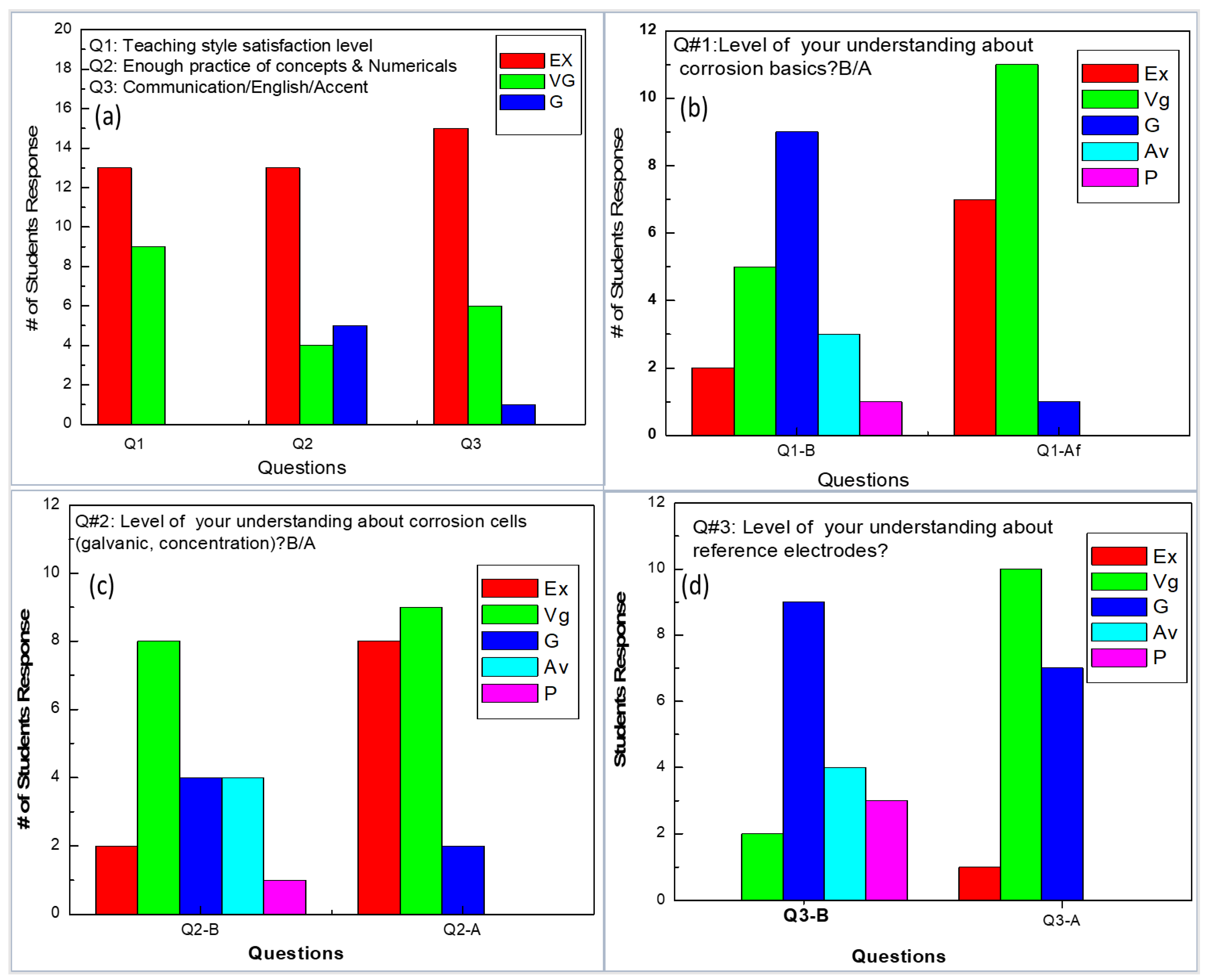
| # of Students | Before (Out of 10) | After (Out of 10) |
| 1 | 8 | 9 |
| 2 | 5 | 6 |
| 3 | 3 | 5 |
| 4 | 2 | 3 |
| 5 | 5 | 5 |
| 6 | 5 | 6 |
| 7 | 4 | 6 |
| 8 | 5 | 7 |
| 9 | 3 | 5 |
| 10 | 5 | 4 |
| 11 | 4 | 6 |
| 12 | 5 | 7 |
| 13 | 5 | 6 |
| 14 | 3 | 5 |
| 15 | 7 | 10 |
| Presentation/Poster Evaluation Guidelines for Project-Based Learning | ||||||||||
|---|---|---|---|---|---|---|---|---|---|---|
| #1 | Background and Objectives: The term project background and objectives are clearly mentioned. | |||||||||
| #2 | Material Used and Preparation: The types of materials used and details about material preparation are well explained. | |||||||||
| #3 | Experimental and Simulation Plan: The experimental plan, as well as the simulation, is well-designed and organized to achieve the objectives. | |||||||||
| #4 | Presentation Quality and Conclusions: The poster was well-organized (concise but informative with no spelling or grammar mistakes) and presented logically. Conclusions are well-documented. | |||||||||
| Project-Based Learning External Evaluation | ||||||||||
| Group and Project Title | Team Members | Project Background (5 point) | Project Objectives (5 point) | Experimental Plan (10 points) | Experimental Results (20 points) | Presentation Quality (5 points) | Team Total (45 points) | Individual Evaluation (10 points) | Progress Meetings (10 points) | Team Member Score (out of 20) |
| Project-Based Learning Peer Evaluation [Provide justification for your evaluation score] | ||||||||||
| Group and Project Title | Team Members | Peer Evaluation (Excellent) | Peer Evaluation (Very Good) | Peer Evaluation (Good) | Peer Evaluation (Poor) | |||||
| #1 | Excellent → As a task leader, not only accomplished their task, but also participated in all project-related activities. | |||||||||
| #2 | Very good → As a task leader, accomplished their task and, when asked, helped others as well in their tasks. | |||||||||
| #3 | Good → As a task leader, focused and accomplished their given task assignment. | |||||||||
| #4 | Poor → Did not complete their task and missed most of the project-related combined activities. | |||||||||
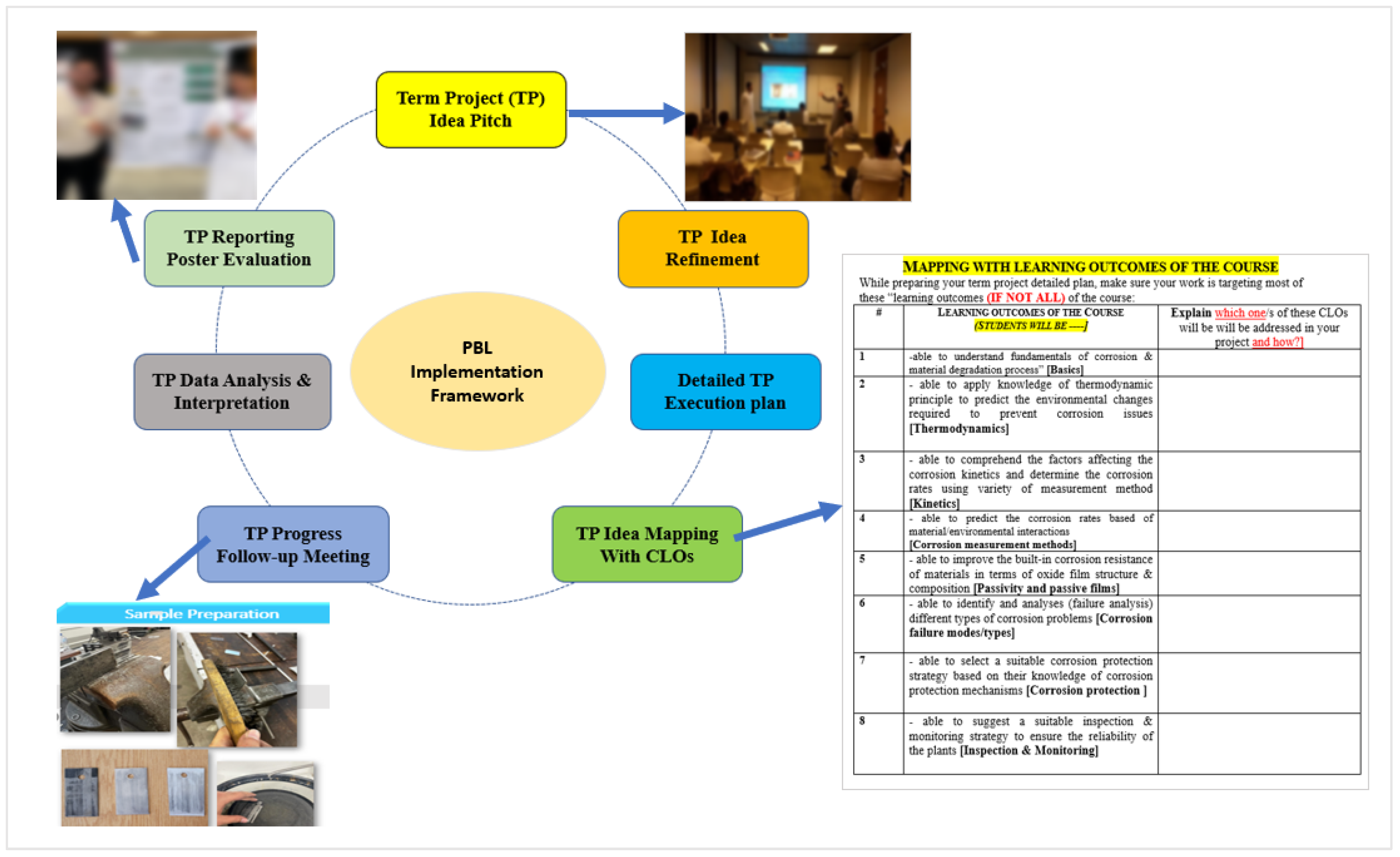
| # | Implementation of Project-Based Learning (PBL) in Corrosion Engineering Course (List of Best Course Projects for the Previous Two Semesters) |
|---|---|
| 1 | Effect of surface roughness (#200, 600, 1000) on the corrosion behavior of Al vs. SS 304 in a chloride environment |
| 2 | Application of machine learning tools in corrosion prediction with a focus on galvanic corrosion design |
| 3 | Effect of processing parameters on the corrosion performance of additively manufactured alloys, mechanism and challenges |
| 4 | Modeling galvanic corrosion between iron and zinc in seawater |
| 5 | Internal corrosion mechanism and challenges of oil and gas pipeline material selection/design considerations |
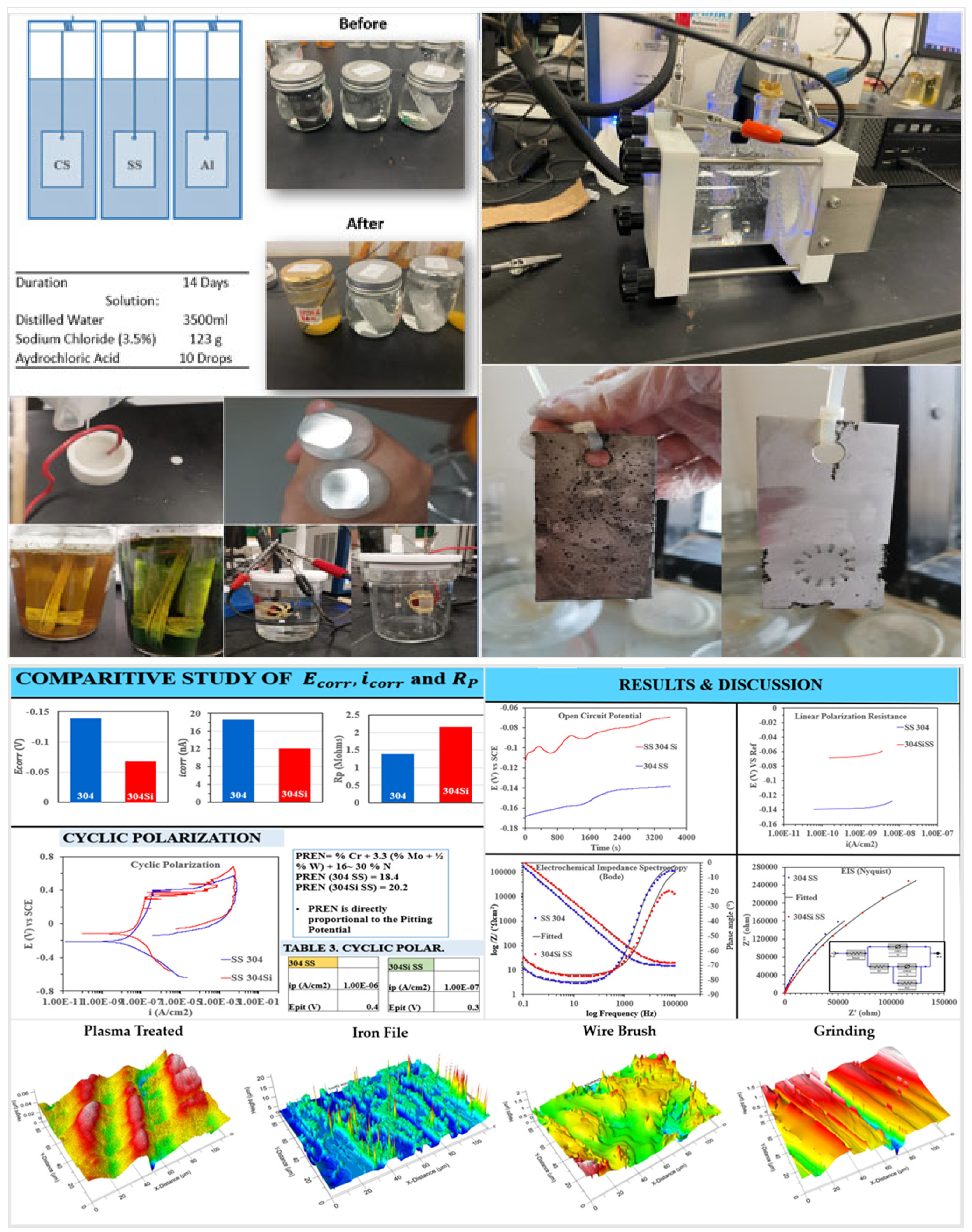
| 6 | Comparative analysis of corrosion resistance in 304 SS and 305Si using electrochemical techniques in 3.5 wt.% NaCl solution |
Disclaimer/Publisher’s Note: The statements, opinions and data contained in all publications are solely those of the individual author(s) and contributor(s) and not of MDPI and/or the editor(s). MDPI and/or the editor(s) disclaim responsibility for any injury to people or property resulting from any ideas, methods, instructions or products referred to in the content. |
© 2025 by the author. Licensee MDPI, Basel, Switzerland. This article is an open access article distributed under the terms and conditions of the Creative Commons Attribution (CC BY) license (https://creativecommons.org/licenses/by/4.0/).
Share and Cite
Toor, I.U. Integrating Active Learning in an Undergraduate Corrosion Science and Engineering Course—KFUPM’s Active Learning Initiative. Sustainability 2025, 17, 10704. https://doi.org/10.3390/su172310704
Toor IU. Integrating Active Learning in an Undergraduate Corrosion Science and Engineering Course—KFUPM’s Active Learning Initiative. Sustainability. 2025; 17(23):10704. https://doi.org/10.3390/su172310704
Chicago/Turabian StyleToor, Ihsan Ulhaq. 2025. "Integrating Active Learning in an Undergraduate Corrosion Science and Engineering Course—KFUPM’s Active Learning Initiative" Sustainability 17, no. 23: 10704. https://doi.org/10.3390/su172310704
APA StyleToor, I. U. (2025). Integrating Active Learning in an Undergraduate Corrosion Science and Engineering Course—KFUPM’s Active Learning Initiative. Sustainability, 17(23), 10704. https://doi.org/10.3390/su172310704