Article

The Study on the Optimization of Composite Enzyme Preparations for Deinking of Old Newsprint Paper


1
Key Laboratory of Industrial Fermentation Microbiology, Ministry of Education, College of Biotechnology, Tianjin University of Science & Technology, Tianjin 300457, China
2
Tianjin Key Laboratory of Pulp and Paper, College of Light Industry Science and Engineering, Tianjin University of Science & Technology, Tianjin 300457, China
3
Shandong Peanut Research Institute, Qingdao 266100, China
*
Authors to whom correspondence should be addressed.
Sustainability 2025, 17(23), 10702; https://doi.org/10.3390/su172310702
Submission received: 21 October 2025 / Revised: 20 November 2025 / Accepted: 27 November 2025 / Published: 29 November 2025

Abstract

Deinking is a key step in the recycling of waste paper. To address the problems of traditional chemical deinking, which generates large amounts of highly polluted wastewater and increases environmental pressure and treatment costs, as well as the issues of insufficient pulp brightness and high effective residual ink concentration (ERIC), a study on enzymatic deinking of old newsprint paper (ONP) was conducted. By optimizing the ratio of lipase, cellulase, amylase, and xylanase, a composite enzyme preparation for ONP deinking was successfully developed, and the corresponding deinking process was established. The composition of the composite enzyme preparation is as follows: Lipase 1.5 U/g oven-dried pulp (ODP), Cellulase 2 U/g ODP, Amylase 1.5 U/g ODP, and Xylanase 2 U/g ODP. When the composite enzyme preparation was used for enzymatic deinking, compared with chemical deinking, the brightness increased by 3.52% ISO, ERIC decreased by 9.12 ppm, and the physical properties of the paper were improved to varying degrees. The deinking efficiency was significantly superior to that of chemical deinking, while the usage of chemical reagents was effectively reduced. Fourier transform infrared spectroscopy (FTIR) and scanning electron microscopy (SEM) were further used to investigate the effect of the composite enzyme on fiber structure and its possible synergistic mechanism: the surface structure and hydrogen bond network of fibers were altered, thereby reducing the content of chromophores such as hydroxyl, carbonyl, and benzene ring groups as well as residual lignin, and facilitating the separation of ink from the fiber surface. This study provides support for the development of an environmentally friendly waste paper recycling process and contributes to promoting the sustainable development of the papermaking industry.

1. Introduction

With the development of the economy and society, the global demand for paper and paper products has been experiencing a continuous and significant increase [1]. The World Wide Fund for Nature (WWF) has stated that global paper consumption has reached 320 million tons per year [2,3]. This has led to an increased demand for plant-based raw materials and the deforestation as well as the degradation of forests. Therefore, the traditional methods of producing paper from virgin wood pulp are both economically inefficient and unsustainable. Calculations show that recycling 1 ton of waste paper can save 3 m3 of wood, 1.2 tons of standard coal, 600 kWh of electricity, and 100 tons of water [4,5]. The recycling of waste paper not only addresses the shortage of virgin fibers but also significantly conserves energy resources.
One of the key steps in recycling waste paper is the deinking process. Traditional chemical deinking methods present several drawbacks, such as low brightness of the deinked pulp, the need for large quantities of chemicals, high deinking costs, and increased complexity and cost of wastewater treatment [6,7]. In contrast, enzymatic deinking can achieve the required pulp quality [8,9] while reducing the costs of subsequent wastewater treatment, meeting environmental protection standards [10]. Therefore, environmentally friendly enzymatic deinking [11,12] has become a major area of focus in the research of waste paper deinking.
Enzymes such as lipase, cellulase, and amylase have been utilized in biotechnological research on deinking [13,14,15,16]. Anne [17] used lipase in combination with surfactants to degrade ink, achieving an 8% increase in brightness when the lipase dosage was 50 U/g of pulp. D.E. [18] found that cellulase can only deink office waste paper under acidic conditions. Xu [19] demonstrated that, compared to a single enzyme, deinking pulp using a combination of cellulase/hemicellulase and the laccase-uric acid system (LVS) resulted in a lower effective residual ink concentration (ERIC). Lee [20] used cellulase and xylanase at a pilot scale to deink mixed office waste paper, achieving a maximum brightness of 83.6% and a deinking efficiency of 6.0%.
Although enzymatic deinking has demonstrated environmental advantages, its practical effect is susceptible to the influence of multiple factors such as enzyme combination and reaction conditions, and relevant research on the synergistic effect of multiple enzymes remains insufficient. This work aims to explore this issue in order to enhance the efficiency and quality of bio-enzymatic deinking. By optimizing the proportions of xylanase, lipase, cellulase, and amylase, a composite enzyme preparation for deinking old newsprint paper (ONP, refers to used, discarded, or inventoried/uncirculated newsprint composed mainly of mechanical pulp, with surface-borne news ink, and without any special additives) was developed, and its deinking process was established. After deinking with this enzyme preparation, the pulp brightness increased by 3.52% ISO compared to chemical deinking pulp, ERIC decreased by 9.12 ppm, and the physical properties of the pulp also improved to varying degrees, while the use of chemical reagents was effectively reduced. Furthermore, Fourier Transform Infrared Spectroscopy (FTIR) and Scanning Electron Microscopy (SEM) were used to investigate the effect of the composite enzyme preparation on fiber structure and the possible synergistic mechanisms. This study provides a technical foundation for establishing eco-friendly waste paper recycling processes and promoting the sustainable development of the paper industry.

2. Materials and Methods

2.1. Materials

The ONP was collected from the Tianjin University of Science and Technology post office, with the ERIC value of 122.2 ppm determined pursuant to TAPPI T567. The lipase, cellulase, amylase, and xylanase were all provided by Baiyin Sainuo Biotechnology Co., Ltd., China. These four enzymes are, respectively, derived from Aspergillus niger, Trichoderma reesei, Bacillus licheniformis, and Trichoderma reesei; however, their genes have all been mutated so as to obtain enzymatic properties meeting industrial application requirements. Their optimal temperatures are around 50 °C, and optimal pH values are around 7.0. Diethylenetriaminepentaacetic acid (DTPA) and sodium silicate were purchased from Cayman Chemical (Ann Arbor, MI, USA), while Tween 80, olive oil, carboxymethyl cellulose, starch, and 3,5-Dinitrosalicylic acid (DNS) were obtained from Sigma-Aldrich (St. Louis, MO, USA). All reagents and chemicals used were of analytical grade.

2.2. Pulp Preparation

The ONP were torn into 2.5 cm2 pieces and soaked in a 0.05% Tween 80 solution to achieve a final mixture concentration of 15% (w/w) for 10 min in a water bath at 40 °C. The pulp was then diluted to 4.5% (w/w) using warm water at 40 °C, followed by processing in a high-concentration hydraulic pulper for 20 min under constant temperature conditions. After pulping, the plup was placed in a pulp bag and centrifuged to remove water. The resulting pulp was then stored in a sealed bag at 4 °C for future use after determining the moisture content.

2.3. Enzyme Activity Stability Assay

Based on the deinking process and the characteristics of the four enzymes, the experimental conditions were set at pH 7.0 and 50 °C, and measure the stability of enzyme activity under these conditions. Each enzyme was prepared as a 0.01 g/mL solution using phosphate buffer, and their enzyme activities were measured. Then, according to requirements, they were mixed in different proportions to prepare different composite enzyme preparations. The single enzyme solutions and composite enzyme solutions were placed at pH 7.0 and 50 °C for 1 h, and the activity of each enzyme was measured to calculate their stability. Lipase activity was determined using the olive oil method [21,22]. Cellulase activity was measured using the carboxymethyl cellulose method [23]. Amylase activity was determined by the phenolphthalein method [24]. Xylanase activity was assessed using the DNS method [25]. However, based on the properties of the enzymes, compared with the reports in the literature [21,22,23,24,25], the reaction conditions were slightly modified, the reaction temperature for each enzyme was set to 50 °C, and the pH values were set to 7.0.

2.4. Deinking

Deinking was performed with lipase, cellulase, amylase, and xylanase, respectively. During the deinking process, lipase hydrolyzes the lipid components between the ink and the binder, weakens the binding force between the ink and fibers, thereby loosening the ink, which is finally removed by flotation; cellulase degrades the microfibrils on the cellulose surface to loosen the binding force between the ink and fibers and promote ink separation; amylase hydrolyzes the starch contained in waste paper into small-molecule sugars, creating conditions for other enzymes to remove ink from the fiber surface; xylanase acts on hemicellulose and lignin-carbohydrate complexes (LCC), promoting the separation of ink adsorbed on hemicellulose from fibers to facilitate pulp deinking. Ultimately, the synergistic action of these four enzymes enables efficient deinking. The experiment was optimized by varying the amounts of each enzyme added: lipase (0.2–2.6 U/g oven-dried pulp (ODP)), cellulase (0.5–5 U/g ODP), amylase (0.2–2.6 U/g ODP), and xylanase (0.5–5 U/g ODP), all conducted under pH7.0 conditions. The paper pulp was placed into sealed bags, and different types and concentrations of enzymes were added (enzymes were dissolved in 0.1 mol/L sodium phosphate buffer at pH7.0). The pulp concentration was adjusted to 10%, and the mixture was incubated at 50 °C in a thermostatic water bath for 1 h.
The control experiment was conducted using a chemical deinking method. The chemical treatment involved adding Tween-80 (0.05%), sodium hydroxide (2%), H2O2 (1%), DTPA (0.5%), and sodium metasilicate (2.5%) solutions to the ONP pulp [20,26]. The pulp concentration was then adjusted to 5%, and the mixture was treated at 50 °C for 15 min. The control group followed conventional industrial deinking parameters, whereas the experimental group employed reaction conditions established through preliminary testing. The remaining steps followed the same procedure as the enzymatic deinking method.

2.5. Flotation

The deinked ONP pulp was subjected to flotation using the Flotation cell. Heated water was used to adjust the pulp concentration to 1%, with a temperature set at 40 °C. The flotation process was carried out for 10 min. After flotation, the pulp was filtered, and the water was drained. The pulp was then sealed and stored at 4 °C.

2.6. Sheet Formation and Paper Performance Evaluation

For the flotation-treated pulp, sheets were made using a standard sheet former, with a basis weight of 60 g/m2. The brightness (TAPPI T452) and ERIC (TAPPI T567) of the hand sheets were measured using the brightness tester. The tensile index (TAPPI T494), burst index (TAPPI T810), and tear index (TAPPI T414) of the hand sheets were measured using the tensile tester, burst tester, and tear tester, respectively.

2.7. Analysis of Structural and Ultrafine Structural Changes in Deinked Pulp

FTIR and SEM were employed to investigate the modification of surface functional groups and morphological changes in the deinked pulp.
Take 2 g of pulp and disperse it in deionized water at a concentration of 2%, and take an appropriate amount for freeze-drying.
For FTIR analysis, the dried samples were mixed with potassium bromide (KBr) at a 1:100 weight ratio, ground together, and compressed into transparent disks for spectral analysis. The scan range was set from 4000 to 400 cm−1, with a resolution of 4 cm−1 [27].
For SEM observation, a small portion of the sample was placed on conductive adhesive, gold-coated for 60 s with a cycle of three times, and then examined under scanning electron microscopy at an acceleration voltage of 5 kV [28].

2.8. Statistical Analysis

In this work, the SPSS software version 27.0 was used to perform statistical analysis of the experimental data, and all experiments were repeated three times. The results were expressed as mean ± standard deviation (M ± SD), and one-way ANOVA was used for comparisons between groups. A p-value < 0.05 indicates significant differences between groups, a p-value < 0.01 indicates extremely significant differences, and a p-value > 0.05 indicates no significant difference between the groups.

3. Results

3.1. Enzyme Activity Stability

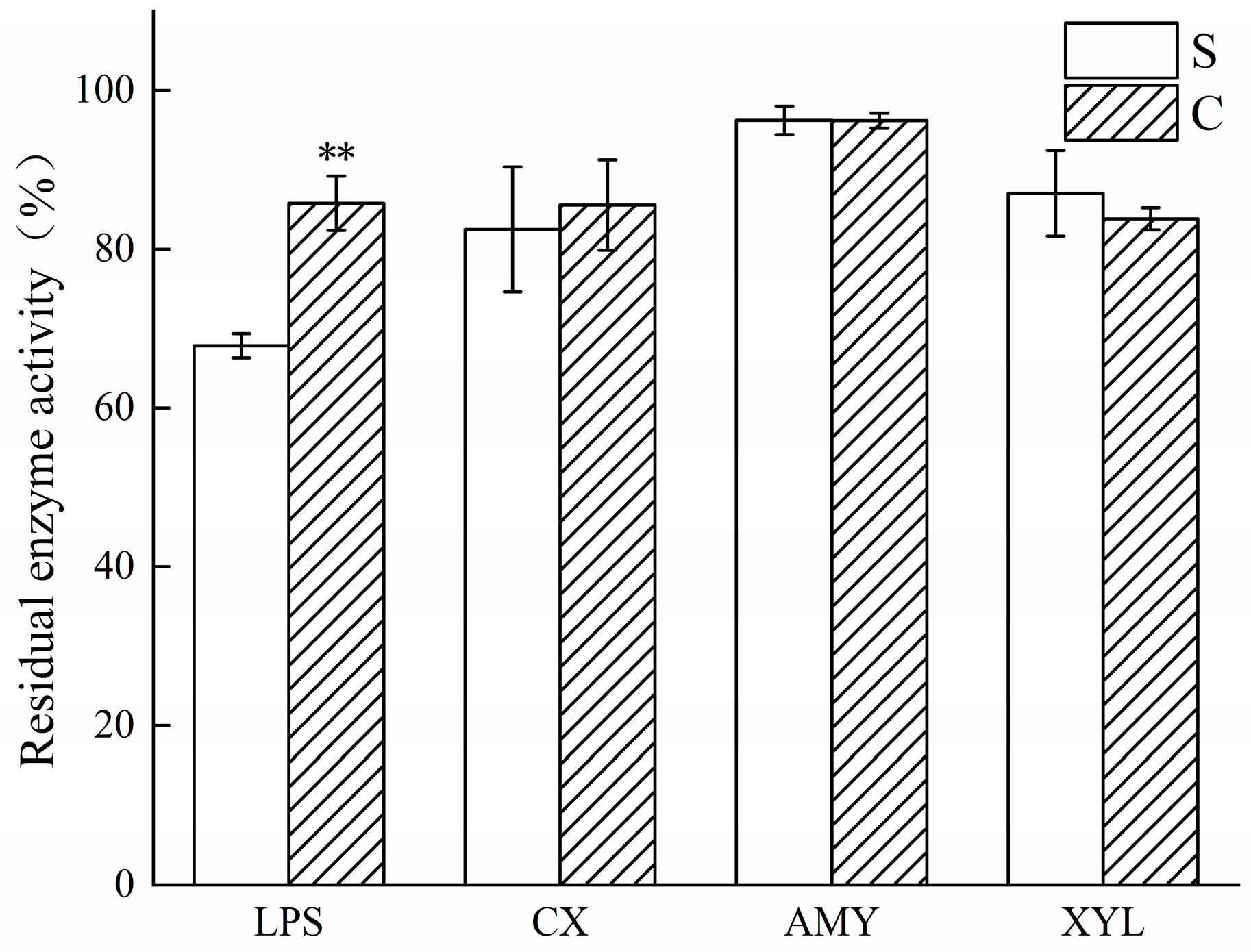
Based on the deinking process, the optimal temperature and pH for the four enzymes, the enzyme activity stability of each individual enzyme, and the enzyme preparation were measured under 50 °C, pH7.0 for 1 h (Figure 1).
The initial enzyme activities of the individual enzymes LPS, CX, AMY, and XYL were 331,426; 8639; 138 and 166,212 U/g, respectively, whereas the initial enzyme activities in the composite enzyme preparation were 382,136; 6126; 142 and 176,781 U/g. The enzyme activity stability of lipase, cellulase, amylase, and xylanase remained at 67.84%, 82.50%, 96.24%, and 87.06%, respectively, after being incubated at 50 °C for 1 h. In the composite enzyme preparation, the enzyme activity stability of lipase, cellulase, amylase, and xylanase remained at 85.80%, 85.57%, 96.21%, and 83.83% (Figure 1), respectively, under the same conditions, indicating that all enzymes exhibited enzyme activity stability above 65%. Further analysis showed that when the enzyme acted together, its residual activity was basically equivalent to a single enzyme. The increased lipase activity may be attributed to the presence of other enzyme proteins in the composite enzyme system, which can enhance the stability of lipase. This is similar to the scenario that bovine serum albumin (BSA) can improve the thermal stability of β-galactosidase from Streptococcus thermophilus [29]. This result shows that the catalytic effects of these enzymes are not weakened by the interaction during the synergistic action. Therefore, from the perspective of enzymatic properties and practical application, the composite enzyme system has good thermal stability and synergistic characteristics and is suitable for experimental research on pulp deinking.

3.2. Effect of Different Enzymes on Deinking Effect

Brightness and ERIC serve as the basic indicators to characterize deinking efficiency. ERIC refers to the concentration of ink particles remaining in the pulp after deinking, which can negatively affect the final brightness and printing performance of the pulp. The unit is usually ppm. In order to obtain the optimal value range of each factor level in the orthogonal experiment, the experiments on the deinking effect of lipase, cellulase, amylase and xylanase on pulp deinking were carried out. The brightness and ERIC of the pulp after deinking were determined. The results are shown in Table 1.
When the four enzymes were used for deinking separately, the brightness was found to exhibit a trend of first increasing and then decreasing, whereas the optimal dosages for different enzymes were different. The pulp deinked by lipase and amylase reached the highest brightness when the addition amount was 1 U/g ODP, while pulp deinked by cellulase and xylanase reached the highest brightness when the addition amount was 2 U/g ODP. The addition of all four enzymes also reduced the ERIC of the pulp, with the same trend as the brightness display.
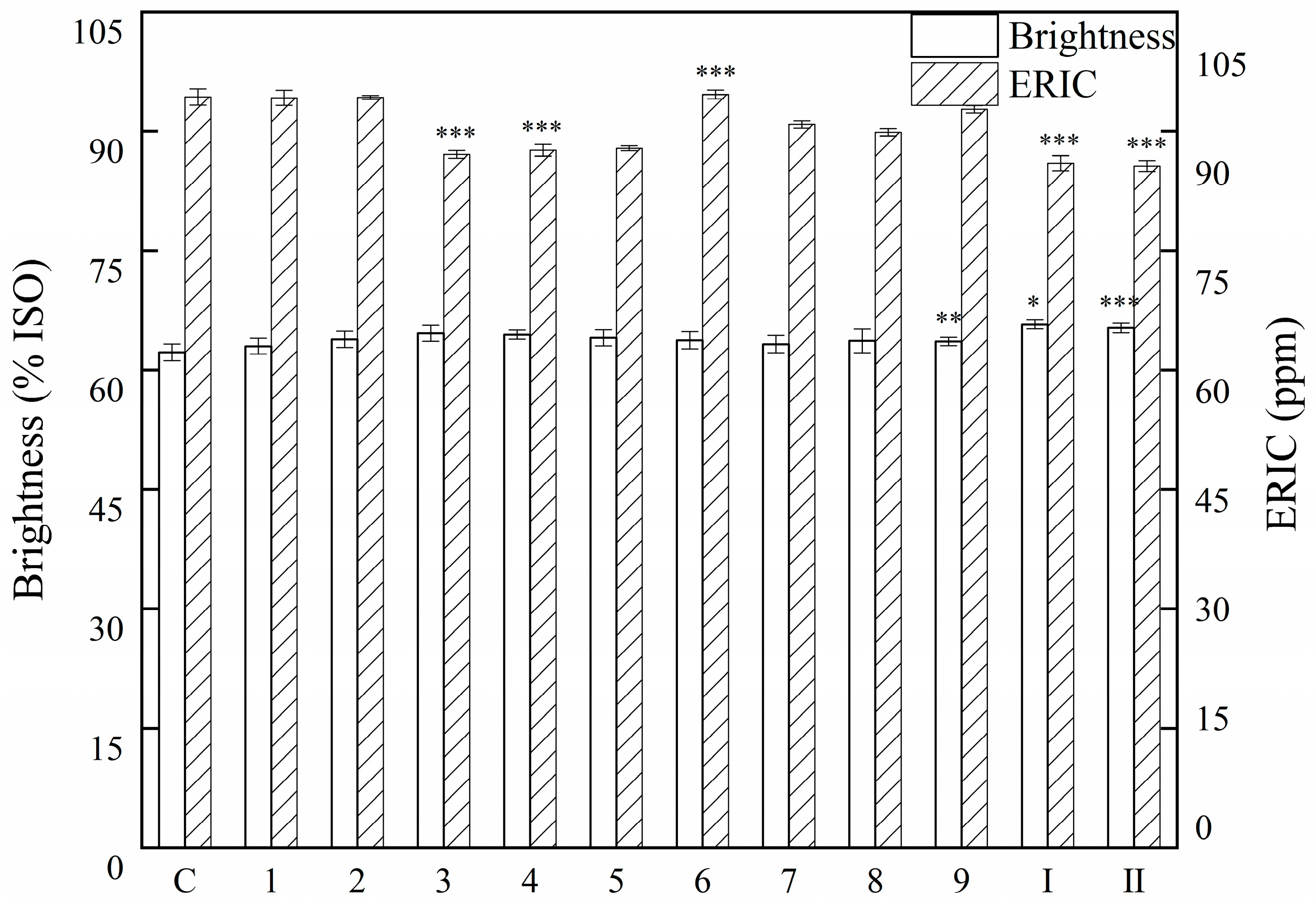
Orthogonal experimental design is a commonly used experimental method for studying multiple factors at multiple levels. It selects a portion of representative points from a comprehensive experiment based on orthogonality, which can reduce the number of experiments, eliminate factor interference, and ensure the accuracy of the results. Considering the complexity of the pulp substrates, to increase the synergistic action of enzymes, a four-factor, three-level orthogonal experiment was designed with lipase, cellulase, amylase, and xylanase as the factors, based on the results of single-factor experiments, with brightness and ERIC as the testing parameters. The orthogonal experimental design is shown in Table 2. The results for brightness and ERIC detection are shown in Table 2 and Figure 2.
Brightness and ERIC values are two basic indicators used to characterize the deinking effect. According to the orthogonal experimental design, we measured the brightness and ERIC values of the pulp after each deinking experiment (Table 2 and Figure 2). Based on the brightness and ERIC values, the corresponding R and k values were calculated (Table 2). A larger R value indicates a more significant effect of the factor on the deinking effect; k1, k2, and k3 represent the three levels of each factor, respectively, with a larger k value indicating a better level. As can be seen from Table 2, in terms of brightness, the R value ranking is A (2.69) > B (1.49) > D (0.33) > C (0.17), indicating that lipase has the greatest impact on the brightness, followed by amylase, cellulase, and xylanase. Based on the maximum k value of each factor, the optimal levels of the factors are A3, B3, C2, and D2. Therefore, the optimal composite enzyme preparation combination that can effectively improve the brightness of deinked pulp is A3B3C2D2, corresponding to lipase 1.5 U/g ODP, amylase 1.5 U/g ODP, xylanase 2 U/g ODP, and cellulase 2 U/g ODP (Composite Enzyme Preparation I). Similarly, based on the detected ERIC values, the influencing factors of ERIC are inferred to be D > C > A > B, and the optimal enzyme preparation combination is A1B3C1D2. This indicates that cellulase has the greatest impact on ERIC, followed by xylanase, lipase, and amylase. Therefore, the best preparation for reducing ERIC is lipase 0.5 U/g ODP, amylase 1.5 U/g ODP, xylanase 1 U/g ODP, and cellulase 2 U/g ODP (Composite Enzyme Preparation II). This indicates that the optimal ratio of composite enzyme preparation affecting brightness and ERIC is not exactly the same. This may be due to the different structural components associated with brightness and ERIC in deinking.
The deinking efficiency of the two composite enzyme preparations was validated using ONP for deinking and compared with that of chemical deinking. The results of the brightness and ERIC tests are shown in Figure 2.
From Figure 2, it can be observed that the brightness of the deinked pulp treated with Enzyme Preparation I is 65.73% ISO, and the ERIC value is 94.17 ppm. The brightness of the deinked pulp treated with Enzyme Preparation II is 65.30% ISO, and the ERIC value is 93.77 ppm. Both enzyme-treated pulp samples have higher brightness than all the pulp samples from the orthogonal experiment groups and also higher than the brightness of the chemically deinked pulp (62.21% ISO). The brightness was increased by 3.52% and 3.09% compared with that of the chemically deinked pulp. The ERIC values for both enzyme treatments are also lower than those of all the orthogonal experiment groups and lower than the ERIC value of the chemically deinked pulp (103.29 ppm). ERIC values were reduced by 9.12 ppm and 9.52 ppm compared with that of the chemically deinked pulp. Both composite enzyme preparations significantly improve the brightness of the pulp and reduce the ERIC value, demonstrating that the deinking effect of the composite enzyme preparations developed in this study is significantly superior to that of the chemical deinking method.

3.3. Analysis of the Physical Properties of Pulp

The deinked pulp was sheeted, and its burst index, tear index, and tensile index were determined; the results are shown in Table 3. It was found from the detection of the physical properties of the paper that the burst index and tensile index of the paper deinked by the two composite enzyme preparations were slightly lower than those of the chemical deinking group, while the tear index was higher than that of the chemical deinking group. This result indicates that both composite enzyme preparations exerted a certain degree of influence on the physical properties of the paper. Compared with Enzyme Preparation II, Enzyme Preparation I exhibited a higher burst index and tensile index, with only a slightly lower tear index, indicating overall superior mechanical properties. Analysis of the variation trends of various physical property indices reveals that the influences of the two composite enzyme preparations on the physical properties of the paper are basically similar.
The effects of enzymatic deinking and chemical deinking on the physical properties of pulp are different; the possible reason is that bio-enzyme deinking acts specifically on the ink-fiber interface and the microfibrils on the fiber surface rather than damaging the main fiber structure, thereby avoiding significant fiber degradation caused by strong alkalis or oxidants in traditional chemical deinking [30]. The stability of the burst index and tensile index further indicates that the enzymatic hydrolysis process did not induce negative effects such as fiber length reduction, excessive fibrillation, or decreased hydrogen bond binding capacity, thus ensuring the applicability of recycled pulp in subsequent processing [31].

3.4. Analysis of Structural Change of Pulp

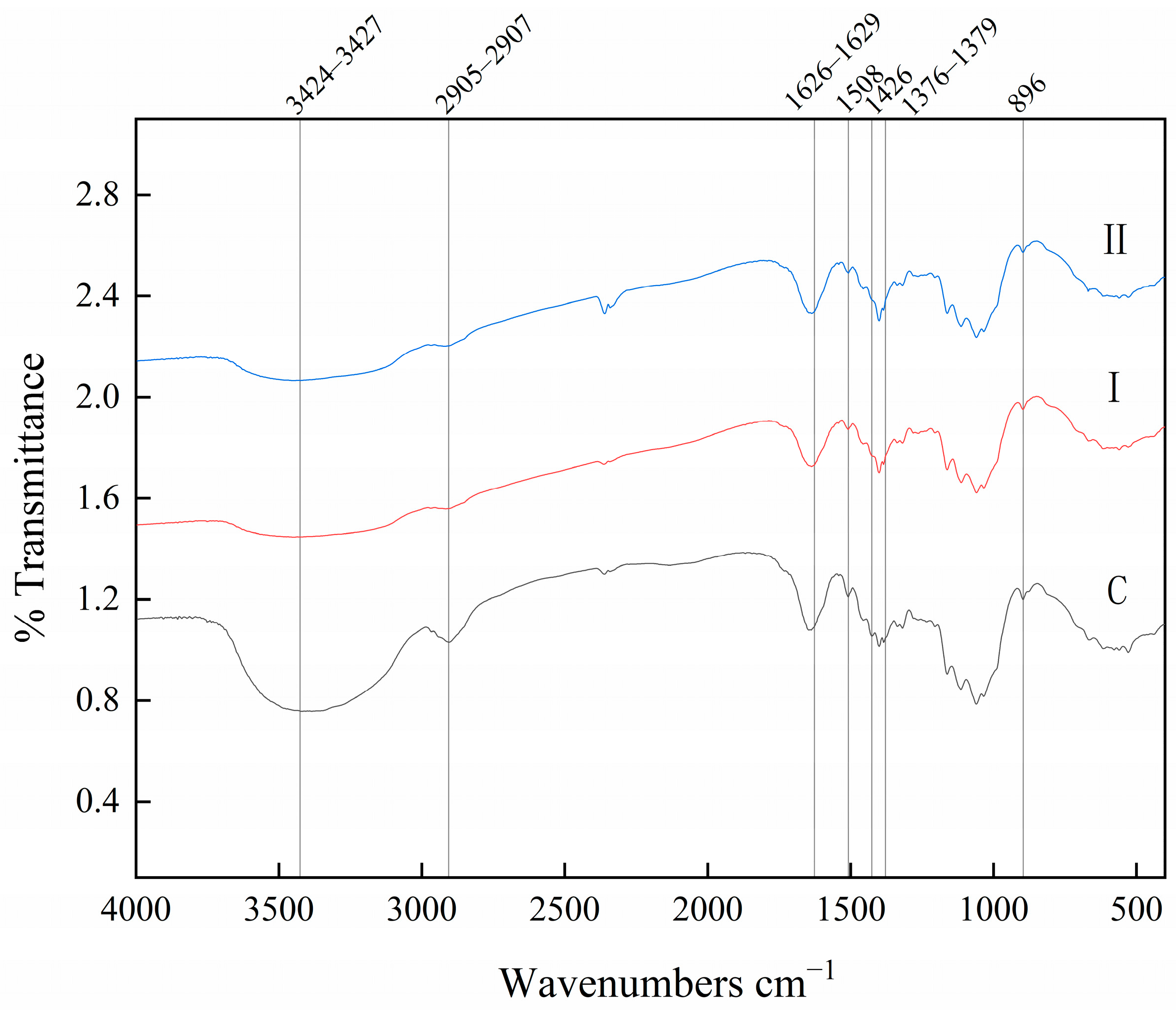
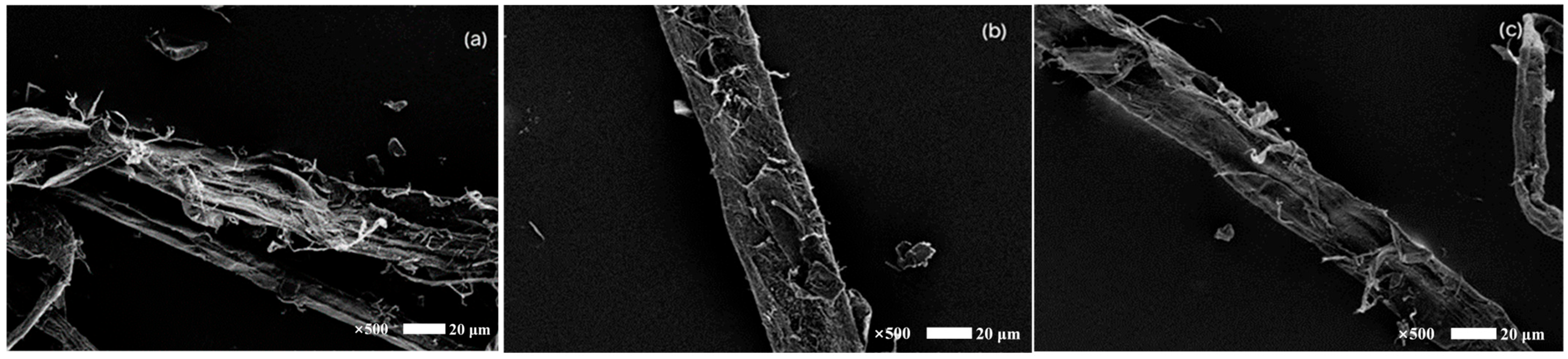
To further evaluate the effect of the two composite enzyme preparations, FTIR and SEM analyses were performed on the deinked pulps treated with the chemical deinking method, Enzyme Preparation I, and Enzyme Preparation II.
The results of the FTIR analysis are shown in Figure 3. After deinking via different methods, changes in the spectral peaks were observed, which indicated that the chromophoric and auxiliary chromophoric groups had undergone changes. These changes can reflect the properties of the pulp [32,33,34]. Compared with chemical deinking, the deinked pulp treated with Enzyme Preparation I and Enzyme Preparation II exhibited a significant reduction in the -OH absorption band in the range of 3424–3427 cm−1. This is because substances such as ink resins generally contain -OH groups or can form disordered hydrogen bonds with cellulose -OH; after the removal of these substances, the hydrogen bonds on the fiber surface become more regularly arranged, thereby leading to a decreased absorption intensity in this region [35]. The absorption peaks at 2905–2907 cm−1 represent the stretching vibration of phenolic hydroxyl groups in different forms. A significant decrease in absorbance was observed for both Enzyme Preparation I and II treated deinked pulp, with Enzyme Preparation I showing a lower absorbance. The absorption intensities of the conjugated carbonyl groups corresponding to 1626–1629 cm−1 and the benzene rings at 1508 cm−1 (a typical characteristic absorption peak of lignin) were weakened, suggesting a decrease in lignin content after deinking treatment. The reduction in these chromophores and auxiliary chromophores is the primary reason for the increase in brightness of the deinked pulp, so the brightness of enzymatic deinking pulp is higher than that of chemical deinking pulp, and the brightness of pulp deinked with Enzyme Preparation I is higher than that of pulp deinked with Enzyme Preparation II. The absorption peak corresponding to 1426 cm−1 was assigned to methoxyl groups. A decrease in the absorption intensity suggested a reduction in the number of methoxyl groups, which further indirectly reflected a decrease in lignin content. The absorption peaks corresponding to 1376–1379 cm−1 originated from the C-H vibrations of the molecular backbones of cellulose and hemicellulose, while the absorption peak at 896 cm−1 mainly originated from the vibration of the anomeric carbon (C1) of hemicellulose. Compared with chemically deinked pulp, the absorption intensities of the aforementioned characteristic peaks remained relatively stable, indicating that enzyme treatment did not cause significant damage to the molecular backbone structures of cellulose and hemicellulose [36]. The aforementioned series of structural changes collectively acted to enable the enzyme-deinked pulp to exhibit a lower ERIC value and higher brightness compared with chemically deinked pulp. Enzyme Preparation I showed sustained superiority in reducing the contents of chromophores and auxochromes, thereby confirming its comprehensive performance advantages in the deinking application of ONP pulp.
SEM analysis provides a detailed examination of the morphological and ultrastructural changes in the deinked pulp and the control samples. The fiber surfaces of the three groups of deinked pulps were rough, with signs of peeling and fracture, indicating some degree of disintegration and exposure of the internal structure (Figure 4). Among them, the deinked pulp treated with Enzyme Preparation I and II exhibited greater disintegration than the chemically deinked pulp. The fiber structure in the pulp treated with Enzyme Preparation I was the most severely damaged, which is consistent with the FTIR results. Some depolymerization of the internal structure was also observed, which may be attributed to the enzymatic hydrolysis by xylanase. This may be the fundamental reason why enzymatic deinking pulp has higher brightness, lower ERIC value, and improved physical strength compared to chemically deinking pulp.

4. Conclusions

Compared with chemical deinking, enzymatic deinking, by virtue of the specificity of enzymes, achieves a lower fiber loss rate, a higher fiber recovery rate, and slower performance attenuation of recycled fibers [37]. However, enzymatic deinking still faces challenges in industrialization, such as the stringent requirements for process parameter optimization and insufficient stability of enzyme preparations. In this study, two types of deinking composite enzyme preparations were obtained. Composite Enzyme Preparation I consists of lipase at 1.5 U/g ODP, cellulase at 2 U/g ODP, amylase at 1.5 U/g ODP, and xylanase at 2 U/g ODP. Composite Enzyme Preparation II contains lipase at 0.5 U/g ODP, cellulase at 2 U/g ODP, amylase at 1.5 U/g ODP, and xylanase at 1 U/g ODP. Both composite enzyme preparations exhibit excellent deinking effects, which are significantly superior to the chemical deinking method. After deinking with Composite Enzyme Preparation I, the brightness of the pulp increased by 3.52% ISO compared to that of the pulp deinked by the chemical method, and the ERIC value decreased by 9.12 ppm. After deinking with Composite Enzyme Preparation II, the pulp brightness increased by 3.09% ISO compared to the chemically deinked pulp, and the ERIC value decreased by 9.32 ppm. From the perspective of brightness, ERIC, and microstructure, Composite Enzyme Preparation I demonstrates a better deinking performance than Composite Enzyme Preparation II, showing that Composite Enzyme Preparation I is the best composite enzyme preparation for deinking ONP. The composite enzyme preparation developed in this study was employed for deinking ONP pulp. Specifically, its brightness was 25.83% ISO higher than that achieved by cellulase and xylanase used by Lee et al. [20] and 6.73% ISO higher than that by cellulase and hemi-cellulase by Ibarra et al. [38].
In conclusion, this study developed an effective ONP enzymatic deinking technology. In terms of the brightness of the deinked pulp, ERIC value, and the physical properties of the pulp, its deinking effect is significantly better than that of chemical deinking methods. More importantly, this enzymatic deinking method does not require the use of chemical reagents such as NaOH or Na2SiO3, reducing chemical wastewater and the corresponding wastewater treatment costs. This research helps in developing an eco-friendly approach for recycling waste paper in the industry, promoting the sustainable development of the paper industry.

Author Contributions

Writing—original draft, M.L., F.L. and Y.B.; writing—review and editing, Y.B., Z.D. and F.G.; Funding acquisition, M.L. and F.L.; Investigation, Y.B., Z.D. and J.W.; Methodology, M.L., Y.B., Q.L. and X.W.; Formal analysis, Y.B., F.G. and J.W.; Conceptualization, F.L., Q.L. and X.W. All authors have read and agreed to the published version of the manuscript.

Funding

This work was supported by the National Key Research and Development Program of China (2022YFC2105500) and the National Natural Science Foundation of China (22278321, 32072161).

Institutional Review Board Statement

Not applicable.

Informed Consent Statement

Not applicable.

Data Availability Statement

The original contributions presented in this study are included in the article. Further inquiries can be directed to the corresponding authors.

Conflicts of Interest

The authors declare no conflicts of interest.

References

  1. Vyas, S.; Lachke, A. Biodeinking of mixed office waste paper by alkaline active cellulases from alkalotolerant Fusarium sp. Enzym. Microb. Technol. 2003, 32, 236–245. [Google Scholar] [CrossRef]
  2. Saxena, A.; Singh Chauhan, P. Role of various enzymes for deinking paper: A review. Crit. Rev. Biotechnol. 2016, 37, 598–612. [Google Scholar] [CrossRef] [PubMed]
  3. Yu, S.; Sumayli, M.; Mashraqi, A.; El-Shabasy, A.; Azizoglu, U.; Ali, S.A. The removal of black ink via Emericella quadrilineata as a green alternative technique to recycling ink waste papers. PLoS ONE 2025, 20, e0324022. [Google Scholar] [CrossRef]
  4. Van Ewijk, S.; Stegemann, J.A.; Ekins, P. Global Life Cycle Paper Flows, Recycling Metrics, and Material Efficiency. J. Ind. Ecol. 2018, 22, 623–990. [Google Scholar] [CrossRef]
  5. Akbarpour, I. Synergistic deinking effect of neutral sodium sulfite with fungal hemicellulase enzyme for improved recycling of waste papers. Int. J. Biol. Macromol. 2024, 282, 137010. [Google Scholar] [CrossRef]
  6. Martin-Sampedro, R.; Miranda, J.; García-Fuentevilla, L.L.; Hernández, M.; Arias, M.E.; Diaz, M.J.; Eugenio, M.E. Influence of process variables on the properties of laccase biobleached pulps. Bioprocess Biosyst. Eng. 2015, 38, 113–123. [Google Scholar] [CrossRef]
  7. Balda, S.; Sharma, A.; Capalash, N.; Sharma, P. Microbial enzymes for eco-friendly recycling of waste paper by deinking. In Microbes for Sustainable Development and Bioremediation; CRC Press: Boca Raton, FL, USA, 2019; pp. 43–54. [Google Scholar]
  8. Chen, H.; Han, Q.; Venditti, R.A.; Jameel, H. Enzymatic Hydrolysis of Pretreated Newspaper Having High Lignin Content for Bioethanol Production. Bioresources 2015, 10, 4077–4098. [Google Scholar] [CrossRef]
  9. Hong, R.; Su, L.; Chen, S.; Long, Z.; Wu, J. Comparison of cutinases in enzymic deinking of old newsprint. Cellulose 2017, 24, 5089–5099. [Google Scholar] [CrossRef]
  10. Pathak, P.; Bhardwaj, N.K.; Singh, A.K. Optimization of chemical and enzymatic deinking of photocopier waste paper. BioResources 2011, 6, 447–463. [Google Scholar] [CrossRef]
  11. Ghosh, D.S.B.; Singh, B. Enzymes for pulp and paper applications. Ind. Enzym. Appli Cations 2019, 287–321. [Google Scholar] [CrossRef]
  12. Nagpal, R.; Bhardwaj, N.K.; Mahajan, R. Potential of crude xylano-pectinolytic enzymes in bleaching of rice straw pulp for improving paper quality and reducing toxic effluent load generation. Environ. Sci. Pollut. Res. 2021, 28, 18284–18293. [Google Scholar] [CrossRef] [PubMed]
  13. Kaur, J.; Chadha, B.; Kumar, B.; Saini, H. Purification and characterization of two endoglucanases from Melanocarpus sp. MTCC 3922. Bioresour. Technol. 2007, 98, 74–81. [Google Scholar] [CrossRef] [PubMed]
  14. Markus Linder, T.T.T. The roles and function of cellulose-binding domains. J. Biotechnol. 1997, 57, 15–28. [Google Scholar] [CrossRef]
  15. Efrati, Z.; Talaeipour, M.; Khakifirouz, A.; Bazyar, B. Impact of cellulase enzyme treatment on strength, morphology and crystallinity of deinked pulp. Cellul. Chem Technol 2013, 47, 547–551. [Google Scholar]
  16. Sharma, A.; Thakur, V.V.; Shrivastava, A.; Jain, R.K.; Mathur, R.M.; Gupta, R.; Kuhad, R.C. Xylanase and laccase based enzymatic kraft pulp bleaching reduces adsorbable organic halogen (AOX) in bleach effluents: A pilot scale study. Bioresour. Technol. 2014, 169, 96–102. [Google Scholar] [CrossRef]
  17. Mørkbak, A.; Degn, P.; Zimmermann, W. Deinking of soy bean oil based ink printed paper with lipases and a neutral surfactant. J. Biotechnol. 1999, 67, 229–236. [Google Scholar] [CrossRef]
  18. Tsatsis, D.E.; Papachristos, D.K.; Valta, K.A.; Vlyssides, A.G.; Economides, D.G. Enzymatic deinking for recycling of office waste paper. J. Environ. Chem. Eng. 2017, 5, 1744–1753. [Google Scholar] [CrossRef]
  19. Xu, Q.; Fu, Y.; Gao, Y.; Qin, M. Performance and efficiency of old newspaper deinking by combining cellulase/hemicellulase with laccase-viol uric acid system. Waste Manag. 2009, 29, 1486–1490. [Google Scholar] [CrossRef]
  20. Lee, C.K.; Ibrahim, D.; Ibrahim, C.O.; Rosli, W.D.W. Enzymatic and chemical deinking of mixed office wastepaper and old newspaper: Paper quality and effluent characteristics. Bioresources 2011, 6, 3859–3875. [Google Scholar] [CrossRef]
  21. Yu, C.; Peng, B.; Luo, T.; Deng, Z. Bound lipase: An important form of lipase in rice bran (Oryza sativa). Food Sci. Hum. Wellness 2023, 12, 1779–1787. [Google Scholar] [CrossRef]
  22. Yu, C.-W.; Zheng, L.-F.; Cheng, M.-Y.; Yu, X.-Y.; Wang, S.-Y.; Fan, Y.-W.; Deng, Z.-Y. Purification, identification, characterization and catalytic mechanism of two lipases from rice bran (Oryza sativa). LWT-Food Sci. Technol. 2021, 140, 110693. [Google Scholar] [CrossRef]
  23. Elsababty, Z.E.; Abdel-Aziz, S.H.; Ibrahim, A.M.; Guirgis, A.A.; Dawwam, G.E. Purification, biochemical characterization, and molecular cloning of cellulase from Bacillus licheniformis strain Z9 isolated from soil. J. Genet. Eng. Biotechnol. 2022, 20, 34. [Google Scholar] [CrossRef] [PubMed]
  24. Zollner, H.K.; Schroeder, L.R. Enzymatic deinking of nonimpact printed white office paper with alpha-amylase. Tappi J. 1998, 81, 166–170. [Google Scholar]
  25. Matos, J.M.S.; Evtuguin, D.V.; Sousa, A.P.M.; Almeida, N.; Oliveira, R.J.; Pereira, S.R.; Pinto, P.C.R.; Carvalho, M.d.G.V.S. Toward Valorization of the Effluent from Xylanase Prebleaching of Eucalypt Kraft Pulp Using a Nanofiltration Purification Step. Ind. Eng. Chem. Res. 2023, 62, 16037–16047. [Google Scholar] [CrossRef]
  26. Bansal Mukesh, C.; Vivek, K.; Shilpa, K. Combined Deinking Technology To Improve The Quality Of Recycled Paper. Indian Pulp Pap. Tech. Assoc. 2011, 23, 145–148. [Google Scholar]
  27. Dixit, M.; Chhabra, D.; Shukla, P. Optimization of endoglucanase-lipase-amylase enzyme consortium from Thermomyces lanuginosus VAPS25 using Multi-Objective genetic algorithm and their bio-deinking applications. Bioresour. Technol. 2023, 370, 128467. [Google Scholar] [CrossRef]
  28. Mondal, S.; Biswal, D.; Pal, K.; Rakshit, S.; Kumar Halder, S.; Mandavgane, S.A.; Bera, D.; Hossain, M.; Chandra Mondal, K. Biodeinking of waste papers using combinatorial fungal enzymes and subsequent production of butanol from effluent. Bioresour. Technol. 2022, 353, 127078. [Google Scholar] [CrossRef]
  29. Bs, C.; Rr, M. Enzyme thermostabilization by bovine serum albumin and other proteins: Evidence for hydrophobic interactions. Biotechnol. Appl. Biochem. 1995, 22, 203–214. [Google Scholar] [CrossRef]
  30. Rossi, C.; Solé, A. A systematic review on enzymatic refining of recycled fibers: A potential to be unlocked. BioResources 2025, 20, 7870. [Google Scholar] [CrossRef]
  31. Kumar, N.V.; Rani, M.E.; Gunaseeli, R.; Kannan, N. Paper pulp modification and deinking efficiency of cellulase-xylanase complex from Escherichia coli SD5. Int. J. Biol. Macromol. 2018, 111, 289–295. [Google Scholar] [CrossRef] [PubMed]
  32. Heitner, C. Light-induced yellowing of wood-containing papers: An evolution of the mechanism. ACS Symp. Ser. 1993, 531, 2–25. [Google Scholar]
  33. Evans, P.D.; Thay, P.D.; Schmalzl, K.J. Degradation of wood surfaces during natural weathering. effects on lignin and cellulose and on the adhesion of acrylic latex primers. Wood Sci. Technol. 1996, 30, 411–422. [Google Scholar] [CrossRef]
  34. Heitner, C. Light-Induced Yellowing of Wood-Containing Papers, Photochemistry of Lignocellulosic Materials. J. Am. Chem. Soc. 1993, 531, 6156. [Google Scholar]
  35. Pradeep, H.K.; Patel, D.H.; Sahana, S.; Abhishek, N.; Jeevan, H.; Karthik, V.; Tejasvini, K.V.; Pattanashetty, D.V. Synthesis and Characterization of Nanocellulose from Neem Sawdust as Biomass using Ionic Liquid. Asian J. Chem. 2024, 37, 145–148. [Google Scholar] [CrossRef]
  36. Wang, S.; Wang, F.; Song, Z.; Song, X.; Yang, X.; Wang, Q. Preparation of Cellulose Nanocrystals Using HighlyRecyclable Organic Acid Treated Softwood Pulp. BioResources 2019, 14, 9331–9351. [Google Scholar] [CrossRef]
  37. Balda, S.; Sharma, A.; Gupta, N.; Capalash, N.; Sharma, P. Deinking of old newsprint (ONP) pulp with an engineered laccase: A greener approach for paper recycling. Biomass Convers. Biorefinery 2024, 14, 3965–3974. [Google Scholar] [CrossRef]
  38. Ibarra, D.; Concepción Monte, M.; Blanco, A.; Martínez, A.T.; Martínez, M.J. Enzymatic deinking of secondary fibers: Cellulases/hemicellulases versus laccase-mediator system. J. Ind. Microbiol. Biotechnol. 2012, 39, 1–9. [Google Scholar] [CrossRef]
Figure 1. Enzyme Activity Stability of Different Enzyme Preparations. LPS: lipase; CX: cellulase; AMY: amylase; XYL: xylanase. “S”: single enzyme; “C”: the enzyme preparation. (Independent experiments n = 3; The ** represented 0.001 < p < 0.01 compared with their controls).
Sustainability 17 10702 g001
Figure 2. Brightness and ERIC of ONP pulp after deinking with different enzyme preparations. C: chemical deinking group; 1 to 9: orthogonal groups 1 to 9; I: the verification group of the Brightness orthogonal experiment; II: the verification group of ERIC orthogonal experiment. (Independent experiments n = 3; The * symbol represented 0.01 < p < 0.05, ** represented 0.001 < p < 0.01, and *** represented p < 0.001 compared with their controls).
Sustainability 17 10702 g002
Figure 3. Infrared spectra of deinked paper pulp with different treatment methods. C: chemical deinking group; I: Enzyme Preparation I; II: Enzyme Preparation II.
Sustainability 17 10702 g003
Figure 4. Scanning electron microscope images of deinked paper pulp with different treatment methods. (a): Enzyme Preparation I; (b): Enzyme Preparation II; (c): Chemical Deinking Group.
Sustainability 17 10702 g004
Table 1. Brightness and ERIC of enzyme deinked pulp with different dosages.
EnzymeEnzyme Dosage (U/g ODP)Brightness (%ISO)ERIC (ppm)
0.058.9 ± 0.63122.2 ± 0.71
LPS0.261.1 ± 0.72119.0 ± 1.62
1.061.5 ± 0.53114.0 ± 1.33
1.860.7 ± 0.62116.1 ± 1.46
2.659.1 ± 0.83118.2 ± 0.93
CX0.560.5 ± 0.93121.0 ± 1.11
2.061.2 ± 0.63118.6 ± 0.99
3.560.6 ± 0.67120.4 ± 1.25
5.059.9 ± 0.69120.9 ± 1.49
AMY0.259.8 ± 0.93122.1 ± 0.93
1.060.6 ± 0.53120.1 ± 0.79
1.860.0 ± 0.67121.0 ± 1.23
2.659.2 ± 0.68121.6 ± 1.46
XYL0.560.8 ± 0.73118.2 ± 1.33
2.061.2 ± 0.68116.7 ± 0.99
3.560.6 ± 0.92118.6 ± 1.03
5.060.5 ± 0.83120.0 ± 1.46
Table 2. Orthogonal experimental design, Brightness and ERIC results of deinking enzyme preparation L9 (34).
Experiment
Number
A
LPS
B
AMY
C
XYL
D
CX (U/g ODP)
Brightness
(%ISO)
ERIC (ppm)
1111163.01103.50
2123263.87103.18
3132364.6495.12
4213364.4696.34
5222164.0796.05
6231263.75103.68
7312263.2799.55
8321364.6698.30
9333163.60101.74
K1202.81/301.80205.38/299.39207.09/305.48206.73/301.29
K2208.40/296.07206.87/297.53207.60/290.72207.72/306.41
K3210.88/299.59209.84/300.54207.40/301.26207.64/289.76
k167.60/100.60 68.46/99.8069.03/101.8368.91/100.43
k269.47/98.6968.96/99.1869.20/96.9169.24/102.14
k370.29/99.8669.95/100.1869.13/100.4269.21/96.59
R2.69/1.911.49/1.000.17/4.920.33/5.55
Table 3. Effect of different deinking methods on physical properties of ONP pulp.
GroupBurst Index (kPa·m2/g)Tensile Index (N·m·g−1)Tear Index (mN·m2/g)
Chemical Deinking1.76 ± 0.03 28.13 ± 0.13 5.93 ± 0.03
Composite Enzyme Preparation I1.25 ± 0.03 24.47 ± 0.18 6.35 ± 0.04
Composite Enzyme Preparation II1.19 ± 0.0223.47 ± 0.206.09 ± 0.03
Disclaimer/Publisher’s Note: The statements, opinions and data contained in all publications are solely those of the individual author(s) and contributor(s) and not of MDPI and/or the editor(s). MDPI and/or the editor(s) disclaim responsibility for any injury to people or property resulting from any ideas, methods, instructions or products referred to in the content.