Article

Sustainable Learning Practices in Engineering Mathematics: Building Self-Regulation and Resilience


Department of Education, Frederick University, Nicosia 1036, Cyprus
Sustainability 2025, 17(22), 10137; https://doi.org/10.3390/su172210137
Submission received: 16 October 2025 / Revised: 5 November 2025 / Accepted: 11 November 2025 / Published: 13 November 2025
(This article belongs to the Special Issue Inputs of Engineering Education Towards Sustainability—2nd Edition)

Abstract

Engineering education for sustainability extends beyond environmental awareness. It is aimed at the cultivation of resilient and self-regulated learners capable of continuous growth. The present work draws upon empirical data from three complementary investigations on first-year engineering students’ affective behavior, mathematical difficulties and the use of online quizzes as self-assessment tools. By integrating these findings, the paper proposes a framework for sustainable learning practices in engineering mathematics. The results highlight that affective factors, such as confidence, self-efficacy and motivation, interact significantly with students’ self-regulatory strategies and performance outcomes. Digital self-assessment tools, when purposefully designed, can promote metacognitive reflection and foster a sustainable cycle of feedback and self-improvement. The study argues that sustainable education in engineering must include pedagogical approaches that empower students with interindividual differences to manage their own learning, overcome affective barriers and develop adaptive resilience in demanding quantitative subjects. The proposed model offers practical implications for designing assessment systems that support long-term learner autonomy and well-being, aligning engineering mathematics education with the broader goals of sustainable development. In alignment with SDG 4.7 and the European Skills Agenda, which both emphasize lifelong learning, learner autonomy and the cultivation of adaptive competences for sustainable futures, the proposed framework positions self-regulation and resilience as core sustainability-oriented outcomes in engineering mathematics education.

1. Introduction

In the context of global educational reform, sustainability has emerged as a guiding principle not only for environmental and economic systems, but also for educational design and learning processes. Within higher education, the concept of sustainability increasingly encompasses the development of learners who can think critically, self-regulate effectively and persist through uncertainty and change. Sustainability in education therefore extends beyond institutional or curriculum reform to include the cultivation of learners who can sustain their own learning processes over time [1]. Within engineering education, this notion of educational sustainability implies cultivating students who are able to manage their learning autonomously, regulate their cognitive and emotional resources to face obstacles, adapt to evolving technological contexts and sustain motivation and performance throughout their academic and professional lives. By learning to plan, monitor and adjust their strategies, students become autonomous and reflective, preparing engineers who can maintain and renew their capacity to learn throughout their professional careers.
Mathematics represents a foundational yet challenging domain within engineering curriculum. The transition from secondary to higher education often exposes substantial cognitive and affective barriers that hinder students’ engagement with mathematical concepts. Many first-year engineering students experience low confidence, high anxiety, negative experiences with mathematics and a lack of effective study strategies, which together contribute to early academic disengagement and, in some cases, attrition [2,3]. These challenges raise an important pedagogical question: how can mathematics instruction in engineering programs be designed to promote sustainable learning trajectories and emotional resilience?
In the global policy landscape, SDG 4.7 [4] explicitly frames education as a vehicle for sustainable development by prioritizing the cultivation of learners who can think critically, act autonomously and engage in lifelong learning as responsible agents of change. Within engineering education, this goal translates into pedagogical approaches that do not merely transmit technical knowledge but deliberately build capacities such as resilience, self-regulation and reflective autonomy. The present study reflects this shift by conceptualizing sustainable education not as an environmental add-on but as a learner-centred outcome embedded in the design of assessment and feedback systems in engineering mathematics.
The need for sustainable learning environments in mathematics has become more pressing as higher education institutions increasingly integrate digital technologies and flexible assessment systems. When used strategically, online quizzes and self-assessment tools can create sustainable feedback loops that promote metacognitive awareness, self-regulatory strategies and learner autonomy. Rather than serving solely as evaluative mechanisms, such tools enable students to monitor their progress, identify conceptual weaknesses and regulate their own learning in real time. In parallel, affective variables such as motivation, confidence and anxiety play a crucial role in sustaining long-term engagement, highlighting the inseparable connection between emotional well-being and sustainable educational outcomes.
Previous research has examined these elements separately: the cognitive and procedural difficulties faced by first-year engineering students [2], the affective dynamics influencing their attitudes towards mathematics [5] and the pedagogical benefits of digital self-assessment for enhancing self-regulation [6]. However, there remains a lack of integrative approaches that combine these dimensions within a unified sustainability perspective. Addressing this gap requires an empirical synthesis that draws upon complementary evidence to identify the mechanisms through which cognitive, affective and self-regulatory processes (as a part of metacognition) interact to support sustainable learning.
The present paper integrates findings from three empirical studies conducted between 2023 and 2025. The first investigated the specific mathematical difficulties encountered by first-year engineering students; the second explored the relationships between affective behavior, motivation and performance; and the third examined the role of online quizzes as self-assessment tools that foster metacognitive reflection. By synthesizing these datasets, the present work aims to propose and empirically ground a Sustainable Learning Framework (SLF) for engineering mathematics. This framework conceptualizes sustainable learning as a dynamic balance between cognitive mastery, affective resilience and metacognitive autonomy. The decision to integrate the three empirical studies was not incidental but theoretically motivated. All three datasets derive from the same population (first-year students in engineering mathematics) and examine complementary dimensions of the same construct of interest, namely the sustainability of learning: Study 1 captures cognitive stability through error typology, Study 2 quantifies affective resilience and its relation to performance, and Study 3 examines metacognitive regulation through digital self-assessment practices. Their integration therefore enables a meta-inferential synthesis in which convergences across independent data sources strengthen the explanatory validity of the proposed Sustainable Learning Framework.
Specifically, the paper seeks to address the following research questions:
  • How do affective factors such as motivation, anxiety and confidence relate to engineering students’ mathematical performance?
  • How do digital self-assessment tools contribute to self-regulation and sustainable engagement in mathematics learning?
  • What integrative model can explain the interplay of cognitive, affective and self-regulatory dimensions in promoting sustainable learning?
Through this synthesis, the study contributes to ongoing discussions about rethinking sustainability in engineering education, not only as a technical competence, but mainly as a holistic educational process that fosters self-regulated, emotionally resilient and lifelong learners. In this study, sustainable learning is framed as a pedagogical pathway toward broader sustainability goals in engineering. By cultivating self-regulated and resilient learners through iterative feedback and reflection, engineering mathematics instruction contributes to the SDG 4.7 ambition that all learners acquire knowledge and skills for sustainable development, operationalized here as autonomy, adaptive problem-solving and responsible professional agency. This educational orientation aligns with UNESCO’s ESD for 2030, which positions educators and learning environments as levers for system-level sustainability transformations.

2. Theoretical Background

2.1. Sustainability and Learning Resilience in Engineering Education

Sustainability in higher education has traditionally been interpreted through environmental, economic and social dimensions. However, contemporary scholarship emphasizes a fourth, equally vital dimension: educational sustainability, which concerns the cultivation of learners who can engage in lifelong, adaptive and reflective learning [7]. Within this perspective, sustainability is not only a content area but also a pedagogical paradigm that shapes how students think, learn and act as responsible future professionals [1].
In engineering education, this paradigm involves preparing students to handle uncertainty, complexity and rapid technological evolution [8]. The capacity to learn continuously and to respond constructively to challenges is therefore central to both professional and educational sustainability [9]. This capacity can be conceptualized through the notion of learning resilience, the ability to maintain engagement, recover from failure by self-regulating the cognitive and affective processes and adapt one’s strategies to achieve long-term learning goals [10].
Learning resilience is particularly relevant in mathematics courses, where many students experience early difficulties and emotional tension [11]. Supporting students’ capacity to persevere through setbacks contributes directly to the sustainability of their learning trajectories and, by extension, to institutional goals of retention and academic success [12].

2.2. Self-Regulated Learning as a Foundation for Sustainable Education

Self-regulated learning (SRL) refers to the process through which learners proactively plan, monitor and evaluate their cognitive and affective engagement in learning tasks [13]. Classic models by Zimmerman (2000) [14] and Pintrich (2004) [15] conceptualize SRL as a cyclical process involving forethought (goal-setting, planning), performance (strategy use, monitoring) and reflection (self-evaluation, adaptation).
In the context of sustainability, SRL provides the mechanism through which sustainable learning is enacted. Sustainable learners are those who can identify their needs, select appropriate strategies, and adapt to feedback in a self-directed manner [16]. Engineering mathematics, with its cumulative and procedural nature, offers an ideal setting for fostering SRL because students must continuously evaluate their understanding and adjust strategies to master complex concepts.
From a pedagogical perspective, promoting SRL aligns with the broader goals of Education for Sustainable Development, as it empowers students to take responsibility for their learning and to develop habits of reflection, autonomy and persistence [9,17]. Integrating self-regulatory strategies, such as self-assessment, goal setting and error analysis, encourages learners to make sense of problems and persevere in solving them [18]. When such strategies are embedded in mathematics instruction, learning becomes a sustainable practice rather than a transient transfer of content knowledge [19].

2.3. Affective Dimensions of Mathematical Learning

The affective dimension of learning encompasses emotional, motivational, and attitudinal factors that influence students’ engagement and performance [20]. In mathematics, affective factors have been shown to play a decisive role in determining students’ persistence and success, particularly during the first year of engineering studies [5]. Mathematics anxiety, for example, is widely recognized as a barrier to performance, as it consumes cognitive resources and discourages deep engagement with problem-solving tasks [21]. Conversely, positive affective states such as confidence, curiosity and intrinsic motivation enhance persistence, self-efficacy and willingness to engage in challenging work [22,23].
Sustainability in learning thus depends not only on cognitive mastery but also on affective stability, meaning the ability to manage emotions and maintain motivation over time. Affective resilience can be viewed as an integral component of sustainable education: it enables learners to transform difficulties into opportunities for growth [12]. Instructors who acknowledge and address affective factors contribute to a learning culture that supports well-being and long-term retention, both of which are pillars of sustainable educational systems [17].

2.4. Digital Self-Assessment and Sustainable Feedback Ecosystems

The integration of digital technologies in higher education provides new opportunities to operationalize sustainability principles in assessment design [20]. Digital self-assessment tools, such as online quizzes, interactive exercises, or automated feedback systems, can function as sustainable feedback ecosystems that promote self-regulated learning and continuous improvement [24].
Unlike traditional assessment, which often provides delayed or summative feedback, digital self-assessment offers immediacy, autonomy and iteration. Students can monitor their progress, receive instant feedback and attempt tasks repeatedly until mastery is achieved. This iterative process mirrors the sustainability principle of cyclical renewal: learning becomes a continuous process rather than a finite event [25].
Moreover, self-assessment fosters metacognitive awareness by encouraging students to reflect on their understanding, identify misconceptions and plan targeted improvement. In mathematics learning, where misconceptions often accumulate unnoticed, such practices can prevent unsustainable learning patterns and promote cognitive resilience [19].
Empirical studies have also shown that when digital quizzes are used not merely for grading but as formative and diagnostic tools, they enhance student engagement, motivation, and self-efficacy [26]. These outcomes resonate with the broader goals of sustainable education by cultivating learners who are autonomous, reflective and emotionally balanced. Thus, the use of digital self-assessment tools in engineering mathematics provides a concrete pathway toward educational sustainability, linking technological innovation with human development and lifelong learning competencies [17].
Taken together, these four perspectives: learning resilience, self-regulated learning, affective engagement and digital self-assessment, we suggest the theoretical foundation for a Sustainable Learning Framework (SLF) in engineering mathematics.

3. Methodology

Research Design

This study follows an empirical integration design, combining data from three complementary research projects conducted between 2023 and 2025 at a private university offering mathematics courses in engineering and business programs [2,5,6] Each study explored a different yet interconnected aspect of mathematics learning at the level of higher education: (a) cognitive difficulties, (b) affective behavior and motivation and (c) digital self-assessment practices (see Table 1). Although the dataset included students from both Engineering and Business Administration, the analyses were not stratified by discipline because the constructs under examination (self-regulation, affective responses and perceived usefulness of self-assessment) were operationalised at the level of learning processes rather than disciplinary content within the shared instructional context.
The integrative design aims to synthesize quantitative and qualitative evidence in order to develop a Sustainable Learning Framework (SLF) for engineering mathematics. Rather than aggregating data mechanically, the approach focuses on identifying cross-cutting patterns and mechanisms that contribute to sustainable learning, defined here as the ability to maintain cognitive growth, emotional balance, and metacognitive autonomy across the learning process. This methodology aligns with the logic of mixed-method meta-inference [27], where findings from different datasets are interpreted within a shared theoretical framework to generate a higher-order understanding of the phenomenon under study.
Across all studies, participants were enrolled in introductory mathematics modules taught by the same academic team, ensuring pedagogical and contextual consistency. Data were collected under institutional ethical approval and participation was voluntary and anonymous. Across the three studies, the sampling frame consisted of all first-year students enrolled in introductory mathematics courses at the same university. Participation was voluntary and conducted within regular class sessions. Response rates ranged between approximately 75% and 85% per cohort, with minimal attrition due to the short data collection period within each semester. In Studies 1 and 2, only engineering students participated, whereas Study 3 included a small comparison group of Business Administration students who completed the same self-assessment activities. Analyses were conducted separately for the two programs; no statistically significant differences were observed in the direction of key relationships. All studies were implemented within a comparable institutional environment and under similar instructional conditions. Because of this shared pedagogical structure and the moderate sample sizes, data were analysed at the individual level rather than through multilevel modelling. However, future research with larger and more diverse samples could explore potential clustering effects by instructor or course context using hierarchical or robust estimation approaches.
The three datasets combined quantitative and qualitative components:
  • Diagnostic Mathematics Tests (Study 1):
Open-ended problems and multiple—choice items identified specific conceptual and procedural misconceptions (e.g., algebraic manipulation, functional reasoning). Error frequencies were coded into categories indicating levels of conceptual stability. Τhe “reflection gap” was not measured through a separate metacognitive scale but inferred from the diagnostic scripts. Responses were coded as reflection gap when students provided only a numerical answer or an incomplete solution without any intermediate reasoning, justification or self-explanation, indicating the absence of reflective processing during problem-solving.
  • Affective Questionnaire (Study 2):
Comprised 24 items grouped into four subscales—mathematics anxiety, motivation, self-confidence, and perceived usefulness of mathematics (as detailed in the Supplementary Materials, Table S1) and demonstrated strong internal consistency across subscales (Cronbach’s α = 0.82–0.91). The affective constructs, such as mathematics confidence, anxiety and motivation were measured using previously validated scales adapted for the engineering education context. Example items include: “I feel confident when solving unfamiliar mathematics problems” (confidence), “I get nervous when I have to apply mathematical concepts in new situations” (anxiety), and “I enjoy engaging with mathematics that challenges my thinking” (motivation). Exploratory factor analysis (principal axis factoring, Varimax rotation) confirmed a three-factor solution consistent with theoretical expectations (eigenvalues > 1, total variance explained = 71.4%). Cronbach’s alpha coefficients ranged from 0.82 to 0.91 across scales. To examine potential cross-program consistency, the reliability coefficients were compared between engineering and business students, showing comparable values (Δα < 0.03). Although formal measurement invariance testing was not conducted due to sample size constraints, the similar internal consistency patterns suggest that the affective scales operated equivalently across programs. Qualitative excerpts from Study 3 were used illustratively to enrich the interpretation of affective findings in Study 2. These narratives were not treated as confirmatory evidence but as complementary observations situated within a meta-inferential synthesis across studies. Each dataset was analysed independently before integration, ensuring that the contextual specificity of affective triggers was preserved.
  • Online Quiz Feedback Survey (Study 3):
Assessed perceived effectiveness of digital quizzes for self-assessment, metacognitive reflection, and motivation. Included both Likert-scale items and open-ended responses.
These instruments provide complementary perspectives: the cognitive, the affective and the metacognitive digital dimensions of learning. Their integration enables the identification of sustainable learning patterns that transcend individual course contexts.
The analysis proceeded in two phases: (1) Within-study analysis and (2) cross-study integration. In the first phase, each dataset was first analyzed independently using appropriate statistical and thematic methods:
Study 1: Descriptive statistics and qualitative error coding.
Study 2: Pearson correlations and regression models linking affective variables with performance.
Study 3: Descriptive and inferential analyses of quiz perceptions; thematic analysis of open-ended feedback.
In the second phase, following the meta-inference approach, results from all studies were re-examined for convergences and divergences. Patterns were mapped onto three sustainability dimensions, cognitive stability, affective resilience and metacognitive continuity, to identify higher-level relationships. A conceptual matrix was used to visualize how findings from each study contribute to the emerging Sustainable Learning Framework (SLF). This matrix allowed for triangulation between quantitative outcomes (performance indicators, correlations) and qualitative insights (students’ reflections on feedback and motivation).
For ethical reasons, participation in all studies was voluntary, meaning that no identifying data were collected, and participants could withdraw at any time.
The integration of the three empirical studies followed a meta-inferential approach aimed at identifying converging evidence across cognitive, affective, and metacognitive dimensions of sustainable learning. Although each study employed distinct samples and instruments, all addressed first-year engineering students’ mathematical learning within the same institutional context. The synthesis was conducted through cross-study comparison of key indicators (performance, affective responses and self-regulatory behaviors), allowing patterns of consistency and complementarity to emerge. This integrative logic enabled the formulation of the Sustainable Learning Framework, which captures how learning resilience, self-regulation, and digital self-assessment interact to sustain long-term educational engagement.
To enhance methodological transparency, the integration process was guided by explicit inclusion and harmonization criteria. Inclusion required that each dataset: (a) involved first-year university students enrolled in mathematics-related modules, (b) addressed at least one of the three focal dimensions of the framework, cognitive, affective, or metacognitive and (c) provided ethically approved and analyzable data. Studies not meeting these criteria were excluded. Harmonization was achieved by aligning comparable constructs across studies: “transfer failure” and “reflection gap” (Study 1) were treated as cognitive and metacognitive indicators; affective variables such as confidence, anxiety, and motivation (Study 2) were standardized; and perceptions of digital self-assessment tools (Study 3) were coded according to self-regulated learning phases (planning, monitoring, reflection). Convergences were identified where constructs displayed similar functional relations, while divergences were interpreted in light of contextual task differences. The synthesis was interpretative rather than statistical—effect sizes and regression coefficients were employed descriptively to support narrative inferences. The full correlation matrix, regression summaries, and survey instruments from Study 2 are now provided as Supplementary Materials to ensure transparency and replicability.

4. Results

The integrated results are presented according to the three core dimensions of the Sustainable Learning Framework: (a) cognitive stability, (b) affective resilience and (c) metacognitive continuity. The synthesis combines statistical patterns, observed tendencies and qualitative insights from students’ feedback across the three studies.

4.1. Cognitive Stability: Understanding Conceptual and Procedural Challenges

Study 1 identified several conceptual weaknesses among first-year engineering students, particularly in algebraic manipulation, understanding functions and calculus fundamentals. The analysis revealed that students often relied on memorized algorithms rather than conceptual reasoning, leading to fragile knowledge structures (Table 2).
Students’ responses in the diagnostic test were subjected to a structured error analysis based on established mathematics education frameworks. Errors were coded into five main categories: conceptual misunderstanding, procedural error, transfer failure, reflection gap, and careless error. The unit of analysis was each individual response to a problem item. The coding was performed independently by two trained raters (both mathematics education researchers) who had jointly developed the initial coding guide during a pilot phase. They first co-coded a random 15% of the dataset to refine category definitions and ensure shared interpretation. Inter-rater agreement for this subset was substantial (Cohen’s κ = 0.84). After calibration, the remaining responses were divided between the raters, with periodic reliability checks to maintain consistency. Discrepancies were resolved through discussion until full consensus was reached. This process ensured that the classification of error types reflected both cognitive and metacognitive dimensions with adequate procedural reliability. These findings suggest that without early intervention, many students’ learning trajectories in mathematics become unsustainable. They accumulate misconceptions that hinder progress in advanced courses.
However, integration with Studies 2 and 3 revealed that students who actively engaged with self-assessment tools demonstrated greater cognitive stability over time. Exposure to iterative digital quizzes encouraged them to revisit core concepts, correct errors, and internalise procedures, supporting the long-term retention of knowledge.

4.2. Affective Resilience: Motivation, Confidence, and Anxiety

Study 2 provided insights into the affective dimension of learning sustainability. Correlational analyses indicated that mathematics anxiety was significantly and negatively correlated with performance (r = −0.41, p < 0.01), while confidence and motivation were positive predictors (r = 0.47 and r = 0.39, respectively). Regression analysis confirmed that these affective variables jointly explained approximately 35% of the variance in course grades.
Qualitative reflections collected through open-ended survey responses illustrated that students who perceived mathematics as a progressive skill rather than a fixed ability tended to display higher persistence and self-efficacy, both key elements of affective resilience. Students reported that exposure to regular, low-stakes assessments reduced anxiety and increased feelings of control over their learning process: “Online quizzes helped me realise that mistakes are part of learning, not proof that I’m bad at Maths” (Student, Study 3) “Seeing my progress every week gave me confidence that I could handle the subject” (Student, Study 2).
These findings emphasize that emotional stability and confidence act as protective factors that sustain engagement and prevent academic fatigue, thereby contributing to the sustainability of learning over time.

4.3. Metacognitive Continuity: Digital Self-Assessment and Feedback Loops

Study 3 explored students’ perceptions of online quizzes as tools for self-assessment and reflection (Table 3). Quantitative data revealed that over 80% of participants agreed or strongly agreed that such tools helped them identify weaknesses and monitor progress. Moreover, students who reported frequent quiz use also demonstrated higher self-regulation scores (r = 0.43, p < 0.01).
Collectively, these outcomes demonstrate that digital self-assessment systems function as sustainable feedback ecosystems, creating iterative loops of reflection and improvement. By decentralizing feedback from the teacher to the learner, such systems promote metacognitive continuity, the ongoing awareness and regulation of one’s learning trajectory. Although metacognitive change was not assessed through a separate validated scale, indirect evidence of reflective adaptation emerged from students’ interaction patterns with the online quizzes. The repeated-attempt design and real-time feedback allowed learners to monitor their progress, identify errors and adjust their strategies over time. Students who engaged consistently with the quizzes showed measurable improvement between the midterm and final examinations, suggesting that self-correction and goal-oriented regulation were activated through the digital self-assessment process. These behavioural indicators, therefore, functioned as proxy evidence of metacognitive engagement and adaptation.

4.4. Integrative Findings and Emerging Model

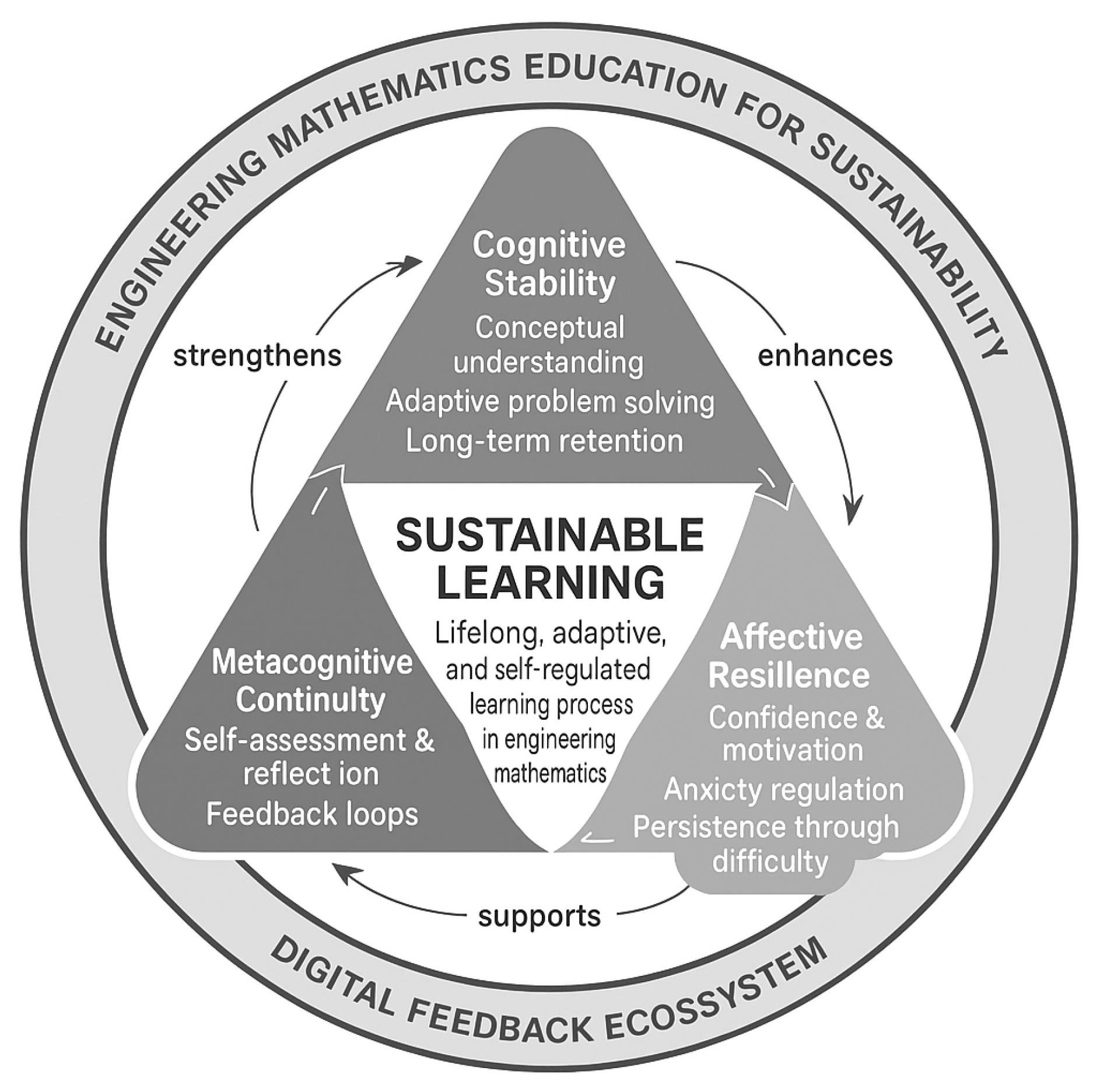
When synthesized across the three studies, the evidence supports a triadic model of sustainable learning in engineering mathematics. Figure 1 presents a conceptual illustration of the Sustainable Learning Framework (SLF), highlighting the dynamic interactions among the three dimensions: (1) Cognitive stability ensures that students build durable conceptual understanding rather than fragile procedural knowledge, (2) Affective resilience enables them to maintain motivation, regulate anxiety, and recover from failure and (3) Metacognitive continuity connects these processes through self-assessment and reflection, ensuring ongoing improvement.
These dimensions interact cyclically: metacognitive awareness strengthens affective control, which in turn supports cognitive engagement, creating a self-reinforcing loop of sustainable learning. The integrated dataset demonstrates that students exposed to digital self-assessment environments tend to display both greater affective resilience (lower anxiety, higher confidence) and improved cognitive stability (fewer conceptual errors). The findings thus confirm that sustainability in learning can be operationalized not only through curricular content but through pedagogical systems that foster emotional regulation, reflective practice, and autonomy.
Τhe empirical evidence obtained from the three studies revealed complementary sustainability dimensions that together explain the dynamics of sustainable learning in engineering mathematics. At the cognitive level, diagnostic test results and students’ performance in repeated online quizzes indicated steady improvement, suggesting that sustainable learning involves conceptual consolidation and adaptive problem solving. At the affective level, significant correlations were found between confidence, motivation and performance, illustrating that emotional regulation and persistence are key components of learning resilience and self-efficacy. Finally, at the metacognitive level, students’ perceptions of self-assessment and digital feedback highlighted the importance of reflection, iterative goal setting and self-monitoring as mechanisms that maintain learning continuity over time. Collectively, these dimensions demonstrate that sustainability in learning emerges through the dynamic interaction of cognitive stability, affective resilience and metacognitive continuity. In our opinion, this empirical integration provides a comprehensive perspective on how sustainable learning develops in engineering mathematics courses. It reveals that sustainability in education is a multi-layered construct that emerges through the alignment of cognitive, affective and metacognitive processes rather than through any single instructional intervention.

5. Discussion

The findings highlight learning resilience as the central driver of sustainable learning in engineering mathematics. Students with higher confidence and lower anxiety were able to sustain engagement and recover from setbacks, consistent with prior work linking emotional regulation to academic persistence. In this sense, resilience functions as the psychological engine of sustainable education, enabling learners to continue working through difficulty without disengagement.
Equally important, self-regulated learning emerged as the mechanistic pathway through which sustainability is enacted [14]. The use of online quizzes and self-assessment tools fostered students’ ability to monitor progress, plan improvements, and reflect on their understanding. These behaviors correspond closely to the cyclical SRL model proposed by Zimmerman (2000) [14], where planning, performance and reflection are interconnected phases that maintain long-term learning efficiency. In this sense, SRL operates as the infrastructure of educational sustainability, the system through which resilient learning is continually renewed [1].
The integration of results has clear pedagogical implications for designing mathematics courses in engineering programs. First, sustainable learning requires pedagogical continuity, frequent, low-stakes opportunities for feedback that support both cognitive mastery and affective well-being. The evidence shows that traditional, high-stakes assessment structures tend to amplify anxiety and promote surface learning strategies, leading to unsustainable outcomes. In contrast, digital self-assessment tools create iterative learning loops that reinforce understanding and confidence [20]. Beyond supporting procedural mastery, these tools were specifically designed to address the “transfer failure” identified in Study 1. By randomising numerical parameters and presenting structurally similar problems in novel configurations, the quizzes required students to generalise underlying concepts rather than memorise fixed solutions. The immediate feedback and multiple-attempt design further encouraged reflection on reasoning and strategic adaptation, helping learners to transfer mathematical knowledge to new contexts. Although these patterns suggest a sequential association between digital self-assessment, metacognitive reflection, resilience, and improved performance, this interpretation remains correlational. The studies relied on observational and self-report data, which do not allow causal inference. Accordingly, the Sustainable Learning Framework conceptualises this sequence as a theoretically plausible mechanism rather than an empirically tested causal pathway. Future research employing structural equation modelling or preregistered experimental designs could examine these mediating relationships more rigorously.
Second, sustainable pedagogy must recognize affective development as integral to mathematical competence. Instructional approaches that normalize error, encourage reflection and reduce the stigma of failure contribute to emotional resilience and sustained motivation [22,23]. Embedding formative self-assessment within mathematics curricula can thus shift the focus from performance to progress, nurturing students’ sense of agency and long-term engagement [19].
Third, sustainability also involves technological empowerment. The judicious use of digital tools enables scalable, personalized feedback systems that decentralize control from the teacher to the learner [17]. This approach aligns with broader trends in engineering education that advocate for student-centred and technology-enhanced learning environments [8]. When thoughtfully designed, these systems reduce the cognitive load associated with evaluation and free both students and instructors to engage in deeper, reflective dialogue [12].
The Sustainable Learning Framework (SLF) proposed in this paper extends existing theories of self-regulated learning and affective engagement by integrating them into a unified model of educational sustainability. In contrast to linear conceptions of SRL, the SLF conceptualizes sustainable learning as a cyclically interactive system. The cyclical character of this interaction is interpreted conceptually rather than statistically. Across the three integrated studies, recurrent patterns suggested that emotional regulation supported sustained engagement, which in turn facilitated cognitive stability and encouraged further self-monitoring—indicating a recursive process of reinforcement. Although the present synthesis does not establish causality, the temporal and functional sequence of these behaviours aligns with established self-regulated learning models [14] that describe learning as an iterative cycle of forethought, performance and reflection. The notion of “cyclicality” in the Sustainable Learning Framework therefore refers to this theoretically grounded mechanism of feedback and adaptation rather than an empirically tested causal loop. While grounded in the principles of self-regulated learning [15,26] the Sustainable Learning Framework (SLF) re-weights these constructs through the lens of educational sustainability. Whereas classic SRL models describe the cyclical regulation of cognition, motivation and behaviour within bounded learning episodes, the SLF emphasises the durability of this regulatory capacity across time and contexts. It conceptualises resilience and self-regulation not as episodic reactions to tasks but as renewable learning resources that sustain engagement and adaptability throughout an engineering programme. In this sense, the “sustainability” dimension introduces a temporal and systemic layer-focusing on how learners maintain cognitive, affective and metacognitive balance under continuous challenge, and how assessment designs can preserve rather than deplete these capacities. The SLF therefore explains not only how regulation occurs, but how it endures as a self-reinforcing capability that underpins long-term learner well-being and professional adaptability. Cognitive stability ensures conceptual grounding and procedural flexibility, affective resilience supports the motivational and emotional balance necessary to persist through challenges and metacognitive continuity maintains awareness and control of learning processes across time. This triadic structure aligns with UNESCO’s principles of Education for Sustainable Development (ESD), particularly the dimensions of learning to know, learning to do, and learning to be [9]. While the present study operationalises sustainable development primarily through self-regulatory and resilient learning behaviours, these attributes constitute core enablers of the wider competencies described in SDG 4.7. The capacity to plan, monitor and adapt one’s learning translates beyond mathematics into the ability to learn continuously, respond ethically to uncertainty and contribute to innovation and problem-solving in professional and civic contexts. Thus, the promotion of self-regulation in engineering mathematics serves as an educational route through which socio-economic and environmental sustainability competencies, such as critical reflection, adaptability and responsible decision-making, can be cultivated. Within this alignment, engineering mathematics serves as a fertile context for developing sustainability competencies such as problem-solving, reflective thinking and adaptive self-management [17].
Beyond the present context, the approach constitutes a transferable sustainability-oriented practice for engineering educators. Concretely: (i) embed low-stakes, iterative digital quizzes as self-assessment; (ii) add structured reflection prompts and (iii) include affective check-ins that normalise struggle and track confidence/anxiety trends. Replicated across courses, these routines build sustainable feedback ecosystems that nurture autonomy, persistence and metacognitive control—competences explicitly prioritised in ESD for 2030 and in skills agendas [28], supporting the green transition.
From an institutional standpoint, the findings call for a systemic rethinking of assessment and support structures in engineering education [7]. Policies that emphasize formative assessment, student well-being, and digital feedback infrastructure can enhance learning sustainability across disciplines. Universities aiming to promote sustainable development goals (SDGs) should recognize that fostering sustainable learners is as critical as producing sustainable technologies [22]. Investing in digital learning ecosystems, providing professional development for faculty in self-regulated learning pedagogies and embedding reflection-based assessment criteria are practical steps toward this vision. In particular, engineering faculties should view mathematics not merely as a technical hurdle but as a pedagogical opportunity to cultivate reflective, resilient and sustainability qualities that define the engineers of the future.
Pedagogically, the results highlight the importance of cultivating self-regulated and emotionally balanced learners rather than focusing solely on performance metrics. Digital self-assessment systems provide an effective mechanism for this transformation by embedding low-stakes iterative feedback and structured reflection prompts that promote autonomy and metacognitive awareness. Academic instructors, therefore, act as facilitators of sustainability by designing courses that balance structure with flexibility and evaluation with encouragement. At the higher-education level, engineering faculties, in particular, have an opportunity to reimagine mathematics courses as spaces where students not only acquire technical competence but also develop the resilience, adaptability, and reflective thinking required for lifelong learning. In this sense, sustainability in engineering education is operationalised through verifiable pedagogical practices—digital self-assessment loops, formative feedback, and affective monitoring—that correspond to the lifelong learning and self-directed learning competencies emphasised in SDG 4.7. Likewise, this approach aligns with the European Skills Agenda [28], which underscores empowering learners with autonomy and adaptability to sustain learning and employability within resilient labour markets.

5.1. Transferability of the Sustainable Learning Design to Engineering Practice

Beyond the present empirical synthesis, the set of practices examined here has direct transferability for engineering educators seeking to translate sustainability frameworks into pedagogical action. The iterative use of low-stakes digital quizzes, coupled with structured metacognitive reflection and explicit attention to affective regulation, constitutes a reproducible design sequence that can be implemented without specialized infrastructure or disciplinary revision. Such practices advance SDG 4.7 in concrete instructional terms by cultivating learners who regulate their progress autonomously, sustain motivation under difficulty and develop adaptable habits of thought. Likewise, the emphasis on autonomy, lifelong learning and adaptive competences aligns with the European Skills Agenda, which frames these learner attributes as preconditions for resilient and sustainable labour markets. In this sense, the model proposed here does not merely demonstrate effectiveness in a single course context. In our opinion, it offers a scalable pedagogical mechanism through which sustainability can be embedded as a behavioural and cognitive capacity within engineering education. If replicated across courses and programmes, such assessment-for-learning designs can progressively shift the culture of mathematics instruction from performance-driven evaluation to sustainability-oriented capability building, amplifying impact beyond the single classroom level.

5.2. Limitations and Future Directions

A limitation of this synthesis is that the development of self-regulation and resilience occurred within a structured pedagogical environment that itself provided substantial external scaffolding. Consequently, the present findings cannot fully disentangle the internal capability from the external support mechanisms of the course design. However, this interplay between structure and autonomy is intrinsic to sustainable learning: external guidance initially supports the formation of self-regulatory routines, which progressively become internalised as learners assume greater control over their strategies. Future longitudinal and comparative studies could further examine how these internal capabilities evolve once external scaffolds are gradually removed.
While the integration of three empirical studies provides a robust foundation, several limitations must be acknowledged. The datasets were derived from a single institutional context, which may constrain the generalizability of findings. Additionally, although the cross-study design offers rich triangulation, the absence of longitudinal data limits inferences about how sustainability develops over time. Future research should adopt longitudinal and cross-institutional approaches to examine the persistence of self-regulation and affective resilience across semesters. Experimental designs could also test specific interventions to measure their long-term impact on sustainable learning outcomes. Further exploration of equity and inclusion within sustainable education frameworks would be valuable. Understanding how individual differences (e.g., gender, prior experience interact with resilience and self-regulation can inform more inclusive, sustainable pedagogies in engineering education. A further limitation concerns the lack of harmonised raw data across the three studies, which restricts the ability to reproduce detailed inferential statistics. Future work should incorporate consistent data archiving and open documentation to ensure full reproducibility.

5.3. Conclusions

This study integrates three empirical investigations to propose the Sustainable Learning Framework (SLF), highlighting the interaction between self-regulation, affective resilience and cognitive stability in engineering mathematics. The framework emphasizes sustainable learning as a self-renewing process that supports both academic achievement and lifelong adaptability. Pedagogically, it provides a model for designing assessment systems that balance feedback, autonomy and emotional well-being. All of them are key dimensions of education for sustainable development.

Supplementary Materials

The following supporting information can be downloaded at: https://www.mdpi.com/article/10.3390/su172210137/s1, Table S1: Correlation Matrix of Study Variables (Study2); Table S2: Regression Summary Predicting Academic Performance (Study 2); The 24-item questionnaire measuring students’ affective responses and attitudes towards mathematics.

Funding

This research received no external funding.

Institutional Review Board Statement

The study was conducted in accordance with the Declaration of Helsinki. This study is waived for ethical review as educational studies involving voluntary, anonymous, and non-interventional student participation are exempt from formal ethics committee approval by Institution Committee.

Informed Consent Statement

Informed consent for participation was obtained from all subjects involved in the study.

Data Availability Statement

The data presented in this study are available on request from the corresponding author as the data supporting the findings of the three studies involve personal and academic information of student participants and therefore cannot be made publicly available due to institutional data protection regulations.

Conflicts of Interest

The author declares no conflicts of interest.

Abbreviations

SLF: Sustainable Learning Framework; SRL: Self-Regulated Learning; ESD: Education for Sustainable Development; SDG: Sustainable Development Goal.

References

  1. Felgueiras, M.C.; Silva, M.; Teixeira, S. Engineering education toward sustainability: Approaches for institutional change. Energy Procedia 2017, 136, 414–417. [Google Scholar] [CrossRef]
  2. Charalambides, M.; Panaoura, R.; Tsolaki, E.; Pericleous, S. First-year engineering students’ difficulties with math courses: What is the starting point for academic teachers? Educ. Sci. 2023, 13, 835. [Google Scholar] [CrossRef]
  3. Demetriou, A.; Spanoudis, G.; Greiff, S.; Makris, N.; Panaoura, R.; Kazi, S. Changing priorities in the development of cognitive competence and school learning: A general theory. Front. Psychol. 2022, 13, 1056428. [Google Scholar] [CrossRef] [PubMed]
  4. United Nations. Transforming Our World: The 2030 Agenda for Sustainable Development. 2015. Available online: https://sdgs.un.org/2030agenda (accessed on 13 March 2022).
  5. Panaoura, A.; Charalambides, M.; Tsolaki, E.; Pericleous, S. First-year engineering students’ affective behavior about mathematics in relation to their performance. Eur. J. Sci. Math. Educ. 2024, 12, 128–138. [Google Scholar] [CrossRef] [PubMed]
  6. Panaoura, A.; Tsolaki, E.; Charalambides, M.; Pericleous, S. Online quizzes as a self-assessment tool in higher education: The case of mathematics in business administration. Bolema 2025, 39, e240124. [Google Scholar] [CrossRef]
  7. Narong, D.K. A system-based framework for engineering education as sustainable development. Eur. J. Eng. Educ. 2024, 49, 911–927. [Google Scholar] [CrossRef]
  8. Bakthavatchaalam, V. Engineering Education and Its Current (Un)suitability in Addressing Sustainable Development Goals. New York: United Nations-Department of Economic and Social Affairs. Available online: https://sdgs.un.org/sites/default/files/2024-05/Bakthavatchaalam_Engineering%20Education%20and%20its%20Current%20%28Un%29suitability%20in%20Addressing%20Sustainable%20Development%20Goals%20.pdf (accessed on 22 September 2025).
  9. Acosta-Castellanos, P.; Queiruga-Dios, A.; Camargo-Marino, J. Environmental education for sustainable development in engineering education in Colombia. Front. Educ. 2024, 9, 1306522. [Google Scholar] [CrossRef]
  10. Panaoura, A. Self-regulatory strategies during problem solving by using an inquiry-based approach: “Make sense of problems and persevere in solving them”. In Problem-Solving: Strategies, Challenges and Outcomes; Newton, K., Ed.; NOVA Science Publishers: Hauppauge, NY, USA, 2016; pp. 223–237. [Google Scholar]
  11. Liu, Y. The relationship between resilience, interactive distance and college students’ online mathematics learning engagement: A longitudinal study. Psychol. Res. Behav. Manag. 2024, 17, 1129–1138. [Google Scholar] [CrossRef] [PubMed]
  12. Makramalla, M.; Coles, A.; Roux, K. Mathematics education for sustainable futures: A strengths-based survey of the field to invite further research action. Educ. Stud. Math. 2025, 119, 535–556. [Google Scholar] [CrossRef]
  13. Alam, A.; Mohanty, A. Framework of self-regulated cognitive engagement (FSRCE) for sustainable pedagogy: A model that integrates SRL and cognitive engagement for holistic development of students. Cogent Educ. 2024, 11, 2363157. [Google Scholar] [CrossRef]
  14. Zimmerman, B.J. Attaining self-regulation: A social cognitive perspective. In Handbook of Self-Regulation; Boekaerts, M., Pintrich, P., Zeidner, M., Eds.; Academic Press: Cambridge, MA, USA, 2000; pp. 13–39. [Google Scholar]
  15. Pintrich, P.R. A Conceptual Framework for Assessing Motivation and Self-Regulated Learning in College Students. Educ. Psychol. Rev. 2004, 16, 385–407. [Google Scholar] [CrossRef]
  16. Panaoura, A. The improvement of students’ self-regulatory behavior in mathematics: The impact of mathematical modeling. In Metacognition: New Research Developments; Larson, C., Ed.; NOVA Publishers: Hauppauge, NY, USA, 2009; pp. 223–237. [Google Scholar]
  17. Zorn, I.; Malz, S. Ustainability in Engineering Education—A case study. In DS 123: Proceedings of the International Conference on Engineering and Product Design Education; Elisava Barcelona School of Designe and Engineering: Barcelona, Spain, 2023. [Google Scholar] [CrossRef]
  18. Aydan, S.; Capa-Aydin, Y. What makes them self-regulated? Self-regulation procedures of academically successful students and key influences. Acta Psychol. 2025, 257, 105106. [Google Scholar] [CrossRef] [PubMed]
  19. Vasquez, C.; Alsina, A.; Seckel, M.; Garcia-Alonso, I. Integrating sustainability in mathematics education and statistics education: A systematic review. Eurasia J. Math. Sci. Technol. Educ. 2023, 19, em2357. [Google Scholar] [CrossRef] [PubMed]
  20. Pepin, B.; Gueudet, G.; Troushe, L. Refining teacher design capacity: Mathematics teachers’ interactions with digital curriculum resources. ZDM 2017, 49, 799–812. [Google Scholar] [CrossRef]
  21. Dowker, A.; Sarkar, A.; Looi, C. Mathematics anxiety: What have we learned in 60 years? Front. Psychol. 2016, 7, 508. [Google Scholar] [CrossRef] [PubMed]
  22. Li, H. STEM education sustainability: What role can mathematics education play in the era of climate change? Res. Math. Educ. 2025, 27, 291–313. [Google Scholar] [CrossRef]
  23. Vintere, A.; Briede, B. Engineers’ Mathematics Education in the Context of Sustainable Development. Eng. Rural. Development. 2016, 1121–1126. Available online: https://www.iitf.lbtu.lv/conference/proceedings2016/Papers/N218.pdf (accessed on 22 September 2025).
  24. Plooy, E.; Casteleijn, D.; Franzsen, D. Personalized adaptive learning in higher education: A scoping review of key characteristics and impact on academic performance and engagement. Heliyon 2024, 10, e39630. [Google Scholar] [CrossRef] [PubMed]
  25. Ben-Eliyahu, A. Sustainable learning in education. Sustainability 2021, 13, 4250. [Google Scholar] [CrossRef]
  26. Parte, L.; Mellado, L. Quizzes as a moderator variable and students’ perceptions and expectations through linguistic analysis. Online Learn. 2022, 26, 124–147. Available online: https://files.eric.ed.gov/fulltext/EJ1348121.pdf (accessed on 22 September 2025). [CrossRef]
  27. Tashakkori, A.; Teddlie, C. SAGE Handbook of Mixed Methods in Social and Behavioral Research; Sage Publications: Thousand Oaks, CA, USA, 2010. [Google Scholar] [CrossRef]
  28. European Commission. European Skills Agenda for Sustainable Competitiveness, Social Fairness and Resilience; European Commission: Brussels, Belgium, 2020; Available online: https://employment-social-affairs.ec.europa.eu/policies-and-activities/skills-and-qualifications/european-skills-agenda_en (accessed on 22 September 2025).
Figure 1. Sustainable Learning Framework (SLF): Engineering Mathematics Education for Sustainability.
Sustainability 17 10137 g001
Table 1. Overview of the three studies.
StudyYearParticipantsMain FocusKey Variables/Instruments
Study 12023128 First-year engineering studentsConceptual and procedural difficulties in mathematicsDiagnostic test in algebra, functions, calculus; error analysis
Study 2202460 First-year engineering studentsAffective behavior and mathematics performanceLikert-type questionnaire measuring confidence, motivation, anxiety; final course grades
Study 32025146 Students in Business Administration and Engineering coursesDigital self-assessment through online quizzesSurvey on perceived usefulness, self-regulation, and learning satisfaction
Table 2. Frequency of common error categories observed in diagnostic assessments.
Error TypeDescriptionFrequency (% of Students)Implication for Sustainability
Conceptual misunderstandingMisinterpretation of symbolic meaning, function notation46%Indicates unstable conceptual foundations
Procedural execution errorsIncorrect application of algorithms38%Reflects overreliance on rote procedures
Transfer failureDifficulty applying known methods to novel contexts52%Signals lack of adaptive learning
Reflection gapFailure to check or justify results61%Low metacognitive engagement
Table 3. Main themes that emerged from qualitative feedback.
ThemeRepresentative QuoteSustainability Implication
Awareness of misconceptions“I understood what I didn’t know before the exam”Encourages reflective learning cycles
Motivation through feedback“Instant results made me want to improve”Fosters iterative engagement
Reduced performance anxiety“I felt more prepared because I practiced often”Enhances affective resilience
Sense of autonomy“I could study at my own pace and see progress”Builds self-regulated learning habits
Disclaimer/Publisher’s Note: The statements, opinions and data contained in all publications are solely those of the individual author(s) and contributor(s) and not of MDPI and/or the editor(s). MDPI and/or the editor(s) disclaim responsibility for any injury to people or property resulting from any ideas, methods, instructions or products referred to in the content.