Exploring the Complex Relationships Between Influential Factors of Urban Land Development Patterns and Urban Thermal Environment: A Study on Downtown Shanghai


Abstract
1. Introduction
2. Materials and Methods
2.1. Study Area
2.2. Data Sources
2.3. Methods
2.3.1. Calculation of 12 Explanatory Variables Representing Urban Land Development Patterns
2.3.2. Regression Modeling
2.3.3. Assessment of Regression Model Performance
3. Results
3.1. Overall Linkage Between Different Land Development Patterns and LST
3.2. Results of Basic Regression Models
3.3. Results of Enhanced Model Construction
4. Discussion
4.1. Analysis of Multicollinearity in the MLR Model
4.2. Analysis of the Pathways Through Which the 12 Main Effects Influence LST
4.3. Further Analysis of the Mechanism Behind Thermal Environment Anomalies at the Interaction Effect Scale
4.4. Implications to Practice in Land Use Management and UHI Mitigation
4.5. Limitations and Future Prospects
5. Conclusions
Author Contributions
Funding
Institutional Review Board Statement
Informed Consent Statement
Data Availability Statement
Conflicts of Interest
Appendix A

| Name | General Description |
|---|---|
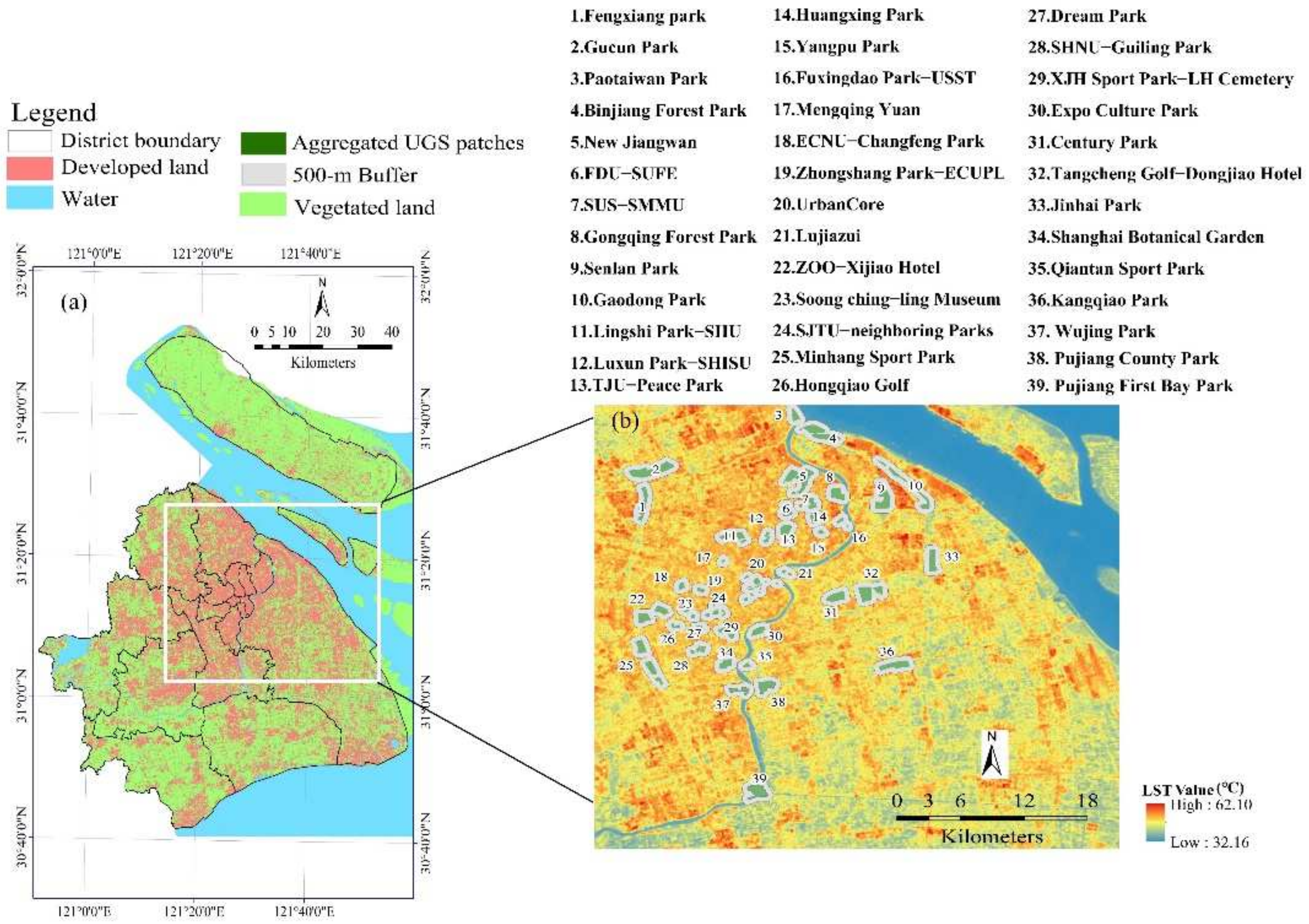
| Fengxiang park (Area: 671.19 ha) | It is a mediumly urbanized area with a mixture of low- and middle-rises. The Fengxiang Park constitutes the aggregation of UGS patches, accounting for 27.22% of total land use shares. |
| Gucun Park (Area: 921.85 ha) | It is a slightly to mediumely urbanized area with a mixture of low- and middle-rises. Gucun Park constitutes the aggregation of UGS patches, accounting for 27.01% of total land use shares. |
| Paotaiwan Park (Area: 331.34 ha) | It is a slightly urbanized area with a mixture of low- and middle-rises. The Paotaiwan Park constitutes the aggregation of UGS patches, accounting for 57.30% of total land use shares. |
| Binjiang Forest Park (Area: 856.555 ha) | It is a slightly urbanized area at the Huangpu River and the Yangtze River intersection. Binjiang Forest Park constitutes the aggregation of UGS patches, accounting for 52.64% of total land use shares. |
| New Jiangwan (Area: 1006.92 ha) | It is a highly urbanized area with a mixture of low- and middle-rises. Vegetated land of Fudan University Jiangwan campus at Songhu road, New Jiangwan Park, Jiangwan Country Park, and New Jiangwan Ecological Conservation Park constitute the aggregation of UGS patches, accounting for 20.22% of total land use shares. |
| FDU-SUFE (Area:350.91 ha) | It is a highly urbanized area with a mixture of low- and middle-rises. Vegetated land of Fudan University (FDU) campus at Handan Road, Shanghai University of Finance and Economics (SUFE) campus at Guoding Road, and Shanghai Pulmonary Hospital constitute the aggregation of UGS patches, accounting for 6.09% of total land use shares. |
| SUS-SMMU (Area: 396.07 ha) | It is a highly urbanized area with a mixture of low- and middle-rises. Vegetated land of the Shanghai University of Sport (SUS), Second Military Medical University (SMMU), Changhai Hospital, and Jiangwan Stadium constitute the aggregation of UGS patches, accounting for 4.13% of total land use shares. |
| Gongqing Forest Park (Area: 450.44 ha) | It is a slightly urbanized area featured with low-rises. Gongqing Forest Park constitutes the aggregation of UGS patches, accounting for 42.19% of total land use shares. |
| Senlan Park (Area:740.07 ha) | It is a highly urbanized area with a mixture of low- and middle-rises. The Senlan Park, Senlan Sports Park, Pudong Peony Gard, and Senlan Oasis Park constitute the aggregation of UGS patches, accounting for 21.70% of total land use shares. |
| Gaodong Park (Area: 1094.69 ha) | It is a slightly to mediumly urbanized area with a mixture of low- and middle-rises. The Gaodong Park constitutes the aggregation of UGS patches, accounting for 22.49% of total land use shares. |
| Lingshi Park-SHU (Area: 551.15 ha) | It is a highly urbanized area with a mixture of low- and middle-rises. Vegetated land of the Lingshi Park, Shang University (SHU) campus at Yanchang Road, Zhabei Park, constitute the aggregation of UGS patches, accounting for 8.32% of total land use shares. |
| Luxun Park-SHISU (Area: 290.57 ha) | It is a highly urbanized area with a mixture of low- and middle-rises. Vegetated land of the Shanghai International Studies University (SHISU) and Luxun Park constitute the aggregation of UGS patches, accounting for 4.67% of total land use shares. |
| TJU-Peace Park (Area: 503.01ha) | It is a highly urbanized area with a mixture of low-, middle-, and high-rises. Vegetated land of the Tongji University (TJU) campus at Siping Road and Peace Park constitute the aggregation of UGS patches, accounting for 5.79% of total land use shares. |
| Huangxing Park (Aarea:258.85 ha) | It is a highly urbanized area with a mixture of low- and middle-rises. The Huangxing Park constitutes the aggregation of UGS patches, accounting for 11.31% of total land use shares. |
| Yangpu Park (Area: 192.23 ha) | It is a highly urbanized area with a mixture of low- and middle-rises. The Yangpu Park constitutes the aggregation of UGS patches, accounting for 7.80% of total land use shares. |
| Fuxingdao Park-USST (Area: 301.58 ha) | It is a highly urbanized area with a mixture of low- and middle-rises. The Fuxingdao Park and the University of Shanghai for Science and Technology (USST) comprise the aggregation of UGS patches, accounting for 24.80% of total land use shares. |
| Mengqing Yuan (Area: 153.35 ha) | It is a highly urbanized area with a mixture of low- and middle-rises. The Mengqing Yuan constitutes the aggregation of UGS patches, accounting for 8.85% of total land use shares. |
| ECNU-Changfeng Park (Area: 37.83 ha) | It is a highly urbanized area with a mixture of low- and middle-rises. Vegetated land of the East China Normal University (ECNU) campus at north Zhongshan Road and Changfeng Park constitute the aggregation of UGS patches, accounting for 12.46% of land use shares in this area. |
| Zhongshang Park-ECUPL (Area:208.23 ha) | It is a highly urbanized area with a mixture of low- and middle-rises. The Zhongshang Park and the East China University of Political Science and Law (ECUPL) constitute the aggregation of UGS patches, accounting for 10.48% of total land use shares. |
| UrbanCore (Area: 941.32 ha) | It is a highly urbanized area at the urban core featured with a mixture of low-, middle-, and high-rise. Several big parks such as People Park, Jing’an Park, Square Park, Huaihai Park, Taipingqiao Park, Fuxing Park, Yuyuan Garden, Gucheng Park, and Bund Park constitute the aggregation of UGS patches, accounting for 7.40% of land use shares in this area. |
| Lujiazui (Area:237.77 ha) | It is a highly urbanized area with a mixture of middle- and high-rises. The Oriental Pearl Park and Lujiazui Central Park constitute the aggregation of UGS patches, accounting for 24.50% of total land use shares. |
| ZOO-Xijiao Hotel (Area: 704.52 ha) | It is a highly urbanized area with a mixture of low- and middle-rises. It is located in the neighborhood of the Hongqiao Airport and Hongqiao high-speed railway station. Vegetated land of Xijiao Hotel and the ZOO constitute the aggregation of UGS patches, accounting for 19.71% of total land use shares. |
| Soong Ching-ling Museum (Area: 286.54 ha) | It is a highly urbanized area with a mixture of low- and middle-rises. The Soong Ching-ling Museum and New Hongqiao Central Garden constitute the aggregation of UGS patches, accounting for 7.06% of total land use shares. |
| SJTU-neighboring Parks (Area:533.94 ha) | It is a highly urbanized area with a mixture of low- and middle-rises. The impervious surfaces occupy 92.26% of total land use shares, of which the buildings’ share is 65.52%. Vegetated land of the Shanghai Jiaotong University (SJTU) campus at Huashan Road, Hengshan Park, Xujiahui Park, Fanyu Park, Huashan Park, and Xinguo Hotel constitute the aggregation of UGS patches, accounting for 7.61% of total land use shares. |
| Minhang Sports Park (Area: 961.66 ha) | It is a highly urbanized area with a mixture of low- and middle-rises. The Minhang Sports Park, Minhang Culture Park, and Li’an Park constitute the aggregation of UGS patches, accounting for 17.36% of total land use shares. |
| Hongqiao Golf (Area:245.25 ha) | It is a highly urbanized area with a mixture of low- and middle-rises. Vegetated land of the Hongqiao Golf constitutes the aggregation of UGS patches, accounting for 10.22% of total land use shares. |
| Dream Park (Area: 216.76 ha) | It is a highly urbanized area with a mixture of low- and middle-rises. The Dream Park constitutes the aggregation of UGS patches, accounting for 6.16% of total land use shares. |
| SHNU-Guiling Park (Area: 372.31 ha) | It is a highly urbanized area with a mixture of low- and middle-rises. Vegetated land of the Shanghai Normal University (SHNU) campus at Guilin Road, Kangjian Yuan, Guilin Park, and Shanghai Administration Institute constitute the aggregation of UGS patches, accounting for 5.91% of total land use shares. |
| XJH Sports Park-LH Cemetery (Area: 382.61 ha) | It is a highly urbanized area with a mixture of low- and middle-rises. The Xujiahui (XJH) Sports Park and Longhua (LH) Cemetery constitute the aggregation of UGS patches, accounting for 2.67% of total land use shares. |
| Expo Culture Park (Area: 349.26 ha) | It is a mediumly urbanized area with a mixture of low- and middle-rises. The Expo Culture Park constitutes the aggregation of UGS patches, accounting for 26.24% of total land use shares. |
| Century Park (Area: 465.60 ha) | It is a mediumly urbanized area with a mixture of low- and middle-rises. The Century Park constitutes the aggregation of UGS patches, accounting for 23.34% of total land use shares. |
| Tangcheng Golf-Dongjiao Hotel (Area: 720.35 ha) | It is a mediumly urbanized area with a mixture of low- and middle-rises. Vegetated land of the Tangcheng Golf and Dongjiao Hotel constitute the aggregation of UGS patches, accounting for 25.70% of total land use shares. |
| Jinhai Park (Area: 520.70 ha) | It is a slightly urbanized area with a mixture of low- and middle-rises. The Jinhai Park constitutes the aggregation of UGS patches, accounting for 34.37% of total land use shares. |
| Shanghai Botanical Garden (Area: 371.73 ha) | It is a highly urbanized area with a mixture of low- and middle-rises. The Shanghai Botanical Garden constitutes the aggregation of UGS patches, accounting for 13.27% of total land use shares. |
| Qiantan Sport Park (Area:215.61 ha) | It is a slightly urbanized area with a mixture of low- and middle-rises. Qiantan Sports Park constitutes the aggregation of UGS patches, accounting for 40.75% of total land use shares. |
| Kangqiao Park (Area: 601.80 ha) | It is a slightly to mediumly urbanized area with a mixture of low- and middle-rises. The Kangqiao Park constitutes the aggregation of UGS patches, accounting for 27.17% of total land use shares. |
| Wujing Park (Area:424.45 ha) | It is a mediumly urbanized area with a mixture of low- and middle-rises. The Wujing Park, Huajing Park, and Huilongyuan Coliseum constitute the aggregation of UGS patches, accounting for 34.28% of total land use shares. |
| Pujiang County Park (Area:481.18 ha) | It is a slightly urbanized area with sparse low-rises on the urban periphery. The Pujiang County Park constitutes the aggregation of UGS patches, accounting for 64.20% of total land use shares. |
| Pujiang First Bay Park (Area:623.31 ha) | It is a slightly to mediumly urbanized area with a mixture of low- and middle-rises. The Pujiang First Bay Park constitutes the aggregation of UGS patches, accounting for 40.18% of total land use shares. |
| Building | OtherIS | UGI | MBH | FAR | MBD | RD | PD | LSI | CLUMPY | LPI | COHESION | |
|---|---|---|---|---|---|---|---|---|---|---|---|---|
| Building | 1.000 | |||||||||||
| OtherIS | 0.610 * | 1.000 | ||||||||||
| UGI | −0.920 ** | −0.090 | 1.000 | |||||||||
| MBH | 0.510 * | −0.210 | 0.540 * | 1.000 | ||||||||
| FAR | 0.520 * | −0.190 | 0.550 * | 0.970 ** | 1.000 | |||||||
| MBD | −0.290 | −0.090 | 0.410 * | −0.190 | −0.210 | 1.000 | ||||||
| RD | 0.830 ** | −0.020 | −0.860 ** | 0.560 * | 0.560 * | −0.270 | 1.000 | |||||
| PD | −0.130 | 0.070 | 0.190 | −0.430 * | −0.370 * | 0.180 | −0.190 | 1.000 | ||||
| LSI | −0.560 * | −0.080 | 0.580 | −0.010 | −0.040 | 0.100 | −0.490 * | −0.510 * | 1.000 | |||
| CLUMPY | −0.780 ** | −0.190 | 0.870 ** | −0.430 * | −0.450 * | 0.230 | −0.740 ** | −0.040 | 0.660 * | 1.000 | ||
| LPI | −0.780 ** | −0.190 | 0.870 ** | −0.430 * | −0.450 * | 0.230 | −0.740 ** | −0.040 | 0.660 * | 0.996 | 1.000 | |
| COHESION | −0.810 ** | −0.120 | 0.870 ** | −0.470 * | −0.480 * | 0.260 | −0.760 ** | 0.110 | 0.610 * | 0.930 ** | 0.930 ** | 1.000 |
References
- Irfeey, A.M.M.; Chau, H.; Sumaiya, M.M.F.; Wai, C.Y.; Muttil, N.; Jamei, E. Sustainable mitigation strategies for urban heat island effects in urban areas. Sustainability 2023, 15, 10767. [Google Scholar] [CrossRef]
- Coutts, A.M.; Beringer, J.; Tapper, N.J. Impact of increasing urban density on local climate: Spatial and temporal variations in the surface energy balance in Melbourne, Australia. J. Appl. Meteorol. Clim. 2007, 46, 477–493. [Google Scholar] [CrossRef]
- Li, D.; Liao, W.; Rigden, A.J.; Liu, X.; Wang, D.; Malyshev, S.; Shevliakova, E. Urban heat island: Aerodynamics or imperviousness? Sci. Adv. 2019, 5, eaau4299. [Google Scholar] [CrossRef] [PubMed]
- Das, M.; Das, A.; Biswas, M.; Pereira, P. ‘greening the edges’—Role of peri-urban green spaces in mitigating local temperature in English Bazar Urban Agglomeration, India. Theor. Appl. Clim. 2025, 156, 387. [Google Scholar] [CrossRef]
- Sharston, R.; Singh, M. Urban morphology, urban heat island (UHI) and building energy consumption: A critical review of methods and relationships among influential parameters. Build. Serv. Eng. Res. Technol. 2025, 46, 561–584. [Google Scholar] [CrossRef]
- Piracha, A.; Chaudhary, M.T. Urban air pollution, urban heat island and human health: A review of the literature. Sustainability 2022, 14, 9234. [Google Scholar] [CrossRef]
- Ellena, M.; Melis, G.; Zengarini, N.; Di Gangi, E.; Ricciardi, G.; Mercogliano, P.; Costa, G. Micro-scale UHI risk assessment on the heat-health nexus within cities by looking at socio-economic factors and built environment characteristics: The Turin case study (Italy). Urban Clim. 2023, 49, 101514. [Google Scholar] [CrossRef]
- Roxon, J.; Ulm, F.J.; Pellenq, R.J.M. Urban heat island impact on state residential energy cost and CO2 emissions in the united states. Urban Clim. 2020, 31, 100546. [Google Scholar] [CrossRef]
- Das, M.; Das, A. Dynamicity of carbon emission and its relationship with heat extreme and green spaces in a global south tropical mega-city region. Atmos. Pollut. Res. 2025, 16, 102484. [Google Scholar] [CrossRef]
- Sharston, R.; Singh, M. The role of passive, active, and operational parameters in the relationship between urban heat island effect (UHI) and building energy consumption. Energy Build. 2024, 323, 114720. [Google Scholar] [CrossRef]
- Yang, K.; Zhang, J.; Cui, D.; Ma, Y.; Ye, Y.; He, X.; Yang, Z.; Cheng, M.; Zhang, Y. Multi-scale study of the synergy between human activities and climate change on urban heat islands in China. Sustain. Cities Soc. 2025, 125, 106341. [Google Scholar] [CrossRef]
- Joshi, K.; Khan, A.; Anand, P.; Sen, J. Understanding the synergy between heat waves and the built environment: A three-decade systematic review informing policies for mitigating urban heat island in cities. Sustain. Earth Rev. 2024, 7, 25. [Google Scholar] [CrossRef]
- Ma, X.; Miao, S.; Masson, V.; Wurtz, J.; Zhang, Y.; Wang, J.; Huang, X.; Yan, C. The synergistic effects of urbanization and an extreme heatwave event on urban thermal environment in paris. Urban Clim. 2024, 53, 101785. [Google Scholar] [CrossRef]
- Garuma, G.F. How the interaction of heatwaves and urban heat islands amplify urban warming. Adv. Environ. Eng. Res. 2022, 3, 1–32. [Google Scholar] [CrossRef]
- Peng, J.; Ma, J.; Liu, Q.; Liu, Y.; Hu, Y.; Li, Y.; Yue, Y. Spatial-temporal change of land surface temperature across 285 cities in China: An urban-rural contrast perspective. Sci. Total Environ. 2018, 635, 487–497. [Google Scholar] [CrossRef]
- Zhu, B. Differential urban-rural effects of population during urbanization and urban-rural development. Urban Rural Plan. 2018, 2, 34–43. [Google Scholar] [CrossRef]
- Kuang, W.; Liu, J.; Dong, J.; Chi, W.; Zhang, C. The rapid and massive urban and industrial land expansions in China between 1990 and 2010: A CLUD-based analysis of their trajectories, patterns, and drivers. Landsc. Urban Plan. 2016, 145, 21–33. [Google Scholar] [CrossRef]
- Yang, X.; Chen, B.; Hu, K. A review of impacts of urbanization on extreme heat events. Prog. Geogr. 2015, 34, 1219–1228. [Google Scholar]
- Geng, S.; Ren, J.; Yang, J.; Guo, A.; Xi, J. Exploration of urban thermal environment based on local climate zone. Acta Ecol. Sin. 2022, 42, 2221–2227. [Google Scholar] [CrossRef]
- Ballester, J.; Quijal-Zamorano, M.; Méndez Turrubiates, R.F.; Pegenaute, F.; Herrmann, F.R.; Robine, J.M.; Basagaña, X.; Tonne, C.; Antó, J.M.; Achebak, H. Heat-related mortality in Europe during the summer of 2022. Nat. Med. 2023, 29, 1857–1866. [Google Scholar] [CrossRef]
- Guan, Z.; Zhang, H. A quantitative analysis of the complex response relationship between urban green infrastructure (UGI) structure/spatial pattern and urban thermal environment in Shanghai. Sustainability 2024, 16, 6886. [Google Scholar] [CrossRef]
- Mueller, N.; Kuttler, W.; Barlag, A. Counteracting urban climate change: Adaptation measures and their effect on thermal comfort. Theor. Appl. Clim. 2014, 115, 243–257. [Google Scholar] [CrossRef]
- Qiu, G.Y.; Li, H.Y.; Zhang, Q.T.; Chen, W.; Liang, X.J.; Li, X.Z. Effects of evapotranspiration on mitigation of urban temperature by vegetation and urban agriculture. J. Integr. Agric. 2013, 12, 1307–1315. [Google Scholar] [CrossRef]
- Bai, Y.; Wang, K.; Ren, Y.; Li, M.; Ji, R.; Wu, X.; Yan, H.; Lin, T.; Zhang, G.; Zhou, X.; et al. 3D compact form as the key role in the cooling effect of greenspace landscape pattern. Ecol. Indic. 2024, 160, 111776. [Google Scholar] [CrossRef]
- Wang, W.; Shu, J. Urban renewal can mitigate urban heat islands. Geophys. Res. Lett. 2020, 47, e2019GL085948. [Google Scholar] [CrossRef]
- Wang, C.; Ren, Z.; Dong, Y.; Zhang, P.; Guo, Y.; Wang, W.; Bao, G. Efficient cooling of cities at global scale using urban green space to mitigate urban heat island effects in different climatic regions. Urban For. Urban Green. 2022, 74, 127635. [Google Scholar] [CrossRef]
- Zhang, Z.; Paschalis, A.; Mijic, A.; Meili, N.; Manoli, G.; van Reeuwijk, M.; Fatichi, S. A mechanistic assessment of urban heat island intensities and drivers across climates. Urban Clim. 2022, 44, 101215. [Google Scholar] [CrossRef]
- Ziter, C.D.; Pedersen, E.J.; Kucharik, C.J.; Turner, M.G. Scale-dependent interactions between tree canopy cover and impervious surfaces reduce daytime urban heat during summer. Proc. Natl. Acad. Sci. USA 2019, 116, 7575–7580. [Google Scholar] [CrossRef]
- Yu, Z.; Xu, S.; Zhang, Y.; Jørgensen, G.; Vejre, H. Strong contributions of local background climate to the cooling effect of urban green vegetation. Sci. Rep. 2018, 8, 6798. [Google Scholar] [CrossRef]
- Gage, E.A.; Cooper, D.J. Relationships between landscape pattern metrics, vertical structure and surface urban heat island formation in a Colorado suburb. Urban Ecosyst. 2017, 20, 1229–1238. [Google Scholar] [CrossRef]
- Li, X.; Zhou, W. Optimizing urban greenspace spatial pattern to mitigate urban heat island effects: Extending understanding from local to the city scale. Urban For. Urban Green. 2019, 41, 255–263. [Google Scholar] [CrossRef]
- Kong, F.; Yin, H.; James, P.; Hutyra, L.R.; He, H.S. Effects of spatial pattern of greenspace on urban cooling in a large metropolitan area of Eastern China. Landsc. Urban Plan. 2014, 128, 35–47. [Google Scholar] [CrossRef]
- Zhang, H.; Kang, M.; Guan, Z.; Zhou, R.; Zhao, A.; Wu, W.; Yang, H. Assessing the role of urban green infrastructure in mitigating summertime urban heat island (UHI) effect in metropolitan Shanghai, China. Sustain. Cities Soc. 2024, 112, 105605. [Google Scholar] [CrossRef]
- Shanghai Bureau of Statistics. Shanghai Statistical Yearbook (2024). 2024; p. 2. Available online: https://tjj.sh.gov.cn/tjnj/20250331/9f8ec62cc2234485b0aa411b8d967c37.html (accessed on 1 January 2024).
- Shanghai Bureau of Statistics. Shanghai Natural Geography. Available online: https://tjj.sh.gov.cn/zrdl/index.html (accessed on 26 July 2025).
- China Meteorological Administration. Historical Weather Data for Shanghai. 2024. Available online: https://www.weather.com.cn/weather40d/101020100.shtml (accessed on 2 July 2025).
- Jiménez Muñoz, J.C.; Sobrino, J.A. A generalized single-channel method for retrieving land surface temperature from remote sensing data. J. Geophys. Res. Atmos. 2003, 108, D22. [Google Scholar] [CrossRef]
- Zhang, H.; Li, T.; Liu, Y.; Han, J.; Guo, Y. Understanding the contributions of land parcel features to intra-surface urban heat island intensity and magnitude: A study of downtown Shanghai, China. Land Degrad. Dev. 2021, 32, 1353–1367. [Google Scholar] [CrossRef]
- Shanghai Bureau of Statistics. Shanghai Statistical Communiqué on National Economic and Social Development 2025; Shanghai Bureau of Statistics: Shanghai, China, 2025. [Google Scholar]
- Feng, Y.; Chen, L.; He, X. Sky view factor calculation based on baidu street view images and its application in urban heat island. Int. J. Geogr. Inf. Sci. 2021, 23, 1998–2012. [Google Scholar] [CrossRef]
- McGarigal, K.; Ene, E.; Cushman, S. FRAGSTATS 4 Tutorial. Available online: https://fragstats.org/index.php/tutorial (accessed on 11 June 2025).
- Geladi, P.; Kowalski, B.R. Partial least-squares regression: A tutorial. Anal. Chim. Acta 1986, 185, 1–17. [Google Scholar] [CrossRef]
- Wold, H. Nonlinear iterative partial least squares (NIPALS) modelling: Some current developments. In Multivariate Analysis–III; Krishnaiah, P.R., Ed.; Academic Press: Cambridge, MA, USA, 1973; pp. 383–407. ISBN 978-0-12-426653-7. [Google Scholar]
- Pang, W.; Fu, Q.; Xu, C.; Zhang, C.; Wang, L.; Zheng, S.; Pang, J.; Chen, J. Analysis key aroma compounds based on the aroma quality and infusion durability of jasmine tea. Food Chem. 2025, 473, 143018. [Google Scholar] [CrossRef] [PubMed]
- Han, X.; Xie, D.; Song, H.; Ma, J.; Zhou, Y.; Chen, J.; Yang, Y.; Huang, F. Estimation of chemical oxygen demand in different water systems by near-infrared spectroscopy. Ecotoxicol. Environ. Saf. 2022, 243, 113964. [Google Scholar] [CrossRef]
- Li, W.; Yue, W.; Chen, J. Examining carbon emission drivers in the digital economy era: Empirical insights from the Beijing-Tianjin-Hebei urban agglomeration, China. Pol. J. Environ. Stud. 2024, 33, 3247–3262. [Google Scholar] [CrossRef]
- Saitta, L.; Vapnik, V. Support-vector networks. Mach. Learn. 1995, 20, 273–297. [Google Scholar]
- Vapnik, V. The Nature of Statistical Learning Theory; Springer: New York, NY, USA, 1995. [Google Scholar]
- Mathew, A.; Sreekumar, S.; Khandelwal, S.; Kumar, R. Prediction of land surface temperatures for surface urban heat island assessment over chandigarh city using support vector regression model. Sol. Energy 2019, 186, 404–415. [Google Scholar] [CrossRef]
- Garzón, J.; Molina, I.; Velasco, J.; Calabia, A. A remote sensing approach for surface urban heat island modeling in a tropical colombian city using regression analysis and machine learning algorithms. Remote Sens. 2021, 13, 4256. [Google Scholar] [CrossRef]
- Team, R.C. R: A Language and Environment for Statistical Computing; R Foundation for Statistical Computing: Vienna, Austria, 2025. [Google Scholar]
- Mevik, B.; Wehrens, R. (Eds.) Introduction to the pls Package; R Foundation for Statistical Computing: Vienna, Austria, 2024. [Google Scholar]
- Meyer, D. E1071: Misc Functions of the Department of Statistics, Probability Theory Group (Formerly: E1071), TU Wien. 1.7-16 Ed.; TU Wien: Vienna, Austria, 2024. [Google Scholar]
- Wu, X.; Zhang, M. Applied Regression and Classification—Based on R; China Renmin University Press: Beijing, China, 2016. [Google Scholar]
- Chen, Y.; Yang, J.; Yang, R.; Xiao, X.; Xia, J.C. Contribution of urban functional zones to the spatial distribution of urban thermal environment. Build. Environ. 2022, 216, 109000. [Google Scholar] [CrossRef]
- Estoque, R.C.; Murayama, Y.; Myint, S.W. Effects of landscape composition and pattern on land surface temperature: An urban heat island study in the megacities of Southeast Asia. Sci. Total Environ. 2017, 577, 349–359. [Google Scholar] [CrossRef] [PubMed]
- Manoli, G.; Fatichi, S.; Schläpfer, M.; Yu, K.; Crowther, T.W.; Meili, N.; Burlando, P.; Katul, G.G.; Bou-Zeid, E. Magnitude of urban heat islands largely explained by climate and population. Nature 2019, 573, 55–60. [Google Scholar] [CrossRef]
- Peng, S.; Piao, S.; Ciais, P.; Friedlingstein, P.; Ottle, C.; Breon, F.; Nan, H.; Zhou, L.; Myneni, R.B. Surface urban heat island across 419 global big cities. Environ. Sci. Technol. 2012, 46, 696–703. [Google Scholar] [CrossRef]
- Masoudi, M.; Tan, P.Y. Multi-year comparison of the effects of spatial pattern of urban green spaces on urban land surface temperature. Landsc. Urban Plan. 2019, 184, 44–58. [Google Scholar] [CrossRef]
- Wang, C.; Li, Z.; Su, Y.; Zhao, Q.; He, X.; Wu, Z.; Gao, W.; Wu, Z. Impact of block morphology on urban thermal environment with the consideration of spatial heterogeneity. Sustain. Cities Soc. 2024, 113, 105622. [Google Scholar] [CrossRef]
- Zhang, Y.; Wang, Y.; Ding, N.; Yang, X. Spatial pattern impact of impervious surface density on urban heat island effect: A case study in Xuzhou, China. Land 2022, 11, 2135. [Google Scholar] [CrossRef]
- Yu, Z.; Zhang, J.; Yang, G. How to build a heat network to alleviate surface heat island effect? Sustain. Cities Soc. 2021, 74, 103135. [Google Scholar] [CrossRef]
- Liu, F.; Liu, J.; Zhang, Y.; Hong, S.; Fu, W.; Wang, M.; Dong, J. Construction of a cold island network for the urban heat island effect mitigation. Sci. Total Environ. 2024, 915, 169950. [Google Scholar] [CrossRef] [PubMed]
- Krsnik, G. Is zagreb green enough? Influence of urban green spaces on mitigation of urban heat island: A satellite-based study. Earth 2024, 5, 604–622. [Google Scholar] [CrossRef]
- Cameron, R.W.F.; Blanuša, T.; Taylor, J.E.; Salisbury, A.; Halstead, A.J.; Henricot, B.; Thompson, K. The domestic garden—Its contribution to urban green infrastructure. Urban For. Urban Green. 2012, 11, 129–137. [Google Scholar] [CrossRef]
- Budzik, G.; Sylla, M.; Kowalczyk, T. Understanding urban cooling of blue–green infrastructure: A review of spatial data and sustainable planning optimization methods for mitigating urban heat islands. Sustainability 2025, 17, 142. [Google Scholar] [CrossRef]
- Peng, J.; Cheng, X.; Hu, Y.; Corcoran, J. A landscape connectivity approach to mitigating the urban heat island effect. Landsc. Ecol. 2022, 37, 1707–1719. [Google Scholar] [CrossRef]
- Frazier, A.E.; Sehner, B.; Rashid, B. Structural and functional connectivity of thermal refuges in a desert city: Impacts of climate change and urbanization on desert wildlife. Land 2025, 14, 480. [Google Scholar] [CrossRef]
- Well, F.; Ludwig, F. Development of an integrated design strategy for blue-green architecture. Sustainability 2021, 13, 7944. [Google Scholar] [CrossRef]
- Tong, Z.; Yang, J.; Liu, Y.; Zhang, Z.; Liu, S.; Lu, Y.; Pang, B.; An, R. Cooling and optimizing urban heat island based on a thermal knowledge-informed multi-type ant colony model. Remote Sens. Environ. 2024, 306, 114138. [Google Scholar] [CrossRef]
- Mohamed, O.Y.A.; Zahidi, I. Artificial intelligence for predicting urban heat island effect and optimising land use/land cover for mitigation: Prospects and recent advancements. Urban Clim. 2024, 55, 101976. [Google Scholar] [CrossRef]
- Liu, T.; Ouyang, S.; Gou, M.; Xiang, W.; Lei, P.; Li, Y. Analysis connectivity of urban heat island in a new-type urbanization based on mspa model. Acta Ecol. Sin. 2023, 2, 615–624. [Google Scholar] [CrossRef]
- Nega, W.; Balew, A. The relationship between land use land cover and land surface temperature using remote sensing: Systematic reviews of studies globally over the past 5 years. Environ. Sci. Pollut. Res. Int. 2022, 29, 42493–42508. [Google Scholar] [CrossRef] [PubMed]
- Erell, E.; Pearlmutter, D.; Williamson, T. Urban Microclimate: Designing the Spaces Between Buildings; Routledge: London, UK, 2012; p. 288. ISBN 9781849775397. [Google Scholar]
- Fernández, F.J.; Alvarez-Vázquez, L.J.; García-Chan, N.; Martínez, A.; Vázquez-Méndez, M.E. Optimal location of green zones in metropolitan areas to control the urban heat island. J. Comput. Appl. Math. 2015, 289, 412–425. [Google Scholar] [CrossRef]
- Aflaki, A.; Mirnezhad, M.; Ghaffarianhoseini, A.; Ghaffarianhoseini, A.; Omrany, H.; Wang, Z.; Akbari, H. Urban heat island mitigation strategies: A state-of-the-art review on Kuala Lumpur, Singapore and Hong Kong. Cities 2017, 62, 131–145. [Google Scholar] [CrossRef]
- Ruan, T.; Xu, Y.; Jones, L.; Boeing, W.J.; Calfapietra, C. Green infrastructure sustains the food-energy-water-habitat nexus. Sustain. Cities Soc. 2023, 98, 104845. [Google Scholar] [CrossRef]
- Jiang, Y.; Jiang, S.; Shi, T. Comparative study on the cooling effects of green space patterns in waterfront build-up blocks: An experience from Shanghai. Int. J. Environ. Res. Public Health 2020, 17, 8684. [Google Scholar] [CrossRef]
- Meng, Q.; Wang, Z.; Zhang, L.; Sun, Z.; Hu, D.; Yang, T. Response relationship between urban thermal environment and impervious surface distribution density at multi-spatial scale: A case study of beijing. Natl. Remote Sens. Bull. 2022, 9, 1789–1801. [Google Scholar] [CrossRef]
- Zhu, S.; Yang, Y.; Yan, Y.; Causone, F.; Jin, X.; Zhou, X.; Shi, X. An evidence-based framework for designing urban green infrastructure morphology to reduce urban building energy use in a hot-humid climate. Build. Environ. 2022, 219, 109181. [Google Scholar] [CrossRef]
- Zhou, W.; Yu, W.; Zhang, Z.; Cao, W.; Wu, T. How can urban green spaces be planned to mitigate urban heat island effect under different climatic backgrounds? A threshold-based perspective. Sci. Total Environ. 2023, 890, 164422. [Google Scholar] [CrossRef]
- McPhearson, T.; Haase, D.; Kabisch, N.; Gren, Å. Advancing understanding of the complex nature of urban systems. Ecol. Indic. 2016, 70, 566–573. [Google Scholar] [CrossRef]
- Lin, J.; Zhang, H.; Chen, M.; Wang, Q. Socioeconomic disparities in cooling and warming efficiencies of urban vegetation and impervious surfaces. Sustain. Cities Soc. 2023, 92, 104464. [Google Scholar] [CrossRef]
- Dong, J.Q.; Peng, J. Review on cooling effect of greenspace: Perspective of landscape regulation. Acta Ecol. Sin. 2024, 4, 1336–1346. [Google Scholar]


| Dataset | Acquisition Date | Description |
|---|---|---|
| Thermally enhanced LST products | 29 August 2013 3 August 2015 24 August 2017 16 August 2020 14 August 2022 | Five thermally enhanced LST products retrieved from cloud-free Landsat-8 TIRS data (Level 1T, path/row: 118/38) were used as the indicator of urban thermal environment. Following a generalized radiative transfer equation [37], the initial LST retrieval was performed using Landsat-8’s band 10 data. Considering that the original 30 m-resolution LST data lacked the capacity to capture fine-scale thermal responses of different land use types, the thermally enhanced LSTs were used as the alternatives. A tedious procedure was applied to generate the thermally sharpened LSTs. A key point of this process is to randomly extract the at-sensor brightness temperature (BT) data from Landsat-8’s band 10 data. Within each scene of Landsat-8’s band 10 image, a cluster of random points (from 50,000 to 4.90 million) with 20 m intervals were generated and used to extract the BT values. Subsequently, an ordinary kriging method was employed to generate the multiple-resolution interpolated BT maps, which were further validated by 20 m land use maps. Thirdly, surface emissivity values were manually corrected by specific land use types. The 20 m thermally sharpened LSTs were generated using generalized radiative transfer equation. Finally, all the sharpened LSTs were resampled to 30 m and overlapped with raw LST at 30-m. Then a pixel-to-pixel comparison was performed to determine the least root mean square error (RMSE) between the thermally sharpened LSTs and raw LSTs. The validated thermally enhanced LSTs have a resolution of 20 m with acceptable RMSE (ranging from 0.2 to 0.4 °C). Details of generating these thermally enhanced LSTs can be referred to Zhang et al., 2024 [33]. |
| Land Use Map of downtown Shanghai (2013) | - | This dataset contains 12 land use types. It was originally generated from high-resolution QuickBird imagery, using an object-oriented classification method. The land use classification was validated through field measurements. The overall classification accuracy reached 91.1% [38]. |
| Digital Thematic Map of Shanghai | - | This dataset contains vector layers of land use and subcategories (e.g., buildings, green spaces, rivers, streams, transport lines, warehouses, and ports), sourced from both commercial and publicly accessible datasets. The commercial data were purchased from Beijing Digital Space TechnologyTM Co., Ltd., China. (2015). The open-access openstreet map (OSM) data was downloaded from https://www.openstreetmap.org/ (accessed on 7 September 2024) and used as a supplement. |
| Field Survey Data | - | Validated land use data were obtained from our research team’s seasonal and semi-annual field surveys for land use (2013–2022). |
| Satellite Map (91 Weitu) | - | A commercial integrated vector and aerial imagery system operated by Beijing Qianfan Vision TechnologyTM Co., Ltd., China |
| Google Maps | - | An open-access satellite imagery platform operated by Google LLCTM (accessed on 7 September 2024). |
| Mapworld (Tianditu) | - | An integrated vector and aerial imagery system operated by the National Geographic Information Public Service Platform of China. |
| PCL Data Repository | - | An open-access scientific data repository operated by the Pengcheng Lab© (https://data-starcloud.pcl.ac.cn/zh, (accessed on 7 September 2024)). |
| Dimension | Indicator (Abbreviation) | Definition |
|---|---|---|
| Hardscape Indicators | Building | Building percentage. It denotes the proportion (%) of land area occupied by buildings within the study area, including residential, office, hospital, school, commercial, and industrial facilities. |
| OtherIS | Percentage of other impervious surfaces. It denotes the proportion (%) of land area covered by non-building impervious surfaces, such as paved roads, playgrounds, parking lots, bridges, and composting facilities. | |
| MBH | Mean Building Height. It is the arithmetic mean height (in meters) of all buildings within the study area. | |
| MBD | Mean Building Distance. It denotes the mean spacing (in meters) between adjacent buildings within clusters, calculated along specified directions. | |
| RD | Road Density. It denotes the total length of roads per unit area (km/km2), calculated as: | |
| FAR | Floor Area Ratio. It is a unitless index denoting the ratio of total building floor area to the land area, reflecting built-up density. It is calculated as: , where F is the building footprint (ha), c is the number of floors, and A is the plot area (ha). | |
| Softscape Indicators | UGI | Urban Green Infrastructure Ratio. It denotes the proportion (%) of the study area covered by green and blue spaces, including trees, shrubs, grasslands, and water bodies (in m2). This index is actually the class-level metric named as PLAND−percentage of UGI within a specific landscape. |
| PD | Patch Density. It denotes number of UGI patches per unit area (patches/ha), which is calculated as: | |
| LSI | Landscape Shape Index. It is a dimensionless and unitless index reflecting the complexity of UGI patch shapes, which is calculated as: | |
| CLUMPY | Clumpiness Index. It is a unitless index quantifying the degree of spatial aggregation of UGI patches, which is calculated as: | |
| LPI | Largest Patch Index. It is a unitless index denoting the percentage of total landscape area occupied by the largest single UGI patch. It is calculated as: | |
| COHESION | Connectivity Index. It is a unitless index reflecting the spatial connectedness of green patches. It is calculated as: |
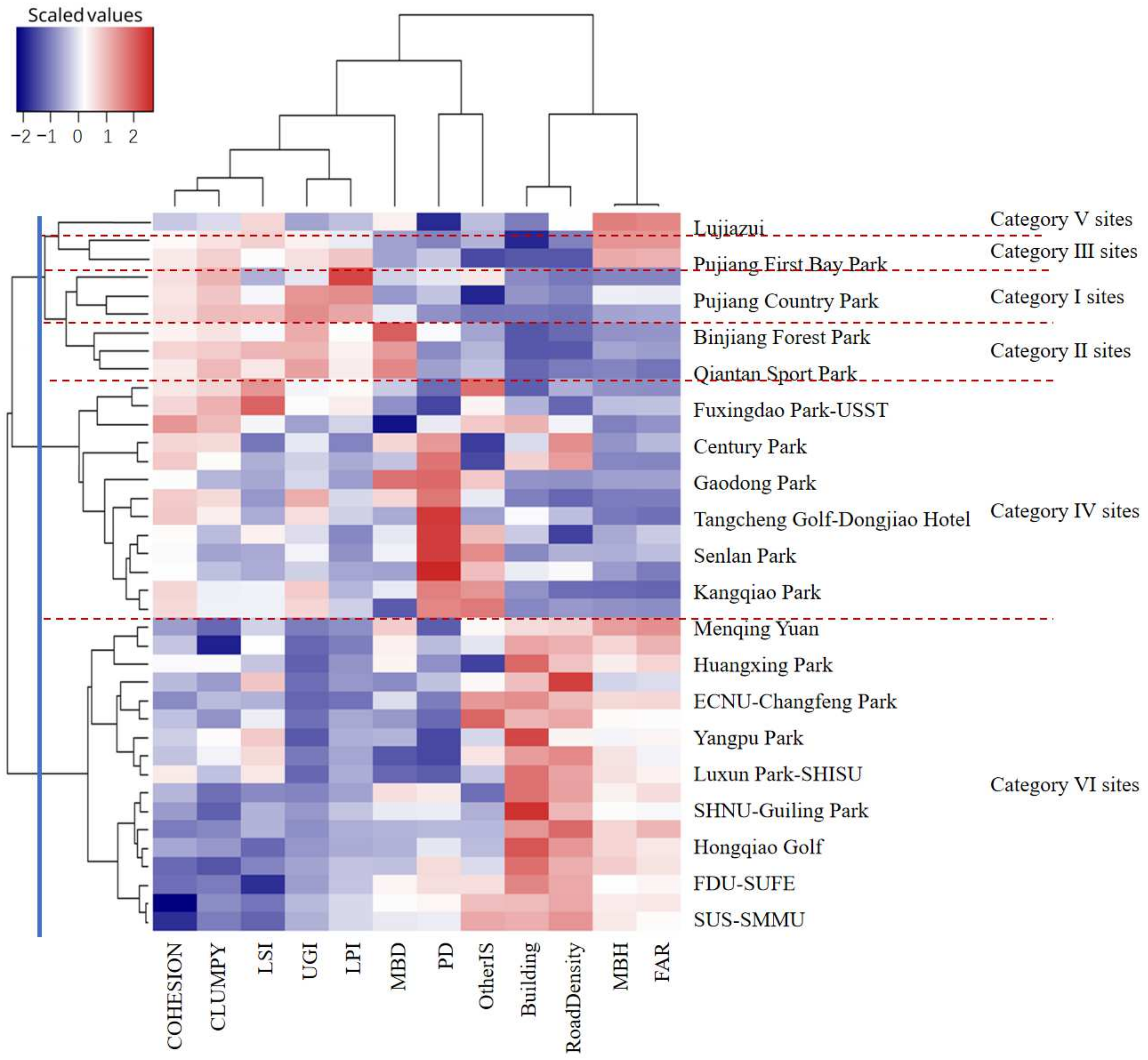
| Category Site | General Description | Mean LST (°C) |
|---|---|---|
| I | This category is under low development pressure. The sites are characterized by relatively minor built-up land, such as lower Building, FAR, and MBH, but higher MBD and spatial connectivity and aggregation traits of the UGI, such as LPI, medium PLAND and CLUMPY. | 42.183 ± 3.633 a |
| II | This category is under low to medium development pressure. The sites show lower Building and M BD, higher FAR and MBH, medium OtherIS, and lower RD. Meanwhile, they have higher spatial connectivity and aggregation traits of the UGI. | 42.910 ± 2.351 a,b |
| III | This category is under medium development pressure. The sites show relatively lower traits of Building, FAR, MBH, MBD, OtherIS, and RD. Meanwhile, they have higher spatial connectivity and aggregation traits of the UGI. | 45.551 ± 2.899 c |
| IV | This category is under medium to high development pressure. The sites exhibit medium Building, lower FAR, lower MBH, lower MBD, medium OtherIS, and medium RD. They are associated with higher PD, medium PLAND, COHESION, and LSI, with lower LPI and CLUMPY. | 46.656 ± 3.086 d |
| V | This category is under very high development pressure, characterized by higher Building, higher FAR, higher MBH, lower MBD, medium OtherIS, and higher RD. In contrast, the UGI traits are characterized by lower LPI, PLAND, CLUMPY, PD, with medium COHESION and LSI. | 49.681 ± 4.296 e |
| VI | This category is under very high development pressure, characterized by higher Building, medium FAR, medium MBH, lower MBD, medium OtherIS, and higher RD. In contrast, the UGI traits are characterized by lower LPI, PLAND, and CLUMPY, with medium PD, COHESION, and LSI. | 49.902 ± 4.612 e,f |
| Basic Regression | Training | Test | ||
|---|---|---|---|---|
| R2 | RMSE | R2 | RMSE | |
| SVR | 0.963 ** [0.932, 0.971] | 0.606 [0.198, 0.976] | 0.559 * [0.479, 0.581] | 3.029 [1.123, 3.904] |
| PLSR | 0.614 * [0.427, 0.772] | 1.515 [0.559, 1.946] | 0.479 * [0.430, 0.564] | 3.321 [1.518, 4.292] |
| MLR | 0.601 * [0.601, 0.602] | 1.862 [0.670, 2.347] | 0.363 * [0.362, 0.363] | 3.067 [1.132, 3.939] |
| Enhanced Regression | Training Set | Testing Sets | ||
|---|---|---|---|---|
| R2 | RMSE | R2 | RMSE | |
| SVR | 0.973 ** [0.971, 0.979] | 0.537 [0.198, 0.690] | 0.705 * [0.583, 0.797] | 3.257 [3.053, 3.612] |
| PLSR | 0.767 ** [0.645, 0.823] | 1.337 [0.494, 1.716] | 0.647 * [0.543, 0.823] | 3.092 [1.046, 3.843] |
| MLR | 0.708 * [0.707, 0.708] | 1.102 [0.406, 1.415] | 0.491 * [0.488, 0.492] | 3.361 [2.759, 3.648] |
| Term | Variable | Coefficient | Variance Inflation Factor (VIF) |
|---|---|---|---|
| Constant | 56.164 [44.562, 61.391] | − | |
| Hardscape Indicators | Building | 24.977 ** [9.215, 32.067] | 87.589 [87.589,87.59] |
| OtherIS | 9.659 ** [3.576, 12.37] | 19.111 [19.111, 19.11] | |
| MBH | 1.823 [0.671, 2.342] | 169.914 [169.91, 169.915] | |
| FAR | −4.583 * [−5.888, −1.686] | 197.472 [197.472, 197.47] | |
| MBD | 0.022 [0.008, 0.028] | 2.936 [2.935, 2.94] | |
| RD | −0.157 ** [−0.202, −0.058] | 10.023 [10.024, 10.02] | |
| Softscape Indicators | UGI | −4.828 * [−6.248, −1.755] | 118.372 [118.373, 118.37] |
| PD | 0.224 * [0.083, 0.287] | 4.107 [4.106, 4.11] | |
| LSI | 35.879 ** [13.23, 46.068] | 11.282 [11.282, 11.28] | |
| CLUMPY | 0.342 * [0.13, 0.437] | 34.176 [34.175, 34.18] | |
| LPI | 0.078 [0.028, 0.1] | 11.106 [11.105, 11.11] | |
| COHESION | −0.499 ** [−0.64, −0.184] | 14.412 [14.413, 14.41] |
| Term | Variable | Coefficient | Standardized Coefficient |
|---|---|---|---|
| Constant | 53.490 [43.544, 57.1977] | − | |
| Hardscape Indicators | Building | 2.204 [0.811, 2.829] | 0.115 [0.114, 0.115] |
| OtherIS | 3.351 [1.233, 4.303] | 0.076 [0.074, 0.079] | |
| MBH | −0.004 [−0.005, −0.001] | −0.009 [−0.011, −0.007] | |
| FAR | −0.007 [−0.009, −0.003] | −0.007 [−0.007, −0.007] | |
| MBD | −0.017 [−0.022, −0.006] | −0.075 [−0.077, −0.071] | |
| RD | 0.0436 [0.016, 0.056] | 0.093 [0.089, 0.099] | |
| Softscape Indicators | UGI | −2.555 [−3.281, −0.94] | −0.148 [−0.17, −0.13] |
| PD | −0.011 [−0.014, −0.004] | −0.025 [−0.026, −0.024] | |
| LSI | −1.783 [−2.289, −0.656] | −0.043 [−0.045, −0.042] | |
| CLUMPY | −0.284 [−0.365, −0.104] | −0.092 [−0.093, −0.091] | |
| LPI | −0.017 [−0.021, −0.006] | −0.092 [−0.093, −0.089] | |
| COHESION | −0.055 [−0.07, −0.02] | −0.090 [−0.092, −0.089] |
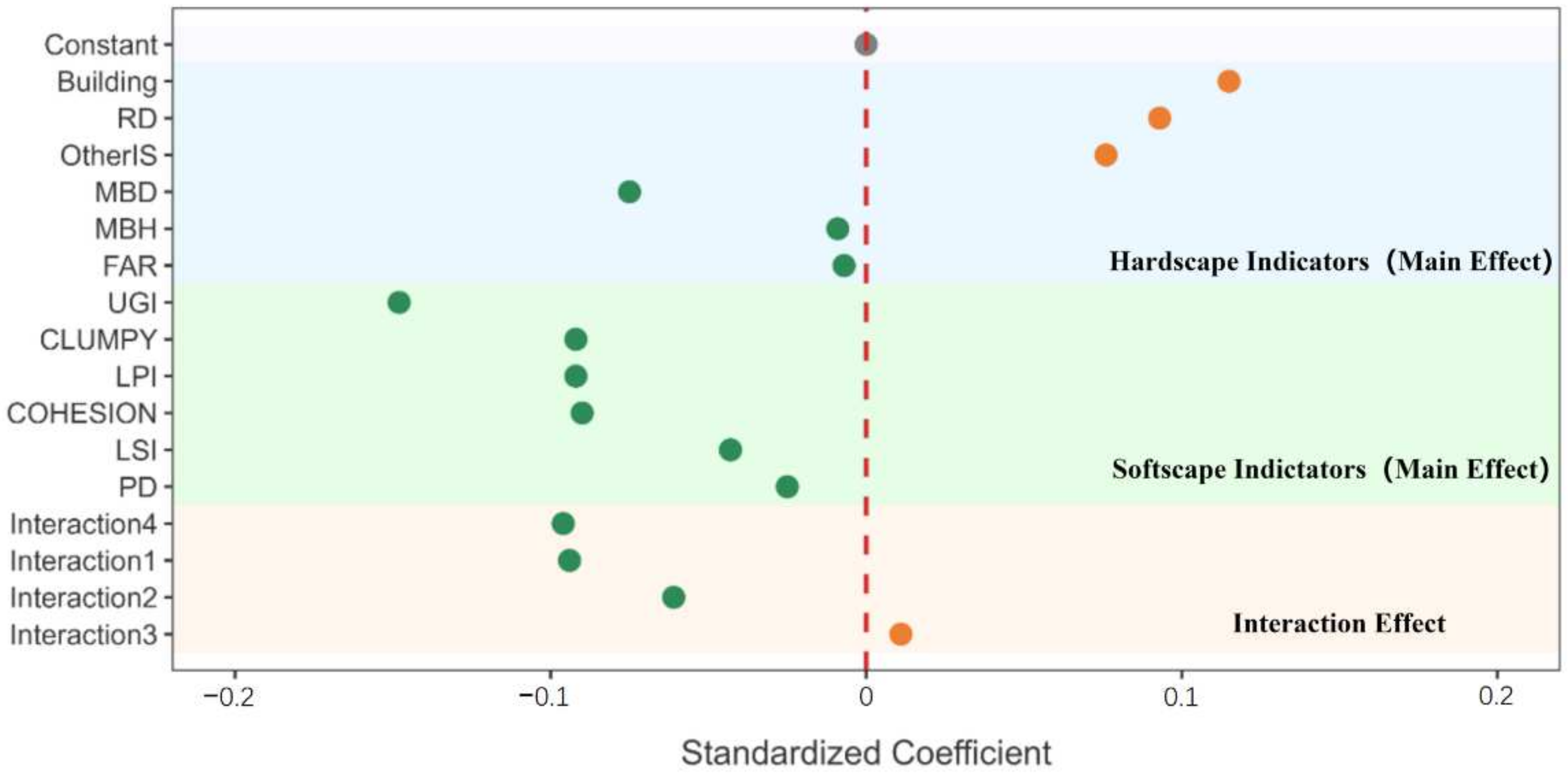
| Term | Variable | Coefficient | Standardized Coefficient |
|---|---|---|---|
| Constant | 53.490 [43.544, 57.1977] | − | |
| Hardscape Indicators (Main Effect) | Building | 2.204 [0.811, 2.829] | 0.115 [0.114, 0.115] |
| OtherIS | 3.351 [1.233, 4.303] | 0.076 [0.074, 0.079] | |
| MBH | −0.004 [−0.005, −0.001] | −0.009 [−0.011, −0.007] | |
| FAR | −0.007 [−0.009, −0.003] | −0.007 [−0.007, −0.007] | |
| MBD | −0.017 [−0.022, −0.006] | −0.075 [−0.077, −0.071] | |
| RD | 0.0436 [0.016, 0.056] | 0.093 [0.089, 0.099] | |
| Softscape Indicators (Main Effect) | UGI | −2.555 [−3.281, −0.94] | −0.148 [−0.17, −0.13] |
| PD | −0.011 [−0.014, −0.004] | −0.025 [−0.026, −0.024] | |
| LSI | −1.783 [−2.289, −0.656] | −0.043 [−0.045, −0.042] | |
| CLUMPY | −0.284 [−0.365, −0.104] | −0.092 [−0.093, −0.091] | |
| LPI | −0.017 [−0.021, −0.006] | −0.092 [−0.093, −0.089] | |
| COHESION | −0.055 [−0.070, −0.020] | −0.090 [−0.092, −0.089] | |
| Interaction Effect | Interaction1 | −0.132 [−0.170, −0.049] | −0.094 [−0.096, −0.091] |
| Interaction2 | 0 [0, 0] ※ | −0.061 [−0.062, −0.06] | |
| Interaction3 | 0 [0, 0] ※ | 0.011 [0.010, 0.013] | |
| Interaction4 | −0.035 [−0.045, −0.013] | −0.096 [−0.098, −0.095] |
Disclaimer/Publisher’s Note: The statements, opinions and data contained in all publications are solely those of the individual author(s) and contributor(s) and not of MDPI and/or the editor(s). MDPI and/or the editor(s) disclaim responsibility for any injury to people or property resulting from any ideas, methods, instructions or products referred to in the content. |
© 2025 by the authors. Licensee MDPI, Basel, Switzerland. This article is an open access article distributed under the terms and conditions of the Creative Commons Attribution (CC BY) license (https://creativecommons.org/licenses/by/4.0/).
Share and Cite
Yang, H.-R.; Li, Y.-H.; Wu, W.-J.; Zhao, A.-L.; Zhang, H. Exploring the Complex Relationships Between Influential Factors of Urban Land Development Patterns and Urban Thermal Environment: A Study on Downtown Shanghai. Sustainability 2025, 17, 8547. https://doi.org/10.3390/su17198547
Yang H-R, Li Y-H, Wu W-J, Zhao A-L, Zhang H. Exploring the Complex Relationships Between Influential Factors of Urban Land Development Patterns and Urban Thermal Environment: A Study on Downtown Shanghai. Sustainability. 2025; 17(19):8547. https://doi.org/10.3390/su17198547
Chicago/Turabian StyleYang, Hao-Rong, Yan-He Li, Wen-Jia Wu, Ai-Lian Zhao, and Hao Zhang. 2025. "Exploring the Complex Relationships Between Influential Factors of Urban Land Development Patterns and Urban Thermal Environment: A Study on Downtown Shanghai" Sustainability 17, no. 19: 8547. https://doi.org/10.3390/su17198547
APA StyleYang, H.-R., Li, Y.-H., Wu, W.-J., Zhao, A.-L., & Zhang, H. (2025). Exploring the Complex Relationships Between Influential Factors of Urban Land Development Patterns and Urban Thermal Environment: A Study on Downtown Shanghai. Sustainability, 17(19), 8547. https://doi.org/10.3390/su17198547