1. Introduction
The construction industry is a driving force in the economic structuring of nations, significantly impacting urban development and the broader economic progress [
1,
2,
3]. In construction projects, the owner is typically involved in the entire management process, from planning and design through the construction phase to completion and acceptance [
4,
5]. The owner can significantly affect the project’s outcomes, as they often determine its objectives, scope, and directions [
4,
5]. For example, the owner’s focus on sustainability, cost, or time can shape the project’s approach from planning to execution. If project progress deviates from the owner’s project expectancy (PE, hereafter), it may lead to misunderstandings, reworkings, and disagreements between the project owner and the relevant partners [
6,
7]. This can further lead to project delays, increased costs, and potential conflicts due to different views on project goals and approaches [
6,
7]. Therefore, it is crucial to identify the factors that construct the owner’s expectancy based on the Expectancy Theory [
8] to ensure the project’s smooth operation and alignment with the project goal.
The Expectancy Theory, proposed by Vroom [
8], has been a dominant framework for understanding motivation. It suggests that individuals are motivated based on their expected outcomes, with their behaviors shaped by the desirability of outcomes and the likelihood of those outcomes being realized [
8]. This motivational theory has gained significant attention in various sectors. For instance, in the educational sector, the theory has been used to investigate what motivates students to provide feedback to teachers regarding their perceptions of the teaching and learning experience [
9,
10]. In the nonprofit sector, the theory has been applied to understand the motivations of volunteers and how they perceive the value of their contributions [
11]. In the field of computer technology, studies have identified that the user-friendliness of a system significantly influences self-efficacy and perceived utility, subsequently affecting decision making regarding software utilization [
12]. Similarly, within the hotel industry, applications of the Expectancy Theory have explored the impact of communication satisfaction on work motivation. It was found that employees who are content with the communication dynamics demonstrate a heightened response to motivational factors, leading to enhanced job performance [
13].
Current research in construction projects, while acknowledging the significance of the Expectancy Theory, primarily focuses on the motivation of construction workers or project managers [
14,
15,
16,
17,
18]. For construction-project management, the crucial role of the owner’s expectancy in the project’s outcomes requires attention. Moreover, many construction professionals rely on intuition or fragmented approaches to predict the owner’s expectancy, leading to inefficiencies and potential conflicts [
19,
20]. The existing gap suggests the need for developing an inventory to accurately gauge and integrate the owner’s expectancy into project planning and management to enhance project outcomes and avoid reliance on intuition or fragmented approaches.
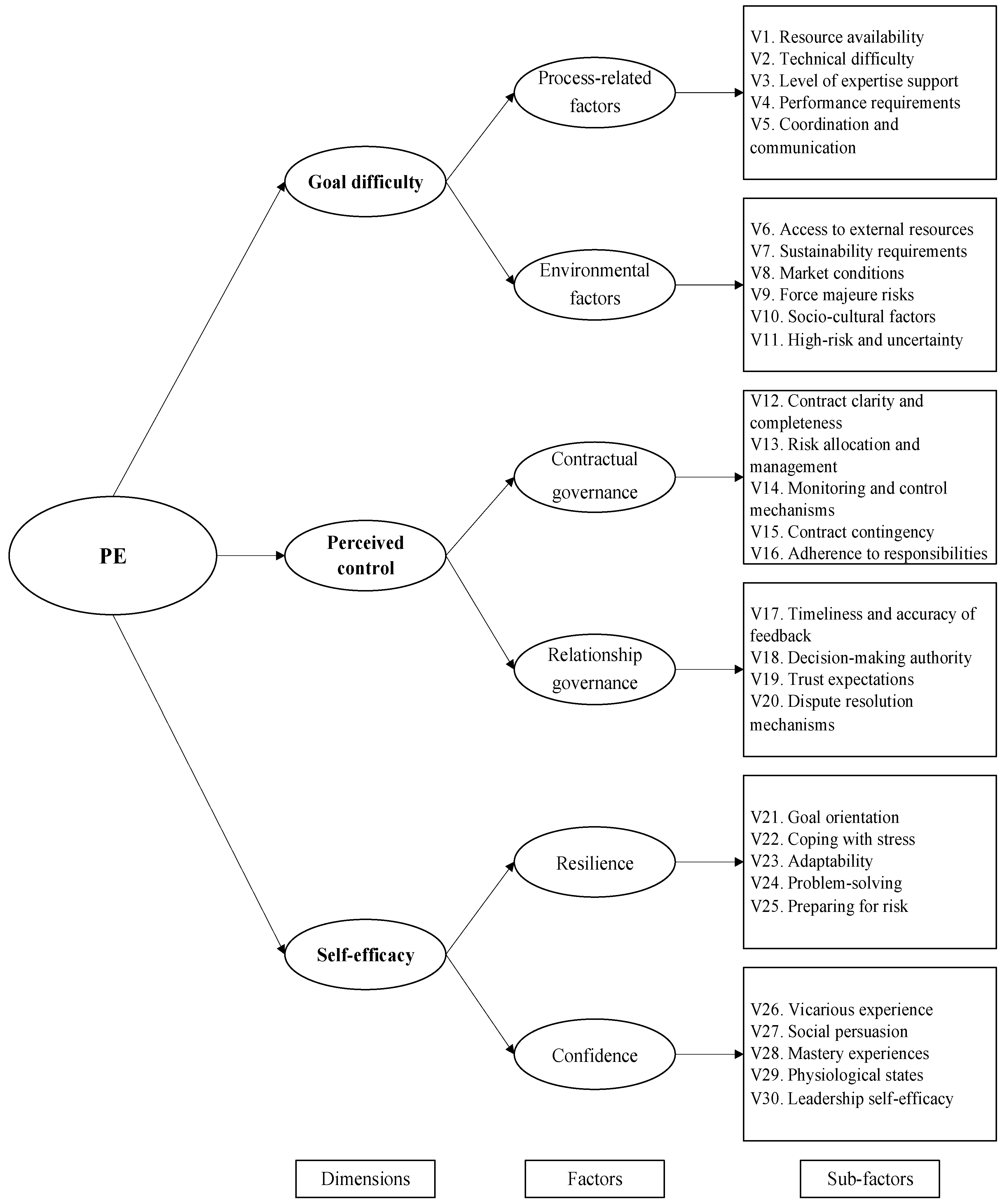
Therefore, this study seeks to address these gaps by developing a systematic inventory to describe and measure the PE from the owner’s perspective in construction projects. Based on the Expectancy Theory, PE is conceptualized through three key dimensions: goal difficulty, perceived control, and self-efficacy [
13]. These three dimensions determine the extent to which the project owner expects to obtain expected results from the project. Based on these aspects, this study further develops a PE inventory from the construction owner’s perspective. The reliability of the inventory is then confirmed through partial least squares structural equation modeling (PLS-SEM, hereafter). The PE inventory offers a structured approach to integrate these factors into project planning and management, enhancing decision making and aligning project goals with the owner’s expectancy. By underscoring the owner’s command over project operations, this inventory assists the project owner in selecting the partners within their control, thus improving teamwork and collaboration. It can also facilitate better decision making, ensuring the projects align with the owner’s expectancy and leads to more successful outcomes. The main objectives of this study are the following:
- (1)
Developing a PE inventory for the owner of a construction project;
- (2)
Determining the priority of the project owner’s expectancy;
- (3)
Providing management solutions for the project owner to select the right partner.
This study is then structured as follows.
Section 2 provides a literature review, developing a new inventory of PE in construction industry.
Section 3 details the methodology, using surveys for data collection from project owners.
Section 4 applies PLS-SEM to validate the PE inventory and introduces a tunneling-construction megaproject as a case study. In
Section 5, the findings are discussed with recommendations for project owners.
Section 6 addresses limitations and future research directions, and
Section 7 concludes the study, summarizing the key insights.
3. Research Design
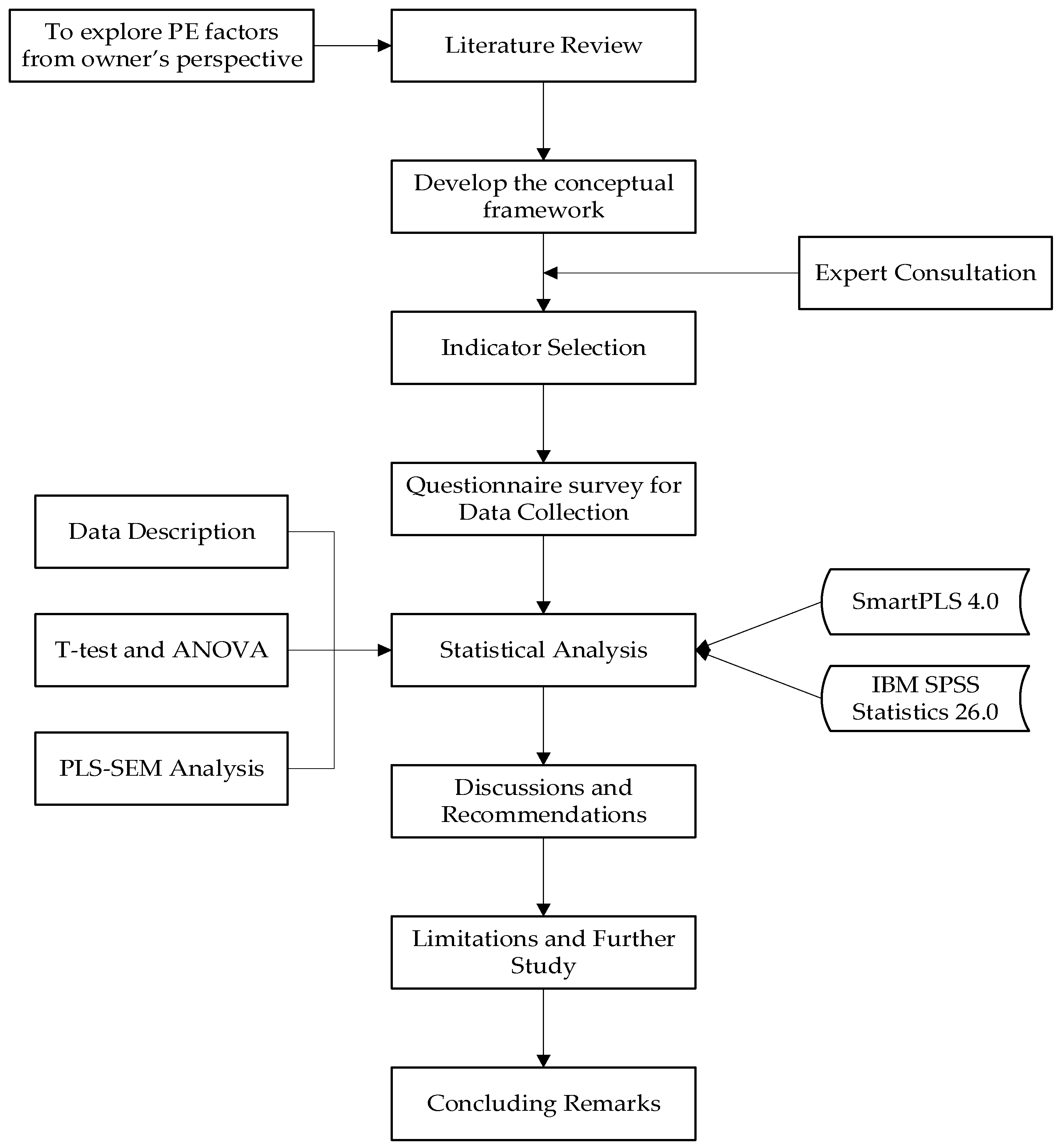
This study employs a structured research design to systematically examine PE factors from the owner’s perspective. The research begins with a comprehensive literature review in the Web of Science database, focusing on PE in construction-project management. This initial step aims to identify knowledge gaps and form a solid theoretical base for the conceptual PE inventory, with a critical evaluation and synthesis of findings to comprehensively understand PE’s various dimensions. Following this, the study develops a conceptual inventory for PE, integrating the literature to define key factors and constructs, ensuring relevance to current industry practices.
Subsequent steps involve engaging industry experts to refine the conceptual inventory, using their feedback to align it with real-world practices. A questionnaire is designed for data collection, specifically targeting those involved in construction projects, and administered to a diverse, purposively sampled group. The study then conducts a thorough statistical analysis using IBM SPSS Statistics 26.0 and SmartPLS 4.0. This includes descriptive statistics, T-tests, Analysis of Variance (ANOVA, hereafter), and PLS-SEM model assessment, with PLS-MGA, to explore group-specific differences. The results and path coefficients of the PE inventory inform a discussion offering specific implications and recommendations for project owners in the construction industry. The research concludes by identifying limitations, suggesting future research directions, and summarizing key findings and their applicability in project management, with a focus on addressing goal difficulty, perceived control, and self-efficacy.
This methodology involves steps focused on identifying, validating, and refining indicators of PE inventory.
Figure 2 illustrates the sequential connections involved in developing PE inventory.
4. Empirical Testing and Analysis
4.1. Data Description
4.1.1. Personal Particulars
In this study, 528 questionnaires were distributed in 2023 in China, and 197 valid responses were received, reflecting a 37.31% response rate. It is noted that response rates in construction-industry studies generally fluctuate between 25 and 30% [
68]. This figure is a bit higher than the median response rate of 35.7% documented in U.S.-based organizational academic studies. Therefore, in this survey, the 37.31% response rate achieved in the present study is acceptable and highlighted. This data shows the efficacy of the survey methodology, thereby enforcing the validity of the research conclusions drawn from this robust respondent engagement.
No outliers were detected in the responses during the IBM SPSS Statistics analysis. To ensure the reliability of PLS-SEM analysis, this study followed the recommendation of Hair et al. [
69], which suggests a minimum sample size of ten times the number of formative indicators for the most complex construct. With six formative indicators in our most complex construct, a minimum sample size of 60 (6 × 10) is required. This study meets this requirement.
The respondents’ particulars are summarized in
Table 4. The survey captured responses from a spectrum of roles in construction, both managerial and technical. Respondents were almost evenly distributed across various project natures: government-involved, government-led, and corporate/private. Therefore, the data are useful for examining whether there are any intergroup differences.
4.1.2. Observations from the Interviewees’ Responses
In this study, respondents evaluated statements using a 1–7 Likert scale, with 1 denoting ‘strongly disagree’ and 7 ‘strongly agree’. This scale, recommended for its precision in reflecting respondents’ perspectives and enhancing data-analysis sensitivity [
70], was employed to assess PE indicators. The descriptive statistics are shown in
Table 5. Cronbach’s alpha is traditionally employed to assess a construct’s internal consistency, with a threshold value of 0.7 [
71]. It should be noted that among the factors, relationship governance has the lowest Cronbach’s alpha (0.69). Zhang and Xu [
72] suggested that if the Cronbach’s alpha value of a subfactor is lower than 0.6, deleting or modifying the item should be considered [
72]. However, all sub-factors’ Cronbach’s alphas of B2 are over 0.6: V17 is 0.63, V18 is 0.65, V19 is 0.60, and V20 is 0.61. Therefore, Cronbach’s alpha of B2 can be acceptable. These figures suggest satisfactory internal consistency for the survey scale.
The findings, as detailed in
Table 5, have mean scores for most indicators exceeding 4 except for items V14, V22, V23, and V27. This suggests general agreement among participants on the prevalence of PE in their projects. Notably, V27, indicating a collective commitment to overcoming project challenges, had the lowest mean score of 3.92, falling below the neutral benchmark. This suggests a discrepancy in perceptions regarding collaborative problem-solving, particularly among managerial and technical staff. V22 also falls below the neutral benchmark, with a score of 3.93. It suggests a significant opportunity for improvement in managing stress and pressure within project teams. Conversely, V1 had the highest mean score (4.81), reflecting a consensus on the project’s robust resource environment conducive to achieving objectives. The consistency in responses was further evident in V12, with the lowest standard deviation (0.86), signifying uniform agreement on the clarity and comprehensiveness of project contracts. In contrast, V2 recorded the highest standard deviation (1.27), indicating divergent views concerning the controllability of the project’s technical difficulties.
4.2. PLS-SEM Analysis
The analytical inventory was assessed using SmartPLS4, adhering to the PLS-SEM analysis guidelines outlined by Hair et al. [
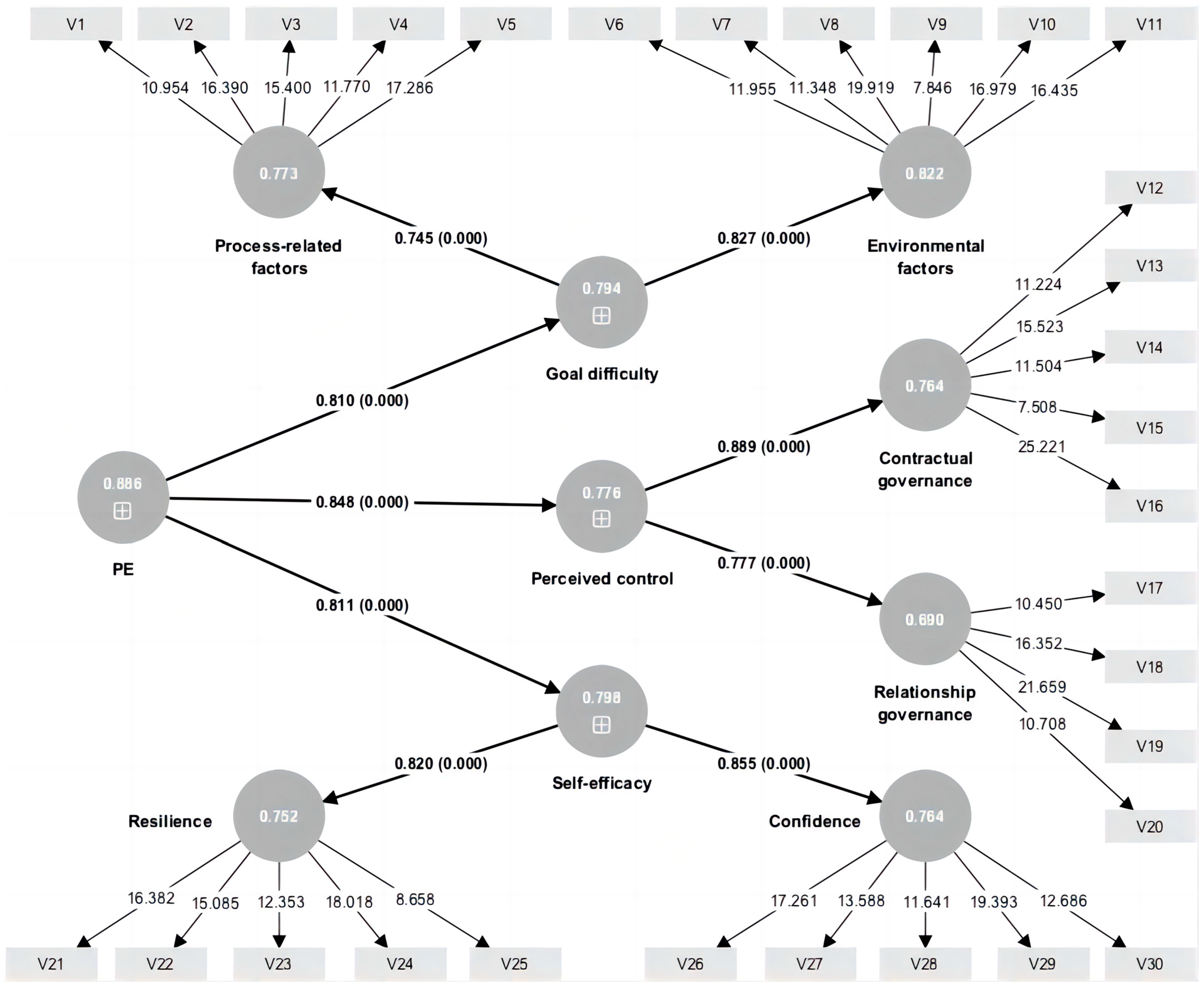
69]. A 5% significance level was established for evaluating path coefficients. The significance of these coefficients was ascertained through bootstrapping, employing 5000 subsamples to ensure a comprehensive analysis. The detailed outcomes of the PLS-SEM analysis are depicted in
Figure 3, providing a visual representation of the path relationships and their respective levels of significance.
The validity of the inventory is further evaluated by analyzing the outcomes of the PLS-SEM [
69].
4.2.1. Common Method Variance
Assessing Common Method Variance (CMV, hereafter) in PLS path modeling is essential since it relates to variance in measures caused by the method of measurement, not the constructs themselves. Given that the constructs were measured simultaneously through a single questionnaire, there is a potential for CMV, which could distort the proper relationships between constructs, leading to inaccurate conclusions. A significant factor explaining over 50% of the variance in a factor analysis suggests the presence of CMV [
73]. However, the dominant factor in this analysis accounted for only 10.80% of the variance, implying that CMV is not a significant concern in this model evaluation.
4.2.2. Composite Reliability and Average Variance Extracted
While Cronbach’s alpha is traditionally used to assess the internal consistency of a construct [
71], Composite Reliability (CR, hereafter) is regarded as a more suitable measure for PLS models [
69]. It is expected that the CR for all constructs should meet or exceed the acceptable threshold of 0.6 [
71]. Convergent validity is further determined by examining the indicators’ outer loadings along with the Average Variance Extracted (AVE, hereafter) [
74]. Typically, an AVE greater than 0.5 is preferred, yet an AVE of 0.4 is considered satisfactory if the Composite Reliability exceeds 0.7 [
75]. The reliability and validity of the PE indicators, as detailed in
Table 6, show that all results exceed the 0.5 threshold, confirming the reliability of the established criteria.
4.2.3. R2 Value, f2 Value and Predictive Relevance Q2
The
R2 value,
f2 effect size, and predictive relevance
Q2 are key metrics for assessing the structural model’s fitness.
R2 measures the model’s predictive accuracy and is the squared correlation between the actual and predicted values of a specific endogenous construct [
69].
R2 and adjusted
R2 values above 0.10 are generally considered acceptable [
76]. The
f2 effect size is used to ascertain the omitted construct’s substantive impact on endogenous constructs, with Cohen [
77] characterizing values of 0.02, 0.15, and 0.35 as indicative of weak, medium, or large effects, respectively. The Stone–Geisser’s
Q2 value, derived from the blindfolding procedure, gauges the model’s predictive relevance, with
Q2 values above zero suggesting predictive relevance. Values of 0.02, 0.15, and 0.35 for
Q2 correspond to small, medium, and large predictive relevance, respectively [
78]. As presented in
Table 7, all
Q2 values in this study are within acceptable ranges.
4.2.4. Heterogeneity
Data heterogeneity occurs due to distinct characteristics across groups, requiring a nuanced analysis to understand the varied dynamics [
78]. PLS-MGA is particularly useful for analyzing nonparametric data, where traditional parametric tests may not be appropriate due to data-distribution issues [
79]. This approach facilitates detailed comparisons across different subsets within the data, revealing significant variances or parallels in their patterns of response or behavior.
In data description, after using T-tests and ANOVA to identify whether there is a difference in all the variables of both participants and projects, the significant differences are observed in two categories of ‘Age’ and ‘Highest degree attained’. Therefore, in heterogeneity analysis, PLS-MGA is used to further test the most critical path in each category. ‘Age’ is divided into groups of ‘Under 35 years old’ and ‘35 years old and above’, and ‘Highest degree attained’ is divided into ‘Bachelor’s degree and under’ and ‘Master’s degree and above’.
The results of the PLS-MGA analysis are in
Table 8. It reveals a significant difference in the ‘Goal difficulty -> Process-related factors’ path for age groups under and over 35 years old (
p = 0.048, under). For the highest degree attained, a significant difference is noted in ‘Self-efficacy -> Resilience’ (
p = 0.032). This suggests a level of homogeneity in the perception of goal difficulty and self-efficacy across different age and educational groups.
4.3. Case Study of a Mega Tunneling Project in China
To demonstrate the practical application of the proposed PE inventory, this research introduces a tunneling-construction megaproject in Southeast China as a case study. This government-led project, valued at over CNY 32 billion, presents unique challenges due to its immense scale, complexity, and inherent uncertainty, particularly in the contractor selection process. This process involves evaluating various potential contractors, each with distinct strengths and areas of expertise. A significant challenge identified in this case is the difficulty in discerning subtle differences among contractors, especially given the relatively comparable capabilities. This scenario underscores the importance of the project owner’s subjective judgments in contractor selection, highlighting the practical implications of the PE inventory in such decisions.
At the beginning of the project, the project owner was interviewed to explore their decision-making priorities for selecting contractors. Questions like “What criteria are most important when evaluating contractors?” and “How do you decide among contractors with similar capabilities?” were investigated. The findings revealed that while standardized processes were initially key in assessing contractors, especially for ensuring selection based on capabilities (aligning with goal difficulty), the scenario shifted when the contractors presented comparable skill sets. In such cases, the owner focused more on subjective evaluations, aspects not typically captured in standard bidding documents. These subjective aspects align closely with perceived control and self-efficacy, underscoring their critical role in the selection process.
At the same time, interviews with the winning contractors provided insights extending beyond their qualifications and backgrounds. Queries such as “Why do you think you were awarded this project?” and “What factors contributed to your successful outcomes?” were explored. Besides addressing goal difficulty, the contractors highlighted their compatibility and previous collaborations with the owner. They acknowledged the significance of aligning with the owner’s preferences and priorities, mirroring the perceived control and self-efficacy aspects of the PE framework. Their adaptability to the owner’s needs and their capability for effective collaboration were identified as key contributors to their success.
This case study clearly reflects the role of the PE framework in a real-world scenario. While goal difficulty is an important consideration, aspects such as perceived control and self-efficacy are also critical, especially in megaprojects with higher risks. The subjective criteria and alignment with the project owner’s preferences prove to be critical. This demonstrates how the PE inventory can assist both project owners and contractors in harmonizing their expectations and strengths, fostering more effective collaboration and successful project results.
5. Conclusions and Recommendations
5.1. Discussions
The results from the PLS-SEM analysis validate the proposed PE inventory, effectively aligning with the Expectancy Theory [
8] and confirming the relevance of the chosen constructs in practical settings.
Figure 3 shows that all path coefficients are statistically significant. Based on the significance of the coefficient values, the components of PE are substantiated statistically. The analysis demonstrates that the owner’s PE is primarily determined by three key dimensions: perceived control, self-efficacy, and goal difficulty [
8,
21].
Comparatively, goal difficulty has the lowest contribution to PE among the three dimensions (with a path coefficient of 0.810). Given the inverse nature of this dimension, it implies that lower goal difficulty correlates with the owner’s higher PE, indicating that excessively challenging goals may diminish the owner’s expectancy of project outcomes [
22]. Within the construct of goal difficulty, environmental factors exert a greater impact than process-related factors. This highlights the importance of external market conditions over internal project processes, with key indicators being coordination and communication (V5) in process-related factors and less competitive market conditions (V8) in environmental factors.
Perceived control is identified as the most influential element (with a path coefficient of 0.848), emphasizing the owner’s control over project progression and outcomes. In this construct, the distinction between contractual and relationship governance is particularly noteworthy [
40,
41]. Contractual governance, indicated by its highest path coefficient of 0.889, highlights the importance of strict adherence to contractual obligations (V16). This aspect suggests that clear, well-defined contracts serve as a foundation for managing and assigning responsibilities, thereby reducing ambiguities and potential conflicts. The relationship governance, though slightly less influential in the model, emphasizes the importance of fostering trust and mutual understanding between the project owner and partners (V19).
Self-efficacy holds a path coefficient of 0.811. It reflects the owner’s confidence in their influence on project results. Self-efficacy extends into two key dimensions: resilience and confidence [
23,
60]. Resilience reflects the owner’s trust in their team’s capacity to recover quickly from difficulties and learn from failures to improve performance [
56]. The emphasis on confidence highlights that a confident leadership approach can foster a positive, proactive work environment [
57]. While both aspects are crucial, confidence emerges as more impactful in the study. It underscores the importance of the owner’s trust in their team’s capabilities (V24) and in the collective endeavor to overcome project-related challenges (V29).
The significant disparities among project owners in age and educational attainment reflect their different perceptions and attitudes toward PE. The difference in ‘Goal difficulty -> Process-related factors’ across age groups may stem from varying experience levels and mindsets; younger participants under 35 might approach process-related challenges differently, likely due to limited professional exposure or diverse problem-solving strategies. Similarly, the disparity in ‘Self-efficacy -> Resilience’ linked to educational attainment implies that higher education may foster enhanced coping and problem-solving abilities, advocating for continuous learning and professional development to build a resilient project owner adept at navigating project complexities.
5.2. Recommendations
PE emphasizes the degree to which project owners anticipate successful outcomes based on certain influential factors [
6,
7]. PE should be considered throughout the entire project operation. For example, at the project-planning stage, through evaluating the extent of PE with due regard to the project nature and characteristics, the project owner can adopt appropriate strategies to ensure the smooth operation of the project [
6,
7]. The following are some suggestions for the project owner:
(1) Tactical partner selection and balanced governance are required to enhance perceived control.
Maintaining perceived control over a project is pivotal from a project owner’s perspective. This involves careful consideration in the selection of contractors and the establishment of project-management rules, ensuring the owner’s command over the project operations.
Firstly, the selection of partners should not rely merely on capabilities and expertise, but on those who can foster teamwork and enhance the quality of collaboration. This approach prioritizes forming a team that aligns with the project’s objectives and meets the owner’s PE. Secondly, balancing contractual and relational governance is crucial. Clear, detailed, and adaptable contracts are necessary for establishing a robust inventory, defining roles and responsibilities, and managing changes in project conditions [
40]. Concurrently, cultivating trust-based relationships with partners fosters a collaborative atmosphere [
41]. Through these strategies, project owners can significantly augment their perceived control, leading to more effective teamwork and successful project outcomes.
(2) Fostering an inclusive team culture and organizational resilience is necessary to strengthen self-efficacy.
To strengthen self-efficacy, the implementation of an inclusive team culture and the creation of organizational resilience are necessary. A project owner who demonstrates resilience and confidence is more adept at managing project challenges effectively [
54,
61,
62]. It is critical for the project owner, especially those with diverse educational backgrounds, to enhance their self-efficacy by fostering an environment of collective decision making and active involvement in project oversight.
Close collaboration with the team is essential to understand the project’s progress and to bolster confidence in the project’s direction. Establishing effective communication channels is also crucial. It ensures seamless information exchange and enhances control over project management. Furthermore, promoting a culture of resilience and collective problem-solving can empower the project owner and lead to improved project performance and outcomes.
(3) Corresponding management strategies should be developed based on different levels of goal difficulty.
While goal difficulty is often an objective factor, the way that the project owner responds to it can significantly impact PE. It is essential for project owners, especially the younger or less experienced ones, to receive adequate mentoring and support. This can be achieved by providing them with resources and training that enhance their understanding and management of complex project aspects. Encouraging an adaptable project-management approach is vital. This means not just setting realistic goals but also being open to revising them in response to changing project dynamics, new information, or unforeseen challenges. Such flexibility helps in maintaining the relevance and achievability of project goals over time.
6. Limitations and Further Study
In this study, data were collected from various project types, encompassing project owners of different ages, educational backgrounds, and levels, reflecting a certain degree of regional diversity. With the progression of digitalization, the international diversity in the study of PE inventory is also increasingly important and warrants further investigation. This indicates that despite the challenges, an in-depth study of PE inventory is essential to enhance the efficiency of current practices and provide a direction for future developments.
The implementation of PE inventory in construction projects faces key challenges. Firstly, adaptability to diverse projects requires significant resources, which is particularly challenging for smaller firms [
5]. Organizational resistance to workflow changes also poses a challenge [
80]. Additionally, it requires specialized skills and training [
81,
82], which are not always available, limiting its adoption. Future research should address these limitations. This includes developing cost-effective strategies for smaller projects, embracing changes, and broadening access to training. These efforts will enhance the industry’s efficiency and development. Addressing these challenges is critical for the successful application and utility of the PE inventory in the construction industry.
7. Concluding Remarks
While the project owner significantly influences project direction and outcomes, there is a lack of structured tools to effectively capture and integrate the project owner’s expectancy into project management. This gap can lead to misalignment between project goals and the owner’s vision, potentially causing delays, cost overruns, and conflicts. Therefore, this study innovatively develops a PE inventory for construction-project owners, prioritizes their expectancy, and offers strategies for effective partner selection, contributing to improved project performance.
Through an extensive literature review, this study identifies three main dimensions of PE in construction projects, including perceived control and self-efficacy [
8,
21]. These dimensions form the foundation of a comprehensive conceptual inventory, incorporating various factors and sub-factors. To refine and validate PE inventory, expert consultations were conducted, providing valuable insights and feedback. This process ensures the inventory’s grounding in both theoretical and practical aspects, addressing the complexities of managing construction projects from the owner’s perspective in a real-world context.
To enhance the reliability of the PE inventory, this study collected data from 197 project owners. These owners evaluated the identified factors within the inventory. Then, the inventory’s structure was validated using PLS-SEM. This analysis revealed statistically significant relationships among the inventory’s factors and their sub-factors. Notable differences in groups of the age and highest-degree aspects led to the validation and refinement of the proposed PE inventory. The practical application of this inventory is demonstrated through a case study of a tunneling-construction megaproject.
It is further proposed that better project performance can be achieved if the owner’s PE is effectively addressed. The following suggestions are recommended: (1) tactical partner selection and balanced governance are required to enhance perceived control, (2) fostering an inclusive team culture and organizational resilience necessary to strengthen self-efficacy, and (3) corresponding management strategies should be developed based on different levels of goal difficulty.
Based on the Expectancy Theory [
8], this study develops a PE inventory for the construction industry, focusing on the project owner’s perspective. It addresses the need for standardized tools to integrate the owner’s expectancy in project management. This study identifies key dimensions of PE: goal difficulty, perceived control, and self-efficacy. The analysis of data from 197 owners using PLS-SEM reveals the paramount importance of perceived control in PE. This research enriches the construction-management literature by offering a structured approach to describe PE, contributing to effective partner selection and decision making, and enhancing project-goal alignment and its outcomes.