A Hybrid Model for Fitness Influencer Competency Evaluation Framework


Abstract
1. Introduction
- (i)
- Fitness influencers’ competency development and planning are unclear.
- (ii)
- The key elements of success for fitness influencers are not known.
- (iii)
- It is unclear what professional competencies and knowledge-transfer skills are required to become a fitness influencer.
- (iv)
- There is no clear performance evaluation that shows how underperforming fitness influencers can improve.
- (v)
- Most fitness influencer research methods use statistical methods or qualitative surveys.
- (i)
- This study developed an appropriate framework for evaluating fitness influencer competencies, and all criteria can be clearly defined and supported by the literature.
- (ii)
- The proposed criteria align with several Sustainable Development Goals (SDGs), namely SDG 3 (Good Health and Well-being), SDG 4 (Quality Education), SDG 5 (Gender Equality), SDG 10 (Reduced Inequalities), and SDG 11 (Sustainable Cities and Communities).
- (iii)
- This study uses Bayesian BWM to obtain fitness influencer competency dimensions and criterion weights, which overcomes the shortcomings of AHP and BWM and significantly reduces the number of criterion pairwise comparisons. In addition, this study uses the modified TOPSIS-AL to identify the distances among existing fitness influencers in the ranking.
- (iv)
- Sensitivity analysis is used to illustrate the importance of the weights of the criteria, and the ranking results of the evaluated subjects will change with the weights.
2. Literature Reviews
2.1. The Research Developments in the Fitness Industry
2.2. The Proposed Evaluation Framework
3. Methodology
3.1. Bayesian BWM Technique
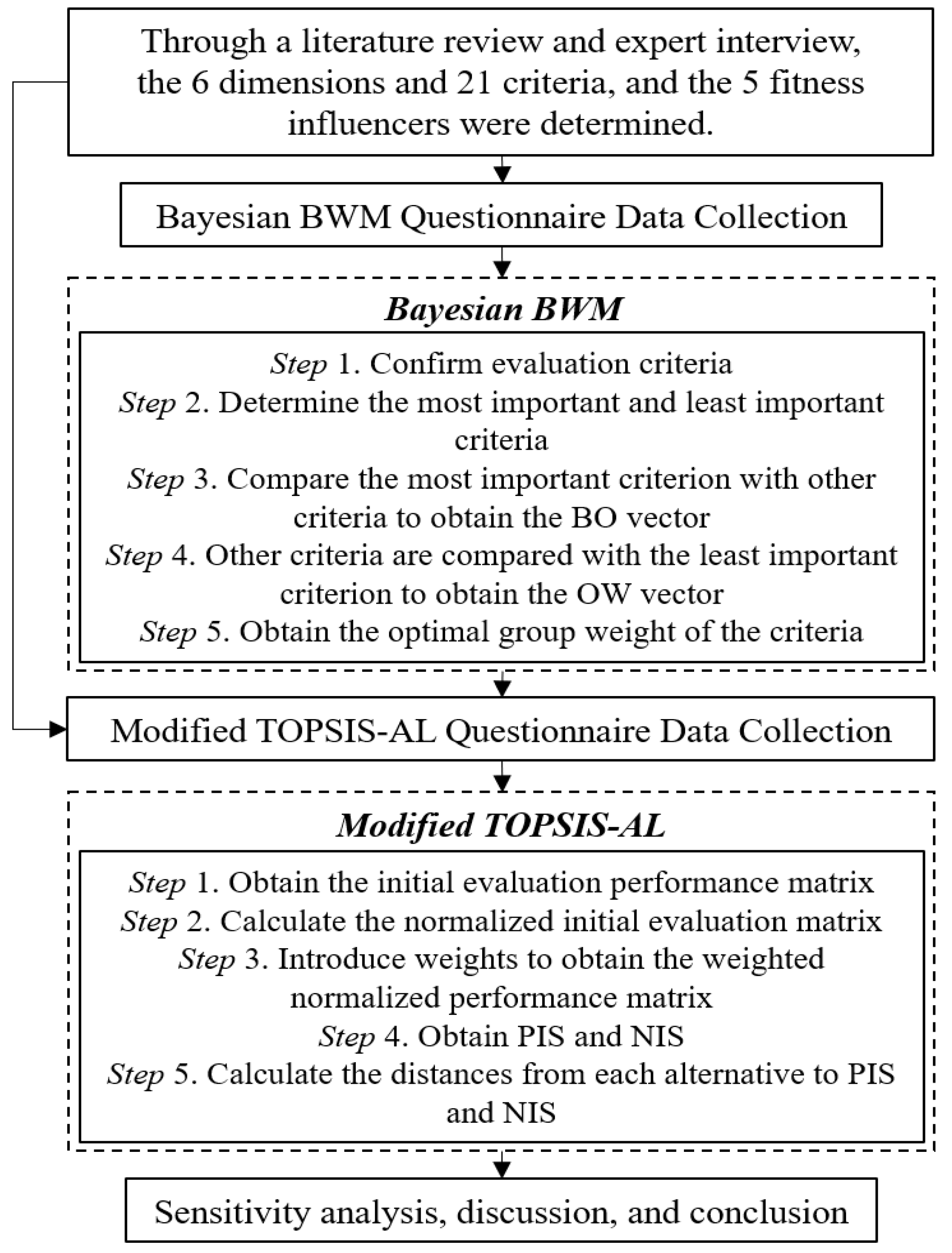
- Step 1. Confirm evaluation criteria
- Step 2. Determine the most important and least important criteria
- Step 3. Compare the most important criterion with other criteria to obtain the BO vector
- Step 4. Other criteria are compared with the least important criterion to obtain the OW vector
- Step 5. Obtain the optimal group weight of the criteria
- Step 5.1. Construct the joint probability distribution of the group
- Step 5.2. Build a Bayesian hierarchical model
3.2. Modified TOPSIS-AL Technique
- Step 1. Obtain the initial evaluation performance matrix
- Step 2. Calculate the normalized initial evaluation matrix
- Step 3. Introduce weights to obtain the weighted normalized performance matrix
- Step 4. Obtain positive and negative ideal solutions (PIS and NIS)
- Step 5. Calculate the distances from each alternative to PIS and NIS
- Step 6. Obtain the final TOPSIS performance value and the ranking
4. An Empirical Study of Fitness Influencer Evaluation
4.1. Case Illustration
4.2. Using Bayesian BWM to Calculate the Criteria Weights
4.3. Using Modified TOPSIS-AL to Calculate Fitness Influencer Function Benchmark Performance
5. Discussion
6. Conclusions
- (i)
- This study has crafted a well-defined framework for assessing fitness influencer abilities.
- (ii)
- This study has addressed the limitations of AHP and BWM by employing Bayesian BWM.
- (iii)
- This study has identified the relative rankings of contemporary fitness influencers by using the modified TOPSIS-AL.
- (iv)
- The robustness of the hybrid model has been confirmed through sensitivity analysis.
Author Contributions
Funding
Institutional Review Board Statement
Informed Consent Statement
Data Availability Statement
Conflicts of Interest
Appendix A

| BO Vectors | Best | D1 | D2 | D3 | D4 | D5 | D6 |
|---|---|---|---|---|---|---|---|
| Expert 1. | D1 | 1 | 1 | 1 | 1 | 1 | 1 |
| Expert 2. | D1 | 1 | 1 | 1 | 1 | 1 | 1 |
| Expert 3. | D1 | 1 | 1 | 1 | 1 | 1 | 1 |
| Expert 4. | D5 | 2 | 2 | 2 | 2 | 1 | 2 |
| Expert 5. | D3 | 4 | 4 | 1 | 2 | 1 | 2 |
| Expert 6. | D3 | 4 | 4 | 1 | 1 | 1 | 4 |
| Expert 7. | D1 | 1 | 1 | 1 | 1 | 1 | 1 |
| Expert 8. | D1 | 1 | 1 | 1 | 1 | 3 | 1 |
| Expert 9. | D2 | 2 | 1 | 1 | 1 | 2 | 1 |
| Expert 10. | D5 | 7 | 4 | 2 | 7 | 1 | 7 |
| OW | Worst | D1 | D2 | D3 | D4 | D5 | D6 |
|---|---|---|---|---|---|---|---|
| Expert 1. | D2 | 1 | 1 | 1 | 1 | 1 | 1 |
| Expert 2. | D2 | 1 | 1 | 1 | 1 | 1 | 1 |
| Expert 3. | D2 | 1 | 1 | 1 | 1 | 1 | 1 |
| Expert 4. | D1 | 1 | 1 | 1 | 1 | 2 | 1 |
| Expert 5. | D1 | 1 | 1 | 4 | 2 | 4 | 2 |
| Expert 6. | D1 | 1 | 1 | 4 | 4 | 4 | 1 |
| Expert 7. | D2 | 1 | 1 | 1 | 1 | 1 | 1 |
| Expert 8. | D1 | 3 | 3 | 3 | 3 | 1 | 3 |
| Expert 9. | D1 | 1 | 2 | 2 | 2 | 1 | 2 |
| Expert 10. | D1 | 1 | 2 | 4 | 1 | 7 | 1 |
| A1 | A2 | A3 | A4 | A5 | Aspiration Level | Worst Level | |
|---|---|---|---|---|---|---|---|
| C11 | 7.7 | 8.2 | 5.9 | 6.7 | 7.4 | 10 | 0 |
| C12 | 7.8 | 7.6 | 6.1 | 5.9 | 7.2 | 10 | 0 |
| C13 | 5.8 | 6.6 | 5.3 | 5.4 | 6.6 | 10 | 0 |
| C14 | 6.0 | 7.0 | 5.8 | 5.9 | 6.6 | 10 | 0 |
| C21 | 6.5 | 7.7 | 6.6 | 7.0 | 7.6 | 10 | 0 |
| C22 | 6.3 | 7.7 | 6.7 | 6.8 | 7.2 | 10 | 0 |
| C23 | 6.5 | 7.5 | 6.7 | 6.7 | 7.1 | 10 | 0 |
| C24 | 7.9 | 8.0 | 6.5 | 6.3 | 7.0 | 10 | 0 |
| C31 | 7.5 | 7.8 | 6.3 | 6.5 | 7.4 | 10 | 0 |
| C32 | 7.5 | 7.5 | 6.6 | 6.7 | 7.5 | 10 | 0 |
| C33 | 6.7 | 7.2 | 6.1 | 6.7 | 7.3 | 10 | 0 |
| C41 | 6.6 | 7.8 | 6.8 | 7.3 | 7.6 | 10 | 0 |
| C42 | 6.3 | 7.9 | 6.8 | 7.3 | 7.5 | 10 | 0 |
| C43 | 6.9 | 7.5 | 6.4 | 6.8 | 7.2 | 10 | 0 |
| C51 | 6.9 | 8.0 | 7.2 | 7.1 | 7.7 | 10 | 0 |
| C52 | 7.4 | 7.9 | 7.7 | 7.6 | 7.8 | 10 | 0 |
| C53 | 8.5 | 8.3 | 7.4 | 8.2 | 8.0 | 10 | 0 |
| C54 | 7.9 | 7.9 | 7.3 | 8.1 | 8.0 | 10 | 0 |
| C61 | 7.2 | 7.8 | 7.2 | 7.6 | 7.5 | 10 | 0 |
| C62 | 7.0 | 7.9 | 6.9 | 7.6 | 7.8 | 10 | 0 |
| C63 | 8.3 | 8.3 | 7.6 | 8.4 | 8.2 | 10 | 0 |
References
- Ahrens, J.; Brennan, F.; Eaglesham, S.; Buelo, A.; Laird, Y.; Manner, J.; Newman, E.; Sharpe, H. A Longitudinal and Comparative Content Analysis of Instagram Fitness Posts. Int. J. Environ. Res. Public Health 2022, 19, 6845. [Google Scholar] [CrossRef]
- Jones, P.; Ratten, V.; Hayduk, T. Sport, Fitness, and Lifestyle Entrepreneurship. Int. Entrep. Manag. J. 2020, 16, 783–793. [Google Scholar] [CrossRef]
- Söderström, T. A 20-year analysis of motives and training patterns of Swedish gym-goers. Ann. Leis. Res. 2023, 26, 521–544. [Google Scholar] [CrossRef]
- Storm, R.K.; Hansen, B.O.R. Commercial fitness centres in Denmark: A study on development, determinants of provision and substitution effects. Ann. Leis. Res. 2021, 24, 468–491. [Google Scholar] [CrossRef]
- Yong, B.; Xu, Z.; Wang, X.; Cheng, L.; Li, X.; Wu, X.; Zhou, Q. IoT-based intelligent fitness system. J. Parallel Distrib. Comput. 2018, 118, 14–21. [Google Scholar] [CrossRef]
- De Veirman, M.; Cauberghe, V.; Hudders, L. Marketing through Instagram influencers: The impact of number of followers and product divergence on brand attitude. Int. J. Advert. 2017, 36, 798–828. [Google Scholar] [CrossRef]
- Kim, M. How can I Be as attractive as a Fitness YouTuber in the era of COVID-19? The impact of digital attributes on flow experience, satisfaction, and behavioral intention. J. Retail. Consum. Serv. 2022, 64, 102778. [Google Scholar] [CrossRef]
- Sokolova, K.; Perez, C. You follow fitness influencers on YouTube. But do you actually exercise? How parasocial relationships, and watching fitness influencers, relate to intentions to exercise. J. Retail. Consum. Serv. 2021, 58, 102276. [Google Scholar] [CrossRef]
- Femenia-Serra, F.; Gretzel, U.; Alzua-Sorzabal, A. Instagram travel influencers in #quarantine: Communicative practices and roles during COVID-19. Tour. Manag. 2022, 89, 104454. [Google Scholar] [PubMed]
- Leung, F.F.; Gu, F.F.; Palmatier, R.W. Online Influencer Marketing. J. Acad. Mark. Sci. 2022, 50, 226–251. [Google Scholar] [CrossRef]
- Muñoz, M.M.; Rojas-de-Gracia, M.M.; Navas-Sarasola, C. Measuring engagement on twitter using a composite index: An application to social media influencers. J. Inf. Technol. 2022, 16, 101323. [Google Scholar] [CrossRef]
- Liu, J.W.; Chang, C.W.; Wang, Y.J.; Liu, Y.H. Constructing a Decision Model for Health Club Members to Purchase Coaching Programs during the COVID-19 Epidemic. Sustainability 2022, 14, 13497. [Google Scholar] [CrossRef]
- Branley-Bell, D.; Talbot, C.V. Exploring the impact of the COVID-19 pandemic and UK lockdown on individuals with experience of eating disorders. J. Eat. Disord. 2020, 8, 44. [Google Scholar] [CrossRef] [PubMed]
- Chang, T.; Pai, C.; Lo, H.; Hu, S. A hybrid decision-making model for sustainable supplier evaluation in electronics manufacturing. Comput. Ind. Eng. 2021, 156, 107283. [Google Scholar] [CrossRef]
- Shao, Q.; Lo, H.W.; Liou, J.J.; Tzeng, G.H. A Data-Driven Model to Construct the Influential Factors of Online Product Satisfaction. Int. J. Inf. Technol. Decis. Mak. 2023, 1–31. [Google Scholar] [CrossRef]
- Mohammadi, M.; Rezaei, J. Bayesian best-worst method: A probabilistic group decision making model. Omega 2019, 96, 102075. [Google Scholar] [CrossRef]
- Wang, L.; Chen, Y. Success or growth? Distinctive roles of extrinsic and intrinsic career goals in high-performance work systems, job crafting, and job performance. J. Vocat. Educ. Train. 2022, 135, 103714. [Google Scholar] [CrossRef]
- Mäkikangas, A.; Schaufeli, W. A person-centered investigation of two dominant job crafting theoretical frameworks and their work-related implications. J. Vocat. Behav. 2021, 131, 103658. [Google Scholar] [CrossRef]
- Dobson, S.; McLuskie, P. Performative entrepreneurship: Identity, behaviour and place in adventure sports Enterprise. Int. Entrep. Manag. J. 2020, 16, 879–895. [Google Scholar] [CrossRef]
- Jang, S.; Han, S.H.; Rhee, J.Y. Cluster of coronavirus disease associated with fitness dance classes, South Korea. Emerg. Infect. Dis. 2020, 26, 1917–1920. [Google Scholar] [CrossRef]
- Fühner, T.; Kliegl, R.; Arntz, F.; Kriemler, S.; Granacher, U. An Update on Secular Trends in Physical Fitness of Children and Adolescents from 1972 to 2015: A Systematic Review. Sports Med. 2021, 51, 303–320. [Google Scholar] [CrossRef] [PubMed]
- Rydzik, Ł.; Ambrozy, T. Physical fitness and the level of technical and tactical training of kickboxers. Int. J. Environ. Res. Public Health 2021, 18, 3088. [Google Scholar] [CrossRef] [PubMed]
- Kim, M. Conceptualization of e-servicescapes in the fitness applications and wearable devices context: Multi-dimensions, consumer satisfaction, and behavioral intention. J. Retail. Consum. Serv. 2021, 61, 102562. [Google Scholar] [CrossRef]
- Kim, H. Social comparison of fitness social media postings by fitness app users. Comput. Hum. Behav. 2022, 131, 107204. [Google Scholar] [CrossRef]
- De Vos, A.; van der Heijden, B.I.J.M.; Akkermans, J. Sustainable careers: Towards a conceptual model. J. Vocat. Behav. 2020, 117, 103196. [Google Scholar] [CrossRef]
- Hoff, K.A.; Song, Q.C.; Wee, C.J.M.; Phan, W.M.J.; Rounds, J. Interest fit and job satisfaction: A systematic review and metaanalysis. J. Vocat. Behav. 2020, 123, 103503. [Google Scholar] [CrossRef]
- Lazazzara, A.; Tims, M.; de Gennaro, D. The process of reinventing a job: A meta–synthesis of qualitative job crafting research. J. Vocat. Behav. 2020, 116, 103267. [Google Scholar] [CrossRef]
- Sun, C.; Shute, V.J.; Stewart, A.; Yonehiro, J.; Duran, N.; D’Mello, S. Towards a generalized competency model of collaborative problem solving. Comput. Educ. 2020, 143, 103672. [Google Scholar] [CrossRef]
- Gruman, J.A.; Budworth, M.-H. Positive psychology and human resource management: Building an HR architecture to support human flourishing. Hum. Resour. Manag. Rev. 2022, 32, 100911. [Google Scholar] [CrossRef]
- Janssen, L.; Schouten, A.P.; Croes, E.A.J. Influencer Advertising on Instagram: Product-Influencer Fit and Number of Followers Affect Advertising Outcomes and Influencer Evaluations Via Credibility and Identification. Int. J. Advert. 2022, 41, 101–127. [Google Scholar] [CrossRef]
- Sokolova, K.; Kefi, H. Instagram and YouTube Bloggers Promote It, Why Should I Buy? How Credibility and Parasocial Interaction Influence Purchase Intentions. J. Retail. Consum. Serv. 2020, 53, 101742. [Google Scholar] [CrossRef]
- Ghosh, S.; Hughes, M.; Hodgkinson, I.; Hughes, P. Digital transformation of industrial businesses: A dynamic capability approach. Technovation 2021, 113, 102414. [Google Scholar] [CrossRef]
- Oberländer, M.; Beinicke, A.; Bipp, T. Digital Competences: A Review of the Literature and Applications in the Workplace. Comput. Educ. 2020, 146, 103752. [Google Scholar] [CrossRef]
- Jiménez-Castillo, D.; Sánchez-Fernández, R. The role of digital influencers in brand recommendation: Examining their impact on engagement, expected value and purchase intention. Int. J. Inf. Manag. 2019, 49, 366–376. [Google Scholar] [CrossRef]
- Casaló, L.V.; Flavian, C.; Ibáñez-Sánchez, S. Influencers on Instagram: Antecedents and consequences of opinion leadership. J. Bus. Res. 2020, 117, 510–519. [Google Scholar] [CrossRef]
- Lim, M.S.C.; Molenaar, A.; Brennan, L.; Reid, M.; McCaffrey, T. Young adults’ use of different social media platforms for health information: Insights from web-based conversations. J. Med. Internet Res. 2022, 24, e23656. [Google Scholar] [CrossRef] [PubMed]
- Maina, M.F.; Ortiz, L.G.; Mancini, F.; Melo, M.M. A Micro-Credentialing Methodology for Improved Recognition of HE Employability Skills. Int. J. Educ. Technol. High. Educ. 2022, 19, 10. [Google Scholar] [CrossRef] [PubMed]
- Flanigan, A.E.; Akcaoglu, M.; Ray, E. Initiating and maintaining student-instructor rapport in online classes. Internet High. Educ. 2022, 53, 100844. [Google Scholar] [CrossRef]
- Schwerter, J.; Dimpfl, T.; Bleher, J.; Murayama, K. Benefits of Additional Online Practice Opportunities in Higher Education. Internet High. Educ. 2022, 53, 100834. [Google Scholar] [CrossRef]
- Rezaei, J. Best-worst multi-criteria decision-making method. Omega 2015, 53, 49–57. [Google Scholar] [CrossRef]
- Huang, C.-N.; Liou, J.J.; Lo, H.-W.; Chang, F.-J. Building an assessment model for measuring airport resilience. J. Air Transp. Manag. 2021, 95, 102101. [Google Scholar] [CrossRef]
- Aydin, N.; Seker, S.; ¸Sen, C. A new risk assessment framework for safety in oil and gas industry: Application of FMEA and BWM based picture fuzzy MABAC. J. Pet. Sci. Eng. 2022, 219, 111059. [Google Scholar] [CrossRef]
- Munim, Z.H.; Balasubramaniyan, S.; Kouhizadeh, M.; Hossain, N.U.I. Assessing blockchain technology adoption in the Norwegian oil and gas industry using Bayesian Best Worst Method. J. Ind. Inf. Integr. 2022, 28, 100346. [Google Scholar] [CrossRef]
- Vieira, F.C.; Ferreira, F.A.F.; Govindan, K.; Ferreira, N.C.M.Q.F.; Banaitis, A. Measuring Urban Digitalization Using Cognitive Mapping and the Best Worst Method (BWM). Technol. Soc. 2022, 71, 102131. [Google Scholar] [CrossRef]
- Gül, M.; Yücesan, M. Performance evaluation of Turkish Universities by an integrated Bayesian BWM-TOPSIS model. Socio-Econ. Plan. Sci. 2022, 80, 101173. [Google Scholar] [CrossRef]
- Zhang, Y.; Zhao, H.; Li, B.; Zhao, Y.; Qi, Z. Research on credit rating and risk measurement of electricity retailers based on Bayesian Best Worst Method-Cloud Model and improved Credit Metrics model in China’s power market. Energy 2022, 252, 124088. [Google Scholar] [CrossRef]
- Lo, H.W.; Liou, J.; Huang, C.N.; Chuang, Y.C. A novel failure mode and effect analysis model for machine tool risk analysis. Reliab. Eng. Syst. Saf. 2019, 183, 173–183. [Google Scholar] [CrossRef]
- Kuo, T. A modified TOPSIS with a different ranking index. Eur. J. Oper. Res. 2017, 260, 152–160. [Google Scholar] [CrossRef]

| Author(s) (Year) | Research Content and Results | Research Method |
|---|---|---|
| Yong et al. [5] | This study develops an intelligent fitness system utilizing Internet of Things (IoT) technology, featuring a unified database and return service, indicative of a broader industry trend. It underscores the burgeoning role of IoT and artificial intelligence in revolutionizing fitness facility management, equipment tracking, and personalized fitness experiences. | Experimental data collection |
| Dobson and McLuskie [19] | This study examines the entrepreneurial identity of mountain bike trainers, revealing their alignment with a ‘lifestyle’ entrepreneurial identity over market-driven pursuits. This reflects a growing trend in the fitness industry where passion and lifestyle choices often drive business models more than traditional market opportunities. | Semi-structured interviews |
| Jones et al. [2] | This study illustrates the connection between fitness, public health, and entrepreneurship, analyzing how these contribute to economic returns. It reflects the fitness industry’s increasing focus on holistic well-being and social entrepreneurship as key drivers of economic growth and community impact. | Literature review |
| Jang et al. [20] | Investigating indoor exercise class size, layout, and training intensity, this study highlights their role in COVID-19 transmission. The findings underscore the fitness industry’s challenge in redesigning spaces and modifying workout regimes to prioritize health and safety during pandemics. | Statistica |
| Fühner et al. [21] | This study advocates for incorporating resistance and endurance training in physical education, aligning with recent industry trends emphasizing diverse training methodologies to enhance the physical development of younger demographics. | Linear mixed model (LMM) |
| Rydzik and Ambroży [22] | Establishing a correlation between various training aspects and taekwondo performance, this study reflects the fitness industry’s focus on specialized training programs that cater to specific athletic needs, enhancing competitive performance through tailored regimens. | Parametric tests, Shapiro-Wilk test, Levene test, descriptive statistics, Pearson’s linear correlation coefficient |
| Kim [23] | Highlighting consumer reliance on mobile technology, this study aligns with the fitness industry’s increasing investment in digital solutions like apps and wearable devices, catering to a tech-savvy consumer base and enhancing user engagement and fitness tracking capabilities. | Principal component analysis, exploratory factor analysis (EFA), Kaiser-Meyer-Olkin test, Bartlett’s spherical test |
| Sokolova and Perez [8] | This study’s findings on the significant impact of YouTube fitness influencers on their audience echo a key trend in the fitness industry: leveraging digital platforms for marketing and community building. The positive demeanor of influencers shaping subscriber attitudes and purchase behaviors reflects the growing importance of digital content creation in the fitness sector. | Partial least squares (PLS) |
| Ahrens et al. [1] | The study underscores the power of celebrity content on Instagram in the fitness industry, highlighting the need for robust content protection policies. This resonates with the industry’s growing focus on responsible and ethical content creation, given its influence on consumer behavior and brand reputation. | Chi-square test |
| Kim [24] | Revealing how fitness comparisons influence user behavior, this study reflects a key aspect of the fitness industry’s community dynamics. The motivational impact of such comparisons underscores the importance of creating supportive and aspirational environments in fitness platforms and communities. | Binary logistic regression analysis |
| Kim [7] | Confirming the significance of content attributes on fitness YouTube channels, this study aligns with the industry’s evolving digital marketing strategies. The focus on quality and interaction highlights the fitness industry’s need to adapt to digital trends, ensuring engaging and valuable content to retain and attract a digital audience. | Correlation analysis, Kaiser-Meyer-Olkin test, factor analysis, Varimax, quantitative analysis of variance, Bonferroni correction |
| Dimension | Criterion | Description | References |
|---|---|---|---|
| Professional skills and knowledge (D1) | Physical fitness skills and knowledge (C11) | Having professional skills and professional knowledge in body composition, nutrition, and sports training. | Wang and Chen [17]; De Vos et al. [25]; Hoff et al. [26] |
| Social media and software operation skills (C12) | Having knowledge of online marketing and community management to build their brand image, awareness, and exposure on social media platforms | Ghosh et al. [32]; De Vos et al. [25]; Oberländer et al. [33] | |
| Data analysis ability (C13) | Able to analyze network traffic and data to understand how to increase impact and add value to themselves. | Sokolova and Perez [8]; Oberländer et al. [33]; Jiménez-Castillo and Sánchez-Fernández [34] | |
| Online marketing skills (C14) | Interacting with users on social media through marketing campaigns to increase value and revenue. | Kim [7]; Sokolova and Perez [8]; Jiménez-Castillo and Sánchez-Fernández [34] | |
| Course instruction competency (D2) | The courses are easy to understand (C21) | The content, format, and teaching style of the courses are easy for the students to understand and master. | Kim [7]; Casaló et al. [35]; Sokolova and Kefi [31] |
| Diversity of course content (C22) | The topics and content covered in the training are rich and diverse to meet the needs of different trainees. | Leung et al. [10]; Lim et al. [36]; Sokolova and Kefi [31] | |
| Content validity (C23) | The courses are effective in enhancing the professional competence, skills, and knowledge of the trainees. | Kim [7]; Leung et al. [10]; Lim et al. [36] | |
| Attractive and trustworthy (C24) | The courses provide participants with the motivation to actively participate and learn and to achieve tangible benefits and growth in the learning process. | Kim [7]; Leung et al. [10]; Lim et al. [36]; Sokolova and Kefi [31] | |
| Behavioral standards (D3) | Active innovation (C31) | Constantly looking for new ways to teach, train, and provide nutritional counseling, developing new content, and using different forms of media to spread fitness knowledge. | Wang and Chen [17]; Mäkikangas and Schaufeli [18]; De Vos et al. [25];Lazazzara et al. [27] |
| Punctuality and discretion (C32) | Arriving at the site on time at the scheduled time with the trainee and taking care of the trainee’s safety and health during the teaching process. | Kim [7]; Sokolova and Perez [8]; Sokolova and Kefi [31] | |
| Self-examination (C33) | Taking the initiative to review teaching methods and performance during training, to identify problems and room for improvement to improve the quality and effectiveness of their teaching. | Maina et al. [37]; Wang and Chen [17]; Mäkikangas and Schaufeli [18]; De Vos et al. [25] | |
| Attitude towards people (D4) | Rapport and motivation (C41) | Able to establish a good interactive relationship with customers and audiences, build trust with each other, and be able to motivate and support each other. | Flanigan et al. [38]; Kim [7]; Lim et al. [36]; Schwerter et al. [39] |
| Continuous interaction and feedback (C42) | Continuing to interact with the audience and customers, and being willing to give suggestions and feedback promptly. | Flanigan et al. [38]; Kim [7]; Lim et al. [36] | |
| Working together to accomplish goals (C43) | Able to establish a good cooperative relationship with team members, trainees, or customers, set goals together, and strive to achieve them. | Flanigan et al. [38]; Lim et al. [36] | |
| Individual traits (D5) | Positive and affectionate (C51) | Projecting a positive image and being approachable through the content posted. | Lim et al. [36]; Sokolova and Kefi [31] |
| Enthusiastic and generous (C52) | Demonstrating a positive, enthusiastic, friendly, and open attitude when interacting with students or fans, and the ability to build rapport with others. | Flanigan et al. [38]; Kim [7]; Leung et al. [10] | |
| Good physical appearance (C53) | Having a healthy, sturdy, aesthetically pleasing physical condition and appearance, and demonstrating fitness knowledge and skills to inspire and guide audiences to a healthy lifestyle through the attractiveness and credibility of their image. | Kim [7]; Lim et al. [36]; Sokolova and Perez [8]; Sokolova and Kefi [31] | |
| Trustworthy (C54) | Having integrity, honesty, and trustworthiness allows students to trust their professional abilities and personal integrity and be willing to follow the guidance of the coach. | Janssen et al. [30]; Kim [7]; Sokolova and Perez [8]; Sokolova and Kefi [31] | |
| Self-improvement (D6) | Developing professional knowledge (C61) | Continuously learning and updating professional knowledge in fitness, exercise, nutrition, and other related fields to provide better fitness advice, instruction, and services. | Wang and Chen [17]; Lazazzara et al. [27] |
| Developing professional skills (C62) | To accomplish goals more effectively, continuing to learn a wide range of professional skills such as fitness training skills, nutrition knowledge, communication skills, education and training skills, and social media skills. | Wang and Chen [17]; Lazazzara et al. [27] | |
| Demanding self-image (C63) | Maintaining a healthy and positive image by staying in good shape and healthy, so that the audience will have a good impression and trust. | Kim [7]; Sokolova and Kefi [31] |
| Expert | Affiliation | Position | Work Experience | Education |
|---|---|---|---|---|
| Expert 1 | School | P.E. teacher | over 10 years | Bachelor |
| Expert 2 | Gym | Personal trainer | over 10 years | High School |
| Expert 3 | School | P.E. teacher | over 10 years | Bachelor |
| Expert 4 | School | P.E. teacher | over 10 years | Bachelor |
| Expert 5 | Gym | Personal trainer | over 10 years | Bachelor |
| Expert 6 | Gym | Personal trainer | over 10 years | Bachelor |
| Expert 7 | Gym | Personal trainer | over 10 years | Bachelor |
| Expert 8 | Gym | Personal trainer | over 10 years | Bachelor |
| Expert 9 | Gym | Personal trainer | over 10 years | Bachelor |
| Expert 10 | Gym | Gym owner | over 10 years | Master |
| Alternative | Brief Biography | Social Media Platform (Number of Fans) |
|---|---|---|
| A1 | The CEO of the ‘G’ group, who owns several gyms and founded a related fitness product brand, also boasts extensive training experience in aerobic and boxing exercises. His background includes many years of dedicated practice in these disciplines. This expertise complements his business acumen, demonstrated by winning several Google YouTube annual ranking awards, showcasing a unique blend of hands-on fitness experience and entrepreneurial success. | Facebook: 1.48 million Instagram: 750,000 YouTube: 400,000 |
| A2 | This individual, who has collaborated with or been sponsored by various fitness-related brands, possesses extensive experience in both general fitness and bodybuilding. With a focus primarily on muscle-building training, they have spent many years mastering and applying techniques aimed at increasing muscle mass. | Facebook: 100,000 Instagram: 190,000 YouTube: 810,000 |
| A3 | This individual, who has collaborated with or been sponsored by various fitness-related product brands, specializes in conducting research that integrates diet with fitness regimes. Their expertise lies in exploring the synergistic effects of nutrition and exercise on overall health and physical performance. | Instagram: 150,000 |
| A4 | This individual, who has collaborated with or been sponsored by various fitness-related brands, stands as the first professional fitness athlete in Taiwan. With a background as a seasoned fitness competitor, they have dedicated many years to self-training and have participated in numerous fitness competitions. | Instagram: 190,000 YouTube: 220,000 |
| A5 | This individual, the founder of several fitness-related brands and owner of a fitness website, has developed a systematic approach to fitness training. He has designed comprehensive fitness programs, including specialized training plans tailored specifically for women. | Facebook: 170,000 Instagram: 200,000 YouTube: 680,000 |
| Dimension | Local Weight | Rank | Criterion | Local Weight | Rank | Global Weight | Rank |
|---|---|---|---|---|---|---|---|
| D1 | 0.1225 | 6 | C11 | 0.2236 | 3 | 0.0274 | 20 |
| C12 | 0.2535 | 2 | 0.0310 | 18 | |||
| C13 | 0.2185 | 4 | 0.0268 | 21 | |||
| C14 | 0.3044 | 1 | 0.0373 | 16 | |||
| D2 | 0.1427 | 4 | C21 | 0.2202 | 3 | 0.0314 | 17 |
| C22 | 0.2033 | 4 | 0.0290 | 19 | |||
| C23 | 0.2800 | 2 | 0.0399 | 14 | |||
| C24 | 0.2965 | 1 | 0.0423 | 13 | |||
| D3 | 0.2187 | 1 | C31 | 0.3116 | 3 | 0.0682 | 3 |
| C32 | 0.3391 | 2 | 0.0742 | 2 | |||
| C33 | 0.3493 | 1 | 0.0764 | 1 | |||
| D4 | 0.1641 | 3 | C41 | 0.3933 | 1 | 0.0645 | 4 |
| C42 | 0.3150 | 2 | 0.0517 | 9 | |||
| C43 | 0.2917 | 3 | 0.0479 | 11 | |||
| D5 | 0.2120 | 2 | C51 | 0.2503 | 3 | 0.0531 | 8 |
| C52 | 0.2331 | 4 | 0.0494 | 10 | |||
| C53 | 0.2657 | 1 | 0.0563 | 6 | |||
| C54 | 0.2508 | 2 | 0.0532 | 7 | |||
| D6 | 0.1400 | 5 | C61 | 0.2782 | 3 | 0.0390 | 15 |
| C62 | 0.3101 | 2 | 0.0434 | 12 | |||
| C63 | 0.4117 | 1 | 0.0577 | 5 |
| D+ | D− | CC | Rank | |
|---|---|---|---|---|
| A1 | 0.204 | 0.796 | 0.028 | 3 |
| A2 | 0.140 | 0.860 | 0.050 | 1 |
| A3 | 0.253 | 0.747 | 0.010 | 5 |
| A4 | 0.215 | 0.785 | 0.024 | 4 |
| A5 | 0.168 | 0.832 | 0.041 | 2 |
| Aspiration | 0.000 | 1.000 | 0.100 | |
| Worst | 1.000 | 0.000 | −0.253 |
| Bayesian BWM | Run 1 | Run 2 | Run 3 | Run 4 | Run 5 | Run 6 | Run 7 | Run 8 | Run 9 | |
|---|---|---|---|---|---|---|---|---|---|---|
| C11 | 0.0274 | 0.0293 | 0.0290 | 0.0288 | 0.0285 | 0.0282 | 0.0279 | 0.0276 | 0.0273 | 0.0270 |
| C12 | 0.0310 | 0.0333 | 0.0329 | 0.0326 | 0.0323 | 0.0319 | 0.0316 | 0.0313 | 0.0309 | 0.0306 |
| C13 | 0.0268 | 0.0287 | 0.0284 | 0.0281 | 0.0278 | 0.0275 | 0.0272 | 0.0269 | 0.0267 | 0.0264 |
| C14 | 0.0373 | 0.0400 | 0.0396 | 0.0391 | 0.0387 | 0.0383 | 0.0379 | 0.0375 | 0.0371 | 0.0367 |
| C21 | 0.0314 | 0.0337 | 0.0333 | 0.0330 | 0.0327 | 0.0323 | 0.0320 | 0.0316 | 0.0313 | 0.0310 |
| C22 | 0.0290 | 0.0311 | 0.0308 | 0.0305 | 0.0302 | 0.0298 | 0.0295 | 0.0292 | 0.0289 | 0.0286 |
| C23 | 0.0399 | 0.0428 | 0.0424 | 0.0420 | 0.0415 | 0.0411 | 0.0407 | 0.0402 | 0.0398 | 0.0394 |
| C24 | 0.0423 | 0.0453 | 0.0449 | 0.0444 | 0.0440 | 0.0435 | 0.0431 | 0.0426 | 0.0421 | 0.0417 |
| C31 | 0.0682 | 0.0731 | 0.0723 | 0.0716 | 0.0708 | 0.0701 | 0.0694 | 0.0686 | 0.0679 | 0.0671 |
| C32 | 0.0742 | 0.0795 | 0.0787 | 0.0779 | 0.0771 | 0.0763 | 0.0755 | 0.0747 | 0.0739 | 0.0731 |
| C33 | 0.0764 | 0.0100 | 0.0200 | 0.0300 | 0.0400 | 0.0500 | 0.0600 | 0.0700 | 0.0800 | 0.0900 |
| C41 | 0.0645 | 0.0692 | 0.0685 | 0.0678 | 0.0671 | 0.0664 | 0.0657 | 0.0650 | 0.0643 | 0.0636 |
| C42 | 0.0517 | 0.0554 | 0.0548 | 0.0543 | 0.0537 | 0.0532 | 0.0526 | 0.0520 | 0.0515 | 0.0509 |
| C43 | 0.0479 | 0.0513 | 0.0508 | 0.0503 | 0.0497 | 0.0492 | 0.0487 | 0.0482 | 0.0477 | 0.0471 |
| C51 | 0.0531 | 0.0569 | 0.0563 | 0.0558 | 0.0552 | 0.0546 | 0.0540 | 0.0535 | 0.0529 | 0.0523 |
| C52 | 0.0494 | 0.0530 | 0.0525 | 0.0519 | 0.0514 | 0.0509 | 0.0503 | 0.0498 | 0.0492 | 0.0487 |
| C53 | 0.0563 | 0.0604 | 0.0598 | 0.0592 | 0.0586 | 0.0580 | 0.0573 | 0.0567 | 0.0561 | 0.0555 |
| C54 | 0.0532 | 0.0570 | 0.0564 | 0.0559 | 0.0553 | 0.0547 | 0.0541 | 0.0536 | 0.0530 | 0.0524 |
| C61 | 0.0390 | 0.0418 | 0.0413 | 0.0409 | 0.0405 | 0.0401 | 0.0397 | 0.0392 | 0.0388 | 0.0384 |
| C62 | 0.0434 | 0.0465 | 0.0461 | 0.0456 | 0.0451 | 0.0447 | 0.0442 | 0.0437 | 0.0433 | 0.0428 |
| C63 | 0.0577 | 0.0618 | 0.0612 | 0.0605 | 0.0599 | 0.0593 | 0.0587 | 0.0581 | 0.0574 | 0.0568 |
| Run 1 | Run 2 | Run 3 | Run 4 | Run 5 | Run 6 | Run 7 | Run 8 | Run 9 | |
|---|---|---|---|---|---|---|---|---|---|
| A1 | 3 | 3 | 3 | 3 | 3 | 3 | 3 | 3 | 3 |
| A2 | 1 | 1 | 1 | 1 | 1 | 1 | 1 | 1 | 1 |
| A3 | 5 | 5 | 5 | 5 | 5 | 5 | 5 | 5 | 5 |
| A4 | 4 | 4 | 4 | 4 | 4 | 4 | 4 | 4 | 4 |
| A5 | 2 | 2 | 2 | 2 | 2 | 2 | 2 | 2 | 2 |
Disclaimer/Publisher’s Note: The statements, opinions and data contained in all publications are solely those of the individual author(s) and contributor(s) and not of MDPI and/or the editor(s). MDPI and/or the editor(s) disclaim responsibility for any injury to people or property resulting from any ideas, methods, instructions or products referred to in the content. |
© 2024 by the authors. Licensee MDPI, Basel, Switzerland. This article is an open access article distributed under the terms and conditions of the Creative Commons Attribution (CC BY) license (https://creativecommons.org/licenses/by/4.0/).
Share and Cite
Yang, C.-C.; Hsu, W.-C.J.; Yeh, C.-S.; Lin, Y.-S. A Hybrid Model for Fitness Influencer Competency Evaluation Framework. Sustainability 2024, 16, 1279. https://doi.org/10.3390/su16031279
Yang C-C, Hsu W-CJ, Yeh C-S, Lin Y-S. A Hybrid Model for Fitness Influencer Competency Evaluation Framework. Sustainability. 2024; 16(3):1279. https://doi.org/10.3390/su16031279
Chicago/Turabian StyleYang, Chin-Cheng, Wan-Chi Jackie Hsu, Chung-Shu Yeh, and Yu-Sheng Lin. 2024. "A Hybrid Model for Fitness Influencer Competency Evaluation Framework" Sustainability 16, no. 3: 1279. https://doi.org/10.3390/su16031279
APA StyleYang, C.-C., Hsu, W.-C. J., Yeh, C.-S., & Lin, Y.-S. (2024). A Hybrid Model for Fitness Influencer Competency Evaluation Framework. Sustainability, 16(3), 1279. https://doi.org/10.3390/su16031279