


Abstract
Cross-border e-commerce is a pivotal component of the digital economy, serving as a crucial gauge for regional competitiveness in digital transformation and international trade. This study employs the Groundings-Enterprises-Markets (GEM) model, factor analysis, and the entropy weight method to evaluate the regional competitiveness of cross-border e-commerce in China. Analyzing data from 2018 to 2021 across 31 provinces, municipalities, and autonomous regions, the research assesses competitiveness through basic, enterprise, and market factors. Findings reveal annual improvement in China’s overall cross-border e-commerce competitiveness, yet notable regional disparities persist, with the east outpacing the west. Guangdong Province emerges as a key player and leader when the regions are classified into three tiers. Key factors influencing competitiveness include the digital economy development index, the number of cross-border e-commerce pilot zones, R&D expenditures, cross-border enterprise competitiveness, and core enterprise scale. The study concludes with policy recommendations, emphasizing digital reform, logistics efficiency enhancement, and the promotion of digital technologies.
1. Introduction
Although the global economy has recently been impacted by the novel coronavirus pandemic, resulting in downturns in some industries, worldwide e-commerce transactions have demonstrated contrasting growth. In 2022, total global e-commerce retail sales reached USD 5.54 trillion, marking a 12.23% increase from the previous year [1]. According to eMarketer, global e-commerce is projected to sustain its growth trend from 2023 to 2026, with the transaction value expected to reach USD 7.39 trillion in 2025, further increasing the proportion of total retail transactions [1].
Fueled by the rapid development of mobile Internet and the widespread use of e-commerce platforms, China experienced significant growth in the total volume of e-commerce transactions between 2010 and 2016. After peaking at a growth rate of 57.6% in 2014, the industry entered a period of stable growth post-2016 [2]. The total volume of e-commerce transactions in China surpassed CNY 43.8 trillion in 2022 [3].
Since 2020, China has introduced the concept of a new development pattern comprising domestic and international double circulation [4]. In response, governing bodies have consistently implemented policies to boost international trade [5,6], with a particular focus on cross-border e-commerce industries [7,8]. These policies include initiatives such as encouraging financial institutions to support infrastructure construction [9,10,11], facilitating personnel exchanges [12,13], and increasing the number of cross-border trading pilot zones [14,15,16].
In this context, conducting a comprehensive analysis of China’s cross-border e-commerce’s regional development status and competitiveness holds significant academic significance [17,18]. The industry’s regional layout exhibits clear clustering [19,20], with varying development levels in different regions [21,22]. Therefore, establishing a scientific evaluation model to assess regional competitiveness across various levels becomes imperative. This paper describes a regional competitiveness evaluation system for cross-border e-commerce based on the characteristics of China’s cross-border e-commerce industry. Scores are calculated for foundational, enterprise, and market factors, enabling the computation of regional comprehensive competitiveness scores. By analyzing the reasons for the leading or lagging development of cross-border e-commerce in each region, the study proposes relevant policy suggestions.
This paper measures the competitiveness of e-commerce in different Chinese regions based on a comprehensive index system encompassing market size, market quality, market efficiency, and market potential. Official data from the National Bureau of Statistics, the Ministry of Commerce, and other sources are utilized to calculate scores for each aspect and the overall competitiveness index for each region. The study follows the regional divisions set by the National Development and Reform Commission, classifying regions as eastern, central, western, and northeastern.
The chosen data span from 2018 to 2021, a period coinciding with the rapid development of cross-border e-commerce in China. This timeframe includes the aftermath of the novel coronavirus pandemic in 2020, which heightened the demand and supply of cross-border e-commerce transactions. Additionally, it covers the implementation of policies to promote cross-border e-commerce, such as establishing comprehensive pilot zones, expanding regulatory venues, and streamlining customs clearance. The researchers believe that this timeframe captures the dynamic changes and regional differences in cross-border e-commerce competitiveness in China.
We use a dataset that includes all 31 provincial-level administrative units in mainland China, excluding Hong Kong, Macao, and Taiwan, to provide a holistic and comparative analysis of cross-border e-commerce competitiveness across different regions. Although acknowledging potential variations and limitations in data availability and quality among regions, the study aims to use the most authoritative and reliable data sources to ensure the validity and reliability of the analysis.
Furthermore, differences in the competitiveness levels among various regions are identified by comparing overall competitiveness index scores and scores for the four aspects. The eastern region consistently scores the highest in all aspects, followed by the central, western, and northeastern regions. The research concludes that the overall pattern of e-commerce competitiveness in China depicts strength in the east and weakness in the west.
This paper contributes to the field by focusing on regions with relatively backward development in cross-border e-commerce, providing a three-tiered analysis of regional competitiveness based on location (east, middle, and west). It also comprehensively analyzes specific reasons for differences in regional competitiveness, offering policy suggestions to promote the coordinated development of regions with varying competitiveness levels. This decision-making basis, particularly relevant for developing countries, aims to enhance the global digital economy and promote cross-border e-commerce development.
2. Literature Review
2.1. Cross-Border E-Commerce
Scholars have generally defined cross-border e-commerce as international commercial activity in which transaction entities belonging to different customs areas conclude contracts, conduct payments and settlements, and deliver goods through cross-border logistics to complete transactions via e-commerce [23,24,25].
The role of cross-border e-commerce in driving the economies involved has been widely recognized by the academic community [26,27,28]. The main aspects of economic significance include effectively expanding the trade scale [29], promoting inclusive trade [30], optimizing trade structures and levels [31], reducing consumer purchasing costs [32,33], saving the “distance cost” of enterprises participating in international transactions [34], promoting the development of small- and medium-sized enterprises [35], and facilitating the transformation and upgrade of the foreign trade industry [36]. The cross-border e-commerce industry is the product of integrating numerous complex industries. Following spatial and temporal development, it exhibits regional distribution, with clear regional agglomeration phenomena, while the distribution of enterprises follows a trend where the center diffuses toward the periphery [37]. In terms of the comprehensive development of cross-border e-commerce in China, the east and west are divided, and regional differences are highly coupled with economic development [38,39].
2.2. Regional Competitiveness
It is generally accepted that regional competitiveness is a force that can support the sustainable survival and development of a region, as well as the region’s attraction of resources and competition for the market to support its own development [40,41,42]. The academic community has interpreted the core of regional competitiveness from multiple perspectives, particularly considering the industrial competitiveness of a region or the feasibility of regional wealth accumulation and welfare creation [43,44,45,46].
In his book, Porter defined industrial competitiveness as the ability of a country (or region) to create a good business environment and enable the country’s (or region’s) enterprises to gain competitive advantages [47]. Based on Porter’s “diamond model” theory for measuring industrial competitiveness, Moon et al. defined regional competitiveness as the ability of an enterprise in an industry to sustainably generate added value. They believed that the traditional single diamond model ignored the importance of international activities in generating sustainable value and proposed a corresponding “double diamond model” [48]. The rationality of the model was confirmed by the empirical cases of Korea and Singapore. Scholars believed that regional competitiveness could be regarded in terms of regional industrial competitiveness, which is ultimately reflected by the comprehensive abilities of enterprises such that the independent innovations of core technologies provide an important driving force for enhancing competitiveness [49,50,51]. To promote industrial competitiveness, some scholars believe that the basic element lies in possessing highly sought-after resources, e.g., owning core technologies, controlling professional production equipment, and holding professional talents [52,53]. Low-level resources, such as traditional cheap labor, abundant raw materials, and general equipment are highly fungible [54,55]. With the facilitation of trade circulation, the advantages of these resources have gradually been reduced, whereas high-level resources are irreplaceable and able to support sustainable development, making them crucial to national (or regional) competitiveness [56,57].
Another view is that regional competitiveness is based on the ability to accumulate wealth and create welfare [58,59,60]. In 1994, the World Competitiveness Report defined regional competitiveness as: (a) the ability of a region to produce more wealth in a balanced way compared with its competitors; (b) the ability of a country (or region) to use its domestic resources to improve the living environment of its people, and (c) the ability of a region to accumulate wealth and enhance value by relying on its internal economy and international trade [61]. Some scholars also believe that regional competitiveness is related to a region’s ability to create welfare, where the specific expression of welfare value can be reflected through financial services, scientific and technological innovation, industrial systems, human resources, and meeting of local needs [62,63,64].
2.3. Regional Competitiveness of Cross-Border E-Commerce
To date, research regarding the regional competitiveness of cross-border e-commerce can be categorized into macro, meso, and micro levels.
From a macro perspective, the analysis index of e-commerce competitiveness is reflected in the overall Internet penetration rate [65], efficient logistics network construction [66], the marketing model [67], and many other aspects [68,69]. The level of cross-border logistics is a decisive factor for cross-border e-commerce consumers [70]. Improving international logistical performance can increase the efficiency of international trade; moreover, there is coupling and coordinated development between logistics development and economic development [71,72]. Regarding the degree of development and competitiveness of logistics, the indicators typically used to measure logistics infrastructure include the penetration rate of Internet of Things technology, flight convenience, cargo volume, and port throughput [73,74]. Owing to the industrial particularity of cross-border e-commerce, its development largely depends on the development of computer technology, e.g., computer software, hardware, and infrastructure. The algorithm development related to cross-border e-commerce exchanges reflects the development level of the industry to a certain extent [75,76].
Research conducted from a meso perspective mainly focuses on the competitiveness of cross-border e-commerce cities (regions). China’s cross-border e-commerce exhibits clear urban agglomeration, which originates from historical and natural factors: China’s cross-border e-commerce enterprises are concentrated in coastal areas with a high population density and in some central regions due to policy-oriented factors [77,78]. Currently, evaluations focus on cross-border e-commerce comprehensive pilot zones, for example, Yin and Yang took the number of localized parks and the level of e-commerce derivative services as key indicators for evaluating national e-commerce demonstration in cities in the Yangtze River Delta using the GA-BP model [79]. Xiao and Ke argued that institutional innovation was the internal driving force for the industrial upgrade of cross-border e-commerce [80].
Research from a micro perspective mainly focuses on the competitiveness of cross-border e-commerce enterprises. The cross-border e-commerce model provides more trade opportunities for traditional small- and medium-sized enterprises [81,82]. Yadav believed that the popularity of the Internet could further reduce the entry cost of trading enterprises [83]. Delina and Tkac proposed that the use of official websites and email could increase the export volumes of enterprises, thereby increasing corporate profits [84]. Meanwhile, cross-border e-commerce also represents an effective way for large enterprises to carry out industrial transformations and upgrades. This is reflected in the application of cross-border e-commerce service systems. Specifically, enterprises can enhance the market exposure opportunities of their products, strengthen the efficiency of supply chain management, and optimize the co-creation of customer value through self-built platforms or third-party cross-border trade platforms [85]. This also manifests in the extended business format of traditional industries. Under a traditional trade model, there are inefficiencies in terms of the trade service links, e.g., international logistics, international payments, international marketing, and customs clearance. In contrast, the cross-border e-commerce service system provides a channel for the digital transformation of related industries, while creating a larger service system market [86].
Based on the literature review, we have identified several research gaps and challenges in the field of cross-border e-commerce in China, such as low custom clearance efficiency, complex monitoring and supervision, tax rebate settlement challenges, payment risks, insufficient talent within the Chinese industry, and the lack of scientific management guidelines. Therefore, we have proposed the following research questions to address these issues and contribute to the existing knowledge:
RQ1: What are the main factors affecting the development of cross-border e-commerce in China?
RQ2: How do these factors influence the performance of cross-border e-commerce enterprises in China?
3. Materials and Methods
3.1. Index System
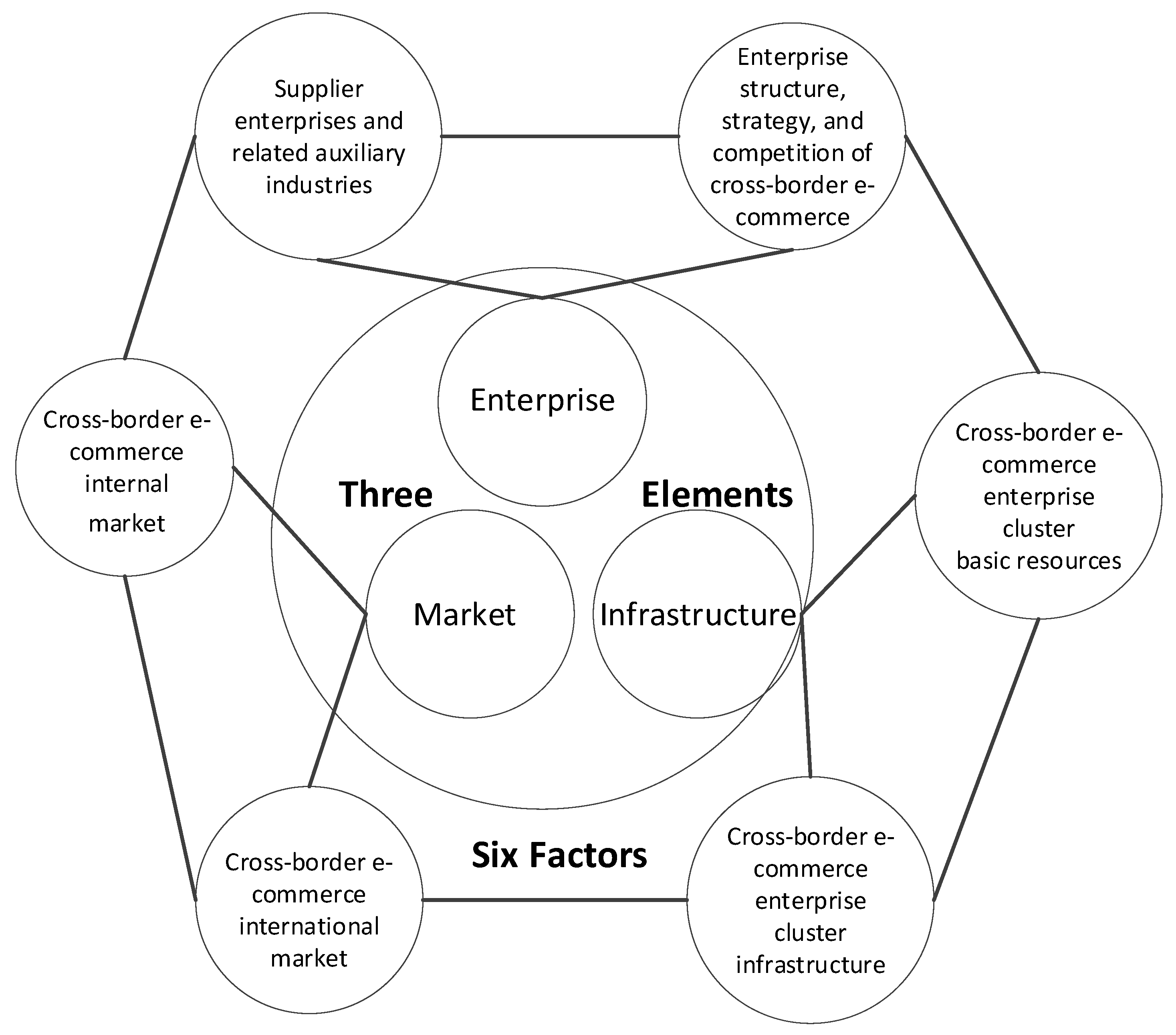
The GEM model stands for the “Groundings-Enterprises-Markets” model. In this model, the competitiveness of industrial clusters depends on three elements and six factors. The three elements are “groundings”, “enterprises”, and “markets”, each of which is composed of a specific pair of factors, thus encompassing a total of six factors [87]. The GEM model adopts a quantitative scoring method. During the quantitative scoring process, the complementary relationships between various factors can be reflected. Additionally, the quantification also demonstrates the interconnectivity between factors. This model is beneficial for objectively and comprehensively describing the strengths and weaknesses of regional industries and effectively conducting comparisons with similar regional industries [88,89].
Comprehensively considering factors such as society, economy, and market in the development of the cross-border e-commerce industry, we select indicators based on three dimensions: the foundational elements of regional cross-border e-commerce, enterprise elements, and market elements. Additionally, we combine existing research and the actual conditions of the cross-border e-commerce industry to construct the GEM model. The structure of the constructed cross-border e-commerce GEM model is shown in Figure 1:
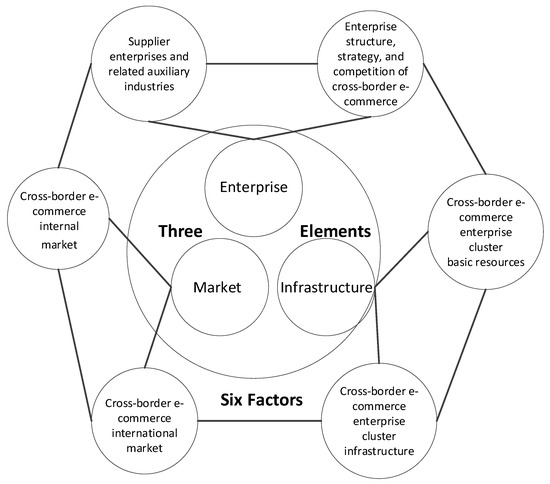
Figure 1.
Cross-border e-commerce GEM structure and relationships.
According to the GEM model and the loads of the indicator factors, 29 specific indicators were selected for this study, and the index system was constructed, as shown in Table 1.

Table 1.
Index system of the GEM model of cross-border e-commerce regional competitiveness.
3.2. Model Construction
After determining each index, the index weights were calculated and preprocessed using factor analysis and an entropy weight method.
Factor analysis is a statistical technique for extracting common factors from multiple indicators to reduce related variables and obtain hidden variables that cannot be measured directly [90]. Effective factor analysis can reduce the randomness introduced by subjective judgment according to the data variance. The factor analysis is expressed as follows,
where is the principal component value of the selected index ; is the set load factor; is the extraction number of the principal component or key factor; and is the covariance characteristic value of the selected index. According to the GEM theory, three key factors were identified: basic competitiveness factor, enterprise competitiveness factor, and market competitiveness factor.
Information entropy is the sum of the probability of each possible event and the amount of information contained in each event. From the perspective of index analysis, the smaller the information entropy of the index, the greater the degree of dispersion and the more significant the impact on the overall competitiveness index. Therefore, the weight of each index of cross-border e-commerce competitiveness can be determined by computing the information entropy. The advantage of this entropy weight method is that it entirely excludes the subjective factors introduced by an expert scoring method or brainstorming method, thus allowing the objective data to speak for themselves. However, the disadvantage of such an entropy weight method is that if the data are of poor quality (e.g., there are extreme values), the effectiveness of the index evaluation is significantly weakened. In this study, we used a combination of factor analysis and entropy weight method to determine the weights of the indicators for cross-border e-commerce competitiveness. Factor analysis is a statistical technique that extracts common factors from multiple indicators to reduce the dimensionality and obtain the latent variables that cannot be measured directly. The entropy weight method is an objective weighting method that measures the degree of dispersion of the indicators and assigns higher weights to the indicators with more information. The steps of the combination method are as follows:
Step 1. The function is a construction to express the information contained in each event:
If there are a total of alternative schemes and evaluation indicators, then the original indicator data matrix is , where is the value of the ith year and the th item (where ).
Step 2. The indicators are normalized, and the negative indicators are as follows:
The positive indicators are
Step 3. According to the entropy weight theory, the weight of an index is calculated as follows:
Step 4. Based on Equation (5), the information entropy of the th index can be obtained as follows,
where K is a constant, defined as
Step 5. From this, the weight of the first indicator is
Step 6. The weight of the jth indicator can be obtained as follows:
3.3. Data Description
The data for this study came from 31 provincial-level administrative units in mainland China from 2018 to 2021, excluding Hong Kong, Macao, and Taiwan. The number of college graduates, the investment of R&D funds, the total amount of imports of foreign-invested enterprises, and other data were obtained from the China Statistical Yearbook; the e-commerce transaction volumes, express delivery volumes, software business income, information technology services, and other data were obtained from the National Bureau of Statistics; the numbers of cross-border e-commerce enterprises, cross-border e-commerce regulatory site operator enterprises, cross-border e-commerce trading platform enterprises, and cross-border logistics enterprises were obtained from the enterprise publicity platform of the General Administration of Customs; the import and export values of the cross-border e-commerce comprehensive pilot zones were obtained from the cities’ statistical yearbooks or the General Administration of Customs; and the digital economy development index was jointly calculated based on information from the Caixin Think Tank and Sulian Mingpin BDD. Because the revenue from software and information technology services in Tibet was not included in the national statistical data, the minimum value method was used as a supplement.
4. Results
4.1. Kaiser–Meyer–Olkin Test
In this paper, the data were standardized to obtain dimensionless data. Then, the Kaiser–Meyer–Olkin (KMO) test was performed for all indicators. The results show that the KMO value is 0.926 (see Table 2).
Table 2.
KMO and Bartlett testing results.
The closer the KMO value is to 1, the stronger the correlation between the indicators. Therefore, the factor analysis achieves better results [91].
4.2. Explanation of the Total Variance
This paper adopted a principal component factor analysis method to extract common factors (i.e., key factors). In total, three key factors were extracted, and the variance contribution rate was 88.019%; all indicators meet the minimum requirements of principal component analysis (see Table 3).
Table 3.
Total variance allocation.
4.3. Matrix Rotation
Then, a maximum variance method was applied to rotate the matrix and check the factor loads of the key factors corresponding to each indicator (see Table 4).
Table 4.
Matrix table after factor analysis rotation.
The bolded factor load values of the key factors corresponding to each indicator are greater than 0.5 and greater than the load values of the same indicator in other factor interpretations. Therefore, indices A1–A14 mainly explain key factor 1, indices A15–A21 mainly explain key factor 2, and indices A22–A29 mainly explain key factor 3. According to the GEM model, these sets correspond to the basic competitiveness factors, enterprise competitiveness factors, and market competitiveness factors, respectively, indicating that the approach meets the requirements of the model [92,93].
4.4. Weight Determination
Finally, the entropy weight method was used to determine the index weight table for cross-border e-commerce. The entropy weight method avoids the subjectivity of expert scores and effectively explains the practical influence of each index on the comprehensive evaluation system. The calculation steps described in Section 3.3 were used to obtain the final index weight table (see Table 5).
Table 5.
Weights of cross-border e-commerce indicators.
All 29 index factors reflect the competitiveness of cross-border e-commerce to varying degrees. However, in terms of the six main factors, the influence of enterprise structure, strategy and competition, suppliers and related auxiliary industries, and the internal and external markets are the strongest, while the impacts of infrastructure and basic resources are relatively weak. In the overall index system, the influence of the total import and export volumes of the cross-border e-commerce comprehensive pilot zones is the largest, indicating that the establishment of pilot zones has played a significant role in promoting the development of the regional cross-border e-commerce industry. In terms of basic competitiveness, the weight corresponding to the number of patents granted by enterprises (0.039) was relatively high, indicating that there is still a gap in the infrastructure of the high-tech industry among provinces. In terms of enterprise competitiveness, the entropy weight of each evaluation index was relatively high, indicating that the inter-provincial cross-border e-commerce core industry and related supporting industries differ significantly. Finally, in terms of market competitiveness, the entropy weight of each evaluation index of the external market is generally higher than the corresponding index of the internal market, indicating that the gap between the cross-border trade markets of different provinces is larger than that of their internal markets.
4.5. Competitiveness Evaluation Results
Based on the computations described above, the final evaluation results of cross-border e-commerce competitiveness among Chinese provinces between 2018 and 2021 are presented in Table 6.
Table 6.
Evaluation of cross-border e-commerce competitiveness among various provinces.
5. Discussion
5.1. Regional Differences in Comprehensive Competitiveness
Considering the differences in comprehensive competitiveness among Chinese provinces, Guangdong Province has a clear lead, and it is difficult for other regions to shake its leadership position. Four years of data show that the most competitive regions have been Guangdong Province, Jiangsu Province, Zhejiang Province, and Shanghai. In addition, the comprehensive competitiveness of coastal areas has generally been higher than that of inland areas, mainly because coastal areas have higher market competitiveness scores. The characteristics of regional development strengthen the foreign trade industry in Guangdong Province, Zhejiang Province, Jiangsu Province, Shanghai City, Shandong Province, Fujian Province, and other developed regions. In these areas, the international market competitiveness is strong, and the consumption level and consumption demand of residents are relatively high, thus supporting both internal and external market competitiveness. Considering the annual fluctuations, the comprehensive competitiveness level of cross-border e-commerce in all regions tends to improve every year, which is consistent with the recent rapid development of China’s national cross-border e-commerce industry.
The four analyzed years of competition revealed that the central provinces of the Pearl River Delta, the Yangtze River Delta, and the Bohai Sea Economic Circle are all at high levels. The Pearl River Delta is located in Guangdong Province, which has the strongest overall competitiveness; however, the surrounding cities do not have high levels of comprehensive competitiveness, except Fujian. The Yangtze River Delta has a similar strength to Jiangsu, Zhejiang, and Shanghai, whereas only Beijing and Shandong in the Bohai Sea Economic Circle have high comprehensive scores. Based on growth pole theory, the Pearl River Delta region and the Bohai Sea Economic Circle have not yet realized their transformation from “single growth pole” to the diffusion of development throughout the surrounding areas.
Notably, although the overall rankings are dominated by the eastern region, some central provinces have emerged and performed strongly, such as Sichuan Province and Henan Province, which are among the leaders in the country. Analysis of the index scores indicated that the main competitive advantages of Sichuan Province were related to the competitiveness of its high-quality business environment. The retail enterprises in Sichuan Province have significant advantages, particularly in terms of their scale. The retail industry has a high degree of overlap with the types of cross-border e-commerce products, which provides a good business environment and infrastructure for the development of cross-border industries. The main competitive advantages of Henan Province are reflected in its logistics infrastructure and the scale of its cross-border e-commerce core enterprises. Its location in the central plains gives Henan Province the natural advantages associated with building modern transportation networks and developing transportation arteries in the province; as a result, the comprehensive transportation network is at the forefront of the central region, which has advantages in terms of cross-border logistics development. In addition, Henan Province actively promotes the construction of the cross-border e-commerce industry, and Zhengzhou and Luoyang (the cross-border e-commerce comprehensive pilot zone cities in the province), were selected as first- and second-tier pilot cities, respectively, by the Ministry of Commerce owing to their excellent construction achievements and the large scale of cross-border e-commerce core enterprises.
According to the comprehensive competitiveness scores of the provinces in 2021, three tiers can be established. The first tier includes Guangdong, Jiangsu, Zhejiang, Shanghai, Beijing, Shandong, Fujian, Sichuan, and Henan, which all scored more than 20 points. The second tier comprises the provinces that scored 8–20 points, including Hubei, Anhui, Hebei, Liaoning, Hunan, Tianjin, Chongqing, Shaanxi, Jiangxi, and Guangxi. Finally, the third tier consists of 12 provinces that scored below 8 points, including Yunnan, Shanxi, Inner Mongolia, Heilongjiang, Jilin, Guizhou, Xinjiang, Gansu, Hainan, Ningxia, Qinghai, and Tibet.
5.2. Regional Differences in Specific Elements
Table 7 shows the competitiveness evaluation results for the basic elements of cross-border e-commerce in China’s provinces between 2018 and 2021.
Table 7.
Evaluation of basic elements’ competitiveness in cross-border e-commerce in Chinese provinces.
In terms of basic factors, Guangdong, Jiangsu, Zhejiang, and Shandong are at the forefront among the evaluated provinces. The results indicate that the common outstanding advantages of these provinces are reflected in the digital economy development index, the number of cross-border e-commerce comprehensive pilot areas, and R&D investments. The advantage of R&D funding is the most significant, opening a lead of an order of magnitude for the aforementioned regions. Moreover, the comprehensive national regional innovation ability rankings also had the above regions at the forefront, indicating that cross-border e-commerce is highly dependent on information technology and that an active innovation environment is an important driving force for industrial development. In addition, these four regions had a higher Internet usage base, which provides a solid foundation for developing cross-border e-commerce. These regions also have clear advantages in terms of the digital economy development index, which can facilitate trade and reduce trade costs, especially for small- and medium-sized enterprises, which makes it easier for them to enter the international supply chain system. Cross-border e-commerce comprehensive pilot zones usually serve as test areas for the latest industrial policies. Therefore, enterprises in the pilot zones enjoy various dividends, such as management innovation, service innovation, and institutional innovation, which effectively attract high-quality cross-border e-commerce enterprises.
Table 8 shows the factor competitiveness evaluation results of cross-border e-commerce enterprises in various provinces in China between 2018 and 2021.
Table 8.
Evaluation of factor competitiveness of cross-border e-commerce enterprises in various provinces in China.
Overall, Guangdong, Zhejiang, and Shanghai have ranked as the top three regions in the country in terms of cross-border e-commerce enterprise competitiveness for four consecutive years. The competitive advantages of enterprises in these regions are mainly reflected in the scale of their cross-border e-commerce core enterprises. The Yangtze River Delta and Pearl River Delta, which are situated within these top-performing regions, house the bulk of China’s import and export trade industry, adopt an open and developed trade development environment, and include the first batch of cross-border e-commerce pilot cities. Many cross-border policies have been implemented in priority areas, and various conditions have enabled Guangzhou, Zhejiang, and Shanghai to become the most crowded and active regions for cross-border e-commerce enterprises in China.
Table 9 shows the evaluation results of cross-border e-commerce market factor competitiveness among Chinese provinces between 2018 and 2021.
Table 9.
Evaluation results of factor competitiveness of cross-border e-commerce market in China’s provinces.
In terms of the market elements of cross-border e-commerce, Guangdong, Shanghai, Beijing, and Jiangsu have clear competitive advantages. The index scores highlight the market advantages associated with the digital core industries in these four regions. Analysis of the existing digital economic development level in each region revealed that the industrial digitization and digital industry in these regions exhibited strong developmental momentum. Essentially, they embody the potential market competitiveness of cross-border e-commerce. Notably, Guangdong, Shanghai, Beijing, and Jiangsu also ranked relatively high in the scale of e-commerce transactions, which reflects the competitive advantage of an external cross-border e-commerce market.
6. Conclusions
We employ a Groundings-Enterprises-Markets (GEM) analytical model to establish a comprehensive regional competitiveness assessment system for China’s cross-border e-commerce, focusing on three dimensions: basic, enterprise, and market factors. The evaluation index system, incorporating three main elements, six factor layers, and 29 indicators, facilitated a thorough examination of cross-border e-commerce in various Chinese provinces from 2018 to 2021.
The analysis presented in this paper shows that the competitiveness of cross-border e-commerce in China generally increases annually, with notable variations among regions. Enterprise competitiveness emerged as a key factor influencing regional distinctions, and the rankings of studied regions remained relatively stable, with Guangdong Province consistently securing the top position.
From a geographical standpoint, eastern coastal areas generally exhibited higher comprehensive competitiveness than inland regions, with exceptions like Sichuan and Henan provinces. Yunnan Province experienced a significant rise in ranking, while Jilin Province witnessed a notable decline. Factors influencing regional rankings included the scale of external market demand, concentration of core enterprises, digital industry scale, and innovation development.
The 31 Chinese regions were categorized into three tiers based on comprehensive cross-border e-commerce competitiveness scores, with Guangdong, Jiangsu, Zhejiang, and Shandong leading in basic competitiveness. These provinces demonstrated high digital economy development indices, more cross-border e-commerce pilot areas, and relatively high R&D investments.
Enterprise competitiveness was identified as the primary contributor to regional differences, with provinces and cities lagging behind Guangdong facing challenges in catching up. Regarding cross-border e-commerce market elements, Guangdong, Shanghai, Beijing, and Jiangsu held significant competitive advantages in both internal and external markets.
While acknowledging China’s leading position in the global cross-border e-commerce market, challenges persist in areas such as platform dependence, international logistics, payment settlement, intellectual property protection, and tax policy. Strategic adjustments and innovations are recommended, including infrastructure enhancement, industrial upgrading, and strengthened international cooperation.
Based on the analysis presented in this paper, we believe that key policies for bolstering China’s cross-border e-commerce are desirable. Priorities include investing in digital logistics, secure payments, and green networks. Industrial upgrading, fostering independent enterprises, and expanding cross-border formats are essential. Active participation in international agreements and transparent standards is crucial. Tailored strategies for different province tiers are advised: deepening digital reform for top-tier, improving logistics for second-tier, and enhancing pilot zones for third-tier provinces. These policies can address challenges and optimize opportunities in China’s cross-border e-commerce sector.
Despite the contributions of our work, potential shortcomings include the use of the GEM model [94,95] and data limitations, which should be addressed in future research. Expanding the GEM model to other industries and the global e-commerce market is suggested, allowing for a broader and more comprehensive assessment of regional competitiveness.
Author Contributions
Conceptualization, J.D. and L.Y.; methodology, J.D.; software, W.Y.; validation, L.Y., J.D. and W.Y.; formal analysis, L.Y.; data curation, J.D.; writing—original draft preparation, J.D.; writing—review and editing, L.Y.; visualization, L.Y.; supervision, L.Y.; project administration, W.Y.; funding acquisition, L.Y. and W.Y. All the authors contributed equally to this work. All authors have read and agreed to the published version of the manuscript.
Funding
Lifan Yang was financially supported by the Project of Shanghai Philosophy and Social Science Planning (2023ZGL005), the First-Class Undergraduate Construction Leading Plan of East China University of Political Science and Law (ECUPL 307-1), Shanghai Municipal Education Commission E-Commerce Innovation and Entrepreneurship Management as the Model Course for International Student (301-12), and The China Law Society Program (CLS 2018 D164). Weixin Yang was financially supported by the General Project of Shanghai Philosophy and Social Science Planning (2021BGL014) and the Shangli Chenxi Social Science Special Project of the University of Shanghai for Science and Technology (22SLCX-ZD-010).
Institutional Review Board Statement
Not applicable.
Informed Consent Statement
Not applicable.
Data Availability Statement
The data used in this paper are all from the statistical data officially released by China and have been explained in Section 3.3.
Conflicts of Interest
The authors declare no conflicts of interest.
References
- eMarketer. Global Ecommerce Forecast; eMarketer Inc.: New York, NY, USA, 2023. [Google Scholar]
- Tang, S. E-Commerce Development in China 2016–2017; China Commerce and Trade Press: Beijing, China, 2017; ISBN 978-7-5103-2023-1. [Google Scholar]
- Ministry of Commerce People’s Republic of China. E-Commerce in China 2022. Available online: http://images.mofcom.gov.cn/dzsws/202306/20230609104929992.pdf (accessed on 30 November 2023).
- The State Council of the People’s Republic of China. Xi Stresses Deeper-Level Reform, Higher-Level Opening-Up. Available online: https://english.www.gov.cn/news/topnews/202009/02/content_WS5f4efa48c6d0f7257693b6e7.html (accessed on 30 November 2023).
- Hassan, T.; Song, H.; Kirikkaleli, D. International Trade and Consumption-Based Carbon Emissions: Evaluating the Role of Composite Risk for RCEP Economies. Environ. Sci. Pollut. Res. 2022, 29, 3417–3437. [Google Scholar] [CrossRef]
- Albertoni, N.; Wise, C. International Trade Norms in the Age of COVID-19 Nationalism on the Rise? Fudan J. Hum. Soc. Sci. 2021, 14, 41–66. [Google Scholar] [CrossRef]
- Elia, S.; Giuffrida, M.; Mariani, M.M.; Bresciani, S. Resources and Digital Export: An RBV Perspective on the Role of Digital Technologies and Capabilities in Cross-Border e-Commerce. J. Bus. Res. 2021, 132, 158–169. [Google Scholar] [CrossRef]
- Song, L.; Chen, Y.; Zhang, B.; Zhu, M. Inventory and Financing Decisions in Cross-Border e-Commerce: The Financing and Information Roles of a Bonded Warehouse. Expert Syst. Appl. 2024, 238, 121639. [Google Scholar] [CrossRef]
- Majcherczyk, M.; Shuqiang, B. Digital Silk Road—The Role of Cross-Border E-Commerce in Facilitating Trade. J. WTO China 2019, 9, 106. [Google Scholar]
- Al-Fawwaz, A. The Chinese Wave: Cross-Border E-Commerce Development in Africa. J. Leg. Ethical Regul. Isses 2022, 25, 1. [Google Scholar]
- Yin, Z.H.; Choi, C.H. The Effects of China’s Cross-Border e-Commerce on Its Exports: A Comparative Analysis of Goods and Services Trade. Electron. Commer. Res. 2023, 23, 443–474. [Google Scholar] [CrossRef]
- Giuffrida, M.; Mangiaracina, R.; Perego, A.; Tumino, A. Cross-Border B2C e-Commerce to China: An Evaluation of Different Logistics Solutions under Uncertainty. Int. J. Phys. Distrib. Logist. Manag. 2019, 50, 355–378. [Google Scholar] [CrossRef]
- Wang, Y.; Jia, F.; Schoenherr, T.; Gong, Y.; Chen, L. Cross-Border e-Commerce Firms as Supply Chain Integrators: The Management of Three Flows. Ind. Mark. Manag. 2020, 89, 72–88. [Google Scholar] [CrossRef]
- Fan, J.; Cai, Y.; Ji, X.; Zhao, L. An Observation on China Comprehensive Pilot Areas for Cross-Border E-Commerce in Henan Province. Procedia Manuf. 2019, 30, 77–82. [Google Scholar] [CrossRef]
- Yang, L.; Liu, J.; Yang, W. Impacts of the Sustainable Development of Cross-Border E-Commerce Pilot Zones on Regional Economic Growth. Sustainability 2023, 15, 13876. [Google Scholar] [CrossRef]
- Li, Q. E-Commerce, Free-Trade Zones, and the Linkage Effect to China’s Foreign Trade. Chin. Econ. 2021, 54, 441–449. [Google Scholar] [CrossRef]
- Niu, B.; Dong, J.; Dai, Z.; Liu, Y. Sales Data Sharing to Improve Product Development Efficiency in Cross-Border e-Commerce. Electron. Commer. Res. Appl. 2022, 51, 101112. [Google Scholar] [CrossRef]
- Zhu, Q.; Ruan, Y.; Liu, S.; Yang, S.-B.; Wang, L.; Che, J. Cross-Border Electronic Commerce’s New Path: From Literature Review to AI Text Generation. Data Sci. Manag. 2023, 6, 21–33. [Google Scholar] [CrossRef]
- Wang, C.; Liu, T.; Wang, J.; Li, D.; Wen, D.; Ziomkovskaya, P.; Zhao, Y. Cross-Border E-Commerce Trade and Industrial Clusters: Evidence from China. Sustainability 2022, 14, 3576. [Google Scholar] [CrossRef]
- Wang, Y.; Li, J. Text Analysis of Cross-Border E-Commerce Policy Based on Co-Word Clustering Method: A Case Study of Gansu Province. J. Phys. Conf. Ser. 2020, 1544, 012008. [Google Scholar] [CrossRef]
- Wang, C. Analyzing the Effects of Cross-Border E-Commerce Industry Transfer Using Big Data. Mob. Inf. Syst. 2021, 2021, e9916304. [Google Scholar] [CrossRef]
- Chen, N. Analysis of the Correlation between Cross-Border E-Commerce and Economic Growth Based on Hierarchical Multilevel Gray Evaluation Model. J. Math. 2022, 2022, e8455404. [Google Scholar] [CrossRef]
- Gomez-Herrera, E.; Martens, B.; Turlea, G. The Drivers and Impediments for Cross-Border e-Commerce in the EU. Inf. Econ. Policy 2014, 28, 83–96. [Google Scholar] [CrossRef]
- Valarezo, Á.; Pérez-Amaral, T.; Garín-Muñoz, T.; Herguera García, I.; López, R. Drivers and Barriers to Cross-Border e-Commerce: Evidence from Spanish Individual Behavior. Telecommun. Policy 2018, 42, 464–473. [Google Scholar] [CrossRef]
- Azam, R. Global Taxation of Cross-Border E-Commerce Income. Va. Tax Rev. 2011, 31, 639. [Google Scholar]
- Giuffrida, M.; Mangiaracina, R.; Perego, A.; Tumino, A. Cross-Border B2C e-Commerce to Greater China and the Role of Logistics: A Literature Review. Int. J. Phys. Distrib. Logist. Manag. 2017, 47, 772–795. [Google Scholar] [CrossRef]
- Van Asch, T.; Dewulf, W.; Kupfer, F.; Cárdenas, I.; Van de Voorde, E. Cross-Border e-Commerce Logistics—Strategic Success Factors for Airports. Res. Transp. Econ. 2020, 79, 100761. [Google Scholar] [CrossRef]
- Sabirin, A.; Budi, A.A.; Adhiyaksa, F.D.; Aurelya, B.P.; Ridwan, S.; Lesmana, J.R.; Alifta, F.D. Green Economy as a Law for the Economic Recovery Post COVID-19 Amidst the Increasing Cross-Border E-Commerce in Indonesia. KnE Social Sciences 2022, 7, 25–42. [Google Scholar] [CrossRef]
- Ni, W. Online and Offline Integration Development of Yiwu Cross-Border E-Commerce in Digital Economy Era. Procedia Comput. Sci. 2022, 202, 307–312. [Google Scholar] [CrossRef]
- Wang, Y.; Gao, H.; Wang, H. The Digital Silk Road and Trade Growth—A Quasi-Natural Experiment Based on Silk Road E-Commerce. Res. Int. Bus. Financ. 2024, 67, 102140. [Google Scholar] [CrossRef]
- Zheng, K.; Huo, X.; Jasimuddin, S.; Zhang, J.Z.; Battaïa, O. Logistics Distribution Optimization: Fuzzy Clustering Analysis of e-Commerce Customers’ Demands. Comput. Ind. 2023, 151, 103960. [Google Scholar] [CrossRef]
- Ting, B.; Nam, I. A Comparative Study on Antecedents to the Customer Satisfaction with Cross-Border E-Commerce in Korea and China. Asia Mark. J. 2016, 18, 4. [Google Scholar] [CrossRef]
- Anson, J.; Boffa, M.; Helble, M. Consumer Arbitrage in Cross-Border e-Commerce. Rev. Int. Econ. 2019, 27, 1234–1251. [Google Scholar] [CrossRef]
- Lendle, A.; Olarreaga, M.; Schropp, S.; Vézina, P. There Goes Gravity: eBay and the Death of Distance. Econ. J. 2016, 126, 406–441. [Google Scholar] [CrossRef]
- Chong, S. Success in Electronic Commerce Implementation: A Cross-country Study of Small and Medium-sized Enterprises. J. Enterp. Inf. Manag. 2008, 21, 468–492. [Google Scholar] [CrossRef]
- Wang, P. On the Development of Cross-Border E-Commerce and the Transformation of Foreign Trade Model. Mod. Econ. 2018, 9, 1665–1671. [Google Scholar] [CrossRef]
- Zhong, M.; Wang, Z.; Ge, X. Does Cross-Border E-Commerce Promote Economic Growth? Empirical Research on China’s Pilot Zones. Sustainability 2022, 14, 11032. [Google Scholar] [CrossRef]
- Zeng, S.; Fu, Q.; Haleem, F.; Han, Y.; Zhou, L. Logistics Density, E-Commerce and High-Quality Economic Development: An Empirical Analysis Based on Provincial Panel Data in China. J. Clean. Prod. 2023, 426, 138871. [Google Scholar] [CrossRef]
- Gessner, G.H.; Snodgrass, C.R. Designing E-Commerce Cross-Border Distribution Networks for Small and Medium-Size Enterprises Incorporating Canadian and U.S. Trade Incentive Programs. Res. Transp. Bus. Manag. 2015, 16, 84–94. [Google Scholar] [CrossRef]
- Kitson, M.; Martin, R.; Tyler, P. Regional Competitiveness: An Elusive yet Key Concept? Reg. Stud. 2004, 38, 991–999. [Google Scholar] [CrossRef]
- Rizzi, P.; Graziano, P.; Dallara, A. The Regional Competitiveness: An Alternative Approach. Riv. Internaz. Sci. Soc. 2015, 123, 307–335. [Google Scholar]
- Sánchez de la Vega, J.C.; Buendía Azorín, J.D.; Calvo-Flores Segura, A.; Esteban Yago, M. A New Measure of Regional Competitiveness. Appl. Econ. Anal. 2019, 27, 108–126. [Google Scholar] [CrossRef]
- Camagni, R.; Capello, R.; Cerisola, S.; Fratesi, U. Fighting Gravity: Institutional Changes and Regional Disparities in the EU. Econ. Geogr. 2020, 96, 108–136. [Google Scholar] [CrossRef]
- Horsley, J.; Prout, S.; Tonts, M.; Ali, S.H. Sustainable Livelihoods and Indicators for Regional Development in Mining Economies. Extr. Ind. Soc. 2015, 2, 368–380. [Google Scholar] [CrossRef]
- Atkinson, G. Regional Integration in the Emerging Global Economy: The Case of NAFTA. Soc. Sci. J. 1998, 35, 159–168. [Google Scholar] [CrossRef]
- Chaisse, J.; Dimitropoulos, G. Special Economic Zones in International Economic Law: Towards Unilateral Economic Law. J. Int. Econ. Law 2021, 24, 229–257. [Google Scholar] [CrossRef]
- Porter, M.E. The Competitive Advantage of Nations; Free Press: Florence, MA, USA, 1998; ISBN 978-0-684-84147-2. [Google Scholar]
- Moon, H.C.; Rugman, A.M.; Verbeke, A. A Generalized Double Diamond Approach to the Global Competitiveness of Korea and Singapore. Int. Bus. Rev. 1998, 7, 135–150. [Google Scholar] [CrossRef]
- Min, S.; Kim, J.; Sawng, Y.-W. The Effect of Innovation Network Size and Public R&D Investment on Regional Innovation Efficiency. Technol. Forecast. Soc. Chang. 2020, 155, 119998. [Google Scholar] [CrossRef]
- Baierle, I.C.; Benitez, G.B.; Nara, E.O.B.; Schaefer, J.L.; Sellitto, M.A. Influence of Open Innovation Variables on the Competitive Edge of Small and Medium Enterprises. J. Open Innov. Technol. Mark. Complex. 2020, 6, 179. [Google Scholar] [CrossRef]
- Carayannis, E.G.; Wang, V.W.L. Competitiveness Model—A Double Diamond. J. Knowl. Econ. 2012, 3, 280–293. [Google Scholar] [CrossRef]
- Sleuwaegen, L.; Ramboer, S. Regional Competitiveness and High Growth Firms in the EU: The Creativity Premium. Appl. Econ. 2020, 52, 2325–2338. [Google Scholar] [CrossRef]
- Fromhold-Eisebith, M.; Marschall, P.; Peters, R.; Thomes, P. Torn between Digitized Future and Context Dependent Past—How Implementing ‘Industry 4.0’ Production Technologies Could Transform the German Textile Industry. Technol. Forecast. Soc. Chang. 2021, 166, 120620. [Google Scholar] [CrossRef]
- Červený, L.; Sloup, R.; Červená, T. The Potential of Smart Factories and Innovative Industry 4.0 Technologies—A Case Study of Different-Sized Companies in the Furniture Industry in Central Europe. Forests 2022, 13, 2171. [Google Scholar] [CrossRef]
- Danyluk, M. Fungible Space: Competition and Volatility in the Global Logistics Network. Int. J. Urban Reg. Res. 2019, 43, 94–111. [Google Scholar] [CrossRef]
- Kara, K.; Yalçın, G.C.; Acar, A.Z.; Simic, V.; Konya, S.; Pamucar, D. The MEREC-AROMAN Method for Determining Sustainable Competitiveness Levels: A Case Study for Turkey. Socio-Econ. Plan. Sci. 2024, 91, 101762. [Google Scholar] [CrossRef]
- Meili, R.; Stucki, T. Money Matters: The Role of Money as a Regional and Corporate Financial Resource for Circular Economy Transition at Firm-Level. Res. Policy 2023, 52, 104884. [Google Scholar] [CrossRef]
- Dunford, M.; Perrons, D. Regional Inequality, Regimes of Accumulation and Economic Development in Contemporary Europe. Trans. Inst. Br. Geogr. 1994, 19, 163–182. [Google Scholar] [CrossRef]
- Iacono, R.; Ranaldi, M. The Wage Curve across the Wealth Distribution. Econ. Lett. 2020, 196, 109580. [Google Scholar] [CrossRef]
- Xu, A.; Qiu, K.; Jin, C.; Cheng, C.; Zhu, Y. Regional Innovation Ability and Its Inequality: Measurements and Dynamic Decomposition. Technol. Forecast. Soc. Chang. 2022, 180, 121713. [Google Scholar] [CrossRef]
- Oral, M.; Chabchoub, H. On the Methodology of the World Competitiveness Report. Eur. J. Oper. Res. 1996, 90, 514–535. [Google Scholar] [CrossRef]
- Aiginger, K. Competitiveness: From a Dangerous Obsession to a Welfare Creating Ability with Positive Externalities. J. Ind. Compet. Trade 2006, 6, 161–177. [Google Scholar] [CrossRef]
- Zeibote, Z.; Volkova, T.; Todorov, K. The Impact of Globalization on Regional Development and Competitiveness: Cases of Selected Regions. Insights Reg. Dev. 2019, 1, 33–47. [Google Scholar] [CrossRef]
- Monk, A.H.B. The Interplay between Social Welfare and Competitiveness: The Case of Canadian Medicare. Geoforum 2008, 39, 2009–2018. [Google Scholar] [CrossRef]
- Harb, G. The Economic Impact of the Internet Penetration Rate and Telecom Investments in Arab and Middle Eastern Countries. Econ. Anal. Policy 2017, 56, 148–162. [Google Scholar] [CrossRef]
- Qian, H. E-Commerce Logistics Mode Selection Based on Network Construction. Mod. Econ. 2019, 10, 198–208. [Google Scholar] [CrossRef]
- Sun, M.; Grondys, K.; Hajiyev, N.; Zhukov, P. Improving the E-Commerce Business Model in a Sustainable Environment. Sustainability 2021, 13, 12667. [Google Scholar] [CrossRef]
- Febransyah, A.; Camelia Goni, J.I. Measuring the Supply Chain Competitiveness of E-Commerce Industry in Indonesia. Compet. Rev. Int. Bus. J. 2020, 32, 250–275. [Google Scholar] [CrossRef]
- Kang, X.; Pang, H. City Selection for Fresh Produce E-Commerce’s Market Entry Strategy: Based on the Perspective of Urban Logistics Competitiveness. Transp. Res. Interdiscip. Perspect. 2022, 13, 100537. [Google Scholar] [CrossRef]
- Hsiao, Y.-H.; Chen, M.-C.; Liao, W.-C. Logistics Service Design for Cross-Border E-Commerce Using Kansei Engineering with Text-Mining-Based Online Content Analysis. Telemat. Inform. 2017, 34, 284–302. [Google Scholar] [CrossRef]
- Yan, B.-R.; Dong, Q.-L.; Li, Q.; Amin, F.U.; Wu, J.-N. A Study on the Coupling and Coordination between Logistics Industry and Economy in the Background of High-Quality Development. Sustainability 2021, 13, 10360. [Google Scholar] [CrossRef]
- Xie, R.; Huang, H.; Zhang, Y.; Yu, P. Coupling Relationship between Cold Chain Logistics and Economic Development: A Investigation from China. PLoS ONE 2022, 17, e0264561. [Google Scholar] [CrossRef]
- Önsel Ekici, Ş.; Kabak, Ö.; Ülengin, F. Improving Logistics Performance by Reforming the Pillars of Global Competitiveness Index. Transp. Policy 2019, 81, 197–207. [Google Scholar] [CrossRef]
- Popova, N.; Kataiev, A.; Nevertii, A.; Kryvoruchko, O.; Skrynkovskyi, R. Marketing Aspects of Innovative Development of Business Organizations in the Sphere of Production, Trade, Transport, and Logistics in VUCA Conditions. Stud. Appl. Econ. 2020, 38, 3962. [Google Scholar] [CrossRef]
- Liu, Z.; Li, Z. A Blockchain-Based Framework of Cross-Border e-Commerce Supply Chain. Int. J. Inf. Manag. 2020, 52, 102059. [Google Scholar] [CrossRef]
- Zhang, Z. An Optimization Model for Logistics Distribution Network of Cross-Border E-Commerce Based on Personalized Recommendation Algorithm. Secur. Commun. Netw. 2021, 2021, e5510481. [Google Scholar] [CrossRef]
- Li, L.; Ma, S.; Zheng, Y.; Xiao, X. Integrated Regional Development: Comparison of Urban Agglomeration Policies in China. Land Use Policy 2022, 114, 105939. [Google Scholar] [CrossRef]
- Huang, Z.; Chen, Y.; Zheng, Z.; Wu, Z. Spatiotemporal Coupling Analysis between Human Footprint and Ecosystem Service Value in the Highly Urbanized Pearl River Delta Urban Agglomeration, China. Ecol. Indic. 2023, 148, 110033. [Google Scholar] [CrossRef]
- Yin, S.; Yang, J. The Appraisal Research of Urban E-Commerce Competitiveness Based on GA-BP Algorithm: Case Study on E-Commerce Demonstration City of Yangtze River Delta. Sci. Technol. Manag. Res. 2018, 38, 208–214. [Google Scholar] [CrossRef]
- Xiao, L.; Ke, T. Research on the Evolution Power and Innovation Realization Mechanism of Cross-Border E-Commerce Comprehensive Pilot Zone. J. Bus. Econ. 2020, 2, 17–29. [Google Scholar] [CrossRef]
- Tolstoy, D.; Melén Hånell, S.; Özbek, N. Effectual Market Creation in the Cross-Border e-Commerce of Small-and Medium-Sized Enterprises. Int. Small Bus. J. 2023, 41, 35–54. [Google Scholar] [CrossRef]
- Chen, W.-H.; Lin, Y.-C.; Bag, A.; Chen, C.-L. Influence Factors of Small and Medium-Sized Enterprises and Micro-Enterprises in the Cross-Border E-Commerce Platforms. J. Theor. Appl. Electron. Commer. Res. 2023, 18, 416–440. [Google Scholar] [CrossRef]
- Yadav, N. The Role of Internet Use on International Trade: Evidence from Asian and Sub-Saharan African Enterprises. Glob. Econ. J. 2014, 14, 189–214. [Google Scholar] [CrossRef]
- Delina, R.; Tkáč, M. Role of E-Business in the Perception of ICT Impact on Revenue Growth. J. Bus. Econ. Manag. 2015, 16, 1140–1153. [Google Scholar] [CrossRef]
- Wang, C.; Chen, M.; Wang, Q.; Fang, Y. The Study of Value Network Reconstruction and Business Model Innovation Driven by Entrepreneurial Orientation. Int. Entrep. Manag. J. 2023, 19, 2013–2036. [Google Scholar] [CrossRef]
- Goldman, S.P.; van Herk, H.; Verhagen, T.; Weltevreden, J.W. Strategic Orientations and Digital Marketing Tactics in Cross-Border e-Commerce: Comparing Developed and Emerging Markets. Int. Small Bus. J. 2021, 39, 350–371. [Google Scholar] [CrossRef]
- Padmore, T.; Gibson, H. Modelling Systems of Innovation:: II. A Framework for Industrial Cluster Analysis in Regions. Res. Policy 1998, 26, 625–641. [Google Scholar] [CrossRef]
- Lu, Y.; Zhou, Y.; Liu, P. Improving the Entrepreneurial Ability of Rural Migrant Workers Returning Home in China: Study Based on 5,675 Questionnaires. Humanit. Soc. Sci. Commun. 2023, 10, 150. [Google Scholar] [CrossRef] [PubMed]
- Yang, D.; Liu, D.; Huang, A.; Lin, J.; Xu, L. Critical Transformation Pathways and Socio-Environmental Benefits of Energy Substitution Using a LEAP Scenario Modeling. Renew. Sustain. Energy Rev. 2021, 135, 110116. [Google Scholar] [CrossRef]
- Huang, J. The Latest Generation of SEZs: Consumer-Oriented Unilateralism in China’s E-Commerce Trade. J. Int. Econ. Law 2021, 24, 299–320. [Google Scholar] [CrossRef]
- Peng, C.; Zhao, Y.; Li, C.; Tang, Z.; Gui, W. A Multi-Featured Factor Analysis and Dynamic Window Rectification Method for Remaining Useful Life Prognosis of Rolling Bearings. Entropy 2023, 25, 1539. [Google Scholar] [CrossRef]
- Chaisse, J. Dangerous Liaisons: The Story of Special Economic Zones, International Investment Agreements, and Investor–State Dispute Settlement. J. Int. Econ. Law 2021, 24, 443–471. [Google Scholar] [CrossRef]
- Chaisse, J. ‘The Black Pit’: Power and Pitfalls of Digital FDI and Cross-Border Data Flows. World Trade Rev. 2023, 22, 73–89. [Google Scholar] [CrossRef]
- Fasha, G.S.; Itika, D. Analysis of Competitiveness of Textile Industries in Morogoro and Dar Es Salaam Regions, Tanzania. Tanzan. J. Agric. Sci. 2021, 20, 24–41. [Google Scholar]
- Holienka, M.; Jančovičová, Z.; Kovačičová, Z. Drivers of Women Entrepreneurship in Visegrad Countries: GEM Evidence. Procedia Soc. Behav. Sci. 2016, 220, 124–133. [Google Scholar] [CrossRef]
Disclaimer/Publisher’s Note: The statements, opinions and data contained in all publications are solely those of the individual author(s) and contributor(s) and not of MDPI and/or the editor(s). MDPI and/or the editor(s) disclaim responsibility for any injury to people or property resulting from any ideas, methods, instructions or products referred to in the content. |
© 2024 by the authors. Licensee MDPI, Basel, Switzerland. This article is an open access article distributed under the terms and conditions of the Creative Commons Attribution (CC BY) license (https://creativecommons.org/licenses/by/4.0/).