


Abstract
Community public hospital provides public health and basic medical services, and their construction environment has an important impact on the health and well-being of the residents. Due to the long construction period of most community hospitals, the population expansion and the change in age structure have led to a mismatch between the needs of patients and the current situation, which is in urgent need of renovation. This paper aims to support the government and hospitals in making decisions by eliminating the blind spots in capital investment and benefit evaluation. In this study, environmental modification design variables are first established, and on this basis, the fuzzy Delphi method is used to understand the willingness for renovation on the part of patients, accompanying personnel, staff, healthcare workers as well as hospital administrators. Besides, the I-S model is used to identify the renovation projects that would maximize user satisfaction. Furthermore, the differences between patients and medical staff are compared. The ODM (Optimal Decision-making) model is used to evaluate the cost investment and benefits, which provides support for the decision-making of government and hospitals. The results clarify the key renovation design variables that can significantly improve user satisfaction and extend them into renovation strategies that can be landed, and identify renovation strategies with larger improvement scores and the range of renovation funds that maximize benefits to promote the sustainable development of community public hospitals. It can be seen that the ODM model can also be well applied to the renovation of community healthcare services. In addition, the reference classification and design variables should be adjusted according to the characteristics of China, taking into consideration the specificity of individual hospitals.
1. Introduction
In recent years, the transformation of the disease spectrum, the demand for the healthcare environment [1,2,3], the transformation of the nursing model [4,5], the improvement of the management level [6], and other factors have led to the need for reconstruction and expansion of many community public hospitals to keep the sustainability [7].
Current studies focus on large hospitals, with research on the following. (1) Fields that could be easily quantified [8,9], such as environmental color, lighting effects, background music, and construction materials. (2) Environmental variables affect the degree of satisfaction of patients and employees [10,11,12]. (3) Key departments include ICU, emergency [13], and operation rooms [14]. But, there are few pieces of research on community public hospitals. Compared to large-scale hospitals with 2000–3000 beds, Chinese community public hospitals might only have 200–300 beds and provide close and quality community medical services. The major responsibility of community-based medical services is to provide basic medical services, including treatment and care for nearby residents on common diseases, frequently occurring diseases, and general chronic diseases. Therefore, the staffing, the selection of medical equipment, and the space design of the hospital should be carried out depending on their characteristics. It is necessary to start targeted research instead of applying the results from large hospitals simply.
On the other hand, China has also proposed requirements for hospital reconstruction. Chinese community public hospitals provide public health and basic medical services, conduct health education, prevention, healthcare, rehabilitation, family planning technical services, and diagnosis and treatment of common and frequently-occurring diseases [15]. With the change in population structure [16] and disease spectrum, China has been promoting the positioning and functional reform policy of community public hospitals. In 2015, the government suggested setting up rehabilitation wards in community public hospitals [17]. Next, the proposal about adding medical and nursing service facilities was submitted in 2019 [18]. Under COVID-19, related departments further proposed strengthening the setting of fever clinics in primary medical and health institutions in 2020 [19]. The above governmental policies or suggestions provide guidance for the future reconstruction of community public hospitals.
After years of exploration and reform, researchers have obtained some results. Firstly, the pre-diagnose system for grading is approaching perfection [20]. It pulls the community public hospitals and the residents closer. The private doctor system enables doctors in community public hospitals to make home visits. Secondly, the internet systems helped establish communication channels between residents and hospitals during the study. Further, according to statistics, the number of community public hospitals steadily rose from 2019 to 2021. These new hospitals had better clinical settings, equipment, and services, making positive progress [21].
However, construction and development problems still not be solved. In particular, the scarce land and environmental resources in the crowded major cities. Many small and medium-sized community public hospitals are facing urgent indoor renovation, including changes in the size, location, and function of departments, as well as the redesign of interior decoration, heating, and ventilation, to improve positioning and functional accuracy, space utilization, and environmental quality [22].
The optimal decision-making (ODM) model could establish the relationship between each decision variable, making the complicated issue clearer using mathematical tools. It showed a broad application and a promising future in solving issues in the medical area. Residents expect much from community public hospitals, but the renovation funds are limited. How to find out a program that can most improve the users’ satisfaction and make a priority list is the primary issue. ODM model can help to find and select the optimal solution. In addition, the ODM model was used for the study of resource allocation in public hospitals, including the optimal budget allocation under the constraint of multi-purpose [23], optimized distributed function system allocation [24], and personnel allocation [25]. Further, it was applied in hospital renovation to evaluate the current environment of hospitals to be renovated and suggest the optimal solution for sustainable renovation [26]. In terms of environment, the model was adopted to study the outdoor environment reform in old communities [27], as well as to guide the cost-efficiency decision in the hospital environmental design [13].
In summary, it has been found that the functions of many community public hospitals located in urban centers in China have been continuously adjusted to meet the basic medical needs of local residents after a period of development. However, the matching degree with the existing space needs to be improved, and there is a large demand for renovation. Therefore, this study first focused on small and medium-sized community public hospitals, filling the gap in research on small and medium-sized hospitals in medical facility studies. And then, this manuscript innovatively establishes the environmental renovation design variables for community public hospitals and introduces the ODM model [27] to the environmental renovation of medical facilities. The design variables and renovation strategies of Dongshan community public hospital are studied and discussed, which will help government investors and hospital managers quickly find renovation objects to improve satisfaction. Meanwhile, the renovation cost estimation and benefit evaluation are conducted to eliminate the investment blind spots and thus support government and hospital decision-making in the environmental design. In addition, the service life of buildings is extended through renovation to promote sustainable development of facilities. Moreover, the limitations of this study and future research topics are proposed.
2. Method
2.1. Research Framework
The study aims to introduce the ODM model for the environmental renovation of community public hospitals in major cities, thereby helping government investors and hospital managers to target renovation objects that could improve satisfaction and evaluate the cost-effectiveness after renovation. The research framework of the paper is shown in Figure 1.
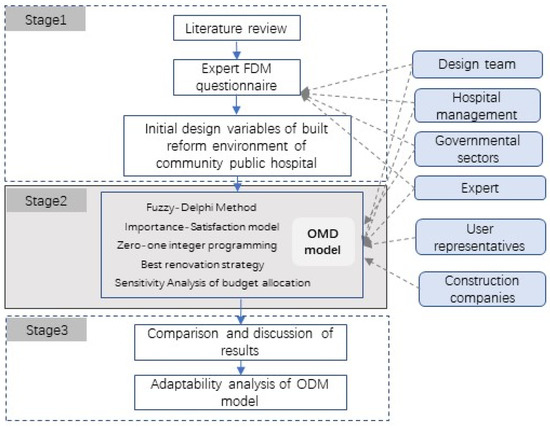
Figure 1.
Research framework.
Based on two papers by Roger Ulirich, this paper first created a set of draft design variables for the environmental renovation of community public hospitals that were suitable in China. Through the expert Delphi method, experts such as the government, architects, and hospital management were consulted to jointly modify and form a set of initial design variables for the environmental renovation of community public hospitals. After that, this paper used the optimal decision-making (ODM)model for reference, and DS (Dongshan) community public hospitals to be transformed were selected as experimental objects. At the initial stage of hospital environmental renovation, multiple stakeholders were involved in formulating design variables, including government, architects, hospital management, doctors, nurses, and caregivers. Next, the Fuzzy-Delphi Method (FDM) [28] was used to invite experts and others to rate the importance of environmental design variables to be improved in community public hospitals. Then, this paper used the Importance-Satisfaction (I-S) model [29] to screen out environmental design variables and specific recommendations to be optimized that were valued by patients and medical staff. Meanwhile, researchers calculated the total improvement score of specific transformation strategies and the benefit evaluation of cost and capital investment corresponding to the design variables through the Zero-one integer programming (ZOIP) [30], helping decision-makers identify key transformation targets and use government funds most effectively. Finally, the role and suitability of the ODM model in the environmental renovation of community public hospitals are summarized and discussed.
2.2. The Formulation of Initial Design Variables for Environmental Renovation
This study drew on the three major categories and subcategories of health outcomes (R. Ulirich, 2008) [31] in Table 1 to set up the initial environmental renovation design variables framework, as shown in Table 2, and applied them to the first two columns. Researchers used The nine major categories and specific design variables (R. Ulirich, 2010) [32] of Environmental Design Variables in Table 3 for reference. Meanwhile, researchers applied the category of environmental design variables and environmental design variables in Table 2 to establish a framework for initial environmental improvement design variables, targeting the indoor renovation and outdoor landscape parts. After that, researchers invited a team of experts to use the Delphi method to improve the draft framework. In detail, researchers conducted a consultation in the form of questionnaires and unified their opinions. The expert team consisted of 5 people, including 1 scholar from the University College of Architecture, 1 architect, 2 community public hospital managers, and 1 expert from the governmental construction planning department. All of them worked locally and were familiar with the situation of local community public hospitals and had an undergraduate degree or above and experience in community public hospital construction projects from different perspectives, so they were invited to this research (Table 4).

Table 1.
Classification table of healthcare outcomes based on the paper of R. Ulirich (2008) [31].
Table 2.
Initial design variables for environmental renovation in community public hospital.
Table 3.
Classification of environmental design variables in the paper of R. Ulirich (2010) [32].
Table 4.
Statistical Table of Expert Information.
In the process of unifying the opinions of experts through the Delphi method, the researchers first provided the expert team with the draft framework of environmental optimization design variables and asked them to express their own opinions. Each category and design variable would have three choices, including Agreement, Revision, and Supplementation. After the first round of feedback collection, the researchers improved the draft based on the opinions of experts and then distributed the revised version of the draft to the experts for the second round of opinion collection. This cycle would continue until the experts agreed on the improved design variables, which meant the signed agreement. The Delphi method conducted four rounds of opinion collection and three revisions, which lasted one month from July 2022. In the first round of revision, the excessive repetition of design variables in many different categories and the excessive frequency of some repetition confused scoring experts. Therefore, researchers simplified the number of design variables from 136 to 78, ensuring that each design variable only appeared once and remained in the category with the greatest impact. In the second round of amendments, design variables for medical waste treatment, HVAC, water supply, and drainage were added. The third round mainly ruled on controversial design variables such as self-service terminal logistics systems, intelligent medical information, and the number of elevators. Furthermore, this paper retained design variables with many agreements. Since there was no significant difference, no centralized meeting was held this time. Finally, the initial design variables of environmental transformation, representing the opinions of the expert group, were formed, with a total of 56 design variables in 15 categories, as shown in Table 4 above.
2.3. Case Study
DS Community Public Hospital is located in Nanjing, Jiangsu Province. It was completed in 2010. The current service population is 240,000, which belongs to a secondary hospital with the function of a primary hospital. In 2021, outpatient visits reached 330,000, of which the elderly and children accounted for about 50%. At present, the average number of COVID-19 daily examinations is 2000. See Table 5 for details.
Table 5.
Construction data for 2010.
Nowadays, the hospital has 70 doctors and 88 nurses, mainly providing general medical outpatient service and small general surgery for common and frequently-occurring diseases. There are 4 wards, including 2 rehabilitation wards, 1 comprehensive ward, and 1 medical and nursing center. The current main issues are the overloaded outpatient service, the intersection of flow lines between healthy people and unhealthy groups, the outdoor and indoor air quality, not enough fever clinics, and the powerless atrium air conditioning system, the intersection of flow lines between healthy and unhealthy groups, low indoor and outdoor air quality, lack of fever clinics. The research period was from August 2022 to October 2022.
2.4. ODM Model
2.4.1. FDM (Fuzzy-Delphi Method)
The FDM method used in this paper applied the fuzzy set theory [33] to unified experts’ opinions, which was formed by asking respondents to give three-point estimations (i.e., conservative, expert value, and optimistic value) and triangular fuzzy numbers (TFNs). Then researchers calculated these “group averages” and described them as two TFNs: one was a conservative TFN (CL, CM, CU), and the other was an optimistic TFN (OL, OM, OU), as shown in Figure 2. The intersection of expert fuzzy opinions (gray triangle area) represented the consensus consistency or convergence. Finally, the consensus value (Gi) of the investigation project or question could be obtained by calculating the geometric mean of the conservative value, expert value, and optimistic value [34]. This study collected the opinions of experts from a questionnaire and also created TFN as follows [27]:
where i is the number of factors; j is the number of experts; Ci is the bottom of the evaluation values of factor i by all experts; Oi is the upper limit of the evaluation value of factor i by all experts; Gi is the geometric mean value of evaluation values of factor i; Xij is the evaluation value of factor i by the jth expert.
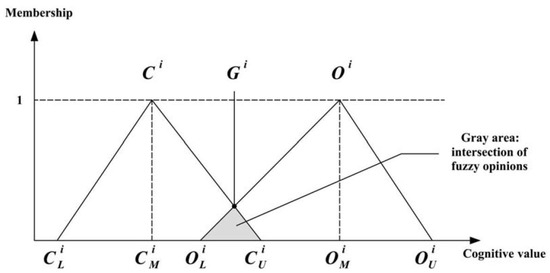
Figure 2.
Triangular fuzzy numbers (TFNs) of FDM.
2.4.2. I-S (Importance-Satisfaction) Model
The Importance-Satisfaction rating is based on the concept that public agencies will maximize overall customer satisfaction by emphasizing improvements in those areas where the level of satisfaction is relatively low and the perceived importance of the service is relatively high [35]. This method is easy to understand and has high popularity, so it is widely used as an important tool for evaluating and judging the satisfaction of the masses. In this model, the horizontal and vertical dimension represents the importance and satisfaction of quality attributes, respectively. The coordinates are divided into four regions using the average of the importance and satisfaction of quality attributes [27], as shown in Figure 3.
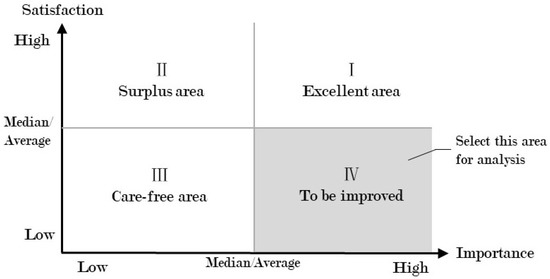
Figure 3.
I-S model.
To measure the urgency of renovation for each fourth quadrant design variable, the improvement coefficient was calculated using the following formula [36]. The higher the absolute value of the score, the higher the priority of renovation.
2.4.3. ZOIP (Zero-One Integer Programming)
ZOIP represents variable x that only takes a value of 0 or 1. Note that x is called the 0-1 variable, or binary variable. In practical problems, if the 0-1 variable is introduced, the linear programming problems that need to be discussed separately in various situations can be discussed in one problem [30]. The purpose of using ZOIP in this study was to select strategies within the limits of intervention funding, achieving the highest overall score on users and experts aspects. The ZOIP model can be described by Equations (6) and (7).
where 1 indicates it has been selected and 0 indicates it has not been selected. Cj is the comprehensive score of the jth decision variable, including the adaptability scores by users and experts, and aj is the cost of the jth strategy. ij is the improvement coefficient, and ej is the expert adaptability score. Z is the standard total value, and b is a limited fixed budget. xj is the decision variable [27].
2.4.4. Budget Sensitivity Analysis
Sensitivity analysis [27] is one of the commonly used methods for analyzing uncertainty in the economic evaluation of investment projects. It identifies sensitive factors that have a significant impact on the economic benefits indicators of investment projects from multiple uncertain factors, analyzes and calculates their impact and sensitivity on the economic benefits indicators of the project, and then judges the project’s ability to withstand risks. If a small change in a certain parameter can lead to a significant change in economic performance indicators, it is called a sensitive factor, on the contrary, it is called a non-sensitive factor [37].
In this experiment, due to the decision variable xj of various indicators being 0 or 1, random number functions and rounding functions can be used to randomly generate 0 or 1 under different renovation indicators. Due to the 27 renovation indicators, there are a total of 702 permutations and combinations. To ensure that the exhaustive method could list all the possible permutations and combinations, a total of 20,000 xj were generated. And then, the xi permutation and combination with the highest improvement score could be selected based on the constraints of cost in different cost ranges and recorded its corresponding costs. Finally, the sensitivity was analyzed by the relationship between the budgets and changes in the total improvement score (Figure 4).
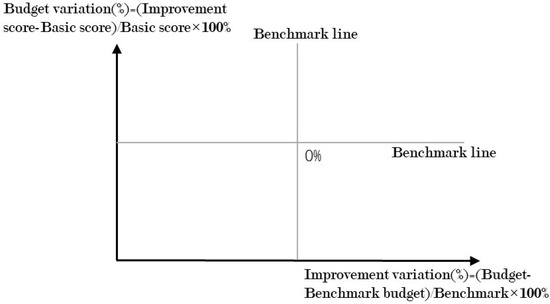
Figure 4.
Budget sensitivity analysis.
3. Results
3.1. FDM Results
Eight experts were invited to participate in the design variables scoring questionnaire [27], including two scholars from the architecture department of the university, two architects, two hospital managers, and two district government officials. Details are shown in Table 6. These eight experts participated in community public hospital renovation projects from different perspectives, so they knew and made some contributions to the research field of this project. Eight experts referred to the description of the current situation of DS community public hospitals and rated 56 initial design variables with the most conservative, optimistic, and expert values, with a score range of 1–10 points.
Table 6.
Statistical Table of Expert Information.
The results of the scoring questionnaire are shown in Table 7. Cronbach’s alpha was applied to measure the reliability of the questionnaire. Due to the internal consistency of all variables exceeding 0.80, the questionnaire was acceptable. The experts considered that C and O were equally important, while E was more important. Therefore the most conservative mean (CM), the most optimistic mean (OM), and the geometric mean (EM) values were weighted at 20%, 20%, and 60%. The measurement value M was calculated by Formulas (8) and (9). The measurement value of Gi was determined as 5.96 as the screening condition. After the operation of FDM, 26 important design variables were selected, and 30 design variables were excluded in the first stage (Table 8).
Table 7.
Result analysis of expert scoring table applying FDM.
Table 8.
Design variables screened according to the score statistics table.
3.2. I-S Model Results
The importance-satisfaction questionnaire was formulated in this stage. 75 doctors and nurses from DS Community Public Hospital and 75 visitors familiar with the hospital (including physical examination, maternal and child healthcare, drug dispensing, visits, inpatients, and chronic disease consultants) were invited to participate in the questionnaire survey. Meanwhile, the questionnaire analysis was conducted through the I-S model to find out that the potential environmental transformation factors of DS Community Public Hospital were the priority transformation goals [27]. The questionnaire was distributed in the hospital for a week in October 2022. The 120 valid questionnaires were recovered, including 60 for medical staff and 60 for visitors, with a recovery rate of 80%. The male-female ratio of medical staff is 1:4, and the male-female ratio of patients is 1:2. In terms of age, the average age of medical staff is about 30 years old, and the average age of patients is about 45 years old. SPSS 26.0 was applied to evaluate the reliability of the questionnaire. The results showed that the importance of evaluation design variables and the satisfaction of Cronbach’s Alpha coefficients were higher than 0.8, indicating that the reliability of importance and satisfaction was acceptable. Therefore the questionnaire passed the reliability test.
In this study, importance (I)was the horizontal axis, and satisfaction (S) was the vertical axis. In addition, the importance and average satisfaction of 26 design variables were taken as the starting point to draw a matrix for the ratings of doctors, nurses, and visitors (Figure 5 and Figure 6). After then, it was found that the design variables in each quadrant of medical care and patients were quite different, so statistics and analysis were carried out. The results are listed in Table 9.
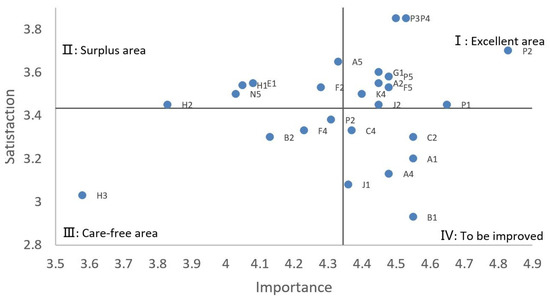
Figure 5.
Factor matrix of I-S staff model.
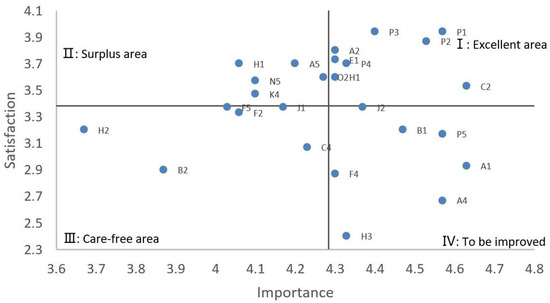
Figure 6.
Factor matrix of I-S visitor model.
Table 9.
Comparison of I-S results between medical staff and patients.
As shown in Figure 7 and Figure 8, according to the average score, the importance and satisfaction of medical staff with the current situation are higher than the visiting population. This phenomenon indicates that doctors are more adaptable to the hospital environment compared to patients. If a visitor is a patient, the deviation will be higher due to his/her medical condition. However, the average value shows that the satisfaction of the survey objects to the current environment is lower than the importance, indicating the necessity of environmental transformation.
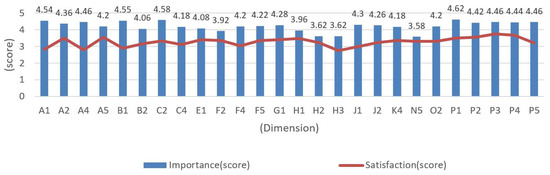
Figure 7.
Analysis of I-S staff questionnaire results.
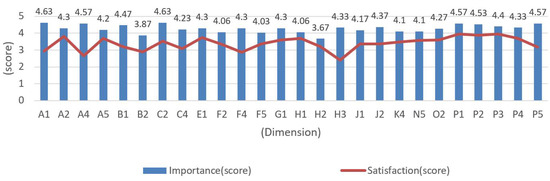
Figure 8.
Analysis of I-S visitor questionnaire results.
The quality improvement coefficient was calculated for the two survey populations based on the ten design variables to be improved in the fourth quadrant. First, the emergency transformation needs of the medical and nursing population for the project were arranged in the following order: The optimization of the air filtration and circulation system (−0.356); The optimization of the outpatient process and plan (−0.302); Fever clinic design according to the standard of three zones and two channels (−0.301); Reducing the intersection of flow lines between healthy and unhealthy groups (−0.297); The sewage treatment for key departments (−0.275); and The optimization of water facilities (−0.238). Then, the priority of visitors was as follows: Outdoor landscape area (−0.446); Fever clinic design according to the standard of three zones and two channels (−0.416); Reducing the intersection of flow lines between healthy and unhealthy groups (−0.367); Maternal and child healthcare (−0.306); The optimization of the air filtration and circulation system (−0.284); The optimization of toilet design (−0.273); and The optimization of emergency process and plan (−0.229).
The potential reasons for the differences:
- Some visitors did not experience all the services of the community public hospital, so they were not familiar with the internal management system, such as the sewage treatment system;
- This survey was conducted during COVID-19 epidemic prevention and control. Therefore, nearly half of the medical staff needed to go out to collect nucleic acids. As a result, many services could not be carried out. This situation would affect the views of doctors, nurses, and patients.
- Medical staff easily ignored the inconvenience, such as the noise of children and the horn in the hall, because of the excessive familiarity with the hospital environment.
- Medical staff focused more on the perfection of primary functions, and visitors paid more attention to the visiting experience.
- Due to the different medical conditions of the visitor, their perception of the environment can also be affected.
For each indicator of quadrant IV, the questions collected in the questionnaire are summarized as follows (Table 10):
Table 10.
Statistical table of opinions on environmental design variables to be improved in community public hospitals.
Based on the I-S model, in the three aspects of outcomes, patient safety has the most content, followed by the other results of patients, and medical staff-related content disappeared, indicating that DS community public hospital pay more attention to patients’ healthcare outcomes.
3.3. ZOIP Results
According to the results and analysis of the critical design variables in the fourth quadrant, a centralized discussion was held, and multiple teams were invited to participate in the formulation of transformation strategies [27]. The team consisted of 15 core members, including 3 governmental officials, 3 medical staff representatives, 3 patient representatives, 3 architects, and 3 construction contractors. A centralized meeting was held on 25 October 2022. In this meeting, 10 transformation design variables were further developed into 27 transformation strategies to evaluate the suitability score of the strategies. The strategy suitability score aims to evaluate the suitability of the environmental transformation strategy or the applied technology in community public hospitals, especially in the design, construction, and subsequent maintenance. The evaluation method was the Likert scale of 1–9. The higher the score, the higher the suitability of environmental transformation. After the meeting, the team decided to expand the old building and adjust its functions of the old building to meet future development needs.
In order to ensure the convergence of the data, this study normalized the priority improvement coefficients of users (average value of medical staff and visitors) and the suitability scores of experts, and controlled the scores between 0 and 1 [38]. The final strategy score, as shown in Table 11, is the average of user improvement scores and expert fitness scores so that the opinions of users and experts are fair in the decision-making process. The table shows the total improvement score calculation and cost estimation of 27 transformation measures. The highest three design variables were: adjusting the position of the health care area and the medical function area to prevent the streamline from crossing, adding a special entrance, replacing of high-power air conditioning system in the outpatient hall, and adding a healing garden near the entrance of the inpatient department and reduce the ground parking space and expand the underground parking area, as shown in Table 11. All these transformation measures required a 15.863 million yuan fund.
Table 11.
Update strategy and cost estimation.
Based on the analysis of renovation strategies by ZOIP model, patient safety still represents the most renovation strategies, followed by the shortening of medical procedures, indicating that these two parts have more renovation contents for the DS community public hospital.
3.4. Budget Sensitivity Analysis
Due to the Chinese national conditions, the government funded the environmental transformation of most community public hospitals. However, the government budget is usually limited, so it is impossible to complete all the strategies required for the transformation in many cases. Therefore, this study continued the sensitivity analysis through ZOIP model calculation to verify the practicability of ODM and the benefits of budget allocation [39]. Furthermore, this study explored the benefits of hospital transformation under different budget plans, providing a reference for future government budget planning [27].
- Step 1: With the budget of 8 million yuan as the benchmark and ± 12.5% as the range, gradually set the change value X of the transformation budget (up to 75%: ¥14 million, down to −75%: ¥2 million).
- Step 2: ZOIP optimization is carried out under different budget constraints to obtain the highest improvement score (S) in each cost range as well as its corresponding cost and update strategy combination (as shown in Table 12).
Table 12. Optimal update policy combination selection.
- Step 3: Sensitivity analysis can be obtained by plotting the change values of Y and X, as shown in Table 13 and Figure 9.
Table 13. Sensitivity analysis of budget and score changes.
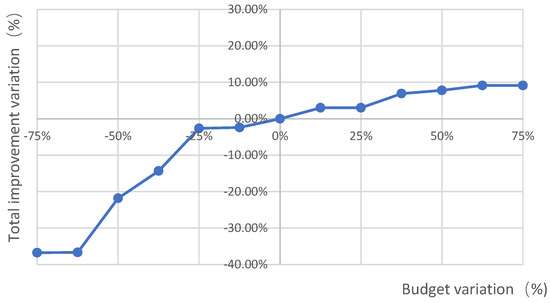 Figure 9. Sensitivity analysis results.
According to the Figure 9, the crease slope tends to zero when the budget is in the range of 2–3, 6–7, and 13–14 million yuan, indicating that the increasing investment amount in this range will not affect its improvement score. When the budget amount is in the range of 3–6 and 7–13 million yuan, the broken line shows an upward trend, indicating that the more investment amount in this range, the higher the total improvement score. However, the score slope increase is larger when the budget is between 3 million and 6 million yuan, showing better efficiency. Although the improvement score also increases when the budget exceeds 6 million yuan, the budget income representing the governmental investment decreases due to the decline of its slope, which will also cause a certain waste of budget allocation. On the contrary, it also demonstrates that the improvement score will not be significantly reduced, and efficiency can still be guaranteed even if the government reduces part of the budget.
After further comparing the slopes between 3 and 6 million yuan, the slopes between 3 and 4 million yuan are greater than those between 5 and 6 million yuan. Meanwhile, the slopes between 4 and 5 million yuan are relatively the lowest. In other words, the transformation benefit of community public hospitals is the best if the government budget is between 3 to 4 million yuan or 5 to 6 million yuan. The research results can also provide a more effective and flexible budget allocation mechanism for the government to reduce the waste of funds or apply the surplus budget for other more critical livelihood improvement projects.
4. Discussion
The initial framework of environmental renovation design variables for this study was derived from two papers by R. Ulirich. Therefore, the text further discussed the adjustments and conclusions made based on different national contexts compared to the research results of R. Ulirich.
4.1. The Comparison between Table 1 and Table 4
First, three classification categories of R. Ulirich for healthcare outcomes were used, but the priority transformation department classification category was added to clarify the focus of transformation to decision-makers at the beginning of planning.
According to the result comparison between the healthcare outcomes in Table 1 and Table 4, the final patient fall in patient safety does not appear in Table 4. This finding indicates that contemporary China pays less attention to patient falls. The reason for this is that both hospitalized and outpatient patients have a high proportion of family members accompanying or hiring caregivers, making them less likely to fall.
In other patient outcomes, Table 4 increases the importance of pathfinding systems to become an important category, as the importance of pathfinding is relatively high in China. This is a community public hospital in China that generally has multiple departments such as outpatient, emergency, medical technology, hospitalization, logistics, management, and preventive healthcare, usually with a large area. For example, the DS community public hospital with 200 beds this time has a total construction area of 18,000 square meters, so finding a way has become an important issue. Finally, there were no changes in employee outcomes.
4.2. The Comparison between Table 2 and Table 4
First, a comparison was made between the environmental design variables in Table 2 and Table 4. The environmental design variables in Table 2 that were present but not present in Table 4 were music, video games, internet access, visual stimulation on the ceiling, easy control of light and temperature, air quality in the operating room, and patient selection of art and decorative labels. Table 4 had the environmental design variables that Table 2 did not have: there was a part for COVID-19, reducing the flow line intersection between healthy people and non-healthy people, providing rehabilitation sites and equipment, optimizing outpatient and emergency plans and routes, and creating nursing processes that adapt to the urgency of the disease. In medical support, many design variables in Table 2 emphasize improving the quality of various spaces, while the design variables in Table 4 focus on increasing the communication, rest, and private spaces of the users.
4.3. The Comparison between Table 4 and Table 8
Table 4 shows the environmental design variables for community public hospital renovation, and Table 8 shows the environment and DS community public hospitals. The environmental design variables in Table 4 but not in Table 8 are noise, social support for patients, and logistics. Except for the information desk, in the employee support classification, except for the configuration in the nursing unit and the shortening of nursing moving distance, as well as the reservation of COVID-19 detection space, the corresponding HVAC design for rooms with different functions, the optimization of rainwater and sewage separation system, the setting of reclaimed water reuse system, install high-performance sound-absorbing materials, use a noiseless paging system, increase lighting and intensity in the work area, install alcohol hand sanitizer dispensers, appropriately increase single person wards, provide comprehensive rehabilitation facilities and equipment, install multimedia equipment, and increase communication space.
4.4. The Comparison between Table 8 and Table 9
After calculating through the I-S model, key transformation design variables that can significantly improve user satisfaction were selected from the design variables for the environmental renovation of DS community public hospitals in Table 8. According to Table 9, the priority renovation department is the maternal and child health department. Meanwhile, design variables decreased from 26 to 10. The environmental design variables in Table 8 but not in Table 9 were the categories of air, lighting, care processes, routing, and employee support. Besides those, vaccination space, reasonable layout of nurse stations, installation of barriers, optimization of water facilities, optimization of contact surface materials, appropriate placement of handrails, increasing window area, providing natural window views, or simulating nature were also considered.
4.5. Summary
To gain a clearer understanding of the results and changes, the detailed changes in the design variables in each step of the ODM model were statistically analyzed as follows (Table 14):
Table 14.
Statistic table for changes in design variables during the ODM experiment.
It can be seen that patient safety has the most content in the three aspects of outcomes. Based on the ODM model, the overall design variables of DS community public hospital account for 53.6% of the initial value, and the healthcare outcomes of privacy protection and social support are filtered out. After I-S model calculation, there are only two classifications related to patients, of which patient safety is the most, and the healthcare part has disappeared. In the final renovation strategies, the content ranking is the same as the top two in the I-S model, i.e., the reduction of hospital infection has the highest content, followed by the shortening of medical procedures.
Through the above comparison, community public hospitals located in the center of major cities in China have some special characteristics. First, the community public hospitals in China contain a large and complex range of functions, requiring both healthcare and basic medical care. Based on this situation, it is necessary to separate healthy and non-healthy populations. In addition, the accompanying rate of domestic patients is very high. At present, the main transformation trends include the design variables such as emergency response to the emergence of COVID-19, blocking infection, and reducing the streamlined intersection between healthy and non-healthy people, and the shortening of medical procedures. Therefore, transformers should make changes to the literature results of R. Ulirich based on Chinese characteristics. The uniqueness of the DS community public hospital is the increasing demand for maternal and child health care, physical examinations, and comprehensive outpatient services for chronic diseases aroused by the significant increase in the number of people served and the proportion of elderly and maternal and child patients.
5. Conclusions
This study firstly focuses on small and medium-sized community public hospitals and has made theoretical contributions to the research on the environmental design of small and medium-sized hospitals. Secondly, design variables are created for the internal environmental renovation of small and medium-sized community public hospitals, and empirical research is conducted using ODM models in practice. Blind spots in investment are eliminated to support government and hospital decision-making by selecting key renovation objects and estimating renovation costs and benefits, extending the service life of buildings, and achieving the goal of sustainable development. The conclusions are as follows:
- The initial design variables for the environmental renovation of small and medium-sized community public hospitals created this time is suitable for community public hospitals located in resource-scarce areas in large city centers that require internal transformation.
- Through the FDM method in ODM, environmental design variables suitable for the hospital to be renovated can be selected from environmental renovation design variables through expert scoring. In this experiment, 26 design variables are ultimately selected.
- Through the I-S model in ODM, priority design variables for improvement can be obtained from the user perspective. In this experiment, there are similarities and differences in the treatment of important design variables to be improved between medical staff and patients. Medical staff value optimizing the air filtration and circulation system, designing fever clinics based on the “three zones and two channels” standard, optimizing outpatient process and layout, reducing the intersection of healthy and non-healthy populations, and optimizing sewage treatment and water facilities for key departments. Patients and their families valued seven design variables: optimizing the air filtration and circulation system, designing fever clinics based on the “three zones and two channels” standard, reducing the flow line intersection of healthy and non-healthy people, setting up outdoor landscape areas, optimizing bathroom design, maternal and child health care, and optimizing emergency procedures and layout.
- Through ZOIP in ODM, the total improvement score and cost estimation of specific renovation strategies can be calculated, and the benefits under different budgets can be evaluated. In this experiment, the three items with the highest improvement scores are: 1. Adjusting the position of the health and medical areas to prevent flow lines from crossing and adding a dedicated entrance and exit; 2. Replacing the high-power air conditioning system in the outpatient hall; 3. Adding a healing garden and reducing ground parking spaces near the entrance of the inpatient department, and expanding the underground parking area. In addition, the transformation efficiency of community public hospitals is the best, with government budgets ranging from 3 to 4 million yuan or 5 to 6 million yuan.
Through the development of environmental design variables and the application of ODM models, the final key transformation design variables and corresponding specific transformation strategies, as well as different cost inputs and benefit evaluations, were gradually derived. This study proves the applicability of the ODM model in refurbishing old community public hospitals in China. Although the budgets and conditions vary with projects in community public hospital refurbishment, this study has obtained relatively consistent improvement design variables and scores. Therefore, the results were adaptable.
There are some limitations in this study. Firstly, this study only conducts one case study for optimization. The results and the subsequent implementation and construction of this study still need to be validated. Secondly, the study is conducted during the COVID-19 pandemic, and the prevention and control policies might affect users’ attitudes to various degrees.
In future research, the researchers will still focus on small and medium-sized hospitals and study the key needs for indoor environmental renovation in different small and medium-sized specialized hospitals. In addition, this study has found significant differences in the evaluation of the medical environment between medical staff and patients. Through statistics, there are also significant differences in age composition and the male ratio between these two types of users. Therefore, in the future, researchers can further explore the preferences of users of different genders for environmental design at different age groups from the above aspects in the future.
Author Contributions
Conceptualization, Y.Z. (Yunhui Zhu) and Y.Z. (Ying Zhou); methodology, Y.Z. (Ying Zhou); software, Y.Z. (Yunhui Zhu); validation, Y.Z. (Yunhui Zhu); formal analysis, Y.Z. (Yunhui Zhu); investigation, Y.Z. (Yunhui Zhu); resources, Y.Z. (Yunhui Zhu) and Y.Z. (Ying Zhou); data curation, Y.Z. (Yunhui Zhu); writing—original draft preparation, Y.Z. (Yunhui Zhu); writing—review and editing, Y.Z. (Yunhui Zhu) and Y.Z. (Ying Zhou); visualization, Y.Z. (Yunhui Zhu); supervision, Y.Z. (Ying Zhou). All authors have read and agreed to the published version of the manuscript.
Funding
This study was funded by the [National Natural Science Foundation of China] grant number [51978143] and the [University-Industry Collaborative Education Program of the Ministry of Education, China] grant number [202101042020].
Informed Consent Statement
Informed consent was obtained from the subjects participating in the study.
Data Availability Statement
The datasets utilized and/or analyzed during the present study are available on reasonable requests from the corresponding author.
Acknowledgments
The authors would like to thank all interviewees in the DS community public hospital for their information support. Meanwhile, the authors would like to acknowledge all key informants for their participation in the interviews and focus group discussions.
Conflicts of Interest
The authors declare no conflict of interest.
References
- Meen, T.H.; Matsumoto, Y.; Wang, M.S. Selected papers from 2019 IEEE Eurasia conference on biomedical engineering, healthcare and sustainability (IEEE ECBIOS 2019). Sustainability 2020, 12, 414. [Google Scholar] [CrossRef]
- Gola, M.; Botta, M.; D’Aniello, A.L.; Capolongo, S. Influence of Nature at the Time of the Pandemic: An Experience-Based Survey at the Time of SARS-CoV-2 to Demonstrate How Even a Short Break in Nature Can Reduce Stress for Healthcare Staff. Health Environ. Res. Des. J. 2021, 14, 49–65. [Google Scholar] [CrossRef] [PubMed]
- Trau, D.; Keenan, K.A.; Goforth, M.; Large, V. Nature Contacts: Employee Wellness in Healthcare. Health Environ. Res. Des. J. 2016, 9, 47–62. [Google Scholar] [CrossRef]
- Pati, D.; Pietrzak, M.P.; Harvey, T.E.; Armstrong, W.B.; Clarke, R.; Weissman, N.J.; Rapp, P.E.; Smith, M.S.; Fairbanks, R.J.; Collins, J.M.G. Advancing translational research through facility design in non-AMC hospitals. Health Environ. Res. Des. J. 2013, 6, 126–137. [Google Scholar] [CrossRef] [PubMed]
- Jimenez, F.E.; Rich, R.K.; Puumala, S.E.; Kentfield, M.; Schoenholtz, L.; Brittin, J. Effects of a Decentralized Nursing Model on Patient Outcomes in Two Rural Community Hospitals. Health Environ. Res. Des. J. 2021, 14, 157–173. [Google Scholar] [CrossRef]
- Shoemaker, L.; Swanson, A.A.W. Making the Case for Evidence-Based Design in Healthcare: A Descriptive Case Study of Organizational Decision Making. Research 2010, 4, 56–88. [Google Scholar] [CrossRef]
- Bernal-Delgado, E.; Ortún-Rubio, V. La calidad del Sistema Nacional de Salud: Base de su deseabilidad y sostenibilidad. Gac. Sanit. 2010, 24, 254–258. [Google Scholar] [CrossRef]
- Wang, P. Chinese medical architectural and environmental design. Chin. Hosp. Archit. Equip. 2007, 4, 12–19. [Google Scholar]
- Patterson, E.S.; Sanders, E.B.N.; Sommerich, C.M.; Lavender, S.A.; Li, J.; Evans, K.D. Meeting Patient Expectations During Hospitalization: A Grounded Theoretical Analysis of Patient-Centered Room Elements. Health Environ. Res. Des. J. 2017, 10, 95–110. [Google Scholar] [CrossRef]
- Talantikite, S.I.; Bencherif, M. Effect of Spatial Ambiances on the Patient Satisfaction and Well-Being in Hospitals: The Case of UHC Ibn Sina Annaba and UHC Benbadis Constantine—Algeria. Health Environ. Res. Des. J. 2021, 14, 83–107. [Google Scholar] [CrossRef]
- MacAllister, L.; Zimring, C.; Ryherd, E. Environmental Variables That Influence Patient Satisfaction: A Review of the Literature. Health Environ. Res. Des. J. 2016, 10, 155–169. [Google Scholar] [CrossRef] [PubMed]
- Zamani, Z. Effects of Emergency Department Physical Design Elements on Security, Wayfinding, Visibility, Privacy, and Efficiency and Its Implications on Staff Satisfaction and Performance. Health Environ. Res. Des. J. 2019, 12, 72–88. [Google Scholar] [CrossRef]
- Squire, M.M.; Sessel, G.K.; Lin, G.; Squire, E.N.; Igusa, T. Optimal Design of Paired Built Environment Interventions for Control of MDROs in Acute Care and Community Hospitals. Health Environ. Res. Des. J. 2021, 14, 109–129. [Google Scholar] [CrossRef]
- de Ridder, E.F.; Friedericy, H.J.; van der Eijk, A.C.; Dankelman, J.; Jansen, F.W. A New Method to Improve the Environmental Sustainability of the Operating Room: Healthcare Sustainability Mode and Effect Analysis (HSMEA). Sustainability 2022, 14, 13957. [Google Scholar] [CrossRef]
- Several Suggestions on the Development of Community Health Services in Cities. 1999. Available online: https://www.chinawch.org.cn/zfcg/flfg/200809/t20080918_49983.html (accessed on 10 October 2022).
- Alavi, K.; Sutan, R.; Shahar, S.; Manaf, M.R.A.; Jaafar, M.H.; Maulud, K.N.A.; Embong, Z.; Keliwon, K.B.; Markom, R. Connecting the Dots between Social Care and Healthcare for the Sustainability Development of Older Adult in Asia: A Scoping Review. Sustainability 2022, 14, 2573. [Google Scholar] [CrossRef]
- Guideline of The General Office of the State Council on Promoting the Construction of Graded Diagnosis and Treatment System. 2015. Available online: http://www.gov.cn/gongbao/content/2015/content_2937321.htm (accessed on 10 October 2022).
- Several Opinions on Further Promoting the Development of the Combination of Medical and Nursing Care. 2019. Available online: http://www.gov.cn/xinwen/2019-10/26/content_5445271.htm (accessed on 10 October 2022).
- Notice on Strengthening the Establishment of Fever Consulting Rooms in Primary Medical and Health Institutions. 2020. Available online: http://www.gov.cn/xinwen/2020-12/08/content_5568390.htm (accessed on 10 October 2022).
- Brittin, J.; Elijah-Barnwell, S.; Nam, Y.; Araz, O.; Friedow, B.; Jameton, A.; Drummond, W.; Huang, T.T.K. Community-engaged public health research to inform hospital campus planning in a low socioeconomic status urban neighborhood. Health Environ. Res. Des. J. 2015, 8, 12–24. [Google Scholar] [CrossRef] [PubMed]
- Zhang, L.; Dong, Y.; Wamg, X.; Lin, C.Z. Study on the progress and sustainable development of community hospital construction. Chin. J. Health Polity 2022, 15, 48–53. [Google Scholar]
- Hu, X. Research on Optimal Design of Community Health Service Center in High-density Urban Environment. Chongqing University. 2021. Available online: https://kns.cnki.net/kcms2/article/abstract?v=3uoqIhG8C475KOm_zrgu4lQARvep2SAke-wuWrktdE-tSIT2YIbQ2OKkUmC5qySf0Wzotj68j6c7N4Umx27zOlbIFJVOSwSk&uniplatform=NZKPT (accessed on 20 October 2022).
- Ren, W.; Zhao, Y.; Zhong, H.; Fu, X.; Wu, J. Exploring the Optimal Allocation Decision-Making of Expenditure Budget in Hospitals Under Multi-Objective Constraints: Evidence from Urban Public Hospitals, China. SAGE Open 2021, 11. [Google Scholar] [CrossRef]
- Li, D.Z.S. Optimal Design of Distributed Energy Resource Systems Under Uncertainties Based on Decision-making Theory. Proc. Chin. Soc. Electr. Eng. 2021, 41, 5232–5242. [Google Scholar]
- Spika, S.B.; Zweifel, P. Buying efficiency: Optimal hospital payment in the presence of double upcoding. Health Econ. Rev. 2019, 9, 38. [Google Scholar] [CrossRef]
- Juan, Y.K.; Cheng, Y.C.; Perng, Y.H.; Castro-Lacouture, D. Optimal decision model for sustainable hospital building renovation—A case study of a vacant school building converting into a community Public Hospital. Int. J. Environ. Res. Public Health 2016, 13, 630. [Google Scholar] [CrossRef] [PubMed]
- Xu, Y.; Juan, Y.K. Optimal decision-making model for outdoor environment renovation of old residential communities based on WELL Community Standards in China. Archit. Eng. Des. Manag. 2022, 18, 571–592. [Google Scholar] [CrossRef]
- Murray, T.J.; Pipino, L.L.; Van Gigch, J.P. A pilot study of fuzzy set modification of Delphi. Hum. Syst. Manag. 1985, 5, 76–80. [Google Scholar] [CrossRef]
- Yang, C.C. Improvement actions based on the customers’ satisfaction survey. Total Qual. Manag. Bus. Excell. 2003, 14, 919–930. [Google Scholar] [CrossRef]
- Ghasemzadeh, F.; Archer, N.; Lyogun, P. A zero-one model for project portfolio selection and scheduling. J. Oper. Res. Soc. 1999, 50, 745–755. [Google Scholar] [CrossRef]
- Roger, S.U.; Craig, Z.; Xuemei, Z.; BArch, P.C. A Review of the Research Literature on Evidence-Based Healthcare Design. Health Environ. Res. Des. 2008, 1, 65–125. [Google Scholar]
- Roger, S.U.; Leonard, L.; Berry, P. A Conceptual Framework for the Domain of Evidence-Based Design. Health Environ. Res. Des. J. 2010, 4, 95–114. [Google Scholar]
- Kaufmann, A.; Gupta, M.M. Fuzzy Mathematical Models in Engineering and Management Science; Elsevier Science Inc.: Amsterdam, The Netherlands, 1988. [Google Scholar]
- Wei, W.L.; Chang, W.C. Analytic network process-based model for selecting an optimal product design solution with zero-one goal programming. J. Eng. Des. 2008, 19, 15–44. [Google Scholar] [CrossRef]
- Liu, Y.; Chen, S. Applying Importance-Satisfaction Model to Evaluate Customer Satisfaction: An Empirical Study of Foodpanda. Sustainability 2021, 13, 10985. [Google Scholar] [CrossRef]
- Yang, C.C.; Yang, K.J.; Yeh, T.M.; Pai, F.Y. Methods for determining areas for improvement based on the design of customer surveys. Serv. Ind. J. 2009, 29, 143–154. [Google Scholar] [CrossRef]
- Zhang, J.; Li, Y.; Zhang, P.B.Y. Uncertainty Analysis—Sensitivity Analysis Method. Knowl. Econ. 2008, 8, 101. [Google Scholar]
- Williams, J.C. A zero-one programming model for contiguous land acquisition. Geogr. Anal. 2002, 34, 330–349. [Google Scholar] [CrossRef]
- Siu, M.F.F.; Lu, M.; AbouRizk, S. Zero-One Programming Approach to Determine Optimum Resource Supply under Time-Dependent Resource Constraints. J. Comput. Civ. Eng. 2016, 30, 04015028. [Google Scholar] [CrossRef]
Disclaimer/Publisher’s Note: The statements, opinions and data contained in all publications are solely those of the individual author(s) and contributor(s) and not of MDPI and/or the editor(s). MDPI and/or the editor(s) disclaim responsibility for any injury to people or property resulting from any ideas, methods, instructions or products referred to in the content. |
© 2023 by the authors. Licensee MDPI, Basel, Switzerland. This article is an open access article distributed under the terms and conditions of the Creative Commons Attribution (CC BY) license (https://creativecommons.org/licenses/by/4.0/).