


A New Hybrid White Shark and Whale Optimization Approach for Estimating the Li-Ion Battery Model Parameters




Abstract
1. Introduction
- Some of the reported meta-heuristic optimization approaches suffer from premature and slow convergence rates; this defect causes trapping in local optima;
- Large computational times and efforts are other defects included in some other reported approaches in addition to excessive data that are required for training the neural network-based technique;
- Many researchers used algorithms that had less desirable optimal characteristics, while others ignored some important parameters such as battery temperature and hysteresis voltage.
- Proposing an efficient hybrid variant of the white shark optimizer for identifying the model parameters of two different Li-ion batteries with the Shepherd model;
- Using the spiral updating position strategy inspired by the whale optimization algorithm for enhancing the exploitation stage of the basic WSO;
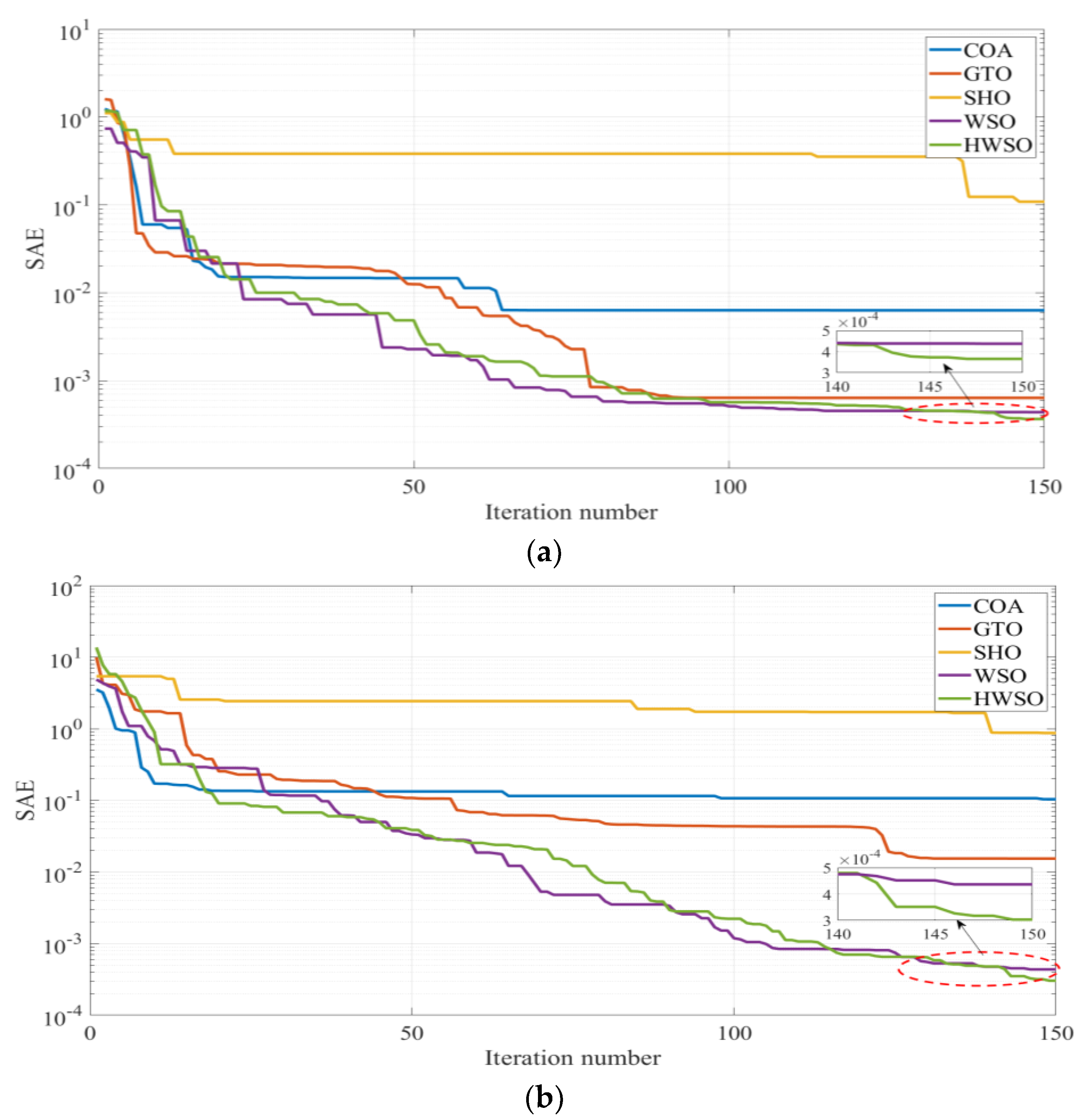
- The proposed HWSO is validated versus SHO, GTO, COA, and WSO;
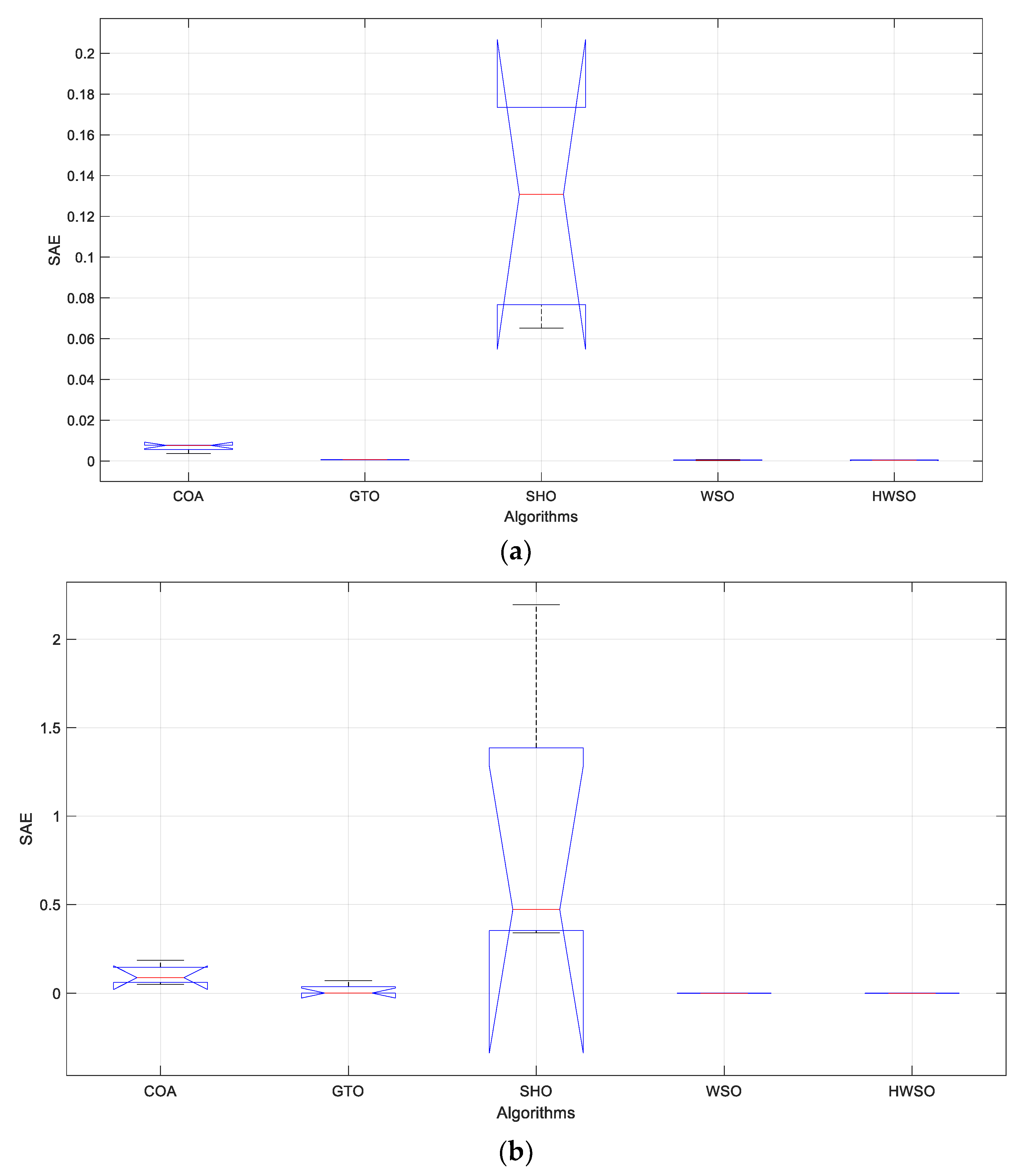
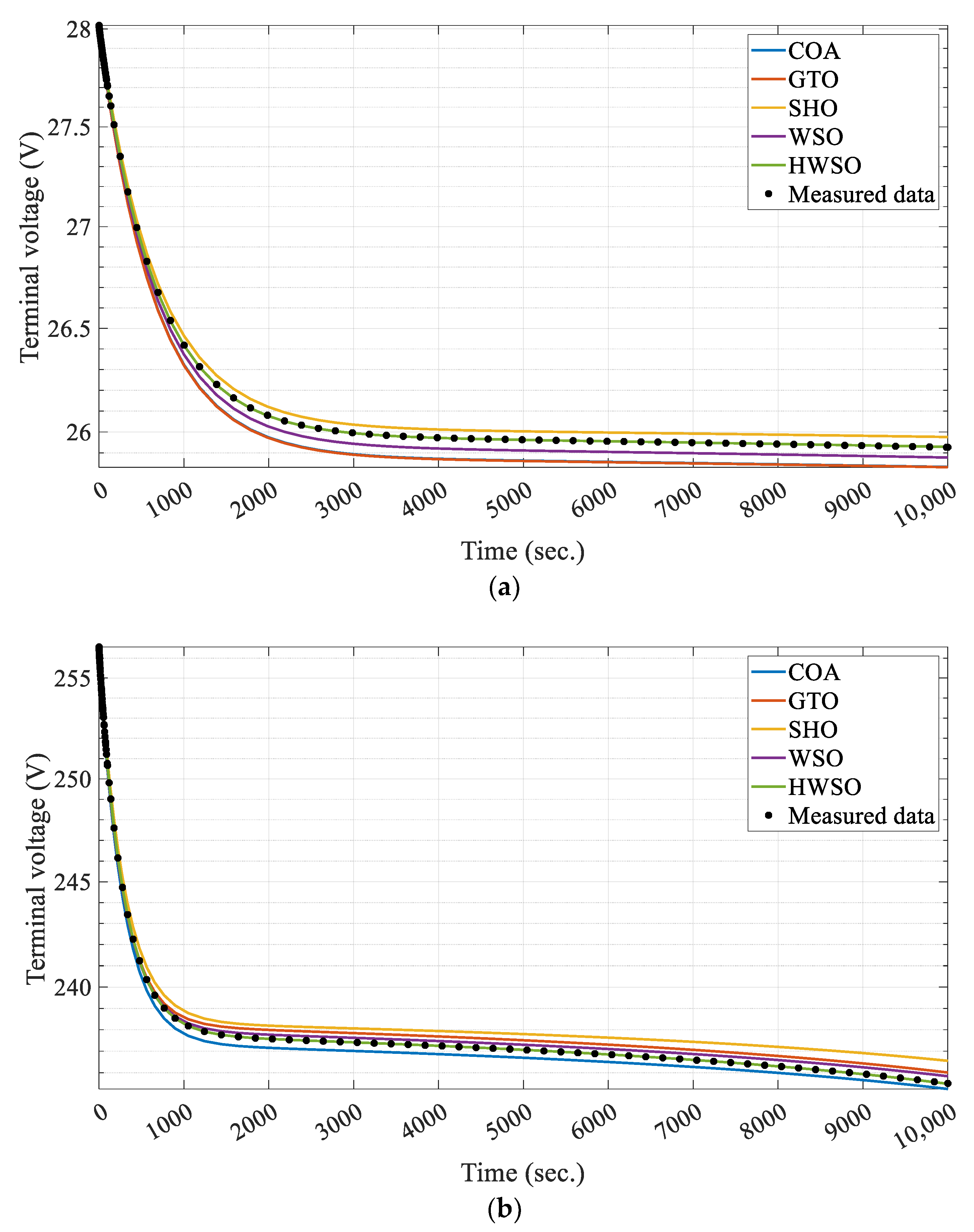
- Sets of statistical analyses, mean convergence, and fitting curves are conducted for the comparisons;
- The competence of the proposed HWSO is proved via the fetched results;
- Table 2 shows a comparison between the proposed approach and other methods in terms of complexity, required data, convergence rate, and trapping in local optima. The comparison clarifies the preference of the proposed methodology over the others;
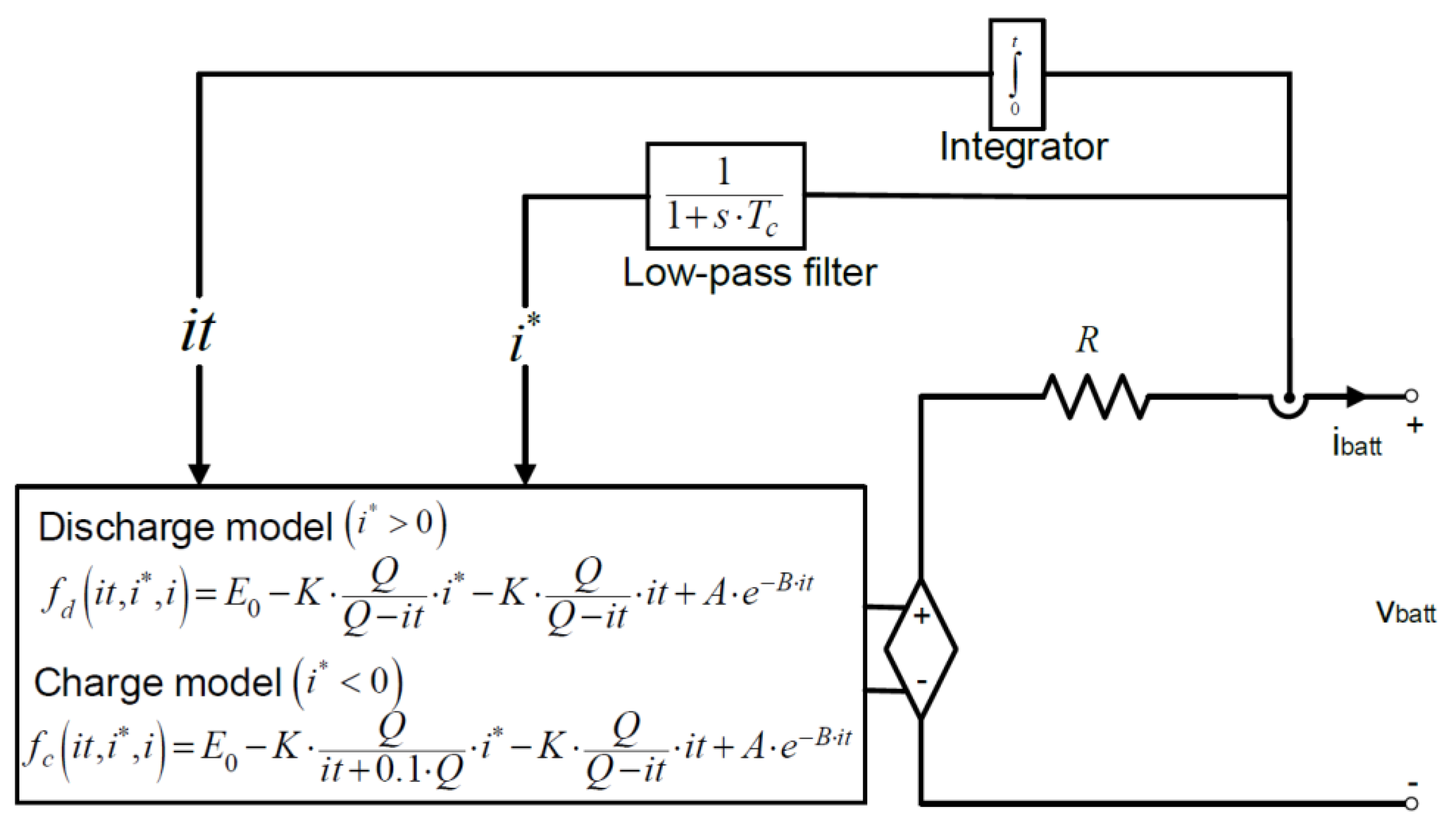
- The rest of this paper is organized as follows: Section 2 handles the model of a Li-ion battery, Section 3 explains the main aspects of the WSO, Section 4 introduces the proposed hybrid WSO-based methodology, Section 5 shows the fetched results and discussions, and conclusions are given in Section 6.
2. The Li-Ion Battery Model
3. White Shark Optimizer (WSO)
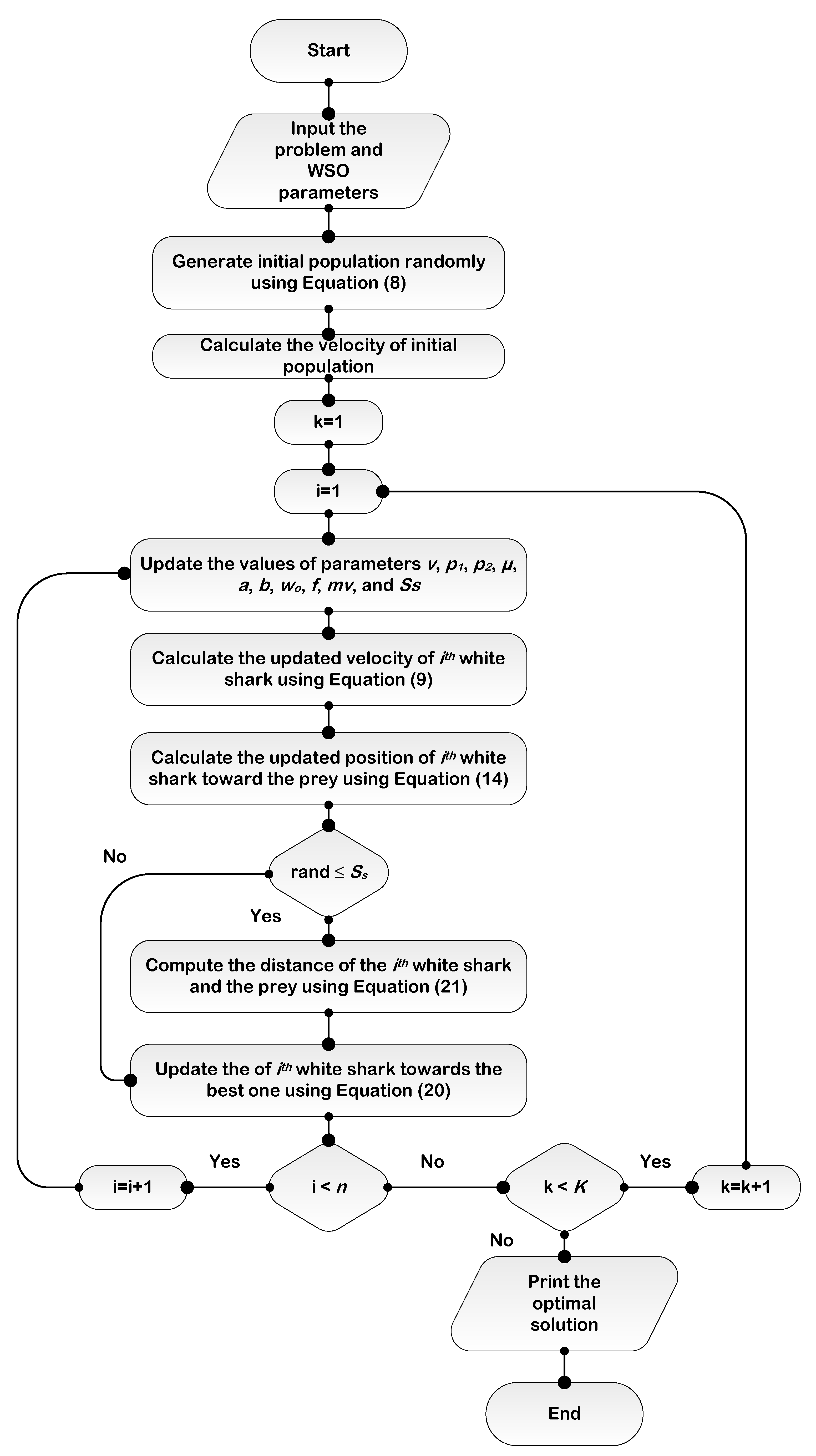
4. The Proposed Hybrid WSO-Based Methodology
| Algorithm 1 A pseudo code summarizing the main structure of the proposed HWSO |
| 1: Set the lower and upper limits of the battery model parameters 2: Determine the HWSO population size (n) and maximum number of iterations (K) 3: Generate the initial solutions (battery model parameters) set of WSO 4: Calculate the initial objective function of Equation (5) corresponding to the initial solutions 5: while (k < K) do 6: Update the HWSO parameters using Equations (10)–(19) 7: for i = 1 to n do 8: Calculate the velocity using Equation (9). 9: end for 10: Ior i = 1 to n do 11: if rand < then 12: Update the white shark’s location using Equation (14) first line 13: else 14: Update the white shark’s location using Equation (14) second line 15: end if 16: end for 17: for i = 1 to n do 18: if rand ≤ then 19: Calculate the distance between the white shark the prey using Equation (19) 20: Update the white shark location using Equation (25) first line 21: else 22: Update the white shark location using Equation (25) second line 23: end if 24: end for 25: Evaluate and update the new battery model parameters 26: k = k + 1 27: end while 28: Display the optimal battery model parameters obtained so far |
5. Numerical Results and Discussions
6. Conclusions
Author Contributions
Funding
Institutional Review Board Statement
Informed Consent Statement
Data Availability Statement
Conflicts of Interest
Nomenclature
| Correction factor | |
| Battery open circuit voltage at full capacity | |
| Polarization coefficient | |
| Capacity of battery | |
| Removed actual charge | |
| i | Current of battery |
| Battery internal resistance | |
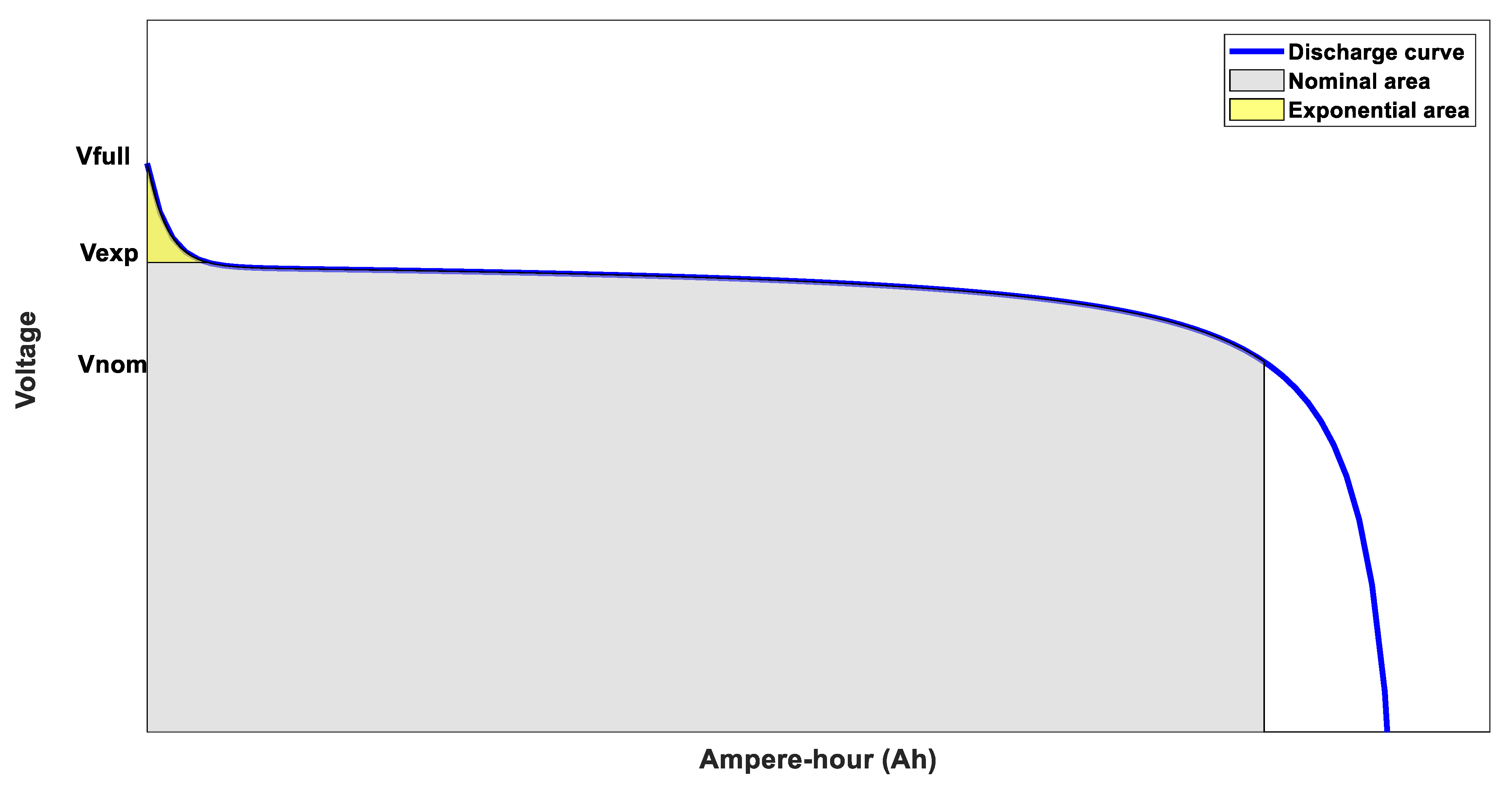
| Amplitude of exponential zone | |
| inverse time constant of exponential zone | |
| Filtered current | |
| Initial state of charge | |
| Vfull | Battery voltages at maximum capacity |
| Vexp | Battery voltages at capacity during the end of exponential zone |
| Vnom | Battery voltages at normal operation capacity |
| Number of data | |
| Battery measured voltage at instant | |
| Minimum limit | |
| Maximum limit | |
| N | Population size |
| d | Problem dimension |
| ith white shark location in jth dimension | |
| Lower bound | |
| Upper bound | |
| Random number in range [0, 1] | |
| Updated and current velocities of th white shark in iterations | |
| Global best location during th iteration | |
| Position of ith white shark in iteration | |
| and | random numbers in range [0, 1] |
| ith best known location to the swarm during iteration | |
| Index vector number i for the white sharks getting the best location | |
| and | White sharks’ forces |
| and | Initial and inferior velocities |
| Acceleration factor | |
| Operator of negation | |
| and | Binary vectors |
| Logical vector | |
| Frequency of white shark wavy motion | |
| and | Maximum and minimum undulating frequencies |
| white shark’s movement force | |
| Parameters to manage the exploration/exploitation behaviors | |
| ith white shark new position with regard to the prey | |
| , , and | Random numbers in range [0, 1] |
| Distance between the white shark and the prey | |
| Constant to define the shape of the logarithmic spiral | |
| Random number in [−1, 1] | |
| Battery estimated voltage at instant | |
| WSO | White shark optimizer |
| WOA | Whale optimization approach |
| HWSO | Hybrid variant of the WSO |
| SHO | Sea horse optimizer |
| GTO | Gorilla troops optimizer |
| COA | Coyote optimization algorithm |
| ESSs | Energy storage systems |
| RESs | Renewable energy sources |
| AEO | Artificial ecosystem optimizer |
| RMSE | Root mean square error |
| SOC | State of charge |
| EA | Equilibrium algorithm |
| PSO | Particle swarm optimizer |
| mCoot | Modified Coot algorithm |
| ESFO | Enhanced sunflower optimizer |
| GA | Genetic algorithm |
| BES | Bald eagle search |
| RMSE | Root mean square error |
References
- Ferahtia, S.; Djeroui, A.; Rezk, H.; Aissa, C.; Houari, A.; Machmoum, M. Optimal parameter identification strategy applied to lithium-ion battery model. Int. J. Energy Res. 2021, 45, 16741–16753. [Google Scholar] [CrossRef]
- Shaheen, A.M.; Hamida, M.A.; El-Sehiemy, R.A.; Elattar, E.E. Optimal parameter identification of linear and non-linear models for Li-Ion Battery Cells. Energy Rep. 2021, 7, 7170–7185. [Google Scholar] [CrossRef]
- Kim, M.; Chun, H.; Kim, J.; Kim, K.; Yu, J.; Kim, T.; Han, S. Data-efficient parameter identification of electrochemical lithium-ion battery model using deep Bayesian harmony search. Appl. Energy 2019, 254, 113644. [Google Scholar] [CrossRef]
- Park, S.; Kato, D.; Gima, Z.; Klein, R.; Moura, S. Optimal Experimental Design for Parameterization of an Electrochemical Lithium-Ion Battery Model. J. Electrochem. Soc. 2018, 165, A1309–A1323. [Google Scholar] [CrossRef]
- Barcellona, S.; Piegari, L. Lithium Ion Battery Models and Parameter Identification Techniques. Energies 2017, 10, 2007. [Google Scholar] [CrossRef]
- Naseri, F.; Schaltz, E.; Stroe, D.-I.; Gismero, A.; Farjah, E. An Enhanced Equivalent Circuit Model With Real-Time Parameter Identification for Battery State-of-Charge Estimation. IEEE Trans. Ind. Electron. 2021, 69, 3743–3751. [Google Scholar] [CrossRef]
- Rahman, A.; Anwar, S.; Izadian, A. Electrochemical model parameter identification of a lithium-ion battery using particle swarm optimization method. J. Power Sources 2016, 307, 86–97. [Google Scholar] [CrossRef]
- Kwak, M.; Lkhagvasuren, B.; Park, J.; You, J.-H. Parameter Identification and SOC Estimation of a Battery Under the Hysteresis Effect. IEEE Trans. Ind. Electron. 2019, 67, 9758–9767. [Google Scholar] [CrossRef]
- Michalczuk, M.; Grzesiak, L.M.; Ufnalski, B. Experimental parameter identification of battery-ultracapacitor energy storage system. In Proceedings of the 2015 IEEE 24th International Symposium on Industrial Electronics (ISIE), Rio de Janeiro, Brazil, 3–5 June 2015; IEEE: New York, NY, USA, 2015; pp. 1260–1265. [Google Scholar]
- Hu, M.; Li, Y.; Li, S.; Fu, C.; Qin, D.; Li, Z. Lithium-ion battery modeling and parameter identification based on fractional theory. Energy 2018, 165, 153–163. [Google Scholar] [CrossRef]
- Miniguano, H.; Barrado, A.; Lazaro, A.; Zumel, P.; Fernandez, C. General Parameter Identification Procedure and Comparative Study of Li-Ion Battery Models. IEEE Trans. Veh. Technol. 2019, 69, 235–245. [Google Scholar] [CrossRef]
- Moubayed, N.; Kouta, J.; El-Ali, A.; Dernayka, H.; Outbib, R. Parameter identification of the lead-acid battery model. In Proceedings of the 2008 33rd IEEE Photovoltaic Specialists Conference, San Diego, CA, USA, 11–16 May 2008; IEEE: New York, NY, USA, 2008; pp. 1–6. [Google Scholar]
- Rahimi-Eichi, H.; Baronti, F.; Chow, M.-Y. Online Adaptive Parameter Identification and State-of-Charge Coestimation for Lithium-Polymer Battery Cells. IEEE Trans. Ind. Electron. 2013, 61, 2053–2061. [Google Scholar] [CrossRef]
- Dai, H.; Xu, T.; Zhu, L.; Wei, X.; Sun, Z. Adaptive model parameter identification for large capacity Li-ion batteries on separated time scales. Appl. Energy 2016, 184, 119–131. [Google Scholar] [CrossRef]
- Madani, S.S.; Schaltz, E.; Kær, S.K. A review of different electric equivalent circuit models and parameter identification methods of lithium-ion batteries. ECS Trans. 2018, 87, 23. [Google Scholar] [CrossRef]
- Houssein, E.H.; Hashim, F.A.; Ferahtia, S.; Rezk, H. Battery parameter identification strategy based on modified coot optimization algorithm. J. Energy Storage 2022, 46, 103848. [Google Scholar] [CrossRef]
- Du, X.; Meng, J.; Zhang, Y.; Huang, X.; Wang, S.; Liu, P.; Liu, T. An Information Appraisal Procedure: Endows Reliable Online Parameter Identification to Lithium-Ion Battery Model. IEEE Trans. Ind. Electron. 2021, 69, 5889–5899. [Google Scholar] [CrossRef]
- Lai, X.; Gao, W.; Zheng, Y.; Ouyang, M.; Li, J.; Han, X.; Zhou, L. A comparative study of global optimization methods for parameter identification of different equivalent circuit models for Li-ion batteries. Electrochim. Acta 2019, 295, 1057–1066. [Google Scholar] [CrossRef]
- Yu, Z.; Xiao, L.; Li, H.; Zhu, X.; Huai, R. Model Parameter Identification for Lithium Batteries Using the Coevolutionary Particle Swarm Optimization Method. IEEE Trans. Ind. Electron. 2017, 64, 5690–5700. [Google Scholar] [CrossRef]
- El-Sehiemy, R.A.; Hamida, M.A.; Mesbahi, T. Parameter identification and state-of-charge estimation for lithium-polymer battery cells using enhanced sunflower optimization algorithm. Int. J. Hydrogen Energy 2020, 45, 8833–8842. [Google Scholar] [CrossRef]
- Li, W.; Demir, I.; Cao, D.; Jöst, D.; Ringbeck, F.; Junker, M.; Sauer, D.U. Data-driven systematic parameter identification of an electrochemical model for lithium-ion batteries with artificial intelligence. Energy Storage Mater. 2022, 44, 557–570. [Google Scholar] [CrossRef]
- Zhang, S.; Zhang, X. A comparative study of different online model parameters identification methods for lithium-ion battery. Sci. China Technol. Sci. 2021, 64, 2312–2327. [Google Scholar] [CrossRef]
- Liu, Y.; Tang, S.; Li, L.; Liu, F.; Jiang, L.; Jia, M.; Ai, Y.; Yao, C.; Gu, H. Simulation and parameter identification based on electrochemical- thermal coupling model of power lithium ion-battery. J. Alloys Compd. 2020, 844, 156003. [Google Scholar] [CrossRef]
- Huo, Y.; Hu, W.; Li, Z.; Rao, Z. Research on parameter identification and state of charge estimation of improved equivalent circuit model of Li-ion battery based on temperature effects for battery thermal management. Int. J. Energy Res. 2020, 44, 11583–11596. [Google Scholar] [CrossRef]
- Chun, H.; Kim, J.; Han, S. Parameter identification of an electrochemical lithium-ion battery model with convolutional neural network. IFAC-Pap. 2019, 52, 129–134. [Google Scholar] [CrossRef]
- Song, Z.; Hofmann, H.; Lin, X.; Han, X.; Hou, J. Parameter identification of lithium-ion battery pack for different applications based on Cramer-Rao bound analysis and experimental study. Appl. Energy 2018, 231, 1307–1318. [Google Scholar] [CrossRef]
- Ren, B.; Xie, C.; Sun, X.; Zhang, Q.; Yan, D. Parameter identification of a lithium-ion battery based on the improved recursive least square algorithm. IET Power Electron. 2020, 13, 2531–2537. [Google Scholar] [CrossRef]
- Shi, N.; Chen, Z.; Niu, M.; He, Z.; Wang, Y.; Cui, J. State-of-charge estimation for the lithium-ion battery based on adaptive extended Kalman filter using improved parameter identification. J. Energy Storage 2022, 45, 103518. [Google Scholar] [CrossRef]
- Duan, W.; Song, C.; Chen, Y.; Xiao, F.; Peng, S.; Shao, Y.; Song, S. Online parameter identification and state of charge estimation of battery based on multitimescale adaptive double Kalman filter algorithm. Math. Probl. Eng. 2020, 2020, 9502605. [Google Scholar] [CrossRef]
- Kim, J.; Chun, H.; Baek, J.; Han, S. Parameter identification of lithium-ion battery pseudo-2-dimensional models using genetic algorithm and neural network cooperative optimization. J. Energy Storage 2022, 45, 103571. [Google Scholar] [CrossRef]
- Shuai, W.; Li, E.; Wang, H. An equivalent circuit model of a deformed Li-ion battery with parameter identification. Int. J. Energy Res. 2020, 44, 8372–8387. [Google Scholar] [CrossRef]
- Rezk, H.; Ferahtia, S.; Ghoniem, R.M.; Fathy, A.; Ghoniem, M.M.; Alkanhel, R. Robust Parameter Identification Strategy for Lead Acid Battery Model. Batteries 2022, 8, 283. [Google Scholar] [CrossRef]
- Tremblay, O.; Dessaint, L.-A. Experimental Validation of a Battery Dynamic Model for EV Applications. World Electr. Veh. J. 2009, 3, 289–298. [Google Scholar] [CrossRef]
- Enache, B.; Lefter, E.; Stoica, C. Comparative study for generic battery models used for electric vehicles. In Proceedings of the 2013 8th International Symposium on Advanced Topics in Electrical Engineering (ATEE), Bucharest, Romania, 23–25 May 2013; IEEE: New York, NY, USA, 2013; pp. 1–6. [Google Scholar]
- Braik, M.; Hammouri, A.; Atwan, J.; Al-Betar, M.A.; Awadallah, M.A. White Shark Optimizer: A novel bio-inspired meta-heuristic algorithm for global optimization problems. Knowl.-Based Syst. 2022, 243, 108457. [Google Scholar] [CrossRef]

| Author | Year | Target | Method | Meta-heuristic | Battery Model | Limitations |
|---|---|---|---|---|---|---|
| Ferahtia et al. [1] | 2021 | RMSE | Artificial ecosystem optimizer | √ | Shepherd model | The algorithm is easy to trap in local optima |
| Shaheen et al. [2] | 2021 | RMSE | Equilibrium algorithm | √ | nRC-model | The algorithm has premature and slow convergence |
| Kim et al. [3] | 2019 | RMSE | Bayesian neural network | × | Pseudo-two-dimensional | Excessive data are required to train the neural network |
| Park et al. [4] | 2018 | Least square error | Gradient-based algorithm | √ | Doyle fuller Newman model | The approach can go in the wrong direction because of frequent updates |
| Naseri et al. [6] | 2021 | MSE | Extended-kernel iterative recursive least square approach | × | Second-order RC | The least square approach has less desirable optimality characteristics |
| Rahman et al. [7] | 2016 | Sum square error | Particle swarm optimizer | √ | Reduced partial differential | PSO has low convergence rate and easy to fall in local optima |
| Kwak et al. [8] | 2019 | Least square approach | × | First-order RC | The least square approach has less desirable optimality characteristics | |
| Hu et al. [10] | 2018 | RMSE | Mixed swarm cooperative PSO | √ | Fractional order | The presented approach required excessive computational efforts |
| Miniguano et al. [11] | 2019 | Sum square error | Matlab optimization toolbox | × | Five models | Nonlinear least square has less desirable optimality characteristics |
| Rahimi-Eichi et al. [13] | 2013 | Least square error | Least square approach | × | First-order RC | The least square approach has less desirable optimality characteristics |
| Dai et al. [14] | 2016 | RMSE | Extended Kalman filtering and recursive least square | × | Second-order RC | The least square approach has less desirable optimality characteristics |
| Houssein et al. [16] | 2022 | RMSE | Modified Coot algorithm | √ | Shepherd model | The modified algorithm required large computational time |
| Du et al. [17] | 2021 | Absolute error | Cramer–Rao lower bound | × | Thevenin circuit | The algorithm is suitable for simple scenarios |
| Yu et al. [19] | 2017 | Sum absolute error | Co-evolutionary PSO | √ | Third-order RC | The algorithm is complex, and the model hysteresis voltage is ignored |
| El-Sehiemy et al. [20] | 2020 | Sum square error | Enhanced sunflower optimizer | √ | First-order RC | The modified algorithm required large computational time |
| Li et al. [21] | 2022 | Voltage error and electrodes’ capacity error | Cuckoo search | √ | Pseudo-two-dimensional | Cuckoo search has slow speed and low convergence accuracy |
| Zhang et al. [22] | 2021 | Absolute error | PSO, extended Kalman filter, and recursive least square | √ | Thevenin circuit | PSO has low convergence rate and easy to fall in local optima. Further, the least square approach has less desirable optimality characteristics. |
| Liu et al. [23] | 2020 | RMSE | Parameter sensitivity division approach | × | Pseudo-two-dimensional | The optimization approach is unclear |
| Huo et al. [24] | 2020 | Mean absolute error and RMSE | Exponential function fitting method | × | Second-order RC | The presented model ignored the temperature effects |
| Chun et al. [25] | 2019 | Least error | Convolutional neural network | × | Pseudo-two-dimensional | Excessive data are required to train the neural network |
| Song et al. [26] | 2018 | Cramer–Rao lower bound | × | First-order RC | The algorithm is suitable for simple scenarios | |
| Ren et al. [27] | 2020 | Sum square error | Recursive least square approach | × | Second-order RC | The method is very sensitive to start values assigned by the user |
| Shi et al. [28] | 2022 | Mean absolute error and RMSE | Thevenin circuit | |||
| Duan et al. [29] | 2020 | RMSE | Adaptive double Kalman filter approach | × | First-order RC | The authors ignored the battery charge and discharge rates in the handled problem |
| Kim et al. [30] | 2022 | Least square error | Neural network and genetic algorithm | √ | Pseudo-two-dimensional | Excessive data are required to train the neural network. |
| Shuai et al. [31] | 2020 | Absolute relative error | Differential evolution algorithm | √ | Thevenin circuit | Differential evolution has slow convergence rate |
| Rezk et al. [32] | 2022 | RMSE | Bald eagle search algorithm | √ | Shepherd model | The algorithm lacks adequate search efficiency and traps in local optima |
| Ref. | Required Data | Complexity | Convergence Rate | Trap in Local Optima? |
|---|---|---|---|---|
| [1] | Few | Low | Fast | √ |
| [2] | Moderate | High | Slow | √ |
| [3] | Large | Moderate | Fast | × |
| [4] | Moderate | High | NA | √ |
| [6] | Few | Low | Slow | NA |
| [7] | Moderate | Low | Slow | √ |
| [8] | Few | High | Slow | √ |
| [10] | Few | High | Fast | × |
| [11] | Moderate | Low | Slow | √ |
| [13] | Large | Moderate | Slow | √ |
| [14] | Large | High | Fast | NA |
| [16] | Few | High | Fast | × |
| [19] | Moderate | High | Fast | √ |
| [20] | Moderate | High | NA | NA |
| [21] | Large | Moderate | Slow | √ |
| [25] | Large | Moderate | Slow | NA |
| [27] | Large | High | Fast | √ |
| [28] | Large | High | Fast | √ |
| [30] | Large | High | Slow | √ |
| [31] | Large | Moderate | Slow | √ |
| [32] | Few | Large | Fast | √ |
| This work | Few | Low | Fast | × |
| (V) | (Ω) | (Ah) | K | (V) | (Ah−1) | (s) | |
|---|---|---|---|---|---|---|---|
| Battery 1 | 26.0246 | 0.08 | 30 | 0.0045161 | 2.0154 | 2.0354 | 30 |
| Battery 2 | 238.559 | 0.01833 | 120 | 0.01374 | 18.475 | 0.509 | 20 |
| Model Parameters/Algorithm | |||||
|---|---|---|---|---|---|
| Battery 1 | COA | GTO | SHO | WSO | HWSO |
| (V) | 26.110 | 26.107 | 26.236 | 26.155 | 26.213 |
| (Ω) | 0.0829 | 0.0824 | 0.0790 | 0.0800 | 0.0827 |
| (Ah) | 29.579 | 29.941 | 29.500 | 29.754 | 29.977 |
| 0.0050 | 0.0049 | 0.0044 | 0.0055 | 0.0055 | |
| (V) | 2.1373 | 2.1397 | 2 | 2.0846 | 2.0337 |
| (Ah−1) | 2.1090 | 2.1129 | 2 | 2.0720 | 2.0557 |
| (s) | 29.830 | 29.874 | 29.800 | 29.941 | 29.838 |
| Best obj | 3.6683 × 10⁻³ | 5.8478 × 10⁻⁴ | 6.5230 × 10⁻² | 2.9707 × 10⁻⁴ | 2.6172 × 10⁻⁴ |
| Worst | 7.6792 × 10⁻³ | 6.8215 × 10⁻⁴ | 1.7342 × 10⁻¹ | 6.0980 × 10⁻⁴ | 4.7305 × 10⁻⁴ |
| Mean | 6.6620 × 10⁻³ | 6.2419 × 10⁻⁴ | 1.2503 × 10⁻¹ | 4.3774 × 10⁻⁴ | 3.9241 × 10⁻⁴ |
| SD | 1.9959 × 10⁻³ | 4.7959 × 10⁻⁵ | 5.6641 × 10⁻² | 1.4213 × 10⁻⁴ | 9.3861 × 10⁻⁵ |
| Computational time (s) | 3912.605 | 4663.27 | 2567.456 | 919.074 | 1744.59 |
| Model Parameters/Algorithm | ||||||
|---|---|---|---|---|---|---|
| Battery 2 | SSA [1] | COA | GTO | SHO | WSO | HWSO |
| (V) | 238.556 | 238.009 | 238.859 | 238.890 | 238.682 | 238.568 |
| (Ω) | 19.1245 | 0.01548 | 0.01449 | 0.01278 | 0.01730 | 0.01918 |
| (Ah) | 120.708 | 120.147 | 122.460 | 118 | 121.666 | 121.637 |
| 0.01374 | 0.01218 | 0.01293 | 0.01000 | 0.01250 | 0.01352 | |
| (V) | 18.7152 | 18.9502 | 18.0755 | 18 | 18.3235 | 18.4857 |
| (Ah−1) | 0.50969 | 0.52409 | 0.53904 | 0.50000 | 0.52951 | 0.51050 |
| (s) | 19.9555 | 18.2464 | 19.7351 | 18 | 18.9890 | 19.5263 |
| Best obj | 0.00900 | 5.1578 × 10⁻² | 6.0177 × 10⁻⁴ | 3.4100 × 10⁻¹ | 6.6197 × 10⁻⁵ | 5.6118 × 10⁻⁴ |
| Worst | 0.019864 | 1.8692 × 10⁻¹ | 7.2259 × 10⁻² | 2.1958 | 9.7378 × 10⁻⁴ | 6.6383 × 10⁻⁴ |
| Mean | 0.009998 | 1.0384 × 10⁻¹ | 1.8926 × 10⁻² | 8.7029 × 10⁻¹ | 5.1000 × 10⁻⁴ | 3.7127 × 10⁻⁴ |
| SD | 0.004595 | 5.9825 × 10⁻² | 3.5557 × 10⁻² | 8.8994 × 10⁻¹ | 3.9079 × 10⁻⁴ | 3.2854 × 10⁻⁴ |
| Source | SS | df | MS | F | Prob > F |
|---|---|---|---|---|---|
| Column | 0.04853 | 4 | 0.01213 | 18.89 | 1.01157 × 10⁻⁵ |
| Error | 0.00964 | 15 | 0.00064 | ||
| Total | 0.05817 | 19 |
| Source | SS | df | MS | F | Prob > F |
|---|---|---|---|---|---|
| Column | 2.28387 | 4 | 0.57097 | 3.58 | 0.0305 |
| Error | 2.39051 | 15 | 0.15937 | ||
| Total | 4.67438 | 19 |
Disclaimer/Publisher’s Note: The statements, opinions and data contained in all publications are solely those of the individual author(s) and contributor(s) and not of MDPI and/or the editor(s). MDPI and/or the editor(s) disclaim responsibility for any injury to people or property resulting from any ideas, methods, instructions or products referred to in the content. |
© 2023 by the authors. Licensee MDPI, Basel, Switzerland. This article is an open access article distributed under the terms and conditions of the Creative Commons Attribution (CC BY) license (https://creativecommons.org/licenses/by/4.0/).
Share and Cite
Fathy, A.; Yousri, D.; Alharbi, A.G.; Abdelkareem, M.A. A New Hybrid White Shark and Whale Optimization Approach for Estimating the Li-Ion Battery Model Parameters. Sustainability 2023, 15, 5667. https://doi.org/10.3390/su15075667
Fathy A, Yousri D, Alharbi AG, Abdelkareem MA. A New Hybrid White Shark and Whale Optimization Approach for Estimating the Li-Ion Battery Model Parameters. Sustainability. 2023; 15(7):5667. https://doi.org/10.3390/su15075667
Chicago/Turabian StyleFathy, Ahmed, Dalia Yousri, Abdullah G. Alharbi, and Mohammad Ali Abdelkareem. 2023. "A New Hybrid White Shark and Whale Optimization Approach for Estimating the Li-Ion Battery Model Parameters" Sustainability 15, no. 7: 5667. https://doi.org/10.3390/su15075667
APA StyleFathy, A., Yousri, D., Alharbi, A. G., & Abdelkareem, M. A. (2023). A New Hybrid White Shark and Whale Optimization Approach for Estimating the Li-Ion Battery Model Parameters. Sustainability, 15(7), 5667. https://doi.org/10.3390/su15075667

