


Abstract
(1) Background: Lithium plays an extremely important role in the national economy. However, the chemical activity of lithium metal leads to many safety problems in the application of lithium technology, which is the bottleneck problem restricting the development of lithium technology. The purpose of this paper is to describe the research status of lithium technology safety issues visually and dynamically, elucidate the pressing issues in this field and reveal future development trends. (2) Methods: In this paper, metrology literature analysis and knowledge graph methods were adopted. With the help of visualization tools, namely, CiteSpace and VOSviewer, literature data exported from the Web of Science were analyzed in a multi-angle and all-round way. (3) Results: The number of papers in the field of lithium technology safety showed an accelerating trend. Close collaboration between authors and institutions. The scope of the research has gradually shifted from the early focus on the medical application of lithium and the resulting safety issues to the health and safety of lithium batteries. (4) Conclusions: Lithium technology safety is a hot topic in the current academic community. Future research trends will continue to focus on the safety problems and solutions of lithium technology, and pay more attention to sustainable development, especially the research on the improvement and optimization of lithium-ion battery performance.
1. Introduction
With the advantages of a high theoretical energy ratio and low density, lithium has been widely used in batteries [1], ceramics [2], medical treatment [3], nuclear energy [4,5] and other aspects. However, due to the active physical and chemical properties of this metal, the lithium technology around us threatens our own security all the time, which has become an important constraint on the development of lithium technology [6]. For example, after the explosion of the first generation of Li||MoS2 battery products of Moli Canada in late spring of 1989, the panic caused by this battery with real commercial significance at that time made the lithium battery disappear from the public’s view for some time afterwards [7]. Therefore, it is very important to pay attention to the safety of lithium for the utilization and development of this technology.
For the last decades, the reviews or discussions about lithium technology safety mostly focus on lithium batteries [8,9,10,11,12,13]. As a basis, Kalluri et al. [8] discussed an in-depth summary of the significant role of lithium metal oxide-based cathode materials in improving ionic conductivity, electrochemical stability, rate capability and safety. Balakrishnan et al. [9] analyzed the possible conditions that caused the safety problems of lithium-ion battery packs and discussed the safety mechanisms such as pressure relief valves, disposable fuses and chemical shuttles. Hendricks et al.’s work [10] reviewed the physical model state of lithium-ion battery failure and provided a detailed framework for lithium-ion battery reliability assessment. More focused, Chombo et al. [11] reviewed the thermal hazards of lithium-ion batteries and effective safety strategies to eliminate the risk of thermal runaway. In addition, research on safety issues related to lithium-ion batteries has proved the rationality of intensive testing on its value chain, allowing for the development and use of prediction tools to help designers develop safer batteries [12]. Recent research [13] also includes the latest development of ionic liquid-based electrolytes in lithium-ion batteries. These studies summarized the safety problems and improvement directions of lithium batteries from different perspectives in different periods, which are likely to make rapid progress in the application of lithium technology in batteries.
Now, lithium technology has been widely used instead of the battery. One of the early important uses of lithium compounds is used in ceramic products [2], especially in enamel products, to play the role of co-solvent. Lithium is also used as a thickener for grease in the form of lithium stearate, a lubricant with both high water resistance, high-temperature resistance and good low-temperature properties. In the metallurgical industry, the use of lithium can strongly react with oxygen, nitrogen, chlorine, sulfur and other substances of their nature, as a deoxidizer and desulfurizer [14]. At the same time, lithium is also an important component of beryllium, magnesium, and aluminum lightweight alloys. For example, a lithium-lead alloy is a good friction-reducing material. In the military field, 1 kg of lithium can release 42,998 kJ of heat after combustion, and lithium has become a “high-energy metal” and is one of the best metals used to make rocket fuel [15]. Lithium also plays an important role in medical treatment. On the biological necessity and human health effect of lithium, lithium can improve hematopoietic functions and improve human immune functions [16]. Lithium is an effective mood stabilizer, which has a regulatory effect on central nervous activity and can calm and control nervous disorders. Lithium is by far the most effective measure for the preventive management of acute mania and manic-depressive disorder.
In the last decade or so, the demand for lithium has increased exponentially in different application scenarios [17], and the following security risks have gradually increased. It is reported that the demand for lithium has increased dramatically from about 2000 tons in 2005 to more than 14,000 tons in 2020. Global lithium consumption is estimated to be more than double the current levels in 2025 [18]. The safety problems of lithium in different application scenarios are also different. Similar to potassium and sodium, lithium metal has a strong reactivity and needs to be stored separately from the air. Although lithium is widely used in medical treatment, its strong corrosivity to human skin is a problem that cannot be ignored. Most of the safety tests conducted in the laboratory or factory cannot replicate the actual conditions of safety accidents on the site [19]. Therefore, it is necessary to analyze and judge the development of lithium technology safety problems in various fields from the perspective of metrology literature.
As far as we know, there is no research on the safety of lithium technology from the perspective of metrology literature. The method of bibliometrics can intuitively present information in this field through a collation of past research and visualization [20]. Using this method to study the safety of lithium technology can well summarize and analyze the current lithium application scenarios and the existing safety problems, so that researchers can understand the research status of lithium safety in various scenarios, including lithium batteries, and better promote the application and development of lithium technology by solving the corresponding safety problems.
In this paper, we use the methodology of bibliometrics, together with CiteSpace and VOSviewer analysis tools, to analyze and present the literature in the field of lithium technology. By analyzing indicators such as publication characteristics, research hotspots, research institutions and major researchers at different development stages, we provide a quantitative overview of the research profile of lithium technology safety issues, with a view to providing scientific references for the in-depth development of lithium technology. In addition, by way of evolution analysis through CiteSpace and co-occurrence analysis through VOSviewer, we explored the evolution process of research on lithium technology safety issues and predicted future development trends.
The contents of this article will be arranged in the following order. Section 2 introduces the data sources and research methods in detail. Section 3 introduces the analysis results and corresponding enlightenment from the number of documents, citations, journals, topics and other aspects. The discussion and conclusions will be described in Section 4.
2. Materials and Methods
2.1. Data Source
In this paper, we use the Web of Science Core Collection (WOSCC) by Thomson Reuters to search for papers related to our research topic. We chose the WOSCC for two main reasons: On the one hand, the core set database is a collection of high-quality papers representing the field, which can help to grasp more accurate and cutting-edge developments. On the other hand, the data in the core set provides more abundant fields, which facilitates the subsequent construction of a visual analysis of multiple networks in VOSviewer.
In advanced search, we use the search formula “TS = lithium and (risk or safety)” to filter papers related to our research topic. The time range was set to 1972–2021. Export the above literature data in the form of a tab-separated file. The total number of retrieved papers related to lithium safety was 14,262 (web of science core collection), of which 56 were missing in the year column. Excluding the papers missing in the year, there are 14,206 papers left. Before performing visual analysis, we first preprocess the data. Specifically, it is necessary to merge the single and plural forms of some keywords and the full name and short form of some specific keywords. By collecting and analyzing the papers published by global scholars in important international journals in related fields, this paper quantifies the research trend and development trend of lithium technology safety issues and then provides support for exploring the research patterns and future research directions of lithium technology safety issues.
2.2. Research Methods
This paper mainly adopts the bibliometric analysis method and knowledge graph method, taking lithium technology as the main research field. With the help of visualization tools CiteSpace and VOSviewer, the paper conducts a multi-angle and all-round analysis of literature data information exported from Web of Science. As shown in Figure 1, based on the number of articles in the field, citations, mainstream journals, cooperation networks (based on authors, institutions and countries), keywords, etc., we plot citation networks, cooperation networks and topic distribution, visually and dynamically revealing the research status and hot issues of lithium technology, so as to realize the research situation and developments trend of lithium technology safety problems.
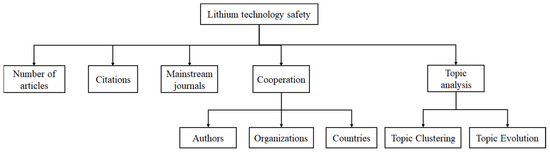
Figure 1.
Flowchart of the research methodology.
CiteSpace is a visualization software based on Java language, widely used for field analysis, frontier analysis, scientific evaluation in scientific research, etc. VOSviewer, developed in collaboration with Nees Janvan Eck and Ludo Waltamn, is commonly used for bibliometric analysis and visualization. In this paper, CiteSpace (version 5.7.R2) and VOSviewer (version 1.6.17) are used for visual bibliometric analysis and scientific evaluation.
3. Results
3.1. Number of Articles
By analyzing the year of publication of valid papers, it was found that the number of lithium-related papers peaked in 2021 with 2490 papers. Figure 2 shows the changes in the number of relevant articles published in the last 20 years, showing a yearly climbing trend. It can be clearly seen that the number of relevant articles published increased the most in 2020, with 422 more articles compared to the previous year. The rapid increase in the number of published articles in recent years shows that the safety of lithium technology has been studied more frequently.
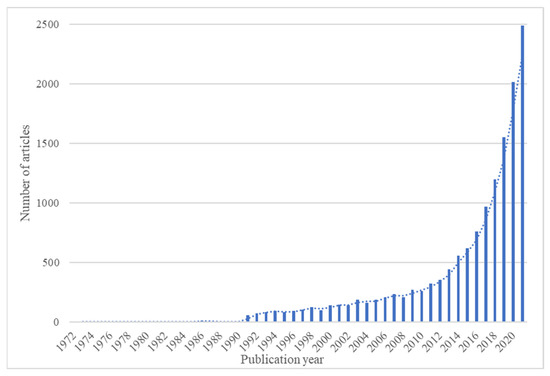
Figure 2.
Number of papers published in the field of lithium safety from 1972 to 2021.
As shown in Figure 2, the research on lithium technology security issues is divided into three phases based on annual publication statistics.
- Budding period (1972–1990): Relevant articles began to appear in 1972 but the number was relatively small, and only 43 articles were published in the field of lithium technology safety issues during this period. This indicates that the research on lithium technology safety issues has not yet been taken seriously and is in the initial period of exploration.
- Groundbreaking period (1991–2010): The number of articles published in this period shows a fluctuating upward trend, but the growth rate is slow. Some countries started late in this field and even did not publish articles in this period. However, it is clear that the number of papers achieved a double-digit breakthrough in 1991 compared to the previous period, thanks to the first commercial development of lithium batteries in 1991 [21].
- Developmental period (2011–2021): The number of research results in this period has grown significantly, and the increase has continued to be high, with a rapid rise. Especially after 2019, there is an unprecedented growth in the number of articles. Notably, 422 more relevant articles were published in 2020 compared to the previous year. This may be related to the fact that John B. Goodenough, M. Stanley Whittingham and Akira Yoshino won the 2019 Nobel Prize in Chemistry for lithium-ion battery research, which has greatly boosted the enthusiasm of researchers.
In recent years, the number of papers published related to the safety of lithium technology has shown an overall increasing trend. The reason for this is mainly because lithium technology is widely used in various industries. Inevitably, there are various safety problems in the application, which cannot be ignored but seriously endanger human life and property safety. In addition, in the context of low carbon, new energy has become the main direction of global development. Large-capacity lithium batteries have been applied to electric vehicles and will become one of the main power sources for electric vehicles in the 21st century. The continuous growth of the production and sales of new energy vehicles has driven up the demand for lithium batteries, while the rapid development of cell phones, electric vehicles, power tools, digital cameras and other industries has also driven the demand for lithium technology applications throughout society. In addition, lithium technology will be applied to artificial satellites, aerospace and energy storage in the future. Such a wide range of application scenarios must primarily address the safety issues of lithium technology in order to make its future development long and sustainable. Therefore, the research on lithium technology and its safety issues will continue to grow in the coming years.
Figure 3 shows the number of articles searched with the search term “lithium”, and the time range is set from 1972 to 2021. We can see that the overall trend is increasing. Combined with Figure 2, we can easily find that among the lithium-related research topics, the number of papers on lithium safety issues has been growing rapidly in recent years, faster than the overall number of papers in the lithium field. This indicates that in the process of lithium technology application and development, the topic of lithium safety is of great interest to scholars and has research prospects. This also shows the importance of studying this topic from the side.
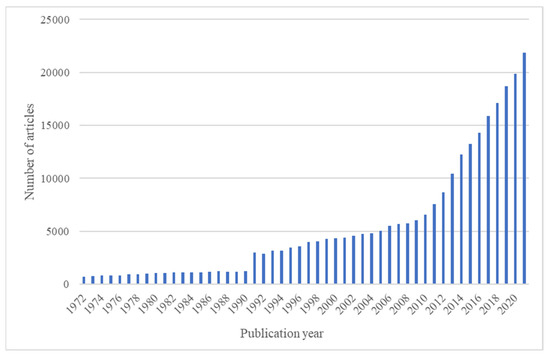
Figure 3.
Number of papers published in the lithium field from 1972 to 2021.
3.2. Citations
Citation analysis is a crucial tool for evaluating the caliber of publications since it captures the level of interest that a research issue generates among academics as well as the level of attention that the scientific community accords to an individual researcher’s work [22]. Table 1 lists the top 10 highly cited papers in the Web of Science core library on the topic of lithium technology safety from 1972 to 2021, in which the papers are classified according to the title, journal, total citations, and year of publication. Our research shows that most of the most highly cited papers are published in periodicals that are specialized in the field of materials science.

Table 1.
List of the top 10 highly cited papers.
3.3. Mainstream Journals
The top five journals in terms of the number of publications are the JOURNAL OF POWER SOURCES, JOURNAL OF THE ELECTROCHEMICAL SOCIETY, JOURNAL OF MATERIALS CHEMISTRY A, ACS APPLIED MATERIALS & INTERFACES, and ELECTROCHIMICA ACTA, as shown in Table 2. These journals are the mainstream journals of materials science, electrochemistry and physical chemistry, which indicate that lithium technology safety-related research has been a hot topic in chemistry.
Table 2.
Top 10 Journals by number of publications.
In addition, the JOURNAL OF AFFECTIVE DISORDERS and the JOURNAL OF CLINICAL PSYCHIATRY are the mainstream journals in the field of psychiatry, and the published articles mainly focus on the safety issues of lithium technology in medical applications. Lithium is an effective measure for the preventive management of acute mania and manic-depressive disorder. Despite the large number of articles published, they were published earlier, almost a decade ago. Interest in and research on lithium therapy has waned in recent years with the advent of new mood stabilizers.
3.4. Cooperation
3.4.1. Authors
Author collaboration network mapping can show the degree of cooperation, research influence and activity of researchers. The authors of the WOS database were analyzed using VOSviewer, with the analysis type set to co-author, authors as the analysis group, papers with more than 25 authors removed, the counting method set to a full count, and the minimum frequency of author occurrences set to 20, resulting in 136 authors. Some of the 136 items in the network are not connected to each other. The largest set of connected items consisted of 123 items. The set of connected items instead of all items. Notably, 456 connected lines and 12 clusters of authors were formed, see Figure 4. In author collaboration networks, the node size indicates the number of citations. Table 3 shows the top ten highly cited authors in the field of lithium technology security.
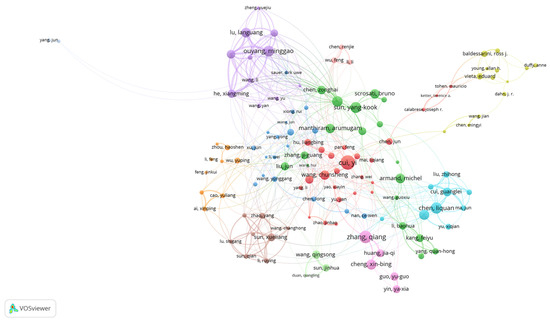
Figure 4.
456 connected lines and 12 clusters of authors were formed.
Table 3.
Top 10 highly cited authors in the field of lithium technology safety.
3.4.2. Organizations
Figure 5 reflects the cooperative relationships of research institutions in this field. The VOSviewer was used to analyze the institutions in the WOS database and the type of analysis was set as co-authorship and organizations were set as the analysis group. Papers with more than 25 institutions were excluded, the counting method was full counting and the minimum frequency of institutions was set as 20. There are 262 institutions, 3719 connecting lines, and 9 institutional clusters. The cooperation within and between institutional clusters is relatively close. Among them, the institution with the largest number of articles was the Chinese Academy of Sciences, with a total of 847 articles. Detailed results are shown in Table 4. In post number in the top 10 institutions, there are seven are research institutions and universities of China, Chinese Academy of Sciences, Tsinghua University, University of Science and Technology of China, University of Chinese Academy of Sciences, Beijing Institute of Technology, Shanghai Jiao Tong University, Huazhong University of Science and Technology. Harvard University, Argonne National Laboratory and Stanford University, all of which are from the United States, ranked 6th to 8th in that order.
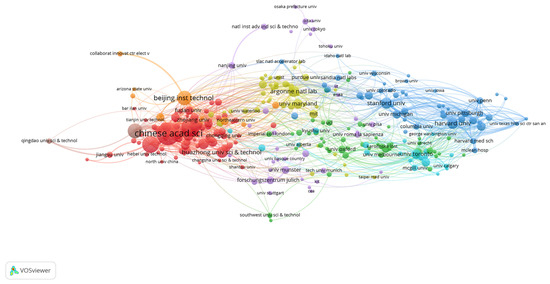
Figure 5.
Organizational cooperation network diagram.
Table 4.
Top 10 published institutions.
3.4.3. Countries
The country co-occurrence map reflects the collaboration of countries in this research area. The analysis type was set to co-authorship, and country was the analysis group. Papers from more than 25 countries were excluded, and the minimum number of country publications was set to 5. The counting method was full count, resulting in 921 connecting lines for 69 countries. As shown in Figure 6, they are divided into seven clusters. The thickness and length of the connecting lines indicate the closeness of the relationship between countries. Table 5 lists the top ten countries with the number of submissions. In the past 20 years, China ranked first in the world in terms of the number of articles published, with 5184, which is as much as 1.3 times more than the second-ranked United States.

Figure 6.
National cooperation network diagram.
Table 5.
Top 10 countries by number of publications.
3.5. Topic Analysis
3.5.1. Topic Clustering
In the keyword co-occurrence network, some keywords exist as singular and plural, but the software does not automatically process them. Therefore, we first build word sets for merging and processing singular and plural words. The analysis type was set as co-occurrence, the analysis group was set as all keywords (author keywords + keywords plus) and the counting method was set as full counting. The minimum occurrence frequency of keywords was set as 20. After human error correction and screening, 879 keywords were formed, and 67,612 complex association network lines were formed between each keyword. The larger the keyword circle is, the higher the frequency of its appearance. The thickness of the network line indicates the strong and weak connection relationship between keywords.
As can be seen from Table 6, the top 10 keywords with the highest frequency are Lithium-ion battery, lithium, performance, safety, battery, bipolar disorder, anode, cell, stability and behavior.
Table 6.
Top 10 keywords with occurrences.
Figure 7 shows the keyword co-occurrence label map, respectively. Five clusters were obtained by keyword clustering, and the keyword clusters corresponding to each research hotspot and some words with high weight in each cluster were summarized in Table 7. From each keyword cluster, it can be seen that the keywords in each cluster are correlated, and the clustering results have high credibility. The keywords were summarized and clustered into the following topics: lithium medical applications, electrolytes, electrochemical performance, battery health and management, and sustainability technology.

Figure 7.
Keyword co-occurrence network diagram.
Table 7.
Five types of research topics in the field of lithium technology safety.
3.5.2. Topic Evolution
Keyword co-occurrence mapping can analyze the research hotspots and their evolution during the period. The frequency of key occurrences is indicated by the size of the nodes, and the thickness of the connecting lines between the nodes intuitively reflects the sparseness of the connections between the keywords, which are positively correlated.
In Figure 8, the color changes from dark to light as time goes on. As can be seen, the application of lithium technology in the medical field is an early research topic. In recent years, the hot spots of research in related fields have focused on the performance and safety of lithium-ion batteries.

Figure 8.
Keyword clustering density map.
CiteSapce software was used to count the frequency of keywords appearing in papers at different stages of development. The keyword emergent mapping can demonstrate the phenomenon of word frequency surge, and the highlighted keywords are often considered to have a popular-oriented function in the research field. Based on this, the lithium security keyword emergent mapping was conducted: the emergent mapping parameters were set to γ = 0.5, and the default Minimum Duration was set to 2. The 106 emergent words were obtained, and the top 30 were taken, as shown in Figure 9. The keywords clustering density map was combined with the keywords clustering density map to obtain keyword and topic profiles in different periods.

Figure 9.
1972–2021 lithium technology safety issues keywords emergent map.
The results showed that the earliest publication was in 1972, and the number of articles during the budding period was 43, with an annual average of 2.26 articles/year, and the research theme was not yet obvious. The number of articles increased significantly in this phase of the foundation period, and the research themes gradually became obvious. The keywords “depression”, “bipolar disorder”, and “lithium carbonate” are the hot keywords, mainly in the medical application of lithium technology and lithium battery safety issues related to research. The number of literature in this period increased to 2955, with an average annual number of 147.75 articles/year. The development period is the most productive period, with 11,264 articles and an average annual publication volume of 1024 articles/year. The research topics are clearly distributed, with “composite”, “energy storage” and “electrode” as the hot keywords. Among them, the hot keyword in the past three years is “ion battery”, which indicates that scholars have gradually shifted their research focus to the safety performance improvement of lithium-ion batteries and other related topics.
The development of the lithium safety field is shown in Figure 10.

Figure 10.
Lithium technology safety theme development pulse chart.
4. Discussion
Based on bibliometric, we used CiteSpace and VOSviewer software to analyze the volume of postings, collaboration analysis, keyword co-occurrence and emergence analysis, as well as to map the visual knowledge graph in the field of lithium security from 1972 to 2021. The results of the study are as follows.
- The number of publications on lithium technology safety issues is in a steady upward trend throughout the study period, especially in the last 3–5 years. The overall number of publications has increased at a significant rate. It is worth mentioning that China leads the world in the number of published articles and far exceeds other countries. In terms of the mainstream journals published, the research topics are highly interdisciplinary, involving materials science, electrochemistry, physical chemistry, etc. Early related research also involved the medical field, which was attributed to the prevalence of lithium technology for medical applications.
- The analysis of cooperation and exchange among authors, institutions, and countries that publish articles using VOSviewer clearly shows that there is closer cooperation and more extensive exchange among international institutions. The degree of contact between domestic institutions in each country is also relatively high. However, in terms of the nature of institutions, most of them are universities and research institutes, and enterprises account for a relatively small number. Of course, this may be due to the fact that corporate R&D results are more often published in the form of patents rather than academic papers.
- Based on the keyword clustering hotspot analysis at each stage, the lithium safety field is more concerned with the safety and risk of lithium-ion batteries. Lithium battery is the most important application of lithium. Safety is the most important issue of lithium-ion batteries, especially for large lithium-ion batteries. The scope of research from the early focus on lithium in medical applications and thus the safety issues caused by the gradual shift to the health and safety of lithium batteries, such as based on electrochemical materials to improve the safety of lithium batteries, more focus on the performance optimization and sustainability of lithium batteries. Lithium technology and other technologies coupled with treatment effects, lithium battery performance optimization, and sustainable development, lithium technology involved in or mediated by the relevant modeling research should be the current and future research hotspots for quite some time.
Author Contributions
Conceptualization, H.Z; methodology, K.L. and Q.S.; software, Q.S.; validation, X.M.; formal analysis, K.L.; investigation, K.L.; resources, X.M.; data curation, K.L.; writing—original draft preparation, K.L. and Q.S; writing—review and editing, K.L. and H.Z; visualization, Q.S.; supervision, H.Z.; project administration, H.Z.; funding acquisition, H.Z. All authors have read and agreed to the published version of the manuscript.
Funding
This study was funded by The Second Tibetan Plateau Scientific Expedition and Research (2019QZKK1005).
Institutional Review Board Statement
Not applicable.
Informed Consent Statement
Not applicable.
Data Availability Statement
Not applicable.
Conflicts of Interest
The authors declare no conflict of interest.
References
- Kulova, T.L.; Fateev, V.N.; Seregina, E.A.; Grigoriev, A.S. A Brief Review of Post-Lithium-Ion Batteries. Int. J. Electrochem. Sci. 2020, 15, 7242–7259. [Google Scholar] [CrossRef]
- Katoh, T.; Inda, Y.; Nakajima, K.; Ye, R.; Baba, M. Lithium/Water Battery with Lithium Ion Conducting Glass–Ceramics Electrolyte. J. Power Sources 2011, 196, 6877–6880. [Google Scholar] [CrossRef]
- Baldessarini, R.J.; Pinna, M.; Contu, M.; Vazquez, G.H.; Tondo, L. Risk Factors for Early Recurrence after Discontinuing Lithium in Bipolar Disorder. Bipolar Disord. 2022, 24, 720–725. [Google Scholar] [CrossRef] [PubMed]
- Arena, P.; Del Nevo, A.; Moro, F.; Noce, S.; Mozzillo, R.; Imbriani, V.; Giannetti, F.; Edemetti, F.; Froio, A.; Savoldi, L.; et al. The DEMO Water-Cooled Lead–Lithium Breeding Blanket: Design Status at the End of the Pre-Conceptual Design Phase. Appl. Sci. 2021, 11, 11592. [Google Scholar] [CrossRef]
- Aubert, J.; Aiello, G.; Arena, P.; Barrett, T.; Boccaccini, L.V.; Bongiovi, G.; Boullon, R.; Cismondi, F.; Critescu, I.; Domalapally, P.K.; et al. Status of the EU DEMO HCLL Breeding Blanket Design Development. Fusion Eng. Des. 2018, 136, 1428–1432. [Google Scholar] [CrossRef]
- Ohzuku, T.; Ueda, A. Why Transition-Metal (Di) Oxides Are the Most Attractive Materials for Batteries. Solid State Ion. 1994, 69, 201–211. [Google Scholar] [CrossRef]
- Gores, H.; Barthel, J. Nonaqueous Electrolyte Solutions: New Materials for Devices and Processes Based on Recent Applied Research. Pure Appl. Chem. 1995, 67, 919–930. [Google Scholar] [CrossRef]
- Kalluri, S.; Seng, K.H.; Guo, Z.; Liu, H.K.; Dou, S.X. Electrospun Lithium Metal Oxide Cathode Materials for Lithium-Ion Batteries. RSC Adv. 2013, 3, 25576. [Google Scholar] [CrossRef]
- Balakrishnan, P.G.; Ramesh, R.; Kumar, T.P. Safety Mechanisms in Lithium-Ion Batteries. J. Power Sources 2006, 155, 401–414. [Google Scholar] [CrossRef]
- Hendricks, C.; Williard, N.; Mathew, S.; Pecht, M. A Failure Modes, Mechanisms, and Effects Analysis (FMMEA) of Lithium-Ion Batteries. J. Power Sources 2015, 297, 113–120. [Google Scholar] [CrossRef]
- Chombo, P.V.; Laoonual, Y. A Review of Safety Strategies of a Li-Ion Battery. J. Power Sources 2020, 478, 228649. [Google Scholar] [CrossRef]
- Abada, S.; Marlair, G.; Lecocq, A.; Petit, M.; Sauvant-Moynot, V.; Huet, F. Safety Focused Modeling of Lithium-Ion Batteries: A Review. J. Power Sources 2016, 306, 178–192. [Google Scholar] [CrossRef]
- Tang, X.; Lv, S.; Jiang, K.; Zhou, G.; Liu, X. Recent Development of Ionic Liquid-Based Electrolytes in Lithium-Ion Batteries. J. Power Sources 2022, 542, 231792. [Google Scholar] [CrossRef]
- Liu, H.; Miao, C.; Meng, Y.; Xu, Q.; Zhang, X.; Tang, Z. Effect of Graphene Nanosheets Content on the Morphology and Electrochemical Performance of LiFePO4 Particles in Lithium Ion Batteries. Electrochim. Acta 2014, 135, 311–318. [Google Scholar] [CrossRef]
- Terry, B.C.; Sippel, T.R.; Pfeil, M.A.; Gunduz, I.E.; Son, S.F. Removing Hydrochloric Acid Exhaust Products from High Performance Solid Rocket Propellant Using Aluminum-Lithium Alloy. J. Hazard. Mater. 2016, 317, 259–266. [Google Scholar] [CrossRef] [PubMed]
- Maddu, N.; Raghavendra, P.B. Review of Lithium Effects on Immune Cells. Immunopharmacol. Immunotoxicol. 2015, 37, 111–125. [Google Scholar] [CrossRef] [PubMed]
- Kavanagh, L.; Keohane, J.; Garcia Cabellos, G.; Lloyd, A.; Cleary, J. Global Lithium Sources—Industrial Use and Future in the Electric Vehicle Industry: A Review. Resources 2018, 7, 57. [Google Scholar] [CrossRef]
- Lithium Supply and Demand to 2030. Available online: https://www.fastmarkets.com/insights/lithium-supply-and-demand-to-2030 (accessed on 23 January 2023).
- Barnett, B.; Ofer, D.; Sriramulu, S.; Stringfellow, R. Lithium-Ion Batteries, Safety. In Batteries for Sustainability: Selected Entries from the Encyclopedia of Sustainability Science and Technology; Brodd, R.J., Ed.; Springer: New York, NY, USA, 2013; pp. 285–318. ISBN 978-1-4614-5791-6. [Google Scholar]
- Zhang, Y.; Guo, Y.; Wang, X.; Zhu, D.; Porter, A.L. A Hybrid Visualisation Model for Technology Roadmapping: Bibliometrics, Qualitative Methodology and Empirical Study. Technol. Anal. Strateg. Manag. 2013, 25, 707–724. [Google Scholar] [CrossRef]
- Thackeray, M. Running with Lithium—Empowering the Earth: A Personal Journey; Archway Publishing: Bloomington, IN, USA, 2019; ISBN 1-4808-7608-9. [Google Scholar]
- He, M.; Zhang, Y.; Gong, L.; Zhou, Y.; Song, X.; Zhu, W.; Zhang, M.; Zhang, Z. Bibliometrical Analysis of Hydrogen Storage. Int. J. Hydrogen Energy 2019, 44, 28206–28226. [Google Scholar] [CrossRef]
Disclaimer/Publisher’s Note: The statements, opinions and data contained in all publications are solely those of the individual author(s) and contributor(s) and not of MDPI and/or the editor(s). MDPI and/or the editor(s) disclaim responsibility for any injury to people or property resulting from any ideas, methods, instructions or products referred to in the content. |
© 2023 by the authors. Licensee MDPI, Basel, Switzerland. This article is an open access article distributed under the terms and conditions of the Creative Commons Attribution (CC BY) license (https://creativecommons.org/licenses/by/4.0/).