


Abstract
Brisbane, Australia will host the Olympic and Paralympic Games in 2032—the first to be contractually obliged to be Climate Positive. This commitment can be achieved through a combination of two levers: emission reduction measures and carbon offsets. The objective of this study is to determine which combination of these levers is likely to maximise sustainability and its social, economic, and ecological dimensions. Based on these dimensions and the perspective of technology determinism, a novel sustainability assessment model is developed. Then, through a document analysis, this study uses emissions data to analyse and evaluate three different combinations of carbon offsets and renewable energy. Results showed that a higher reliance on carbon offsets resulted in poorer sustainability outcomes for this mega-event. The most sustainable scenario, involving large-scale investment in renewable energy infrastructure, involved significant cost implications but is likely to create greater legacy outcomes. Key recommendations include improving the governance and socialisation of Climate Positive delivery, and increasing partnerships with the private sector. Doing so will help enhance the authenticity and legacy of Climate Positive commitments for host regions.
Keywords:
Olympic Games; Brisbane; Queensland; carbon management; sustainability; Net Zero; mega-events 1. Introduction
1.1. Background and Context
The 2032 Olympic and Paralympic Games, to be hosted in Brisbane, Queensland, Australia, are the first to be contractually obliged to be delivered as “Climate Positive”. The Games are also the first to be awarded under the International Olympic Committee (IOC)’s New Norm, adopted as part of Olympic Agenda 2020, which seeks to minimise costs, complexity, risk and waste; and maximise sustainability, flexibility, efficiency and partnerships [1]. Sustainability and climate commitments have been increasing in recent Olympics, with the Tokyo 2020 Games officially achieving carbon neutrality, and subsequent Games all committed to delivering similar commitments [2].
With this increasing focus on carbon emissions, a fundamental design choice in Games delivery is emerging: the extent to which carbon offsets are used. Further, in the case of Brisbane 2032, the contractual delivery of a Climate Positive Games, by its very definition, necessitates carbon offsets to be an unavoidable part of Games planning and hosting. While carbon offsets have some level of appropriateness for discrete, time-bound activities such as major events, an over-reliance on offsets may reduce opportunities for longer-term emissions reductions (e.g., through decarbonisation of electricity systems) which can form part of a Games legacy [3].
While a number of sustainability assessments exist for infrastructure investment decision-making [4,5,6,7,8,9,10,11], the evaluation of carbon offsets and emissions reduction measures for mega-events has not been proposed in the literature, especially in the context of Net Zero and Climate Positive commitments. The research questions that this paper seeks to address are two-fold: firstly, how can carbon offsets and emissions reduction measures be evaluated from a sustainability perspective? And secondly, for the case of the Brisbane 2032 Olympic and Paralympic Games, which combination of these levers is likely to maximise sustainability and its social, economic, and ecological dimensions? This paper addresses these questions by developing a novel sustainability assessment, and then evaluating three potential scenarios for Brisbane 2032 Games delivery, with varying combinations of offsets and renewable energy.
1.2. Brisbane 2032 and Its Climate Positive Commitments
Brisbane is a city of 2.5 million people on the east coast of Australia, capital of the state of Queensland, and part of a wider conurbation in Southeast Queensland of 3.5 million. The city has held ambitions of hosting the Olympic and Paralympic Games since its successful 1982 Commonwealth Games and 2001 Goodwill Games, and prepared and submitted a bid to host the 1992 Summer Olympics. Brisbane stands out from larger, more well-known cities that have been awarded the Summer Olympics recently, including London (2012), Rio de Janeiro (2016), Tokyo (2020–2021), Paris (2024) and Los Angeles (2028). The success of Brisbane’s 2032 bid, and its future success in Games delivery and legacy benefits, may pave the way for other mid-size cities around the world to host Summer Olympic and Paralympic Games [12].
Brisbane started to prepare its Olympic and Paralympic Games bid through a pre-feasibility study in 2016 [13]. In 2018, the 132nd session of the IOC made major reforms to Games bidding processes and hosting expectations, encouraging more transparency and a lower-cost, more flexible and sustainable delivery model—known as Olympic Agenda 2020—The New Norm [1]. The New Norm encouraged future Games bids to align with long-term development goals of the host region, use existing and temporary venues, and allowed the hosting of events over a wider geographical area than in previous Games [1]. These reforms were critical for Brisbane, allowing organisers to advance planning of a Games bid involving the wider conurbation of Southeast Queensland with its many existing stadia (including those built for the Gold Coast 2018 Commonwealth Games). With the COVID-19 pandemic creating a highly uncertain global environment (including the unprecedented postponement of the Tokyo 2020 Games to 2021), Brisbane’s advanced bid represented a high degree of stability and certainty for the IOC [14]. At the 138th session of the IOC in June 2021, a full 11 years before the event, Brisbane was awarded the rights to host the 2032 Olympic and Paralympic Games.
In March 2020, the IOC announced that all future Olympic Games will be Climate Positive from 2030. This was intended to “lead both the global effort to combat climate change and to leave a tangible, positive legacy for the planet” [15]. As the next host city awarded the Games after this announcement, Brisbane 2032 is thus the first to have committed to this Climate Positive outcome, via its Host Contract [16,17]. Delivering a Climate Positive Olympic and Paralympic Games means going beyond Net Zero, a concept where emissions of greenhouse gases to the atmosphere are balanced by compensation (via carbon capture and offsets) [18]. Climate Positive goes beyond this balance by compensating for more than 100% of the residual emissions related to Olympic activities [19]. This concept is illustrated in Figure 1. Specifically, the IOC defines Climate Positive as:
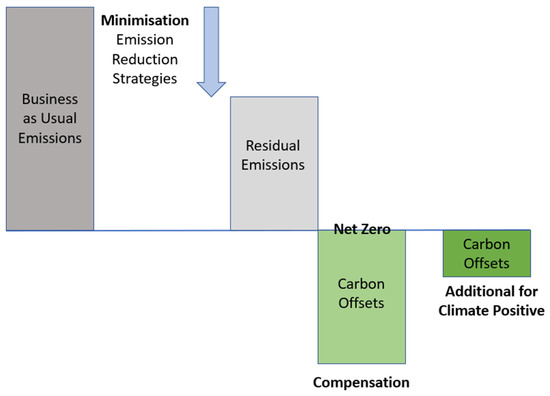
Figure 1.
Minimisation and compensation efforts to achieve Climate Positive commitments—each block represents a quantity of carbon dioxide (CO2).
- Minimising and compensating the direct and indirect emissions related to the Games.
- Implementing long-term zero-carbon solutions for the Olympic Games and beyond.
Details of the extent of minimising (via emission reduction measures) and compensating (via carbon offsets) for Brisbane 2032 are currently under development [19]. The IOC’s reference to long-term zero-carbon solutions implies a legacy element in the delivery of a Climate Positive Games. Thus, the trade-offs in the minimisation/compensation mix warrants examination from a sustainability and legacy perspective.
The long lead time of Brisbane 2032 provides the opportunity to create a positive legacy to accelerate Queensland’s emission reduction and renewable energy targets [20]. The Brisbane 2032 bid documents [20,21] contain a commitment to minimise Games’ emissions as much as possible. In response, the IOC accepted a Climate Positive delivery plan [14] which contains emissions reduction and renewable energy targets for Queensland:
- 50% renewable energy by 2030.
- An economy with zero net emissions by 2050, with an interim target to reduce emissions by 30% below 2005 levels by 2030.
The use of carbon offsets is an increasingly popular tool for organisations and nations in efforts to achieve Net Zero carbon emissions by 2050, a key commitment of the Paris Climate Agreement [22]. Offsets have been embraced by the IOC as a Climate Positive action at an organisational level, including the announcement of the establishment of an Olympic Forest [15]. Plantation forests have been referred to as part of Brisbane’s delivery of a Climate Positive Games [23].
However, carbon offsets are viewed as the lowest priority of the carbon management hierarchy [24]. Some argue that carbon offsets provide a mechanism for organisations and nations to continue Business-As-Usual emissions, rather than reducing emissions at the source [25,26]. Offset projects are varied and can have considerable costs, including carbon-capture and storage (CCS), forestry sequestration, as well as carbon credits generated from external entities such as energy efficiency measures and renewable energy projects. There are also risks and controversies with a number of offset types. In plantations, carbon sequestration can be slow and can be affected by natural disasters such as bush fires and droughts [3]. In addition, the concept of offsets derived from avoiding vegetation clearing can be nebulous [27].
1.3. Sustainability and Carbon Management in the Olympic and Paralympic Games
The Olympic Agenda 2020—The New Norm was the IOC’s response to address and minimise the impacts of the Olympic Games on the environment. Its follow-up plan, Olympic Agenda 2020 +5 [28], commits to the delivery of Climate Positive Olympic Games by 2030 at the latest. However, scholars such as Gold and Gold [29] have commented that the IOC has failed to provide a coherent definition of the dimensions of sustainability and have noted a persistent gap between rhetoric and reality in the sustainability commitments of the Olympic host cities. This has been compounded by the complexities of the evolving notion of sustainability in mega-events [11]. Some scholars consider that mega-events such as the Olympic Games, with their large infrastructure, travel, and operational requirements, are impossible to be truly sustainable—and as such, sustainability claims are pursued more as a branding and “greenwashing” exercise [30]. Others consider that such events, with defined scopes, provide an opportunity to exercise agency by host governments to achieve sustainability outcomes. Such events may also provide an opportunity to showcase innovations and can effectively mainstream sustainability practices in local and global realities [31]. Increasingly, sustainability outcomes are seen as a key component of the legacy outcomes of the Olympics [32,33,34]
Climate impacts of the Olympics and Paralympics have been actively measured since the 2010 Winter Games in Vancouver [35]. An increasing convention in Olympic Games sustainability reporting (pre- and post- Games) is to separate emissions into three distinct categories:
- Construction: This includes construction of stadia (new, temporary, or refurbished), athletes’ villages, training facilities, and broadcasting and press centres, as well as infrastructure developments such as public transport, electricity, waste, water, and communication networks. A large proportion of construction emissions arise from material choices [12].
- Operations: Associated with the organisation and running of the Games which includes overlay, electricity, and fuel usage as well as domestic and international transport and accommodation of “Games family” (athletes, IOC members, media, and the non-resident workforce).
- Spectators: international and domestic transport of spectators to the host city, and accommodation, transport, and food while they are in the city.
These three emission sources, and any accompanying offsets, together form a carbon budget for the host city. Figure 2 shows the carbon footprints of Summer and Winter Olympic and Paralympic Games since 2008, based on official sustainability reports from the associated Olympic committees. Summer Olympics tend to have a significantly greater carbon footprint due to higher numbers of athletes and visitors (generally up to half a million people per Games), larger stadia and more extensive transport infrastructure [36]. The figure shows that carbon offsets have been employed as a key carbon management tool since the 2014 Winter Olympics in Sochi, Russia [37]. In the Sochi Games, carbon neutrality was achieved by offsets derived from sustainable farming and energy efficiency measures. Rio de Janeiro’s hosting of the 2016 Summer Olympics had a high number of spectators [38], resulting in high associated emissions. It also had an extensive compensation program through reforestation, with more than 24 billion trees planted, capturing 202 million tonnes of carbon dioxide (Mt CO2) [39].
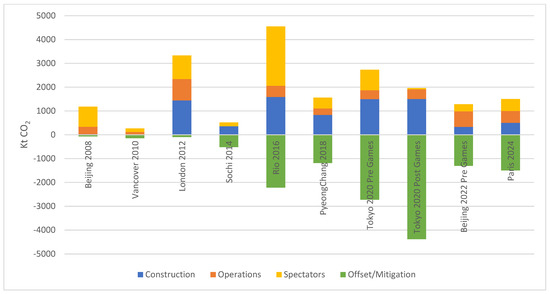
Figure 2.
Carbon footprints of recent Olympic Games including emissions categories and associated offsets [2,37,39,40,41,42,43].
The Tokyo Olympic and Paralympic Games, planned for 2020, were severely disrupted by the global COVID-19 pandemic and re-scheduled to 2021. The pre-Games emissions estimations [2] provide a useful reference point in the running of a modern Olympics. The Tokyo Games committed to prioritising renewable energy and had an extensive offset program to compensate unavoidable emissions. Zero-emission vehicles, including hydrogen cars, were a feature of the official fleet in Tokyo. The Tokyo Games were held in 2021 with no spectators due to COVID-19 restrictions; this resulted in these Games being the most ecologically friendly to date [44]. The use of cap-and-trade programs and emissions trading schemes meant that offsets over-compensated emissions by 2.42 Mt CO2, resulting in the Games in 2021 being Climate Positive [41].
Carbon neutrality is the objective of the Beijing 2022 Winter Olympic and Paralympic Games, which committed to using 100 per cent renewable energy for all Olympic venues [43]. Currently, only pre-Games estimates of offsets compensating for expected emissions are available.
Paris 2024 is the first Olympic and Paralympic Games to fully implement Olympic Agenda 2020, and is committed (although not obliged contractually) to deliver a Climate Positive Olympic and Paralympic Games [45]. The Games aim to limit emissions to 1.5 Mt CO2 (less than half that of London 2012’s 3.3 Mt CO2) and 95% of its venues will be existing or temporary. Paris 2024 also plans to be the launchpad of innovations in technologies to reduce emissions [42], including a digital interactive virtual venue that will reduce the need for physical visits by stakeholders and spectators [46]. Looking further ahead, Milano Cortina’s 2026 Winter Games and Los Angeles’ 2028 Summer Games have committed in their Host City contracts to achieve carbon neutrality [15]. The FIFA World Cup 2022, held in Qatar, committed to deliver a carbon neutral event by advancing low-carbon solutions, implementing numerous energy efficiency practices, and notably, had a large reliance on carbon offsets via tree plantations [47,48].
1.4. Contribution of the Study
Increasingly, the hosting of mega-events such as the Olympic Games includes sustainability commitments such as Net Zero or Climate Positive [11]. While there are sustainability assessment tools in literature for infrastructure, there are no specific event-orientated assessments to facilitate decision-making around the two principal levers for mega-event carbon management, emissions reductions (minimisation) and carbon offsets (compensation). This paper addresses this gap by developing a sustainability assessment model, providing a novel contribution to assess decisions regarding economic, social, and environmental legacies.
The paper then applies this model to Brisbane 2032, where sustainability planning is in its early stages. The Brisbane 2032 host website states, “Brisbane 2032 aspires to create a legacy for the people of Queensland and Australia by leveraging … the Games as a catalyst to enhance social, economic, and environmental outcomes for our communities.” [49]. This study may be able to contribute to, and influence, the discussions about the Climate Positive strategy for Brisbane 2032, and the broader discourse about the composition of Net Zero strategies for events, companies, and governments.
2. Materials and Methods
2.1. Methodology Overview
The methodological steps used in this study are outlined in Figure 3. The overarching method is through document analysis. The first research question concerning the sustainability assessment of mega-events, is addressed through two steps: the development of the sustainability assessment model, and the scorecard framework for sustainability dimensions. The other steps address the specific case study of the Brisbane 2032 Olympic and Paralympic Games, including the development of scenarios for Climate Positive delivery, and emissions assumptions.
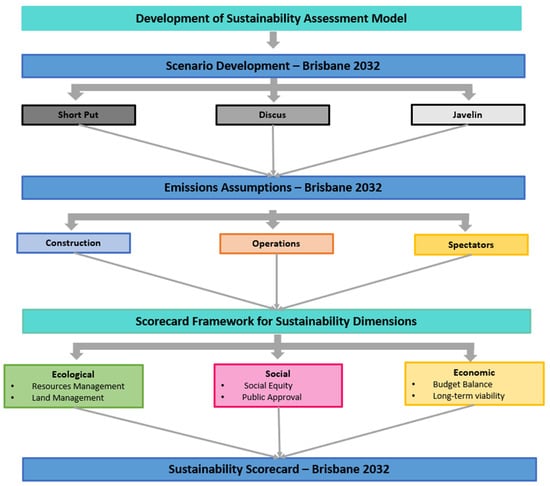
Figure 3.
Methodology overview.
2.2. Sustainability Assessment Model
The development of a novel methodology is aligned to the first research question of this study: namely, how can carbon offsets and emissions reduction measures be evaluated from a sustainability perspective? The assessment comes from a technology determinism perspective, where the combination of technologies chosen (in this case, renewable energy infrastructure and carbon offsets) will determine societal outcomes, which are manifest in three dimensions of sustainability: social, economic, and ecological.
In examining previous literature, a number of studies have considered the assessment of sustainability of energy systems and events. As shown in Table 1, they vary across system boundaries, methodologies, and approaches. From the literature review, five sustainability assessments have been used in mega-events such as the Olympic Games. Three assessments [4,5,6] focussed solely on environmental aspects of sustainability, whilst one assessment [10] used qualitative approaches and did not consolidate the sustainability dimensions into a score. Another, authored by Müller et al. [11] developed a conceptual model to evaluate the sustainability of previous Olympic Games and is further discussed below. None of the examined studies considered carbon offsets in the assessment of sustainability. Thus, the literature review showed that there is a gap regarding sustainability assessment methodology for evaluating both emission reductions and offset actions for discrete mega-events.

Table 1.
Recent studies on sustainability assessments.
Considering this review, a novel sustainability assessment model has been developed and applied in this study, which builds on many of the concepts introduced by Müller et al. They define “Sustainable Olympic Games” across three dimensions: a limited ecological and material footprint; improving social justice outcomes; and improving economic efficiencies. By equally weighting the three dimensions, Müller et al.’s definition and subsequent model occupies a “middle ground” between stronger notions of sustainability (which prioritise ecological limits over social and economic improvements) with weaker notions that may have a greater focus on social and economic development. This principle is consistent with the Sustainable Development Goals and the Paris Agreement [11].
Müller et al.’s model provides a systemic longitudinal approach to evaluate the sustainability of mega-events, based on the evaluation of post Games data. This model enabled comparison of 16 editions of the Summer and Winter Olympic Games between 1992 and 2020. In this present study, aspects of Müller et al.’s model have been modified to develop a new sustainability assessment model to compare Climate Positive scenarios of the same event (the Brisbane 2032 Olympic and Paralympic Games). The number of indicators used to evaluate each dimension has been reduced from three to two (due to relevancy), and in some cases, indicators have been substituted (due to availability of data).
This study undertook two steps to ensure the model’s validity. First, content validity was ascertained by determining whether each of the indicators in the model was relevant for assessing the sustainability of a Climate Positive Games. Second, attribution validity was checked by ensuring that the value assigned to each indicator could plausibly be attributed to the scenarios considered. Figure 4 presents the sustainability assessment model, its dimensions, and indicators.
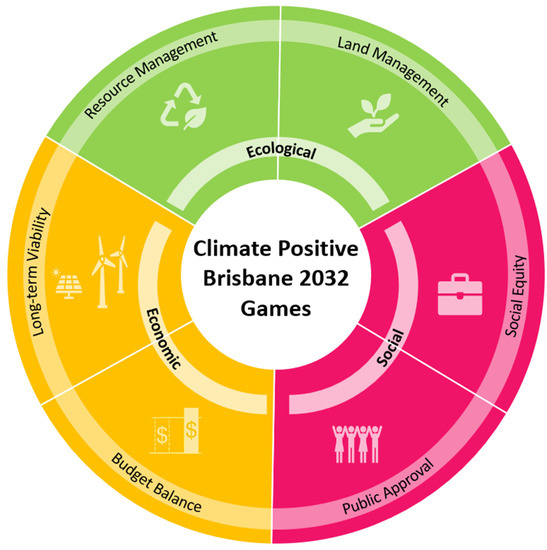
Figure 4.
The sustainability assessment model for Climate Positive scenarios for Brisbane 2032.
Based on the six indicators, a detailed score card was developed (Section 2.4) to apply the sustainability model for the case of Brisbane 2032. Each scenario was then scored via the six indicators on a scale from 0 to 100, where 0 means ‘least sustainable’ and 100 ‘most sustainable’. To do this, the evaluation uses statements and estimates from the Brisbane 2032 bid documentation, and a baseline of emissions estimations from London 2012 and Tokyo 2020 (compiled prior to the rescheduling of these Games) (see Appendix A, Table A1). The assessment uses both qualitative and quantitative data, with justifications and references to literature.
2.3. Scenarios and Emissions Estimations
With the mix of emissions reduction (minimisation) and carbon offset (compensation) measures still in the planning stages for Brisbane 2032 Games, this paper sets out three Climate Positive scenarios, that are then evaluated using the sustainability assessment model. The three scenarios have been named after Olympic track-and-field throwing events (shot put, discus and javelin), to highlight the notion of ambition and achievement in a defined field of play. The scenarios names also align the extent of emissions reduction measures (predominantly via the deployment of new renewable energy infrastructure) with the typical distances thrown in each event. Details of these scenarios are presented in Table 2 and discussed below.
Table 2.
Key assumptions made across the study’s three scenarios.
The Brisbane 2032 bid documents form a base-case scenario, labelled DISCUS, which centres around the Queensland Government’s commitments to transition the state to 50% renewable energy, and reduce emissions by 30% of 2005 levels, by 2030. Regarding transport, the bid documents commit to operating a carbon-neutral Games fleet for client groups and have targeted 90% of the spectator travel in the Games region to be via public and active transport. In this scenario, the bid documents commit to 80% of Games venues being existing or temporary, and all new infrastructure having a 6-star Green Star rating [50,51]. The emissions intensity from spectator travel (flights, etc.) remains high, requiring significant carbon offsets to achieve a Climate Positive outcome.
From this base case scenario, a scenario is considered in which emissions reductions are maximised via a range of measures, including the complete decarbonisation of Queensland’s electricity network—by retiring fossil fuel generation systems and investing in renewable energy. This scenario, labelled JAVELIN, is more radical, pushing the boundaries of what can be practically achieved in the wider host state, Queensland. The JAVELIN scenario produces larger legacy benefits in the area of infrastructure—using the Games to accelerate the transition to a zero-emissions system to power the entire state [52,53].
The decarbonised electricity system would result in zero emissions of Games operations at venues and the region’s domestic transport system. This scenario requires significant material consumption in the construction of new renewable energy infrastructure. Games venues would target a 90% usage of existing facilities, and all new infrastructure would have a 6-star Green Star rating [50,51]. It was assumed that aviation emissions in this scenario would be further reduced through the use of Sustainable Aviation Fuels (SAF) in all domestic aviation services during the Games [54,55,56]. The use of SAF in international aviation services was considered to be beyond the control of the Games organisers. Overall, even in this optimistic JAVELIN scenario, the use of carbon offsets will be required to achieve a Climate Positive Games.
The SHOT PUT scenario is based on the energy mix of Queensland in 2022, essentially representing a ‘do-nothing’ or status-quo situation. It was felt that including this scenario, which sees no changes to the Queensland energy mix and transport facilities between now and 2032, illustrates an extreme scenario of higher emissions-intensive Olympic Games, supplemented by greater carbon offsets to achieve Climate Positive. New venues would be constructed using existing building standards, for example. The extended workings and data sources for emissions estimations are available in the Appendix A (Table A2, Table A3, Table A4, Table A5, Table A6, Table A7, Table A8 and Table A9).
All scenarios have several assumptions in common. Firstly, it is assumed that carbon offsets will be achieved by new tree plantations planted over several years, in the state of Queensland. Secondly, it is assumed that emissions from international aviation were unavoidable and constant across all three scenarios. It is assumed that in 2032, there will similar aviation emissions as in 2022, except for decarbonised domestic aviation in the JAVELIN scenario. The underlying assumption across all scenarios was that emissions reduction would occur to the maximum extent possible, before compensating for the residual emissions through offsets.
Emissions Assumptions
For each of the scenarios, detailed assumptions across the aspects of construction, operations, and spectators were considered, allowing the evaluation of the three dimensions of sustainability and their corresponding indicators. A key bid document for Brisbane 2032, the Future Host Commission Questionnaire Response [14], provides preliminary details of climate and carbon commitments. These include a commitment to calculate the Games’ carbon budget using the IOC carbon footprint methodology (2018); to use an independent Climate Active registered consultant to monitor and verify carbon management; and to publicly disclose emissions reduction measures and a registry of carbon offsets. The Questionnaire Response and other bid documentation do not contain any data on estimates of energy use or emissions, and their resultant carbon footprint. Thus, previous host cities’ emissions data is used to inform the estimation of Brisbane 2032 emissions, initially under the SHOT PUT scenario of 2022’s emissions intensity, and then extrapolated to DISCUS and JAVELIN scenarios.
Emissions data for Olympic and Paralympic Games are estimated in pre-Games reports, and actual emissions are reported in post-Games reports. Since 2018, this reporting has generally followed the IOC carbon footprint methodology [57]. However, disaggregated emissions data have also been reported for earlier Games, including Beijing 2008 and Vancouver 2010 [58,59]. One of the issues with the disaggregated emissions data from pre- and post-Games sustainability reports is that the categorisation of emissions has lacked consistency between Games hosts. Thus, using two or more Games hosts’ emissions data has helped to triangulate Brisbane 2032 estimates.
The Council of Mayors’ Feasibility Study [60] states that Brisbane 2032 Games delivery will use London 2012 as a benchmark, including energy policy and demand, Games operations plans, venue capacities and design principles. Total emissions for London 2012 (before offsets were considered) were 3329 kilo-tonnes (kt) CO2 [40]. The most recent Games, in Tokyo, were projected to have similar total emissions (before offsets), of 2730 kt CO2 [2]. The 2016 Summer Olympic and Paralympic Games in Rio de Janeiro had higher emissions (before offsets) than Tokyo 2020 and London 2008 and did not follow their distribution patterns – and thus, data from Rio 2016 is not used to inform Brisbane emissions estimations. The emissions intensity in the United Kingdom during London 2012 was 0.46 t CO2/megawatt-hour (MWh) [61]; while in Japan during the Tokyo Games, emissions intensity was 0.506 t CO2/MWh [62]. These are lower than Queensland’s emissions intensity in 2020 (0.78 t CO2/MWh [63]). Based on this data, this study assumes that Brisbane 2032’s emissions (before offsets) under the status-quo SHOT PUT scenario will be 3665 kt CO2.
Generally, projected emissions data for the three scenarios considered for Brisbane 2032 were based on pre- and post-Games sustainability reports for London 2012 [40,64] and Tokyo 2020 [2,41]. London and Tokyo had similar emissions patterns across the three categories of Games delivery (Construction, Operations and Spectators), and thus formed the basis for the breakdown of the SHOT PUT scenario for Brisbane 2032. This was supplemented with statements and parameters collected from official reports and press releases on Brisbane 2032.
2.4. Scoring
To evaluate the sustainability level of the three Brisbane 2032 Climate Positive scenarios, three sustainability dimensions (ecological, social, and economic) and six associated indicators were used. The study considers the economy wide changes to achieve each scenario’s outcomes, e.g., state-wide energy system infrastructure improvements. The dimensions, indicators and variables are summarised in the scorecard framework presented in Table 3. For most indicators, proxy variables were used to provide meaningful data. The table provides commentary on the levels of plausibility of these proxy variables, as well as their relationship to sustainability. The scoring method has been developed specifically for this study and the Brisbane 2032 context. Each proxy variable’s score is scaled from 0 to 100 (in increments of 20) based on data derived for Brisbane 2032.
Table 3.
Scorecard framework for sustainability dimensions.
The ecological dimension is composed of resource management (estimated emissions from energy consumption) and land management (land required for energy generation and carbon offsets—calculated based on data of the annual net changes in carbon stock [65]. These are determined for each scenario based on the facilities, penetration of renewable energy and alternative fuel usage in powering venues and the transition towards more sustainable transport.
The social dimension is composed of Social Equity and Public Approval indicators. Proxy data for Social Equity was based on the estimated jobs created under each scenario, while Public Approval scores were estimated by polls and policy surveys in Australia. Finally, the economic dimension includes a Budget Balance indicator (based on the cost, in Australian dollars, of additional renewable energy infrastructure and carbon offset plantations) and a Long-term Viability indicator. Cost data was collected from various Queensland Government reports related to future investments in the Emission Reduction Fund and the Land Restoration Fund. Long-term Viability was estimated based on the degree of anticipated after-use of infrastructure and facilities. Detailed calculations and information sources are included in the Appendix A of this paper.
3. Results
A visual overview of the results of the scoring of each scenario against the indicators is shown in Figure 5, and a bar chart of the results is shown in Figure 6. Further, Table 4 shows the indicator data and scorecards for each scenario. Overall results show the considerable differences in sustainability dimensions according to the emissions reductions/offset mix of each scenario.
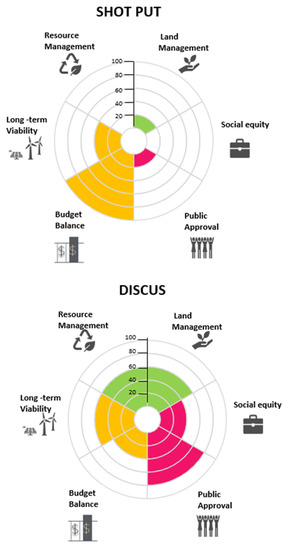
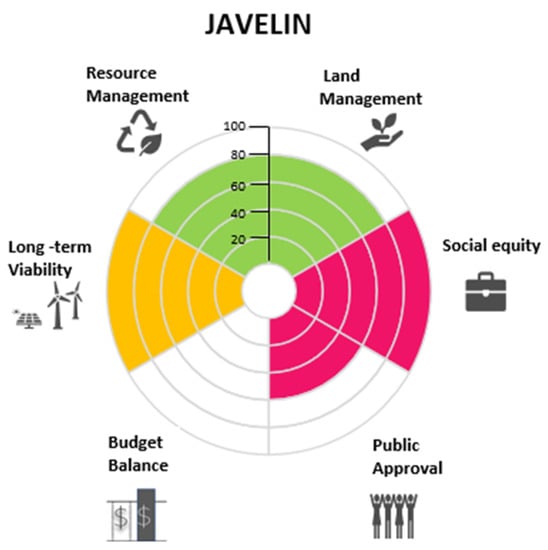
Figure 5.
Sustainability scoring of individual scenarios for Brisbane 2032.
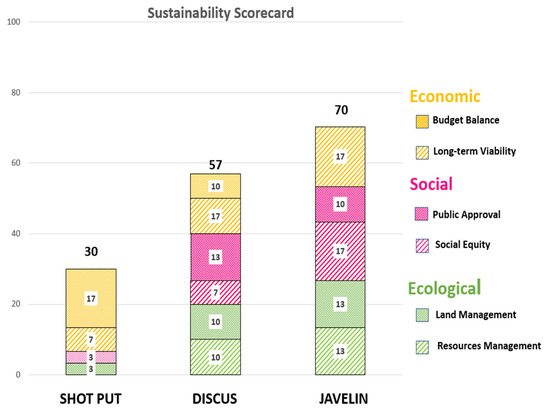
Figure 6.
Sustainability Scorecard for Brisbane 2032.
Table 4.
Data and sustainability assessment model scorecard for various scenarios.
The SHOT PUT scenario, based on the current 2022 electricity mix of Queensland and higher compensation through offsets, scores lowest on the ecological and social dimensions of sustainability. Plantation forests for the offsets will require significant land, leading to a low score for land management. Evidence suggests that a heavy reliance on offsets, when not accompanied by significant emissions reductions, has low public support. In the economic dimension, SHOT PUT requires no additional energy infrastructure, with investment solely in offsets ($122 million) to deliver a Climate Positive Games. This scenario represented the lowest cost option and was scored 100 for the Budget Balance indicator. However, the Long-term Viability of this scenario receives a low score, with the high use of plantation offsets providing only limited longevity, and no additional long-term electricity infrastructure.
The DISCUS scenario, based on the Brisbane 2032 bid documents, calls for continued commitment to Queensland’s emission reduction and renewable energy targets—most notably, the target of 50% renewable energy by 2030 [20]. This gradual increase in renewable electricity capacity, along with the progressive retirement of fossil fuel generation, would still generate 1783 kt CO2, which would require compensation via offsets. This policy has been part of the election platform of recent Queensland Government elections (as recently as 2020) and enjoys bi-partisan political support; recent surveys have shown that this policy setting has high levels of public support [66,67].
The DISCUS scenario incorporates zero-emissions Games Family transport, but Spectators public transport will still generate emissions. The land area required for generating the additional renewable energy, and the forestry areas required for offsets, reduce the Land Management score of the DISCUS scenario compared with SHOT PUT. The DISCUS scenario requires the Queensland Government’s stated pipeline of infrastructure including 5774 MW of new wind and solar projects, costing $10.9 billion [68]. The cost of offsets in this scenario is estimated at $62 million, producing an overall Budget Balance score of 20. This scenario would deliver around 7900 full-time jobs in new renewables, and 89 jobs in offsets, resulting in a score of 60 for the Social Equity indicator. The Long-term Viability score for the DISCUS scenario is higher than SHOT PUT due to the renewable energy infrastructure to be installed. It was found that DISCUS and JAVELIN scenarios, with new infrastructure constructed to a 6-star Green Star rating, have 65% lower emissions in construction than in the SHOT PUT scenario.
The JAVELIN scenario represents the most ambitious plan, with Queensland’s electricity system moving to zero emissions by 2032. Interestingly, under this scenario the total estimated Games emissions levels (1203 kt CO2) are not significantly less than the emissions under the DISCUS scenario (1783 kt CO2). This is because the emissions from aviation transport are unable to be significantly lowered, even with SAFs used in domestic air services. The total land required in this scenario (for plantation offsets and new renewable electricity infrastructure) is less than in the DISCUS scenario—resulting in a higher score for the Land Management indicator.
The JAVELIN scenario scores highest in Social Equity, with estimates of over 23,000 jobs created in the construction of new electricity infrastructure. The new infrastructure required for this scenario will result in expenditure of $25 billion, which results in a low score for Budget Balance. However, the Long-term Viability of this scenario scores high, as it produces a lasting renewable energy infrastructure legacy for the state. It is likely that the significant cost implications will result in lower public approval.
When considering all three dimensions of sustainability, and taking the mean of all indicator scores, JAVELIN (70) is the most sustainable, followed by DISCUS (53) and SHOT PUT (30). Notably, offsets are required to achieve a Climate Positive Games in all scenarios—even in the JAVELIN scenario.
4. Discussion
The findings show that Budget Balance and Social Equity are the two indicators with the highest variability between the three scenarios, underscoring the importance of the “bottom-line” in sustainability and concurring with the findings of similar investigations [19]. This study has assessed sustainability based on the notion of equality across the three dimensions, but the cost implications of the JAVELIN scenario are noticeably high, which may be unpalatable for government and host authorities to implement. The cost implications may create a barrier, that needs to be countered by significant social, ecological and reputational advantages. After the scenario development presented in this study was completed, the Queensland Government announced a plan for 70% renewable energy for the state by 2032 [69]. The selection of the date for this goal is significant, indicating that the Queensland Government is indeed harnessing the momentum of the Olympics, and the global spotlight it provides.
As an alternative, the installation of specific renewable electricity infrastructure that would be additional to the Queensland Government’s 2030 commitments (as set out in the DISCUS scenario) has been examined. This could be in the form of a singular piece of energy infrastructure that could essentially offset residual emissions, whilst further contributing to Games legacy. The DISCUS scenario requires offsets of 1.78 Mt CO2, which, if delivered by plantation forests, would cost $62 million. The alternative strategy involves the installation of 800 MW of renewable energy infrastructure, which provides the additional abatement of 1.9 Mt CO2 from the business-as-usual Master Plan and drawing electricity from the national grid. The cost for this additional capacity is around $0.8 billion, based on Queensland’s renewable energy target (5774 MW installed capacity achieves emissions reductions of 13.8 Mt CO2, with large-scale solar photovoltaic costs of $1441/KW [70]). While high, this is commensurate with the Queensland Government’s 2030 infrastructure plan which has been estimated to cost $10.9 billion.
Arguably, such an investment would have greater legacy benefits than plantation offsets. In their quantitative study, Pálvölgyi et al. [71] concluded that the impact benefits of renewable energy infrastructure were double that of plantation offsets. Also, renewable energy infrastructure has a greater job intensity than plantation forests, and more public support. An “Olympic” solar farm (or similar) would also support the Queensland Government’s energy goals beyond 2030, contributing towards its Net Zero by 2050 target, as well as providing social benefits [36,72]. In a similar way, other operations and facilities have commissioned renewable energy infrastructure to offset electricity consumption. For example, The University of Queensland commissioned a 64 MW solar farm which has allowed the university to generate 100% of its electricity demand from renewable energy, even though the facility is connected to the national grid [73]. Additional emissions reductions could be achieved through various energy efficiency improvements focussing on the built environment, including integration of solar energy and thermal energy recovery systems [74,75].
While the results of this paper’s sustainability assessment of the three Brisbane 2032 Climate Positive scenarios are not readily comparable with previous Olympics using Müller et al.’s model, the results can be contextualised with the relevant trends found in their article. Müller et al. found that despite the IOC adopting policies such as the New Norm, the sustainability of the Olympic Games has decreased over time. This negative trend holds true for all but the economic dimension, with the ecological dimension declining the most. This means that the promotion of the environment and sustainability as a pillar of the Olympic policy agenda has not been able to stop or reverse the decline of sustainability over time.
Brisbane 2032, with its relatively smaller metropolitan region and a plan to run a more decentralised Games, is in many ways more similar to Winter Games hosts than the mega-cities that have (and will, in the near future) host the Summer Games. Notably, Müller et al. found that two Winter Olympic Games were the most sustainable: Salt Lake City, United States, in 2002 and Albertville, France, in 1992.
Limitations of the Sustainability Assessment Model
The methodology and scorecards for the three scenarios are subjective and necessarily arbitrary, and a high score in an indicator was based on an assessment of the relative strength of that aspect of the sustainability dimension, compared with other scenarios. Compromises were necessary in choosing the proxy variables of the indicators, and data was often extrapolated from previous Games, rather than directly sourced. This is because detailed information regarding the implementation of some of the Brisbane 2032 Games’ sustainability concepts was not available at the time of writing.
5. Conclusions and Recommendations
Based on the methodology developed along with the findings for Brisbane 2032, this study has been able to explore and assess the dimensions of sustainability for Climate Positive scenarios involving combinations of minimisation, via increased renewable energy, and compensation, via carbon offsets. The assessment tool developed in this study presents an accessible, indicator-based methodology across three dimensions of sustainability, that can be adapted for other mega-events.
Applying this model to the case of Brisbane 2032 shows that a higher reliance on carbon offsets results in poorer sustainability outcomes for this event. The most sustainable scenario, involving full decarbonisation of the Queensland electricity sector and transport system, involved significant cost implications but is likely to create greater legacy outcomes. While the costs are very high, and there are indications that public approval towards such expenditure might be becoming more favourable [76]. Further, decarbonisation efforts of this scale are required to be delivered in cities and urban environments, if the world is to avoid the worst effects of climate change [77]. These viewpoints, and the international exposure of the Games, have undoubtedly led to the Queensland Government’s announcement of a 70% target for renewable energy by 2032.
This study has also concluded that significant levels of compensation, via carbon offsets, will be required in all scenarios. Offsets do play an important role in Net Zero pathways in global, national, and local carbon budgets, but may reduce the pace of emission reductions, and have additionality, permanence and leakage issues [24,27,78]. In a discrete mega-event like Brisbane 2032 with clear boundaries, an over-reliance on offsets may prevent the true potential of legacy benefits being realised. While carbon offsets are inherent in the term Climate Positive, the potential overall contribution of offsets has been found to be limited in Australia’s pathway to Net Zero [79].
Recommendations
There is a clear opportunity for Brisbane, Queensland, and Australia to harness the momentum of the Olympics, and the contractual obligations of delivering a Climate Positive Games, to maximise sustainable legacies. To contribute to this discussion, this study offers three key recommendations.
Firstly, an improvement in the governance surrounding Climate Positive Games delivery is recommended, by creating an independent committee to develop detailed, credible pathways, and monitor their implementation and resultant emissions. This would improve transparency and confidence, with the IOC and host authorities providing more details on the legacy elements of Climate Positive Games delivery.
Secondly, increasing the level of socialisation and public awareness around the commitment to a Climate Positive Games, its concepts, and legacy benefits, would be beneficial as part of the early stages of Games planning and delivery [72]. This would increase public support for deeper efforts to decarbonise the electricity sector and transport systems as part of the Climate Positive legacy. This could include an ‘additional’ Olympic solar farm as an important step on the pathway to reducing emissions. Successful implementation would highlight the opportunities to fast-track sustainability initiatives as a result of hosting the Games.
Finally, increased engagement is recommended with the private sector, which entirely funds the IOC and the Olympic movement, around Climate Positive activities and efforts. The Olympic Partners (TOP) program grants exclusive marketing rights to multi-national partners, which could be used as a vehicle for increased action (and associated branding) in the Climate Positive space [80]. Substantial reductions in emissions in air transport by corporate partners could leverage the Olympic brand and the Climate Positive label to become a catalyst for wider decarbonisation in the sector.
Overall, the Olympic movement has a track record of influence in using sport and the staging of events to progress attitudes and societies [81]. With Brisbane 2032, the commitment to Climate Positive has the potential to go beyond rhetoric, supporting the transition of sustainable energy and transport systems. The methodologies developed in this study can help track these commitments, as details of the Games’ delivery are developed.
Author Contributions
Conceptualization, A.P.H. and P.V.A.; methodology, A.P.H. and P.V.A.; formal analysis, P.V.A.; investigation, P.V.A.; data curation, P.V.A.; writing—original draft preparation, A.P.H.; writing—review and editing, A.P.H. and P.V.A.; visualization, P.V.A. All authors have read and agreed to the published version of the manuscript.
Funding
This research received no external funding.
Institutional Review Board Statement
Not applicable.
Informed Consent Statement
Not applicable.
Data Availability Statement
Not applicable.
Acknowledgments
Thank you to Anna Knudsen for administrative support in the preparation of the manuscript.
Conflicts of Interest
The authors declare no conflict of interest.
Appendix A
Table A1.
Emissions from previous Olympic Games used for Brisbane 2032 calculations [2,39,40,41].
Table A1.
Emissions from previous Olympic Games used for Brisbane 2032 calculations [2,39,40,41].
| Olympics | London 2012 | Tokyo 2020 | Average London & Tokyo | |
|---|---|---|---|---|
| Unit | KtCO2 | KtCO2 | KtCO2 | |
| Construction | Permanent Venues | 1442 | 336 | 336 |
| Olympic Stadium | 311 | 311 | ||
| Olympic villages | 553 | 553 | ||
| New venues (Temporary Parts) | 83 | 83 | ||
| Temporary Venues | 89 | 89 | ||
| Existing Venues | 127 | 127 | ||
| Others | 588 | 392.5 | ||
| TOTAL | 2030 | 1499 | 1765 | |
| Operations | Overlay | 47 | 11 | 29 |
| Venue energy consumption | 60 | 17 | 38.5 | |
| Torch relay | 1 | 3 | 2 | |
| Media (IT Services) | 37 | 44 | 31 | |
| Games workforce and athletes | 15 | 7.5 | ||
| Accommodation | 16 | 202 | 16 | |
| International Travel—Games Family | 138 | |||
| Domestic Air Travel—Games Family | ||||
| Domestic non-air Travel—Games Family | ||||
| Transport Services | 11 | |||
| Transport Grant | 31 | |||
| Ceremonies | 5 | 25 | 15 | |
| Security | 26 | 13 | ||
| Medical | 11 | 5.5 | ||
| Advertisement and publicity | 13 | 6.5 | ||
| Commemorative coins | 2 | 1 | ||
| Medals | 0.1 | 0.5 | ||
| Furniture, fixtures, and Equipment | 38 | 38 | ||
| Logistics | 20 | 10 | ||
| Others | 50 | |||
| TOTAL | 311 | 374 | 343 | |
| Spectators | Accommodation | 883 | 168 | 168 |
| Food | 8838 | 30 | 30 | |
| Shopping (Officially Licensed goods) | 49 | 49 | ||
| International Travel | 610 | 505 | ||
| Domestic Air Travel | 6100 | 8 | ||
| Domestic non-air Travel | 97 | 97 | ||
| Others | ||||
| TOTAL | 988 | 857 | 923 | |
| OVERALL | 3329 | 2730 | 3030 |
Table A2.
Brisbane 2032 emissions estimation for SHOT PUT, DISCUS & JAVELIN scenarios.
Table A2.
Brisbane 2032 emissions estimation for SHOT PUT, DISCUS & JAVELIN scenarios.
| Olympics | Indicator | SHOT PUT | Comments | DISCUS | Comments | JAVELIN | Comments |
|---|---|---|---|---|---|---|---|
| Unit | KtCO2 | KtCO2 | KtCO2 | ||||
| Construction | Permanent Venues | 356.16 | 10% of the emissions are due to the electricity usage during construction. This value is multiplied by the difference in the emissions intensity (1.6x the average emissions) | 124.66 | Using 6-star rating produce 65% fewer greenhouse gas emissions than average Australian buildings. | 124.66 | |
| Olympic Stadium | 329.66 | 115.38 | 0.00 | No upgrade of main stadium | |||
| Olympic villages | 586.18 | 205.16 | 205.16 | ||||
| New venues (Temporary Parts) | 87.98 | 30.79 | 30.79 | ||||
| Temporary Venues | 94.34 | 33.02 | 100% renewable electricity used in Games construction | 33.02 | |||
| Existing Venues | 134.62 | 47.12 | 47.12 | ||||
| Others | 416.05 | ||||||
| TOTAL | 2004.99 | 556.13 | 440.75 | ||||
| Operations | Overlay | 30.74 | Overlays are temporary structures similar to construction | 27.67 | Overlays are temporary structures similar to construction | 27.67 | Overlays are temporary structures similar to construction |
| Venue energy consumption | 61.60 | 2022 electricity mix used in Games operations with 20% current Renewable Energy mix (1.6x the average emissions). | 38.50 | 2030 electricity mix (50% renewable) used in Games operations | 0.00 | 100% renewable electricity used in Games operations | |
| Torch relay | 3.20 | Activity considered to have 10% embodied electricity usage (1.6x the average emissions). | 2.00 | 0.00 | |||
| Media (IT Services) | 49.60 | 31.00 | |||||
| Games workforce and athletes | 12.00 | 7.50 | |||||
| Accommodation | 25.60 | 16.00 | 0.00 | ||||
| International Travel—Games Family | 113.83 | The ratio of emissions is assumed to be the same as the ratio of Spectators transport emissions. | 113.83 | 113.83 | |||
| Domestic Air Travel—Games Family | 1.80 | 1.80 | 0.36 | SAF imple-mentation by airlines (e.g., Qantas) reduces emissions by 80% | |||
| Domestic non-air Travel—Games Family | 21.86 | 0.00 | Zero emissions Games Family local transport | 0.00 | Zero-emissions Games Family transport | ||
| Transport Services | |||||||
| Transport Grant | |||||||
| Ceremonies | 24.00 | Every activity considered to have 10% embodied electricity usage which is 1.6 intense than average emissions. | 15.00 | 0.00 | 100% renewable electricity used in Games operations | ||
| Security | 20.80 | 13.00 | 0.00 | ||||
| Medical | 8.80 | 5.50 | 0.00 | ||||
| Advertisement and publicity | 10.40 | 6.50 | 0.00 | ||||
| Commemorative coins | 1.00 | 0.63 | 0.00 | ||||
| Medals | 0.50 | 0.31 | 0.00 | ||||
| Furniture, fixtures, and Equipment | 60.80 | 38.00 | 0.00 | ||||
| Logistics | 16.00 | 10.00 | 0.00 | ||||
| Others | |||||||
| TOTAL | 462.54 | 327.24 | 141.86 | ||||
| Spectators | Accommo-dation | 268.80 | Every activity considered to have 10% embodied electricity usage which is 1.6 intense than average emissions. | 168.00 | 2030 electricity mix (50% renewable) for spectator activities | 0.00 | 100% renewable electricity used for spectator activities |
| Food | 48.00 | 46.20 | Change in electricty mix affects 10% of food emissions, with the remainder unchanged (embodied). | 43.20 | Change in electricty mix affects 10% of food emissions, with the remainder unchanged (embodied). | ||
| Shopping (officially licensed goods) | 78.40 | 75.46 | 70.56 | ||||
| International travel | 505.00 | Regular 2022 international and domestic air travel by Games Family | 505.00 | 505.00 | |||
| Domestic air travel | 8.00 | 8.00 | 1.60 | SAF used in domestic air travel by spectators, | |||
| Domestic non-air travel | 97.00 | 97.00 | 0.00 | Zero emission domestic public transport | |||
| Others | |||||||
| TOTAL | 1005.20 | 899.66 | 620.36 | ||||
| OVERALL | 3473 | 1783 | 1203 |
Table A3.
Data Scoring Sources.
Table A3.
Data Scoring Sources.
| Dimensions | Indicators | Units | SHOT PUT | DISCUS | JAVELIN |
|---|---|---|---|---|---|
| Ecological | Recourses Consumption | Estimated emission levels (Mt CO2) | [14,15,16,20,51,82] | ||
| Land Required/disturbed | Land required for plantations (thousands of hectares) | [65,83,84] | |||
| Land required for renewable energy generation (thousands of hectares) | [69,85,86] | ||||
| Social | Social equity/Job creations | Offset Jobs | [84,87] | [72,84,88] | [67,72,89] |
| RE Jobs | |||||
| Public approval | Percentage | [84,90] | [67,72,91] | [66,92,93] | |
| Economic | Budget balance | Cost of ACCU/plantations ($ Million) | [94,95] | [88,91,94] | [89,94] |
| Cost of new renewable energy infrastructure ($ Million) | |||||
| Long-term viability | Percentage of new renewable energy infrastructure | [3] | [91,93] | ||
Table A4.
Land required for plantations.
Table A4.
Land required for plantations.
| Scenarios | Residual Emissions (kt CO2) | Land Required (ha) |
|---|---|---|
| SHORT PUT | 3473 | 996,674 |
| DISCUS | 1783 | 511,729 |
| JAVELIN | 1203 | 345,251 |
Assumption: Land required for Plantations: 0.287 ha/year required to sequester 1 t CO2 [65].
Table A5.
Land required for renewable energy installation.
Table A5.
Land required for renewable energy installation.
| Scenarios | Renewable Electricity Target (%) | Capacity (MW) | Land Required (ha) |
|---|---|---|---|
| SHORT PUT | 20 | 0 | 0 |
| DISCUS | 50 | 5500 | 16,500 |
| JAVELIN | 100 | 20,000 | 60,000 |
Assumption: Land required for renewable energy generation: solar farm requires 3 ha per MW of installed capacity [86].
Table A6.
Cost required for plantation in terms of ACCU.
Table A6.
Cost required for plantation in terms of ACCU.
| Scenario | Residual Emissions (ktCO2) | Cost ($ million) |
|---|---|---|
| SHORT PUT | 3473 | 122 |
| DISCUS | 1783 | 62 |
| JAVELIN | 1203 | 42 |
Assumption: Cost equivalent to Australian Carbon Credit Units (ACCUs), $35/tCO2 [94].
Table A7.
Cost of renewable energy infrastructure.
Table A7.
Cost of renewable energy infrastructure.
| Scenarios | Renewable Electricity Target (%) | Capacity (MW) | Cost ($ million) | Sources |
|---|---|---|---|---|
| SHORT PUT | 20 | 0 | 0 | |
| DISCUS | 50 | 5500 | 10,900 | [88,91] |
| JAVELIN | 100 | 20,000 | 25,000 | [89] |
Table A8.
Number of jobs created through plantations.
Table A8.
Number of jobs created through plantations.
| Scenarios | Residual Emissions (ktCO2) | Number of Jobs |
|---|---|---|
| SHORT PUT | 3473 | 174 |
| DISCUS | 1783 | 89 |
| JAVELIN | 1203 | 60 |
Assumption: Jobs created through plantations: Carbon Offset = 25–50 jobs per MtCO2 abated [84].
Table A9.
Legacy renewable energy infrastructure: capacity, cost and emissions abated.
Table A9.
Legacy renewable energy infrastructure: capacity, cost and emissions abated.
| Scenarios | Capacity Required to Abate Eesidual Emissions (MW) | Cost of Infrastructure ($ million) | Emissions Abated (MtCO2) |
|---|---|---|---|
| DISCUS | 800 | 864 | 1.91 |
References
- International Olympic Committee. Olympic Agenda 2020 Olympic Games: The New Norm 2018; International Olympic Committee: Lausanne, Switzerland, 2020. [Google Scholar]
- Tokyo Organising Committee of the Olympic and Paralympic Games. Sustainability Progress Report; Tokyo Organising Committee of the Olympic and Paralympic Games: Tokyo, Japan, 2019. [Google Scholar]
- Anderson, B.; Bernauer, T. How much carbon offsetting and where? Implications of efficiency, effectiveness, and ethicality considerations for public opinion formation. Energy Policy 2016, 94, 387–395. [Google Scholar] [CrossRef]
- Parkes, O.; Lettieri, P.; Bogle, D. Defining a quantitative framework for evaluation and optimisation of the environmental impacts of mega-event projects. J. Environ. Manag. 2016, 167, 236–245. [Google Scholar] [CrossRef]
- Collins, A.; Flynn, A. Measuring the Environmental Sustainability of a Major Sporting Event: A Case Study of the FA Cup Final. Tour. Econ. 2008, 14, 751–768. [Google Scholar] [CrossRef]
- Gujba, H.; Mulugetta, Y.; Azapagic, A. Environmental and economic appraisal of power generation capacity expansion plan in Nigeria. Energy Policy 2010, 38, 5636–5652. [Google Scholar] [CrossRef]
- Santoyo-Castelazo, E.; Azapagic, A. Sustainability assessment of energy systems: Integrating environmental, economic and social aspects. J. Clean. Prod. 2014, 80, 119–138. [Google Scholar] [CrossRef]
- Castanheira, G.; Bragança, L. The Evolution of the Sustainability Assessment Tool SBToolPT: From Buildings to the Built Environment. Sci. World J. 2014, 2014, 491791. [Google Scholar] [CrossRef]
- Boggia, A.; Massei, G.; Paolotti, L.; Rocchi, L.; Schiavi, F. A model for measuring the environmental sustainability of events. J. Environ. Manag. 2018, 206, 836–845. [Google Scholar] [CrossRef]
- Baroughi, F.; Paulo, R.; Lourenco, J.M. Olympics´ Impacts in Rio de Janeiro´s Urban Sustainability. Transylv. Rev. 2018, XXVIII, 7759–7765. [Google Scholar]
- Müller, M.; Wolfe, S.D.; Gaffney, C.; Gogischivili, D.; Hug, M.; Leick, A. An evaluation of the sustainability of the Olympic Games. Nat. Sustain. 2021, 4, 340–348. [Google Scholar] [CrossRef]
- Griesbach, J.W. Summer Olympic Games Hosting Infrastructure Requirements: Still Too Big for Most of the World? Ph.D. Thesis, Amitos University of the Peloponnese, Tripoli, Greece, 2021. [Google Scholar]
- Council of Mayors—South East Queensland. Pre-Feasibility Analysis of a Potential South East Queensland bid for the 2028 Olympic Games; Council of Mayors: Queensland, Australia, 2016. [Google Scholar]
- International Olympic Committee. Report of the Future Host Commission for the Games of the Olympiad to the IOC Executive Board 10 June 2021. Targeted Dialogue Brisbane 2032; International Olympic Committee: Lausanne, Switzerland, 2021. [Google Scholar]
- International Olympic Committee. Olympic Games to become “Climate Positive” from 2030. Available online: https://olympics.com/ioc/news/olympic-games-to-become-climate-positive-from-2030 (accessed on 25 April 2022).
- International Olympic Committee IOC Elects Brisbane 2032 as Olympic and Paralympic Host. Available online: https://olympics.com/ioc/news/ioc-elects-brisbane-2032-as-olympic-and-paralympic-host (accessed on 25 April 2022).
- Tham, A. Getting a head start: The 2032 Olympic Movement through the preferred candidature bid involving Brisbane, Australia. Sport Soc. 2022, 2022, 1–17. [Google Scholar] [CrossRef]
- Loveday, J.; Morrison, G.M.; Martin, D.A. Identifying Knowledge and Process Gaps from a Systematic Literature Review of Net-Zero Definitions. Sustainability 2022, 14, 3057. [Google Scholar] [CrossRef]
- Queensland Department of Environment and Science. Brisbane 2032 Climate Positive Games. Available online: https://www.des.qld.gov.au/climateaction/climate-positive-games (accessed on 25 April 2022).
- Australian Olympic Committee; Australian Government; Queensland Government; Council of Mayors South East Queensland; Brisbane City Council. IOC Future Host Commission Questionnaire Response; Australian Olympic Committee: Sydney, Australia, 2021. [Google Scholar]
- Department of the Premier and Cabinet—The State of Queensland. 2032 Olympic and Paralympic Game Value Proposition Assessment; Department of the Premier and Cabinet—The State of Queensland: Queensland, Australia, 2019. [Google Scholar]
- Huang, M.-T.; Zhai, P.-M. Achieving Paris Agreement temperature goals requires carbon neutrality by middle century with far-reaching transitions in the whole society. Adv. Clim. Chang. Res. 2021, 12, 281–286. [Google Scholar] [CrossRef]
- International Olympic Committee Media. 138th IOC Session—Day 2. Available online: https://youtu.be/gy2p6GI6-Uw?t=29488 (accessed on 25 April 2022).
- Piper, K.; Longhurst, J. Exploring corporate engagement with carbon management techniques. Emerald Open Res. 2021, 3, 9. [Google Scholar] [CrossRef]
- Boykoff, J. Olympic sustainability or Olympian smokescreen. Nat. Sustain. 2021, 4, 294–295. [Google Scholar] [CrossRef]
- Polonsky, M.; Garma, R. Are carbon offsets potentially the new “greenwash?”. In Proceedings of the ANZMAC 2008: Australian and New Zealand Marketing Academy Conference 2008: Marketing: Shifting the Focus from Mainstream to Offbeat, Sydney, Australia, 1–3 December 2008. [Google Scholar]
- Kreibich, N.; Hermwille, L. Caught in between: Credibility and feasibility of the voluntary carbon market post-2020. Clim. Policy 2021, 21, 939–957. [Google Scholar] [CrossRef]
- International Olympic Committee. Olympic Agenda 2020+5; International Olympic Committee: Lausanne, Switzerland, 2021. [Google Scholar]
- Gold, J.R.; Gold, M.M. Olympic legacies and the sustainability agenda. Nat. Sustain. 2021, 4, 290–291. [Google Scholar] [CrossRef]
- Streck, C. How voluntary carbon markets can drive climate ambition. J. Energy Nat. Resour. Law 2021, 39, 367–374. [Google Scholar] [CrossRef]
- Schmidt, R. The Carbon Footprint of the Games—International Climate Change Law and the Olympics. AJIL Unbound 2020, 114, 362–367. [Google Scholar] [CrossRef]
- Kaplanidou, K. The importance of legacy outcomes for Olympic Games four summer host cities residents’ quality of life: 1996–2008. Eur. Sport Manag. Q. 2012, 12, 397–433. [Google Scholar] [CrossRef]
- Samuel, S.; Stubbs, W. Green Olympics, green legacies? An exploration of the environmental legacies of the Olympic Games. Int. Rev. Sociol. Sport 2013, 48, 485–504. [Google Scholar] [CrossRef]
- Minnaert, L. An Olympic legacy for all? The non-infrastructural outcomes of the Olympic Games for socially excluded groups (Atlanta 1996–Beijing 2008). Tour. Manag.. 2012, 33, 361–370. [Google Scholar] [CrossRef]
- Karadakis, K.; Kaplanidou, K. Legacy perceptions among host and non-host Olympic Games residents: A longitudinal study of the 2010 Vancouver Olympic Games. Eur. Sport Manag. Q. 2012, 12, 243–264. [Google Scholar] [CrossRef]
- Pourpakdelfekr, T.; Oboudi, B. Overview of Sustainable Solutions to Improve the Environmental Impacts of Mega Sporting Events. Athens J. Sport. 2022, 9, 1–16. [Google Scholar] [CrossRef]
- Olympic Winter Games Organizing Committee—Sochi. Sustainability Report / Organizing Committee of xxii Olympic Winter Games and xi Paralympic Winter Games 2014 in Sochi; Olympic Winter Games Organizing Committee: Beijing, China, 2014; Volume 2014, p. 22. [Google Scholar]
- Trendafilova, S.; Graham, J.; Bemiller, J. Sustainability and the Olympics: The Case of the 2016 Rio Summer Games. J. Sustain. Educ. 2017, 16, 1–22. [Google Scholar]
- Organising Committee of Rio 2016 Olympic and Paralympic Games. Rio 2016 Carbon Footprint Report; Comitê Organizador dos Jogos Olímpicos e Paralímpicos Rio 2016: Rio de Janeiro, Brazil, 2016. [Google Scholar]
- London Organising Committee of the Olympic Games and Paralympic Games. London 2012 Post-Games Sustainability Report—A Legacy of Change; London Organising Committee of the Olympic Games and Paralympic Games: London, UK, 2012. [Google Scholar]
- Tokyo Organising Committee of the Olympic and Paralympic Games. Sustainability Post-Games Report; The Olympic Studies Center: Tokyo, Japan, 2021. [Google Scholar]
- Paris 2024 Environmental Ambition. Paris 2024 Environmental Ambition. Available online: https://www.paris2024.org/en/a-pioneering-ambition-for-the-environment/ (accessed on 25 April 2022).
- Olympic Winter Games Organizing Committee Beijing 2022. Sustainability for the Future: Beijing 2022 Pre-Games Sustainability Report; Beijing Organising Committee for the 2022 Olympic and Paralympic Winter Games: Beijing, China, 2022. [Google Scholar]
- Trendafilova, S.; Ross, W.J.; Triantafyllidis, S.; Pelcher, J. Tokyo 2020 Olympics sustainability: An elusive concept or reality? Int. Rev. Sociol. Sport 2022, 11, 10126902221110157. [Google Scholar] [CrossRef]
- Nicoliello, M. The new agenda 2020+ 5 and the future challenges for the Olympic movement. Athens J. Sport. 2021, 8, 121–140. [Google Scholar] [CrossRef]
- Glebova, E.; Book, R.; Gerke, A. The transformational role of technology in sports events. In Sports Management in an Uncertain Environment; Springer: Berlin/Heidelberg, Germany, 2023. [Google Scholar]
- FIFA World Cup Qatar 2022—First Sustainability Progress Report; Fédération Internationale de Football Association (FIFA); the FIFA World Cup Qatar 2022 LLC (Q22); the Supreme Committee for Delivery and Legacy (SC): Doha, Qatar, 2022.
- Spanos, I.; Kucukvar, M.; Bell, T.C.; Elnimah, A.; Hamadan, H.; Al Meer, B.; Prakash, S.; Lundberg, O.; Kutty, A.A.; AlKhereibi, A.H.A. How FIFA World Cup 2022™ can meet the carbon neutral commitments and the United Nations 2030 Agenda for Sustainable Development?: Reflections from the tree nursery project in Qatar. Sustain. Dev. 2022, 30, 203–226. [Google Scholar] [CrossRef]
- Queensland Government Brisbane 2032 Olympic and Paralympic Games. Available online: https://www.qld.gov.au/about/Brisbane2032 (accessed on 25 April 2022).
- Australian Sustainable Build Environment Council. Low Carbon, High Performance—How Buildings Can Make a Major Contribution to Australia’s Emission and Productivity Goals; Australian Sustainable Build Environment Council: Darlinghurst, Australia, 2016. [Google Scholar]
- Foth, M.; Kamols, N.; Turner, T.; Kovachevich, A.; Hearn, G. Brisbane 2032: The Promise of the First Climate-positive Olympics for Regenerative Cities. In Design for Regenerative Cities and Landscapes, Springer: Berlin/Heidelberg, Germany, 2022; pp. 227–248.
- Renew Economy. Queensland Shift to 100 Percent Renewables Feasible within 15 Years. Available online: https://reneweconomy.com.au/queensland-shift-to-100-per-cent-renewables-feasible-within-15-years-38661/ (accessed on 25 April 2022).
- Dean, A.; Tidemann, C.; Baxter, T.; Cheung, H.; Rayner, J.; Gardner, J.; Bradshaw, S.; Morgan, W. Power Up: Ten Climate Gamechangers; Climate Council of Australia: Canberra, Australia, 2022. [Google Scholar]
- Hasan, M.A.; Mamun, A.A.; Rahman, S.M.; Malik, K.; Al Amran, M.I.U.; Khondaker, A.N.; Reshi, O.; Tiwari, S.P.; Alismail, F.S. Climate Change Mitigation Pathways for the Aviation Sector. Sustainability 2021, 13, 3656. [Google Scholar] [CrossRef]
- Qantas Group. Sustainable Aviation Fuel. Available online: https://www.qantas.com/au/en/qantas-group/acting-responsibly/our-planet/sustainable-aviation-fuel.html (accessed on 25 April 2022).
- International Air Transport Association. Net Zero 2050: Sustainable Aviation Fuels; International Air Transport Association: Montréal, QC, Canada, 2022. [Google Scholar]
- International Olympic Committee Carbon Footprint Methodology for the Olympic Games; International Olympic Committee: Lausanne, Switzerland, 2018.
- Vancouver Organizing Committee. Vancouver 2010 Sustainability Report; Vancouver Organizing Committee: Vancouver, BC, Canada, 2010; Volume 2010. [Google Scholar]
- United Nations Environment Programme (UNEP). Independent Environment Assessment, Beijing 2008 Olympic Games; United Nations: Geneva, Switzerland, 2009. [Google Scholar]
- Council of Mayors—South East Queensland. 2032 SEQ Olympic and Paralympic Games Feasibility Study; Council of Mayors: Queensland, Australia, 2019. [Google Scholar]
- Greater London Authority. London Energy and Greenhouse Gas Inventory (LEGGI)—2012 In London Data Store; Greater London Authority: London, UK, 2012. [Google Scholar]
- International Energy Agency. Japan 2021—Energy Policy Review; International Energy Agency: Paris, France, 2021. [Google Scholar]
- Clean Energy Regulator. Greenhouse and Energy Information by Designated Generation Facility 2020–2021. Available online: https://www.cleanenergyregulator.gov.au/DocumentAssets/Pages/Greenhouse-and-energy-information-by-designated-generation-facility-2020-21.aspx (accessed on 25 April 2022).
- London Organising Committee of the Olympic Games and Paralympic Games. London 2012 Pre-Games Sustainability Report—Delivering Change; London Organising Committee of the Olympic Games and Paralympic Games: London, UK, 2012. [Google Scholar]
- Department of Agriculture and Water Resources. Australia’s State of the Forests Report; Department of Agriculture and Water Resources: Canberra, Australia, 2018. [Google Scholar]
- Australian Conservation Foundation. Australia’s Biggest Climate Poll; Australian Conservation Foundation: Carlton, Australia, 2021. [Google Scholar]
- Carbon Market Institute. Australian Climate Policy Survey 2021; Carbon Market Institute: Melbourne, Australia, 2021. [Google Scholar]
- Queensland Audit Office. Managing Queensland’s Transition to Renewable Energy; Queensland Audit Office: Brisbane, Australia, 2021. [Google Scholar]
- Department of Energy and Public Works. Queensland Energy and Jobs Plan—Power for Generations; Department of Energy and Public Works: Queensland, Australia, 2022. [Google Scholar]
- CSIRO. GenCost 2021–2022; 2022. Available online: https://publications.csiro.au/publications/publication/PIcsiro:EP2022-2576 (accessed on 25 April 2022).
- Pálvölgyi, T.; Princz-Palvolgi, T.; Valko, L.; Kosi, K.; Hary, A. Qualitative Analysis of Carbon Emissions and Offsetting Opportunities of Zalaegerszeg Automotive Proving Ground. Period. Polytech. Transp. Eng. 2022, 50, 128–135. [Google Scholar] [CrossRef]
- Weaver, D.; McLennan, C.-L.; Moyle, B.; Casali, G.L. Early community recommendations for sustainable mega-events: Evidence from the 2032 Brisbane Olympic Games. J. Sustain. Tour. 2022, 1–21. [Google Scholar] [CrossRef]
- The University of Queensland. UQ Sustainability Strategy. Available online: https://sustainability.uq.edu.au/projects/renewable-energy/warwick-solar-farm-during-construction (accessed on 25 April 2022).
- Singh, G.; Das, R. Experimental study of a combined biomass and solar energy-based fully grid-independent air-conditioning system. Clean Technol. Environ. Policy 2021, 23, 1889–1912. [Google Scholar] [CrossRef]
- Singh, G.; Das, R. Comparative assessment of different air-conditioning systems for nearly/net zero-energy buildings. Int. J. Energy Res. 2020, 44, 3526–3546. [Google Scholar] [CrossRef]
- Zhang, Y.; Abbas, M.; Iqbal, W. Perceptions of GHG emissions and renewable energy sources in Europe, Australia and the USA. Environ. Sci. Pollut. Res. 2022, 29, 5971–5987. [Google Scholar] [CrossRef] [PubMed]
- Karimipour, H.; Tam, V.W.Y.; Le, K.N.; Burnie, H. A greenhouse-gas emission reduction toolkit at urban scale. Sustain. Cities Soc. 2021, 73, 103103. [Google Scholar] [CrossRef]
- McDonnell, J.; Bartlett, J. Marketing to change public opinion on climate change: A case study. Int. J. Clim. Chang. Impacts Responses 2009, 1, 63–74. [Google Scholar] [CrossRef]
- Net Zero Australia. Interim Results; Net Zero Australia: Carlton, Australia, 2022. [Google Scholar]
- Kang, K.J.; Stotlar, D. An Investigation of Factors Influencing Decision Making for Participation in The Olympic Partners Sponsorship: A Case Study of Samsung. Int. J. Appl. Sport. Sci. 2011, 23, 225–250. [Google Scholar] [CrossRef]
- Wan, S.K.; Song, H. Economic Impact Assessment of Mega-Events in the United Kingdom and Brazil. J. Hosp. Tour. Res. 2019, 43, 1044–1067. [Google Scholar] [CrossRef]
- International Olympic Committee. IOC Feasibility Assessment—Olympic Games; International Olympic Committee: Lausanne, Switzerland, 2021. [Google Scholar]
- Queensland Government Farming Carbon—Potential to Store Carbon. Available online: https://www.qld.gov.au/environment/plants-animals/habitats/regrowth/regrowth-guides/euc-open/euc-open-carbon (accessed on 25 April 2022).
- Carbon Market Institute. Carbon Farming Industry Roadmap; Carbon Market Institute: Melbourne, Australia, 2017. [Google Scholar]
- Climate Council. Renewables: Powering Queensland’s Future; Climate Council: Marshfield, Australia, 2017. [Google Scholar]
- Queensland Government—Department of Resources Minerals and Energy. Queensland Solar Farm Guidelines—Practical Guidance for Communities, Landowners and Project Proponents; Queensland Government: Queensland, Australia, 2018. [Google Scholar]
- Energetics. Unlocking Value for the Queensland Economy with Land and Agriculture Offset; Department of Environment and Heritage Protection, Queensland Government: Queensland, Australia, 2017. Available online: https://www.qld.gov.au/__data/assets/pdf_file/0017/67310/unlocking-value-qld-from-offsets.pdf (accessed on 25 April 2022).
- Queensland Audit. Office Managing Queensland’s Transition to Renewable Energy; Queensland Audit: Queensland, Australia, 2021. [Google Scholar]
- Queensland Greens. 100% Publicly Owned Renewable Energy. Available online: https://greens.org.au/qld/renewables (accessed on 25 April 2022).
- Lowy Institute. Climate Poll 2021; Lowy Institute: Sydney, Australia, 2021. [Google Scholar]
- Queensland Renewable Energy Expert Panel. Credible Pathways to a 50% Renewable Energy Target for Queensland; Queensland Renewable Energy Expert Panel: Queensland, Australia, 2016. [Google Scholar]
- IPSOS. Climate Change Report 2020; Queensland Renewable Energy Expert Panel: Queensland, Australia, 2020. [Google Scholar]
- Clean Energy Council. Clean Energy Australia; Clean Energy Council: Melbourne, Australia, 2021. [Google Scholar]
- Clean Energy Regulator Australian Carbon Credit Units (ACCUs). Available online: https://www.cleanenergyregulator.gov.au/Infohub/Markets/Pages/qcmr/march-quarter-2022/Australian-carbon-credit-units-(ACCUs).aspx (accessed on 25 April 2022).
- Australian Government—Clean Energy Regulator Statement of Opportunities in the ACCU Market—March 2019. Available online: http://www.cleanenergyregulator.gov.au/Infohub/Markets/buying-accus/australian-carbon-credit-unit-market-updates/statement-of-opportunities-in-the-accu-market-%E2%80%93-march-2019 (accessed on 25 April 2022).
Disclaimer/Publisher’s Note: The statements, opinions and data contained in all publications are solely those of the individual author(s) and contributor(s) and not of MDPI and/or the editor(s). MDPI and/or the editor(s) disclaim responsibility for any injury to people or property resulting from any ideas, methods, instructions or products referred to in the content. |
© 2023 by the authors. Licensee MDPI, Basel, Switzerland. This article is an open access article distributed under the terms and conditions of the Creative Commons Attribution (CC BY) license (https://creativecommons.org/licenses/by/4.0/).