


Aggregation Stability and Carbon Pools in Extremely Kaolinitic Soils from the East Coast of Brazil as Affected by Land Use Changes

 , , , and
Abstract
1. Introduction
2. Materials and Methods
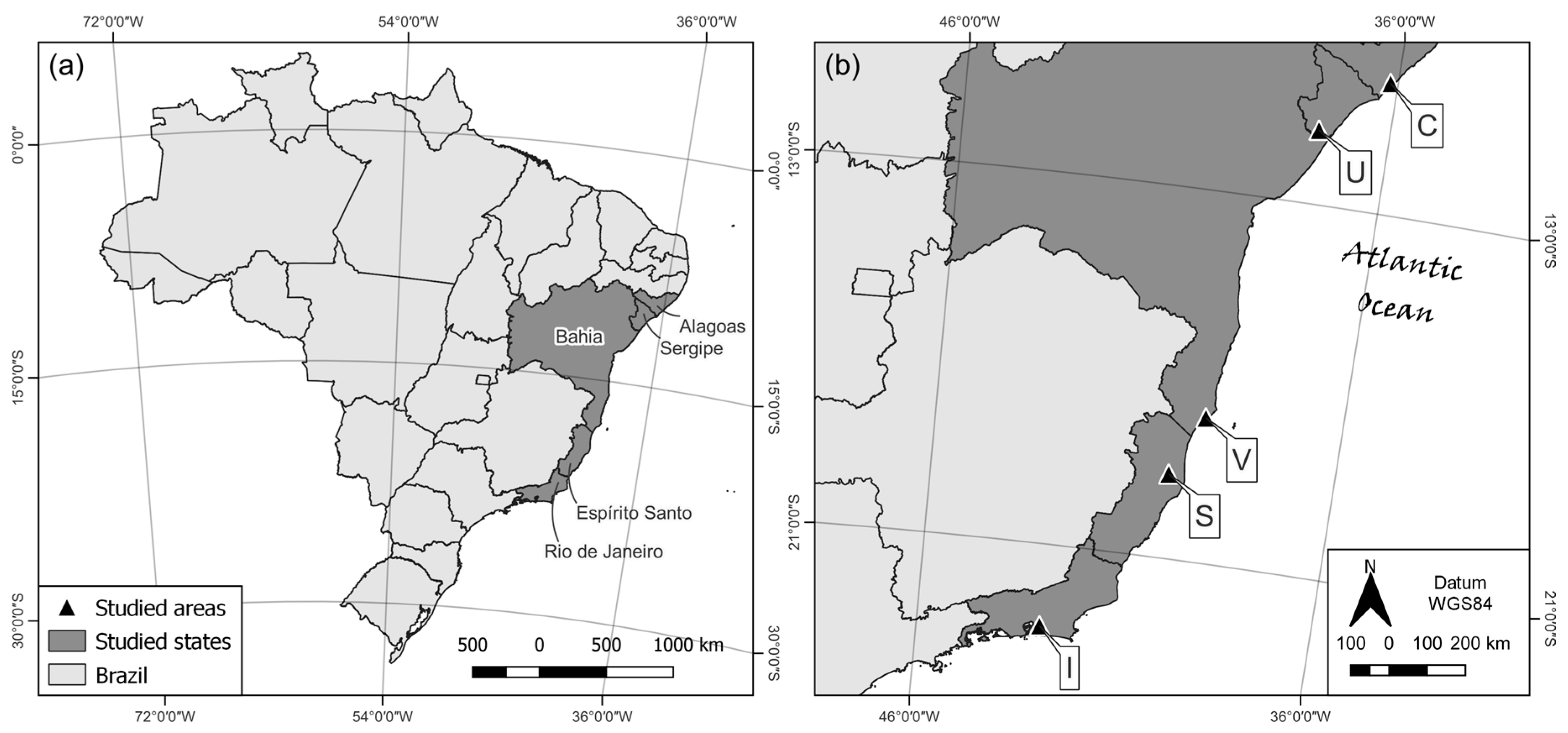
2.1. Study Areas
2.2. Soil Sampling and Analyses
2.3. Differential Carbon Pools of Cultivated and Native Forest Soils (Deltas—Δ)
2.4. Statistical Analyses
3. Results and Discussion
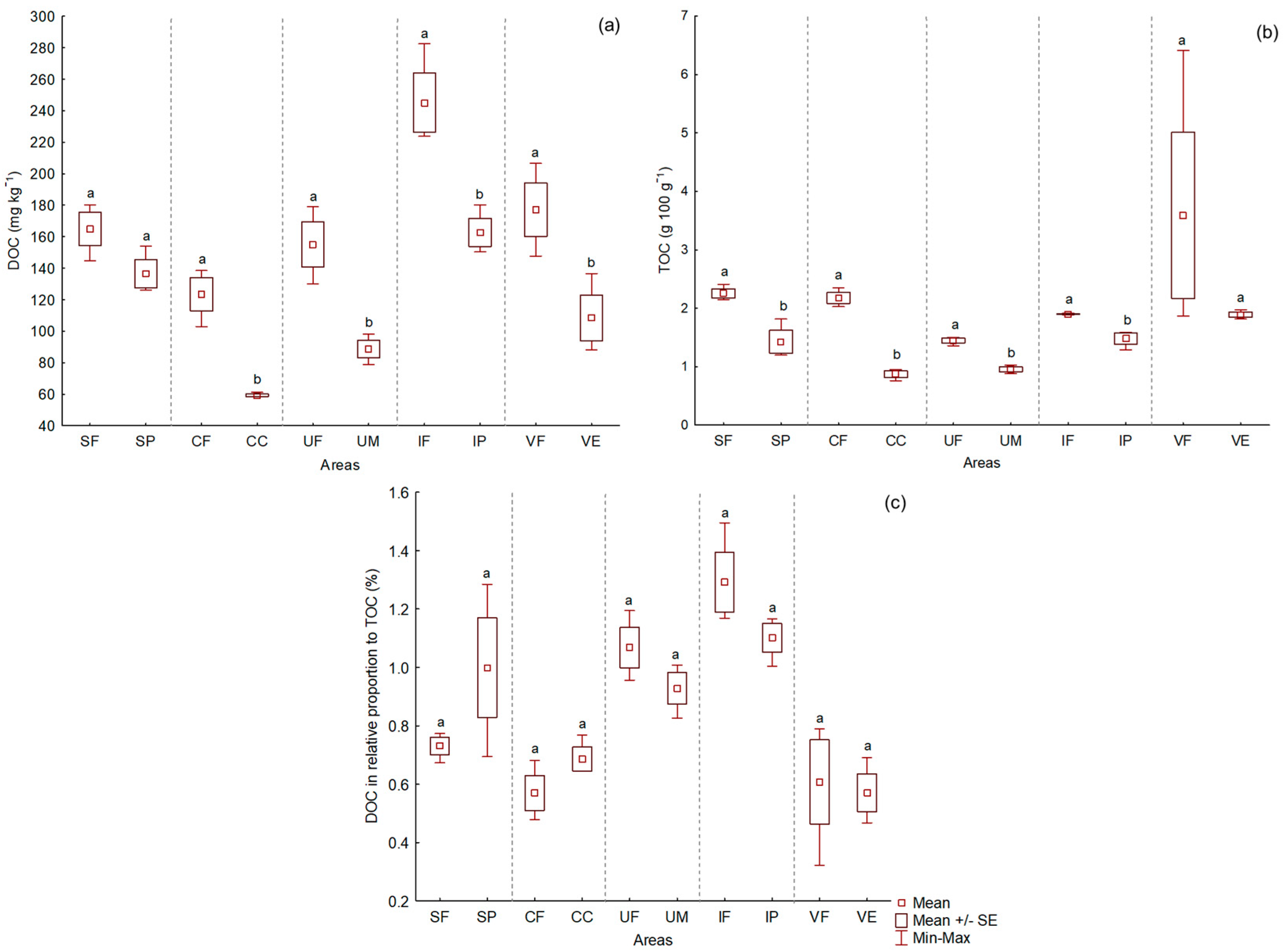
3.1. Total and Dissolved Organic Carbon
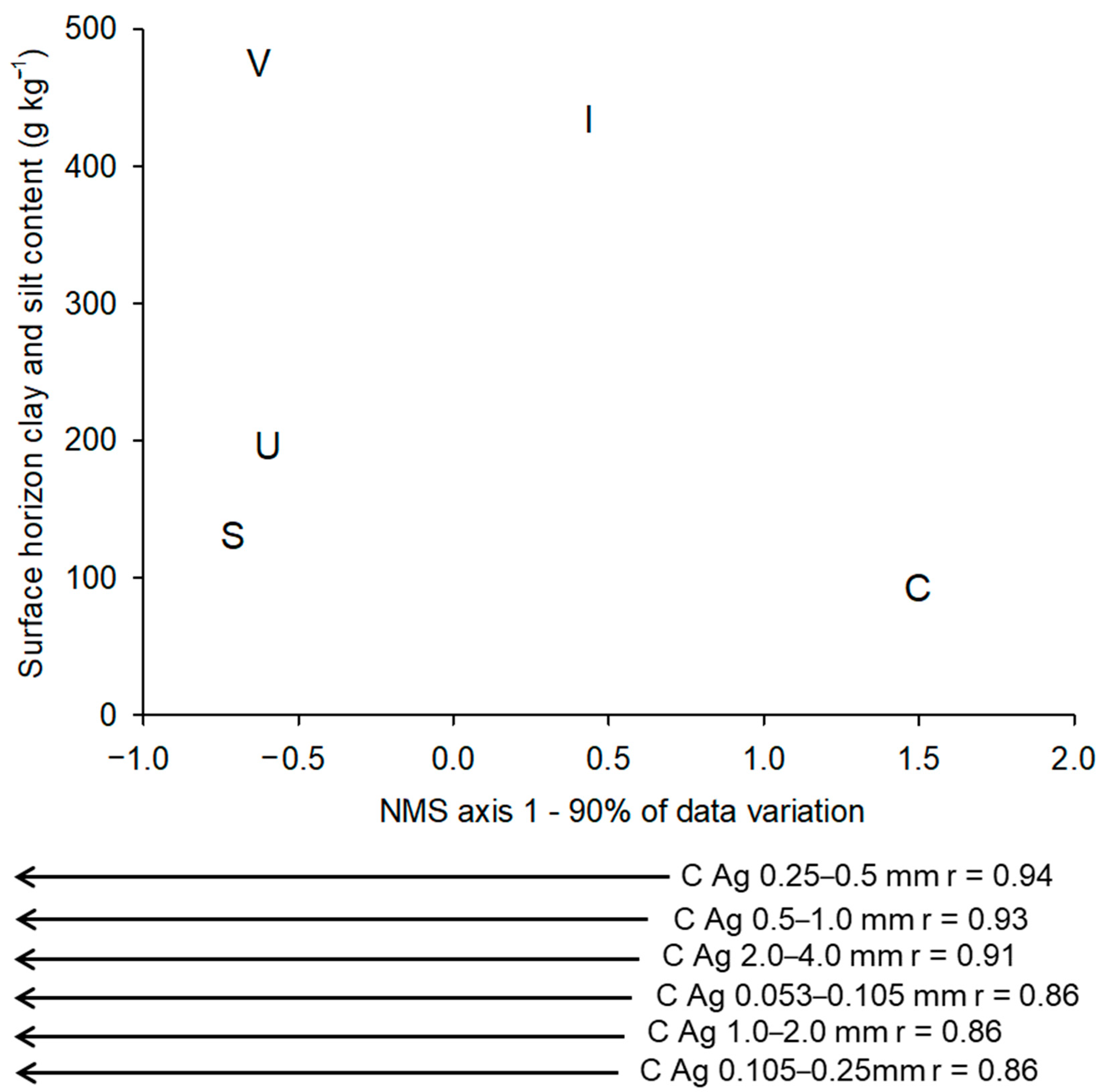
3.2. Distribution of Soil Aggregate Size Classes
3.3. Carbon in Soil Aggregate Size Classes
3.4. Carbon Pools in Native Forest and Counterpart Cultivated Soils
3.4.1. Differential of DOC (ΔDOC)
3.4.2. Differential of Organic Carbon of the Aggregate Size Classes (ΔCag) and of the Sum of the Aggregate Size Classes (ΔTOCag)
4. Conclusions
Supplementary Materials
Author Contributions
Funding
Institutional Review Board Statement
Informed Consent Statement
Data Availability Statement
Acknowledgments
Conflicts of Interest
References
- Feller, C.; Albrecht, A.; Tessier, D. Aggregation and organic matter storage in kaolinitic and smectitic tropical soils. In Structure and Organic Matter Storage in Agricultural Soils, 1st ed.; Carter, M.R., Stewart, B.A., Eds.; CRC Press: Boca Ranton, FL, USA, 1995; pp. 309–359. [Google Scholar] [CrossRef] [Scilit]
- Chaney, K.; Swift, R.S. The influence of organic matter on aggregate stability in some British soils. Eur. J. Soil Sci. 1984, 35, 223–230. [Google Scholar] [CrossRef] [Scilit]
- Chenu, C.; Le Bissonnais, Y.; Arrouays, D. Organic Matter Influence on Clay Wettability and Soil Aggregate Stability. Soil Sci. Soc. Am. J. 2000, 64, 1479–1486. [Google Scholar] [CrossRef] [Scilit]
- Baldock, J.A.; Nelson, P.N. Soil organic matter. In Handbook of Soil Science; Summer, M.E., Ed.; CRC Press: Boca Raton, FL, USA, 2000; pp. 25–84. [Google Scholar]
- Tisdall, J.M.; Oades, J.M. Organic matter and water-stable aggregates in soils. Eur. J. Soil Sci. 1982, 33, 141–163. [Google Scholar] [CrossRef] [Scilit]
- Six, J.; Paustian, K. Aggregate-associated soil organic matter as an ecosystem property and a measurement tool. Soil Biol. Biochem. 2014, 68, A4–A9. [Google Scholar] [CrossRef] [Scilit]
- Cheng, X.; Luo, Y.; Xu, X.; Sherry, R.; Zhang, Q. Soil organic matter dynamics in a North America tallgrass prairie after 9 yr of experimental warming. Biogeosciences 2011, 8, 1487–1498. [Google Scholar] [CrossRef] [Scilit]
- Dou, F.; Soriano, J.; Tabien, R.E.; Chen, K. Soil Texture and Cultivar Effects on Rice (Oryza sativa, L.) Grain Yield, Yield Components and Water Productivity in Three Water Regimes. PLoS ONE 2016, 11, e0150549. [Google Scholar] [CrossRef] [Scilit]
- Novelli, L.E.; Caviglia, O.P.; Piñeiro, G. Increased cropping intensity improves crop residue inputs to the soil and aggregate-associated soil organic carbon stocks. Soil Tillage Res. 2017, 165, 128–136. [Google Scholar] [CrossRef] [Scilit]
- Pereira, M.G.; Loss, A.; Batista, I.; de Melo, T.R.; Silva Neto, E.C.; da Silva Rodrigues Pinto, L.A. Biogenic and physicogenic aggregates: Formation pathways, assessment techniques, and influence on soil properties. Rev. Bras. Cienc. Solo. 2021, 45. [Google Scholar] [CrossRef] [Scilit]
- Chi, J.; Fan, Y.; Wang, L.; Putnis, C.V.; Zhang, W. Retention of soil organic matter by occlusion within soil minerals. Rev. Environ. Sci. Bio/Technol. 2022, 21, 727–746. [Google Scholar] [CrossRef] [Scilit]
- Guo, L.B.; Gifford, R.M. Soil carbon stocks and land use change: A meta analysis. Glob. Chang. Biol. 2002, 8, 345–360. [Google Scholar] [CrossRef] [Scilit]
- Yamashita, T.; Flessa, H.; John, B.; Helfrich, M.; Ludwig, B. Organic matter in density fractions of water-stable aggregates in silty soils: Effect of land use. Soil Biol. Biochem. 2006, 38, 3222–3234. [Google Scholar] [CrossRef] [Scilit]
- Powers, J.S.; Corre, M.D.; Twine, T.E.; Veldkamp, E. Geographic bias of field observations of soil carbon stocks with tropical land-use changes precludes spatial extrapolation. Proc. Natl. Acad. Sci. USA 2011, 108, 6318–6322. [Google Scholar] [CrossRef] [Scilit] [PubMed]
- Alkimim, A.; Clarke, K.C. Land use change and the carbon debt for sugarcane ethanol production in Brazil. Land Use Policy 2018, 72, 65–73. [Google Scholar] [CrossRef] [Scilit]
- Don, A.; Schumacher, J.; Freibauer, A. Impact of tropical land-use change on soil organic carbon stocks-a meta-analysis. Glob. Chang. Biol. 2011, 17, 1658–1670. [Google Scholar] [CrossRef] [Scilit]
- Harris, N.L.; Brown, S.; Hagen, S.C.; Saatchi, S.S.; Petrova, S.; Salas, W.; Hansen, M.C.; Potapov, P.V.; Lotsch, A. Baseline Map of Carbon Emissions from Deforestation in Tropical Regions. Science 2012, 336, 1573–1576. [Google Scholar] [CrossRef] [Scilit] [PubMed]
- Wei, X.; Shao, M.; Gale, W.; Li, L. Global pattern of soil carbon losses due to the conversion of forests to agricultural land. Sci. Rep. 2014, 4, 1–6. [Google Scholar] [CrossRef] [Scilit]
- Bailey, V.L.; Pries, C.H.; Lajtha, K. What do we know about soil carbon destabilization? Environ. Res. Lett. 2019, 14, e.083004. [Google Scholar] [CrossRef] [Scilit]
- Stevenson, F.J. Humus Chemistry: Genesis, Composition, Reactions, 2nd ed.; John Wiley and Sons: New York, USA, 1994; p. 512. [Google Scholar]
- Gmach, M.R.; Cherubin, M.R.; Kaiser, K.; Cerri, C.E.P. Processes that influence dissolved organic matter in the soil: A review. Sci. Agricola 2020, 77, e20180164. [Google Scholar] [CrossRef] [Scilit]
- Marques, J.D.D.O.; Luizão, F.J.; Teixeira, W.G.; Ferreira, S.J.F. Variations of dissolved organic carbon and soil physical properties under different land uses in Central Amazonia. Rev. Bras. Ciênc. Solo. 2012, 36, 611–622. [Google Scholar] [CrossRef] [Scilit]
- Da Silva, D.M.L.; Ometto, J.P.H.B.; Lobo, G.D.A.; Lima, W.D.P.; Scaranello, M.A.; Mazzi, E.; Da Rocha, H.R. Can land use changes alter carbon, nitrogen and major ion transport in subtropical brazilian streams? Sci. Agricola 2007, 64, 317–324. [Google Scholar] [CrossRef] [Scilit]
- Silva, F.B.R.; Riché, G.R.; Tonneau, J.P.; Souza Neto, N.C.; Brito, L.T.L.; Correia, R.C.; Cavalcanti, A.C.; Silva, F.H.B.B.; Silva, A.B.; Araújo Filho, J.C.; et al. Zoneamento Agroecológico do Nordeste: Diagnóstico do quadro natural e Agrossocioeconômico; Embrapa-CPATSA: Petrolina, Brazil, 1993. [Google Scholar]
- Jacomine, P.K.T. Evolução do conhecimento sobre solos coesos no Brasil. In Workshop Coesão Em Solos dos Tabuleiros Costeiros; Cintra, L.F.D., Anjos, J.L., Ivo, W.M.P.M., Eds.; Embrapa Tabuleiros Costeiros: Aracaju, Brazil, 2001; pp. 19–46. [Google Scholar]
- Gomes, J.B.V.; Silva, C.A.; Ferreira, T.L.D.A.; Ferreira, M.M.; Inda, A.V.; Curi, N. Carbon Stocks and Pools in Relation to the Texture of Kaolinitic Soils from the Brazilian East Coast. Rev. Bras. Ciênc. Solo. 2018, 42, e0170260. [Google Scholar] [CrossRef] [Scilit]
- Carvalho Filho, A.; Curi, N.; Fonseca, S. Avaliação Informatizada e Validada da Aptidão Silvicultural das Terras dos Tabuleiros Costeiros Brasileiros Para Eucalipto, 1st ed.; Editora UFLA: Lavras, Brazil, 2013; p. 138. [Google Scholar]
- Krull, E.; Baldock, J.; Skjemstad, J. Soil texture effects on decomposition and soil carbon storage. In Net Ecosystem Exchange; Kirschbaum, M.U.F., Mueller, R., Eds.; Cooperative Research Centre for Greenhouse Accounting: Canberra, Australia, 2001; pp. 103–110. [Google Scholar]
- Plante, A.F.; Conant, R.T.; Stewart, C.E.; Paustian, K.; Six, J. Impact of Soil Texture on the Distribution of Soil Organic Matter in Physical and Chemical Fractions. Soil Sci. Soc. Am. J. 2006, 70, 287–296. [Google Scholar] [CrossRef] [Scilit]
- Singh, M.; Sarkar, B.; Sarkar, S.; Churchman, J.; Bolan, N.; Mandal, S.; Menon, M.; Purakayastha, T.J.; Beerling, D.J. Stabilization of Soil Organic Carbon as Influenced by Clay Mineralogy. In Advances in Agronomy; Elsevier: Amsterdam, The Netherlands, 2018; Volume 148, pp. 33–84. [Google Scholar]
- Angst, G.; Messinger, J.; Greiner, M.; Häusler, W.; Hertel, D.; Kirfel, K.; Kögel-Knabner, I.; Leuschner, C.; Rethemeyer, J.; Mueller, C.W. Soil organic carbon stocks in topsoil and subsoil controlled by parent material, carbon input in the rhizosphere, and microbial-derived compounds. Soil Biol. Biochem. 2018, 122, 19–30. [Google Scholar] [CrossRef] [Scilit]
- Ge, N.; Wei, X.; Wang, X.; Liu, X.; Shao, M.; Jia, X.; Li, X.; Zhang, Q. Soil texture determines the distribution of aggregate-associated carbon, nitrogen and phosphorous under two contrasting land use types in the Loess Plateau. Catena 2019, 172, 148–157. [Google Scholar] [CrossRef] [Scilit]
- Machado, M.A.B.L.; de Carvalho Chaves, L.D.F.; Neto, J.L.R.; de Lyra-Lemos, R.P. Florística do estrato arbóreo de fragmentos da Mata Atlântica do Nordeste oriental, município de Coruripe, Alagoas, Brasil. Rev Ouricuri. 2012, 2, 55–72. [Google Scholar]
- Magnago, L.F.S.; Edwards, D.P.; Edwards, F.A.; Magrach, A.; Martins, S.V.; Laurance, W.F. Functional attributes change but functional richness is unchanged after fragmentation of Brazilian Atlantic forests. J. Ecol. 2014, 102, 475–485. [Google Scholar] [CrossRef] [Scilit]
- Uhlmann, A.; Bonnet, A.; Curcio, G.R.; Silva, A.D.P.; Gonçalves, F.L.A.; de Resende, A.S. A cobertura vegetal das florestas e pastagens. In Monitoramento da Revegetação do Comperj: Etapa Inicial; Prado, R.B., Fidalgo, E.C.C., Bonnet, A., Eds.; Embrapa: Brasília, Brazil, 2014; pp. 223–244. [Google Scholar]
- IBGE–Instituto Brasileiro de Geografia e Estatística. Manual Técnico de Geomorfologia; IBGE: Rio de Janeiro, Brazil, 1995; p. 113. [Google Scholar]
- Gomes, J.B.V.; Araújo, J.C.; Vidal-Torrado, P.; Cooper, M.; Da Silva, E.A.; Curi, N. Cemented Horizons and Hardpans in the Coastal Tablelands of Northeastern Brazil. Revista Brasileira de Ciência do Solo 2017, 41. [Google Scholar] [CrossRef] [Scilit]
- Scaglia, B.; Adani, F. Biodegradability of soil water soluble organic carbon extracted from seven different soils. J. Environ. Sci. 2009, 21, 641–646. [Google Scholar] [CrossRef] [Scilit]
- Haynes, R.J. Interactions between soil organic matter status, cropping history, method of quantification and sample pretreatment and their effects on measured aggregate stability. Biol. Fertil. Soils 2000, 30, 270–275. [Google Scholar] [CrossRef] [Scilit]
- Kemper, W.D.; Rosenau, R.C. Agregate stability and size distribution. In Methods of Soil Analysis: Physical and Mineralogical Methods, 2nd ed.; Klute, A., Ed.; American Society of Agronomy: Madison, WI, USA, 1986; pp. 425–442. [Google Scholar]
- McCune, B.; Mefford, M.J. PC-ORD. Multivariate Analysis of Ecological Data, Version 6; MjM Software Design: Gleneden Beach, OR, USA, 2011.
- Buringh, P. Organic carbon in soils of the world. In The Role of Terrestrial Vegetation in the Global Carbon Cycle: Measurement by Remote Sensing; Woodwell, G.M., Ed.; SCOPE/ICSU, Wiley & Sons: Chichester, UK, 1984; pp. 91–109. [Google Scholar]
- Yang, Y.; Xie, J.; Sheng, H.; Chen, G.; Li, X.; Yang, Z. The impact of land use/cover change on storage and quality of soil organic carbon in midsubtropical mountainous area of southern China. J. Geogr. Sci. 2009, 19, 49–57. [Google Scholar] [CrossRef] [Scilit]
- Geraei, D.S.; Hojati, S.; Landi, A.; Cano, A.F. Total and labile forms of soil organic carbon as affected by land use change in southwestern Iran. Geoderma Reg. 2016, 7, 29–37. [Google Scholar] [CrossRef] [Scilit]
- Andrade, E.M.; Valbrun, W.; De Almeida, A.M.M.; Rosa, G.; Da Silva, A.G.R. Land-Use Effect on Soil Carbon and Nitrogen Stock in a Seasonally Dry Tropical Forest. Agronomy 2020, 10, 158. [Google Scholar] [CrossRef] [Scilit]
- Dos Santos, O.A.Q.; Silva Neto, E.C.; García, A.C.; Fagundes, H.D.S.; Diniz, Y.V.D.F.G.; Ferreira, R.; Pereira, M.G. Impact of land use on Histosols properties in urban agriculture ecosystems of Rio de Janeiro, Brazil. Rev. Bras. Ciênc. Solo. 2020, 44, e02000041. [Google Scholar] [CrossRef] [Scilit]
- Eswaran, H.; Berg, E.V.D.; Reich, P. Organic Carbon in Soils of the World. Soil Sci. Soc. Am. J. 1993, 57, 192–194. [Google Scholar] [CrossRef] [Scilit]
- Ferreira, A.C.C.; Leite, L.F.C.; de Araújo, A.S.F.; Eisenhauer, N. Land-Use Type Effects on Soil Organic Carbon and Microbial Properties in a Semi-arid Region of Northeast Brazil. Land Degrad. Dev. 2014, 27, 171–178. [Google Scholar] [CrossRef] [Scilit]
- Paes, E.D.C.; Fernandes, I.O.; Dias, F.P.M.; Pereira, E.G.; Santos, D.N.; de Lima, J.M.; Nóbrega, R.S.A.; Nóbrega, J.C.A. Land use, management and physical attributes of dense Ferralsols in tropical northeastern Brazil. Catena 2021, 203, 1–11. [Google Scholar] [CrossRef] [Scilit]
- Khomutova, T.E.; Shirshova, L.T.; Tinz, S.; Rolland, W.; Richter, J. Mobilization of DOC from sandy loamy soils under different land use (Lower Saxony, Germany). Plant Soil 2000, 219, 13–19. [Google Scholar] [CrossRef] [Scilit]
- Aitkenhead-Peterson, J.A.; McDowell, W.H.; Neff, J.C. Sources, Production, and Regulation of Allochthonous Dissolved Organic Matter Inputs to Surface Waters. In Aquatic Ecosystems; Academic Press: Cambridge, MA, USA, 2003; pp. 25–70. [Google Scholar] [CrossRef] [Scilit]
- Chantigny, M.H. Dissolved and water-extractable organic matter in soils: A review on the influence of land use and management practices. Geoderma 2003, 113, 357–380. [Google Scholar] [CrossRef] [Scilit]
- Möller, A.; Kaiser, K.; Guggenberger, G. Dissolved organic carbon and nitrogen in precipitation, throughfall, soil solution, and stream water of the tropical highlands in northern Thailand. J. Plant Nutr. Soil Sci. 2005, 168, 649–659. [Google Scholar] [CrossRef] [Scilit]
- Pesántez, J.; Mosquera, G.M.; Crespo, P.; Breuer, L.; Windhorst, D. Effect of land cover and hydro-meteorological controls on soil water DOC concentrations in a high-elevation tropical environment. Hydrol. Process. 2018, 32, 2624–2635. [Google Scholar] [CrossRef] [Scilit]
- Xu, C.; Guo, L.; Dou, F.; Ping, C.-L. Potential DOC production from size-fractionated Arctic tundra soils. Cold Reg. Sci. Technol. 2009, 55, 141–150. [Google Scholar] [CrossRef] [Scilit]
- Yang, Y.G.; He, Z.L.; Wang, Y.B.; Liu, Y.L.; Liang, Z.B.; Fan, J.H.; Stoffella, P.J. Dissolved Organic Carbon in Association with Water Soluble Nutrients and Metals in Soils from Lake Okeechobee Watershed, South Florida. Water Air Soil Pollut. 2012, 223, 4075–4088. [Google Scholar] [CrossRef] [Scilit]
- Gomes, J.B.V.; Fernandes, M.F.; Barreto, A.C.; Araújo Filho, J.C.D.; Curi, N. Soil attributes under agroecosystems and forest vegetation in the coastal tablelands of northestern Brazil. Ciência Agrotec. 2012, 36, 649–664. [Google Scholar] [CrossRef] [Scilit]
- De Lima, C.A.; Montenegro, A.A.D.A.; Dos Santos, T.E.M.; De Andrade, E.M.; Monteiro, A.L.N. Práticas agrícolas no cultivo da mandioca e suas relações com o escoamento superficial, perdas de solo e água. Rev. Ciênc. Agron. 2015, 46, 697–706. [Google Scholar] [CrossRef] [Scilit]
- Jastrow, J.D.; Miller, R.M.; Lussenhop, J. Contributions of interacting biological mechanisms to soil aggregate stabilization in restored prairie. Soil Biol. Biochem. 1998, 30, 905–916. [Google Scholar] [CrossRef] [Scilit]
- Schwendenmann, L.; Pendall, E. Effects of forest conversion into grassland on soil aggregate structure and carbon storage in Panama: Evidence from soil carbon fractionation and stable isotopes. Plant Soil 2006, 288, 217–232. [Google Scholar] [CrossRef] [Scilit]
- Anaya, C.A.; Huber-Sannwald, E. Long-term soil organic carbon and nitrogen dynamics after conversion of tropical forest to traditional sugarcane agriculture in East Mexico. Soil Tillage Res. 2015, 147, 20–29. [Google Scholar] [CrossRef] [Scilit]
- Ashagrie, Y.; Zech, W.; Guggenberger, G. Transformation of a Podocarpus falcatus dominated natural forest into a monoculture Eucalyptus globulus plantation at Munesa, Ethiopia: Soil organic C, N and S dynamics in primary particle and aggregate-size fractions. Agric. Ecosyst. Environ. 2005, 106, 89–98. [Google Scholar] [CrossRef] [Scilit]
- Ferreira, M.M.; Fernandes, B.; Curi, N. Influência da mineralogia da fração argila nas propriedades físicas de latossolos da região sudeste do Brasil. Rev. Bras. Ciên. Solo. 1999, 23, 515–524. [Google Scholar] [CrossRef] [Scilit]
- Vitorino, A.C.T.; Ferreira, M.M.; Curi, N.; De Lima, J.M.; Silva, M.L.N.; Da Motta, P.E.F. Mineralogia, química e estabilidade de agregados do tamanho de silte de solos da Região Sudeste do Brasil. Pesq. Agropec. Bras. 2003, 38, 133–141. [Google Scholar] [CrossRef] [Scilit]
- Barreto, R.C.; Madari, B.E.; Maddock, J.E.; Machado, P.L.; Torres, E.; Franchini, J.; Costa, A.R. The impact of soil management on aggregation, carbon stabilization and carbon loss as CO2 in the surface layer of a Rhodic Ferralsol in Southern Brazil. Agric. Ecosyst. Environ. 2009, 132, 243–251. [Google Scholar] [CrossRef] [Scilit]
- Vicente, L.C.; Gama-Rodrigues, E.F.; Gama-Rodrigues, A.C.; Marciano, C.R. Organic carbon within soil aggregates under forestry systems and pasture in a southeast region of Brazil. Catena 2019, 182, 104139. [Google Scholar] [CrossRef] [Scilit]
- Carrizo, M.E.; Alesso, C.A.; Cosentino, D.; Imhoff, S. Aggregation agents and structural stability in soils with different texture and organic carbon contents. Sci. Agricola 2015, 72, 75–82. [Google Scholar] [CrossRef] [Scilit]
- Chaplot, V.; Cooper, M. Soil aggregate stability to predict organic carbon outputs from soils. Geoderma 2015, 243-244, 205–213. [Google Scholar] [CrossRef] [Scilit]
- Shrestha, B.M.; Sitaula, B.K.; Singh, B.R.; Bajracharya, R.M. Soil organic carbon stocks in soil aggregates under different land use systems in Nepal. Nutr. Cycl. Agroecosyst. 2004, 70, 201–213. [Google Scholar] [CrossRef] [Scilit]
- Ashagrie, Y.; Zech, W.; Guggenberger, G.; Mamo, T. Soil aggregation, and total and particulate organic matter following conversion of native forests to continuous cultivation in Ethiopia. Soil Tillage Res. 2007, 94, 101–108. [Google Scholar] [CrossRef] [Scilit]
- Laskar, S.Y.; Sileshi, G.W.; Pathak, K.; Debnath, N.; Nath, A.J.; Laskar, K.Y.; Singnar, P.; Das, A.K. Variations in soil organic carbon content with chronosequence, soil depth and aggregate size under shifting cultivation. Sci. Total Environ. 2021, 762, e143114. [Google Scholar] [CrossRef] [Scilit]
- Signor, D.; Zani, C.F.; Paladini, A.A.; Deon, M.D.; Cerri, C.E.P. Estoques de carbono e qualidade da matéria orgânica do solo em áreas cultivadas com cana-de-açúcar. Rev. Bras. Cienc. Solo. 2014, 38, 1402–1410. [Google Scholar] [CrossRef] [Scilit]
- Bayer, C.; Amado, T.J.C.; Tornquist, C.G.; Cerri, C.E.C.; Dieckow, J.; Zanatta, J.A.; Nicoloso, R.S. Estabilização do Carbono no solo e mitigação das emissões de gases de efeito estufa na agricultura conservacionista. Tópicos em Ciência do Solo 2011, 7, 55–118. [Google Scholar]
- De Souza, E.D.; Costa, S.E.V.G.D.A.; De Lima, C.V.S.; Anghinoni, I.; Meurer, E.J.; Carvalho, P.C.D.F. Carbono orgânico e fósforo microbiano em sistema de integração agricultura-pecuária submetido a diferentes intensidades de pastejo em plantio direto. Rev. Bras. Cienc. Solo 2008, 32, 1273–1282. [Google Scholar] [CrossRef] [Scilit]

| Areas | Soil Class | Horizon A Texture Class | Relief | Chronology/ Lithology | Annual Dry Season | |
|---|---|---|---|---|---|---|
| BSSC 1 | Soil Taxonomy | |||||
| Coruripe | PA | Ustult | Sand/loamy sand | Flat | Tertiary/Barreiras | Summer |
| Umbaúba | PA | Ustult | Sandy loam | Flat | Tertiary/Barreiras | Summer |
| Nova Viçosa | LV | Udox | Sandy clay | Flat | Tertiary/Barreiras (with influence of Proterozoic sediments) | Winter (driest month with rainfall >60 mm) |
| Sooretama | PA | Ustult | Sand/loamy sand | Flat | Tertiary/Barreiras | Winter |
| Itaboraí | LA | Ustox | Sandy clay | Undulated | Tertiary/Macacu | Winter |
| Areas | Forest | Agricultural Use | |||
|---|---|---|---|---|---|
| Specification | Fragment Conservation Status 1 | Symbol | Specification | Symbol | |
| Coruripe | Primary forest | Intermediate to good | CF | Sugarcane (renewal) | CC |
| Umbaúba | Secondary forest | Intermediate | UF | Post-cassava (fallow) | UM |
| Nova Viçosa | Primary forest | Intermediate | VF | Eucalyptus | VE |
| Sooretama | Primary forest | Good | SF | Brachiaria decumbens with animal grazing | SP |
| Itaboraí | Secondary forest | Acceptable | IF | Brachiaria decumbens without animal grazing in the last 2 years | IP |
| Scheme 1 | pH (in Water) | Al3+ | H + Al | Ca2+ | Mg2+ | K+ | SB 2 | CEC 3 | P 4 | BD 5 | Sand | Silt | Clay |
|---|---|---|---|---|---|---|---|---|---|---|---|---|---|
| cmolc dm−3 | mg dm−3 | Mg m−3 | dag kg−1 | ||||||||||
| SP | 4.93 | 0.20 | 3.23 | 0.93 | 0.53 | 0.10 | 1.56 | 4.80 | 2.40 | 1.19 | 85 | 7 | 8 |
| SF | 4.67 | 0.70 | 5.66 | 0.60 | 0.30 | 0.04 | 0.91 | 6.57 | 1.32 | 1.24 | 90 | 1 | 9 |
| CF | 5.17 | 0.23 | 2.84 | 2.27 | 0.93 | 0.09 | 3.29 | 6.10 | 2.20 | 1.15 | 89 | 2 | 9 |
| CC | 5.13 | 0.23 | 2.63 | 0.83 | 0.43 | 0.08 | 1.35 | 3.97 | 28.15 | 1.46 | 91 | 0 | 9 |
| UF | 4.97 | 0.27 | 3.09 | 1.27 | 0.63 | 0.09 | 1.99 | 5.08 | 1.23 | 1.32 | 81 | 4 | 15 |
| UM | 5.53 | 0.10 | 1.81 | 1.73 | 0.60 | 0.18 | 2.51 | 4.32 | 17.36 | 1.54 | 80 | 3 | 17 |
| IP | 4.13 | 1.80 | 7.87 | 0.50 | 0.17 | 0.05 | 0.72 | 8.59 | 1.73 | 1.38 | 58 | 7 | 35 |
| IF | 4.07 | 2.63 | 10.50 | 0.20 | 0.20 | 0.04 | 0.44 | 10.94 | 2.37 | 1.32 | 54 | 8 | 38 |
| VF | 5.70 | 0.00 | 2.33 | 8.30 | 1.50 | 0.35 | 10.22 | 12.55 | 5.30 | 1.09 | 51 | 8 | 41 |
| VE | 5.37 | 0.17 | 3.97 | 2.73 | 0.50 | 0.21 | 3.44 | 7.41 | 3.06 | 1.36 | 52 | 3 | 45 |
| Attribute | R |
|---|---|
| Dissolved Organic C (DOC) | 0.47 ** |
| Total Organic C (TOC) | 0.36 |
| DOC/TOC ratio | 0.12 |
| % mass of aggregate size class 2–4 mm | 0.88 ** |
| % mass of aggregate size class 1–2 mm | −0.19 |
| % mass of aggregate size class 0.5–1 mm | −0.38 * |
| % mass of aggregate size class 0.25–0.5 mm | −0.74 ** |
| % mass of aggregate size class 0.105–0.25 mm | −0.69 ** |
| % mass of aggregate size class 0.053–0.105 mm | −0.65 ** |
| % of macroaggregates | 0.68 ** |
| Mean weight-diameter of aggregates | 0.87 ** |
| Mean geometric-diameter of aggregates | 0.80 ** |
| Organic C content of aggregate size class 2–4 mm | −0.01 |
| Organic C content of aggregate size class 1–2 mm | 0.11 |
| Organic C content of aggregate size class 0.5–1 mm | 0.09 |
| Organic C content of aggregate size class 0.25–0.5 mm | 0.19 |
| Organic C content of aggregate size class 0.105–0.25 mm | 0.16 |
| Organic C content of aggregate size class 0.053–0.105 mm | 0.44 * |
| Sum of organic C content of aggregate size classes | 0.13 |
| Symbol 1 | Aggregate Size Class (mm) | MA 2 | MWD 2 | MGD 2 | |||||
|---|---|---|---|---|---|---|---|---|---|
| 2–4 | 1–2 | 0.5–1 | 0.25–0.5 | 0.105–0.25 | 0.053–0.105 | ||||
| % | mm | ||||||||
| -------------------------------------------------- Sooretama --------------------------------------------------- | |||||||||
| SF | 25 a | 36 b | 15 a | 15 a | 7 a | 3 a | 91 a | 1.30 a | 1.03 a |
| SP | 24 a | 51 a | 7 a | 8 b | 6 a | 4 a | 90 a | 1.32 a | 1.07 a |
| ---------------------------------------------------- Coruripe ---------------------------------------------------- | |||||||||
| CF | 20 a | 26 a | 14 a | 18 b | 15 a | 7 a | 78 a | 1.07 a | 0.87 a |
| CC | 18 a | 17 a | 14 a | 22 a | 18 a | 11 a | 71 a | 0.93 a | 0.78 a |
| ---------------------------------------------------- Umbaúba --------------------------------------------------- | |||||||||
| UF | 32 a | 28 a | 12 a | 13 b | 10 b | 6 b | 84 a | 1.39 a | 0.99 a |
| UM | 23 a | 23 a | 15 a | 18 a | 13 a | 8 a | 79 b | 1.13 b | 0.88 b |
| ----------------------------------------------------- Itaboraí ----------------------------------------------------- | |||||||||
| IF | 62 a | 31 a | 2 a | 3 a | 1 a | 1 a | 98 a | 2.19 a | 1.37 a |
| IP | 46 a | 30 a | 4 a | 8 a | 7 a | 5 a | 88 a | 1.77 a | 1.16 a |
| ------------------------------------------------- Nova Viçosa -------------------------------------------------- | |||||||||
| VF | 53 a | 21 a | 13 a | 8 a | 4 a | 1 a | 95 a | 1.94 a | 1.22 a |
| VE | 48 a | 22 a | 14 a | 10 a | 5 a | 1 a | 94 a | 1.82 a | 1.17 a |
| Symbol 1 | Aggregate Size Class (mm) | Sum of Size Classes (TOCag) | |||||
|---|---|---|---|---|---|---|---|
| 2–4 | 1–2 | 0.5–1 | 0.25–0.50 | 0.105–0.25 | 0.053–0.105 | ||
| g kg−1 | |||||||
| --------------------------------------------------- Sooretama --------------------------------------------------- | |||||||
| SF | 51.9 a | 39.6 a | 44.8 a | 40.4 a | 42.3 a | 13.3 a | 42.5 a |
| SP | 25.5 a | 27.3 a | 25.1 a | 28.6 a | 31.7 a | 16.3 a | 26.7 a |
| ---------------------------------------------------- Coruripe ---------------------------------------------------- | |||||||
| CF | 52.3 a | 49.5 a | 47.7 a | 43.3 a | 32.7 a | 40.0 a | 44.9 a |
| CC | 21.8 b | 18.8 b | 16.7 b | 18.4 b | 14.7 b | 13.9 b | 17.6 b |
| --------------------------------------------------- Umbaúba --------------------------------------------------- | |||||||
| UF | 24.2 a | 22.0 a | 20.9 a | 18.7 a | 15.9 a | 17.8 a | 21.0 a |
| UM | 18.1 a | 16.0 b | 14.7 b | 15.5 b | 12.4 b | 16.1 b | 15.8 b |
| ---------------------------------------------------- Itaboraí ---------------------------------------------------- | |||||||
| IF | 41.6 a | 41.3 a | 38.6 a | 40.9 a | 40.4 a | 30.9 a | 41.2 a |
| IP | 19.6 b | 20.4 b | 20.2 b | 23.9 b | 24.1 b | 14.8 b | 20.5 b |
| -------------------------------------------------- Nova Viçosa ------------------------------------------------- | |||||||
| VF | 47.1 a | 45.6 a | 45.8 a | 44.9 a | 38.6 a | 47.0 a | 45.7 a |
| VE | 27.5 a | 28.4 a | 27.5 a | 29.5 a | 23.9 a | 31.9 a | 27.7 a |
| Areas | ΔDOC |
|---|---|
| mg kg−1 | |
| Sooretama | −21.06 a |
| Coruripe | −64.11 ab |
| Umbaúba | −66.51 ab |
| Itaboraí | −83.53 b |
| Nova Viçosa | −54.00 ab |
| Areas 1 | ΔAggregate Size Class (Cag)—mm | ΔSum of Classes (ΔTOCag) | |||||
|---|---|---|---|---|---|---|---|
| 2–4 | 1–2 | 0.5–1 | 0.25–0.50 | 0.105–0.25 | 0.053–0.105 | ||
| g kg−1 | |||||||
| S | −12.75 ab | 3.47 a | −4.83 a | −0.50 a | 3.28 a | 7.42 a | −2.23 a |
| C | −30.46 b | −30.71 c | −30.95 b | −24.92 c | −18.03 c | −26.09 c | −27.35 c |
| U | −6.12 a | −6.07 ab | −6.22 a | −3.19 ab | −3.48 ab | −1.69 ab | −5.21 ab |
| I | −23.15 b | −22.07 bc | −19.40 ab | −16.93 bc | −16.42 bc | −16.98 bc | −21.46 bc |
| V | −6.20 a | −2.83 ab | −3.22 a | −2.72 ab | −3.93 abc | −1.80 ab | −4.12 ab |
Disclaimer/Publisher’s Note: The statements, opinions and data contained in all publications are solely those of the individual author(s) and contributor(s) and not of MDPI and/or the editor(s). MDPI and/or the editor(s) disclaim responsibility for any injury to people or property resulting from any ideas, methods, instructions or products referred to in the content. |
© 2023 by the authors. Licensee MDPI, Basel, Switzerland. This article is an open access article distributed under the terms and conditions of the Creative Commons Attribution (CC BY) license (https://creativecommons.org/licenses/by/4.0/).
Share and Cite
Ercole, T.M.; Gomes, J.B.V.; Motta, A.C.V.; Ferreira, M.M.; Inda, A.V.; Mancini, M.; Curi, N. Aggregation Stability and Carbon Pools in Extremely Kaolinitic Soils from the East Coast of Brazil as Affected by Land Use Changes. Sustainability 2023, 15, 1204. https://doi.org/10.3390/su15021204
Ercole TM, Gomes JBV, Motta ACV, Ferreira MM, Inda AV, Mancini M, Curi N. Aggregation Stability and Carbon Pools in Extremely Kaolinitic Soils from the East Coast of Brazil as Affected by Land Use Changes. Sustainability. 2023; 15(2):1204. https://doi.org/10.3390/su15021204
Chicago/Turabian StyleErcole, Tamires Maiara, João Bosco Vasconcellos Gomes, Antônio Carlos Vargas Motta, Mozart Martins Ferreira, Alberto Vasconcellos Inda, Marcelo Mancini, and Nilton Curi. 2023. "Aggregation Stability and Carbon Pools in Extremely Kaolinitic Soils from the East Coast of Brazil as Affected by Land Use Changes" Sustainability 15, no. 2: 1204. https://doi.org/10.3390/su15021204
APA StyleErcole, T. M., Gomes, J. B. V., Motta, A. C. V., Ferreira, M. M., Inda, A. V., Mancini, M., & Curi, N. (2023). Aggregation Stability and Carbon Pools in Extremely Kaolinitic Soils from the East Coast of Brazil as Affected by Land Use Changes. Sustainability, 15(2), 1204. https://doi.org/10.3390/su15021204

