


Abstract
Protected areas are prime areas for ecotourism development, attracting large numbers of visitors to an abundance of ecologically significant and often sensitive flora and fauna. The current study identified adverse impacts of ecotourism in four prominent tourist hotspots in Iran, namely Lar National Park, Jajrud Protected Area with Sustainable Use of Natural Resources, Tangeh Vashi National Natural Monument, and Kavdeh Wildlife Refuge. Impacts were compared against the IUCN guidelines according to the degree of ecological sensitivity and multiple managerial objectives. In addition, an analytic network process (ANP) was applied within a Strengths, Weaknesses, Opportunities, and Threats (SWOT) analysis to identify optimal strategies for reducing threats and weaknesses and improving opportunities and strengths for sustainable ecotourism management. We found the greatest negative impacts of ecotourism in a Jajrud that was exposed to rapidly expanding urbanisation and the corresponding development of economic and physical activities. Conversely, the least negative impact occurred in a national park (Lar) that was managed based on conservation approaches, accounting for high ecological sensitivities, and adapting legal prohibitions. The SWOT-ANP analysis demonstrates that certain strategies can minimise impacts and should be adopted as conservation tools by protected area managers and land planners.
1. Introduction
Sustainable ecotourism serves as a viable alternative to mass tourism, effectively empowering local communities and safeguarding the environment [1]. It is considered a tool to promote sustainability in, for instance, developing countries with rich natural and cultural resources [2]. Ecotourism offers a hybrid of opportunities for environmental protection and income generation for local communities [3], but it also poses a threat with potential long-term negative consequences for ecotourism destinations. The adverse impacts of ecotourists have therefore received increasing attention (e.g., Arsic et al., [4]; Lee and Jan, [5]).
Protected areas (PAs) harbour a great potential for ecotourism development as tourists flock to a diverse system of natural, historical, and cultural attractions. Ecotourism in PA aims to provide job opportunities for local communities and reduce poverty [5]. However, it is crucial to manage sustainable ecotourism effectively, taking into consideration social and environmental sensitivities. This includes ensuring the protection of natural resources as well as providing opportunities for environmental education and promoting tourism activities that are rooted in nature [6]. Therefore, ecotourism managers face growing pressure to attract a larger number of visitors by offering appropriate amenities and meaningful experiences, all while maintaining environmental conservation and providing visitor education [7]. Unfortunately, over the past decade, many PAs that form a part of the world heritage list have been impacted by unsustainable practises leading to environmental pollution, increased habitat loss, a reduction in biodiversity, and even species extinction [8]. Thus, the expansion of ecotourism activities in PAs poses a significant threat to rare endemic species and ecosystems of high ecological value.
Effective sustainable ecotourism management necessitates strategic planning, which can be accomplished through the identification and analysis of internal factors (IF), such as strengths and weaknesses, as well as external factors (EF), including opportunities and threats [9]. The ultimate goal in sustainable management of these areas is to develop and adopt an appropriate strategy that accounts for both EF and IF [10]. Several studies evidence the importance of this issue for strategic planning and development of sustainable management in PAs using Strengths, Weaknesses, Opportunities, and Threats (SWOT) [11,12], AHP-SWOT [13], and SWOT-ANP [14] methods.
Nevertheless, the management of PAs may encounter significant difficulties when attempting to implement the concept of ecotourism and harness the potential of these areas. Consequently, they must adopt an effective approach to management that encompasses fulfilling societal demands and development objectives. This entails overseeing the PA’s boundaries, safeguarding biodiversity [8], and establishing a harmonious relationship between conservation and economic advancement. Consequently, managers of numerous PAs are faced with mounting pressure to draw in a larger number of visitors while catering to their diverse requirements by offering suitable amenities. Furthermore, our motivation to conduct this research stemmed from the lack of well-established strategic plans capable of effectively accomplishing the defined objective of promoting ecotourism development in diverse types of PAs. The present study aims to identify the negative impacts of ecotourism development in PAs, using several sites in Iran as examples, and to investigate the relationship between increasing unsustainability and legal restrictions in various types of PAs. The primary research inquiries addressed in this study are as follows: (1) What are the primary adverse effects of ecotourism that may lead to increasing unsustainability in various types of PAs? (2) What strategies can be used to reduce unsustainable practises? (3) What are the optimal strategies to manage impacts? We first identified the negative impacts of ecotourism, harnessing the knowledge of experts, and then compared these impacts with International Union for Conservation of Nature (IUCN) guidelines, considering existing laws and regulations. Finally, we used a SWOT-ANP model to discuss optimal strategic planning and sustainable ecotourism management in various PAs in Iran. Our study may serve as a blueprint for other PAs to develop strategies to manage impacts using an innovative method that allows for the uncovering of a detailed list of ecotourism impact indicators along with the strengths, weaknesses, opportunities, and threats of PAs.
2. Theoretical Framework
The constructive role of PAs in fostering regional development is readily discernible through a multitude of benchmarking collaborations and partnerships. Resolving the prevailing conflicts among key stakeholders who have an impact on the development and management of PAs poses a significant hurdle to their progress in many countries [15,16]. To enhance collaboration among stakeholders and effectively manage PAs, it is crucial to establish partnerships based on the pursuit of common objectives. Achieving successful partnerships necessitates the active engagement and commitment of all participants, starting with making collective decisions and subsequently implementing planned activities together [17].
Collaborative efforts and proactive engagement between stakeholders in PAs, including local communities, have a beneficial impact on the formulation and implementation of regional development policies, plans, and activities [18,19].
The identification and integration of ecotourism development strategies play a vital role in their successful implementation. Various models are available that can effectively fulfil this objective, with each model offering distinct perspectives and employing different methodologies. Among these models, the SWOT matrix is the most widely used [20]. The SWOT matrix analyses the system by assessing its internal strengths and weaknesses while also considering the external opportunities and threats that it encounters. By deriving a strategy based on these factors, decision-makers can obtain realistic solutions and determine the extent to which the system aligns with the vision of sustainable development. This approach provides guidance for aligning efforts towards the desired and optimal structure. In addition, past studies demonstrate that SWOT analysis is frequently utilised alongside other complementary approaches in many cases, such as Simple Additive Weighting (SAW; [21]), AHP [22], and ANP [23]. This combination allows for the development of scientific plans and the quantification of their significance and prioritisation.
Through an examination of the available scientific literature, it becomes apparent that there is a noticeable absence of a robust connection between theory and practise in the realm of this study. Despite the development of numerous methodological approaches to systemic management in PAs within the field of management science, the actual application of these solutions remains constrained. One of the contributing factors to this resistance is the inadequate integration of theoretical frameworks into existing practises and approaches. As a result, this research proposes a systemic approach to effectively managing various types of PAs.
3. Materials and Methods
3.1. Study Areas
Four PAs were chosen for this study in Tehran province, including Lar National Park (henceforth Lar), Jajrud Protected Area with Sustainable Use of Natural Resources (henceforth Jajrud), Tangeh Vashi National Natural Monument (henceforth Tangeh Vashi), and Kavdeh Wildlife Refuge (henceforth Kavdeh) (Figure 1). These locations were chosen as they represent different types of PAs and because of the presence of abundant natural, historical, and cultural attractions, as well as uncontrolled tourism activities, an excessive number of tourists, and a high level of reported unsustainability in these areas (Table 1).
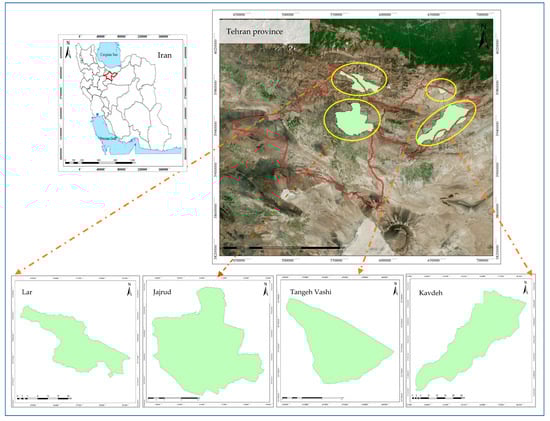
Figure 1.
Location of the four diverse types of Protected Areas (PAs) in northern Iran.

Table 1.
Overview of the four selected study areas.
Lar, spanning an area of 35,800 hectares, is situated between Tehran and Mazandaran Provinces. Popular animal species for wildlife viewing include wild sheep (Ovis orientalis), wild goats (Capra aegagrus), Persian leopards (Panthera pardus saxicolor), and grey wolves (Canis lupus). Astragalus is an important plant genus and an attractive flowering plant. Additionally, this area serves as a habitat for brown trout, which is considered one of the most scarce and precious aquatic species in the Middle East. Jajrud is located in the Tehran metropolis, and the two oldest national parks in Iran are located in Jajrud (Khojir and Sorkheh Hesar). Astragalus is a dominant plant genus here too, and wild sheep and goats are dominant wildlife species. Tangeh Vashi is recognised as a national natural monument and is located in the northeastern part of Tehran province. Wild sheep and goats have been identified as the main wildlife species in this area. Galbanum (Ferula gumosa) is the dominant species in terms of plant life. Kavdeh, spanning an area of 76,900 ha, is situated between Tehran and Isfahan Provinces. This region is known for its rich plant and animal diversity. Not only is this area species-rich, but it also provides a significant corridor for wildlife dispersal [24].
3.2. Methodology
3.2.1. Delphi Method
The Delphi method serves as a valuable tool for harnessing group knowledge, enabling planners to attain a theoretical consensus by leveraging expert opinions [25,26]. Moreover, this method can help decision-making based on survey data where individual information is unreliable and expert viewpoints are heterogeneous [27]. Every participant in the study is a specialist in the relevant area and is deliberately kept anonymous to one another [28,29]. Furthermore, all participants unanimously agreed on a specific matter [30]. In the context of Delphi studies, there are varying perspectives on what constitutes the ideal size for the expert panel. The number of expert members can vary greatly, ranging from as few as seven to well over a thousand [31]. Nonetheless, several studies have argued that there is limited empirical evidence supporting a direct correlation between the size of the expert panel and the validity of the consensus procedures [31]. In contrast to statistical studies that rely on representative samples, the Delphi method does not require expert panels to be statistically representative. The validity of the results depends more on the quality and expertise of the panellists than on the sheer number of participants [32]. In the present study, we questioned 40 experts on 66 tourism impact indicators (Tables S1 and S2). Invitations were extended to subject-matter experts in the form of letters, requesting their participation in this study. The experts included academicians, researchers, managers, tour operators, and government and non-government officials (Table S1). To obtain quantitative information and select the most relevant ecotourism impacts, experts were asked to rate the level of impact of the 66 indicators (Table S2) on a 5-point Likert scale. We used the mean to determine ranking, with the lowest mean being number one. Therefore, the indicators of ecotourism impacts were sorted in descending order, starting from high and progressing to low. The Delphi method consisted of a three-round process. During the first round, a questionnaire was created to gather the experiences and viewpoints of the experts. In the second round, the questionnaires were distributed again, with the exception that two respondents chose not to participate. In the final round of the process, the participants were requested to review their initial answers and scores, resulting in one participant choosing not to continue with the process. The objective of the second and third rounds is to reach a consensus or stability among the panel members’ answers [28]. To determine the level of agreement among the expert panel members regarding the incorporation of a particular element, the Content Validity Ratio (CVR) [33] was utilised. Altogether, 37 questionnaires were completed and used for analysis.
3.2.2. SWOT-ANP
SWOT analysis is a widely used methodology in natural resource management. The process entails the identification and analysis of the strengths, weaknesses, opportunities, and threats associated with a specific project, initiative, or resource. This approach is employed to facilitate decision-making analysis and enables individuals to identify both internal and external factors within a specific environment. By examining the strengths, weaknesses, opportunities, and threats, stakeholders can gain insights that inform their decision-making processes [34]. The SWOT structural model helps formulate organisational strategy. However, as a qualitative social science tool on its own, it does not provide quantitative matrices that enable direct comparison of all four attributes. To obtain quantitative values for SWOT attributes, the preferred approach is to use the Analytical Network Process (ANP) methodology [35]. The ANP is capable of analysing interdependencies in decision-making problems by utilising an interdependent network structure that allows for connections between elements [35,36]. The ANP method has been widely used to enhance the measurability of SWOT factors and strengthen the quantitative foundation for strategic planning [37,38,39]. Combining SWOT analysis with an ANP model has proven effective in facilitating decision-making processes [4,37,39,40].
3.2.3. SWOT Analysis
The SWOT model was used to evaluate the IF (i.e., strengths and weaknesses) and the EF (i.e., opportunities and threats) along with their individual, specific sub-factors that can affect sustainable ecotourism development. According to Figure 2, SWOT involves the following steps [41]: (a) Identification of IF and EF; (b) Assessment of IF, EF, and sub-factors; (c) Analysis and formulation of strategies; and (d) Design of the matrix of IF and EF. This process leads to the development of four categories of strategies:
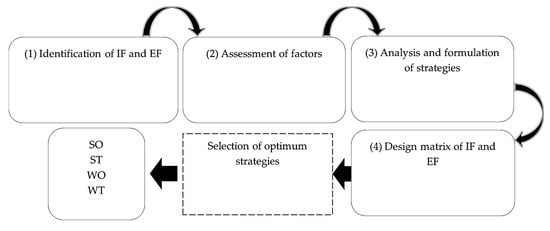
Figure 2.
The primary stages involved in the SWOT model.
- SO (aggressive strategies): Use strengths and opportunities.
- ST (diverse strategies): Use strengths to avoid threats.
- WO (review strategies): Use opportunities to reduce weaknesses.
- WT (defensive strategies): Reduce weaknesses and avoid threats.
3.2.4. ANP Model
The ANP model is an integral component of multi-criteria decision-making (MCDM) analysis, providing a means to assess various criteria and their interrelationships. It is essential for solving management problems in PAs because it is possible to develop a list of strategies to improve the situation in these areas [4,42]. Accordingly, the ANP model steps are as follows [43]:
(1) Creating a network structure through modelling and transformation: In this step, the Delphi method is employed to generate a network structure. The issue undergoes a transformation into a network format, with clusters represented as nodes in the network. Elements within each cluster can be connected to other elements within the same cluster or to elements in different clusters.
(2) Generating a matrix of pairwise comparisons and computing priority vectors: During this stage, pairwise comparisons are conducted to evaluate the relative importance of decision elements within each cluster. A matrix is constructed to capture these comparisons, and priority vectors are calculated to determine the influence of each element on the others. The internal significance vector, obtained using Equation (1), represents the relative importance of elements or clusters. Furthermore, the interrelationship between cluster criteria is assessed by referring to Table S3.
where A is the matrix comparison of criteria and is the largest eigenvalue value of the matrix.
(3) Constructing a super-matrix and establishing the limit of a super-matrix: In a system where reciprocal impacts exist, the overall priorities are determined by inserting the internal priority vectors into the corresponding columns of a matrix. This results in a super-matrix that represents the relationships between two clusters within the system. Within this super-matrix, W21 represents the vector indicating the target impacts on dimensions, and W32 represents the impacts of dimensions on variables. The “I” matrix represents a single matrix. The dimensions mutually influence each other, and this interdependence is captured by incorporating the W22 matrix into a Wn super-matrix, as outlined in Equation (2).
This matrix is considered the primary super-matrix. By replacing the vectors of internal priorities of elements and clusters in the primary super-matrix, an unbalanced super-matrix is obtained. In the subsequent step, the values of an unbalanced super-matrix within the cluster matrix are multiplied to compute a harmonic super-matrix. Furthermore, the lim(W)k super-matrix is normalised by enabling all elements of the harmonic super-matrix until convergence is reached, meaning that all elements of the super-matrix are aligned in Equation (3).
(4) Choosing the optimal alternative: The super-matrix formed in the third stage is analysed to determine the best alternative. The overall priority of each option is calculated based on the options column in the super-matrix. The most optimal solution for the specific subject or problem is identified by choosing the alternative that possesses the highest overall priority among the available options.
3.2.5. Comparing the Negative Impacts of Ecotourism and the Guidelines of the IUCN in PAs
Different types of PAs vary in their biological sensitivity, goals, and management objectives, as well as the physical and economic activities that take place there. IUCN guidelines for management should be adhered to. Accordingly, the current study compared the negative impacts of ecotourism with the management criteria set by the IUCN for PAs [44].
4. Results
4.1. Respondent Demographics
Most respondents (45%) were between 40 and 50 years old (Table S4). Fifty percent of respondents had a Ph.D. degree in tourism disciplines, and 20% of the respondents were employed at a university. Furthermore, 40% of the respondents stated that they had between 10 and 20 years of tourism management experience (Table S4).
4.2. Evaluating the Negative Impacts of Ecotourism on PAs
During the initial round of the Delphi study, a total of 66 impact indicators were derived based on expert opinions and perspectives (Table S5). In the second round, the selection process resulted in the identification of 65 indicators, as indicated in Table S6. In the third round, 63 indicators were selected based on the responses (Table 2). Moreover, the findings from the study reveal that Jajrud demonstrates the highest average negative impacts of ecotourism, scoring 3.14, whereas Lar exhibits the lowest average impacts with a score of 2.78 (Table 2).
Table 2.
Mean levels for ecotourism impact indicators based on 5-point Likert scale ratings by tourism management experts (n = 37) for four different Protected Areas (third round of the Delphi method). Grey highlights indicate the highest mean values, meaning the greatest impacts.
4.3. Comparing the Negative Impacts of Ecotourism and the Guidelines of the IUCN in PAs
As demonstrated in Table 3, each of the studied areas has specific managerial objectives and prohibitions for the development of human activities that must be considered in the use of these areas. However, the results also indicate that visible conflicts arise from human activities (Table 3). In Lar National Park, the major conflicts directly and indirectly relating to tourism include the presence of tourists in sensitive areas, overgrazing livestock, injury to brown trout (Salmo trutta fario), destruction of vegetation, an increase in environmental pollution, and land use/land cover (LULC) changes. At the same time, consumptive or physical uses are prohibited (Table 3). In addition, Lar has the highest degree of ecological sensitivities and legal prohibitions, whose purpose is to minimise the negative impacts of ecotourism (Table 3). Since Jajrud is located in the metropolis of Tehran, it is affected by a variety of physical and economic activities. On the other hand, according to the guidelines of the IUCN, the management of Jajrud is based on the principles of sustainability and adaptation to nature. Likewise, in Tangeh Vashi National Natural Monument, the development of tourism activities causes an increase in conflicts because of soil erosion, dispersal of waste and sewage production, environmental pollution, livestock overgrazing, poaching in the area, and LULC changes (Table 3). However, according to the guidelines of the IUCN, Tangeh Vashi is characterised by the highest protection priority and degree of biological sensitivity after national parks, and its management goal is to preserve the natural conditions of national natural monuments. Finally, in Kavdeh Wildlife Refuge, major conflicts observed include the threat to habitats due to the presence of tourists and ranchers in sensitive regions, livestock overgrazing, poaching in the area, LULC changes, the development of unplanned tourism activities, and the development of agricultural activities (Table 3). Despite that, the management objective in Kavdeh is based on measures to improve habitat conditions and species conservation. Accordingly, in all studied areas, results indicate that extensive development of human activities and a lack of attention to protection and legal standards contribute to unsustainability (Table 3).
Table 3.
Comparison of ecotourism’s negative impacts following IUCN guidelines (IUCN/WCMC, 1994) for four protected areas in Iran.
4.4. Assessment of Factors (IF and EF)
The findings indicate that in Lar, Tangeh Vashi, and Kavdeh, the strengths category received the highest score, while the threats category obtained the lowest score (Table 4, Table 5, Table 6 and Table 7). Accordingly, the strengths and opportunities identified for these areas were more important than the identified weaknesses and threats. Likewise, in Jajrud, we demonstrate that the threats category received the highest score, while the lowest is related to opportunities (Table 4, Table 5, Table 6 and Table 7).
Table 4.
Weighting of SWOT factors and sub-factor matrix in the Lar.
Table 5.
Weighting of SWOT factors and sub-factor matrix in the Jajrud.
Table 6.
Weighting of SWOT factors and sub-factor matrix in the Tangeh Vashi.
Table 7.
Weighting of SWOT factors and sub-factor matrixes in the Kavdeh.
4.5. Determination and Selection of the Best Strategy
According to expert opinion, the “SO” strategy emphasises the development of public education to inform on less impactful behaviour (Table 8, Table 9, Table 10 and Table 11). In addition, it provides opportunities for tourists to have meaningful experiences in nature. The second strategy is “ST”, which combines strengths and threats. This necessitates controlling factors such as habitat degradation and pollution, conserving tourism attractions, expanding tourism activities, and LULC changes (Table 8, Table 9, Table 10 and Table 11). Another strategy is the “WO” strategy, which emphasises developing and improving ecotourism infrastructure and facilities, increasing protective equipment and infrastructure, developing partnerships between tourism stakeholders and relevant organisations, and revising rules and regulations to enhance institutional cooperation in managing and safeguarding study sites. In addition, the “WO” strategy is focused on investing in the private sector in these areas and increasing their partnership with government agencies to protect ecosystems and biodiversity and to responsibly develop ecotourism infrastructure (Table 8, Table 9, Table 10 and Table 11). Finally, the “WT” strategy, a defensive strategy, was created by combining weaknesses and threats. This approach seeks to promote and cultivate institutional cooperation to protect ecosystems and biodiversity and to control human economic and physical activities (Table 8, Table 9, Table 10 and Table 11).
Table 8.
Matrix of strategies in the Lar.
Table 9.
Matrix of strategies in the Jajrud.
Table 10.
Matrix of strategies in the Tangeh Vashi.
Table 11.
Matrix of strategies in the Kavdeh.
In Lar, “SO” strategies were selected for strategic planning and management of sustainable ecotourism ventures (Table 12 and Figure 3). In Jajrud, “WT” strategies were thought to be most effective (Table 13 and Figure 3). In Tangeh Vashi, “ST” strategies were selected as the best choice for strategic planning and development of sustainable ecotourism ventures (Table 14 and Figure 3). Finally, in the Kavdeh Wildlife Refuge, “ST” strategies were also deemed most effective (Table 15 and Figure 3).
Table 12.
Matrix of weighted strategies for the Lar using the ANP method.
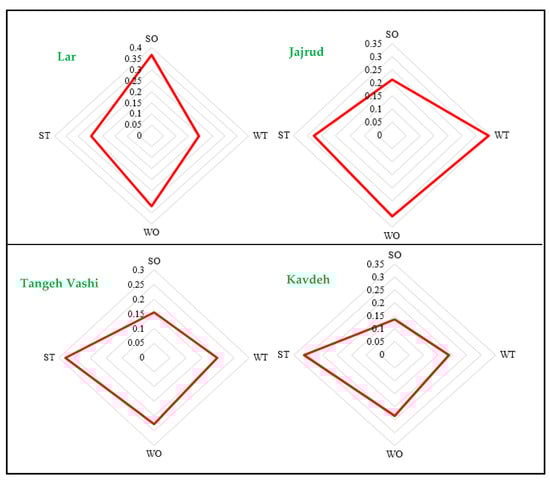
Figure 3.
The quadrilateral of the SWOT-ANP strategies in the studied areas.
Table 13.
Matrix of weighted strategies for the Jajrud using the ANP method.
Table 14.
Matrix of weighted strategies for the Tangeh Vashi using the ANP method.
Table 15.
Matrix of weighted strategies for the Kavdeh using the ANP method.
In the above part, ANP is used to rank the relative importance of its influencing factors. The ranking results shown in Table 12, Table 13, Table 14 and Table 15 indicate that the impact of each factor on the development strategy of ecotourism varies significantly across the different PAs. To construct a four-half-dimension coordinate system (i.e., a strategic quadrilateral graph), four variables were employed, with the positive semi-axis represented by the overall priority score of WT and SO and the negative semi-axis represented by ST and WO. This arrangement allowed for a comprehensive representation of the four variables in the coordinate system. The strategic quadrilateral graph (Figure 3) was formed by connecting the four points in a sequential manner, symbolising the SWOT-ANP strategies at each study site.
5. Discussion
Our research findings indicate that the most significant negative impacts of ecotourism are associated with physical and environmental aspects, especially because of the importance of these areas for sustaining biodiversity, their value as genetic resources, and the presence of natural and historic ecotourism attractions. Since sustainable ecotourism in PAs cannot succeed without considering human factors, we have also considered economic-institutional and socio-cultural dimensions. The complex, multi-dimensional nature of ecotourism impacts and their management was noted in numerous studies [45,46,47].
Jajrud has been exposed to high levels of change and severe destruction from human activities, population growth, and urbanisation. These findings are confirmed by other studies [29,48], which demonstrate that the development of economic and physical activities spans across fragmented habitats and has caused species extinction. Overall, the major challenge for Jajrud is its proximity to the metropolis of Tehran and the growth and development of human activities. Consequently, we propose “WT” strategies to reduce weaknesses and control threats in the area. This includes controlling and preventing the physical and economic exploitation of intervening organisations, the elimination of military activities and noisy vehicle traffic from this area to reduce stress levels in the fauna and prevent their displacement, and also enhancing the attractiveness of the area for tourists.
In Lar National Park, managerial objectives, legal bans, and protection measures have not been devised adhering to IUCN guidelines; thus, issues caused by human activities are prevalent. Previous studies, such as the one conducted by Jahani and Saffariha [49], have corroborated these findings. They have demonstrated that human activities, including overgrazing and the establishment of ecotourism ventures, have resulted in various impacts. Lar National Park shows high sensitivity and low levels of adaptation to the development of human activities [50]. Restrictions and legal measures established to protect the area have not been effective, as confirmed by the IUCN. “SO” strategies were thought to be optimal in this case, including the development of educational and research activities due to the presence of pristine habitat and high populations of S. trutta fario; furthering the development of sport-fishing in rivers due to the presence of valuable aquatic resources; and finally converting the area into a mountaineering hotspot to harness opportunities offered by Damavand Peak. At the same time, monitoring threats while increasing strengths and opportunities will be important.
In Tangeh Vashi, the combination of a large number of tourists flocking to the area (Table 1) without proper monitoring of the use of the many historical, natural, and cultural attractions has made ecotourism in this area unsustainable. “ST” strategies seem most prudent, as evidenced by their high score, to develop strengths and eliminate threats. This area shows the second highest ecological sensitivity after Lar and high levels of visitation to various natural, historical, and artificial attractions. Controlling the growth of scattered constructions in Tangeh Vashi to protect historical monuments and increasing a sense of safety for tourists by developing access to vital infrastructure will be important. Finally, in Kavdeh, wildlife hunting and habitat loss pose threats to be addressed through “ST” strategies, which aim to decrease conflicts between local communities and wildlife. To preserve the best habitats as wildlife refuges, ecosystem degradation needs to be managed along with vegetation loss, increased pollution, the development of scattered and unbalanced construction, and environmental hazards, as supported in other studies [51,52,53].
Overall, the uncontrolled and widespread development of tourism activities and the lack of partnerships between different organisations and a common agenda with a clear prioritisation of the most pressing issues have impacted all four PAs in our study. Strategic planning will be essential to attract the support and cooperation of multiple agencies to sustainably harness ecotourism potential [54,55,56].
5.1. Research Implications
The suggested approach, along with the sustainable ecotourism outcomes it produces, was initially illustrated and defined through a case study conducted at the site level, focusing on different types of PAs. This process can be further expanded to encompass other ecological and geographical contexts. The ultimate goal is to develop a comprehensive and practical model that can be universally implemented in various PAs as ecotourism destinations in the future, ensuring its effectiveness and usefulness. The method employed in this study enables the objective consideration of the factors influencing ecotourism sustainability in different types of PAs in Iran. By combining qualitative and quantitative approaches, a comprehensive understanding of these factors is achieved. This implies that the method can be applied to other frameworks and regions, allowing for flexibility and broader applicability. The strategies obtained from our study can be potentially applied in regions that share similar characteristics to the studied region. In order to expand the applicability of the study method to other areas, it is crucial to adapt and redefine the SWOT factors and sub-factors to align with the unique characteristics of those specific areas.
5.2. Research Limitations and Future Works
It is important to acknowledge several limitations in our study. Firstly, the research may have limited generalizability as it primarily focuses on the sustainable determinants of ecotourism in Iran, specifically aligning with international guidelines. Secondly, the strategic elements identified in the study are derived from the viewpoints of a particular group of experts, and it is possible that the findings might differ when considering the perspectives of another subset of experts. To enhance the accuracy of factor weighting, it is recommended to employ other MCDM methods, such as Technique for Order Preference by Similarity to Ideal Solution (TOPSIS). Additionally, incorporating evaluations based on fuzzy logic is suggested to account for uncertainty in the analysis. In future research, the utilisation of multi-criteria decision-making models should encompass a diverse range of criteria. It is important to identify undiscovered attractions and incorporate updated methods such as artificial neural networks and support vector machines. By employing these advanced techniques, complex multi-criteria decisions can be made more accurately, enabling the identification of areas with untapped ecotourism potential.
6. Conclusions
PAs hold great potential for ecotourism development, and yet they are consistently challenged by the accompanying impacts. We used a SWOT-ANP analysis to demonstrate how this can be applied to select optimal strategies for the management of ecotourism destinations. Ultimately, it is crucial to implement appropriate strategies that leverage the strengths and opportunities while mitigating the weaknesses and threats to effectively develop ecotourism in PAs. We exemplified the utility of this approach for four PAs in Iran.
We found that for each type of PA in Iran, a different strategy should be selected for strategic planning and the development of sustainable ecotourism ventures. In Lar, aggressive strategies were chosen for the strategic planning and management of sustainable ecotourism ventures. In Jajrud, defensive strategies were considered to be the most effective. In the Tangeh Vashi and Kavdeh areas, diverse strategies were selected as the optimal choice for strategic planning and the development of sustainable ecotourism ventures. To protect these areas, a range of management measures were presented, such as the implementation of integrated management plans based on zoning guidelines, the establishment of better protection laws and regulations, and the development of partnerships and cooperation between organisations, local communities, and tourists.
Supplementary Materials
The following supporting information can be downloaded at: https://www.mdpi.com/article/10.3390/su151411013/s1. Table S1: Details of respondents (n = 40). Table S2: List of dimensions, variables, and indicators of negative impacts of ecotourism for four different Protected Areas in Iran. Table S3: Relative preference values for pairwise comparisons (adapted from Saaty, 1996). Table S4: Descriptive profile of the respondents. Table S5: Mean levels for ecotourism impact indicators (total = 66 indicators) based on 5-point Likert scale ratings (very low to very high) by tourism management experts (n = 40) for four different protected areas in Iran (first round of the Delphi method). Table S6: Mean levels for ecotourism impact indicators based on 5-point Likert scale ratings by tourism management experts (n = 38) for four different Protected Areas in Iran (second round of the Delphi method). References [57,58,59,60,61,62,63,64,65,66,67,68,69,70,71,72,73,74,75,76,77,78,79,80,81,82] are cited in the Supplementary Materials.
Author Contributions
Conceptualisation, H.E. and S.M.M.S.; methodology, P.S. and H.E.; software, P.S.; formal analysis, P.S.; writing—original draft preparation, P.S. and H.E.; writing—review and editing, I.D.W., M.L., M.V.M. and S.M.M.S.; visualisation, P.S. and S.M.M.S.; supervision, H.E. and S.M.M.S. All authors have read and agreed to the published version of the manuscript.
Funding
This research received no external funding.
Institutional Review Board Statement
Not applicable.
Informed Consent Statement
Not applicable.
Data Availability Statement
The data supporting the findings of this study are available from the second author (H.E.) upon reasonable request.
Conflicts of Interest
The authors declare no conflict of interest.
References
- Tapfuma, M.M.; Musavengane, R.; Magwaza, R. The role of creative tourism through arts and crafts in promoting inclusive tourism in Zimbabwe. J. Tour. Cult. Change 2023, 1–20. [Google Scholar] [CrossRef]
- Cobbinah, P.B.; Amenuvor, D.; Black, R.; Peprah, C. Ecotourism in the Kakum Conservation Area, Ghana: Local politics, practice and outcome. J. Outdoor Recreat. Tour. 2017, 20, 34–44. [Google Scholar] [CrossRef]
- Surendran, A.; Sekar, C. A comparative analysis on the socio-economic welfare of dependents of the Anamalai Tiger Reserve (ATR) in India. Margin J. Appl. Econ. Res. 2011, 5, 361–379. [Google Scholar] [CrossRef]
- Arsić, S.; Nikolić, D.; Živković, Ž. Hybrid SWOT-ANP-FANP model for prioritization strategies of sustainable development of ecotourism in National Park Djerdap, Serbia. For. Policy Econ. 2017, 80, 11–26. [Google Scholar] [CrossRef]
- Lee, T.H.; Jan, F.-H. Can community-based tourism contribute to sustainable development? Evidence from residents’ perceptions of the sustainability. Tour. Manag. 2019, 70, 368–380. [Google Scholar] [CrossRef]
- Valdivieso, J.C.; Eagles, P.F.; Gil, J.C. Efficient management capacity evaluation of tourism in protected areas. J. Environ. Plan. Manag. 2015, 58, 1544–1561. [Google Scholar] [CrossRef]
- LaPage, W. Rethinking Park Protection Treading the Uncommon Ground of Environmental Beliefs; CABI: Wallingford, UK, 2012. [Google Scholar]
- Soltani, N.; Amini-birami, F.; Keshavarzi, B.; Moore, F.; Busquets, R.; Sorooshia, A.; Javid, R.; Rahmani Shahraki, A. Microplastic occurrence in selected aquatic species of the Persian Gulf: No evidence of trophic transfer or effect of diet. Sci. Total Environ. 2023, 892, 164685. [Google Scholar] [CrossRef]
- Golkar, K. Tailoring SWOT Analytical Technique for Urban Design Application. 2020. Available online: https://www.researchgate.net/publication/339055754_Tailoring_SWOT_Analytical_Technique_for_Urban_Design_Application (accessed on 17 January 2022).
- Kajanus, M.; Kangas, J.; Kurttila, M. The use of value focused thinking and the A’WOT hybrid method in tourism management. Tour. Manag. 2004, 25, 499–506. [Google Scholar] [CrossRef]
- Bertini, A.; Vitolo, T. Historical Centres, protected natural areas, communities and sustainable development: A possible balance. Land 2023, 12, 403. [Google Scholar] [CrossRef]
- Başkent, E.Z. Assessing and developing improvement strategies for the protected area management (PAM) planning process/effectiveness in Turkey. Environ. Dev. 2023, 46, 100867. [Google Scholar] [CrossRef]
- Papapostolou, A.; Karakosta, C.; Apostolidis, G.; Doukas, H. An AHP-SWOT-Fuzzy TOPSIS Approach for Achieving a Cross-Border RES Cooperation. Sustainability 2020, 12, 2886. [Google Scholar] [CrossRef]
- Arsić, S.; Nikolić, D.; Mihajlović, I.; Fedajev, A.; Živković, Ž. A new approach within ANP-SWOT framework for prioritization of ecosystem management and case study of National Park Djerdap, Serbia. Ecol. Econ. 2018, 146, 85–95. [Google Scholar] [CrossRef]
- Li, J.; Stoffelen, A.; Vanclay, F. A conceptual framework and research method for understanding protected area governance: Varying approaches and epistemic worldviews about human-nature relations. J. Environ. Plan. Manag. 2023, 66, 1393–1412. [Google Scholar] [CrossRef]
- Soltani-Nejad, N.; Rastegar, R.; Shahriari-Mehr, G.; Taheri-Azad, F. Conceptualizing tourist journey: Qualitative analysis of tourist experiences on tripadvisor. J. Qual. Assur. Hosp. Tour. 2022, 1–22. [Google Scholar] [CrossRef]
- Tanaka, T.; Takashina, N. Governance paradox: Implications from Japan’s national parks for managing complex protected areas. Sustain. Sci. 2023, 18, 1995–2007. [Google Scholar] [CrossRef]
- Gulte, E.; Tadele, H.; Haileslassie, A.; Mekuria, W. Perception of local communities on protected areas: Lessons drawn from the Bale Mountains National Park, Ethiopia. Ecosyst. People 2023, 19, 2227282. [Google Scholar] [CrossRef]
- Sobhani, P.; Esmaeilzadeh, H.; Sadeghi, S.M.M.; Wolf, I.D.; Deljouei, A. Relationship Analysis of Local Community Participation in Sustainable Ecotourism Development in Protected Areas, Iran. Land 2022, 11, 1871. [Google Scholar] [CrossRef]
- Fan, P.; Zhu, Y.; Ye, Z.; Zhang, G.; Gu, S.; Shen, Q.; Meshram, S.G.; Alvandi, E. Identification and prioritization of tourism development strategies using SWOT, QSPM, and AHP: A case study of Changbai Mountain in China. Sustainability 2023, 15, 4962. [Google Scholar] [CrossRef]
- Jaiswal, A.; Negi, P.; Singh, N. MCDM Computational Approaches for Green Supply Chain Management Strategies. In Proceedings of the 2023 6th International Conference on Information Systems and Computer Networks (ISCON), Mathura, India, 3–4 March 2023; pp. 1–9. [Google Scholar]
- Qayyum, M.; Yuyuan, Y.; Bhatti, U.A.; Shijie, L. Evaluation of the one belt and one road (OBOR) in economic development and suggestions analysis based on SWOT analysis with weighted AHP and entropy methods. Multimed. Tools Appl. 2023, 82, 14985–15006. [Google Scholar] [CrossRef]
- Oktari, R.S.; Latuamury, B.; Idroes, R.; Sofyan, H.; Munadi, K. Knowledge management strategy for managing disaster and the COVID-19 pandemic in Indonesia: SWOT analysis based on the analytic network process. Int. J. Disaster Risk Reduct. 2023, 85, 103503. [Google Scholar] [CrossRef]
- Sobhani, P.; Esmaeilzadeh, H.; Sadeghi, S.M.M.; Marcu, M.V.; Wolf, I.D. Evaluating Ecotourism Sustainability Indicators for Protected Areas in Tehran, Iran. Forests 2022, 13, 740. [Google Scholar] [CrossRef]
- Huber, D.-J.; Huber, J.; Hesser, F.; Höllbacher, E.; Stern, T. Two experts, three opinions: Volatile organic compounds’ testing methods and regulative systems. Eur. J. Wood Wood Prod. 2018, 76, 5–12. [Google Scholar] [CrossRef]
- Sutterlüty, A.; Hesser, F.; Schwarzbauer, P.; Schuster, K.C.; Windsperger, A.; Stern, T. A Delphi approach to understanding varying expert viewpoints in sustainability communication: The case of water footprints of bio-based fiber resources. J. Ind. Ecol. 2017, 21, 412–422. [Google Scholar] [CrossRef]
- Kennedy, H.P. Enhancing Delphi research: Methods and results. J. Adv. Nurs. 2004, 45, 504–511. [Google Scholar] [CrossRef]
- Paraskevas, A.; Saunders, M.N. Beyond consensus: An alternative use of Delphi enquiry in hospitality research. Int. J. Contemp. Hosp. Manag. 2012, 24, 907–924. [Google Scholar] [CrossRef]
- Ma, X.; Xie, Y.; Wang, H. Research on the construction and application of teacher-student interaction evaluation system for smart classroom in the post COVID-19. Stud. Educ. Eval. 2023, 78, 101286. [Google Scholar] [CrossRef]
- Joseph-Williams, N.; Newcombe, R.; Politi, M.; Durand, M.-A.; Sivell, S.; Stacey, D.; O’Connor, A.; Volk, R.J.; Edwards, A.; Bennett, C. Toward minimum standards for certifying patient decision aids: A modified Delphi consensus process. Med. Decis. Mak. 2014, 34, 699–710. [Google Scholar] [CrossRef]
- Fallah, M.; Ocampo, L. The use of the Delphi method with non-parametric analysis for identifying sustainability criteria and indicators in evaluating ecotourism management: The case of Penang National Park (Malaysia). Environ. Syst. Decis. 2021, 41, 45–62. [Google Scholar] [CrossRef]
- Powell, C. The Delphi technique: Myths and realities. J. Adv. Nurs. 2003, 41, 376–382. [Google Scholar] [CrossRef]
- Lawshe, C.H. A quantitative approach to content validity. Pers. Psychol. 1975, 28, 563–575. [Google Scholar] [CrossRef]
- Yüksel, İ.; Dagdeviren, M. Using the analytic network process (ANP) in a SWOT analysis–A case study for a textile firm. Inf. Sci. 2007, 177, 3364–3382. [Google Scholar] [CrossRef]
- Saaty, T.L.; Vargas, L.G.; Saaty, T.L.; Vargas, L.G. The seven pillars of the analytic hierarchy process. In Models, Methods, Concepts & Applications of the Analytic Hierarchy Process; Springer: Boston, MA, USA, 2012; pp. 23–40. [Google Scholar]
- Saludares, Q.E.D.; Namoco, R.A. Optimizing Allocation and Distribution of Students’ Assistance Among SUCs Using Analytic Network Process (ANP). J. Innov. Teach. Learn. 2023, 3, 19–22. [Google Scholar]
- Yuslem, N.; Nawawi, Z.M.; Dahrul, S. Strategy For Strengthening Business Incubators As Establishment Of Entrepreneurship Using The Anp Model In Private Higher Education In North Sumatera. Edukasi Islam. J. Pendidik. Islam 2023, 11, 1–12. [Google Scholar]
- Margles, S.W.; Masozera, M.; Rugyerinyange, L.; Kaplin, B.A. Participatory planning: Using SWOT-AHP analysis in buffer zone management planning. J. Sustain. For. 2010, 29, 613–637. [Google Scholar] [CrossRef]
- Starr, M.; Joshi, O.; Will, R.E.; Zou, C.B. Perceptions regarding active management of the Cross-timbers forest resources of Oklahoma, Texas, and Kansas: A SWOT-ANP analysis. Land Use Policy 2019, 81, 523–530. [Google Scholar] [CrossRef]
- Li, M.; Li, Z.; Xing, X. The Dilemma of Sustainable Development of Russian Arctic Development Based on ANP-SWOT Model Theory Perspective. Systems 2023, 11, 334. [Google Scholar] [CrossRef]
- Hosseini, A.; Pourahmad, A.; Oroji, H.; Alizadeh, M. The Priority of Measuring the Strategies for Development of Cultural Tourism in Alamut, Qazvin. Hum. Geogr. Res. 2013, 45, 1–17. [Google Scholar] [CrossRef]
- Grošelj, P.; Hodges, D.G.; Stirn, L.Z. Participatory and multi-criteria analysis for forest (ecosystem) management: A case study of Pohorje, Slovenia. For. Policy Econ. 2016, 71, 80–86. [Google Scholar] [CrossRef]
- Saaty, T.L. Decision Making with Dependence and Feedback: The Analytic Network Process; RWS Publications: Pittsburgh, PA, USA, 1996; Volume 4922. [Google Scholar]
- IUCN; WCMC. Godliness for Protected Areas Management Categories; IUCN: Gland, Switzerland; CNPPA: Ambleside, UK; WCMC: Cambridge, UK, 1994. [Google Scholar]
- Pollard, W.; Rajendran, D.; Sendjaya, S.; Neesham, C. Organisational culture and effectiveness in ecotourism: The case of World-Wide Opportunities on Organic Farms Australia (WWOOF Australia). Asia Pac. J. Tour. Res. 2023, 28, 111–126. [Google Scholar] [CrossRef]
- Karthik, A.; Jeniffer, M.; Chandran, R.A. Multi-Dimensional Strands of Rural Tourism in Alankuppam A Stimulus for Destination Branding. Int. Res. J. Econ. Manag. Stud. IRJEMS 2023, 2, 94–98. [Google Scholar]
- Wongthong, P.; Harvey, N. Integrated coastal management and sustainable tourism: A case study of the reef-based SCUBA dive industry from Thailand. Ocean Coast. Manag. 2014, 95, 138–146. [Google Scholar] [CrossRef]
- Sobhani, P.; Esmaeilzadeh, H.; Sadeghi, S.M.M.; Marcu, M.V. Estimation of Ecotourism Carrying Capacity for Sustainable Development of Protected Areas in Iran. Int. J. Environ. Res. Public Health 2022, 19, 1059. [Google Scholar] [CrossRef] [PubMed]
- Jahani, A.; Saffariha, M. Human activities impact prediction in vegetation diversity of Lar National Park in Iran using artificial neural network model. Integr. Environ. Assess. Manag. 2021, 17, 42–52. [Google Scholar] [CrossRef] [PubMed]
- Rakhshan, M.; Mahmoudi, H.; Abdoli, A.; Veisi, H.; Babrgir, S. The interaction of local people and natural area in Haraz drainage basin; Case study: Ab-e Ask village. Front. Water 2023, 4, 949691. [Google Scholar] [CrossRef]
- Berry, S.; Ladkin, A. Sustainable tourism: A regional perspective. Tour. Manag. 1997, 18, 433–440. [Google Scholar] [CrossRef]
- Pandit, M.K. The Himalayas must be protected. Nature 2013, 501, 283. [Google Scholar] [CrossRef]
- Scott, D. Why sustainable tourism must address climate change. J. Sustain. Tour. 2011, 19, 17–34. [Google Scholar] [CrossRef]
- Ardoin, N.M.; Wheaton, M.; Bowers, A.W.; Hunt, C.A.; Durham, W.H. Nature-based tourism’s impact on environmental knowledge, attitudes, and behavior: A review and analysis of the literature and potential future research. J. Sustain. Tour. 2015, 23, 838–858. [Google Scholar] [CrossRef]
- Blancas, F.J.; Lozano-Oyola, M.; Gonzalez, M.; Guerrero, F.M.; Caballero, R. How to use sustainability indicators for tourism planning: The case of rural tourism in Andalusia (Spain). Sci. Total Environ. 2011, 412, 28–45. [Google Scholar] [CrossRef]
- Lozano-Oyola, M.; Blancas, F.J.; González, M.; Caballero, R. Sustainable tourism indicators as planning tools in cultural destinations. Ecol. Indic. 2012, 18, 659–675. [Google Scholar] [CrossRef]
- Bell, S.; Morse, S. Breaking through the glass ceiling: Who really cares about sustainability indicators? Local Environ. 2001, 6, 291–309. [Google Scholar] [CrossRef]
- Bottrill, C.G.; Pearce, D.G. Ecotourism: Towards a key elements approach to operationalising the concept. J. Sustain. Tour. 1995, 3, 45–54. [Google Scholar] [CrossRef]
- Butler, R.W. Sustainable tourism: A state-of-the-art review. Tour. Geogr. 1999, 1, 7–25. [Google Scholar] [CrossRef]
- Castellani, V.; Sala, S. Sustainable performance index for tourism policy development. Tour. Manag. 2010, 31, 871–880. [Google Scholar] [CrossRef]
- Céron, J.P.; Dubois, G. Tourism and sustainable development indicators: The gap between theoretical demands and practical achievements. Curr. Issues Tour. 2003, 6, 54–75. [Google Scholar] [CrossRef]
- Chávez-Cortés, M.; Maya JA, A. Identifying and structuring values to guide the choice of sustainability indicators for tourism development. Sustainability 2010, 2, 3074–3099. [Google Scholar] [CrossRef]
- Dhakal, S.; Imura, H. Policy-based indicators systems: Emerging debates and lessons. Local Environ. 2003, 8, 113–119. [Google Scholar] [CrossRef]
- Gabrielsen, P.; Bosch, P. Environmental Indicators: Typology and Use in Reporting; European Environment Agency: Copenhagen, Denmark, 2003; 20p. [Google Scholar]
- Hall, C.M. Tourism Planning: Policies, Processes and Relationships; Pearson Education: Harlow, UK, 2000. [Google Scholar]
- Innes, J.E.; Booher, D.E. Indicators for sustainable communities: A strategy building on complexity theory and distributed intelligence. Plan Theor. Pract. 2000, 1, 173–186. [Google Scholar] [CrossRef]
- Ko, T.G. Development of a tourism sustainability assessment procedure: A conceptual approach. Tour. Manag. 2005, 26, 431–445. [Google Scholar] [CrossRef]
- Lee, T.H. A structural model to examine how destination image, attitude, and motivation affect the future behavior of tourists. Leis. Sci. 2009, 31, 215–236. [Google Scholar] [CrossRef]
- Lee, T.H.; Hsieh, H.P. Indicators of sustainable tourism: A case study from a Taiwan’s wetland. Ecol. Ind. 2016, 67, 779–787. [Google Scholar] [CrossRef]
- Mascarenhas, A.; Nunes, L.M.; Ramos, T.B. Selection of sustainability indicators for planning: Combining stakeholders’ participation and data reduction techniques. J. Clean. Prod. 2015, 92, 295–307. [Google Scholar] [CrossRef]
- Miller, G. The development of indicators for sustainable tourism: Results of a Delphi survey of tourism researchers. Tour. Manag. 2001, 22, 351–362. [Google Scholar] [CrossRef]
- Qiu, Q.; Zheng, T.; Xiang, Z.; Zhang, M. Visiting intangible cultural heritage tourism sites: From value cognition to attitude and intention. Sustainability 2020, 12, 132. [Google Scholar] [CrossRef]
- Sigala, M. Exploiting Web 2.0 for new service development: Findings and implications from the Greek tourism industry. Int. J. Tour. Res. 2012, 14, 551–566. [Google Scholar] [CrossRef]
- Taghvaei, M.; Akbari, M. Introduction to Urban Planning and Tourism Management Isfahan; Alavi Publications: Tehran, Iran, 2010. [Google Scholar]
- Tanguay, G.A.; Rajaonson, J.; Therrien, M.C. Sustainable tourism indicators: Selection criteria for policy implementation and scientific recognition. J. Sustain. Tour. 2013, 21, 862–879. [Google Scholar] [CrossRef]
- Torres-Delgado, A.; Palomeque, F.L. Measuring sustainable tourism at the municipal level. Ann. Tour. Res. 2014, 49, 122–137. [Google Scholar] [CrossRef]
- Tucker, H. Gendering sustainability’s contradictions: Between change and continuity. J. Sustain. Tour. 2020, 30, 1–18. [Google Scholar]
- Wang, S.H.; Lee, M.T.; Château, P.A.; Chang, Y.C. Performance indicator framework for evaluation of sustainable tourism in the Taiwan Coastal Zone. Sustainability 2016, 8, 652. [Google Scholar] [CrossRef]
- White, V.; McCrum, G.; Blackstock, K.L.; Scott, A. Indicators and Sustainable Tourism: Literature Review; The Macaulay Institute: Aberdeen, UK, 2006. [Google Scholar]
- Yoon, Y.; Gursoy, D.; Chen, J.S. Validating a tourism development theory with structural equation modeling. Tour. Manag. 2001, 22, 363–372. [Google Scholar] [CrossRef]
- Zhang, H.Q.; Fan DX, F.; Tse TS, M.; King, B. Creating a scale for assessing socially sustainable tourism. J. Sustain. Tour. 2017, 25, 61–78. [Google Scholar] [CrossRef]
- Zhang, Y.; Xiao, X.; Zheng, C.; Xue, L.; Guo, Y.; Wu, Q. Is tourism participation in protected areas the best livelihood strategy from the perspective of community development and environmental protection? J. Sustain. Tour. 2020, 28, 587–605. [Google Scholar] [CrossRef]
Disclaimer/Publisher’s Note: The statements, opinions and data contained in all publications are solely those of the individual author(s) and contributor(s) and not of MDPI and/or the editor(s). MDPI and/or the editor(s) disclaim responsibility for any injury to people or property resulting from any ideas, methods, instructions or products referred to in the content. |
© 2023 by the authors. Licensee MDPI, Basel, Switzerland. This article is an open access article distributed under the terms and conditions of the Creative Commons Attribution (CC BY) license (https://creativecommons.org/licenses/by/4.0/).