Abstract
With the rapid development of urbanization, the overall consumption level of rural residents has been improved accordingly in China, and the consumption structure has gradually become perfect. However, in the process of urbanization, it is necessary to handle some practical problems in order to realize the sustainable development of consumption in rural areas. Under the concept of sustainable consumption, urbanization has become a new engine that drives rural residents’ consumption in China. The digital economy has injected new vitality to expand domestic demand as well. Therefore, whether consumption upgrading in rural areas is affected by urbanization and the digital economy is a topic worth studying. To discuss the relationship between urbanization, the digital economy and consumption levels in rural areas, this paper uses an intermediary effect model to test how urbanization promotes the consumption upgrading in rural regions with the digital economy as the intermediary variable and explores the threshold characteristics of urbanization. The results are as follows: urbanization significantly promotes the rural residents’ consumption upgrading, and there is regional heterogeneity. It improves the consumption optimization in the eastern and central regions, but not in the western region. The digital economy intermediates the relationship between urbanization and consumption optimization. Moreover, urbanization has a double threshold, and with the increase of the threshold value, the marginal effect of urbanization on rural residents’ consumption upgrading also increases gradually. China should seize the opportunities of the development of urbanization and the digital economy, constantly raise farmer income, and narrow the income gap between urban and rural area, so as to promote the sustainable development of consumption in rural areas.
1. Introduction
In 1992, the United Nations Conference on Environment and Development proposed for the first time that all countries should try best to promote sustainable consumption patterns in “Agenda for 21st”. This is the first time that consumption was given a “sustainable” label. Then, in 1994, the United Nations Environment Programmed launched a report, the Policy Factors of Sustainable Consumption, which defined sustainable consumption. It proposed that sustainable consumption means that services and related products provided not only meet basic needs and improve the quality of life but also minimized the use of resources and harmful substances as well as the discharge of wastes and pollutants during their life cycle.
The living standard of the Chinese people has been greatly improved since 1978. The consumption demand of the people has shifted from merely meeting basic needs to encompassing material, spiritual, and ecological requirements. From 1978 to 2021, the Engel coefficient in China dropped from 60% to 29.8%. With the advance of urbanization, the consumption level of residents is being improved, and consumption structure has been continuously improved; however, insufficient consumption, especially that of rural residents, is still an important factor of insufficient domestic demand in China [1,2]. In 2021, China’s total consumer expenditure was CNY 34.04 trillion, of CNY 27.71 trillion was from urban regions and CNY 6.33 trillion was from rural areas, accounting for 81.39% and 18.61%, respectively. By the end of 2021, there were 498 million people living in rural areas, accounting for 35.27% of the total population. The rural population, which accounts for nearly 40% of the national population, consumed less than 20% of the national household consumption.
Urbanization provides a great contribution to economic development in China, as well as a lasting driving force to improve rural consumption level [3]. In 1978, there were just 172 million people living in urban regions in China; however, by the end of 2021, the population in urban areas increased rapidly, reaching to 914 million, accounting for 64.72% of the total population. With the steady progress of urbanization, many people from rural areas entered cities to earn a living, resulting higher income, which effectively activates the rural consumer market. Meanwhile, the digital economy is playing an increasingly important role in unleashing consumption potential due to the new means of payment and shopping, such as online shopping and mobile payment, which promotes consumption upgrading further. The revolution of consumption channels brought about by the digital economy has promoted the flow and output of consumption resources to rural areas, which greatly stimulates consumer demand in rural areas as well. However, problems between urban and rural areas and unbalanced regional development have existed for a long time, especially the income gap, which hinders the farmer’s consumption desire and consumption level. This paper explored the relationship between urbanization and farmer’s consumption, attempting to find the threshold characteristics of urbanization and the intermediary role of the digital economy, which has important practical significance for activating the Chinese rural consumption market, improving the rural consumption structure, and providing new insight to explain consumption structure optimization. In addition, urban development is a human-centered urbanization process, so cities need to become more livable and smarter. In order to realize the promotion effect of urbanization on consumption upgrading, it is necessary to construct consumption scenes with higher quality, more diversification and more characteristics in the process of urbanization in order to improve green consumption, digital consumption and experiential consumption, so as to optimize the consumption structure of residents and realize sustainable consumption. In this regard, the research results of this paper provide an important insight on realizing the sustainable consumption of society.
2. Literature Review
The impact of urbanization on consumption upgrading has been studied for a long time. Zhang [4] thought that urbanization expands domestic demand, and consumption upgrading is a direct consequence of urbanization. Using the data from China, Liu [5] found that population urbanization significantly improves the consumption level. Chen et al. [6] found that urbanization significantly promoted consumption upgrading. Shang and Li [7] concluded that the development of urbanization stimulates residents’ consumption potential. Using the data from “Belt and Road”, Liu et al. [8] believes that in the middle and high stages of urbanization development, urbanization increases the consumption level. However, in the initial stage of urbanization development, residents’ consumption level decreases with the increase of urbanization level. Lewis [9] thinks that the differences between urban and rural income caused populations to transfer to towns, improving the level of the demand of the whole society. Duesenberry [10] and Carroll [11] believes that the consumption pattern of urban residents has a “demonstrative” effect on the new inflow of rural residents and can guide rural residents to change their consumption habits. Stark and Taylor [12] pointed out that improving residents’ income level is decided by the town’s high salary income, and the external economy caused by urbanization through the “accumulation effect” and “scale effect” promotes the demand for expansion.
Herrmann [13] found that there is a significant positive correlation between urbanization level and people’s consumption level. Daniels, Connor and Huton [14] found that the higher the level of urbanization, the higher the level of service consumption, and it is believed that the regional market generated by urbanization promotes the growth of consumption. Akita and Miyata [15] found that urbanization has a significant positive effect on the consumption level of urban residents. Nguyen [16] conducted an empirical study using a panel data model and found that urbanization can promote farmers’ consumption. When the urbanization rate increases by 1%, farmers’ consumption expenditure increases by 0.39%. Bunyan [17] believes that the development of urbanization will improve financial services and further promote consumer consumption. Arouria et al. [18], based on household survey data, found that rural residents’ consumption increases gradually with the development of urbanization.
Some scholars have studied the relationship between the digital economy and consumption upgrading. Most of them thought that the digital economy significantly improves the advancement of consumption levels [19,20,21,22]. Xiong and Guo [23] concluded that there is a positive spatial spillover effect between the digital economy and consumption upgrading. In addition, Lian and Cai [24] found that online shopping optimized the consumption structure. Yao [25] analyzed the impact of industrial digital transformation on the performance of the retail industry based on the micro data of enterprises and found that industrial digital transformation had a significant positive impact on consumption upgrading. Moreover, digital inclusive finance combined with inclusive finance and digital technology can help people at the bottom enjoy the development dividends of inclusive finance and improve social equity. The credit availability of traditional finance is subject to more government controls, resulting in the consumption gap between urban and rural residents [26]. The development of digital inclusive finance overcomes the problem of limited credit availability, breaks through the limitations of traditional finance, increases financial resources in areas with backward resources, which effectively promotes the consumption upgrading of rural residents [27]. Soumare et al. [28] pointed out that digital financial inclusion can provide financial support for vulnerable groups and help alleviate the situation of unbalanced and unequal development.
To sum up, scholars have done a lot of research on urbanization, the digital economy and consumption upgrading, but there is little research on rural consumption upgrading. However, in reality, with the increase of rural residents’ disposable income, farmers’ willingness to consume gradually increases, and their desire for high-level consumption and demand becomes stronger and stronger. Therefore, this paper systematically explains the mechanism behind urbanization affecting consumption in rural areas and tries to explore the relationship between urbanization and rural residents’ consumption. The contributions of this paper are mainly as follows: First, based on the intermediary effect model, this paper examines the intermediary role played by the digital economy. Second, it tests the threshold characters of urbanization. Finally, it explores how urbanization affects the consumption level in different rural areas.
3. Theoretical Analysis and Research Hypothesis
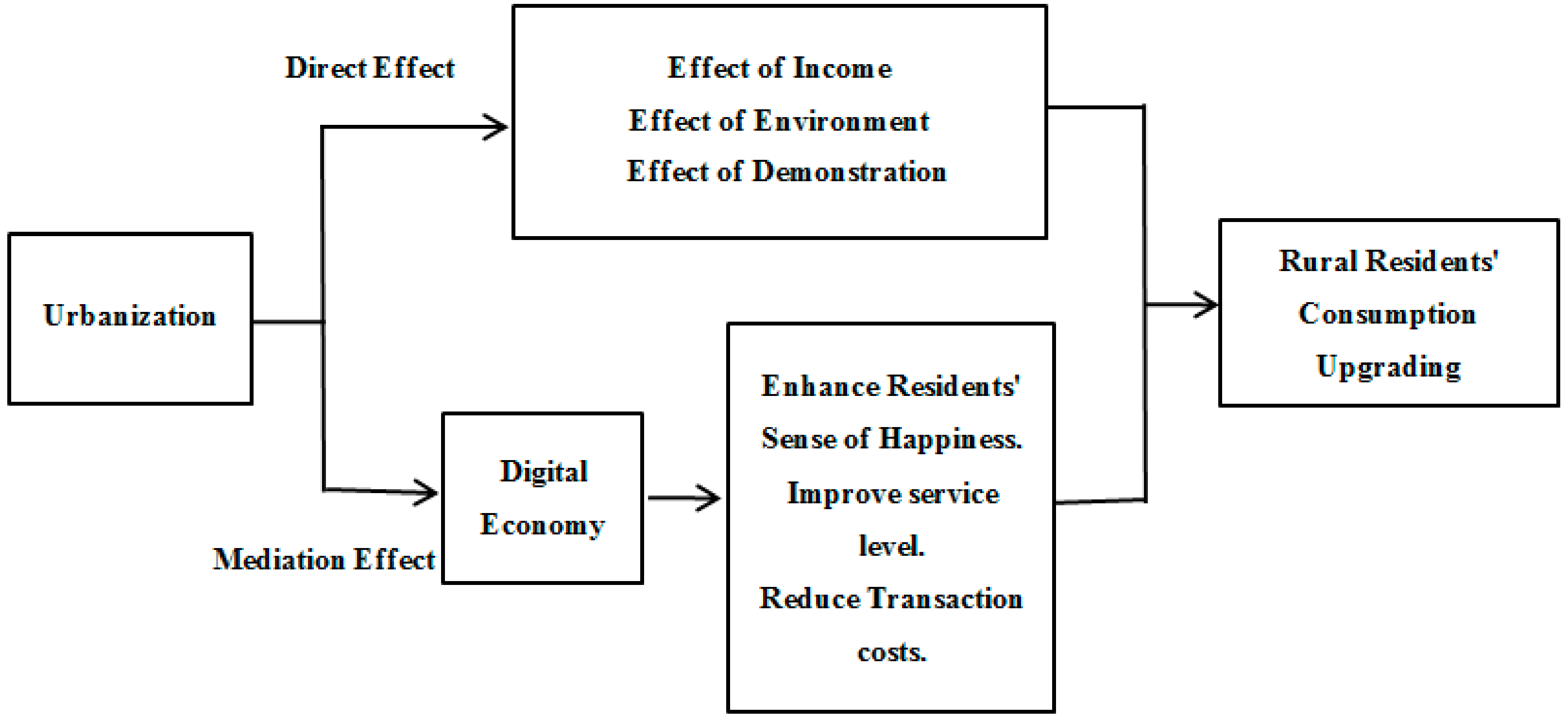
Based on the intermediary effect and threshold effect model, this paper discusses the relationship between urbanization and consumption in rural areas. It is concluded that urbanization development directly affects the consumption of rural residents and that the digital economy plays an important role (see Figure 1).
Figure 1.
Mechanism of urbanization affecting consumption upgrading of rural residents.
Urbanization is an important support to develop the potential of domestic demand, increase the purchasing power of residents, and improve the consumption level in rural regions. First, urbanization increases the income of rural residents [29]. The development of urbanization brings various resources closer to cities, accelerates the development of the secondary and tertiary industries, which increases the employment opportunities of rural residents, and significantly improves their income. Farmers are more inclined increase their consumption for enjoyment purposes with an increase in income, thus affecting the consumption structure and consumption level. Second, urbanization improves the consumption environment of residents. Urbanization promotes the investment of various consumption platforms and other infrastructure, which stimulates the consumption desire of rural residents, especially the consumption desire of pleasurable commodities, and thus improving the consumption upgrade. Third, urbanization leads a consumption trend through its exemplary role [30,31,32,33]. With the acceleration of urbanization process, the consumption behavior of urban residents serves as a demonstration to rural residents. Rural residents will follow the urban residents and increase their consumption expenditure for enjoyment purposes, which leads to the consumption habits of rural residents being changed. Therefore, urbanization affects the consumption structure of rural residents through the income effect, environmental effect and demonstration effect, leading to an upgrade in the consumption of rural residents. The first research hypothesis of this paper is proposed as follows:
Hypothesis 1 (H1):
Urbanization significantly advances the consumption level of rural areas.
Meanwhile, urbanization has accelerated the construction of the digital economy infrastructure as well. The development of the digital economy improves the service level and reduce transaction costs, which can stimulate consumers’ purchase desire and increase consumers’ purchase demand. It makes the consumption structure and consumption level optimized. First of all, in the process of urbanization, urban information infrastructure has been continuously improved. The latest information technology has been used to integrate public data resources. A new smart city, consisting of smart transportation, smart water, smart energy and smart government, has been formed, which is an opportunity and challenge for the developing digital economy. Second, online platforms and third-party payment, such as TikTok, Taobao, Jingdong, Alipay, Wechat, etc., make consumers consume with more carriers, which improves their consumption experience and even provides consumers with customized demands based on big data technology. The consumption structure has shifted from subsistence consumption to enjoyment consumption. Finally, digital technology has changed the traditional circulation process, which is closely linked supply and demand, significantly reducing the cost of time and resources, improving the efficiency of factor allocation, and reducing transaction costs, which promotes the transformation of the consumption structure [34]. Based on the analysis above, the second hypothesis of this paper is proposed.
Hypothesis 2 (H2):
Urbanization can upgrade rural residents’ consumption by driving digital economy development.
4. Methodology
4.1. Constructing Model
In order to verify the research hypotheses, H1 and H2, econometric models have been constructed as follows:
where represents province, and is time. , and are consumption upgrading in rural areas and urbanization, respectively. represents control variables, including human capital, government intervention, marketization level, and opening-up level. is the random disturbance term. If in Equation (1), in Equation (2), and and in Equation (3) are all significant, it means there is a partial mediation effect. If ,, and are significant, but is not significant, then there is a complete mediation effect.
4.2. Variable
4.2.1. Dependent Variable
Rural residents’ consumption level: This paper takes Engel’s coefficient as the proxy variable of rural residents’ consumption level. The inverse of rural Engel’s coefficient is used to measure rural residents’ consumption upgrading, referring to the related literature [35]. Engel’s coefficient reflects the proportion of food expenditure in the total consumption expenditure. The larger the inverse of Engel’s coefficient, the higher the level of consumption. As Engel’s coefficient decreases, the consumption level will be continuously optimized. This indicates that the proportion of development and enjoyment consumption expenditure is higher. Appendix A is Engel’s coefficient for rural residents.
4.2.2. Core Explanatory Variable
Urbanization: Urbanization is the core independent variable in this paper, which is measured by the proportion of permanent urban residents in the total population (see Appendix B).
4.2.3. Intermediary Variable
Digital economy: Referring to Li et al. [36], this paper selected two indicators, Internet development and the index of digital finance, to build a digital economy evaluation system (see Table 1) and chose the entropy method to calculate the development of the digital economy. Appendix C presents the index of digital economy.
Table 1.
Evaluation index system of digital Economy.
4.2.4. Control Variables
By referring to the relevant literature [37,38], this paper selects government intervention, human capital level, marketization level and openness as control variables.
The variables in this paper are described in detail in Table 2.
Table 2.
Variable description.
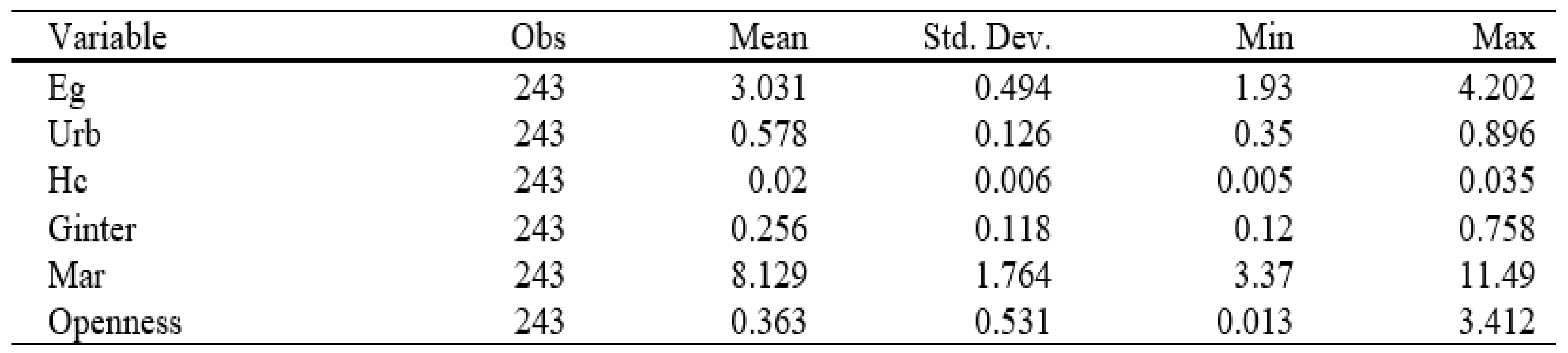
The samples are from 27 provinces and autonomous region in China (excluding Tibet, Xinjiang, Yunnan, Neimenggu, Hong Kong, Taiwan, and Macao). The data of digital financial inclusion derive from the China Digital Financial Inclusion Index co-compiled by the Research Center for Digital Finance of Peking University and Ant Financial Services Group [39]. Other data are from the 2011–2019 Statistical Yearbooks of provinces and the National Bureau of Statistics. Descriptive statistics of variables are shown in Table 3.
Table 3.
Descriptive statistics.
5. Findings
5.1. Baseline Regression
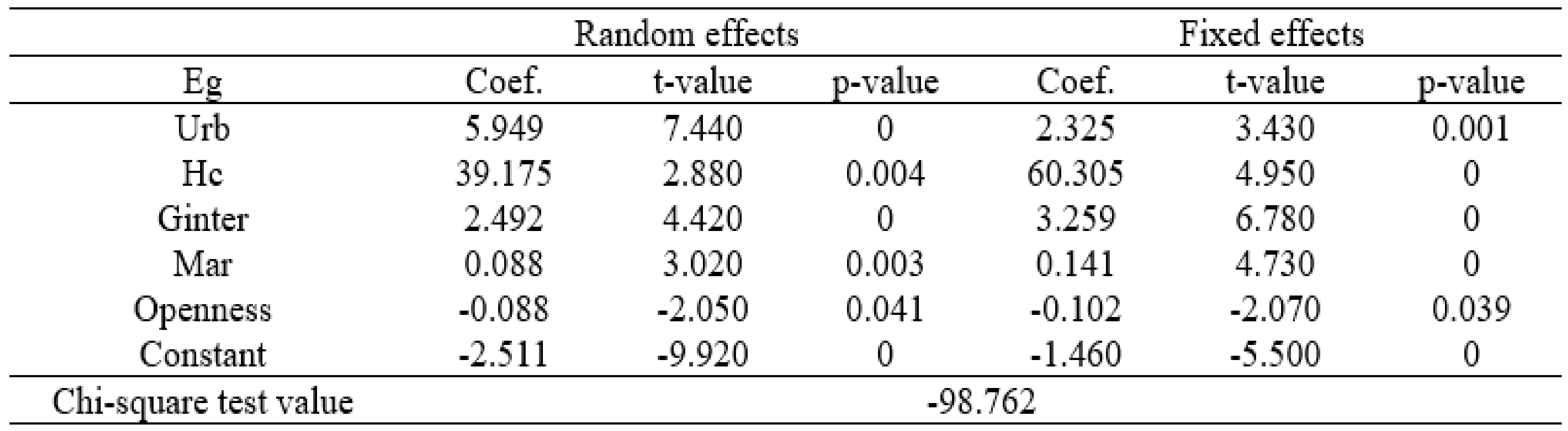
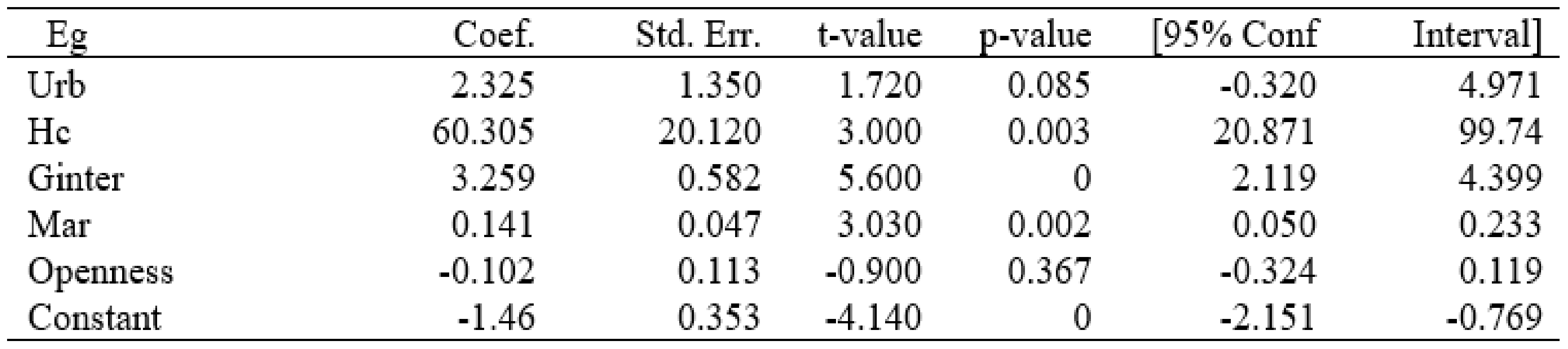
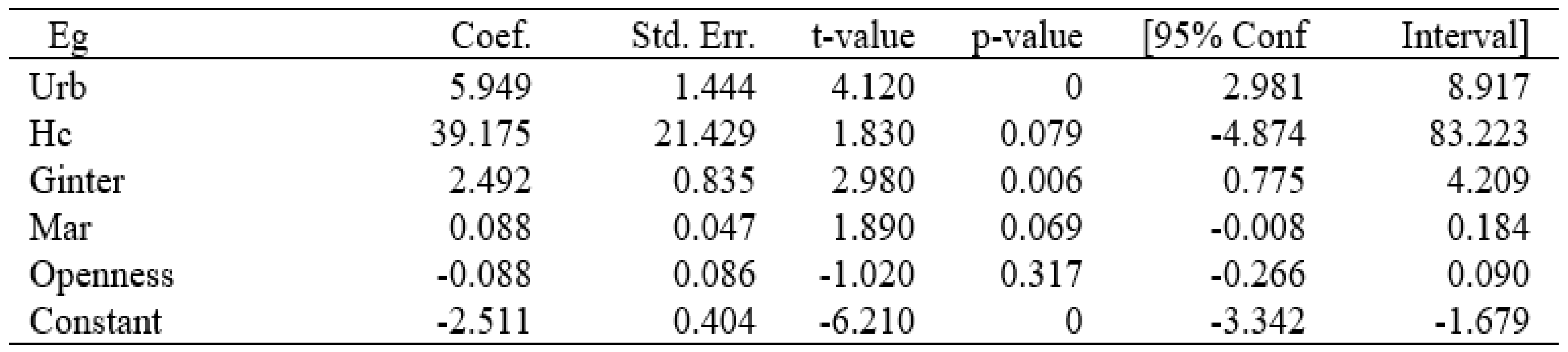
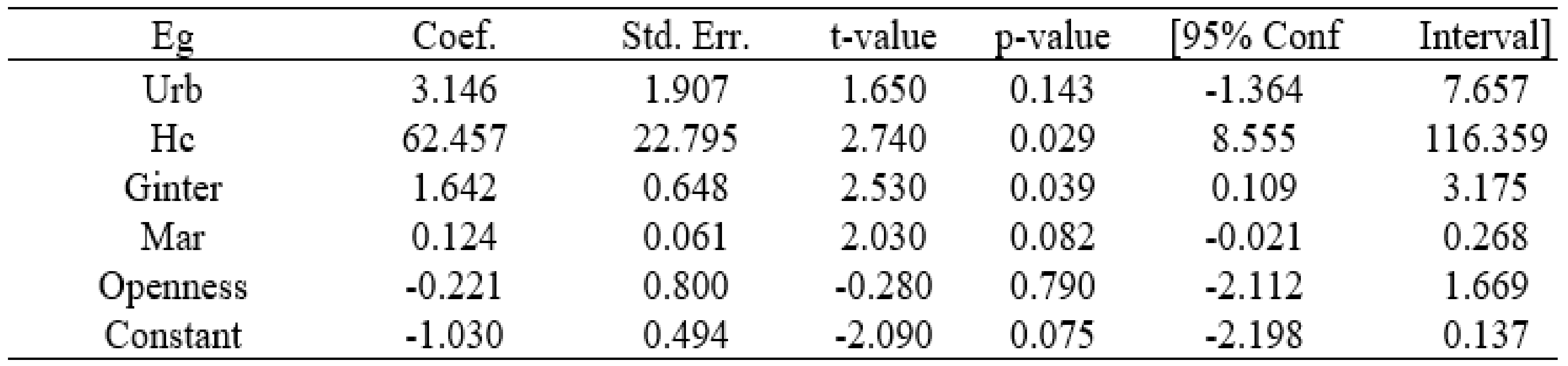
All empirical procedures in this paper are implemented by Stata 15. Appendix D presents the empirical procedures. Table 4 shows the results of baseline regression. Model 2 and Model 3 represent the test results of random effect and fixed effect, respectively. The Hausman test shows that fixed effect was selected last for regression analysis as the Chi-square test value is negative [40,41] (see Figure A2). Model 1 is the estimation result without control variables. The coefficient of urbanization is significantly positive at the 1% confidence level. Model 3 is the estimated result after adding the control variables. The coefficient of urbanization is also significantly positive at the 1% confidence level, which indicates that urbanization has a significant promoting effect on the consumption upgrading of rural residents. Hypothesis H1 is verified.
Table 4.
Results of benchmark regression test.
5.2. Robustness Analysis
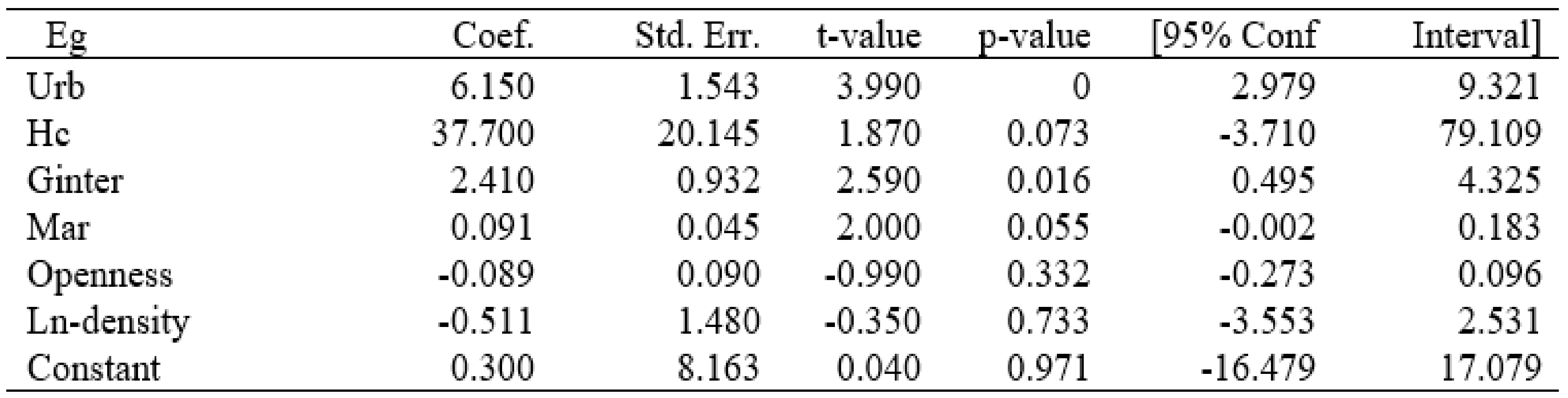
The results of the baseline regression show that urbanization significantly improves the consumption level in rural areas. In order to ensure the reliability of the result, this paper conducts a robustness analysis in terms of the following methods. First, to deal with the possible endogenous problems of the model, this paper selects and as the instrumental variables, and estimates Equation (1) by two-stage least square (2SLS) again. The results of the unidentification test and transition identification test show that the selected instrumental variables are effective. The regression results are shown in Model 1 of Table 5, and the regression coefficient of explanatory variable is significantly positive at the 1% confidence level. Second, the explained variable is replaced by another indicator. Based on Maslow’s hierarchy of needs, the residents’ consumption is divided into subsistence consumption, enjoyment consumption, and other services [42,43,44,45]. Subsistence consumption consists of food, clothing and living expenses. Enjoyment consumption consists of transportation and information, healthcare, education and culture. The higher the proportion of development and enjoyment consumption expenditure in the total expenditure, the higher the consumption level. Therefore, the consumption upgrading of rural residents is measured by the proportion of development and enjoyment consumption expenditure in the total consumption expenditure. Model 2 in Table 5 shows the regression results; the regression coefficient of the explanatory variable is significantly positive at the 1% significance level. Third, the population density is added as the control variable, which is measured by the ratio of the regional total population to the regional administrative area. The regression results are shown in Model 3 of Table 4. After adding control variables, the regression coefficient of the explanatory variables is still significantly positive. The three test results above are consistent with the baseline regression result, which indicates that the regression results in this paper are robust.
Table 5.
Result of robust analysis.
5.3. Heterogeneity Effect
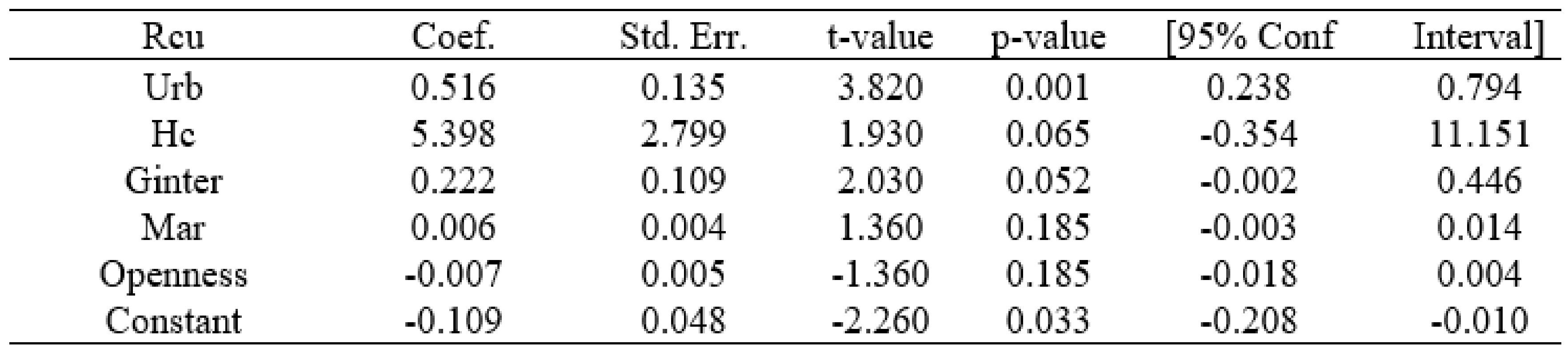
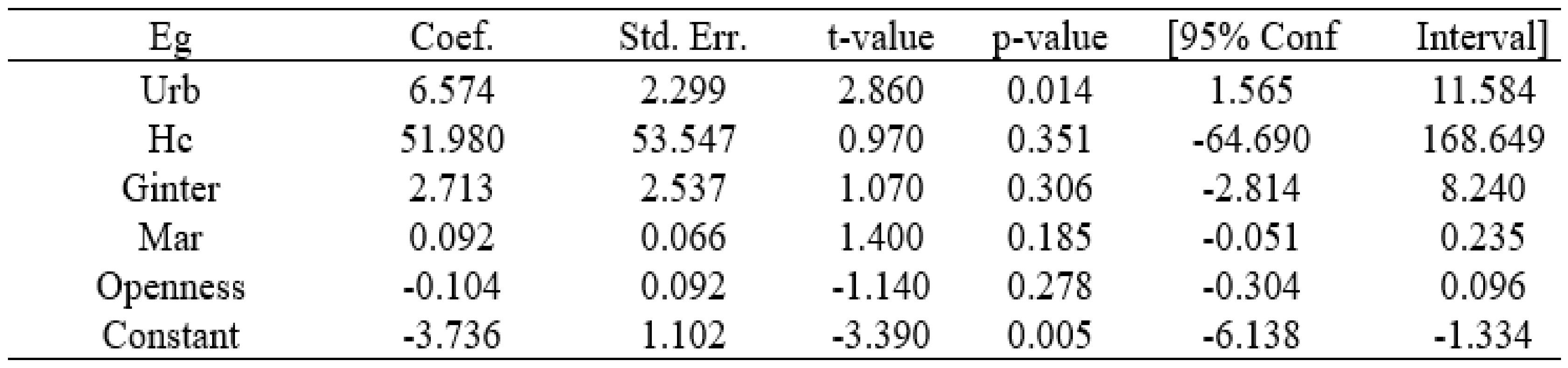
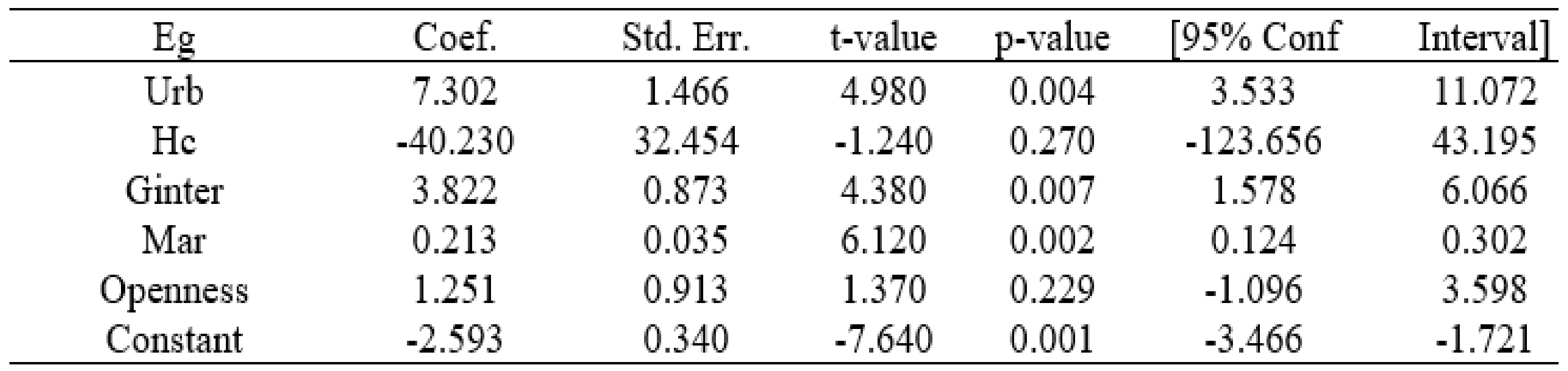
In fact, since the reform and opening up, there are significant regional differences in urbanization in China. Therefore, this paper divided the research samples into three samples according to the location in China, the eastern, central and western region, respectively, to test the regional heterogeneity of urbanization on rural residents’ consumption upgrading. Table 6 shows the regression results. The results show that the regression coefficients of urbanization in the eastern and central regions are significantly positive at the confidence level of 5% and 1%, respectively, indicating that urbanization both significantly increases consumption level of rural residents in the eastern and western region; however, the increase is not significant in the western region. The reason may be that the urbanization in the eastern and central regions of China is relatively high, and so the dividends of urbanization can be more fully released.
Table 6.
Result of regional heterogeneity test.
5.4. Intermediary Effect
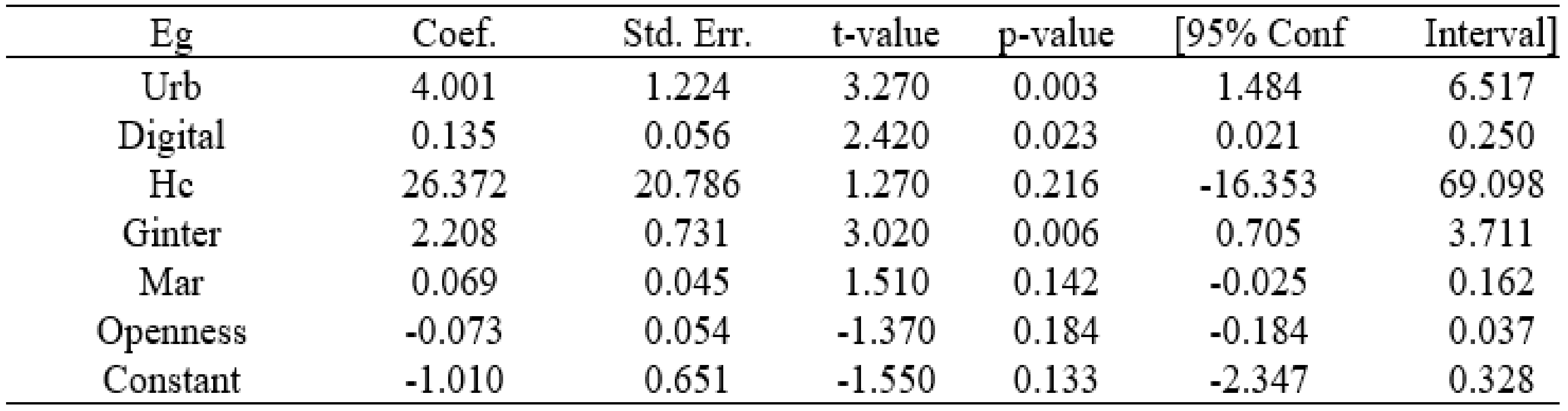
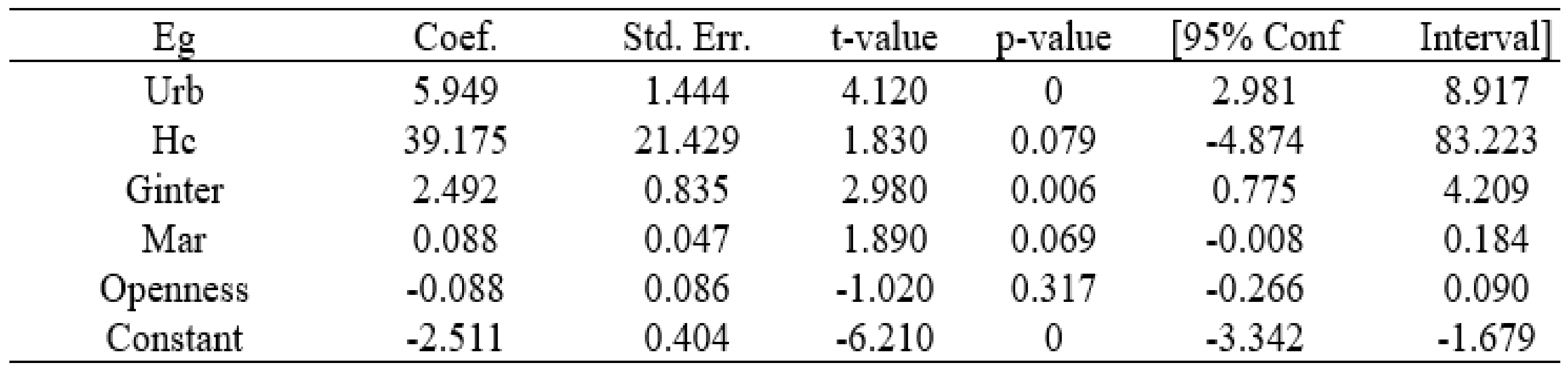
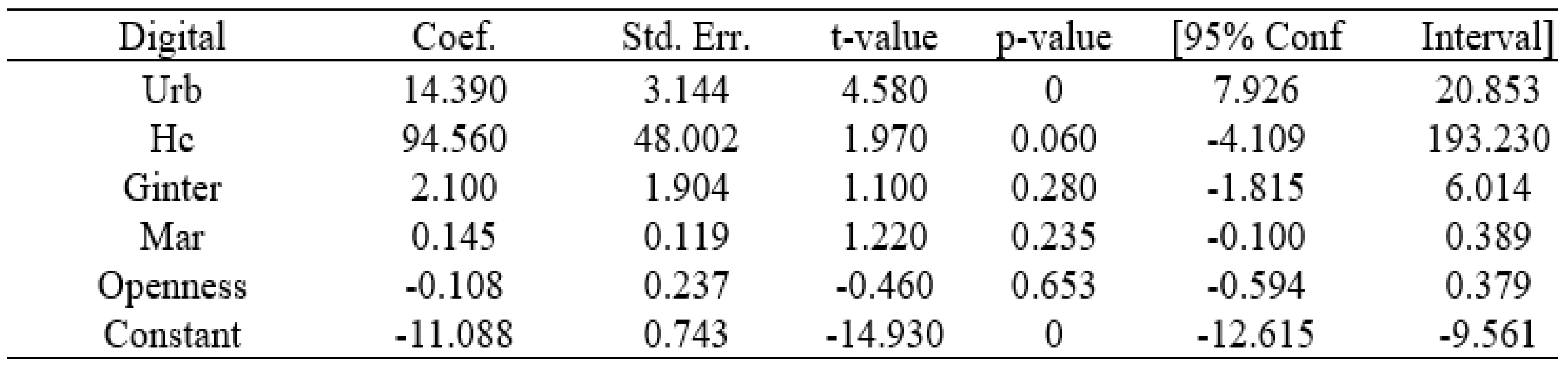
Table 7 shows the test results of the mediation effect. The coefficient of urbanization is significantly positive at the level of 1% in model 2, while the coefficients of urbanization and digital are significantly positive at the level of 1% and 5% in model 3, respectively. It shows that there is an intermediary effect with the digital economy as the intermediary variable, that is, urbanization, can affect the advancement of the consumption level in rural areas through the intermediary effect played by the digital economy. According to Model 1 in Table 7, the total effect of urbanization on the consumption level is 5.949. Through model 2 and model 3 in Table 2, it can be calculated that the mediating effect of the digital economy is 1.9426 (14.39 × 0.135), and the proportion of the mediating effect in the total effect is 32.65% (1.9426/5.949). In conclusion, digital intermediates the relationship between urbanization and the consumption level in rural regions; therefore, the research hypothesis H2 is verified.
Table 7.
Result of mediation effect test.
5.5. Threshold Effect
The threshold model proposed by Hansen [46] points out that when a variable reaches a certain value, structural mutations will occur in another variable. In this paper, the panel threshold model is used to further explore the threshold effect of urbanization on rural residents’ consumption upgrading. The panel threshold model is established as follows:
where i represents the province, t represents the time, I is the indicative function with a value of 0 or 1, γ is the threshold value, represents individual effect, is the random disturbance term, and is the control variable.
The threshold effect is tested with urbanization as the threshold variable. Table 8 shows the test results. The single and double threshold values of urbanization are both significant at the 1% confidence level, while the triple threshold values fail the significance test; therefore, it can be concluded that urbanization has a double threshold effect.
Table 8.
Threshold effect test.
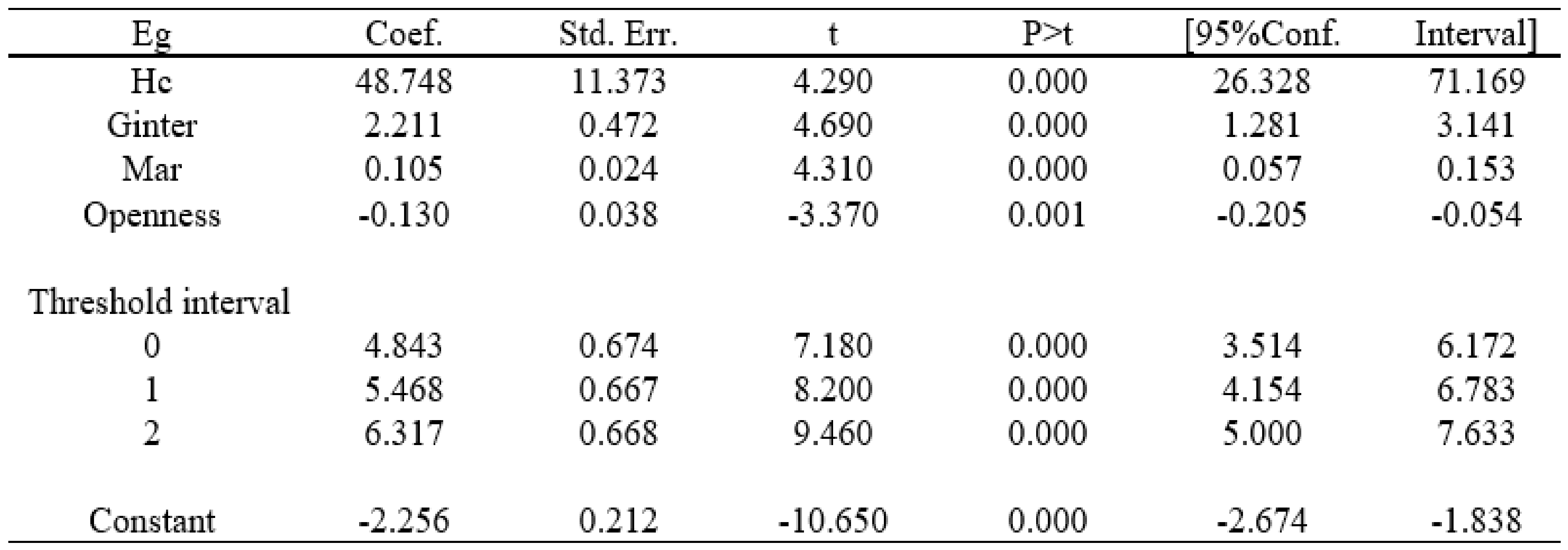
Using the results of the panel threshold test, a regression analysis was carried out based on Equation (4). Table 9 shows the regression results. According to the regression results, urbanization within different threshold ranges has a significant positive effect on the consumption level in rural areas. Moreover, with the improvement of urbanization level, the marginal effect of urbanization on rural residents’ consumption upgrading shows an increasing trend. First, when urbanization is lower than the first threshold value of 0.6689, the impact coefficient of urbanization on the consumption upgrade of rural residents is 4.843, indicating that when urbanization increases by 1 unit, the marginal effect on rural residents’ consumption upgrading is 4.843. Second, when urbanization is within the threshold ranged from 0.6689 to 0.8630, the marginal contribution of urbanization to the consumption upgrade of rural residents rises to 5.468. Third, when urbanization crosses the second threshold value of 0.8630, the marginal effect of urbanization on the consumption upgrade of rural residents further rises to 6.317. It is concluded that different levels of urbanization have different impacts on the consumption level in rural areas, showing the characteristics of the double threshold.
Table 9.
Estimation result of threshold effect.
The main reasons may be as follows: First, due to the rapid development of urbanization, the demonstrative effect of consumption brought by urban residents plays a more important role. The consumption desire and consumption structure in rural regions have been changed through imitation and following as well, thus achieving consumption upgrading. Second, with the development of urbanization, famers continue to gather in cities, which not only increases the opportunities for rural residents to work in cities, but also promotes the development of rural industries, enabling more farmers to achieve “local and nearby” employment. It significantly increases farmers’ income and promotes consumption upgrading. Third, with the development of urbanization, various public service facilities have been improved accordingly, which not only provides a good consumption environment for urban residents but also provides farmers with diversified and all-round consumption choices. The consumption desire of farmers has also been stimulated, which leads to the optimization of the consumption structure.
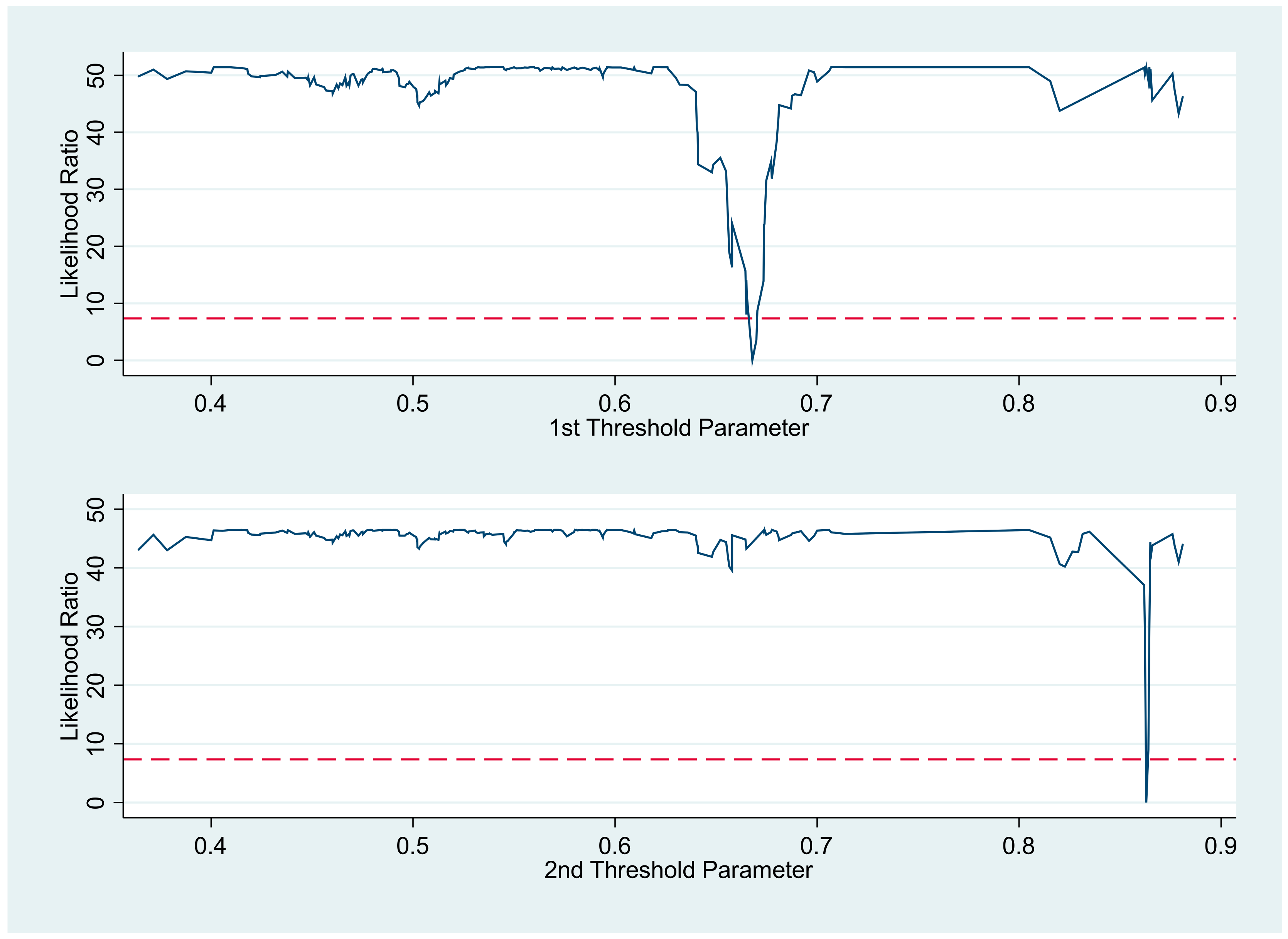
In order to provide more intuitive and detailed test information, this paper presents the confidence interval graph of threshold effect. Figure 2 shows the confidence intervals of the single threshold and double threshold. The horizontal dotted line is 95% confidence. The curve is the line of the search point of each threshold value, and the longitudinal coordinate corresponding to each point on the curve represents the likelihood ratio of the threshold value. The intersection of the curved and dotted line is the confidence interval under the 95% confidence level. The narrower the confidence interval, the lesser the unobservable influence, and the more accurate the threshold estimation.
Figure 2.
Tendency of likelihood ratio.
6. Conclusions and Policy Recommendations
6.1. Main Conclusions
Based on the sample from China, this paper constructs an intermediary effect model and panel threshold model to test the relationship between urbanization and consumption level in rural areas. The empirical results are as follows:
First, there is a significant positive correlation between urbanization and consumption upgrading, that is, urbanization is beneficial to the advancement of the consumption level in rural areas. Moreover, there is also a regional difference, which has a significant promoting effect in the eastern and central region, but not in the western region. Second, when urbanization affects the consumption level, the digital economy plays an intermediary role. Third, urbanization presents the characteristics of the double threshold when taking urbanization as a threshold variable. With the increase in the threshold value, the promoting effect of urbanization on the improvement of consumption level increases gradually.
6.2. Policy Recommendations
With the rapid development of urbanization and the vigorous development of mobile payment and rural e-commerce, the rural consumption environment has been gradually improved. Under the sustainable consumption, it is a key to upgrade the consumption level of rural residents. The government should seize the opportunities of developing urbanization and the digital economy, constantly raising farmer income, narrowing the income gap between urban and rural areas, and stimulating farmer enthusiasm for consumption; However, it is a systematic project to increase rural residents’ consumption upgrading with urbanization and the digital economy, which requires joint efforts from the nation and its residents. This paper puts forward the following policy suggestions:
- (a)
- Establishing an income and distribution system
The government should work out a fair distribution system. First, by improving the fiscal and tax systems, the government should adjust the distribution among different industries, enterprises, and between enterprises and residents. Second, by gradually reducing or even breaking up industrial monopolies, especially the monopolized industries that occupy state-owned resources. Third, by improving the distribution mechanism adjusted by the market so that the market mechanism can flexibly reflect the contribution of resources and have more influence in the distribution of labor in a vulnerable position through the association, trade union and other non-governmental organizations. Finally, by ensuring the interests of vulnerable groups through government redistribution.
- (b)
- Strengthening the construction of the digital economy platform and fostering a well-regulated and orderly digital ecological environment
Information security, intellectual property protection and personal privacy security should be urgently addressed in the process of developing the digital economy. The government should accelerate the construction of government service platforms; improve the information exchange and data sharing mechanism between government agencies, public and market; strive to build a service-oriented “digital government”; and make full use of digital technologies to build a unified, open and orderly national online market, that breaks through market barriers between urban and rural areas, bridges the digital divide, and allows rural residents to share the development dividend of the digital economy. In addition, local governments should seize the opportunity of building new infrastructure supported by the central government to strengthen the construction of the network, communication, and other infrastructure in rural areas, narrowing the “digital divide” between urban and rural areas. Moreover, the government should strengthen the development rural smart logistics and smooth the “last mile” of rural logistics to constantly optimize the consumption link of rural residents.
- (c)
- Changing the consumption concept of rural residents
The consumption concept has a guiding effect on consumption behavior. The demonstration of urban residents and the promotion of digital media play an important role in changing the consumption concept of rural residents. The government should guide farmers to change their traditional lifestyle with excessive frugality and form a positive, healthy and moderately advanced idea of consumption. In addition, the government should impart knowledge of modern science and culture and knowledge of the market economy via digital platforms so as to promote the enjoyment, development and spiritual and cultural consumption of rural residents.

Author Contributions
Conceptualization, X.L.; data curation, X.L. and X.S.; supervision, K.G.; writing—original draft, X.L.; writing—review and editing, X.L. and K.G. All authors have read and agreed to the published version of the manuscript.
Funding
This work was supported by the National Natural Science Foundation (no. 71863021), the Philosophy and Social Science Planning Research Project of Guangxi (no. 22FJY040), the National Social Science Foundation (no. 21BJL072), the National Social Science Foundation (no. 22XJY005), and the Young and Middle-aged Teacher’s Basic Ability Improvement Project of University in Guangxi (no. 2023KY0693).
Institutional Review Board Statement
Not applicable.
Informed Consent Statement
Not applicable.
Data Availability Statement
Not applicable.
Acknowledgments
This research was completed under the supervision of Kuo Gao. We are greatly indebted to Kuo Gao, who gave his invaluable academic and moral support over the whole period of production of this research.
Conflicts of Interest
The authors declare no conflict of interest.
Appendix A. Engel’s Coefficient of Rural Residents (%)
Table A1.
Engel’s Coefficient for Rural Residents of each Province from 2011 to 2019 (%).
Table A1.
Engel’s Coefficient for Rural Residents of each Province from 2011 to 2019 (%).
| Province | 2011 | 2012 | 2013 | 2014 | 2015 | 2016 | 2017 | 2018 | 2019 |
|---|---|---|---|---|---|---|---|---|---|
| Shanghai | 40.10 | 40.00 | 39.70 | 36.00 | 35.00 | 33.60 | 33.80 | 37.20 | 36.41 |
| Beijing | 32.40 | 33.20 | 34.60 | 27.80 | 27.70 | 26.90 | 24.70 | 23.80 | 25.33 |
| Jilin | 35.30 | 36.70 | 33.00 | 29.60 | 29.00 | 28.60 | 28.20 | 27.80 | 28.15 |
| Sichuan | 46.24 | 46.85 | 40.03 | 39.70 | 39.10 | 38.10 | 37.20 | 35.80 | 34.71 |
| Tianjin | 35.33 | 36.22 | 34.86 | 31.40 | 29.50 | 31.30 | 29.60 | 29.60 | 30.82 |
| Ningxia | 37.30 | 35.34 | 34.40 | 29.90 | 29.10 | 26.50 | 25.30 | 27.30 | 27.43 |
| Anhui | 41.50 | 39.30 | 39.60 | 35.60 | 35.80 | 34.20 | 33.50 | 33.00 | 32.70 |
| Shandong | 35.71 | 34.30 | 34.50 | 31.00 | 30.40 | 29.80 | 28.60 | 28.10 | 27.81 |
| Shanxi | 37.71 | 33.42 | 33.00 | 29.40 | 29.00 | 28.30 | 27.40 | 27.70 | 28.28 |
| Guangdong | 49.10 | 49.10 | 49.00 | 39.50 | 40.60 | 40.40 | 40.20 | 36.60 | 37.11 |
| Guangxi | 43.80 | 42.80 | 40.00 | 36.90 | 35.40 | 34.50 | 32.20 | 30.10 | 30.91 |
| Jiangsu | 38.50 | 37.40 | 36.30 | 31.40 | 31.70 | 29.50 | 28.90 | 26.20 | 26.23 |
| Jiangxi | 45.20 | 43.53 | 42.30 | 36.50 | 36.20 | 35.30 | 33.60 | 31.30 | 30.42 |
| Hebei | 33.53 | 33.90 | 32.00 | 29.40 | 28.60 | 28.00 | 26.70 | 26.40 | 26.66 |
| Henan | 36.11 | 33.82 | 34.45 | 29.60 | 29.20 | 28.50 | 27.10 | 26.70 | 26.24 |
| Zhejiang | 37.60 | 37.70 | 35.60 | 31.90 | 31.10 | 31.80 | 31.00 | 30.30 | 30.58 |
| Hainan | 51.81 | 50.90 | 49.50 | 43.20 | 42.70 | 43.20 | 41.90 | 41.80 | 41.71 |
| Hubei | 39.00 | 37.60 | 36.80 | 31.40 | 30.10 | 30.10 | 28.60 | 28.20 | 27.16 |
| Hunan | 45.24 | 43.90 | 38.38 | 34.30 | 32.90 | 31.70 | 30.50 | 29.20 | 28.81 |
| Gansu | 39.66 | 37.13 | 34.47 | 34.90 | 32.90 | 31.30 | 30.40 | 29.70 | 29.16 |
| Fujian | 46.40 | 46.00 | 38.90 | 38.20 | 37.60 | 37.30 | 36.90 | 35.70 | 35.53 |
| Guizhou | 47.70 | 44.60 | 43.00 | 37.20 | 34.20 | 30.80 | 30.20 | 28.30 | 27.07 |
| Liaoning | 39.10 | 38.40 | 32.90 | 28.30 | 28.20 | 26.90 | 26.70 | 26.70 | 26.55 |
| Chongqing | 41.50 | 38.90 | 43.80 | 40.50 | 40.00 | 38.70 | 36.50 | 34.90 | 34.89 |
| Shaanxi | 30.00 | 29.72 | 31.82 | 29.10 | 27.80 | 26.90 | 26.00 | 25.60 | 25.90 |
| Qinghai | 37.83 | 34.81 | 30.90 | 31.90 | 29.90 | 29.40 | 29.70 | 29.50 | 29.73 |
| Heilongjiang | 35.10 | 37.90 | 35.20 | 28.20 | 27.50 | 27.70 | 26.50 | 27.30 | 26.81 |
Appendix B. Urbanization
Table A2.
Urbanization Level of each Province from 2011 to 2019.
Table A2.
Urbanization Level of each Province from 2011 to 2019.
| Year | 2011 | 2012 | 2013 | 2014 | 2015 | 2016 | 2017 | 2018 | 2019 |
|---|---|---|---|---|---|---|---|---|---|
| Shanghai | 0.89 | 0.89 | 0.90 | 0.90 | 0.88 | 0.88 | 0.88 | 0.88 | 0.88 |
| Beijing | 0.86 | 0.86 | 0.86 | 0.86 | 0.87 | 0.87 | 0.86 | 0.87 | 0.87 |
| Jilin | 0.48 | 0.47 | 0.47 | 0.47 | 0.48 | 0.49 | 0.50 | 0.49 | 0.49 |
| Sichuan | 0.42 | 0.44 | 0.45 | 0.46 | 0.48 | 0.49 | 0.51 | 0.52 | 0.54 |
| Tianjin | 0.81 | 0.82 | 0.82 | 0.82 | 0.83 | 0.83 | 0.83 | 0.83 | 0.83 |
| Ningxia | 0.50 | 0.51 | 0.52 | 0.54 | 0.55 | 0.56 | 0.58 | 0.59 | 0.60 |
| Anhui | 0.45 | 0.47 | 0.48 | 0.49 | 0.51 | 0.52 | 0.53 | 0.55 | 0.56 |
| Shandong | 0.41 | 0.42 | 0.42 | 0.44 | 0.48 | 0.49 | 0.50 | 0.51 | 0.50 |
| Shanxi | 0.50 | 0.51 | 0.53 | 0.54 | 0.55 | 0.56 | 0.57 | 0.58 | 0.60 |
| Guangdong | 0.67 | 0.67 | 0.68 | 0.68 | 0.69 | 0.69 | 0.70 | 0.71 | 0.71 |
| Guangxi | 0.42 | 0.44 | 0.45 | 0.46 | 0.47 | 0.48 | 0.49 | 0.50 | 0.51 |
| Jiangsu | 0.62 | 0.63 | 0.64 | 0.65 | 0.67 | 0.68 | 0.69 | 0.70 | 0.71 |
| Jiangxi | 0.46 | 0.48 | 0.49 | 0.50 | 0.52 | 0.53 | 0.55 | 0.56 | 0.57 |
| Hebei | 0.46 | 0.47 | 0.48 | 0.49 | 0.51 | 0.53 | 0.55 | 0.56 | 0.58 |
| Henan | 0.41 | 0.42 | 0.44 | 0.45 | 0.47 | 0.49 | 0.50 | 0.52 | 0.53 |
| Zhejiang | 0.62 | 0.63 | 0.64 | 0.65 | 0.66 | 0.67 | 0.68 | 0.69 | 0.70 |
| Hainan | 0.51 | 0.52 | 0.53 | 0.54 | 0.55 | 0.57 | 0.58 | 0.59 | 0.59 |
| Hubei | 0.52 | 0.54 | 0.55 | 0.56 | 0.57 | 0.58 | 0.59 | 0.60 | 0.61 |
| Hunan | 0.45 | 0.47 | 0.48 | 0.49 | 0.51 | 0.53 | 0.55 | 0.56 | 0.57 |
| Gansu | 0.37 | 0.39 | 0.40 | 0.42 | 0.43 | 0.45 | 0.46 | 0.48 | 0.48 |
| Fujian | 0.58 | 0.60 | 0.61 | 0.62 | 0.63 | 0.64 | 0.65 | 0.66 | 0.66 |
| Guizhou | 0.35 | 0.36 | 0.38 | 0.40 | 0.42 | 0.44 | 0.46 | 0.48 | 0.49 |
| Liaoning | 0.64 | 0.66 | 0.66 | 0.67 | 0.67 | 0.67 | 0.67 | 0.68 | 0.68 |
| Chongqing | 0.55 | 0.57 | 0.58 | 0.60 | 0.61 | 0.63 | 0.64 | 0.66 | 0.67 |
| Shaanxi | 0.47 | 0.50 | 0.51 | 0.53 | 0.54 | 0.55 | 0.57 | 0.58 | 0.59 |
| Qinghai | 0.46 | 0.47 | 0.49 | 0.50 | 0.50 | 0.52 | 0.53 | 0.54 | 0.56 |
| Heilongjiang | 0.57 | 0.57 | 0.57 | 0.58 | 0.59 | 0.59 | 0.59 | 0.60 | 0.61 |
Appendix C. Digital Economy Index
Table A3.
Digital Economy Index of each Province from 2011 to 2019.
Table A3.
Digital Economy Index of each Province from 2011 to 2019.
| Year | 2011 | 2012 | 2013 | 2014 | 2015 | 2016 | 2017 | 2018 | 2019 |
|---|---|---|---|---|---|---|---|---|---|
| Shanghai | 0.79 | 1.10 | 1.96 | 2.17 | 2.36 | 2.33 | 2.80 | 3.68 | 4.39 |
| Beijing | 2.79 | 3.31 | 3.73 | 4.20 | 4.56 | 4.37 | 4.82 | 5.80 | 6.61 |
| Jilin | −0.25 | −0.10 | 0.22 | 0.43 | 0.56 | 0.63 | 0.99 | 1.47 | 1.89 |
| Sichuan | −0.81 | −0.57 | −0.01 | 0.18 | 0.45 | 0.52 | 0.86 | 1.44 | 1.90 |
| Tianjin | 0.04 | 0.34 | 0.44 | 0.53 | 0.73 | 0.84 | 1.20 | 1.89 | 2.42 |
| Ningxia | −0.51 | −0.19 | 0.09 | 0.28 | 0.41 | 0.50 | 0.91 | 1.57 | 2.02 |
| Anhui | −0.91 | −0.66 | −0.35 | −0.15 | −0.01 | 0.10 | 0.43 | 0.98 | 1.52 |
| Shandong | −0.57 | −0.35 | 0.10 | 0.23 | 0.41 | 0.52 | 0.79 | 1.25 | 1.66 |
| Shanxi | −0.49 | −0.19 | 0.12 | 0.25 | 0.39 | 0.40 | 0.66 | 1.11 | 1.57 |
| Guangdong | 0.52 | 0.79 | 1.28 | 1.42 | 1.58 | 1.59 | 2.00 | 2.86 | 3.38 |
| Guangxi | −0.80 | −0.53 | −0.33 | −0.16 | 0.00 | 0.04 | 0.37 | 1.04 | 1.48 |
| Jiangsu | −0.09 | 0.21 | 0.67 | 0.72 | 0.89 | 0.86 | 1.18 | 1.90 | 2.51 |
| Jiangxi | −1.03 | −0.72 | −0.39 | −0.22 | −0.07 | −0.03 | 0.35 | 0.88 | 1.40 |
| Hebei | −0.57 | −0.31 | 0.04 | 0.15 | 0.27 | 0.42 | 0.73 | 1.25 | 1.77 |
| Henan | −1.03 | −0.78 | −0.37 | −0.21 | −0.07 | 0.05 | 0.40 | 0.98 | 1.54 |
| Zhejiang | 0.36 | 0.70 | 1.02 | 1.20 | 1.42 | 1.35 | 1.75 | 2.39 | 3.10 |
| Hainan | −0.36 | −0.06 | 0.26 | 0.46 | 0.63 | 0.64 | 1.07 | 1.74 | 2.21 |
| Hubei | −0.59 | −0.32 | −0.04 | 0.15 | 0.31 | 0.40 | 0.76 | 1.37 | 2.05 |
| Hunan | −0.78 | −0.51 | −0.31 | −0.17 | −0.07 | 0.04 | 0.33 | 0.84 | 1.39 |
| Gansu | −0.88 | −0.63 | −0.28 | −0.18 | −0.02 | 0.03 | 0.44 | 1.04 | 1.63 |
| Fujian | 0.12 | 0.44 | 0.76 | 0.83 | 1.07 | 0.99 | 1.29 | 1.82 | 2.27 |
| Guizhou | −0.92 | −0.70 | −0.35 | −0.20 | −0.01 | 0.11 | 0.57 | 1.27 | 2.02 |
| Liaoning | −0.01 | 0.27 | 0.67 | 0.81 | 0.98 | 1.00 | 1.36 | 1.75 | 2.16 |
| Chongqing | −0.59 | −0.33 | 0.00 | 0.14 | 0.34 | 0.39 | 0.78 | 1.39 | 1.89 |
| Shaanxi | −0.15 | 0.11 | 0.35 | 0.52 | 0.69 | 0.80 | 1.17 | 1.94 | 2.43 |
| Qinghai | −0.32 | −0.01 | 0.24 | 0.31 | 0.43 | 0.44 | 0.86 | 1.62 | 2.07 |
| Heilongjiang | −0.66 | −0.42 | −0.05 | 0.23 | 0.36 | 0.43 | 0.82 | 1.20 | 1.74 |
Appendix D
Figure A1.
Descriptive statistics 1.
Figure A2.
Benchmark regression 1.
Figure A3.
Benchmark regression 2.
Figure A4.
Benchmark regression 3.
Figure A5.
Benchmark regression 4.
Figure A6.
Robustness analysis 1.
Figure A7.
Robustness analysis 2.
Figure A8.
Robustness analysis 3.
Figure A9.
Heterogeneity test 1.
Figure A10.
Heterogeneity test 2.
Figure A11.
Heterogeneity test 3.
Figure A12.
Mediation effect test 1.
Figure A13.
Mediation effect test 2.
Figure A14.
Mediation effect test 3.
Figure A15.
Threshold effect test 1.
Figure A16.
Threshold effect test 2.
References
- Xiao, Z.; Zhao, C.; Li, S. Regional Difference and Threshold Effect of Urbanization on Rural Residents’ Consumption. West. Forum 2015, 3, 16–23. [Google Scholar]
- Yuan, X.; Xu, L. Analysis of Regional Differences in Expanding Rural Residents’ Consumption under the New Development Pattern. Jiangsu Agric. Sci. 2021, 20, 1–8. [Google Scholar]
- Wang, F.; Hu, L. The Impact of Urbanization on the Consumption of Rural Residents in China and its Transmission Path: A Multi-Mediating Effect Test Based on Income Effect and Income gap. Macroecon. Res. 2022, 9, 64–77. [Google Scholar]
- Zhang, Y. Urbanization, Expanding Domestic Demand and Upgrading Consumption. Zhejiang Acad. J. 2017, 3, 129–134. [Google Scholar]
- Liu, N. Upgrading Effect of Residents’ Consumption Structure in Population Urbanization: Based on the Mediating Effect of Different Channels. Bus. Econ. Res. 2020, 20, 47–50. [Google Scholar]
- Chen, B.; Wu, J.; Wang, W. The Impact of Urbanization and Urban-rural Income Gap on Household Consumption and Regional Differences. Bus. Econ. Res. 2021, 18, 42–45. [Google Scholar]
- Shang, C.; Li, Z. the Impact of Urbanization on Residents’ Consumption Structure. Bus. Econ. Res. 2021, 17, 48–51. [Google Scholar]
- Liu, Y.; Shen, M.; Huang, Y. Research on the Relationship between Urbanization and Household Consumption Level. Xinjiang Financ. Econ. 2019, 5, 70–80. [Google Scholar]
- Lewis, A.E. Economic Envelopment with Unlimited Supplies of Labor. Manch. Sch. Econ. Soc. Stud. 1954, 22, 131–191. [Google Scholar]
- Duesenberry, J.S. Income, Saving, and the Theory of Consumer Behavior; Harvard University Press: Cambridge, UK, 1949. [Google Scholar]
- Carroll, C.D. Risky Habits and the Marginal Propensity to Consume Out of Permanent Income. Int. Econ. J. 2000, 14, 1–41. [Google Scholar] [CrossRef]
- Stark, O.; Taylor, J.E. Migration Incentives, Migration Types: The Role of Relative Deprivation. Econ. J. 1991, 101, 1163–1178. [Google Scholar] [CrossRef]
- Herrmann, R.O. Interaction Effects and the Analysis of Household Food Expenditures. J. Farm Econ. 1967, 4, 16–17. [Google Scholar] [CrossRef]
- Daniels, O.; Connor, K.; Huton, T. The Planning Response to Urban Service Sector Growth: An International Comparison. Growth Chang. 1991, 22, 3–26. [Google Scholar] [CrossRef]
- Akita, T.; Miyata, S. Urbanization, Educational Expansion, and Expenditure Inequality in Indonesia in 1996, 1999, and 2002. J. Asia Pac. Econ. 2008, 13, 147–167. [Google Scholar] [CrossRef]
- Nguyen, C. Does Urbanization Help Poverty Reduction in Rural Areas?—Evidence from a Developing Country; University of Munich: Munich, Germany, 2013; pp. 1–20. [Google Scholar]
- Bunya, S.; Collins, A.; Torrisi, G. Analyzing Household and Intra-Urban Variants in the Consumption of Financial Services: Uncovering “Exclusion” In an English City. J. Consum. Policy 2016, 39, 199–221. [Google Scholar] [CrossRef]
- Arouri, M.; Youssef, A.B.; Nguyen, C. Does Urbanization Reduce Rural Poverty? --Evidence from Vietnam. Econ. Model. 2017, 60, 253–270. [Google Scholar] [CrossRef]
- Jiao, S.; Sun, Q. The Empirical Research on the Mechanism of the Linkage between the Development of the Digital Economy and the Upgrading of Consumption. Ind. Tech. Econ. 2021, 40, 84–93. [Google Scholar]
- Gao, Z. Mechanism and Path Selection of Enabling Consumption upgrading in Digital Economy. Southwest Financ. 2021, 10, 44–54. [Google Scholar]
- Li, J.; Guo, C.; Zhou, T. Digital Economy, Consumption Upgrading and High-quality Economic Development. Tech. Econ. Manag. Res. 2022, 6, 94–98. [Google Scholar]
- Zhao, X.; Ding, N.; Sun, S. Does the Development of Digital Finance Promote the Upgrading of Household Consumption? J. Lanzhou Univ. Financ. Econ. 2021, 5, 61–75. [Google Scholar]
- Xiong, Y.; Guo, S. The Spatial Effect and Mechanism of Digital Economy on the Upgrading of Household Consumption Structure in China. J. Huazhong Agric. Univ. 2023, 8, 47–57. [Google Scholar]
- Lian, T.; Cai, S. Does Online Shopping Promote Household Consumption Upgrade? Shenzhen Soc. Sci. 2021, 3, 60–68. [Google Scholar]
- Yao, Z. The Impact of Industrial Digital Transformation on Consumption Upgrading and Retail Industry Performance. J. Harbin Inst. Technol. 2021, 23, 143–151. [Google Scholar]
- Mckinnon, R.I. Money and Capital in Economic Development. Int. J. 1974, 29, 649. [Google Scholar] [CrossRef]
- Jeanneney, S.G.; Kpodar, K. Financial Development and Poverty Reduction: Can There Be a Benefit Without a Cost? Post-Print J. Dev. Stud. 2008, 6, 143–163. [Google Scholar] [CrossRef]
- Soumare, I.; Tchana Tchana, F.; Kengne, T.M. Analysis of the determinants of financial inclusion in Central and West Africa. Transnatl. Corp. Rev. 2016, 8, 231–249. [Google Scholar]
- Li, F. Labor Productivity Disparity, Urbanization and Optimization of Employment Structure. Mod. Econ. Rev. 2017, 6, 116–123. [Google Scholar]
- Wei, M.; Zhang, H. The Impact of Urbanization Quality on Rural residents’ Consumption from the Perspective of Consumption Habits Formation. Rural Econ. 2020, 4, 83–90. [Google Scholar]
- Bian, W.; Yan, G. Analyzing Intention to Purchase Brand Extension via Brand Attribute Associations: The Mediating and Moderating Role of Emotional Consumer-Brand Relationship and Brand Commitment. Front. Psychol. 2022, 13, 884673. [Google Scholar] [CrossRef]
- Liu, X.; Kong, M.; Tong, D.; Zeng, X.; Lai, Y. Property Rights and Adjustment for Sustainable Development during Post-Productivist Transitions in China. Land Use Policy 2022, 122, 106379. [Google Scholar] [CrossRef]
- Tong, D.; Chu, J.; Han, Q.; Liu, X. How Land Finance Drives Urban Expansion under Fiscal Pressure: Evidence from Chinese Cities. Land 2022, 11, 253. [Google Scholar] [CrossRef]
- Guo, H.; Gao, X. Urbanization, Digital Economy and High-quality Economic Development. Econ. Perspect. 2021, 3, 18–29. [Google Scholar]
- Xie, C.; Liu, M.; Hu, H. Consumption Upgrading, Market size and Manufacturing Value Chain Climbing. Collect. Financ. Econ. Essays 2021, 4, 12–22. [Google Scholar]
- Li, X.; Wu, F.; Zhu, L. Digital Economy and Regional Innovation Performance. J. Shanxi Univ. Financ. Econ. 2021, 43, 17–30. [Google Scholar]
- Zhou, S.; Zhang, W. An Analysis of the Subjective Welfare Effects of Internet. Econ. Res. J. 2021, 56, 158–174. [Google Scholar]
- Zhang, H.; Huang, L. Industrial Structure Upgrading and Household Consumption Upgrading: Empirical Analysis Based on CHIP Micro Data. Curr. Econ. Sci. 2022, 6, 127–142. [Google Scholar]
- Guo, F.; Wang, J.Y.; Wang, F.; Kong, T.; Cheng, Z.Y. Measuring the Development of Digital Inclusive Finance in China: Index Compilation and Spatial Characteristics. Economics 2020, 4, 1402–1418. [Google Scholar]
- Schreiber, S. The Hausman Test Statistic Can Be Negative Even Asymptotically. J. Econ. Stat. 2008, 228, 394–405. [Google Scholar] [CrossRef]
- Magazzini, L.; Calzolari, G. Negative Variance Estimates in Panel Data Models; Working Papers; Department of Economics, University of Verona: Verona, Italy, 2010. [Google Scholar]
- Wu, B.; Liu, Z.; Gu, Q.; Tsai, F. Underdog Mentality, Identity Discrimination and Access to Peer-to-peer Lending Market: Exploring Effects of Digital Authentication. J. Int. Financ. Mark. Inst. Money 2023, 83, 101714. [Google Scholar] [CrossRef]
- Shang, Y.; Zhu, L.; Qian, F.; Xie, Y. Role of Green Finance in Renewable Energy Development in the Tourism Sector. Renew. Energy 2023, 206, 890–896. [Google Scholar] [CrossRef]
- Guo, B.; Wang, Y.; Zhang, H.; Liang, C.; Feng, Y.; Hu, F. Impact of the Digital Economy on High-quality Urban Economic Development: Evidence from Chinese Cities. Econ. Model. 2023, 120, 106194. [Google Scholar] [CrossRef]
- Li, X.; Li, R. Analysis of Household Consumption Structure and its Influencing Factors in Four Major Economic Regions. J. Quant. Tech. Econ. 2013, 30, 89–105. [Google Scholar]
- Hansen, B.E. Sample Splitting and Threshold Estimation. Econometric 2000, 68, 575–603. [Google Scholar] [CrossRef]
Disclaimer/Publisher’s Note: The statements, opinions and data contained in all publications are solely those of the individual author(s) and contributor(s) and not of MDPI and/or the editor(s). MDPI and/or the editor(s) disclaim responsibility for any injury to people or property resulting from any ideas, methods, instructions or products referred to in the content. |
© 2023 by the authors. Licensee MDPI, Basel, Switzerland. This article is an open access article distributed under the terms and conditions of the Creative Commons Attribution (CC BY) license (https://creativecommons.org/licenses/by/4.0/).