


Perceptions of the Impact of COVID-19 Countermeasures on Safe Foodservice Provision at International Sporting Competitions: A Qualitative Study




Abstract
1. Introduction
2. Methods
2.1. Design
2.2. Participants
2.3. Data Collection
2.4. Data Analysis
3. Results
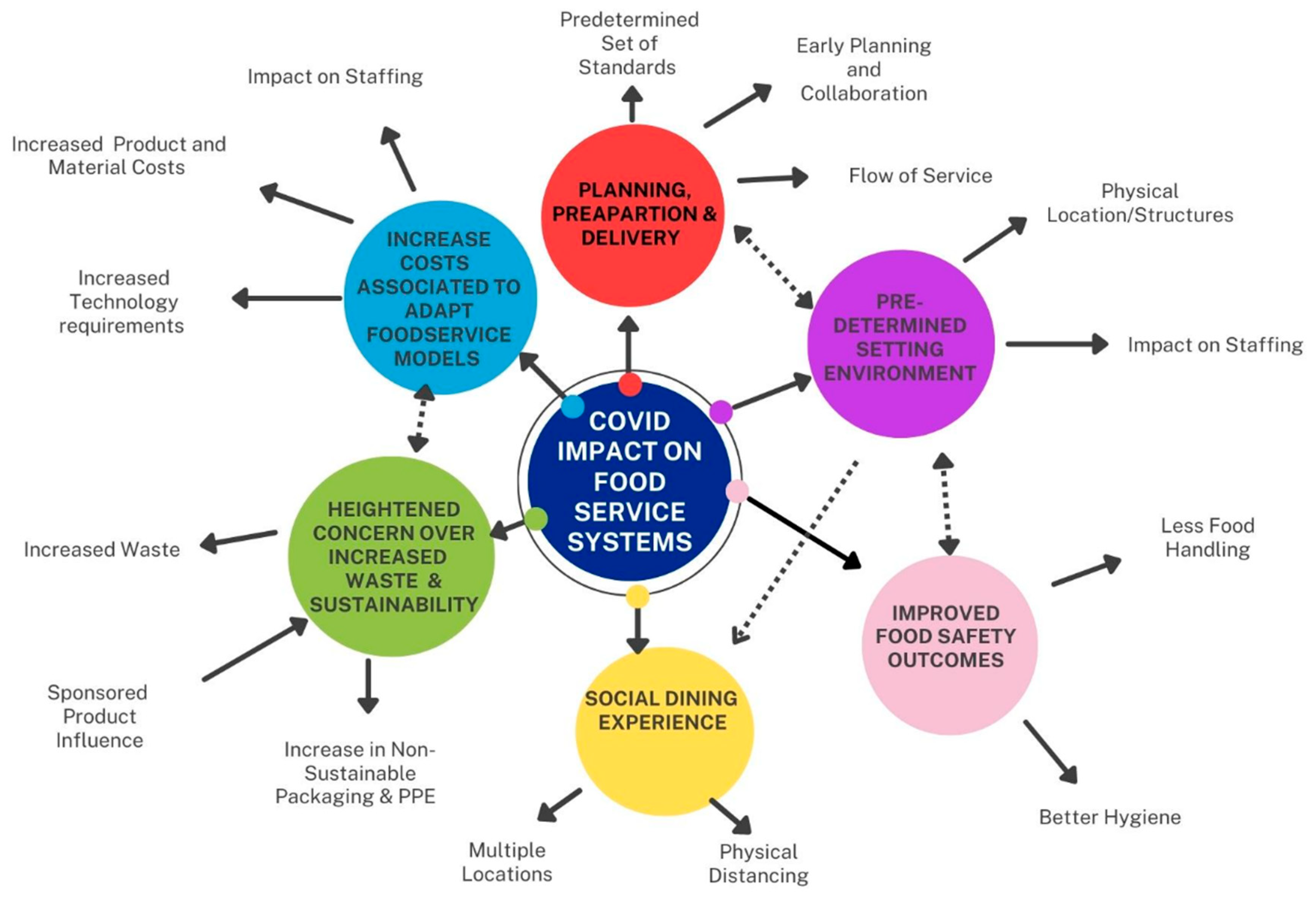
3.1. Improved Food Safety Outcomes from a Renewed Perceived Attention to Food Safety Measures
3.2. Increased Costs Associated to Adapt Foodservice Models
3.3. Heightened Concerns over Increased Waste and Sustainability
3.4. Impact of Changes Relevant to COVID-19 on Foodservice Planning, Preparation and Delivery
3.5. Pre-Determined Settings and Environment Dictate the Foodservice Delivery Model
3.6. Impact on Social Dining Experience
4. Discussion
5. Limitations
6. Conclusions
Author Contributions
Funding
Institutional Review Board Statement
Informed Consent Statement
Data Availability Statement
Acknowledgments
Conflicts of Interest
References
- Gössling, S.; Scott, D.; Hall, C. Pandemics, tourism and global change: A rapid assessment of COVID-19. J. Sustain. Tour. 2021, 29, 1–20. [Google Scholar] [CrossRef]
- Centre for Disease Control. Consid. Restaur. Bars. 2020. Available online: https://www.cdc.gov/coronavirus/2019-ncov/community/organizations/business-employers/bars-restaurants.html (accessed on 22 June 2022).
- World Health Organization. Key Planning Recommendations for Mass Gatherings in the Context of the Current COVID-19 Outbreak: Interim Guidance, 14 February 2020. (No. WHO/2019-nCoV/POEmassgathering/2020.1); World Health Organization: Geneva, Switzerland, 2020.
- Hall, C.M.; Prayag, G.; Amore, A. Tourism and Resilience: Individual, Organisational and Destination Perspectives; Channelview Publications: Bristol, UK, 2017. [Google Scholar]
- Galanakis, C.M. The food systems in the era of the coronavirus (COVID-19) pandemic crisis. Foods 2020, 9, 523. [Google Scholar] [CrossRef] [PubMed]
- Goddard, E. The impact of COVID-19 on food retail and food service in Canada: Preliminary assessment. Can. J. Agric. Econ./Rev. Can. D’agroeconomie 2020, 68, 157–161. [Google Scholar] [CrossRef]
- Huff, A.G.; Beyeler, W.E.; Kelley, N.S.; McNitt, J.A. How resilient is the United States’ food system to pandemics? J. Environ. Stud. Sci. 2015, 5, 337–347. [Google Scholar] [CrossRef] [PubMed]
- European Food Safety Authority (EFSA). Coronavirus: No Evidence that Food Is a Source or Transmission Route; EFSA Unión Europea, Parlamento Europeo: Parma, Italy, 2020; Available online: https://www.efsa.europa.eu/en/news/coronavirus-no-evidence-food-source-or-transmission-route (accessed on 20 June 2022).
- Food and Drug Administration. Food and Drug Administration. Food Safety and the Coronavirus Disease 2019 (COVID-19). In Best Practices for Retail Food Stores, Restaurants, and Food Pick-Up/Delivery Services During the COVID-19 Pandemic; CDC Newsletter Centers for Disease Controls and Prevention: Silver Spring, MD, USA, 2020. Available online: https://www.fda.gov/food/food-safety-during-emergencies/best-practices-retail-food-stores-restaurants-and-food-pick-updelivery-services-during-covid-19 (accessed on 20 June 2022).
- Rizou, M.; Galanakis, I.M.; Aldawoud, T.M.; Galanakis, C.M. Safety of foods, food supply chain and environment within the COVID-19 pandemic. Trends Food Sci. Technol. 2020, 102, 293–299. [Google Scholar] [CrossRef]
- World Health Organization. Public Health for Mass Gatherings: Key Considerations; World Health Organization: Geneva, Switzerland, 2015.
- Jorm, L.R.; Thackway, S.V.; Churches, T.R.; Hills, M.W. Watching the games: Public health surveillance for the Sydney 2000 Olympic Games. J. Epidemiol. Community Health 2002, 57, 102–108. [Google Scholar] [CrossRef]
- Khan, K.; Freifeld, C.C.; Wang, J.; Mekaru, S.R.; Kossowsky, D.; Sonricker, A.L. Preparing for infectious disease threats at mass gatherings: The case of the Vancouver 2010 Olympics Winter games. Can. Med. Assoc. J. 2010, 6, 579–583. [Google Scholar] [CrossRef]
- Torbjørn, S.; Palmer, D.; Steffen, K.; Lopes, A.D.; Grant, M.-E.; Kim, D.; Lee, S.Y.; Salmina, N.; Toresdahl, B.; Chang, J.Y.; et al. Sports injury and illness incidence in the PyeongChang 2018 Olympic Winter Games: A prospective study of 2914 athletes from 92 countries. Br. J. Sport. Med. 2019, 53, 1085–1092. [Google Scholar] [CrossRef]
- Pelly, F.; Parker Simmons, S. Food Provision at the Rio 2016 Olympic Games: Expert Review and Future Recommendations. Int. J. Sport Nutr. Exerc. Metab. 2019, 29, 382–387. [Google Scholar] [CrossRef]
- Pelly, F.E.; O’Connor, H.; Tweedie, J. Evolution of Food Provision at the Olympic Games in the New Millennium; A Metanarritive Review. 2021; under review. [Google Scholar]
- Mountjoy, M.; Moran, J.; Ahmed, H.; Bermon, S.; Bigard, X.; Doerr, D.; Lacoste, A.; Miller, S.; Weber, A.; Foster, J.; et al. Athlete health and safety at large sport events: The development of consensus-driven guidelines Consensus statement. Br. J. Sport. Med. 2020, 55, 191–197. [Google Scholar] [CrossRef]
- Zanetta, L.D.A.; Hakim, M.P.; da Cunha, D.T. COVID-19 policies and recommendations for foodservice reopening: An integrative review. J. Foodserv. Bus. Res. 2021, 1–25. [Google Scholar] [CrossRef]
- International Olympic Committee (IPC). The Playbook, Athletes and Officials, Your Guide to a Safe and Successful Games, Version 3 June, 2021; International Olympic Committee and International Paralympic Committee: Lausanne Switzerland, 2020; Available online: https://stillmed.olympics.com/media/Documents/Olympic-Games/Tokyo-2020/Playbooks/The-Playbook-Press-V3.pdf (accessed on 22 June 2022).
- International Olympic Committee (IPC). The Playbook, Athletes and Team officials, Your Guide to a Safe and Successful Games, Version 2 December 2021; International Olympic Committee and International Paralympic Committee: Lausanne Switzerland, 2021; Available online: https://stillmed.olympics.com/media/Documents/Olympic-Games/Beijing-2022/Playbooks/The-Playbook-Athletes-and-Team-Officials-December-2021.pdf?_ga=2.1749425.1431499139.1660082337-1968399819.1660082337 (accessed on 20 June 2022).
- Djekic, I.; Nikolić, A.; Uzunović, M.; Marijke, A.; Liu, A.; Han, J.; Brnčić, M.; Knežević, N.; Papademas, P.; Lemoniati, K.; et al. COVID-19 pandemic effects on food safety—Multi-country survey study. Food Control 2021, 122, 107800. [Google Scholar] [CrossRef] [PubMed]
- Shahbaz, M.; Bilal, M.; Moiz, A.; Zubair, S.; Iqbal, H. Food safety and COVID-19: Precautionary measures to limit the spread of coronavirus at food service and retail sector. J. Pure Appl. Microbiol. 2020, 14, 749–756. [Google Scholar] [CrossRef]
- Mack, C.D.; Wasserman, E.B.; Perrine, C.G.; MacNeil, A.; Anderson, D.J.; Myers, E.; Smith, S.; McDonald, L.C.; Osterholm, M.; Solomon, G.S.; et al. Implementation and evolution of mitigation measures, testing, and contact tracing in the national football league, August 9–November 21, 2020. Morb. Mortal. Wkly. Rep. 2021, 70, 130. [Google Scholar] [CrossRef] [PubMed]
- Pelly, F.E.; Thurecht, R.L.; Slater, G. Determinants of Food Choice in Athletes: A Systematic Scoping Review. Sports Med. Open 2022, 8, 77. [Google Scholar] [CrossRef]
- Pelly, F.E.; Thurecht, R.L. Evaluation of athletes’ food choices during Competition with Use of Digital Images. Nutrients 2019, 11, 1627. [Google Scholar] [CrossRef]
- Pelly, F.E.; Wright, H. Outcomes of a nutrition service provided by dietitians at a major multi-cultural competition event: An observational study. Nutr. Diet. 2021, 78, 183–191. [Google Scholar] [CrossRef]
- Burkhart, S.J.; Pelly, F.E. Athletes’ opinions of food provision at the 2010 Delhi Commonwealth Games: The influence of culture and sport. Int. J. Sport Nutr. Exerc. Metabolism. 2013, 23, 11–23. [Google Scholar] [CrossRef]
- Pelly, F.; Meyer, N.L.; Pearce, J.; Burkhart, S.J.; Burke, L.M. Evaluation of food provision and nutrition support at the London 2012 Olympic Games: The opinion of sports nutrition experts. Int. J. Sport Nutr. Exerc. Metab. 2014, 24, 674–683. [Google Scholar] [CrossRef]
- Pelly, F.; Mirchin, J. Catering for the athletes village at the Sydney 2000 Olympic Games: The role of sports dietitians. Int. J. Sport Nutr. Exerc. Metab. 2009, 19, 340–354. [Google Scholar] [CrossRef]
- Pelly, F.E.; Tweedie, J. Inclusion of nutrition expertise in catering operations at a major global sporting event: A qualitative case study using a foodservice systems approach. J. Acad. Nutr. Diet. 2021, 121, 121–133. [Google Scholar] [CrossRef] [PubMed]
- Tindall, L.; Smith, J.A.; Flower, P.; Larkin, M. Interpretative Phenomenological Analysis: Theory, Method and Research; Taylor & Francis: London, UK, 2009. [Google Scholar]
- Fade, S. Using interpretative phenomenological analysis for public health nutrition and dietetic research: A practical guide. Proc. Nutr. Soc. 2004, 63, 647–653. [Google Scholar] [CrossRef] [PubMed]
- Smith, J.A. Reflecting on the development of interpretative phenomenological analysis and its contribution to qualitative research in psychology. Qual. Res. Psychol. 2004, 1, 39–54. [Google Scholar] [CrossRef]
- Eatough, V.; Smith, J.A. Interpretative phenomenological analysis. In The Sage Handbook of Qualitative Research in Psychology; Sage: Atlanta, GA, USA, 2017; pp. 193–209. [Google Scholar]
- Tong, A.; Sainsbury, P.; Craig, J. Consolidated criteria for reporting qualitative research (COREQ): A 32-item checklist for interviews and focus groups. Int. J. Qual. Health Care 2007, 19, 349–357. [Google Scholar] [CrossRef] [PubMed]
- O’Leary, Z. The Essential Guide to Doing Your Research Project, 3rd ed.; SAGE Publications: London, UK, 2017. [Google Scholar]
- Malterud, K.; Siersma, V.D.; Guassora, A.D. Sample size in qualitative interview studies: Guided by information power. Qual. Health Res. 2016, 26, 1753–1760. [Google Scholar] [CrossRef]
- Nowell, L.S.; Norris, J.M.; White, D.E.; Moules, N.J. Thematic analysis: Striving to meet the trustworthiness criteria. Int. J. Qual. Methods 2017, 16, 1609406917733847. [Google Scholar] [CrossRef]
- Liamputtong, P. Qualitative data analysis: Conceptual and practical considerations. Health Promot. J. Austraila 2009, 20, 133–139. [Google Scholar] [CrossRef]
- Pilnick, A.; Swift, J. Qualitative research in nutrition and dietetics: Assessing quality. J. Hum. Nutr. Diet. 2011, 24, 209–214. [Google Scholar] [CrossRef]
- Irvine, F.; Roberts, G.; Bradbury-Jones, C. The researcher as insider versus the researcher as outsider: Enhancing rigour through language and cultural sensitivity. In Doing Cross-Cultural Research; Springer: Dordrecht, The Netherlands, 2008; pp. 35–48. [Google Scholar] [CrossRef]
- Palermo, C.; Reidlinger, D.P.; Rees, C.E. Internal coherence matters: Lessons for nutrition and dietetics research. Nutr. Diet. 2021, 78, 252–267. [Google Scholar] [CrossRef]
- Memish, Z.A.; Steffen, R.; White, P.; Dar, O.; Azhar, E.I.; Sharma, A.; Zumla, A. Mass gatherings medicine: Public health issues arising from mass gathering religious and sporting events. Lancet 2019, 393, 2073–2084. [Google Scholar] [CrossRef]
- McCloskey, B.; Zumla, A.; Ippolito, G.; Blumberg, L.; Arbon, P.; Cicero, A.; Endericks, T.; Lim, P.L.; Borodina, M. Mass gathering events and reducing further global spread of COVID-19: A political and public health dilemma. Lancet 2020, 395, 1096–1099. [Google Scholar] [CrossRef] [PubMed]
- Pelly, F.; Mirchin, J. Catering for athletes. In Clinical Sports Nutrition, 6th ed.; Burke, L., Deakin, V., Eds.; McGraw Hill: New York, NY, USA, 2021. [Google Scholar]
- Lippert, J.F.; Furnari, M.B.; Kriebel, C.W. The Impact of the COVID-19 Pandemic on Occupational Stress in Restaurant Work: A Qualitative Study. Int. J. Environ. Res. Public Health 2021, 18, 10378. [Google Scholar] [CrossRef] [PubMed]
- Lund, S.; Madgavkar, A.; Mischke, J.; Remes, J. What’s Next for Consumers, Workers, and Companies in the Post-COVID-19 Recovery; McKinsey & Company: Tokyo, Japan, 2021. [Google Scholar]
- Walker, T.R.; McGuinty, E.; Charlebois, S.; Music, J. Single-use plastic packaging in the Canadian food industry: Consumer behavior and perceptions. Humanit. Soc. Sci. Commun. 2021, 8, 1–11. [Google Scholar] [CrossRef]
- Molloy, S.; Varkey, P.; Walker, T.R. Opportunities for single-use plastic reduction in the food service sector during COVID-19. Sustain. Prod. Consum. 2022, 30, 1082–1094. [Google Scholar] [CrossRef]
- International Olympic Committee (IOC). Sustainability Report 2021. 2021. Available online: https://stillmed.olympics.com/media/Documents/News/2021/12/IOC-Sustainability-Report-2021.pdf?_ga=2.229356700.1431499139.1660082337-1968399819.1660082337 (accessed on 1 November 2022).
- Kitz, R.; Walker, T.; Charlebois, S.; Music, J. Food packaging during the COVID-19 pandemic: Consumer perceptions. Int. J. Consum. Stud. 2022, 46, 434–448. [Google Scholar] [CrossRef]
- Benson, N.U.; Bassey, D.E.; Palanisami, T. COVID pollution: Impact of COVID-19 pandemic on global plastic waste footprint. Heliyon 2021, 7, e06343. [Google Scholar] [CrossRef]
- Cook, T. Personal protective equipment during the coronavirus disease (COVID) 2019 pandemic–a narrative review. Anaesthesia 2020, 75, 920–927. [Google Scholar] [CrossRef]
- Mohalijah, M.; Boo, H.; Muhammad Shahrim, A.; Ainul Zakiah, A. Factors affecting dining satisfaction and acceptability of food item among athletes during a sporting event. Int. Food Res. J. 2014, 21, 1719–1724. [Google Scholar]
- Kim, Y.; Lee, E.; Lee, H. Characteristics of Eating Alone Affecting the Stress, Depression, and Suicidal Ideation. Community Ment. Health J. 2020, 56, 1603–1609. [Google Scholar] [CrossRef]

| Theme | Subtheme | Participant Responses |
|---|---|---|
| Renewed perceived attention to food safety measures | Better hygiene | In an athlete’s village environment, there is quite a strict regime about cleanliness in common areas … that regime has been increased in some senses tenfold, so rather than being done twice a day, it’s done on the hour...I think for me from the COVID thing...what I did think was good was the focus on cleaning. I think focusing on cleaning your desk, cleaning your area, and people having some responsibility. (P3) I think the pandemic has shown us the value of taking care of minimal stuff like washing your hands and cleaning your spaces and being more careful about how close you are to people. (P1) |
| Less food handling (at self-serve buffets) | When I think about a traditional affluent sort of dining room, the buffet style for me sort of always worked well because it was served to the athlete in most circumstances, so there was that control element trying to … minimize any risk of … touching or contamination. (P5) | |
| Increased costs associated with adapting food service models to pandemic planning | Increased product and material costs | So that impact whether it be cleaners within the dining halls or cleaners across the board that it’s had a much bigger impact on the industry, the associated cleaning chemicals, and the consumables as well. (P8) There wasn’t exactly a COVID safe budget in the bottom of anyone’s drawer. Back to those topics of viral outbreaks in the world and sporting events, no one’s got a spreadsheet, dusts it off and says, “Hey guys, follow this spreadsheet” … that budget must come from the IOC and the organizing committee onto the caterer. It can’t just be the caterers and the IOC writing the tender. “Oh, you guys also have to have follow the plastic sustainable plan”, it’s like, “well, OK, write that into my budget and I’ll follow it. (P2) A decentralized model costs thirty, forty, fifty percent more because of infrastructure, right? So … it doesn’t cost more in food, it costs more in kitchens. You’ve got to have more kitchens, more generators, more fridges. (P4) |
| Impact on staffing | I mean you know to be honest, to talk about increasing staff, along with increasing staff increase costs … but I guess the balance now for organizing committees or clients in that regard as to the price you might put against … not having a blowout of COVID or other matters within your village or within your environment, so it becomes about striking the balance there. (P5) | |
| Increased technology requirements | How do we better embrace technology? I think we’re seeing a lot now in our everyday lives around technology, click and collect or QR coding...because they can order something ahead of time or know what’s on the menu before they get to that destination that they’re actually already making a choice ahead of time. So, it’s limiting their movement, limiting that need to queue and be amongst people if they don’t have to. (P5) | |
| Heightened concerns over increased waste and sustainability | Increase in non-sustainable packaging | Single use plastic bottles and single use this and single use that. And so they send the message out there that they want the event to take their environmental stance. And then you’ve got event organizers who are trying to work out how to deliver bulk services rather than single use services in a pandemic. (P8) |
| . | COVID-19 impacts sponsored products use and sustainability | … Because they’re trying to appease somebody who has an environmental awareness and, obviously, an environmental stewardship, those are the sorts of challenges they’re up against. It’s a different challenge … I guess in an Olympics where we’re encouraged to use as many plastic bottles of Coca Cola and water as possible for a number of reasons … especially in the pandemic. (P8) |
| Impact of increased waste | What do we do with gloves? With all those bags of gloves and all that plastic? (P3) Everything went back to flow wrapping of food, individually portioned meals...Individually wrapped cutlery, napkins, etc. …Which of course we know increases a massive amount of wastage in plastic, all the things we’ve been working so hard to stop during games over the past ten to twenty years since Sydney. (P2) | |
| Impact of changes relevant to COVID-19 on foodservice planning, preparation and delivery | Early planning needed to better prepare for pandemic requirements | We used to have a stringent focus on how you plan ahead. In particular, when you look at inventory of goods and the biggest thing in the food industry for us was always around predominantly food safety, but it just goes so much further than that nowadays with making sure everyone is understanding the requirements of COVID. (P5) |
| Mutually Agreed Upon Set of COVID-19 Safe Standards | I think we’ll see a new era of planning, a COVID safe event will just be standard in any operational plan now. It will probably be number two- I’m guessing even number one. It’ll be, “are you COVID safe for your event to run?” and then every process in our program management together will be that extra full stack of paperwork, unfortunately. Are your suppliers COVID safe? Are you COVID safe? Are your stores COVID safe? (P2) Having some sort of checklist, something where the teams are actually saying these are the things that are important, especially in a post COVID situation. (P8) There has to be some degree of recommendation and standards set, and especially when it comes to health and safety. (P7) | |
| Restricted service operations | I think the big challenge for buffet style service … is that those sorts of things are not really the major option at the moment. It’s more assisted service … rather than self-service and that restricts the … volume you can get through in the time that it takes to serve rather than allow people to do it themselves. (P8) But there’s areas like breads and all of that that are self-serve. So I don’t know how you can change that without then creating so many limitations in flow that it becomes, you know, an impediment to people. (P7) | |
| Pre-determined settings and environment dictate the food service delivery model | Physical setting and space influence the caterers’ ability to adapt to COVID-19 counter measures | One of the main challenges would be managing the volume of athletes at the same time at a dining hall and having enough space required to have the tables and separated with enough distance. I guess we would even have to put schedules in place and try to serve sports in schedules, like there’s lunch one served from eleven to one and then there’s lunch two from one to three, or things like that to be able to separate people and to manage the volume of people inside. (P1) Is it different formats to have more naturally ventilated sort of open dining spaces. It depends again on climate, location, locality, where these events are being held, what season during the year. But the committee here actually created these outdoor spaces partly to bring down their cost of not having to put up a structure around it. But it actually made sense in that type of climate and environment to do that, and it did actually work well because it was an outdoor space. Now and not knowing what was coming in a couple of years after that, what we’re dealing with now, but those would be good examples of actually what did work as people were outside and it was circulating in the open air. (P5) |
| Impact on social dining experience | I get what they’re trying to do, and to a degree that works, but by having all of the rules and regulations in place anyway, I don’t think you saw that- what you used to see in dining halls in previous games is that they were a meeting place for- and you’d see different nations eating with each other, next to each other, talking to each other. (P7) The Perspex little glass cubby holes and the whole anti-socialization with eating and that sort of thing … I think the whole focus on people going into the dining room, getting some food and then leaving rather than hanging around and using it as a social space, because I think that’s missing in the village, the dining hall becomes the socialization area. (P3) |
Disclaimer/Publisher’s Note: The statements, opinions and data contained in all publications are solely those of the individual author(s) and contributor(s) and not of MDPI and/or the editor(s). MDPI and/or the editor(s) disclaim responsibility for any injury to people or property resulting from any ideas, methods, instructions or products referred to in the content. |
© 2022 by the authors. Licensee MDPI, Basel, Switzerland. This article is an open access article distributed under the terms and conditions of the Creative Commons Attribution (CC BY) license (https://creativecommons.org/licenses/by/4.0/).
Share and Cite
Dufour, A.C.; Pelly, F.E.; Tweedie, J.; Wright, H. Perceptions of the Impact of COVID-19 Countermeasures on Safe Foodservice Provision at International Sporting Competitions: A Qualitative Study. Sustainability 2023, 15, 576. https://doi.org/10.3390/su15010576
Dufour AC, Pelly FE, Tweedie J, Wright H. Perceptions of the Impact of COVID-19 Countermeasures on Safe Foodservice Provision at International Sporting Competitions: A Qualitative Study. Sustainability. 2023; 15(1):576. https://doi.org/10.3390/su15010576
Chicago/Turabian StyleDufour, Angela C., Fiona E. Pelly, Judith Tweedie, and Hattie Wright. 2023. "Perceptions of the Impact of COVID-19 Countermeasures on Safe Foodservice Provision at International Sporting Competitions: A Qualitative Study" Sustainability 15, no. 1: 576. https://doi.org/10.3390/su15010576
APA StyleDufour, A. C., Pelly, F. E., Tweedie, J., & Wright, H. (2023). Perceptions of the Impact of COVID-19 Countermeasures on Safe Foodservice Provision at International Sporting Competitions: A Qualitative Study. Sustainability, 15(1), 576. https://doi.org/10.3390/su15010576

