1. Introduction
The COVID-19 virus has spread across many countries around the world, and it has been detected in many transregional food products, as well as outer packaging. This is a major risk for the food circulation supply chain. For example, in 2021, some imported salmon, cherries, and other food products in China were positively tested for the novel coronavirus, which made the construction of a cold food chain traceability system an urgent consideration for enterprises.
Traceability systems are important tools for improving supply chain performance factors related to risk management. They can obtain, update, and transmit information in real time [
1,
2], enhance the enterprise’s ability to monitor real-time events and ensure that responsible partners take necessary actions [
3]. A supply chain is resilient if it has the operational capability to enable a firm to prepare for, respond to, and recover from a disruption or crisis relating to normal operational capacity, or even recover with a greater capacity [
4]. Thus, in the context of the FSC, a traceability system is a powerful tool for improving its resilience [
5].
In Europe, EC General Food Law Regulation 178/2002, applied in 2005, requires the establishment of a traceability system for all food products [
6]. The data in the traceability system can be mandatory or optional [
7]. Since 2000, China has been building a traceability system guided by the government and, voluntarily, by enterprises.
However, the implementation of a traceability system requires enterprises to invest in relevant information systems and equipment, which increases business costs. The higher the enterprise’s investment in a traceability information system, the higher the degree of product traceability. In China, enterprises have little enthusiasm for voluntary processes, which can affect the realization of FSC traceability. Therefore, it is necessary to consider ways to encourage enterprises to invest in supply chain traceability systems.
First, the successful implementation of a traceability system requires the consideration of multiple stakeholders [
8]. Government regulations and supportive policies can influence a company’s investment in traceability systems for food and agricultural products [
9,
10]. In particular, in countries at the early stages of establishing traceability systems, government support and consumer education both play important roles in promoting their construction [
11].
Second, an efficient traceability system can harness interfirm relationships to create value for stakeholders [
12]. However, organizational differences and the individual rights of firms along the supply chain are obstacles to the implementation of traceability systems [
3]. The key to realizing such a system is the traceability information found at each supply link; however, the core enterprises in the supply chain also play a crucial role in promoting traceability. The different positions of core enterprises in the supply chain will lead to different decision-making mechanisms for the implementation of traceability, for example, supplier-led supply chains (e.g., dairy processors) and retailer-led supply chains (e.g., Walmart).
Third, some social issues related to consumers, such as rising incomes, lifestyle changes, and increased health awareness are also driving food companies to implement traceability systems [
13]. Consumer preferences for traceability information can affect a firm’s investment decisions about these systems because they can influence how firms evaluate the costs and benefits of traceability [
9].
In recent years, the Chinese government has adopted subsidy policies to actively guide enterprises in establishing traceability systems, but the incentive effects on different enterprises have been variable. For example, let us say that Food Manufacturer A in Xiamen, China, establishes wholesale prices and sells its products through retail channels. Its traceability system is slow and only records simple information from manufacturers. However, Food Manufacturer B (like the supplier of Tmall Supermarket) has the right to make decisions about price negotiations. Its traceability system is complete, and it can trace the visual processing and circulation information of products using a unique two-dimensional code. Therefore, in the early stages of voluntarily constructing a traceability system, it is worthwhile to ask if government subsidies can produce incentivizing effects. What about the FSC traceability decisions of different channel power structures using government subsidies? How do consumer traceability preferences influence food supply chain traceability decisions?
Based on the above research background, this paper addresses three research questions:
How does a channel’s power structure affect the traceability, wholesale price, retail price, demand, and profit of all parties involved in the FSC?
What is the impact of government subsidy behavior on FSC traceability decisions and channel performance under different power structures?
What is the impact on FSC traceability decisions and channel performance when consumer traceability preferences change?
The remainder of this paper is organized as follows. The next section reviews the related literature.
Section 3 describes the model, including hypotheses and notations.
Section 4 and
Section 5 present the optimal results of FSC traceability under different power structures, with and without government subsidies, respectively. In
Section 6, comparisons between four different models are presented.
Section 7 illustrates a numerical simulation. Finally,
Section 8 sets out our conclusions and provides some practical prospects.
2. Related Literature
The literature related to this study mainly involves studies on FSC traceability and decision-making, government subsidies, power structures, and consumer preferences.
2.1. FSC Traceability and Decision-Making
Many studies have discussed the applications [
14,
15,
16,
17,
18,
19,
20,
21] and strategic significance [
9,
22] of traceability in FSC management. Traceability systems can not only carry out quality management and recall management [
9,
15,
23] but can also bring economic benefits to the supply chain [
24]. Some studies suggest that traceability has a significant positive impact on the sustainability performance of the FSC [
25].
Some scholars have also discussed differences between traceability abilities. To distinguish differences in the degree of traceability, Golan et al. [
9] identified three main dimensions: the amount of information recorded (breadth); the sectors of the supply chains involved (depth); and the tracking unit used (precision). In addition to these dimensions, the speed with which the information flows within supply chains was also used to define the traceability degree [
26].
Enterprises need to weigh the cost of investing in traceability systems and the potential benefits to decide on the level of traceability capability. Some studies have begun to study the problems of investing in food traceability systems. Saak [
27] studied the questions of why and when a supply chain should invest in a traceability system. Most researchers have studied the influencing factors of enterprise investment traceability systems using empirical research. Heyder et al. [
28] developed and tested a theoretical framework using the partial least squares methodology and empirical data from 234 companies of the German food industry to answer what factors exactly determine a firm’s investments in traceability systems. Mattevi and Jones [
29] examined the awareness and attitudes toward traceability in the FSC in small- and medium-sized enterprises (SMEs) in the UK.
However, there are few studies on the impact of these investment factors on FSC traceability decision-making based on supply chain management. Resende-Filho and Buhr [
30] developed a principal–agent game structure to identify the optimal levels of traceability investment. Wang and Yang [
31] focused on the herbal products industry and applied a game theory approach to studying the strategic choices of government departments, farmers (producers), certification bodies, and consumers. A small number of scholars have begun to study the economics of traceability using mathematical models. Dong et al. [
24] constructed a three-tier supply chain and studied the impact introducing traceability technology has on the incentives and expected returns of supply chain members.
The differences between this paper and the above studies are detailed. First, this paper focuses on the decision-making relating to FSC traceability capability under the joint action of internal economic drives and external government subsidies. The second difference is a comparison and analysis of the different incentive results of internal and external driving factors relating to supply chain traceability under different power structures.
2.2. Government Subsidy
As a stakeholder, the government’s regulatory means and supporting policies will affect an enterprise’s investment intentions in a food traceability system [
32]. The quality certification system formulated by the government and the government’s financial subsidy for enterprises to invest in supply chain traceability can encourage enterprises to implement supply chain traceability [
33]. Golan et al. [
9] think that the government should pay more attention to ways it can encourage enterprises to establish traceability systems. Government policy support can help enterprises reduce costs and affect the enthusiasm of enterprises for investing in traceability systems [
9]. Scholars have used case studies and empirical methods to study the drivers of traceability system investments. “Government regulation” was identified as the most important critical success factor with the highest drive-power being in food traceability systems [
8]. Liu et al. [
34] studied subsidy policies of the fresh supply chain investment traceability system and concluded that government subsidies can reduce prices and improve the revenues of supply chain members. As an effective means of financial reward, government subsidies are widely used in many countries.
Government subsidies will affect supply chain-related investment decisions. For example, Chen et al. [
11] studied the impact of government subsidies on the sustainable innovation of supply chains. Song et al. [
35] studied government subsidies and corporate social responsibility (CSR) investments in a closed-loop supply chain, and the results showed that government subsidies are conducive not only to expanding market demand and increasing waste recycling rates but also to improving CSR investment levels. Yang and Qian [
36] studied the effect of government subsidies on supply chain decision-making and coordination in the context of COVID-19. The results showed that government subsidies can improve the level of social welfare in an epidemic situation.
The above studies show that government subsidies have a positive impact on the traceability performance of FSCs. In addition, some studies have investigated the influence of government subsidies on decision-making issues related to supply chains. However, there are few studies on the impact of government subsidies on supply chain-related decisions at the operational level based on traceability.
2.3. Power Structure
Implementing a traceability system requires the joint participation of upstream and downstream enterprises in a supply chain, and an effective traceability system reinforces a maximum level of coordination between different partners in the FSC [
37]. The implementation of FSC traceability needs to play a coordinating role between the core enterprises of the supply chain as well as the upstream and downstream enterprises. Thus, the power structure of the supply chain needs to be incorporated into any study of FSC traceability.
In recent years, many scholars have studied the influence of supply chain power structures on supply chain-related decisions. For example, Shi et al. [
38] examined how power structures affect supply chain members’ performance considering uncertain demand. Gao et al. [
39] studied the influence of different channel power structures on the optimal decisions and performance of a closed-loop supply chain, and they identified the most profitable channel power structure. Li and Mizuno [
40] studied dynamic pricing and inventory management in a dual-channel supply chain under different power structures.
Research in the literature has mainly studied the relevant decisions of supply-chain traceability, with retailers as the dominant players, and it has drawn the conclusion that traceability is beneficial to retailers, ignoring the influence of different power structures on the traceability decisions of the food supply chain. The literature on the influence of power structures on supply chain-related decisions provides a useful reference for this study.
2.4. Consumer Preference
A large number of studies have examined consumer attitudes toward traceable products through questionnaires [
21], and the results show that consumers have a preference for products with traceability information and are willing to pay a certain premium. Dickinson and Bailey [
41] found that consumers had a higher willingness to pay for traceable meat through their survey of American consumers. Wang et al. [
42] conducted a survey on fish products in the Beijing consumer market, and the results showed that consumers were willing to pay a 6% premium for traceable fish products. Zhang et al. [
43] took traceable beef, milk, and edible oil as research objects and found that consumers had a positive willingness to pay a significant price premium for traceable products through the study of consumers in Nanjing, China. Jin et al. [
44] took apples as the research object and conducted an empirical study on Chinese consumers, finding that consumers had a positive willingness to pay a price premium for traceable products and a higher preference for more accurate tracking information. Chen et al. [
45] conducted an empirical study on Jiangxi Province in China and concluded that consumers have a certain preference for the traceability technology of eco-logical agricultural products and are willing to make additional payments.
2.5. Summary
The literature can help us understand the significance and driving factors of FSC traceability implementation, but how these various driving factors affect the decision-making of upstream and downstream enterprises in the FSC is still lacking. First, existing studies have pointed out that government actions can affect an enterprise’s investment in FSC traceability systems, but there is little literature on how specific government subsidy actions affect decisions related to the FSC. Second, research in the literature has mainly studied incentives for upstream suppliers to share traceability information from downstream enterprises. However, in practice, FSCs with different power structures involve different decision-making behaviors, which can also affect the government’s subsidy behavior. Finally, research in the literature has empirically studied consumer preferences and willingness to pay for FSC traceability, but it has not further studied the impact of consumer preferences on FSC traceability-related decisions. Therefore, in order to fill these research gaps, this paper studies the decision-making problem of FSC traceability under the influence of government subsidies, power structures and consumer preferences.
In addition, this paper applies the game theory method to specifically describe the power structure of two different channels, that is, manufacturer-led and retailer-led. Many studies have used the game theory method to study the influence of power structures on supply chain decision-making. Using the Stackelberg game model to solve the equilibrium solution, we can obtain the optimal decision information and the influence mechanism of various factors on FSC traceability decision-making can be further compared and analyzed.
The comparison between this paper and related literature is shown in the
Table 1.
In summary, this paper analyzes the traceability decision problem of FSC by constructing a game model under the following three factors: government subsidy, power structure, and consumer preference. We study the equilibrium solution of supply chain traceability with different power structures, as well as the effect of government subsidies under different power structures. In addition, the equilibrium solutions and member profits of the supply chain are further compared and analyzed to reveal the influence mechanism of government subsidies, power structures, and consumer preferences. This will provide policy formulation support and enterprise operation decision support for traceability construction in the food supply chain.
3. Model Hypotheses and Notations
Consider an FSC consisting of a manufacturer and a retailer. The manufacturer sells its products to the retailer at wholesale prices, and the retailer sells to consumers at retail prices. The manufacturer records the relevant food production information from the source to ensure the traceability of food. The retailer shares manufacturer traceability information and records sales information. Therefore, the whole FSC can be traced and tracked.
Hypothesis 1 (H1). Let c, w, and p stand for the production cost of the manufacturer, the wholesale price, and the retail price, respectively, where . w is the manufacturer’s decision variable. p is the retailer’s decision variable.
Hypothesis 2 (H2). The traceability degree of an FSC is related to the input cost of information technology in the supply chain. The traceability cost is also assumed to be an increasing and convex function of the traceability degree, , defined as . is the cost factor of supply chain traceability. Such a quadratic cost function is commonly used in the literature [46,47,48]. It represents an increase in the traceability cost as the degree of traceability increases, but it is uneconomical to pursue a high level of traceability. Since the traceability and quantity of the production information collected and recorded by the manufacturer determine food traceability, and the manufacturer bears the main investment cost of the traceability system, it is the manufacturer that determines the traceability capability, t. Hypothesis 3 (H3). Consumers in the market have a positive willingness to pay for traceable products [21,43,44]. Therefore, the market demand for the product is negatively related to the retail price and positively related to the degree of supply chain traceability. The traceability preferences of consumers are introduced based on the additive market demand function. The demand function of consumers for traceable products is expressed as:whererepresents the market potential,is the price sensitivity of consumers, andrepresents the coefficient of consumer preferences for products that can be traceable in the supply chain. It is assumed that the retailer can accurately predict the demand for the product and make purchases based on the demand forecast. The manufacturer has sufficient capacity to meet the retailer’s order. Hypothesis 4 (H4). In China, the government launched demonstrations of important product traceability systems in several cities. The main approach is to subsidize investment in the construction of traceability information systems. Therefore, this paper adopts the strategy of subsidizing the fixed cost of a traceability system. The amount of subsidy is related to the traceability degree, t, and the coefficient of subsidy is .
Hypothesis 5 (H5). Both the manufacturer and the retailer are risk-neutral and perfectly rational. They also have perfectly symmetrical demand and cost information.
The variables and parameters used in the model are listed in
Table 2.
4. FSC Traceability Decisions under Different Power Structures without Government Subsidies
Since FSC traceability requires recording traceable information from the production process, the manufacturer bears the main cost of traceability, including the fixed costs incurred in the construction and maintenance of the traceability information system. The cost of traceability for the downstream retailer is relatively negligible.
The profit function of the manufacturer can be expressed as:
The profit function of the retailer can be expressed as:
4.1. Manufacturer–Stackelberg (MS) Power Structure
Under the MS power structure, the manufacturer plays a Stackelberg game with the retailer in a dominant position. The manufacturer first decides the wholesale price, w, and the traceability degree, t. The retailer sets the retail price, p, based on the manufacturer’s decisions.
By taking the first partial derivative and the second-order partial derivative of Equation (2) with respect to , , .
Thus, the profit function of is a concave function of p, and we can obtain .
Substituting into Equation (1) and taking a partial derivative of the resultant equation with respect to w, t, , .
Then, computing the second-order partial derivatives of w, t for Equation (2), we can obtain the Hessian matrix: . When , it is a negative definite matrix, and the profit function, , is a strictly concave function of w and t.
According to the first-order condition, let , and the optimal solution can be obtained.
Theorem 1. Under MS power structures without government subsidies, when, the optimal decisions are as follows: The profits of supply chain members are: The condition for the traceability of the FSC () is .
4.2. Retailer–Stackelberg (RS) Power Structure
Under the RS power structure, the retailer plays a Stackelberg game with the manufacturer in a dominant position. The retailer first decides the retail price, p. Then, the manufacturer sets the wholesale price, w, and the traceability, t.
According to Equations (1) and (2), similar to Theorem 1, by applying the reverse recursion method, we can obtain Theorem 2.
Theorem 2. Under an RS power structure without government subsidy, when, the optimal decisions are as follows: The profits of supply chain members are: The condition for the traceability of the FSC () is .
5. FSC Traceability Decisions under Different Power Structures with Government Subsidies
Based on the demonstrated work of the important products traceability system in China, this paper considers a case in which the government contributes a one-time subsidy to the fixed cost of constructing a traceability system. Since the manufacturer bears the main traceability cost, the scenario of a subsidized manufacturer can be studied.
The profit function of the manufacturer can be expressed as:
The profit function of the retailer can be expressed as:
5.1. Manufacturer–Stackelberg (MS) Power Structure
Under the dominance of the manufacturer, the manufacturer and the retailer play a Stackelberg game. According to Equations (3) and (4), similar to Theorem 1, by applying the reverse recursion method, we can obtain Theorem 3.
Theorem 3. Under MS power structures without government subsidies, when, the optimal decisions are as follows: The profits of supply chain members are: The condition for the traceability of the FSC () is.
5.2. Retailer–Stackelberg (RS) Power Structure
Under the dominance of the retailer, the retailer and the manufacturer play a Stackelberg game. According to Equations (3) and (4), similar to Theorem 1, by applying the reverse recursion method, we can obtain Theorem 4.
Theorem 4. Under RS power structures without government subsidies, when , the optimal decisions are as follows: The profits of supply chain members are: The condition for the traceability of the FSC () is.
6. Decision Analysis and Discussion
In this section, the equilibrium solutions in the above four models are compared; based on the condition that , we can derive the following propositions:
Proposition 1. When there is no government subsidy, the equilibrium solutions under the MS power structure and the RS power structure are compared; thus, we have the following results:
- (i)
We always have .
- (ii)
There is a threshold where if , then ; otherwise, we have .
Proposition 1 shows that the degree of traceability, the market demand, and the retailer’s profits increase when power shifts from the manufacturer to the retailer, but the retail price decreases. Thus, retailer-led supply chains are more conducive to manufacturers achieving FSC traceability. The manufacturer bears the main cost of traceability and is far away from the market of consumers, so it is not willing to achieve supply chain traceability. Under the MS power structure, the manufacturer does not necessarily make more profit. When the consumer preference for traceable products is lower (), the manufacturer’s profits are larger in an MS power structure. When consumer preferences for traceable products reach a certain threshold (), the manufacturer can gain greater profits under the RS power structure. However, in the RS power structure, although the retailer sets lower retail prices, the combination of price and traceability preferences will increase demand and, ultimately, yield higher profits. Therefore, the retailer has a high willingness to improve traceable products. At the same time, with the increase in consumer preferences for traceable products, the wholesale price increases; thus, a manufacturer who pays the traceability cost can also profit. Therefore, a retailer-led supply chain is more conducive to the traceability of the FSC. When consumer preferences reach a certain threshold, both members of the supply chain will benefit.
Proposition 2. When there is a government subsidy and the equilibrium solutions under the MS power structure and the RS power structure are compared, we obtain the following results:
- (i)
We always have .
- (ii)
There is a threshold where if , then ; otherwise, we have .
Proposition 2 states that the degree of traceability, demand, and the retailer’s profits under the RS power structure are higher than those under the MS power structure when government subsidies are provided, but the retail price is lower. Although the government subsidizes the manufacturer, who bears the main traceability costs, under the RS power structure, it is still the supply chain that is more conducive to the traceability of the FSC. When consumer preferences reach a certain threshold, the wholesale price and manufacturer’s profit under the RS power structure are also higher than those under the MS power structure.
Based on Propositions 1 and 2, we can conclude that the degree of traceability, the quantity demand, and the retailer’s profits are all greater under the RS power structure than under the MS power structure, regardless of whether there are any government subsidies. When the consumer’s traceability preferences reach a certain threshold, the wholesale price and the manufacturer’s profits are also greater.
Proposition 3. Under the MS power structure and comparing the equilibrium solution with and without government subsidies, the following holds: Proposition 3 shows that under the MS power structure, government subsidies can increase the supply chain’s traceability, wholesale prices, retail prices, demand, the manufacturer’s profits, and the retailer’s profits. Although the government subsidizes the manufacturer, the retailer also benefits. Government subsidies compensate some of the traceability costs paid by the manufacturer, reduce the traceability cost pressure of the manufacturer, encourage the manufacturer to improve traceability, increase the market demand, and ultimately benefit the retailer. Hence, government subsidies are conducive to improving the traceability of the food supply chain under an MS power structure.
Proposition 4. Under the RS power structure and comparing the equilibrium solution with and without government subsidies, the following holds: Proposition 4 states that the government can still improve the traceability of the supply chain and increase the profits of both sides of it under an RS power structure through subsidies to the manufacturer.
Proposition 5. When the increase in each equilibrium solution with government subsidies is compared between the MS and RS power structures, we gain the following results:
- (i)
We always have .
- (ii)
There is a threshold where if , then ; otherwise, we have .
- (iii)
There is a threshold where if , then ; otherwise, we have .
Proposition 5 shows that the increase in the degree of supply chain traceability, the increase in demand and the increase in the retailer’s profit after government subsidies are all higher under an RS power structure than those under an MS power structure. When consumer preferences reach a certain threshold, the increase in the retail price, manufacturer profit, and wholesale price under the RS power structure are also higher than those under an MS power structure. Therefore, government subsidies will produce better incentive effects under an RS power structure.
Based on Propositions 3–5, we can conclude that government subsidies can improve all equilibrium solutions regardless of whether they are under an MS structure or an RS structure, but the improvement is greater under an RS structure.
7. Numerical Analysis
To further analyze the influence of government subsidies, power structures, and consumer traceability preferences on the degree of FSC traceability, this paper set up three scenarios in which the consumer price sensitivity coefficient is greater than, equal to, or less than the consumer traceability preference coefficient. This allows us to explore changes in the equilibrium solution of the FSC traceability game. This paper takes edible agricultural products in the food directory as the object and fresh agricultural products managed by a food company in Xiamen as the example. On the condition that the above equilibrium solution is satisfied, the model parameters are set as .
- (1)
Case 1: Let b = 3 and β = 2. This indicates that the consumer price sensitivity coefficient is greater than the consumer traceability preference coefficient. At this time, FSC traceability is in the stage of consumer recognition, and consumers pay more attention to the price.
- (2)
Case 2: Let b = 3 and β = 3. This indicates that the consumer price sensitivity coefficient is equal to the consumer traceability preference coefficient. At this time, FSC traceability is generally recognized by consumers, who believe that price and traceability are equally important.
- (3)
Case 3: Let b = 3 and β = 3.4. This indicates that the consumer price sensitivity coefficient is less than the consumer traceability preference coefficient. At this time, FSC traceability is recognized and valued by consumers, who think the degree of traceability is more important.
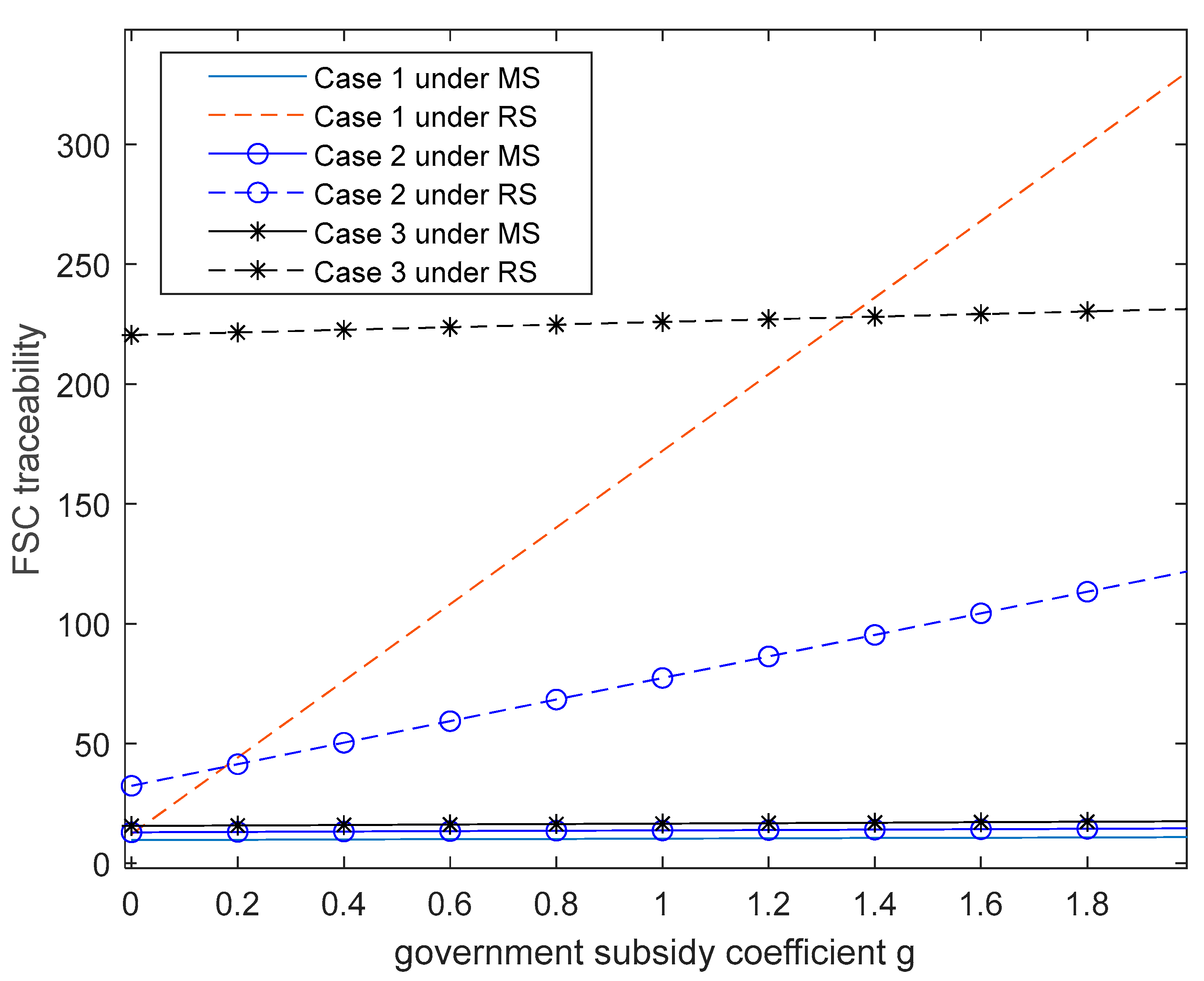
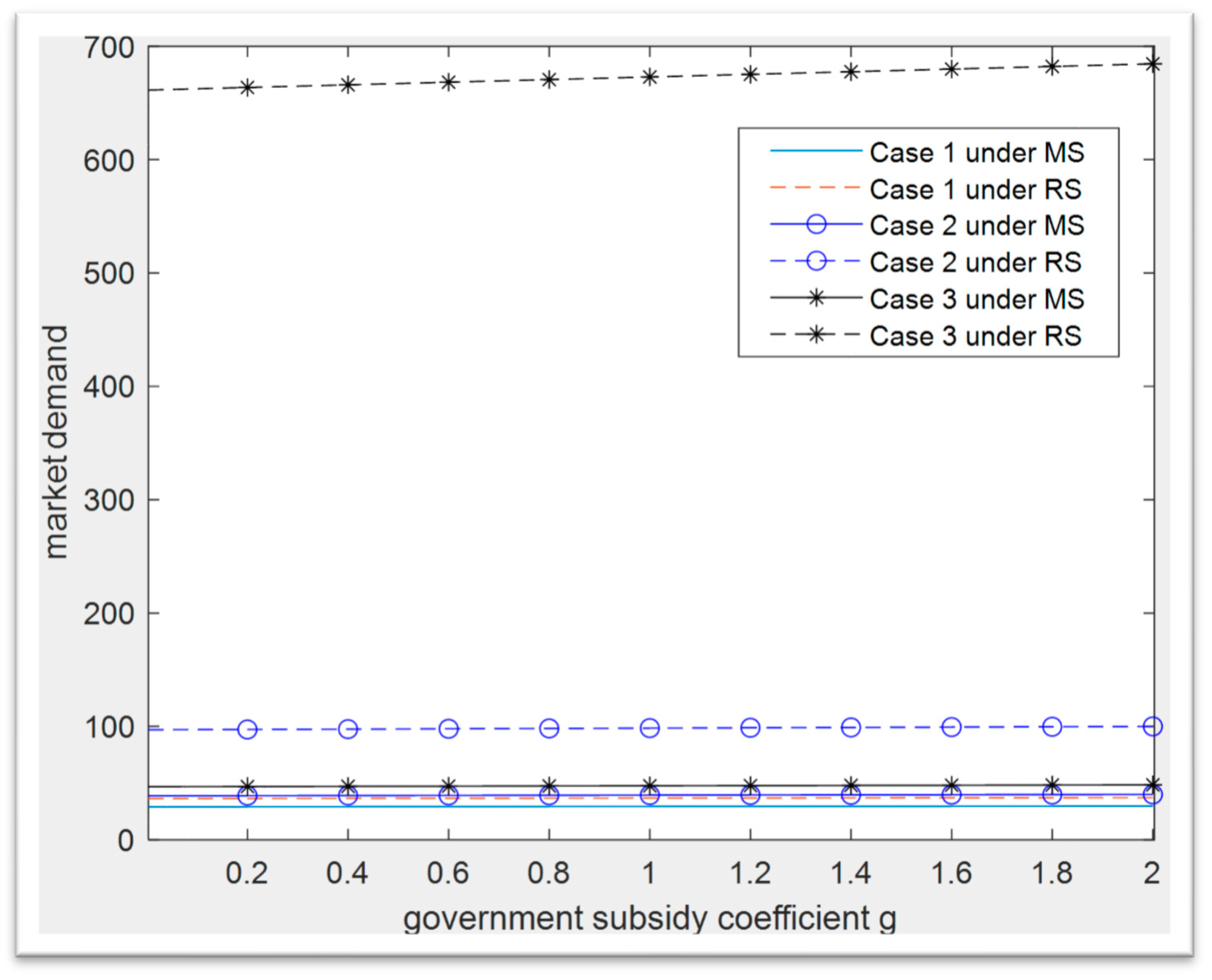
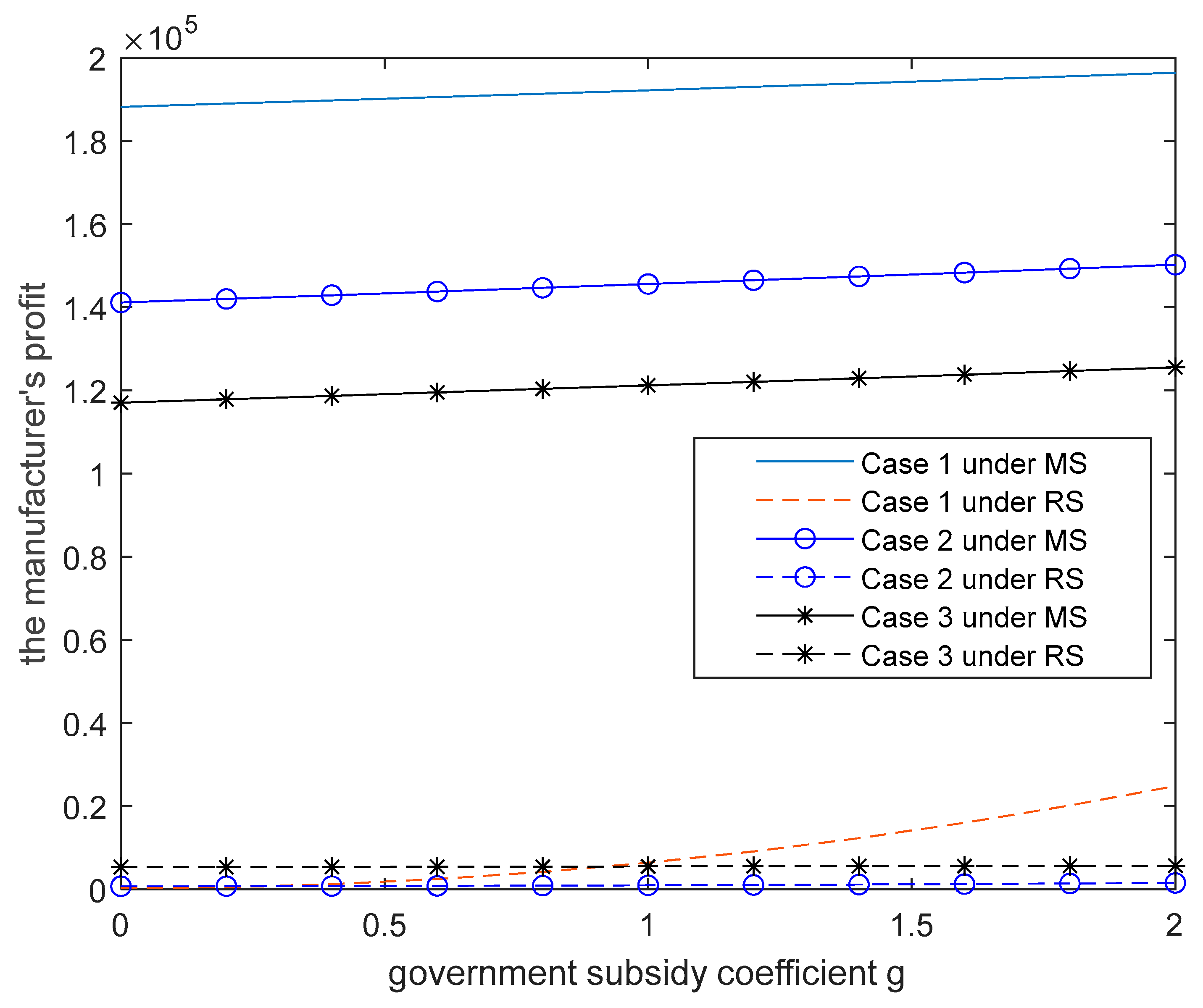
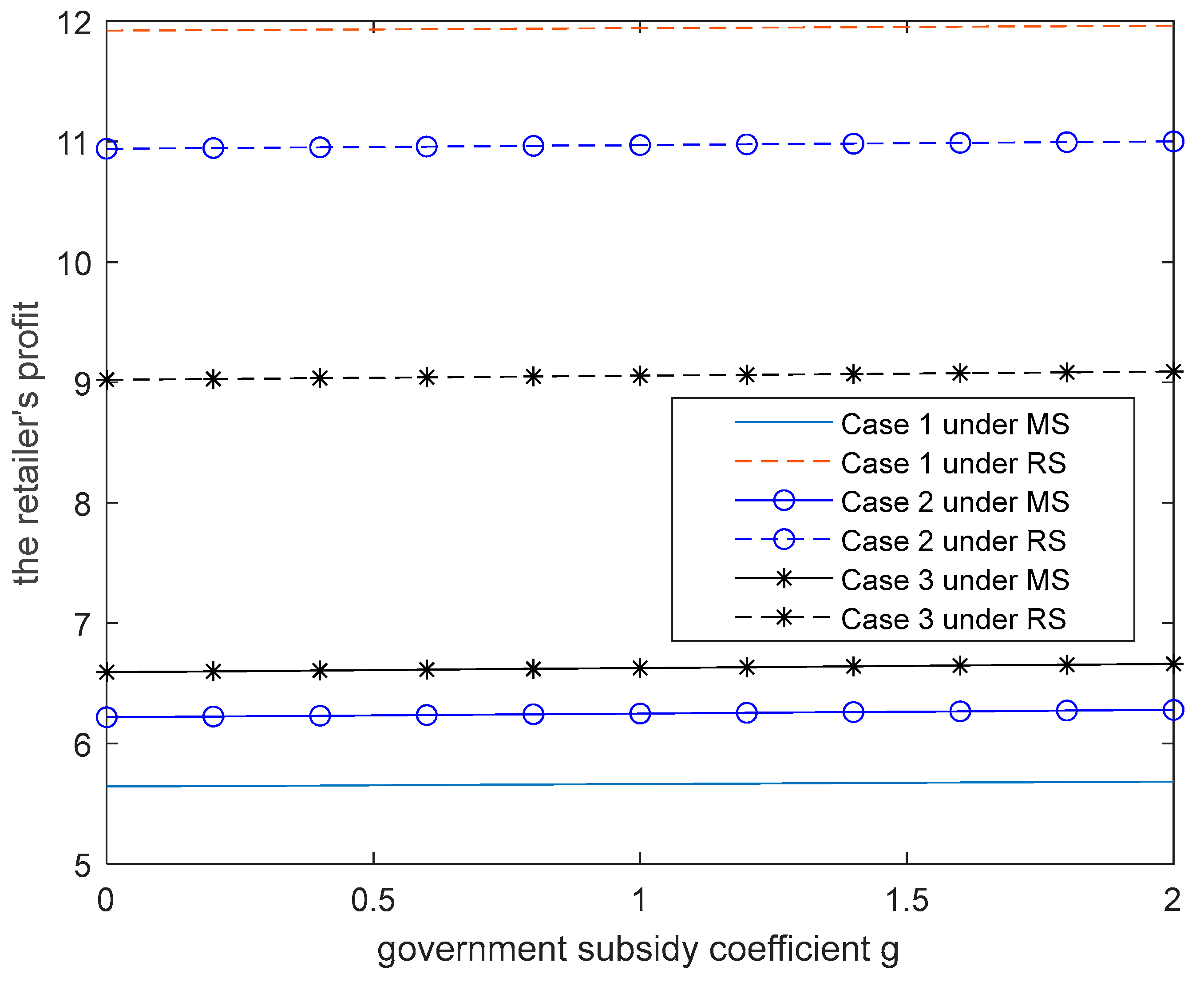
Figure 1,
Figure 2,
Figure 3 and
Figure 4 plot the changing trend in the FSC traceability degree, market demand, manufacturer’s profits, and retailer’s profits with the increase in the government subsidy coefficient, respectively.
Figure 1 shows that under an RS power structure, FSC traceability increases significantly with the increased government subsidy factor. Under an MS power structure, the greater the consumer traceability preference, the higher the traceability degree. However, under an RS power structure, when the government subsidy coefficient is very small, the consumer traceability preference is larger, and the traceability degree is higher. When the government subsidy coefficient reaches a certain threshold, the smaller the consumer traceability preference, the higher the degree of traceability. Under the RS power structure, when the consumer traceability preference is small, government subsidies can produce a significant incentive effect and encourage enterprises to improve the traceability of their supply chain. When consumers are not sufficiently aware of traceability information and have different traceability preferences, this finding can provide good inspiration for decision-making in FSC traceability.
Figure 2 shows that demand will increase with an increased government subsidy coefficient. Under the same power structure, demand will increase with an increase in consumer preferences. Under the same scenario, the demand under an RS structure is higher than under an MS structure. In case 3, the demand gap between the two power structures is the largest. We found that with the increase in consumer preferences, the demand will increase significantly under an RS power structure, and as the government subsidy factor increases, the demand increases.
Figure 3 shows that the manufacturer’s profits increase with an increased government subsidy coefficient. Under an MS structure, as consumer traceability preferences increase, the manufacturer’s profits will decrease because the manufacturer bears the cost of constructing the traceability system, and the government’s subsidy to the manufacturer can reduce the impact of traceability costs on the manufacturer’s profits. In particular, under an RS structure, when consumers have a low preference for traceability, an increase in the government subsidy coefficient can significantly promote an increase in the manufacturer’s profits.
Figure 4 shows that with the increase in the government subsidy coefficient, the retailer’s profits do not significantly increase because the government subsidizes the manufacturer. Under an RS structure, with the increase in consumer traceability preferences, the retailer’s profits decrease. Under an MS structure, with an increase in consumer traceability preferences, the retailer’s profit increases. Therefore, in the manufacturer-led supply chain, the retailer actively promotes traceable products and improves consumer traceability preferences, which can increase the retailer’s profit.
8. Conclusions
To cope with supply chain risks, food enterprises must improve the degree of supply chain traceability and increase supply chain resilience. This paper focused on a two-stage food supply chain consisting of a manufacturer and a retailer to explore the impact of government subsidies, power structures, and consumer preferences on traceability decisions in an FSC. First, manufacturer-led and retailer-led supply chain models, with or without government subsidies, were constructed. Then, the equilibrium solutions of the four models were compared and analyzed. Finally, the variation trends in the solutions under the three different consumer preference scenarios were analyzed using numerical experiments. The results show the following findings. (1) Government subsidies have a positive effect on FSC traceability investment, but there are differences when it comes to improving equilibrium solutions with different power structures. (2) A retailer-led supply chain has a higher degree of traceability than one led by a manufacturer, and government subsidies have a greater effect on the improvement of equilibrium solutions. (3) In a supply chain dominated by a retailer with an increased government subsidy coefficient, the degree of traceability and the manufacturer’s profits increase the most. (4) In a supply chain dominated by a manufacturer, government subsidies can reduce traceability costs on the manufacturer’s profits and improve them. At the same time, as the consumer traceability preference coefficient increases, the retailer’s profits increase. Therefore, the manufacturer should urge the retailer to actively promote traceable products and improve consumer preferences for traceable products.
According to the above research conclusions, we can put forward several suggestions for the construction of FSC traceability systems. (1) The government should actively introduce supportive policies to promote the construction of these systems. Subsidies are provided to manufacturers to encourage them to establish food traceability information from the source, thereby reducing the negative impact of manufacturer investments in terms of traceability system costs. In particular, for products with low consumer traceability preferences, government subsidies can have a significant effect. (2) Improving the leading role of retailers in the FSC is conducive to the FSC’s traceability. Therefore, leading enterprises in food circulation should be supported and cultivated, their voices in the supply chain should be strengthened, and their behaviors should be regulated. (3) Manufacturers should seize the opportunity to actively build an FSC traceability system under supportive policies from the government and provide guidance to retailers in publicizing traceable products.
However, there are still some shortcomings in this study, which can be improved in a number of respects. (1) When constructing its game theory model, this paper only considered a case in which the manufacturer bears the traceable cost, and future research could consider how upstream and downstream enterprises in a supply chain can share costs. (2) The current study only considers the situation of transparent information, and the impact of information asymmetry on traceability decisions in an FSC could be studied in the future. (3) When discussing government subsidies, this paper only examined the strategy of subsidizing a manufacturer. Future work should analyze the influence of different subsidy strategies on traceability decisions in an FSC.