Multi-Criteria Analysis of Sustainable Travel and Tourism Competitiveness in Europe and Eurasia

Abstract
1. Introduction
2. Literature Review
2.1. Review of the Literature on the Influence of COVID-19
Pandemic on Tourism
- 26 million people working in the congress, meeting, and event sector on a global scale were negatively affected by the pandemic process in professional terms;
- 87% of event planners announced that they canceled the events they were going to organize;
- 66% of the events were postponed to a later date;
- 61% were undecided whether to cancel or postpone events due to uncertainty;
- 70% moved their face-to-face activities to virtual platforms;
- 63% of them stated that they are seeking to develop their competencies in order to be successful in online platforms;
- 43% faced issues such as layoffs, salary cuts, and other measures.
- -
- Travel agencies with up to five employees were provided with 9 thousand euros for 3 months;
- -
- Travel agencies with up to 10 employees were provided with a grant of 15 thousand euros for 3 months.
2.2. Literature Review about Studies on Similar Methods and Subjects
3. Material and Methods
3.1. Proposed Multi-Criteria Decision-Making Methods
Entropy Method and Objective Weights
3.2. Cluster Analysis
- (1)
- Determine the K center positions (c1, …, cK);
- (2)
- Distribute all xi to closest cluster center cK;
- (3)
- All cluster centers are recalculated to be the average of all xi’s nearest to it;
- (4)
- Compute
- (5)
- When the value of D converges, (c1, …, cK) is returned; otherwise, continue from Step 2.
3.3. VIKOR (Multi-Criteria Optimization and Compromise Solution)
4. Results
5. Discussion
6. Conclusions
Author Contributions
Funding
Institutional Review Board Statement
Informed Consent Statement
Data Availability Statement
Conflicts of Interest
References
- Gamlen, A. Migration and Mobility after the 2020 Pandemic: The End of an Age; IOM’s Migration Research High Level Advisers: Washington, DC, USA, 2020; pp. 2–14. [Google Scholar]
- Tsai, M.-C. Developing a sustainability strategy for Taiwan’s tourism industry after the COVID-19 pandemic. PLoS ONE 2021, 16, e0248319. [Google Scholar] [CrossRef] [PubMed]
- Marinković, G.; Stevanović, S. Performance changes of the tourism sector in the crises. In 5th International Thematic Monograph: Modern Management Tools and Economy of Tourism Sector in Present Era; Association of Economists and Managers of the Balkans; Faculty of Tourism and Hospitality, Belgrade: Belgrade, Serbia, 2021. [Google Scholar]
- Teczke, M.; Kaliyeva, T.; Sembiyeva, L.; Zhagyparova, A.; Zholamanova, M.; Zhussupova, A. Silk Roads Routes. Sustainable Tourism after COVID-19. J. Environ. Manag. Tour. 2022, 13, 1192–1206. [Google Scholar]
- Iwamoto, H. The unexplored potential of foreign workers in Japan’s travel and tourism industries. In Open Borders, Open Society? Immigration and Social Integration in Japan; Verlag Barbara Budrich: Leverkusen, Germany, 2022; p. 145. [Google Scholar]
- Hambira, L.W.; Stone, L.S.; Pagiwa, V. Botswana nature-based tourism and COVID-19: Transformational implications for the future. Dev. South. Afr. 2022, 39, 51–67. [Google Scholar] [CrossRef]
- Hall, C.M. Constructing sustainable tourism development: The 2030 agenda and the managerial ecology of sustainable tourism. J. Sustain. Tour. 2019, 27, 1044–1060. [Google Scholar] [CrossRef]
- Almuhrzi, H.M.; Al-Azri, H.I. Conference report: Second UNWTO/UNESCO world conference on tourism and culture: Fostering sustainable development. Int. J. Cult. Tour. Hosp. Res. 2019. [Google Scholar] [CrossRef]
- Streimikiene, D.; Svagzdiene, B.; Jasinskas, E.; Simanavicius, A. Sustainable tourism development and competitiveness: The systematic literature review. Sustain. Dev. 2021, 29, 259–271. [Google Scholar] [CrossRef]
- Andereck, L.K.; Nyaupane, G.P. Exploring the nature of tourism and quality of life perceptions among residents. J. Travel Res. 2011, 50, 248–260. [Google Scholar] [CrossRef]
- Luekveerawattana, R. Key factors affecting of tourists’ decisions to stay at environmental friendly hotels. Pol. J. Manag. Stud. 2018, 17, 148–157. [Google Scholar] [CrossRef]
- Murava, I.; Korobeinykova, Y. The analysis of the waste problem in tourist destinations on the example of Carpathian region in Ukraine. J. Ecol. Eng. 2016, 17, 43–51. [Google Scholar] [CrossRef]
- Font, X.; Torres-Delgado, A.; Crabolu, G.; Palomo Martinez, J.; Kantenbacher, J.; Miller, G. The impact of sustainable tourism indicators on destination competitiveness: The European Tourism Indicator System. J. Sustain. Tour. 2021, 1–23. [Google Scholar] [CrossRef]
- Rodríguez-López, N.; Diéguez-Castrillón, M.I.; Gueimonde-Canto, A. Sustainability and tourism competitiveness in protected areas: State of art and future lines of research. Sustainability 2019, 11, 6296. [Google Scholar] [CrossRef]
- Henseler, M.; Maisonnave, H.; Maskaeva, A. Economic impacts of COVID-19 on the tourism sector in Tanzania. Ann. Tour. Res. Empir. Insights 2022, 3, 100042. [Google Scholar] [CrossRef]
- Onifade, S.T.; Gyamfi, B.A.; Bekun, F.V.; Altuntaş, M. Significance of air transport to tourism-induced growth hypothesis in E7 economies: Exploring the implications for environmental quality. Tour. Int. Interdiscip. J. 2022, 70, 339–353. [Google Scholar] [CrossRef]
- Jäggi, C.J. Economic Importance of Tourism, in Tourism before, during and after Corona; Springer: Berlin/Heidelberg, Germany, 2022; pp. 27–46. [Google Scholar]
- Yıldırım, S.; Yıldırım, D.Ç.; Aydın, K.; Erdoğan, F. Regime-dependent effect of tourism on carbon emissions in the Mediterranean countries. Environ. Sci. Pollut. Res. 2021, 28, 54766–54780. [Google Scholar] [CrossRef] [PubMed]
- Doğanalp, N.; Arslan, A. Comparative efficiency analysis of tourism industry in the Southern Mediterranean region. In Contemporary Issues in Social Science; Emerald Publishing Limited: Bingley, UK, 2021; pp. 49–66. [Google Scholar]
- Senanayake, U.J. Threats and opportunities of the COVID 19 on tourism industry in Sri Lanka and South Asian region. Int. J. Hosp. Tour. Manag. 2021, 5, 15. [Google Scholar]
- Ranasinghe, R.; Sugandhika, M. The contribution of tourism income for the economic growth of Sri Lanka. J. Manag. Tour. Res. 2018, 1, 67–84. [Google Scholar]
- Adinugraha, H.H.; Nasution, I.F.A.; Faisal, F.; Daulay, M.; Harahap, I.; Wildan, T.; Takhin, M.; Riyadi, A. Halal Tourism in Indonesia: An Indonesian Council of Ulama National Sharia Board Fatwa Perspective. J. Asian Financ. Econ. Bus. 2021, 8, 665–673. [Google Scholar]
- Behere, D. Global Tourism and Its Impact on Business. ZENITH Int. J. Bus. Econ. Manag. Res. 2018, 8, 73–85. [Google Scholar]
- Kataya, A. The Impact of COVID-19 Pandemic on International and Lebanese Tourism Indicators. Econ. Appl. Inform. 2021, 2, 5–13. [Google Scholar] [CrossRef]
- Ertaş, M.; Sel, Z.G.; Kırlar-Can, B.; Tütüncü, Ö. Effects of crisis on crisis management practices: A case from Turkish tourism enterprises. J. Sustain. Tour. 2021, 29, 1490–1507. [Google Scholar] [CrossRef]
- Jawabreh, O. Management of tourism crisis in the Middle East. In Public Sector Crisis Management; IntechOpen: London, UK, 2020. [Google Scholar]
- Kumar, S.; Nafi, S.M. Impact of COVID-19 Pandemic on Tourism: Perceptions from Bangladesh. Available online: https://papers.ssrn.com/sol3/papers.cfm?abstract_id=3632798 (accessed on 15 February 2022).
- Fernandes, N. Economic Effects of Coronavirus Outbreak (COVID-19) on the world Economy; University of Navarra, IESE Business School; European Corporate Governance Institute (ECGI): Barcelona, Spain, 2020. [Google Scholar]
- Payne, E.J.; Gil-Alana, L.A.; Mervar, A. Persistence in Croatian tourism: The impact of COVID-19. Tour. Econ. 2022, 28, 1676–1682. [Google Scholar] [CrossRef]
- de Silva, O.D.; Aulicino, M.P. Obstacles and adaptations of mega-events in São Paulo in the face of the COVID-19 Pandemic. In Handbook of Research on the Impacts and Implications of COVID-19 on the Tourism Industry; IGI Global: Hershey, PA, USA, 2021; pp. 728–746. [Google Scholar]
- Moreno-Luna, L.; Robina-Ramírez, R.; Sánchez MS, O.; Castro-Serrano, J. Tourism and sustainability in times of COVID-19: The case of Spain. Int. J. Environ. Res. Public Health 2021, 18, 1859. [Google Scholar] [CrossRef] [PubMed]
- Sucheran, R. Global impacts and trends of the COVID-19 pandemic on the cruise sector: A focus on South Africa. Afr. J. Hosp. Tour. Leis. 2021, 10, 22–39. [Google Scholar] [CrossRef]
- Zhong, L.; Sun, S.; Law, R.; Li, X.; Yang, L. Perception, reaction, and future development of the influence of COVID-19 on the hospitality and tourism industry in China. Int. J. Environ. Res. Public Health 2022, 19, 991. [Google Scholar] [CrossRef]
- Dube, K.; Nhamo, G.; Chikodzi, D. COVID-19 pandemic and prospects for recovery of the global aviation industry. J. Air Transp. Manag. 2021, 92, 102022. [Google Scholar] [CrossRef]
- Napoli, J.; Goetz, P.A.R.; Drogoul, F.; Basile, M.; Depasse, S.; Cavallo, J.; Chaufrein, M.; Silvie, T.; Brilland, J. Agility in the Air Transport and Tourism Sectors: A Worldwide Vision. J. Tour. Sports Manag. 2022, 5, 15–41. [Google Scholar]
- Peručić, D.; Greblički, M. Key Factors Driving the Demand for Cruising and Challenges Facing the Cruise Industry in the Future. Tour. Int. Interdiscip. J. 2022, 70, 87–100. [Google Scholar] [CrossRef]
- Antonellini, L. Impact of COVID-19 on the Cruise Industry. J. Tour. Res. 2022, 27, 1–10. [Google Scholar]
- Kapia, A. Crisis Management in MICE Industry: The Case of Thessaloniki. Master’s Thesis, School of Humanities, Social Sciences and Economics, Hospitality & Tourism Management, International Hellenic University, Nea Moudania, Greece, 2021. [Google Scholar]
- Rouhi Khorasani, P. Event Industry during COVID-19 Pandemic in Sweden; Impact, Recovery and Future Trends. Ph.D. Thesis, School of Natural Sciences, Technology and Environmental Studies, Tourism Studies, Södertörn University, Huddinge, Sweden, 2021. [Google Scholar]
- Alwi, K.M.; Patwary, A.K.; Ramly, N.I. Impact of COVID-19 Towards Tourism Industry: An Evidence from Malaysia. PalArch’s J. Archaeol. Egypt Egyptol. 2020, 17, 354–382. [Google Scholar]
- Herédia-Colaço, V.; Rodrigues, H. Hosting in turbulent times: Hoteliers’ perceptions and strategies to recover from the COVID-19 pandemic. Int. J. Hosp. Manag. 2021, 94, 102835. [Google Scholar] [CrossRef]
- Smart, K.; Ma, E.; Qu, H.; Ding, L. COVID-19 impacts, coping strategies, and management reflection: A lodging industry case. Int. J. Hosp. Manag. 2021, 94, 102859. [Google Scholar] [CrossRef] [PubMed]
- Gössling, S.; Scott, D.; Hall, C.M. Pandemics, tourism and global change: A rapid assessment of COVID-19. J. Sustain. Tour. 2020, 29, 1–20. [Google Scholar] [CrossRef]
- Abbass, K.; Begum, H.; Alam, A.F.; Awang, A.H.; Abdelsalam, M.K.; Egdair IM, M.; Wahid, R. Fresh insight through a Keynesian theory approach to investigate the economic impact of the COVID-19 pandemic in Pakistan. Sustainability 2022, 14, 1054. [Google Scholar] [CrossRef]
- Desson, Z.; Lambertz, L.; Peters, J.W.; Falkenbach, M.; Kauer, L. Europe’s COVID-19 outliers: German, Austrian and Swiss policy responses during the early stages of the 2020 pandemic. Health Policy Technol. 2020, 9, 405–418. [Google Scholar] [CrossRef] [PubMed]
- Clark, E.A.; Lepinteur, A. Pandemic policy and life satisfaction in Europe. Rev. Income Wealth 2022, 68, 393–408. [Google Scholar] [CrossRef] [PubMed]
- Clark, E.A.; d’Ambrosio, C.; Lepinteur, A. The fall in income inequality during COVID-19 in four European countries. J. Econ. Inequal. 2021, 19, 489–507. [Google Scholar] [CrossRef]
- Aydoğan, K.E.; Özmen, M. Travel and tourism competitiveness of economies around the world using rough SWARA and TODIM Method. In Strategic Innovative Marketing and Tourism; Springer: Berlin/Heidelberg, Germany, 2020; pp. 765–774. [Google Scholar]
- Fedajev, A.; Popovic, G.; Stanujkic, D. MCDM framework for evaluation of the tourism destination competitiveness. In Proceedings of the 5th International Scientific Conference Innovation as an Initiator of the Development–MEFkon, Belgrade, Serbia, 6 December 2019. [Google Scholar]
- Rodríguez-Díaz, B.; Pulido-Fernández, J.I. Analysis of the Worth of the Weights in a new Travel and Tourism Competitiveness Index. J. Travel Res. 2021, 60, 267–280. [Google Scholar] [CrossRef]
- Gómez-Vega, M.; Martín, J.C.; Picazo-Tadeo, A.J. Ranking world tourism competitiveness: A comparison of two composite indicators. In Tourism and Regional Science; Springer: Berlin/Heidelberg, Germany, 2021; pp. 15–35. [Google Scholar]
- Liu, Y.L.; Ko, P.F.; Chiang, J.T. Developing an Evaluation Model for Monitoring Country-based Tourism Competitiveness. SAGE Open 2021, 11, 21582440211047559. [Google Scholar] [CrossRef]
- Bire, B.R.; Conterius, A.L.F.; Nasar, A. Drivers of Regional Destination Competitiveness: A DEMATEL-Fuzzy TOPSIS Approach. Indones. J. Geogr. 2021, 53, 144–152. [Google Scholar] [CrossRef]
- Hašková, S.; Horák, J. Fuzzy logic and artificial intelligence tools in the context of tourism analysis. In Modern Management Tools and Economy of Tourism Sector in Present Era; 2020; p. 601. Available online: https://www.udekom.org.rs›tmt.2020.601.pdf (accessed on 10 April 2022).
- Stanujkic, M.; Stanujkic, D.; Karabasevic, D.; Sava, C.; Popovic, G. Comparison of Tourism Potentials Using Preference Selection Index Method. QUAESTUS Multidiscip. Res. J. 2020, 177–187. [Google Scholar]
- Stecyk, A.; Sidorkiewicz, M.; Orfin-Tomaszewska, K. Model of regional tourism competitiveness: Fuzzy multiple-criteria approach (FDM-FAHP-PROMETHE II framework). Eur. Res. Stud. J. 2021, 24, 638–662. [Google Scholar] [CrossRef]
- Uppink, L.; Soshkin, M. Travel & Tourism Development Index 2021 Rebuilding for a Sustainable and Resilient Future; World Economic Forum: Geneva, Switzerland, 2022. [Google Scholar]
- Shannon, E.C.; Weaver, W. A Mathematical Model of Communication; University of Illinois Press: Urbana, IL, USA, 1949; p. 11. [Google Scholar]
- Zeleny, M. Multiple Criteria Decision Making Kyoto 1975; Springer: Berlin/Heidelberg, Germany, 2012; Volume 123. [Google Scholar]
- Burg, J.P. Maximum entropy spectral analysis. Astron. Astrophys. Suppl. 1974, 15, 383. [Google Scholar]
- Rosenfeld, R. Adaptive Statistical Language Modeling. Ph.D. Thesis, Carnegie Mellon University, Pittsburgh, PA, USA, 1994. [Google Scholar]
- Golan, A.; Judge, G.; Miller, D. The maximum entropy approach to estimation and inference. In Applying Maximum Entropy to Econometric Problems; Emerald Group Publishing Limited: Bingley, UK, 1997; pp. 3–24. [Google Scholar]
- Lihong, M.; Yanping, Z.; Zhiwei, Z. Improved VIKOR algorithm based on AHP and Shannon entropy in the selection of thermal power enterprise’s coal suppliers. In Proceedings of the 2008 International Conference on Information Management, Innovation Management and Industrial Engineering, Taipei, Taiwan, 19–21 December 2008. [Google Scholar]
- Wang, T.C.; Lee, D.H. Developing a fuzzy TOPSIS approach based on subjective weights and objective weights. Expert Syst. Appl. 2009, 36, 8980–8985. [Google Scholar] [CrossRef]
- Shemshadi, A.; Shirazi, H.; Toreihi, M.; Tarokh, M.J. A fuzzy VIKOR method for supplier selection based on entropy measure for objective weighting. Expert Syst. Appl. 2011, 38, 12160–12167. [Google Scholar] [CrossRef]
- Apan, M.; Öztel, A.; İslamoğlu, M. Teknoloji Sektörünün Entropi Ağırlıklı Uzlaşık Programlama (CP) ile Finansal Performans Analizi: BİST’de Bir Uygulama. In Proceedings of the 19th Finance Symposium, Hitit University Çorum, Çorum, Turkey, 21–24 October 2015; Available online: https://www.researchgate.net/publication/283299704 (accessed on 7 December 2017).
- Azadnia, H.A.; Ghadimi, P.; Molani-Aghdam, M. A hybrid model of data mining and MCDM methods for estimating customer lifetime value. In Proceedings of the 41st International Conference on Computers and Industrial Engineering (CIE41), Los Angeles, CA, USA, 23–26 October 2011. [Google Scholar]
- Opricović, S. Vikor method. In Multicriteria Optimization of Civil Engineering Systems; University of Belgrade-Faculty of Civil Engineering: Belgrade, Serbia, 1998; pp. 142–175. [Google Scholar]
- Ozkaya, G.; Timor, M.; Erdin, C. Science, Technology and Innovation Policy Indicators and Comparisons of Countries through a Hybrid Model of Data Mining and MCDM Methods. Sustainability 2021, 13, 694. [Google Scholar] [CrossRef]
- Morrison, A.M. Tourism Marketing: In the Age of the Consumer; Routledge: Oxfordshire, UK, 2022. [Google Scholar]
- Ianioglo, A.; Rissanen, M. Global trends and tourism development in peripheral areas. Scand. J. Hosp. Tour. 2020, 20, 520–539. [Google Scholar] [CrossRef]
- Scully, E.; Douma, F.; Krishnan, V.; Seeley, J.; Neher, K.; Obeid, M. Rebooting Customer Experience to Bring Back the Magic of Travel; Mckinsey and Company: New York, NY, USA, 2021. [Google Scholar]
- Constantin, M.; Saxon, S.; Yu, J. Reimagining the $9 trillion tourism economy—what will it take. In Travel, Logistics and Transport Infrastructure Practice; Mckinsey and Company: New York, NY, USA, 2020. [Google Scholar]


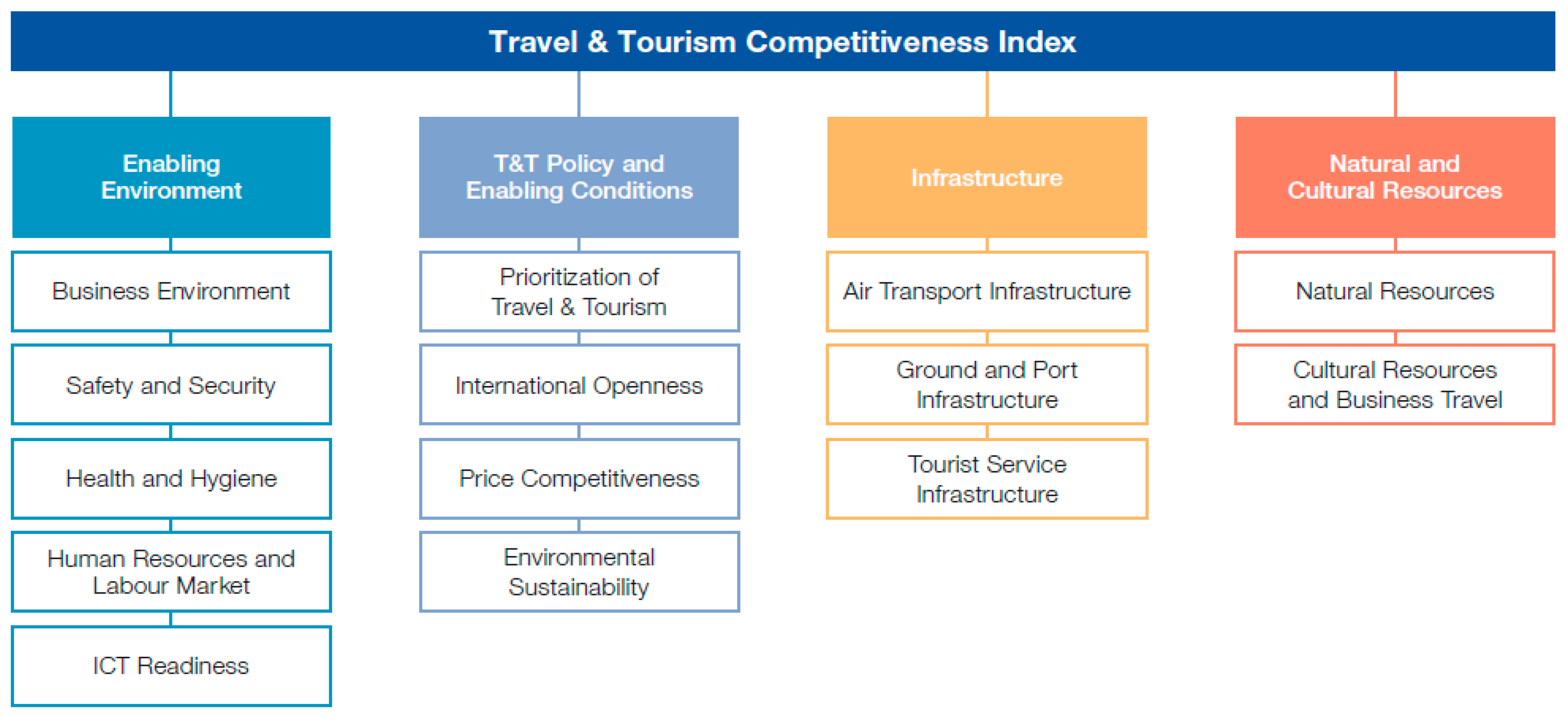
| Dimensions | Codes | Indicators 1–7 (Best) | Implications |
|---|---|---|---|
| Enabling Environment | C1 | Business environment | Economic growth, productivity, and final investment choices are all heavily influenced by policy stability, the extent of regulatory constraints, and the prevalence of corruption. T&T is not an exception; these considerations are vital to any industry. |
| C2 | Safety and security | Countries with high crime or violence rates are less likely to attract tourists, making it even more difficult for the T&T industry to succeed there. | |
| C3 | Health and hygiene | The consequences of infectious illnesses on the T&T industry have been brought to light by COVID-19. More specifically, the pandemic has highlighted the significance of a country’s healthcare system in reducing the effects of pandemics, guaranteeing travel safety, and maintaining a robust and available workforce. If visitors or workers get sick, the country’s healthcare system must be prepared to treat them. This includes having enough doctors on call, enough hospital beds, and enough other medical services to treat the illness. | |
| C4 | Human resources and labor market | When an economy has plenty of qualified workers, businesses may easily find the partners they need to succeed. Years spent in school, rates of formal educational attainment, the capacity of the education system to satisfy economic demands, and the participation of the business sector in improving human resources are all indicators of a high-quality workforce. | |
| C5 | Travel and tourism ICT readiness | T&T companies are realizing the growing relevance of online services and digital platforms. Itinerary planning and hotel reservations are only two of the many uses for these kinds of services and platforms. In addition, ICT is essential for companies to reach new customers, expand existing customer bases, increase productivity, and better understand their clients’ wants and requirements. | |
| Travel and Tourism Policy and Enabling Conditions | C6 | Government prioritization of travel and tourism | T&T growth is significantly influenced by the level of government attention given to the industry. By emphasizing the importance of the sector, the government may better allocate resources toward crucial development initiatives and better organize the players and resources needed to advance the sector. The government may play a significant role in luring visitors by funding and coordinating extensive advertising initiatives on a national scale. |
| C7 | International openness and travel facilitation | To grow the T&T industry on a global scale, it is necessary to remove barriers to communication and travel. Tourists’ interest in a nation decreases when entry constraints, including lengthy visa processes, are imposed. The free movement of money is essential for international commerce and investment in T&T services; hence, this factor is also included in the index. | |
| C8 | Price competitiveness in the travel and tourism industry | When a country’s travel and tourism (T&T) industry has lower operating expenses, it becomes more enticing to both tourists and potential investors. | |
| C9 | Environmental sustainability | Policies and variables that promote environmental sustainability are essential to the future allure of a country as a tourist destination. The state of a country’s environment may be gauged by looking at indicators such as water scarcity, marine and air pollution, deforestation, and the likelihood of species becoming extinct. The degree to which the government and the private sector are maintaining the natural assets that create nature-based T&T may be seen in the degree to which the environment and national parks are protected. Last but not least, metrics regarding GHG emissions, renewable energy use, investment in green infrastructure, and exposure to weather-related events are important for understanding how vulnerable, prepared, and willing a country is to address climate change, one of the greatest long-term threats to the T&T sector. | |
| Infrastructure | C10 | Air transport infrastructure | The availability of reliable air transport is crucial for international and domestic travel in many nations. |
| C11 | Ground and port infrastructure | In order to have a developed national T&T economy, it is necessary to have road and railway networks that are sufficiently large, as indicated by road and railway densities, and road, railway, and port infrastructure that fulfills world standards of comfort, security, and modal efficiency. Quality taxis, trains, and other public transportation options are also vital for a country’s appeal to tourists. | |
| C12 | Tourist service infrastructure | Possessing a sufficient number of hotels, resorts, and recreational centers may be a major boon for any nation. Since service price and quality are affected by industry competition, this factor is taken into consideration as well. | |
| Travel and Tourism Demand Drivers | C13 | Natural resources | The environment, natural parks, and the diversity of wildlife are all examples of natural capital. Perhaps more so than others, countries rich in natural resources might benefit from more tourism. Measures of digital demand for nature and related activities provide insight into the visibility and attractiveness of a country’s natural resources. |
| C14 | Cultural resources | Among the factors considered in calculating this index are the country’s number of UNESCO World Heritage Sites, the number of big stadiums capable of hosting major sports or entertainment events, and the level of interest in such sites and events as measured by digital demand. The list also contains the number of cities that have been designated as UNESCO Creative Cities, signifying their commitment to fostering and preserving cultural and creative businesses and activities. |
| wi | 0.0491 | 0.0989 | 0.0914 | 0.0670 | 0.0490 | 0.0554 | 0.0667 | 0.0855 | 0.0589 | 0.0702 | 0.0628 | 0.0794 | 0.0468 | 0.1187 |
| Countries | C1 | C2 | C3 | C4 | C5 | C6 | C7 | C8 | C9 | C10 | C11 | C12 | C13 | C14 |
| MAX | MAX | MAX | MAX | MAX | MAX | MAX | MAX | MAX | MAX | MAX | MAX | MAX | MAX | |
| Armenia | 4.98 | 5.83 | 5.99 | 4.77 | 4.7 | 5.13 | 3.21 | 5.75 | 4.04 | 2.39 | 2.83 | 4.33 | 2.51 | 1.45 |
| Austria | 4.84 | 6.19 | 6.99 | 5.29 | 6.07 | 5.88 | 4.01 | 4.69 | 5.68 | 4.2 | 5.22 | 6.66 | 4.14 | 3.15 |
| Azerbaijan | 5.09 | 5.85 | 6.06 | 5.26 | 4.96 | 5.53 | 3.08 | 5.87 | 4.08 | 2.59 | 3.93 | 3.17 | 2.17 | 1.87 |
| Belgium | 4.83 | 5.65 | 6.54 | 5.29 | 5.83 | 4.34 | 4.15 | 4.76 | 4.81 | 4.09 | 5.46 | 5.2 | 2.54 | 3.69 |
| Bosnia and Herzegovina | 3.36 | 5.39 | 5.62 | 4.1 | 4.54 | 3.23 | 2.41 | 5.46 | 4.28 | 2.03 | 2.35 | 3.94 | 1.94 | 1.46 |
| Bulgaria | 4.43 | 5.19 | 6.73 | 4.59 | 5.19 | 4.72 | 3.89 | 5.65 | 4.85 | 2.71 | 3.21 | 5.95 | 3.69 | 2.08 |
| Croatia | 3.78 | 5.87 | 6.33 | 4.12 | 5.17 | 5.89 | 4.16 | 5.05 | 5.1 | 3.61 | 3.86 | 6.48 | 4.44 | 2.76 |
| Czech Republic | 4.5 | 6.1 | 6.86 | 4.89 | 5.68 | 4.5 | 4.17 | 5.37 | 5.01 | 3.36 | 4.94 | 5.21 | 2.52 | 2.44 |
| Denmark | 5.52 | 5.81 | 6.19 | 5.6 | 6.39 | 4.96 | 4.36 | 4.4 | 5.39 | 4.47 | 5.33 | 4.82 | 3.33 | 2.34 |
| Estonia | 5.07 | 6.24 | 6.34 | 5.07 | 6.11 | 5.01 | 3.67 | 5.4 | 5.18 | 2.47 | 4.47 | 5.41 | 2.4 | 1.56 |
| Finland | 5.69 | 6.7 | 6.37 | 5.47 | 6.12 | 5.13 | 4.12 | 4.67 | 5.6 | 4.88 | 4.53 | 4.66 | 2.92 | 2.01 |
| France | 4.76 | 5.65 | 6.54 | 5.12 | 5.92 | 5.59 | 4.24 | 4.53 | 5.27 | 4.85 | 5.56 | 5.69 | 4.92 | 6.8 |
| Georgia | 5.18 | 5.98 | 6.02 | 4.75 | 4.9 | 5.99 | 3.42 | 5.72 | 4.25 | 2.51 | 3.24 | 4.89 | 2.35 | 1.55 |
| Germany | 5.45 | 5.82 | 6.95 | 5.65 | 5.96 | 5.17 | 4.26 | 4.61 | 5.34 | 4.87 | 5.74 | 5.95 | 4.06 | 6.46 |
| Greece | 3.93 | 5.58 | 6.49 | 4.7 | 5.22 | 5.75 | 4.11 | 4.86 | 4.54 | 4.77 | 3.85 | 5.75 | 3.52 | 3.33 |
| Hungary | 4.31 | 5.83 | 6.64 | 4.6 | 5.27 | 5.08 | 4.17 | 5.27 | 4.83 | 3.35 | 4.15 | 4.75 | 2.71 | 2.33 |
| Iceland | 5.31 | 6.54 | 6.21 | 5.61 | 6.32 | 6.05 | 4.4 | 3.57 | 4.81 | 4.96 | 4.01 | 6 | 3.1 | 1.48 |
| Ireland | 5.21 | 5.98 | 5.84 | 5.34 | 5.74 | 6.24 | 4.51 | 4.59 | 4.88 | 4.51 | 4.48 | 5.79 | 2.58 | 2.91 |
| Italy | 4.01 | 5.51 | 6.28 | 4.64 | 5.48 | 4.93 | 4.13 | 4.44 | 4.29 | 4.45 | 4.67 | 6.01 | 4.89 | 6.52 |
| Kazakhstan | 4.73 | 5.58 | 6.49 | 4.71 | 4.97 | 4.71 | 2.49 | 6.33 | 3.81 | 2.66 | 2.94 | 3.4 | 2.55 | 1.74 |
| Kyrgyz Republic | 4.37 | 5.17 | 5.67 | 4.28 | 4.02 | 4.93 | 3 | 6.14 | 3.71 | 1.96 | 2.07 | 2.09 | 2.52 | 1.51 |
| Latvia | 4.55 | 5.81 | 6.36 | 4.99 | 5.71 | 4.24 | 3.99 | 5.67 | 4.67 | 3.47 | 4.19 | 4.51 | 2.4 | 1.37 |
| Lithuania | 4.68 | 5.86 | 6.91 | 5.06 | 5.64 | 3.79 | 4.01 | 5.72 | 4.57 | 2.48 | 4.31 | 4.42 | 2.29 | 1.45 |
| Luxembourg | 5.78 | 6.32 | 6.2 | 5.45 | 6.19 | 5.36 | 4.27 | 5.02 | 5.63 | 3.65 | 5.5 | 5.93 | 2.84 | 1.57 |
| Malta | 4.95 | 6.01 | 6.45 | 4.81 | 5.8 | 6.37 | 3.96 | 4.92 | 4.7 | 3.89 | 4.84 | 5.47 | 2.78 | 1.55 |
| Moldova | 4.03 | 5.52 | 6.11 | 4.42 | 4.58 | 3.75 | 3.11 | 5.97 | 4.29 | 2.12 | 2.58 | 2.9 | 1.66 | 1.22 |
| Montenegro | 4.6 | 5.57 | 5.84 | 4.78 | 5.21 | 6.11 | 2.44 | 5.63 | 4.72 | 3.16 | 3.34 | 5.51 | 2.73 | 1.13 |
| Netherlands | 5.5 | 6 | 6.33 | 5.56 | 6.25 | 4.88 | 4.27 | 4.61 | 5.41 | 5.23 | 6.14 | 4.84 | 2.72 | 3.39 |
| Norway | 5.29 | 6.13 | 6.42 | 5.51 | 6.3 | 5.21 | 4.05 | 4.17 | 5.8 | 5.63 | 3.86 | 5.15 | 3.23 | 2.16 |
| Poland | 4.26 | 5.62 | 6.3 | 4.76 | 5.51 | 3.31 | 4.1 | 5.68 | 4.21 | 3.21 | 4.26 | 4.52 | 3.2 | 2.98 |
| Portugal | 4.66 | 6.28 | 6.04 | 5.09 | 5.55 | 6.07 | 4.23 | 5.05 | 4.18 | 4.72 | 4.18 | 6.7 | 4.01 | 4.09 |
| Romania | 4.38 | 5.96 | 6.14 | 4.54 | 5.16 | 3.59 | 3.93 | 5.6 | 4.41 | 2.72 | 3.1 | 4.55 | 3.19 | 2.31 |
| Russian Federation | 4.26 | 5.15 | 6.72 | 5.01 | 5.27 | 4.53 | 2.23 | 5.81 | 4.21 | 4.61 | 3.33 | 4.14 | 3.84 | 3.75 |
| Serbia | 4.39 | 5.48 | 6.26 | 4.7 | 5.09 | 4.51 | 3.25 | 5.48 | 4.47 | 2.61 | 3.02 | 3.91 | 2.06 | 1.69 |
| Slovak Republic | 4.08 | 5.62 | 6.2 | 4.75 | 5.67 | 3.74 | 3.91 | 5.45 | 4.69 | 1.99 | 4.16 | 4.42 | 3.43 | 1.61 |
| Slovenia | 4.31 | 6.15 | 6.17 | 4.95 | 5.47 | 4.81 | 3.72 | 5.13 | 5.36 | 2.55 | 4.76 | 5.42 | 4.11 | 1.68 |
| Spain | 4.48 | 6.14 | 6.19 | 4.94 | 5.78 | 6.15 | 3.95 | 5.02 | 4.74 | 5.05 | 5.24 | 6.56 | 4.8 | 6.66 |
| Sweden | 5.28 | 5.87 | 6.2 | 5.53 | 6.38 | 4.81 | 4.09 | 4.28 | 5.24 | 4.98 | 4.66 | 4.77 | 3.21 | 2.91 |
| Switzerland | 6 | 6.39 | 6.54 | 5.78 | 6.34 | 5.66 | 4.13 | 3.7 | 5.98 | 5.04 | 6.07 | 6.2 | 3.7 | 2.75 |
| Tajikistan | 4.28 | 5.59 | 5.52 | 4.66 | 3.37 | 6.25 | 2.5 | 5.58 | 3.9 | 2.16 | 2.81 | 1.97 | 2.86 | 1.28 |
| Turkey | 4.4 | 4.31 | 5.48 | 4.18 | 4.64 | 5.08 | 3.83 | 5.62 | 3.67 | 4.74 | 3.56 | 5.04 | 2.77 | 3.82 |
| Ukraine | 4.11 | 4.84 | 6.52 | 4.83 | 4.52 | 3.53 | 3.73 | 5.9 | 3.88 | 2.74 | 3.14 | 4.29 | 2.23 | 1.94 |
| United Kingdom | 5.75 | 5.78 | 5.82 | 5.53 | 6.18 | 5.16 | 4.24 | 3.19 | 5.21 | 5.23 | 5.36 | 6.1 | 4.38 | 5.62 |
| fj* | 6.00 | 6.70 | 6.99 | 5.78 | 6.39 | 6.37 | 4.51 | 6.33 | 5.98 | 5.63 | 6.14 | 6.70 | 4.92 | 6.80 |
| fi− | 3.36 | 4.31 | 5.48 | 4.10 | 3.37 | 3.23 | 2.23 | 3.19 | 3.67 | 1.96 | 2.07 | 1.97 | 1.66 | 1.13 |
| Definitions | Indicators | wj |
|---|---|---|
| WEF Cultural resources and business travel, 1–7 (best) | C14 | 0.1187 |
| WEF Safety and security pillar, 1–7 (best) | C2 | 0.0989 |
| WEF Health and hygiene, 1–7 (best) | C3 | 0.0914 |
| WEF Price competitiveness in the travel and tourism industry pillar, 1–7 (best) | C8 | 0.0855 |
| WEF Tourist service infrastructure pillar, 1–7 (best) | C12 | 0.0794 |
| WEF Air transport infrastructure, 1–7 (best) | C10 | 0.0702 |
| WEF Human resources and labor market, 1–7 (best) | C4 | 0.0670 |
| WEF International openness and travel facilitation pillar, 1–7 (best) | C7 | 0.0667 |
| WEF Ground and port infrastructure, 1–7 (best) | C11 | 0.0628 |
| WEF Environmental sustainability, 1–7 (best) | C9 | 0.0589 |
| WEF Government prioritization of travel and tourism, 1–7 (best) | C6 | 0.0554 |
| WEF Business environment, 1–7 (best) | C1 | 0.0491 |
| WEF Travel and tourism ICT readiness, 1–7 (best) | C5 | 0.0490 |
| WEF Natural resources pillar, 1–7 (best) | C13 | 0.0468 |
| Countries | C1 | C2 | C3 | C4 | C5 | C6 | C7 | C8 | C9 | C10 | C11 | C12 | C13 | C14 | Si | Ri |
|---|---|---|---|---|---|---|---|---|---|---|---|---|---|---|---|---|
| Armenia | 0.0190 | 0.0360 | 0.0606 | 0.0403 | 0.0274 | 0.0219 | 0.0380 | 0.0158 | 0.0495 | 0.0620 | 0.0511 | 0.0398 | 0.0346 | 0.1120 | 0.6079 | 0.6079 |
| Austria | 0.0216 | 0.0211 | 0.0000 | 0.0196 | 0.0052 | 0.0086 | 0.0146 | 0.0447 | 0.0077 | 0.0274 | 0.0142 | 0.0007 | 0.0112 | 0.0764 | 0.2729 | 0.0764 |
| Azerbaijan | 0.0169 | 0.0352 | 0.0563 | 0.0208 | 0.0232 | 0.0148 | 0.0418 | 0.0125 | 0.0485 | 0.0582 | 0.0341 | 0.0593 | 0.0395 | 0.1032 | 0.5643 | 0.1032 |
| Belgium | 0.0218 | 0.0435 | 0.0272 | 0.0196 | 0.0091 | 0.0358 | 0.0105 | 0.0428 | 0.0299 | 0.0295 | 0.0105 | 0.0252 | 0.0342 | 0.0651 | 0.4045 | 0.0651 |
| Bosnia and Herzegovina | 0.0491 | 0.0542 | 0.0830 | 0.0670 | 0.0300 | 0.0554 | 0.0615 | 0.0237 | 0.0434 | 0.0689 | 0.0585 | 0.0463 | 0.0428 | 0.1118 | 0.7955 | 0.1118 |
| Bulgaria | 0.0292 | 0.0625 | 0.0157 | 0.0475 | 0.0195 | 0.0291 | 0.0181 | 0.0185 | 0.0288 | 0.0559 | 0.0452 | 0.0126 | 0.0177 | 0.0988 | 0.4991 | 0.0988 |
| Croatia | 0.0413 | 0.0343 | 0.0400 | 0.0662 | 0.0198 | 0.0085 | 0.0102 | 0.0349 | 0.0225 | 0.0386 | 0.0352 | 0.0037 | 0.0069 | 0.0846 | 0.4467 | 0.0846 |
| Czech Republic | 0.0279 | 0.0248 | 0.0079 | 0.0355 | 0.0115 | 0.0330 | 0.0099 | 0.0261 | 0.0248 | 0.0434 | 0.0185 | 0.0250 | 0.0345 | 0.0913 | 0.4142 | 0.0913 |
| Denmark | 0.0089 | 0.0368 | 0.0484 | 0.0072 | 0.0000 | 0.0249 | 0.0044 | 0.0526 | 0.0151 | 0.0222 | 0.0125 | 0.0316 | 0.0228 | 0.0934 | 0.3807 | 0.0934 |
| Estonia | 0.0173 | 0.0190 | 0.0394 | 0.0283 | 0.0045 | 0.0240 | 0.0246 | 0.0253 | 0.0204 | 0.0605 | 0.0258 | 0.0217 | 0.0362 | 0.1097 | 0.4567 | 0.1097 |
| Finland | 0.0058 | 0.0000 | 0.0375 | 0.0124 | 0.0044 | 0.0219 | 0.0114 | 0.0452 | 0.0097 | 0.0143 | 0.0248 | 0.0342 | 0.0287 | 0.1003 | 0.3507 | 0.1003 |
| France | 0.0231 | 0.0435 | 0.0272 | 0.0263 | 0.0076 | 0.0137 | 0.0079 | 0.0490 | 0.0181 | 0.0149 | 0.0089 | 0.0170 | 0.0000 | 0.0000 | 0.2574 | 0.0490 |
| Georgia | 0.0152 | 0.0298 | 0.0587 | 0.0411 | 0.0242 | 0.0067 | 0.0319 | 0.0166 | 0.0441 | 0.0597 | 0.0447 | 0.0304 | 0.0369 | 0.1099 | 0.5501 | 0.1099 |
| Germany | 0.0102 | 0.0364 | 0.0024 | 0.0052 | 0.0070 | 0.0212 | 0.0073 | 0.0468 | 0.0163 | 0.0145 | 0.0062 | 0.0126 | 0.0124 | 0.0071 | 0.2057 | 0.0468 |
| Greece | 0.0385 | 0.0464 | 0.0303 | 0.0431 | 0.0190 | 0.0109 | 0.0117 | 0.0400 | 0.0367 | 0.0165 | 0.0353 | 0.0159 | 0.0201 | 0.0727 | 0.4371 | 0.0727 |
| Hungary | 0.0314 | 0.0360 | 0.0212 | 0.0471 | 0.0182 | 0.0227 | 0.0099 | 0.0289 | 0.0293 | 0.0436 | 0.0307 | 0.0327 | 0.0318 | 0.0936 | 0.4772 | 0.0936 |
| Iceland | 0.0128 | 0.0066 | 0.0472 | 0.0068 | 0.0011 | 0.0056 | 0.0032 | 0.0752 | 0.0299 | 0.0128 | 0.0329 | 0.0118 | 0.0261 | 0.1114 | 0.3835 | 0.1114 |
| Ireland | 0.0147 | 0.0298 | 0.0696 | 0.0176 | 0.0105 | 0.0023 | 0.0000 | 0.0474 | 0.0281 | 0.0214 | 0.0256 | 0.0153 | 0.0336 | 0.0814 | 0.3974 | 0.0814 |
| Italy | 0.0370 | 0.0492 | 0.0430 | 0.0455 | 0.0148 | 0.0254 | 0.0111 | 0.0515 | 0.0431 | 0.0226 | 0.0227 | 0.0116 | 0.0004 | 0.0059 | 0.3837 | 0.0515 |
| Kazakhstan | 0.0236 | 0.0464 | 0.0303 | 0.0427 | 0.0230 | 0.0293 | 0.0591 | 0.0000 | 0.0554 | 0.0568 | 0.0494 | 0.0554 | 0.0340 | 0.1059 | 0.6113 | 0.1059 |
| Kyrgyz Republic | 0.0303 | 0.0633 | 0.0799 | 0.0599 | 0.0385 | 0.0254 | 0.0442 | 0.0052 | 0.0579 | 0.0702 | 0.0628 | 0.0774 | 0.0345 | 0.1108 | 0.7602 | 0.1108 |
| Latvia | 0.0270 | 0.0368 | 0.0381 | 0.0315 | 0.0110 | 0.0375 | 0.0152 | 0.0180 | 0.0334 | 0.0413 | 0.0301 | 0.0368 | 0.0362 | 0.1137 | 0.5067 | 0.1137 |
| Lithuania | 0.0245 | 0.0348 | 0.0048 | 0.0287 | 0.0122 | 0.0455 | 0.0146 | 0.0166 | 0.0360 | 0.0603 | 0.0282 | 0.0383 | 0.0378 | 0.1120 | 0.4943 | 0.1120 |
| Luxembourg | 0.0041 | 0.0157 | 0.0478 | 0.0132 | 0.0032 | 0.0178 | 0.0070 | 0.0357 | 0.0089 | 0.0379 | 0.0099 | 0.0129 | 0.0299 | 0.1095 | 0.3536 | 0.1095 |
| Malta | 0.0195 | 0.0286 | 0.0327 | 0.0387 | 0.0096 | 0.0000 | 0.0161 | 0.0384 | 0.0327 | 0.0333 | 0.0201 | 0.0206 | 0.0307 | 0.1099 | 0.4309 | 0.1099 |
| Moldova | 0.0366 | 0.0488 | 0.0533 | 0.0543 | 0.0294 | 0.0462 | 0.0410 | 0.0098 | 0.0431 | 0.0672 | 0.0549 | 0.0638 | 0.0468 | 0.1168 | 0.7120 | 0.1168 |
| Montenegro | 0.0260 | 0.0468 | 0.0696 | 0.0399 | 0.0191 | 0.0046 | 0.0606 | 0.0191 | 0.0321 | 0.0473 | 0.0432 | 0.0200 | 0.0315 | 0.1187 | 0.5785 | 0.1187 |
| Netherlands | 0.0093 | 0.0290 | 0.0400 | 0.0088 | 0.0023 | 0.0263 | 0.0070 | 0.0468 | 0.0145 | 0.0077 | 0.0000 | 0.0312 | 0.0316 | 0.0714 | 0.3258 | 0.0714 |
| Norway | 0.0132 | 0.0236 | 0.0345 | 0.0108 | 0.0015 | 0.0204 | 0.0135 | 0.0588 | 0.0046 | 0.0000 | 0.0352 | 0.0260 | 0.0243 | 0.0971 | 0.3635 | 0.0971 |
| Poland | 0.0324 | 0.0447 | 0.0418 | 0.0407 | 0.0143 | 0.0539 | 0.0120 | 0.0177 | 0.0452 | 0.0463 | 0.0290 | 0.0366 | 0.0247 | 0.0800 | 0.5192 | 0.0800 |
| Portugal | 0.0249 | 0.0174 | 0.0575 | 0.0275 | 0.0136 | 0.0053 | 0.0082 | 0.0349 | 0.0459 | 0.0174 | 0.0302 | 0.0000 | 0.0131 | 0.0567 | 0.3527 | 0.0575 |
| Romania | 0.0301 | 0.0306 | 0.0515 | 0.0495 | 0.0200 | 0.0490 | 0.0170 | 0.0199 | 0.0401 | 0.0557 | 0.0469 | 0.0361 | 0.0249 | 0.0940 | 0.5651 | 0.0940 |
| Russian Federation | 0.0324 | 0.0641 | 0.0163 | 0.0307 | 0.0182 | 0.0324 | 0.0667 | 0.0142 | 0.0452 | 0.0195 | 0.0434 | 0.0430 | 0.0155 | 0.0639 | 0.5055 | 0.0667 |
| Serbia | 0.0299 | 0.0505 | 0.0442 | 0.0431 | 0.0211 | 0.0328 | 0.0369 | 0.0232 | 0.0385 | 0.0578 | 0.0481 | 0.0468 | 0.0411 | 0.1070 | 0.6210 | 0.1070 |
| Slovak Republic | 0.0357 | 0.0447 | 0.0478 | 0.0411 | 0.0117 | 0.0464 | 0.0176 | 0.0240 | 0.0329 | 0.0696 | 0.0306 | 0.0383 | 0.0214 | 0.1087 | 0.5704 | 0.1087 |
| Slovenia | 0.0314 | 0.0228 | 0.0497 | 0.0331 | 0.0149 | 0.0275 | 0.0231 | 0.0327 | 0.0158 | 0.0589 | 0.0213 | 0.0215 | 0.0116 | 0.1072 | 0.4716 | 0.1072 |
| Spain | 0.0283 | 0.0232 | 0.0484 | 0.0335 | 0.0099 | 0.0039 | 0.0164 | 0.0357 | 0.0316 | 0.0111 | 0.0139 | 0.0024 | 0.0017 | 0.0029 | 0.2629 | 0.0484 |
| Sweden | 0.0134 | 0.0343 | 0.0478 | 0.0100 | 0.0002 | 0.0275 | 0.0123 | 0.0558 | 0.0189 | 0.0124 | 0.0228 | 0.0324 | 0.0246 | 0.0814 | 0.3939 | 0.0814 |
| Switzerland | 0.0000 | 0.0128 | 0.0272 | 0.0000 | 0.0008 | 0.0125 | 0.0111 | 0.0716 | 0.0000 | 0.0113 | 0.0011 | 0.0084 | 0.0175 | 0.0848 | 0.2592 | 0.0848 |
| Tajikistan | 0.0320 | 0.0459 | 0.0890 | 0.0447 | 0.0490 | 0.0021 | 0.0588 | 0.0204 | 0.0531 | 0.0664 | 0.0514 | 0.0794 | 0.0296 | 0.1156 | 0.7374 | 0.1156 |
| Turkey | 0.0298 | 0.0989 | 0.0914 | 0.0639 | 0.0284 | 0.0227 | 0.0199 | 0.0193 | 0.0589 | 0.0170 | 0.0398 | 0.0279 | 0.0309 | 0.0624 | 0.6113 | 0.0989 |
| Ukraine | 0.0351 | 0.0770 | 0.0285 | 0.0379 | 0.0303 | 0.0501 | 0.0228 | 0.0117 | 0.0536 | 0.0553 | 0.0463 | 0.0405 | 0.0386 | 0.1018 | 0.6295 | 0.1018 |
| United Kingdom | 0.0046 | 0.0381 | 0.0708 | 0.0100 | 0.0034 | 0.0213 | 0.0079 | 0.0855 | 0.0196 | 0.0077 | 0.0120 | 0.0101 | 0.0078 | 0.0247 | 0.3236 | 0.0855 |
| Countries | WEF Travel & Tourism Competitiveness Index, 1–7 (Best) | Countries | VIKOR Qi Scores |
|---|---|---|---|
| Spain | 5.44 | Spain | 0 |
| France | 5.4 | Germany | 0.087632895 |
| Germany | 5.39 | France | 0.090846201 |
| United Kingdom | 5.19 | Switzerland | 0.097008452 |
| Italy | 5.09 | Italy | 0.113948194 |
| Switzerland | 5.02 | United Kingdom | 0.199920872 |
| Austria | 4.95 | Netherlands | 0.203755353 |
| Portugal | 4.89 | Austria | 0.245898935 |
| Netherlands | 4.79 | Portugal | 0.249342409 |
| Norway | 4.59 | Luxembourg | 0.250771667 |
| Denmark | 4.58 | Norway | 0.267608077 |
| Sweden | 4.56 | Denmark | 0.296800275 |
| Luxembourg | 4.56 | Sweden | 0.301438768 |
| Belgium | 4.55 | Ireland | 0.301917591 |
| Greece | 4.55 | Belgium | 0.319146194 |
| Ireland | 4.54 | Greece | 0.325009559 |
| Croatia | 4.53 | Croatia | 0.337071407 |
| Finland | 4.52 | Finland | 0.353501907 |
| Iceland | 4.5 | Malta | 0.381837396 |
| Malta | 4.36 | Czech Republic | 0.392412168 |
| Slovenia | 4.35 | Iceland | 0.40858715 |
| Czech Republic | 4.33 | Russian Federation | 0.425540794 |
| Russian Federation | 4.32 | Slovenia | 0.450793217 |
| Poland | 4.23 | Poland | 0.460349257 |
| Turkey | 4.22 | Turkey | 0.4894101 |
| Bulgaria | 4.21 | Hungary | 0.497546392 |
| Estonia | 4.2 | Bulgaria | 0.508261343 |
| Hungary | 4.19 | Estonia | 0.510442382 |
| Latvia | 4.04 | Latvia | 0.531594286 |
| Romania | 3.99 | Georgia | 0.58392129 |
| Lithuania | 3.98 | Lithuania | 0.607990908 |
| Slovak Republic | 3.97 | Romania | 0.609414559 |
| Montenegro | 3.89 | Slovak Republic | 0.618303721 |
| Georgia | 3.88 | Montenegro | 0.632056288 |
| Azerbaijan | 3.8 | Azerbaijan | 0.68200448 |
| Ukraine | 3.72 | Ukraine | 0.687614994 |
| Armenia | 3.71 | Kazakhstan | 0.687730263 |
| Kazakhstan | 3.67 | Armenia | 0.704149646 |
| Serbia | 3.63 | Serbia | 0.718490026 |
| Moldova | 3.29 | Moldova | 0.858456664 |
| Bosnia and Herzegovina | 3.28 | Tajikistan | 0.901505967 |
| Tajikistan | 3.28 | Kyrgyz Republic | 0.940117442 |
| Kyrgyz Republic | 3.23 | Bosnia and Herzegovina | 1 |
| Cluster | 1 | 2 | 3 | 4 |
|---|---|---|---|---|
| 1 | 4.073 | 5.504 | 7.506 | |
| 2 | 4.073 | 2.710 | 4.984 | |
| 3 | 5.504 | 2.710 | 2.608 | |
| 4 | 7.506 | 4.984 | 2.608 |
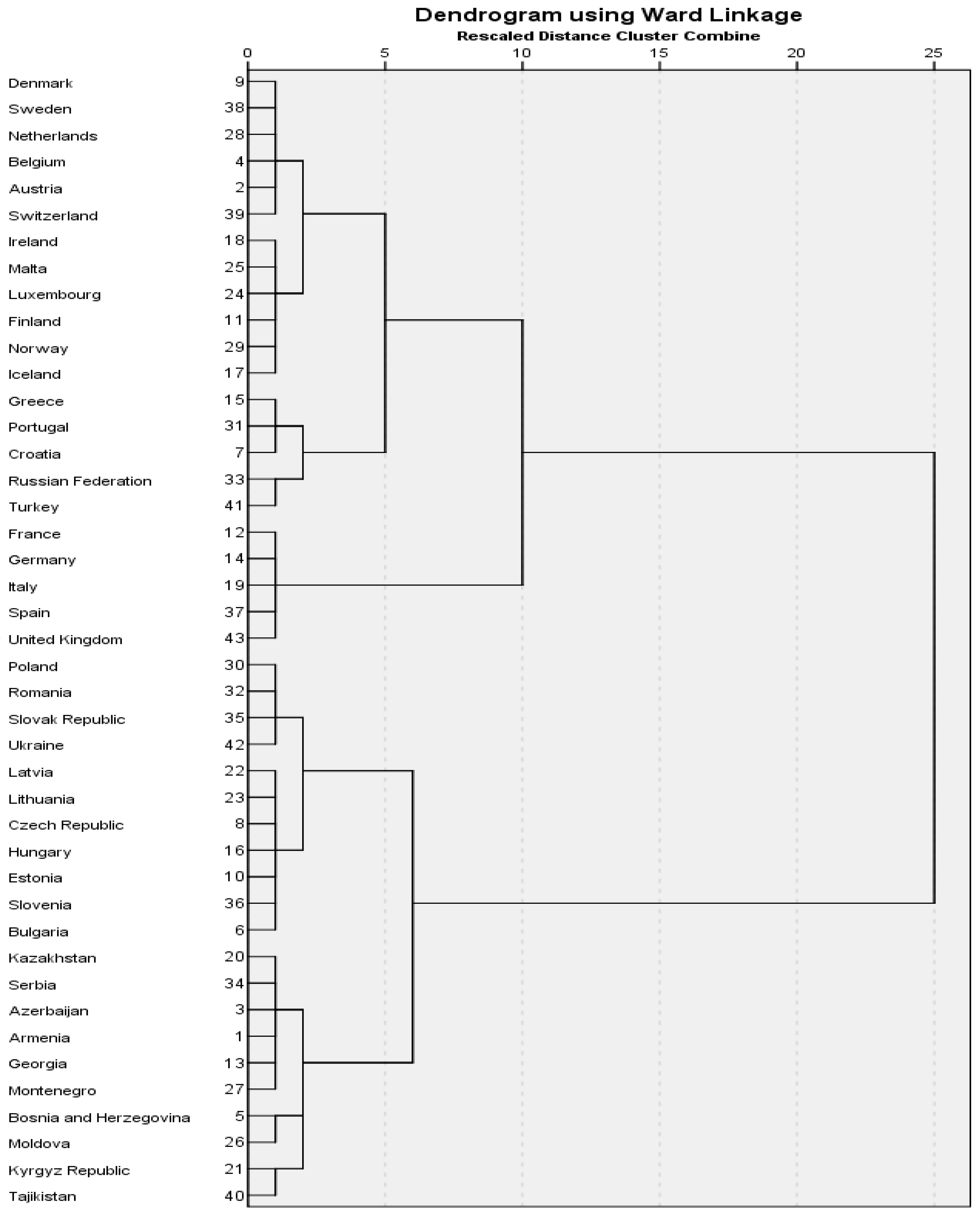
| Cluster Membership | Countries | WEF Travel & Tourism Competitiveness Index, 1–7 (Best) | Countries | Qi Scores | ||
|---|---|---|---|---|---|---|
| Countries | Cluster | Distance | ||||
| France | 3 | 0.8262 | Spain | 5.44 | Spain | 0 |
| Germany | 3 | 1.2898 | France | 5.4 | Germany | 0.0876 |
| Italy | 3 | 1.6371 | Germany | 5.39 | France | 0.0908 |
| Spain | 3 | 1.3653 | United Kingdom | 5.19 | Switzerland | 0.0970 |
| United Kingdom | 3 | 1.8806 | Italy | 5.09 | Italy | 0.1139 |
| Austria | 2 | 1.8194 | Switzerland | 5.02 | United Kingdom | 0.1999 |
| Belgium | 2 | 2.0727 | Austria | 4.95 | Netherlands | 0.2038 |
| Croatia | 2 | 2.8473 | Portugal | 4.89 | Austria | 0.2459 |
| Denmark | 2 | 1.4151 | Netherlands | 4.79 | Portugal | 0.2493 |
| Finland | 2 | 1.6652 | Norway | 4.59 | Luxembourg | 0.2508 |
| Greece | 2 | 2.1416 | Denmark | 4.58 | Norway | 0.2676 |
| Iceland | 2 | 2.0748 | Sweden | 4.56 | Denmark | 0.2968 |
| Ireland | 2 | 1.3178 | Luxembourg | 4.56 | Sweden | 0.3014 |
| Luxembourg | 2 | 1.9718 | Belgium | 4.55 | Ireland | 0.3019 |
| Malta | 2 | 1.8579 | Greece | 4.55 | Belgium | 0.3191 |
| Netherlands | 2 | 2.1064 | Ireland | 4.54 | Greece | 0.3250 |
| Norway | 2 | 1.8232 | Croatia | 4.53 | Croatia | 0.3371 |
| Portugal | 2 | 2.4946 | Finland | 4.52 | Finland | 0.3535 |
| Sweden | 2 | 1.3704 | Iceland | 4.5 | Malta | 0.3818 |
| Switzerland | 2 | 2.2491 | Malta | 4.36 | Czech Republic | 0.3924 |
| Bulgaria | 4 | 1.6895 | Slovenia | 4.35 | Iceland | 0.4086 |
| Czech Republic | 4 | 1.5716 | Czech Republic | 4.33 | Russian Federation | 0.4255 |
| Estonia | 4 | 1.8337 | Russian Federation | 4.32 | Slovenia | 0.4508 |
| Georgia | 4 | 2.1451 | Poland | 4.23 | Poland | 0.4603 |
| Hungary | 4 | 1.0166 | Turkey | 4.22 | Turkey | 0.4894 |
| Latvia | 4 | 1.3119 | Bulgaria | 4.21 | Hungary | 0.4975 |
| Lithuania | 4 | 1.7504 | Estonia | 4.2 | Bulgaria | 0.5083 |
| Montenegro | 4 | 2.4311 | Hungary | 4.19 | Estonia | 0.5104 |
| Poland | 4 | 1.7718 | Latvia | 4.04 | Latvia | 0.5316 |
| Romania | 4 | 1.5564 | Romania | 3.99 | Georgia | 0.5839 |
| Russian Federation | 4 | 3.0730 | Lithuania | 3.98 | Lithuania | 0.6080 |
| Slovak Republic | 4 | 1.7639 | Slovak Republic | 3.97 | Romania | 0.6094 |
| Slovenia | 4 | 1.9643 | Montenegro | 3.89 | Slovak Republic | 0.6183 |
| Turkey | 4 | 3.2189 | Georgia | 3.88 | Montenegro | 0.6321 |
| Armenia | 1 | 1.3907 | Azerbaijan | 3.8 | Azerbaijan | 0.6820 |
| Azerbaijan | 1 | 1.8491 | Ukraine | 3.72 | Ukraine | 0.6876 |
| Bosnia and Herzegovina | 1 | 2.1861 | Armenia | 3.71 | Kazakhstan | 0.6877 |
| Kazakhstan | 1 | 1.1445 | Kazakhstan | 3.67 | Armenia | 0.7041 |
| Kyrgyz Republic | 1 | 1.8152 | Serbia | 3.63 | Serbia | 0.7185 |
| Moldova | 1 | 1.3608 | Moldova | 3.29 | Moldova | 0.8585 |
| Serbia | 1 | 1.1154 | Bosnia and Herzegovina | 3.28 | Tajikistan | 0.9015 |
| Tajikistan | 1 | 2.6304 | Tajikistan | 3.28 | Kyrgyz Republic | 0.9401 |
| Ukraine | 1 | 1.9532 | Kyrgyz Republic | 3.23 | Bosnia and Herzegovina | 1 |
| Correlations | ||||
|---|---|---|---|---|
| WEF | VIKOR | |||
| Spearman’s rho | WEF | Correlation Coefficient | 1.000 | 0.994 ** |
| Sig. (2-tailed) | 0.000 | |||
| N | 43 | 43 | ||
| VIKOR | Correlation Coefficient | 0.994 ** | 1.000 | |
| Sig. (2-tailed) | 0.000 | |||
| N | 43 | 43 | ||
Publisher’s Note: MDPI stays neutral with regard to jurisdictional claims in published maps and institutional affiliations. |
© 2022 by the authors. Licensee MDPI, Basel, Switzerland. This article is an open access article distributed under the terms and conditions of the Creative Commons Attribution (CC BY) license (https://creativecommons.org/licenses/by/4.0/).
Share and Cite
Ozkaya, G.; Demirhan, A. Multi-Criteria Analysis of Sustainable Travel and Tourism Competitiveness in Europe and Eurasia. Sustainability 2022, 14, 15396. https://doi.org/10.3390/su142215396
Ozkaya G, Demirhan A. Multi-Criteria Analysis of Sustainable Travel and Tourism Competitiveness in Europe and Eurasia. Sustainability. 2022; 14(22):15396. https://doi.org/10.3390/su142215396
Chicago/Turabian StyleOzkaya, Gokhan, and Ayse Demirhan. 2022. "Multi-Criteria Analysis of Sustainable Travel and Tourism Competitiveness in Europe and Eurasia" Sustainability 14, no. 22: 15396. https://doi.org/10.3390/su142215396
APA StyleOzkaya, G., & Demirhan, A. (2022). Multi-Criteria Analysis of Sustainable Travel and Tourism Competitiveness in Europe and Eurasia. Sustainability, 14(22), 15396. https://doi.org/10.3390/su142215396