You are currently viewing a new version of our website. To view the old version click .
Sustainability
  • Systematic Review
  • Open Access

4 October 2022

Internet of Medical Things in the COVID-19 Era: A Systematic Literature Review

and
1
Department of Computer Engineering, Science and Research Branch, Islamic Azad University, Tehran 1955847781, Iran
2
Future Technology Research Center, National Yunlin University of Science and Technology, 123 University Road, Section 3, Douliou, Yunlin 64002, Taiwan
*
Author to whom correspondence should be addressed.
This article belongs to the Special Issue Sustainability/Privacy-Preserving of IoT-Based Application in Smart Healthcare

Abstract

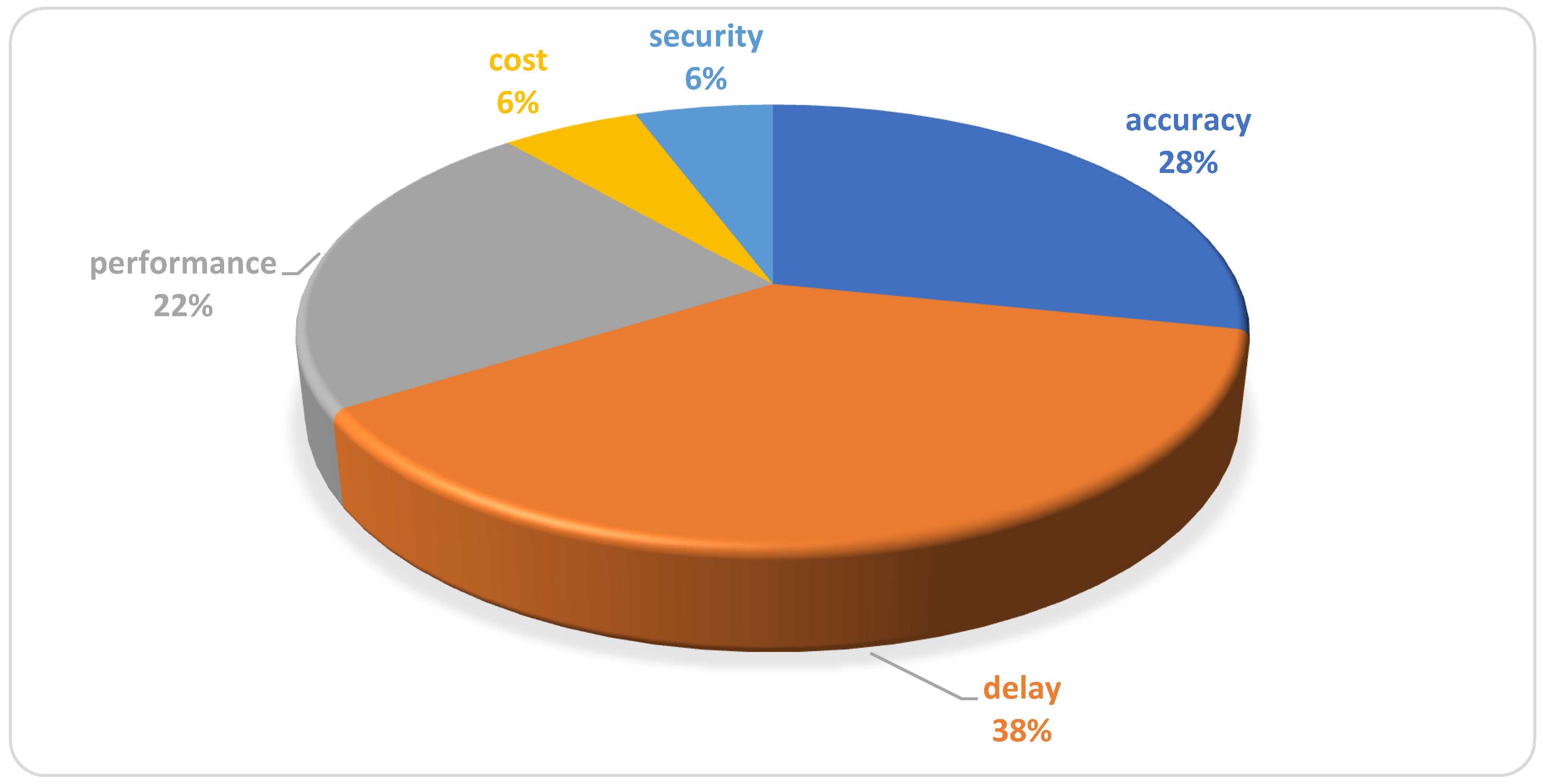
In recent years, the medical industry has rapidly modernized, incorporating technology to aid in accelerating and simplifying procedures for better accuracy. This technology is becoming more interconnected to create a larger network known as the Internet of Medical Things (IoMT) that can combat the pandemic’s spread. In other words, IoMT emphasizes health applications while maintaining the core concept of the Internet of Things (IoT). The further spread of Coronavirus Disease-2019 (COVID-19) can be halted by employing it. Consequently, this paper uses the Systematic Literature Review (SLR) methodology to evaluate recently published articles in the IoMT domain during the COVID-19 era. Between 2019 and 2022, we analyzed 41 studies. An analysis of the evaluation criteria reveals that the delay factor comprises 38% of the evaluation criteria, the highest percentage because a low-delay IoMT device has a quick response time between the time a request is made and the time a response is received. Moreover, the performance factor accounts for 22%, the accuracy factor accounts for 28%, the security factor for 6%, and the cost factor for 6%. Finally, we concentrate on open issues and future research challenges in IoMT during the COVID-19 era.

1. Introduction

Our living environments are increasingly becoming covered with sensors embedded in common objects. As a result of IoT technology, they are smoothly integrated into the internet network and can run autonomously without any manual effort required [1]. Currently, the IoT plays a significant role in a wide range of industries. The IoT has had a considerable impact on the healthcare industry. For example, the IoT has revolutionized people’s lives by tracking their health in real-time. IoT devices are more valuable because they are less expensive and can diagnose diseases faster.
Digital tools and technology, specifically IoT, have played an important role in combating COVID-19. The COVID-19 pandemic has had a significant impact on the IoT ecosystem. As a result of the COVID-19 pandemic, IoT-inspired frameworks and solutions got a much-needed reality check. The authorities used IoT technologies such as remote monitoring to control and contain COVID-19 [2]. All governments are combating the virus while seeking a cost-effective solution. They were using technology to teach people how the virus spreads and preventative measures can be more effective in educating people. IoT can assist in preventing the spread of this pandemic despite other technologies such as artificial intelligence, machine learning, cloud computing, and robots [3].
IoT and similar technologies may be beneficial in decreasing COVID-19 pandemics. A brief review of several potential sources of several technological approaches used to cope with the COVID-19 pandemic’s effects [4]. COVID-19 might be controlled with the use of an IoT-based architecture. In addition, a list of IoT sensors and their application domains existed. In a second demonstration, the article mentioned a possible IoT architecture for preventing the spread of COVID-19 [5].
COVID-19’s impact on the global economy has been emphasized. Thus, the conversation has shifted to using new technologies such as IoT, drones, AI, blockchain, and 5G to reduce the impact of the COVID-19 pandemic. Until a treatment for this disease is found, these technologies will be mainly responsible for managing and limiting its damage [6].
According to review studies in the field of IoMT in the era of COVID-19, the main contributions of our paper are:
  • To mention and discuss upcoming research ideas and unresolved concerns based on the SLR method.
  • Furthermore, we design a taxonomy for categorizing various aspects of IoMT in the era of COVID-19.
  • Then, we present research questions (RQs) about the IoMT in the era of COVID-19 and answer them.
The following sections comprise this paper: Section 2 offers outlines of related work and a review of the concept. Section 3 describes the study’s objective and provides more information on selecting relevant work and categorizing the content. In Section 4, several analytical comparisons of previous research studies are presented. Section 5 discusses the present state of challenges and promising future research directions. Section 6 is the conclusion.

3. Research Selection Method

This section provides an overview of the IoT in the era of the COVID-19 classification method based on the SLR process, including research questions, database selection, and search terms.
The following exploration string was developed after considering the alternatives and other synonyms of the major essential components:
(“Internet of Things” OR “IoT”) AND (“COVID-19”) AND (“survey” OR “review” OR “overview” OR “challenges”)
Due to the importance of the selected topic and other factors, such as the lack of a comprehensive article on the topic of “IoT in the era of COVID-19,” the following Research Questions (RQ) will be addressed as part of this SLR study.
RQ1:
What are the roles of IoMT in the control and prevention of COVID-19?
RQ2:
What are the evaluation criteria in the domains of IoMT in COVID-19?
RQ3:
What are the effects of IoMT on COVID-19 concerns?
RQ4:
What are the important applications of IoMT for the COVID-19 pandemic?
RQ5:
What are the future research challenges and open issues of IoMT in COVID-19?
In addition, the inclusion criteria mentioned below are considered when selecting the final studies:
  • Research articles.
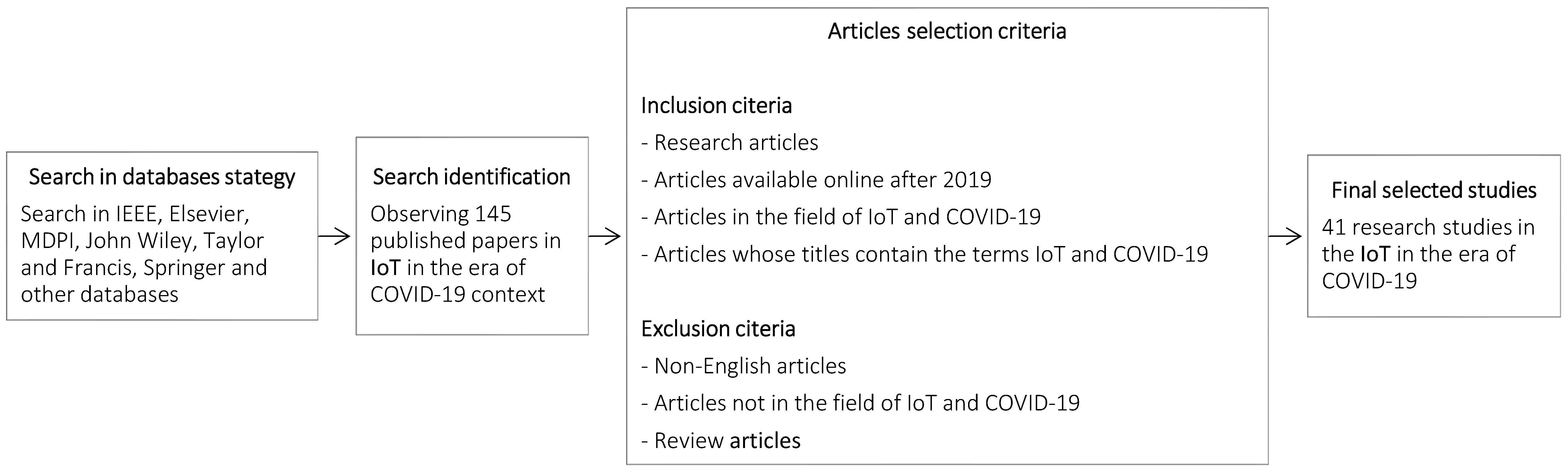
  • Articles available online after 2019.
  • Articles in the field of IoT and COVID-19.
  • Articles whose titles contain the terms IoT and COVID-19.
Moreover, the exclusion criteria mentioned below are considered when selecting the final studies:
  • Non-English articles.
  • Articles not in the field of IoT and COVID-19.
  • Review articles.
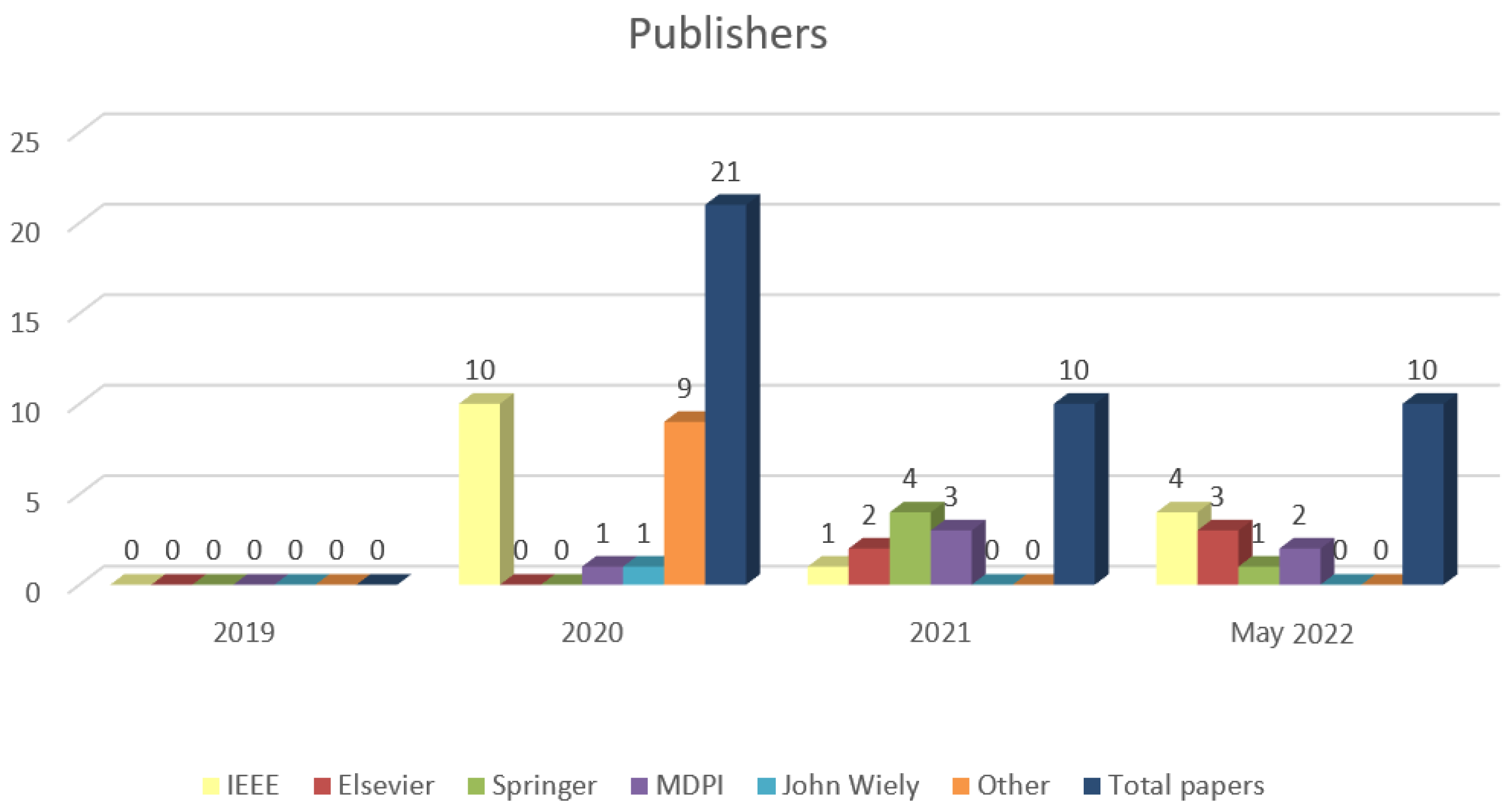
Finally, 41 studies were chosen for evaluation and analysis. Figure 3 shows the number of papers published from 2019 until May 2022 published by top scientific publishers, including Elsevier, IEEE, Springer, John Wiley, Taylor and Francis, MDPI, and others on journal citations.
Figure 3. Distribution of research papers by publisher.
Based on a systematic review, our work aims to give an overview of current efforts and achievements in the field of IoT in the era of COVID-19 and propose open topics for future research in this field. The research strategy’s five stages are shown in Figure 4.
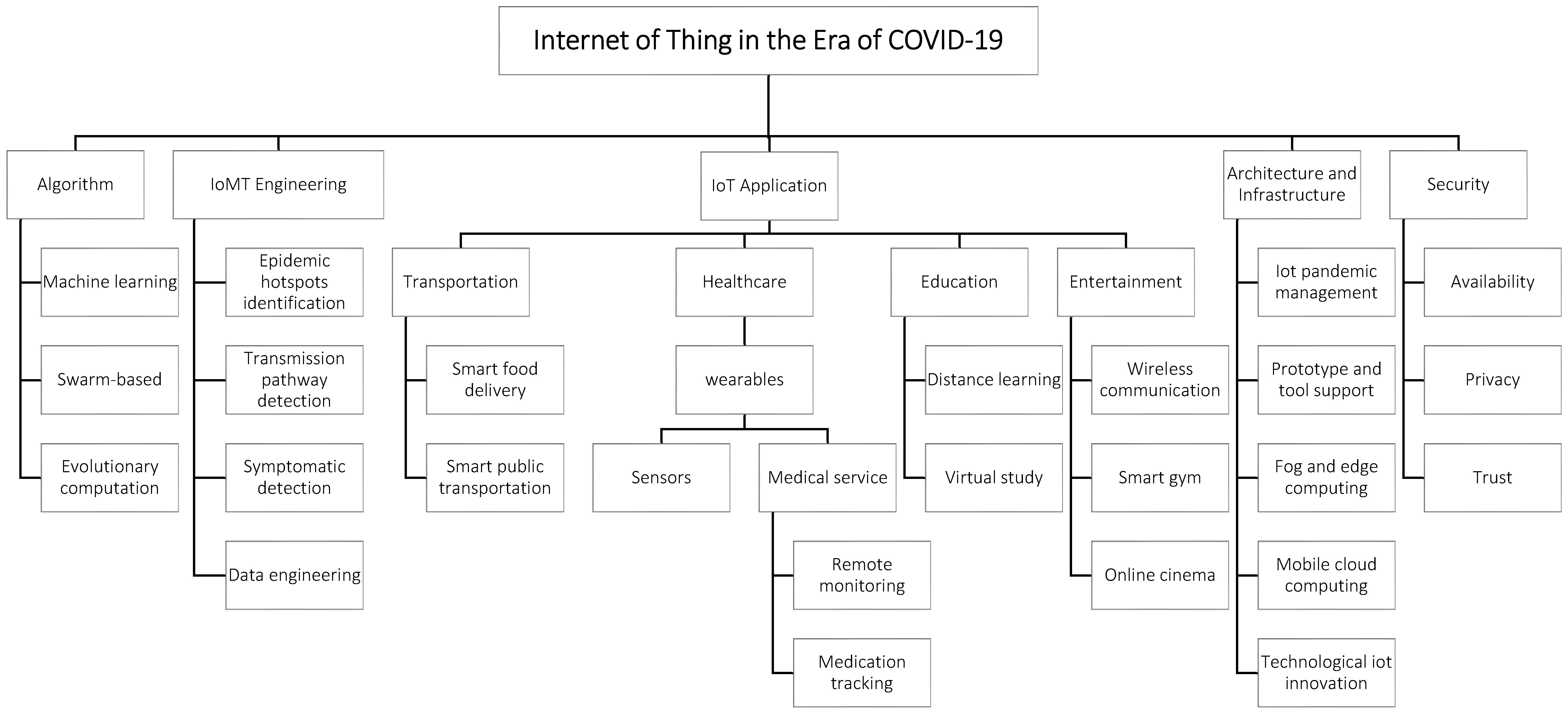
A comprehensive taxonomy of the IoT in COVID-19, covering security, IoT systems engineering, algorithms, architecture and infrastructure, and IoT applications, is shown in Figure 5. In the next step, we break each aspect down into its sub-aspects.
Figure 5. The taxonomy of IoT in the era of COVID-19.
Figure 4. Research study selection criteria and assessment chart.

4. Organization of IoMT in the Era of COVID-19

As part of the SLR process, this section provides a technical overview of the selected IoMT in the COVID-19 era for current research.
The taxonomy for IoT in the COVID-19 era categorizes existing works in the specified field based on the study chosen. Each item is classified by IoMT engineering, algorithm, architecture and infrastructure, IoMT application, and security. We review each study in terms of its major background and the advantages and disadvantages of each study’s findings.

4.1. Algorithm

Most studies provide a new COVID-19 diagnostic model based on the IoMT employing algorithms, particularly machine learning-based methods. For instance, machine learning-based methods may accurately identify COVID-19 from computed tomography images by examining radiological characteristics.
Table 2 illustrates the classification of the listed articles of the algorithm category of IoMT in the COVID-19 era. The following determines the most important contexts in the algorithm category:
  • Machine learning.
  • Swarm-based.
  • Evolutionary computation.
In addition, the evaluation criteria for this categorization are shown in Table 3. Mobility, performance, accuracy, time, and signal value are the evaluation criteria for the algorithm category.
Table 3. Evaluation criteria in the algorithm category.
Table 2. Reviewed studies in the algorithm classification.
ResearchMain ScopeBenefitDrawbackSimulation/Implementation
Yacchirema et al. [25]An IoT-based system for safer mobility in the COVID-19 areaMore accurateNo detail mentionedImplementation
Abdulkareem et al. [26]An IoT-based system to diagnose COVID-19 using machine learning algorithms-Better performance
-Reduce the workload
-Reduce the mortality rate
Simulation
Shalabi et al. [27]COVID-19 symptoms monitoring mechanismBetter performanceNot enough detailImplementation
/Simulation using C++
Ukhalkar et al. [28]An IoT-enabled and machine learning-based model for early predicting the COVID-19 test--No simulation, no Implementation
-Not mention the impacts clearly
No Implementation/No simulation
Mukhtar et al. [29]An IoT framework to screen coronavirus -No simulation, no Implementation
-Not experiment with the idea
No Implementation/No simulation
Yang et al. [30] Prevention and Control of COVID-19EffectivenessSystems hardware complexityNo Implementation/No simulation
Yacchirema et al. [25] proposed an IoT-based system for safer mobility in the era of COVID-19. An IoT, fog, and cloud solution-integrated layered architecture was used to monitor and regulate the social distance between individuals in real-time and the capacity of shared interior spaces. It has been done by employing machine learning algorithms to recognize people’s whereabouts. Data collected from a portable IoT device has been used to train and assess these models. The disadvantage of the paper is that it did not mention details, and the advantage is that it improved the accuracy.
Abdulkareem et al. [26] presented an IoT model that used machine learning algorithms to diagnose COVID-19 patients in smart hospitals. Their machine learning model was developed and assessed using laboratory datasets. There were three primary methodological scenarios for COVID-19 diagnosis, including original and normalized datasets and feature selection. The advantages of the proposed model are better performance, reduced workload, and reduced mortality rate.
Shalabi et al. [27] presented the COVID-19 Symptoms Monitoring Mechanism (CSMM), based on IoT technology and wireless sensor networks, and intended to monitor patients, particularly the elderly, who suffer from chronic immune disorder deficiencies during their quarantine. Due to this, it is more likely to diagnose major diseases. The method was based on remote patient data monitoring and was successful. Better performance is the advantage of the presented design.
Ukhalkar et al. [28] suggested a prospective model for predicting the COVID-19 test early using symptoms. With the Smart Voice Recorder and the Bluetooth Thermometer in this model, input sounds of coughing were captured. It is possible to estimate COVID-19 susceptibility based on symptoms using classifiers such as random forest trees and decision tree classifiers. This suggested model will minimize human intervention and the usage of testing equipment for most affected populations. The main drawbacks of the paper are that no simulation or implementation approaches were used in the study, and it does not mention the impacts of the model.
Mukhtar et al. [29] suggested a framework for remote virus screening using standards-based practices. Sensors are integrated into a wearable gadget that anyone may wear to determine whether they are healthy or not in a few seconds. The framework called for testing on a large population. The data gained via testing may be utilized for advanced analytics such as epidemic prediction and prevention, population segmenting, and assisting the government and decision-makers in taking necessary steps. The disadvantage of the paper is that no simulation or implementation was used.
Yang et al. [30] emphasized the IoT’s potential for internal COVID-19 infection prevention and control. The suggested scheduling system could prevent people from congregating in certain regions. A navigation system with a density control approach and global route planning capabilities is implemented using K-Nearest Neighbor and introduces a tool for creating an internal positioning system. They constructed an iBeacon network and employed a fingerprint-based approach for real-time location. The results of the experiments suggest that the positioning system is feasible. In addition, a risk assessment model for an enclosed space has been developed. It may be incorporated into a government-sponsored macro data prevention and control system, which aids in developing a complete and systematic COVID-19 prevention and control mechanism.

4.2. IoMT Engineering

COVID-19 for the economy and people has been an inconvenience. While some sectors have been affected due to COVID-19, some special fields, such as IoMT engineering, witnessed a leap. Over the next few years, the vast IoT systems will be connected. This increase in the number of IoT systems used will also significantly increase IoT businesses. A job in IoT could have good wages because of the increase in demand, but the volunteers will need combinatorial skills to ensure an IoT hopeful career.
Table 4 illustrates the classification of the listed articles in IoMT engineering. The following determines the most important contexts in the IoMT engineering category:
  • Epidemic hotspots identification.
  • Transmission pathway detection.
  • Symptomatic detection.
  • Data engineering.
The evaluation criteria of this classification are shown in Table 5.
Table 5. Evaluation criteria in the IoT systems engineering category.
Table 4. Reviewed studies in the IoT systems engineering classification.
ResearchMain ScopeBenefitDrawbackSimulation/Implementation
Akinola et al. [31]Superstrate antenna for satellite cynosure-Better performance
-Provide a long-time sustainable solution
-Simulation
Ashraf et al. [32]Use of IoT-Edge technologies to identify and monitor contagion--Not any simulation or implementation
-Not mentioned the apparent impact of the proposed framework
No Implementation/No simulation
Priambodo et al. [33]Monitoring self-isolation patients of COVID-19 with the IoT technologyBetter visibility on monitoring-Not enough detail mentioned about the workImplementation
Misra et al. [34] Safety-aware IoT navigation tool to find safe routes for travelingReduce the distance-Not focus on real-time traffic and speed control.Implementation
Rana et al. [35]Secure IoT communication systems for the transport and storage of COVID-19 dataReduce the time-Implementation
Le et al. [36]IoT-enabled depthwise separable convolution neural network for diagnosing COVID-19Better performance-Implementation
Cacovean et al. [37]An IoT system for diagnosing COVID-19 patients--Not presenting any detailed analysis
-Not mentioned the apparent impact of the proposed framework
Implementation
Akhund et al. [38]IoT-based low-cost robotic agent for a patient with a physical disability affected by the COVID-19 virusEffectiveness-Not presenting any statistical analysisImplementation
Bashir et al. [39]IoT-Based COVID-19 system for COVID-19 applicationsEffectivenessRestricting the scope of the check to only the given areaSimulation
Jung et al. [40]An IoT-based platform for monitoring and tracking COVID-19-related person-Reduce latency
-Scalability
-Simulation/Implementation
Bhardwaj et al. [41] Health Monitoring System Effectiveness -High delay
-Less secure data
Implementation
Saranya et al. [42] Health Monitoring System-High performance in monitoring patients
-Better accuracy
-Better scalability
-Implementation
Akinola et al. [31] suggested a superstrate for a rectangular micro-strip antenna. A 3D electromagnetic computer simulation package was used to model the proposed antenna, simulate it using a frequency-domain solver, and verify it using a time-domain solver. The advantages of the suggested antenna are better performance and the ability to provide a long-term sustainable solution for combating the COVID-19 epidemic.
Ashraf et al. [32] proposed a wearable smart gadget surveillance system for remote monitoring, prior warning, temperature, heartbeat rate, and cardiac conditions to detect sick or suspicious individuals. The proposed architecture provided a continuously updated pattern of the communication chain of COVID-19-infected people that could spread throughout their national community. The paper’s important drawbacks are that no simulation or implementation approaches were used in the study, not to mention the apparent impact of the proposed framework.
Priambodo et al. [33] created a healthcare system based on IoT and wireless body sensor networks and a gateway that can be utilized for data collection and transmission. An open-source Elastic search Logstash Kibana (ELK) stack is used for logging and indexing massive incoming data streams so that medical staff may study and display measurement results of patients and their location on a dashboard. They may monitor the patient’s status and take preventive measures if necessary. The proposed system’s advantage is better monitoring visibility, but the disadvantage is that there is not enough detail about the system.
Misra et al. [34] described developing a safe navigation system based on Q-learning that minimizes travel over categorized hotspots in a road network. Input from commuters was used to determine a safe route for travel and punished zones to create a reward function for the reinforcement learning model and showed that the system was convergent in all situations. An IoT-based architecture integrating cloud and fog computing was also proposed. The main advantage of the paper is reducing the distance. It does not focus on real-time traffic and speed control.
Rana et al. [35] developed secure communication networks to transport and store pandemic data. For instance, the COVID-19 framework was built and verified by considering COVID-19 states. A new IoT-based secure communication system was suggested for providing a central control center with information on local observations. A signal processing method was implemented that is best for the task at hand to forecast the COVID-19 model. Reducing the time is the proposed model’s benefit.
Le et al. [36] proposed an IoT-enabled depth-wise separable convolution neural network (DWS-CNN) for COVID-19 diagnosis and classification. The suggested method used a deep support vector machine. The IoT devices collected patient data and sent them to a cloud server during the data gathering step. In addition, the method was used to eliminate noise from the picture. The proposed method was then used to replace the default convolution for automated feature extraction, replacing the default convolution. Finally, the binary and multiple class labels of COVID-19 were determined using the proposed method. Better performance was the advantage of the proposed method.
Cacovean et al. [37] proposed that a centralized IoT system for diagnosing COVID-19 patients and managing their medical data would be beneficial if adopted by governments. This experiment was conducted on a sample of 300 individuals. Wearables gadgets are assigned to them, and they must wear them for a week during the day. The data are received every 60 min in real-time. These wearables were outfitted with temperature, heart rate, and GPS sensors to identify users inside or outside of a viral outbreak. The main disadvantages of this study are that it does not present any detailed analysis, nor does it mention the apparent impact of the proposed framework.
Akhund et al. [38] illustrated a virus-affected person with a physical disability using a wireless gesture control robot. As a result, the system will benefit the disabled and those infected with a virus. This robot can help wherever other people are terrified of being near people infected by a virus. The device can be used with a wheelchair to allow them to go from one location to another. Not presenting any statistical analysis is the drawback, but robots’ effectiveness is the advantage of the paper’s idea.
Bashir et al. [39] developed a low-cost IoT-enabled system based on the standard operating procedure (SOP) in COVID-19 applications. It counts the number of individuals entering and leaving an area, maintains physical distance, measures body temperature, and notifies attendees and managers of security breaches. It consisted of numerous sensor nodes communicating with a central server through a network cable. To ensure compliance, real-time monitoring and planning were all possible for the information saved on the server. No personal information was stored in the system, nor was there a way to determine who attended the meeting. The lack of a developed system restricts the scope of real-time monitoring to only the given area.
Jung et al. [40] proposed a public platform based on Software-Defined Networking Controllers to monitor and record information for COVID-19-related individuals and provide real-time information disclosure services to global centers for disease control. The platform was designed to ensure secrecy and authentication services by offering users a unique secret key. To mention the benefits of the proposed platform, we can point to reducing latency and providing scalability.
Using IoT technology, Bhardwaj et al. [41] created a complex medical monitoring system that monitors a patient’s blood pressure, heartbeat, oxygen level, and temperature. This method is advantageous in rural areas or cities and towns where neighborhood medical centers can communicate with urban hospitals regarding their patients’ health. The IoT system will notify the doctor or physician if patient health changes occur outside standard levels. This IoT-based health monitoring device makes collecting real-time data simple for doctors. The system can control the settings regularly since high-speed Internet access is available. Furthermore, the cloud platform enables data storage and recall of past measurements. Individuals can be identified and treated early with this technique.
Saranya et al. [42] designed and produced an IoT monitoring system that does not require the use of the cloud. The system comprises unobtrusive sensors, a data collection device, a microcontroller, a Wi-Fi module, a web server, and a web or mobile application. This design shows a system for monitoring and identifying the severity of coronavirus in patients by employing a variety of unobtrusive sensors to assess disease-specific vital factors such as heart rate, temperature, oxygen level, and pulse rate, which are the key symptoms of coronavirus. A microcontroller and a Wi-Fi module translate patient data from the sensor to the cloud server in real-time via the HTTP protocol. According to an experimental investigation, the suggested structures successfully monitor the severity of respiration in patients. Finally, the correctness and scalability of the architectural performance are verified.

4.3. Architecture and Infrastructure

Medical devices and software are connected to a health technology infrastructure through the IoMT, which uses communications systems. The IoMT includes portable smart displays, smart wearables, and other sophisticated tools for tracking your health state. Based on the complexity of healthcare systems, managing hundreds of medical devices diversely linked to the Internet is essential to upholding the highest level of constancy. Researchers are creating smart healthcare architectures and frameworks for deploying, coordinating, and developing intelligent IoMT services.
Table 6 shows the listed articles of IoT’s architecture and infrastructure category in the COVID-19 era. The primary contexts in the architecture and infrastructure category are based on the following:
  • IoT pandemic management.
  • Prototype and tool support.
  • Fog and edge computing.
  • Mobile cloud computing.
  • Technological IoT innovation.
Moreover, Table 7 displays the evaluation criteria of this classification.
Table 7. Evaluation criteria in the architecture and infrastructure category.
Table 6. Reviewed studies in the architecture and infrastructure classification.
ResearchMain ScopeBenefitDrawbackSimulation/Implementation
Kolhar et al. [43]A platform for face detection during COVID-19 city lockdownGood performance-Simulation
Roy et al. [44]A framework for contact and infection tracking for COVID-19Effective utilization of the scarce resourcesNot supported on a large scaleSimulation using Python.
Poongodi et al. [45]An IoT-based architecture for detecting the COVID-19 infectionEffectivenessNot enough detailSimulation using Python.
Rajasekar et al. [46]An IoT-based tracking model for identifying prospective contacts for COVID-19-High effectiveness
-Low cost
-No Implementation/No simulation
Kumar et al. [47]Blockchain–IoT-enabled pharmaceutical supply chain for COVID-19-Improve the visibility
-Improve transparency
-Improve privacy
-Reduce the chances of infections
No simulation, no Implementation No Implementation/No simulation
Pandey et al. [48]Ensuring elderly well-being during COVID-19 using the IoT--No Implementation/No simulation
Kallel et al. [49]An architecture based on IoT-fog-cloud for smart systemsEffectiveness Implementation
Ramallo-González et al. [50]An IoT platform for health data gathering and the fight against the COVID-19 pandemic -No detail mentionedNo Implementation/No simulation
Lavric et al. [51]IoT concepts in the Context of the COVID-19
Pandemic
-Improve monitoring capabilities
-Better scalability
-Implementation
Mohammedqasim et al. [52]COVID-19 detection with IoT sensorHigh accuracy-Implementation
Roy et al. [53]IoMT for early prediction of COVID-19EffectivenessThe results of the proposed model need to be guaranteedSimulation
Leila et al. [54]Patient Health Monitoring System-Lower cost
-Lower energy
-No Implementation/No simulation
Kolhar et al. [43] proposed an IoT-based biometric face detection platform for cities under lockdown during COVID-19 outbreaks in a decentralized manner. Their platform utilizes a three-layered edge computing architecture to limit the public’s movement. They used a multi-task cascading deep learning framework to detect faces. On benchmarking datasets, including FDDB and WIDER FACE, they compared the face detection approach to the current state-of-the-art algorithms. Good performance is the benefit of their proposed platform.
Roy et al. [44] developed a novel IoT-based contact and infection tracking framework, notably integrating symptom-based detection. The capacity of this system to combine real-time symptom information with verified COVID-19 cases offered a rapid and efficient means of tracking the illness’s spread, ultimately benefiting the effective utilization of precious resources. The large-scale system’s lack of support is the drawback of their provided framework.
Poongodi et al. [45] provided a powerful health-based IoT system that may enhance COVID-19 management and produce higher outcomes with given resources. The simulation results indicate that the suggested method for infection detection was effective and reliable. Not mentioning enough details is the main disadvantage of the paper, but effectiveness is its advantage.
Rajasekar et al. [46] developed an IoT-based automated tracking approach to identify prospective contacts using RFID tags and mobile phones that function as readers. This would track down those who have crossed the border without knowing those accused of doing so. A 100-percent quarantine of all conceivable primary and secondary contacts would be achievable, with administrative authorities monitoring them. We can point to the approach’s high effectiveness and low cost, not to mention its benefits.
Kumar et al. [47] presented the Blockchain-IoT that enabled the pharmaceutical supply chain. Stakeholders’ confidence will be maintained with the aid of the created framework. It would increase medical necessity and data visibility, openness, and privacy, and reduce the risk of infection by implementing technology to limit the direct participation of employees. COVID-19 may be effectively controlled and managed with the help of this framework.
Pandey et al. [48] assembled a model for elder care in the event of a disaster. The model allows for delivering essential things to the elderly on-demand and guarantees that the client receives the right assistance when needed. In this way, the elderly person’s privacy was protected.
Kallel et al. [49] proposed a modification to IoT-aware business process modeling. The suggested model considered heterogeneous IoT and non-IoT resources, resource capabilities, and quality of service limitations. Their model uses a new IoT-fog-cloud architecture that supports distributed interlayer communication, real-time stream processing, and multi-application execution within a multitenancy architecture. The proposed model uses single sign-on techniques to ensure data integrity within a multitenancy architecture. Effectiveness is the main advantage of the presented model.
Ramallo-González et al. [50] presented an IoT-based integrated solution, CIoTVID, which can act as an opportunistic agent for health data gathering in the fight against the COVID-19 pandemic. The platform consisted of four layers: data collection, data aggregation, machine intelligence, and services. The data aggregation layer was essential in this solution since the data coming from medical devices have an entirely different character than electronic sensors. Individuals, politicians, and clinics might benefit from the platform’s ability to adapt to diverse data and large data volumes. The disadvantage of this study is that it does not go into detail.
Lavric et al. [51] designed, developed, and implemented an integrated COVID-19 patient management system based on the LoRaWAN communication infrastructure. Their system has several advantages over similar solutions, including remotely monitoring symptoms and health of isolated or quarantined individuals without requiring any external interaction with the patient. Two isolated people were observed for the duration of the normal quarantine period to test the proposed system’s performance. They highlighted the suggested solution’s excellent scalability, which can monitor a large number of patients at the same time owing to the LoRaWAN communication protocol. Governments can effectively deploy this method to improve monitoring capabilities while saving lives.
Mohammedqasim et al. [52] developed an in-depth learning optimization system that can deal with imbalanced datasets to enhance patient categorization. The balancing problem is solved using an artificial minority sampling approach, and the most effective features are determined using a recursive feature reduction procedure. The data are separated into training and experimental sets to verify all models once it has been balanced and features extracted. The experimental prediction results demonstrate that the models are stable and compatible with the data, resulting in maximum accuracy. Finally, proposed approaches for dealing with data bias and obtaining high classification accuracy for COVID-19 patients are discussed. The outcomes of this study might help healthcare organizations prioritize assets more effectively.
Roy et al. [53] presented the idea of transfer models for predicting COVID-19 in patients’ chest X-ray pictures early. The dataset for this study came from the Kaggle repository, divided into two classes: COVID-19 Positive and COVID-19 Negative. The suggested model had the best accuracy and the fewest false positive predictions in the experimental sample. This can aid in the early detection of COVID-19 by doctors and technicians. A patient’s health may be tracked remotely via Internet-connected gadgets, often known as the IoMT.
Leila et al. [54] developed an intelligent approach for tracking COVID-19 patients’ health. It is an IoT architecture for monitoring the health of hospitalized patients whose conditions necessitate widespread surveillance. The device combines a portable IoT node with a remote monitoring application that collects clinical data such as temperature and oxygen saturation, among other things, depending on the scenario. The IoT system component creates a local subsystem for the patient, and the robot connects to the Internet to transfer data to a cloud server. The information is delivered to a secure location for long-term storage, which is utilized for real-time monitoring and statistics that the hospital will require in the future.

4.4. IoMT Application

IoMT has been implemented in several areas with other techniques to prevent the spread of COVID-19 and boost effectiveness by lowering the disease’s number of deaths. Research demonstrates that by integrating security measures with this technology, safe IoMT applications may be used. Additionally, the development of new IoMT technologies combined with blockchain, big data, and artificial intelligence offers more useable options.
Table 8 illustrates the classification of the listed articles in the IoMT application category in the COVID-19 era. The main scopes in the IoMT application category are based on the following:
  • Transportation.
  • Healthcare.
  • Education.
  • Entertainment.
Table 8. Reviewed studies in the IoT application classification.
ResearchMain ScopeBenefitDrawbackSimulation/Implementation
Ahanger et al. [55]An IoT–fog–cloud-based system for predicting COVID19 outbreaks -Accuracy in classification
-Better performance
-More reliability
Did not investigate the development of a system that produces energySimulation
Stolojescu-Crisan et al. [56]An IoT-based intelligent application for avoiding contact with various objects Management of various appliances and sensors is possible with this application.-Did not take into account keeping track of the air humidity
-Did not take advantage of the thermal cameras to detect fever
Implementation by Raspberry Pi
Mohammed et al. [57]An IoT diagnosis system for detecting COVID-19 EffectivenessLong delaySimulation using Proteus Circuit
Bharathi et al. [58]Smart system for COVID-19 using IoTBetter performanceAdditional smart ideas are required for the proposed modelSimulation
Paganelli et al. [59] Remote monitoring of COVID-19-Increasing flexibility
-Security
-No Implementation or simulation
-Did not consider energy consumption
No Implementation/No simulation
Saha et al. [60] Oxygen Saturation Monitoring High accuracyLess adaptabilityImplementation
Yelure et al. [61] Remote monitoring of Covid-19 EffectivenessAdditional sensors and functionalities can be added to the suggested model.Implementation
Moreover, Table 9 displays the evaluation criteria of this classification.
Table 9. Evaluation criteria in the IoT Application category.
Ahanger et al. [55] provided an effective method of early detection and prediction of COVID-19. The suggested structure consists of COVID-19 data gathering, classification, mining and extraction, and COVID-19 prediction and decision modeling. The degree of membership was calculated using a temporal recurrent neural network to estimate the geographic region accurately. In addition, an approach was developed to aid in the perception of the suggested model’s feasibility. Their proposed method’s advantages are classification accuracy, better performance, and more reliability.
Stolojescu-Crisan et al. [56] presented an IoT-based method for avoiding contact with various objects and surfaces. They suggest a framework for efficiently connecting smart devices, providing intelligence that assists in automating many daily operations in offices. A smartphone application enables users to control various appliances and sensors.
Mohammed et al. [57] proposed a method to automatically identify the coronavirus from a thermal picture with little human intervention by utilizing a thermal imaging device mounted on a smart helmet. The thermal camera technology was integrated into the smart helmet and combined with IoT technology to provide real-time monitoring of the screening process. The proposed device can also display the pedestrian’s personal information and automatically take their temperature. Effectiveness is the benefit of the proposed method.
Bharathi et al. [58] suggested a concept for future IoT-based pharmaceutical services frameworks connected to general frameworks that screen particular diseases. Several wearables and non-intrusive sensors were exhibited and discussed, focusing on those monitoring basic indications, circulatory strain, and blood oxygen levels. The appropriateness of exchange standards for human services applications was then evaluated. We can point to better performance, not to mention the advantage of the provided framework.
Paganelli et al. [59] presented an IoT-based approach for remote monitoring of COVID-19 admitted patients at home that fulfills the major needs of identification, interoperability, network dynamics, context, reliability, and privacy. As remote monitoring of patients at home, especially during an epidemic, might pose challenges for safe and ethical data collection, our design includes a content management module to ensure transparency and ensure the data’s security. In addition, the research developed techniques to support an adjustable scoring system and adaptation in wearable devices to improve healthcare usefulness and expert adoption.
Saha et al. [60] demonstrated a methodology for monitoring oxygen levels and determining the severity and likelihood of a COVID-19 patient. The framework may also safeguard patient privacy and classify severity. This approach is unique in combining oxygen saturation with the IoT architecture to detect COVID-19, which has never been done before. The oximeter results are combined to produce a specific warning, and a possible categorization is carried out. The chin block delay and overall reaction, as well as throughput, detection, and intensity, are all factors in determining the outcome. This research, in the framework of the IoT, reveals a practical and substantial answer to the world’s present health threat.
Yelure et al. [61] designed a prototype using wearable IoT sensors and a trained deep learning algorithm for monitoring COVID-19 patients. Using different assessment criteria, we conducted a comparison study of CNN and DNN for cough detection. Our findings were also compared to prior research. It may be inferred that a band based on IoT and AI can always follow self-isolated or quarantined COVID-19 patients. The band system was created to track the oxygen level, temperature, pulse rate, and coughing of patients with COVID-19. The band system may collect data from various sensors and send them to physicians or healthcare professionals through Wi-Fi to keep track of the patient’s status. Patients may transmit health updates to doctors without visiting them using this technology. This will prevent COVID-19 patients from coming into contact with the outside world, lowering the chance of the virus spreading and easing the strain on the healthcare system.

4.5. Security

Medical consumers’ insufficient security knowledge exacerbates existing issues and may encourage attacks that endanger patients’ lives. As a result, guaranteeing the IoMT’s security and privacy has become an important problem that needs additional research and solution. It cannot be managed, monitored, or controlled if security cannot be evaluated. Security has also seen significant improvements due to the fast and global adoption of IoMT, which has led to significant applications and technological advancements.
Table 10 depicts the classification of the articles mentioned within the security category of IoMT in the COVID-19 era. The most significant main scopes in the security category are based on the following:
  • Availability.
  • Privacy.
  • Trust.
Moreover, Table 11 displays the evaluation criteria of this classification.
Table 11. Evaluation criteria in the security category.
Table 10. Reviewed studies in the security classification.
ResearchMain ScopeBenefitDrawbackSimulation/Implementation
Masud et al. [62] A secure protocol to allow network devices to authenticate the user’s validity in IoMT-Ensures data privacy
-Integrity
-More security
-Implementation
Yongjun et al. [63]A prediction model based on KNN and BPN-Prediction ability
-Fault tolerance ability
-High accuracy
-High efficiency
-Small mean square error
-Implementation
Al-Turjman et al. [64] An IoMT framework for privacy-preservingBetter performance efficiencyNot focus on mobility environmentSimulation
Alam et al. [65] IoT Framework for online detecting COVID-19 patients Flexibility-Not mentioned enough detail of the proposed framework
-No implementation of simulation methods using
No Implementation/No simulation
Masud et al. [62] developed a lightweight and physically secure protocol to allow network devices to authenticate the user’s validity and sensor node before setting up a session key for communication. Thanks to the suggested protocol, the IoMT networks are protected by authentication, secrecy, integrity, and anonymity. In defense against physical assaults, the suggested protocol uses fewer resources and is better for IoT-based medical network applications.
Yongjun et al. [63] presented a novel algorithm called KNN-BP based on the combination of K-Nearest Neighbor (KNN) and Back Propagation Neural Network (BPN). As a first step, the KNN-BP algorithm can detect sensor data. Results are filtered once the prediction has been finished. While the KNN technique has better data consistency than the standard BPN, it also increases the accuracy of the prediction model. The advantages of this technique include its excellent efficiency and minimal mean square error, and there is a significant improvement in the accuracy and efficiency of IoT using the KNN-BP algorithm. The security of the IoT network has been ensured.
Al-Turjman et al. [64] created an environmentally friendly framework that respects privacy. As a result, energy efficiency stabilizes the network performance using Kruskal’s algorithm and the cipher blockchain. Simulated results show that the proposed framework outperforms existing methods. Better performance and efficiency are the advantages of the proposed framework.
Alam et al. [65] created a framework for COVID-19 patients to detect health problems and diagnoses online. Smartphones can track COVID-19 patients reliably. Infectious patients’ conditions can be improved by installing mobile apps on smart devices, reducing time and costs, and enhancing patient performance. Technology such as IoT and blockchain was used to suggest a four-layer design. Flexibility is the benefit of this framework.

5. Discussion and Comparison

The method for analyzing the selected papers in IoMT in the COVID-19 era was described in previous sections. In addition, we categorized and compared the articles based on several factors, including the main scope, simulation/implementation, benefits, drawbacks, evaluation criteria, and so on. This section provides statistical and comparative information on the IoMT in the era of COVID-19 categories.
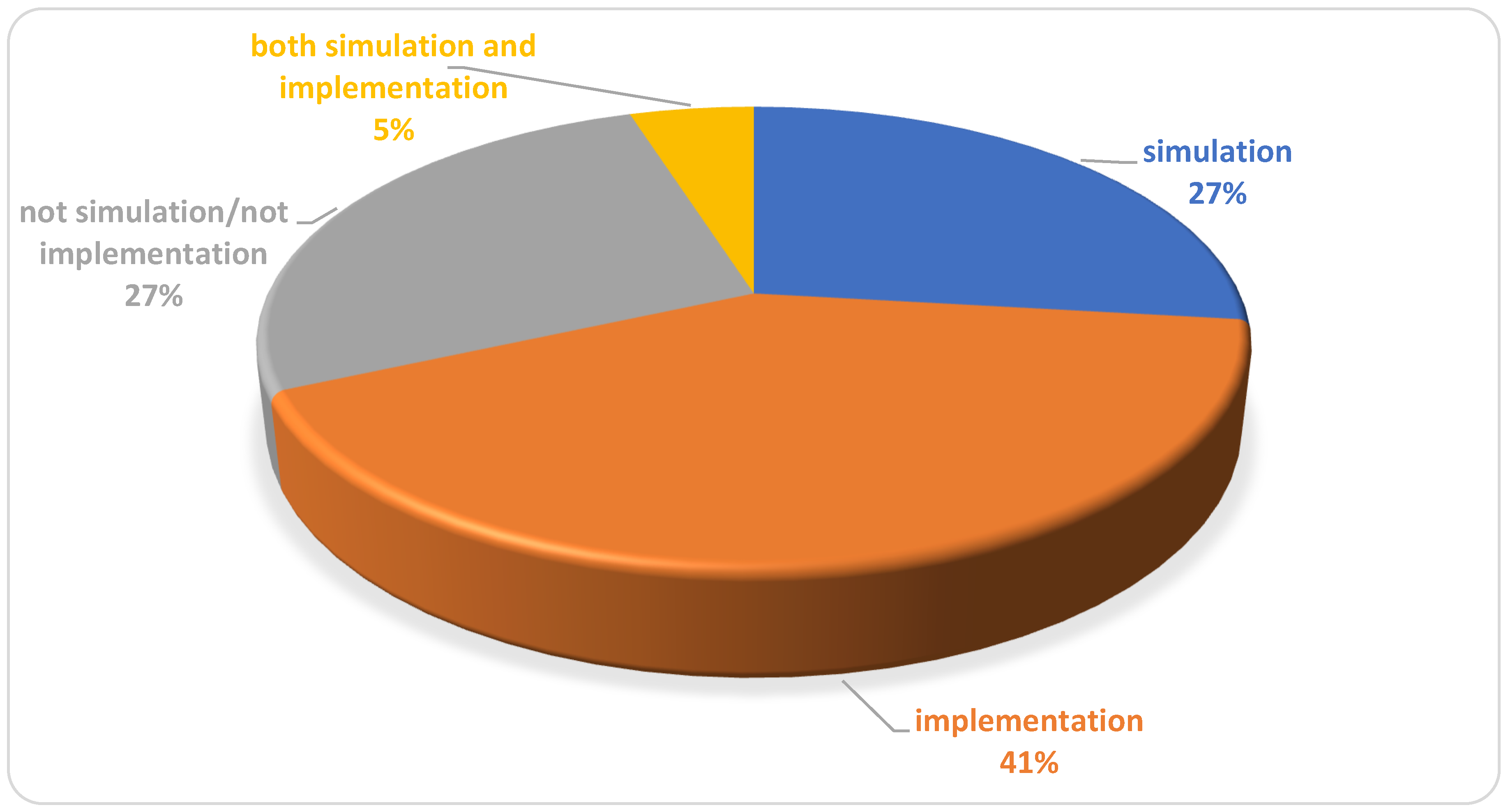
We found that 41% of the studies had implemented their proposed idea, whereas 27% of the publications employed simulation approaches to assess their new idea. As simulation platforms, we can refer to Python and Proteus. In addition, 27% of the articles did not employ any implementation or simulation, whereas 5% employed both simulation and implementation approaches, as illustrated in Figure 6.
Figure 6. Percentage of the presented evaluation environments.
The following analytical answers are presented in response to the RQs of Section 2:
RQ1: What are the roles of IoMT in the control and prevention of COVID-19?
The requirement to use IoMT technology during critical periods will pique the interest of inventors, scientists, and developers in IoMT technology, possibly resulting in remarkable growth in the post-COVID era. IoT was mainly associated with larger-scale concepts, such as smart cities and vehicles [2,3].
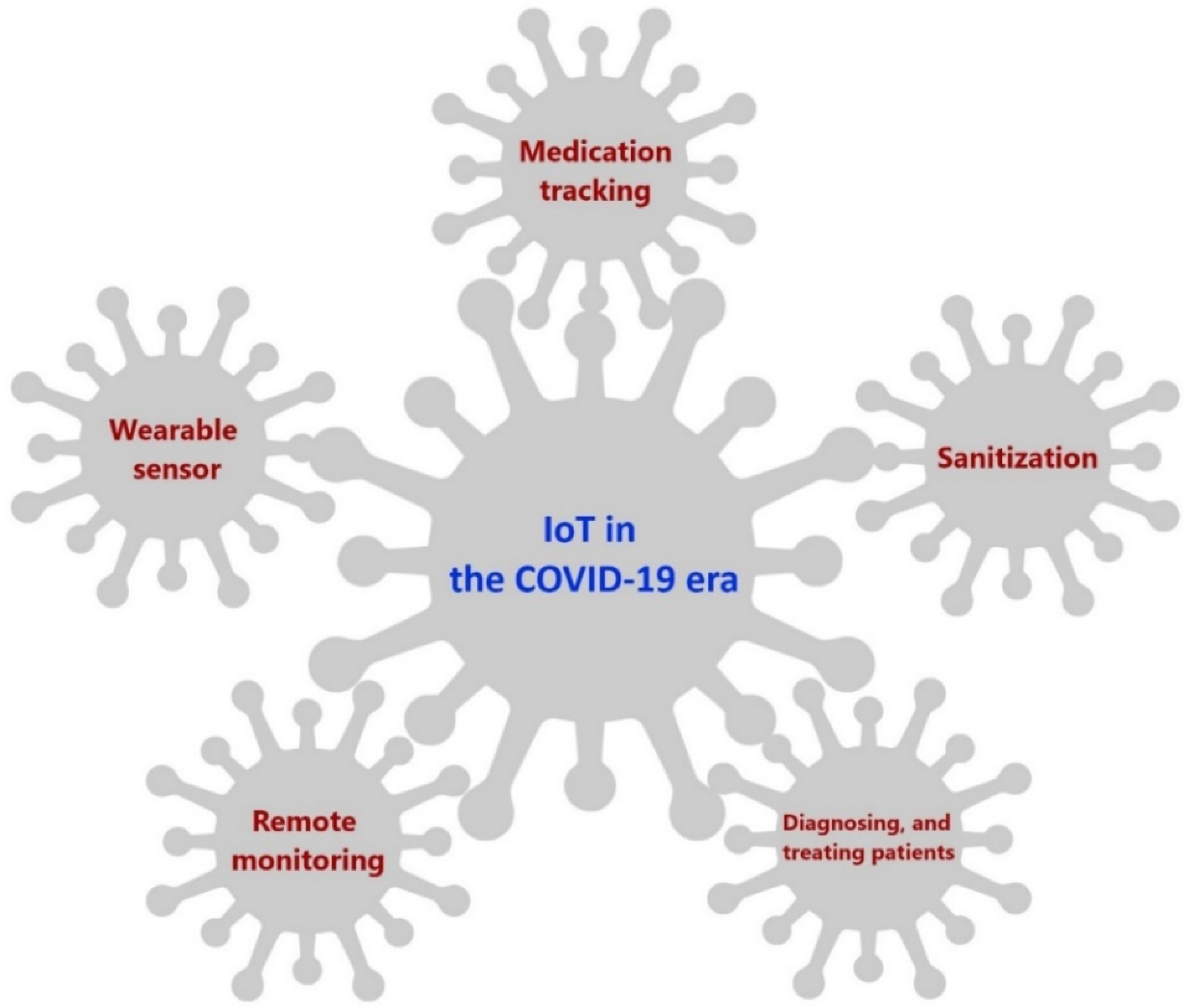
In this question, the role of IoMT will be discussed in COVID-19 as follows:
(a)
Monitoring and screening using IoMT
It might be a highly effective approach to preventing COVID-19 outbreaks. When individuals walk in public areas, drones monitor their body temperatures to see if anyone is suspicious. When individuals maintain social distancing, monitoring can provide reliable information. It can also be used to identify any dense gatherings, which will allow the authorities to take appropriate action. Wireless sensors, facial recognition, and artificial intelligence can all be helpful in this regard. IoMT may be used to improve screening methods [32,33].
  • (b) Delivery
Even when restaurants and grocery shops are closed, the IoT can assist in supplying the basics in a user’s place. Users can purchase online via web pages and smartphone applications, and numerous suggestions have been made to utilize robots or drone deliveries to confined individuals to maintain social distance. COVID-19 will be followed by a growth in the home automation sector. It allows us to automate the delivery of products from restaurants and grocery shops by deploying many drones. Benefits include the elimination of the need for a human intermediary and the need for paper-based transactions [66].
  • (c) Sanitization
For this pandemic, it is crucial to consider that we need a clean environment. IoMT can improve the government’s efficiency, regularity, and reliability of sanitization efforts. Setting up autonomous drones and cleaning systems that regularly sanitize and record which regions need sanitization is possible. It is not always feasible to sterilize our bodies after touching every object or piece of clothing. Even using a “Self-Sanitizing Suit” can help decrease the problem to a certain level to prevent coronavirus transmission through our clothing. We need an automatic anti-coronavirus suit. The sanitization liquid will be pumped into the suit on a timer. As the product would be in high demand during the COVID-19 era, an effort must be made to reduce its price so everyone can use it [67].
  • (d) Digital diagnostics
Advanced digital diagnostics and IoMT connections are useful when combating a worldwide pandemic. Potential paradigm shifts for COVID-19 include digital diagnostics and IoMT connectivity. Many companies have integrated IoT solutions to improve operational activities, develop digital capabilities, and differentiate products and services. So, a variety of IoT devices are utilized to track health data. A smart thermometer replaces regular thermometers with smart thermometers that capture valuable data to protect communities better and share valuable data with health professionals [68].
  • (e) Work from home and IoT
Corporate remote working has grown commonplace since the pandemic, and it will only become more frequent in the future. You have more flexibility and may spend less time commuting from your home. IoT sensors and networks enable this, and employment has become more appealing to prospective employees [69].
  • (f) E-commerce and IoT
In the constructed environment, COVID-19 has had a significant influence. Due to strict lockout procedures, a substantial reduction in human circulation in buildings has led to bankruptcy. In the context of the pandemic, malls are being transformed into warehouses, mostly due to the expansion of e-commerce. Wholesalers and merchants had difficulty keeping track of inventories during the shutdown because of supply chain network disruptions created by the outbreak. As a result of the IoT, users now have access to more transparent and faster services [69].
RQ2: What are the evaluation criteria in the domains of IoMT in COVID-19?
The evaluation criteria of IoMT in the era of COVID-19 are compared in Figure 7. The statistical percentage of the evaluation criteria proves that the delay factor has a high percentage of the IoT in the COVID-19 era at 38%, the performance has 22%, accuracy has 28%, security has 6%, and cost has 6%.
Figure 7. Evaluation criteria of IoT in the era of COVID-19.
According to the evaluation criteria of the reviewed articles used to evaluate their proposed models, five factors were the most repeated: delay, accuracy, performance, cost, and security, respectively. Among them, the delay is the most frequent, which shows the importance of this factor in evaluating proposed methods in the field of IoMT in COVID-19. Real-time performance is an essential feature for IoMT. Particularly in the COVID-19 era, a low-delay IoMT device has a quick turnaround between when a request is submitted and when the answer returns. Since reducing reaction time is essential for realizing the full potential of the IoMT, researchers are constantly working to achieve this goal. More and more groups are using IoMT data to make decisions in real-time. The data can be useless if there is a long delay. Any IoMT application with a low delay is more likely to provide the most up-to-date data, enabling users to make better-informed decisions. Any application involving autonomous mobility must have low-delay IoMT.
RQ3: What are the effects of COVID-19 on IoMT?
COVID-19 has profoundly affected society, the economy, and innovation and will continue to do so. Effects of COVID-19 on IoT are mentioned in detail in Table 12.
Table 12. Effects of COVID-19 on IoT.
RQ4: What are the important applications of IoMT for the COVID-19 pandemic?
(a)
Healthcare
Due to concerns about contamination in hospitals, there has been a significant decrease in on-site referrals for recurrent care. There has also been a reported desire to monitor non-extreme COVID-19 patients continuously, either at their quarantine sites at home or in committed quarantine locations. As a result, the pandemic has created incentives to innovate and improve or develop new remotely delivered healthcare services [7,37,70].
Some healthcare applications are listed below:
  • Body temperature monitoring.
  • Remote health monitoring.
  • Breathing monitoring.
  • Wearable sensor.
  • Medication tracking.
  • Blood oxygen monitoring.
(b)
Education and communication
COVID-19 has resulted in a rise in distance learning and social media usage for educational and communication reasons. Furthermore, the learning process is performed online.
Some education and communication applications are listed below:
  • Distance learning.
  • Distance communication.
  • Virtual studies.
(c)
Transportation
Reducing human presence in cars and transportation infrastructure is widely accepted in intelligent transportation systems and COVID-19 standards. On the other hand, the cause of the decreased human presence is quite different. Intelligent transportation systems try to improve transportation services by replacing human handling and supervision with new technology. COVID-19 intends to minimize overcrowding in transportation because an overcrowded bus or train increases the likelihood of infection [71].
Some transportation applications are listed below:
  • Public transportation monitoring.
  • Intelligent transportation system.
  • Smart vehicle.
  • Traffic management.
RQ5: What are the future research challenges and open issues of IoMT in COVID-19?
(a)
Machine learning
Machine learning and developing a lightweight encryption scheme for distributed storage are the two areas where scientific researchers interested in IoT-based social insurance stand to make the most remarkable improvements. There is no end-to-end framework for specific or general goals that includes all segments in this area: wearable sensors, short- and long-extend correspondences, cloud-based capacity, and machine learning. Growing such a system would be a great accomplishment in IoMT-based medical services and should be a top priority for industry experts [58].Scalability
The integration of technologies to improve the performance of various systems will be the foundation of research in the future. Identifying various barriers and facilitators for adopting an integrated framework in The Public Service Commission would also give helpful information to a strategic planner for better technology adoption. Scalability is still a key challenge for integrating diverse technologies, and it requires the attention of research groups to tackle the implementation problem [47].
  • (b) Lack of data
The researchers discovered that not much data are accessible in open data sources linked to the COVID-19 pandemic. It is predicted that more datasets will be available for usage on systems in the coming days. The lack of electronic health records, medical staff, and administrative resources in many developing nations prevents the implementation of the proposed systems. Ideally, the study may be expanded to include more people in better settings in the future post-COVID-19 [29,48,50].
  • (c) Flexibility
With COVID-19 being the most important problem, flexibility should be considered because remote monitoring systems should easily be connected to other systems and use existing resources to improve patient safety and provide additional support [71]. Various nations must use flexible manufacturing methods to produce required medical equipment quickly [49,69].
  • (d) Transportation
The transportation, logistics, and accommodation industries have all been badly affected by the COVID-19 outbreak. The future solutions will be traceable and transparent logistics, data-driven and self-adaptive decision-making, IoT tracking and monitoring data development, and effective ways to communicate with travelers [69].

6. Conclusions

In this paper, we presented an SLR-based methodology on the IoMT in the COVID-19 era domain based on the observation of 145 papers published between 2019 and 2022. We selected and examined 41 publications to address our five RQs. We showed that in recent years, IoMT has arisen as a key study issue, as COVID-19 has begun a new era. We designed a comprehensive taxonomy and categorized our research reviews into five categories: IoMT engineering, algorithm, architecture and infrastructure, IoMT application, and security. We also looked at this field’s most common evaluation criteria and reviewed and discussed open works and future research. We discovered that most publications had implemented their suggested model as an experimental finding. Delay was considered to be the most significant evaluation factor in this field, according to the examination of the evaluation criteria. Due to the growing number of studies conducted in this field, it will not be easy to verify that all studies have been covered by 2022 when this document is completed.

Author Contributions

Methodology, visualization, validation, writing—original draft, preparation, data curation, A.H.; conceptualization, investigation, writing—review and editing, supervision, A.M.R. All authors have read and agreed to the published version of the manuscript.

Funding

This research received no external funding.

Institutional Review Board Statement

Not applicable.

Data Availability Statement

Not applicable.

Conflicts of Interest

There is no conflict of interest.

References

  1. Dong, Y.; Yao, Y.-D. IoT platform for COVID-19 prevention and control: A survey. IEEE Access 2021, 9, 49929–49941. [Google Scholar] [CrossRef] [PubMed]
  2. Yousif, M.; Hewage, C.; Nawaf, L. IoT Technologies during and beyond COVID-19: A Comprehensive Review. Future Internet 2021, 13, 105. [Google Scholar] [CrossRef]
  3. Chaurasia, R.K.; Mishra, R.; Mishra, R.G. The Road Map and Role of Internet of Things (IoT) in COVID-19 pandemic Scenario. Open Transp. J. 2021, 15, 11–15. [Google Scholar]
  4. Abubakari, M.S. The Internet of Things (IoT) as an Emerging Technological Solution for the COVID-19 pandemic Mitigation: An Overview. In Journal of Physics: Conference Series; IOP Publishing: Bristol, UK, 2021; Volume 1737, p. 012003. [Google Scholar]
  5. Kumar, K.; Kumar, N.; Shah, R. Role of IoT to avoid spreading of COVID-19. Int. J. Intell. Netw. 2020, 1, 32–35. [Google Scholar] [CrossRef]
  6. Chamola, V.; Hassija, V.; Gupta, V.; Guizani, M. A comprehensive review of the COVID-19 pandemic and the role of IoT, drones, AI, blockchain, and 5G in managing its impact. IEEE Access 2020, 8, 90225–90265. [Google Scholar] [CrossRef]
  7. Singh, R.P.; Javaid, M.; Haleem, A.; Suman, R. Internet of things (IoT) applications to fight against COVID-19 pandemic. Diabetes Metab. Syndr. Clin. Res. Rev. 2020, 14, 521–524. [Google Scholar] [CrossRef]
  8. Ndiaye, M.; Oyewobi, S.S.; Abu-Mahfouz, A.M.; Hancke, G.P.; Kurien, A.M.; Djouani, K. IoT in the wake of COVID-19: A survey on contributions, challenges and evolution. IEEE Access 2020, 8, 186821–186839. [Google Scholar] [CrossRef]
  9. Kumar, M.; Nayar, N.; Mehta, G.; Sharma, A. Application of IoT in Current pandemic of COVID-19. In IOP Conference Series: Materials Science and Engineering; IOP Publishing: Bristol, UK, 2021; Volume 1022, p. 012063. [Google Scholar]
  10. Kamal, M.; Aljohani, A.; Alanazi, E. IoT meets COVID-19: Status, Challenges, and Opportunities. arXiv 2020, arXiv:2007.12268. [Google Scholar]
  11. Shamsabadi, A.; Pashaei, Z.; Karimi, A.; Mirzapour, P.; Qaderi, K.; Marhamati, M.; Barzegary, A.; Fakhfouri, A.; Mehraeen, E.; SeyedAlinaghi, S.; et al. Internet of things in the management of chronic diseases during the COVID-19 pandemic: A systematic review. Health Sci. Rep. 2022, 5, e557. [Google Scholar] [CrossRef]
  12. Javaid, M.; Khan, I.H. Internet of Things (IoT) enabled healthcare helps to take the challenges of COVID-19 Pandemic. J. Oral Biol. Craniofacial Res. 2021, 11, 209–214. [Google Scholar] [CrossRef]
  13. Chandrayan, S.S.; Suman, S.; Mazumder, T. IoT for COVID-19: A descriptive viewpoint. In Impact of AI and Data Science in Response to Coronavirus Pandemic; Springer: Singapore, 2021; pp. 193–208. [Google Scholar]
  14. Sharma, A.B.; Nagajayanthi, A.; Kumar, C.; Dinakaran, S. IoT-Based COVID-19 Patient Monitor with Alert System. In Futuristic Communication and Network Technologies; Springer: Singapore, 2022; pp. 1019–1027. [Google Scholar]
  15. Jahmunah, V.; Sudarshan, V.K.; Oh, S.L.; Gururajan, R.; Gururajan, R.; Zhou, X.; Tao, X.; Faust, O.; Ciaccio, E.J.; Ng, K.H.; et al. Future IoT tools for COVID-19 contact tracing and prediction: A review of the state-of-the-science. Int. J. Imaging Syst. Technol. 2021, 31, 455–471. [Google Scholar] [CrossRef] [PubMed]
  16. Meraj, M.; Singh, S.P.; Johri, P.; Quasim, M.T. An investigation on infectious disease patterns using Internet of Things (IoT). In Proceedings of the 2020 International Conference on Smart Technologies in Computing, Electrical and Electronics ICSTCEE), Bengaluru, India, 9–10 October 2020; IEEE: New York, NY, USA, 2020; pp. 599–604. [Google Scholar]
  17. Meraj, M.; Alvi, S.A.M.; Quasim, M.T.; Haidar, S.W. A critical review of detection and prediction of infectious disease using IOT sensors. In Proceedings of the 2021 Second International Conference on Electronics and Sustainable Communication Systems (ICESC), Coimbatore, India, 4–6 August 2021; IEEE: New York, NY, USA, 2021; pp. 679–684. [Google Scholar]
  18. Razdan, S.; Sharma, S. Internet of Medical Things IoMT, Overview, Emerging Technologies, and Case Studies. IETE Tech. Rev. 2021, 1–14. [Google Scholar] [CrossRef]
  19. Jain, S.; Nehra, M.; Kumar, R.; Dilbaghi, N.; Hu, T.; Kumar, S.; Kaushik, A.; Li, C. Internet of medical things (IoMT)—Integrated biosensors for point-of-care testing of infectious diseases. Biosens. Bioelectron. 2021, 179, 113074. [Google Scholar] [CrossRef] [PubMed]
  20. Mazhar, M.S.; Saleem, Y.; Almogren, A.; Arshad, J.; Jaffery, M.H.; Rehman, A.U.; Shafiq, M.; Hamam, H. Forensic Analysis on Internet of Things (IoT) Device Using Machine-to-Machine (M2M) Framework. Electronics 2022, 11, 1126. [Google Scholar] [CrossRef]
  21. Rehman, A.; Paul, A.; Ahmad, A. A query based information search in an individual’s small world of social internet of things. Comput. Commun. 2020, 163, 176–185. [Google Scholar] [CrossRef]
  22. Fan, Z.; Jamil, M.; Sadiq, M.T.; Huang, X.; Yu, X. Exploiting multiple optimizers with transfer learning techniques for the identification of COVID-19 patients. J. Healthc. Eng. 2020, 2020, 8889412. [Google Scholar] [CrossRef]
  23. Rehman, A.U.; Tariq, R.; Rehman, A.; Paul, A. Collapse of Online Social Networks: Structural Evaluation, Open Challenges, and Proposed Solutions. In Proceedings of the 2020 IEEE Globecom Workshops GC Wkshps, Taipei, Taiwan, 7–11 December 2020; IEEE: New York, NY, USA, 2020; pp. 1–6. [Google Scholar]
  24. Ahmad, R.W.; Salah, K.; Jayaraman, R.; Yaqoob, I.; Ellahham, S.; Omar, M. Blockchain and COVID-19 pandemic: Applications and challenges. IEEE TechRxiv 2020. [Google Scholar] [CrossRef]
  25. Yacchirema, D.; Chura, A. SafeMobility: An IoT-based System for safer mobility using machine learning in the age of COVID-19. Procedia Comput. Sci. 2021, 184, 524–531. [Google Scholar] [CrossRef]
  26. Abdulkareem, K.H.; Mohammed, M.A.; Salim, A.; Arif, M.; Geman, O.; Gupta, D.; Khanna, A. Realizing an effective COVID-19 diagnosis system based on machine learning and IoT in smart hospital environment. IEEE Internet Things J. 2021, 8, 15919–15928. [Google Scholar] [CrossRef]
  27. Shalabi, M. COVID-19 Symptoms Monitoring Mechanism using Internet of Things and Wireless Sensor Networks. IJCSNS 2020, 20, 16. [Google Scholar]
  28. Ukhalkar, P. Machine learning-based IoT-enabled perspective model for prediction of COVID-19 test in early stage. Mach. Learn. 2020, 29, 2599–2604. [Google Scholar]
  29. Mukhtar, H.; Rubaiee, S.; Krichen, M.; Alroobaea, R. An IoT Framework for Screening of COVID-19 Using Real-Time Data from Wearable Sensors. Int. J. Environ. Res. Public Health 2021, 18, 4022. [Google Scholar] [CrossRef]
  30. Yang, C.; Wang, W.; Li, F.; Yang, D. An IoT-Based COVID-19 Prevention and Control System for Enclosed Spaces. Future Internet 2022, 14, 40. [Google Scholar] [CrossRef]
  31. Akinola, A.; Singh, G.; Hashimu, I.; Prabhat, T.; Nissanov, U. FSS superstrate antenna for satellite cynosure on IoT to combat COVID-19 pandemic. Sens. Int. 2021, 2, 100090. [Google Scholar] [CrossRef]
  32. Ashraf, M.U.; Hannan, A.; Cheema, S.M.; Ali, Z.; Alofi, A. Detection and tracking contagion using IoT-edge technologies: Confronting COVID-19 pandemic. In Proceedings of the 2020 International Conference on Electrical, Communication, and Computer Engineering ICECCE, Istanbul, Turkey, 12–13 June 2020; IEEE: New York, NY, USA, 2020; pp. 1–6. [Google Scholar]
  33. Priambodo, R.; Kadarina, T.M. Monitoring self-isolation patient of COVID-19 with Internet of Things. In Proceedings of the 2020 IEEE International Conference on Communication, Networks and Satellite (Comnetsat), Batam, Indonesia, 17–18 December 2020; IEEE: New York, NY, USA, 2020; pp. 87–91. [Google Scholar]
  34. Misra, S.; Deb, P.K.; Koppala, N.; Mukherjee, A.; Mao, S. S-Nav: Safety-Aware IoT Navigation Tool for Avoiding COVID-19 Hotspots. IEEE Internet Things J. 2020, 8, 6975–6982. [Google Scholar] [CrossRef]
  35. Rana, M.M.; Abdelhadi, A.; Ahmed, M.R.U.; Ali, A. Secure IoT communication systems for prediction of COVID-19 outbreak: An optimal signal processing algorithm. In Proceedings of the 2020 Third International Conference on Smart Systems and Inventive Technology (ICSSIT), Tirunelveli, India, 20–22 August 2020; IEEE: New York, NY, USA, 2020; pp. 135–139. [Google Scholar]
  36. Le, D.N.; Parvathy, V.S.; Gupta, D.; Khanna, A.; Rodrigues, J.J.P.C.; Shankar, K. IoT enabled depthwise separable convolution neural network with deep support vector machine for COVID-19 diagnosis and classification. Int. J. Mach. Learn. Cybern. 2021, 12, 3235–3248. [Google Scholar] [CrossRef]
  37. Cacovean, D.; Ioana, I.; Nitulescu, G. IoT system in diagnosis of COVID-19 patients. Inform. Econ. 2020, 24, 75–89. [Google Scholar] [CrossRef]
  38. Akhund, T.M.N.U.; Jyoty, W.B.; Siddik, M.A.B.; Newaz, N.T.; al Wahid, S.K.A.; Sarker, M.M. IoT based low-cost robotic agent design for disabled and COVID-19 virus affected people. In Proceedings of the 2020 Fourth World Conference on Smart Trends in Systems, Security and Sustainability (WorldS4), London, UK, 17–28 July 2020; IEEE: New York, NY, USA, 2020; pp. 23–26. [Google Scholar]
  39. Bashir, A.; Izhar, U.; Jones, C. IoT-based COVID-19 SOP compliance and monitoring system for businesses and public offices. In Engineering Proceedings; Multidisciplinary Digital Publishing Institute: Basel, Switzerland, 2020; Volume 2, p. 14. [Google Scholar]
  40. Jung, Y.; Agulto, R. A Public Platform for Virtual IoT-Based Monitoring and Tracking of COVID-19. Electronics 2020, 10, 12. [Google Scholar] [CrossRef]
  41. Bhardwaj, V.; Joshi, R.; Gaur, A.M. IoT-Based Smart Health Monitoring System for COVID-19. SN Comput. Sci. 2022, 3, 1–11. [Google Scholar] [CrossRef]
  42. Saranya, G.; Dineshkumar, N.; Hariprasath, A.S.; Jeevanantham, G. Design of IoT Enabled Cloud Assisted Health Monitoring System for Covid-19 Patients. In Proceedings of the 2022 Second International Conference on Artificial Intelligence and Smart Energy (ICAIS), Coimbatore, India, 23–25 February 2022; IEEE: New York, NY, USA, 2022; pp. 1227–1232. [Google Scholar]
  43. Kolhar, M.; Al-Turjman, F.; Alameen, A.; Abualhaj, M.M. A three layered decentralized IoT biometric architecture for city lockdown during COVID-19 outbreak. IEEE Access 2020, 8, 163608–163617. [Google Scholar] [CrossRef]
  44. Roy, A.; Kumbhar, F.H.; Dhillon, H.S.; Saxena, N.; Shin, S.Y.; Singh, S. Efficient monitoring and contact tracing for COVID-19: A smart IoT-based framework. IEEE Internet Things Mag. 2020, 3, 17–23. [Google Scholar] [CrossRef]
  45. Poongodi, M.; Nguyen, T.N.; Hamdi, M.; Cengiz, K. A Measurement Approach Using Smart-IoT Based Architecture for Detecting the COVID-19. Neural Process. Lett. 2021. [Google Scholar] [CrossRef] [PubMed]
  46. Rajasekar, S.J.S. An enhanced IoT based tracing and tracking model for COVID-19 cases. SN Comput. Sci. 2021, 2, 1–4. [Google Scholar]
  47. Kumar, S.; Pundir, A.K. Blockchain—Internet of things (IoT) Enabled Pharmaceutical Supply Chain for COVID-19. In Proceedings of the NA International Conference on Industrial Engineering and Operations Management Detroit, Detroit, MI, USA, 10–14 August 2020. [Google Scholar]
  48. Pandey, P.; Litoriya, R. Ensuring Elderly Well-Being During COVID-19 by Using the Internet of Things. Disaster Med. Public Health Prep. 2020, 16, 763–766. [Google Scholar] [CrossRef]
  49. Kallel, A.; Rekik, M.; Khemakhem, M. IoT-fog-cloud based architecture for smart systems: Prototypes of autism and COVID-19 monitoring systems. Softw. Pract. Exp. 2021, 51, 91–116. [Google Scholar] [CrossRef]
  50. Ramallo-González, A.P.; González-Vidal, A.; Skarmeta, A.F. CIoTVID: Towards an Open IoT-Platform for Infective pandemic Diseases such as COVID-19. Sensors 2021, 21, 484. [Google Scholar] [CrossRef] [PubMed]
  51. Lavric, A.; Petrariu, A.I.; Mutescu, P.; Coca, E.; Popa, V. IoT Concept in the Context of the COVID-19 Pandemic: A Multi-Sensor Application Design. Sensors 2022, 22, 503. [Google Scholar] [CrossRef] [PubMed]
  52. Mohammedqasim, H.; Ata, O. Real-time data of COVID-19 detection with IoT sensor tracking using artificial neural network. Comput. Electr. Eng. 2022, 100, 107971. [Google Scholar] [CrossRef]
  53. Roy, P.K.; Kumar, A. Internet of Medical Things for early prediction of COVID-19 using ensemble transfer learning. Comput. Electr. Eng. 2022, 101, 108018. [Google Scholar] [CrossRef]
  54. Leila, E.A.; Othman, S.B.; Sakli, H. IoT Based Patient Health Monitoring System to Combat COVID-19 Pandemic. In Proceedings of the 2022 2nd International Conference on Computing and Information Technology (ICCIT), Tabuk, Saudi Arabia, 25–27 January 2022; IEEE: New York, NY, USA, 2022; pp. 144–147. [Google Scholar]
  55. Ahanger, T.A.; Tariq, U.; Nusir, M.; Aldaej, A.; Ullah, I.; Sulman, A. A novel IoT–fog–cloud-based healthcare system for monitoring and predicting COVID-19 outspread. J. Supercomput. 2021, 78, 1783–1806. [Google Scholar] [CrossRef]
  56. Stolojescu-Crisan, C.; Butunoi, B.-P.; Crisan, C. IoT based intelligent building applications in the context of COVID-19 pandemic. In Proceedings of the 2020 International Symposium on Electronics and Telecommunications (ISETC), Timisoara, Romania, 5–6 November 2020; IEEE: New York, NY, USA, 2020; pp. 1–4. [Google Scholar]
  57. Mohammed, M.N.; Halim Syamsudin, S.; Al-Zubaidi, R.R.; Sairah, A.K.; Yusuf, E. Novel COVID-19 detection and diagnosis system using IoT based smart helmet. Int. J. Psychosoc. Rehabil. 2020, 24, 2296–2303. [Google Scholar]
  58. Bharathi, N.; Sriramya, P. Smart healthcare system for COVID-19 using internet of things. J. Crit. Rev. 2020, 7, 1697–1702. [Google Scholar]
  59. Paganelli, A.I.; Velmovitsky, P.E.; Miranda, P.; Branco, A.; Alencar, P.; Cowan, D.; Endler, M.; Morita, P.P. A conceptual IoT-based early-warning architecture for remote monitoring of COVID-19 patients in wards and at home. IoT 2022, 18, 100399. [Google Scholar] [CrossRef]
  60. Saha, R.; Kumar, G.; Kumar, N.; Kim, T.; Devgun, T.; Thomas, R.; Barnawi, A. Internet-of-Things Framework for Oxygen Saturation Monitoring in COVID-19 Environment. IEEE IoT J. 2021, 9, 3631–3641. [Google Scholar] [CrossRef] [PubMed]
  61. Yelure, B.S.; Deokule, N.S.; Mane, S.S.; Bhosale, M.V.; Chavan, A.B.; Satpute, C.V. Remote monitoring of Covid-19 patients using IoT and AI. In Proceedings of the 2022 Second International Conference on Artificial Intelligence and Smart Energy (ICAIS), Coimbatore, India, 23–25 February 2022; IEEE: New York, NY, USA, 2022; pp. 73–80. [Google Scholar]
  62. Masud, M.; Gaba, G.S.; Alqahtani, S.; Muhammad, G.; Gupta, B.B.; Kumar, P.; Ghoneim, A. A lightweight and robust secure key establishment protocol for internet of medical things in COVID-19 patients care. IEEE Internet Things J. 2020, 8, 15694–15703. [Google Scholar] [CrossRef]
  63. Yongjun, T. Security design and application of Internet of things based on asymmetric encryption algorithm and neural network for COVID-19. J. Intell. Fuzzy Syst. 2020. [Google Scholar] [CrossRef]
  64. Al-Turjman, F.; Deebak, B.D. Privacy-aware energy-efficient framework using the internet of medical things for COVID-19. IEEE Internet Things Mag. 2020, 3, 64–68. [Google Scholar] [CrossRef]
  65. Alam, T. Internet of things and blockchain-based framework for Coronavirus (COVID-19) disease. SSRN 2020. [Google Scholar] [CrossRef]
  66. Siddiqui, S.; Shakir, M.Z.; Khan, A.A.; Dey, I. Internet of Things (IoT) Enabled Architecture for Social Distancing During pandemic. Front. Commun. Netw. 2021, 2, 6. [Google Scholar] [CrossRef]
  67. Sadhu, A.; Raj, Y.; Chatterjee, S. IoT based corona preventive polycoat with automatic sanitization system. In Journal of Physics: Conference Series; IOP Publishing: Bristol, UK, 2021; Volume 1797, p. 012043. [Google Scholar]
  68. Mukati, N.; Namdev, N.; Dilip, R.; Hemalatha, N.; Dhiman, V.; Sahu, B. Healthcare assistance to COVID-19 patient using internet of things (IoT) enabled technologies. Mater. Today Proc. 2021. [Google Scholar] [CrossRef]
  69. Umair, M.; Cheema, M.A.; Cheema, O.; Li, H.; Lu, H. Impact of COVID-19 on IoT Adoption in Healthcare, Smart Homes, Smart Buildings, Smart Cities, Transportation and Industrial IoT. Sensors 2021, 21, 3838. [Google Scholar] [CrossRef] [PubMed]
  70. Behar, J.A.; Liu, C.; Kotzen, K.; Tsutsui, K.; Corino, V.D.A.; Singh, J.; Pimentel, M.A.F.; Warrick, P.; Zaunseder, S.; Andreotti, F.; et al. Remote health diagnosis and monitoring in the time of COVID-19. Physiol. Meas. 2020, 41, 10TR01. [Google Scholar] [CrossRef] [PubMed]
  71. Wiseman, Y. Intelligent Transportation Systems along with the COVID-19 pandemic will Significantly Change the Transportation Market. Open Transp. J. 2021, 15, 11–15. [Google Scholar] [CrossRef]
Publisher’s Note: MDPI stays neutral with regard to jurisdictional claims in published maps and institutional affiliations.

Article Metrics

Citations

Article Access Statistics

Multiple requests from the same IP address are counted as one view.