


Abstract
To address the complex and difficult challenges that are occurring in complex social-ecological systems, a transformation toward sustainable futures is required. Understanding the characteristics and functions of leverage points (LPs), which bring about significant changes in complex systems, will greatly contribute to the various practices toward achieving sustainable futures. We conducted a detailed analysis of 15 cases of autonomous innovations emerging among vulnerable sectors in six countries to contribute to understanding the mechanisms of transformation of social-ecological systems by identifying the characteristics and functions of LPs. We found that three types of LPs with different characteristics play their roles in a multi-layered and interrelated manner in the emergence processes of autonomous innovations. These LPs contributed to the improvement of various aspects of well-being and facilitated the transformation of the social-ecological systems by enhancing the five previously proposed enabler categories. The multi-layered and interrelated functioning of LPs promotes the enhancement of various aspects of human well-being and strengthens the enabler categories. These were found to be important mechanisms for the transformation of social-ecological systems. Based on these results, we derive nine guiding principles for the conditions and mechanisms of transformation. These results indicate that a deeper study of autonomous innovation through an LP lens could make a significant contribution to solving or mitigating the wicked problems faced by humanity.
1. Introduction
1.1. Leverage Points to Promote the Transformation of Social-Ecological Systems
To achieve sustainable futures, it is necessary to solve the various challenges summarized in the SDGs [1,2]. The various services provided by forests, oceans, agricultural lands, and other ecosystems are called ecosystem services [3]. Their global degradation is intricately linked to the social challenges that humanity faces, such as inequality and poverty [4]. Nature and human activities are deeply interconnected and constitute complex systems which are called social-ecological systems [5,6,7]. The various challenges that arise in social-ecological systems are extremely difficult to solve, with no fixed problem to be solved and a myriad of solutions. Such complex and unanswerable challenges are called wicked problems [8,9,10]. Wicked problems arise because of the complex interactions between society and the natural environment around us due to their intricate connection. Therefore, the solution or mitigation of wicked problems requires a transformation of the social-ecological systems [11,12].
The concept of leverage points (LPs) is gaining attention as a mechanism for bringing about the transformation of complex systems. An LP is a critical component, among the myriad of components that make up a system, that can cause significant changes in the behavior of the system as a whole [13,14,15,16]. Understanding the characteristics of LPs and applying them effectively can facilitate solutions to complex challenges, such as the degradation of natural resources and other ecosystem services, and achieve the transformation of social-ecological systems toward sustainable futures.
1.2. Autonomous Innovations Emerging among Socially Vulnerable People
Numerous examples have been found around the world where transformation has been achieved to solve or alleviate the wicked problems faced by complex social-ecological systems [17,18]. We have collected and analyzed cases in which socially vulnerable people in developing countries have created innovations that have facilitated the transformation of social-ecological systems [11,19]. The socially vulnerable people in developing countries are usually seen as targets of aid, but in reality, they are autonomous innovators of various innovations addressing difficult challenges on their own [20,21]. We define “autonomous innovation” as “actions emerging from local practitioners with the potential to transform social-ecological systems, and the mechanisms that support them” [19]. Innovators who promote the emergence of innovations simultaneously achieve sustainable resource management and improvement of various aspects of human well-being. Thus, the continued emergence of autonomous innovations among socially vulnerable people, especially in developing countries, will facilitate the transformation of social-ecological systems.
Tajima, et al. (2022) found that autonomous innovations starting from motivations closer to everyday life could produce by-products of collective actions that promote public value enhancement [19]. They argued that this process was important to the emergence of innovations that could address wicked problems. It was also important for the innovators to have a proactive attitude toward continuous improvement rather than being satisfied with short-term outcomes, to promote the emergence of autonomous innovations to achieve the integrated management of diverse natural resources. They also reported that self-sustained and adaptive collective actions were required to create synergies for integrated natural resource management [19]. These observations indicate that it is critically important to examine the conditions and mechanisms of the emergence of autonomous innovations among socially vulnerable people in developing countries to promote the transformation of social-ecological systems.
1.3. Application of the Leverage Point Lens
Socially vulnerable people in developing countries are generating various impacts through the emergence of autonomous innovations to solve or mitigate wicked problems in complex social-ecological systems. Their autonomous innovations produce these impacts through sustainable resource management and the improvement of human well-being [11,19]. Therefore, identifying the leverage points (LPs) involved in the emergence of autonomous innovations and clarifying their characteristics will help us understand the mechanisms of transformation of social-ecological systems [15,16].
The emergence processes of autonomous innovations that we have collected thus far can be described as causal chains in a time series [22,23,24,25,26]. Takemura et al. (in press) have developed an analytical method for LP identification using causal network analysis. They also clarified that LPs were classified into three types with different characteristics [27]. Since this method is based on causal relationship chains, it allows us to analyze the function of LPs in the emergence of innovations along the time series in detail. Therefore, we decided to analyze the LP functions in the emergence processes of autonomous innovations among socially vulnerable people to achieve the sustainable management of diverse natural resources and improvement of human well-being. These analyses will contribute to the understanding of the mechanisms of transformation of social-ecological systems.
1.4. Transformation Mechanisms of Social-Ecological Systems
Tajima et al. (2022) discussed that autonomous innovations improved various aspects of human well-being, which in turn created new collective actions and promoted the transformation of social-ecological systems [19]. Therefore, a detailed time-series analysis of the relationships between LPs and indices of human well-being would help us understand the mechanisms of transformation. Based on case studies of transdisciplinary research and practices in local communities around the world, Sato, et al. (2018) proposed five hypothetical categories of enablers of the transformation of social-ecological systems, “facilitate collective actions”, “identify and visualize values”, “build new linkages”, “provide options and opportunities”, and “encourage multiple translators and viewpoints” [28]. However, there have not been enough evidence-based verifications accumulated regarding the relationship of these enabler categories with the emergence processes of innovations and the transformation of social-ecological systems. A detailed analysis of the relationship between LPs and these enabler categories will facilitate further understanding of transformation mechanisms.
1.5. Research Questions
This study clarifies the conditions and mechanisms of transformation of social-ecological systems by analyzing the process of emergence of autonomous innovations to achieve integrated natural resource management and the improvement of human well-being by answering three research questions. We applied the classification of LPs proposed by Takemura et al. (in press) for the characterization of LP functions and analyzed what types of LPs function at what stages of the emergence process of autonomous innovation, what indicators of human well-being these LPs are associated with, and the relationship between LPs and the enablers of the transformation of social-ecological systems [27].
- How do diverse LPs function in the emergence processes of autonomous innovations?
- What aspects of human well-being do LPs contribute?
- Through what enabler categories do LPs produce impacts on the transformation of social-ecological systems?
2. Methods
2.1. Analysis Target
We described the emergence processes of autonomous innovations among socially vulnerable people in developing countries in the form of narratives and accumulated them in a simple database, the autonomous innovation toolbox [19]. The narratives of autonomous innovations analyzed in this study were 15 of 20 narratives in the toolbox with sufficient information for detailed analysis. These narratives were co-created in three regions in Indonesia (Gorontalo, Polewali, and Jeneberang), one in the Philippines (Ifugao), one in Thailand (Rayong), one in Fiji (Wai), three in Malawi (Nkhotakota, Salima, and Chembe) and one in Turkey (Karapinar) (see supplementary materials of Tajima et al. [19]).
2.2. Identification and Classification of Leverage Points
Takemura et al. (in press) extracted causal chains from the narratives of autonomous innovations organized in the autonomous innovation toolbox, converted each causal chain into a chronological list of nodes and links, and drew causal networks [27]. In this study, we used this methodology to draw network diagrams for 15 innovations. Takemura, et al. (in press) also developed a new definition of LPs using network centralities and developed an analysis method to identify nodes that have a significant impact on social-ecological systems as LPs [27]. LPs were classified into three types (“in”, “out”, and “all”) according to the characteristics of the nodes. The LP (in) functions to integrate components, such as local conditions, challenges, actors inside and outside the region, as well as innovation outcomes, technologies produced, new knowledge, and new human networks, into the emergence processes of innovations. The LP (out) promotes new practices for creating innovation outcomes, and visualizes new challenges. The LP (all) is an LP that dynamically transforms the emergence processes of innovations through the integration of various components into the processes as well as through the creation of new practices and visualization of new challenges [27]. We used this method to identify LPs for the above 15 narratives of autonomous innovation and classified them into three types.
2.3. The Function of the Leverage Points in the Emergence Processes of Autonomous Innovations
Figure 1 shows a conceptual diagram of the causal network of an autonomous innovation produced using the methods of Takemura et al. [27]. Initial conditions motivate and trigger an autonomous innovation. The process of various collective actions that arise from these conditions is expressed as a feedback loop. Various outcomes are generated, and the remaining challenges are visualized from these collective actions.
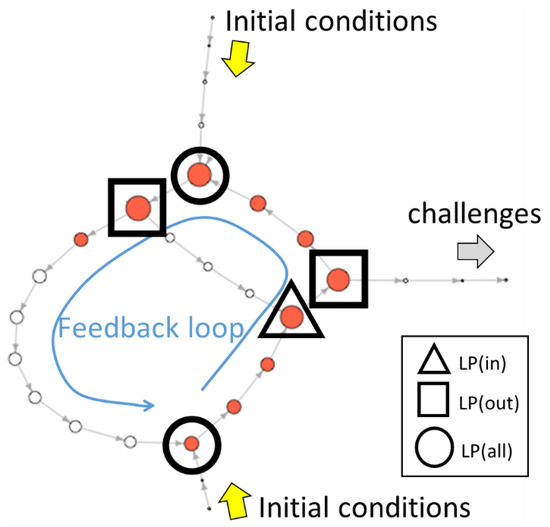
Figure 1.
Conceptual diagram of a causal network.
The figure shows the process by which a feedback loop representing outcomes (blue line) is generated from initial conditions (yellow arrow) and new challenges (gray arrow) are visualized, as well as the positions of the three hypothetical types of LPs in the process.
To clarify how the three types of LPs function in the emergence processes of autonomous innovations, we divided the individual LPs into three stages according to their position in the chronological list of nodes and links (edge list) extracted from the narratives [27]. Each innovation was composed of approximately 35 to 50 nodes and links. We defined the “initial stage” within the first 30% of the list, the “developing stage” from 30% to 70%, and the “outcome-generating stage” as over 70%. We assumed that the LPs in the initial stage promote collective actions triggered by initial conditions, the LPs in the developing stage promote the development of collective actions and progress toward outcomes, and the LPs in the outcome-generating stage are those that generate the outcomes of collective actions and bring the remaining challenges to light. Based on these assumptions, we analyzed the functions of LPs in the emergence processes of autonomous innovations.
2.4. Relationship between LPs and Human Well-Being
We analyzed the relationship between LPs and four indices of human well-being to determine the aspects of human well-being to which LPs promoting the emergence of innovations contribute. The four indices of human well-being proposed by the millennium ecosystem assessment represent “basic materials for a good life”, “safety”, “health”, and “good social relations”; the fulfillment of these four indices is a necessary condition for achieving “freedom of choice and action” [3,29,30]. Therefore, we focused on the four basic indices, excluding “freedom of choice and action”, in the analysis of this paper (see supplementary materials of Tajima et al. [19] for more details).
We examined the relationship between three types of LPs and four indices of human well-being for 15 autonomous innovations. We hypothesized that the indices of human well-being associated with LPs in the initial and developing stages represented the most important and direct motivating and triggering components of autonomous innovations, while the indices of human well-being associated with LPs in the developing and outcome-generating stages referred to aspects of human well-being that were enhanced by autonomous innovation. We also assumed that the indices of human well-being to which an LP relates were not necessarily singular, but that an LP might relate to multiple aspects of human well-being.
We determined correspondences between LPs and indices of human well-being using the criteria based on the contexts of each LP in the narratives. Concerning the relationship between the “basic materials for a good life” and LPs, we focused on contributions to improving the lives of socially vulnerable people. Regarding the relationship of an LP with “safety” and “health”, we selected only the cases where there was a broad impact on the community. LPs were related to “good social relations” only when the social relations among important actors in local communities were evident. We analyzed the relationship between each LP and the human well-being indices based on the number of LPs associated with each human well-being indicator at each stage. We tried to understand what aspects of human well-being triggered and motivated the emergence of autonomous innovations and what outcomes of these innovations improved different aspects of human well-being.
2.5. Relationship between LPs and the Enabler Categories of Social-Ecological Transformation
We analyzed the relationship between LPs and five categories of enablers proposed by Sato et al. [28] to identify at what stage and through which enablers LPs contribute to the transformation of social-ecological systems. Enablers are defined as the “factors responsible for knowledge-based adaptive societal transformation toward sustainable futures, working synergetic to mobilize the collective decision making and action.” They further defined the five categories of enablers as follows [28].
“Firstly, co-produced knowledge can identify and allow collective visualization of new sharable values in local communities that may serve to mobilize collaborative decision making and actions (i.e., “identify and visualize values”). Secondly, it may build new linkages among actors within and outside the community, including actors addressing broader issues (i.e., “build new linkages”). Thirdly, the co-produced knowledge may expand options and opportunities for sustainable actions among stakeholders and mediates changes in environmental perception (i.e., “provide options and opportunities”). The shared knowledge may directly enable and facilitate collective actions, which transform existing local institutions or form new ones (i.e., “facilitate collective actions”). And finally, knowledge translators (individuals or institutions), playing their roles at multiple scales and levels, can catalyze all these processes by employing and emphasizing new contextualization of knowledge (i.e., “encourage multiple translators and viewpoints”).” (Sato et al., 2018 p. 6).
We analyzed the correspondences between LPs and the five categories of enablers in 15 autonomous innovations. We determined the relationship between the LPs and the enabler categories based on the contents of the LPs and contexts within the causal network. We selected enabler categories that contributed to the non-negligible changes that the LPs made to the overall system. We also assumed that a single LP could be associated with more than one enabler category. We analyzed which function of the enabler category was more strongly promoted by each LP in a stage based on the number of LPs that were associated with each category. We tried to understand which enabler category is strengthened by the LPs in the emergence processes of autonomous innovations to facilitate the transformation of the social-ecological systems.
3. Results
3.1. The Function of LPs in the Emergence Processes of Autonomous Innovations
Figure 2 shows the actual positions of the three types of LPs in an example of the causal network of the emergence processes of autonomous innovations; LPs in the initial stage (green, numbers 9 and 29) are located near the initial conditions (yellow arrows), the LP in the developing stage (red, number 26) appears in the middle of the feedback loops, and LPs in the outcome-generating stage (blue, numbers 29 and 32) appear at the end of the feedback loops or near the remaining challenges (grey arrows). LPs (all), which are represented by circles, fulfill the dual functions in the initial stage (green, number 29) and outcome-generating stage (blue, number 29).
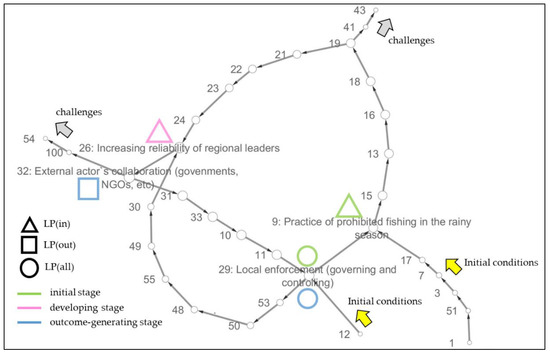
Figure 2.
The location of the three types of leverage points in the causal network (Innovation No. 10: Seasonal fishing bans around Mbenji Island by traditional chiefs).
The types of LPs (in, out, all) are represented by the shapes of the symbols, and the stages of the LPs are represented by the colors of the symbols. Yellow and grey arrows indicate the initial conditions and remaining challenges of the innovation. The size of the nodes in the network diagram represents the value of betweenness centrality (BWC), according to the definition of LP by Takemura et al. (in press), and the arrows represent the direction of causal relationship links. For more details of the causal network diagrams, please see Figure 3 of Takemura et al. (in press) [27].
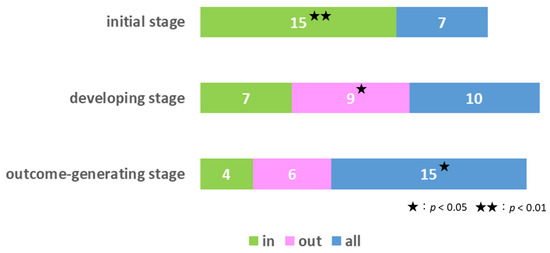
Figure 3.
Numbers of the three types of LPs per stage.
We identified 63 LPs from 15 autonomous innovations and organized all LPs into types according to the stages (Table 1). In total, 20 LPs (in), 15 LPs (out), and 22 LPs (all) were identified. Although all three types of LPs functioned in all stages, the frequency of each type differed among stages. The LP (in) functioned in all autonomous innovations but there were three innovations without LPs (out) and two without LPs (all). There were no innovations lacking both LPs (out) and LPs (all).

Table 1.
Identified LPs at each stage of autonomous innovations. The numbers at the beginning of the titles of LPs represent the node numbers in the causal networks; shadowed cells are LPs (all) performing different functions at different stages. The numbers in parentheses in the innovation numbers at the leftmost column are the innovation numbers in Tajima et al. (2022) [19].
Ten LPs (all) had some functions in the initial or developing stage and performed a different function in another subsequent stage (shadowed cells in Table 1 and number 29 in Figure 2). Thus, the cumulative total of LPs in Table 1 and subsequent analyses is 73: 22 LPs in the initial stage, 26 in the developing stage, and 25 in the outcome-generating stage. Of the 10 LPs (all) that performed multiple functions, 9 were involved in the achievement of outcomes in the outcome-generating stage.
Figure 3 represents the numbers of the three types of LPs per stage. The LP (in) was significantly more common in the initial stage, the LP (out) in the developing stage, and the LP (all) in the outcome-generating stage, compared to the other stages (χ2 (4) = 19.62, p < 0.01).
3.2. Contribution of LPs to Human Well-Being
Figure 4 shows the components of well-being that triggered or motivated the innovation and aspects of human well-being that improved outcomes, based on the relationship between the LPs and the four indices of human well-being for each LP in an example of a causal network showing the emergence process of autonomous innovation. The LP (in) at the initial stage (green, number 7) was related to all four well-being indicators. All aspects of human well-being were considered to have motivated or triggered this innovation. The LP (all) at the development stage (red, number 24) and the outcome-generating stage were related to “basic materials for a good life” and “health” in the developing stage, indicating that these were the motivation and triggers for this autonomous innovation. In the outcome-generating stage, the same LP (all) (blue, number 24) was related to “good social relations” in addition to “basic materials for a good life” and “health”, which indicated that outcomes related to “basic materials for a good life”, “health”, and “good social relations” were promoted in parallel. The LP (all) at the outcome-generating stage (blue, number 23) also indicated that “basic materials for a good life” and “good social relations” were achieved in parallel.
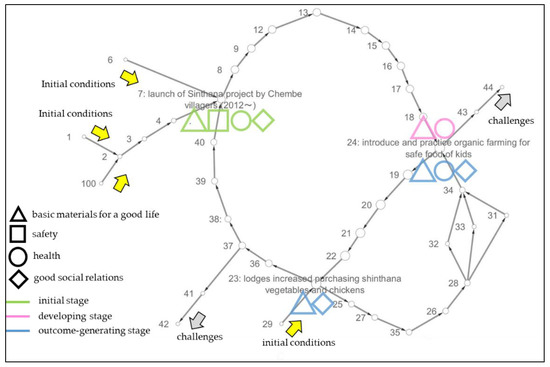
Figure 4.
An example of the relationship between leverage points and indices of human well-being in a causal network (Innovation No. 13: Organic farming by small-scale irrigation linked to educational activities (Sinthana)).
The indices of human well-being (“basic materials for a good life”, “safety”, “health”, and “good social relations”) are represented by the shapes of the symbols and the LP stages are represented by the colors of the symbols. See the caption of Figure 2 for more details of the causal network diagram.
We examined the relationship of 73 LPs with human well-being indices (Table 2). One LP was related to one or more indices of human well-being. Therefore, the cumulative number of correspondences between LPs and well-being indices was 131. LPs were associated with “basic materials for a good life”, “safety”, and “good social relations” at all stages. Few LPs were associated with “health”. A comparison of the number of indices of human well-being addressed by each of the three types of LPs showed no particular trend.
Table 2.
Correspondence between LPs and indices of human well-being for each stage. The innovation numbers in the leftmost column are the same as in Table 1. Shadowed cells are LPs (all) performing different functions in different stages. BM: basic materials for a good life, SA: safety, HE: health, and GR: good social relations. Titles of LPs are not shown in this table, as they are shown in Table 1.
Figure 5 compares LPs and corresponding indices of human well-being by stages. In all stages, “basic materials for a good life” and “good social relations” were significantly higher than the “safety” and “health” indices of human well-being (initial stage: χ2(3) = 10.44, p < 0.01, developing stage: χ2(3) = 14.87, p < 0.01, outcome-generated stage: χ2(3) = 15.00, p < 0.01). There was no significant difference in the frequency of the four human well-being indices among the three LP stages and the three types of LPs (χ2(6) = 3.70, n.s.).
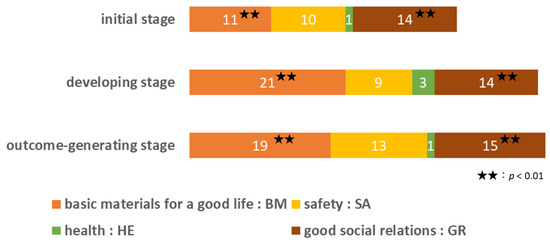
Figure 5.
Number of LPs corresponding to each human well-being index per stage.
3.3. Impact of the LP on the Transformation of Social-Ecological Systems
Figure 6 illustrates the causal network diagram showing the emergence processes of an autonomous innovation and the enabler category in which the LPs are considered to have enhanced their functions. The LP (all) at the initial stage (green, number 11) facilitated collective actions and built new linkages. The LP (in) at the developing stage (red, number 19) promoted the visualization of value, and the LP (out) at the developing stage (red, number 21) created new linkages. The LP (all) at the outcome-generating stage (blue, number 11) visualized values and the LP (all) (blue, number 25) encouraged the collective actions that led to the transformation of the social-ecological system.

Figure 6.
An example of the relationship between leverage points (LPs) and enabler categories in the causal network (Innovation No. 8: Reorganization and usage of traditional salt making).
The enabler categories (“facilitate collective actions”, “identify and visualize values”, “provide options and opportunities”, “build new linkages”, and “encourage multiple translators”) are represented by the shapes of the symbols and the LP stages are represented by the colors of the symbols. See the caption of Figure 2 for more details of the causal network diagram.
Regarding 73 LPs, we identified 125 cases of relations to enabler categories (Table 3). At every stage, LPs contributed to “facilitate collective actions”, “identify and visualize values”, “provide options and opportunities”, and “build new linkages”, while there were very few contributions to “encourage multiple translators and viewpoints”. This can be attributed to the fact that the perspective of bilateral knowledge translation [28] was not commonly shared among both innovators and collaborating scientists.
Table 3.
Enabler categories in which the LPs of each stage have enhanced their functions. The innovation numbers in the leftmost column are the same as in Table 1. Shadowed cells are LPs (all) performing different functions at different stages. AC: facilitate collective actions, VA: identify and visualize, LI: build new linkages, OP: provide options and opportunities, and TR: encourage multiple translators and viewpoints. Titles of LPs are not shown in this table, as they are shown in Table 1.
Figure 7 compares the number of enabler categories that were enhanced by the LPs at different stages. Among the enabler categories, “facilitate collective actions” was significantly more common in the initial stage than in the other stages, and “identify and visualize values” was significantly more common in the outcome-generating stage than in the other stages (χ2(8) = 16.12, p < 0.05). A few LPs that strengthened the function of “encourage multiple translators” appeared in the developing stage and beyond. Among the three types of LPs, “encourage multiple translators” was significantly more common in the LP (out) (χ2(8) = 13.65, p < 0.05).

Figure 7.
Number of LPs and corresponding enabler categories per stage.
4. Discussion
4.1. Functions of the Three Types of LPs in the Emergence Processes of Autonomous Innovations
The LP (in) was significantly more common in the initial stage, the LP (out) in the developing stage and the LP (all) in the outcome-generating stage, than in the other stages, respectively (Figure 3). In the initial stage, the LP (in) integrates various components into the system, while the LP (out) creates new movements in the developing stage. The LP (all) integrates these outcomes in the outcome-generating stage. It is important for LPs with these different functions to play their respective roles in the emergence processes of autonomous innovations. Previous discussions on LPs have mainly focused on the magnitude of the impact of LPs, with specific characteristics on the system as a whole, as seen in Meadows’ 12 leverage points [13,14,15,16,31,32,33]. In contrast, our finding that at least two, and in most cases three, types of LPs appeared in all innovations suggests a mechanism whereby LPs with different characteristics function in a multi-layered and interrelated manner in the emergence processes of innovations to promote the transformation of the social-ecological system as a whole [19,27]. These results will make a significant contribution to the research of autonomous innovations emerging among socially vulnerable sectors in developing countries [34,35,36].
All 10 LPs (all) had some functions in the initial or developing stage, and most of them also functioned differently in the outcome-generating stage (Table 1). LPs (all) in the outcome-generating stage often appear at the end of the feedback loop, as shown in Figure 2. The LP (all) has two functions: integrating various components and creating new movements. Therefore, these LPs (all) are involved in the emergence and promotion of autonomous innovations in the early stages and play a role in producing outcomes in the final phase of the process. The existence of LPs with such dual functions and their multi-layered linkages with various other LPs is thought to play a particularly important role in the transformation of social-ecological systems. These LPs (all) are likely to represent “deep” LPs that previous studies suggested to produce fundamental impacts on the complex systems with strong interventions [14,15,16]. Takemura et al. (in press) also indicated that the interventions on the initial conditions and remaining challenges were relatively easy to influence the functions of LPs [27]. To strengthen the functions of LPs (all) as the “deep” LPs, we suggest the possibility of exerting influence on the initial conditions and remaining challenges connected to LPs (all) to promote the social-ecological transformation.
4.2. Parallel Contributions to Multiple Aspects of Human Well-Being
Among the four indices of human well-being, “basic materials for a good life” and “good social relations” were significantly abundant at all stages of LPs. “Safety” (including physical safety and improvement of resilience) was also associated with LPs at all stages in many autonomous innovations. We hypothesized that the indices of human well-being associated with LPs in the initial and developing stages referred to the most important and direct motivations and triggers of autonomous innovation, while the indices of human well-being associated with LPs in the developing and outcome-generating stages referred to the aspects of human well-being that have been enhanced by autonomous innovations. Therefore, these indices of human well-being are deemed to be the motivation and impetus for the emergence of innovations, as well as the eventual achievement. It is important for the transformation of social-ecological systems that different LPs are interlinked with different aspects of human well-being throughout the emergence processes of innovations and that various aspects of human well-being are improved in parallel [14,15,16,17,18,19]. Previous studies in systems thinking have pointed to the importance of multiple positive feedback loops producing diverse outcomes for overall system transformations [22,24]. The results of this study indicate the possibility that a single feedback loop could simultaneously produce outcomes to improve multiple human well-being indicators. This result provides a new perspective on transformation studies in systems thinking.
Although few, there were cases in which LPs related to “health”, a highly public indicator of human well-being, played an important role. For example, in the case of autonomous innovation shown in Figure 4 (Table 2, No. 13), all four human well-being indices, including “health” (the need to improve the nutritional status of children), were the motivation for the innovation. In the developing stage, this innovation produced outcomes of the promotion of activities aimed at improving “basic materials for a good life” (improving the production of organic agriculture) and “health” (improving the health of children). In the outcome-generating stage, “good social relations” (collaborations between farmers and tourist lodges) were also achieved. Here, various motivations, including highly public child nutrition improvement, generated by-products of another public value: extensive collaboration between farmers and tourist lodges. In Innovation No. 12 (Table 2), “good social relations” (between the lodge and the tour guide association) provided the foundation for the innovation, which was triggered by “health” (improved sanitation) as the motivation, and produced a public value of “good social relations” (networking of people with skills) as the outcome. The emergence of collective actions from the highly public motive of improving sanitation at the village level led to the creation of by-products with another highly public outcome of building a network of diverse people in the village, including vulnerable groups. Tajima et al. (2022) pointed out that the process of collective actions, emerging from motivations closer to the everyday life of people to produce outcomes of high public value as by-products, is an important enabler of the emergence of autonomous innovations [19]. This study revealed another pathway where autonomous innovation, initiated from motivation with a highly public value in the first place, generated additional by-products that have another highly public value. The parallel production of outcomes with high public values related to multiple indices of human well-being would also facilitate the transformation of the social-ecological system. The importance of considering the by-products in the process of social-ecological transformation has also been suggested in the studies of resilience planning [37] and fisheries resource management [38]. Our findings have a strong implication for these arguments.
4.3. Contribution of LPs to the Transformation of Social-Ecological Systems through the Enabler Categories
Sato et al. (2018) proposed five enabler categories as mechanisms for the knowledge-based transformation of social-ecological systems [28]. We analyzed the relationship between LPs and the five enabler categories to understand the mechanisms of the contribution of different types of LPs to contribute to transformation. LPs associated with the five enabler categories functioned in almost all stages of innovation. In the emergence processes of autonomous innovations, it is highly likely that the five enabler categories interact with each other to produce various collective actions. LPs, as a whole, promote the dynamic transformation of a social-ecological system through these collective actions [28]. Among the enabler categories, “facilitate collective actions” were significantly more frequent in the initial stage than in the other stages. The creation of new and unprecedented actions was apparently important in the initial stage. Previous studies indicated that collective actions often trigger the transformation of social-ecological systems [39]. In the developing stage, “encourage multiple translators” was counted for the first time, although the number of cases was small. The function of the “encourage multiple translators” category was thought to be mainly carried out by LPs (out). The bilateral knowledge translation that bridges gaps between diverse actors effectively promotes collaboration through the LP (out) in the developing stage. In the outcome-generating stage, the “identify and visualize values” category was significantly more frequent. This suggests that the new values create or expand outcomes of the innovations and dynamically stimulate the creation of new directions.
Tajima et al. (2022) found that the creation of by-products through collective actions and the proactive attitude of innovators were important enablers for the emergence of innovations [19]. The process of the creation of by-products includes “facilitate collective actions” and “identify and visualize values” among the enabler categories. The innovator’s proactive attitude is the foundation of all five enabler categories, but it can be the driving force behind new and unprecedented collective actions in the initial stage when LPs related to the “facilitate collective actions” category are functioning. In the outcome-generating stage, when LPs associated with the “identify and visualize values” category play a role, proactive attitudes can support the creation or expansion of new values and outcomes. In order to “build new linkages” and “provide options and opportunities” to function as enablers in all stages, a proactive attitude is essential for innovators to effectively use these linkages and opportunities.
According to Tajima et al. (2022), the emphasis on public values, self-sustained and adaptive collective action, and the improvement of the supporting services, one of the four ecosystem services [3] were closely related to the emergence of synergies in integrated natural resource management [19]. Autonomy and adaptiveness are particularly important when new collective actions are generated in the initial stage and when new values are visualized in the outcome-generating stage to promote the emergence of synergies. The emphasis on public values and the improvement of supporting services are relevant to all five enabler categories because these provide the foundations for the sustainability of diverse resources and the enhancement of human well-being. The “encourage multiple translators” category and related LPs have important functions, especially in the developing stage when collective actions incorporate and visualize various public values, including supporting services, to facilitate the creation of further outcomes of innovations and the synergies for integrated resource management. Supporting services have been postulated as the fundamental component of diverse ecosystem services, including provisional services, to provide various natural resources [3,4]. It is highly likely that the improvement of supporting services can open a window for the emergence of synergies among multiple resource management practices.
The empirical enablers derived by Tajima et al. (2022) from a qualitative analysis of diverse autonomous innovations [19] and the five enabler category hypotheses [28] were highly consistent. This study also identified the conditions and mechanisms for the five enabler categories and associated LPs to function effectively in the emergence processes of autonomous innovations. The analysis of LPs in this study revealed the importance of the multi-layered functioning of the various enabler categories and LPs, significantly advancing our understanding of the transformation mechanisms of social-ecological systems.
5. Conclusions
The results of this study indicate that the concept of leverage points (LPs) is useful for understanding the mechanisms of transformation of social-ecological systems through autonomous innovations, as indicated previously [13,26,32]. The extraction of three types of LPs by network analysis and a detailed analysis of their functions revealed that different types of LPs function in different stages of the emergence processes of autonomous innovations. We found that the LP (in) integrates diverse components into the system, the LP (out) creates new movements, and the LP (all) integrates their outcomes. We also found that the LP (all) is an important LP involved in both the emergence of innovations and the creation of outcomes of autonomous innovations. Different types of LPs function in a multi-layered and interrelated manner in the emergence of innovations, which promote the transformation of the social-ecological systems in aggregate. These LPs are intricately linked to diverse aspects of human well-being, and the multi-layered linkage of LPs promotes the enhancement of diverse aspects of human well-being. The LPs associated with the five enabler categories were functional in almost all stages of innovation. The LPs related to the five enabler categories interact with each other to generate diverse collective actions that, as a whole, promote the dynamic transformation of social-ecological systems.
Based on the results in this study, combined with the previous two studies in the series of papers: the qualitative analysis of the emergence of autonomous innovations by Tajima et al. (2022) [19] and the classification of LPs into three types by Takemura et al. (in press) [27], we propose the nine guiding principles below as fundamental conditions and mechanisms to promote the transformation of social-ecological systems facilitated by autonomous innovations.
- Three types of LPs with different functions play synergetic roles in the emergence processes of autonomous innovations at different stages.
- The existence of LPs with dual functions such as the LP (all) and multi-layered linkages with other types of LPs.
- The improvement of various aspects of human well-being in parallel through the interlinked functioning of multiple LPs of different types.
- I. The emergence of new and unprecedented collective actions at the beginning of autonomous innovations; II. The functioning of bilateral knowledge translators that bridge the gaps between diverse actors as collective actions unfold; and III. The new values, outcomes, and new directions that emerge dynamically through diverse functioning LPs.
- Accelerating the creation of by-products through the emergence of collective actions and visualization of new values promoted by LPs.
- Parallel achievements of highly public values, including supporting services through the functions of various LPs, create collective actions from different motivations.
- Proactive attitudes of innovators effectively support LP functions to drive new collective action, deepen and expand people’s connections, provide new options and opportunities, and create new values and outcomes.
- Self-sustained and adaptive collective actions enhance the functions of diverse LPs and create or visualize new values dynamically.
- Effective bilateral knowledge translations incorporate and deploy various public values in collective actions through the functions of LPs.
These guiding principles for the transformation of social-ecological systems open up new horizons for the study of transformation mechanisms of social-ecological systems through autonomous innovations emerging among socially vulnerable people in developing countries. The reality of the interaction of LPs with different characteristics should be clarified through more detailed transdisciplinary research on cases that have produced particularly significant outcomes. Such in-depth case studies would validate and elaborate these guiding principles. Transdisciplinary research should also promote further collection and analyses of autonomous innovations that are creating synergies between different natural resource management practices. Detailed analyses of synergetic implementations of integrated natural resource management will clarify mechanisms that improve various aspects of human well-being and strengthen resilience through transdisciplinary collaborations, leading to a better understanding of new mechanisms of the transformation of social-ecological systems through synergy. The policy implications of facilitating these guiding principles to tackle various societal challenges, including integrated natural resource management, is another important area of research. We hope that the progress of such research will lead to the solution or mitigation of wicked problems toward sustainable futures.
Author Contributions
Conceptualization, H.T., S.T., and T.S.; Methodology, H.T., S.T., and T.S.; Validation, H.T. and S.T.; Data Curation and Formal Analysis, H.T., S.T., T.S., J.H., and M.M.; Writing—Original Draft Preparation, H.T. and T.S.; Writing—Review and Editing, H.T., S.T., T.S., J.H., and M.M., Supervision, H.T., T.S.; Project Administration, T.S.; Funding Acquisition, T.S. All authors have read and agreed to the published version of the manuscript.
Funding
This research was funded by the “Transdisciplinary Study of Natural Resource Management under Poverty Conditions Collaborating with Vulnerable Sectors (TD-Vuls) Project” under the Initiative for the Promotion of Future Earth Concept Program provided by the Research Institute of Science and Technology for Society (RISTEX), Japan Science and Technology Agency (JST) from 2017 to 2019 (JPMJRX16F3), and the “Establishment of a Sustainable Community Development Model based on Integrated Natural Resource Management Systems in Lake Malawi National Park (IntNRMS) Project” under the Science and Technology Research Partnership for Sustainable Development (SATREPS) program provided by Japan Science and Technology Agency (JST) and Japan International Cooperation Agency (JICA) from 2020 to 2024 (JPMJSA1903).
Institutional Review Board Statement
The study was conducted in accordance with the Declaration of Helsinki, and approved by the Research Ethics Committee, Faculty of Collaborative Regional Innovation, Ehime University (2020-01, 23 June 2020).
Informed Consent Statement
Not applicable.
Data Availability Statement
Not applicable.
Acknowledgments
This paper benefited greatly from discussions with TD-Vuls and IntNRMS project members. We are grateful to community-based autonomous innovators as the partners of this transdisciplinary research, including Yunis Amu, Guntur Amu, Dorothea Agnes Rampisela, NGO Pelangi, Ilyas Laja, Kamaruddin Rola, Hasanuddin Nassa, Herwin Hartawan Soekirman, Amrisal Alamzah Sennang, Umar, Untuk Indonesia Hijau, Dari K, Co. Ltd., Adam, Idrus (Indonesia), Rolando Addug (Philippines), Boonchu Sewana, Sathawat Jantong, Kitsana Sakpeerakul, Kittisak Sakpeerakul (Thailand), Anareta, Dokai (Fiji), Chief Makanjira, Sanudi Abudu, Liviton Tape, Total Land Care, Richard Museka, Charles Misinga, Bright Sande, Arnold Rumaka, Lackson Maliwanda, John Banana Matewere, Brighten Ndawala, Zaret Kalanda, Madothi Beach Village Committee (Malawi), and Hayri Merdane (Turkey). Motoko Shimagami, Hideyuki Onishi, Koji Nakamura, Takashi Torii, Satoru Nishimura, Bosco Rusuwa, Daud Kassam, Dylo Pemba, and Takashi Kume contributed to the co-creation of the narratives of autonomous innovations and Atsuko Fukushima provided administrative support throughout the research process. This research would not have been completed without their help.
Conflicts of Interest
The authors declare no conflict of interest.
References
- United Nations. Transforming Our World: The 2030 Agenda for Sustainable Development. Available online: https://sdgs.un.org/2030agenda (accessed on 8 June 2022).
- United Nations. The Sustainable Development Goals Report 2017. Available online: https://unstats.un.org/sdgs/report/2017/ (accessed on 8 June 2022).
- Millennium Ecosystem Assessment. Ecosystems and Human Well-being: A Framework for Assessment; Island Press: Washington, DC, USA, 2005. [Google Scholar]
- Marin-Monroy, E.A.; Garcia, J.U. Ecosystem services and their impact on poverty and inequality in coastal communities of Baja California Sur. Int. J. Sustain. Dev. Plan. 2014, 9, 430–444. [Google Scholar] [CrossRef]
- Berkes, F.; Colding, J.; Folke, C. Navigating Social-Ecological Systems: Building Resilience for Complexity and Change; Cambridge University Press: Cambridge, UK, 2003. [Google Scholar] [CrossRef]
- Folke, C. Resilience: The emergence of a perspective for social–ecological systems analyses. Glob. Environ. Change 2006, 16, 253–267. [Google Scholar] [CrossRef]
- Ostrom, E. A general framework for analyzing sustainability of social-ecological systems. Science 2009, 325, 419–422. [Google Scholar] [CrossRef] [PubMed]
- Rittel, H.W.J.; Webber, M.M. Dilemmas in a general theory of planning. Policy Sci. 1973, 4, 155–169. [Google Scholar] [CrossRef]
- Pryshlakivsky, J.; Cory, S. Sustainable development as a wicked problem. In Managing and Engineering in Complex Situations. Topics in Safety, Risk, Reliability and Quality; Kovacic, S., Sousa-Poza, A., Eds.; Springer: Dordrecht, The Netherlands, 2013; Volume 21. [Google Scholar] [CrossRef]
- Peters, B.G. What is so wicked about wicked problems? A conceptual analysis and a research program. Policy Soc. 2017, 36, 385–396. [Google Scholar] [CrossRef]
- Sato, T.; Chabay, I.; Helgeson, J. Transformations of social-ecological systems. In Co-Creating Integrated Knowledge Toward Sustainable Futures; Springer: Singapore, 2018. [Google Scholar] [CrossRef]
- Salomaa, A.; Juhola, S. How to Assess Sustainability Transformations: A Review Global Sustainability. In Global Sustainability; Cambridge University Press: Cambridge, UK, 2020; pp. 1–12. [Google Scholar] [CrossRef]
- Meadows, D.H. Leverage Points: Places to Intervene in a System; Sustainability Institute: Hartland, VA, USA, 1999. [Google Scholar]
- Abson, D.J.; Fischer, J.; Leventon, J.; Newig, J.; Schomerus, T.; Vilsmaier, U.; von Wehrden, H.; Abernethy, P.; Ives, C.D.; Jager, N.W.; et al. Leverage points for sustainability transformation. Ambio 2017, 46, 30–39. [Google Scholar] [CrossRef] [PubMed]
- Fischer, J.; Riechers, M. A leverage points perspective on sustainability. People Nat. 2019, 1, 115–120. [Google Scholar] [CrossRef]
- Leventon, J.; Abson, D.J.; Lang, D.J. Leverage points for sustainability transformations: Nine guiding questions for sustainability science and practice. Sustain. Sci. 2021, 16, 721–726. [Google Scholar] [CrossRef]
- UNDP. Local Action for the Global Goals: Promoting Innovative Conservation and Development Solutions; UNDP: New York, NY, USA, 2016. [Google Scholar]
- Bundy, A.; Chuenpagdee, R.; Cooley, S.R.; Defeo, O.; Glaeser, B.; Guillotreau, P.; Isaacs, M.; Makino, M.; Perry, R.I. A decision support tool for response to global change in marine systems: The IMBER-ADApT framework. Fish Fish. 2016, 17, 1183–1193. [Google Scholar] [CrossRef]
- Tajima, H.; Sato, T.; Takemura, S.; Hori, J.; Makino, M.; Rampisela, D.A.; Shimagami, M.; Matewere, J.B.; Ndawala, B. Autonomous innovations in the rural communities of developing countries I—A narrative analysis of innovations and synergies for integrated natural resource management. Sustainability 2022, 14, 1659. [Google Scholar] [CrossRef]
- Bahadur, A.; Doczi, J. Unlocking Resilience through Autonomous Innovation; Overseas Development Institute: London, UK, 2016; pp. 1–30. [Google Scholar]
- Chataway, J.; Hanlin, R.; Kaplinsky, R. Inclusive innovation: An architecture for policy development. Innov. Dev. 2014, 4, 33–54. [Google Scholar] [CrossRef]
- Senge, P.M. The Fifth Discipline: The Art and Practice of the Learning Organization, 2nd ed.; Cornerstone: London, UK, 2006. [Google Scholar]
- Meadows, D.H.; Wright, D. (Eds.) Thinking in Systems: A Primer; Chelsea Green Publishing: Chelsea, VT, USA, 2008. [Google Scholar]
- Ramage, M.; Shipp, K. Systems Thinkers; Springer: Berlin/Heidelberg, Germany, 2009. [Google Scholar] [CrossRef]
- Nguyen, N.C.; Bosch, O.J.H.; Maani, K.E. Creating ‘learning laboratories’ for sustainable development in biospheres: A systems thinking approach. Syst. Res. Behav. Sci. 2012, 28, 51–62. [Google Scholar] [CrossRef]
- Nguyen, N.C.; Bosch, O.J.H. A systems thinking approach to identify leverage points for sustainability: A case study in the Cat Ba Biosphere Reserve, Vietnam. Syst. Res. Behav. Sci. 2013, 30, 104–115. [Google Scholar] [CrossRef]
- Takemura, S.; Tajima Hori, J.; Makino, M.; Matewere, J.B.; Rampisela, D.A.; Sato, T. Autonomous innovations in rural communities of developing countries II—Causal network and leverage point analyses for transformations. Sustainability 2022, 2054, in press. [Google Scholar] [CrossRef]
- Sato, T.; Chabay, I.; Helgeson, J. Introduction. In Transformation of Social-Ecological Systems: Studies in Co-creating Integrated Knowledge Toward Sustainable Futures; Sato, T., Chabay, I., Helgeson, J., Eds.; Springer: Singapore, 2018; pp. 1–7. [Google Scholar] [CrossRef]
- Hori, J.; Makino, M. The structure of human well-being related to ecosystem services in coastal areas: A comparison among the six North Pacific countries. Mar. Policy 2018, 95, 221–226. [Google Scholar] [CrossRef]
- McKinnon, M.C.; Cheng, S.H.; Dupre, S.; Edmond, J.; Garside, R.; Glew, L.; Holland, M.B.; Levine, E.; Masuda, Y.J.; Miller, D.C.; et al. What are the effects of nature conservation on human well-being? A systematic map of empirical evidence from developing countries. Environ. Evid. 2016, 5, 1–25. [Google Scholar] [CrossRef]
- Hughes, B.B. Building a global model: The Toolkit. In International Futures: Building and Using Global Models; Hughes, B.B., Ed.; London Academic Press: London, UK, 2019; pp. 7–32. [Google Scholar] [CrossRef]
- Lam, D.P.M.; Martín-López, B.; Horcea-Milcu, A.I.; Lang, D.J. A leverage points perspective on social networks to understand sustainability transformations: Evidence from Southern Transylvania. Sustain. Sci. 2021, 16, 809–826. [Google Scholar] [CrossRef]
- Ives, C.D.; Abson, D.J.; Wehrden, H.V.; Dorninger, C.; Klaniecki, K.; Fischer, J. Reconnecting with nature for sustainability. Sustain. Sci. 2018, 13, 1389–1397. [Google Scholar] [CrossRef] [PubMed]
- Seyfang, G.; Smith, A. Grassroots innovations for sustainable development: Towards a new research and policy agenda. Environ. Politics 2007, 16, 584–603. [Google Scholar] [CrossRef]
- Bloom, L. Bottom-up humanitarian innovation. In Research in Brief; Refugee Studies Centre; University of Oxford: Oxford, UK, 2015; Volume 1, pp. 1–4. [Google Scholar]
- Basu, R.R.; Banerjee, P.M.; Sweeny, E.G. Frugal innovation: Core competencies to address global sustainability. J. Manag. Glob. Sustain. 2013, 1, 63–82. [Google Scholar] [CrossRef]
- Helgeson, J. Institutional support for combining multiple knowledge systems in planning for community resilience to natural and anthropogenic hazards. In Transformations of Social-Ecological Systems: Studies in Co-Creating Integrated Knowledge toward Sustainable Futures; Sato, T., Chabay, I., Helgeson, J., Eds.; Springer: Singapore, 2018; pp. 373–391. [Google Scholar] [CrossRef]
- Sato, T.; Pemba, D. Villagers managing lake fisheries resources by themselves: Mbenji Islands in Lake Malawi. In Satoumi Science: Co-Creating Social-Ecological Harmony Between Human and the Sea; Kakuma, S., Yanagi, T., Sato, T., Eds.; Springer: Singapore, 2022; pp. 145–167. [Google Scholar] [CrossRef]
- Henrik, E. Transformative collective action: A network approach to transformative change in ecosystem-based management. In Social Networks and Natural Resource Management: Uncovering the Social Fabric of Environmental Governance; Örjan, B., Christina, P., Eds.; Cambridge University Press: Cambridge, UK, 2012; pp. 255–287. [Google Scholar] [CrossRef]
Publisher’s Note: MDPI stays neutral with regard to jurisdictional claims in published maps and institutional affiliations. |
© 2022 by the authors. Licensee MDPI, Basel, Switzerland. This article is an open access article distributed under the terms and conditions of the Creative Commons Attribution (CC BY) license (https://creativecommons.org/licenses/by/4.0/).