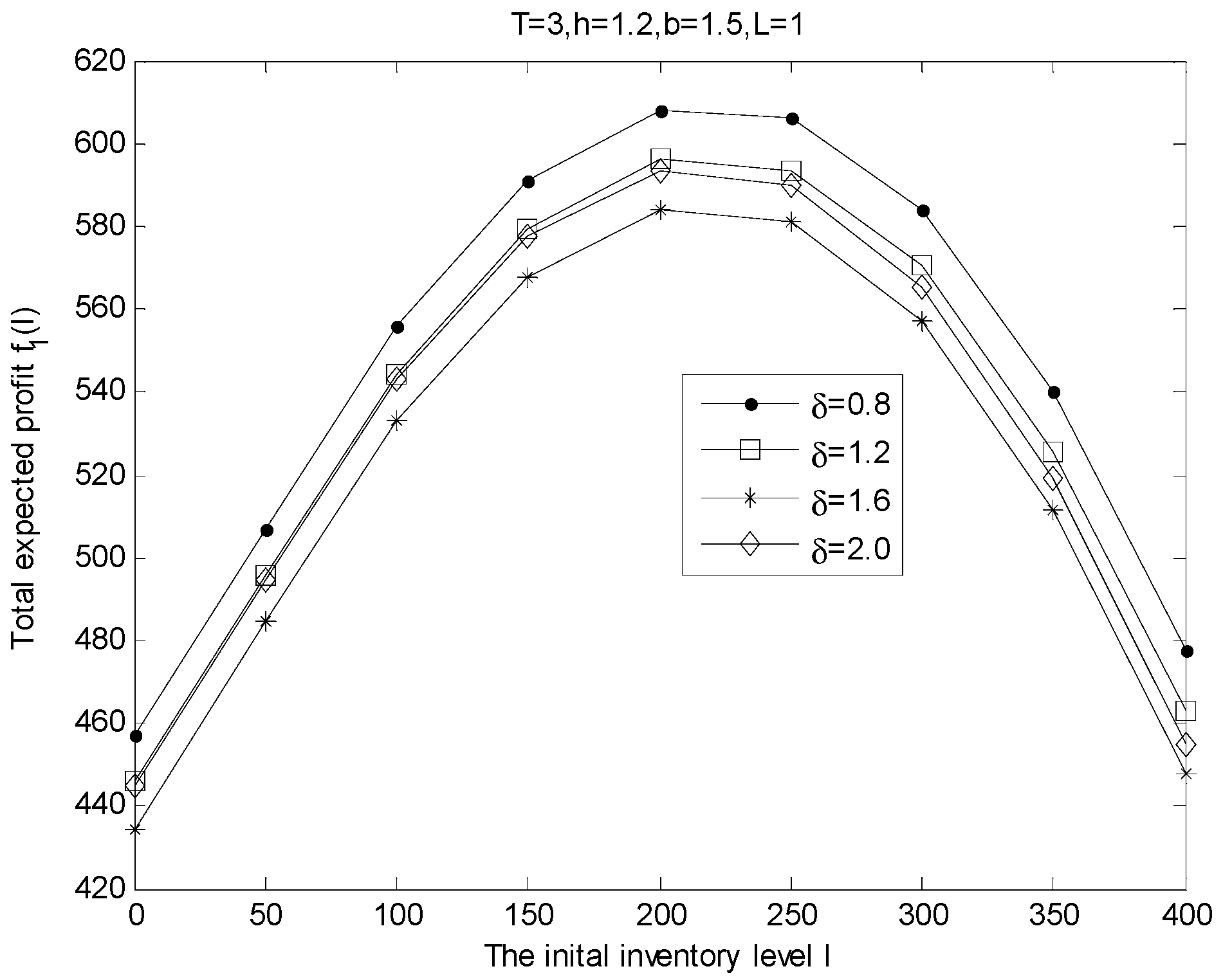
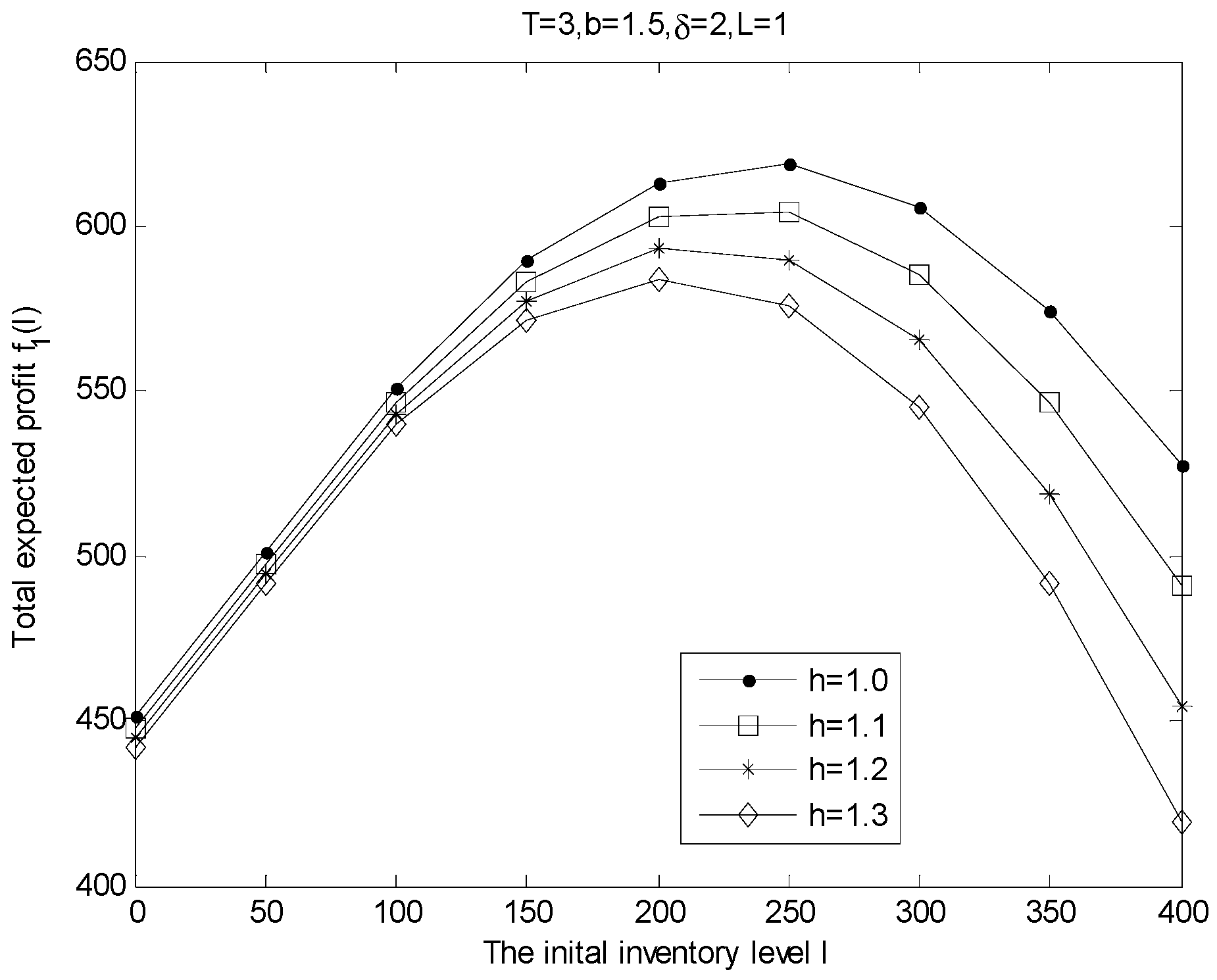
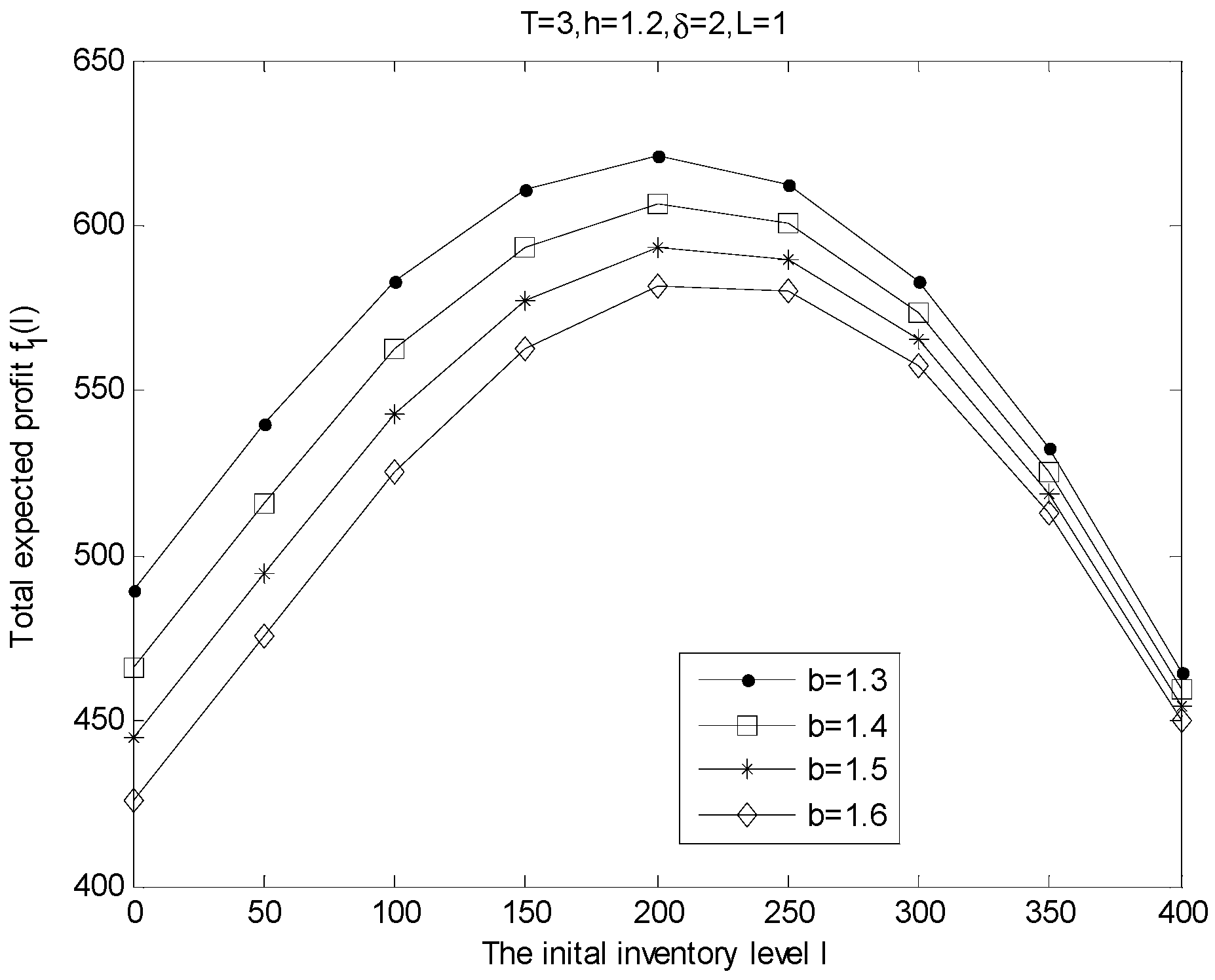
1. Introduction
With E-commerce developing rapidly, a growing number of retailers operate the offline channel as well as the online channel [
1,
2]. Nearly 80% of American retailers and practically all large retailers adopt dual-channel sales models [
3]. The main advantage of the online shopping is that one does not need to visit the retail store in person. It saves a great amount of time and energy for customers, especially for those far away from the retail store. Though online shopping brings much convenience for customers, buying offline still has some irreplaceable advantages. Customers visiting shops, for instance, can get more information of the product by feel and touch. This could avoid customers paying expensive return costs due to the uncertainty of the product valuation, before actually receiving the products. Therefore, customers are more likely to choose the online channel if they are far away from the offline store, or if the online return cost is low. Customers are generally willing to choose offline channels if they are close to the offline store, or face a high online return cost. As a result, channel visit costs and return costs are key factors impacting customers’ channel choice.
In addition to the costs referred to above, another crucial factor related to a customer’s channel choice is the sales mode in each channel. In practice, many products (e.g., the mineral water and facial tissue) are usually sold online in the quantity-sales mode. That is, several units of products are sold as a whole, and splitting is not allowed, which is different with the unit-sales mode.
Table 1 presents sales modes and selling prices of some products in the online/offline channel. For instance, if a customer needs to buy facial tissues in Tmall supermarket, he/she must buy at least six units in the online channel or at least one unit offline. The quantity-sales mode can not only increase customer demand, but also avoid the case that the revenue from one unit is too low to offset the delivery fee. Hence, it is quite common in real life to use the quantity-sales mode online and the unit-sales mode offline. The difference in sales modes and prices in different channels leads to different customer utilities. Therefore, the effect of the sales mode also needs to be taken into consideration when the dual-channel retailer makes operational decisions.
Drawing on the above discussion, customers’ costs and the sales mode of the product influence their purchasing channel decisions, thus impacting sales of the dual-channel retailer. Furthermore, the sale influences the dual-channel retailer’s operational decisions, including the inventory level, pricing level and sales channel, and thus the total profit. At the same time, the dynamic inventory and price decisions are also two crucial and effective levers to manage the retailer’s profitability [
4]. Accordingly, this paper will investigate the dual-channel retailer’s integrated inventory and price problem over multiple periods with the quantity-sales mode. We assume that customer valuation, offline visit costs and the market size are stochastic. To obtain the long-term profit optimization, the retailer needs to decide the total stock level and the pricing levels of both channels during each period, and the customer needs to choose the purchasing channel based on the customer valuation, visit costs, return cost, sales mode and pricing level of each channel. For this model, we concentrate on the main questions as below.
What is the dual-channel retailer’s optimum inventory and pricing policy over multiple periods when the quantity-sales mode is adopted online? Specifically, when is it optimum to make the online and offline sales simultaneously? When is it optimum to make only the online or offline sales?
Can the quantity-sales mode, the dual-channel sales model and the dynamic decisions really drive the retailer’s profit? How do the customer return cost and the inventory cost affect the dual-channel retailer’s profit?
To answer these two research problems, we first prove the concavity and supermodularity of the objective function. With the concavity, the optimality of the base-stock policy is established. Utilizing the supermodularity, we prove that if the replenishment level is low (resp. high), only operating the offline (resp. online) channel is optimum for the dual-channel retailer, otherwise operating both channels simultaneously is optimum. Moreover, the difference between the online price and the offline price of one unit product is decreasing in the replenishment level. Finally, by conducting numerical experiments, we conclude that the retailer’s profit is improved after the quantity-sales mode, dual-channel sales model and the multi-period dynamic decisions are considered. The retailer’s profit does not always decrease with the return cost. In addition, we also numerically verify influences of inventory costs on the total profit. Therefore, our research results would help the dual-channel retailer to obtain the long-term profit optimization by dynamically adjusting the price and stock decisions in a practical operation. Moreover, it would also enrich the research on the dual-channel supply chain with multiple periods and the research on the quantity-sales mode. In addition, the modeling process can provide ideas for solving similar dynamic programming problems.
We organize the rest of this research in the following way:
Section 2 is the literature review;
Section 3 presents the model formulation;
Section 4 covers main results;
Section 5 presents numerical results; and
Section 6 is the conclusions.
2. Literature Review
Literature associated with our study is divided into three streams in
Table 2 as below.
The first literature stream is related to the dual-channel retailer’s optimal decision problems. Radhi and Zhang [
1] analyze the impact of cross-channel returns on the pricing decision. Liu et al. [
5] consider the influence of return services on the retailer’s profit and pricing levels of both channels. Guo et al. [
6] develop a dual-retailer’s coordinated pricing and service model with free riding. In these models, the deterministic demand only depends on the product price of each channel or the service level and is independent of the customer utility. Instead, we consider the utility-based demand model. That is, in addition to pricing decisions, customer demand of each channel is also related to the customer valuation, utility parameter and visit costs, which we have shown as key factors influencing the dual-channel retailer’s profit. Under the setting of the dual-channel retailer’s single-period pricing decision and the deterministic demand, some literature concentrates on the utility-based demand model. For example, Zhang et al. [
7] develop the influence of the “purchase online and pick-up offline” (abbr. BOPS) mode and represent the channel price. They obtain the relationship between the optimal channel price and parameters including the customer valuation and the visit cost. Xu et al. [
8] concentrate on the case of two competitive dual-channel retailers selling substitutable products. They compare two retailers’ prices when price matching is considered. One can refer to the literature [
9,
10,
11] for more studies on the utility-based demand model and the dual channels. All the above literature referred to only focuses on the deterministic demand, and the effects of prices on the dual-channel sales. However, effects of the inventory decision are ignored. In contrast, we argue that the (s, S) inventory policy is optimal, and that the offline price is decreasing in the stock decision.
The following three papers explore the dual-channel retailer’s single-period inventory policy with demand uncertainty: The study by Gao and Su [
12] argues that the retailer should lower the stock level of the offline channel to increase the risk of stock availability for the case of physical showrooms. Gao and Su [
13] argue that BOPS mode would decrease a retailer’s profit when the product sells well in the offline channel. Radhi and Zhang [
14] test the effect of products that are returned and then resold on the replenishment quantity of each channel. These three studies assume that the pricing decision is an exogenous fixed variable that does not need to be optimized. However, we endogenize both the pricing and stock decisions into the optimization model. We argue that the corresponding inventory decision relies on the initial inventory instead of given pricing levels. In addition, we also show that if the dual-channel retailer’s optimal inventory level is low (high), only the price of the offline (online) channel needs to be determined, otherwise prices of both channels need to be optimized. There are a few papers that study the dual-channel retailer’s stock and pricing decisions simultaneously. Sun et al. [
15] develop a dual-channel retailer’s multi-product stock and pricing decisions with the service level constraint. They mainly focus on how the solution of the optimization problem can be obtained. Moreover, they only consider the single-period problem. In contrast, our goal is to maximize the long-term profit over multiple periods. We have shown that the performance under the multi-period policy is obviously better than that under the one-period policy. Moreover, all the above literature referring to dual-channel retailing concentrates on the unit-sales mode but ignores the quantity-sales mode that has yet to be considered by this study.
The second literature stream is the periodic-review coordinated inventory and pricing model. Based on this model, various forms of periodic-review inventory policies have been shown as optimal, such as the base-stock policy [
16,
17,
18,
19,
20], the modified base-stock policy [
21], the (s, S) policy [
22], and the multi-threshold inventory policy [
23,
24]. The structure of our inventory policy is in accord with the base-stock policy. Different from that in literature [
16], our policy parameter
S depends on the customer utility, customer cost parameters, and quantity-sales parameters. Regarding the pricing policy, some literature analyzes how the selling price changes with system parameters. For example, Li and Zheng [
16] argue that the optimum price increases with the initial stock. Moreover, the randomness of the yield will lead to a higher pricing level. Yang and Zhang [
21] indicate that the optimum decisions rely on the customer-observable stock when scarcity effects are considered. Chen et al. [
17] argue that the current reference price increases with the previous reference price, and the price decreases with the initial inventory. Xu et al. [
18] demonstrate that the service price increases with past sales and the service cost. The above studies only make pricing decisions for the single channel. However, this study needs to decide the selling prices of both channels when the retailer’s stock level is neither too high nor too low. Specifically, we find that the online price is invariant with the retailer’s inventory, but increases with the customer valuation and decreases with the return fee and visit cost. In addition, the offline price is decreasing in the retailer’s optimal stock level.
The third literature stream is related to models with the quantity-sales mode. Most of these models only focus on specific forms of the quantity-sales mode, such as “buy-one-get-one” (abbr. BOGO) [
25,
26,
27,
28], “buy-one-get-more” [
26], and “buy-
x-get-one” [
29]. Li et al. [
25] find that the BOGO sales mode is better for products that are hard to stock. Yen et al. [
26] compare two special quantity-sales modes, BOGO and buy-one-get-more, and provide the conditions that each quantity-sales mode can generate the more social welfare. They only focus on pricing decision problems. Under the setting of the inventory decision and the stochastic customer demand, Par et al. [
27] have compared a retailer’s inventory model in the BOGO sales mode with that in the traditional sales mode, and presented conditions under which the BOGO sales mode is optimal. For the multi-period case, Kim et al. [
28] establish a discrete-time dynamic pricing model and consider three specific forms of the quantity-sales mode. They provide sufficient conditions for the optimality of three forms. Literature [
25,
26,
27,
28] mainly discusses the choice of several specific forms of the quantity-sales mode, and the inventory and price are not determined simultaneously. For the inventory and pricing joint decision problem with a general form of the quantity-sales mode over multiple periods, Lu et al. [
30] have developed a demand model depending on the pricing level and customer valuation. Lu et al. [
30] is also the study most related to our research. In contrast with their study, we have four key different points: First, we consider the dual-channel retailer, and analyze when to operate dual channels simultaneously and how to price the dual channels. However, they only consider the single channel. Second, we find that the price for the quantity-sales mode does not change with the stock level. This is different from their result that the price for the quantity-sales mode decreases with the stock level. Third, we find that an increase in the customer’s return cost does not always lead to a profit loss, while the return cost is not considered in Lu et al. [
30]. Fourth, we consider the effect of the sales channel, sales mode and dynamic decisions on the retailer’s profit, while they only consider the effect of the sales mode.
In summary, the main contributions of our research include three points: First, our research is the first to study the dual-channel retailer’s dynamic stock and pricing model considering the quantity-sales mode over multiple periods. This can motivate scholars to do further research in this direction. Second, the characterization of the related stock and price policy is complete. To do this, we develop novel sufficient conditions for concavity and supermodularity of a two-dimensional function. These conditions could be adopted to handle similar optimization problems. Third, we numerically verify values of the quantity-sales mode, the dual-channel sales model, and the dynamic decisions. Moreover, effects of customer returns and inventory costs are tested. These research results will help dual-channel retailers to optimize their long-term profits by adopting sales modes and dynamic decisions flexibly.
3. Model Formulation
Consider a dual-channel retailer’s integrated decision-making model for the stock and price policy, targeting with optimizing the total profit over periods. At the beginning of period , on the basis of the initial stock , the dual-channel retailer decides the ordering quantity and places an order with a per-unit regular cost . Next, the dual-channel retailer’s on-hand inventory becomes immediately, where the lead time is zero. At the same time, prices of both sales channels are determined. Specifically, the quantity-sales mode is adopted online with a price for units of products, where and units are sold as a whole and not allowed to split; the unit-sales mode is deployed offline with a price . After deciding inventory and pricing levels, the dual-channel retailer’s on-hand inventory is used to satisfy customer demand of both channels. When period ends, the initial stock in period is generated.
Following Gao and Su [
12,
13], we assume that a customer’s online visit cost is constant, which is denoted by
. It is incurred by a long wait before receiving the product and the anxiety about the transaction security in the online channel. If a customer purchases in the offline store, the offline visit cost (or the related hassle cost) will include the time cost and transportation cost. Since different customers have different distances from the physical store, their offline visit costs are also different. It leads to different inclinations to offline purchase. The Customers’ difference in the offline visit cost will lead to their variations in the channel selection. To specify this difference, we introduce a nonnegative stochastic variable
to represent a customer’s offline visit cost [
9], where the mean is
and the variance is
. We also denote the related density and distribution by
and
, respectively. To facilitate the analysis, Assumption 1 is considered as below:
Assumption 1. is increasing in , whereis the support of the random variable .
Assumption 1 is reasonable since it could be satisfied by many common distributions including Uniform, Exponential, Gamma with shape parameter ≤1, Beta with mode ≤0 and the truncated normal distribution. Note that under the first four distributions the related density function is decreasing in . Together with the increasing property of , it ensures the increasing property of function . Thus, the first four distributions satisfy Assumption 1. It remains to explain why the truncated normal distribution satisfies Assumption 1. This would hold if the normal distribution satisfied Assumption 1. Note that for the uniform distribution, the density , and . Thus , where . Moreover, and imply that for any , and hence for any . Therefore, is increasing, and then the truncated normal distribution satisfies Assumption 1.
Since a customer who is interested in the product could be not sure if the product fits his/her taste and needs, we introduce a constant
to represent the likelihood that a customer likes the product [
10]. If a customer dislikes the product, then the corresponding valuation is 0. Otherwise, the valuation for the unit-sales mode is
and the valuation for the quantity-sales mode (
units) is
. In agreement with Lu et al. [
30], we assume that
. It implies that the customer valuation for
units is higher than that for one unit, and that the customer’s margin utility decreases with quantity. Compared with purchasing online, customers purchasing in the offline store could feel and touch the product directly, and hence can get more product information. Thus, customers purchasing offline can determine whether they really like the product immediately, but customers buying online can determine it only after receiving the product. Therefore, it is assumed that returns are not allowed for customers buying offline, while customers buying online can return their disliked products to the retailer with paying a return fee
[
10,
12].
Customers maximize their utilities by choosing to purchase products online or offline. When a customer chooses to buy online, the utility will be
if the product is liked, otherwise
utility will be obtained. Thus, when buying online, the customer’s expected utility is:
where
. When a customer chooses to buy offline, the utility is
if the product is liked, otherwise it is
. Thus, when buying offline, the customer’s expected utility is:
Hence, a customer purchases online if, and only if,
and
, while a customer purchases offline if, and only if,
and
. Therefore, the online market share and offline market share are:
respectively. Note that if
, i.e.,
, then
. This implies that no customers purchase online and thus the corresponding result is trivial. To avoid it, this paper only focuses the case
. Then, we have:
where
. The strictly increasing property of the distribution function
and the expression of
can ensure that:
Moreover, expressions of and can establish equality .
Assume that the market size
is a nonnegative random variable with a mean
and is independent across time. Recall that
and
are the online market share and offline market share, respectively. Hence, customers buying online and offline are
and
, respectively. Note that the retailer could meet customer demand by placing an expedited order [
31,
32,
33] if the on-hand stock is below the customer demand. Thus, all the demand can be satisfied in each period [
34]. The dual-channel retailer’s revenue in period
is:
To facilitate discussion similar to literature by Wang et al. [
9] and Mutlu and Bish [
35], we assume that each customer buys at most one unit or one batch including
units. Then the total number of products which the dual-channel retailer sells in period
is:
where the total demand rate
. If we denote
and
as the expedited ordering cost and holding cost
, then the expedited cost and the stock holding cost in period
are
and
, respectively, where
. In addition to the inventory cost, the dual-channel retailer can also incur a loss
if
units of returns are received. Moreover, a fraction
of customers buying online will dislike products and return them back while receiving a full refund. Thus, in period
, the dual-channel retailer’s loss from customer returns is
.
After satisfying customer demand in period
, the number of remaining products is
and the number of customer returns is
. Thus, the dual-channel retailer’s inventory at the end of period
:
where
,
, and
.
Denote the expected operator related to the stochastic market size
by
. In period
, the dual-channel retailer’s regular ordering cost, expedited ordering cost, stock holding cost, revenue and cost from customer returns are
,
,
,
and
, respectively. Since only the single-period revenue and the cost from customer returns are related to the decision variable
, to simplify the analysis we introduce the following auxiliary optimization problem:
In this problem, the objective function is the dual-channel retailer’s one-period expected revenue minus the loss from returns, which can also be called modified one-period revenue. It is increasing in
, which ensures that the optimal online price:
Moreover, the modified one-period revenue related to the online market share
can be expressed as
Recall that
and hence:
Therefore, if given the initial inventory level
of period
, the total profit accumulated from period
to period
is:
where the discount factor
and the terminal value function
. To facilitate the subsequent analysis, let
, and then an equivalent transformation of the original optimization problem is as below:
where
,
and
. To simplify symbols, denote the objective function and the optimal solution of the above dynamic programming (14) by
and
, respectively.
4. Model Analysis
This section first analyzes the concavity and supermodularity of the objective function in the main optimization problem (14). Next, we characterize the inventory and price policy.
4.1. Concavity and Supermodularity of the Objective Function
To analyze the concavity and supermodularity of the objective function in the main problem (14), we first present some sufficient conditions for these properties:
Lemma 1. (i) Given any one-dimensional function , suppose that its derivative function and inverse function exist. If both and are increasing, then function is concave. (ii) Given any two-dimensional concave function , if its partial derivative function , then is concave. (iii) If a one-dimensional differentiable function is decreasing and concave, and two nonnegative parameters satisfy , then is a supermodular function.
Proof. (i) To simplify notations, let
and then
. Taking derivative of
in terms of
and defining
, we can obtain
. Hence:
Taking derivative of
about
, we get that:
Inserting Formulas (15) into (16), we yield that:
Note also the assumptions that both and are increasing. As a result, is decreasing, which further ensures the concavity of function .
(ii) For notation conciseness, define
. When
, we have:
The first equality holds because of the expression of function
, the first inequality is from the concavity in
of function
, the second inequality can be yielded by
and
, and the last equality can be established by the expression of
. When
, we have:
The first two equalities can be derived by definitions of and , the first inequality is from and , and the second inequality can be obtained in accordance with the concavity of in . Formulas (18) and (19) imply that . Note also that both and are concave, and the concavity is preserved under the minimization operator. Therefore, function is concave.
(iii) If one-sided derivative
of function
is increasing in
, and one-sided derivative
of function
increases with
, then
has increasing differences. Together with Theorem 2.2.2 in Topkis [
36], it ensures the supermodularity of function
. Thus, it suffices to show that
is increasing in
and
is increasing in
. Since methods to show the increasing property of
and
in
are similar, and methods to prove the monotonicity of
and
in
are similar, we only present the proof of the monotonicity of
and
.
We first show the increasing property of
with respect to
. According to the definition of function
, its left derivative regarding
is:
Note that the concavity of and inequality can establish that function is increasing in . Moreover, the decreasing property of function implies that . Therefore, following the expression of in (20), we yield that increases with .
Next, we show the increasing property of
in
. By the definition of function
:
Note that the decreasing property of
and
indicate that:
Moreover, the concavity of and inequality can establish that increases with . Therefore, with the expression of in (21), we conclude that is increasing in . The proof is completed.
Lemma 1 (i) presents a sufficient condition to establish that the product of two one-dimensional increasing functions is concave. From Lemma 1 (ii), we know that the nonlinear transformation of a two-dimensional concave function is still concave under some conditions. Lemma 1 (iii) develops a sufficient condition to ensure that the nonlinear transformation of a one-dimensional decreasing concave function is supermodular. These results will be utilized to analyze the concavity and supermodularity of the objective function in the main optimization problem (14). □
Proposition 1. For given the optimal value function is decreasing and concave. Moreover, the objective function is concave and supermodular.
Proof. For preparation, we first show the concavity of function
. Lemma 1 (i) indicates that function
is concave. Moreover, the concavity under a linear transformation is preserved according to Proposition 2.1.3 (b) in literature [
37]. We thus obtain the concavity of function
in
. Together with the expression of
, it ensures the concavity of
. Accordingly, from the definition of
, we have that
is concave.
Next, we prove that the concavity of optimum value function
by the induction related to
, and the concavity of objective function
. Note that
is a decreasing and concave function, and hence we assume so is
. In the following, we will prove that
also has these properties. To simplify notations, let:
Then applying definitions of
and
, we can derive:
If
is a joint concave function, then in accordance with the concavity of
we know that
is jointly concave in
. Moreover, note that Proposition 2.1.3 (b) and (c) of literature [
37] state that the concavity is preserved under the linear transformation and the expectation operator. Thus,
is jointly concave in
, which together with the concavity of
ensures the concavity of
in Formula (24). Therefore, we only need to show the concavity of
in the following. Following the inductive assumption, we have that
is concave, which ensures the concavity of
in
. Moreover, the inductive assumption ensures that the decreasing property of function
, implying
. As a result, according to Lemma 1 (ii), we can establish the concavity of
.
Recall that it has been proved that the concavity of the objective function
in problem (14). Moreover, the constraint set
of problem (14) is convex. Thus,
is concave by Proposition 2.1.15 (b) in Simchi-Levi et al. [
37].
Next, we show the decreasing property of the optimal value function . The objective function of optimization problem is independent of state variable and the constraint set is decreasing in . Consequently, the optimal value function is decreasing.
Finally, we show the supermodularity of function
. On the one hand, since functions
and
are convex, and inequalities
and
hold, from expression of
we have that
is concave. Together with Theorem 2.2.6 (b) and 2.2.5 (d) in Simchi-Levi et al. [
37], it establishes that
is supermodular in
. On the other hand, the decreasing property and concavity of
, the definition of system dynamic
, and Lemma 1 (iii) ensure that
is supermodular in
. Together with Proposition 2.2.5 (d) in literature [
37] it can verify the supermodularity of
in
. Therefore, by the expression of function
in problem (14), the supermodularity of
can be derived. We complete the proof. □
Proposition 1 states that the objective function of optimization problem (14) is concave and supermodular. These results will be instrumental to characterize the dual-channel retailer’s optimum inventory and pricing policy.
4.2. The Optimal Inventory and Pricing Policy
In this subsection, we first characterize the optimum stock policy with the concavity of objective function
derived in Proposition 1. Next, we characterize the optimum pricing policy with the supermodularity of
. For ease of exposition, let
be the optimum solution of problem
, and denote the minimum maximizer of function
by
, that is:
Theorem 1. If the initial inventory , then the optimum order-up-to level ; otherwise , i.e., no ordering is optimum.
Proof. By Proposition 1, the objective function
of problem
is concave and the corresponding constraint set is convex. Thus, by Proposition 2.1.15 (a) in literature [
37] we derive the concavity of
. Therefore, from Lemma 7.3 in Porteus [
38], the optimal solution
of
satisfies that
if
and
if
. We complete the proof. □
From Theorem 1, we know that the base-stock policy is optimum. Specifically, there is a threshold point, such that ordering up to this point is optimum if the initial inventory is below this point and ordering nothing is optimum otherwise.
To analyze the relationship between the optimal price levels and the optimum order-up-to level, we define two threshold points
and
. Specifically,
is the infimum of sets with inventory levels ensuring that the optimal total demand rate
is above
, and
is the supremum of sets with inventory levels ensuring that the optimal total demand rate
is below
. That is:
About the total demand rate and these two threshold points, we have the following results.
Proposition 2. The optimal total demand rate is increasing, and thresholds points .
Proof. By Proposition 1, the objective function of problem
is supermodular. Moreover, the constraint set
is a lattice. Thus, by Lemma 2.8.1 in Topkis [
36], we have that the optimal solution
is increasing. Together with definitions of threshold points
and
, it establishes that inequality
holds. We complete the proof. □
Proposition 2 states that the optimum total demand rate is decreasing in the stock level. Moreover, two threshold points satisfy that . The following Theorem 2 will apply these two results to study the optimum pricing policy.
Theorem 2. When the optimal order-up-to level , only the operating offline channel is optimal; when , only the operating online channel is optimal; when , operating both channels is optimal.
Proof. Based on Proposition 2, we obtain that the optimum total demand rate increases. This, together with the definition of , ensures that if, and only if, . Moreover, recall that and . It implies that and hence if, and only if, . Therefore, the optimal online demand rate if, and only if, , i.e., the dual-channel retailer sells online. In a similar way, we can show that the offline demand rate if, and only if, , i.e., the dual-channel retailer sells offline. As a result, only operating the offline channel is optimal when ; only operating the online channel is optimal when ; operating both channels is optimal when . We complete the proof. □
Theorem 2 shows that the retailer only operates online (resp. offline) if the optimal inventory is below (resp. above) point (resp. ), otherwise operating both the online channel and the offline channel is optimal. Recall that the quantity-sales mode and the unit-based sales mode are deployed online and offline, respectively. Thus, if a customer switches to the online (resp. offline) channel from offline (resp. online), the retailer’s total sales will increase (resp. decrease); in addition, high (resp. low) sales naturally need high (resp. low) stock level to match. Accordingly, when the inventory is high (resp. low), the retailer operates the online (resp. offline) channel.
The following theorem analyzes the relation between dual-channel prices and the optimal inventory level.
Theorem 3. The optimal pricing level online , and the optimal pricing level offline decrease with the optimal stock level . Thus, the price difference is decreasing in .
Proof. From Formula (12), we obtain that the optimum price online
. We next show that the optimal pricing level offline
decreases with the optimal stock level
. In accordance with the expression of
in Formula (7) and
in Formula (12), we have
. Recall that
and
, implying
. Therefore:
Note that function is increasing. Thus, is increasing in . Moreover, increases with by Proposition 2. Therefore, is increasing in . Together with the expression of it ensures that the price difference is decreasing in . We complete the proof. □
Theorem 3 shows that the optimal pricing level online (i.e., the price for the quantity-sales mode) is increasing in the customer valuation and the probability that the customer likes the product. However, it is decreasing in the customer return fee and the online visit cost . Moreover, as the optimal stock increases, the optimum price online is unchanged, but the optimal pricing level offline (i.e., the price for the unit-sales mode) increases. Theorem 3 also states that with the optimal inventory level increasing, the difference decreases between the online per-unit price and the offline per-unit price.
6. Conclusions
This is the first research to study a dual-channel retailer’s integrated stock and pricing problem with the quantity-sales mode over multiple periods. Products are sold in the quantity-sales mode online and in the unit-sales mode offline. Moreover, customer valuations, the market size, and the visit cost offline are stochastic. To derive the maximum long-term profit, in each period the retailer needs to determine price levels of both sales channels and the inventory level. To solve it, a stochastic dynamic programming problem is developed, and the concavity and supermodularity of the objective function are derived. With these properties, the optimality of the base-stock policy is shown. The optimum pricing policy satisfies that only operating the online (resp. offline) channel is optimal if the optimal inventory level is low (resp. high), otherwise operating both sales channels is needed. Moreover, the per-unit price difference between online and offline decreases with the optimal inventory level.
Some interesting management enlightenments are obtained. First, the dual-channel retailer needs to order up to some threshold point if the initial stock is low, otherwise there is no need to order. Second, the retailer only operates offline if the optimal stock level is low, only operates the online channel if the optimal stock level is high, and otherwise operates both channels. Third, the quantity-sales mode, the dual-channel sales model, and the multi-period dynamic decisions could improve the profit. Fourth, the dual-channel retailer’s profit is not always decreasing in the customer return cost. Fifth, in the process of actual operation, when the dual-channel retailer’s initial inventory is high (low), it is better to lay emphasis on decreasing the holding cost (the expedited cost).
There are two limitations in this research. The dual-channel retailer meets the customer demand in both channels by the same warehouse. Though this setting is common for the physical store with online APP, there still exist some retailers who own two separate warehouses, with one satisfying online customers and the other satisfying offline customers. If two separate warehouses are considered, then the dimension of the state space needs to be added to specify the stock level of the added warehouse. It will be difficult to analyze the related multi-period stochastic dynamic programming problem. Therefore, it is still open to make optimal dynamic stock and pricing decisions under the case with separate warehouses.
Another limitation is the assumption that only the quantity-sales mode is online and only the unit-sales mode is offline. Yet, some products can be sold in the quantity-sales mode and unit-sales mode in the similar channel. Therefore, the dual-channel retailer’s multi-period stock and pricing problem with two sales modes in each channel is an interesting research direction.