Analysis of the Social Capital in a Technological System of a Smart City Using a PLS-SEM Model


Abstract
1. Introduction
2. Materials and Methods
2.1. Literature and Surveillance
2.2. Modelling Stages
2.3. Variable Configuration
2.4. From the Conceptual Model to the Measurement Model
- First: Social interaction variable is explained through trust and shared vision;
- Second: Trust variable is explained through social interaction and shared vision;
- Third: Shared vision variable is explained through social interaction and trust;
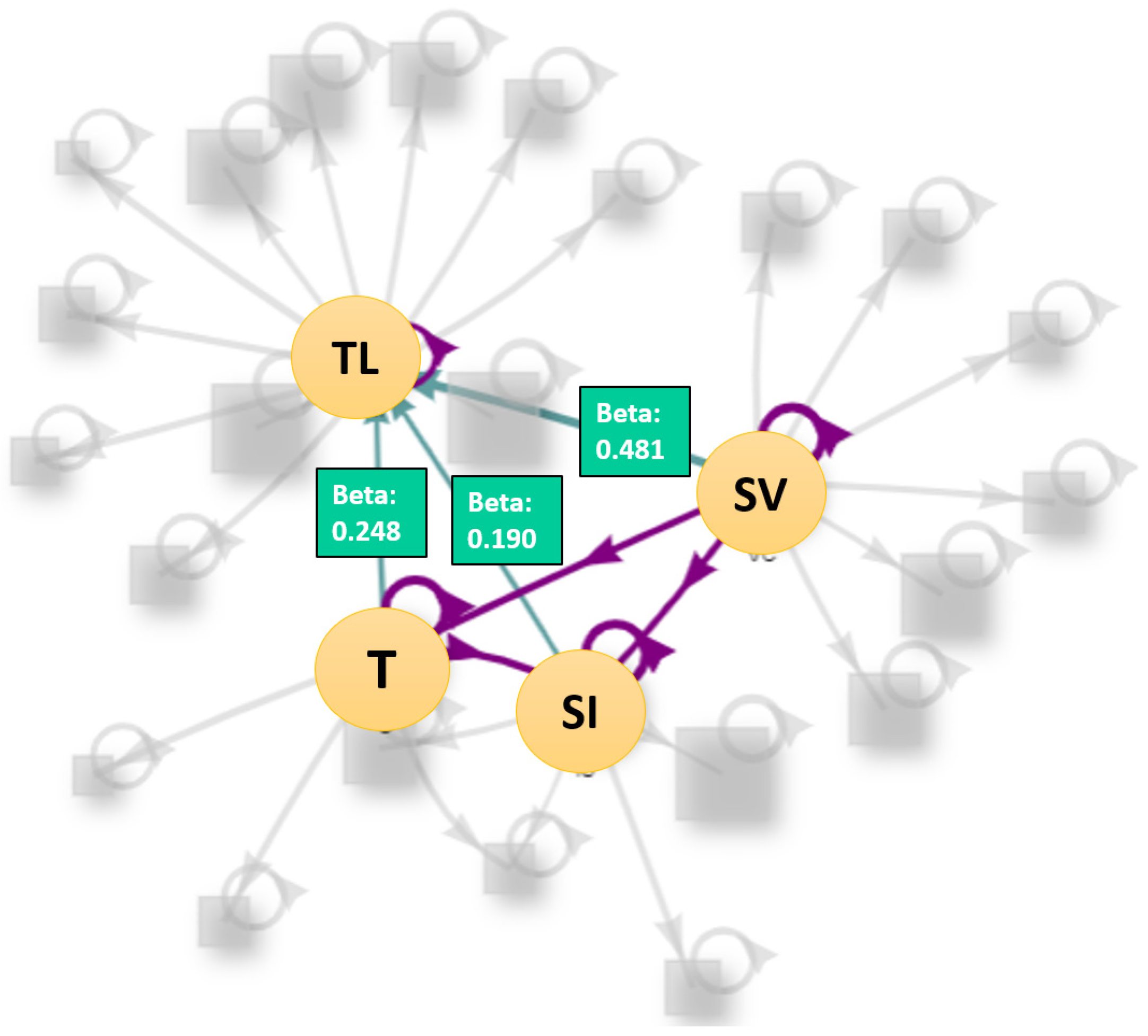
- Fourth: Technological Learning is explained through trust, social interaction, and shared vision.
- 1.
- The structural equations model (SEM) library is charged: library (lavaan).
- 2.
- The data matrix is built based on the correlations’ matrix.
- 3.
- The complete correlation matrix is obtained by first using the getCov to convert the input data matrix (the diagonal above) into a complete matrix. The next conversions were considered: (a) correlations matrix; (b) sds ( ): the typical deviations were represented with NULL because there were none; (c) names ( ): items’ names.
- 4.
- The names of the tangible variables were checked to be correctly filled out in the matrix by using the command: matriz.cov.
- 5.
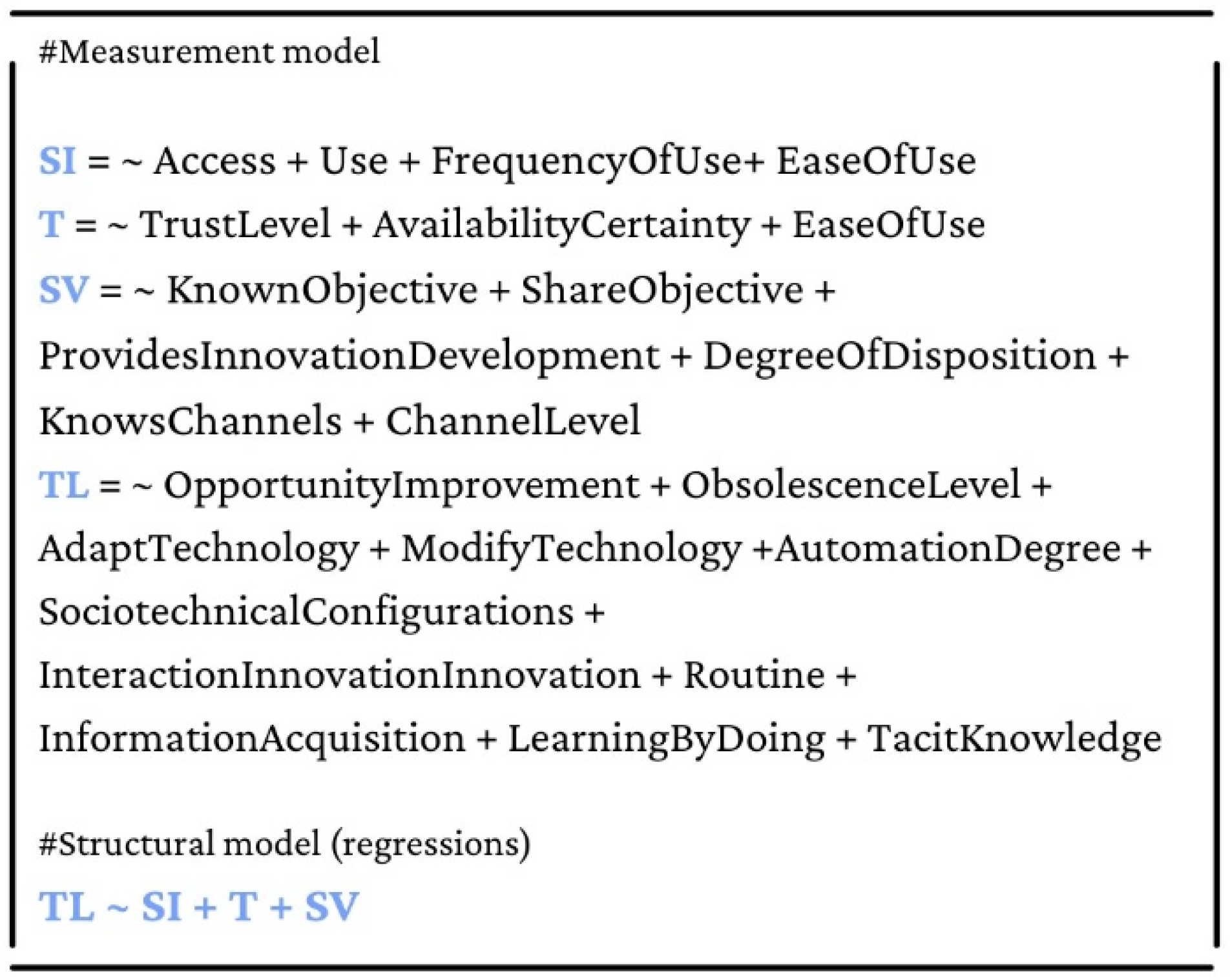
- Once the complete correlation matrix was obtained, the model was specified. This means that the specified conceptual model presented in Figure 2 was translated to build the exploratory measurement model, whose syntax in lavaan was: variable =~ item1 + item2 + item3.
- 6.
- Building the exploratory measurement model considering the relationship between variables was the next step. In this case, it is the direct effects. The syntax for this relationship was: dependent variable ~ var. independent1 + var. independent2. In other words, Technological learning (hereinafter TL) ~ Social interaction (hereinafter SI) + Truth (hereinafter T) + Shared vision (hereinafter SV):TL ~ SI + T + SV
- 7.
- The evaluation and estimation of the model was then done through the development of the software SEMVIZ. v 1.0 [47], which allowed the visualization of SEM analysis and interpretation through the server: http://162.241.38.68:3838/semviz/ (accessed on 21 October 2021). The step-by-step process for the application was:
- The CVS the normalized data file and the labels file were charged in the “Data Gestion SET module” in explicative variables and label sections, correspondingly.
- With the structural measurement model syntaxis, the syntaxis for the software was built. It is important to bear in mind that this latter syntaxis, was constructed in an exploratory manner because there was a tighter relationship between some data and the modeling than other. Some explorations were carried out with groups of tangible variables considered for each group of latent variables. This gave way to the refinement of the syntaxis.
- In the “Specify and Estimate” module, the syntaxis was linked. This one is presented in Figure 4.
- 8.
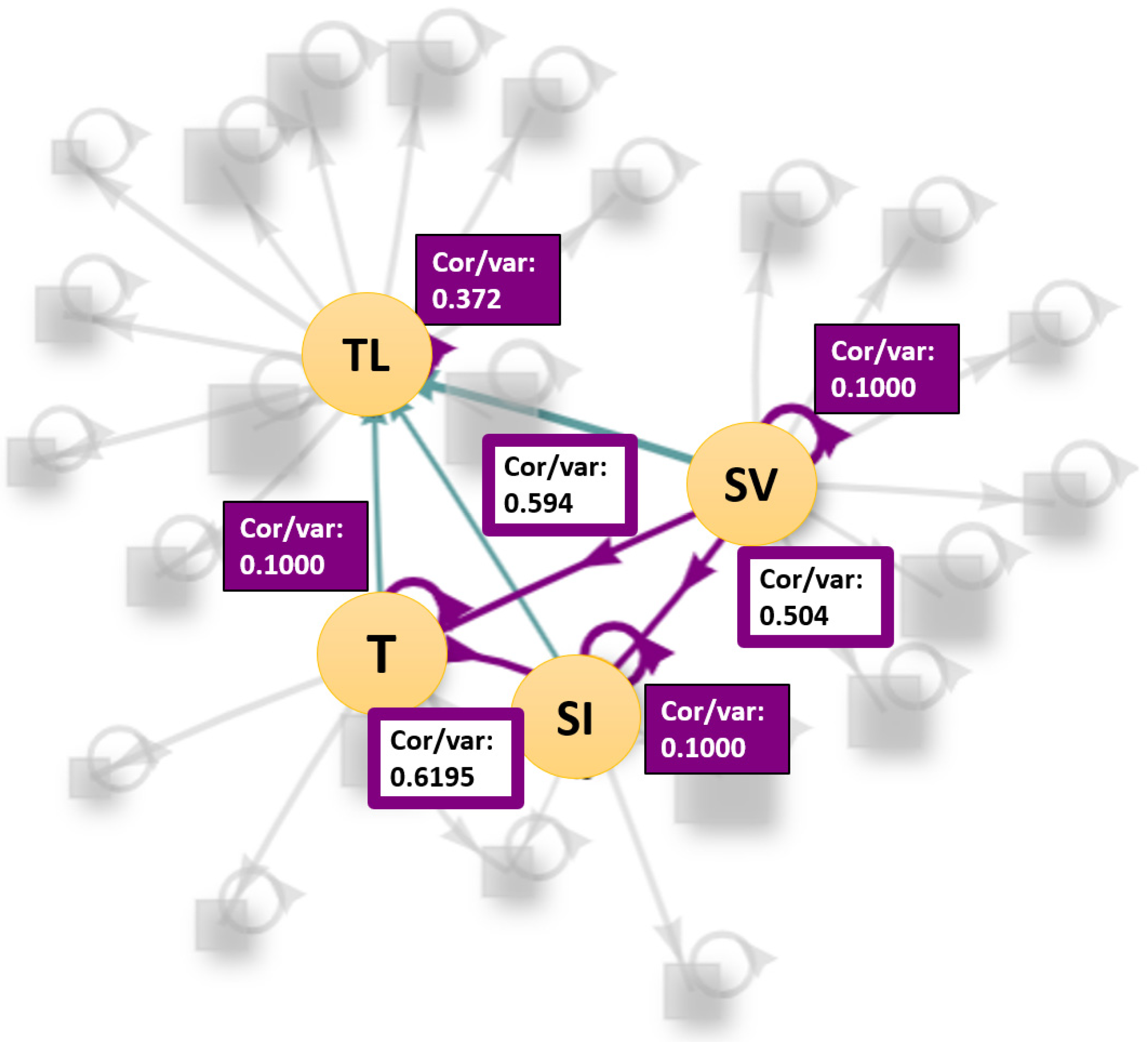
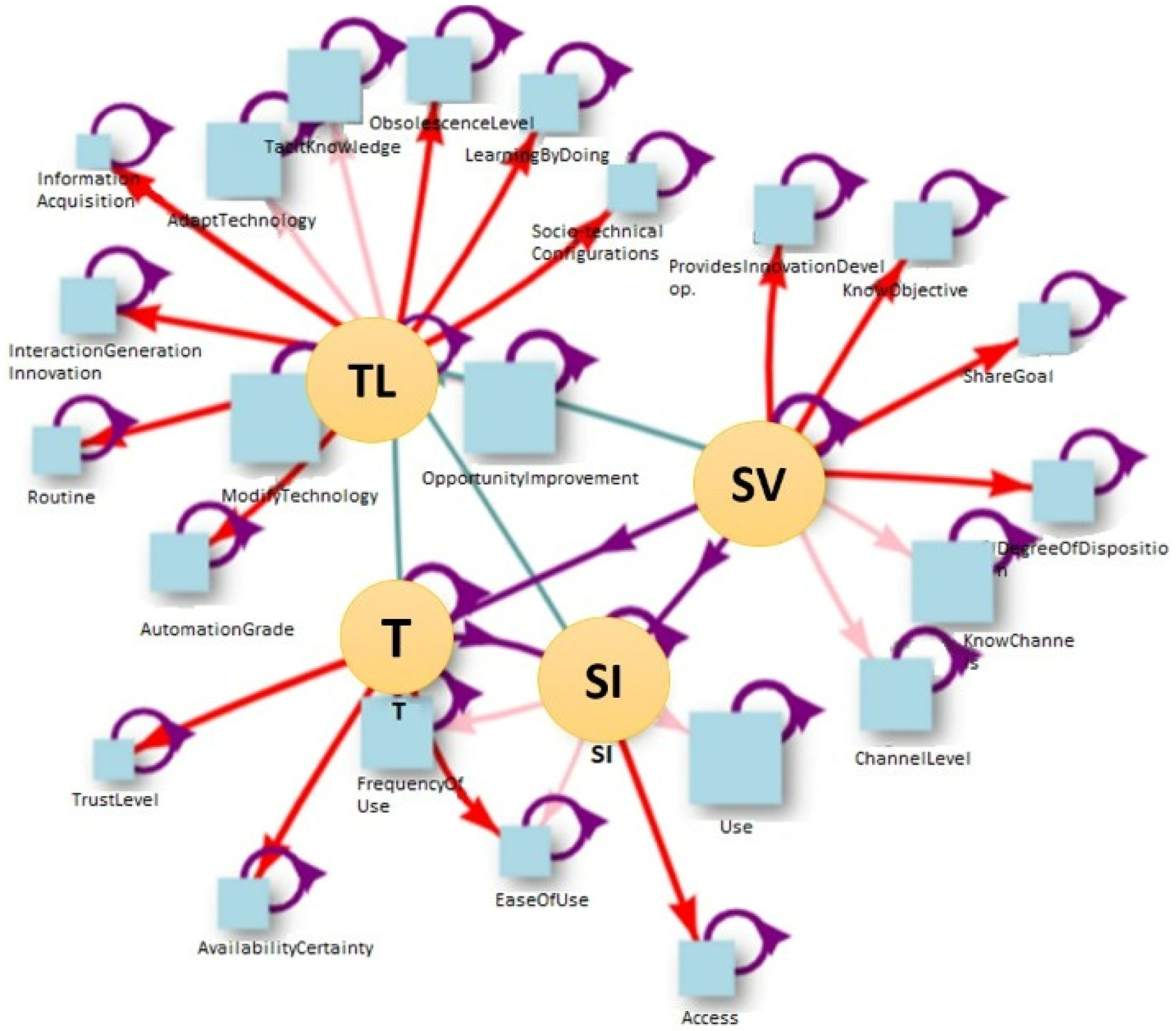
- With the specification and estimation of the syntaxis, it was possible for the software to build a graphic model that represented the relationship between the variables. This graphic model is presented in Figure 5.
3. Results
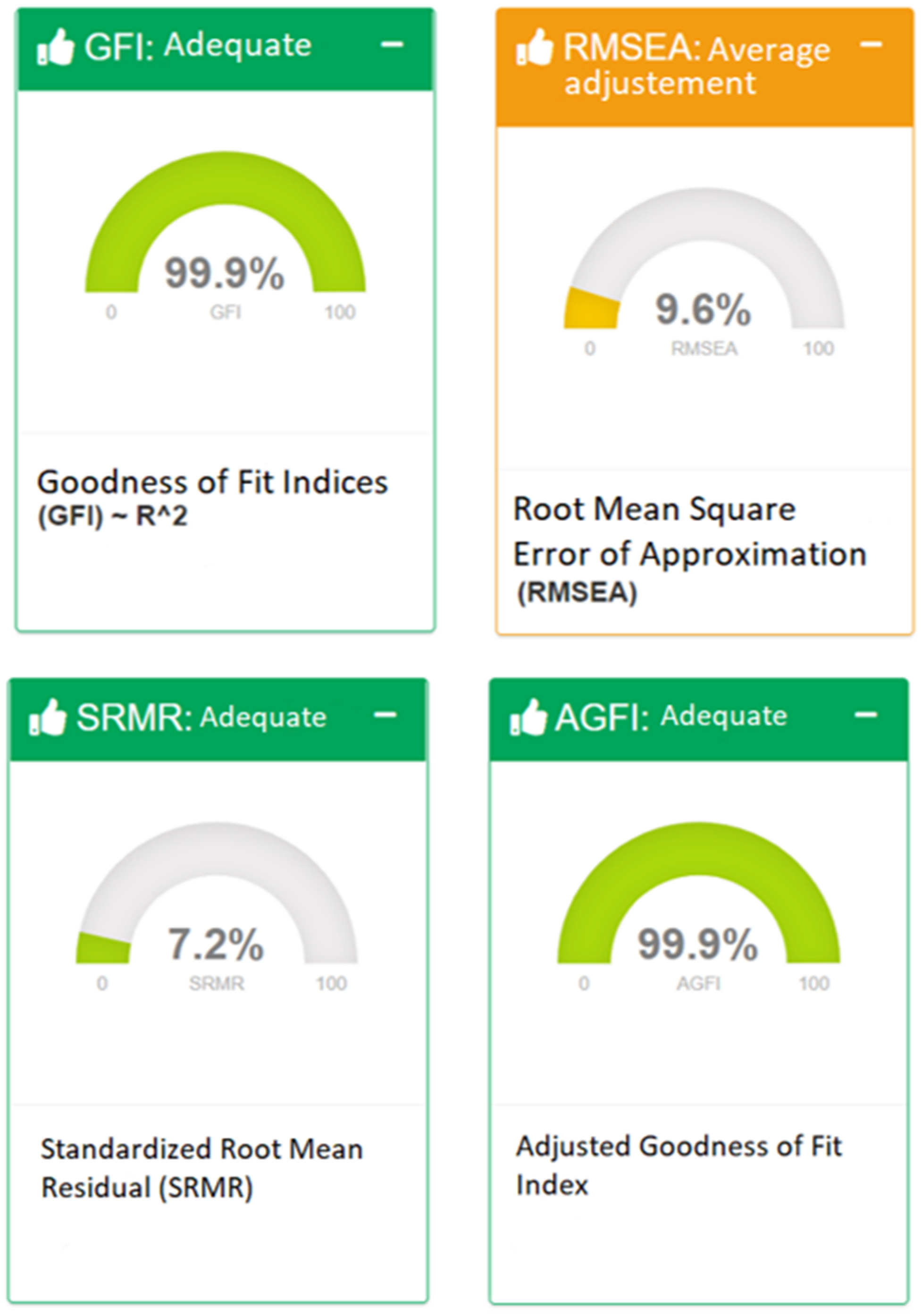
- Goodness of Fit Indices (GFI) ~ R^2. GFI explains the level of variances accounted for by the estimated population variance. In this case, the GFI is adequate as it scored a 0.99, positioning it over 0.95, which is a recommended level [63].
- Root Mean Square Error of Approximation (RMSEA) presented an inferior level to 0.10, which was 0.096, meaning an average adjustment. Even though a level below 0.05 is highly recommended, the model passed the test with the adjustment obtained [64].
- Standardized Root Mean Residual (SRMR) presented a level below 0.08, which is highly recommended, with a score of 0.072. This means the test was approved by the model [65].
- Adjusted Goodness of Fit Index (AGFI) presented a level above 0.90 with 0.99 that allows the model to pass this test [63].
4. Discussion
The Surveillance and Theorization
5. Conclusions
Author Contributions
Funding
Institutional Review Board Statement
Informed Consent Statement
Data Availability Statement
Acknowledgments
Conflicts of Interest
References
- Castells, M. The Informational City: Information Technologies, Economic Restructuring and The Urban Process (La Ciudad Informacional: Tecnologías de La Información, Reestructuración Económica y El Proceso Urbano); Alianza Editorial: Madrid, Spain, 1995. [Google Scholar]
- Sassen, S. The global city: An introduction to the concept and its history. Brown J. Word Aff. 1995, 11, 27–43. [Google Scholar]
- Marcuse, P.; van Kempen, R. Globalizing Cities. A New Spatial Order; Blackwell Publishers: Oxford, UK, 2000. [Google Scholar]
- Veltz, P. Mondialisation, Villes et Territoires. L’economie D’archipe; Presses Universitaires de France: Paris, France, 1996. [Google Scholar]
- Amendiola, G. The Postmodern City. Magic and Fear of the Contemporary Metrópolis (La Ciudad Postmoderna. Magia y Miedo de La metrópolis Contemporánea); Celeste ediciones: Madrid, Spain, 2002. [Google Scholar]
- De Mattos, C.A. Metropolization and suburbanization (Metropolización y suburbanización). EURE 2001, 27, 5–8. [Google Scholar] [CrossRef]
- Soja, E.W. Postmetropolis: Critical Studies of Cities and Regions; Blackwell of World Affairs: Oxford, UK, 2001. [Google Scholar]
- Heineberg, H. Metropolis in the Globalization Process (Las Metrópolis en el Proceso de Globalización) Revista Bibliográfica de Geografía y Ciencias Sociales; Universidad de Barcelona: Barcelona, 2005; pp. 1–23. [Google Scholar]
- Mitchell, W. Smart Cities (Ciudades Inteligentes); Uocpaper, Universitat Oberta de Catalunya: Barcelona, Spain, 2007. [Google Scholar]
- Puig, T. City Bran; Paidos: Madrid, Spain, 2009. [Google Scholar]
- Naam, T.; Pardo, T. Conceptualizing smart city with dimensions of technology, people, and institutions. ACM Int. Conf. Proceeding Ser. 2011, 282–291. [Google Scholar] [CrossRef]
- Sarmiento, J.R. (October–January) The human component of smart cities (El componente humano de las smart cities). Rev. TELOS 2017, 105, 1–11. [Google Scholar]
- Giffinger, R.; Gudrun, H. Smart cities ranking: An effective instrument for the positioning of the cities? ACE Arch. City Environ. 2010, 4, 7–26. [Google Scholar] [CrossRef]
- Hollands, R.G. Will the real smart city please stand up? City 2008, 12, 303–320. [Google Scholar] [CrossRef]
- Harrison, C.; Eckman, B.; Hamilton, R.; Hartswick, P.; Kalagnanam, J.; Williams, P. Foundations for Smarter Cities. IBM J. Res. Dev. 2010, 54, 1–16. [Google Scholar] [CrossRef]
- Caragliu, A.; Del Bo, C.; Nijkamp, P. Smart Cities in Europe. J. Urban Technol. 2021, 18, 65–82. [Google Scholar] [CrossRef]
- Schaffers, H.; Komninos, N.; Pallot, M.; Trousse, B.; Nilsson, M.; Oliveira, A. Smart cities and the future internet: Towards cooperation frameworks for open innovation. In The Future Internet Assembly; Springer: Berlin, Germany, 2011; pp. 431–446. [Google Scholar]
- Chourabi, H.; Nam, T.; Walker, S.; Gil-Garcia, J.R.; Mellouli, S.; Nahon, K.; Pardo, T.A.; Scholl, H.J. Understanding smart cities: An integrative framework. In Proceedings of the 2012 45th Hawaii International Conference on System Science, Maui, HI, USA, 4–7 January 2012; pp. 2289–2297. [Google Scholar]
- European Commission: Digital Agenda for Europe. Smart Cities: A Europe 2020 Initiative. Available online: https://ec.europa.eu/info/eu-regional-and-urban-development/topics/cities-and-urban-development/city-initiatives/smart-cities_en (accessed on 8 March 2022).
- Mocholí, A. Smartcities’ for Smart Citizens. 2016. Available online: http://anamocholi.com/smartcities-paraciudadanos-inteligentes/ (accessed on 4 October 2019).
- Sikora-Fernández, D. Smart city development factors (Factores de desarrollo de las ciudades inteligentes). Rev. Univ. De Geogr. 2017, 26, 135–152. Available online: https://www.researchgate.net/publication/318662037_Factores_de_desarrollo_de_las_ciudades_inteligentes (accessed on 5 October 2019).
- Valderrama, N. Smart Cities. Basic Concepts; Universidad de Manizales: Manizales, Colombia, 2017. [Google Scholar]
- Renard, L.; St-Amand, G. Capacité, capacité organisationnelle et capacité dynamique: une proposition de définitions. Les Cah. Du Manag. Technol. 2003, 13, 43–56. [Google Scholar]
- Portes, A. Social Capital: Its Origins and Applications in Modern Sociology. Annu. Rev. Sociol. 1998, 24, 1–24. [Google Scholar] [CrossRef]
- Kennan, W.R.; Hazleton, V. Internal public relations, social capital, and the role of effective organizational communication. In Public Relations Theory II; En, C.H., Botan, V.H., Eds.; Lawrence Erlbaum: Mahwah, NJ, USA, 2006; pp. 311–338. [Google Scholar]
- Membiela, M.E. Social Capital, Relational Goods and Revealed Subjective Well-Being. A Contrast of Lin’s Model (Capital Social, Bienes Relacionales y Bienestar Subjetivo Revelado. Una Contrastación del Modelo de Lin); Universidade da Coruña: Coruña, Spain, 2015. [Google Scholar]
- Cimoli, M.; Dosi, G. Tecnología y Desarrollo. Algunas Consideraciones Sobre Los Recientes Avances en La Economía de La In-Novación. El Cambio Tecnológico Hacia El Nuevo Milenio, Debates y Nuevas Teorías; Icaria-Fuhem: Barcelona, Spain, 1992. [Google Scholar]
- Dollinger, M.J. Entrepreneurship: Strategies and Resources; Irwin: Boston, MA, USA, 1995. [Google Scholar]
- Malerba, F. Learning by Firms and Incremental Technical Change. Econ. J. 1992, 102, 845. [Google Scholar] [CrossRef]
- Von Hippel, E.; Tyre, M.J. How learning by doing is done: Problem identification in novel process equipment. Res. Policy 1995, 24, 1–12. [Google Scholar] [CrossRef]
- International Institute for Management Development. Smart City Index; IMD ORG: Suiza, Singapore, 2020. [Google Scholar]
- Escobedo, M.T.; Hernández, J.Á.; Estebané, V.; Martínez, G. Structural Equation Models: Characteristics, Phases, Construction, Application and Results. (Modelos de Ecuaciones Estructurales: Características, Fases, Construcción, Aplicación y Resultados); Universidad Autónoma de ciudad Juárez: Chihuahua, Mexico, 2015. [Google Scholar]
- Hair, J.F.; Risher, J.J.; Sarstedt, M.; Ringle, C.M. When to use and how to report the results of PLS-SEM. Eur. Bus. Rev. 2019, 31, 2–24. [Google Scholar] [CrossRef]
- Xavier, N.; Oliveira, T. Factors affecting behavioural intention to adopt e-participation: Extending the UTAUT 2 model. In Proceedings of the European Conference on IS Management and Evaluation (ECIME), Evora, Portugal; 2016; pp. 322–325. [Google Scholar]
- Sepasgozar, S.M.; Hawken, S.; Sargolzaei, S.; Foroozanfa, M. Implementing citizen centric technology in developing smart cities: A model for predicting the acceptance of urban technologies. Technol. Forecast. Soc. Chang. 2018, 142, 105–116. [Google Scholar] [CrossRef]
- De Guimarães, J.C.F.; Severo, E.A.; Júnior, L.A.F.; Da Costa, W.P.L.B.; Salmoria, F.T. Governance and quality of life in smart cities: Towards sustainable development goals. J. Clean. Prod. 2020, 253, 119926. [Google Scholar] [CrossRef]
- Lombardo, G.; Mordonini, M.; Tomaiuolo, M. Adoption of Social Media in Socio-Technical Systems: A Survey. Information 2021, 12, 132. [Google Scholar] [CrossRef]
- Bhattarai, K.; Conway, D. Urban Growth. In Contemporary Environmental Problems in Nepal; Springer: Cham, Switzerland, 2020; pp. 201–334. [Google Scholar] [CrossRef]
- Hajduk, S. Using multivariate statistical methods to assess the urban smartness on the example of selected European cities. PLoS ONE 2020, 15, e0240260. [Google Scholar] [CrossRef]
- Fortino, G.; Fotia, L.; Messina, F.; Rosaci, D.; Sarné, G. A meritocratic trust-based group formation in an IoT environment for smart cities. Future Gener. Comput. Syst. 2020, 108, 34–45. [Google Scholar] [CrossRef]
- Mukhametov, D. Smart city: From the metaphor of urban development to innovative city management. TEM J. 2019, 8, 1247–1251. [Google Scholar] [CrossRef]
- Israilidis, J.; Odusanya, K.; Mazhar, M.U. Knowledge Management in Smart City Development: A Systematic Review. In Proceedings of the 20th European Conference on Knowledge Management, Universidade Europeia de Lisboa, Lisbon, Portugal, 5–6 September 2019. [Google Scholar] [CrossRef]
- Esmalian, A.; Ramaswamy, M.; Rasoulkhani, K.; Mostafavi, A. Agent-Based Modeling Framework for Simulation of Societal Impacts of Infrastructure Service Disruptions during Disasters. ASCE Comput. Civ. Eng. Workshop 2019, 16–23. [Google Scholar] [CrossRef]
- Molnár, S. Community informatics tools relating to smart city developments: Social software, online participation, crowdsourcing. [Az okos város fejlesztesekhcz kapcsolódó közösségi i n form at i kai eszközök: Társadalmi szoftver, online participáció, crowdsourcing]. Inf. Tarsad. 2016, 16, 101–112. [Google Scholar] [CrossRef][Green Version]
- Tawalbeh, L.A.; Basalamah, A.; Mehmood, R.; Tawalbeh, H. Greener and Smarter Phones for Future Cities: Characterizing the Impact of GPS Signal Strength on Power Consumption. IEEE Access 2016, 4, 858–868. [Google Scholar] [CrossRef]
- Valetto, G.; Bucchiarone, A.; Geihs, K.; Büscher, M.; Petersen, K.; Nowak, A.K.; Rychwalska, A.; Pitt, J.; Shalhoub, J.; Rossi, F.; et al. All Together Now: Collective Intelligence for Computer-Supported Collective Action. In Proceedings of the 2015 IEEE International Conference on Self-Adaptive and Self-Organizing Systems Workshops, Cambridge, MA, USA; 2015; pp. 13–18. [Google Scholar] [CrossRef]
- Giovannella, C.; Iosue, A.; Tancredi, A.; Cicola, F.; Camusi, A.; Moggio, F.; Coco, S. Scenarios for active learning in smart territories. Interact. Des. Archit. 2013, 16, 7–16. [Google Scholar]
- Perillo, G. Smart models for a new participatory and sustainable form of governance. WIT Trans. Ecol. Environ. 2013, 179, 1227–1236. [Google Scholar] [CrossRef]
- Uzzi, B. The Sources and Consequences of Embeddedness for the Economic Performance of Organizations: The Network Effect. Am. Sociol. Rev. 1996, 61, 674. [Google Scholar] [CrossRef]
- Portes, A.; Sensenbrenner, J. Embeddedness and Immigration: Notes on the Social Determinants of Economic Action. Am. J. Sociol. 1993, 98, 1320–1350. [Google Scholar] [CrossRef]
- Granovetter, M.S. Problems of Explanation in Economic Sociology. In Networks and Organizations: Structure, Form, and Action; Nohria, N.R.E., Ed.; Harvard Business School Press: Boston, MA, USA, 1992; pp. 25–26. [Google Scholar]
- Lindenberg, S. Constitutionalism versus Relationalism: Two Views of Rational Choice Sociology; Falmer Press: London, UK, 1996; pp. 299–311. [Google Scholar]
- Hakansson, H.; Snehota, I. Developing Relationships in Business Networks; Routledge: London, UK, 1995. [Google Scholar]
- Penrose, E. The Theory of the Growth of the Firm; John Wiley: New York, NY, USA, 1959. [Google Scholar]
- Coleman, J.S. Foundations of Social Theory; Harvard University Press: Cambridge, UK, 1992. [Google Scholar]
- Dutrénit, G. Learning and Knowledge Management in the Firm. From Knowledge Accumulation to Strategic Capabilities; Edward Elgar: Cheltenham, UK, 2000. [Google Scholar]
- Quintero, S.; Giraldo, D.P. El Aprendizaje en Los Sistemas Regionales de Innovación Desde la Perspectiva de la Modelación Basada en Agentes; Universidad Pontificia Bolivariana: Medellín, Colombia, 2018. [Google Scholar]
- Rafi Khan, S. Learning from South Asian Successes: Tapping social Capital. South Asian Econ. J. 2006, 7, 157–178. [Google Scholar] [CrossRef]
- Albert, M.; Kleinman, D.L. Bringing Pierre Bourdieu to Science and Technology Studies. Minerva A Rev. Sci. Learn. Policy 2011, 49, 263–273. [Google Scholar] [CrossRef]
- Ivanova, A.S.; Holionko, N.G.; Tverdushka, T.B.; Olejarz, T.; Yakymchuk, A.Y.; Kiev National Economic University named after Vadim Hetman; International Institute of Business (IIB); Rzeszow University of Technolog y Rzeszow; National University of Water and Environmental Engineering. The Strategic Management in Terms of an Enterprise’s Technological Development. J. Compet. 2019, 11, 40–56. [Google Scholar] [CrossRef]
- Tsai, W.; Ghoshal, S. Social Capital and Value Creation. The role of intrafirm networks. Acad. Manag. J. 1998, 41, 464–476. [Google Scholar]
- Quintero, S. Resources and Capabilities as Key Elements of Learning. Ph.D. Dissertation, Universidad Nacional, Medellín, Colombia, 2016. [Google Scholar]
- Jöreskog, K.G.; Sörbom, D. LISREL V: Analysis of Linear Structural Relationships by Maximum Likelihood and Least Squares Methods; National Educational Resources: Chicago, IL, USA, 1981. [Google Scholar]
- Steiger, J.H.; Lind, J.C. Statistically Based Tests for the Number of Common Factors; Psychometric Society Annual Meeting: Iowa City, IA, USA, 1980. [Google Scholar]
- Bentler, P.M. Theory and Implementation of EQS, a Structural Equations Program; BMDP Statistical Software: Los Angeles, CA, USA, 1985. [Google Scholar]
- Pérez, M. Aplicación SEMVIZ. 2019. v 1.0. Available online: http://162.241.38.68:3838/semviz/ (accessed on 21 October 2021).
- Zona-Ortiz, A.T.; Fajardo-Toro, C.H.; Pirachicán, C.M.A. Propuesta de un marco general para el despliegue de ciudades inteligentes apoyado en el desarrollo de Iot en Colombia. Rev. Ibérica Sist. Tecnol. Inf. 2020, 28, 894–907. [Google Scholar]





| Technique | Mainly Exploratory (Predictive) | Mainly Confirmatory (Evidential or Explanatory) |
|---|---|---|
| First generation Techniques | Cluster analysis, exploratory factor analysis, multidimensional scaling | Analysis of variance, logistic regression, multiple logistic regression, confirmatory factor analysis. |
| Second generation Techniques | PLS-SEM | CB-SEM |
| ID. | Search Formulas | Number of Results | Authors |
|---|---|---|---|
| 1 | (TITLE-ABS-KEY (“Social Capital” AND “SEM Model” AND “Smart City”) | Does not return results | Does not apply |
| 2 | (TITLE-ABS-KEY (“Social Capital”) AND TITLE-ABS-KEY (“Partial Least Squares Structural Equation”) AND TITLE-ABS-KEY (“Smart City”) AND TITLE-ABS-KEY (modeling)) | Does not return results | Does not apply |
| 3 | (TITLE-ABS-KEY (“Social Capital”) AND TITLE-ABS-KEY (“Partial Least Squares Structural Equation”) AND TITLE-ABS-KEY (“Smart City”) AND TITLE-ABS-KEY (modeling)) | Does not return results | Does not apply |
| 4 | TITLE-ABS-KEY (“Social Capital” AND SEM AND model AND “Smart City”) | One (1) result | Xavier. and Oliveira T. [34]. |
| 5 | (TITLE-ABS-KEY (“Social Capital”) AND TITLE-ABS-KEY (“Partial Least Squares”) AND TITLE-ABS-KEY (“Smart City”) AND TITLE-ABS-KEY (modeling)) | One (1) result | Xavier. and Oliveira T. [34]. |
| 6 | (TITLE-ABS-KEY (“Social Capital”) AND TITLE-ABS-KEY (“PLS-SEM”) AND TITLE-ABS-KEY (“Smart City”)) | One (1) result | Xavier. and Oliveira T. [34]. |
| 7 | (TITLE-ABS-KEY (“Social Capital”) AND TITLE-ABS-KEY (“PLS-SEM”) AND TITLE-ABS-KEY (“Smart City”) AND TITLE-ABS-KEY (model)) | One (1) result | Xavier. and Oliveira T. [34]. |
| 8 | (TITLE-ABS-KEY (“Social Capital”) AND TITLE-ABS-KEY (“Partial Least Squares”) AND TITLE-ABS-KEY (“Smart City”) AND TITLE-ABS-KEY (modeling) AND TITLE-ABS-KEY (“technological learning”)) | Does not return results | Does not apply |
| 9 | (TITLE-ABS-KEY (“Social Capital”) AND TITLE-ABS-KEY (“Partial Least Squares”) AND TITLE-ABS-KEY (“Smart City”) AND TITLE-ABS-KEY (“technological learning”)) | Does not return results | Does not apply |
| 10 | (TITLE-ABS-KEY (“Social Capital”) AND TITLE-ABS-KEY (“PLS-SEM”) AND TITLE-ABS-KEY (“Smart City”) AND TITLE-ABS-KEY (“technological learning”)) | Does not return results | Does not apply |
| 11 | (TITLE-ABS-KEY (“Social Capital”) AND TITLE-ABS-KEY (model) AND TITLE-ABS-KEY (“Smart City”) AND TITLE-ABS-KEY ("technological learning")) | Does not return results | Does not apply |
| 12 | (TITLE-ABS-KEY (“Social Capital”) AND TITLE-ABS-KEY (“Smart City”) AND TITLE-ABS-KEY (“technological learning”)) | Does not return results | Does not apply |
| 13 | (TITLE-ABS-KEY (“Social Capital”) AND TITLE-ABS-KEY (“Smart City”) AND TITLE-ABS-KEY (“technological learning”) AND TITLE-ABS-KEY (modelling)) | Does not return results | Does not apply |
| 14 | TITLE-ABS-KEY (“Social Capital” AND “Structural equation modeling” AND “Smart City”) | Two (2) results | Sepasgozar, Hawken, Sargolzaei, Foroozanfa [35]; De Guimarães, Severo, Felix Junior, Da Costa, Salmoria, [36] |
| 15 | TITLE-ABS-KEY (“Social Capital” AND model AND “Smart City”) | Fifteen (15) results | Lombardo, Mordonini, and Tomaiuolo [37]; Bhattarai, and Conway [38]; Hajduk, [39]; Fortino, Fotia, Messina, Rosaci, and Sarné [40]; Mukhametov, [41]; Sepasgozar, Hawken, Sargolzaei, and Foroozanfa. [35]; Israilidis, Odusanya, and Mazhar [42]; Esmalian, Ramaswamy, Rasoulkhani, and Mostafavi [43]; Szilard [44]; Xavier and Oliveira [34]; Tawalbeh, Basalamah, Mehmood, and Tawalbeh [45]; Valetto, Bucchiarone, Geihs, Busche, Petersen, Nowak, Bernardeschi [46]; Giovannella, Iosue, Tancredi, Cicola, Camusi, Moggio, Coco [47]; Perillo [48]. |
| Construct | Systemic Treatment | Authors |
|---|---|---|
| Social Capital | Social Capital holders | Portes [24]. |
| Social Capital sources | Portes [24]. | |
| Social Capital resources | Portes [24]. |
| Construct | Moderating Variable | Latent Variable | Authors |
|---|---|---|---|
| Social Capital | |||
| The capability from which a social structure obtains benefits [24,25]. | Social capital resources | Social interaction | Granovetter [51]; Lindenberg [52]; Hakansson and Snehota [53] |
| Social capital resources | Trust | Uzzi [50] | |
| Social capital resources | Shared vision | Portes and Sensenbrenner [49]; Coleman [55]. | |
| Technological learning | |||
| Integrated process of information acquisition that improves the accumulation of knowledge and capabilities | Social Capital sources | Technological learning | Malerba [29]; Von Hippel and Tyre [30] Dutrénit [56]; Quintero and Giraldo [57] Rafi Khan [58]; Albert and Kleinman [59]; Ivanova, Holionko, Tverdushka, Olejarz y Yakymchuk [60]; Dollinger [28]; Mitchell [9]. |
| Observable Variable | Key | Question | Authors | Latent Variable | Moderating Variable |
|---|---|---|---|---|---|
| X1: technological system knowledge | Knows | Have you seen, listened, or known about the bicycle shared system EnCicla? | Tsai and Ghoshal [61]. | Social interaction | Social capital resources |
| X.2: … | Access | … | … | … | … |
| X N: … | … | …. | …. | … | … |
| X 24. Routine | Routine | Has the frequent use of the bicycle system allowed you to learn about the functioning of it? | Quintero [62]. | Technological Learning | Social Capital Holders |
| X31: … | … | … | … | … | … |
| No. Range | Range | Quantity of Users per Age Range | % of Users per Age Range |
|---|---|---|---|
| 1 | 17–24 | 19,886 | 18.74 |
| 2 | 25–40 | 60,033 | 56.56 |
| 3 | 41–62 | 22,867 | 21.54 |
| 4 | 63–< | 3353 | 3.16 |
| 106,139 | 100 |
| No. Range | Age Range | Quantity of Surveyed | % of Surveyed Users per Age Range (Sample) | % of EnCicla Users per Age Range (Universe) |
|---|---|---|---|---|
| 1 | 17–24 | 129 | 18.75 | 18.74 |
| 2 | 25–40 | 389 | 56.54 | 56.56 |
| 3 | 41–62 | 148 | 21.51 | 21.54 |
| 4 | 63–< | 22 | 3.20 | 3.16 |
| 688 | 100 | 100 |
Publisher’s Note: MDPI stays neutral with regard to jurisdictional claims in published maps and institutional affiliations. |
© 2022 by the authors. Licensee MDPI, Basel, Switzerland. This article is an open access article distributed under the terms and conditions of the Creative Commons Attribution (CC BY) license (https://creativecommons.org/licenses/by/4.0/).
Share and Cite
Mejia, J.; Manotas, E.C.; Quintero, S. Analysis of the Social Capital in a Technological System of a Smart City Using a PLS-SEM Model. Sustainability 2022, 14, 11238. https://doi.org/10.3390/su141811238
Mejia J, Manotas EC, Quintero S. Analysis of the Social Capital in a Technological System of a Smart City Using a PLS-SEM Model. Sustainability. 2022; 14(18):11238. https://doi.org/10.3390/su141811238
Chicago/Turabian StyleMejia, Juliana, Eva Cristina Manotas, and Santiago Quintero. 2022. "Analysis of the Social Capital in a Technological System of a Smart City Using a PLS-SEM Model" Sustainability 14, no. 18: 11238. https://doi.org/10.3390/su141811238
APA StyleMejia, J., Manotas, E. C., & Quintero, S. (2022). Analysis of the Social Capital in a Technological System of a Smart City Using a PLS-SEM Model. Sustainability, 14(18), 11238. https://doi.org/10.3390/su141811238