


Abstract
The traditional multiple input multiple output (MIMO) systems cannot provide very high Spectral Efficiency (SE), Energy Efficiency (EE), and link reliability, which are critical to guaranteeing the desired Quality of Experience (QoE) in 5G and beyond 5G wireless networks. To bridge this gap, ultra-dense cell-free massive MIMO (UD CF-mMIMO) systems are exploited to boost cell-edge performance and provide ultra-low latency in emerging wireless communication systems. This paper attempts to provide critical insights on high EE operation and power control schemes for maximizing the performance of UD CF-mMIMO systems. First, the recent advances in UD CF-mMIMO systems and the associated models are elaborated. The power consumption model, power consumption parts, and energy maximization techniques are discussed extensively. Further, the various power control optimization techniques are discussed comprehensively. Key findings from this study indicate an unprecedented growth in high-rate demands, leading to a significant increase in energy consumption. Additionally, substantial gains in EE require efficient utilization of optimal energy maximization techniques, green design, and dense deployment of massive antenna arrays. Overall, this review provides an elaborate discussion of the research gaps and proposes several research directions, critical challenges, and useful recommendations for future works in wireless communication systems.
1. Introduction
The prevalence of massive devices and mobile applications has recently gained widespread popularity in the wireless communication domain. The dramatic rate variations and inter-cell interference inherent in classical cell-based structures impose a heavy burden on the existing wireless network infrastructure [1]. As a result, ultra-dense cell-free massive multiple input multiple output (UD CF-mMIMO) has been identified as a candidate wireless networking technology to cater to the continuous data traffic surge, remedy the cell-edge performance issues, and guarantee unprecedented wireless network link reliability [2]. However, the transitioning towards tetherless connectivity for a fully mobile-networked society, achieving multiple orders of Energy Efficiency (EE) gains and quality throughput, poses an increasingly important design criterion.
The real-time requirements of connected devices and capacity demands of the current wireless network infrastructure are increasing rapidly. The landscape of upcoming wireless networks is envisaged to support pervasive interconnectivity, high transmission rates, ultra-reliability, and low latency, spurring novel information and communication technologies (ICT) and revolutionary ultra-dense (UD) wireless infrastructure [3]. The envisioned next-generation wireless communication systems will integrate virtually everything into the internet while accommodating novel technologies like virtual reality [4,5], machine-to-machine (M2M) communications [6,7,8], vehicle-to-everything (V2X) [9], and device-to-device (D2D) communications [10].
Essentially, the next-generation wireless networks will rely on the availability of higher frequency bands, which brings more opportunities for multi-gigabit throughput and extreme capacity [11,12,13,14]. Ultra-dense networks (where the density of the base stations (BSs) is much higher than that of the network users) and/or massive multiple input multiple output (mMIMO) (where large antenna arrays enhance the BSs) have been identified as enabling technology to satisfy the vast requirements of next-generation wireless networks [2]. However, the service-quality variations and cell-edge issues inherent in the traditional cellular network architecture pose a significant bottleneck for the mobile network operators [1,15].
Cell-free massive multiple input multiple output (CF-mMIMO), a practical incarnation of distributed mMIMO, has become an intensive research topic in industry and academia. CF-mMIMO can potentially mitigate significant pathloss variations and cell-edge performance issues inherent in conventional cellular networks [16,17,18,19,20,21]. Despite the enormous merits of CF-mMIMO, the outcry for environment-friendly designs and greener networking solutions is alarming [22]. Adopting a distributed antenna array in CF-mMIMO systems could dramatically increase the power consumption and the overall energy emissions of wireless communication systems [23].
Consequently, the geometric outburst of digital signal processing (DSP) power consumption, prohibitive radio-frequency (RF) circuit power costs, and energy costs of data processing units have become a critical concern for mobile network operators [24]. As such, Energy Efficiency (EE), expressed in bits/joule, has emerged as a dominant performance index for benchmarking wireless communication systems [25]. Depicted in Figure 1 is a typical illustration of the next-generation communication system. In this configuration, a dearth of user equipment (UE) is jointly served by a large chunk of arbitrarily allocated access points (APs), all connected to a central processing unit (CPU) that handles complex signal processing [10,26].
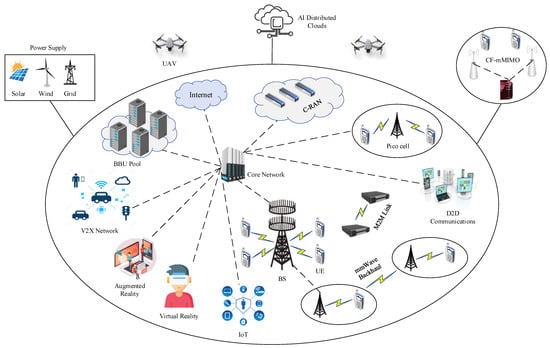
Figure 1.
Illustration of a typical next-generation communication system.
Gracia-Morales et al. [27] proposed an insightful switch on/off algorithm to minimize the global carbon footprint emanating from cellular network equipment. Ahmed et al. [28] characterized the network capacity, energy efficiency, and design constraints of UD infrastructure. Similarly, Dai and Yu [29] proposed the implementation of precoding techniques to improve the EE performance of CF-mMIMO. Nguyen et al. [30] investigated the uplink EE of CF-mMIMO by introducing a novel closed-form algorithm with a zero-forcing (ZF) precoder to resolve a multi-objective total EE maximization problem. In another related study, Hamdi and Qaraqe [31] considered the feasibility of incorporating energy harvesting and energy exchange capabilities into CF-mMIMO networks.
Power control in CF-mMIMO is of particular interest and a significant figure of merit to optimize the network performance and realize uniform quality of service (QoS) for all users, including those at the cell-edge [32]. Moreover, power control techniques are essential to deal with interference and pilot contamination issues inherent in CF architectures [33]. Results from existing reports on the actual performance of CF-mMIMO with power control optimization techniques, reveal that proper power allocation can greatly improve the net throughput, max-min fairness, spectral efficiency (SE), and EE of CF-mMIMO systems [34,35,36,37,38]. More precisely, Ngo et al. [39] demonstrated that max-min power control could moderately improve the lowest user throughput. Andrea et al. [40] illustrated a deep learning-based power control approach, which is capable of addressing the sum-rate and minimum-rate maximization problem in CF-mMIMO. The results reported in [34] indicate that the EE performance of CF-mMIMO can be enhanced significantly with proper power control. The findings of the work [41] revealed that insightful power allocation algorithms could effectively optimize the sum SE of CF-mMIMO systems.
Nonetheless, the existing works of literature on CF-mMIMO systems lack research attempts that jointly optimize EE and power control. In light of the above, this paper aims to bridge this gap by considering green networking solutions and sustainable power allocation strategies in UD CF-mMIMO systems. In particular, the paper attempts to identify contemporary research trends, unearth key research challenges, and guide future research in this domain. A concise roadmap of this study is presented in Figure 2. The noteworthy contributions of the review paper are outlined as follows:
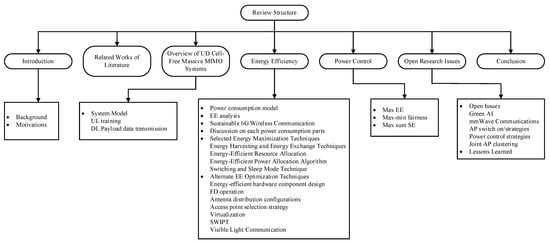
Figure 2.
A comprehensive roadmap of the study.
- ▪
- The fundamental structure of CF-mMIMO and its corresponding system model is described.
- ▪
- A panoramic view of the power consumption model and power consumption parts is highlighted.
- ▪
- A comprehensive analysis of selected green communication techniques is discussed.
- ▪
- An exhaustive study of current trends in power control techniques for CF-mMIMO systems is presented.
- ▪
- Critical open research issues are identified, and future research directions for energy-efficient power control schemes in CF-mMIMO systems are elaborated.
The structure of the paper is as follows: Section 2, “Related Work”, discusses prior works on energy-efficient power control schemes in emerging wireless communication networks. Section 3, “Overview of Ultra-Dense Cell-Free Massive MIMO Systems”, summarizes the foundational background on CF-mMIMO systems and the associated system model, including the Uplink (UL) training and Downlink (DL) payload data transmission. Further, the power consumption model, power consumption parts, and an exhaustive analysis of selected EE maximization techniques are presented in Section 4, “Energy Efficiency”. Similarly, insightful power allocation strategies for performance maximization are discussed in Section 5, “Power Control”. Section 6, “Open Research Issues”, provides a clear path for future investigations in wireless communication. Finally, a concise conclusion is drawn in Section 7, “Conclusion”.
2. Related Work
The need to minimize the global carbon footprint and address interference issues associated with wireless communication networks has gained significant, widespread research interest in the past few years. Many innovative green networking techniques, EE maximization schemes, interference detection and mitigation techniques, and connectivity management strategies have been proposed [42,43,44]. The schemes are designed to facilitate efficient wireless networks to meet the growing traffic demand and guarantee the continuous evolution of wireless systems. Specifically, in [45], Tang et al. characterized the EE of simultaneous wireless information and power transfer (SWIPT)-aided non-orthogonal multiple access networks. As a step further, Alageli et al. [46] considered the distinctive combination of CF-mMIMO and SWIPT for energy-efficient wireless communication networks.
As reported by Jin et al. [47], a novel strategy to maximize the sum of SE and total EE by properly allocating DL data power control coefficients and pilot is proposed. Alonzo et al. [38] examined the EE of CF and user-centric (UC) networks with millimeter (mm)-Wave. Hamdi and Qaraqe [48] provide essential design insights for greening wireless networks. Their proposed design was achieved by incorporating energy cooperation and a management approach for CF-mMIMO systems. Wang et al. [49] proposed an insightful AP selection technique and an optimal power allocation algorithm to maximize the total EE of CF-mMIMO. Furthermore, a computationally efficient convex conic feasibility checking problem is proposed in [50] to solve the problem of max-min power control in CF-mMIMO networks.
Nikbakht and Lozano [51] proposed a fractional power control policy to maximize the UL performance of CF-mMIMO systems. Interestingly, Zhao et al. [52] advocated using an optimized DL power control algorithm to jointly maximize the SE of 95% of users and the experience of high-priority users in wireless networks. Lai et al. [53] introduced a novel artificial fish school algorithm to maximize the mean rate of users while realizing the target of max-min power control. Mai et al. [54] explored the possibility of minimizing the effect of pilot contamination and ultimately improving the performance of UL CF-mMIMO systems using a data power control algorithm and a joint pilot design. Following a similar approach, Li et al. [55] formulated a novel pilot assignment algorithm in weighted counting to mitigate the so-called pilot contamination effect in CF wireless networks.
Nevertheless, detailed characterization of energy-efficient wireless communication and power control schemes is integral for designing and optimizing CF-mMIMO networks. Accordingly, this article explores the contemporary perspectives of energy-efficient power control techniques and highlights promising directions for future research in emerging wireless communication systems. Table 1 features the scope and drawbacks of some related research attempts and the authors’ contribution to bridging the research gaps in the current review.

Table 1.
Limitations of some related works.
3. Overview of Ultra-Dense Cell-Free Massive MIMO Systems
In the last decade, the geometric outburst of various innovative communication technologies has been overwhelming. Primarily, mMIMO network architecture has evolved over the years to support the explosive increase in wireless data traffic. In the regime of large-scale antenna arrays at the BSs and by exploiting spatial multiplexing, spatial diversity, and advanced beamforming, a large number of User Equipment (UE) can be served with the same time/frequency resources [3,61]. However, large service-quality variations and cell-edge performance issues constitute a significant setback for the effective deployment of cellular network infrastructure [1]. Thus, UD CF-mMIMO has appeared as a promising network paradigm to cater to the continuous data traffic surge and alleviate the mediocre cell-edge problems inherent in cellular networks [62,63]. In these networks, an excess number of geographically allocated Access Points (APs) coordinated by a Central Processing Unit (CPU) coherently serve a smaller number of UEs distributed across a wide serving area [64].
CF-mMIMO is essentially a practical embodiment of mMIMO and network MIMO, where cooperation between low-complexity APs deployed in a distributed manner helps to potentially minimize the effects of intercell interference and offer considerable gains in coverage probability [16]. As in cellular networks, CF-mMIMO reaps the benefits of channel hardening and favorable propagation through simple signal processing [65]. Moreover, compared with Small-Cells (SCs) and co-located systems, CF-mMIMO promises multifold improvement in SE, EE, and 95% likely per-user throughput [66]. Figure 3 illustrates the fundamental structure of a typical CF-mMIMO network. It comprises the CPU and the associated APs linked via a fronthaul network to the CPU without the intervening cells.
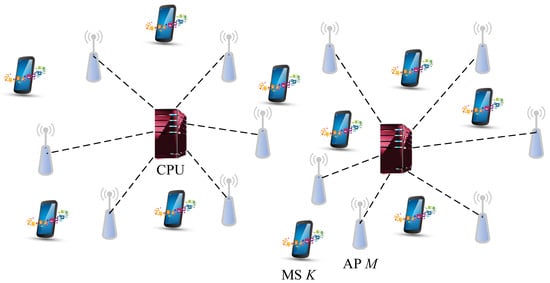
Figure 3.
A Typical Architecture of a Cell-Free Massive MIMO (CF-mMIMO) Network.
3.1. System Model
A CF-mMIMO system operated in time division duplex (TDD) mode is investigated. Let specify the number of randomly deployed single-antenna APs simultaneously serving single-antenna UEs in the same time/frequency block. All APs are linked via a fronthaul network to a CPU, wherein network information is exchanged. Let reflect the channel between the th AP and the th UE. The channel model is defined as (1)
where accounts for the large-scale fading and accounts for the small-scale fading. It is assumed that are independent identically distributed (i.i.d) random variables, for What is more, concerning frequency, coefficients are assumed to be constant and known as a priori at any moment. In this context, two communication protocols—UL training and DL payload data transmission—are analyzed.
3.1.1. Uplink Training
For each coherence interval, let reflect the length of UL training duration and let reflect the pilot sequence forwarded by the th user, Further, we assume that these assigned pilot sequences are mutually orthonormal. for , and , which necessitates that . The th AP receives a pilot signal defined by (2)
where accounts for the normalized transmit signal-to-noise ratio (SNR) and accounts for the additive noise. The received pilot at the th AP is processed as (3)
By adopting the minimum mean squared error (MMSE) technique, the channel is estimated. The channel estimation of is expressed as (4)
where is reflected by (5), and the associated channel estimation error is reflected by (6)
3.1.2. Downlink Payload Data Transmission
In this phase, conjugate beamforming (CB) is employed. The transmitted signal from the th AP to the users is expressed as (7)
where specifies the normalized transmit SNR corresponding to the data symbol and specifies the symbol assigned to the th UE, satisfying . Moreover, by exploiting , , and power control coefficients, the average power constraint is satisfied. Thus, the power constraint can be remodeled as (8)
where reflects the variance of the channel estimate and is given by (9)
The received data signal at the th UE is defined as (10)
where and .
4. Energy Efficiency
The demand for green communication is exacerbated by the proliferation of data-intensive applications, increased operational costs, capital investment, and power consumption [67,68,69]. Reasonably, Energy Efficiency (EE), considered a critical performance criterion, has attracted more and more research attention in recent times. The goal is to minimize the ecological and environmental concerns resulting from the mobile communication industry [70]. Numerous energy-efficient strategies, resource allocation algorithms, and optimal power control strategies have been proposed [34,49]. As a result, it is paramount to characterize this meaningful and appropriate design index extensively. This context sheds more light on the EE metric. As a starting point, the corresponding power consumption model and an insightful formulation of the total achievable EE of the CF-mMIMO network are highlighted clearly.
4.1. Power Consumption Model
According to recent reports [23,34], the total power consumption is defined as (11)
where accounts for the amplifier and circuit power consumption at the th AP and accounts for the backhaul link power consumption associated with the th AP. The power consumption is obtained as (12)
where depicts the efficiency of the power amplifier, depicts the noise power, and depicts the power needed to run the circuit units of each antenna at the th AP. As a further advance, the backhaul power consumption can be modeled as (13)
where reflects the fixed power consumption value of each backhaul link, reflects the transmission bandwidth, and specifies the traffic-dependent power. By substituting the values of and into (11), the total power consumption can be remodeled as (14)
4.2. Spectral Efficiency
The total achievable EE, measured in bit/joule, is defined as the ratio of the sum throughput (bit/s) and the total consumed power (watt) in the system and is defined as (15)
where is the sum of Spectral Efficiency (SE). Going forward, it is instructive to provide insights into the concept of SE which is a critical performance metric to be considered in keeping pace with an ever-increasing number of wireless data services and high-rate expectations. UD CF-mMIMO is envisioned to provide tremendous gains in SE through efficient utilization of massive and dense antenna arrays, insightful power optimization algorithms, and novel approaches to receiver filter coefficient design [10,14]. To put it simply, some key enabling technologies for 6G are gaining widespread popularity thanks to their ability to potentially improve and optimize SE through coherent transceiver processing. SE is measured in bits/second/hertz and is established as (16)
4.3. Discussions on Each Power Consumption Parts
This section briefly analyzes each power consumption part in the network [71].
- (a)
- Circuit power: The deployment of large-scale antenna arrays, as in CF-mMIMO, significantly increases the power consumption of wireless networks owing to an abundance of antenna circuit elements [72]. The circuit power, resulting from the energy dissipated by the circuit elements such as analog devices and residually lossy factors in BSs, grows in tandem with the number of transmit antennas. Consequently, as the size of the hardware of the system grows large, the total circuit power dissipated increases.
- (b)
- Signal processing power: Signal processing power dissipation is increasingly becoming a prime challenge to researchers, due to the greater complexity of signal processing algorithms and architectures per requirement. Advanced wireless communication systems, such as CF-mMIMO, require sophisticated signal processing units to code, precode, and decode symbols at both transmission ends. Although manifold benefits are realized, the total power consumption resulting from signal processing remains a significant issue to be addressed.
- (c)
- Signal transmission power: The optimized data speed and simultaneous transmission of multiple signals in modern wireless communication systems necessitate even higher transmission power to maximize SNR, operating capacity, and coverage area. Besides, the power allocated to the transmitter during networking signals corresponds to the number of distributed users and antenna elements. Thus, signal transmission power has become a big deal in designing energy-efficient network architectures. The power consumption resulting from the signal transmission can be derived mathematically as , where specifies the average transmit power of the BS, and specifies the efficiency of the average transmit power.
- (d)
- The system fixed power: In addition to achieving tetherless connectivity and quality performance, minimizing the static energy (stable power consumption) caused by the hardware components of UD infrastructures, especially when performing different types of communication processes is critical.
4.4. Selected Energy Maximization Techniques
The problem of minimizing the high-power consumption of wireless communication systems while satisfying the target users’ quality of service demands remains the focal point of many research works in recent times [73,74,75,76]. In order to tackle this fundamental issue and ensure the realization of an energy-efficient network, umpteen green networking approaches and novel strategies have been developed. In particular, energy-efficient resource allocation schemes, low-complexity power allocation algorithms, energy harvesting and energy exchange techniques, and hardware conditioning, amongst several other strategies, have been deployed [48,77,78,79]. Indeed, it is of practical interest to provide an up-to-date review of current trends in green wireless communications to guide future research efforts. In this context, an exhaustive analysis of the fundamental structure and recent advances in selected EE maximization techniques indexed in high-impact scientific research databases are presented. The key aspects considered are outlined as follows.
4.4.1. Energy Harvesting and Energy Exchange Techniques
Energy harvesting has emerged as a springboard to the realization of green wireless communications [80]. The basic idea underpinning energy harvesting is adopting renewable energy resources to complement existing grid-powered network architectures, which would probably guarantee sustainable and environmentally friendly networking solutions. Thus, telecom equipment manufacturers may incorporate energy bought from the electrical grid and preferentially independent energy harvesting sources to power a set of distributed APs [81]. Interestingly, novel algorithms based on Simultaneous Wireless Information and Power Transfer (SWIPT) have been formulated to maximize energy harvesting [82]. The potential of renewable energy sources to supply the energy demands of mobile communication networks while delivering equivalent information, as in the case of non-renewable energy sources, has also been primarily characterized. Available results indicate that the operational cost and greenhouse gas mitigation are substantially optimized [69,83,84]. As a result, the integration of renewable energy sources such as solar photovoltaic, biomass, wind, hydropower, ocean power, and geothermal, alongside widely used energy supply (hydrocarbon, diesel generator), is deemed ideal to offset the power consumption cost and maximize system EE, particularly for geographical regions lacking mature network infrastructures [85].
In the same vein, CF-mMIMO can be enabled with energy exchange capabilities via a smart grid infrastructure to minimize network operational costs and carbon footprints [48]. By exploiting the power cooperation between APs, extra available energy can be transferred from APs with low price/power requirements to APs with high price/power requirements. Thus, efficiently managing the energy supplied from different sources and compensating for the intermittency of renewable energy sources [31]. Although energy harvesting and exchange capabilities have appeared as preferred candidates for energy savings, several unresolved practical issues persist. Specifically, achieving economically justifiable configurations, ensuring data security, preserving fault tolerance without service disruption, and minimizing power dissipation losses in scenarios with solar photovoltaics, are significant shortcomings in deploying energy harvesting techniques. In addition, the cooperation between two APs through energy exchange results in a power loss [86,87]. Figure 4 illustrates the architecture of a CF-mMIMO network with per-AP renewable energy resources. In addition, Table 2 provides essential insights into the development of optimal energy harvesting and energy exchange techniques for energy-efficient wireless communication systems.
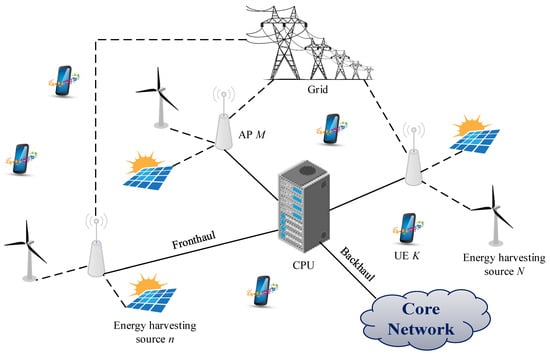
Figure 4.
Renewable Energy-Powered Cell-Free Massive MIMO Network.
Table 2.
Recent advances in energy harvesting and energy exchange techniques for energy-efficient wireless communication.
4.4.2. Energy-Efficient Resource Allocation
With an attendant rise in the greenhouse effect and energy shortage, energy-efficient resource allocation is a significant criterion to solve the problem of EE in next-generation wireless networks [91]. Resource allocation entails intelligently assigning the limited available resources such as pilot training, transmit power, and spatial transmission resources among users to maximize performance and minimize complexity in hardware design costs. More precisely, network resources are adjusted adaptively and synchronously to achieve the highest possible performance [92]. Resource allocation can be modeled as a design utility optimization problem that simultaneously maximizes the power allocation, user selection, bandwidth allocation, number of antennas, subcarrier, and time. If the resource allocation scheme is optimized, the optimization algorithm can efficiently allocate the time for data transmission and energy harvesting and optimally schedule antennas to enable UEs to create high-quality links and ultimately enhance EE [1]. Numerous computationally efficient and low-complexity resource allocation techniques have been proposed for energy-efficient wireless communications [93,94,95]. Table 3 presents an exhaustive analysis of recent advances in resource allocation for wireless communication architectures.
Table 3.
Recent advances in resource allocation schemes for energy-efficient wireless communication.
4.4.3. Energy-Efficient Power Allocation Algorithm
As a design goal of green mobile networks, it is critical to formulate novel and comprehensive power allocation algorithms, which are considered an essential index to prolong the lifetime of network terminals, and achieve EE maximization in mMIMO systems [101]. Appropriately dividing power between the UEs to optimize utility functions is referred to as power allocation [2]. Herein, an AP can arbitrarily cut down on their powers to avoid unnecessary interference and high-power consumption. In the last decade, low-complexity power allocation algorithms and optimization frameworks have been proposed to minimize energy consumption in wireless networks significantly. While striking a balance between optimality and computational complexity remains a prime challenge, numerous energy-efficient algorithms with faster convergence and better performance have been developed [102,103,104]. Table 4 summarizes recent works on power allocation algorithms for green wireless communication.
Table 4.
Recent advances in power allocation techniques for energy-efficient wireless communication.
4.4.4. Switching and Sleep Mode Techniques
In a bid to substantially increase the network EE and yield significant energy allowances to the telecom network operators at low implementation cost, switching and sleep mode strategies have appeared as an innovative paradigm for energy-efficient system design and energy savings, particularly in low-traffic scenarios [27]. As alluded to earlier, the APs are responsible for the highest proportion of energy consumed in wireless technology. Intuitively, incorporating AP switching and sleep mode techniques in the upcoming wireless networks is considered elementary and has attracted considerable research attention recently [27,108,109]. The architecture in Figure 5 presents a diagrammatic illustration of a sleep mode scenario in CF-mMIMO. In such approaches, a low-power state in the hardware is implemented. Some resources are either astutely turned off during “off-peak” hours or operated in low-energy consumption states. Lightly loaded APs can be dynamically turned on/off in correspondence with the traffic load/order of priority of APs within the network architecture [110].
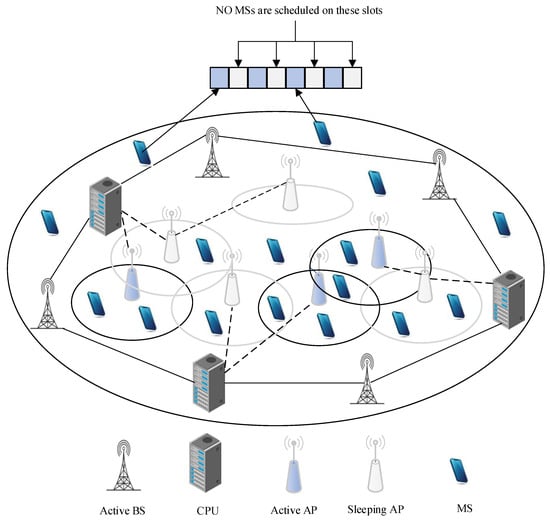
Figure 5.
Sleep Mode Scenario in Cell-Free Massive MIMO.
Switching on and off APs must be modulated over the variations in traffic patterns on a daily or weekly basis. Hence, traffic load in the network can be monitored. Then, the particular energy-saving algorithm may decide to turn off/switch to the deep idle mode or turn on specific components in the network, thus avoiding unnecessary power consumption. Some hardware components that can be switched between low-power mode and awake mode include the entire AP, signal processing unit, power amplifiers, cooling equipment, etc. As a complement to the use of sleep modes, green user association techniques, cell breathing, and self-organizing networks are crucial enablers [111]. While energy saving can be realized by adopting switching and sleep mode techniques, the QoS is primarily impacted due to reduced system capacity [79]. A summary of recent advances in AP switching and sleep mode techniques is presented in Table 5.
Table 5.
Recent advances in switching and sleep mode for energy-efficient wireless communication.
4.5. Alternate Energy Efficiency Optimization Techniques
The emerging sophistication in mobile and wireless networks and the tremendous growth in the number of subscribers has accentuated energy consumption. Thus, capping power consumption while achieving reliability and performance objectives has also skyrocketed research efforts in the wireless ecosystem [69]. In addition to the EE improvement techniques delineated in this contribution, numerous innovative approaches for greener wireless technology and greater power savings are being extensively researched. A few of the prominent strategies include green transmission techniques [113], energy-efficient component design [114], AP assignment algorithms [115], antenna distribution configurations [116], full-duplex (FD) operation [117], virtualization [118], SWIPT [119], and software-defined networking (SDN) [120]. The following provides important insights into developing novel strategies for energy-efficient wireless communication. Additionally, Table 6 summarizes the recent advances in alternate EE optimization strategies.
Table 6.
Recent advances in alternate EE techniques for green wireless communication.
4.5.1. Energy-Efficient Hardware Component Design
Considering the large amount of energy consumed by hardware components, it is essential to utilize components with higher energy-efficient features. For instance, power amplifiers widely deployed in wireless communication to optimize the signal level over the communication medium are shown to dissipate more than 80% of the input energy as heat [111]. Moreover, from an EE perspective, the static energy and the signal transmit energy consumed by hardware components are grossly unsatisfactory [71]. Adopting well-established models that satisfy certain EE requirements by minimizing energy consumption in such systems is preferable. While certain hardware replacement can be financially burdensome and economically unjustifiable, special consideration of both economic and operational features are critical to achieving a substantial amount of energy savings [130].
4.5.2. Full Duplex Operation
Full duplex (FD) wireless systems have been identified as a critical technology for the 5G and beyond 5G wireless networks, given the exponential demand for ubiquitous and untethered connectivity [131]. By enabling coherent transmission of UL and DL data on the same time-frequency resource, capacity enhancement in terms of SE and EE can be actualized for traditional wireless communication systems. Interestingly, advanced self-interference suppression mechanisms for FD technology have now been implemented in real-time, thereby making FD an attractive solution for future wireless networks [132]. Thus, it is of practical interest to exploit the possible gains in EE of FD and CF-mMIMO to reach even higher EE and greater carbon footprint minimization [133]. The system model for an FD CF-mMIMO network is presented in Figure 6.
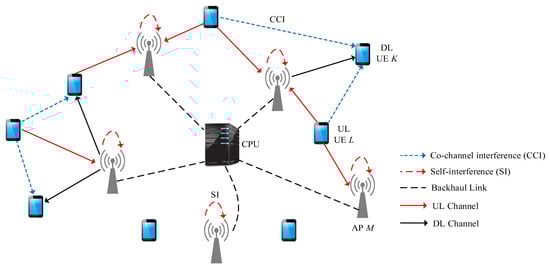
Figure 6.
Full-Duplex Cell-Free Massive MIMO Communication.
4.5.3. Antenna Distribution Configurations
A promising approach to improve network coverage and achieve significant power-saving along with cost-effective networks consists of deploying distributed antenna systems [134]. As revealed by measurement-based evaluations [135], optimally deploying antennas of distributed antenna systems can result in reduced total radiated power level, less energy consumption, and enhanced SE. In the CF-mMIMO network, many distributed antennas cooperate in providing robust connections to users with optimized EE, which is a paramount index for implementation in a real environment. Many investigations on various antenna distribution setups and optimal positioning of distributed antennas are currently being explored for network capacity enhancement and greener communications [136,137,138,139].
4.5.4. Access Point Selection Strategy
In practice, reducing the effect of backhaul power consumption has been a very sought-after way of maximizing EE [140]. One of the significant research areas to improve energy usage in backhaul links and reach considerable energy savings is the energy-efficient AP selection technique [141]. The selection strategy addresses this problem by adaptively selecting a subset of APs to serve each user. More precisely, only some APs in the proximity of a given user jointly cooperate in serving it, thus ensuring efficient resource utilization [142]. The beneficial combination of both power allocation schemes and AP selection strategies helps to handle the complexity of the problem and its feasibility [121]. This method is thus a promising trend to satisfy the given QoS constraints for all users while increasing the total EE.
4.5.5. Virtualization
With a huge growing concern about the attendant rise in energy consumption, virtualization has been proposed as a prominent approach to consolidate other EE techniques and achieve performance maximization [122]. In this case, it is possible to minimize the number of dedicated hardware and software components, such that functions are separated from their underlying hardware and forwarded into software-based mobile functions while being made available on-demand [143]. As a further advance, network function virtualization can be incorporated with optical network-supported frameworks to achieve significant gains in agility, scalability, and reduced power consumption [144]. To this end, research efforts are targeting green virtualization frameworks that can contribute to reduced energy usage in wireless communication systems.
4.5.6. Simultaneous Wireless Information and Power Transfer
Recently, notable research activities geared towards addressing the energy scarcity problem in wireless networks through the reclamation of energy have gained traction. The emergence of simultaneous wireless information and power transfer (SWIPT), spurred by ever-increasing connected devices and high energy consumption has provided an insightful alternative to reach the green design target of mobile network operators and enhances the sustainable development of wireless communication systems [45]. In this case, part of the energy carried by wireless devices can be harvested and utilized to relay power and information across the wireless network. Essentially, radio frequency signals are exploited for superposing information and power transfer [82]. This technique can be effectively applied to energy-constrained relays to provide the much-needed flexibility for harvesting energy [46]. The concept of SWIPT has attracted a great deal of research attention in both academia and industry, to overcome the trade-off between rate and energy, eavesdropping, and practical implementation of transmit beamforming.
4.5.7. Visible Light Communication
A new paradigm of radio frequency-based technology, visible light communication (VLC), otherwise known as optical wireless communication, is envisaged to revolutionize the future of next-generation wireless standards [145,146,147,148]. Experimental and analytical investigations have demonstrated the potential of VLC to support large data rates and ultra-wide bandwidth with remarkable optimization in EE [149,150]. VLC seeks to harness the potential of LED luminaires through efficient modulation of the visible light spectrum for high-speed data communication. By exploiting the EE and unprecedented enhancement of LED technologies, VLC can serve as a complement to the existing network infrastructures, while providing improved EE as well as added security/privacy [151]. VLC, although in its infancy, is a potential access option to reach highspeed sustainable wireless frontiers, and is an interesting area requiring further elucidation [152].
Key findings from Table 2 indicate a robust improvement in EE due to a drastic minimization of grid power consumption and greenhouse emissions compared to systems without cooperation. Although the architecture suffers from the discredit of intermittency, infrastructure challenges, and huge initial capital investment. Future development in this domain comprises the application of Machine Learning (ML) in power cooperation modeling, intricate power optimization algorithms, and reliable energy storage systems.
From Table 3, aside from ensuring substantial energy savings, green resource allocation techniques provide a reliable and cost-effective starting point in the pursuit of sustainable next-generation wireless communication systems. Moreover, as demonstrated in Table 3, researchers have demonstrated impressive strides in this domain. The various literature reviewed can be extended to more practical and advanced configurations.
Table 4 indicates tremendous progress in terms of insightful power allocation algorithms with robust computational efficiency and a much faster run time. More so, the total EE is trending upwards in cases with low-complexity optimization algorithms, as opposed to cases without power control schemes.
From a practical viewpoint, the investigative studies delineated in Table 5 illustrate that switching and sleep mode techniques are innovative energy-based solutions with numerous potential applications. Effective AP switching and properly designed sleep mode techniques are shown to substantially enhance the achievable EE of wireless networks. As seen in Table 5, using sophisticated AP switch on/off strategies is not without contention. Nonetheless, the state-of-the-art provides a clear roadmap towards realizing a future with clean energy.
Alternate energy maximization schemes are evolving to consolidate the existing green innovative techniques for optimal performance. Key findings shown in Table 6 indicate that an adequate supply of green networking solutions geared toward addressing the attendant rise in energy consumption have been proposed. Most notable amongst them is the energy-efficient hardware component design, FD operation, SWIPT, AP selection scheme, and antenna distribution configuration, which is shown to substantially minimize energy consumption in mobile networks. Although the transition will be harder to achieve and requires further elucidation/verification, the approaches under consideration are promising technological enablers in achieving the desired goals of energy sustainability.
4.6. Sustainable 6G Wireless Systems
One of the design goals of the commercialized 5G mobile system standard is to support massive connectivity, guarantee low latency, deliver a completely immersive experience, and robust security, and exhibit even more heterogeneity [3,153,154,155]. However, with the exponential growth of data-centric and automated systems, novel synthesis of future services such as multi-sensory data fusion and massive man-machine interfaces, and the escalating demands for tetherless connectivity in a fully mobile-networked society, 5G networks will be insufficient to fulfill the wireless networks’ demand of the future [14]. 6G wireless standards are currently being developed and are envisioned to overcome the laggings of 5G networks. 6G wireless systems will support innovative applications and address new challenges in wireless connectivity. Like its predecessors, 6G technology will provide substantially higher capacity, ultra-low latency and ubiquitous instant communications, and very high-data-rate connectivity per device [10,156]. The 6G system is expected to exploit higher frequencies than 5G networks, to facilitate the integration of maritime, aerial, and terrestrial communications into a sophisticated network with improved access to cutting-edge technologies such as holographic beamforming [157,158,159,160], fog/edge computing [161], tactile Internet [162], quantum communications [163], intelligent reflecting surface (IRS) [164,165], backscatter communication [166,167], artificial intelligence (AI)/machine learning (ML) [168,169], and 3-dimensional (3D) networking [170,171]. Besides a laudable increase in delivering much more data at faster rates, tackling sustainable wireless communication development issues will pose serious concerns in the 6G era. The issue of sustainability has become imperative, owing to the exponential increase in greenhouse emissions, deterioration of the environment, and climate change resulting from massive energy consumption from dense wireless devices [171,172]. Thus, to achieve commercial success in 6G, stringent green requirements and sustainable development goals should form the core requirements.
5. Power Control
The transmit power constitutes one of the primary radio resources for a wireless network and should be managed appropriately [22]. Power control encompasses the procedure of intelligently controlling the power of a transmitter to improve the Quality of Service (QoS) of all the users. During the UL transmission phase, the users are required to select suitable transmit powers , while the APs are required to forward their transmit powers during DL transmission phase [2]. Power control is of prime importance in CF-mMIMO to optimize the power of the desired received signal, reduce pilot contamination, manage the generated interference, and offer considerable improvement in the QoS to the UEs [33,52].
In addition, power control can help to limit the total power consumption in a CF-mMIMO network [56]. Thus, selecting appropriate power control algorithms is critical to maximizing the overall efficiency of the wireless network. It is worth noting that power control algorithms can be dynamically deployed to solve specific system-wide utility functions [173]. Some of the most common utility functions—max EE, max-min fairness, and max sum SE—are discussed extensively in the next section. Table 7, Table 8, Table 9, Table 10 and Table 11 present a concise summary of recent advances in power control algorithms (geometric programming (GP), successive convex approximation (SCA), fractional power control, Second-Order Cone Program (SOCP), and ML-based power optimization schemes), respectively. Essentially, these schemes are dimensioned to maximize the common utility optimization problems.
5.1. Max Energy Efficiency
One of the major concerns for designing a wireless network is optimizing energy consumption while satisfying performance and reliability objectives [174]. Specifically, to pave the way for the practical implementation of CF-mMIMO alongside other emerging technologies, it is vital to prioritize total energy maximization, i.e., how much energy can be saved during the communication process [3]. A possible approach to minimize energy consumption is to deploy insightful power optimization algorithms [175]. Choi et al. [59] characterized the EE maximization problem in a CF-mMIMO network using ZF reception. The problem was solved effectively by exploiting three different Transmit Power Control (TPC) algorithms with a sub-optimal trade-off in SE.
Bashar et al. [176] considered the EE maximization problem under multiple constraints. Since the problem is non-convex, an alternate approach that decomposed the original problem into two sub-problems, receiver filter coefficient design and power allocation, was exploited. Results indicate that the receiver filter coefficient design was formulated as a generalized eigenvalue problem. In contrast, a heuristic sub-optimal model and a Successive Convex Approximation (SCA) scheme were deployed to solve the power allocation problem. Nguyen et al. [30] proposed a novel SCA scheme with a ZF precoding design to achieve energy savings in CF-mMIMO under the per-UE and per-AP power constraints. The EE maximization problem was addressed after exploiting a sequence of SOCP. It is worth noting that novel algorithms and insights are rapidly emerging for maximizing the EE utility function [177].
5.2. Max-Min Fairness
CF-mMIMO is essentially a practical embodiment of mMIMO and network MIMO, where joint cooperation between low-complexity APs deployed in a distributed manner help to minimize the effects of intercell interference and offers improved QoS over the wide serving area [178]. Max-min fairness is deployed in these systems to optimize the SE performance of all users in the network, particularly those with the worst channel condition, thus ensuring uniform service for mobile subscribers [64]. It is interesting to note that max-min fairness is equivalent to finding the maximum possible value of the Signal-to-interference-plus noise ratio (SINR) among all the UEs [66]. Max-min fairness problems can either be convex [179] or non-convex [180]. An optimal solution can be obtained in the former using insightful algorithms such as GP, convex optimization, bisection search, and SOCP [181].
An alternate optimization can be exploited in the latter to find a local optimum [182]. A weighted power control algorithm to solve the problem of max-min fairness in UL CF-mMIMO with ZF receiver was proposed in [183]. The weighted algorithm offered considerable gains in the achievable UL per-user rate and improved QoS. Zhou et al. [179] characterized the performance of an optimum DL beamforming technique for CF-mMIMO. A max-min optimization problem is introduced to enhance the minimum SINR among all users.
Moreover, a low-complexity approach to address the max-min fairness problem in UL CF-mMIMO was proposed in [184]. The original problem is decomposed into two subproblems and solved using a generalized eigenvalue problem and an accelerated projected gradient approach, combined with a smoothing technique. The meta-heuristics approach was exploited in [185] to solve the max-min fairness optimization problem under linear maximum ratio combining at APs and per-UE power constraints. Although ML-based models can be adapted to improve computational efficiency, their solutions are suboptimal compared to classical optimization techniques [186]. A feedforward neural network was proposed in [187] to solve the problem of max-min fairness in CF wireless networks.
5.3. Max-Sum Spectral Efficiency
With the attendant rise in mobile subscriptions and the demand for extremely high data rates in wireless networks, it is of paramount importance to maximize the overall SE performance of the network [188]. While the SE achieved by each user can be individually optimized, the overall system performance could be impacted by a dearth of UEs in the worst conditions [178]. Thus, the max sum SE problem has appeared as a preferred candidate over the max-min SE fairness problem to reach a substantially larger SE. The problem mentioned above is usually non-convex. Thus, it is difficult to arrive at the optimal solution [1]. However, insightful algorithms have been developed to achieve a local optimum. The sum SE optimization problem for CF-mMIMO was studied in [189]. Novel fractional programming and weighted minimum mean square error algorithms were employed to find the global optimum solution with reduced complexity.
In a related study, Nguyen et al. [190] considered the sum SE minimization problem. Since the problem is nondeterministic polynomial time (NP)-hard, an insightful successive approach was adopted to solve the problem. The SCA scheme was also exploited in [191] to solve the sum SE minimization problem. The algorithm was reformulated as a SOCP to obtain the local optimum solution. ML-based models may also be applied to provide performance enhancement [192]. A deep neural network (DNN) optimization scheme was analyzed in [35] to find better solutions to the sum SE problem. Last, Andrea et al. [40] proposed an artificial neural network (ANN) to address the sum SE problem in a CF-mMIMO network.
The respective Table 7, Table 8, Table 9, Table 10 and Table 11 on power control techniques covering the GP, SCA, fractional power control, SOCP, and ML-based schemes suggest that insightful power allocation algorithms and low-complexity frameworks are needed to facilitate realistic deployment of next-generation wireless networks. Obviously, with ever-evolving wireless network standards, it is critical to optimize the power of the desired received signal, manage the prevailing interference, minimize the effect of pilot contamination, and optimize the overall SE and energy consumption, while satisfying performance and reliability objectives. The power control techniques under consideration have emerged as new participants to match these requirements. Compared to distributed power allocation techniques and other benchmark schemes, the ML-based approach is shown to provide a robust improvement in system performance with optimal complexity and processing time.
Table 7.
Recent advances in GP power control technique.
Table 7.
Recent advances in GP power control technique.
| Ref. | Focus and Coverage | Key Findings | Remarks | Year |
|---|---|---|---|---|
| [176] | The work exploited the unique interplay between a heuristic sub-optimal scheme and an SCA approach to reformulate a power allocation problem. The problem is designed for EE maximization of UL CF-mMIMO into a standard GP problem. | The work compared to the equal power allocation scheme; the EE is considerably maximized with the proposed algorithms. | Unfortunately, a modest part of the max-min SE is sacrificed. | 2019 |
| [182] | Bashar et al. proposed to solve the max-min optimization problem for user fairness maximization by exploiting the choice of receiver coefficient and power allocation. The original problem is decoupled into two sub-problems, in which GP and the generalized eigenvalue problem are iteratively solved. | Results manifest that a three-fold increase in system rate is obtainable with the proposed technique. | The DL rate of the users was not considered. | 2018 |
| [193] | The work examined a QoS problem to enable real-time users to meet the QoS constraints in CF-mMIMO. A standard GP is adopted to solve the user power allocation problem, which decomposes the original problem. | The proposed scheme provides a substantial improvement in 90% likely throughput compared to a simple benchmark scheme. | More advanced strategies with superior convergence are required. | 2018 |
| [194] | The work provided a comprehensive rate analysis for UL and DL CF-mMIMO networks over spatially correlated Rayleigh channels. A GP approach is introduced to characterize the objective function for UL rate analysis. | Simulation results validate the superiority of the proposed max-min fairness algorithms, which can be decoupled as GP and SOCP. | The impact of channel correlation is detrimental to the system’s performance. | 2020 |
| [195] | The work investigated the max-min problem of a CF-mMIMO system concerning the effect of quantization. While an eigenvalue problem is adopted to design the receiver filter, the GP approach is employed to solve the power allocation problem. | Numerical results confirm the effectiveness of the proposed algorithm in improving system performance compared to existing algorithms. | The algorithm can be further optimized, using even more sophisticated approaches. | 2019 |
Table 8.
Recent advances in the SCA power control technique.
Table 8.
Recent advances in the SCA power control technique.
| Ref. | Focus and Coverage | Key Findings | Remarks | Year |
|---|---|---|---|---|
| [190] | The work proposed jointly optimizing the power control and load balancing in UL CF-mMIMO networks under different objectives. These include power minimization, min QoS, and sum SE maximization. In order to solve the power control optimization, an SCA scheme is applied to convert the sum SE maximization problem into the form of GP. | The proposed scheme significantly outperforms full-set joint transmission and maximum SNR association, particularly in high QoS scenarios. | Compared to the BS-users association method, the proposed linear receiver framework is becoming more influential. | 2018 |
| [191] | The work characterized the performance of CF-mMIMO with non-ideal hardware transceivers using two insightful power allocation algorithms, namely mixed QoS and max-total-SE algorithms. | Both algorithms are shown to maximize the total SE and satisfactorily satisfy their target users’ QoS constraints. | The SE is significantly degraded when the target UE coincides with the receiver. | 2020 |
| [196] | The work evaluated the performance of a DL CF-mMIMO system to optimize the target users’ signal-to-interference-plus-noise ratio (SINR). An SCA optimization algorithm alongside a CB precoder is proposed. | The results obtained validate the effectiveness of the proposed algorithm in minimizing the sum of DL transmission power and meeting each users’ SINR constraints. | More advanced strategies with superior convergence are required. | 2018 |
| [197] | The work performed a thorough analysis of the effect of the spatial distribution of APs on the performance of CF-mMIMO. Further, several DL power control policies are developed. | However, the SCA policy is shown to outperform other schemes with high complexity. | In scenarios where a subset of all APs serves a given user and where coordination is absent, the SE begins to degrade. | 2019 |
| [198] | The work proposed to optimize the performance of federated learning frameworks using CF-mMIMO systems. An online SCA algorithm is deployed to solve the formulated optimization problem. | Results indicate that CF-mMIMO provides a significant gain in the training time of federated learning frameworks compared with other benchmark schemes. | CF-mMIMO is a promising technological enabler for improved federated learning in a wireless environment. | 2020 |
Table 9.
Recent advances in fractional power control technique.
Table 9.
Recent advances in fractional power control technique.
| Ref. | Focus and Coverage | Key Findings | Remarks | Year |
|---|---|---|---|---|
| [199] | The work proposed an insightful UL fractional power control and DL power allocation scheme based on large-scale quantities for performance maximization in CF-mMIMO. | The scheme is shown to optimize neither specific indices such as a weighted sum nor guarantee favoring individual users. | Learning-based frameworks are promising solutions to achieving superior trade-offs between performance and scalability. | 2020 |
| [17] | In addition to an initial access algorithm, two pilot assignment techniques, and a partial large-scale fading decoding technique, a fractional power control policy is introduced to solve the challenge of scalable massive access implementation in CF-mMIMO. | Simulation results validate the effectiveness of the proposed scheme compared to the state-of-the-art. | The proposed framework can be applied to cases with a larger class of fading distributions and multi-antenna UEs. | 2021 |
| [36] | The work examined the effect of channel ageing and pilot contamination on the performance of CF-mMIMO networks. In addition, the study adopted a fractional power control technique to minimize inter-user interference. | Compared to the full power transmission technique, the performance of fractional power control in scenarios with channel ageing is unsatisfactory. | In scenarios with severe channel ageing, advanced strategies more robust to channel ageing are required. | 2020 |
| [51] | The work characterized the performance of a fully distributed fractional power control policy for the UL of CF networks. | The proposed power control obtains fairly satisfactory performance compared to the max-min solution. | The effect of noise on the system was not accounted for accordingly. The scheme is also limited to UL CF wireless networks. | 2019 |
| [200] | The study performed a thorough investigation to determine the impact of fractional power control on the DL performance of mMIMO systems. | The results indicate a robust improvement in the cell border throughput, coupled with moderate performance optimization in cases with extreme pilot contamination. | To facilitate realistic deployments, introducing additional pilot contamination mitigation mechanisms is paramount. | 2019 |
Table 10.
Recent advances in SOCP power control technique.
Table 10.
Recent advances in SOCP power control technique.
| Ref. | Focus and Coverage | Key Findings | Remarks | Year |
|---|---|---|---|---|
| [22] | The work evaluated the performance of energy-efficient load balancing as well as power allocation schemes for large-scale networks. Due to the non-convexity of the optimization problem, a mixed SOCP is exploited to provide a globally optimal solution. | Power consumption is significantly reduced. Moreover, the proposed algorithms are sufficient to handle AP activation and power allocation in large CF networks. | The developed algorithms are sub-optimal and consume even higher energy compared to the global optimum. | 2020 |
| [32] | The work proposed a joint optimization of power allocation and load balancing in CF-mMIMO. The optimization framework, which is non-convex, is solved using a mixed SOCP. | A significant energy saving is achieved compared to reducing the transmit power and keeping all APs turned on. | The obtained solution is sub-optimal in a real-time environment. | 2020 |
| [73] | The work performed a detailed analysis of two power minimization algorithms based on the QoS constraints of each user. With the precoders employing (CB and ZF), the power minimization problems are reformulated as a SOCP. | In the regime of low QoS SE, CB is shown to achieve significant power savings over the ZF precoder. | The benefits of the CB precoder vanish as the QoS SE increases. | 2019 |
| [201] | Characterized the total EE of a TDD CF-mMIMO system under backhaul and hardware power consumption to maximize EE. A power optimization algorithm is formulated, which is approximately solved by a SOCP. | The proposed algorithm significantly maximizes the EE compared to the case without power allocation. | As the number of APs grows large, the total EE is substantially degraded due to backhaul power consumption. | 2017 |
| [202] | The work proposed to maximize the scalability and EE of IoT systems using CF-mMIMO. A neural network is utilized in place of a SOCP problem to allocate power. | It suffices that considerable gains in SE and EE are achieved with the proposed algorithm as opposed to the full transmission technique. | The proposed algorithm, though sub-optimal, allows for scalability, which is crucial for IoT systems. | 2021 |
Table 11.
Recent advances in machine learning-based power control techniques.
Table 11.
Recent advances in machine learning-based power control techniques.
| Ref. | Focus and Coverage | Key Findings | Remarks | Year |
|---|---|---|---|---|
| [40] | The work exploited a deep learning approach to solve the sum-rate and minimum rate maximization problem in the UL of a CF-mMIMO system. | While a near-optimal performance is obtained, the effect of pilot contamination on the learning capabilities of the ANN is shown to be quite modest. | In the presence of shadowing, the learning capabilities of the ANN are significantly impacted. | 2019 |
| [187] | The work proposed to exploit the potential of feedforward neural networks with unsupervised learning to scale up power control implementation in UL CF-mMIMO systems. | The unsupervised neural network ensures superior performance while vastly satisfying distinct signals to interference objectives. | However, when large-scale channel gains are employed as inputs, the approximations become tighter, with a longer learning stage. | 2019 |
| [192] | The work proposed a low-complexity large-scale fading-deep learning-based power control scheme to perform sum-rate maximization in limited-fronthaul CF-mMIMO. | Results reveal a considerable boost in throughput, owing to the mapping derived from deep convolutional neural networks. | The practicality of the proposed scheme is validated through extensive simulation results and is a rich area for future research. | 2020 |
| [203] | The work introduced a deep learning framework to perform power allocation in the DL CF-mMIMO system using the max-min fairness approach. | A properly trained feed-forward DNN is shown to outperform the conventional distributed power allocation technique in terms of complexity and processing time. | More work is needed to bridge the gap between the decentralized and centralized approaches. | 2019 |
| [204] | The work considered an innovative DNN to overcome the nondeterministic polynomial-hard problem in CF-mMIMO with low time complexity. | It suffices that the DNN approach exhibits a performance close to the widely deployed heuristic concerning the bisection algorithm. | The study can be further extended to the mmWave domain with more advanced channel models. | 2020 |
6. Open Research Issues
The open research issues require further research to pave the way for seamless wireless connectivity, greener wireless networks, and sustainable evolution of wireless communications. The lines of research that need to be addressed in future work are summarized as follows:
- (a)
- Green Artificial Intelligence (GAI): One possible approach toward sustainable wireless communication is the integration of Artificial Intelligence (AI) to drive the design and optimization of learning-based models for maximized SE and EE indices [108]. Although groundbreaking advancements led by insightful ML solutions have been realized [205], the research in this line of interest is still in its infancy and requires further effort. Exploring yet undiscovered ML architectures that prioritize computational efficiency and energy consumption towards improved operating conditions may be interesting. More precisely, ML paradigms with faster convergence, high computational processing capabilities, and optimized energy consumption during the training and exploitation phases are needed.
- (b)
- mmWave frequency spectrum: The distinctive interplay of CF-mMIMO alongside the rapidly emerging mmWave frequency bands is expected to reap mutual benefits from higher macro-diversity due to the coherent distributed transmission across APs [206]. However, mmWave propagation is characterized mainly by severe penetration, path, and diffraction losses, which continue to roadblock the successful coexistence of these enabling technologies [207]. Therefore, it is essential to address critical challenges in mmWave communications while analyzing the impact of the state-of-the-art on the achievable EE of CF-mMIMO systems.
- (c)
- Sophisticated AP switch on/off strategies: Several AP switch on/off strategies for CF-mMIMO networks designed to switch BSs into sleep mode adaptively have been proposed in the literature [27]. Substantial energy allowances to the network operators can be achieved at the expense of the system capacity [79]. Further investigations on more reactive AP switch on/off techniques, the authenticity of the models, and their implementation issues constitute an attractive future research direction.
- (d)
- Intricate power control strategies: The widespread popularity of complex scenarios in CF-mMIMO, such as user assignment and joint AP selection, calls for the design of innovative power control strategies to get better results in such complex configurations [208]. Besides, sophisticated power control techniques are urgently needed to manage scenarios where conventional approaches might be sub-optimal or time-consuming. Also, the evaluation of advanced pilot assignment techniques to contain pilot contamination may be considered in future studies.
- (e)
- Joint AP clustering: In a typical CF-mMIMO configuration, a dearth of UE is jointly served by a large chunk of arbitrarily allocated APs, all linked to a CPU via a fronthaul network. The QoS will be impacted when the limited capacity fronthaul link becomes saturated [209]. Aiming at the practical implementation of CF-mMIMO alongside other emerging technologies such as SWIPT, joint AP clustering has appeared as an innovative paradigm to minimize the pressure on the fronthaul networks [141]. Nonetheless, performance degradation, amongst other challenges, must be tackled in this domain to satisfy future massive connectivity in a realistic environment.
Lessons Learned
In this section, a concise elucidation of key findings and lessons learned from this review is presented. These lessons, which encompass a broad range of investigative analysis and evaluation, would provide a reliable framework to open up new frontiers in the wireless communication domain.
Lesson One: The demand for increased mobility and coverage, microsecond latency communications, and ultra-high data rates have skyrocketed recently and continue to grow at a breakneck pace. Wireless networks are currently being upgraded beyond 5G systems to match the fast-paced development of revolutionary applications, wireless services demands, and smart social needs. While the current 5G architecture is designed to provide ubiquitous wireless connectivity and gives lower latency substantially, the technology is faced with rising technical requirements such as improved QoS, higher system capacity, and data speed. 6G wireless standards, with significantly more modest features than 5G, are envisioned to meet these requirements and support innovative applications through the deployment of the unexplored spectrum, UD CF-mMIMO networks, energy-efficient transmission techniques, and key disruptive technologies in conjunction with advanced AI techniques.
Lesson Two: Averting the energy crunch resulting from the deployment of novel paradigms of wireless communication remains a prime challenge. With the drive towards tetherless connectivity and capacity enhancement, network operators and standardization bodies are exploring cutting-edge technologies to address the requirements of rate-demanding and innovative services without tangible recourse to the environmental and ecological implications of these technologies. At present, the design and development of sustainable/green communication technologies are even more compelling, driven by global concerns for implicit consumption of energy, ecological imbalance, the strain on natural resources, and health, safety, and environmental challenges. Thus, EE becomes a key element in the standardization of beyond 5G and 6G wireless communication systems.
Lesson Three: As alluded to earlier, next-generation wireless networks are gaining widespread popularity and significant traction in the wireless industry and academia. Consequently, there is an urgent need to develop insightful energy-efficient frameworks and techniques to match up with such evolvement. Following the development and novel approaches to sustainable wireless network design, investigative analysis of the performance of several EE maximization techniques, such as energy harvesting and energy exchange techniques, energy-efficient resource allocation, and switching and sleep mode techniques, is presented. While a significant amount of environmental benefits/energy savings can be obtained with the proposed technologies, it is noteworthy that sustainable 6G communication is a relatively subjective concept. More precisely, the state-of-the-art is largely connected with the transmission mechanisms, component conditioning, specific configuration, and physical topology of the communication system.
Lesson Four: Intuitively, energy-efficient resource allocation, switching and sleep mode techniques, and energy harvesting techniques are promising landscapes for achieving sustainable communication systems. By intelligently assigning the limited resources among users, maximizing the fixed energy consumption in lightly loaded APs, and incorporating energy harvesting technologies in emerging wireless communication architectures, energy consumption can be significantly maximized. Additionally, energy-efficient hardware component design, FD operation, antenna distribution configuration, SWIPT, AP selection strategies, and VLC are also increasingly evolving green communication techniques with large potential for energy saving. However, to maximize the prospects of the EE maximization techniques, an excess count of unresolved issues ranging from techno-economic feasibility to unrealistic assumptions need to be carefully tackled.
Lesson Five: Even though various enabling technologies to achieve the desired goals of sustainable 6G communication systems have been proposed, the issue of cost-efficiency and economic justification of selected EE maximization techniques have been ignored. Specific hardware design solutions covering major architectural modifications can be financially burdensome. Moreover, deploying energy-efficient techniques with novel infrastructural requirements may consume higher energy than the existing system resulting in a cost-efficiency issue. For instance, large initial capital investment is required to reliably utilize renewable energy resources. Thus, technically feasible models, as well as minimized-cost solutions, are critical to achieving sustainable wireless communication systems.
Lesson Six: It is observed that next-generation wireless technology, in conjunction with UD CF-mMIMO, can provide substantial improvement in both the SE and throughput of wireless communication systems. Unfortunately, adopting a distributed antenna array in UD CF-mMIMO systems may dramatically increase the power consumption and the overall energy emissions of wireless communication systems. Indeed, the conflict of simultaneously optimizing the SE and EE of UD CF-mMIMO systems remains one of the prime concerns for network operators. Since both of these two-design metrics are critical for future wireless communication networks, obtaining a suitable balance between EE and SE is imperative.
Lesson Seven: Power control is an indispensable candidate technique offering a tremendous improvement in the QoS of all users. Power control is also of great necessity to minimize the effects of pilot contamination and manage the associated interference. Interestingly, insightful power allocation algorithms such as GP, SCA, SOCP, fractional power control, and ML-based power allocation schemes can be effectively deployed to resolve common utility optimization problems (max EE, max-min fairness, and max-sum SE) and achieve optimal performance.
7. Conclusions
This work has provided an extensive overview of the concepts and techniques proposed for energy-efficient power control in ultra-dense cell-free massive MIMO (UD CF-mMIMO) systems. An elaborate introduction to the technical foundations and mathematical system model of CF-mMIMO is presented. Next, a comprehensive evaluation of the power consumption model, energy efficiency (EE), and power consumption parts are provided. Further, standard EE-maximization techniques for the state-of-the-art, including energy-efficient resource allocation schemes, energy harvesting and exchange techniques, switching and sleep mode techniques, and virtualization, are discussed comprehensively. Additionally, a review of recent advances in energy-efficient power control in UD CF-mMIMO systems was highlighted. Different power allocation schemes, such as geometric programming (GP), successive convex approximation (SCA), Second-Order Cone Program (SOCP), fractional power control, and ML-based power control, target max EE, max sum SE, and max-min fairness in wireless networks are discussed elaborately. Finally, critical insights on the open issues and critical challenges in guaranteeing sustainable wireless communication are delineated. Key findings from the survey thread evidence that an ever-increasing number of users and high-rate demands are accompanied by a substantial increase in energy consumption. While significant gains in EE have been realized through efficient utilization of energy maximization techniques and dense deployment of antenna arrays, the concept of energy sustainability and green design expectations remains. Future work would examine the design and characterization of optimal energy-efficient power control schemes in UD CF-mMIMO networks for application in the envisioned 6G wireless communication systems.
Author Contributions
The manuscript was written through the contributions of all authors. A.L.I. was responsible for the conceptualization of the topic; article gathering and sorting were carried out by H.I.O. and A.L.I.; manuscript writing and original drafting and formal analysis were carried out by H.I.O., A.L.I., F.I.A. and S.N.S.; writing of reviews and editing were carried out by H.I.O., A.L.I., F.I.A. and S.N.S.; and A.L.I. led the overall research activity. All authors have read and agreed to the published version of the manuscript.
Funding
The work of Agbotiname Lucky Imoize is supported in part by the Nigerian Petroleum Technology Development Fund (PTDF) and in part by the German Academic Exchange Service (DAAD) through the Nigerian-German Postgraduate Program under grant 57473408.
Institutional Review Board Statement
Not applicable.
Informed Consent Statement
Not applicable.
Data Availability Statement
Not applicable.
Acknowledgments
The authors acknowledge the anonymous reviewers for the comments which help to improve the quality of the paper.
Conflicts of Interest
The authors declare no conflict of interest.
Abbreviations
| 3D | 3-Dimensional |
| 5G | Fifth-Generation |
| AI | Artificial Intelligence |
| ANN | Artificial Neural Network |
| AP | Access Point |
| BS | Base Station |
| CB | Conjugate Beamforming |
| CCI | Co-channel Interference |
| CF-mMIMO | Cell-Free Massive MIMO |
| CPU | Central Processing Unit |
| DL | Downlink |
| DNN | Deep Neural Network |
| DSP | Digital Signal Processing |
| D2D | Device-to-Device |
| EE | Energy Efficiency |
| FD | Full-Duplex |
| FDD | Frequency Division Duplexing |
| GP | Geometric Programming |
| HI | Hardware Impairment |
| ICT | Information and Communication Technology |
| i.i.d | Independent Identically Distributed |
| IoT | Internet of Things |
| IRS | Intelligent Reflecting Surface |
| ML | Machine Learning |
| mm | Millimeter |
| M2M | Machine-to-Machine |
| NFV | Network Function Virtualization |
| NOMA | Non-Orthogonal Multiple Access |
| NP | Nondeterministic Polynomial Time |
| QoS | Quality-of-Service |
| RF | Radio-frequency |
| RIS | Reconfigurable Intelligent Surfaces |
| SC | Small-Cell |
| SCA | Successive Convex Approximation |
| SDN | Software Defined Networking |
| SE | Spectral Efficiency |
| SI | Self-Interference |
| SNR | Signal-to-noise ratio |
| SINR | Signal-to-interference-plus noise ratio |
| SOCP | Second-Order Cone Program |
| SWIPT | Simultaneous Wireless Information and Power Transfer |
| TDD | Time Division Duplex |
| TPC | Transmit Power Control |
| UAV | Unmanned Aerial Vehicle |
| UC | User-Centric |
| UD | Ultra-Dense |
| UE | User Equipment |
| UL | Uplink |
| V2X | Vehicle-to-Everything |
| VLC | Visible Light Communication |
| ZF | Zero-Forcing |
References
- Demir, Ö.T.; Björnson, E.; Sanguinetti, L. Foundations of User-Centric Cell-Free Massive MIMO. Found. Trends Signal Process. 2021, 14, 162–472. [Google Scholar] [CrossRef]
- Chen, S.; Zhang, J.; Zhang, J.; Björnson, E.; Ai, B. A Survey on User-Centric Cell-Free Massive MIMO Systems. arXiv 2021, arXiv:2104.13667. [Google Scholar] [CrossRef]
- Obakhena, H.I.; Imoize, A.L.; Anyasi, F.I.; Kavitha, K.V.N. Application of cell-free massive MIMO in 5G and beyond 5G wireless networks: A survey. J. Eng. Appl. Sci. 2021, 68, 13. [Google Scholar] [CrossRef]
- Anthes, C.; García-Hernández, R.J.; Wiedemann, M.; Kranzlmüller, D. State of the art of virtual reality technology. In Proceedings of the 2016 IEEE Aerospace Conference, Big Sky, MT, USA, 5–12 March 2016; pp. 1–19. [Google Scholar]
- Wohlgenannt, I.; Simons, A.; Stieglitz, S. Virtual reality. Bus. Inf. Syst. Eng. 2020, 62, 455–461. [Google Scholar] [CrossRef]
- Lo, A.C.C.; Law, Y.W.; Jacobsson, M. A cellular-centric service architecture for machine-to-machine (M2M) communications. IEEE Wirel. Commun. 2013, 20, 143–151. [Google Scholar] [CrossRef]
- Verma, P.K.; Verma, R.; Prakash, A.; Agrawal, A.; Naik, K.; Tripathi, R.; Alsabaan, M.; Khalifa, T.; Abdelkader, T.; Abogharaf, A. Machine-to-Machine (M2M) communications: A survey. J. Netw. Comput. Appl. 2016, 66, 83–105. [Google Scholar] [CrossRef]
- Tuna, G.; Kogias, D.G.; Gungor, V.C.; Gezer, C.; Taşkın, E.; Ayday, E. A survey on information security threats and solutions for Machine to Machine (M2M) communications. J. Parallel Distrib. Comput. 2017, 109, 142–154. [Google Scholar] [CrossRef]
- Thompson, A.W.; Perez, Y. Vehicle-to-Everything (V2X) energy services, value streams, and regulatory policy implications. Energy Policy 2020, 137, 111136. [Google Scholar] [CrossRef]
- Imoize, A.; Adedeji, O.; Tandiya, N.; Shetty, S. 6G Enabled Smart Infrastructure for Sustainable Society: Opportunities, Challenges, and Research Roadmap. Sensors 2021, 21, 1709. [Google Scholar] [CrossRef]
- Saad, W.; Bennis, M.; Chen, M. A Vision of 6G Wireless Systems: Applications, Trends, Technologies, and Open Research Problems. IEEE Netw. 2019, 34, 134–142. [Google Scholar] [CrossRef] [Green Version]
- David, K.; Berndt, H. 6G Vision and requirements: Is there any need for beyond 5G? IEEE Veh. Technol. Mag. 2018, 13, 72–80. [Google Scholar] [CrossRef]
- Yang, P.; Xiao, Y.; Xiao, M.; Li, S. 6G Wireless Communications: Vision and Potential Techniques. IEEE Netw. 2019, 33, 70–75. [Google Scholar] [CrossRef]
- You, X.; Wang, C.X.; Huang, J.; Gao, X.; Zhang, Z.; Wang, M.; Huang, Y.; Zhang, C.; Jiang, Y.; Wang, J.; et al. Towards 6G wireless communication networks: Vision, enabling technologies, and new paradigm shifts. Sci. China Inf. Sci. 2021, 64, 110301. [Google Scholar] [CrossRef]
- Imoize, A.L.; Ibhaze, A.E.; Atayero, A.A.; Kavitha, K.V.N. Standard Propagation Channel Models for MIMO Communication Systems. Wirel. Commun. Mob. Comput. 2021, 2021, 8838792. [Google Scholar] [CrossRef]
- Interdonato, G.; Frenger, P.; Larsson, E.G. Scalability Aspects of Cell-Free Massive MIMO. In Proceedings of the IEEE International Conference on Communications, Shanghai, China, 22–24 May 2019. [Google Scholar]
- Chen, S.; Zhang, J.; Bjornson, E.; Zhang, J.; Ai, B. Structured Massive Access for Scalable Cell-Free Massive MIMO Systems. IEEE J. Sel. Areas Commun. 2021, 39, 1086–1100. [Google Scholar] [CrossRef]
- Imoize, A.L.; Obakhena, H.I.; Anyasi, F.I.; Adelabu, M.A.; Kavitha, K.V.N.; Faruk, N. Spectral Efficiency Bounds of Cell-Free Massive MIMO Assisted UAV Cellular Communication. In Proceedings of the 2022 IEEE Nigeria 4th International Conference on Disruptive Technologies for Sustainable Development (NIGERCON), Abuja, Nigeria, 15–17 May 2022; pp. 1–5. [Google Scholar]
- Imoize, A.L.; Tofade, S.O.; Ughegbe, G.U.; Anyasi, F.I.; Isabona, J. Updating analysis of key performance indicators of 4G LTE network with the prediction of missing values of critical network parameters based on experimental data from a dense urban environment. Data Br. 2022, 42, 108240. [Google Scholar] [CrossRef]
- Gradoni, G.; Russer, J.; Baharuddin, M.H.; Haider, M.; Russer, P.; Smartt, C.; Creagh, S.C.; Tanner, G.; Thomas, D.W. Stochastic electromagnetic field propagation—Measurement and modelling. Philos. Trans. R. Soc. A Math. Phys. Eng. Sci. 2018, 376, 20170455. [Google Scholar] [CrossRef]
- Imoize, A.L.; Orolu, K.; Atayero, A.A.-A. Analysis of key performance indicators of a 4G LTE network based on experimental data obtained from a densely populated smart city. Data Br. 2020, 29, 105304. [Google Scholar] [CrossRef]
- Van Chien, T.; Bjornson, E.; Larsson, E.G. Joint power allocation and load balancing optimization for energy-efficient cell-free massive mimo networks. IEEE Trans. Wirel. Commun. 2020, 19, 6798–6812. [Google Scholar] [CrossRef]
- Zhang, Y.; Cheng, Y.; Zhou, M.; Yang, L.; Zhu, H. Analysis of Uplink Cell-Free Massive MIMO System with Mixed-ADC/DAC Receiver. IEEE Syst. J. 2021, 15, 5162–5173. [Google Scholar] [CrossRef]
- Liu, T.; Tong, J.; Guo, Q.; Xi, J.; Yu, Y.; Xiao, Z. Energy efficiency of massive MIMO systems with low-resolution ADCs and successive interference cancellation. IEEE Trans. Wirel. Commun. 2019, 18, 3987–4002. [Google Scholar] [CrossRef]
- Ibhaze, A.E.; Imoize, A.L.; Okoyeigbo, O. A Brief Overview of Energy Efficiency Resources in Emerging Wireless Communication Systems. Telecom 2022, 3, 281–300. [Google Scholar] [CrossRef]
- Zhang, J.; Chen, S.; Lin, Y.; Zheng, J.; Ai, B.; Hanzo, L. Cell-Free Massive MIMO: A New Next-Generation Paradigm. IEEE Access 2019, 7, 99878–99888. [Google Scholar] [CrossRef]
- Garcia-Morales, J.; Femenias, G.; Riera-Palou, F. Energy-Efficient Access-Point Sleep-Mode Techniques for Cell-Free mmWave Massive MIMO Networks with Non-Uniform Spatial Traffic Density. IEEE Access 2020, 8, 137587–137605. [Google Scholar] [CrossRef]
- Ahmed, A.H.; Al-Heety, A.T.; Al-Khateeb, B.; Mohammed, A.H. Energy Efficiency in 5G Massive MIMO for Mobile Wireless Network. In Proceedings of the HORA 2020—2nd International Congress on Human-Computer Interaction, Optimization and Robotic Applications, Ankara, Turkey, 26–27 June 2020. [Google Scholar]
- Dai, B.; Yu, W. Energy Efficiency of Downlink Transmission Strategies for Cloud Radio Access Networks. IEEE J. Sel. Areas Commun. 2016, 34, 1037–1050. [Google Scholar] [CrossRef]
- Nguyen, L.D.; Duong, T.Q.; Ngo, H.Q.; Tourki, K. Energy Efficiency in Cell-Free Massive MIMO with Zero-Forcing Precoding Design. IEEE Commun. Lett. 2017, 21, 1871–1874. [Google Scholar] [CrossRef]
- Hamdi, R.; Qaraqe, M. Power Allocation and Cooperation in Cell-Free Massive MIMO Systems with Energy Exchange Capabilities. In Proceedings of the IEEE Vehicular Technology Conference, Virtual, 18 November–16 December 2020. [Google Scholar]
- Van Chien, T.; Bjornson, E.; Larsson, E.G. Optimal Design of Energy-Efficient Cell-Free Massive Mimo: Joint Power Allocation and Load Balancing. In Proceedings of the ICASSP, IEEE International Conference on Acoustics, Speech and Signal Processing, Barcelona, Spain, 4–8 May 2020. [Google Scholar]
- Mai, T.C.; Ngo, H.Q.; Egan, M.; Duong, T.Q. Pilot Power Control for Cell-Free Massive MIMO. IEEE Trans. Veh. Technol. 2018, 67, 11264–11268. [Google Scholar] [CrossRef]
- Ngo, H.Q.; Tran, L.N.; Duong, T.Q.; Matthaiou, M.; Larsson, E.G. On the Total Energy Efficiency of Cell-Free Massive MIMO. IEEE Trans. Green Commun. Netw. 2018, 2, 25–39. [Google Scholar] [CrossRef]
- Liang, F.; Shen, C.; Yu, W.; Wu, F. Towards optimal power control via ensembling deep neural networks. IEEE Trans. Commun. 2020, 68, 1760–1776. [Google Scholar] [CrossRef]
- Zheng, J.; Zhang, J.; Bjornson, E.; Ai, B. Cell-Free Massive MIMO with Channel Aging and Pilot Contamination. In Proceedings of the 2020 IEEE Global Communications Conference, GLOBECOM 2020, Taipei, Taiwan, 7–11 December 2020. [Google Scholar]
- Rajapaksha, N.; Kapuruhamy Badalge, S.M.; Rajatheva, N.; Latva-aho, M. Deep Learning-based Power Control for Cell-Free Massive MIMO Networks. arXiv 2021, arXiv:2102.10366. [Google Scholar]
- Alonzo, M.; Buzzi, S.; Zappone, A.; D’Elia, C. Energy-Efficient Power Control in Cell-Free and User-Centric Massive MIMO at Millimeter Wave. IEEE Trans. Green Commun. Netw. 2019, 3, 651–663. [Google Scholar] [CrossRef] [Green Version]
- Ngo, H.Q.; Ashikhmin, A.; Yang, H.; Larsson, E.G.; Marzetta, T.L. Cell-Free Massive MIMO: Uniformly great service for everyone. In Proceedings of the IEEE Workshop on Signal Processing Advances in Wireless Communications, SPAWC, Stockholm, Sweden, 28 June–1 July 2015. [Google Scholar]
- D’Andrea, C.; Zappone, A.; Buzzi, S.; Debbah, M. Uplink Power Control in Cell-Free Massive MIMO via Deep Learning. In Proceedings of the 2019 IEEE 8th International Workshop on Computational Advances in Multi-Sensor Adaptive Processing, CAMSAP 2019, Le Gosier, Guadeloupe, 15–18 December 2019. [Google Scholar]
- Nayebi, E.; Ashikhmin, A.; Marzetta, T.L.; Rao, B.D. Performance of cell-free massive MIMO systems with MMSE and LSFD receivers. In Proceedings of the Conference Record-Asilomar Conference on Signals, Systems and Computers, Pacific Grove, CA, USA, 29 October–1 November 2017. [Google Scholar]
- Tarongi, J.M.; Camps, A. Radio frequency interference detection and mitigation algorithms based on spectrogram analysis. Algorithms 2011, 4, 239–261. [Google Scholar] [CrossRef]
- Cucho-Padin, G.; Wang, Y.; Li, E.; Waldrop, L.; Tian, Z.; Kamalabadi, F.; Perillat, P. Radio frequency interference detection and mitigation using compressive statistical sensing. Radio Sci. 2019, 54, 986–1001. [Google Scholar] [CrossRef]
- Adeogun, R.; Berardinelli, G.; Rodriguez, I.; Mogensen, P.E.; Razzaghpour, M. Measurement and analysis of radio frequency interference in the UWB spectrum. In Proceedings of the 2019 IEEE 90th Vehicular Technology Conference (VTC2019-Fall), Honolulu, HI, USA, 22–25 September 2019. [Google Scholar] [CrossRef]
- Tang, J.; Yu, Y.; Liu, M.; So, D.K.C.; Zhang, X.; Li, Z.; Wong, K.K. Joint Power Allocation and Splitting Control for SWIPT-Enabled NOMA Systems. IEEE Trans. Wirel. Commun. 2020, 19, 120–133. [Google Scholar] [CrossRef]
- Alageli, M.; Ikhlef, A.; Alsifiany, F.; Abdullah, M.A.M.; Chen, G.; Chambers, J. Optimal downlink transmission for cell-free SWIPT massive MIMO systems with active eavesdropping. IEEE Trans. Inf. Forensics Secur. 2020, 15, 1983–1998. [Google Scholar] [CrossRef]
- Jin, S.N.; Yue, D.W.; Nguyen, H.H. Spectral and Energy Efficiency in Cell-Free Massive MIMO Systems over Correlated Rician Fading. IEEE Syst. J. 2021, 15, 2822–2833. [Google Scholar] [CrossRef]
- Hamdi, R.; Qaraqe, M. Energy cooperation in renewable-powered cell-free massive MIMO systems. In Proceedings of the 2019 25th Asia-Pacific Conference on Communications, APCC 2019, Ho Chi Minh City, Vietnam, 6–8 November 2019. [Google Scholar]
- Papazafeiropoulos, A.; Ngo, H.Q.; Kourtessis, P.; Chatzinotas, S.; Senior, J.M. Towards Optimal Energy Efficiency in Cell-Free Massive MIMO Systems. IEEE Trans. Green Commun. Netw. 2021, 5, 816–831. [Google Scholar] [CrossRef]
- Wang, B.; Wang, J.; Fang, J.; Duan, H.; Li, H. Efficient max-min power control for cell-free massive mimo systems: An alternating projection-based approach. IEEE Signal Process. Lett. 2021, 28, 2102–2106. [Google Scholar] [CrossRef]
- Nikbakht, R.; Lozano, A. Uplink Fractional Power Control for Cell-Free Wireless Networks. In Proceedings of the IEEE International Conference on Communications, Shanghai, China, 20–24 May 2019. [Google Scholar]
- Zhao, D.; Guo, A.; Song, C. Power control algorithm for cell-free massive MIMO system. Syst. Eng. Electron. 2021, 43, 854–860. [Google Scholar] [CrossRef]
- Lai, Y.; Sun, X.; Chen, D. Power Control for Cell-free Massive MIMO Based on AFSA. In Proceedings of the 2nd International Conference on Artificial Intelligence and Information Systems, Chongqing, China, 28–30 May 2021. [Google Scholar]
- Mai, T.C.; Quoc Ngo, H.; Tran, L.N. Design of Pilots and Power Control in the Cell-Free Massive MIMO Uplink. In Proceedings of the Conference Record—Asilomar Conference on Signals, Systems and Computers, Pacific Grove, CA, USA, 1–4 November 2020. [Google Scholar]
- Li, W.; Sun, X.; Chen, D. Pilot Assignment Based on Weighted-Count for Cell-Free Massive MIMO Systems. In Proceedings of the 2021 Asia-Pacific Conference on Communications Technology and Computer Science, ACCTCS 2021, Shenyang, China, 22–24 January 2021. [Google Scholar]
- Alonzo, M.; Buzzi, S.; Zappone, A. Energy-Efficient Downlink Power Control in mmWave Cell-Free and User-Centric Massive MIMO. In Proceedings of the IEEE 5G World Forum, 5GWF 2018—Conference Proceedings, Silicon Valley, CA, USA, 9–11 July 2018. [Google Scholar]
- Papazafeiropoulos, A.; Ngo, H.Q.; Kourtessis, P.; Chatzinotas, S.; Senior, J.M. Optimal energy efficiency in cell-free massive MIMO systems: A stochastic geometry approach. In Proceedings of the IEEE International Symposium on Personal, Indoor and Mobile Radio Communications, PIMRC, London, UK, 31 August–3 September 2020. [Google Scholar]
- Zhang, X.; Qi, H.; Zhang, X.; Han, L. Spectral Efficiency Improvement and Power Control Optimization of Massive MIMO Networks. IEEE Access 2021, 9, 11523–11532. [Google Scholar] [CrossRef]
- Choi, T.; Ito, M.; Kanno, I.; Oseki, T.; Yamazaki, K.; Molisch, A.F. Uplink Energy Efficiency of Cell-Free Massive MIMO with Transmit Power Control in Measured Propagation Channels. In Proceedings of the IEEE Workshop on Signal Processing Systems, SiPS: Design and Implementation, Coimbra, Portugal, 19–21 October 2021. [Google Scholar]
- Qiu, J.; Xu, K.; Xia, X.; Shen, Z.; Xie, W. Downlink Power Optimization for Cell-Free Massive MIMO Over Spatially Correlated Rayleigh Fading Channels. IEEE Access 2020, 8, 56214–56227. [Google Scholar] [CrossRef]
- Chataut, R.; Akl, R. Massive MIMO systems for 5G and beyond networks—Overview, recent trends, challenges, and future research direction. Sensors 2020, 20, 2753. [Google Scholar] [CrossRef] [PubMed]
- Bjornson, E.; Sanguinetti, L. A New Look at Cell-Free Massive MIMO: Making It Practical with Dynamic Cooperation. In Proceedings of the IEEE International Symposium on Personal, Indoor and Mobile Radio Communications, PIMRC, Istanbul, Turkey, 8–11 September 2019. [Google Scholar]
- Bjornson, E.; Sanguinetti, L. Making Cell-Free Massive MIMO Competitive with MMSE Processing and Centralized Implementation. IEEE Trans. Wirel. Commun. 2020, 19, 77–90. [Google Scholar] [CrossRef]
- Nayebi, E.; Ashikhmin, A.; Marzetta, T.L.; Yang, H.; Rao, B.D. Precoding and Power Optimization in Cell-Free Massive MIMO Systems. IEEE Trans. Wirel. Commun. 2017, 16, 4445–4459. [Google Scholar] [CrossRef]
- Polegre, A.A.; Riera-Palou, F.; Femenias, G.; Armada, A.G. New insights on channel hardening in cell-free massive MIMO networks. In Proceedings of the 2020 IEEE International Conference on Communications Workshops, Dublin, Ireland, 7–11 June 2020. [Google Scholar]
- Ngo, H.Q.; Ashikhmin, A.; Yang, H.; Larsson, E.G.; Marzetta, T.L. Cell-Free Massive MIMO Versus Small Cells. IEEE Trans. Wirel. Commun. 2017, 16, 1834–1850. [Google Scholar] [CrossRef]
- Alamu, O.; Gbenga-Ilori, A.; Adelabu, M.; Imoize, A.; Ladipo, O. Energy efficiency techniques in ultra-dense wireless heterogeneous networks: An overview and outlook. Eng. Sci. Technol. Int. J. 2020, 23, 1308–1326. [Google Scholar] [CrossRef]
- Pramanick, M.; Basak, P.; Chowdhury, C.; Neogy, S. Analysis of energy efficient wireless sensor networks routing schemes. In Proceedings of the 2014 Fourth International Conference of Emerging Applications of Information Technology, Kolkata, India, 19–21 December 2014; pp. 379–384. [Google Scholar]
- Jawad, H.M.; Nordin, R.; Gharghan, S.K.; Jawad, A.M.; Ismail, M. Energy-efficient wireless sensor networks for precision agriculture: A review. Sensors 2017, 17, 1781. [Google Scholar] [CrossRef]
- Ogbebor, J.O.; Imoize, A.L.; Atayero, A.A.-A. Energy Efficient Design Techniques in Next-Generation Wireless Communication Networks: Emerging Trends and Future Directions. Wirel. Commun. Mob. Comput. 2020, 2020, 7235362. [Google Scholar] [CrossRef]
- Tan, W.; Xie, D.; Xia, J.; Tan, W.; Fan, L.; Jin, S. Spectral and Energy Efficiency of Massive MIMO for Hybrid Architectures Based on Phase Shifters. IEEE Access 2018, 6, 11751–11759. [Google Scholar] [CrossRef]
- Yang, H.; Marzetta, T.L. Energy Efficiency of Massive MIMO: Cell-Free vs. Cellular. In Proceedings of the IEEE Vehicular Technology Conference, Porto, Portugal, 3–6 June 2018. [Google Scholar]
- Zhang, Y.; Cao, H.; Zhou, M.; Li, Y.; Yang, L. Power Minimization for Cell-Free Massive MIMO. In Proceedings of the 2019 IEEE International Conference on Consumer Electronics, Yilan, Taiwan, 20–22 May 2019. [Google Scholar]
- Deruyck, M.; Tanghe, E.; Joseph, W.; Martens, L. Modelling and optimization of power consumption in wireless access networks. Comput. Commun. 2011, 34, 2036–2046. [Google Scholar] [CrossRef] [Green Version]
- Björnson, E.; Larsson, E.G. How energy-efficient can a wireless communication system become? In Proceedings of the 2018 52nd Asilomar Conference on Signals, Systems, and Computers, Pacific Grove, CA, USA, 28–31 October 2018; pp. 1252–1256. [Google Scholar]
- Yakine, F.; Kenzi, A. Energy Harvesting in wireless communication: A survey. E3S Web Conf. 2022, 336, 74. [Google Scholar] [CrossRef]
- Zhou, Z.; Chang, Z.; Liao, H. Energy-Efficient Resource Allocation for Wireless Powered Massive MIMO System with Imperfect CSI. In Green Internet of Things (IoT): Energy Efficiency Perspective. Wireless Networks; Springer: Cham, Switzerland, 2021. [Google Scholar]
- Hua, M.; Ni, W.; Tian, H.; Nie, G. Energy-efficient uplink power control in NOMA enhanced cell-free massive MIMO networks. In Proceedings of the 2021 IEEE/CIC International Conference on Communications in China, Xiamen, China, 28–30 July 2021. [Google Scholar]
- Jung, S.; Hong, S.E. Performance analysis of Access Point Switch ON/OFF schemes for Cell-free mmWave massive MIMO UDN systems. In Proceedings of the International Conference on ICT Convergence, Jeju, Korea, 20–22 October 2021. [Google Scholar]
- Khalil, A.A.; Selim, M.Y.; Rahman, M.A. CURE: Enabling RF energy harvesting using cell-free massive MIMO UAVs assisted by RIS. In Proceedings of the Proceedings—Conference on Local Computer Networks, Edmonton, AB, Canada, 4–7 October 2021. [Google Scholar]
- Xu, B.; Chen, Y.; Elkashlan, M.; Zhang, T.; Wong, K.K. User association in massive MIMO and mmWave enabled HetNets powered by renewable energy. In Proceedings of the IEEE Wireless Communications and Networking Conference, WCNC, Doha, Qatar, 3–6 April 2016. [Google Scholar]
- Femenias, G.; Garcia-Morales, J.; Riera-Palou, F. SWIPT-Enhanced Cell-Free Massive MIMO Networks. IEEE Trans. Commun. 2021, 69, 5593–5607. [Google Scholar] [CrossRef]
- Qiu, T.; Wang, L.; Lu, Y.; Zhang, M.; Qin, W.; Wang, S.; Wang, L. Potential assessment of photovoltaic power generation in China. Renew. Sustain. Energy Rev. 2022, 154, 111900. [Google Scholar] [CrossRef]
- Qi, L.; Jiang, M.; Lv, Y.; Zhang, Z.; Yan, J. Techno-economic assessment of photovoltaic power generation mounted on cooling towers. Energy Convers. Manag. 2021, 235, 113907. [Google Scholar] [CrossRef]
- Lee, H.S.; Kim, D.Y.; Lee, J.W. Radio and Energy Resource Management in Renewable Energy-Powered Wireless Networks with Deep Reinforcement Learning. IEEE Trans. Wirel. Commun. 2022, 21, 5435–5449. [Google Scholar] [CrossRef]
- Wang, X.; Ashikhmin, A.; Wang, X. Asymptotic Analysis and Power Control optimization for Wirelessly Powered Cell-free IoT. In Proceedings of the 2020 IEEE Global Communications Conference, Taipei, Taiwan, 7–11 December 2020. [Google Scholar]
- Prauzek, M.; Konecny, J.; Borova, M.; Janosova, K.; Hlavica, J.; Musilek, P. Energy harvesting sources, storage devices and system topologies for environmental wireless sensor networks: A review. Sensors 2018, 18, 2446. [Google Scholar] [CrossRef]
- Hamdi, R.; Driouch, E.; Ajib, W. Energy management in hybrid energy large-scale MIMO systems. IEEE Trans. Veh. Technol. 2017, 66, 10183–10193. [Google Scholar] [CrossRef]
- Alabi, C.A.; Tooki, O.O.; Imoize, A.L.; Faruk, N. Application of UAV-Assisted 5G Communication: A Case Study of the Nigerian Environment. In Proceedings of the 2022 IEEE Nigeria 4th International Conference on Disruptive Technologies for Sustainable Development (NIGERCON), Lagos, Nigeria, 5–7 April 2022; pp. 1–5. [Google Scholar]
- Demir, Ö.T.; Björnson, E. Joint Power Control and LSFD for Wireless-Powered Cell-Free Massive MIMO. IEEE Trans. Wirel. Commun. 2021, 20, 1756–1769. [Google Scholar] [CrossRef]
- Tan, F.; Wu, P.; Wu, Y.C.; Xia, M. Energy-Efficient Non-Orthogonal Multicast and Unicast Transmission of Cell-Free Massive MIMO Systems with SWIPT. IEEE J. Sel. Areas Commun. 2021, 39, 949–968. [Google Scholar] [CrossRef]
- Chen, Z.; Bjornson, E.; Larsson, E.G. Dynamic Resource Allocation in Co-Located and Cell-Free Massive MIMO. IEEE Trans. Green Commun. Netw. 2020, 4, 209–220. [Google Scholar] [CrossRef] [Green Version]
- Tilahun, F.D.; Abebe, A.T.; Kang, C.G. Joint Communication and Computing Resource Allocation over Cell-Free Massive MIMO-enabled Mobile Edge Network: A Deep Reinforcement Learning-based Approach. In Proceedings of the 3rd International Conference on Artificial Intelligence in Information and Communication, ICAIIC 2021, Jeju, Korea, 20–23 April 2021. [Google Scholar]
- Wu, S.; Liu, L.; Zhang, W.; Meng, W.; Ye, Q.; Ma, Y. Revenue-Maximizing Resource Allocation for Multitenant Cell-Free Massive MIMO Networks. IEEE Syst. J. 2021, 16, 3410–3421. [Google Scholar] [CrossRef]
- Buzzi, S.; D’Andrea, C.; Zappone, A.; D’Elia, C. User-Centric 5G Cellular Networks: Resource Allocation and Comparison with the Cell-Free Massive MIMO Approach. IEEE Trans. Wirel. Commun. 2020, 19, 1250–1264. [Google Scholar] [CrossRef]
- Hu, Y.; Zhang, F.; Li, C.; Wang, Y.; Zhao, R. Energy efficiency resource allocation in downlink cell-free massive MIMO system. In Proceedings of the 2017 International Symposium on Intelligent Signal Processing and Communication Systems, ISPACS 2017, Xiamen, China, 6–9 November 2017. [Google Scholar]
- Kassaw, A.; Hailemariam, D.; Zoubir, A.M. Review of Energy Efficient Resource Allocation Techniques in Massive MIMO System. In Proceedings of the 9th International Conference on Information and Communication Technology Convergence: ICT Convergence Powered by Smart Intelligence, ICTC 2018, Jeju, Korea, 17–19 October 2018. [Google Scholar]
- Wang, Z.; Lin, Z.; Lv, T.; Ni, W. Energy-Efficient Resource Allocation in Massive MIMO-NOMA Networks with Wireless Power Transfer: A Distributed ADMM Approach. IEEE Internet Things J. 2021, 8, 14232–14247. [Google Scholar] [CrossRef]
- Han, T.; Zhao, D. Energy Efficiency of User-Centric, Cell-Free Massive MIMO-OFDM with Instantaneous CSI. Entropy 2022, 24, 234. [Google Scholar] [CrossRef]
- Zhao, W.; Wang, B.; Bao, H.; Li, B. Secure Energy-Saving Resource Allocation on Massive MIMO-MEC System. IEEE Access 2020, 8, 137244–137253. [Google Scholar] [CrossRef]
- Zhao, Y.; Niemegeers, I.G.; De Groot, S.M.H. Dynamic Power Allocation for Cell-Free Massive MIMO: Deep Reinforcement Learning Methods. IEEE Access 2021, 9, 102953–102965. [Google Scholar] [CrossRef]
- An, J.; Zhao, F. Trajectory Optimization and Power Allocation Algorithm in MBS-Assisted Cell-Free Massive MIMO Systems. IEEE Access 2021, 9, 30417–30425. [Google Scholar] [CrossRef]
- Hosseini, S.S.; Champagne, B.; Chang, X.W. A Green Downlink Power Allocation Scheme for Cell-Free Massive MIMO Systems. IEEE Access 2021, 9, 6498–6512. [Google Scholar] [CrossRef]
- Palhares, V.M.T.; De Lamare, R.C.; Flores, A.R.; Landau, L.T.N. Iterative AP selection, MMSE Precoding and power allocation in cell-free massive MIMO systems. IET Commun. 2020, 14, 3996–4006. [Google Scholar] [CrossRef]
- Zhang, Y.; Cao, H.; Zhou, M.; Yang, L. Power Optimization for Energy Efficiency in Cell-Free Massive MIMO with ZF Receiver. In Proceedings of the International Conference on Advanced Communication Technology, ICACT, PyeongChang, Korea, 17–20 February 2019. [Google Scholar]
- Mai, T.C.; Ngo, H.Q.; Tran, L.N. Energy Efficiency Maximization in Large-Scale Cell-Free Massive MIMO: A Projected Gradient Approach. IEEE Trans. Wirel. Commun. 2022, 21, 6357–6371. [Google Scholar] [CrossRef]
- Mai, T.C.; Ngo, H.Q.; Tran, L.N. Energy-efficient power allocation in cell-free massive MIMO with zero-forcing: First order methods. Phys. Commun. 2022, 51, 101540. [Google Scholar] [CrossRef]
- Lopez-Perez, D.; De Domenico, A.; Piovesan, N.; Xinli, G.; Bao, H.; Qitao, S.; Debbah, M. A Survey on 5G Radio Access Network Energy Efficiency: Massive MIMO, Lean Carrier Design, Sleep Modes, and Machine Learning. IEEE Commun. Surv. Tutor. 2022, 24, 653–697. [Google Scholar] [CrossRef]
- Feng, M.; Mao, S.; Jiang, T. Base station ON-OFF switching in 5G wireless networks: Approaches and challenges. IEEE Wirel. Commun. 2017, 24, 46–54. [Google Scholar] [CrossRef]
- Femenias, G.; Lassoued, N.; Riera-Palou, F. Access Point Switch ON/OFF Strategies for Green Cell-Free Massive MIMO Networking. IEEE Access 2020, 8, 21788–21803. [Google Scholar] [CrossRef]
- Wu, J.; Zhang, Y.; Zukerman, M.; Yung, E.K.-N. Energy-efficient base-stations sleep-mode techniques in green cellular networks: A survey. IEEE Commun. Surv. Tutor. 2015, 17, 803–826. [Google Scholar] [CrossRef]
- Mishra, A.K.; Vijayakumar, P. AP Switch ON/OFF strategy in Green Cell-Free massive MIMO Based Radio Stripe Network. In Proceedings of the 2021 5th International Conference on Computer, Communication, and Signal Processing, ICCCSP 2021, Chennai, India, 24–25 May 2021. [Google Scholar]
- Trivedi, V.K.; Ramadan, K.; Kumar, P.; Dessouky, M.I.; Abd El-Samie, F.E. Enhanced OFDM-NOMA for next generation wireless communication: A study of PAPR reduction and sensitivity to CFO and estimation errors. AEU-Int. J. Electron. Commun. 2019, 102, 9–24. [Google Scholar] [CrossRef]
- Zheng, J.; Zhang, J.; Zhang, L.; Zhang, X.; Ai, B. Efficient Receiver Design for Uplink Cell-Free Massive MIMO with Hardware Impairments. IEEE Trans. Veh. Technol. 2020, 69, 4537–4541. [Google Scholar] [CrossRef]
- Bashar, M.; Ngo, H.Q.; Cumanan, K.; Burr, A.G.; Xiao, P.; Bjornson, E.; Larsson, E.G. Uplink Spectral and Energy Efficiency of Cell-Free Massive MIMO with Optimal Uniform Quantization. IEEE Trans. Commun. 2020, 69, 223–245. [Google Scholar] [CrossRef]
- Ito, M.; Kanno, I.; Ohseki, T.; Yamazaki, K.; Kishi, Y.; Choi, T.; Molisch, A.F. Effect of Antenna Distribution on Spectral and Energy Efficiency of Cell-Free Massive MIMO. In Proceedings of the IEEE Vehicular Technology Conference, Norman, OK, USA, 27–30 September 2021. [Google Scholar]
- Wang, D.; Wang, M.; Zhu, P.; Li, J.; Wang, J.; You, X. Performance of Network-Assisted Full-Duplex for Cell-Free Massive MIMO. IEEE Trans. Commun. 2020, 68, 1464–1478. [Google Scholar] [CrossRef]
- Pradhan, D.; Priyanka, K.C. Rajeswari. SDR Network & Network Function Virtualization for 5G Green Communication (5G-GC). In Future Trends in 5G and 6G: Challenges, Architecture, and Applications; CRC: Boca Raton, FL, USA, 2021. [Google Scholar]
- Wang, M.; Zhang, H.; Wang, L.; Dong, G. A green swipt enhanced cell-free massive mimo system for iot networks. In Proceedings of the International 2019 Cyberspace Congress, CyberDI and CyberLife, Beijing, China, 16–18 December 2019; Volume 1138. [Google Scholar]
- Norouzi, A.; Majidi, B.; Movaghar, A. Reliable and Energy-Efficient Routing for Green Software Defined Networking. In Proceedings of the 9th International Symposium on Telecommunication: With Emphasis on Information and Communication Technology, IST 2018, Tehran, Iran, 17–19 December 2018. [Google Scholar]
- Vu, T.X.; Chatzinotas, S.; Shahbazpanahi, S.; Ottersten, B. Joint Power Allocation and Access Point Selection for Cell-free Massive MIMO. In Proceedings of the IEEE International Conference on Communications, Dublin, Ireland, 7–11 June 2020. [Google Scholar]
- Al-Quzweeni, A.N.; Lawey, A.Q.; Elgorashi, T.E.H.; Elmirghani, J.M.H. Optimized Energy Aware 5G Network Function Virtualization. IEEE Access 2019, 7, 44939–44958. [Google Scholar] [CrossRef]
- Zhang, J.; Wei, Y.; Bjornson, E.; Han, Y.; Li, X. Spectral and energy efficiency of cell-free massive MIMO systems with hardware impairments. In Proceedings of the 2017 9th International Conference on Wireless Communications and Signal Processing, WCSP 2017, Nanjing, China, 11–13 October 2017. [Google Scholar]
- Zhao, X.; Zhang, J.; Zhang, J.; Xiong, F.; Ai, B. Efficient receiver for cell-free massive MIMO systems with low-resolution ADCs. In Proceedings of the 2020 IEEE International Conference on Communications Workshops, ICC Workshops 2020, Dublin, Ireland, 7–11 June 2020. [Google Scholar]
- Nguyen, H.V.; Nguyen, V.D.; Dobre, O.A.; Sharma, S.K.; Chatzinotas, S.; Ottersten, B.; Shin, O.S. On the Spectral and Energy Efficiencies of Full-Duplex Cell-Free Massive MIMO. IEEE J. Sel. Areas Commun. 2020, 38, 1698–1718. [Google Scholar] [CrossRef]
- Datta, S.; Amudala, D.N.; Sharma, E.; Budhiraja, R.; Panwar, S.S. Full-Duplex Cell-Free Massive MIMO Systems: Analysis and Decentralized Optimization. IEEE Open J. Commun. Soc. 2022, 3, 31–50. [Google Scholar] [CrossRef]
- Kim, S.; Shim, B. FDD-Based Cell-Free Massive MIMO Systems. In Proceedings of the IEEE Workshop on Signal Processing Advances in Wireless Communications, SPAWC, Kalamata, Greece, 25–28 June 2018. [Google Scholar]
- Li, N.; Gao, Y.; Xu, K. On the optimal energy efficiency and spectral efficiency trade-off of CF massive MIMO SWIPT system. EURASIP J. Wirel. Commun. Netw. 2021, 2021, 167. [Google Scholar] [CrossRef]
- Abdullaziz, O.I.; Capitani, M.; Casetti, C.E.; Chiasserini, C.F.; Chundrigar, S.B.; Landi, G.; Li, X.; Moscatelli, F.; Sakaguchi, K.; Talat, S.T. Energy monitoring and management in 5G integrated fronthaul and backhaul. In Proceedings of the EuCNC 2017—European Conference on Networks and Communications, Oulu, Finland, 12–15 June 2017. [Google Scholar]
- Papazafeiropoulos, A.; Bjornson, E.; Kourtessis, P.; Chatzinotas, S.; Senior, J.M. Scalable Cell-Free Massive MIMO Systems: Impact of Hardware Impairments. IEEE Trans. Veh. Technol. 2021, 70, 9701–9715. [Google Scholar] [CrossRef]
- Hu, Y.; Ge, H.; Wang, H.; Wang, D. Spectral Efficiency of Network-Assisted Full-Duplex for Cell-Free Massive MIMO System under Pilot Contamination. IEEE Access 2021, 9, 110826–110841. [Google Scholar] [CrossRef]
- An Overview of Emerging Technologies for 5G: Full-Duplex Relaying Cognitive Radio Networks, Device-to-Device Communications and Cell-free Massive MIMO. Thu Dau Mot Univ. J. Sci. 2020, 2, 348–362. [CrossRef]
- Yang, H.; Xia, X.; Li, J.; Zhu, P.; You, X. Joint Transceiver Design for Network-Assisted Full-Duplex Systems With SWIPT. IEEE Syst. J. 2022, 16, 1206–1216. [Google Scholar] [CrossRef]
- Interdonato, G.; Björnson, E.; Quoc Ngo, H.; Frenger, P.; Larsson, E.G. Ubiquitous cell-free Massive MIMO communications. EURASIP J. Wirel. Commun. Netw. 2019, 2019, 197. [Google Scholar] [CrossRef]
- Liu, Z.; Du, W.; Sun, D. Energy and spectral efficiency tradeoff for massive MIMO systems with transmit antenna selection. IEEE Trans. Veh. Technol. 2017, 66, 4453–4457. [Google Scholar] [CrossRef]
- Ibrahim, A.A.I.; Ashikhmin, A.; Marzetta, T.L.; Love, D.J. Cell-free massive MIMO systems utilizing multi-antenna access points. In Proceedings of the Conference Record of 51st Asilomar Conference on Signals, Systems and Computers, ACSSC 2017, Pacific Grove, CA, USA, 29 October–1 November 2017. [Google Scholar]
- Mai, T.C.; Ngo, H.Q.; Duong, T.Q. Downlink Spectral Efficiency of Cell-Free Massive MIMO Systems with Multi-Antenna Users. IEEE Trans. Commun. 2020, 68, 4803–4815. [Google Scholar] [CrossRef]
- Forooshani, A.E.; Lotfi-Neyestanak, A.A.; Michelson, D.G. Optimization of antenna placement in distributed MIMO systems for underground mines. IEEE Trans. Wirel. Commun. 2014, 13, 4685–4692. [Google Scholar] [CrossRef]
- Truong, K.T.; Heath, R.W. The viability of distributed antennas for massive MIMO systems. In Proceedings of the Conference Record—Asilomar Conference on Signals, Systems and Computers, Pacific Grove, CA, USA, 3–6 November 2013. [Google Scholar]
- Panda, S. Performance optimization of cell-free massive MIMO system with power control approach. AEU-Int. J. Electron. Commun. 2018, 97, 210–219. [Google Scholar] [CrossRef]
- Wang, R.; Shen, M.; He, Y.; Liu, X. Performance of Cell-Free Massive MIMO with Joint User Clustering and Access Point Selection. IEEE Access 2021, 9, 40860–40870. [Google Scholar] [CrossRef]
- Dao, H.T.; Kim, S. Effective Channel Gain-Based Access Point Selection in Cell-Free Massive MIMO Systems. IEEE Access 2020, 8, 108127–108132. [Google Scholar] [CrossRef]
- Liang, C.; Yu, F.R. Wireless Network Virtualization: A Survey, Some Research Issues and Challenges. IEEE Commun. Surv. Tutor. 2015, 17, 358–380. [Google Scholar] [CrossRef]
- Eramo, V.; Lavacca, F.G.; Catena, T.; Giorgio, F. Di Reconfiguration of Optical-NFV Network Architectures Based on Cloud Resource Allocation and QoS Degradation Cost-Aware Prediction Techniques. IEEE Access 2020, 8, 200834–200850. [Google Scholar] [CrossRef]
- Shi, D.; Zhang, X.; Shi, L.; Vladimirescu, A.; Mazurczyk, W.; Cabaj, K.; Meunier, B.; Ali, K.; Cosmas, J.; Zhang, Y. On improving 5G internet of radio light security based on led fingerprint identification method. Sensors 2021, 21, 1515. [Google Scholar] [CrossRef]
- Arnon, S. Visible Light Communication; Cambridge University Press: Cambridge, UK, 2015; ISBN 1107061555. [Google Scholar]
- Pathak, P.H.; Feng, X.; Hu, P.; Mohapatra, P. Visible light communication, networking, and sensing: A survey, potential and challenges. IEEE Commun. Surv. Tutor. 2015, 17, 2047–2077. [Google Scholar] [CrossRef]
- Jovicic, A.; Li, J.; Richardson, T. Visible light communication: Opportunities, challenges and the path to market. IEEE Commun. Mag. 2013, 51, 26–32. [Google Scholar] [CrossRef]
- Yang, H.; Zhong, W.D.; Chen, C.; Alphones, A. Integration of Visible Light Communication and Positioning within 5G Networks for Internet of Things. IEEE Netw. 2020, 34, 134–140. [Google Scholar] [CrossRef]
- Arai, S.; Kinoshita, M.; Yamazato, T. Optical wireless communication: A candidate 6G technology? IEICE Trans. Fundam. Electron. Commun. Comput. Sci. 2021, E104A, 227–234. [Google Scholar] [CrossRef]
- Chowdhury, M.Z.; Hasan, M.K.; Shahjalal, M.; Hossan, M.T.; Jang, Y.M. Optical Wireless Hybrid Networks: Trends, Opportunities, Challenges, and Research Directions. IEEE Commun. Surv. Tutor. 2020, 22, 930–966. [Google Scholar] [CrossRef]
- Matheus, L.E.M.; Vieira, A.B.; Vieira, L.F.M.; Vieira, M.A.M.; Gnawali, O. Visible light communication: Concepts, applications and challenges. IEEE Commun. Surv. Tutor. 2019, 21, 3204–3237. [Google Scholar] [CrossRef]
- Andrews, J.G.; Buzzi, S.; Choi, W.; Hanly, S.V.; Lozano, A.; Soong, A.C.K.; Zhang, J.C. What will 5G be? IEEE J. Sel. Areas Commun. 2014, 32, 1065–1082. [Google Scholar] [CrossRef]
- Liu, D.; Hong, W.; Rappaport, T.S.; Luxey, C.; Hong, W. What will 5G antennas and propagation be? IEEE Trans. Antennas Propag. 2017, 65, 6205–6212. [Google Scholar] [CrossRef]
- Ahmad, I.; Shahabuddin, S.; Kumar, T.; Okwuibe, J.; Gurtov, A.; Ylianttila, M. Security for 5G and beyond. IEEE Commun. Surv. Tutor. 2019, 21, 3682–3722. [Google Scholar] [CrossRef]
- Bhat, J.R.; AlQahtani, S.A. 6G Ecosystem: Current Status and Future Perspective. IEEE Access 2021, 9, 43134–43167. [Google Scholar] [CrossRef]
- Black, E.J. Holographic Beam Forming and MIMO; Pivotal Commware: Toronto, ON, Canada, 2017; pp. 1–8. [Google Scholar]
- Huang, C.; Hu, S.; Alexandropoulos, G.C.; Zappone, A.; Yuen, C.; Zhang, R.; Di Renzo, M.; Debbah, M. Holographic MIMO surfaces for 6G wireless networks: Opportunities, challenges, and trends. IEEE Wirel. Commun. 2020, 27, 118–125. [Google Scholar] [CrossRef]
- Zhang, H.; Zhang, H.; Di, B.; Di Renzo, M.; Han, Z.; Poor, H.V.; Song, L. Holographic integrated sensing and communication. IEEE J. Sel. Areas Commun. 2022, 40, 2114–2130. [Google Scholar] [CrossRef]
- Deng, R.; Di, B.; Zhang, H.; Niyato, D.; Han, Z.; Poor, H.V.; Song, L. Reconfigurable holographic surfaces for future wireless communications. IEEE Wirel. Commun. 2021, 28, 126–131. [Google Scholar] [CrossRef]
- Ndikumana, A.; Tran, N.H.; Ho, T.M.; Han, Z.; Saad, W.; Niyato, D.; Hong, C.S. Joint Communication, Computation, Caching, and Control in Big Data Multi-Access Edge Computing. IEEE Trans. Mob. Comput. 2020, 19, 1359–1374. [Google Scholar] [CrossRef]
- Maier, M.; Chowdhury, M.; Rimal, B.P.; Van, D.P. The tactile internet: Vision, recent progress, and open challenges. IEEE Commun. Mag. 2016, 54, 138–145. [Google Scholar] [CrossRef]
- Nawaz, S.J.; Sharma, S.K.; Wyne, S.; Patwary, M.N.; Asaduzzaman, M. Quantum Machine Learning for 6G Communication Networks: State-of-the-Art and Vision for the Future. IEEE Access 2019, 7, 46317–46350. [Google Scholar] [CrossRef]
- Basar, E. Transmission through Large Intelligent Surfaces: A New Frontier in Wireless Communications. In Proceedings of the 2019 European Conference on Networks and Communications (EuCNC), Valencia, Spain, 18–21 June 2019; pp. 112–117. [Google Scholar] [CrossRef]
- Wu, Q.; Zhang, R. Intelligent Reflecting Surface Enhanced Wireless Network: Joint Active and Passive Beamforming Design. In Proceedings of the 2018 IEEE Global Communications Conference (GLOBECOM), Abu Dhabi, United Arab Emirates, 9–13 December 2018; pp. 1–6. [Google Scholar] [CrossRef]
- Van Huynh, N.; Hoang, D.T.; Lu, X.; Niyato, D.; Wang, P.; Kim, D.I. Ambient backscatter communications: A contemporary survey. IEEE Commun. Surv. Tutor. 2018, 20, 2889–2922. [Google Scholar] [CrossRef]
- Akyildiz, I.F.; Kak, A.; Nie, S. 6G and Beyond: The Future of Wireless Communications Systems. IEEE Access 2020, 8, 133995–134030. [Google Scholar] [CrossRef]
- Xun, L.; Tran-Thanh, L.; Al-Hashimi, B.M.; Merrett, G.V. Optimising resource management for embedded machine learning. In Proceedings of the 2020 Design, Automation & Test in Europe Conference & Exhibition (DATE), Grenoble, France, 9–13 March 2020; pp. 1556–1561. [Google Scholar]
- Zhu, G.; Liu, D.; Du, Y.; You, C.; Zhang, J.; Huang, K. Toward an intelligent edge: Wireless communication meets machine learning. IEEE Commun. Mag. 2020, 58, 19–25. [Google Scholar] [CrossRef]
- Viswanathan, H.; Mogensen, P.E. Communications in the 6G Era. IEEE Access 2020, 8, 57063–57074. [Google Scholar] [CrossRef]
- Jiang, W.; Han, B.; Habibi, M.A.; Schotten, H.D. The Road Towards 6G: A Comprehensive Survey. IEEE Open J. Commun. Soc. 2021, 2, 334–366. [Google Scholar] [CrossRef]
- Anyasi, I.F.; Imoize, A.L. Information technology and the business communities: A case study of small-scale business enterprises in Nigeria. Res. J. Appl. Sci. Eng. Technol. 2010, 2, 45–49. [Google Scholar]
- Farooq, M.; Ngo, H.Q.; Hong, E.K.; Tran, L.N. Utility Maximization for Large-Scale Cell-Free Massive MIMO Downlink. IEEE Trans. Commun. 2021, 69, 7050–7062. [Google Scholar] [CrossRef]
- Gandotra, P.; Jha, R.K.; Jain, S. Green Communication in Next Generation Cellular Networks: A Survey. IEEE Access 2017, 5, 11727–11758. [Google Scholar] [CrossRef]
- Hoang, T.M.; Ngo, H.Q.; Duong, T.Q.; Tuan, H.D.; Marshall, A. Cell-free massive MIMO networks: Optimal power control against active eavesdropping. IEEE Trans. Commun. 2018, 66, 4724–4737. [Google Scholar] [CrossRef]
- Bashar, M.; Cumanan, K.; Burr, A.G.; Ngo, H.Q.; Larsson, E.G.; Xiao, P. Energy Efficiency of the Cell-Free Massive MIMO Uplink with Optimal Uniform Quantization. IEEE Trans. Green Commun. Netw. 2019, 3, 971–987. [Google Scholar] [CrossRef]
- Zeng, M.; Hao, W.; Dobre, O.A.; Poor, H.V. Energy-Efficient Power Allocation in Uplink mmWave Massive MIMO with NOMA. IEEE Trans. Veh. Technol. 2019, 68, 3000–3004. [Google Scholar] [CrossRef]
- Ammar, H.A.; Adve, R.; Shahbazpanahi, S.; Boudreau, G.; Srinivas, K.V. User-Centric Cell-Free Massive MIMO Networks: A Survey of Opportunities, Challenges and Solutions. IEEE Commun. Surv. Tutor. 2022, 24, 611–652. [Google Scholar] [CrossRef]
- Zhou, A.; Wu, J.; Larsson, E.G.; Fan, P. Max-Min Optimal Beamforming for Cell-Free Massive MIMO. IEEE Commun. Lett. 2020, 24, 2344–2348. [Google Scholar] [CrossRef]
- Bashar, M.; Cumanan, K.; Burr, A.G.; Debbah, M.; Ngo, H.Q. On the uplink max-min SINR of cell-free massive MIMO systems. IEEE Trans. Wirel. Commun. 2019, 18, 2021–2036. [Google Scholar] [CrossRef]
- Zhang, Y.; Cao, H.; Yang, L. Max-Min Power Optimization in Multigroup Multicast Cell-Free Massive MIMO. In Proceedings of the IEEE Wireless Communications and Networking Conference, WCNC, Marrakesh, Morocco, 15–18 April 2019. [Google Scholar]
- Bashar, M.; Cumanan, K.; Burr, A.G.; Debbah, M.; Ngo, H.Q. Enhanced max-min SINR for uplink cell-free massive MIMO systems. In Proceedings of the 2018 IEEE International Conference on Communications (ICC), Kansas City, MO, USA, 20–24 May 2018; pp. 1–6. [Google Scholar]
- Bai, X.; Zhang, Y.; Zhou, M.; Qiao, X.; Yang, L. Max-Min Fairness for Cell-Free Massive MIMO with Zero-Forcing Receiver. In Proceedings of the 2019 IEEE 5th International Conference on Computer and Communications, ICCC 2019, Chengdu, China, 6–9 December 2019. [Google Scholar]
- Farooq, M.; Ngo, H.Q.; Nam Tran, L. A Low-Complexity Approach for Max-Min Fairness in Uplink Cell-Free Massive MIMO. In Proceedings of the IEEE Vehicular Technology Conference, Helsinki, Finland, 25–28 April 2021. [Google Scholar]
- Conceicao, F.; Antunes, C.H.; Gomes, M.; Silva, V.; DInis, R. Max-Min Fairness Optimization in Uplink Cell-Free Massive MIMO Using Meta-Heuristics. IEEE Trans. Commun. 2022, 70, 1792–1807. [Google Scholar] [CrossRef]
- Bjornson, E.; Giselsson, P. Two Applications of Deep Learning in the Physical Layer of Communication Systems [Lecture Notes]. IEEE Signal Process. Mag. 2020, 37, 134–140. [Google Scholar] [CrossRef]
- Nikbakht, R.; Jonsson, A.; Lozano, A. Unsupervised-Learning Power Control for Cell-Free Wireless Systems. In Proceedings of the IEEE International Symposium on Personal, Indoor and Mobile Radio Communications, PIMRC, Istanbul, Turkey, 8–11 September 2019. [Google Scholar]
- Zhang, Y.; Cao, H.; Zhou, M.; Yang, L. Spectral efficiency maximization for uplink cell-free massive MIMO-NOMA networks. In Proceedings of the 2019 IEEE International Conference on Communications Workshops, ICC Workshops 2019, Shanghai, China, 20–24 May 2019. [Google Scholar]
- Chakraborty, S.; Demir, O.T.; Bjornson, E.; Giselsson, P. Efficient downlink power allocation algorithms for cell-free massive mimo systems. IEEE Open J. Commun. Soc. 2021, 2, 168–186. [Google Scholar] [CrossRef]
- Nguyen, T.H.; Nguyen, T.K.; Han, H.D.; Nguyen, V.D. Optimal Power Control and Load Balancing for Uplink Cell-Free Multi-User Massive MIMO. IEEE Access 2018, 6, 14462–14473. [Google Scholar] [CrossRef]
- Zhang, Y.; Cao, H.; Zhou, M.; Li, L.; Yang, L. Power optimization in cell-free massive MIMO with non-ideal hardware transceiver. Chin. J. Electron. 2020, 29, 190–198. [Google Scholar] [CrossRef]
- Bashar, M.; Akbari, A.; Cumanan, K.; Ngo, H.Q.; Burr, A.G.; Xiao, P.; Debbah, M.; Kittler, J. Exploiting Deep Learning in Limited-Fronthaul Cell-Free Massive MIMO Uplink. IEEE J. Sel. Areas Commun. 2020, 38, 1678–1697. [Google Scholar] [CrossRef]
- Bashar, M.; Cumanan, K.; Burr, A.G.; Ngo, H.Q.; Poor, H.V. Mixed quality of service in cell-free massive MIMO. IEEE Commun. Lett. 2018, 22, 1494–1497. [Google Scholar] [CrossRef]
- Zhou, M.; Zhang, Y.; Qiao, X.; Yang, L. Spatially Correlated Rayleigh Fading for Cell-Free Massive MIMO Systems. IEEE Access 2020, 8, 42154–42168. [Google Scholar] [CrossRef]
- Bashar, M.; Cumanan, K.; Burr, A.G.; Ngo, H.Q.; Debbah, M.; Xiao, P. Max-Min Rate of Cell-Free Massive MIMO Uplink with Optimal Uniform Quantization. IEEE Trans. Commun. 2019, 67, 6796–6815. [Google Scholar] [CrossRef]
- Zhang, Y.; Cao, H.; Guo, Y.; Yang, L. SCA Power optimization in Cell-Free Massive MIMO with Short-Term Power Constraints. In Proceedings of the 2018 10th International Conference on Wireless Communications and Signal Processing, WCSP 2018, Hangzhou, China, 18–20 October 2018. [Google Scholar]
- Francis, J.; Baracca, P.; Wesemann, S.; Fettweis, G. Downlink power control in cell-free massive MIMO with partially distributed access points. In Proceedings of the IEEE Vehicular Technology Conference, Kuala Lumpur, Malaysia, 28 April–1 May 2019. [Google Scholar]
- Vu, T.T.; Ngo, D.T.; Tran, N.H.; Ngo, H.Q.; Dao, M.N.; Middleton, R.H. Cell-Free Massive MIMO for Wireless Federated Learning. IEEE Trans. Wirel. Commun. 2020, 19, 6377–6392. [Google Scholar] [CrossRef]
- Nikbakht, R.; Mosayebi, R.; Lozano, A. Uplink Fractional Power Control and Downlink Power Allocation for Cell-Free Networks. IEEE Wirel. Commun. Lett. 2020, 9, 774–777. [Google Scholar] [CrossRef]
- Baracca, P.; Giordano, L.G.; Garcia-Rodriguez, A.; Geraci, G.; Lopez-Perez, D. Downlink Performance of Uplink Fractional Power Control in 5G Massive MIMO Systems. In Proceedings of the 2018 IEEE Globecom Workshops, Abu Dhabi, United Arab Emirates, 9–13 December 2018. [Google Scholar]
- Ngo, H.Q.; Tran, L.N.; Duong, T.Q.; Matthaiou, M.; Larsson, E.G. Energy efficiency optimization for cell-free massive MIMO. In Proceedings of the IEEE Workshop on Signal Processing Advances in Wireless Communications, SPAWC, Sapporo, Japan, 3–6 July 2017. [Google Scholar]
- Yan, H.; Ashikhmin, A.; Yang, H. A Scalable and Energy-Efficient IoT System Supported by Cell-Free Massive MIMO. IEEE Internet Things J. 2021, 8, 14705–14718. [Google Scholar] [CrossRef]
- Chakraborty, S.; Bjornson, E.; Sanguinetti, L. Centralized and Distributed Power Allocation for Max-Min Fairness in Cell-Free Massive MIMO. In Proceedings of the 53rd Asilomar Conference on Signals, Systems and Computers, Pacific Grove, CA, USA, 3–6 November 2019. [Google Scholar]
- Zhao, Y.; Niemegeers, I.G.; De Groot, S.H. Power Allocation in Cell-Free Massive MIMO: A Deep Learning Method. IEEE Access 2020, 8, 87185–87200. [Google Scholar] [CrossRef]
- Khanh, L.T.; Pham, V.Q.; Kha, H.H.; Hoang, N.M. Deep learning for uplink spectral efficiency in cell-free massive MIMO systems. J. Adv. Inf. Technol. 2021, 12, 119–127. [Google Scholar] [CrossRef]
- Femenias, G.; Riera-Palou, F. Cell-Free Millimeter-Wave Massive MIMO Systems with Limited Fronthaul Capacity. IEEE Access 2019, 7, 44596–44612. [Google Scholar] [CrossRef]
- Uwaechia, A.N.; Mahyuddin, N.M. A comprehensive survey on millimeter wave communications for fifth-generation wireless networks: Feasibility and challenges. IEEE Access 2020, 8, 62367–62414. [Google Scholar] [CrossRef]
- Denis, J.; Assaad, M. Improving cell-free massive MIMO networks performance: A user scheduling approach. IEEE Trans. Wirel. Commun. 2021, 20, 7360–7374. [Google Scholar] [CrossRef]
- Masoumi, H.; Emadi, M.J. Performance Analysis of Cell-Free Massive MIMO System with Limited Fronthaul Capacity and Hardware Impairments. IEEE Trans. Wirel. Commun. 2020, 19, 1038–1053. [Google Scholar] [CrossRef]
Publisher’s Note: MDPI stays neutral with regard to jurisdictional claims in published maps and institutional affiliations. |
© 2022 by the authors. Licensee MDPI, Basel, Switzerland. This article is an open access article distributed under the terms and conditions of the Creative Commons Attribution (CC BY) license (https://creativecommons.org/licenses/by/4.0/).