


Abstract
This study investigated the role of public policy in transforming innovation systems into innovation ecosystems. Despite the numerous studies that examined the role of innovation policies in promoting innovation systems and the increasing attention paid to the transition from innovation systems to innovation ecosystems in the literature, research on the role of public policy in facilitating this transition is sparse. To develop an analytical framework that identifies factors to be considered in policies that facilitate the transition towards innovation ecosystems, we synthesised the literature that investigated (1) the role of policy in innovation systems, (2) new features of innovation ecosystems and (3) the relations between (transformative) policies and innovation ecosystems. To identify these factors, we also drew on the concept of policy layering and the neo-Triple Helix model of innovation ecosystems. Specifically, we identified the following factors: the willingness and capacity of innovation actors to develop cross-boundary interactions on a global scale; an institutionalised civil society based on bottom-up media; and the prevailing sustainability ethos in economic, social and environmental dimensions. These can be used to design and evaluate policies that promote sustainable innovation and development as core features of innovation ecosystems.
1. Introduction
This conceptual study aimed to develop an analytical framework for understanding the key factors that need to be considered when designing and evaluating public policies that aim to transform innovation systems into innovation ecosystems. There are two core concepts in this purpose statement: public policy and innovation ecosystems. Public policy can be understood as ‘anything a government chooses to do or not to do’ (p. 2) [1]. Naturally, one may expect that a definition of innovation ecosystems is also provided here to better understand our research. There is no shortage of definitions of innovation ecosystems in the literature. For instance, Cai et al. [2] defined innovation ecosystems as
co-innovation networks, in which actors from organizations concerned with the functions of knowledge production, wealth creation and norm control interact with each other in forming co-evolution and interdependent relations (both direct or indirect) in cross-geographical contexts, and, through which new ideas and approaches from various internal and external sources are integrated into a platform to generate shared values for the sustainable transformation of the society.(p. 2)
However, we considered the lack of an agreed-upon definition of innovation ecosystems, especially regarding how they differ from innovation systems, to be a problem, as explained below. The concept of innovation ecosystems also overlaps with notions such as business ecosystems and platform ecosystems [3]. Therefore, part of our research objective was to provide a comprehensive description of the differences between innovation systems and innovation ecosystems, in addition to elucidating the role of public policy in transforming the former into the latter.
In recent years, the concept of innovation ecosystems has become prominent in research on innovation and sustainability [4], along with a rising consensus on promoting sustainable innovation and a shift towards ‘a renewed human-centred/human-centric industrial paradigm’ [5]. Public policy has simultaneously become oriented towards promoting innovation ecosystems and addressing related challenges [6]. Governments’ commitments to developing innovation ecosystems were also reinforced by the United Nations’ 2030 Agenda adopted in 2015, which aims to achieve the 17 Sustainable Development Goals (SDGs). Several studies (e.g., [7,8,9]), examined the relationship between policies and innovation ecosystems. Gifford et al. [9] understood policymaking in knowledge-intensive innovation ecosystems as an evolutionary process in which top-down exploration of policy alternatives and bottom-up knowledge-intensive entrepreneurial activity co-evolve and influence each other. Vlaisavljevic et al. [8] found that policies’ effects on the development of open innovation ecosystems depend on regional histories and contexts. Although they did not explicitly use the term innovation ecosystems, Schot and Steinmueller [7] proposed three policy frameworks for understanding the transitions from research and development (R&D) policies to innovation system policies and, in turn, to transformative innovation policies. The transformative innovation policy frame directly addresses policy changes that integrate sustainability transitions into innovation systems, thus fostering innovation ecosystems.
However, the aforementioned studies had two shortcomings. First, there was a lack of agreement on what to focus on when understanding innovation ecosystems. When exploring how policies influence the systems, the authors referred to different aspects of innovation ecosystems, such as entrepreneurship, open innovation and sustainability transitions. Second, they did not develop a systematic framework for analysing the role of policy in developing innovation ecosystems. Although some studies explicitly investigated how policies influence innovation ecosystems (e.g., [8,10,11]), the innovation ecosystems discussed in these studies were not much different from innovation systems. To rectify this, studies on the relationship between policy and innovation ecosystems should be integrated with insights from the literature on (1) the features of innovation ecosystems that distinguish them from innovation systems and (2) the role of policy in encouraging the development of innovation systems.
Several studies recently discussed what distinguishes innovation ecosystems from innovation systems (e.g., [12,13,14,15]) but they applied different comparative lenses. In their systematic literature review, Gomes et al. [16] found that ‘scholars presented different conceptualisations of innovation ecosystem, which may lead to contradictory and competing concepts’ (p. 45). By integrating these studies’ insights through an appropriate lens, one can gain a comprehensive understanding of what constitutes an innovation ecosystem.
When it comes to the role of policies in fostering innovation ecosystems, the approaches to system failure [17,18], the Triple Helix model [19,20], policy learning [21] and policy mix [22] are considered to be the most helpful [23]. Based on a review and integration of the literature on these approaches, Cai et al. [23] proposed a framework for analysing the role of innovation policy in developing innovation systems. Two assumptions underlie their framework: (1) an ideal model of innovation systems is enabled by certain conditions and (2) the role of policy is to influence local conditions to match ideal enablers. Thus, the key to constructing such a framework is to identify the conditions (both tangible and intangible) that enable innovation systems.
Cai et al.’s [23] study aimed to bridge a research gap: ‘While there are high expectations that innovation policy would foster regional innovation, it has been less understood how innovation policy actually promotes innovation processes’ (p. 239). Five years later, such a research gap has re-emerged in the context of innovation ecosystems, in line with the two aforementioned shortcomings in the literature. Beaudry et al. [6] also noted that how policy impacts innovation ecosystems is still an under-researched subject. They called for further research to ‘understand the organisational structures of innovation ecosystems and how these are managed to accelerate and improve the innovation process and lead to better economic development and wealth creation’ (p. 539). When explaining why conducting policy analyses in the innovation system context is challenging, Cai et al. [23] pointed out three reasons: (1) the innovation system is too complex to be grasped, (2) the impacts of policy are difficult to measure and (3) existing approaches have not taken full account of the essential factors in policymaking [23]. These can also be valid when accounting for the research gaps in policy analysis within the context of innovation ecosystems, as identified in the present study: (1) there is a lack of agreement on what to focus on when understanding innovation ecosystems and (2) there are few systematic frameworks for analysing the role of policy in developing innovation ecosystems.
To address the aforementioned gaps in the literature, we posed the following two research questions:
- What unique characteristics distinguish innovation ecosystems from innovation systems?
- What key factors should be considered when designing policies to facilitate the transition from innovation systems to innovation ecosystems?
2. Research Method
To write this conceptual paper, we conducted research mainly for the purpose of theory building. According to Jaakkola [24], the challenges researchers face in writing conceptual papers are due to a lack of methodological guidance. Thus, she provided helpful suggestions on research designs for writing conceptual papers. While empirical studies draw on data based on people’s experiences, the data for conceptual papers come from the literature, typically ‘in the form of previously developed concepts and theories’ (p. 19) [24]. In this regard, a conceptual paper is similar to a literature review paper. However, a literature review is just a tool used to write a conceptual paper, not its ultimate goal [24]. Jaakkola identifies two often interrelated goals of conceptual papers: (1) to conceptualise a focal phenomenon that is observable but not adequately addressed in the existing research and (2) to improve a particular concept, theory or research domain that is incomplete in some important respects. Among the approaches suggested by Jaakkola to achieve these goals, our research employed the theory synthesis and theory adaptation approaches [24].
The theory synthesis approach integrates multiple theoretical perspectives to conceptualise a new phenomenon [24]. Such an approach is suitable for answering our first research question, which concerns the unique characteristics that distinguish innovation ecosystems from innovation systems. Despite the wide array of studies describing innovation ecosystems, their discussions are too fragmented and lack consensus on the definitions, core characteristics and theoretical roots of the systems [25,26]. To consolidate our understanding of innovation ecosystems, the current discussions on the topic need to be synthesised and integrated. Specifically, we synthesised the following literature: (1) studies that directly compared innovation systems and innovation ecosystems [12,13,25,26,27] and (2) studies that enhanced our conceptual or theoretical understanding of innovation ecosystems [16,28,29,30]. We further analysed insights from these studies using the comparative lens developed by Edquist [31] and identified the unique characteristics of innovation ecosystems from the perspective of the neo-Triple Helix model of innovation ecosystems proposed by Cai [30].
The theory adaptation approach is about ‘changing the scope or perspective of an existing theory by informing it with other theories or perspectives’ (p. 22) [24]. One example of its application is expanding an existing theory or concept by introducing a new theoretical lens [24]. Such an approach is useful for answering our second research question, which concerns the conceptualisation of the role of policy in transforming innovation systems into innovation ecosystems. We used the concept of policy layering as a theoretical lens to expand Cai et al.’s [23] policy analysis framework regarding the role of policy in developing innovation systems. We also drew insights from studies that investigated the relations between policies and innovation ecosystems [6,9,32,33,34] and the literature on transformative innovation policies [35,36,37,38] that are closely related to innovation ecosystem development, especially sustainability transitions.
Policy layering is a concept that was created to better understand institutional change. It refers to ‘the layering of new arrangements on top of pre-existing structures intended to serve different purposes’ (p. 15) [39]. Mahoney and Thelen [40] posited that ‘layering occurs when new rules are attached to existing ones, thereby changing the ways in which the original rules structure behaviour’ (p. 16). In policy studies, policy layering is one of the four approaches of policy mixes for policy reforms; the other three are policy drift, policy conversion and policy integration [41]. The four approaches can be distinguished according to their coherence/consistency with existing policy goals and policy instruments (Table 1). While policy goals reflect desired outcomes, policy instruments ‘are techniques of governance which, one way or another, involve the utilization of state resources, or their conscious limitation, in order to achieve policy goals’ (p. 2) [41]. Since the transition from innovation systems to innovation ecosystems entails a paradigm change (which is discussed in Section 3), it requires that policymakers reorient their policy goals and instruments, which is reflected in the policy-laying approach and can be seen in the current innovation policies of the European Union (EU) [42] and EU member states (e.g., [43]).

Table 1.
Typology of policy mixes according to their relations with existing policies. Source: adapted from Howlett and Rayner [41].
In our search and identification of relevant literature for both theory synthesis and theory adaptation, we combined traditional and systematic techniques [44]. A traditional literature review is ‘often based on a personal selection of materials because the writer believes the original authors have some important contribution to make to current knowledge’ (p. 15) [44]. A systematic review requires more rigorous procedures for selecting relevant literature [45]. We primarily applied the traditional approach because one of the authors has closely followed the development in the literature of related topics throughout his previous research experience and ongoing research projects. Nevertheless, we acknowledged our limitations in following the explosive growth of academic publications. Thus, we also searched for relevant articles from the Web of Science by using keywords such as ‘innovation’, ‘ecosystem’ and ‘policy’ in different combinations, as well as combinations of ‘transformative policy’, ‘sustainable development’ and ‘ecosystem’ in January 2022.
3. The Unique Features That Distinguish Innovation Ecosystems from Innovation Systems
In this section, we compare innovation systems and innovation ecosystems by synthesising the studies comparing the two systems using the consistent comparative lens developed by Edquist [31]. Then, we identify the main characteristics of innovation ecosystems using the neo-Triple Helix model [30] to pave the way for our next step of theory adaptation, which is presented in Section 4.
3.1. Innovation Ecosystems Versus Innovation Systems
While innovation ecosystems share some essential characteristics with innovation systems, they also have unique features [26]. For instance, Cai et al. [46] argued that ‘what is new in the innovation ecosystem is its ecological aspect, characterised by the interdependency among different collaborative actors and the co-evolution/co-creation that binds them together over time, along with the sustainable development dimension’ (p. 6). According to Smorodinskaya et al. [15], ‘Eco’ ‘emphasize[s] the non-linear nature of innovation and the crucial role of collaboration in producing innovations to achieve sustainable development in non-linear environments’ (p. 5248). The unique characteristics of innovation ecosystems can be best understood when they are compared with those of innovation systems. Table 2 summarises the findings of some recent publications that provide the most comprehensive comparisons of innovation systems and innovation ecosystems.
Table 2.
Summary of studies comparing innovation systems and innovation ecosystems. Source: authors’ synthesis of the literature.
While these studies provide useful insights into the differences between innovation systems and innovation ecosystems, they do not collectively offer a consensus on what comparative framework should be used. Since the concept of innovation ecosystems evolved from the concept of an innovation system, we could use the main components of innovation systems as a lens through which to further identify new features of innovation ecosystems. When theorising about innovation systems, Edquist [31] suggested emphasising the nature of knowledge production, perceptions of innovation, key actors in the system, relations between the actors, and system boundaries and contexts. We used these dimensions to identify the unique characteristics of innovation ecosystems, and in doing so, we also synthesised the studies that conceptualised innovation ecosystems (e.g., [46,48]) and reviewed studies on innovation ecosystems (e.g., [4]). Table 3 presents the outcomes of the literature synthesis.
Table 3.
Comparison of innovation systems and innovation ecosystems using Edquist’s lens. Source: authors’ synthesis of the literature.
3.2. Characteristics of the Neo-Triple Helix Model of Innovation Ecosystems
We continued to use the neo-Triple Helix model of innovation ecosystems proposed by Cai [30] to identify the characteristics of innovation ecosystems, which helped to concretise the concept of policy layering when attempting to understand what new policy arrangements for fostering innovation ecosystems should be layered on top of pre-existing structures of innovation systems, which were elaborated on by Cai et al. [23]. While Cai et al.’s [23] framework largely drew insights from the Triple Helix model of innovation (where interactions of universities, industries and governments foster innovation and entrepreneurship [20,70]), the neo-Triple Helix model of innovation ecosystems conceptualises what new elements are added on the Triple Helix model. By integrating the Triple Helix [71], Quadruple Helix [59] and Quintuple Helix [72] innovation models, Cai [30] proposed the neo-Triple Helix model of innovation ecosystems, which distinguishes two layers of triple helices: (1) university–industry–government triple helix interactions (i.e., ‘innovation genes’) and (2) triple helix interactions between innovation genes, social structures and the natural environment. The two kinds of helices generate innovation dynamics and sustainable development dynamics, respectively. Whereas an innovation system is mainly driven by innovation dynamics, an innovation ecosystem requires both innovation dynamics and sustainable development dynamics. The relevance of the neo-Triple Helix model to policy layering is illustrated in Table 4.
Table 4.
Policy layering from the perspective of the neo-Triple Helix model of innovation ecosystems.
From the perspective of the neo-Triple Helix model of innovation ecosystems, the innovation dynamics of university–industry–government interactions are explained by the Triple Helix model, and the interactions between innovation genes, social structures and the environment that generate sustainable development dynamics in innovation ecosystems are explained by the Quadruple and Quintuple Helix models. Carayannis and Campbell [73] considered the core theses of the Quadruple and Quintuple Helix innovation systems as follows: first, democracy or knowledge democracy enables the advancement of knowledge and innovation; second, environmental challenges drive sustainable knowledge production and innovation.
Thus, when identifying what is new in innovation ecosystems, one should pay attention to the characteristics of innovation genes, social structures and the environment in the second layer of triple helices and the relationships between these components. Since Cai’s [30] conceptualisation of these components is at a relatively abstract level, we aimed to concretise the three helices and their interactions based on the new features of innovation ecosystems discussed above. The unique features of innovation ecosystems from the neo-Triple Helix model’s perspective are presented in Table 5.
Table 5.
Unique characteristics of innovation ecosystems from the perspective of the neo-Triple Helix model. Source: authors’ synthesis of the literature.
4. The Role of Policy in Transforming Innovation Systems into Innovation Ecosystems
In this section, we discuss key factors to consider when designing policies that are intended to facilitate the transition from innovation systems to innovation ecosystems through theory adaptation. Specifically, we expand Cai et al.’s [23] framework for analysing the role of policy in this context.
4.1. Revisiting Cai et al.’s Framework: Innovation Policies and Their Roles in Developing Innovation Systems
In studies that examined the role of policies in innovation systems, such policies are often called innovation policies. They evolve out of science and technology policy regulations and address the development of innovation systems. By synthesising some classic innovation system literature [75,76,77,78,79], Cai et al. [23] found that ‘innovation systems consist of complex functions and interactions among various organisations, including government, enterprises, universities and research institutes, as well as institutions, for example, policies and social norms, with the ultimate goal of boosting technological innovation and hence enhancing economic competitiveness’ (p. 238). They further defined innovation policies ‘as those governmental policies and programmes, on various levels and in different fields, which could either intentionally or by coincidence enhance enabling conditions of the innovation systems’ (p. 240) [23]. Such a definition reflects a systemic approach to innovation [17] and a ‘policy-mix’ perspective [22]. Whereas the former addresses system failure instead of market failure [80], the latter views innovation policy as a mix of complex variables consisting of many interrelated policy elements [22].
Cai et al. [23] reviewed four approaches to innovation systems that are relevant to understanding the role of innovation policy: policy learning [21], system failure [17,18], policy mix [22] and the Triple Helix [19,20]. All these approaches imply certain (ideal-type) enabling conditions for innovation system development, but ideal enabling conditions may not always be consistent with local conditions, especially in non-Western contexts [81]. Condition gaps can explain system failures, and the purpose of policy interventions is to change the conditions in a region to fill those gaps. Compared with the others, the Triple Helix approach provides a more comprehensive view of the enabling conditions of Triple Helix interactions that constitute the core innovation dynamics of innovation systems [82,83]. Consequently, Cai et al. [23] identified five categories of contextual conditions that are essential for innovation system development (Table 6).
Table 6.
Enabling conditions for innovation systems. Source: adapted from Cai et al. [23].
When designing innovation policies, policymakers should consider which policy instruments are most effective for use during an intervention based on the enabling conditions for regional innovation. This also entails that there is no one-size-fits-all approach, as a policy or programme that works well in one region may not be applicable in another setting. Cai et al.’s [23] framework for analysing the role of policy in innovation systems mainly provides a lens that helps researchers and policymakers to know where to start the analysis and what key issues to examine. To make the framework more operational, they suggested some example questions be asked when applying it to design and evaluate regional innovation policies (Table 7).
Table 7.
The analytical framework for understanding how innovation policies influence the enabling conditions for innovation dynamics in innovation systems. Source: adapted from Cai et al. [23].
4.2. The Influence of Transformative Innovation Policy on the Transition from Innovation Systems to Innovation Ecosystems
To distinguish between policy in innovation systems and innovation ecosystems, we refer to the former as innovation system policy and the latter as transformative innovation policy. Diercks [84] defined ‘transformative innovation policy as an emerging policy paradigm that represents a reframing of the policy objectives, domains and rationales of innovation policy to address not only economic but also wider social and environmental issues’ (pp. 34–35). Research on transformative innovation policy studies has been closely related to strategies for developing innovation ecosystems [85].
According to Schot and Steinmueller [7], public policies, including innovation policies, ‘arise from understandings of past experience with actions, reflections on contemporary challenges and perceptions of future potentials for action’ (p. 1554), which form the policy frames that guide policy analyses and policy actions. They identified three frames of innovation policy: frame 1 (innovation for growth), frame 2 (national systems of innovation) and frame 3 (transformative change) [7]. The three frames are, respectively, associated with (1) science and technology policies that emerged after World War II; (2) innovation systems policies developed since the 1990s and focus on building innovation networks and clusters and enabling entrepreneurship; and (3) transformative innovation policies that promote socially responsible innovation and achieving the SDGs [7,86], which are prevalent in current policy discourses.
Although they developed through an evolutionary process, the three frames co-exist [7]. The co-existing nature of policy frames can be explained by the concept of policy layering, which is ‘used to explain how a policy keeps its core purpose by adding new layers in response to political pressure for more substantial changes’ (p. 598) [87] and has been increasingly applied in transformative innovation policy studies [44,86]. According to the policy-layering approach, a transformative innovation policy is formulated by adding a new layer of policy to the layer of innovation system policy to address new features that have arisen in innovation ecosystems.
To identify new elements to be added to the new policy layer to facilitate the transition from innovation systems to innovation ecosystems, we focused on the features of innovation genes, social structures and the environment, as well as their interactions (Table 5), particularly their implications for the contextual conditions of the regions or nations in which policies are implemented to promote innovation ecosystems. As mentioned above, the interactions between innovation genes, social structures and the environment generate the sustainable development dynamics that represent what is unique about innovation ecosystems [30]. Thus, knowing what conditions enable sustainable development dynamics is essential. These conditions should be considered when designing transformative innovation policies in the new layer. In the following sections, we identify the conditions associated with the features of innovation genes, social structures, the environment and their interactions in the neo-Triple Helix model of innovation ecosystems.
4.2.1. Enabling Conditions for Transforming Innovation Genes in Innovation Ecosystems
The quality of innovation genes in innovation ecosystems is changing, which requires participants in the genes (e.g., universities, industries and governments) to operate in a complex context. On the one hand, actors in regional or national innovation ecosystems are interconnected with their counterparts in other innovation ecosystems, often on a global scale. On the other hand, the indirect or hidden relationships between innovation actors (especially those across geographical boundaries) are revealed and leveraged. For instance, in Cai et al.’s [46] study on transnational university–industry co-innovation networks (TUICNs) in innovation ecosystems, the authors emphasised the important role of hidden links between international university collaboration and international industry collaboration in building trust and fostering institutional change.
To enable the transformation of innovation genes, actors participating in innovation processes must have the vision and capabilities to build partnerships across geographical and sectoral boundaries. In this regard, Cai [88] provided examples of the role of international university research collaboration in creating TUICNs. His study also suggested that policies and service providers should empower innovation actors committed to creating interlinks between regional or national innovation (eco)systems. Developing cross-boundary interactions on a global scale also requires innovation actors’ adaptive capability, which is ‘the ability to adapt to changing conditions’ (p. 5) [62].
4.2.2. Enabling Conditions for Shaping Knowledge Democracy in Innovation Ecosystems
The social structures in innovation ecosystems are characterised by knowledge democracy. According to Carayannis and Campbell [73], to transform an innovation system into a Quadruple/Quintuple Helix innovation ecosystem, ‘the political regime hosting these helixes needs to be democratic in essence, not just in form’ (p. 1). While Triple-Helix-based innovation systems occur in the knowledge economy, Quadruple/Quintuple Helix innovation ecosystems emerge in knowledge societies or knowledge democracies [68]. The transition from a knowledge economy to a knowledge democracy (often referred to as a knowledge society) can be described as follows: ‘As the industrial economy has been combined with mass democracy through universal suffrage and later by the rise of mass media, one might suggest that the logical successor of knowledge economy is a new type of governance, to be called “knowledge democracy”’ (p. 6) [67]. Nevertheless, knowledge democracy recognises the co-existence of the knowledge economy due to ‘the importance of techno-science for economic development’ (p. 479) [69]. In a knowledge democracy, users are at the heart of the innovation processes, where ‘users or citizens … own and drive the innovation processes’ (p. 150) [48] and they increasingly interact with governments, businesses and educational institutions in innovation processes that are often associated with SDGs [54].
A fundamental condition for knowledge democracy is the ‘bottom-up media’ or ‘new media’ that supplements and competes with the ‘top-down media’ or ‘classic media’ [67]. The existence of bottom-up media means that ‘citizens themselves have become media: any citizen may produce a YouTube picture that is world-famous in 2 days’ (p. 5) [67]. According to in ’t Veld [67], a knowledge democracy is shaped when the media joins the interactions between science and politics to form the knowledge democracy triangle. In the same vein, Carayannis and Campbell [50] argued that a knowledge democracy is enabled by ‘media-based and culture-based public and civil society’ (p. 13). Such a social structure facilitates grassroots entrepreneurship and public participation in innovation policy formulation, both of which are crucial in innovation ecosystems [14].
4.2.3. Enabling Conditions for Institutionalising Environmental Concerns in Innovation Processes
To fully address environmental sustainability in innovation ecosystems, there must be public awareness of environmental challenges and a strong sense of global responsibility within the social and organisational culture. The importance of the natural environment in innovation ecosystems was well elaborated in the Quintuple Helix model [72]. As noted by Carayannis et al. [68], ‘the Quintuple Helix regards environmental or ecological challenges also as possible drivers for further and new knowledge and innovation, by this future knowledge and future innovation, which may have the potential to also finally advance society, economy and democracy’ (p. 8). Therefore, innovations in innovation ecosystems are eco-innovations, also referred to as green innovation or sustainable innovation, which include ‘not only environmental technologies but also processes, practices, systems, and services that improve the quality of human life while reducing the negative impact on the environment’ (p. 2) [89].
To ensure that such environmental initiatives are fully considered in the process of knowledge generation and (social and technological) innovation, a sustainability ethos should be instilled among research organisations, firms and citizens that participate in innovation processes [90]. A sustainability ethos is in line with the norm of responsible research and innovation (RRI), ‘a transparent, interactive process by which societal actors and innovators become mutually responsive to each other with a view to the (ethical) acceptability, sustainability, and societal desirability of the innovation process and its marketable products’ (p. 9) [91]. Studies showed that innovation participants from universities, industries and the public sector who are more inclined to RRI are more likely to contribute to sustainable innovation (e.g., [92,93]). When implementing RRI, companies not only innovate but also reflect the ethics underpinning their innovations [94]. In their case study of Quadruple Helix innovation in the energy sector in the Tampere region, Mehari et al. [93] found that although their interviewees, who were from different sectors, were unaware of the policy concept of RRI, they believed in the ideas underlying it, such as democracy, mode 3 knowledge production and (crossing-boundary) interdependency. Moreover, RRI entails an ecological dimension of sustainability [95].
4.2.4. Enabling Conditions for Co-Evolution/Co-Creation Relations between Innovation Genes, Social Structures and the Environment
When it comes to the co-evolution/co-creation relationship between innovation genes, social structures and the environment, it is important to know what value is co-created and what the selection mechanisms are in co-evolution processes. The literature on innovation ecosystems frequently refers to co-evolution and value co-creation as though there is a shared understanding of the terms. However, they are not clearly defined. The neo-Triple Helix model of innovation ecosystems implies that the relationships between innovation genes, social structures and the environment can be understood from a value system perspective; that is, the three components co-create value systems in a co-evolutional process. These value systems are (1) an environmental sustainability ethos enhanced by social actions responding to environmental challenges, (2) a social sustainability ethos developed in a knowledge democracy and (3) an economic sustainability ethos underlying the transformation of innovation genes in innovation ecosystems [30].
Deblonde [95] described the environmental, social and economic aspects of the sustainability ethos as the ‘strong’ version of sustainable development, equality and ‘a-growth’, respectively. In contrast to the ‘weak’ version of sustainable development, which assumes ‘that the degree of substitutability between … manmade and natural capital will always suffice to realise required utility’, the ‘strong’ version ‘assumes that possibilities to substitute are limited and that transgression of some absolute limits of natural capital poses a threat to the sustainability of societies’ (p. 25) [95]. Equality is considered a normative anchor point for sustainable development because ‘inequality—in both income and power—does not only result in unequal access to ecosystem services, but also in unequal distribution of the costs of environmental degradation’ (p. 25) [95]. A-growth is understood ‘in the sense in which we speak of “a-theism”, rather than “de-growth”’ (p. 8) [96]. This means that ‘being indifferent about growth is a more logical social aim to substitute for the current goal of economic growth, given that GDP (per capita) is a very imperfect indicator of social welfare’ (p. 881) [97].
Triple helix co-evolutionary processes are driven by selection mechanisms. While Leydesdorff [98] identified three selection mechanisms—namely, wealth creation, knowledge production and normative control in the Triple Helix model for innovation and economic growth—the selection mechanisms in the innovation genes–social structures–environment triple helix are (1) innovation for economic growth (associated with innovation genes), (2) public participation via democracy (related to social structures) and (3) the survival of humanity and higher quality of life for citizens (associated with the environment) (Figure 1). These mechanisms also reflect the ‘triple bottom lines of sustainability’: sustainability’s environmental, social and economic dimensions [99].
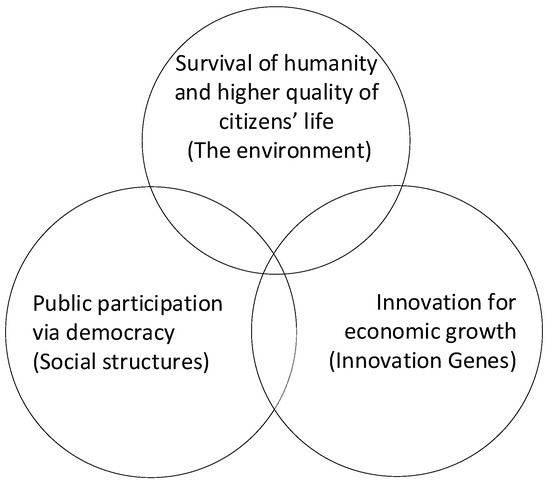
Figure 1.
Selection mechanisms in the innovation genes–social structures–environment triple helix co-evolution process.
4.3. The Role of Policy in Changing Conditions That Enable Innovation Ecosystems
This section discusses the role of policy in influencing enabling conditions for innovation ecosystems. The enabling conditions for transforming innovation genes; shaping social structures; institutionalising environmental concerns; and the co-evolution relations between innovation genes, social structures and the environment are summarised in Table 8. The table also includes the expected major outcomes when the conditions are met.
Table 8.
Conditions that enable the transition towards the neo-Triple Helix model of innovation ecosystems.
Next, we show how these conditions are described in studies that investigated relations between policies and innovation ecosystems (Table 9) to confirm the relevance of these conditions in policy design. It should be noted that although some studies refer to innovation ecosystems, they mainly touch upon the conditions required for innovation systems, similar to those mentioned by Cai et al. [23]. In our analysis, we focused on the unique conditions required for innovation ecosystems discussed in the literature.
Table 9.
Enabling conditions for innovation ecosystems described in studies that investigated relations between policies and innovation ecosystems.
The enabling conditions discussed above can be treated as factors to be considered in transformative innovation policymaking, adding a new layer to existing innovation system policies. We further allocated the new layer of conditions (Table 9) into the dimensions in Cai et al.’s [23] framework concerning enabling conditions for innovation systems, resulting in Table 10. It should be mentioned that both the conditions required for innovation systems described by Cai et al. [23] and those required for innovation ecosystems proposed in the present study are ideal types. Although policymakers or innovation organisers often try to achieve ideal-type conditions, there are always gaps between realities and ideal situations. As noted by Streeck and Thelen [101], ‘the enactment of a social rule is never perfect and that there always is a gap between the ideal pattern of a rule and the real pattern of life under it’ (p. 14).
Table 10.
Enabling conditions to be addressed in a new policy layer for transforming innovation systems into innovation ecosystems.
Since the role of policy for developing innovation (eco)systems is to foster ideal-type conditions, these conditions are important factors in policymaking. This means that the purpose of a policy is not to directly influence actors’ behaviours but to create an optimal environment in which relevant actors can independently develop strategies to maximise their performance. Such a perspective is in line with ‘design policy’, which aims to create an environment in which actors in each relevant sector can better perform and be creative by designing their strategies [102]. Design policy should not be a rational and straightforward problem-solving activity but ‘a socially based, collective activity for generating solutions to complex problems and challenges’ (p. 278) [103]. From a design perspective, policymakers need to have the ability to make complex things (in innovation ecosystems) simple and make more simplified information richer and more manageable for communications in policymaking processes [104]. Design policy or design-driven approaches to innovation have frequently been used by the EU and EU member states (e.g., [105]).
When designing transformative innovation policies to influence the transition from innovation systems to innovation ecosystems, policymakers can examine the conditions listed in Table 10 and ask the following questions suggested by Cai et al. [23]: (1) What are the possible gaps between the conditions in reality and the ideal-type conditions? (2) What policy instruments can be used to bridge these gaps? (3) How can the effectiveness of policy instruments be evaluated? Following the policy-layering approach, there is no need to abandon existing innovation policies. Instead, the new policy layer can be designed and implemented by initiating new programmes and actions; ‘policy making is the process by which governments translate their political vision into programmes and actions to deliver “outcomes”’ (p. 15) [106]. For instance, the EU has launched dozens of programmes and budgets supporting the development of innovation ecosystems in Europe [42], such as:
- The European Regional Development Fund (ERDF), which focuses on building infrastructure for research and innovation ecosystems, the modernisation of public and private sectors, and cooperation networks and clusters
- The Programme for Environment and Climate Action (LIFE), which facilitates the shift towards a sustainable, circular, energy-efficient, renewable energy-based, climate-neutral and resilient economy; protects (restores and improves) the quality of the environment; and tackles the degradation of ecosystems.
While addressing new enabling conditions, transformative innovation policies also entail a different expectation of institution–action interactions than that of innovation policy. From an institutional theory perspective, public policies primarily deal with institutional structures and the actions of organisations or individuals [107]. Beaudry et al. [6] aptly noted the differences between innovation systems and innovation ecosystems from an institution–action perspective:
A system of innovation focuses on how the nature of interactions between existing institutions (which remain unchanged in the process) conditions innovation trajectories (‘how institutions drive action’).… The notion of ecosystem does not assume that institutions already exist. Instead, it concentrates on the dynamics of innovation that lead to the transformation of institutions or the formation of new institutions and practices (‘how action drives institutions’).(p. 536) [6]
Indeed, the evolution from innovation systems to innovation ecosystems are institutional changes that reinforce a sustainability ethos. For instance, one of the significant changes is described by Deblonde [95] as follows: ‘economic ambition of “maximising utility of natural capital” should be replaced by a (practical) societal ambition of “preserving resilience of life support systems”’ (p. 15). Drawing on Beck’s [108] concept of ‘paradigm confusion’, which describes contradictions between economic goals and socio-environmental needs, Saravanamuthu [109] noted a normative change that follows the introduction of a sustainability ethos—from the ‘zero-sum presumption that supports economic growth at the expense of the natural environment’ to the concern that ‘the real-world environmental devastation wrecked by unfettered economic growth’ (p. 10).
5. Conclusions
Based on the unique features that distinguish innovation ecosystems from innovation systems identified in this study, we suggested three ideal-type conditions that are required to create innovation ecosystems: (1) the willingness and capacity of innovation actors to develop cross-boundary interactions on a global scale; (2) civil society based on bottom-up media; and (3) a prevailing sustainability ethos, including a strong version of sustainable development (environmental dimension), equality (social dimension) and a-growth (economic dimension). The role of policy in the transition from innovation systems to innovation ecosystems lies in its ability to move the local context towards the ideal-type conditions. The underlying assumption is that when optimal contextual conditions are set, actors in innovation ecosystems can perform better by creatively designing their strategies. Since making policies that foster the creation of innovation ecosystems is becoming increasingly complex [47], the approach proposed in this study helps policymakers grasp the essential factors, thus making policy design more feasible. The framework developed in this study can also guide policy evaluation regarding the efficacy of policy in developing innovation ecosystems. Nevertheless, the framework must be tested and improved through policy analysis and policy planning in various empirical contexts.
Our research contributes to the literature in three ways. First, by bringing studies comparing innovation systems and innovation ecosystems under a consistent comparative lens, we identified the unique characteristics of innovation ecosystems. This lens helps to synergise the various studies conceptualising innovation ecosystems. Second, by elucidating what is unique about innovation ecosystems, we developed a framework for analysing the role of policy in transforming innovation systems into innovation ecosystems. The framework distinguishes between enablers of innovation dynamics underlying innovation systems and enablers of sustainable development dynamics that are unique to innovation ecosystems from the perspective of the neo-Triple Helix model [30]. Third, while applying the concepts of policy layering and transformative innovation policy in our analytical framework building, we advanced studies on the two concepts by conceptualising transformative innovation policy as new policy arrangements layering on top of pre-existing innovation system policies.
The limitations of this study concerning its relatively narrow focus indicate some potential avenues for further research. First, although this study focused on identifying new conditions that enable transitions from innovation systems to innovation ecosystems, policymakers should also pay attention to such conditions from a ‘path-dependency’ [110] perspective. In light of historical institutionalism, ‘path dependency not only connects the past to the present but also highlights the fact that the past limits the range of choices in the present’ (p. 570) [111]. Its implication for policy analysis is that ‘policy change at one point in time created institutions which served as a barrier to change at a later point’ (p. 73) [107]. Thus, future research should investigate how previous policies for optimising conditions that enable innovation systems might become institutional constraints for institutional changes underlying innovation ecosystem development.
Second, for policymakers, being aware of the conditions that foster the transition from innovation systems to innovation ecosystems is necessary but not sufficient. Since the ultimate goal of transformative innovation policy is institutional change, policymakers should also identify potential change agents in the process and empower them through appropriate policy instruments. Thus, in future research, the framework for the role of policy in influencing enabling conditions for innovation ecosystems should incorporate the insights of recent studies on change agents and their roles in changing the institutional contexts for sustainable innovation and green growth [112,113].
Author Contributions
Conceptualization, Y.C. and X.Z.; Data curation, X.Z. and Y.C.; Formal analysis, X.Z. and Y.C.; Methodology, X.Z. and Y.C.; Writing—original draft, X.Z. and Y.C.; Writing—review & editing, Y.C. and X.Z. All authors have read and agreed to the published version of the manuscript.
Funding
This research received no external funding.
Informed Consent Statement
Not applicable.
Data Availability Statement
The data in the study come from the literature, which is publicly accessible.
Conflicts of Interest
The authors declare no conflict of interest.
References
- Dye, T.R. Understanding Public Policy; Prentice-Hall: Englewood Cliffs, NJ, USA, 1972. [Google Scholar]
- Cai, Y.; Ma, J.; Chen, Q. Higher Education in Innovation Ecosystems. Sustainability 2020, 12, 4376. [Google Scholar] [CrossRef]
- Jacobides, M.G.; Cennamo, C.; Gawer, A. Towards a theory of ecosystems. Strateg. Manag. J. 2018, 39, 2255–2276. [Google Scholar] [CrossRef] [Green Version]
- Gu, Y.; Hu, L.; Zhang, H.; Hou, C. Innovation Ecosystem Research: Emerging Trends and Future Research. Sustainability 2021, 13, 11458. [Google Scholar] [CrossRef]
- Carayannis, E.G.; Morawska-Jancelewicz, J. The Futures of Europe: Society 5.0 and Industry 5.0 as Driving Forces of Future Universities. J. Knowl. Econ. 2022. [Google Scholar] [CrossRef]
- Beaudry, C.; Burger-Helmchen, T.; Cohendet, P. Editorial: Innovation policies and practices within innovation ecosystems. Ind. Innov. 2021, 28, 535–544. [Google Scholar] [CrossRef]
- Schot, J.; Steinmueller, W.E. Three frames for innovation policy: R&D, systems of innovation and transformative change. Res. Policy 2018, 47, 1554–1567. [Google Scholar] [CrossRef]
- Vlaisavljevic, V.; Medina, C.C.; Van Looy, B. The role of policies and the contribution of cluster agency in the development of biotech open innovation ecosystem. Technol. Forecast. Soc. Chang. 2020, 155, 119987. [Google Scholar] [CrossRef]
- Gifford, E.; McKelvey, M.; Saemundsson, R. The evolution of knowledge-intensive innovation ecosystems: Co-evolving entrepreneurial activity and innovation policy in the West Swedish maritime system. Ind. Innov. 2020, 28, 651–676. [Google Scholar] [CrossRef]
- Ma, L.; Liu, Z.; Huang, X.; Li, T. The Impact of Local Government Policy on Innovation Ecosystem in Knowledge Resource Scarce Region: Case Study of Changzhou, China. Sci. Technol. Soc. 2019, 24, 29–52. [Google Scholar] [CrossRef]
- Tamtik, M. Innovation policy is a team sport—Insights from non-governmental intermediaries in Canadian innovation ecosystem. Triple Helix 2018, 5, 1–19. [Google Scholar] [CrossRef]
- Bassis, N.F.; Armellini, F. Systems of innovation and innovation ecosystems: A literature review in search of complementarities. J. Evol. Econ. 2018, 28, 1053–1080. [Google Scholar] [CrossRef] [Green Version]
- Russo-Spena, T.; Tregua, M.; Bifulco, F. Searching through the jungle of innovation conceptualisations. J. Serv. Theory Pract. 2017, 27, 977–1005. [Google Scholar] [CrossRef]
- Amitrano, C.C.; Tregua, M.; Tiziana Russo, S.; Bifulco, F. On Technology in Innovation Systems and Innovation-Ecosystem Perspectives: A Cross-Linking Analysis. Sustainability 2018, 10, 3744. [Google Scholar] [CrossRef] [Green Version]
- Smorodinskaya, N.; Russell, M.; Katukov, D.; Still, K. Innovation Ecosystems vs. Innovation Systems in Terms of Collaboration and Co-creation of Value. In Proceedings of the Hawaii International Conference on System Sciences, Hilton Waikoloa Vilage, HI, USA, 3–7 January 2017. [Google Scholar]
- Gomes, L.A.d.V.; Facin, A.L.F.; Salerno, M.S.; Ikenami, R.K. Unpacking the innovation ecosystem construct: Evolution, gaps and trends. Technol. Forecast. Soc. Chang. 2018, 136, 30–48. [Google Scholar] [CrossRef]
- Woolthuis, K.R.; Lankhuizen, M.; Gilsing, V. A system failure framework for innovation policy design. Technovation 2005, 25, 609–619. [Google Scholar] [CrossRef]
- Christensen, J.L. Innovation Policy Evaluation? Challenges and Roads Ahead. In Proceedings of the DRUID 2012, CBS, Copenhagen, Denmark, 16–19 June 2012. [Google Scholar]
- Universities and the Global Knowledge Economy: A Triple Helix of University-Industry-Government Relations; Etzkowitz, H.; Leydesdorff, L. (Eds.) Printer: London, UK, 1997. [Google Scholar]
- Etzkowitz, H.; Leydesdorff, L. The Triple Helix—University-Industry-Government Relations: A Laboratory for Knowledge-Based Economic Development. EASST Rev. 1995, 14, 14–19. [Google Scholar]
- Tödtling, F.; Trippl, M. One size fits all: Towards a differentiated regional innovation policy approach. Res. Policy 2005, 34, 1203–1219. [Google Scholar] [CrossRef]
- Flanagan, K.; Uyarra, E.; Laranja, M. Reconceptualising the ‘policy mix’ for innovation. Res. Policy 2011, 40, 702–713. [Google Scholar] [CrossRef]
- Cai, Y.; Pugh, R.; Liu, C. A framework for analysing the role of innovation policy in regional innovation system development. Int. J. Innov. Reg. Dev. 2017, 7, 237–256. [Google Scholar] [CrossRef]
- Jaakkola, E. Designing conceptual articles: Four approaches. AMS Rev. 2020, 10, 18–26. [Google Scholar] [CrossRef] [Green Version]
- Ritala, P.; Almpanopoulou, A. In defense of ‘eco’ in innovation ecosystem. Technovation 2017, 60–61, 39–42. [Google Scholar] [CrossRef]
- Suominen, A.; Seppänen, M.; Dedehayir, O. A bibliometric review on innovation systems and ecosystems: A research agenda. Eur. J. Innov. Manag. 2019, 22, 335–360. [Google Scholar] [CrossRef] [Green Version]
- Oh, D.-S.; Phillips, F.; Park, S.; Lee, E. Innovation ecosystems: A critical examination. Technovation 2016, 54, 1–6. [Google Scholar] [CrossRef]
- Su, Y.-S.; Kajikawa, Y.; Tsujimoto, M.; Chen, J. Innovation ecosystems: Theory, evidence, practice, and implications. Technol. Forecast. Soc. Chang. 2018, 136, 14–17. [Google Scholar] [CrossRef]
- Akberdina, V.; Vasilenko, E. Innovation Ecosystem as a Multi-Component Concept: Theoretical Review. SHS Web Conf. 2021, 110, 01052. [Google Scholar] [CrossRef]
- Cai, Y. Neo-Triple Helix Model of Innovation Ecosystems: Integrating Triple, Quadruple and Quintuple Helix Models. Triple Helix 2022, 9, 76–106. [Google Scholar] [CrossRef] [Green Version]
- Edquist, C. The Systems of Innovation Approach and Innovation Policy: An Account of the State of the Art. In Proceedings of the DRUID Conference, Aalborg, Denmark, 12–15 June 2001. [Google Scholar]
- Shivakumar, S. Beyond clusters: Crafting contexts for innovation. Rev. Austrian Econ. 2021, 34, 115–127. [Google Scholar] [CrossRef]
- Rong, K.; Lin, Y.; Yu, J.; Zhang, Y.; Radziwon, A. Exploring regional innovation ecosystems: An empirical study in China. Ind. Innov. 2021, 28, 545–569. [Google Scholar] [CrossRef]
- Daniels, C.U.; Ustyuzhantseva, O.; Yao, W. Innovation for inclusive development, public policy support and triple helix: Perspectives from BRICS. Afr. J. Sci. Technol. Innov. Dev. 2017, 9, 513–527. [Google Scholar] [CrossRef]
- Hirvilammi, T. The Virtuous Circle of Sustainable Welfare as a Transformative Policy Idea. Sustainability 2020, 12, 391. [Google Scholar] [CrossRef] [Green Version]
- Räkköläinen, M.; Saxén, A. Pathway to the Transformative Policy of Agenda 2030: Evaluation of Finland’s Sustainable Development Policy; Springer International Publishing: New York, NY, USA, 2022; pp. 237–249. [Google Scholar]
- Van Oost, E.; Kuhlmann, S.; Ordóñez-Matamoros, G.; Stegmaier, P. Futures of science with and for society: Towards transformative policy orientations. Foresight 2016, 18, 276–296. [Google Scholar] [CrossRef]
- Lukkarinen, J.P.; Nieminen, H.; Lazarevic, D. Transitions in planning: Transformative policy visions of the circular economy and blue bioeconomy meet planning practice. Eur. Plan. Stud. 2022, 1–21. [Google Scholar] [CrossRef]
- Schickler, E. Disjointed Pluralism: Institutional Innovation and the Development of the U.S. Congress; Princeton University Press: Princeton NJ, USA, 2001. [Google Scholar]
- Mahoney, J.; Thelen, K. (Eds.) A Theory of Gradual Institutional Change. In Explaining Institutional Change: Ambiguity, Agency, and Power; Cambridge University Press: New York, NY, USA, 2010; pp. 1–37. [Google Scholar]
- Howlett, M.; Rayner, J. Design Principles for Policy Mixes: Cohesion and Coherence in ‘New Governance Arrangements’. Policy Soc. 2007, 26, 1–18. [Google Scholar] [CrossRef] [Green Version]
- González Fernández, S.; Kubus, R.; Mascareñas Pérez-Iñigo, J. Innovation Ecosystems in the EU: Policy Evolution and Horizon Europe Proposal Case Study (the Actors’ Perspective). Sustainability 2019, 11, 4735. [Google Scholar] [CrossRef] [Green Version]
- Parks, D. Directionality in transformative innovation policy: Who is giving directions? Environ. Innov. Soc. Transit. 2022, 43, 1–13. [Google Scholar] [CrossRef]
- Jesson, J.; Matheson, L.; Lacey, F.M. Doing Your Literature Review: Traditional and Systematic Techniques; SAGE Publications: London, UK, 2011. [Google Scholar]
- Arksey, H.; O’Malley, L. Scoping studies: Towards a methodological framework. Int. J. Soc. Res. Methodol. 2005, 8, 19–32. [Google Scholar] [CrossRef] [Green Version]
- Cai, Y.; Ferrer, B.R.; Lastra, J.L.M. Building University-Industry Co-Innovation Networks in Transnational Innovation Ecosystems: Towards a Transdisciplinary Approach of Integrating Social Sciences and Artificial Intelligence. Sustainability 2019, 11, 4633. [Google Scholar] [CrossRef] [Green Version]
- Russell, M.G.; Smorodinskaya, N.V. Leveraging complexity for ecosystemic innovation. Technol. Forecast. Soc. Change 2018, 136, 114–131. [Google Scholar] [CrossRef]
- Carayannis, E.G.; Grigoroudis, E.; Campbell, D.F.J.; Meissner, D.; Stamati, D. The ecosystem as helix: An exploratory theory-building study of regional co-opetitive entrepreneurial ecosystems as Quadruple/Quintuple Helix Innovation Models. RD Manag. 2018, 48, 148–162. [Google Scholar] [CrossRef]
- Gibbons, M. Higher Education Relevance in the 21st Century. UNESCO Word Conference on Higher Education; UNESCO: Paris, France, 1998. [Google Scholar]
- Carayannis, E.G.; Campbell, D.F.J. Mode 3 Knowledge Production in Quadruple Helix Innovation Systems; Springer: New York, NY, USA, 2012; pp. 1–63. [Google Scholar]
- Borowski, P.F. Innovative Processes in Managing an Enterprise from the Energy and Food Sector in the Era of Industry 4.0. Processes 2021, 9, 381. [Google Scholar] [CrossRef]
- Edquist, C. (Ed.) Systems of innovation approaches-their emergence and characteristics. In Systems of innovation: Technologies, institutions and organizations; Printer: London, UK, 1997; pp. 1–35. [Google Scholar]
- Carayannis, E.G.; Grigoroudis, E.; Stamati, D.; Valvi, T. Social Business Model Innovation: A Quadruple/Quintuple Helix-Based Social Innovation Ecosystem. IEEE Trans. Eng. Manage. 2021, 68, 235–248. [Google Scholar] [CrossRef]
- Appio, F.P.; Lima, M.; Paroutis, S. Understanding Smart Cities: Innovation ecosystems, technological advancements, and societal challenges. Technol. Forecast. Soc. Change 2019, 142, 1–14. [Google Scholar] [CrossRef]
- Boons, F.; Montalvo, C.; Quist, J.; Wagner, M. Sustainable innovation, business models and economic performance: An overview. J. Clean. Prod. 2013, 45, 467–479. [Google Scholar] [CrossRef]
- Baturina, D. Pathways towards Enhancing HEI’s Role in the Local Social İnnovation Ecosystem; Springer International Publishing: New York, NY, USA, 2022; pp. 37–59. [Google Scholar]
- Leydesdorff, L.; Lawton Smith, H. Triple, Quadruple, and Higher-Order Helices: Historical Phenomena and (Neo-)Evolutionary Models. Triple Helix 2022, 9, 6–31. [Google Scholar] [CrossRef]
- Cai, Y.; Etzkowitz, H. Theorizing the Triple Helix model: Past, present, and future. Triple Helix 2020, 7, 189–226. [Google Scholar] [CrossRef]
- Carayannis, E.G.; Campbell, D.F.J. “Mode 3” and “Quadruple helix”: Toward a 21st century fractal innovation ecosystem. Int. J. Technol. Manag. 2009, 46, 201–234. [Google Scholar] [CrossRef] [Green Version]
- Walrave, B.; Talmar, M.; Podoynitsyna, K.S.; Romme, A.G.L.; Verbong, G.P.J. A multi-level perspective on innovation ecosystems for path-breaking innovation. Technol. Forecast. Soc. Chang. 2017, 136, 103–113. [Google Scholar] [CrossRef] [Green Version]
- Boyer, J.; Ozor, J.; Rondé, P. Local innovation ecosystem: Structure and impact on adaptive capacity of firms. Ind. Innov. 2021, 28, 620–650. [Google Scholar] [CrossRef]
- Borowski, P.F. Innovation strategy on the example of companies using bamboo. J. Innov. Entrep. 2021, 10, 1–17. [Google Scholar] [CrossRef]
- Etzkowitz, H. The Triple Helix: University-Industry-Government Innovation in Action; Routledge: London, UK, 2008; p. 164. [Google Scholar]
- Saragih, H.S.; Tan, J.D. Co-innovation: A review and conceptual framework. Int. J. Bus. Innov. Res. 2018, 17, 361–377. [Google Scholar] [CrossRef]
- Dicken, P. Global Shift, Seventh Edition: Mapping the Changing Contours of the World Economy; Guilford Publications: New York, NY, USA, 2015. [Google Scholar]
- Sotarauta, M.; Heinonen, T.; Sorvisto, P.; Kolehmainen, J. Innovation Ecosystems, Competences and Leadership: Human Spare Parts and Venture Finance Ecosystems Under Scrutiny; Tekes—The Finnish Funding Agency for Innovation: Helsinki, Finland, 2016. [Google Scholar]
- in ‘t Veld, R.J. (Ed.) Towards Knowledge Democracy. In Knowledge Democracy: Consequences for Science, Politics, and Media; Springer: Berlin/Heidelberg, Germany, 2010; pp. 1–12. [Google Scholar]
- Carayannis, E.G.; Campbell, D.F.J.; Grigoroudis, E. Helix Trilogy: The Triple, Quadruple, and Quintuple Innovation Helices from a Theory, Policy, and Practice Set of Perspectives. J. Knowl. Econ. 2021. [Google Scholar] [CrossRef]
- Biesta, G. Towards the knowledge democracy? Knowledge production and the civic role of the university. Stud. Philos. Educ. 2007, 26, 467–479. [Google Scholar] [CrossRef]
- Etzkowitz, H.; Leydesdorff, L. The dynamics of innovation: From National Systems and “Mode 2” to a Triple Helix of university-industry-government relations. Res. Policy 2000, 29, 109–123. [Google Scholar] [CrossRef]
- Cai, Y.; Amaral, M. The Triple Helix Model and the Future of Innovation: A Reflection on the Triple Helix Research Agenda. Triple Helix 2021, 8, 217–229. [Google Scholar] [CrossRef]
- Carayannis, E.G.; Campbell, F.J.D. Triple Helix, Quadruple Helix and Quintuple Helix and how do knowledge, innovation, and environment relate to each other: A Proposed Framework for a Trans-disciplinary Analysis of Sustainable Development and Social Ecology. Int. J. Soc. Ecol. Sustain. Dev. 2010, 1, 41–69. [Google Scholar] [CrossRef]
- Carayannis, E.G.; Campbell, D.F.J. Democracy of Climate and Climate for Democracy: The Evolution of Quadruple and Quintuple Helix Innovation Systems. J. Knowl. Econ. 2021, 12, 2050–2082. [Google Scholar] [CrossRef]
- Ketonen-Oksi, S.; Valkokari, K. Innovation Ecosystems as Structures for Value Co-Creation. Technol. Innov. Manag. Rev. 2019, 9, 25–35. [Google Scholar] [CrossRef]
- Edquist, C. (Ed.) Systems of Innovation: Technologies, Institutions and Organizations; Printer: London, UK, 1997. [Google Scholar]
- Lundvall, B.-Å. (Ed.) National Systems of Innovation: Towards a Theory of Innovation and Interactive Learning; Pinter Publishers: London, UK, 1992; p. 342. [Google Scholar]
- Kumaresan, N.; Miyazaki, K. An integrated network approach to systems of innovation—The case of robotics in Japan. Res. Policy 1999, 28, 563–585. [Google Scholar] [CrossRef]
- Nelson, R. National Systems of Innovation: A Comparative Study; Oxford University Press: Oxford, UK, 1993. [Google Scholar]
- OECD. Managing National Innovation Systems; OECD: Paris, France, 1999. [Google Scholar]
- Dodgson, M.; Hughes, A.; Foster, J.; Metcalfe, S. Systems thinking, market failure, and the development of innovation policy: The case of Australia. Res. Policy 2011, 40, 1145–1156. [Google Scholar] [CrossRef] [Green Version]
- Cai, Y. Implementing the Triple Helix model in a non-Western context: An institutional logics perspective. Triple Helix 2014, 1, 1–20. [Google Scholar] [CrossRef] [Green Version]
- Cai, Y. What contextual factors shape “innovation in innovation”?—Integration of insights of the Triple Helix and the institutional logics perspective. Soc. Sci. Inf. 2015, 54, 299–326. [Google Scholar] [CrossRef]
- Cai, Y.; Pugh, R.; Liu, C. Enabling conditions for regional Triple Helix systems. Helice 2015, 2015, 19–23. [Google Scholar]
- Diercks, G.A. Transformative Innovation Policy: Assessing Discourse Institutionalisation of an Emerging Policy Paradigm; Imperial College London: London, UK, 2017. [Google Scholar]
- Könnölä, T.; Eloranta, V.; Turunen, T.; Salo, A. Transformative governance of innovation ecosystems. Technol. Forecast. Soc. Chang. 2021, 173, 121106. [Google Scholar] [CrossRef]
- Diercks, G.A.; Larsen, H.; Steward, F. Transformative innovation policy: Addressing variety in an emerging policy paradigm. Res. Policy 2019, 48, 880–894. [Google Scholar] [CrossRef]
- Choi, T.; Seon, S.W. Target Groups on the Mainline: A Theoretical Framework of Policy Layering and Learning Disparity. Adm. Soc. 2021, 53, 595–618. [Google Scholar] [CrossRef]
- Cai, Y. Towards a new model of EU-China innovation cooperation: Bridging missing links between international university collaboration and international industry collaboration. Technovation 2022. [Google Scholar] [CrossRef]
- Nylund, P.A.; Brem, A.; Agarwal, N. Enabling technologies mitigating climate change: The role of dominant designs in environmental innovation ecosystems. Technovation 2021. [Google Scholar] [CrossRef]
- Munodawafa, R.T.; Johl, S.K. A Systematic Review of Eco-Innovation and Performance from the Resource-Based and Stakeholder Perspectives. Sustainability 2019, 11, 6067. [Google Scholar] [CrossRef] [Green Version]
- von Schomberg, R. Prospects for Technology Assessment in a Framework of Responsible Research and Innovation. In Technikfolgen Abschätzen Lehren. Bildungspotenziale Transdisziplinärer Methoden; Dusseldorp, M., Beecroft, R., Eds.; Springer: Dordrecht, The Netherlands, 2011; pp. 39–61. [Google Scholar]
- Nylund, P.A.; Brem, A.; Agarwal, N. Innovation ecosystems for meeting sustainable development goals: The evolving roles of multinational enterprises. J. Clean. Prod. 2021, 281, 125329. [Google Scholar] [CrossRef]
- Mehari, Y.; Pekkola, E.; Hjelt, J.; Cai, Y.; Stenvall, J.; Ortega-Colomer, F.J. Defining ‘Responsible’ in Responsible Research and Innovation: The Case of Quadruple Helix Innovation in the Energy Sector in the Tampere Region. In Social Innovation in Higher Education; Păunescu, C., Lepik, K.-L., Spencer, N., Eds.; Springer International Publishing: New York, NY, USA, 2022; pp. 199–225. [Google Scholar]
- Stahl, B.C.; Chatfield, K.; Ten Holter, C.; Brem, A. Ethics in corporate research and development: Can responsible research and innovation approaches aid sustainability? J. Clean. Prod. 2019, 239, 118044. [Google Scholar] [CrossRef]
- Deblonde, M. Responsible research and innovation: Building knowledge arenas for glocal sustainability research. J. Responsible Innov. 2015, 2, 20–38. [Google Scholar] [CrossRef] [Green Version]
- Latouche, S.; Macey, D. Farewell to Growth; Wiley: Hoboken, NJ, USA, 2009. [Google Scholar]
- Van Den Bergh, J.C.J.M. Environment versus growth—A criticism of “degrowth” and a plea for “a-growth”. Ecol. Econ. 2011, 70, 881–890. [Google Scholar] [CrossRef]
- Leydesdorff, L. The Triple Helix, Quadruple Helix, …, and an N-Tuple of Helices: Explanatory Models for Analyzing the Knowledge-Based Economy? J. Knowl. Econ. 2012, 3, 25–35. [Google Scholar] [CrossRef] [Green Version]
- Elkington, J. Partnerships from cannibals with forks: The triple bottom line of 21st-century business. Environ. Qual. Manag. 1998, 8, 37–51. [Google Scholar] [CrossRef]
- Stefani, U.; Schiavone, F.; Laperche, B.; Burger-Helmchen, T. New tools and practices for financing novelty: A research agenda. Eur. J. Innov. Manag. 2020, 23, 314–328. [Google Scholar] [CrossRef]
- Streeck, W.; Thelen, K. (Eds.) Introduction: Institutional change in advanced political economies. In Beyond Continuity: Institutional Change in Advanced Political Economies; Oxford University Press: Oxford, UK, 2005. [Google Scholar]
- Raulik-Murphy, G.; Cawood, G.; Lewis, A. Design Policy: An Introduction to What Matters. Des. Manag. Rev. 2010, 21, 52–59. [Google Scholar] [CrossRef]
- Hobday, M.; Boddington, A.; Grantham, A. Policies for design and policies for innovation: Contrasting perspectives and remaining challenges. Technovation 2012, 32, 272–281. [Google Scholar] [CrossRef]
- Barbero, S.; Bicocca, M. Systemic Design approach in policy-making for sustainable territorial development. Des. J. 2017, 20, S3496–S3506. [Google Scholar] [CrossRef]
- Mortati, M.; Maffei, S. Researching Design Policy Ecosystems in Europe. She Ji J. Des. Econ. Innov. 2018, 4, 209–228. [Google Scholar] [CrossRef]
- Blair, T.; Cunningham, J. Modernising Government, Presented to Parliament by the Prime Minister and the Minister for the Cabinet Office by Command of Her Majesty. 1999. Available online: https://ntouk.files.wordpress.com/2015/06/modgov.pdf. (accessed on 26 April 2022).
- Hill, M.J. The Public Policy Process, 5th ed.; Pearson Longman: Harlow, UK, 2009; p. 331. [Google Scholar]
- Beck, U. Ecological Politics in an Age of Risk; Polity Press: Cambridge, UK, 1995. [Google Scholar]
- Saravanamuthu, K. Instilling a sustainability ethos in accounting education through the Transformative Learning pedagogy: A case-study. Crit. Perspect. Account. 2015, 32, 1–36. [Google Scholar] [CrossRef]
- Greener, I. Theorising path-dependency: How does history come to matter in organisations? Manag. Decis. 2002, 40, 614–619. [Google Scholar] [CrossRef]
- Raadschelders, J.C.N. Evolution, institutional analysis and path dependency: An administrative-history perspective on fashionable approaches and concepts. Int. Rev. Adm. Sci. 1998, 64, 565–582. [Google Scholar] [CrossRef] [Green Version]
- Sotarauta, M.; Suvinen, N.; Jolly, S.; Hansen, T. The many roles of change agency in the game of green path development in the North. Eur. Urban Reg. Stud. 2021, 28, 92–110. [Google Scholar] [CrossRef]
- Cai, Y.; Liu, C. The Role of University as Institutional Entrepreneur in Regional Innovation System: Towards an Analytical Framework. In Examining the Role of Entrepreneurial Universities in Regional Development; Preto, M.T., Daniel, A., Teixeira, A., Eds.; IGI Global: Hershey, PA, USA, 2020; pp. 133–155. [Google Scholar]
Publisher’s Note: MDPI stays neutral with regard to jurisdictional claims in published maps and institutional affiliations. |
© 2022 by the authors. Licensee MDPI, Basel, Switzerland. This article is an open access article distributed under the terms and conditions of the Creative Commons Attribution (CC BY) license (https://creativecommons.org/licenses/by/4.0/).